The belief that the United States is a unique “land of opportunity” in which a better future is the inevitable reward for hard work has been at the core of America's self-image for more than three centuries. But recent research has found that the reality of American mobility is often more complicated than its popular image: although the United States was indeed a place of uniquely high occupational mobility in the late nineteenth and early twentieth centuries, mobility in the modern United States proves to be little different from that elsewhere.2
See Ferrie, “End,” for a survey of research on mobility in the historical and modern United States, along with comparisons between mobility in the United States and in other countries over time.
Studies of occupational mobility, however, have generally focused on urban settings where movement from worse to better occupations is easy to identify. Occupational progress in the agricultural sector has been less extensively studied even though until 1920, more Americans lived in rural places than in urban ones, and even as late as the 1940s agriculture accounted for nearly a quarter of the employed labor force.
3 U.S. Bureau of the Census, Historical Statistics, Series D 1–10.
The movement from farms to cities and towns in the twentieth century was dramatic in the case of some groups (such as blacks), but we know far more about the opportunities they faced in the urban places to which they moved than about the opportunities they faced in the rural places they left. We know little about how much improvement in the form of movement up the “tenure ladder” (from wage worker to cropper to tenant to owner) people could expect if they chose to remain in the farm sector, even though these expectations no doubt factored into their decisions regarding migrating from farms to towns and cities.
The expectations of those who considered leaving farming reflected answers to a series of questions that our data allow us to address: What makes it easier for a wage worker or sharecropper to become a renter? How likely were renters to fall in status and become sharecroppers or laborers? And how long did movement up the farm hierarchy take? From cross-sectional studies, we learned that human capital in the form of age and experience and physical capital (the ownership of workstock) are good predictors of the position on the tenure ladder of workers on average. But we know little about the experiences of individual farmers and how the factors an individual faced over time may have differed from the insights we gained from cross-sectional studies. In our study we can test for the factors that affected the movement up or down the agricultural ladder of individual farmers.
A better understanding of the forces shaping mobility in agriculture will produce several benefits. The first is a more realistic picture of the experience of individual farmers. For example, one of the problems associated with tenancy is inadequate attention to the long-run viability of the land if those involved are short-term renters rather than long-term tenants or owners. If tenants expect a long tenure as a residual claimant their incentive to mine the soil is reduced.4
We explore the issue of stasis for tenants and sharecroppers but not for owners. For owners we will explore this issue in greater detail in future work using the 25,000 surviving schedules from the 1920 Agricultural Census in Alston and Ferrie, “Farm Tenure.”
More importantly, without data on individual farmers it is impossible to account for the unobserved characteristics of farmers (e.g., ability, entrepreneurship, and willingness to work).
A better understanding of the extent of tenure mobility can also shed light on views toward redistributive policies. Americans may accept greater income inequality than Europeans because of a perception in the United States that individuals are more likely than Europeans to increase their income or otherwise improve their status over time.5
On the trade-off between mobility and redistribution, see the review by Putterman, Roemer, and Sylvestre, “Does Egalitarianism.”
In societies where there is little mobility up the tenure ladder, the electorate tends to support land reform efforts and other political interventions in land markets. For example, one of the turning points in Argentine history was imposition of rent controls in the Pampas in the 1940s.
6 Alston and Gallo, “Erosion.”
In short, the United States has been (and is) perceived as the “land of opportunity.” This popular notion has much anecdotal support but it is difficult to test.
7 For an attempt to assess the link between perceptions of social mobility and preferences for redistributive policies, see Alesina and La Ferrara, “Preferences.” For evidence on changes in occupational and wealth mobility in the United States since the 1850s, see Ferrie, “End.”
The notion of the United States as a land of opportunity came under attack in the early twentieth century as the agricultural sector suffered through two decades of high farm failures in the 1920s and 1930s.
8 On the magnitude and causes of farm distress in the interwar period, see Alston, “Farm Foreclosures.”
We will assess the causes of mobility in agriculture at the individual level and how the “boom” years surrounding the First World War, and the “bust” years of the interwar period and Great Depression affected mobility. Our analysis will focus on black farmers, most of whom worked on plantations. To the extent that this group of farmers experienced upward mobility during a time of extreme legal and social discrimination, we can only infer that the “average American farmer” fared better.
THE FARM TENANCY “PROBLEM” IN THE TWENTIETH-CENTURY UNITED STATES
Though tenancy rates had been climbing consistently from the late nineteenth century, the distress in the agricultural sector in the 1920s and 1930s provoked alarm among social commentators and policy-makers. They feared that the United States was becoming a country of absentee farm owners. There was considerable variation across regions, with tenancy remaining low in the Northeast while reaching 42 percent in the South by 1930.9
The U.S. census defined tenancy rates as the number of sharecroppers plus share and fixed rent tenants as a percentage of the number of operators, defined as the number of sharecroppers, share and fixed renters plus owners. The census did not include wage workers as part of farm operators. In our tenancy figures in the text we exclude sharecroppers because of our belief that sharecroppers were more akin to wage workers than tenants. If we include sharecroppers as tenants the percentage of tenancy in the South reached 56 percent in 1930. See Alston and Kauffman, “Agricultural Chutes and Ladders,” for estimates of croppers in 1900 and 1910 and revised estimates of “true tenancy.”
The concern over tenancy prompted numerous reports in the 1920s by researchers in the U.S. Department of Agriculture. Analysts in the 1920s generally reached sanguine conclusions regarding tenancy and the prospects for farmers to ascend the agricultural ladder from wage worker to sharecropper (a rung primarily in the South) to tenant to owner.
10 See for example the excellent studies by Gray et al., “Farm Ownership”; and Goldenweiser and Truesdell, “Farm Tenancy.”
L. C. Gray et al. addressed the issue of farm mobility.11
Gray et al., “Farm Ownership.”
Using data from the 1920 Census of Agriculture, the authors found that for the United States as a whole, 42 percent of farmers who became tenants between 1915 and 1920 had previously worked for wages, whereas 47 percent started their careers as tenants.
12 The percentage of tenants who never worked for wages was much higher in the South because of the census classification of croppers as tenants. Consistent with this interpretation, Gray et al. found that the average age at which farm laborers became farm tenants was lowest in the South, though counting croppers as tenants. They also found signs of falling down the agricultural ladder: in 1920 for the United States as a whole, 11 percent of farm tenants had once been owners. This fraction was as high as one-third in some of the Rocky Mountain and desert states.
13 The authors also track the length of time spent at various rungs on the agricultural ladder prior to reaching ownership. Typically, the longer a state had been occupied, the longer it took to become an owner. The authors caution not to attach welfare implications to the varying periods of time it takes to reach ownership. They argued that several factors account for the increase in tenancy: time spent in education prior to farming, different capital requirements, and different age structures of the resident population.
In the 1930s the reviews of tenancy were mixed. The Report of the President's Committee on Farm Tenancy in 1937 was the most alarmist. The President's report prompted research on the causes of farm tenancy.14
Most notable among the research efforts were: Black and Allen, “Growth”; and Schuler, “Social Status.” Schuler wrote under the auspices of the USDA, the Farm Security Administration, and the Bureau of Agricultural Economics. Black and Allen attributed a large part of the rise in tenancy to the increased use of croppers instead of farm laborers in the South. Most scholars in the 1920s and 1930s were well aware of the important distinction between croppers and tenants even as the census continued to consider croppers a subgroup of tenants: “[N]othing could be more misleading than such a grouping” (Brandt, “Fallacious Census Terminology,” p. 24).
Consistent with the economists in the USDA in the 1920s, academic scholars in the 1930s maintained that to understand the tenancy issue required looking at all the rungs of the agricultural ladder (wage laborer, cropper, tenant, and owner) and then assessing the causes of movements up, down, and off the ladder. On the basis of census data (or at times educated guesswork), John Black and R. H. Allen reached several conclusions: first, the rate of ascent on the agricultural ladder was relatively constant over the first three decades of the twentieth century, but entrants started at lower rungs over time; second, there was considerable variation across regions (mostly accounted for by differences in crops) in the number of farmers on each rung; third, prosperity (1900–1920) or depression (the 1890s and the interwar period) were major determinants of the number of farmers on each rung; and fourth, croppers were on the decline in the 1930s as a result of tractorization, relief work, and the policies of the Agricultural Adjustment Acts.
Black and Allen relied on cross-sectional data and their intuition for several of their conclusions because the census has never systematically collected data on full-time laborers.15
Black and Allen, “Growth.”
This issue has hampered research on the agricultural ladder because changes in tenancy (including sharecroppers) could result from either movements out of or into the wage labor category or movements into or out of the ownership category. On these movements rest many welfare implications concerning not only the farm sector in the historical United States but also in developing and transition economies.
E. A. Schuler more systematically addressed the tenancy question through a survey in 1938 of 2,700 farmers in two of the major farming regions in the United States, the cotton and corn belts. The surveys produced occupational and locational histories of the farmers along with individual characteristics of the farmers: year and place of birth, father's tenure status, years of schooling, age at leaving home, years and amounts of any inheritance, marital status, and relationship to the landowner. By looking at aggregated regional averages and using bi-variate ocular regression techniques (i.e., eyeballing the data), Schuler reached several general conclusions: first, there was considerable variation across regions and between races in movements up and down the agricultural ladder; second, inheritance caused a substantial boost up the agricultural ladder; and third, education provided more of a boost for black southern farmers than for northern or southern white farmers.
JEFFERSON COUNTY AS REPRESENTATIVE OF THE COTTON REGION
In our own work we can better assess the determinants of movements on the agricultural ladder than our predecessors could in the 1920s and 1930s, or our contemporaries can today.16
The best treatment of movement on the ladder is the work of Atack (“Tenants” and “Agricultural Ladder”) but Atack was forced to draw inferences from cross-sectional data.
Our approach relies on the 227 extant manuscripts for Jefferson County, Arkansas from the larger study produced by Schuler in 1938 for the Farm Security Administration.
17 The schedules are located in the Rare Books and Manuscripts Division of the University of Arkansas Library at Fayetteville, in the records of the University's Department of Agricultural Economics and Rural Sociology.
Fortunately, we are able to reach general conclusions about tenure mobility for black farmers in the Cotton South because Jefferson County appears quite representative of the region as a whole.
Jefferson County is located just southeast of the center of Arkansas (at 34.26° north latitude, 91.92° west longitude). The county was established in 1829 and was, as early as the 1830s, recognized as extremely productive land for cotton cultivation.18
The county's early agricultural and commercial histories are summarized in Garman, “Economic History.”
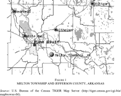
Figure 1 shows the location of Melton Township, the area sampled by Schuler in Jefferson County. It lies roughly 20 miles southeast of Pine Bluff, the county seat, below the Arkansas River, which bisects the county, in alluvial lowlands, “comprised of soils and silt, etc. … very fertile and adaptable to cultivation.”
19 The county's characteristics are described in detail in the Federal Writers Project county history available at the Pine Bluff–Jefferson County Public Library (Jefferson County, Ark., History, compiled by the Federal Writers Project of the Works Progress Administration for the State of Arkansas, n.d., n.p.).
FIGURE 1 MELTON TOWNSHIP AND JEFFERSON COUNTY, ARKANSAS
The county as a whole, but particularly the portion of it containing Melton Township, is quite representative of the Cotton Belt. In most respects (racial make-up, tenancy, and crop value in cotton), Jefferson County lies in the same quartile of the distribution as other counties in the Yazoo-Mississippi Delta and in the Cotton Belt. Researchers in the 1920s and 1930s recognized that Jefferson County was representative of the South's Delta cotton plantation areas: a 1937 survey of Arkansas cotton plantations includes several units in the portion of Jefferson County containing Melton Township, and an examination of land tenure in Arkansas groups Jefferson County with “Delta type” counties along the Mississippi and lower Arkansas rivers.20
Blalock, “Plantation Operations”; and Baker and McNeely, “Land Tenure.”
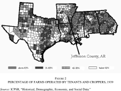
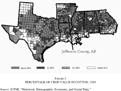
To reinforce our claim that Jefferson County is representative of the tenancy situation in the Cotton South we show in Figures 2 and 3 the percentage of farms operated by tenants and croppers and the percentage of crop value represented in cotton. In both instances Jefferson County shows up as being part of the heart of the Cotton South.21
The one difference of note for Jefferson County compared to other cotton counties is that agricultural workers had more nearby off-farm opportunities. In June 1935 Pine Bluff had 47 large manufacturing firms and 35 smaller industrial plants (Federal Writers Project: n.p.). These included lumber mills manufacturing oak flooring, firms manufacturing brakes and bodies for automobiles, and cotton oil mills. Pine Bluff Chamber of Commerce, Report on the Industrial Survey of Pine Bluff, Arkansas (Pine Bluff, 1926).
The impact of these off-farm employment opportunities on our analysis of mobility up and down the agricultural ladder is likely to increase the amount of time that farmers spend in employment outside agriculture during their careers, compared to other Cotton Belt counties. It is impossible to determine the direction of the bias this imparts to our measures of upward and downward movement along the agricultural ladder without knowing how agricultural and industrial employment were correlated and whether the same individuals who did best in farming were also those with the skills to fare best in manufacturing.
22 We can say that some workers had better alternatives than workers in other regions of the South.
FIGURE 2 PERCENTAGE OF FARMS OPERATED BY TENANTS AND CROPPERS, 1939
FIGURE 3 PERCENTAGE OF CROP VALUE IN COTTON, 1929
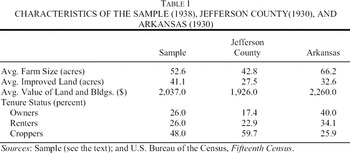
In Table 1, we compare the characteristics of farmers in our sample to those on all the farms in Jefferson County and to those on all the farms in Arkansas. In most respects, the sample straddles the data for the county and the state. This is the result of the sampling strategy used by Schuler's team: it sought responses from tenure classes that corresponded to the shares of those classes engaged in cotton farming.
We can also compare our sample to the U.S. Census Public Use Samples for Jefferson County for the period 1900 to 1920 (Table 2). The characteristics compared included: Percent Black; Age; Percent Married; and Percent Born Out of State. For 1910 and 1920 the ratio of these figures in the Census Public Use data to these figures in our sample data is between 0.9 and 1.1 for all characteristics except Percent Born Out of State.23
Our sample has far fewer respondents born out of state than the census data. This is not surprising because the census includes urban and rural respondents.
For 1900 the same holds except that the ratio for
Age is 1.5. The close comparisons are important because the data in the Schuler study were collected retrospectively, so only those still in agriculture in 1938 could have their agricultural career histories recorded. For example, a farmer who began farming in 1910, but who had moved out of agriculture by 1930, would not show up in Schuler's data. If the characteristics of those in the Schuler data at census dates in the past are similar to those in the county population generally at those dates, then we can have confidence that the retrospective nature of the survey is not causing us to miss farmers “falling off” the agricultural ladder who differ systematically from those who remained on the ladder and whom we can observe. The close correspondence between the Schuler data in 1900, 1910, and 1920 and the population of the county's farmers at those dates suggests that this bias is not substantial.
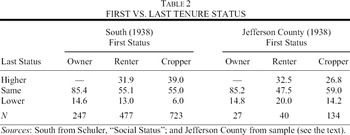
The cross-sectional characteristics of the Schuler data for Jefferson County are thus reasonably representative of the counties in the Delta where plantation cultivation of cotton was prevalent. The longitudinal characteristics of the Jefferson County data also point to its representativeness. When career mobility among tenure classes in our sample data from Jefferson County is compared in Table 2 to tenure mobility for the entire South in Schuler's published tables, it is clear that Jefferson County looks much like the rest of the cotton regions in the South. For example, in both Jefferson County and in the whole South, 85 percent of those who started their careers as owners remained owners at the end of their careers, whereas just under a third of those who started as renters ended up in a higher status (as owners).
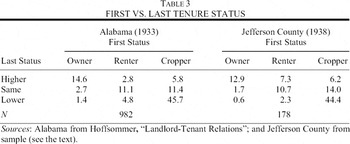
An unpublished survey by Harold Hoffsommer in 1933 provides an additional comparison. Hoffsommer examined the careers of nearly a thousand Alabama farmers. His results are compared in Table 3 to those from Jefferson County. In both samples, roughly 45 percent of farmers started and ended their careers as croppers, whereas about 6 percent began as croppers and moved up to ownership over their careers. Eleven percent rented throughout their careers.
DETERMINANTS OF MOBILITY ON THE AGRICULTURAL LADDER
For agriculture, ascension on the ladder is a good indicator of economic mobility because as workers ascend, their incomes increase.24
Incomes increase for two reasons: farmers take on more risk and hence need to be compensated; and the incentive for landlords to monitor workers decreases and workers capture some of the decrease in monitoring costs in higher incomes.
For example, Blalock reports average net income in 1934 for agricultural workers in the Arkansas River plantation region of $226 for wage workers, $233 for sharecroppers, and $386 for tenants.
25 Blalock, “Plantation Operations.”
These figures include adjustments for “home use products.” The income of wage laborers and sharecroppers was thus similar, but the step up to tenant represented an income increase of 66 percent. The real earnings of wage laborers and sharecroppers compare favorably to wages received by unskilled workers in manufacturing until 1933 when New Deal policies boosted relative manufacturing wages, though at the expense of increased urban unemployment.
26 For estimates of the earnings gap between agricultural and manufacturing laborers for 1925 to 1941, see Alston and Hatton, “Earnings Gap.”
In income terms, the step up to tenant was similar to moving from the unskilled to the skilled category in manufacturing.
The theoretical underpinnings of the agricultural ladder are similar (and indeed intellectually prior) to the underpinnings of the age-earnings profile used in labor economics. Over time workers acquire both human and physical capital enabling them to ascend the ladder, which is akin to a promotion in pay and status. Along the career trajectory exogenous events such as wartime prices or depressions can cause ascents or descents from one tenure category to another. Equally important are individual characteristics such as thrift, luck, or hard work. In addition, an inheritance can quickly bounce a farmer up the ladder to tenant or owner.
Rather than presenting an overarching theoretical framework for tenure mobility, we will develop hypotheses for the dynamics of tenure mobility in the early part of the twentieth century, though our hypotheses have relevance for tenure mobility in other times and places. The literature on agricultural tenancy broadly speaking focuses on transaction cost and risk.27
We will not directly test for the importance of risk but tangentially will do so through cohort effects. For a discussion of the role of risk in agricultural contracts, see Allen and Lueck, “Role.” They find little evidence for the role of risk in shaping tenancy arrangements.
Transaction cost determinants of contract form generally fall into the categories of supervision and enforcement costs. Our measures for supervision costs and enforcement costs include individual-level measures for age, education, inheritance, and the cohort effects of war and depression. Before conducting empirical tests we will flesh out the roles of supervision and enforcement costs in tenure mobility.
Supervision Costs
As farmers ascend the agricultural ladder, landlords have a decreasing need to supervise the labor effort of farmers. As labor moves from wage worker to cropper to tenant and ultimately to ownership, the share of net output going to the operator increases, increasing the incentive for work effort. The contractual form chosen will be closely related to the incentive for the landowner to monitor work effort, which depends on the sensitivity of crop output to labor effort. It is not only labor effort in the fields that needs to be monitored. Individuals have an incentive to monitor the use of all assets that they bring to the production process, though labor-monitoring costs can be considered a residual to the monitoring of the other assets.28
If one farmer supplies all inputs to the production process, then all costs of stinting or abuse are internalized so monitoring costs disappear.
Consider the following simplified production process for cotton. Output is a function of land (quantity and quality), physical capital (a mule or horse or tractor), human capital of the farm owner and operator, labor effort, and uncertain weather.29
In the absence of weather-related shocks that produce uncertain effects on output, landlords could presumably measure labor effort by observing output and reward or punish workers accordingly. It is the uncertainty of the impact of the shock on output that prevents contingent contracting.
We assume that the market for inputs is competitive and endowments vary across farmers (e.g., some farmers have land and mules and are looking to hire labor, and some laborers have farm experience and mules and are searching for land). How do suppliers and demanders of inputs match up? This is best illustrated with an example. Suppose a resident farm owner with considerable farming experience and a mule is looking for a laborer. He is willing to supply all the inputs except labor effort. Given his endowment, what would be the best match? He would search for a laborer who has no capital and little farming experience. In this way, he would get the best return on his human and physical capital. In this situation, the landowner has an incentive to be in the fields to monitor his physical capital (the mule in particular) to prevent its depreciation, and to furnish directions (human capital). Given the presence of the landlord for these reasons, the marginal cost of monitoring labor effort is low; there are economies of scope in monitoring.
30 Alston and Higgs, “Contractual Mix,” developed the hypotheses about economies of scope in monitoring. Similar to Alston and Higgs, Eswaran and Kotwal, “Theory,” provide an endowment model of managerial ability to explain the mix of contracts—fixed-wage, share, and fixed-rent.
When workers are endowed with more physical or human capital, the landlord cannot benefit from such economies of scope; as a result the residual costs of monitoring the labor effort of these workers is greater than for workers with less capital. To reduce the residual costs of monitoring better-endowed workers, landlords will negotiate contracts higher on the agricultural ladder. Similarly if certain crops are more soil-depleting (e.g., row crops compared to grain crops), then owners will have an incentive to limit output. One mechanism is to negotiate more share relative to fixed-rent contracts because the tenant will have less incentive to maximize short-run yields at the expense of long-run soil fertility.
31 Allen and Lueck, “Contract Choice,” found evidence consistent with this hypothesis.
An important means of acquiring physical capital is an inheritance. An inheritance could enable a worker to purchase a mule, thereby increasing the likelihood of being a tenant, or if the inheritance is more substantial it may enable a tenant to purchase a farm and ascend to the owner rung.
From our data we can construct several proxies for the human and physical capital of workers. We have the following measures of human capital: age, schooling, and years in current status. Workers who are older, better schooled, and longer in their current status should ascend the ladder faster.32
We also had marital status but almost all of our farmers were married.
For the physical capital of workers and landlords, we have the year and amount of any inheritances. To the extent workers possess greater capital, they should be on higher rungs.
Enforcement Costs
Enforcement costs of labor effort result from efforts to ensure an adequate labor supply during the season's peak demand, which for cotton is the harvest. During peak demand, piece rates and day wages increase, giving an incentive for some workers to abandon their current employment. Higher tenure status decreases the incentive for abandonment because higher tenure status brings with it expected higher post-harvest remuneration. The enforcement costs to landlords increase as labor becomes scarcer, as do the returns to enforcement. As such, boom times (e.g., the war years), should be associated with ascension up the agricultural ladder, and conversely depression years should be associated with movements down the ladder.33
Ideally, one would control for the independent effect of gains or losses of physical capital but we can do so only through inheritance.
The war years brought boom times to agriculture until prices fell drastically, beginning in July 1920. The bust in prices brought unparalleled levels of farm failures during subsequent interwar years.
Prosperity on the farm should affect all rungs of the ladder. Prosperity should enable wage workers and croppers to accumulate the capital necessary to become tenants. On the other hand farm distress in the form of farm foreclosures affects primarily the highest levels of the tenure ladder. When foreclosure rates are high, we should see some of our owners fall to the tenant rung or at times all the way to wage laborer. Correspondingly, high foreclosure rates bring low farm prices and some of our tenants may ascend to the ownership rung. Similarly, for tenants a bad year may entail having to sell a mule and falling to the cropper rung, whereas for croppers, depressed mule prices may enable some to climb to the tenant rung. Whether falling down or rising up the agricultural ladder dominates is an empirical question. With our sample from Jefferson County we will be able to compare the time spent as a wage earner or cropper compared to time as a tenant for good and bad years.34
Alston, “Tenure Choice,” found that wage contracts were more prevalent in regions with a more abundant supply of farm labor.
Another enforcement cost issue is the potential for underreporting of output. Douglas Allen and Dean Lueck argue that yield variability affects the ability of share tenants to cheat landlords by underreporting the output.35
As such, they expect to observe more fixed-rent contracts where yields are more variable. Though we do not dismiss this as a possible factor affecting tenure category we will control for it by the nature of holding crop constant and combining fixed-rent and share tenants.
36 Higgs, “Patterns,” found that risk was a primary factor explaining the cross-state variation in the use of fixed-rent and share tenant contracts.
Additionally, underreporting cotton is more difficult than underreporting other crops because of the need to gin at a central location.
ANALYSIS OF THE DYNAMICS OF THE AGRICULTURAL LADDER
In our analysis, we focus on black workers because we have too few observations on whites and black owners who started their agricultural careers as wage workers, sharecroppers, or tenants. The Schuler sample for Jefferson County is overwhelmingly black (85 percent), reflecting the dominance of plantation farming in Melton Township. During the period we examine, blacks in the South faced overt social and legal discrimination.37
See Alston and Ferrie, Paternalism.
To the extent that we find upward mobility, it is testimony to the hard work of individuals within a competitive market environment.
38 Our interpretation of our findings parallels that of Higgs, Competition, for the period 1865–1914.
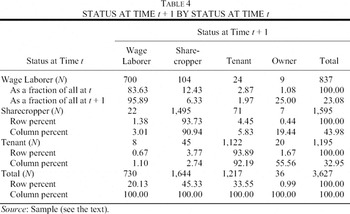
Our sample consists of individuals who have 3,627 opportunities for ascent or descent from year to year. In Table 4 we show the yearly movements from rung to rung.
39 We do have some workers with a few years outside of agriculture but the numbers are not large enough to allow any testing.
Overall, stasis is the most likely outcome. Wage laborers are the most mobile with 12 percent moving yearly to the sharecropper rung, 3 percent to tenancy, and 1 percent to ownership. Sharecroppers are more likely to move up than down the ladder: 1.4 percent of the yearly movement is into the wage category and 5 percent is into tenancy or ownership. This is somewhat surprising given that 25 percent of our moves are in our sample years of the Great Depression 1930–1937. Though 94 percent of the possible movement for tenants is stasis, the downward mobility to sharecropper or wage is about 2.5 percentage points greater than the upward movement to ownership. Because 44 percent of the possible moves for all categories are from the sharecropper rung, upward mobility exceeded downward mobility overall.40
These micro results are consistent with the finding of overall ascension for the period 1900–1930 reached by Alston and Kauffman, “Agricultural Chutes and Ladders” and “Up, Down, and Off the Agricultural Ladder.”
Stasis from year to year and particularly over longer periods suggests that mining the soil would not be a wealth maximizing strategy for sharecroppers and tenants.
41 Stasis on the same farm and local reputational effects make mining the soil unprofitable. Mining the soil may be profitable if a farmer plans on leaving agriculture.
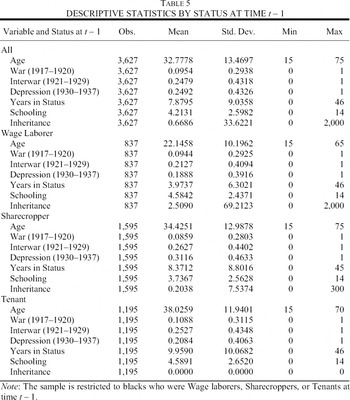
In Table 5 we present descriptive statistics for the sample that we use in our regression analysis. Wage laborers tend to be younger than sharecroppers or tenants but there are large standard deviations. There is considerable variation across our sample individuals in time spent on a rung. Some are clearly on the fast track whereas others never move from the wage worker category. About 25 percent of possible moves occur during the depression years of 1930–1937. The boom years of the war and immediate postwar period (1917–1920) account for 16 percent of possible moves.
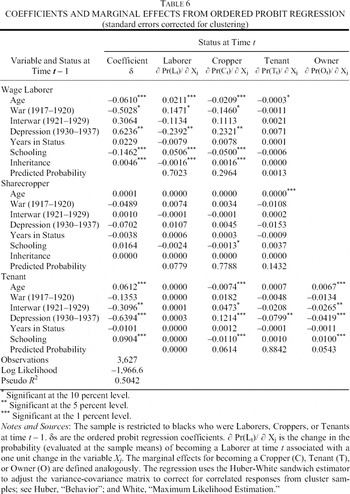
In Table 6 we present the regression results from an ordered probit estimation, with the standard errors corrected for clustering.
42 We also estimated the coefficients with an ordered probit regression controlling for random effects. The two estimations yielded the same substantive results so we only report the estimates with the standard errors corrected for clustering.
In order to account for the high degree of stasis shown in Table 4, we estimate
Pij(
t), which is the probability that an individual
i was in tenure category
j (= laborer, cropper, tenant, owner) at time
t, as a function of his characteristics at time
t,
Xi(
t), and his tenure status at time
t – 1,
Pij(
t – 1). This is a first-order Markov chain:
where β′ is a vector of coefficients to estimate and μi(t) is a random error term. The individual's previous tenure status is introduced by including interactions between dummies for having been a laborer, cropper, or tenant at time t – 1 into the ordered probit regression. To take advantage of the panel structure of the data (with repeated observations on the same individuals over a number of years), we correct the standard errors for clustering, allowing μi(t) to be correlated over t within the career of any individual i.
The marginal effects are calculated at the mean age and years in tenure status for the time t – 1 tenure class, and the omitted category for the time dummies (pre-1916). The estimates demonstrate that agriculture provided some upward mobility for blacks in the cotton belt, though for wage laborers and sharecroppers, this mobility was not positively associated with age. In fact, a standard deviation increase in age for black wage laborers (ten years) decreased the likelihood of moving to the sharecropper rung by 21 percentage points and increased the probability of remaining in the wage laborer category by the same magnitude. To the extent that movement upward from wage laborer occurs, it must result from unobserved individual heterogeneity (luck or hard work) or from the impact of particular time periods. As it does for wage laborers, individual variation in initiative or good luck influences the movement of sharecroppers. Age does not influence moving from sharecropper to tenant or from sharecropper to wage laborer. Age does, however, result in a greater likelihood that tenants will become owners (and a reduced likelihood that tenants will fall to sharecropper). This is consistent with the view that over time tenants accumulated physical capital to weather a few bad years. A standard deviation increase in age for tenants (12 years) reduces the likelihood of falling down the ladder to sharecropper by nearly 11 percentage points, while raising the likelihood of attaining ownership by 8 percentage points. Years in their current status did not have an impact on mobility off a rung, again consistent with the role played by individual characteristics.
The depression hit tenants the hardest. In each year of the depression, tenants had a 12 percentage point increased likelihood of falling down the ladder to cropper and a four percentage point lower likelihood of becoming an owner. The fall for tenants to the sharecropper rung may have resulted from low cotton prices, which caused a tenant to sell his workstock (horse or mule). Alternatively, in certain years agricultural policies may have prompted the fall in status but this would not have been the case for the majority of depression years in our sample. The depression did not affect the mobility of sharecroppers or wage laborers. The war years generally reduced upward mobility for laborers and had no impact on mobility for croppers or tenants.43
We anticipated that the high cotton prices during the war years would boost croppers and tenants up the ladder.
The interwar years only had an impact on tenants: tenants were less likely to become owners and more like to end up as croppers than in the years before World War I.
44 We find this result somewhat surprising given the high level of foreclosures. We thought that this would increase the likelihood of tenants acquiring a farm. Counterbalancing this was that the prewar years have been known as the “golden years” for farmers.
The reduced likelihood of tenants becoming owners during the interwar and depression years needs to be viewed in light of our base years: those in the prewar period, widely recognized as times of highly favorable agricultural conditions. Overall, tenants were still ascending to ownership but simply not as speedily as they did during the prewar or war years.
Our most explicit measure of human capital is schooling. Schooling was generally beneficial, promoting some upward mobility for sharecroppers and tenants and preventing some downward movement.45
This is consistent with Schuler's overall observation that schooling was particularly beneficial for blacks in the South.
Its impact for laborers, however, was to reduce mobility as did age. A standard deviation increase in schooling for wage laborers (2.5 years) was associated with a greater probability of remaining a wage laborer (13 percentage points), and an equal decrease in the probability of rising to sharecropper. At first this result may seem puzzling but we think that it arises from unobserved heterogeneity among wage laborers. Younger workers with less education are able to advance with experience (age) whereas older workers with the same age became trapped presumably because they lacked the necessary drive or simply had bad luck.
46 We thank an anonymous referee for this interpretation.
For sharecroppers, a standard deviation increase in schooling had a small (0.3 percentage point) negative effect on remaining a sharecropper. Tenants were 2.5 percentage points more likely to become owners if they had an additional standard deviation of schooling, and correspondingly less likely to fall to sharecropper.
Inheritance is the most direct measure for an exogenous change in physical capital. No one who was a tenant received an inheritance in year t – 1, so the importance of inheritances could be assessed only for those who were wage laborers or sharecroppers at time t – 1. The receipt of an inheritance in year t – 1 made upward movement from wage laborer to tenant more likely: an increase in the inheritance of one standard deviation ($70) made a wage laborer 8 percentage points more likely to rise to sharecropper, and 7 percentage points less likely to remain a wage laborer. The impact of moving from wage laborer status to tenant after receiving an inheritance most likely resulted from the ability to purchase a mule or a horse.
When the coefficients are examined jointly, it becomes clear how individuals could become trapped at particular rungs on the ladder. For example, for an individual who began his career as a wage laborer, each additional year of age increased the probability that the individual would remain a wage laborer by 2 percentage points. Each additional year as a wage laborer raised the probability of escaping this category by only 0.8 percentage points, so absent any other change, the passage of time would continuously reduce the individual's odds of moving up. The receipt of an inheritance, however, would be to bump the wage laborer up onto a more favorable trajectory.
CONCLUSION
Despite the legal and social discrimination faced by blacks in the plantation South in the early part of the twentieth century, there was some economic mobility. The mobility experienced over the course of a decade was similar in magnitude and character to that observed for blacks in the general population in the 1920s, before large-scale migration from rural to urban places, and even in the 1970s. In Jefferson County, Arkansas, 39 percent of males who were farm laborers or sharecroppers in their twenties (almost all of whom were black) had become tenants or owners over the next ten years—an improvement in their income and autonomy comparable to a change from unskilled to skilled or white-collar work in the nonfarm population. Among unskilled males in their twenties in 1920 in the general population, 53 percent had obtained skilled or white-collar jobs by 1930 (55 percent for whites, 38 percent for blacks). Between 1971 and 1981, 44 percent of unskilled males in their twenties rose into a skilled or white-collar job (50 percent for whites, 32 percent for blacks).47
Mobility from 1920 to 1930 was calculated with a random sample of 515 males ages 20 to 29 in 1920 linked from the 1920 One Percent U.S. Census of Population Public Use Sample to the manuscript schedules of the 1930 U.S. Census of Population. Mobility from 1971 to 1981 was calculated using 793 males ages 20 to 29 in 1971 drawn from the National Longitudinal Survey Young Male cohort.
Both the interwar years and the depression increased the likelihood of tenants falling to sharecropper status and reduced their ability to attain ownership status, relative to the boom years of the first two decades of the twentieth century. The depression years increased the likelihood of wage laborers rising to the sharecropper level. We also find some evidence of an upward sloping age tenure profile, though the magnitude of the effect of age is not as great as the magnitude of unobserved individual effects. For many, a career in agriculture was akin to climbing with the aid of an escalator whereas for others it was like Sisyphus pushing his rock up the mountain.48
For a moving oral history of a black man in the South who rose rapidly up the agricultural ladder, see Rosengarten, All God's Dangers.
The difference between ascension and entrapment was individual initiative or good luck.
For research assistance, we thank Kara Norlin and Clayton Reck. For financial support we thank the Research Board at the University of Illinois and the National Science Foundation. For comments we thank Jeremy Atack, the editor of the JEH, anonymous referees, Michael Haines, Deirdre McCloskey, A. Mushfiq Mobarak, Michael Sykuta, Gavin Wright, and participants at: workshops at the University of Colorado, the University of Illinois and Northwestern University; the Summer Institute of the NBER; and the annual meeting of the Economic History Association and the International Society for the New Institutional Economics.