INTRODUCTION
In recent years, utilization of home hospice care has increased in the United States (Teno et al., Reference Teno, Gozalo and Bynum2013), and as it continues to develop and evolve, agencies are working to make improvements to both care delivery and satisfaction of family caregivers. In home hospice care, family caregivers provide the majority of care, with support from hospice nurses, who also coordinate interdisciplinary hospice team services (Berry & Griffie, Reference Berry, Griffie, Ferrell and Coyle2010; Coyle, Reference Coyle, Ferrell and Coyle2010; Egan City & Labyak, Reference Egan City, Labyak, Ferrell and Coyle2010). Though often a successful model, caregivers nonetheless report having unmet needs related to support for in-home care (Bee et al., Reference Bee, Barnes and Luker2009; Kutner et al., Reference Kutner, Kilbourn and Costenaro2009; Newton et al., Reference Newton, Bell and Lambert2002). If a caregiver has unmet needs and is in turn unable to effectively navigate the demands of care, both patient and caregiver health may suffer. Caregiving has been recognized as a major stressor for families and has adverse effects on caregiver quality of life, physical health, and emotional distress (Doorenbos et al., Reference Doorenbos, Given and Given2007; Given et al., Reference Given, Wyatt and Given2004; Markowitz & McPhee, Reference Markowitz and McPhee2003; Nijboer et al., Reference Nijboer, Triemstra and Tempelaar2000; Weitzner et al., Reference Weitzner, McMillan and Jacobsen1999). Social support has been shown to reduce caregiver burden (Rodakowski et al., Reference Rodakowski, Skidmore and Rogers2012) and is related to better caregiver health (Baron et al., Reference Baron, Cutrona and Hicklin1990). Often, home hospice nurses are in a position to provide different forms of social support to family caregivers.
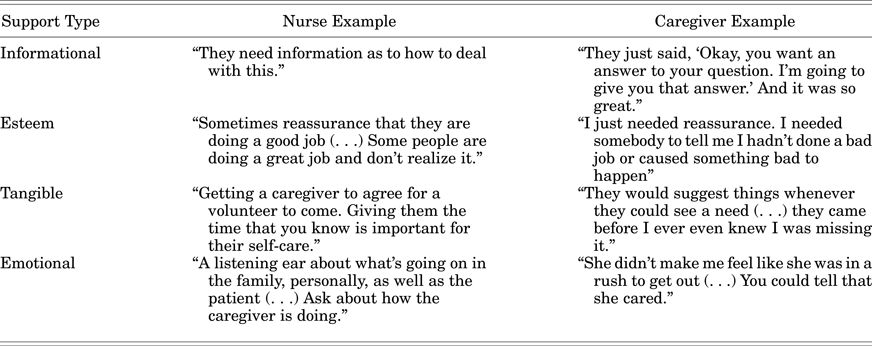
Researchers have sought to determine what family caregivers in home hospice need and how, from the caregiver's perspective, to best meet them (Newton et al., Reference Newton, Bell and Lambert2002). Across studies, caregivers frequently report needing help from hospice nurses with symptom management and self-care, coping, obtaining information, and emotional support. These needs correspond to common functions of social support (Cutrona & Russell, Reference Cutrona, Russell and Sarason1990), as shown in Table 1 (with examples). Informational support consists of providing advice or useful information for problem solving. For example, a nurse telling a caregiver what to expect or explaining a symptom or medication would be providing Informational support. Tangible support involves provision of goods, services, or other concrete assistance. This would include providing medical equipment, like a hospital bed, or performing tasks, such as cleaning or changing a catheter. Esteem support includes bolstering a caregiver's confidence and self-efficacy through reassurance and encouragement. Emotional support involves offering empathy and acceptance, and often involves “being there” for someone or offering a compassionate presence. While Esteem and Emotional support are often linked and both assist caregivers in feeling good about their role, the key difference is that the latter is a passive form of support (listening, taking in what the caregiver has to say) and the former a more active form of support (working to build or reinforce the caregiver). Finally, Belonging support, or having networks of people to turn to for common interests and a sense of membership, is also important to caregivers. However, this may be less important to the relationship with one's healthcare provider; this often comes from family, friends, and other groups, such as church membership or support groups. Previous research has found needs for all five of these types of social support in coping with broad-reaching life events, such as bereavement (Cutrona & Russell, Reference Cutrona, Russell and Sarason1990).
Types of social support provided by home hospice nurses

Though social support—or physical and emotional comfort and help—is obviously needed by caregivers and has been shown to be beneficial to psychological and physical health (Holt-Lunstad et al., Reference Holt-Lunstad, Smith and Layton2010; House et al., Reference House, Landis and Umberson1988), it is not always effective (Lehman et al., Reference Lehman, Ellard and Wortman1986). In order for social support to be beneficial, the social support desired by an individual has to match the support provided to him or her, or be responsive to his/her needs (Maisel & Gable, Reference Maisel and Gable2009); this is known as the stress–support matching hypothesis (Cutrona & Russell, Reference Cutrona, Russell and Sarason1990). Psychological stress may increase if a type of support is provided that is different from what the recipient wishes to receive (e.g., Information is given when Emotional support is sought), whereas matched support may ameliorate stress response by adequately addressing a need (Horowitz et al., Reference Horowitz, Krasnoperova and Tatar2001; Linden & Vodermaier, Reference Linden and Vodermaier2012; Thoits, Reference Thoits1986). A broad range of factors, including understanding the needs and priorities of the support recipient, shape the type of support one may offer. By tailoring support to patient and family needs, healthcare providers are likely to not only meet needs, but also reduce distress and enhance coping for ongoing care provision.
Though home hospice nurses may identify particular caregiver needs, they still need to decide whether it is beneficial to offer support, what kind, and to what degree, based on the priorities of the patient and family as well as their own role as healthcare providers. Previous research with breast cancer patients has shown that there are different patterns of what type support is found to be most helpful (Arora et al., Reference Arora, Finney Rutten and Gustafson2007; Neuling & Winefield, Reference Neuling and Winefield1988). While these patterns change over time, there is evidence that helpful support is provided by an entire network of family, friends, and providers and that the support most helpful offered by providers includes not only Informational support but also Emotional and Esteem support. Thus, there is evidence that the role of the provider goes beyond supporting patients and caregivers tangibly through treatment and with information to make decisions, but also to bolster them emotionally and ensure their confidence.
Although one of the key roles for hospice nurses is to address family caregiver needs, caregivers continue to report multiple unmet needs. We suggest that, perhaps rather than a lack of support, ongoing reports of unmet caregiver needs may, in reality, be a mismatch between the types of support caregivers need and the types of support hospice nurses provide.
OBJECTIVES
The objectives of this study were to (1) identify which of five types of social support (Informational, Esteem, Emotional, Tangible, Belonging) are most cited by nurses and family caregivers, and (2) determine the match between perceived needs and actually received support by comparing how frequently these types of support are mentioned by nurses and caregivers.
METHODS
As part of a larger, multiphase project funded by the American Cancer Society (ACS PEP-11-165-01-PCSM; PI: Ellington), focus groups were conducted with former family caregivers and hospice nurses to discuss their experiences of home hospice care and to gather their opinions about the important issues involved in that care. All study activities were conducted with university IRB approval, including procedures for informed consent.
Inclusion Criteria and Recruitment
The criteria for former family caregivers to be invited to participate included having previously served as an at-home caregiver for an adult who received hospice services within the previous 36 months and speaking English. Former family caregivers were recruited through a local hospice agency and a grief and bereavement support program. These organizations provided a list of those who agreed to be contacted about the study. The research team followed up by calling those individuals to explain the study and screen for inclusion criteria. Enrollment continued until an adequate number of participants agreed to attend one of two former family caregiver focus groups (n = 14).
The criteria for accepting nurse case managers included those who had spent at least one year in the role of a hospice nurse case manager. Nurse participants were recruited from attendees at the 2012 Annual Assembly of the American Academy of Hospice and Palliative Medicine (AAHPM) and the Hospice and Palliative Nurses Association (HPNA) in Denver. A notice was distributed through the HPNA electronic newsletter inviting interested individuals to contact a researcher, who provided more study information and screened for inclusion criteria. Enrollment continued until there was an adequate number of participants for two nurse focus groups (n = 13).
Data Collection Procedures
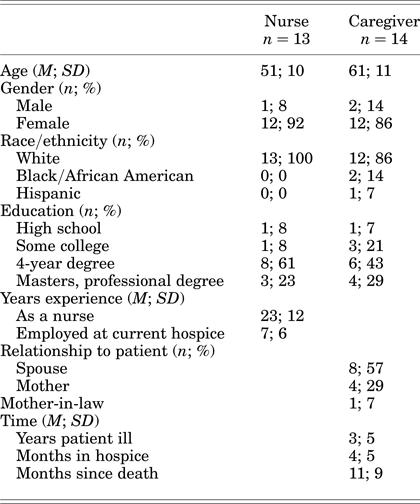
Prior to the beginning of each of the focus groups, all participants completed a demographic form that included information specific to their role as either family caregiver or hospice nurse. These data are summarized in Table 2.
Focus group demographics

The family caregiver groups met in local campus conference rooms. The nurse focus groups met in conference rooms at the 2012 AAHPM/HPNA annual assembly. All focus groups were moderated by a member of the research team experienced in conducting focus groups, while another member of the research team experienced in qualitative research observed, took notes, and assisted with asking follow-up questions and probing responses. Both focus groups centered on the question of how to best support home hospice family caregivers. Facilitator questions included open-ended questions, for example, “Based on your experience, tell us what hospice family caregivers need the most.” Participants were also asked for examples of when caregivers were supported well and how things could have been done differently when things did not go well. The focus group discussions were audio-recorded, professionally transcribed, and verified by the research team.
Coding
To identify which of five types of social support (Informational, Esteem, Emotional, Tangible, Belonging) were most cited by nurse and caregiver groups and determine the match in perception of support needs, caregiver and nurse statements within focus group transcripts were coded for type of support. Talk categorized in previous analyses (Cloyes et al., under review) as within the broad theme of “Caregiver Needs” was extracted for analysis to narrow the scope to discussion surrounding support given to or needed by caregivers (i.e., eliminate extraneous talk or talk of institutional needs for nurses). Employing the standard definitions of social support from the literature (Cutrona & Russell, Reference Cutrona, Russell and Sarason1990), two coders independently sorted all unique statements, exclusively and exhaustively, into six categories. This included the five functions of social support—Informational, Esteem, Tangible, Emotional, and Belonging—and a “general need” category. The general need category was used when participants mentioned that caregivers were in need of support, without a specific mention as to what type of support that meant; these statements were not included in further analyses. Coders employed the descriptions of support that caregivers and nurses spoke of as a “caregiver need” and the context of the conversation to choose the best-fitting category. After an initial round of coding, coders compared their output and worked to achieve a consensus. Though Belonging support was included in the initial coding system, it was not included as a final category, as neither nurses nor caregivers mentioned this as a need. Additionally, provision of this type of support may be considered inappropriate from a healthcare provider and may signal a provider crossing his/her professional boundaries (National Ethics Committee of the Veterans Health Administration, 2003).
RESULTS
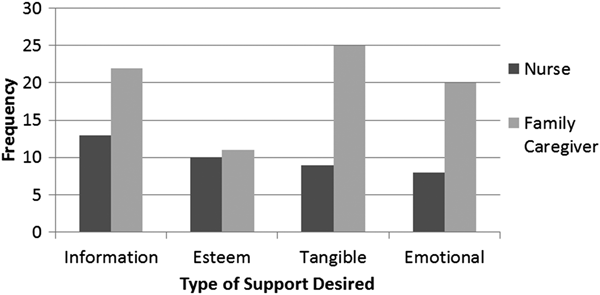
Nurses had 40 unique statements of caregiver need and caregivers 78. Examples of each of the four types of support were identified. As can be seen in Figure 1, nurses most frequently cited the need to provide Information (n = 13, 32%), followed by Esteem (n = 10, 25%), Tangible (n = 9, 22.5%), and Emotional support (n = 8, 20%). There were no statistically significant differences between the frequencies in these categories (χ2 = 3.34, p = 0.34, df = 3). Meanwhile, caregivers most cited Tangible (n = 25, 32%), then Information (n = 22, 28%), Emotional (n = 20, 26%), and Esteem support (n = 11, 14%). There were marginally significant differences between the frequencies endorsed by caregivers (χ2 = 7.2, p = 0.066, df = 3).
Mentions of type of support by nurse and family caregiver.

Informational support is a primary purpose of a nurse's vocation—to guide caregivers in knowing what to do—and therefore it is logical that both groups would state that caregivers have a great need for this type of support from nurses. As one nurse noted,
They need to know what's coming. Then, as impossible as it is to tell them, we tell them all different case possibilities (. . .) They just have a need to know what is going to happen.
Another caregiver expressed a similar sentiment:
I think what they need to understand is [that], as the caregiver, the reality that you're about to lose someone very, very close to you—we need you to educate us as much as possible about what you're going to encounter.
This need for information encompasses not just information about the future, but also information about the current situation, and to all family caregivers. One caregiver described frustration with her lack of support in this area as follows:
It was very difficult for me to get any information at all. They're supposed to leave logs, and they would rarely write in the log. They would communicate with my mother, who could never remember anything, and I gave them my phone number. I would tell them at every opportunity that I could: “Please let me know what's going on.”
The complex nature of individual family structure (or culture) and ability to manage strain complicates an already challenging situation, where caregivers are often stressed and may not absorb information well. For instance, this from a nurse:
They're overwhelmed, or they can't hear you, or whatever it is. Maybe if you do go and they can wash the dishes and let it sink in a little bit, it helps. The next day they go, “Were you talking about (. . .) whatever?”
Despite these complexities and challenges, both caregivers and nurses seemed to agree that Informational support was important. While caregivers are often only involved with hospice once or twice in their lives, nurses have far greater experience that both groups see as a valuable resource.
Obviously, the other type of support to be provided by nurses is Tangible support, or providing goods and services. While nurses may see Tangible support as the most basic level of services they provide, even the simple act of visiting was seen as supportive by caregivers:
When it got closer and these things were happening, we needed the nurse to come more. The nurse started out coming three times a week. And then she started coming by every day. We didn't even have to say—they just came.
Tangible support may be particularly important to caregivers, as this may not be available elsewhere within the support network. It may seem to be a simple thing to nurses, but caregivers rely on the materials they provide and, unlike some other forms of support, are unable to receive medications or supplies from other support sources, such as friends. Additionally, nurses perform tasks that require a level of expertise or comfort not readily available to other types of caregivers. One caregiver commented,
With me, there were times I'd kind of make demands. Look, you're the nurse. I'm not. You can tell me this, this, and this. But there's some things I just need you to do. I don't know why.
Caregivers appreciate having the tools needed to do their jobs. A lack of supplies will probably be frustrating for caregivers and result in unmet needs, and often it is difficult for those without experience to plan to acquire the supplies needed to respond to what are often rapid changes in care needs. One caregiver marveled at the extent of the supplies available and needed, while another noted how unsure her family was of what support they needed in order to care for a dying family member:
They brought in a bed. They brought in a porta-potty. They brought in a wheelchair, everything. Anything we wanted, they'd find and bring to us.
They would suggest things—whatever they could see there was a need. “Oh, let's get you this; let's get you that.” And they were really important and very needed, and so they came before I ever even knew I was missing it.
Caregivers were tuned to the medications and services that hospice nurses provided, but this was rarely mentioned as a need by nurses, except for organizational tools:
Yeah, writing down. I try to give them a notepad and say, “As this goes along, write down whatever you want to ask me.”
Another nurse mentioned the importance of Tangible support but noted the difficulty in providing care for caregivers rather than patients:
You step in and say, “Please, please accept this [volunteer coming to help], because I think it would be good for you.” And again, oftentimes they're able to say—maybe not at the time—maybe at the time they're mad at you—but later on they're able to say how much that helped them.
Esteem support was frequently mentioned by nurses but was the least mentioned (by a large margin; see Fig. 1) by caregivers. This strong endorsement by nurses was perhaps a response to the previous research and training showing that caregivers felt overwhelmed, resulting in nurses attempting to compensate through reassurance:
Encouragement that they are doing a good job. Many times they think they're not doing it right. Just us telling them that they're doing a wonderful job.
They need us to validate their feelings.
Caregivers did agree that validation is valuable:
I just needed reassurance. I needed somebody to tell me I hadn't done a bad job or caused something bad to happen.
However, the way caregivers often framed the need for validation was related to their own expertise:
I appreciated that the hospice would ask me—they would get my opinion. They would respect that I had some knowledge of what would be best.
Given this confidence in their abilities, one potential reason for the relatively low endorsement of a need for this type of support by caregivers may be selection bias—former family caregivers who needed less reassurance in their role might have been more likely to participate in focus groups.
While Emotional support is often desired by patients from healthcare providers (Arora et al., Reference Arora, Finney Rutten and Gustafson2007), it is often thought to be provided more frequently by friends and family, as these individuals are often closer and require no specialized skills. For example, caregivers who talked about Emotional support from the hospice staff often discussed the opportunity to “bounce things off somebody that was understanding,” not necessarily to provide any medical care. When caregivers talked about Emotional support from nurses, they often spoke of the humanity and compassionate presence of that individual:
One of the really special things that this nurse provided was (. . .) patien[ce], a really caring quality. It was a human interaction, a warm human interaction.
It relaxes you to know that they really are there and that you are okay.
While for some the nurse is a reassuring presence, for others this role may have been filled by family members, trusted friends, or church group members. One nurse who recognized the need for Emotional support in caregivers mentioned that she refers people “to therapy, or support groups” when they need Emotional support; it is possible that this is seen as an area for nurses to refer to other hospice resources. While it is important for nurses to listen to caregivers' issues, perhaps both groups see more active forms of support as more useful. For instance, a nurse suggested that Emotional support could lead to identifying issues for which nurses could lend other types of support:
You have to listen to them, intensive[ly], and not just one visit (. . .) Part of our job is helping them figure out what they need (. . .) It's helping them get to the root of “What's really bothering you about this?”
DISCUSSION
This research identifies the types of support perceived as needed by recipients (family caregivers) and providers (home hospice nurses) to determine the match in terms of support. Overall, family caregivers and nurses provided similar responses. However, the relative importance, as determined by the frequency of each response, differed by group. Overall, caregivers mentioned the support they needed twice as frequently as nurses (78 vs. 40 unique instances). This is likely due to differences in perspective; while family caregivers are focused on the care of their individual patients, nurses also discussed care at a more systems level. Their talk regarding managing caseloads, nurse mentorship, and other institutional factors, while important to understand their role in supporting caregivers, was not directed toward individual support of family caregivers and thus was not coded for purposes of this paper.
In terms of most frequent types of support endorsed by each group, nurses most often mentioned Information, Esteem, Tangible, and, finally, Emotional support, but there were no significant differences between frequencies, suggesting nurses saw these types of support to be needed in equal measure across the range of their caseloads. This suggests that previous research on caregiver needs (Bee et al., Reference Bee, Barnes and Luker2009; Kutner et al., Reference Kutner, Kilbourn and Costenaro2009; Newton et al., Reference Newton, Bell and Lambert2002) has not been lost on hospice nurses; they make an effort to attend to supporting caregivers across appropriate domains.
Caregivers, however, exhibited marginally significant differences in the frequencies of their responses. They most mentioned Tangible, followed by Informational and Emotional support, and least mentioned Esteem support. The relative frequency of needs discussed in the group may indicate a differential need for prioritizing physical items and information over validation in their role as caregivers. In previous research with breast cancer patients (Reynolds & Perrin, Reference Reynolds and Perrin2004), the match of support (receiving wanted support and not receiving unwanted support) selected well-being above and beyond the amount of support received and simple satisfaction with that support. The authors also noted that there was variability in terms of the types of support desired across the population; what was desired by one patient was not desired by others.
These individual differences in types of support desired are likely based on the situation and the existing skills and resources of the individual. Families dealing with more challenging issues, such as ongoing unresolved pain or complex family dynamics, may require more support across types from healthcare providers than other families. Additionally, family caregivers with greater external resources, such as broader social networks, may require less support from healthcare providers, particularly in terms of Emotional and Esteem support. Each family's needs are likely to be different and vary over time in a unique fashion (DuBenske et al., Reference DuBenske, Wen and Gustafson2008). Even within our sample of family caregivers, there were disagreements as to what was seen as helpful, emphasizing the need for skilled individual patient and family assessment by the hospice team.
A limitation of our study lies in its retrospective focus group design. From the perspective of family caregivers, some of the conversation revolved around what would have been helpful, rather than what actually occurred, and, particularly with this group, selection bias may have affected our findings. Additionally, as this is a descriptive study, there were no outcome measures. From the analysis of focus group transcripts, we were unable to determine whether particular types of support or a better match of desired and received support would lead to improved perception of care or well-being. Finally, it is important to note work on invisible support (Bolger & Amarel, Reference Bolger and Amarel2007; Bolger et al., Reference Bolger, Zuckerman and Kessler2000), which indicates that the support not noticed by the recipient may be most beneficial, as it reduces many of the negative side effects of support, such as feelings of indebtedness or lowered self-efficacy.
Our findings suggest that home hospice nurses take a global perspective of support provision across their caseloads and are addressing a broad spectrum of support needs—including Informational, Tangible, Esteem, and Emotional. Family caregivers may value certain types of support more or less. Given that matching support types has been linked to improved outcomes (Cutrona & Russell, Reference Cutrona, Russell and Sarason1990; Linden & Vodermaier, Reference Linden and Vodermaier2012), it is important to focus on this match in healthcare populations particularly vulnerable to psychological stress, including family caregivers of home hospice patients. This research has implications for interventions to match support provision with caregiver needs, as has been done in other realms (Crane & Constantino, Reference Crane and Constantino2003), or for education for home hospice providers, to ensure that they are not only sensitive to the possibility of a broad range of needs, but that they can see the necessity of tailoring care to those needs.
ACKNOWLEDGMENTS
The authors would like to thank McKenzie Carlisle, Ph.D., for her assistance on this paper, and our participants. This work was generously funded by grant ACS PEP 11-165-01-PCSM: PI, Lee Ellington.