

1 Introduction
In the wake of the 2008 Financial Crisis, many developing countries experienced strong capital inflows when U.S. interest rates hit historic lows and the United States Federal Reserve initiated quantitative easing. When the Federal Reserve began to unwind its quantitative easing in mid-2013, developing countries braced themselves for a sharp reversal in capital flows. Between the policy announcement in May and the end of September, Indonesia's Jakarta Composite Index and Turkey's BIST 100 both lost approximately 20 percent and the cost of a ten-year government bond in Turkey shot up by nearly 370 basis points.Footnote 1 The turmoil motivated the Indian Finance Minister to call for renewed cooperation on monetary policy to minimize the impact of Federal Reserve policy on developing economies. In a globalized and hegemonically organized international economy, the financial conditions of the hegemon often have spillover effects for peripheral economies.
In this paper, I build on recent insights regarding the domestic structural and international causes of financial crises, as well as the earliest systemic theory of financial crisis, Charles Kindleberger's Hegemonic Stability Theory (HST), to advance a systemic theory of financial crisis. However, while Charles Kindleberger focused on the stability brought about by a hegemonically structured international economy, I emphasize the dynamics of volatility present in this type of system. Hegemonic systems may exhibit stability when a crisis originates in a peripheral country, suggesting hegemonic systems are more stable, as Kindleberger proposed. But hegemonic systems are also especially fragile to a crisis that originates within the hegemon. In fact, hegemonic systems are quite sensitive to financial conditions of the hegemon in general. While hegemonic systems may be resilient to contagion from crises that originate in peripheral countries, the dynamics of the crises that emerge in peripheral countries are driven by the financial conditions of the hegemon.
I argue, herein, that a hierarchical distribution of economic activity in the international system means that the financial cycle of the most central country influences the financial conditions in peripheral countries that lead to financial crisis. Evidence from financial crises, which occurred in the long nineteenth century, support this theory. During the long nineteenth century, Great Britain was the largest and most interconnected country in terms of both international trade and investment. Periods of expansion in the financial cycle of Britain, when Bank of England interest rates were relatively low and credit was readily available, coincided with higher levels of foreign investment to peripheral countries and greater demand for raw materials from them. As a result, productivity and credit expanded in these countries, leading to higher asset prices and increasing the probability of credit and asset bubbles that precede financial crises.
This paper is structured as follows. The first section of this article outlines the core theoretical framework of how globalization and the structure of the international economy in the nineteenth century influenced the dynamics of financial crises and generates three testable hypotheses. The second section explores the historical evidence for this theory, and the third section uses statistical analysis and data on financial flows and crises in the nineteenth century to test my hypotheses more formally. The results suggest that even after controlling for domestic “pull factors,” system level dynamics affect the probability that a country experiences a surge in capital flows and financial crisis. The last section discusses the implications of these findings for the broader literature on the political economy of financial crises.
2 Global and domestic financial cycles culminate in financial crises
The HSTFootnote 2 was first developed by Charles KindlebergerFootnote 3 and spawned one of the foundational research programs in the field of international political economy. Kindleberger argued that the lack of a hegemon contributed to the depth and severity of the Great Depression, and that the stability of the international system requires a single dominant state to dictate the rules of interaction among the most important states in the international system. This argument was and remains unique in the causal role it attributed to the structure of the internatinal economy. In contrast to other theories of the Great Depression, which emphasized the failures in a single country's regulation, intervention, or monetary policy,Footnote 4 Kindleberger proposed a failure in the structure of relations between nation-states:
[T]he 1929 depression was so wide, so deep and so long because the international economic system was rendered unstable by British inability and United States unwillingness to assume responsibility for stabilizing it […]. The shocks to the system from the overproduction of certain primary products such as wheat; from the 1927 reduction of interest rates in the United States (if it was one); from the halt of lending to Germany in 1928; or from the stock-market crash of 1929 were not so great. Shocks of similar magnitude had been handled in the stock-market break in the spring of 1920 and the 1927 recession in the United States. The world economic system was unstable unless some country stabilized it.Footnote 5
Kindleberger's theory fell out of favor among most political economists, as scholars questioned the logic of the collective action framework on which Kindleberger's theory was built. For instance, Duncan SnidalFootnote 6 showed that a hegemon was not a prerequisite for solving collective action problems and providing the counter cyclical policies that Kindleberger linked to international economic stability. However, when removed from the collective action framework, the central hypothesis of HST does hold merit. Indeed, from the perspective of Complex Systems Theory, it makes good sense.
If the global economy is a system of national economies connected via trade and (perhaps more importantly in the case of crises) investment flows, as some scholars such as Thomas Oatley propose,Footnote 7 then there is reason to think that hegemonic systems are more stable. Hegemonic systems are hierarchical systems, where a single country is disproportionately well connected to other countries. To use more technical network terminology, a hierarchical system is one where the distribution of degree centrality among the nodes is highly skewed because a single node has a much higher degree centrality than any other node. A network definition of hegemony is quite compatible with traditional definitions of hegemony that emphasized a single nation holding a preponderance of resources and influence within the international system. Degree centrality implies both a preponderance of wealth that results from a high volume of economic exchange as well as a high degree of influence within the network via the countries numerous economic links to other countries.
Within Complex Systems Theory, a well known characteristic of hierarchical systems is remarkable stability. In hierarchical systems, the most central agent is capable of absorbing shocks that originate elsewhere in the system, preventing them from spreading.Footnote 8 In the context of financial crises, this means that a hegemonic system should, as Kindleberger argued, be robust to systemic financial crises, provided they occur outside of the hegemon. Complex Systems Theory proposes that the size of the hegemon's economy is sufficiently large enough to absorb any real or financial shocks that emanate from peripheral countries, preventing crises that originate in the periphery from spreading to the rest of the world economy.Footnote 9, Footnote 10
However, hegemonic systems are also fragile to crises that originate within the hegemon, as the hegemon maintains the most numerous and substantial economic ties through which crises are transmitted to other countries. Whether the transmission mechanism of financial crises is real economic disruption (illiquidity) or semi-rational investor expectations,Footnote 11 contagion cannot exist in the absence of an economic relationship.Footnote 12 This is the flip-side of Kindleberger's argument: Hegemonic systems are robust yet fragile.
The core logic of the “robust yet fragile” property of hierarchical systems, and of network theory more generally, is that the influence of a node in a network is determined by its position relative to another nodes, as well as the overall structure of the network. Thus, another way of characterizing the robust-yet-fragile property of hierarchical systems is to say that the most central actor holds significant influence over other actors in the network and thus plays a special role in driving the dynamics of the system overall. This property is important not only to understanding contagion in the wake of a financial crisis but to understanding the emergence of crises as well. This property implies that financial conditions of the hegemon influence these same conditions in other national economies and by extension, financial conditions in the hegemon are likely to influence or drive the crises that result from developments in these conditions in other countries in the system.
The hegemon drives crises throughout the rest of the system because its numerous trade and investment links act as conduits of “spillover” effects from its financial cycles. Scholars who study financial cycles define them similarly to business cycles—the pattern of expansion, peaks, contractions, and troughs that occur in an economy's asset (with an emphasis on property) and credit prices.Footnote 13 These cycles are the result of “self-reinforcing interactions between perceptions of value and risk (property prices), [and] attitudes towards risk and financing constraints (credit), which translate into booms followed by busts.”Footnote 14 They are, in essence, a property of market systems, like business cycles.Footnote 15 The financial cycle is, however, distinct from the business cycle, in that it is much longer—sixteen to twenty years verses eight for the average business cycle—but it sometimes coincides or aligns with the business cycle, because financial and real sectors are inextricably linked. The period from 2000–8 in the United States is an example of an alignment of the two cycles. As was also the case in 2008, the peak of financial cycles are usually associated with a period of financial distress.
As the volume of trade and investment increases between countries, the probability increases that financial cycles “spill over” from one country to another, in particular from a disproportionately large economy to smaller economies. When a country's financial cycle is expanding, credit and debt is expanding, and market liquidity is high. This facilitates investment abroad, particularly if growth is moderate or strong. The increased investment applies downward pressure to the market interest rates of recipient countries and can push them below the natural rate implied by the productivity of the real of economy.Footnote 16 When a country's market interest rates are lower than the natural rate warranted by real sector productivity, credit and asset bubbles are sure to follow since the divergence will stimulate demand for credit and assets.Footnote 17 As Charles KindlebergerFootnote 18 and Hyman MinskyFootnote 19 have theorized, and as other economists have demonstrated with empirical evidence,Footnote 20 asset and credit bubbles frequently precede financial crises because the financial sector amplifies real sector activity.Footnote 21
The ability of a hegemon's financial cycle to create spill-over effects for the financial sectors of other, smaller economies has been highlighted in the contemporary period by economist Helene Rey. Rey documents the existence of what she calls the “global financial cycle”:
There is a global financial cycle in capital flows, asset prices, and in credit growth. This cycle co-moves with the VIX, a measure of uncertainty and risk aversion of the markets. […] The global financial cycle is not aligned with countries' specific macroeconomic conditions. Symptoms can go from benign to large asset price bubbles and excess credit creation, which are among the best predictors of financial crises. […] One of the determinants of the global financial cycle is monetary policy in the centre country, which affects leverage of global banks, capital flows and credit growth in the international financial system. Whenever capital is freely mobile, the global financial cycle constrains national monetary policies regardless of the exchange rate regime.Footnote 22
In other words, the global financial cycle is the tendency for the financial cycle of the most central country in the international economic system to influence or spillover to the financial sectors in other countries.Footnote 23 I propose that a very similar phenomenon occurred during British Hegemony in the long nineteenth century.
If this logic is correct, and system structure and the economic fundamentals of the hegemon drive financial crises, then a correlation should exist between the state of the financial cycle in the hegemon and international financial crises in the periphery. The first era of globalization in the long nineteenth century presents an ideal case with which to examine this relationship. In the nineteenth century, the international economy was hierarchically structured with Britain as the hegemon, or most central and connected economy. Britain dominated international trade and was the preeminant source of international investment. Furthermore, because the gold standard was in place and capital was highly mobile, interest rates in peripheral countries were heavily influenced by interest rates in Britain. In the next two sections, I examine historical qualitative and quantitative evidence in support of this correlation. Specifically, I will examine evidence for the following testable hypotheses based on the theory I have outlined.
Hypothesis 1: When the British financial cycle was expanding, the probability that peripheral countries experienced a surge of capital from the hegemon increased.
Hypothesis 2: When the British financial cycle contracted, and credit shrank, the probability that peripheral countries experienced a financial crisis increased.
Hypothesis 3: Experiencing a surge in capital flows from the hegemon increased the probability that a periphery country experienced a financial crisis.
3 The global financial cycle and financial crises in the long nineteenth century
The international economy in the nineteenth century revolved around Great Britain due to its industrial and technological leadership. Britain emerged victorious from the Napoleonic Wars in 1815 and, with the onset of the second industrial revolution, became the world's leading economic power. With regard to trade, Britain imported primary commodities, mostly from North America, Argentina, Brazil, and Uruguay, and exported finished manufactured goods to former and current colonies. With regard to international investment, London's capital market was twice as large as its rivals' combined by 1870. Britain was the largest exporter of capital to its current and former colonies in Africa and the Americas. On average, between 1870 and 1913, it invested 5 percent of its GDP overseas, but this amount peaked at nearly 10 percent just before WWI.Footnote 24 The United States, Canada, Australia, Argentina, Brazil, and Uruguay attracted the largest share of this investment. Britain's position in trade and investment markets was, of course, linked to the gold standard and Sterling's role as the dominant reserve currency. Britain formally established the Gold Standard in 1819 and most countries adopted a similar arrangement in the 1870s, making it the linchpin of the international economy in the nineteenth century. The adoption of the Gold Standard and participation in the monetary union or currency band led to increased trade.Footnote 25
The centrality of Britain in all three dimensions of the international economy—monetary, financial, and trade—amounted to nothing short of economic hegemony. This hierarchical structure determined patterns of crisis in the periphery, as the financial cycles in Britain disproportionately influenced the financial conditions abroad. A more elaborate exposition of the British financial system and British monetary policy in the nineteenth century will illuminate these dynamics.
In the nineteenth century, the British financial system revolved around the Bank of England (BOE). By today's standards, the BOE was a quasi-central bank during the period and exercised less control over monetary policy than it does now. It was the largest financial institution in the country and held significant influence within financial markets, but it did not set interest rates for the purpose of maintaining price or employment levels, as do contemporary central banks. Instead, as the first and only joint-stock bank allowed to operate with limited liability until 1826, the BOE was a private bank accountable to its shareholders. Very few firms borrowed from the BOE. Its primary activity was to rediscount bills for discount houses, who in turn lent to banks, who in turn lent to firms. As rediscounting was the primary function of the BOE, the Bank naturally provided lender of last resort services in times of crisis but was free to deny credit to any institution deemed unprofitable.
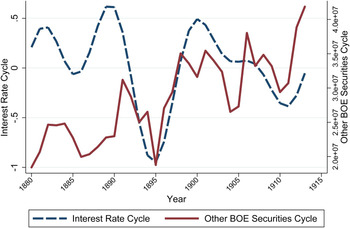
It was through these two functions, rediscounting and lender of last resort, that the Bank influenced (but did not solely determine) monetary policy and short term interest rates. In fact, between 1857–90, when the BOE limited rediscounting for London discount houses, it actually chased the market rate set by the London discount houses rather than leading them.Footnote 26 For most of the nineteenth century, the BOE rates were largely a reflection of two factors: the amount of gold reserves and the demand for rediscounting by other discount houses in London. The BOE lowered rates when demand for rediscounting was low, and its reserves were plentiful, and it raised rates when demand for rediscounting was high, and its levels of reserves tended to be lower. Figure 1 plots the bandpass filtered cycles of BOE interest rates against “other securities” on the BOE's balance sheet. These “other securities” were rediscounted bills. The cycles apparently follow very similar trends.
Comparison of interest rate and other BOE securities cycles

While the BOE served as a lender of last resort, its role in the economy was mostly pro-cyclical. When BOE rates were low and stable, this was an indication that credit was easy to obtain, that economic fundamentals were strong, and that the money supply was expanding. When rates were high and volatile, demand for re-discounting from the BOE was high, and the money supply was shrinking. Higher rates could also be an indication of trouble within the banking system or that the economy was experiencing a contraction.Footnote 27
Perhaps more importantly, the BOE influenced but did not completely control the national money supply. The Bank began to issue banknotes soon after its creation in 1694. However, the Banking Charter Act of 1844 was the first major attempt to regulate the institution's credit and banknote operations, giving the Bank sole power to create banknotes. But even this special role conferred relatively little influence over the nation's money supply. The act was a response to the Bank Panic of 1825, which the public blamed on the oversupply of banknotes, and sought to prevent banking crises due to the expansion of the money supply. The Act had notable flaws and did not accomplish this objective. The Act restricted the creation of banknotes to the BOE and fixed a quota of $14,000,000 on the number of notes the Bank could issue, above which any additional printing of notes by the Issue Department had to be 100 percent backed by gold. However, the Act did not, in practice, ensure that the value of banknotes in circulation varied with level of gold reserves. This was partly because the BOE was divided into two sections—the issue department and the banking department. The issue department issued bank notes in exchange for gold. The banking department handled rediscounting. As Collins explains:
The Issue Department issued notes directly only to the Bank's own Banking Department, with these notes, in turn, entering into general circulation as customers drew on their accounts and borrowed from, or sold securities to, the bank. At any one time the Banking Department retained a reserve of notes and the extent to which they were passed to customers would depend on many factors such as rates of interest and the public demand for legal tender. The 1844 Act did not fix the ratio of the Banking Department's reserve to its note liabilities. Thus, it was possible for the Banking Department to pay out notes to the public—or take them in—with some degree of independence from the size of the regulated reserve in the Issue Department. In other words, the purity of the direct link that the Currency School had sought to establish between the gold reserve and the note circulation was never attained.Footnote 28
The legislation also failed to limit the creation of other types of money, most notably book money—that is credit or deposits that existed on the books. Given the growing prevalence of checks and banker's drafts during this period, book money was an important component of the money supply and did not vary with the level of gold reserves.Footnote 29 Thus, while the supply of money in the form of banknotes was technically limited, the British money supply largely expanded and contracted with the real sector's demand for credit. In other words, the money supply was minimally constrained by the gold reserves at the Issue Department of the BOE.
Lying at the center of the international economy, the British financial sector conditions heavily influenced real and financial sector developments in other countries. When the financial cycle was in a period of expansion and credit was expanding, capital flowed to other countries fluidly as well. Indeed, most international loans were channeled through the London discount houses, which had the most direct relationship with the BOE. When credit was bountiful (and rates were relatively low), capital flowed out of the country looking for higher returns abroad. This, in turn, pushed rates down abroad. Quantitative evidence tells us that short term interest rates and price movements were tightly integrated across major economies on the gold standard.Footnote 30 In countries with a central bank, the institution usually adjusted their bank rates in response to Britain's. When Britain raised or lowered rates, peripheral countries made corresponding changes within several months.Footnote 31 In economies without a centralized banking system, rates were affected via the gold standard. The availability of British capital during periods of low rates helped fuel economic expansion in recipient countries by raising incomes and spurring demand, which in turn also boosted domestic investor confidence, created demand for assets, and fostered speculation in asset markets.Footnote 32
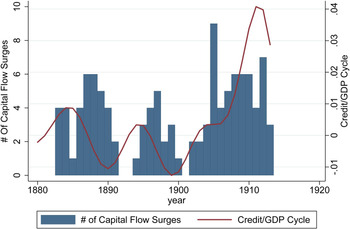
Data from the nineteenth century confirms the plausibility of this account. Figure 2 presents the bandpass filtered credit/GDP cycle of Great Britain along with the number of surges in U.K. capital outflows to peripheral countries. The logic for using surges in capital flows rather than simply a continuous measure of all capital flows is that large influxes of capital flows can have different effects on a countries' economy than smaller, gradual increases. Large influxes can cause asset prices to appreciate more rapidly, and interest rates to fall.Footnote 33, Footnote 34 To construct this figure, I first calculated the annual change in gross capital flows from Britain to each country for the period 1880–1913 using data from Irving Stone's estimates of gross annual capital flows from Britain to twenty-five countries.Footnote 35 I then constructed the average and standard deviation for the previous five years.Footnote 36 I define a surge as a change in capital flows that is greater than one standard deviation above the average change of capital flows. The bars denote the number of capital flows surges in a given year. In this figure, it is evident that capital flow surges tend to follow a similar trend to the U.K. credit/GDP cycle. Figure 3 similarly plots the credit/GDP cycle of Great Britain against the number of financial crises occurring in other countries. Clustering of taller bars is evident around recessions and troughs in Britain's financial cycle.
U.K. credit/GDP and capital outflow surges 1880–1913

U.K. credit/GDP cycle and financial crises 1880–1913

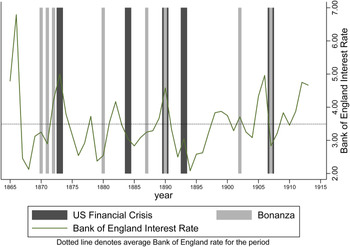
The dynamics illustrated by these charts are well illustrated by the economic history of the United States, which experienced several significant banking crises in the long nineteenth century. As the United States developed and its financial sector expanded, it experienced a series of banking crises that grew in size and significance.Footnote 37 The three largest crises, in 1873, 1890, and 1907, were preceded by large surges in capital flows from Great Britain (see figure 4) and coincided with contractions in the British financial cycle.
U.S. financial crises and U.K. capital flow bonanzas 1865–1913

The most substantial financial crisis prior to the Great Depression, the Panic of 1907, presents a good case study of these dynamics. The crisis was the byproduct of international market conditions, heavily influenced by British economic fundamentals and financial conditions. In 1895, when the British financial cycle began to expand and interest rates bottomed out during the recovery from the Barings Crisis, U.K. capital flows to the United States surged and the United States experienced an economic boom. The expansion in the United States peaked in 1900–1, when the recession in Britain took a toll on the U.S. economy and again in 1905–6, when the financial cycle in Great Britain expanded (1904–5), credit increased and capital outflows surged. The years 1905–6 featured particularly high GDP growth for the United States at 7.34 percent (nearly twice the average of the previous five years). This period of expansion was accompanied by 10.5 percent increase in exports, a 12 percent increase in imports, a credit boom, and an asset boom. Bonds, in particular, were a favorite form of asset. In the two years, $872,000,000 in new bonds were listed on the New York Stock Exchange. To compare this to the prior period with hot growth in 1900–1, the total was only $367,000,000 (GDP growth in 1901 was over 9 percent). Property prices also increased in the United States, throughout Europe, and South America as investors sought higher rates of return than corporate railroad bonds offered.Footnote 38
Economic conditions during the first few years of the twentieth century were nearly as prosperous for other countries as for the United States. Russia, France, Belgium, and Italy all experienced significant increases in trade as a share of GDP with Great Britain. The demand for credit to facilitate this trade was not restricted to the United States, but occurred in other industrializing countries as well. Warning of impending market correction, M. Leroy Beaulieu, a prominent French economist of the era, noted in the Economiste Francaise in 1907:
The growing industrial states, particularly the new countries, are at this moment demanding more capital than the whole world has accumulated recently, or is accumulating to-day. From this fact follow two consequences: first, that the users of this capital have to pay more for it in the shape of a higher interest rate; second, that they will be compelled to postpone, or extend for several years, many of the enterprises on which they had decided and for which they had already made preparations.Footnote 39
The demand for credit was also reflected in higher international commodity prices. The Economist's commodity price index rose from 1,885 in 1897 to 2,136 at the end of 1904, to 2,601 in June of 1907. In short, this period marked a major upswing in the global financial cycle that was driven by a period of economic and financial expansion in Great Britain.Footnote 40
A tug of war for gold between Great Britain and the United States, brought on by the world-wide economic boom, ultimately caused the BOE to raise rates in 1906. That year, the U.S. Treasury devised a strategy to increase gold flows using financing bills. Gold poured in—$50 million in just over a month. In response, Britain raised interest rates in late 1906 to defend against a banking crisis.Footnote 41 Rates followed in other major economies. When the finance bills matured and Great Britain suspended any new issues, the United States exported nearly $30 million in gold back to Great Britain for repayment during the summer of 1907. Impacted by the higher interest rates, beginning in January 1907, bonds took a tumble. Investors passed altogether on several new bond issuances by railroad companies. The stock market bubble popped as well. Securities began a steady and substantial decline. Against this background, in late October 1907, the banking panic struck.Footnote 42
The immediate cause of the banking panic was Otto Heinze's attempt to manipulate the stock of the United Copper Company. As stock prices were falling, Otto Heinze concluded that speculators were borrowing United Copper Company stocks to short sell them. He devised a scheme to aggressively purchase United Copper stock and force the short sellers to pay for the shares they had borrowed. Conditions in the market were worse than Otto assessed, however, and his scheme failed. Ultimately, his brokerage house, Gross & Kleeberg, declared bankruptcy. His ploy sparked a run on banks that held United Copper Company stocks as collateral or on those banks and trust companies that were associated with Heinze brothers. Ordinarily the financial system might have stood resilient to a contained bank panic brought about by such a scheme.Footnote 43 However, the reason bank runs on the State Savings Bank of Butte Montana, The Mercantile National Bank, National Bank of North America, and the New Amsterdam National led to more widespread systemic crisis was the over-leveraged state of trust company balance sheets.
Starting in 1900, trust company assets and deposits grew at nearly 2.5 times the rate of assets and deposits at state and national banks. Trust companies, unlike retail banks, were permitted by federal law at the time to own property and trade on the stock market but competed with banks for counter deposits. These institutions had no minimum reserve requirement and were not members of clearing houses, which most frequently acted as the lender of last resort in times of financial strain during the National Banking Era. In 1907, these financial institutions held around 5 percent of their assets in cash, compared to the 25 percent reserve standard for national banks. Trust companies largely supplied uncollateralized loans to traders, who used them to purchase stocks, which they then used as collateral for call loans from traditional banks. By providing short-term liquidity to speculators and purchasing large amounts of securities themselves, the growth of trust companies facilitated the asset bubble that grew from 1900–7. Trust companies were deeply embedded in the financial system, yet were particularly susceptible to runs because they were not participating members of clearinghouses and had grown deeply leveraged over the preceding boom years.
To summarize, the British financial and business cycles impacted financial and real sector conditions in other countries due to its central location in the world economy. As the financial cycle expanded in Great Britain, capital flowed abroad from Britain looking for higher returns, fueling growth, facilitating investment, and fostering speculation that led to bubbles and crises. The Panic of 1907 in the United States was a product of these exact dynamics. A nearly decade-long period of low interest rates and economic expansion in Britain facilitated large amounts of British foreign investment in the United States. Rates in the United States also dipped during this period and this created the conditions for credit and asset bubbles, which eventually burst and made financial institutions vulnerable to the panic that struck in the fall of 1907.
4 Statistical analysis
Statistical analysis offers more systematic evidence of British influence on conditions in peripheral countries. I test the three hypotheses presented at the end of the first section by using logistic time series analysis and lagged dependent variable models with panel data for banking crises and British capital flows ranging from 1880–1913. I first examine whether the British financial cycle affected the global incidence of capital flow surges and check the robustness of this model with a measure of aggregate capital flows from Britain. I then test whether capital flow surges and the financial cycle predicted crises when controlling for a range of domestic variables that other studies suggest are important causes of financial crises. I estimate the models with random effects because some of the control variables in the data change very little or not at all from year to year, and because some countries in the sample never experience a crisis.
The main dependent variable for the first set of models to test my first hypothesis is a dichotomous measure of whether a country experienced a surge in capital flows from Great Britain. I define a surge as a change in capital flows greater than one standard deviation above the the average change of capital flows. Of the 614 country years included in the data set, fifty-eight, or approximately 9 percent, experienced a surge in capital from Great Britain. For robustness, I also estimate the models using the volume of capital flows from Great Britain to each country. The data on U.K. capital flows is taken from Irving Stone's “The Global Export of Capital From Great Britain 1865–1914.”Footnote 44
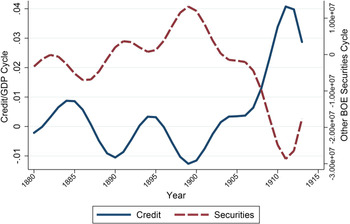
Operationalizing the conditions that I propose drive these surges is a slightly more difficult task. Contemporary measures of a country's financial cycle usually combine measures of credit and housing or asset prices. Data availability is more limited in the nineteenth century. However, the Jorda-Schularik-Taylor Macro History database does contain data on credit from 1880 onward. I use credit/GDP from this database as one measure of the British financial cycle. As an additional measure of the British Financial cycle, I use an item from the annual BOE balance sheet for the period called “Other Securities.” As I explained in my case study of the British financial system in the nineteenth century, the BOE served a lender of last resort function, which meant that it lent to other banks throughout England when they were experiencing liquidity problems. These loans showed up the BOE balance sheet as “other securities.” Thus, these assets would have been higher during periods of financial stress (when the financial cycle contracted) and lower during expansionary periods in the cycle. These two variables should be mirror images of one another. Indeed, when I bandpass filter each to remove the trend and compare the remaining cyclical components of the two variables, the cycles move in continuous counterpoint (see figure 5). Using these variables as two measures of the financial cycle in Great Britain, I therefore expect a positive correlation between credit/GDP and capital flow surges, and a negative correlation between “other securities” and capital flow surges.
Comparison of credit/GDP cycle and BOE securities cycle

Data on appropriate control variables is limited from this period, so I include minimal control variables to proxy for institutional, political, and economic “pull factors” highlighted in the existing literature on capital flow surges. In existing literature, these controls include measures of economic health and/or need for capital, measures of political stability, and measures of institutional quality. The variables I include to measure institutional quality include regime type and a dichotomous measure for whether a country had a central bank or not. Data on regime type comes from the Polity Project. Polity scores ranges from −10 to 10, with a higher score indicating a higher level of democracy. Polity is the best available indicator for assessing the effect of domestic political institutions. Financial repression should be reduced, economic transparency should be higher, and the price system less distorted in more democratic and liberal regimes, which may act as “pull factors,” attracting international investment.Footnote 45 Data on the year central banks were created was gathered from individual central bank websites. The presence of a central bank may or may not attract international investment. On the one hand, if the central bank acts as a lender of last resort, investors may feel more secure investing in the country. Alternatively, if the central bank can affect interests rates, and is therefore able to close the difference between U.K. and domestic rates more quickly than in economies without a central bank, such countries may be less likely to experience a surge in investment. To control for economic conditions, I include measures of inflation and real GDP growth. Higher inflation and lower growth should deter investors, making a surge less likely. I include measures of a country's budget deficit and public debt to account for economic need, which could result in a sudden influx of capital. Data for these variables is taken from from Flandreau and Zumer's economic history database.Footnote 46 However, because each of these variables contain missingness across different observations, I include each of these controls separately in different models so as to keep the number of observations as high as possible.Footnote 47 Including all the controls in a single model reduces the amount of observations by half.
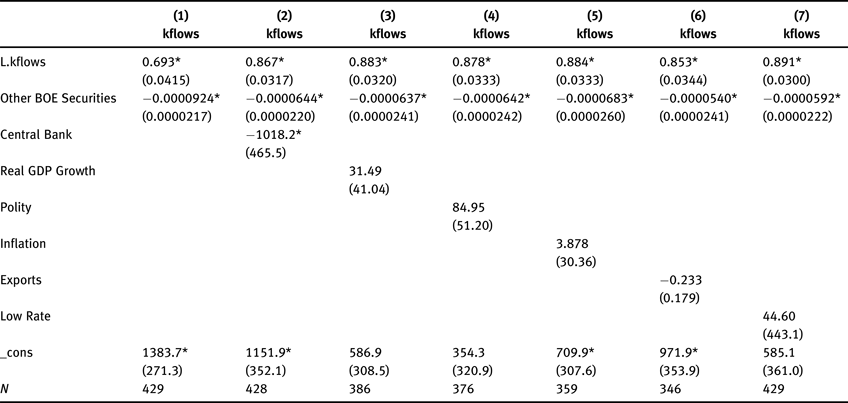
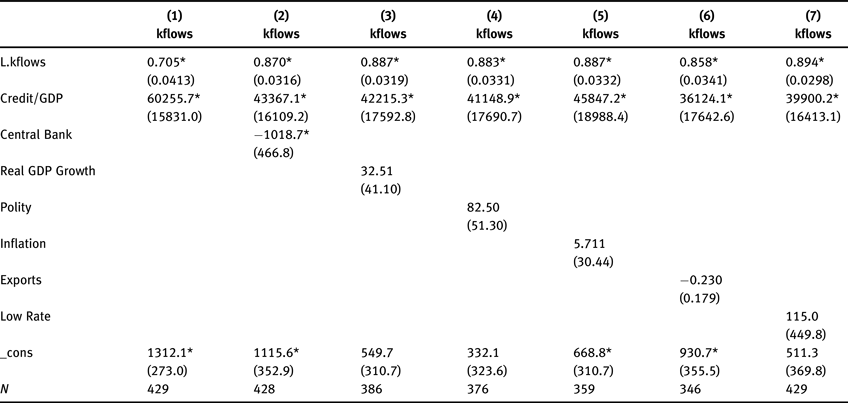
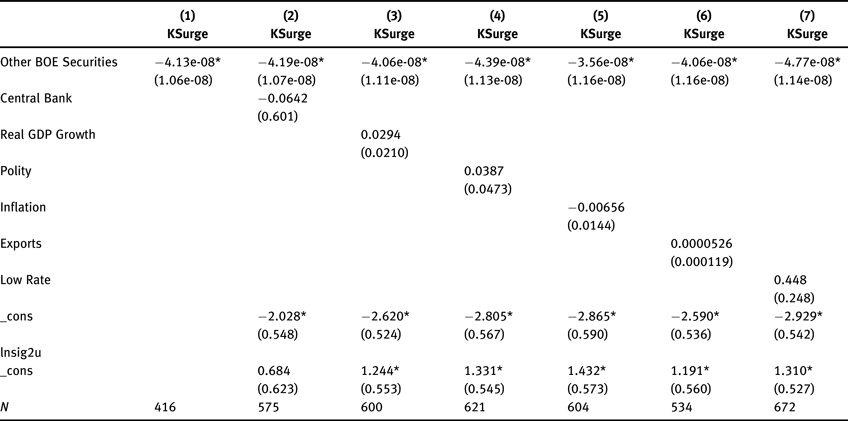
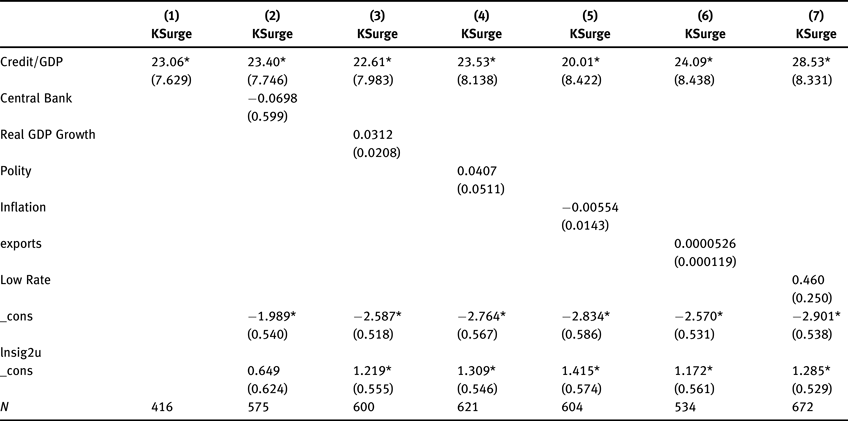
The results are summarized in tables 1 through 4. In both the lagged dependent variable models using the bilateral U.K. capital flow exports and the logit models using capital flow surges, both independent variables perform as expected and are statistically significant. A one point expansion in the credit/GDP ratio (from zero to .1) increases the volume of exports by anywhere from £36,000 to £60,000 British, depending on the control variables included. For every additional one million pounds the BOE lent to British banks as the lender of last resort, British capital exports decreased by anywhere from 500 to 900 GBB. Interpreting the results of the logistic regression models, a one million GBB increase in the value of “other securities” on the BOE balance sheet decreases the probability that a country experiences a capital flow surge by .004–.005 (depending on which control variables are employed). A .01 increase in the credit/GDP ratio increases the probability of a capital flow surge by about .02–.04 (depending on which control variables are employed). The only control variable that returns statistical significance is the presence of a central bank and only in the lagged dependent variable models using the volume of capital flows. The existence of a central banks reduces the volume of capital flows, by about 1018 GGB, on average. This may be because the existence of a central bank minimized interest rate differentials between countries. The variable is not significant in the surge models, suggesting the existence of a central bank did not mediate the tendency for a country to experience large surges in capital inflows from Great Britain.
To test my second and third hypotheses regarding the effect of the British financial cycle and capital flow surges from Britain on the incidence of financial crisis in the international system, I re-estimate the logit models above using crisis as my dependent variable, rather than capital flow surges. The main independent variables are thus credit/GDP, other securities, and a dummy variable denoting whether a country experienced a surge in capital flows from Britain in the previous two years. I choose two years because the unit of observation is country-year, and because the formation of a bubble can take time. The process usually occurs over several years, not within the span of single twelve month period. The data on financial crises come from Reinhart and Rogoff's database.Footnote 48 In these models, I would expect a negative correlation between credit/GDP in Great Britain and the incidence of financial crises in the international system, since a contraction of British credit implies less credit to offer abroad. The “other securities” variable should be positively correlated with the incidence of financial crisis. The occurrence of a capital surge from Britain in the previous two years should also increase the likelihood that a country experiences a crisis.
Lagged DV Models with Capital Flows & BOE Securities

Standard errors in parentheses.
*p < 0.05
Lagged DV Models with Capital Flows & Credit/GDP

Standard errors in parentheses.
*p < 0.05
Logit Models with Capital Flow Surge and BOE Securities

Standard errors in parentheses.
*p < 0.05
Logit Models with Capital Flow Surges & Credit/GDP

Standard errors in parentheses.
*p < 0.05
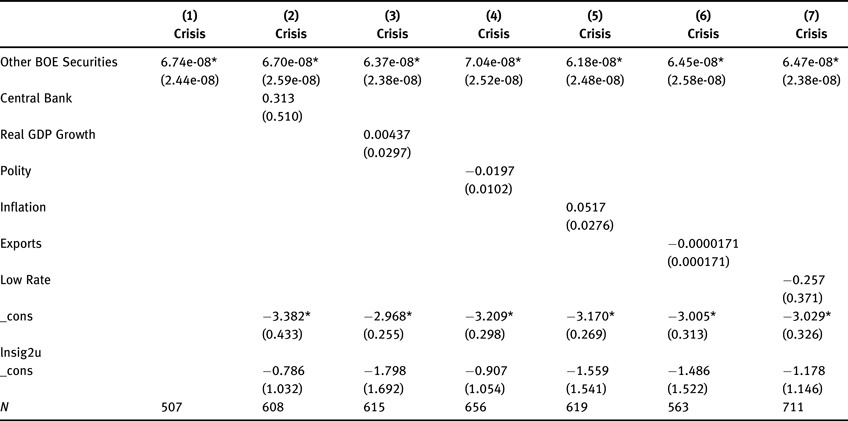
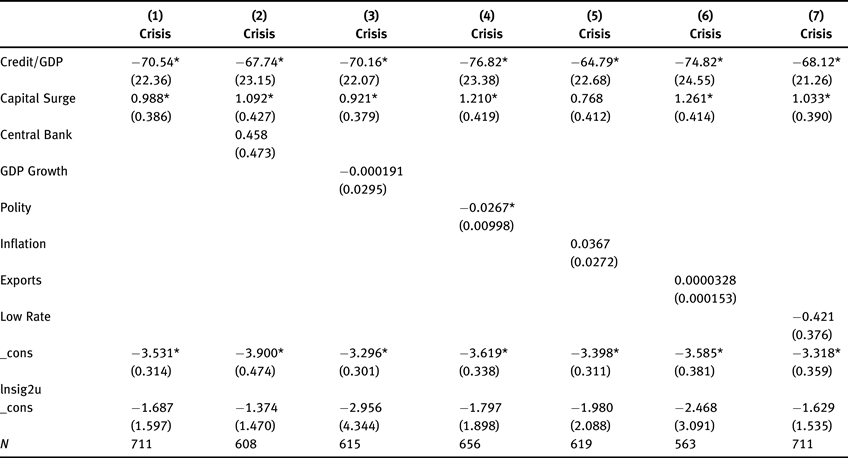
Results are presented in tables 5 and 6. In these tables, both the credit/GDP and “other securities” variables perform as expected. A one million GGB increase in the “other securities” on the BOE balance sheet increases the probability that a country experiences a crisis by .002–.003. Alternatively, an increase of .01 in the credit/GDP ratio decreases the probability of a crisis by .014. As well, the coefficient on the capital flow surge variable is positive and statistically significant in all models except model 5. While this could imply that inflation is a confounding variable, the coefficient on the inflation variable is not significant, so the change in significance is probably attributable to a reduction in sample size. Interpreting the coefficient on the capital flow surge variable implies that when a country experiences a capital flow surge from Great Britain, the probability that it experiences a crisis within two years increases by .05.
Logit Models with Crises & BOE Securities

Standard errors in parentheses.
*p < 0.05
Logit Models with Crises, Credit/GDP & Capital Surge

Standard errors in parentheses.
^** p < 0.05
Taken together, these results lend strong empirical support to the three hypotheses presented above. They suggest that for the years in which the financial cycle in Britain was expanding, and capital flows to peripheral countries surged. Furthermore, countries that experienced an especially large increase in capital flows from Britain were more likely to experience a financial crisis shortly thereafter, particularly when the British financial cycle was contracting.
5 Conclusion
The structure of the international economy and the pattern of economic integration play a crucial role in the timing and prevalence of financial crises. The structure of the international economy determines which countries exert the most financial influence on other countries in the system, and by extension which country has the greatest ability to create the conditions for financial crisis. Developments in the financial cycles of the most central economy can spillover to many other peripheral economies. The long nineteenth century presents an opportunity to test this theory about the systemic determinants of financial crises. Scholars have identified the nineteenth century, particularly 1860–1913, as the first wave of economic globalization, unmatched in terms of the volume of capital flows (as a percentage of GDP). Also during this period, the economy was hegemonically organized. Britain served as the world's largest importer, and was the largest source of foreign investment for many other developed and developing countries in the international system. The evidence cited within suggests that this hegemonic structure of trade and financial relations meant that during the long nineteenth century the financial conditions of Great Britain heavily influenced financial (and to some extent real sector conditions) in peripheral countries, which fostered bubbles and the subsequent financial crises.
While this paper focuses on the dynamics at work in the long nineteenth century, the theory proposed herein is applicable to the contemporary era. The same dynamics at work in the international economy in the long nineteenth century are also at work in contemporary times. Both trade and investment have been centralized in the United States throughout much of the post-WWII period. Though the dynamics are slightly more complex and nuanced given the variety of exchange rates regimes that have prevailed, the economy of the United States has undoubtedly played a role in setting the financial and real sector conditions conducive to crisis in peripheral countries.
Therefore, this study has implications for the politics of international cooperation on financial regulation, monetary policy, and crisis management. It suggests that regulation may matter at the margin, and that countries' macroeconomic policy, and in particular monetary policy, are of greater import for fostering international financial stability. Thus, monetary policy cooperation may indeed be a critical addition to recent efforts to generate a framework for macroprudential regulation. However, this study also implies that achieving greater stability in the international financial system might actually require the imposition of constraints on the largest and most interconnected economies, who, as a result of their position and the privileges the position provides, have little or no incentive to bind themselves.
Furthermore, the dynamics of interdependence highlighted in this paper have critical implications for power in the contemporary international financial system. If the conditions of crisis in a hierarchical or hegemonic system are disproportionately determined by a single or a handful of major economies, as are the economic conditions for recovery and the conditionality of lending assistance, the costs of international economic integration may be far higher for developing and underdeveloped countries than conventionally recognized, and the extent of U.S. and G-7 financial power far greater than is currently acknowledged. Thus, many financial crises may actually serve to reinforce the existing international structure and distribution of power, rather than redefine it.Footnote 49
Lastly, this study implies that a return to the international level of analysis and macro-level causality is warranted and long overdue in the field of political economy. Financial interdependence means that the economic and credit conditions that affect bubbles and crises cannot be isolated at the national level. The causes of financial crises are in fact jointly determined by system and domestic-level factors. As Oatley argues, “a defining characteristic of financial interdependence is the inability to separate the system into independent national units or distinct levels of analysis.”Footnote 50 Instead, we need to think of the international financial system as one unified system, whose dynamics are likely to be disproportionately affected by the largest and most interconnected economies.