1. INTRODUCTION
One significant issue which provokes regular border skirmishes within the discipline of sound art is the incompatibility of the idealist and phenomenological readings of sonic art practice. Seth Kim-Cohen makes the case for the former, arguing that a sound work is constituted not in sound phenomena, but within an expanded field of socially and historically conditioned meanings, a semantic grid of differences (Kim-Cohen Reference Kim-Cohen2009). The latter perspective contrarily asserts that both the subject and the work emerge, not from the semantic grid, but from the listener’s participatory sensory engagement with the world. This view, set out by Salomé Voegelin in her book Listening to Noise and Silence (2010), extols the immediacy of the listening experience over the disengaged ex post facto theoretical descriptions it elicits. Broadly speaking, the idealist is prejudiced against the perceived essentialism that music pedals and the phenomenologist regards the conceptual structures of music as a hindrance to true communion with sound phenomena. At the heart of both philosophies lies a mutually held antipathy for music notation. Voegelin says:
The impulse to subsume sound into the visual is so ingrained as to blight music criticism and the discourse of sound art, whose focus is invariably on the score or the arrangement, on the orchestra or the performer, the sound source, the installation view or the documentation of the sonic event, in short the visual manifestation rather than the sounds heard.
(Voegelin Reference Voegelin2010: xi)
For the phenomenologist, the music score confers an unwanted visuality on sound that necessitates a disengagement from the activity of listening. The charge that Kim-Cohen levels against music is that it is inward looking; it seeks meaning only in its own internal workings. He introduces, as evidence for the prosecution, the exclusionary term ‘extra-musical’:
The intramusical (simply referred to, in music parlance, as ‘music’) is captured either in the inscription of notation or in specifically quantifiable, audible phenomena. Only what avails itself to the assignment of specific musical values (i.e., pitch [and pitch relations], meter, tempo, dynamics, instrumental voicing) is proclaimed internal to the proper concerns of music. All else is extramusical.
(Kim-Cohen Reference Kim-Cohen2009: 40)
Voegelin argues that the score inhibits a true phenomenology of listening. Kim-Cohen regards the score to be the primary site of the musical essentialism he laments. Whether one is more sympathetic to the phenomenologist or idealist perspective, it would appear that notation is a significant casualty of sound’s long journey into art. It is true that music has a history of essentialist ambitions in which the score becomes the sole arbiter of musical meaning. However, contemporary theorists such as Lydia Goehr have moved away from reductive score-centred analysis of musical works (Goehr Reference Goehr2007). They have instead advocated an open historical approach to interpreting works, in which the sociocultural factors that condition the creation, performance and reception of music is taken into account (Goehr Reference Goehr2007). Given that musicologists have already cogently argued against essentialist principles, I will set Kim-Cohen’s objections regarding notation aside. In any case, of the two ideological camps, it is Voegelin’s phenomenology that presents the most testing and thought-provoking challenge to musical notation. For Voegelin, notation functions as text. It is to be read, not perceived, and as such is resolutely conceptual. It is therefore debarred, without hint of reprieve, from the phenomenology of sound art that Voegelin describes. The question that this article seeks to address is whether the marginalisation of notation is a necessary consequence of phenomenological practice.
This article begins by examining the conceptual semiotic structure that underwrites all forms of notation. It then asks whether it is possible for fixed notation to breach its conceptual boundaries and opt in to the lived felt experience in which Voegelin believes sound art to be constituted. Drawing on theories developed by Rudolf Arnheim (Reference Arnheim1974) and Mark Johnson (Reference Johnson1987), I will suggest that the intrinsic dynamic quality of an image, with no semiotic structure to underpin it, may be used to shape musical performance. A case study exploring the practical applications of the outlined theories shall be presented in the form of an original composition. The piece, entitled I Remember It Was Yellow, was written for string quartet and tape. Only those elements of the score developed to confront the issue of notation and phenomenology will be examined. Four supporting audio files are included on the disc accompanying this journal. These audio files present short extracts relevant to the theories discussed. This article seeks to re-enfranchise the score within phenomenological practice. What follows is not a wholesale rejection of the fundamental tenets that theorists such as Kim-Cohen and Voegelin ascribe to music notation but rather an explorative test of their boundaries.
2. WHAT’S THE SCORE?
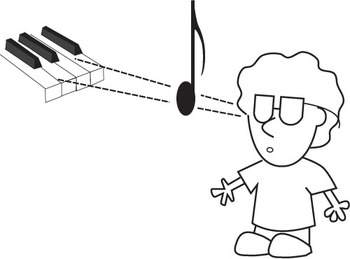
Notation, whether fixed, aleatoric, text, staff or graphic notation mediates between a composer’s intentions and the performer. The printed score employs an inscribed language of signs and symbols that signify or refer to something other than the markings on the page (Figure 1). Performers are expected to bring a surfeit of knowledge and experience to bear on the notation if they wish to render an acceptable interpretation of the composer’s wishes.
Semiotic structure of notation: symbols signify musical concepts.

Without the musical education that provides the conceptual knowledge of what the lines of a musical stave represent, the performer is unable to ‘read’ the intentions encoded in Beethoven’s notation. When a composer uses graphic scores with the express intention of eschewing overly prescriptive performance directions, it is normally expected that the taxonomic void be filled in by the performer. To achieve this, a performer will draw upon the reserve of musical concepts that they do have and explore ways of making suitable links between those concepts and the abstract score that confronts them. The score remains as ‘text’.
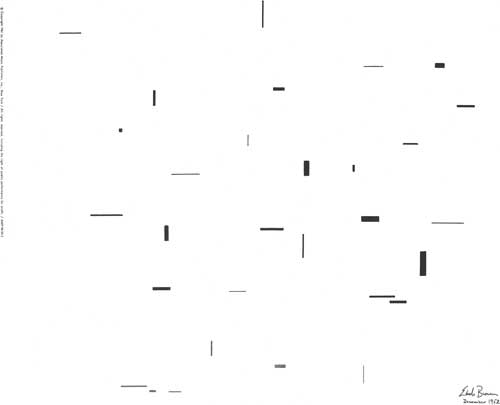
Michael Nyman’s description of John Tilbury’s rendering of Earle Brown’s December 1952 (Figure 2)illustrates the normal strategy of interpreting the ambiguous markings of the score as representative of something other than the markings themselves. ‘[Tilbury] treats the horizontal rectangles as melody, with thickness as intensity and length duration; the vertical blocks are represented by harmony, with width again as intensity and height frequency’ (Nyman Reference Nyman1999: 58).
For Tilbury the notation functions exactly as more conventional notation functions. The markings are symbols, stand-ins for musical concepts gained through experience: melody, duration, harmony, intensity and frequency. Why does Brown not define those criteria directly? The advantage, according to Dick Higgins, of empowering performers to make their own links between notation and musical material was that ‘the most relevant materials for a given time and mentality can be filled in, thus avoiding the appalling irrelevance of perishable materials that are no longer relevant’(Nyman Reference Nyman1999: 58).
Earle Brown December 1952 excerpt from FOLIO (1952/53) and 4 SYSTEMS (1954) 11 15/16 x 16¾ inches. © 1961 by Associated Music Publishers. Print courtesy The Earle Brown Music Foundation.
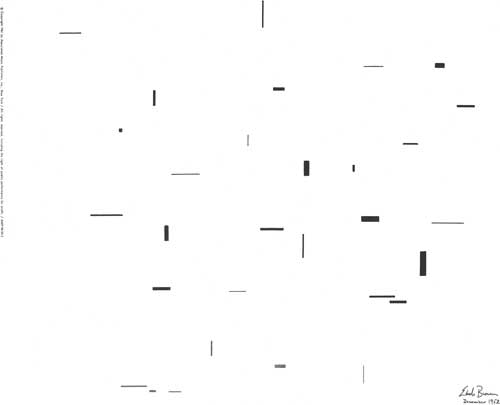
The weight of responsibility for assigning concepts to symbols shifts to the performer and can, as Higgins points out, change with each interpretation to suit changing sociocultural norms (Nyman Reference Nyman1999). However, it is worth restating that the custom of notation as representation is not threatened by this process. Behind both Brown’s mobile scores and conventional staff notation is the idea that a simple line can stand in for a musical concept. In staff notation, the horizontal line is tethered to the concept of pitch: the more elevated the line, the higher the pitch. For Brown’s part he does not prescribe any concept in relation to the horizontal lines in his score December 1952. It is assumed that performers will bring their particular store of concepts to bear on them when preparing the piece. Contrary to Tilbury’s approach, Brown had no desire to fix the work, advocating instead a mobile, dynamic approach to performing the score. The fluidity he advocated, however, was determinedly conceptual. The changeability of the score, according to Brown, depended upon the performer’s ability to mentally move around the fixed graphic, spontaneously and continually amending its meaning (Brown Reference Brown1970). The performer’s capacity for doing so was what he referred to as their ‘conceptual mobility potential’ (Brown Reference Brown1970: 6).
3. CONCEPT VS AFFECT IN MUSICAL NOTATION
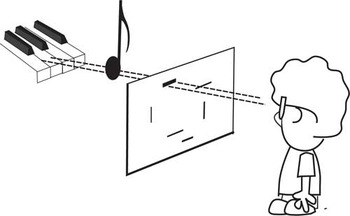
Any metrication of Brown’s score removes the phenomenal experience that the score, taken as a whole, induces in the viewer. Tilbury chooses to ignore the sensorial encounter and, instead, reads the score as if it was an additional layer in the semiotic structure. He binds each line to a set of fixed musical concepts. Abstraction becomes representation (Figure 3).
Abstraction becomes representation: graphic scores add an additional layer to the existing semiotic structure.

The convention, which Tilbury follows in this instance, of reading concepts into music notation, is accompanied by a tacit assumption regarding the limits of notational practice: a fixed image cannot intrinsically hold any of the dynamic properties of ‘live’ performance. Both Voegelin and Kim-Cohen allude to this apparent dichotomy between lifeless musical inscription and vibrant sensory experience. Kim-Cohen regards the performance of a score as an act of ‘reanimating inert matter’ (Kim-Cohen Reference Kim-Cohen2009: 50). Voegelin adopts a similar position when she says ‘The modernist score is autonomous of the sounds potentially produced, which would drag the lines and dots back to life … The actual sounds are uncontrollable, feeble and human, involving the fleshness of living that the score avoids’ (Voegelin Reference Voegelin2010: 59). The printed score, according to both these statements, is lifeless, inert. It acts as a signifier of kinetic energies that it does not itself possess. In what follows, I shall argue that this portrayal of notation is needlessly limiting and disregards what is intrinsic to our perception of visual form.
It is useful to remember that, when first encountered, an abstract image is not read. It is apprehended. The viewer does not initially disassemble an image, pairing off its constituent elements with a list of ready-made concepts. It is given to the viewer in its complete form, none of its parts existing outside of the whole. Disassembling the image, as Tilbury does in the case of December 1952, absents the striking qualitative character of Brown’s score from the resulting performance. In defence of Tilbury’s approach to December 1952, it might be pointed out that allowing oneself to be guided only by the affective quality of the image is impractical and will lead inevitably to the score’s marginalisation and a largely improvised performance. Using a ruler to assign musical concepts to the length, width and spacing of the line segments is, at least, being faithful to the structural integrity of Brown’s image. What is the alternative? How could the abstract image, with no conceptual grounding, meaningfully shape performance? In any case, surely the performer’s store of experiences will, inevitably, flood in to fill any conceptual void left by an abstract image. An improvisation that bears only a superficial relationship to the arrangement of elements in the score is hardly more satisfying than Tilbury’s considered study.
For Voegelin, the sound art object is constituted in the productive phenomenal encounter with the subject and not given by notated authorial diktat. She maintains that:
It is the body that listens and hears and then tries to find language that holds the key to the language sought itself. As fragments this body has abandoned habitual language – it has shot past the collective towards an alien utterance.
(Voegelin Reference Voegelin2010: 69)
Composers continue to notate conceptual, semiotic structure and not the alien utterances of the body. Yet the work, according to Voegelin, is constituted in the living, fleshy body of both performer and listener. A truly phenomenological notation must, therefore, endeavour to communicate using the ‘alien language’ of the body.
Notation is to some extent an intractable obstacle in this exercise. Conventional notation, graphic and text scores have meaning bestowed upon them by pointing to concepts, objects and events beyond the image. Notation lacks the ‘opaque ambiguity’, to use Voegelin’s phrase, of the phenomenal encounter (Voegelin Reference Voegelin2010: 26). On the contrary, it thrives on its permeability, letting the lived world of objects, concepts and ideas seep onto the page. It prescribes, hints at and suggests actions or events to be enacted. It is intentional in that it is about something. It mediates between performer and their store of musical resources.
If, following Gilles Deleuze, we regard the primary currency of art to be affect rather than concept, then we might look again at the role the graphic score plays in shaping the sensory experiences of the performer (Deleuze and Guattari Reference Deleuze and Guattari2003). Music notation, by convention, functions as a written language. The markings of staff notation have long been bound to a catalogue of agreed concepts pertaining to pitch, rhythm dynamics and phrasing. Graphic notation can, like other forms of visual art, deal in affects with no system of representation behind it. However, the abstract state of graphic notation is normally fleeting. Just as Tilbury did with Brown’s December 1952, the performer confers a signifying status upon the abstract image by supplying referents drawn from experience and musical training. But what’s to become of the graphic score if signifier–referent structures are removed? If the notation is not grounded by concepts, whether fixed by the composer or latterly imposed by the performer, how might the score remain meaningful? Abstract art may be used as a jumping off point for performance, as a mood setter. A Jackson Pollock painting will usually tend to elicit a busier, more fractured musical response than a Mark Rothko painting. But in truth, this kind of musical reworking of visual art still depends on fixing concepts such as texture or density to the image. The abstract is rendered representative anew. Notation remains determinedly conceptual. The ‘alien utterances of the body’ that are, according to Voegelin, responsible for conditioning our pre-conceptual, sensorial engagement with sound phenomena continue to elude the practice of music notation.
It is my contention that musical meaning is not predicated purely on conceptual appreciation of note structures or culturally codified norms. It is also rooted in performers’ proprioceptive understanding of their bodies, how the body inhabits the world and the way in which its movement is constrained by the external forces acting upon it. In the next sections I will briefly explore the theory that the body, conditioned by external forces, is at the heart of propositional musical systems. I will then examine how those forces are constituted in conceptual and visual modes of experience before discussing, with the aid of the score for I Remember It Was Yellow, the practical implications these theories afford the art of graphic notation.
4. THE ROLE FORCE STRUCTURES PLAY IN OUR MUSICAL UNDERSTANDING
A cursory survey of the terminology used to verbalise musical experience highlights how much of musical conception is rooted in embodied experience. Our understanding of concepts such as musical ‘gesture’, harmonic ‘tension’ and ‘release’, rhythmic ‘pulse’ or ‘pushing’ and ‘pulling’ the beat is dependent on our having direct bodily experience of interacting forces in our daily lives. This suggests that the terminology we use to describe musical expression reflects the way music is conditioned by our sensorimotor experiences.
It is not just expressive musical terms that bear a relationship to sensorimotor force structures. On the surface music organised around dominant–tonic relationships seems to condition us, through repeated exposure, to directly perceive forceful connections between notes. Individual tones are differentiated according to the force of their relationship to the established tonality. The tonic will be perceptually balanced whereas the leading note is the sonic equivalent of a coiled spring, demanding to be released of its kinetic charge via an upward movement to the equilibrium of the tonic. But what about other musical forms? In cases in which there is no tonality to speak of is the music force-free?
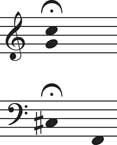
Even in music in which a tonality is absent and the notes appear to float free of any gravitational field, they remain embedded in a perceptually dynamic system. Our working memory frames the context of a note irrespective of the presence of any perceived pattern or progression. Morton Feldman famously eschewed preparatory systems, whether tonal or serial, preferring instead to subvert the binds of pitch relations and compose freely. He said of his compositional style: ‘I make one sound and then I move on to the next’ (Nyman Reference Nyman1999: 53). But how does this apparent conceptual disconnect between notated events play out in our listening experience which seems hardwired to detect patterns? In an essay first published in Perspectives on New Music, Catherine Costello-Hirata discusses the opening two sounds of Feldman’s Last Pieces, a three-note chord followed by a single F (Figure 4). She remarks upon:
being able to focus on the F – in such a way that everything going on between the first chord and the F is somehow projected onto the F, is experienced as part of the sound of the F. And with such a focus, hearing in that F, not a bunch of intervals … rather some special quality. As if that tension between the force of the interval from the C# to the F, and the force of the interval from the C to the F somehow infuses the sound of the F.
(Costello-Hirata 1996: 11)
Opening pitches of Morton Feldman’s Last Pieces.
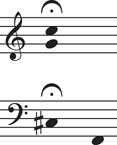
Costello-Hirata appears to suggest that the constellation of forces connecting note events exists in sensory experience even when there is no analytic system present. We do not apprehend static patterns made up of networks of fixed connections in our sensory field. Objects and events fluidly interact in our perception continually modifying our qualitative moment-to-moment experience of the environment. Although the note F has no nominal analytic meaning in Feldman’s opening gesture, it is coloured by and in turn colours the events that frame it. There is no musical schema to account for this interaction, no tonal or conceptual structure to underwrite Costello-Hirata’s qualitative experience. It is affect, with no propositional system at its core.
Costello-Hirata’s account seems to suggest that forces in music may not just be culturally determined but ubiquitous. Are we somehow hardwired to perceive events in our aural field as being bound together by assorted tensions in this way? Invoking biological determinism on the basis of one subjective experience may be stretching the evidence a bit thin, so it is helpful to examine the possible role embodied forces play in determining our conceptual structures generally.
4.1. Force structures and conceptual thought
Voegelin posits that:
Sound is the solitary edge of the relationship between phenomenology and semiotics, which are presumed to meet each other in the quarrel over meaning. It raises questions about their relationship, and how one can function through the other without abandoning itself. Does the latter inform and pre-set the experience of the first, or does the experience invite the latter for consolidation? – In sound they just might not meet at all.
(Voegelin Reference Voegelin2010: 27)
The issue confronting any attempt to devise a notational system that draws upon phenomenology is the ‘edge’ that apparently cleaves phenomenological experience from semiotics. Notation, by its nature is a symbolic language. Is phenomenology abandoned, as Voegelin suggests, once semiotic structure is imposed upon the sensory information issuing from our surroundings? The two, by Voegelin’s reading, may well be irreconcilably conflicted. Yet, for proponents of an embodied theory of cognition, describing the relationship between semiotics and phenomenology as one of perpetual quarrelling understates the reciprocity that binds them together (Freeman and Nunez Reference Freeman and Nunez1999).
In his book Body and Mind, Johnson (Reference Johnson1987) has argued that our ability to encode, store and manipulate mental representations of events and objects in the world, real or imaginary, is underwritten by structures borrowed from regular, repeated interactions with our environment. According to Johnson, how we move through our environment not only shapes what we think about, but also equips us with the structural basis for thought. For example, the reasoning process, Johnson says, takes place amidst a network of force vectors that facilitate or hinder our progress towards conclusion. The vectors that hold between competing arguments are characterised by modal verbs such as ‘may’, ‘must’ and ‘should’. These verbs connote degrees of compulsion or obstruction along a particular path of reasoning, for example, ‘We should take an umbrella as it may rain later.’ Once a proposition is arrived at, we become bounded within the space that the proposition defines. To hold that the proposition is false is to characterise ourselves as being outside the boundary marked out by the proposition. In this way embodied experiences are projected upon rational thought (Johnson Reference Johnson1987).
Embodied theories of the mind, such as Johnson’s, suggest that there is not a gap between semiotic and phenomenological domains, maybe not even an edge, as Voegelin theorises. There is, instead, a fluid, co-dependent chain of causation operating in both directions. Perhaps phenomenology need not be abandoned in favour of semiotics. If mental reasoning and phenomenological experience exhibit a common fundamental structure, then why not employ that structure to mediate effectively between epistemic and phenomenological domains?
It is not particularly newsworthy to performers that there exists a connection between embodied structures, sound and musical concepts. Pianist Gyorgy Sandor placed the link at the core of his musical thinking. In his book On Piano Playing: Motion Sound and Expression, he says: ‘Just as motions and sounds are interrelated, so are motions and emotions. Sounds are the result of motions, and motions must correspond to emotions’ (Sandor Reference Sandor1981: 4).
He is in no doubt that there exists a feedback loop comprising a performer’s movements, sound and their qualitative perceptions. The aim of this article was to examine what role, if any, the score can possibly play within this network. Sound, motion and emotion are in perennial flux. They are, like performance, irreducibly dynamic. A fixed score, however, does not on the surface appear to exhibit those qualities. Both Voegelin and Kim-Cohen have suggested that notation is comparatively lifeless, fixed and insensible. Sandor is not so definitive about the score’s apparent lifelessness. He writes:
The written image of music (the notes) indicates with unequivocal clarity the type of motions (technique) to be employed in the process of performing the music. The notated score establishes an absolutely clear connection between emotions and motions.
(Sandor Reference Sandor1981: 4)
It is striking that Sandor references a strong connection between image, motion and emotion in this passage. It is not clear whether Sandor is claiming that the score is invoking motion via a signifier–referent structure in the way the word ‘motion’ does. He seems to suggest that there is a dynamic quality to the fixed image which corresponds to sensorimotor perception. Sandor apprehends the image in its wholeness and in so doing undergoes a qualitative, dynamic experience that informs his performance. It may be argued that this sentiment is not entirely clear in Sandor’s words, that this is my overly subjective reading of a rather ambiguous statement. Yet it is possible to infer from Johnson’s theories and Costello-Hirata’s testimony that force structures originating in our embodied engagement with the world condition our capacity for inferring patterns within conceptual and acoustic experience. Sandor has implicated sensorimotor perception in the act of reading music notation. Do these same force structures extend to visual perception? If this is the case, I contend that it may be possible to amplify that quality within the performer’s perception of the score in a way that meaningfully shapes performance. In the next section I will examine more closely the sensorimotor foundations of visual perception. I will then present extracts from the score I Remember It Was Yellow. I composed this piece for string quartet and tape in 2012. It was premiered by the Royal Quartet, in Belfast in 2012 and subsequently performed at the Kwartesencja Festival in Warsaw, Poland in 2013.
This project provided an opportunity for investigating possible interconnections between psycho-visual, sensorimotor and aural experiences of force within a working musical ensemble. In order to effectively explore these issues it was desirable that each performer was adept at understanding and using their influence to intervene in a group sound. For this reason, the string quartet format was considered an ideal instrumental ensemble. No traditional instrumental grouping strives for coherence via a more equitable distribution of responsibility. Arnold Steinhardt, violinist with the Guarneri String Quartet, illustrated this point when he wrote that performing with a quartet was akin to:
entering a social unit with no boss, no underlings, and certainly no conductor … The four of us had to search out each other’s strengths and weaknesses to create a working organism that operated in complete freedom from layers of command.
(Steinhardt Reference Steinhardt2000: 88)
In addition to the democratic workings of a quartet, the string instruments themselves afford another advantage for this article. A string player may modulate the sound issuing from their instrument on a moment-to-moment basis in a way that pianists, to take one example, cannot. Once a note is sounded on the piano, the pianist must relinquish control of the tone to the vagaries of instrumental and room acoustics. A violinist, however, can significantly alter the dynamic and timbre of a sustaining tone throughout its duration. The string player’s extended tone control allows them a greater opportunity to respond to the sounds, sights and feelings given by their surroundings. It also grants an observer a larger window in which to gauge those momentary responses.
It is worth reemphasising that the piece is not a clinical study. It was composed for a working quartet and is first and foremost a musical composition. Those parts of the score that directly confront issues pertaining to phenomenology and notation are explored in this article and the corresponding audio provided. Much of the rest of the score uses conventional semiotic systems of notation and will be omitted from discussion. The four audio extracts are taken from a complete performance of the piece.
Before beginning a discussion of the score, it is necessary to touch upon the psycho-visual phenomena that determined the fixed graphics employed within its pages.
4.2. The sensorimotor basis of visual perception
It is natural to assume that the role of the image in art, prior to abstraction, has always been that of signifier of an object, event or person beyond the picture frame. Since the High Renaissance the image has been largely used by the Catholic Church (historically the primary patron of visual art) as a pedagogical tool, a means for expressing the fundamental tenets of the Bible to a largely illiterate flock. The Church recognised, however, that an image held affective potential over and above its straightforward semiotic function.
In his biography of Caravaggio, Andrew Graham-Dixon (Reference Graham-Dixon2011) relates that followers of St Francis of Assisi and St Ignatius Loyola believed that meditation upon an image could conjure up the events of the Bible in the mind’s eye in an actual rather than an abstract way. A worshipper could, through contemplation of an image, project themselves as actors into a biblical scene. The artists, and the church that employed them, believed strongly in the power of the image to invoke deeply felt phenomenal experiences in the viewer. The image, they reasoned, could not just shape a devout Christian’s conceptual appreciation of events in the Bible but also imbue the viewer with the embodied experiences of the protagonists that enacted those very events. Artists endeavoured to enable this process, and move the image closer to actuality, through the development of illusionistic techniques such as perspective. This method of intense visual meditation eventually fell out of favour in the High Renaissance but it illustrates an appreciation of the dynamic quality of an image and its potential for impacting directly the embodied experiences of the viewer.
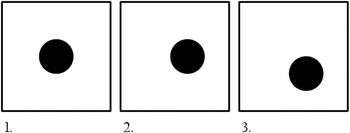
Perhaps it is asking a lot of the contemplative capacities of a contemporary viewer to expect them to share the felt experiences of the figures in a painted biblical scene. This may be why the Mannerists abandoned the practice in favour of a pictorial language that was free to express higher conceptual thought (Graham-Dixon Reference Graham-Dixon2011). However, a case can be made that an image has the capacity to directly shape the viewer’s qualitative experience without any necessary conceptual overlay. The mechanics of visual perception reveal a dependence on the same preconceptual sensorimotor structures that Johnson believes are responsible for reasoned thought and, as is the contention of this article, instrumental to musical performance. As with performance, music and conceptual thought, visual perception is perpetually dynamic. According to perceptual psychologist Rudolf Arnheim, it is ‘first of all, an interplay of directed tensions’ (Arnheim Reference Arnheim1974: 11). Underlying every image is a structural skeleton, an invisible though perceptible network of forces that act upon the viewer’s experience of the image (Figure 6). Our brain not only perceives relationships pertaining to size and location in our visual field, but also perceives tensions acting between those objects. It is as if every ‘thing’ in our visual field has a gravitational force that attracts and repels everything else that is coexistent in that field. Arnheim uses the example in Figure 5 to illustrate the visual phenomenon.
Forces acting in the visual field.

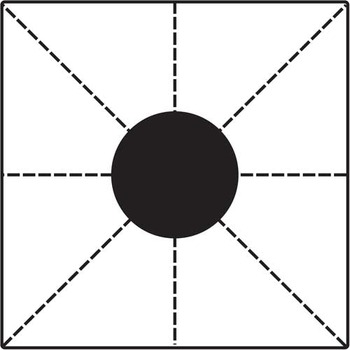
Arnheim points out that tensions can be perceived depending on the position of the black disk in the square. When the circle is located in the centre of the square (image 1), the image appears well balanced and largely static. When the circle is moved to other points in the square (images 2 and 3), changing degrees of perceptible ‘pull’ are exerted upon it, lending the image a more dynamic quality. Arnheim shows that underlying the square is an invisible cross-shaped framework that dictates the degree to which we perceive imbalance in the image. The framework that underlies the central, horizontal and diagonal axes acts as a reference point against which we judge tension or imbalance in the image.
Arnheim’s perceptible framework.

This is strikingly redolent both of tonal music and of Costello-Hirata’s description of her experience of the forces acting between note events in Feldman’s Last Pieces. Arnheim compares the phenomenon in visual perception to the way in which a scale acts as a point of reference against which we judge the individual pitches in a musical composition.
Just as a melody is drawn back towards the chord tones of the tonic, the disc in Arnheim’s image is pulled back toward the axes that the surrounding frame implies. Interestingly, not even when the disc is perfectly centred is there a total absence of forces acting upon it. Perfect balance, Arnheim contests, does not imply an absence of pull but rather implies an equal distribution of forces. There is no overriding pull from any one direction not because there is no pull being exerted but because the pull is equal from all directions. The phrase ‘dead centre’ is a misnomer because the image is never ‘dead’ even when the disc has achieved perfect equilibrium (Arnheim Reference Arnheim1974).
4.3. A dynamic score
When devising the score for I Remember It Was Yellow, I wished to explore ways of establishing links to the pre-conceptual embodied structures that might guide the performance. The qualitative experiences of each member of the quartet, which are the music’s determining factor, are in perpetual flux. Any performance is irreducibly dynamic, moulded by the reciprocal exchange between the performer and their environment. A static image has, as Arnheim has shown, dynamic qualities similarly rooted in bodily movement. It seems that if higher thought, visual perception and performance are all shaped by a common ancestor, namely dynamic embodied experience, it may be useful for graphic scores to appeal directly to this level of experience.
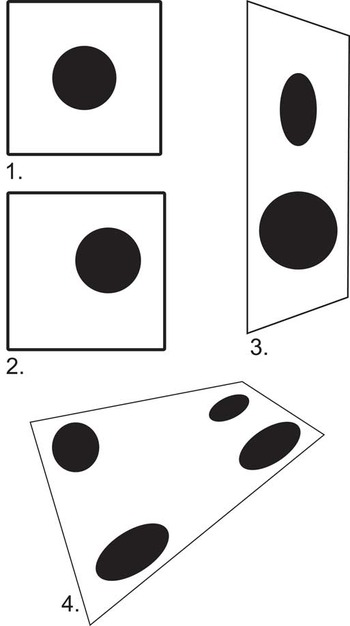
Taking Arnheim’s examples as a point of departure, simple graphics (numbered 1 to 4 below) were created that engaged this basic phenomenon of an image’s intrinsic dynamic qualities (Figure 7).
Four ‘intrinsically dynamic’ images.

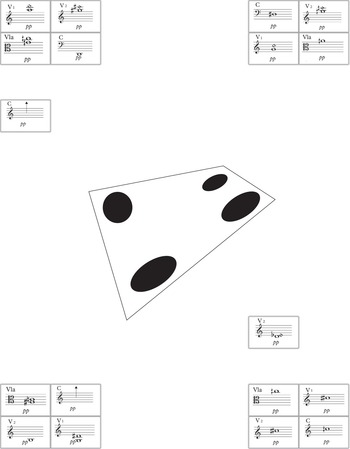
Each graphic is accompanied by a number of chords whose articulation it is supposed to determine (Figure 8). The four audio clips are numbered to coincide with the four images. For example, audio clip number 1 presents a series of chords that were played while the performers were viewing image number 1. Each image is created to directly engage a performer’s preconceptual experience of balance or tension. It does not represent the concept of balance or fix the concept to a discrete scale. The image aspires to directly engage the performer’s sensorimotor, rather than conceptual experience. They function in the same way the Franciscans thought theological paintings should function. The image, when meditated upon, is received not by the higher cognitive faculties but by the nervous system. It actualises balance or tension directly in the performers’ felt experiences, which in turn imbues the chord within their subjective experience with a perceptible tensile quality.
Score Extract from I Remember It Was Yellow (2012).
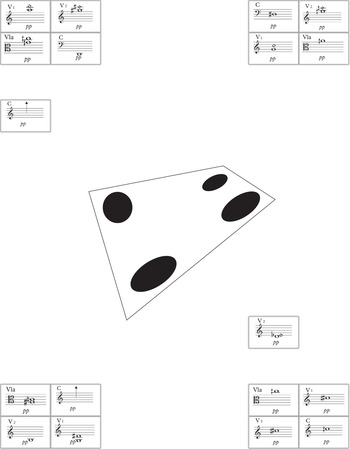
The members of the Royal Quartet, who premiered this work, were very receptive to the graphic elements of the score. I did not discuss with them in any detail about how I wished the sound to be articulated. I emphasised that I was not particularly concerned that I detect any discernible acoustical difference between chords affiliated with different images. I merely wished that they contemplate the image when arriving at a group sound and in so doing establish a degree of reciprocity in their own sensorial experience between the pictorial and acoustical image. When discussing their approach they did, in part, read musical concepts into elements of the images. For example they would assign the more elevated aspects of the image to the violins and the lower elements to the cello. Tension or imbalance tended to be equated with increased vibrato and balance with a ‘purer’ non-vibrato articulation. Part of the point of this notation is to be non-prescriptive. I do not wish to posit any absolutes regarding interpretive strategies but will suggest that the performers need not be so explicit in trying to ‘convey’ imbalance within a chord. It is perhaps sufficient to allow the image to be present in their overall sensible experience. In trying to transmit the qualitative content of their experience, they may be affixing conceptual content to preconceptual phenomena. It is not the intention of the notation that the picture is translated into sound. That would be reminiscent, to a degree, of Tilbury’s approach to interpreting Brown’s score. I wish merely that, through contemplation, the affective quality of the image is assimilated into the performer’s wider qualitative experience. In this way the perceived force structures within an image might resonate sympathetically with the embodied force structures that shape the articulation of a chord in performance.
5. ELEMENTARY EXPERIENCE
On the relationship between notation, words and music Igor Stravinsky remarked:
Sometimes I feel like those old men Gulliver encounters in the Voyage to Laputa, who have renounced language and who try to converse by means of objects themselves. A composer is always in that position: he has no verbal control over his music. Nowadays he tries to talk about it in graphs, statistical charts, symbolic codings, and other devices which may be more efficient – they are certainly more trenchant – than his statements in ordinary verbal syntax, but which bring him no nearer to the music. The one true comment on a piece of music is another piece of music.
(Stravinsky and Craft Reference Stravinsky and Craft1968: 62–3)
Stravinsky is acutely cognizant of the seemingly inexorable divide between graphic markings and the music it represents. In a remark that echoes Stravinsky’s sentiment regarding text and music, Arnheim comments that although a scientist can represent an apple through very fine measurements of size, shape, weight etc., he is precluded from ‘seizing the phenomenon itself’ (Arnheim Reference Arnheim1974: 45). A composer is, in some sense, a scientist in reverse. The composer approaches the intended sound via metric measurements of pitch, rhythm, timbre or any other quantifiable acoustical property they can imagine. Yet, despite Sandor’s discernment of patterns of movement within music scores, the composer does not explicitly aspire to create directly in their notation the dynamic experience of music. However detailed the description, ‘the phenomenon itself’ escapes conventional notational language. Notation instead acts as a road map for performance and, like a map, its utility is dependent upon judicious omissions of experiential information. The only alternative is, Stravinsky claims, another piece of music. At this point notation ceases. Yet is another piece of music, as Stravinsky suggests, the only alternative to the unedifying irrelevance of verbal and notational representation in sonic art?
The issue of effective notation is becoming more pertinent in the light of both contemporary music practice and sound art. In genres of music that limit or actively avoid any form of preparation (notational, verbal or otherwise), the music becomes increasingly reliant on the preconceptual bodily movements of the performers. Derek Bailey identifies ‘the instrumental impulse’ as the underlying force of free improvisation. He says:
It is the attitude of the player to this tactile element, to the physical experience of playing an instrument, to the instrumental impulse which establishes much of the way he plays. One of the basic characteristics of his improvising, detectable in everything he plays, will be how he harnesses the instrumental impulse. Or how he reacts against it.
(Bailey Reference Bailey1992: 97)
Whatever Stravinsky’s misgivings regarding the relevance of symbolic coding to his music, conventional notation does not bring us anywhere near the qualitative experience that personifies Bailey’s improvisations. The tactile, physical impulse that drives Bailey’s improvisations finds no place in any subsequent transcription. Transcription, Bailey said, ‘far from being an aid to understanding improvisation, deflects attention towards peripheral considerations’ (Bailey Reference Bailey1992: xi). During an interview with Henry Kaiser, Bailey expressly said of his practice that ‘I don’t think the grammar lies in the pitch’ (Kaiser Reference Kaiser1975). In a statement that recalls Johnson’s belief in the embodied origins of conceptual structures, Bailey remarked that ‘in free improvisation, you get this purely physical – and I don’t just mean the sort of heavy German strength type thing, but like the nervous system taking over’ (Kaiser Reference Kaiser1975). The ‘non-idiomatic’ structural patterns that characterise Bailey’s music appear to be grounded in structures of bodily interaction with his surroundings. These structures have no need for the conceptual validation that music notation confers. However, notation, or to adopt a more neutral phrase, compositional direction, need not be so hamstrung by the limitations that Stravinsky ascribes it.
Stravinsky has observed that although our methods for information storage and delivery may evolve and our ability to mine statistical data may become more refined, we are not brought any nearer to the music. However, if Stravinsky’s terms of reference are abstracted slightly, a solution may present itself. I will rephrase his aphoristic observation:
The one true comment on a piece of music is another piece of music
as:
The one true comment on one phenomenal experience is another phenomenal experience.
The central tenet of Stravinsky’s remark remains untouched but all of a sudden intrinsic to the statement is a possible solution for composers: one qualitative mode of experience may engage another. This effectively summarises the point of this article and articulates the conclusion that: a visual percept may resonate effectively with the preconceptual embodied structures that guide performance.
In a comment that bears comparison to Bailey’s description of free improvisation, Arnheim characterises the process of visual perception as a disruption of the equilibrium of the nervous system by external worldly forces:
A struggle must result as the invading forces try to maintain themselves against the physiological field forces, which endeavour to eliminate the intruder or at least reduce it to the simplest possible pattern. The relative strength of the antagonistic forces determines the resulting percept.
(Arnheim Reference Arnheim1974: 438)
The antagonistic relationship that Arnheim says exists between ‘invading forces’ and ‘physiological field forces’ has parallels in Bailey’s description of ‘stimulus’, ‘instrumental impulse’ and the guiding role that the nervous system plays in improvised performance. Both are grounded in the dynamic interaction of opposing forces. In neither case is intellectual reflection the primary basis for the experience. The interaction of sensory stimulus and physiological impulse determine the overall structure of both visual and musical phenomena.
6. CONCLUSION
Voegelin regrets the move in music away from acoustic phenomena towards their ‘visual manifestation’ (Voegelin Reference Voegelin2010: xi). Yet, as discussed, the visual need not be an obstacle to a phenomenological approach to sound art. The graphic elements of the I Remember It Was Yellow score attempt to alter the ontological status of the notation. The score strives to become an object in the world that is phenomenally experienced by the performer, taking its place in the expanded web of worldly things: the instrument, the room, the audience, the sights and sounds in which the performer is situated. It is not explicitly a signifier of concepts, actions or objects but a purveyor of affect. Interpreting a graphic score by translating the image into metric data and assigning musical properties to that data reaffirms the assumption that the sensory information issuing from a static image conveys nothing without the viewer’s abstract reasoning to complement it. It is my contention that if the dynamic affect that art trades in is rooted in sensorimotor perception, then it may be worth exploring the embodied structures that are held in common by visual and sonic art. If we take our embodied experience to be the base of the trunk out of which our different modes of perception branch, then we can draw a pathway between visual and aural affects in aesthetic experience. Composers can effectively map features of phenomenal experience in their work. Stravinsky questioned, with some justification, the value of employing words or symbols to comment upon music. However, it may be possible to make effective links between graphic and sonic patterns of organisation at a deeply rooted preconceptual level that eschew the need to overlay them with the signifier–referent systems that Stravinsky lists. The graphic presentation (as opposed to representation) of tension in the score for I Remember It Was Yellow is a modest step in that direction.
Supplementary Material
To view supplementary material for this article, please visit http://dx.doi.org/10.1017/S1355771815000047