Introduction
Insects, with the most species and abundant biodiversity, have evolved two general strategies to cope with habitat changes: diapause and migration, which have been referred to as the ‘here later’ and ‘there now’ strategies (Dingle, Reference Dingle2014). Long-distance migration, a seasonal to and from movement of insects between regions where conditions are favorable or unfavorable, plays a key role in the life-cycle of many insect species (Dingle & Drake, Reference Dingle and Drake2007). Billions of insects migrate (over land, or through air, or across water) within and between continents every year, often responsible for sudden outbreaks of crop pests and insect-vectored plant diseases (Chapman et al., Reference Chapman, Drake and Reynolds2011, Reference Chapman, Reynolds and Wilson2015). A good understanding of insect migration facilitates the development of forecasting systems and management strategies, however the general patterns of how populations migrate across different regions and seasons are largely unknown in most insect species (Stefanescu et al., Reference Stefanescu, Páramo, Åkesson, Alarcón, Ávila, Brereton, Carnicer, Cassar, Fox, Heliölä, Hill, Hirneisen, Kjellén, Kühn, Kuussaari, Leskinen, Liechti, Musche, Regan, Reynolds, Roy, Ryrholm, Schmaljohann, Settele, Thomas, Swaay and Chapman2013).
Heliothis viriplaca (Hüfnagel) (Lepidoptera: Noctuidae), one of the major crop pests in the world, is widely distributed in European, Africa and Asia (Kravchenko et al., Reference Kravchenko, Orlova, Fibiger, Ronkay, Mooser, Li and Muller2005), occupying climates ranging from tropical to temperate (Weigand, Reference Weigand1996; Kahrarian et al., Reference Kahrarian, Ebadi, Seyedol Eslami and Tohidi2012). In China, H. viriplaca is widely distributed from northeastern through central to the Tibetan Plateau, and occasionally the occurrence range can extend to southeastern provinces. There are 2–4 generations of this species each year, increasing as the effective accumulative temperature increases from north to south (He et al., Reference He, Zhang, Huang and Jiang1997). H. viriplaca larvae are polyphagous with 78 host plants including >20 cultivated crops. They mainly damage peas in spring; cotton, maize and soybean in summer; alfalfa, sunflower and sugar beet in autumn; and overwinter as pupae in the soil (Cui et al., Reference Cui, Gai, Ji and Ren1997; He et al., Reference He, Zhang, Huang and Jiang1997; Liu et al., Reference Liu, Zhang, Li, Su, Wu and Zhang2010). It is hard to prevent the damage and to control this pest species because it can silk and roll plant leaves, and it has also developed resistance to chemical pesticides (Mu et al., Reference Mu, Liu, Zhao and Wu2004). In the past decade, a series of major outbreaks of H. viriplaca has been reported in Asian soybean, maize, and chickpea fields, and severe infestations commonly reduce yields by 40–90% (Mu et al., Reference Mu, Liu, Zhao and Wu2004; Liu et al., Reference Liu, Zhang, Li, Su, Wu and Zhang2010; Kahrarian et al., Reference Kahrarian, Ebadi, Seyedol Eslami and Tohidi2012).
Although it is commonly accepted that the wide distribution of H. viriplaca is due to its strong flight ability (He et al., Reference He, Zhang, Huang and Jiang1997), so far there is no direct evidence that this species is a long-distance migrant. And if so, it is still unclear (1) whether the migration of this species is a regular occurrence, and (2) what the pattern and physiological states of seasonal migration is in this species. In the current study, the combination of searchlight trapping and ovarian dissection was used to monitor wind-borne migration of H. viriplaca for 12 consecutive years on a small isolated island located in the center of the Bohai Strait, China. Findings from this study will be helpful in developing sound management strategies against H. viriplaca.
Materials and methods
Searchlight trapping and field observation
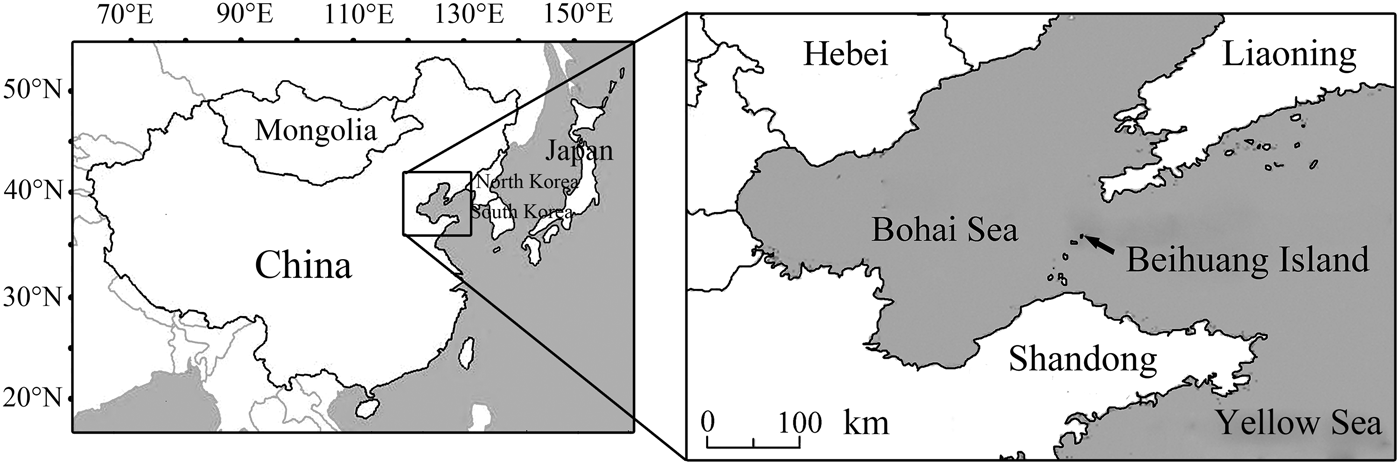
The searchlight trapping studies were carried out each year from April to October 2003–2014 on Beihuang island (BH, 38°24′N, 120°55′E), the northern most island of Changdao county in Shandong province. BH (≈2.5 km2) is located in the center of the Bohai Strait at a distance of ≈60 km from the mainland to the south and ≈40 km to the north (fig. 1). A vertical-pointing searchlight trap was placed on a platform≈8 m above sea level, and was used to attract and capture high-altitude migrants (up to ≈500 m above the ground level; Feng et al., Reference Feng, Wu, Wu and Wu2009). The trap was equipped with a 1000 W metal halide lamp (model JLZ1000BT; Shanghai Yaming Lighting Co. Ltd., Shanghai, China), which produces a vertical beam of light with a luminous flux of 105,000 lm, a color temperature of 4000 K, and a color rendering index of 65.
Maps showing the position of Beihuang (BH) Island, the searchlight trapping site, relative to the Bohai and Yellow Sea.

The searchlight trap was turned on at sunset and turned off at sunrise on all nights from April to October (Zhai, Reference Zhai2004). Incomplete data sets caused by power cuts or heavy rains were excluded from the analysis, while those nights in which the light trapping was carried out normally but no H. viriplaca was captured were given a ‘zero’ count in the analysis. Trapped insects were collected with a nylon net bag (60 mesh) beneath the trap, which was changed manually every 2 h each night. The trapped insects were kept in a freezer at −20°C for 4 h before being identified and H. viriplaca females were dissected.
There are some pine trees and graminaceous weeds on BH, but no arable lands or host crops of H. viriplaca. To confirm whether there is a local population of H. viriplaca (e.g., on the weeds), visual observations were carried out daily to detect larvae of this species on any potential wild host plants from spring throughout autumn 2003–2014.
Ovarian dissection
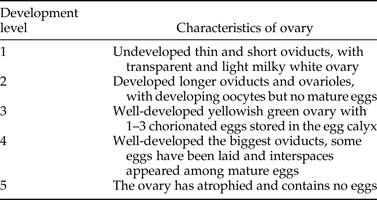
To test the hypothesis of an ‘oogenesis-flight syndrome’, a subsample of 20 H. viriplaca females (or all individuals if the total capture of females was <20) was randomly taken each night, and was dissected under a stereomicroscope (model JNOEC-Jsz4; Motic China Group Co.Ltd., Xiamen, China) to determine the development level of the ovaries from 2009 to 2014. The level of ovarian development 1–5 was estimated according to the criteria described in table 1. These data were used to generate an average monthly level of ovarian development (i.e., the sum of individual levels of ovarian development divided by the number of females dissected). Females with ovarian development level 1–2 were regarded as ‘sexually immature individuals’, and others with level 3–5 were regarded as ‘sexually mature individuals’ (Zhang et al., Reference Zhang, Lu and Geng1979). Moreover, mating frequency and mating occurrences of H. viriplaca were determined by the number of spermatophores in the female spermatheca (Zhang et al., Reference Zhang, Lu and Geng1979).
Criteria of ovarian development level of H. viriplaca moths.

Meteorological data
Daily wind directions on Bohai Strait from May to October 2003–2014 were obtained from China Meteorological Data Sharing Service System (http://cdc.cma.gov.cn/).
Data analysis
Dates of trap catches reported in this paper indicate the period from sunset of that day to sunrise of the next day. Differences in the number of H. viriplaca captured in the searchlight trap, the monthly mean proportion of females, mated females, and sexually mature females (the proportion data were arcsine square root transformed), were analyzed by using generalized linear mixed models, with month as the fixed effect and year as the random effect (Chaves, Reference Chaves2010; Tang, Reference Tang2010; Tang & Zhang, Reference Tang and Zhang2013). If the analysis of variance (ANOVA) indicated a significant difference between months, Tukey's HSD (honestly significant difference) test was employed to distinguish significantly different monthly means. Sex ratio (females: males = 1:1) in each month from 2009 to 2014 was compared using chi-square tests. Differences of the mean proportion between mated and unmated females, sexually mature and immature females, were compared by using t-test (the proportion data were arcsine square root transformed). In order to distinguish mass or weak invasion years, the annual total catches of H. viriplaca were analyzed by hierarchical cluster analysis (clustering distance: Euclidean distance; clustering method: nearest-neighbor method) (Zhang et al., Reference Zhang, Li, Chen, Shi and Song2015). All statistical analysis was performed by SPSS software, except for the sex ratio, which was analyzed by SAS software (SAS Institute, 1990).
Results
Annual and seasonal pattern of migration
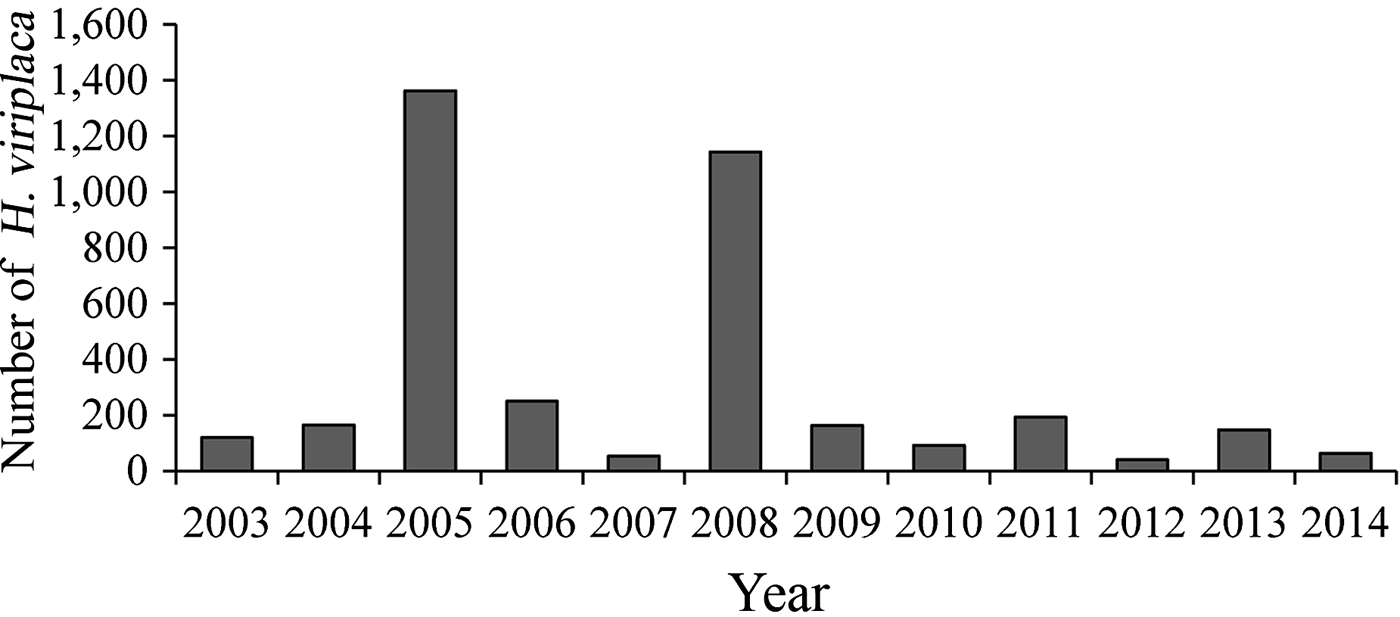
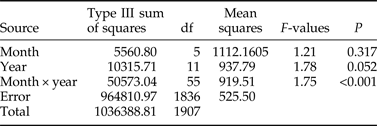
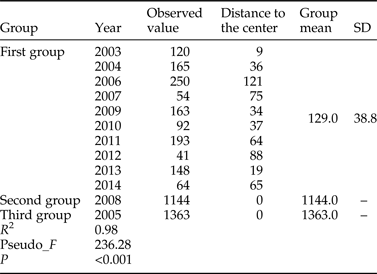
During the study period of 2003–2014, no H. viriplaca larvae were found on BH by field investigations although some graminaceous weeds were available as potential wild host plants. However, H. viriplaca moths were regularly captured in the searchlight trap, which strongly suggests that these moths immigrate from the mainland rather than emerging locally, and that they migrated at least 40–60 km (and probably much greater distances) to reach the trapping site across the Bohai Strait. The strength of this over-sea migration did not differ significantly across years (F 11, 1836 = 1.78, P = 0.052; table 2), but month × year interaction (F 55, 1836 = 1.75, P < 0.001; table 2) was significant. The results of the hierarchical cluster analysis indicated that the annual total trap catches could be divided into three groups – 2005, 2008, and the other 10 years clustered together (table 3). Specifically, mass migrations occurred in 2005 and 2008 (with the annual total catches reaching 1363 and 1144 individuals, respectively), while weak migrations occurred in the other years (with the annual total catches of H. viriplaca ranging between 40 and 250 individuals; fig. 2).
Annual number of H. viriplaca captured in the searchlight trap on BH from 2003 to 2014.

Two-way ANOVA analysis on the number of H. viriplaca captured in the searchlight trap on BH from May to October 2003–2014.

Hierarchical clustering analysis on the annual total numbers of H. viriplaca captured in the searchlight trap on BH from May to October 2003–2014.

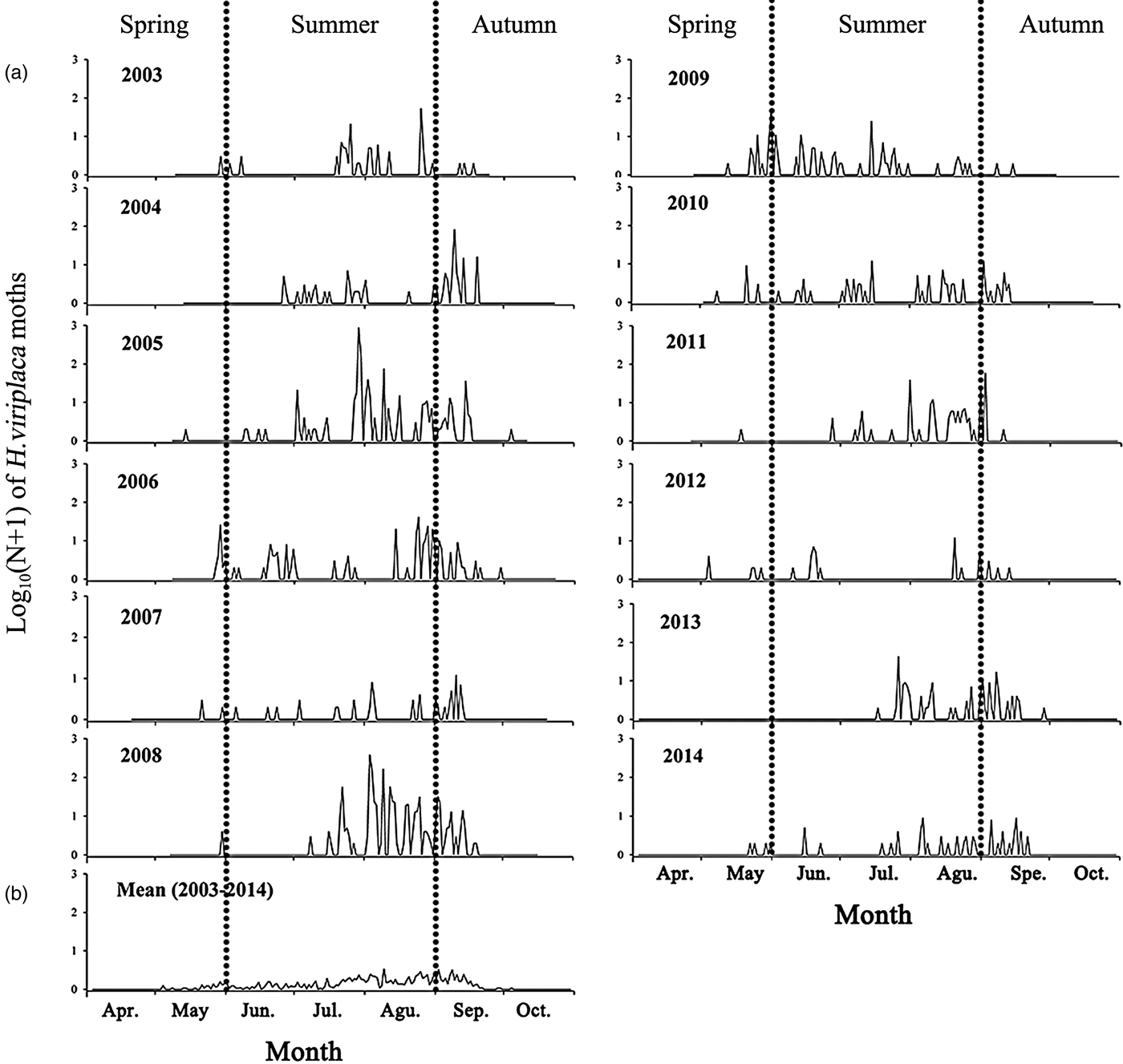
The number of H. viriplaca captured in the searchlight trap was not significantly different across months (F 5, 1836 = 1.21, P = 0.317; table 2 and fig. 3), but month × year interaction (F 55, 1836 = 1.75, P < 0.001; table 2) was significant. Throughout the early summer (May–July), southerly winds (ESE to WSW, 65.4 ± 1.6%) were the prevailing airstream over the Bohai Strait (fig. 4), and the mean proportion of H. viriplaca trapped in this period was 39.83 ± 7.48%. In contrast, throughout the late summer and the autumn (August–October), northerly winds (WNW to ENE, 51.0 ± 2.2%) became the prevailing airstream (fig. 4), and the mean proportion of H. viriplaca trapped in this period reached to 60.2 ± 7.5%.
Nightly catch (a) and annually mean number (b) of H. viriplaca in the searchlight trap on BH from April to October during 2003–2014.

Frequency distribution of wind direction on BH during 2003–2014. Concentric circles indicate the frequency of wind direction, and each circle means difference value of 4% in May, 7% in June, 8% in July, 6% in August, 4% in September, and 3% in October.

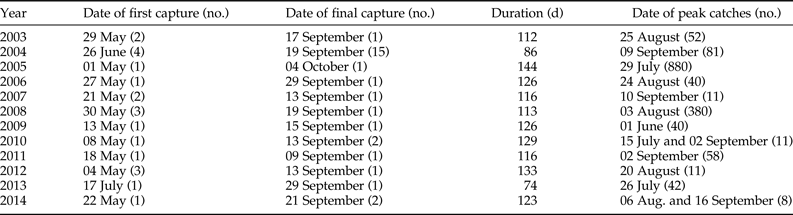
The mean period when over-sea migration was detectable on the island was 116.5 ± 5.6 days (ranged from 74 to 144 days) during 2003–2014, with the earliest and latest trapping occurred on 1May and 4 October 2005, respectively (table 4).
Duration and peak catches of H. viriplaca moths caught in the searchlight trap on BH from May to October 2003–2014.

Sex ratio, mating frequency, and ovarian development
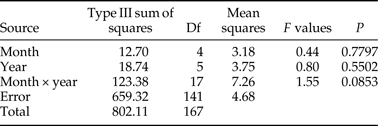
From May to September 2009–2014, the vast majority of trapped H. viriplaca were females (fig. 5a), and the proportion of trapped females was significantly greater than that of males in each month (chi-square tests: May: 60.1 ± 6.8%, χ2 = 11.76, df = 1, P < 0.01; June: 57.9 ± 3.8%, χ2 = 13.13, df = 1, P < 0.01; July: 66.8 ± 1.1%, χ2 = 32.76, df = 1, P < 0.01; August: 66.7 ± 2.37%, χ2 = 34.57, df = 1, P < 0.01; September: 62.2 ± 1.75%, χ2 = 21.62, df = 1, P < 0.01) (fig. 5b). The monthly mean proportion of H. viriplaca females captured in the searchlight trap did not differ significantly across months (F 4, 141 = 0.44, P = 0.780; table 5) or years (F 5, 141 = 0.80, P = 0.550; table 5), and there was no significant month × year interaction (F 17, 141 = 1.55, P = 0.085; table 5) during 2009–2014 (fig. 5b).
Proportion of females (a, b), mated females (c, d) and sexually mature females (e, f) of H. viriplaca captured in the searchlight trap from May to September 2009–2014. The histograms in (a) and (c) indicate the mean proportion in each month. The histograms in (e) indicate the mean ovarian development level in each month. Vertical bars in (a), (c), and (e), represent Standard errors between days in that month. Dots in (b), (d), and (f) indicate the monthly mean proportion from 2009 to 2014. Vertical bars in (b), (d), and F represent Standard errors between years in that month. Single asterisk (*) above a bar in (b) indicates the sex ratio (female: male) was >1:1 in that month at the 5% level of significance as determined by chi-squared test. Single asterisk (*) above a bar in (d) and (f), indicates there was significant difference between the monthly mean proportion of mated and unmated females, and that of sexually mature and immature females at the 5% level of significance as determined by t-test in (d) and (f).

Two-way ANOVA analysis on the monthly mean proportion of H. viriplaca females captured in the searchlight trap on BH from May to September 2009–2014 (the proportions were arcsine square root transformed).

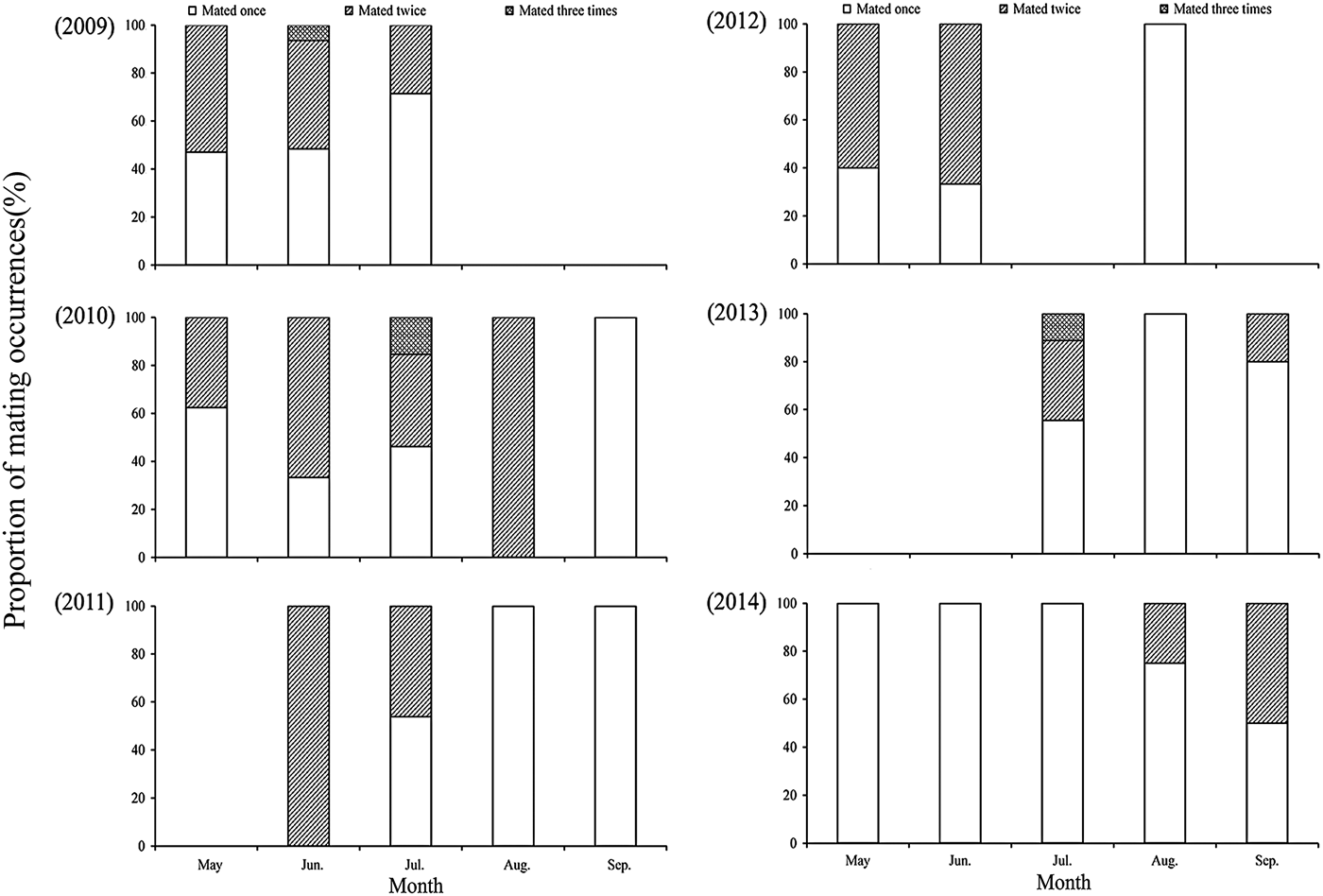
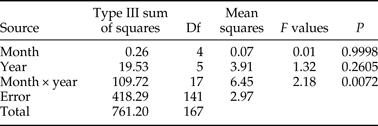
In May and June, most of the trapped H. viriplaca females were mated individuals (May: 90.3 ± 4.0%, t = 5.19, df = 6, P < 0.01; June: 76.2 ± 6.4%, t = 2.59, df = 8, P < 0.01). There was no significant difference between the proportion of mated (45.3 ± 4.1%) and unmated (54.71 ± 4.1%) females in July (t = 0.71; df = 8; P = 0.50). However, in August and September, the majority of the trapped H. viriplaca females was unmated individuals (August: 90.4 ± 1.5%, t = 9.49, df = 10, P < 0.01; September: 93.1 ± 1.0%, t = 10.61, df = 10, P < 0.01). The monthly mean proportion of mated females was not significantly different across months (F 4, 141 = 0.01, P = 0.999; table 6) or years (F 5, 141 = 1.32, P = 0.261; table 6), but month × year interaction (F 17, 141 = 2.18, P = 0.007; table 6) was significant. Overall, the seasonal variation in the mean proportion of mated females showed a significant downward trend from May to September (logistic regression model: y = 96.18/(1+6.01 × 10−5*e 1.41), R 2 = 0.94, n = 5, F = 33.02, P = 0.03) (fig. 5d). The majority (65.1 ± 6.7%) of the mated females had mated once, about a third (33.5 ± 6.6%) had mated twice, only a small proportion (1.4 ± 0.8%) had mated three times, and no individuals mated more than this (fig. 6).
Proportion of mating occurrences of H. viriplaca females captured in the searchlight trap on BH from May to September 2009–2014.

Two-way ANOVA analysis on the monthly mean proportion of mated H. viriplaca females captured in the searchlight trap on BH from May to October 2009–2014 (the proportions were arcsine square root transformed).

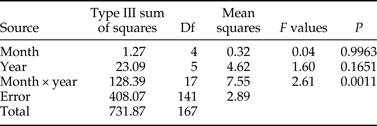
In May and June, the vast majority of the trapped H. viriplaca females were sexually mature individuals (May: 77.4 ± 7.5%, t = 2.52, df = 6, P = 0.04; June: 85.8 ± 3.2%, t = 4.90, df = 8, P < 0.01). There was no significant difference between the proportion of sexually mature (53.2 ± 3.8%) and immature (56.8 ± 3.8%) females in July (t = 0.55; df = 8; P = 0.60). However, in August and September, most of the trapped H. viriplaca females was sexually immature individuals (August: 77.3 ± 2.5%, t = 6.14, df = 10, P < 0.01; September: 86.6 ± 1.8%, t = 6.45, df = 10, P < 0.01). The monthly mean proportion of sexually mature females was not significantly different across months (F 4, 141 = 0.04, P = 0.996; table 7) or years (F 5, 141 = 1.60, P = 0.165; table 7), but month × year interaction (F 17, 141 = 2.61, P = 0.001; table 7) was significant. Overall, the seasonal variation on the mean proportion of sexually mature females showed a significant downward trend (logistic regression model: y = 170.43/(1 + 0.032*e 0.65), n = 5, F = 173.56, P < 0.01, R 2 = 0.99) from May to September 2009–2014 (fig. 5f).
Two-way ANOVA analysis on the monthly mean proportion of sexually mature H. viriplaca females captured in the searchlight trap on BH from May to October 2009–2014 (the proportions were arcsine square root transformed).

Discussion
Migratory insects have been studied for many years because of their economic and ecological importance, and a better understanding of the migration behavior of crop pests is essential for the development of forecasting systems and sustainable Integrated Pest Management strategies (Irwin Reference Irwin1999; Wu & Guo, Reference Wu and Guo2005; Wu et al., Reference Wu, Zhai, Feng, Cheng and Guo2006). H. viriplaca is one of the most destructive crop pests in East Asia, and there has been a long debate about whether this species is a migrant or not (Wu et al., Reference Wu, Xu and Guo1998). In the present long-term study, the results from the combination of searchlight trapping, field investigations and ovarian dissection on BH Island provide direct evidence that H. viriplaca is a long-distance migrant. The seasonal population dynamics of this species observed in this study was similar to previous observations for other migratory insects in the orders of Lepidoptera, Odonata, and Coleoptera made over the sea (Feng et al., Reference Feng, Wu, Cheng and Guo2003, Reference Feng, Wu, Cheng and Guo2004a , Reference Feng, Wu, Cheng and Guo b , Reference Feng, Wu, Ni, Cheng and Guo2005, Reference Feng, Wu, Ni, Cheng and Guo2006, Reference Feng, Zhao, Wu, Wu and Wu2008, Reference Feng, Wu, Wu and Wu2009; Wu et al., Reference Wu, Xu and Guo1998, Reference Wu, Zhai, Feng, Cheng and Guo2006).
The East Asian monsoon airflows in temperate regions provide an advantageous carrier for long-distance insect migration (Drake & Farrow, Reference Drake and Farrow1988). In the semi-arid temperate climate zone (Liaoning province, which is located to the north of BH), the average of daily minimum temperature in April is generally <6°C. Given the low temperature, H. viriplaca moths cannot overwinter or produce a new generation in spring (Kahrarian et al., Reference Kahrarian, Ebadi, Seyedol Eslami and Tohidi2012). In the current study, H. viriplaca moths could be captured on BH island as early as May, and considering the prevailing southerly winds during this season, these individuals should be coming from the mainland in south of BH by windborne migration, in order to exploit temporary habitats in northeastern agricultural regions of China, while the spring maize and soybean widely planted there plays an important role in the survival of H. viriplaca larvae. Similar wind-related migration has been observed in Helicoverpa armigera (Hübner), Spodoptera exigua Hübner, Mythimna separata (Walker), and Loxostege sticticalis L. at the same site (Feng et al., Reference Feng, Wu, Cheng and Guo2004a , Reference Feng, Wu, Cheng and Guo b , Reference Feng, Wu, Ni, Cheng and Guo2005, Reference Feng, Zhao, Wu, Wu and Wu2008, Reference Feng, Wu, Wu and Wu2009).
In autumn (August–October), prevailing northerly winds, caused by the prevailing temperature gradient, blowing from east Siberia to northern China, and the updraft airflows that generally occur in the northeastern agricultural region of China, promote large number of offspring produced by summer breeders emigrating to the south. Characteristics of the backward migration observed in the present study were rather similar to those windborne migrations of Empoasca fabae (Harris) (Taylor & Reling, Reference Taylor and Reling1986), Nilaparvata lugens (Stål) (Riley et al., Reference Riley, Reynolds, Smith, Rosenberg, Cheng, Zhang, Xu, Cheng, Bao, Zhai and Wang1994), Cnaphalocrocis medinalis Guenée (Riley et al., Reference Riley, Reynolds, Smith, Edwards, Zhang, Cheng, Wang, Cheng and Zhai1995), Agrotis ipsilon (Rottemberg) (Showers, Reference Showers1997), Vanessa atalanta (L.) (Mikkola, Reference Mikkola2003), M. separata (Feng et al., Reference Feng, Zhao, Wu, Wu and Wu2008), H. armigera (Feng et al., Reference Feng, Wu, Wu and Wu2009), and Autographa gamma (L.) (Chapman et al., Reference Chapman, Bell, Burgin, Reynolds, Pettersson, Hill, Bonsall and Thomas2012), and it has been postulated that this behavior facilitated return movements to the southern overwintering areas of these species. Understanding the seasonal migration pattern of H. viriplaca is also of economic importance, as this species becomes a major pest in many Asian crop fields during outbreak years. Just how representative H. viriplaca is of other migrant insects is a matter for further study, but given the similarities in the migration strategies of H. viriplaca to those of other insects in Asia, it is very likely that the results of this study will be applicable to a wide range of migrants.
The monthly mean proportion of mated females and that of sexually mature females showed a significant downward trend from May to September 2009–2014. Trapped females in May and June showed a relatively higher mating rates and some degree of ovarian development when compared with July, August, and September, which might be due to these moths emigrating from sites far away from the trapping site and therefore having several successive nights of migration. This trend was similar to previous observations in M. separata (Zhao et al., Reference Zhao, Feng, Wu, Wu, Liu, Wu and McNeil2009), Athetis lepigone (Fu et al., Reference Fu, Liu, Li, Ali and Wu2014), S. litura (Fu et al., Reference Fu, Zhao, Xie, Ali and Wu2015), A. ipsilon (Liu et al., Reference Liu, Fu, Feng, Liu and Wu2015), Agrotis segetum (Guo et al., Reference Guo, Fu, Wu, Zhao and Wu2015), Mamestra brassicae (Wu et al., Reference Wu, Fu, Guo, Zhao and Wu2015) and Ctenoplusia agnata (Li et al., Reference Li, Fu, Feng, Ali, Li and Wu2014) at the same site. However, the majority of the trapped H. viriplaca females from August to September have little or no ovarian development, supporting the idea that the onset of migration is initiated by sexually immature individuals (Riley et al., Reference Riley, Reynolds, Smith, Edwards, Zhang, Cheng, Wang, Cheng and Zhai1995). The relationship between long-duration flight and the state of oogenesis appears to be similar to that of A. ipsilon in North America (Showers, Reference Showers1997). Here the northward-moving spring migrants developed reproductively, and it was suggested that there was no need to shut down reproductive development because the movement takes place rapidly, aided by the low-level jet stream. The southward movement in autumn is generally much slower (8–15 nights) due to the slow-speed winds, and in this case the moths may enter reproductive diapause (Showers, Reference Showers1997).
The current study provides direct evidence that H. viriplaca can migrate across the Bohai Strait, thus the hypothesis that H. viriplaca is a long-distance migrant is confirmed. These findings will contribute to a better understanding of the occurrence of this species in northern China, and also to make managing this pest more efficient. However, further study is needed to characterize the population dynamics of H. viriplaca on the Chinese mainland. In addition, migration behavior in high-altitude and trajectory analysis would be beneficial to determine the seasonal pathway of this pest.
Acknowledgements
The authors thank Jianglong Guo, Xiao Wu, Hong Chang, and Limei He from Institute of Plant Protection, Chinese Academy of Agricultural Sciences; Ning Liu, HaoHao Li from College of Plant Protection, Henan Agricultural University; and Congzheng Yuan, Shengyuan Zhao from College of Agronomy and Plant Protection, Qingdao Agricultural University, for their contributions in field investigation. This research was supported by Special Fund for Agro-scientific Research in the Public Interest of China (grant number 201403031).