Introduction
Strontium (Sr2+) treatment is well known as very effective in activation of the oocytes and thus used practically after nuclear transfer or microinjection of specific-stage spermatozoa such as round spermatids that are deficient or insufficient in their ability to activate oocytes. It has been reported that Sr2+ supports and/or positively affects the sperm-related physiological and morphological responses, such as the capacitation, acrosome reaction, hyper-activation, and penetration into the oocyte in the guinea pig, hamster, human, and mouse (Yanagimachi & Usui, Reference Yanagimachi and Usui1974; Yanagimachi, Reference Yanagimachi1978; Mortimer, Reference Mortimer1986; Fraser, Reference Fraser1987; Mortimer et al., Reference Mortimer, Chorney, Curtis and Trounson1988; Stock & Fraser, Reference Stock and Fraser1989; Magnus et al., Reference Magnus, Brekke, Abyholm and Purvis1990), when substituted for calcium ions in the medium. There is, however, no report of how Sr2+ affects spermatozoa of domestic animals including the pig.
The pig would be an excellent model for certain human biomedical approaches, i.e. xenotransplantation, stem cell technologies, and so on (Prather et al., Reference Prather, Hawley, Carter, Lai and Greenstein2003). Of these, embryonic stem cell (ESc) technologies would be an important step to achieve the above purpose. Such research, however, requires a great number of high-quality embryos (i.e. blastocysts). For this purpose, in vitro production of embryos using in vitro fertilization is a convenient way for most laboratories. There are very few satisfactory protocols for in vitro production of embryos in this species, because of problems associated with polyspermy. For this reason, intracytoplasmic sperm injection (ICSI) that can result in monospermic fertilization is expected as a reliable and extensive application. Moreover, the ICSI procedure excludes some polyspermic oocytes that develop into blastocysts with abnormal chromosomes (McCauley et al., Reference McCauley, Mazza, Didion, Mao, Wu, Coppola, Coppola, Di Berardino and Day2003). As reported thus far, the efficiently of ICSI in the pig is still not satisfactory and this approach requires certain improvements.
In the present study, we investigated whether Sr2+ affects the boar spermatozoa as in other species, i.e. the viability and acrosome morphology of spermatozoa incubated with Sr2+ were examined using the fluorescence staining and electron microscopy. Second, the spermatozoa treated with Sr2+ were injected into porcine oocytes matured in vitro, and the fertilization, cleavage, and subsequent development following sperm injection were examined.
Materials and Methods
All chemicals and reagents were purchased from Sigma-Aldrich unless stated otherwise. For electron microscopy, all chemicals were purchased from Electron Microscopy Sciences, unless otherwise stated.
Sperm preparation
Sperm preparation was performed as described previously (Okada et al., Reference Okada, Krylov, Kren and Fulka2006). The commercial extended boar semen (stored maximally for up to 5 days at 17–18 °C; Selko) was centrifuged at 210 g for 10 min. After centrifugation, the sperm pellet was loaded with some volume of extended medium onto a discontinuous gradient of 2 ml of 90% and 5 ml of 45% isotonic Percoll (Amersham Pharmacia Biotech AB, Uppsala, Sweden) prepared with Dulbecco's phosphate-buffered saline (PBS) in a 15 ml centrifugation tube and then centrifuged at 640 g for 15 min. The spermatozoa were recovered and then washed twice in PBS containing 0.01% polyvinyl alcohol (PBS-PVA) by centrifugation at 210 g for 10 min. The sperm pellet was resuspended in 0.5–1 ml of Ca2+-free modified Tris-buffered medium (mTBM: 113.1 mM NaCl, 3 mM KCl, 20 mM Tris, 11 mM glucose, and 5 mM sodium pyruvate supplemented with 2 mg/ml BSA). The sperm suspension was diluted with 0.5 ml of each experimental medium to give a final concentration of 2 × 10⁶ cells/ml, and spermatozoa were incubated for 1–2.5 h before use (see results).
Evaluation of sperm viability
The viability of boar spermatozoa was evaluated according to the method of Harayama (Reference Harayama2003) using the LIVE/DEAD Sperm Viability Kit (Molecular Probes, Inc.). Briefly, after incubation with Sr2+ or Ca2+ for 1–2.5 h, 500 μ l of sperm suspension (concentration: 2 × 10⁶ cells/ml) was stained with 0.2 μ M SYBR14 for 10 min and subsequently with 12 μ M propidium iodide (PI) for 10 min at 38.5 °C. After staining, the suspension was centrifuged at 700 g for 5 min and the supernatant was removed to concentrate the cells (approximately 2 × 10⁷ cells/ml). The evaluation was carried out under an epifluorescence microscope (BX61: Olympus Europa GMBH, Hamburg, Germany). One hundred spermatozoa from each sample were counted to determine the percentage of PI-negative (live) and positive (damaged or dead) spermatozoa.
Transmission electron microscopy
After incubation with Sr2+ or Ca2+ for 1 h, each sample of spermatozoa was fixed in 2.5% glutaraldehyde (pH 7.2) for 2 h and post-fixed in 1% OsO4 containing 0.1 M cacodylate buffer for 60 min. The samples were then dehydrated through ethanol series, infiltrated in propylene oxide and embedded in epoxy resin (Durcupan® ACM Fluka). Ultrathin sections (70 nm) were stained with uranyl acetate and lead citrate. Electron micrographs were taken on a Zeiss EM-900 electron microscope (Carl Zeiss). One hundred sperm heads were assessed in each sample. According to Szollosi & Hunter (Reference Szollosi and Hunter1978) and Stock & Fraser (Reference Stock and Fraser1989), each cell was classified into one of the following four stages: Stage 1, intact acrosome: spermatozoa with the plasma membrane separated from the acrosome were classified as intact spermatozoa, as the membrane separation might be an artifact (Jones, Reference Jones1973); Stage 2, initial stage of acrosome reaction (slight swelling of acrosome); Stage 3, advanced stage of acrosome reaction (swelling of acrosome and lacking of the acrosome contents); Stage 4, completed stage of acrosome reaction (exposed inner acrosome membrane except in the equatorial segment).
Oocyte collection and maturation
Pig ovaries were collected from prepubertal gilts at a local abattoir and transported to the laboratory in PBS-PVA at 30–35 °C. After three washes in PBS-PVA, healthy looking antral follicles that were 4–6 mm in diameter were dissected from ovaries using the technique described by Moor & Trounson (Reference Moor and Trounson1977). The follicles were opened in HTF–HEPES medium (Cambrex Bio Science) supplemented with 2 mg/ml bovine serum albumin (BSA; essentially fatty acid free) and 50 μg/ml gentamicin (Gibco Invitrogen), and oocyte-cumulus-granulosa cell complexes (OCGCs) were isolated from follicles. Groups of 20–35 OCGCs were cultured in 500 μl of bicarbonate-buffered medium 199 supplemented with 4 mg/ml of bovine serum growth proteins (Sevapharma), 0.5 μg/ml FSH (from porcine pituitary), 0.5 μg/ml LH (from ovine pituitary), 40 μg/ml sodium pyruvate, 70 μg/ml l-cysteine, and 50 μg/ml gentamicin in 4-well dishes (Nunc) (Krylov et al., Reference Krylov, Kren, Okada, Vackova, Tlapakova and Fulka2005). The OCGCs were cultured in a humidified atmosphere of 5% CO2 in air at 38.5 °C for 44–48 h. After culture, OCGCs were recovered and treated with 0.01% hyaluronidase to remove the cumulus cells. The oocytes were then denuded completely by pipetting with a small-bore pipette. Oocytes that showed a normal morphology with a polar body were selected and used for sperm injection.
Sperm injection and examination of fertilization
Microinjection was performed under an inverted microscope (IX71, Olympus Europa GMBH) equipped with Narishige micromanipulators (Narishige Co. Ltd) and the Cell Tram Oil microinjector (Eppendorf AG). For the manipulation, two 3 μl drops of Sydney IVF polyvinylpyrrolidone solution (10% PVP; COOK Australia) were placed on the lid of a plastic dish, and a 20 μl drop (for washing pipette) and several 10 μl drops (for injection) of HTF–HEPES medium surrounded the PVP drops. All drops were covered with paraffin oil (Carl Roth). Three microlitres of sperm suspension were then transferred into a PVP drop (final concentration of spermatozoa and PVP: 1 × 10⁶ cells/ml and 5%, respectively). Ten to 15 oocytes were transferred to the medium drops and their manipulation was completed within 20 min. For sperm injection, a single motile spermatozoon was immobilized by hitting the midpiece with the injection pipette and the spermatozoon was then aspirated, tail first, into the pipette in a PVP drop. The pipette was moved to a drop of the HTF–HEPES medium, and the spermatozoon was microinjected conventionally into the oocyte (pipettes; Microtech IVF). Sperm injection was performed as described previously by Kolbe & Holtz (Reference Kolbe and Holtz1999) and Katayama et al. (Reference Katayama, Sutovsky, Yang, Cantley, Rieke, Farwell, Oko and Day2005). As a control in all experiments, some oocytes were sham-injected using the same procedure but without a spermatozoon.
The injected oocytes were cultured in porcine zygote medium supplemented with 3 mg/ml BSA (PZM3: Yoshioka et al., Reference Yoshioka, Suzuki, Tanaka, Anas and Iwamura2002) for 18–20 h. Oocytes were then mounted on slides, fixed in an acetic acid–ethanol (1:3, v/v) solution for 36–48 h, and stained with 1% aceto-orcein. The rates of fertilization and the status of the sperm head were examined. Oocytes were defined as fertilized normally when they contained a fully decondensed male and female pronucleus with two polar bodies.
Development of injected oocytes
The injected oocytes were cultured as described previously (Okada et al., Reference Okada, Krylov, Kren and Fulka2006). Briefly, after injection, any oocytes with signs of degeneration were excluded from subsequent culture and the remaining oocytes were cultured in 500 μl of PZM3 for 7 days. Embryos were transferred into a fresh medium on days 2 and 4. From days 4 to 7, PZM3 supplemented with 10% fetal bovine serum (Gibco Invitrogen), instead of BSA, was used. Cleavage of embryos and development to the blastocyst stage were evaluated on days 2 and 7, respectively. After culture, blastocysts were fixed in PBS–PVA containing 4% paraformaldehyde, stained with SlowFader Gold antifade reagent with DAPI (Molecular Probes Inc.) and the number of nuclei was counted under an epifluorescence microscope. In the present study, blastocysts with a cell number of more than 20 were considered normal.
Statistical analysis
The data shown in the tables were pooled from at least three experiments. Data for sperm assessments were analysed by one-way analysis of variance (ANOVA) and Tukey's test as a multiple comparison procedure using the Statcel program (OMS Publishing Inc.). Data for the fertilization and development after ICSI were analysed using the chi-squared test. A p value < 0.05 was considered statistically significant.
Results
Sperm viability and acrosome morphology after incubation with divalent cations
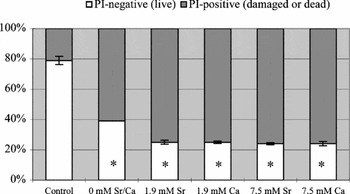
Before incubation, 79% of spermatozoa were classified as PI-negative (live) (Fig. 1, control). After incubation for 1–2.5 h in mTBM supplemented with 0 (no divalent cations), 1.9, and 7.5 mM SrCl2, or 1.9 and 7.5 mM calcium chloride (CaCl2), 39%, 25%, 25%, 24%, and 24% of incubated spermatozoa were classified as PI-negative (p > 0.05), respectively. These values were significantly lower than the control (p < 0.05).
The viability of boar spermatozoa before and after incubation with divalent cations. In total, 300 spermatozoa were examined in each sample (n = 3). Propidium iodide (PI)-negative and -positive indicate live and damaged/dead spermatozoa, respectively. Control: non-incubated spermatozoa. Values are mean % ± SEM. *p < 0.05 compared with control.

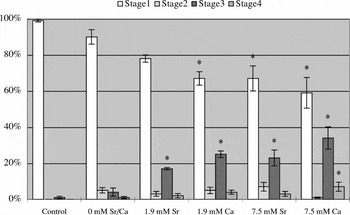
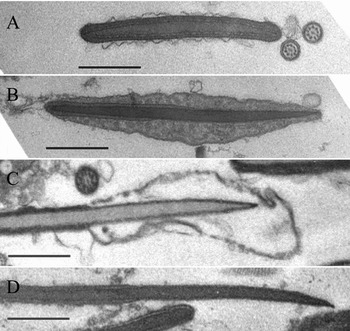
The occurrence of acrosome reaction evaluated by transmission electron microscopy (TEM) is summarized in Fig. 2. The total proportion of spermatozoa that had initiated the acrosome reaction (Fig. 3b–d: Stages 2–4) was lower in cation-free medium (0 mM, 10%) than in Sr2+- or Ca2+-containing medium after incubation. There was no significant difference in percentage of spermatozoa initiating the acrosome reaction (Stages 2–4) between divalent cations-treated groups (1.9 and 7.5 mM SrCl2, 22% and 33%; 1.9 and 7.5 mM CaCl2, 33% and 41%, respectively). When comparing the use of Sr2+ with Ca2+ at the same concentration, Ca2+ tended to promote the response for Stage 3 (1.9 mM SrCl2 and CaCl2, 17 and 25%; 7.5 mM SrCl2 and CaCl2, 23 and 34%, respectively) and Stage 4 (2 and 4%; 3 and 7%, respectively).
Transmission electron microscopy of the acrosome status of boar spermatozoa before and after incubation with divalent cations. In total, 300 spermatozoa were examined in each sample (n = 3). Stage 1: intact acrosome; Stage 2: initial stage of acrosome reaction; Stage 3: advanced stage of acrosome reaction; Stage 4: completed stage of acrosome reaction; Control: non-incubated spermatozoa. For a description and images of each stage, see Materials and methods, and Fig. 3, respectively. Values are mean % ± SEM. *p < 0.05 compared with control.

Transmission electron micrographs of extended boar spermatozoa before (a) and after incubation with 7.5 mM SrCl2 (b–d) at different stages of acrosome reaction. (a) Stage 1: spermatozoa with intact acrosome; (b) Stage 2: initial stage of acrosome reaction; (c) Stage 3: advanced stage of acrosome reaction; (d) Stage 4: completed stage of acrosome reaction. Scale bars represent 1 μm. For the description of each stage, see Materials and methods.

Microinjection of boar spermatozoa incubated with Sr2+ and their subsequent development
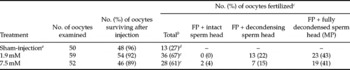
The spermatozoa incubated with Sr2+ were injected conventionally. Fifty (sham-injected control), 59 (Sr2+ 1.9 mM), and 52 (Sr2+ 7.5 mM) oocytes were injected and subsequently 48 (96%), 54 (92%), and 46 (89%) oocytes, respectively, survived. Following the injection of spermatozoa incubated with 1.9 or 7.5 mM SrCl2, 67% and 61% of injected oocytes were fertilized, and subsequently 43% and 41%, respectively, contained a fully decondensed sperm head (Table 1). Sham-injected oocytes were activated at a significantly lower rate than the Sr2+-treated groups (27%, p < 0.05). Thus, the 1.9 mM SrCl2-treated group was chosen for the examination of development followed by ICSI.
Microinjection of the boar spermatozoa incubated with SrCl2

aOocytes were injected in the same manner but without a spermatozoon.
bValue of sham-injection is the number of oocytes activated.
cPercentage value represents the number of oocytes that survived. FP: fully developed female pronucleus, MP: fully developed male pronucleus.
d ,e Values within a column with different superscripts are significantly different (p < 0.05).
After injection of spermatozoa treated with 1.9 mM SrCl2, oocytes were cultured in PZM3 up to 7 days. On day 2 after sperm injection, 45% of the injected oocytes cleaved (Table 2). These injected oocytes cleaved at a significantly higher rate than sham-injected oocytes (15%, p < 0.05). After 7 days, 18% (mean cell number: 53 ± 7) of the injected oocytes developed to the blastocyst stage. None of sham-injected oocytes developed to the blastocyst stage.
In vitro development of the oocytes injected with boar spermatozoon incubated with 1.9 mM SrCl2

aOocytes were injected in the same manner but without a spermatozoon and then cultured.
bCleavage of embryos and development to the blastocyst stage were evaluated on days 2 and 7, respectively.
cOthers represent normal or expanding blastocysts.
dMean ± SEM.
e,fValues within a column with different superscripts are significantly different (p < 0.05).
Discussion
In mammalian spermatozoa studied thus far, the presence of Sr2+ in Ca2+-free medium supports sperm-related responses such as capacitation, acrosome reaction, penetration, and so on. It has been reported that when human spermatozoa were incubated in Sr2+-containing medium for 20 h and then co-cultured with zona-free hamster eggs for 2–3 h, the penetration rate was significantly higher than with Ca2+ supplementation (Mortimer, Reference Mortimer1986). Our experiments show that Sr2+ itself acts on boar spermatozoa in a manner similar to Ca2+, as the number of living spermatozoa incubated in divalent cation-free medium (PI-negative, 39%) tended to be higher than for the Sr2+-treated groups (p > 0.05). The results of our TEM study confirmed that the presence of divalent cations (7.5 mM SrCl2, 1.9 and 7.5 mM CaCl2) resulted in a significantly higher proportion of boar spermatozoa that initiate and/or undergo the acrosome reaction after the incubation than control group. Regarding the possibility that Sr2+ might be able to support the acrosome reaction, we noted variable results depending on the concentration of divalent cations. Our data provide the evidence that the percentage of acrosome reacting/reacted cells (Stages 2–4) was not significantly different between the groups treated with divalent cations, with the exception of 1.9 mM SrCl2- and 7.5 mM CaCl2-treated groups at Stage 3 (17% and 34%, respectively, p < 0.05). These results are in agreement with TEM observations in human spermatozoa (Stock & Fraser, Reference Stock and Fraser1989), who found that the proportion of acrosome-reacted cells in 1.8 mM SrCl2 was slightly lower (6 h, 9.6%; 24 h, 12.5%) than that in 1.8 mM CaCl2 (6 h, 12%; 24 h, 14%). Our result using a higher concentration (7.5 mM) of divalent cations shows that the percentage of acrosome reacting/reacted cells (Stages 2–4) in the Sr2+-treated group (33%) was lower than in the Ca2+-treated group (41%), although there was no significant difference between these groups. In the mouse, Sr2+ induces capacitation and acrosome loss efficiently with the same effectivity as Ca2+ (Fraser, Reference Fraser1987). Thus, the Sr2+ sensitivity of spermatozoa may be different among species, as mouse oocytes can be more effectively activated by Sr2+ than oocytes from other species. Although it is unclear how Sr2+ acts on mammalian spermatozoa (and oocytes also), it has been reported recently that the action of Sr2+ to induce Ca2+ oscillation is mediated through inositol 1,4,5-trisphosphate (InsP3) receptors. The activation of phospholipase C (PLC) is included in these processes in mouse oocytes (Zhang et al., Reference Zhang, Pan, Yang, He, Huang and Sun2005). On the other hand, the existence of a PLC-InsP3 receptor-signalling pathway has been reported, which generates an increase in intracellular free calcium ions in boar spermatozoa (Harayama et al., Reference Harayama, Murase and Miyake2005). Taken together, Sr2+ may act on boar spermatozoa through such a signalling pathway to induce the capacitation and acrosome reaction.
The outcome of ICSI in the pig differs among research groups with approximately half of injected oocytes having a maternal and paternal pronucleus [52% (Kim et al., Reference Kim, Lee, Jun, Lee and Chung1998); 31% (Katayama et al., Reference Katayama, Miyano, Miyake and Kato2002); 46.7% (Yong et al., Reference Yong, Pyo, Hong, Kang, Lee, Lee and Hwang2003); 47.1% (Lee et al., Reference Lee, Tian and Yang2003); and 64% (here [%] is from activated oocytes, Garcia-Rosello et al., Reference Garcia-Rosello, Matas, Canovas, Moreira, Gadea and Coy2006)], when ejaculated or cryopreserved spermatozoa were used with no artificial activation after injection. Values for the pretreatment of spermatozoa, however, differ among research groups. Thus, for example, a higher percentage of fully decondensed sperm head was achieved when progesterone was used for pretreatment of spermatozoa (64%; Katayama et al., Reference Katayama, Miyano, Miyake and Kato2002). In our study, 43% (1.9 mM) and 41% (7.5 mM) of oocytes injected with Sr2+-treated spermatozoa contained fully decondensed sperm heads, indicating that Sr2+ has no detrimental effect on boar spermatozoa during their preincubation. Piezo-actuated manipulation might be powerful tool for the improvement of the ICSI procedure in boar, as it has been reported that fertilization following sperm injection was increased when compared with the conventional method in mouse, rat, human and bovine (Kimura & Yanagimachi, Reference Kimura and Yanagimachi1995; Dozortsev et al., Reference Dozortsev, Wakaiama, Ermilov and Yanagimachi1998; Katayose et al., Reference Katayose, Yanagida, Shinoki, Kawahara, Horiuchi and Sato1999; Yanagida et al., Reference Yanagida, Katayose, Yazawa, Kimura, Konnai and Sato1999). Katayama et al. (Reference Katayama, Sutovsky, Yang, Cantley, Rieke, Farwell, Oko and Day2005) have also demonstrated that the immobilization of boar spermatozoa by piezo-pulses enhances male pronucleus formation when compared with immobilization without piezo-pulse.
Unfortunately, development to the blastocyst stage following ICSI with no artificial activation is often low, as reported previously in pigs (4.6%, Lai et al., Reference Lai, Sun, Wu, Murphy, Kuhholzer, Park, Bonk, Day and Prather2001; 17.5%, Yong et al., Reference Yong, Pyo, Hong, Kang, Lee, Lee and Hwang2003; 8%, Lee et al., Reference Lee, Tian and Yang2003; 4%, Garcia-Rosello et al., Reference Garcia-Rosello, Matas, Canovas, Moreira, Gadea and Coy2006), although early cleavage rates were relatively high (41.4%–63.3%). Conversely, Kim et al. (Reference Kim, Lee, Jun, Lee and Chung1998) have reported that 38% of injected oocytes formed blastocysts. In the present study, when Sr2+-treated spermatozoa were microinjected, we found that both the rate of cleavage and the rate of development to blastocysts was be similar to that of the above-mentioned results (44% and 18%, respectively), as the use of Sr2+ may lead to a series of favourable sperm physiological responses during preincubation.
In conclusion, the present study is the first to report in the pig that SrCl2 can affect sperm viability and induce a change in acrosome morphology. The study indicates that Sr2+ probably has a positive effect on the fertilizing capacity of boar spermatozoa.
Acknowledgements
We are grateful to Dr Josef Fulka Jr (VUZV) for helpful discussion and reading the original manuscript. We also thank Dr Hiroshi Harayama (Kobe University) for instruction in the assessment of sperm viability and Dr Hiroshi Tomogane (NVLU) for helpful advice. This work was supported by a grant from MZE 0002701401.