Introduction
This article uses the example of a single temple to elucidate the reconstruction and transformation of the legacy of the Nanzhao 南詔 (738–902) and Dali 大理 (937–1253) kingdoms during the Ming Dynasty. The history of the Dengjue Temple in Menghua, Yunnan, during the Ming Dynasty affords a critical vantage point from which to examine the entangled relationships among local officials, Buddhist institutions, and imperial authority. In the process, it provides valuable insights into the active roles local elites played in transforming their society in accordance with the political and religious norms and expectations of the new imperial state.
Previous studies of south-west China during the Ming Dynasty have often approached the region from a centre–periphery perspective, portraying frontier governance as a unidirectional process of assimilation wherein the imperial court imposed Confucian institutions and Ming-style cultural values onto indigenous populations.Footnote 1 Within this framework, local elites—both tusi and imperial examination degree holders—tend to be cast as intermediaries who advanced state interests. However, such interpretations risk obscuring the strategic agency of these elites, who navigated and reshaped new ideological principles in ways that also preserved local forms of legitimacy. As Smith has noted, during the Song–Yuan–Ming transition, elites ‘were less dependent on the state than they had been during the Tang and the Northern Song’,Footnote 2 resulting in the emergence of a powerful and autonomous local gentry class that was capable of reshaping regional institutions.
This study employs an interdisciplinary methodology that integrates textual analysis and art historical interpretation to examine the evolving significance of the Dengjue Temple from the early fifteenth to the early seventeenth century. However, it also situates the temple within a much longer historical arc that begins with the emergence and development of Yunnan’s Buddhist kingship traditions under the Nanzhao and Dali kingdoms. The region’s strategic position along the south-western Silk Road facilitated sustained exchanges with Tibet, India, and Southeast Asia, as well as the Chinese heartland. This geographical centrality enabled the convergence of diverse Buddhist traditions, which became integral to the cultural identity of the local elites.
Central to this religious landscape was the Azhali 阿吒力 tradition—the dominant form of Buddhism in the Dali period. Often classified as a form of Tantric or Esoteric Buddhism, Azhali was a syncretic form of practice that reflected Chinese, Tibetan, and Burmese influences. From the Nanzhao period onwards, monarchs were conceptualised as embodiments of an Esoteric form of Buddhist kingship—human incarnations of buddhas and bodhisattvas with overall responsibility for upholding and disseminating the Dharma as well as all the usual secular aspects of government.Footnote 3 The title Buddha-King thus carried considerable ideological weight, positioning the monarch as the ultimate source of moral authority within the polity.Footnote 4 After the final Nanzhao ruler formally adopted Buddhism as the state religion, the Duan ruling house of the successor Dali Kingdom not only maintained but institutionalised this policy until Buddhist doctrine became a key component of its political legitimacy.
Following the Mongol conquest of Dali in 1254, the Yuan Dynasty reinstated the final Duan monarch, Xingzhi 興智, as the local ruler in order to preserve regional stability. In addition, it revived the Sanskrit title Maharāja with a view to enhancing the Duan family’s legitimacy by highlighting its historical association with Buddhist kingship.Footnote 5
Throughout these centuries, Buddhism in Tang (618–907) and Song (960–1279) China followed a markedly different trajectory. For instance, the Tang period witnessed the flourishing of several major philosophical schools, such as Faxiang and Huayan, alongside the consolidation of Tiantai, the introduction of Esoteric Buddhism from India, and the rise of the Chan and Pure Land traditions. Later, during the Song Dynasty, these traditions merged with Confucian thought and local religious practices, resulting in the emergence of a syncretic religious culture throughout the Chinese heartland.Footnote 6
The Ming conquest of Yunnan in 1382 marked the end of the Buddhist kingship model. In its place, the court instituted a centrally regulated religious administration that curtailed the autonomy of regional Buddhist traditions and diminished the influence of former magnate families.Footnote 7 The development of the Dengjue Temple as a Ming-era senggang si 僧綱司 (prefectural Buddhist registry) reflects this paradigmatic shift in religious authority. However, this was not an entirely straightforward transition. Cultural differences and the remoteness of the region meant the Ming state often encountered difficulties when trying to assert direct control over Yunnan. Consequently, it was obliged to delegate administrative responsibilities to local elites by appointing their leaders as tusi in exchange for their military and political cooperation. This arrangement produced a network of semi-autonomous polities operating under nominal imperial suzerainty.
Concurrently, the imperial examination system facilitated the rise of a new class of Confucian elites, who gradually displaced the older magnate families by the late fifteenth century. These degree holders played a key role in redefining local culture and religion by disseminating Confucian moral instruction and thereby reinforcing Ming ideological norms. Over time, Han military migrants to the region became localised, while indigenous Confucian elites gained political dominance. As J. Ma notes, local responses to Ming integration included complex and adaptive strategies that challenge the simplistic dichotomy of ‘civilised Han’ versus ‘uncivilised barbarians’.Footnote 8 In particular, Menghua—revered as the birthplace of the Nanzhao royal family—offered local magnate lineages a powerful narrative framework through which to claim ancestral prestige, assert legitimacy, and navigate the processes of institutional transformation under Ming rule.
In sum, this study explores the ways in which the construction, decline, and restoration of the Dengjue Temple both reflected and contributed to broader processes of socio-religious restructuring in Ming Yunnan. It argues that the temple served as a critical node in the process of imperial integration that was shaped as much by local agency and historical memory as it was by central policy. Consequently, what follows moves beyond the conventional binary of imperial imposition and indigenous resistance to present a more nuanced account of negotiated collaboration on the Ming frontier.
Background to the restoration of the Dengjue Temple
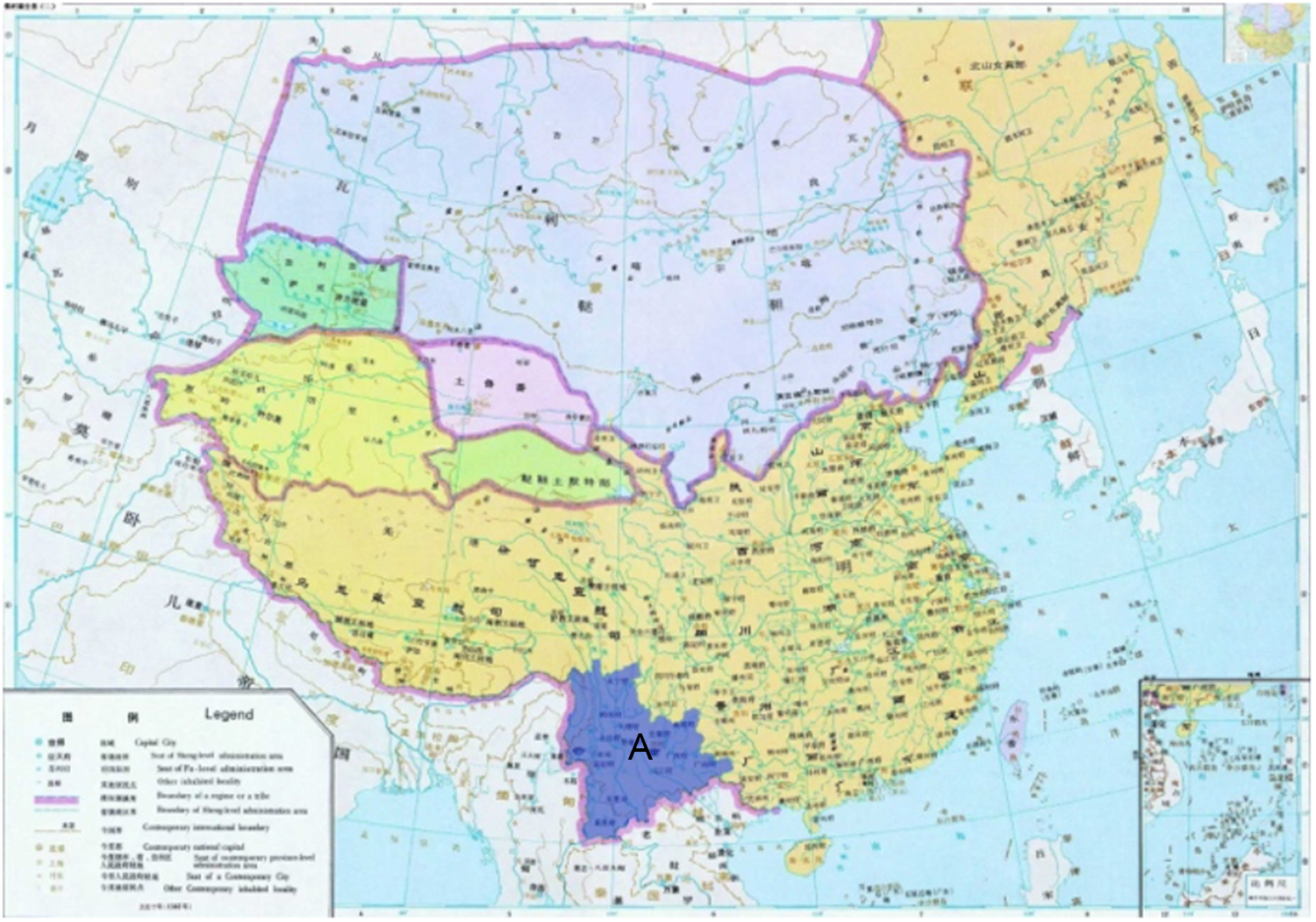
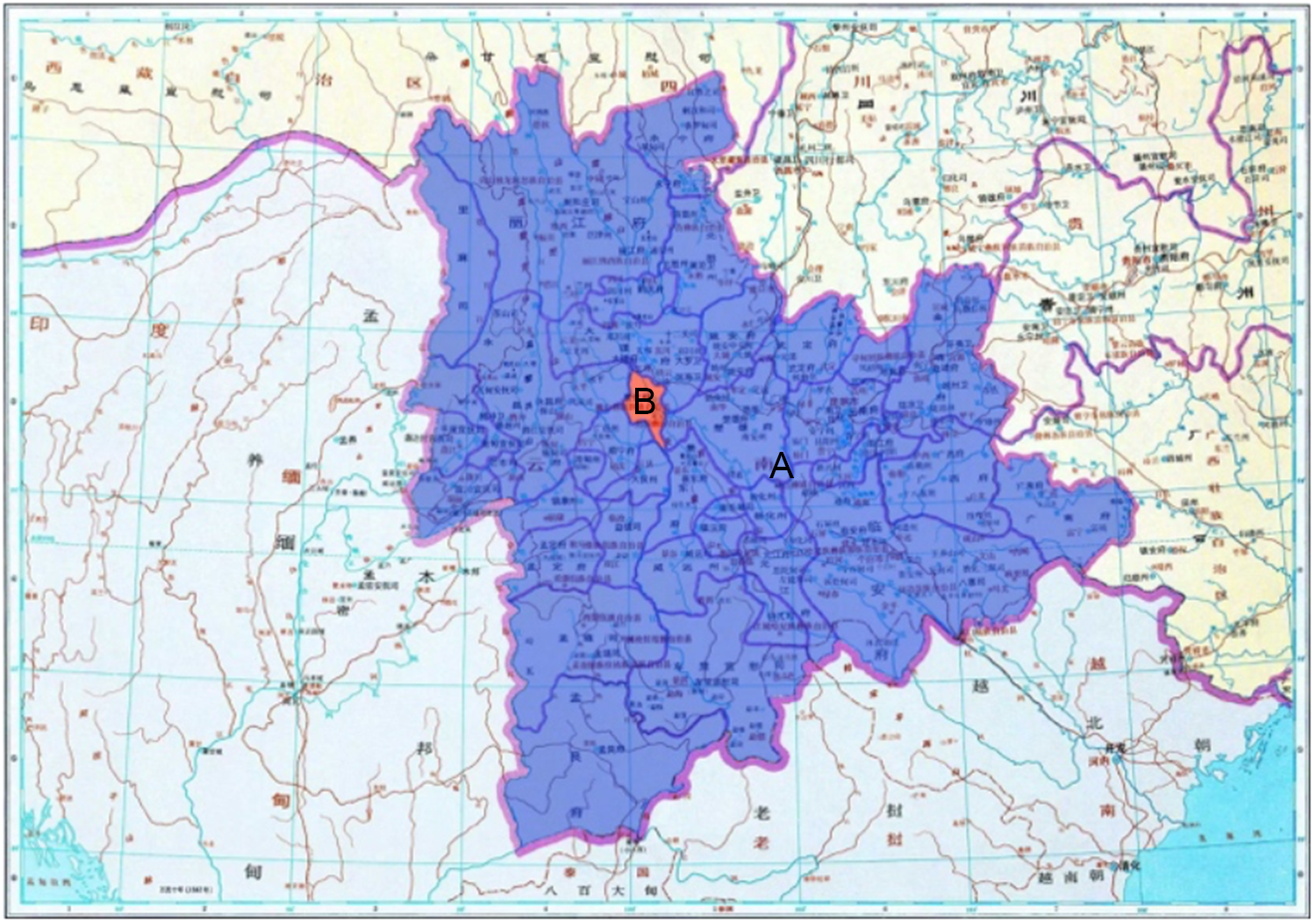
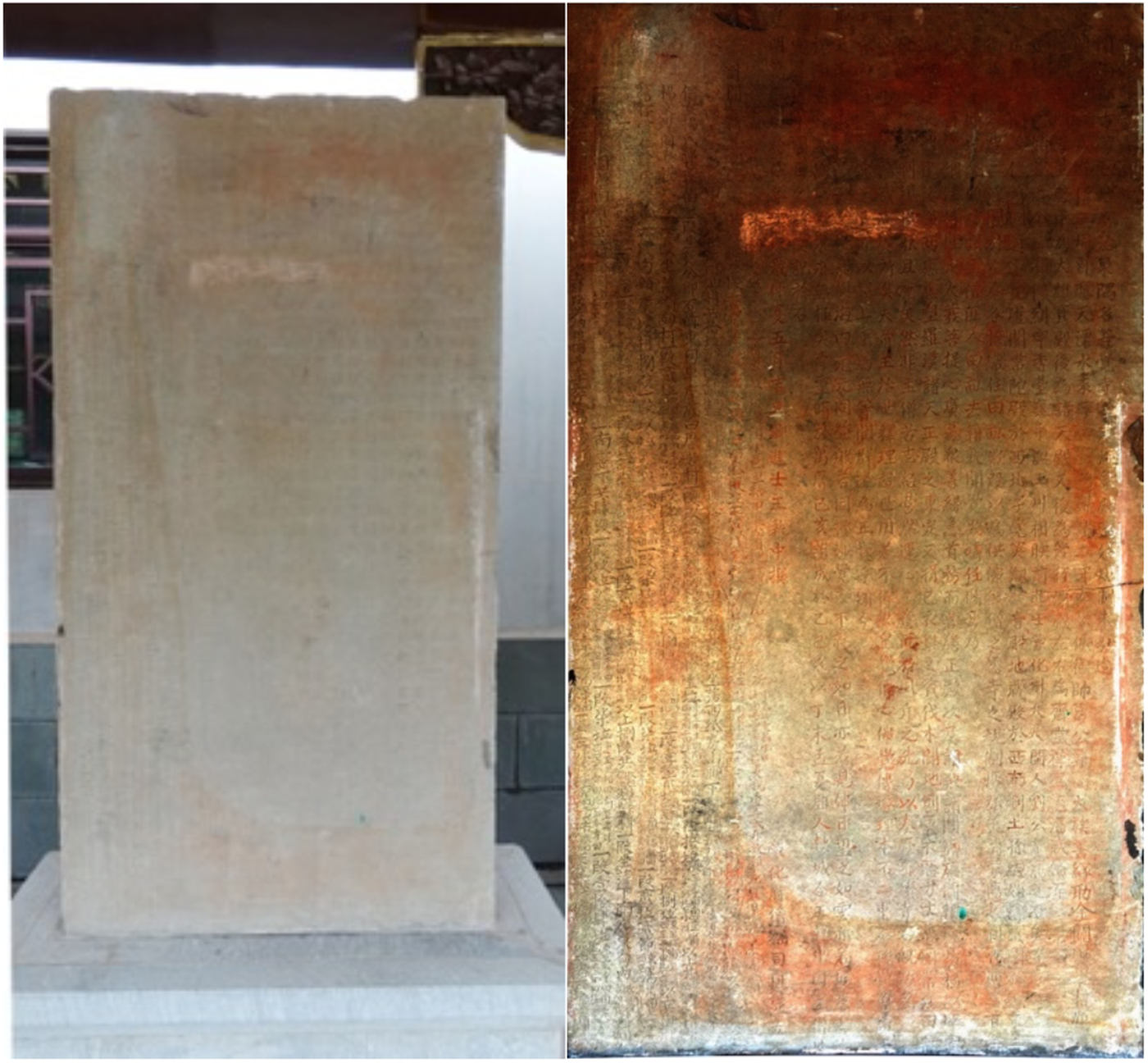
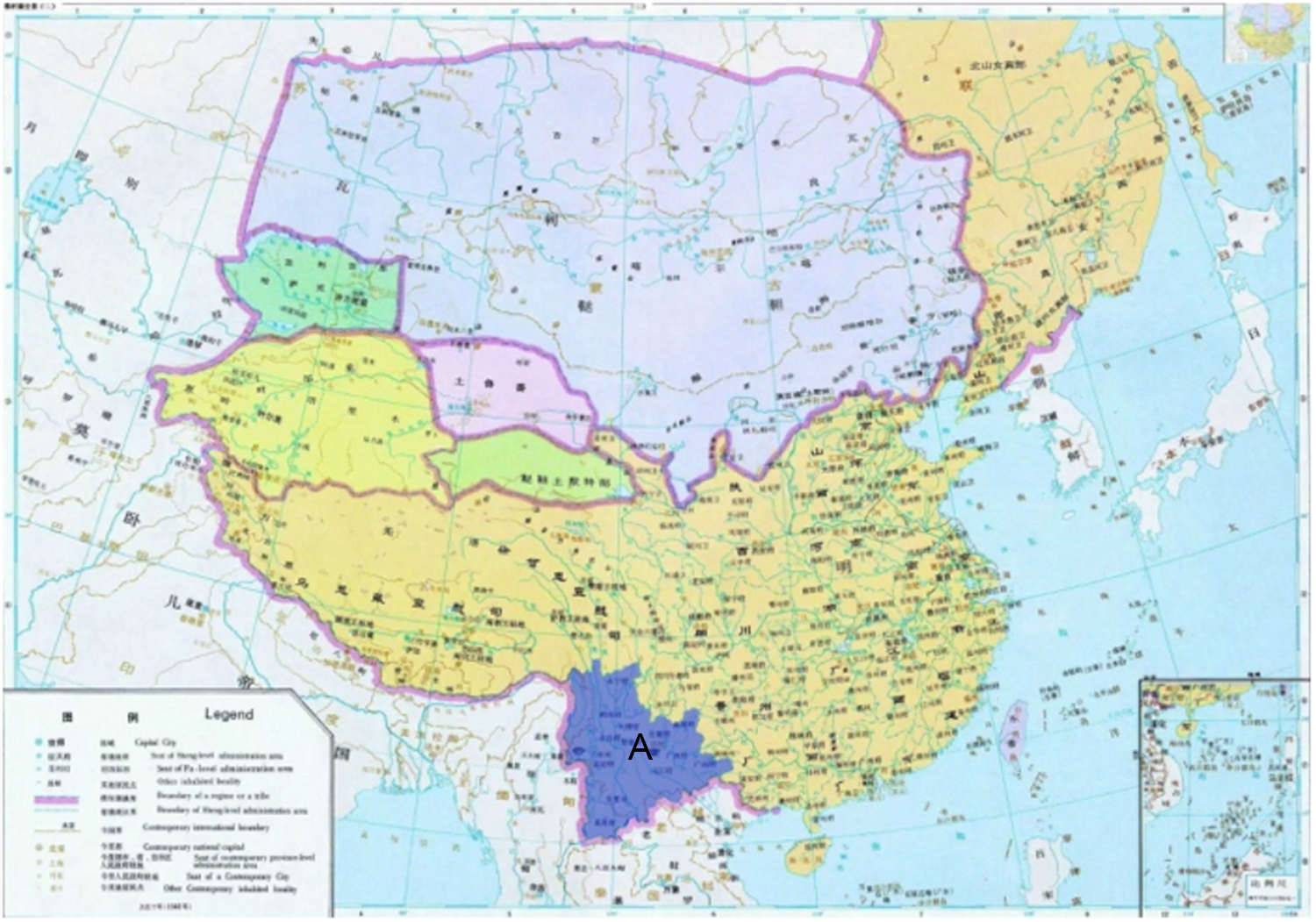
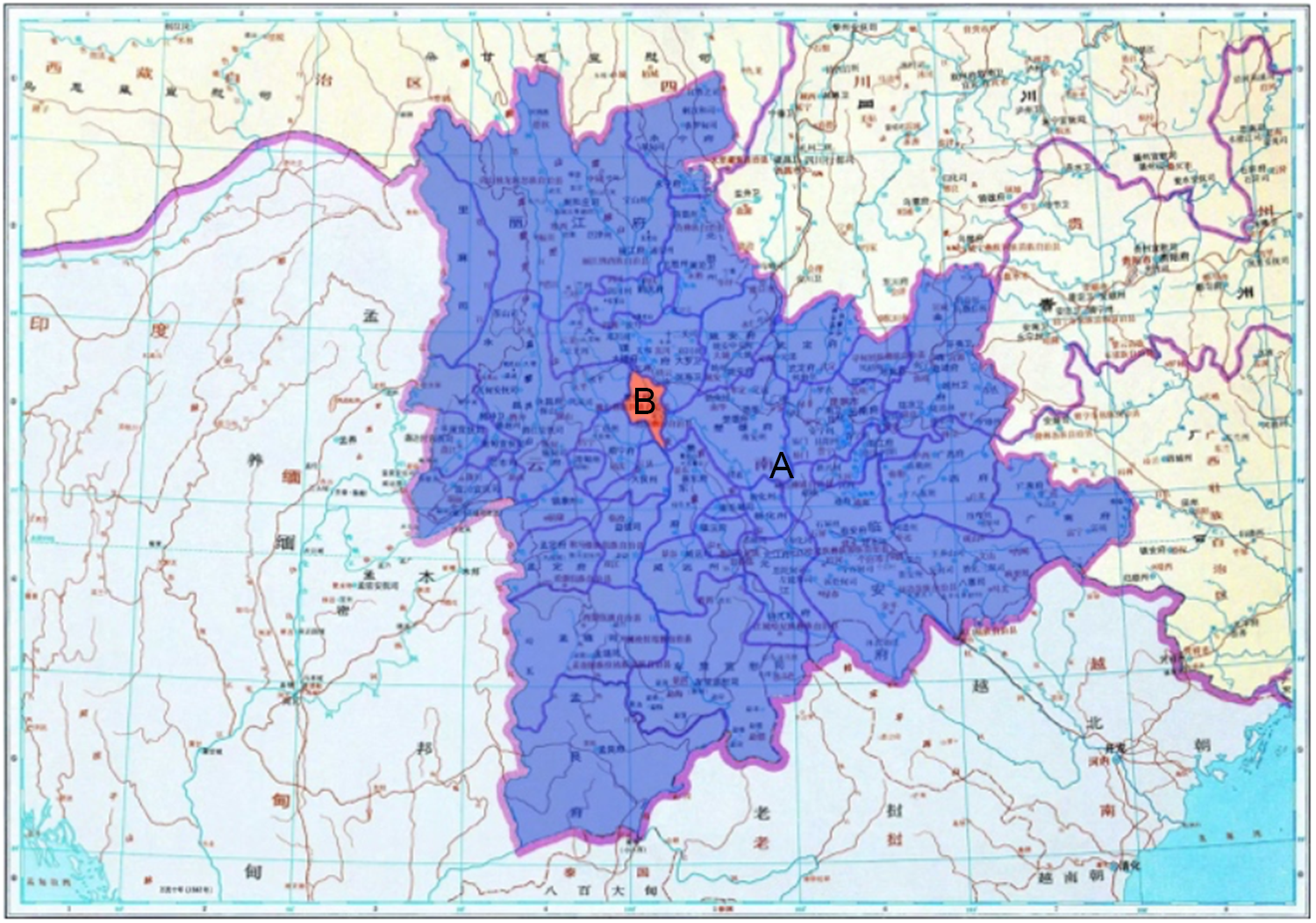
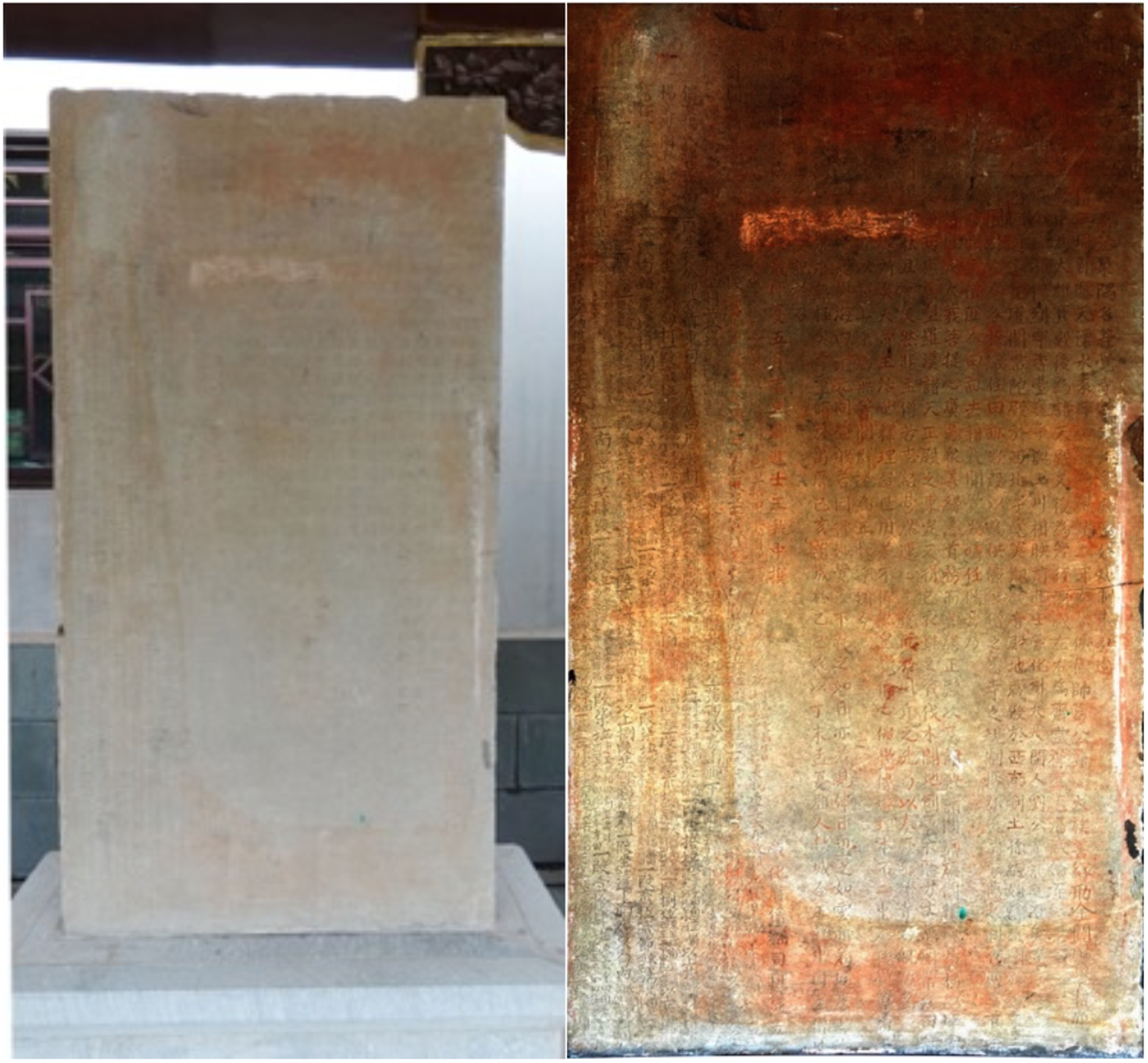
The Dengjue Temple is located in present-day Weishan County, Dali Prefecture, Yunnan Province, China, which was known as Menghua during the Ming Dynasty (see Figures 1 and 2). The main source of information on the temple’s history is an inscription on a stone tablet, Chongxiu Dengjue si beiji 重修等覺寺碑記 (Stele of the restoration of the Dengjue Temple; hereinafter the ‘Restoration Stele’; see Figure 3).Footnote 9 The author of this inscription, Wang Zhizhong 王執中, was a native of Menghua Prefecture who had passed the provincial examinations (juren 舉人) and at the time was serving as magistrate (xianling 县令) of Gucheng County (present-day Donghe Town, Pingyin, Shandong Province). The text was engraved in the first month of the summer of 1607 on a stele that was commissioned and erected by Abbot Xingding 性定, the Buddhist superior of the Menghua Prefectural Buddhist Registry, with financial support provided by a lay patron named Zhu Guochen 朱國臣.Footnote 10 The inscription underscores the close alignment between the restoration project and Ming state-sponsored Buddhism, while also illustrating the active engagement of local elites—both clerical and secular—in broader processes of social and institutional reconstruction. Despite its title, this stele provides a detailed account of more than just the restoration, which occurred in several phases between 1418 and 1607. For example, it begins by explaining that the temple was erected on the site of the Shixiang Dian 獅象殿 (Lion and Elephant Hall), which dated back to the Nanzhao Kingdom, then lists all of those who were involved in its construction:
開南郡, 古蒙詔地, 郡治東隅名等覺寺, 肇建獅象殿, 為始規制未弘。迨皇明永樂戊戌, 有僧無用自應天溧水來, 存心覺路謀諸土守左公伽, 衛帥葛公升暨大族, 善緣助金開辟也。
Kainan Prefecture was in the territory of the ancient Mengzhao [polity]. In the eastern corner of the [Ming Dynasty] prefectural seat of [Menghua], the [temple] named Dengjue was originally established as the Lion and Elephant Hall. The scale of the building was not very large. It was not until the sixteenth year of Yongle (1418), during the Ming Dynasty, that a monk named Wuyong came here from Lishui County, Yingtian [present-day Nanjing]. For the sake of Buddhism, he financed the construction of the Dengjue Temple, together with Zuo Gong Jia (native official Zuo Jia), the commander of the garrison, Ge Sheng, and some great families.
Map of Ming Dynasty China (1582 CE). Source: Q. Tan, Zhongguo lishi ditu ji, di 7 ce: Yuan·Ming shiqi 中國歷史地圖集, 第七冊: 元・明時期 (Beijing, 1996), pp. 42–43; area A (marked by the author) is Yunnan.
Map of Ming Dynasty Yunnan (1582 CE). Source: Tan, Zhongguo lishi ditu ji, pp. 76–77; area A (marked by the author) is Yunnan; area B (marked by the author) is Menghua.
Chongxiu Dengjue si beiji (Stele of the restoration of the Dengjue Temple), Ming Dynasty. Source: Photographs by the author.
This section of the inscription is explored in further detail below.
The historical evolution of Menghua
First, the inscription states that the Dengjue Temple was built in Kainan Prefecture, explicitly situating it within the historical territory of the Nanzhao and Dali kingdoms. This area has had several names throughout its history. For instance, during the seventh and eighth centuries CE, it was known as Mengshe Zhao 蒙捨詔 (or simply Mengzhao)—a polity that may be considered as the precursor to the Nanzhao Kingdom, which unified Yunnan in 738. Mengshe continued to be recognised as the birthplace of the Nanzhao royal family as well as the location of the kingdom’s original capital, Jiu Du 舊都, even after a new capital was established at Taihe City 太和城. While the political centre of this polity was located in the vicinity of Lake Erhai, Kainan Prefecture lay along a strategic route leading towards the Upper Mekong region.Footnote 11 It was during the Dali Kingdom era that the region was renamed Kainan Jun 開南郡 (Kainan Prefecture), before becoming Menghua 蒙化 in 1274, shortly after the establishment of the Yuan Dynasty (1271–1368).Footnote 12 It then retained this name for the next 680 years, only becoming Weishan Xian 巍山县 (Weishan County) in 1954, and (officially) Weishan Yizu Huizu Zizixian 巍山彝族回族自治县 (Weishan Yi and Hui Autonomous County) four years later. To avoid confusion, the remainder of this article will refer exclusively to the appellation by which the region was known under the Ming and Qing dynasties—Menghua.
Wuyong
The inscription provides the name of a Nanzhao-era predecessor of the Dengjue Temple—the Lion and Elephant Hall—then asserts that a monk named Wuyong 無用 travelled from the capital of the early Ming Dynasty, Nanjing, to Menghua in the sixteenth year of the Yongle era (1418). Next we learn that he mobilised local officials and nobles to develop the Lion and Elephant Hall into the Dengjue Temple. This project exemplifies the Ming government’s Buddhist policy along the empire’s south-western frontier. For instance, in the twenty-first year of the Hongwu era (1388), Zhu Yuanzhang 朱元璋 (1328–1398), the first Ming emperor, had ordered the construction of temples throughout the region:
但有討度牒的僧, 二十以上的, 發去烏蠻、曲靖等處, 每三十里造一座庵, 自耕自食, 就化他一境的人。Footnote 13
Any monk over the age of 20 who requested a monk’s certificate was sent to places such as Wuman and Qujing, located on the south-western frontier. There, they built a temple every 30 li,Footnote 14 farmed to support themselves, and gradually converted the local population.
The primary objectives of this exercise—which involved a significant number of monks—were to exert cultural influence over the local population, safeguard the frontier, and thereby enhance the Ming Court’s authority.Footnote 15 However, Buddhism subsequently experienced a decline in state support, which meant the newly established monasteries were forced to rely on the patronage of the local gentry and affluent landowners in rural areas, and merchants in the towns and cities. Fortunately for the monastic community, significant commercial expansion in the region meant that such individuals were willing and able to fund major restoration and expansion projects,Footnote 16 especially if the instigator had strong connections to the capital. This goes some way to explaining why so many members of the Menghua elite supported Wuyong’s plans for the Dengjue Temple.
Another inscribed stele—known as the Zhaojue si bei 昭覺寺碑 (Zhaojue Temple stele)Footnote 17—provides further information about the monk who initiated the scheme:
立軍衛保障群黎, 是則有若道人, 姓姜名無用者, 髫年從軍, 來自應天溧水, 長通释氏……卒伍入禅刹
[The Ming court] established military garrison defences to protect the people. There was someone who looked like a devotee named Jiang Wuyong. Hailing from Lishui in Yingtian, he joined the military at a young age. Over time, he became well versed in Buddhist teachings … eventually transitioning from a soldier to a monk.
Evidently, then, Wuyong was originally a soldier prior to becoming a monk and persuading prominent families in Menghua to finance the building of the Dengjue Temple. It seems safe to assume that his military background enabled him to maintain a close relationship with the local garrison and its commander, Ge Sheng 葛升, who also contributed to the project.Footnote 18
Zuo Jia
Aside from Wuyong himself, the first person named in the Restoration Stele inscription is Zuo Jia 左伽 (native official Zuo Jia). Introduced during the Yuan Dynasty, the tusi system comprised myriad hereditary positions that were held by local leaders in north-west and south-west China.Footnote 19 The Zuo family—who monopolised the post of tusi in Menghua—emerged in the late Yuan era and flourished under both the Ming and Qing. One of three major tusi in Yunnan Province,Footnote 20 it was renowned for its exceptionally long duration—over 500 years.Footnote 21
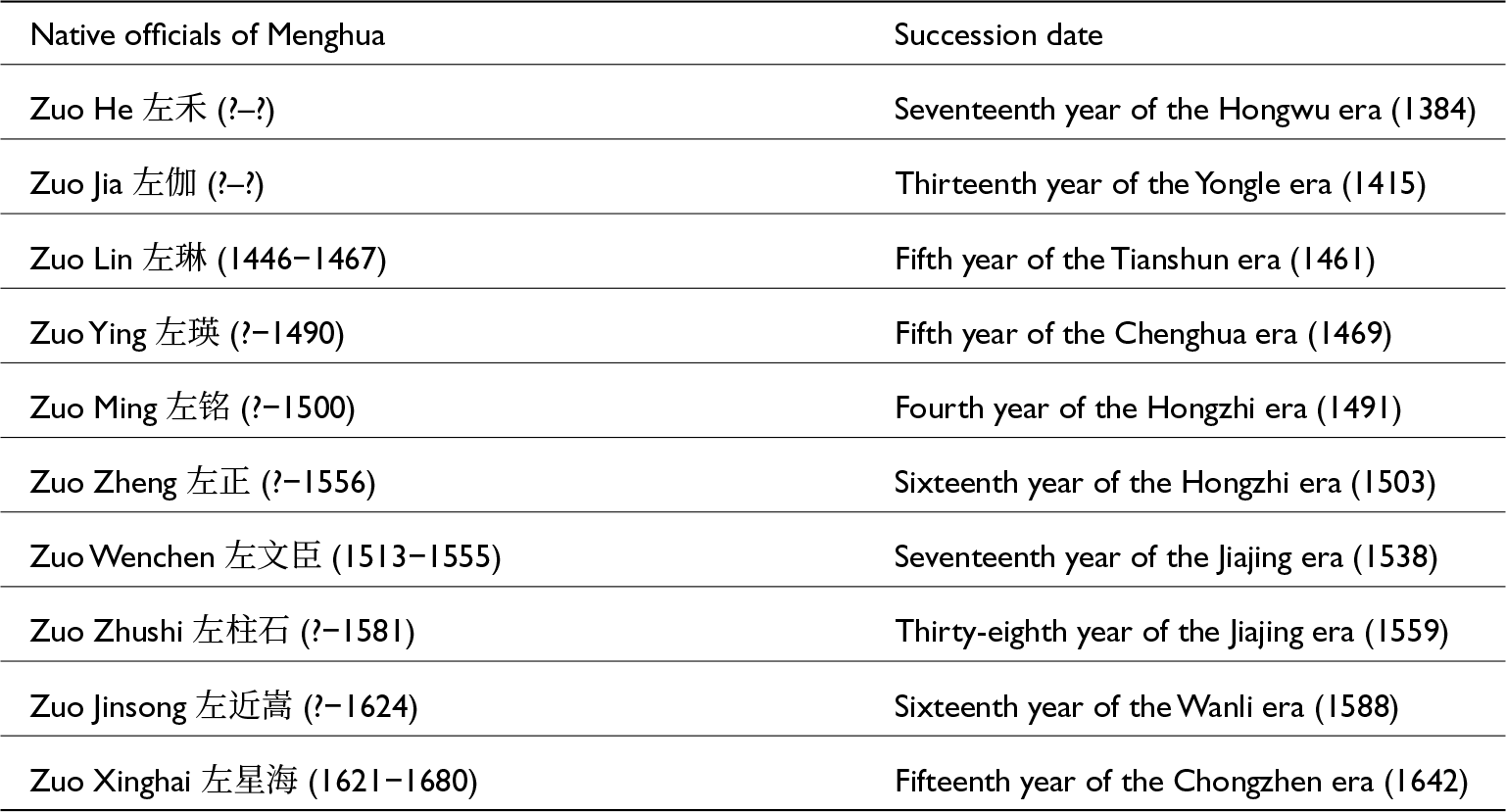
Zuo Jia was the native official of the Menghua region when work commenced on the Dengjue Temple in 1418. At the beginning of the Ming Dynasty, Emperor Zhu Yuanzhang had made it known that important administrative responsibilities would be entrusted to local leaders who were prepared to submit to his rule. Shortly thereafter, in 1382, a village head named Zhang Bao 張保 recommended Zuo Jia’s father—the local militia leader Zuo He 左禾—for such a role, and the latter duly pledged allegiance to the new regime.Footnote 22 After assisting the Ming army in its conquest of Menghua, he was appointed the region’s first native official in 1384, which enabled him to lay the foundations for centuries of prosperity, power, and influence for his descendants. (See Table 1 for a complete list of Zuo officials during the Ming Dynasty.)
The native officials of Menghua in the Ming Dynasty
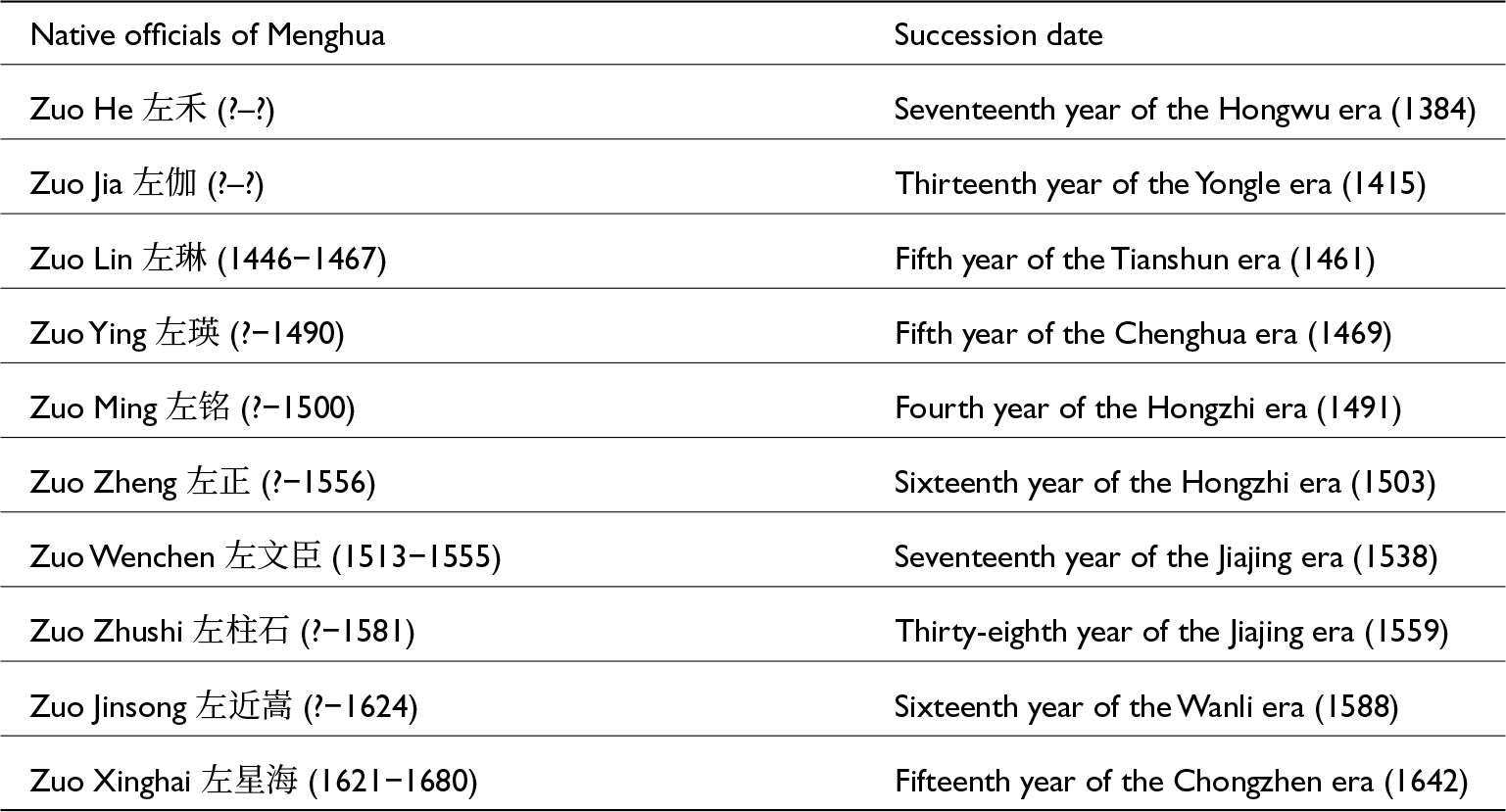
Source: S. Yang and Y. Zhao, Dali congshu, Zupu pian, juan yi 大理叢書, 族譜篇, 卷一 (Kunming, 2009), pp. 338–347; L. Xue et al. (eds.), Weishan wenshi ziliao, di san ji 巍山文史資料, 第三輯 (Weishan, 1989), pp. 80–86.
Zuo Jia succeeded his father as native official of Menghua in the thirteenth year of the Yongle era (1415).Footnote 23 Three years later, he began his long association with the Dengjue Temple, with his sponsorship playing a significant role in its development and enhanced status. However, frequent rebellions by indigenous leaders led to continuous warfare in the border regions of western Yunnan. In response, the Ming court adopted a policy of ‘using barbarians to control barbarians’ (yi yi zhi yi 以夷制夷), often deploying native troops in its military campaigns.Footnote 24 Consequently, during the Yongle (1403–1424) and Zhengtong (1436–1449) eras, Zuo Jia was repeatedly dispatched to suppress rebellions along the south-west frontier.Footnote 25 These commissions gave him numerous opportunities to showcase his military prowess. Notably, during the Luchuan Zhiyi 麓川之役 (Luchuan–Pingmian Campaign; 1436–1449), a protracted conflict between the Ming government and the Luchuan native official in western Yunnan, he led a force of over 1,000 local soldiers in support of the main Ming army. As a result, he was promoted to governor of the Lin’an 臨安府 (now Jianshui County) and Dali 大理府 (now Dali City) prefectures.Footnote 26 However, Menghua remained his principal power base, and in 1448 he petitioned the emperor to raise it from a zhou 州 (sub-prefecture) to a fu 府 (prefecture), citing its substantial population and tax revenues,Footnote 27 as recorded in the Tuguan dibo 土官底薄 (Native official records):Footnote 28
本州奏称三十五里, 人民四千一百四十八户, 税粮四千七百余石, 要将本州改为府治, 本部行该会勘明白。Footnote 29
This sub-prefecture has 35 li, a population of 4,148 families and [a quota of] 4,700 dan Footnote 30 of grain for taxation. We propose elevating the status from sub-prefecture to prefecture and request that the central authorities conduct a detailed investigation.
Inaccurate tax records and censuses were often used to consolidate power in this form of indirect governance, so it is worth stressing that Zuo Jia had such confidence in his proposal that he actually welcomed thorough investigations into these matters. In addition, he made several trips to the capital to present gifts to the emperor.Footnote 31 The Ming court eventually granted his request, appointing him governor of the new Menghua Prefecture.Footnote 32 Under his leadership, Menghua’s reputation and power increased significantly.
The garrison and Ge Sheng
The Ming government established the Menghua garrison (wei 衛) in the twenty-third year of the Hongwu era (1390) as part of its broader strategy to fortify and safeguard the frontier regions, including western Yunnan.Footnote 33 The emperor then disbanded approximately 250,000 Chinese troops and ordered them to settle in Yunnan, either with their existing wives or after marrying local women, which had a significant impact on the demographic composition of south-west China.Footnote 34 Thereafter, the garrisons continued to exercise military supervision over the native officials, serving as an intermediary political arrangement between indirect and direct rule.Footnote 35 In short, while the native official had overall responsibility for administrative affairs, the garrison commander was in charge of security matters.
The Menghua garrison housed a large number of officers and troops, with the zhihui shi 指揮使 (commander) holding the rank zheng san pin 正三品 (main third rank), which meant he was the most senior official in the region at the time.Footnote 36 Consequently, in 1418, Ge Sheng officially outranked the cong san pin 从三品 (sub-third rank) Zuo Jia. Yet, unusually for a society so governed by status, Zuo Jia’s name appears before Ge Sheng’s in the Restoration Stele inscription, presumably to indicate that he donated far more to the Dengjue Temple project.
Collaboration
As we have seen, Wuyong persuaded the native official, the garrison commander, and a number of prominent local families to fund the building of the Dengjue Temple. In addition to underscoring the temple’s significance, this joint effort reflects the fact that regions such as Menghua were governed through close cooperation between the local (native official) and military (garrison) authorities with a view to reinforcing Ming rule throughout the empire. Von Glahn’s concept of ‘vernacular religion’—which he defines as ‘local and common discourse, expressed in belief and ritual’—provides a useful framework for understanding why the project attracted such strong support from all these disparate actors.Footnote 37 In Menghua, as in other parts of western Yunnan, temples functioned as nodes of social organisation, serving as centres for the reconstruction of ethnic identity and community life following the imposition of Ming administrative norms.Footnote 38 The Dengjue Temple, with its evolving layout and elite sponsorship, was an active participant in this broader process of religious and social restructuring.
The architectural layout of the Dengjue Temple
The Restoration Stele inscription not only details the background of the Dengjue Temple project and the people involved but also provides a fascinating account of the construction process itself. As such, it highlights the localised nature of temple building in frontier regions during the Ming Dynasty.
As Debreczeny points out, when studying differences in the development of art and architecture between the imperial centre and the border regions, ‘the primary distinction to be made … is not between metropolitan or provincial locations and visual idioms, but rather between imperial and local programs of sponsorship’.Footnote 39 Much like the Dengjue Temple, the Dabaojigong 大宝积宫 (Dabaoji Palace), in Lijiang, north-western Yunnan, exemplifies the complex interplay between Ming architectural conventions and localised cultural influences. Both were funded by local patrons in regions that lay beyond direct imperial oversight. Dabaojigong was constructed by the Naxi, an ethnic group believed to have proto-Tibetan roots, who by the Ming Dynasty had aligned themselves politically and culturally with the Han Chinese. For example, local officials depicted themselves as Chinese administrators in portraiture and wrote their records in Chinese. Similarly, the temple follows Chinese architectural conventions, and the murals in the front hall reflect themes that are commonly found in Ming Dynasty Buddhist temples. However, traditional Tibetan elements are interwoven throughout the design.Footnote 40 These hybridised visual expressions mirrored similar developments in other frontier regions, such as Gansu, where Tibetan architectural forms were embedded into Ming architectural frameworks as early as the fourteenth century, resulting in a unique Sino-Tibetan synthesis.Footnote 41 Such examples underscore that frontier temples were not merely copied from central models but dynamic products of negotiation between imperial design principles and the traditions of the frontier.
The Dengjue Temple may be viewed as a significant architectural undertaking in which local sponsorship, ethnic diversity, and religious devotion coalesced to produce a characteristically Ming complex that was nevertheless deeply rooted in the Buddhist traditions of Nanzhao and Dali. As the Restoration Stele records:
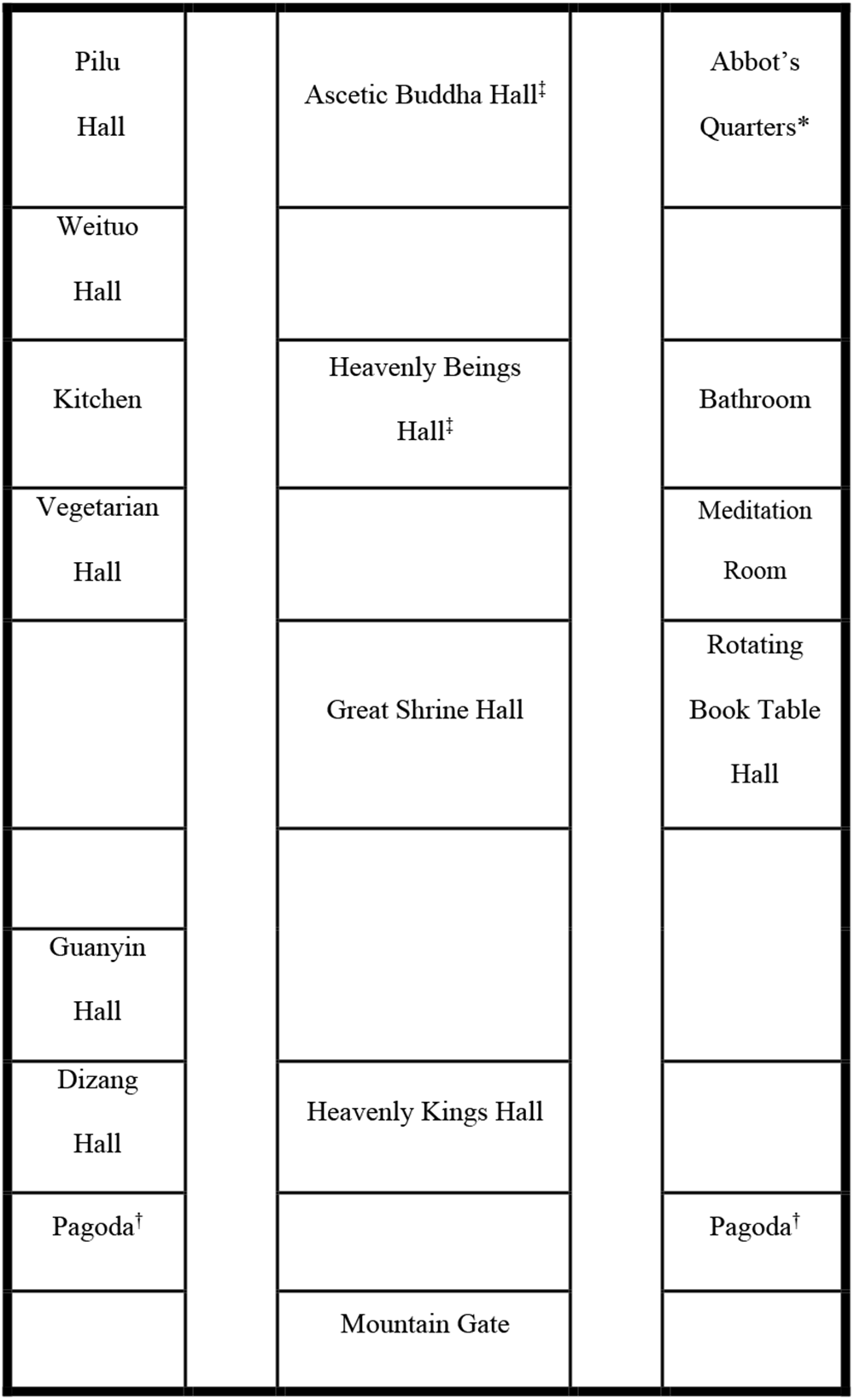
聚材鸠工, 前為山門、天王殿, 中為大雄寶殿, 後為諸天殿, 又後為苦行佛殿, 左右為齋堂、禪室, 庖、湢咸备。
至正統丁巳始莊嚴金身寶像, 紺宇香䑓, 魏乎, 與山川相映。前進士蒙化州大夫閩人劉公童記之石矣。
至成化年間善信蘇圓通建毘盧閣、韋陀殿於西北, 字覺英剙觀音殿、地藏殿於西南, 劉士孫經始輪藏殿於正東, 土衙張恭人造二浮圖於左右, 各捨常住田畆数段, 以為供佛飯僧之需, 寺之規制恢弘。美哉!蒙陽名剎也。
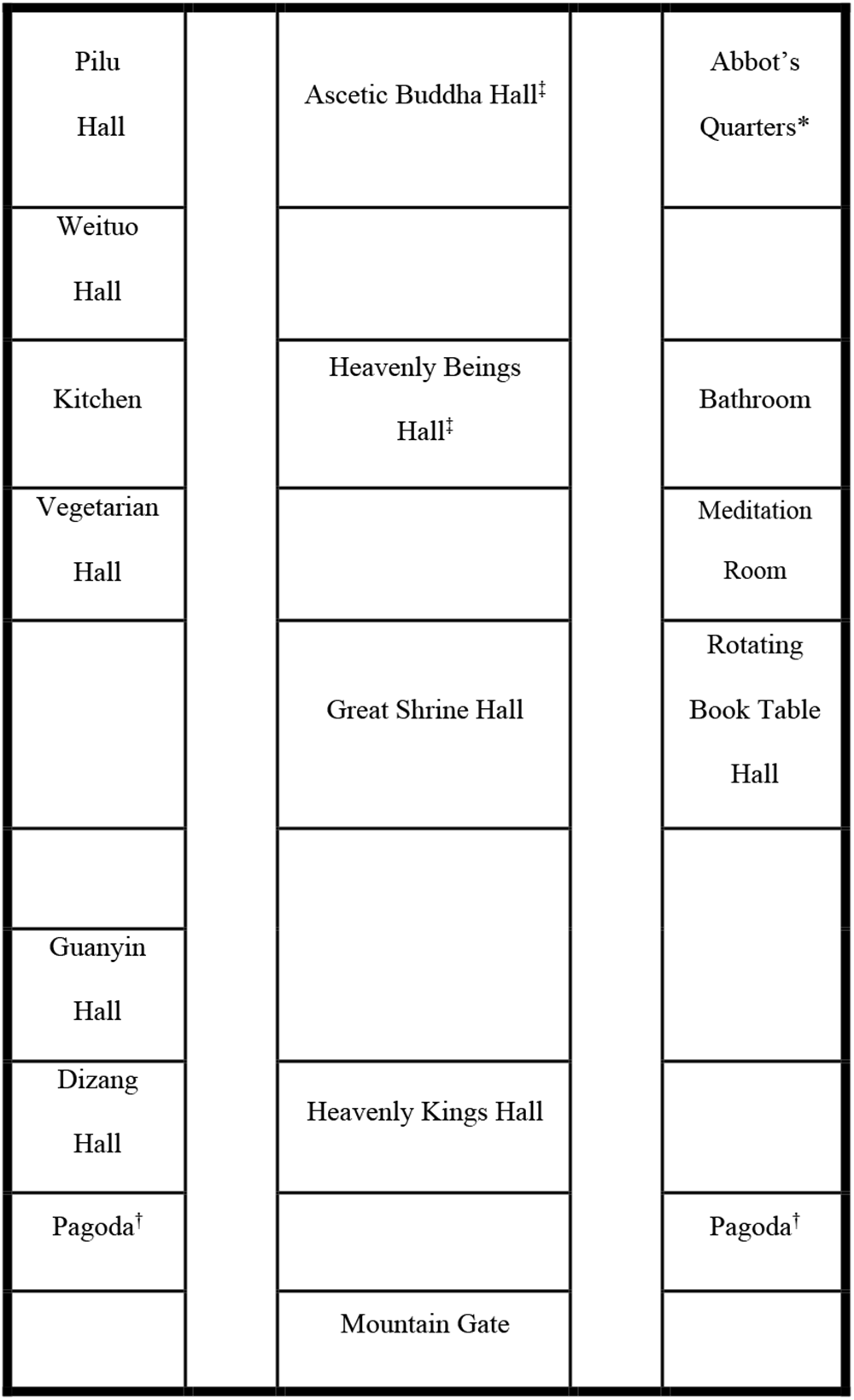
Funders gathered materials and craftsmen to build the temple, which includes the Shanmen (Mountain Gate), the Tianwang Dian (Heavenly Kings Hall) in front, the Daxiong Baodian (Great Shrine Hall) in the middle, the Zhutian Dian (Heavenly Beings Hall) in the rear, and the Kuxing Fodian (Austerity Buddha Hall) further back. The zhaitang (vegetarian hall) and the chanshi (meditation room) are on the left and right, respectively, and the kitchen and bathroom are fully equipped.
In the Dingsi year of the Zhengtong era (1437), golden Buddha statues were sculpted for the temple, and an incense stand was established, harmonising with the natural surroundings. Liu Tong, a scholar from Fujian, recorded this construction in stone.
During the Chenghua era (1465–1487), the Buddhist Su Yuantong built the Pilu Ge (Vairocana Hall) and the Weituo Dian (Skanda Hall) in the north-west of the temple. Zi Jueying built the Guanyin Dian (Avalokiteśvara Hall) and the Dizang Dian (Kṣitigarbha Hall) in the south-west. Liu Shisun constructed the lunzang dian (rotating book table hall) on the east side. Lady Zhang of the native official’s office built two pagodas on either side of the temple and donated extensive fields to support the monks. The temple is huge and beautiful, and renowned in the Menghua area.
This detailed description of the layout of the Dengjue Temple reveals the strong influence of Chan Buddhism—in particular the dominant Linji 臨濟 and Caodong 曹洞 branches—on the Menghua region during the Ming Dynasty.Footnote 42 For instance, Wuyong and another monk named in the inscription, Xingding 性定, both belonged to the Linji school.Footnote 43 However, as we shall see below, while the Dengjue Temple’s layout follows the blueprint that was used for countless Chan Buddhist structures during the Ming Dynasty, it also boasts a number of unique architectural features that distinguish it from its contemporaries.
The layout of Chan Buddhist temples during the Ming Dynasty
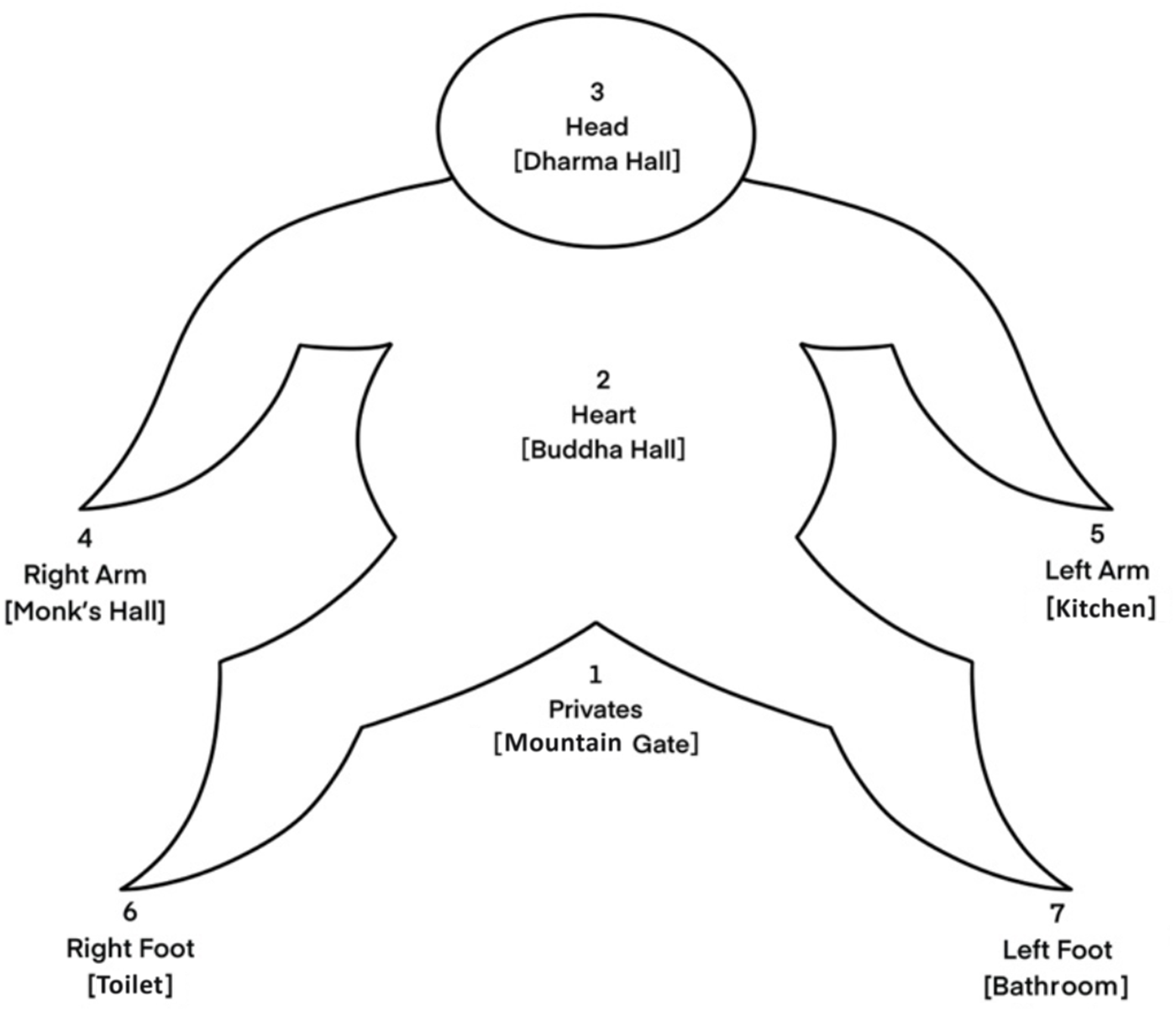
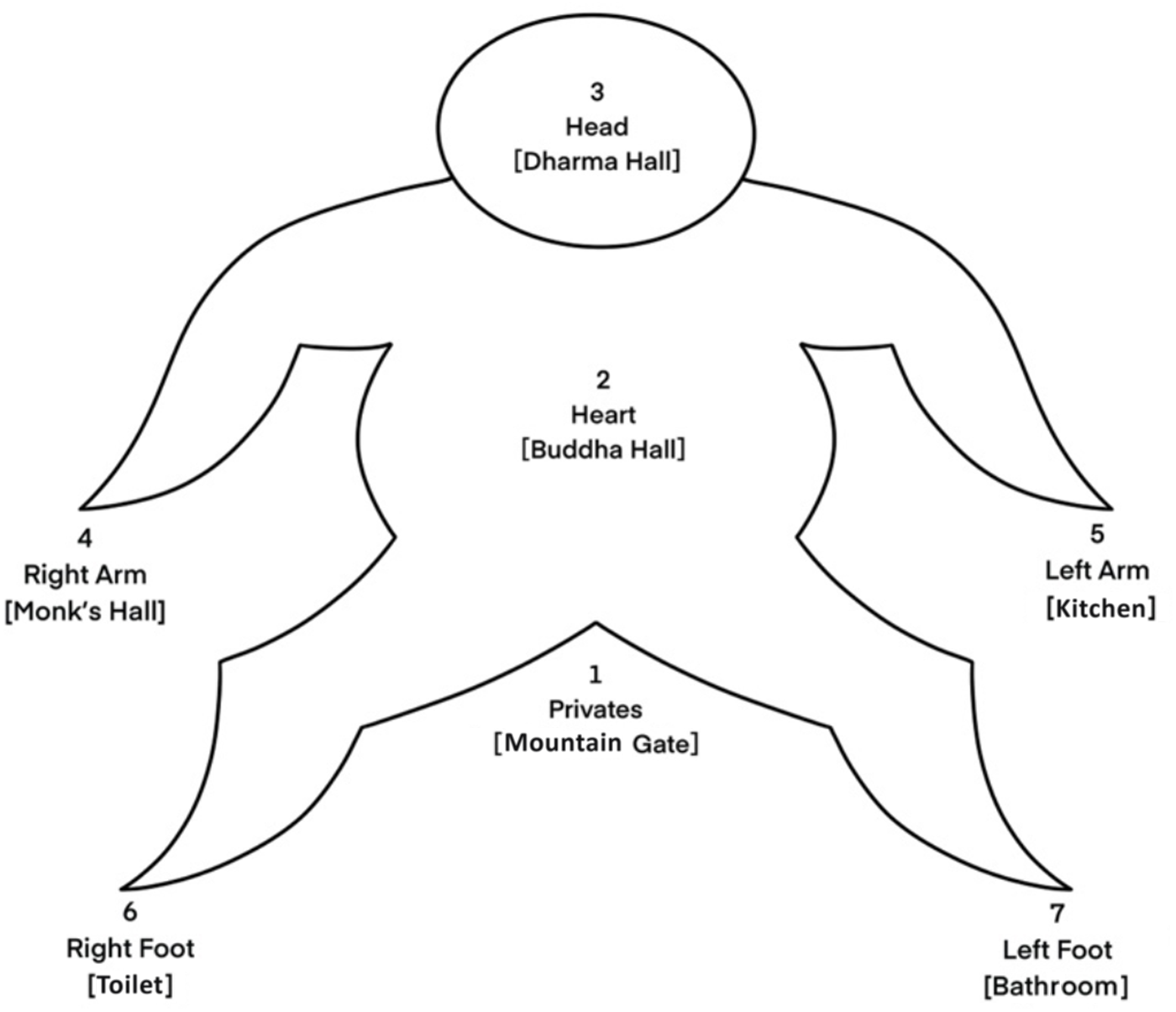
According to Liu, the Linji school had a strong presence in Yunnan Province from the Yuan Dynasty onwards.Footnote 44 Most of the region’s temples adhered to the qielan qitang 伽藍七堂 (seven halls of the sangha) design concept, albeit with some adjustments to accommodate local conditions. Originating in Japan, the concept of the seven halls of the sangha may be regarded as a summary and formalisation of the architectural layout of Chan temples dating from the Song and early Yuan dynasties.Footnote 45 In these eras, although the names and precise arrangement of the seven halls varied over time and across the various Chan schools, they were typically known as the Shanmen 山门 (Mountain Gate), the Fodian 佛殿 (Buddha Hall), the Fatang 法堂 (Dharma Hall), the sengtang 僧堂 (monks’ hall), the chufang 厨房 (kitchen), the yushi 浴室 (bathroom), and the xijing 西净 (toilet), which were arranged in a pattern that corresponded to the traditional seven vital organs of the human body (see Figure 4).
Typical layout of the seven halls of the sangha. Source: Adapted from S. Heine, From Chinese Chan to Japanese Zen: A Remarkable Century of Transmission and Transformation (Oxford, 2017).
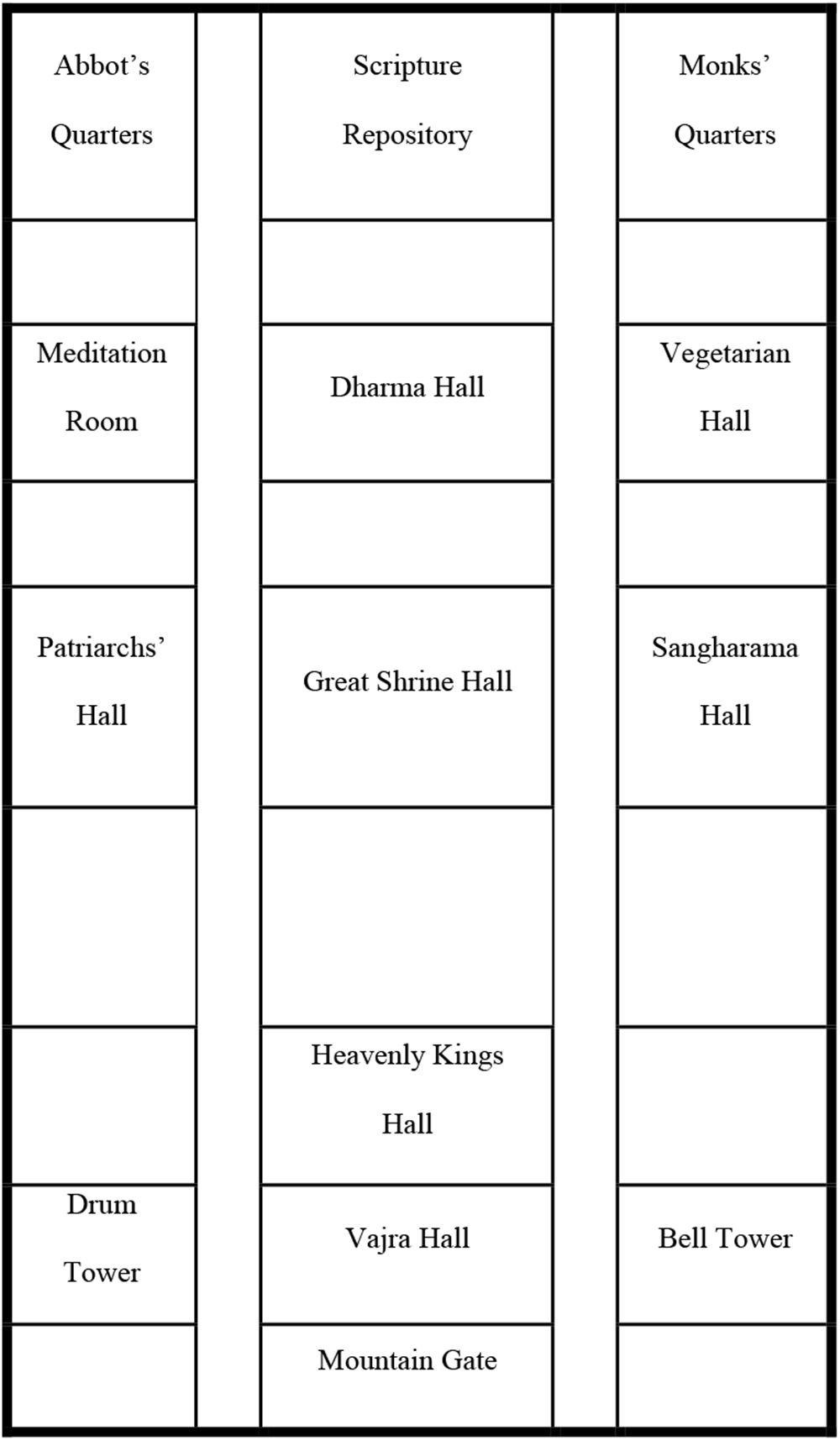
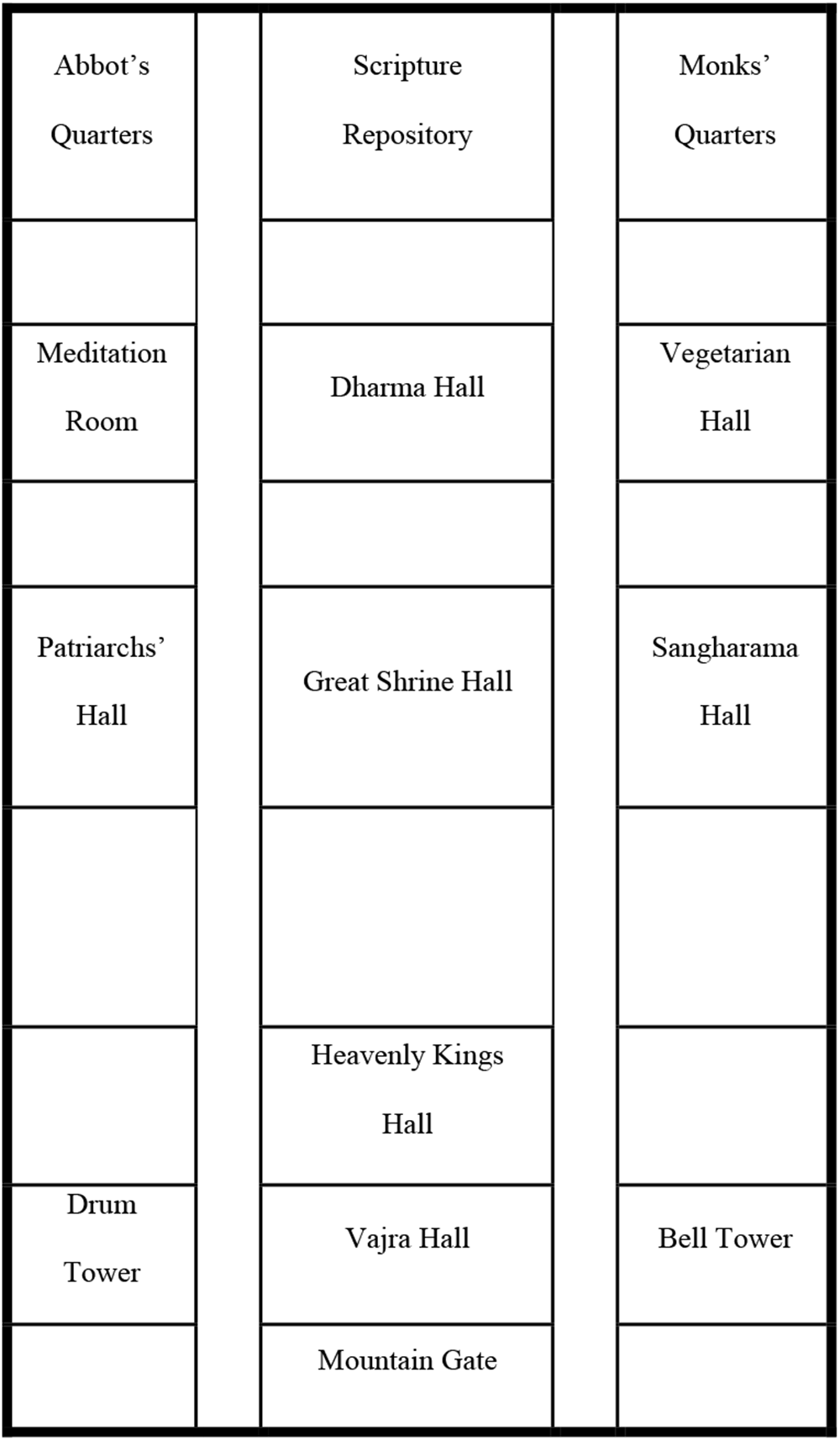
Although some Chan temples continued to adhere to this design long into the Ming and even Qing dynasties,Footnote 46 most temple builders started to follow a rather different template from the early Ming period onwards. Aligned along a central axis, the Mountain Gate was still positioned at the front, but this was now sometimes followed by a Jingang Dian 金剛殿 (Vajra Hall) and always by a Tianwang Dian 天王殿 (Heavenly Kings Hall). Next came the main hall, known as the Daxiong Baodian 大雄寶殿 (Great Shrine Hall), where the primary Buddha images were enshrined. Finally, at the rear, there tended to be a Dharma Hall, cangjing ge 藏经阁 (scripture repository), and/or the abbot’s quarters. On either side of these large halls, positioned at regular intervals along the outer edges of the temple complex, there might be a Zushi Dian 祖師殿 (Patriarchs’ Hall), Qielan Dian 伽蓝殿 (Sangharama Hall), gulou 鼓樓 (drum tower), zhonglou 鐘樓 (bell tower), zhaitang 斋堂 (vegetarian hall), and/or chanshi 禅室 (meditation room) (see Figure 5).Footnote 47 While the layout of the Dengjue Temple does not diverge too far from this standard design, several significant modifications were made in each of the three main building phases, which occurred in the Yongle, Zhengtong, and Chenghua eras (see Figure 6). These are discussed in detail in the following subsections.
Layout of a typical Ming Dynasty Chan temple. Source: The author.
Layout of the Dengjue Temple. Source: The author.
Construction work on the Dengjue Temple during the Yongle era
As we have seen, the first phase of construction of the Dengjue Temple commenced in 1418, when the focus was on building two somewhat unconventional halls on the central axis—a Zhutian Dian 諸天殿 (Heavenly Beings Hall) and a Kuxing Fodian 苦行佛殿 (Ascetic Buddha Hall)—which occupied the space that was usually filled by a Dharma Hall.
The idealised Chinese temple is designed to resemble a mountain, with the main entrance—the Mountain Gate—and other buildings’ roofs replicating individual peaks. This may explain why literary sources generally associate monasteries with mountain ranges, even when they lie on flat land.Footnote 48 In some temples, the Mountain Gate would lead directly onto a Vajra Hall, which was designed to extend the length of the central axis and thereby make the whole temple complex more grand and imposing.Footnote 49 However, this tradition was never adopted in Menghua, so the Dengjue Temple’s first major structure after the main gate is the Heavenly Kings Hall. A significant feature of Ming temples, these halls were a consequence of the transition from the elaborate, multi-tiered Mountain Gates of the Song and Yuan periods to the simpler, single-storey gates of the Ming Dynasty.Footnote 50 They were decorated with images of the Four Heavenly Kings, who were often depicted as Han Chinese generals.Footnote 51 Hence, as in Menghua, they often reflected the presence of a powerful local garrison.
Immediately after the Heavenly Kings Hall comes the principal structure of the temple complex—the Great Shrine Hall. This appellation seems to have been coined during the Ming period, and it was in quite common usage by the end of the dynasty.Footnote 52 These central rooms were frequently dedicated to the Buddha of the past (Dīpaṃkara), present (Śākyamuni), or future (Maitreya),Footnote 53 although there is no record of such a dedication in the Dengjue Temple.
The most important temple building in the early years of Chan Buddhism was the Dharma Hall, which served as the venue for senior monks to deliver sermons.Footnote 54 It relinquished that position to the Great Shrine Hall after Ming Chan masters started advocating Chan jing shuangxiu 禪淨雙修 (Chan–Pure Land dual cultivation), which emphasised recitation of the Buddha’s name, with much less focus on rigorous meditation practices and complex doctrinal theories. Nevertheless, the Dharma Hall still usually occupied second place in a temple’s architectural hierarchy, immediately behind the main hall.Footnote 55 This raises the question of why there is no Dharma Hall in the Dengjue Temple. There are two possible reasons for this. First, the temple’s architects may simply have thought that such a structure was unnecessary, given the general decline in the status of Dharma Halls and the shift away from sermonising. In addition, though, the hall’s omission is a prime example of Yunnan’s propensity for architectural innovation, which set it apart from its south-western neighbours, Sichuan and Guizhou, both of which were more inclined to follow the lead of other parts of China.Footnote 56 Indeed, Dengjue was not the only temple in Yunnan to make this particular break with tradition—the Yunyin Si 雲隱寺 (Yunyin Temple) lacked a Dharma Hall, too.Footnote 57
As mentioned earlier, in the Dengjue Temple, a Heavenly Beings Hall sits in the position normally occupied by a Dharma Hall—directly behind the Great Shrine Hall. The presence of this structure as a prominent, separate entity within the temple compound reflects the complex religious context in which it was constructed. Although considered divine, heavenly beings are different from the likes of bodhisattvas and arhats in that they have not yet attained enlightenment. Originating in ancient myths and legends, they are revered for their exceptional powers and entrusted with safeguarding and spreading Buddhist teachings. This concept underscores the dynamic nature of religious fusion, which is a notable feature of Chinese Buddhism. In general, 20 heavenly beings are recognised, although some temples have increased this figure to 24 or 28 by adding Taoist immortals to the group.Footnote 58 In the early Ming period, representations of these divinities would typically flank a temple’s Great Shrine Hall, rather than occupy a dedicated building on the central axis. By deviating from this standard layout and affording extra prominence to the heavenly beings, it seems likely that the architects of the Dengjue Temple were hoping to attract followers who were familiar with such deities from their native religious practice and thereby facilitate the dissemination of Ming-style Buddhism in Menghua. Furthermore, the inclusion of a number of Taoist immortals among the heavenly beings aligns with the Ming principle of san jiao he yi 三教合一 (Unity of the Three Teachings), which promoted a synthesis of Confucianism, Buddhism, and Taoism. This vision of religious syncretism was actively promoted by prominent local scholars such as Li Yuanyang 李元陽 (1497–1580), who incorporated it into broader programmes of social and religious reconstruction. Intellectuals from Yunnan emerged as influential Confucian figures whose impact was comparable to that of their peers in the Central Plains.Footnote 59 The formation of a regional gentry class, consisting of formally educated elites, was instrumental in transforming local society by blending Confucian moral instruction with existing indigenous cultural practices. As von Glahn explains, the religious culture of the Ming period was shaped by the syncretic flexibility of vernacular practices, which, unbound by rigid doctrine, integrated both elite and popular traditions into dynamic, multifaceted institutions such as the Dengjue Temple.Footnote 60
Lying behind the Heavenly Beings Hall on the central axis of the Dengjue Temple is an even less common Chinese Buddhist structure—the Ascetic Buddha Hall. This may have been built to highlight the temple’s proximity to Mount Jizu 雞足 (Cock’s Foot),Footnote 61 a holy site of the Buddha’s disciple Mahākāśyapa, who is renowned for his asceticism.Footnote 62 Numerous Buddhist scriptures document Mahākāśyapa’s meditation and teaching on Mount Jizu,Footnote 63 and the Yunnan mountain of that name subsequently became the epicentre of Buddhism in the south-western region, with numerous temples dedicated to him. Indeed, it was so revered during the Ming Dynasty that it was often identified as the fifth sacred mountain of Buddhism.Footnote 64
However, it is important to note that this Mount Jizu is not the mountain that appears in the historical texts. According to Zhang, the Yunnan peak acquired the name Jizu only in the early years of the Ming Dynasty, after the new regime had conquered the Dali Kingdom.Footnote 65 At that point, some of the region’s former rulers attempted to establish a spiritual connection with India that would highlight the differences between their cultural traditions and those of the Ming Dynasty. It was during this period that Yunnan’s Mount Jizu was established as a holy site for Mahākāśyapa. Therefore, the inclusion of the Ascetic Buddha Hall in the Dengjue Temple reflects not only the highly revered status of Mount Jizu throughout the region but also the temple’s close connection with local traditions.
The five major structures that lie along the central axis represent the primary components of the Dengjue Temple’s architecture, but these are flanked by several other buildings that serve the daily needs of the residents, including a vegetarian hall, meditation room, pao 庖 (kitchen), and bi 湢 (bathroom).
The emergence of separate dining (or vegetarian) halls and meditation rooms was a significant development in Ming Dynasty temple design, as previously the monks’ hall had been the venue for both dining and meditation.Footnote 66 This shift reflects Chan Buddhism’s increasing emphasis on meditation.Footnote 67 Meanwhile, the decision to include a kitchen and bathroom in the Dengjue Temple not only improved the monks’ quality of life and hygiene conditions but also aligned with an important principle of Han Buddhism—the maintenance of physical and mental purity.Footnote 68
The aforementioned components of the Dengjue Temple were all completed in the initial phase of building in the Yongle period. They reflect the implementation of Ming policies in Yunnan, extensive cultural promotion, and the migration of a significant number of people from the Ming heartland to the region, which resulted in closer ties between the Central Plains and the south-western frontier and a gradual reduction in cultural disparities between the two regions. Nevertheless, as the preceding discussion has demonstrated, Menghua still maintained at least some of its unique local characteristics.
Additions to the Dengjue Temple during the Zhengtong era
Almost two decades after the initial construction phase, in the Dingsi year of the Zhengtong era (1437), golden statues of the Buddha were sculpted for the Dengjue Temple and an incense stand was erected, creating a spectacular display that mirrored the grandeur of the surrounding mountains and rivers. This burst of activity was linked to the overall expansion of Buddhism during the Ming Dynasty. For example, an entry in the Ming Yingzong shi lu 明英宗實錄 (Veritable records of Emperor Yingzong of Ming)Footnote 69 dating from the fourteenth year of the Zhengtong era (1449) states:
近年以来, 修盖寺观, 遍满京师, 男女出家, 累千百万。
In recent years, the construction of temples has proliferated throughout the capital, with millions of men and women choosing the monastic life.Footnote 70
Meanwhile, according to the Restoration Stele, a literatus named Liu Tong 劉童 recorded the erection of the golden Buddhas and incense stand in the Dengjue Temple. According to the Kangxi Menghua fuzhi 康熙蒙化府志 (Kangxi gazetteer of Menghua Prefecture),Footnote 71 Liu Tong hailed from Fujian Province in south-eastern China, passed the jinshi 進士 (the highest degree in the imperial examination system), and eventually served as Menghua’s zhizhou 知州 (prefect)—the highest administrative position within the prefecture—earning the admiration of the local people through his benevolent governance. The fact that this member of the Ming elite recorded the latest additions to the temple demonstrates that it was already a significant religious institution less than two decades after its founding.
Expansion of the Dengjue Temple during the Chenghua era
The Dengjue Temple underwent further significant development during the Chenghua era (1465–1487). According to the Restoration Stele, the Pilu Ge 毗盧閣 (Vairocana Hall), Weituo Dian 韋陀殿 (Skanda Hall), Guanyin Dian 觀音殿 (Avalokiteśvara Hall), Dizang Dian 地藏殿 (Kṣitigarbha Hall), and lunzang dian 輪藏殿 (rotating book table hall), along with two pagodas, were all completed in this third phase of construction.
Once again, this ambitious expansion project reflects the growth of Buddhism throughout the empire at the time. For instance, the Ming Xianzong shi lu Footnote 72 reports that Emperor Xianzong 憲宗 (1447–1487; r. 1464–1487) supported the establishment of hundreds of temples during his reign:
成化十七年以前, 京城内外敕赐寺观至六百三十九所。后复增建, 以至西山等处相望不绝, 自古佛寺之多未有过于此。
Before the seventeenth year of the Chenghua era (1481), there were 639 temples approved for construction within and outside the capital. Subsequently, the construction continued to increase, to the extent that they extended without interruption, visible from places like the Western Hills, surpassing any precedent in the multitude of Buddhist temples.Footnote 73
A devout believer named Su Yuantong 蘇圓通 is credited with constructing the Pilu and Weituo halls in the north-west corner of the Dengjue Temple complex. Piluzhena Fo (毗盧遮那佛; abbreviated as Pilu)—who is revered as a Primordial Buddha—holds a central position in both Mahāyāna and Vajrayāna Buddhism, so the dedication of halls to him is a strong indicator of the popularity of Esoteric Buddhism.Footnote 74 In addition, though, such halls were once closely associated with secular political authority in the Dali region. Historian Ku Chengmei’s reinterpretation of the Zhang Shengwen fanhua juan 張勝溫梵畫卷 (The long scroll by Zhang Shengwen) sheds new light on the politico-religious organisation of the Dali Kingdom in the latter half of the twelfth century by revealing that King Duan Zhixing 段智興 (r. 1172–1200) used Pilu as a symbol of kingship, thereby blending Buddha worship with political power.Footnote 75 In this framework, Buddhist kingship was more than a religious ideal as the monarchs’ presentation of themselves as reincarnations of buddhas and bodhisattvas enabled them to claim unrivalled spiritual and political authority. This model of governance differed significantly from that of the Ming Dynasty, which was rooted in Confucian ideology and imperial centralisation. Nevertheless, it continued to feature prominently in the collective memory of the Menghua region long after the Ming conquest of Dali. Hence, it is safe to assume that the construction of a Pilu Hall in the Dengjue Temple was widely supported as a subtle reaffirmation of local identity and agency under the new political order.
The Weituo Hall was constructed concurrently with the Pilu Hall. Weituo (known as Skanda in Sanskrit) is a significant Buddhist bodhisattva with origins in Hinduism.Footnote 76 Skanda evolved into Weituo during the Ming Dynasty,Footnote 77 whereupon he assumed the role of temple guardian. Hence, he is routinely depicted as a Chinese general, often alongside the Four Heavenly Kings, typically near temple entrances or main gates. Later, his role expanded to include safeguarding the Buddha’s relics, which led to his image appearing frequently on the opening pages of Buddhist scriptures. This protective function explains why his hall is adjacent to the Pilu Hall in the Dengjue Temple—the bodhisattva is guarding the Buddha.
According to the Restoration Stele, a donor named Zi Jueying 字覺英 constructed the Guanyin and Dizang halls in the south-west corner of the Dengjue Temple complex. This arrangement deviates from architectural symmetry principles, as the Pilu and Weituo halls are also situated on the western edge of the complex. Hence, there are significantly more buildings to the west of the central axis than to the east, likely due to the terrain. It seems safe to assume that the named sponsor of these two buildings belonged to a prominent Menghua family. The majority of people from this region could trace their ancestry back to the Nanzhao Kingdom. Initially, the predominant surname among them was Meng 蒙. However, after the downfall of the Nanzhao regime, the Meng clan faced widespread persecution, leading many to flee the area and others to change their surnames to the likes of Cha 茶, Zi 字, and Zuo 左. It is believed that the first two of these symbolise remembrance of the families’ ancestors, as both 茶 and 字 retain elements of the character 蒙—specifically 艹 and 宀, respectively. They remain common surnames of the Yi 彝 ethnic group in Weishan to this day.Footnote 78 By contrast, Zuo is simply a Chinese version of Meng.Footnote 79
Unfortunately, while these developments explain why a member of the Zi clan may have been in a position to fund the construction of two halls in the Dengjue Temple, the historical record contains no mention of anyone named Zi Jueying. Nevertheless, we know that the Zi family was flourishing in the latter half of the fifteenth century. The groundwork for this prosperity was laid by Zi Ying 字瑛 (?–1466), who participated in several successful military campaigns alongside Native Official Zuo Jia. In recognition of this service, in the sixth year of the Jingtai 景泰 era (1455), the Ming court appointed him to the Menghua garrison and granted him the title Wude jiangjun 武德将军 (Wude general). After inheriting this position on his father’s death in 1466, Zi Ying’s son Zi Yong 字雍 successfully petitioned the Ming court for permission to establish the Zi Ying Temple字瑛庙 in Menghua.Footnote 80 Clearly, Zi Ying was a significant figure in Menghua at that time. Based on the recorded personnel ranks in the inscription, it seems Zi Ying himself should be documented in the inscription. However, there is no evidence to confirm that Zi Jueying is indeed Zi Ying.
Irrespective of who built them, however, we know that the Guanyin and Dizang halls were constructed simultaneously. Such halls often appear in combination or in a symmetrical layout in Chinese Buddhist temples. Their pairing symbolises their respective roles in aiding sentient beings, with Guanyin assisting the living and Dizang guiding those in the underworld.Footnote 81
Guanyin has long been the most popular and widely represented of the four great bodhisattvas who are worshipped in China.Footnote 82 This is especially the case in Yunnan, where she was revered in the Nanzhao and Dali courts and closely associated with royal authority.Footnote 83 Dizang’s exalted status stems from his perceived ability to assist the dead—a trait that was emphasised from the Tang Dynasty onwards.Footnote 84 During the Ming Dynasty, Emperor Shenzong 神宗 (1563–1620; r. 1572–1620) associated him with Mount Jiuhua, turning it into a sacred site. Although not explicit in Buddhist scripture, the pairing of these two deities is evident in Chinese architectural practice.Footnote 85 For instance, two ancient temples in Shanxi Province—Shanhua 善化 and Guangsheng 廣勝—placed their respective halls side by side, reflecting a broader tradition of invoking them together in mortuary rituals.
As noted above, the layout of the Dengjue Temple conforms to this tradition. This alignment of funerary space exemplifies how Ming state-sanctioned religious reforms reshaped Buddhist practice inherited from the Dali period. The local gentry increasingly promoted Confucian burial rites as preferable to the cremation practices that had been prevalent under the Dali Kingdom as part of a broader campaign to transform local customs and bring them more in line with Ming ideological norms.Footnote 86
The addition of a rotating book table hall on the eastern side of the Dengjue Temple complex is testament to the fact that it received substantial economic backing, as such halls were costly and typically found only in large institutions. They were effectively scripture libraries, with dozens of sūtras housed within the niches of a large rotating shaft.Footnote 87 Spinning the shaft once was considered equivalent to reading the scriptures, so it was a convenient way for illiterate Buddhists to gain merit. Some temples monetised this practice by charging devotees for each spin.Footnote 88 In the Ming Dynasty, the Guanyin Hall and the rotating book table hall were often positioned directly opposite each other on either side of the central axis, with the former on the left and the latter on the right.Footnote 89 Although the layout in the Dengjue Temple is slightly different, with the Guanyin Hall closer to the main entrance, the two structures still occupy their conventional positions to the left and right of the main buildings.
The section of the Restoration Stele that chronicles the expansion of the Dengjue Temple in the Chenghua era concludes by recording a significant milestone in the institution’s development: the provision of twin pagodas at the entrance by Lady Zhang 张夫人, coupled with the generous donation of fields to support the monks. Lady Zhang—the mother of the third Menghua native official, Zuo Lin 左琳 (1446–1467)—wielded considerable influence within the Zuo family, and indeed throughout the region, as the Ming court entrusted her with numerous important responsibilities. Her high status was confirmed when Emperor Xianzong granted her the honorific gaoming furen 誥命夫人.Footnote 90 Renowned for her wisdom and benevolence, her counsel was routinely sought by family members and local officials alike.Footnote 91 In certain parts of the south-west, the Ming government allowed wives to succeed their husbands as native official if they had no descendants, reflecting the strength of female lineages in the region.Footnote 92 Similarly, in Yunnan, a mother might inherit the position after her son’s death, or a daughter after her father’s death.Footnote 93 Although Lady Zhang never actually held the position of native official in Menghua, the fact that it was a possibility would certainly have reinforced her influence.
Lian Ruizhi has explored the crucial role played by native officials’ wives and mothers in south-western politics, specifically with regard to protecting legitimate male heirs from succession disputes and forging marital alliances to consolidate or enhance their clan’s status.Footnote 94 Moreover, the Zhang family had been close allies of the Zuo family for many years. Indeed, Lady Zhang may have been a descendant of the aforementioned Zhang Bao—the village leader who recommended the first native official, Zuo He, to the Ming court—although there is no concrete evidence to support this claim.Footnote 95
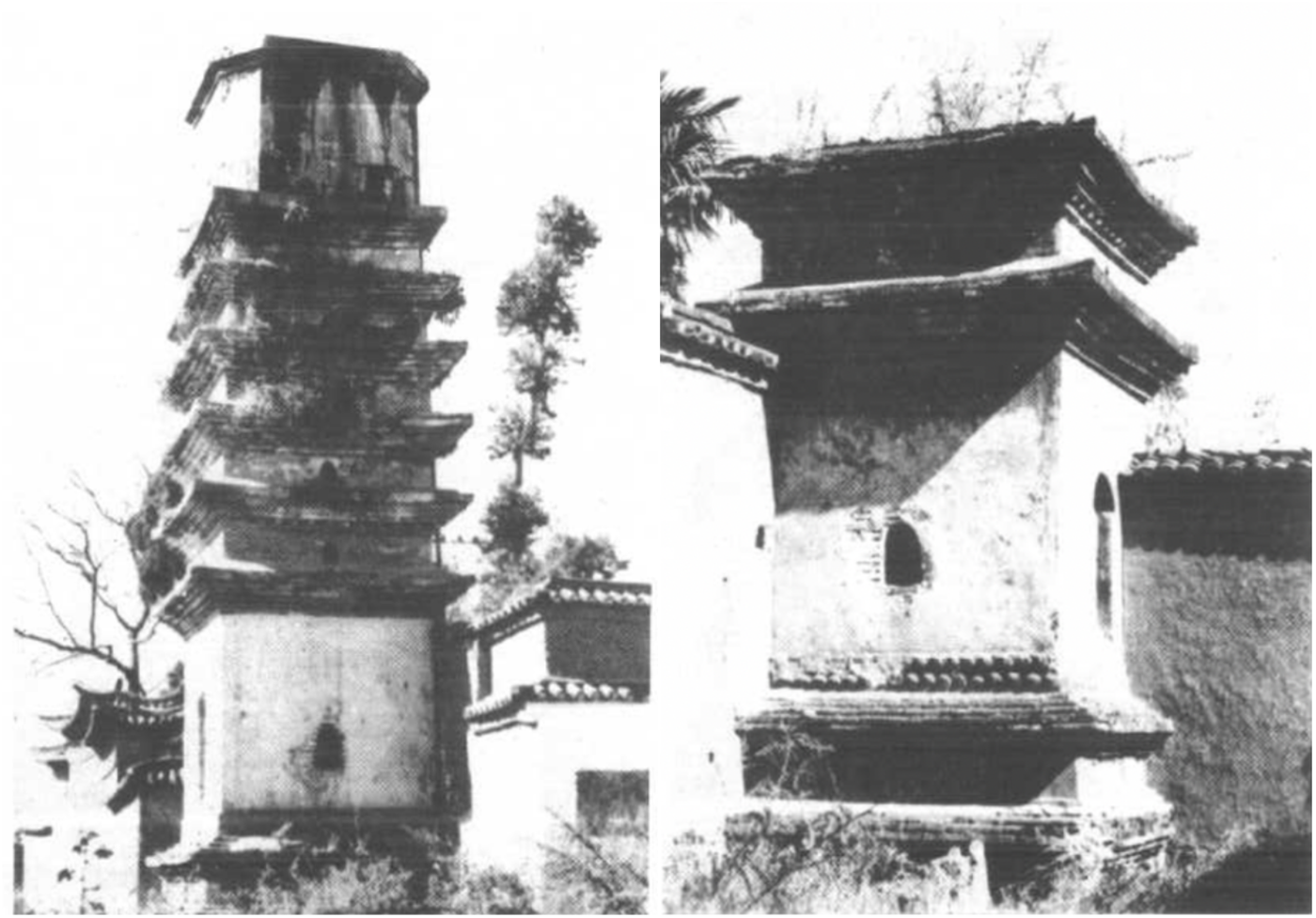
The twin pagodas of the Dengjue Temple were erected in the first year of the Chenghua era (1465) and remain standing today, albeit with significant damage inflicted during the Cultural Revolution (see Figure 7). Originally reaching a height of approximately 15 metres, each pagoda was built as a nine-tier, square, solid-brick structure, adorned with layers of closely connected eaves. Such buildings, which are commonly known as miyan ta 密檐塔 (dense-eaved pagodas),Footnote 96 adhere to Tang architectural principles and featured prominently in temples throughout the Nanzhao and Dali periods, persisting well into the Qing Dynasty in Yunnan.Footnote 97 Indeed, they can be understood as material manifestations of the historical and religious memory of the Nanzhao and Dali kingdoms, symbols of the region’s distinctive Buddhist heritage. Their presence in the Dengjue Temple complex highlights the site’s multilayered historical identity, with the spatial coexistence of several historical strata pointing to a narrative of continuity and adaptation.
The twin pagodas of the Dengjue Temple in 1983. Source: C. Li and X. Zhang, Dali guta 大理古塔 (Kunming, 1985), p. Q, plate 14.
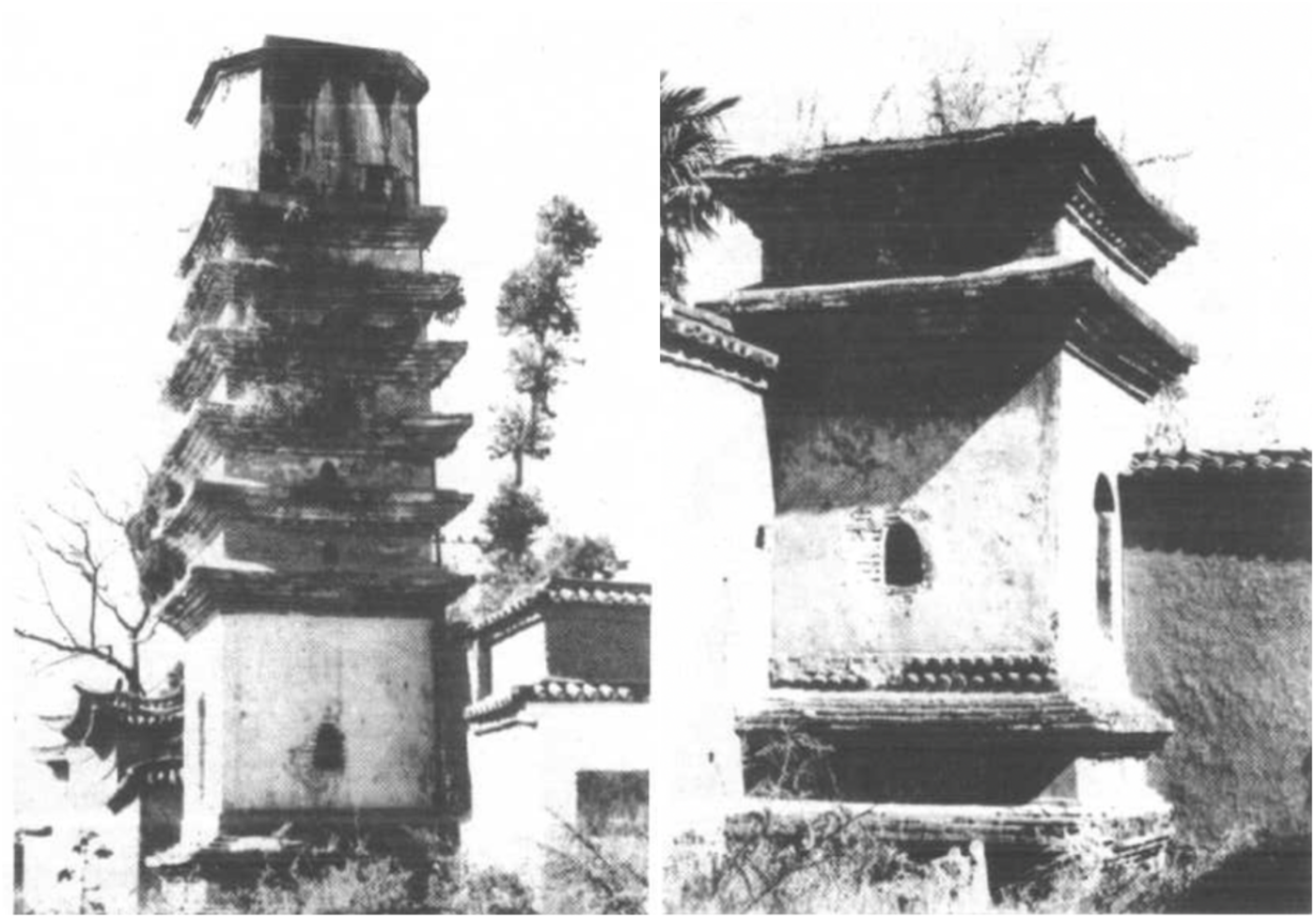
The involvement of Lady Zhang in the construction of the pagodas typifies the way in which the Dengjue Temple developed during the Chenghua period. Members of the local elite were keen to provide the funding for a host of new facilities and elaborate halls that enabled the temple to enhance its status in Menghua and beyond. The end result was a Buddhist institution of considerable regional, if not national, significance. As Naquin notes, ‘Temples were storehouses of special information and themselves constituted blueprints for replication, just as their essential objects were models for imitation.’Footnote 98 These complexes conformed to imperial directives while simultaneously resonating with the values and practices of their local communities.
The Dengjue Temple during the mid Ming period
Despite the prestige it acquired in the latter half of the fifteenth century, the Dengjue Temple subsequently entered a period of steep decline, as the Restoration Stele records:
歷二百餘載, 棟宇傾圮, 金像頹毀, 主僧匪人, 田畝去籍。孰開覺路疇化修營, 乃萬曆丁酉僧綱住持性定, 大發菩提心, 募眾善緣。急首務而營繕正殿, 次及諸殿、諸閣; 廊、廡、門、楣咸易朽以堅, 撤而新之;又鼎建後殿兩廡, 兼塑羅漢諸天。正殿之東, 定又捐己衣鉢之資, 伐木辟地, 創更衣廳、方丈香廚、常住田產什物俱備, 規制視昔弘且麗矣。然非主僧苦志經營, 默運心工意匠於風斤之先, 曷以奏厥丕績。寺功既竣, 為國祝釐, 為眾祈福, 咸有處所矣。夫帝王治世, 釋理超世, 用若不侔。然皇覺傳心, 佛覺傳燈, 理本不二。中忝後覺, 曾讀書寺內, 因悟夫佛之道, 可以超上乘為無等, 開群迷為正覺乎。矧今聖天子以蕩蕩巍巍之化嘉, 與海內元元同登般若, 同證妙覺, 天下就之如日, 亦若見佛日, 望之如雲, 亦若披慈雲, 華祝而嵩呼, 蓋萬萬年, 永永無極矣。寺重修於萬曆己亥, 落成於乙巳, 茲以丁未孟夏郡人谷城令王執中因主僧性定、善信朱國臣之請, 爰記於石。
Over two centuries, the buildings have crumbled, golden statues have fallen, the monastery has lost its senior monks, and the fields have been deregistered. Who spearheaded the initiation of the path to enlightenment and oversaw the temple’s reconstruction? In the Dingyou year of the Wanli era (1597), Xingding, the abbot of the Dengjue Temple, was appointed head of the senggang si and actively assisted the community in gathering people under the influence of the Bodhi mind. The foremost task involved renovation of the main hall, then repairing other halls and pavilions. The corridors, roofs, doors, and lintels, all of which had deteriorated, were replaced with sturdy materials by dismantling the old and installing the new. Moreover, two rear halls were constructed, accompanied by the simultaneous sculpting of statues depicting arhats and celestial beings. Xingding made substantial donations of his personal wealth. He prepared materials to the east of the main hall and cleared the land. He established a dressing room, the abbot’s quarters, and a fragrant kitchen, and renovated the monastery’s fields, ensuring they were well equipped. The temple is now as grand and beautiful as it was before.
If it were not for the abbot’s resolute determination to oversee these projects and implement the architects’ clever designs in the face of bitingly cold winds, such great accomplishments would never have been achieved. The reconstruction of the Dengjue Temple is now complete, providing a place for imperial and public blessings. Emperors oversee affairs of state, while Buddhist principles transcend the mundane world, presenting distinct approaches to governance. Nevertheless, as emperors enlighten and disseminate their philosophies and as the Buddha enlightens and spreads the Dharma, the underlying principles reveal no inherent distinctions. I feel a sense of regret for attaining enlightenment relatively late. I once studied within the Dengjue Temple, where I realised that understanding the principles of Buddhism allows one to transcend the highest levels and attain the state of Nirvana. This pursuit aims to bring genuine awakening to sentient beings who have lost touch with their inherent nature. Moreover, the present great monarch, who is revered for both his authority and his benevolence, together with people from across the empire, ascends the wisdom of bōrě (prajñā). They attain sublime enlightenment, brightening the world like the rising sun, resembling the radiant day of encountering the Buddha. Their presence is vast, akin to the expansive clouds or the comforting embrace of compassionate mist. With reverence and jubilation, their influence echoes through myriad eons, reaching an infinite and eternal expanse.
The Dengjue Temple renovations began in the Jihai year of the Wanli era (1599) and were completed in the Yisi year (1605). In the early summer of the thirty-fifth year of Wanli (1607), Abbot Xingding of the Dengjue Temple, along with the devoted believer Zhu Guochen, commissioned the local scholar Wang Zhizhong to inscribe this text onto this stone tablet.
Buddhist policies during the mid Ming Dynasty
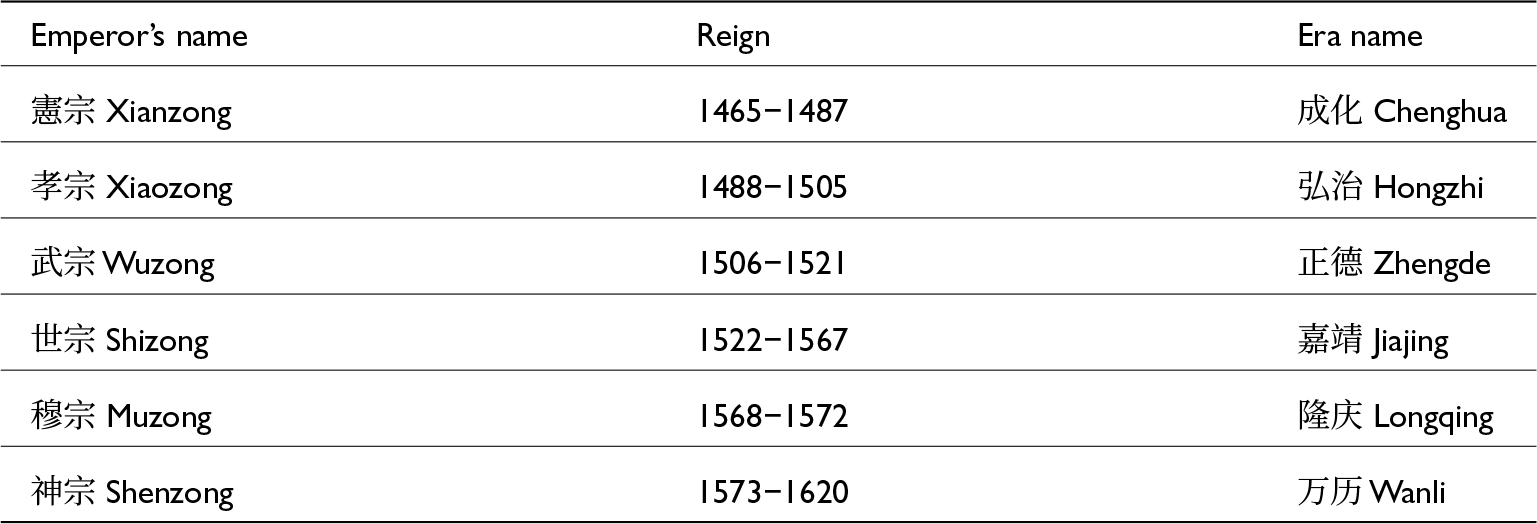
As the inscription testifies, by the Wanli era, the Dengjue Temple was in a state of serious disrepair following the collapse of several buildings, the toppling of golden statues, the loss of its senior monks, and the deregistration of its farmland. Unfortunately, the author of the text, Wang Zhizhong, neglects to explain precisely when or why this happened. However, it is possible to answer these questions by exploring the reigns of the six emperors who held the imperial throne between the Chenghua and Wanli eras (see Table 2).
The emperors of the Ming Dynasty from the Chenghua era to the Wanli era
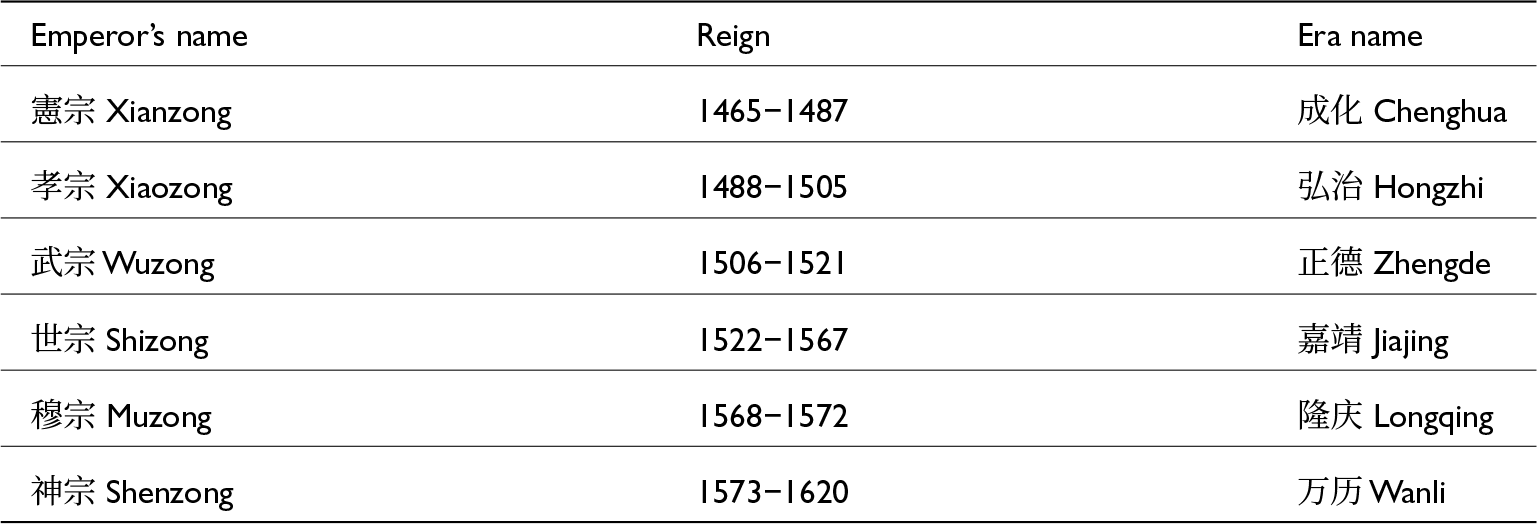
Each of these rulers developed his own unique approach towards the Chinese Buddhist community.Footnote 99 For example, whereas Xianzong was an enthusiastic promoter of the religion, Xiaozong was more of a Confucianist, and Wuzong was primarily interested in Tibetan Buddhism. Nevertheless, all three displayed a generally benevolent attitude towards the empire’s monastic communities. However, there was a major turning point during the reign of the next emperor—Shizong. A strong adherent of Taoism, his disdain for Buddhism eventually developed into outright hostility and persecution,Footnote 100 as the Wanli yehuo bian 萬曆野獲編 (Unofficial gleanings from the Wanli era)Footnote 101 reports:
成化一朝, 僧道俱幸⋯⋯其时僧道官各数千人⋯⋯若世宗朝, 惟玄门见礼, 而释氏俱废灭。
During the Chenghua era, both Buddhism and Taoism flourished … At that time, officials responsible for managing Buddhist and Taoist affairs numbered in the thousands … During the reign of Emperor Shizong, only Taoism was revered, while Buddhism suffered from devastating destruction.Footnote 102
Thereafter, though, relations between the court and the monasteries gradually improved, as Muzong and especially Shenzong reinstated the pro-Buddhist policies of earlier Ming rulers.
Inevitably, the contrasting attitudes of these six emperors towards Buddhism had a profound impact on the evolution of the religion and its institutions. Over the course of the sixteenth century, countless Buddhist temples experienced significant growth, followed by disastrous decline, and eventual resurgence. One such institution was the Dengjue Temple, as evidenced by the restoration project that began in the Jihai year of the Wanli era (1599). Hence, its rise, fall, and recovery exemplify three successive phases in the synergistic relationship between the Ming state, local elites, and Buddhist temples.
Abbot Xingding’s restoration project
The Restoration Stele credits Xingding 性定, the abbot of the Dengjue Temple, with orchestrating the institution’s revival. In his role as dugang 都綱 (supervisor) of Menghua’s senggang si 僧綱司 (prefectural Buddhist registry), he was responsible for overseeing Buddhist affairs across the region. The establishment of this administrative system can be traced back to the reign of the first Ming emperor, Zhu Yuanzhang. It consisted of Buddhist (and Taoist) registries at county, sub-prefectural, prefectural, and imperial levels, all staffed by local monks. The prefectural Buddhist registries were typically housed within prestigious urban monasteries in which the supervisors often held the position of abbot, such as Xingding in the Dengjue Temple. In less developed regions, including Yunnan, these high-ranking supervisors frequently had additional duties, such as dispatching members of the monastic community to small chapels in remote, rural areas with few educational facilities. In addition to disseminating Buddhism, these monks played an important role for the Ming state by acting as its representatives wherever its authority was weak.Footnote 103
Xingding was not merely a highly respected administrator but also a renowned Linji monk and scholar with a deep knowledge of the Buddhist scriptures who actively spread Buddhist teachings, mobilised support, and organised community aid.Footnote 104 Under his leadership, the derelict buildings of the Dengjue Temple were restored to their former glory, statues of arhats and heavenly beings were carved and erected, and three new rooms—a dressing room, fangzhang 方丈 (abbot’s quarters), and kitchen—were added to the eastern side of the complex. Moreover, he funded much of the work himself, helped with the preparation of materials, cleared the land, and renovated the temple’s fields.
The successful completion of this ambitious restoration project suggests that the Dengjue Temple’s economic foundations were still relatively sound. During the Ming Dynasty, temples commonly relied on two main sources of income: public donations and land management. There are three mentions of the temple’s agricultural land in the Restoration Stele inscription:
1. Lady Zhang … donated extensive fields to support the monks.
2. Over two centuries, the buildings have crumbled, golden statues have fallen, the monastery has lost its senior monks, and the fields have been deregistered.
3. Xingding … renovated the monastery’s fields, ensuring they were well equipped.
Xingding’s careful management of these resources would have helped to ensure the temple’s economic stability. From the mid Ming period onwards, many temples received significant gifts of land from both the court and individual donors, which enabled them to accumulate substantial wealth and influence. In addition, where supervision was lax, it was relatively easy for temple leaders to convert public land into monastic land.Footnote 105 Although there are no detailed records of the full extent of the Dengjue Temple’s landholdings, it is safe to assume that the likes of Lady Zhang were generous with their donations. Furthermore, the temple may well have benefited from the tradition of members of the nobility acting as supervisors or guarantors.Footnote 106
Inside the temple complex itself, one of the main features of the renovation was the installation of new statues of heavenly beings and arhats. Both of these groups of deities are credited with safeguarding and disseminating Buddhism, but whereas heavenly beings have origins in local myths and folklore, arhats are revered Buddhist disciples. Although venerated within Chinese Mahāyāna Buddhism, the latter divinities are thought to have achieved a lower form of enlightenment than Gautama Buddha, making them more relatable to ordinary people.Footnote 107 Laypeople’s worship of them traditionally involves providing members of the monastic community with food, clothing, medicine, and other gifts in return for karmic merit.Footnote 108 Therefore, the erection of arhat statues in the Dengjue Temple was probably considered a wise investment, given the amount of income they were likely to generate and the extra devotees they were likely to attract.
Xingding also constructed a fangzhang 方丈. In Chan Buddhism, this term is used in reference to both the abbot’s quarters and the abbot himself—akin to how Chan masters name themselves after their mountain residences. Its origins can be traced to the legend of a Buddhist layman–sage who taught and debated with bodhisattvas in a tiny hut that symbolised not only his humility but also his profound wisdom.Footnote 109 Over time, Chan temples’ abbot’s quarters started to resemble those in Taoist temples, serving as venues for teaching, administrative tasks, and cultural activities.Footnote 110 The Restoration Stele inscription does not specify the position of the abbot’s quarters in the Dengjue Temple, but they were typically located to the north of the Dharma Hall and, from the Ming Dynasty onwards, to the west of the central axis.Footnote 111
Finally, the inscription states that Xingding established a xiangchu 香廚 (fragrant kitchen). Earlier in the text, the simpler term pao 庖 is used for the temple’s kitchen, so the inference is that Xingding upgraded this facility. Xiangchu—along with the alternative term xiangjichu 香積廚—is derived from the Buddhist myth of a Land of Fragrance, where the inhabitants thrive on the aroma of incense.Footnote 112
In conclusion, the inscription emphasises that the Dengjue Temple’s recovery would have been impossible without the abbot’s steadfast determination and prudent leadership. Moreover, Wang Zhizhong highlights the significance of Xingding’s achievement by pointing out that the temple has become a venue for both imperial and public blessings.
Buddhism and imperial authority
One particularly significant aspect of the inscription is that it draws parallels between imperial (specifically Emperor Shenzong’s) policies and the Buddha’s teachings. Wang Zhizhong expresses regret that he did not attain enlightenment earlier in life, highlighting the importance of comprehending Buddhist principles, then immediately lauds Shenzong’s authority, wisdom, and benevolence. The message is clear: enlightened emperors support Buddhism. Moreover, according to Wang Zhizhong, there is no conflict between this and the emperor’s duty to promote secular, Confucian values. This typifies the thinking of many Ming scholar–officials, who often supported the integration of the two ideologies.
Completion of the restoration
After explaining that the Dengjue Temple’s renovation was a six-year project, spanning the years 1599 to 1605, the inscription concludes with an account of how the text itself came to be written. Wang Zhizhong asserts that Abbot Xingding and a Buddhist devotee named Zhu Guochen 朱國臣 commissioned him to inscribe the report onto the stone tablet, once again highlighting the fact that the success of temple projects in Ming China often rested on close cooperation between the monastic community, local lay donors, and scholar–officials.
Conclusion
This study has demonstrated that the Dengjue Temple functioned not only as a prominent Buddhist institution but also as a critical arena for negotiating imperial authority, local identity, and religious transformation along the south-western frontier of the Ming empire. Detailed examination of the Dengjue Temple’s Restoration Stele has revealed that the temple’s evolution—across the Yongle, Zhengtong, Chenghua, and Wanli periods—reflected the shifting dynamics between Ming state policy and regional socio-political configurations.
At the core of this case lies the tension between the Ming court’s ambition to impose normative, Ming-style Chan Buddhism throughout the empire and the enduring legacy of the Nanzhao–Dali Buddhist kingship tradition. The monk Wuyong, a former soldier from Nanjing, embodied this relationship. His successful mobilisation of support from native official Zuo Jia, garrison commander Ge Sheng, and local aristocratic families illustrates the strategic role played by itinerant monks in translating imperial religious policy into localised frameworks of belief and practice. Rather than top-down imposition, the Ming Buddhist project in Menghua required collaborative engagement, particularly with hereditary lineages such as the Zuo family, who leveraged both their ancestral prestige—rooted in the memory of Nanzhao sovereignty—and imperial recognition to entrench their authority under the new regime.
The temple’s architectural record reinforces this interpretation. While the layout conformed to Ming institutional templates, its incorporation of a Heavenly Beings Hall and an Ascetic Buddha Hall reflected local spiritual priorities and regional adaptations. Such features—along with the later additions of the Vairocana, Skanda, Guanyin, and Dizang halls—illustrate the persistence of syncretic traditions that blurred the boundaries between imperial orthodoxy and local devotional practices. The temple’s twin pagodas, constructed during the Chenghua era, exemplify the enduring architectural legacy of the Nanzhao and Dali periods through their square-form, dense-eaved design, symbolising the region’s historical Buddhist identity within a Ming institutional framework. Their architectural hybridity and the donations that funded their construction further reflect what was a complex matrix of cultural negotiation.
Abbot Xingding’s renovations in the Wanli period reasserted the temple’s institutional prominence. His leadership, grounded in both scriptural knowledge and effective resource mobilisation, exemplifies how regional monastics operated as agents of Ming religious reconstruction. The support of Confucian scholar–officials like Wang Zhizhong and Liu Tong, combined with the ongoing patronage of local elite families such as the Zhang and Zi lineages, attests to the importance of temple building in both the reinforcement of imperial authority and local strategies of legitimacy. As Naquin observes, temples were not fixed monuments but evolving products of collective aspiration—a point vividly demonstrated by the Dengjue Temple’s multilayered development.Footnote 113
Ultimately, the history of the Dengjue Temple reveals the limitations of conventional centre–periphery models by demonstrating the myriad ways in which imperial ambition, local agency, religious innovation, and architectural form were deeply intertwined during the Ming Dynasty. Far from being passive recipients of Ming policy, Menghua’s native officials and religious communities actively shaped the contours of Buddhist practice and institutional space. By foregrounding these dynamics, this study contributes to a broader reassessment of Ming frontier governance as a dialogic and negotiated process in which temples served as both symbols and instruments of cultural transformation.
Conflicts of interest
None.