The status of women in the Arab world continues to concern both political scientists and policymakers. Biases against women in politics are unusually prevalent there (Inglehart and Norris, Reference Inglehart and Norris2003b). These biases have been attributed to several factors, including Islam (Fish, Reference Fish2002; Inglehart and Norris, Reference Inglehart and Norris2003a), Arab political history and culture (Donno and Russett, Reference Donno and Russett2004), and oil (Ross, Reference Ross2008).
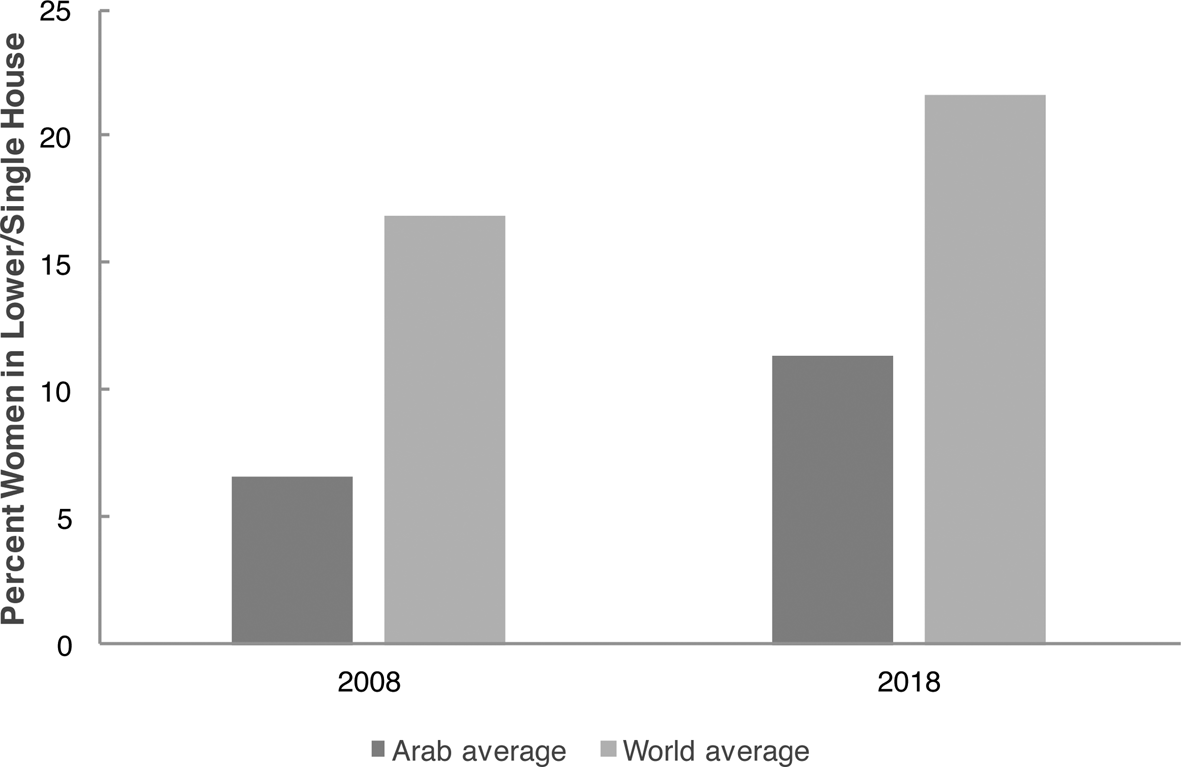
Arab women also have limited descriptive representation in national parliaments. As Figure 1 shows, women made up only 11 percent of parliaments in the Arab world as of 2018, which was considerably less than the world average of 22 percent. And yet Figure 1 also shows that women's descriptive representation in the Arab world has improved considerably in recent years, almost doubling since 2008. In many cases, this increase was thanks to quotas designed to elect more women. The growing number of women representatives in Arab countries with widespread biases against women in politics raises questions about how the changing composition of legislatures is shaping citizens’ political engagement. Will having more women representatives lead women citizens to become more engaged? Or could it depress citizen engagement due to pervasive gender biases?
Women in national parliaments (lower/single house). Data from Inter-Parliamentary Union, using data from 20 May 2018 for 2018 and 31 May 2008 for 2008.

To shed light on these questions, we draw on a large, nationally-representative panel survey with an embedded experiment to examine the effect of having women representatives on the political engagement of constituents in Tunisia. Our study took place around the country's first democratic elections for parliament in 2014. We provided Tunisians with an opportunity in the survey to communicate a political opinion with representatives from their districts. Citizens’ willingness to contact elected officials is an important political behavior, especially in new democracies, and has been shown to shape countries’ democratic trajectories (Lussier, Reference Lussier2011, Reference Lussier2016). It is also a key variable in the literature on how women officeholders affect citizen engagement (e.g., Wolbrecht and Campbell, Reference Wolbrecht and Campbell2007; Zetterberg, Reference Zetterberg2009; Barnes and Burchard, Reference Barnes and Burchard2013). Thus, we sought to understand how women officeholders would influence citizen engagement in a more democratic Tunisia.
We compared contact rates between respondents randomly selected to be primed to think of their women representatives and two different control conditions. In the first wave of the panel survey, we measured respondents’ baseline rate of contact absent a prime about their women representatives. These responses act as the first control group. In the second wave of the survey, respondents were randomly selected into a women-only treatment condition in which they were asked to consider communicating with their women representatives or a second control group in which they were asked to consider communicating with a mixed-gender group of representatives.Footnote 1 This research design was possible because Tunisia is divided into 27 multi-member electoral districts and—thanks to a quota that requires parties to alternate between men and women candidates on their lists—every district but one elected both men and women to parliament.
Unexpectedly, people were significantly more likely to want to communicate with their representatives when primed to think of a women-only group versus a mixed-gender group. This pattern did not vary according to the respondent's gender. These findings are surprising considering the hypotheses we draw from the literature, which predicted that people would either be less willing to communicate with women officeholders due to gender bias or that communication would vary by gender, with women contacting women more. The surprising effect could either be interpreted as reflecting enthusiasm for contacting women officeholders or as a negative reaction to gender mixing.
We find more support for the latter interpretation. The effect we identify was driven by political Islamists. Although supporters of Ennahda, the main Islamist party, and supporters of Nidaa Tounes, the main secular party, contacted women officeholders at similar rates, Ennahda supporters penalized the mixed-gender group of officeholders, with a contact rate that was 9 percentage points lower. To unpack this finding, we consider the literature on women's symbolic representation in the Arab world. Drawing on recent insights into gender segregation (Benstead, Reference Benstead2014; Ben Shitrit, Reference Ben Shitrit2015; Gottlieb, Reference Gottlieb2016), we posit that some Islamists follow a conservative interpretation of Islam and are less likely to approve of gender mixing in public and professional settings. Consequently, we argue that some Islamists reacted negatively to our mixed-gender prime and were less interested in contacting their representatives as a result.
This study demonstrates the value of studying women's symbolic representation in the Arab world. Whereas previous research has examined the gender dynamics of service provision in this region (Benstead, Reference Benstead2016; Buehler, Reference Buehler2016), the broader ways that women officeholders shape citizens’ perceptions and opinions have been largely unexplored, with the exception of important research by Ben Shitrit (Reference Ben Shitrit2016) on Islamic movements in Egypt, Israel, and Palestine. Our findings build on those from other world regions about the limited positive effects of women's increased presence in elected bodies on women's mass engagement (Zetterberg, Reference Zetterberg2009; Kittilson and Schwindt-Bayer, Reference Kittilson and Schwindt-Bayer2012; Clayton, Reference Clayton2015).
In addition, to the best of our knowledge, ours is the first study to identify a negative symbolic effect—albeit a conditional one—of women's representation that is related to norms about gender mixing. Understanding the prevalence of such effects will be an important task for future research. Quotas have made gender mixing in political institutions more common, including in quite conservative societies (Krook, Reference Krook2009; Bush, Reference Bush2011). Although a rich literature has sought to explore the effects of this trend (Franceschet et al., Reference Franceschet, Krook, Piscopo, Franceschet, Krook and Piscopo2012), many questions remain about the dynamics of women's representation in societies where citizens have concerns about gender mixing. Whereas descriptive representation may enhance symbolic representation and democratic legitimacy in the United States (Clayton et al., Reference Clayton, O'Brien and Piscopo2019), the same may not be true for more conservative societies in the Arab world and beyond.
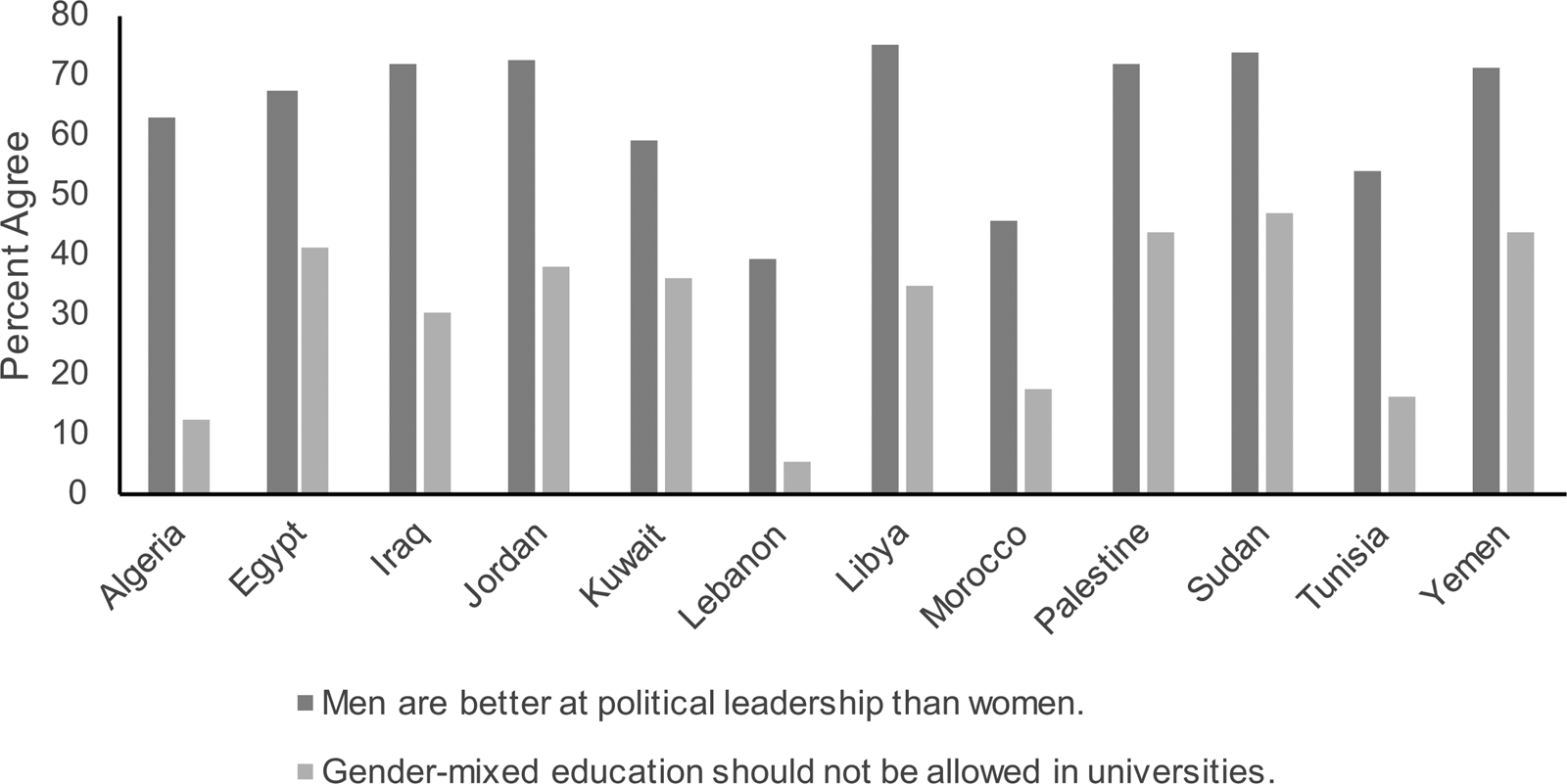
That we found evidence of these dynamics in Tunisia is striking given that it might be considered a hard case for uncovering such effects within the Arab world. As Figure 2 shows, and despite the country's history of relative gender equality, Tunisians have clear explicit biases against women in politics. According to the 2013 round of the Arab Barometer, 55 percent of Tunisians agreed with this statement: “In general, men are better at political leadership than women.” Though that is a substantial proportion, it is lower than in most countries surveyed. Meanwhile, Tunisians support gender mixing more than respondents in most other countries in the region. According to the same survey, only 16 percent of Tunisians disagreed with this statement: “Gender-mixed education should be allowed in universities.” Thus, norms against gender mixing in other Arab countries could present even stronger barriers to women's substantive and symbolic representation than in Tunisia.
Gender attitudes in the 2013 round of the Arab Barometer, using responses to questions 601 and 607-4.

The implication of these norms is that some voters will be more comfortable communicating with their elected politicians if democratic institutions conform to local gender segregation norms or preferences. If they do, it may make democracy work more effectively and smoothly. Yet, doing so would undermine the democratic norms often adhered to elsewhere, where the idea of gender segregation among parliamentary representatives would be rejected as undemocratic and unequal. This research thus carries implications for research on gender and political participation not only in the Middle East, but also in developing countries, more broadly, where gender segregation continues to be present in many places, such as in parts of South Asia, where both Hindus and Muslims engage in the practice of purdah.
1. Communication with women officeholders
Increases in women's descriptive representation globally have prompted interest in how the presence of women officeholders affects citizens’ political engagement. In this section, we review the literature, identifying two main perspectives. The first suggests that people will contact women officeholders less due to biases. The second posits that women will contact women officeholders more than men because of shared gender.
1.1 Gender bias
Biases against women serving in leadership roles are common. Across many contexts, people tend to associate women and men with different personality traits (e.g., viewing women as conciliatory and men as assertive).Footnote 2 Consequently, they may assess women's and men's suitability for leadership positions differently (Eagly and Karau, Reference Eagly and Karau2002). As noted above, biases against women in politics are common in the Arab world. These biases may cause people to view women as ineffective leaders and unqualified for positions of power. This literature suggests the following hypothesis: Women officeholders will be perceived as ineffective, unqualified, or both (Hypothesis 1).
Biases against women leaders could depress citizen contact with them through several mechanisms. First, an important reason why citizens contact elected officials—even in countries that are not consolidated democracies—is to encourage those officials to respond to their concerns (Lussier, Reference Lussier2011, Reference Lussier2016; Dimitrov, Reference Dimitrov and Dimitrov2013). If people do not think that elected officials are capable, then people may doubt officials’ ability or willingness to respond to their concerns. Thus, the perceived value of contacting such officials will be less than it would be otherwise. An implication is that when people are biased against women politicians they will also be less likely to contact them.
Second, people may be more likely to contact elected officials toward whom they feel favorably for other reasons. For example, people may prefer to contact such individuals because they feel more comfortable doing so (Gay, Reference Gay2002: 718). The implication is that if people hold negative opinions of women political leaders, then they will be less likely to contact them. Thus, the hypothesis is: Contact with officeholders will be lower when individuals are primed to think of women officeholders (Hypothesis 2).
1.2 Shared gender
In contrast to the above literature, other research argues that women officeholders will cause more engagement among women constituents. This research is rooted in normative theory that emphasizes how descriptive representatives can communicate and establish trust better with traditionally disadvantaged groups, including women (Mansbridge, Reference Mansbridge1999). The core prediction is: Men constituents will contact women officeholders at lower rates than women constituents (Hypothesis 3).
This hypothesis has received mixed empirical support in the literature. Several studies have identified a positive relationship between women's descriptive representation and women's mass participation. Researchers have examined advanced industrial countries (Wolbrecht and Campbell, Reference Wolbrecht and Campbell2007; Karp and Banducci, Reference Karp and Banducci2008), Latin America (Desposato and Norrander, Reference Desposato and Norrander2009), and sub-Saharan Africa (Barnes and Burchard, Reference Barnes and Burchard2013). Similarly, research from India, where gender quotas have been randomly assigned at the local level, has identified lasting positive effects of women officials on women's political engagement (Beaman et al., Reference Beaman, Chattopadhyay, Duflo, Pande and Topalova2009; Bhavnani, Reference Bhavnani2009).
Yet, other studies have reached different conclusions. Cross-national evidence suggests that quotas are at best associated with smaller gender gaps on certain dimensions of political engagement—though this effect is largely driven by a decline in men's engagement—and no changes in other dimensions (Zetterberg, Reference Zetterberg2009; Kittilson and Schwindt-Bayer, Reference Kittilson and Schwindt-Bayer2012). Meanwhile, studies focused on Mexico (Zetterberg, Reference Zetterberg, Franceschet, Krook and Piscopo2012) and Lesotho (Clayton, Reference Clayton2015) conclude that quotas do not increase women's engagement and, in the latter case, even reduce it on certain measures. These ambivalent findings suggest that any positive effects of women officeholders on women's engagement may be contextual. Consequently, there is a need for further research that examines the effect of women officeholders on women's engagement, and women's communication specifically, including in the Arab world.
2. The Tunisian case
We test the hypotheses using evidence from Tunisia. Our study was carried out shortly after Tunisia elected its first democratic parliament in October 2014.
Tunisia is relatively unique among Arab countries in its embrace of gender equality. In 1956, the country passed a Code for Personal Status that enshrined many progressive rights for women, including a right to divorce. By 1959, women were given the rights to vote and run for political office. These achievements were top-down reforms adopted as part of a secular state-building strategy after independence from France (Charrad, Reference Charrad2001). Tunisian presidents continued to embrace women's rights in the ensuing decades, leading Tunisia to be rated highest in every category in a 2010 survey of women's rights in the Middle East and North Africa (Kelly and Breslin, Reference Kelly and Breslin2010). Nevertheless, Tunisia is characterized by inegalitarian public attitudes, as shown earlier in Figure 2.
Given this context, many worried that when Tunisia turned to democracy after the 2011 revolution, the status of women would worsen. As Benstead et al. (Reference Benstead, Jamal and Lust2015: 75) note, “Even as some celebrated the downfall of long-standing dictators after 2011, many raised concerns that women's rights would suffer setbacks in political transitions.”Footnote 3 Tunisian experiences were thus poised to set an example in the region for international organizations interested in promoting women's rights and democracy.
As anticipated, the transition period in Tunisia involved many debates about gender, religion, and politics. The Constituent Assembly, which was led by an Islamist party, Ennahda, in coalition with two secular parties, oversaw the writing of a new constitution and electoral law. A noteworthy feature of the electoral law was its quota. After the 2011 election for the Constituent Assembly, women's groups successfully advocated for laws requiring parity in parties’ electoral lists (Chambers and Cummings, Reference Chambers and Cummings2014: 39; Shalaby, Reference Shalaby, Shalaby and Moghadam2016: 173). In the 2014 election, political parties achieved parity by alternating men and women on their candidate lists. However, there was resistance to parity since most parties still nominated men at the top of their lists, which resulted in a parliament with more men than women (Krook, Reference Krook2016: 276–277).
This quota made Tunisia a valuable case from the perspective of research design. A challenge for understanding how officeholder gender affects citizens is that officeholders are not assigned randomly to constituents. As a consequence, inferences about the effect of women officeholders may be biased. Imagine, for example, that women are more likely to contact women officeholders. Women representatives may be more likely to get elected when women voters are more politically active, causing us to overestimate the effect of officeholder gender on contact.
In 2014, the Tunisian parliament had 27 multi-member electoral districts that represented people in Tunisia. Because of the quota, every district but one had both men and women representatives. We were thus able to provide Tunisians with an opportunity to communicate with their real representatives while randomly-selecting some participants to think specifically about their women representatives.Footnote 4
The election that we study occurred on 24 October 2014. The election was mostly a competition between Ennahda and Nidaa Tounes, a secular party formed following the Constituent Assembly election. Neither Ennahda nor Nidaa Tounes featured women's issues prominently in its platform (Tavana and Russell, Reference Tavana and Russell2014: 6–10). Sixty-six percent of Tunisians voted. Nidaa Tounes won a plurality of seats (86 out of 217), and Ennahda captured the second-highest total (69 out of 217). No other party secured more than 16 seats. In total, 68 women were elected; 37 represented Nidaa Tounes, and 27 represented Ennahda. In other words, roughly 40 percent of both parties’ representatives were women.
3. The research design
To test the hypotheses, we use data from a large, nationally-representative, two-wave panel survey we fielded with a Tunisian survey research firm, ELKA Consulting. Local enumerators interviewed respondents in Arabic in their homes using pen and paper. Wave 1 was fielded immediately following the parliamentary election. Wave 2 occurred two months later, following the presidential election.Footnote 5
The survey used quota sampling, including on gender, to achieve a nationally-representative sample. Respondents were not matched to enumerators by gender.Footnote 6 In wave 1, 1,400 adult Tunisians participated. In total, 1,089 respondents returned for wave 2. Despite the drop-offs, the sample remained broadly representative; see the Supporting information (SI) for further information on the sample composition.
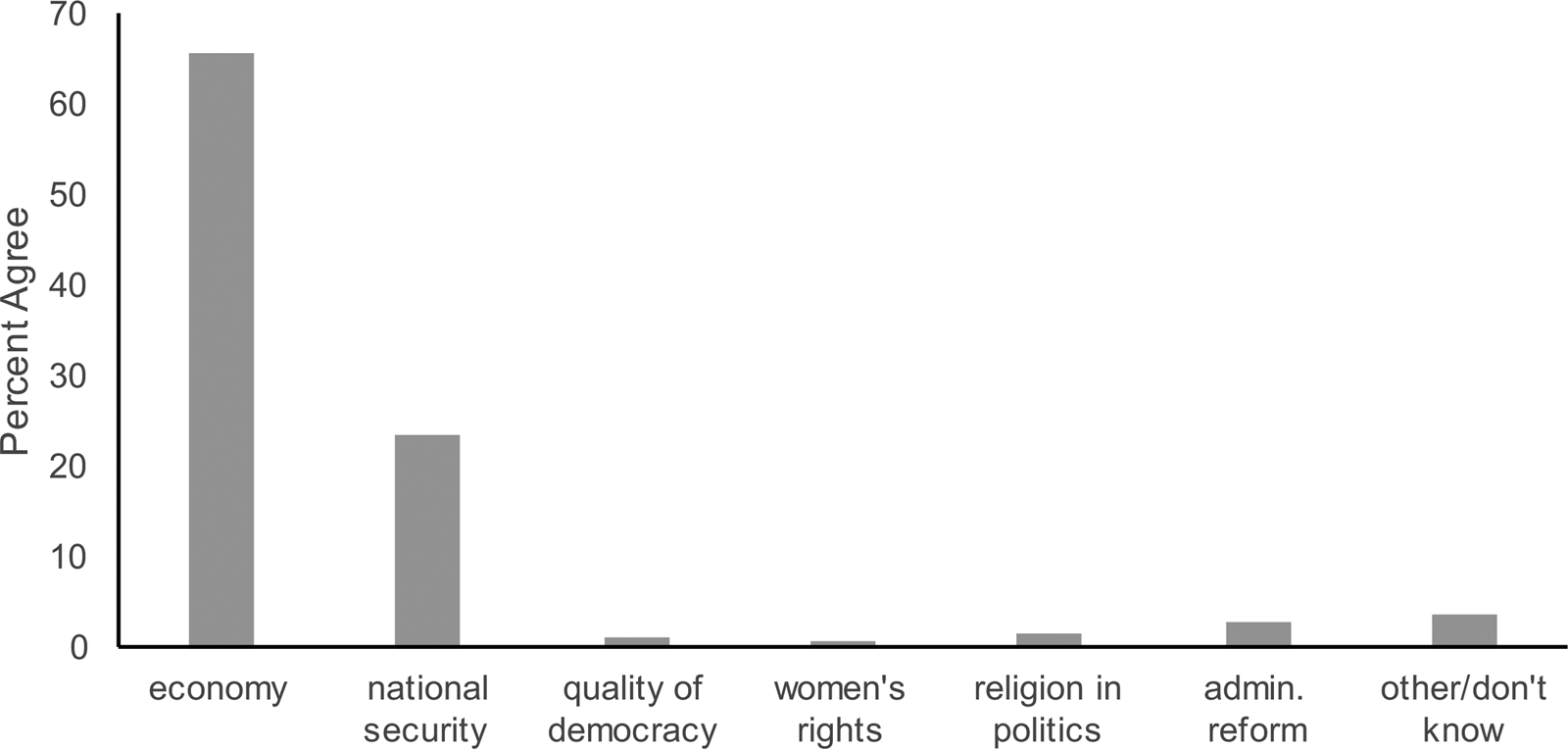
In both waves, enumerators asked respondents what they thought the main problem facing Tunisia was. Figure 3 presents the responses from wave 2; responses in wave 1 were similar. Among the problems that respondents were asked to choose from, the economy was perceived as most important (66 percent). The second most important problem was national security (24 percent). In contrast, few viewed women's rights as the most important issue. The economy and national security are relatively “masculine” policy areas (Barnes and O'Brien, Reference Barnes and O'Brien2018; Gottlieb et al., Reference Gottlieb, Grossman and Robinson2018). As such, we expected people might not want to communicate with women officeholders out of a belief that they would not be effective at making policy. As we show below, that was not the case.
The most important problem facing Tunisia, wave 2.

We embedded an experiment in our panel survey that was intended to isolate the effect of women officeholders on the political communication of constituents. In wave 1, we asked respondents if they wanted us to tell their representatives their answer about the most important problem facing Tunisia. The question did not include a prime about women officeholders. Rather, every respondent heard the Arabic translation of “representatives,” which took the plural masculine noun form and is used to specify either a mixed-gender group of people or a group of men. Answers were either “yes” or “no.” Responses to this question serve as the first control group since they capture individuals’ baseline willingness to communicate with a group of their representatives.
In wave 2, we again asked respondents if they wanted us to tell their representatives their opinion about the most important problem facing Tunisia. This time, we randomly selected some respondents to receive a prime designed to make them think about their women representatives. Since respondents in nearly every district had women representatives, respondents had an equal probability of assignment to treatment.Footnote 7 For respondents in the treatment condition, interviewers first showed a photograph of women in the Tunisian parliament and told respondents that they had been recently elected. Then, they asked: “Do you want us to tell your women representatives your answer about the main problem facing Tunisia today?” The Arabic translation explicitly stated “women representatives” instead of letting gender be implied by the plural noun form.
The control group contained the other half of respondents, who were not assigned to receive the women representatives treatment. The photo showed a mixed-gender group of representatives, and the question asked whether they wanted us to tell their men and women representatives their answer about the main problem facing Tunisia. The Arabic translation explicitly stated “men and women representatives.”
The dependent variable questions were answered using “yes” or “no.” This design allowed us to compare rates of contact within the same subjects in waves 1 and 2 as well as between subjects in wave 2.Footnote 8 Subsequent questions measured the hypothesized mediators: beliefs about representatives’ effectiveness and qualifications.
Balance checks reported in the SI show that the experimental groups were similar in terms of age, respondent gender, enumerator gender, education level, employment status, geographic location, household income, marital status, policy priority, political knowledge, religiosity, and voting in the parliamentary election. Only 18 subjects refused to answer our questions about communicating with their representatives. Non-response rates did not vary notably across the experimental groups.
Finally, two design-related decisions require further discussion. First, why did we choose this outcome measure? To start, citizen contact is relevant for the hypotheses we sought to test and is central to the literature on gender and citizen engagement (e.g., Wolbrecht and Campbell, Reference Wolbrecht and Campbell2007; Zetterberg, Reference Zetterberg2009; Barnes and Burchard, Reference Barnes and Burchard2013; Kalla et al., Reference Kalla, Rosenbluth and Teele2018). Contact is also relevant for democracy (Lussier, Reference Lussier2011, Reference Lussier2016). Contact rates would likely have been lower had we measured respondents’ willingness to write letters or make phone calls. Yet, our goal was to identify the effect of women officeholders on contact rather than to calculate an “objective” rate of contact in Tunisia. We know of no reason why using an easy type of contact as our outcome would have biased us in favor of finding support for the hypotheses. If anything, it may have limited variation in our outcome measure and thus made null effects more likely.
Second, why did we design the treatments this way? As noted, our goal was to identify the effect of women officeholders on citizen contact. Thus, our design centered around a treatment that primed respondents to think of women officeholders as well as two control conditions. We piloted an alternative design that compared constituent contact after priming respondents to think about either women officeholders or men officeholders.Footnote 9 Our pre-tests indicated that respondents thought it was strange when men representatives were highlighted. Thus, we were concerned that we might identify significant treatment effects due to respondents’ sense that they were part of a study rather than due to women officeholders, per se. In contrast, in the context of international efforts to increase Arab women's representation, an invitation to contact women did not strike subjects as strange. Quite possibly, people imagined men officeholders when an explicit gender cue was absent in wave 1, which sheds additional light on the dynamics we discuss below.
4. The effects of women officeholders on contact
Tunisians were very interested in contacting their representatives. Eighty-six percent of respondents in wave 2 wanted to communicate with their representatives. Although communication was easy to do in our survey, we believe that this figure also reflects Tunisians’ enthusiasm about contacting their first democratically-elected officials.
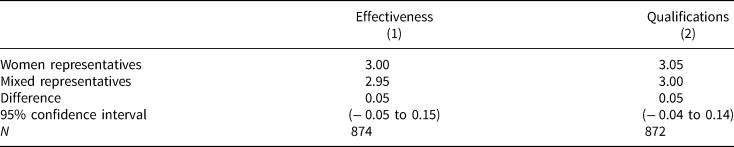
Strikingly, as Table 1 shows, we find no evidence that women officeholders were perceived as relatively ineffective or unqualified (Hypothesis 1).Footnote 10 This finding is noteworthy since one criticism of quotas is that they will lead to the election of less qualified women. At the same time, women representatives were not perceived as significantly more effective or qualified, as might have been the case if Tunisians thought women were less corrupt.
The effects of women officeholders on perceived effectiveness and qualifications, wave 2

Effectiveness and qualifications were measured on four-point scales.
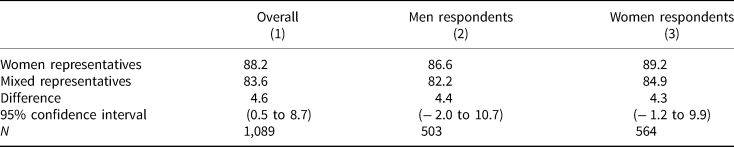
We also fail to find that citizens were less willing to engage with women officeholders (Hypothesis 2). As column 1 in Table 2 shows, subjects in wave 2 were not more willing to contact under the control condition of the mixed representatives; in fact, they were significantly less likely to do so (p = 0.03). The difference is around 5 percentage points. Our within-subjects analysis, presented in the SI in the interest of space, shows similar patterns relative to the baseline from wave 1. Since women representatives were not perceived as differently qualified or effective than mixed-gender representatives, this unexpected finding cannot be explained by a perception that they were more likely to listen or respond to citizens.
The effects of women officeholders and individuals’ gender on willingness to communicate, between-subjects, wave 2

This table displays the rate of contact.
Social desirability is also unlikely to explain the treatment effect. As noted earlier, there are strong explicit biases against women leaders in Tunisia. It is therefore unclear why respondents would have felt social pressure to demonstrate their willingness to contact women representatives in our study. In the next section, we discuss further reasons why it is unlikely that this effect is driven by social desirability or experimenter demand.
Finally, the patterns do not vary by respondent gender. Looking at columns 2 and 3 in Table 2, we see that both men and women were more willing to contact women in wave 2, and the effect sizes are similar.Footnote 11
5. Political Islam and support for gender mixing
Thus far, we have identified a surprising pattern: Tunisians were more willing to communicate with women representatives than a mixed-gender group of representatives. This pattern could reflect either enthusiasm for contacting women representatives or a negative reaction to the control condition in which respondents were asked about a mixed-gender group of representatives. We favor the latter explanation, proposing that some conservative Islamist respondents in our survey may have had a negative reaction to seeing gender mixing in a public setting in what we had intended to be a control condition. In this section, we develop an argument about the connection between Islamism and support for gender segregation, test this explanation, and consider alternative explanations.
5.1 Support for gender segregation in the Arab world
Although nearly all Tunisians are at least nominally Muslim, they disagree about the role that religion should play in public life. Whereas secularists favor the French notion of laïceté, Islamists support the implementation of Islamic law in politics. Among some conservative Tunisian Islamists, gender segregation in public and professional spaces is a particular concern.
Although the scriptural basis for prohibitions against gender mixing has been questioned, some Islamist leaders throughout the Arab world have promoted them. For example, the Islamic Movement in Israel wrote in its publication Al-Mithaq, “Islam sees in the mixing of men and women a real danger…lead[ing] to the deterioration of society, the loss of self-respect, the corruption of the heart, the destruction of homes and of families, loosening of morals and softening of manliness to the extent of intersexuality and softness” (quoted in Ben Shitrit, Reference Ben Shitrit2015: 53). In Palestine, Hamas has advocated for gender segregation in Gaza schools. Similarly, in Jordan, Islamist parliamentarians have (unsuccessfully) attempted to pass laws mandating gender segregation (Clark and Schwedler, Reference Clark and Schwedler2003: 304).
As discussed earlier, Tunisia has historically been a relatively progressive Arab state on gender issues. Norms against gender mixing are not entrenched in society. Nevertheless, some Tunisians have questioned the appropriateness of men and women mixing in public. These questions became more salient after the 2011 revolution made it possible for Islamists to participate more fully in civic life. Tunisian women who are part of the Salafi movement—a particularly conservative type of Islamism—may actively participate in civic life while simultaneously avoiding or condemning gender mixing (Kolman, Reference Kolman, Cavatorta and Merone2017). In one well-known example, a group of Salafi students in Tunisia led a month-long demonstration against gender mixing in classrooms and faculty lounges.Footnote 12
Concerns about the appropriateness of gender mixing have had political ramifications. During the 2011 Constituent Assembly election, some women candidates found it difficult to campaign due to their inability to access cafés, which are “hubs of political and social activity” and tend to be gender segregated (Petkanas, Reference Petkanas2013: 13). At the same election, men and women voters segregated themselves at polling stations. As one man who was there explained, “The segregation is good. We are satisfied. We don't want men and women together in line. My wife, my sister, and my mother voted and faced no problems.”Footnote 13
It is important to note that the leaders of Ennahda, the main Islamist party in Tunisia, have not advocated publicly for gender segregation. Yet, some of Ennahda's members support it. Debates within Ennahda—especially between its relatively moderate leaders and more conservative grassroots activists—have often centered around gender (Torelli, Reference Torelli, Cavatorta and Merone2017; Wolf, Reference Wolf2017: 138–142). Some of the party's conservative elements have advocated for gender segregation, such as when an Ennahda representative in the Constituent Assembly called for it in beaches and public transportation.Footnote 14 Ennahda has acknowledged the presence of conservative Islamist supporters within its ranks by using gender-segregated outreach strategies to reach potential voters and service constituents (Benstead, Reference Benstead2017; Abdel-Samad and Benstead, Reference Abdel-Samad and Benstead2018). This approach mirrors strategies of gender segregation used by other Islamist parties, such as the Muslim Brotherhood in Egypt (Blaydes and Tarouty, Reference Blaydes and Tarouty2009) and the Islamic Movement in Israel (Ben Shitrit, Reference Ben Shitrit2016: 20).
Unfortunately, our survey did not ask about gender mixing. Using data from the Arab Barometer in 2013, however, we can examine the relationship between support for political Islam and support for gender-mixed education in universities.Footnote 15 As expected, relatively few Tunisians expressed support for Islamism (24 percent), and as noted earlier, few believed that gender-mixed education should not be allowed. However, Islamists were more than three times as likely to oppose gender mixing than others (31 versus 10 percent). Similarly, people who identified as Ennahda supporters were less likely to support gender mixing (p = 0.0001).Footnote 16 These patterns reveal Islamists are less comfortable with gender mixing, on average.
Thus, qualitative and survey evidence both suggest that some Islamists in our survey may have indeed refused to contact the mixed representatives due to discomfort with gender mixing. Recall that our treatment image included a mixed-gender group of representatives sitting together in parliament, and the treatment language emphasized both men and women. People who were less comfortable with gender mixing may have felt that contacting a mixed group was inappropriate.
5.2 Probing the gender mixing argument
We use two variables to test our argument about Islamism and gender mixing: party identification and support for political Islam. Because the empirical tests in this section go beyond what was included in our pre-analysis plan, they are necessarily tentative and should be tested in future work with additional data. Nevertheless, they offer important insights into our significant finding in an unexpected direction.
We begin by exploring whether the treatment effects vary by party.Footnote 17 Recall that Ennahda is the Islamist party in Tunisia. As such, we expect Ennahda supporters to support gender mixing less than other parties’ supporters.
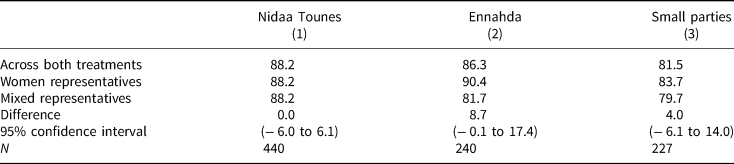
As Table 3 shows, there were significant partisan differences between respondents in wave 2. We compare three groups: Nidaa Tounes supporters (40 percent of the sample), Ennahda supporters (22 percent), and supporters of five smaller parties (21 percent). The remaining respondents did not report supporting a party or reported supporting a party that was so small that its name was not recorded. We find no effect of women officeholders on communication among supporters of Nidaa Tounes or the small parties. In contrast, Ennahda supporters were significantly less likely to want to contact the mixed-gender group of officeholders.Footnote 18 Though Ennahda supporters were still quite willing to communicate with the mixed-gender group, the difference is substantial at around 9 percentage points.
The effects of women officeholders and individuals’ party identification on willingness to communicate, between-subjects, wave 2

This table displays the rate of contact.
We draw attention to the fact that Ennahda supporters contacted women representatives at a rate similar to that of Nidaa Tounes supporters, whereas they contacted the mixed-gender representatives substantially less. As such, they seem to have penalized the mixed representatives. This pattern suggests that social desirability bias and experimenter demand are not concerns. The treatment effect does not result from a boost in contacting women. Instead, it is driven by a negative reaction to the mixed-gender condition. This effect size is substantial; it represents almost a doubling in the number of respondents who refused contact when we compare the mixed-gender condition to the women-only condition. Given that our dependent variable is a relatively easy form of contact, one could interpret a refusal as a protest or symbolic gesture of disapproval of the representatives.
Yet, Ennahda supporters are not monolithic in terms of anxieties about gender mixing. In fact, not all Ennahda supporters are even Islamists, as some Tunisians support the party for other, programmatic reasons. Nor do all Tunisian Islamists support Ennahda (Berman and Nugent, Reference Berman and Nugent2015: 11–16). Some Islamists support other parties for programmatic reasons, while others do not vote at all. Thus, we also explore whether the treatment effect was conditional on support for Islamism, not just support of Ennahda. In wave 1, to assess support for political Islam, we asked respondents how much they agreed with the following statement: “Religious practices are private and should be separated from social and political life.” Relatively few Tunisians supported political Islam according to this measure, with 27 percent disagreeing or strongly disagreeing with the idea that religious practices should be separated from social and political life.
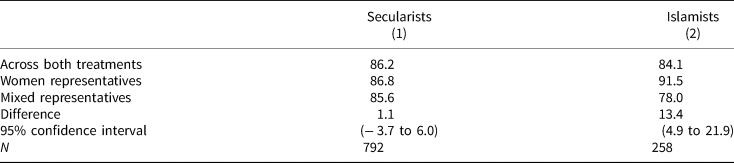
Table 4 shows that there is a large difference in contact rates across treatment conditions for Islamists, but rates of contact are similar for secularists. Islamists were 13.4 percentage points less likely to want to communicate with a mixed-gender group of representatives (p < 0.01). As the SI shows, the results are similar if we control for other variables that are potentially correlated with support for Islamism, such as age, gender, education, employment status, and region. Moreover, a three-way interaction between the treatment, support for Islamism, and the respondent's gender reveals that the treatment effect was not conditional on respondent gender. These findings, together with our findings about party identification, support our argument that the unexpected average treatment effect was due to an aversion to gender mixing among some Islamists.
The effects of women officeholders and support for political Islam on willingness to communicate, between-subjects, wave 2

This table displays the rate of contact.
5.3 Alternative explanations and discussion
As we noted earlier, the pattern we identified—that Tunisians were more willing to communicate with women representatives than a mixed-gender group of representatives—is potentially consistent with a variety of mechanisms that could have prompted people to be either more enthusiastic about contacting women representatives or less enthusiastic about contacting a mixed-gender group of representatives. Our further analysis has, however, shown that the treatment effect is almost entirely concentrated among Islamists according to two different measures. Thus, alternative explanations for the effect we identified must explain not only why contact rates varied across the treatments, but why they varied only for Islamists. We explore four such alternative explanations.
First, it is possible that the patterns we uncovered can be better explained by variation in the most important issues reported by secularists and Islamists. We do not find support for this claim. Supporters of Nidaa Tounes, Ennahda, and the small parties all prioritized the economy the most and did so at roughly similar rates. However, Nidaa Tounes supporters were about 8 percentage points more likely than supporters of Ennahda and small parties to prioritize security (p = 0.03 for both comparisons). To assess whether that difference explains Ennahda supporters’ relative willingness to contact women representatives, we regressed contact on indicators for the treatment and prioritization of national security, as well as their interaction. As the results in the SI show, we do not find evidence of a significant interaction between the treatment and prioritization of national security, including when we subset the analysis by party and respondent gender. The SI also shows similar results when we interact the treatment and prioritization of the economy.
Second, Ennahda supporters could have perceived women representatives as unusually responsive to their needs. As Benstead (Reference Benstead2017: 23) writes, “More than women from other parties, Islamist female deputies mobilize voters and reshape social networks by meeting other women in private spaces…and establishing linkages with women who were previously excluded from patronage networks.” The representatives in our experiment were not, however, specified as being from the respondent's party. Moreover, the effect was not concentrated among women Ennahda supporters. Finally, since Ennahda supporters penalized the mixed-gender group, it is unlikely that the pattern is explained by Ennahda supporters holding unusually favorable attitudes toward women representatives, such as that they are less corrupt or more responsive.
Third, Tunisian Islamists may have been less comfortable contacting the mixed-gender group due to less familiarity with, and therefore greater uncertainty about, how well mixed-gender groups of people work together. After all, in Liberia, Fearon et al. (Reference Fearon, Humphreys and Weinstein2015) found that individuals who witnessed a successful mixed-gender interaction gained confidence that men and women could make decisions together effectively. In the SI, we show that Ennahda supporters perceived the mixed-gender group to be significantly less effective and qualified than the women-only group. Supporters of Nidaa Tounes and small parties did not perceive significant differences across the groups in their effectiveness or qualifications. The distaste or negative affect some Islamists feel when reminded of gender mixing may lead them to avoid situations in which gender mixing occurs and thus to have less experience with how effective mixed-gender groups can be. We cannot, however, rule out that distaste has a direct effect on communication in addition to the possibly-mediated effect that works though beliefs about legislator effectiveness.
Fourth, Islamists may have avoided contacting the mixed-gender representatives because of the photos included in our treatments, although we emphasize that respondents were not asked about communicating with the displayed representatives but their own representatives.Footnote 19 Specifically, 60 percent of the women in the women-only group wore headscarves, as compared to 50 percent in the mixed-gender group. Arguably, the photo therefore implied a slightly more Islamic or Islamist group of representatives, which could have encouraged Ennahda supporters to want to communicate with them. Yet, if headscarves implied something about the representatives’ religious or political beliefs, then we would also expect Nidaa Tounes supporters (i.e., secularists) to have penalized the women-only group, which appeared more Islamist. As shown in Tables 3 and 4, that was not the case. Moreover, this alternative explanation implies that Ennahda supporters would want to contact women representatives more than Nidaa Tounes supporters would since the women representatives are the group that appears more Islamic or Islamist. Yet, the difference between Nidaa Tounes and Ennahda supporters in their likelihood of contacting women representatives is small and statistically indistinguishable from 0 (difference = 2.2 percentage points; p = 0.52).
Finally, we note that women's election to political office itself represents a form of gender mixing, since men traditionally dominate parliaments.Footnote 20 In other words, some Islamists seem to support women participating in political life as elected officials (evidenced by their willingness to contact women representatives) as long as they appear segregated from men. We believe this dynamic is similar to the examples cited earlier in which Tunisians supported women voting but preferred to use segregated lines or supported women running for office but not campaigning in certain spaces. As a consequence, people who have a relatively conservative perspective on gender may paradoxically be more comfortable communicating with women officeholders than with a mixed group of officeholders.
Such a pattern would be consistent with notions of gender complementarity. Ennahda leaders, including women in the party, have emphasized that complementarity “does not at all mean that women are less than men or that the man has a higher position than women,” but instead that men and women each have significant roles to play in public life (quoted in Charrad and Zarrugh, Reference Charrad and Zarrugh2014: 239). Following this logic, some Tunisian citizens may support women's political engagement but nevertheless view it as more appropriate when it does not compete with other values, such as about gender segregation. Given the prevalence of international pressure on countries to improve women's representation, we suspect there may be a number of countries where some opposition to gender mixing coexists with a basic acceptance of women's inclusion in formal politics.
6. Conclusion
In a nationally-representative experiment, we found that Tunisians were less willing to contact their representatives when primed to think of a mixed-gender group of officeholders than when primed to think about women officeholders or when not primed to think about gender. This effect is inconsistent with two predictions from the literature: that on average individuals will be less likely to engage with women representatives and that engagement is conditional on respondent gender.
We found that Islamists drove the counter-intuitive effect we identified. We hypothesized that Islamists felt less comfortable with gender mixing than the average Tunisian. We found preliminary support for this argument, which can and should be tested further in the future. By clearly documenting our ex ante hypotheses as well as the analyses that deviated from them, we also join the movement within comparative politics in favor of research transparency (e.g., Findley et al., Reference Findley, Jensen, Malesky and Pepinsky2016).
The findings have important implications for the literature on gender and politics and especially for thinking about dynamics of representation in the Arab world. First, our evidence does not suggest that Tunisians were hesitant to communicate with women representatives. This finding challenges the notion that gender biases translate into limited citizen support for or engagement with women officeholders. It therefore builds on previous research that emphasizes the limits of culture and ideology when it comes to understanding gender politics in the Middle East (Sater, Reference Sater2007; Blaydes and Tarouty, Reference Blaydes and Tarouty2009; Benstead, Reference Benstead2016). Moreover, our evidence does not suggest that Tunisian women were more willing to contact women representatives. It thus contributes to the literature that challenges the notion that descriptive representatives necessarily increase citizen engagement. At the same time, more experience with democracy in Tunisia could yield different results.
Second, we are not aware of other studies that examine how gender mixing in civic life affects the quality of representation. Our findings suggest that biases against gender mixing represent a meaningful obstacle to women's participation in men-dominated political institutions. These biases should be added to the list of factors that make it difficult for women to obtain equal representation. That we found evidence of this dynamic in Tunisia is particularly striking, given that it has relatively low levels of support for gender segregation in public life for an Arab state. As women's descriptive representation increases in the Arab world and beyond thanks to the passage of quotas, women's presence in elected bodies may become normalized. But are women able to fully integrate men-dominated institutions in societies where gender segregation is the norm? If the public—not to mention families and friends—punishes women for working closely with men officeholders, will women officeholders be able to influence policy and represent their constituents? How might these dynamics change as women representatives reach a “critical mass”? Our findings suggest the value of a research agenda exploring the impact of gender mixing on women's substantive and symbolic representation. It should extend beyond the Arab world to other settings in which gender mixing is discouraged. These settings may include Muslim-majority countries that are not Arab as well as non-Muslim-majority countries. This research agenda may also be extended to explore the dynamics of political mixing across racial and ethnic lines.
Future research can build on this study in several ways. First, scholars can more directly test our gender mixing theory. Research suggests that religious leaders’ endorsements shape attitudes about gender equality in the Arab world (Masoud et al., Reference Masoud, Jamal and Nugent2016). Scholars could investigate whether religious statements supporting gender mixing mitigate negative responses to it. Second, researchers might examine the effect of negative opinions about gender mixing on other forms of citizen engagement. As noted previously, opting to communicate in the context of our panel survey was a relatively easy form of political contact. More costly forms of communication—such as writing to or visiting representatives—could accentuate the treatment effects we identify, as they require more direct contact and therefore might be more uncomfortable for respondents who feel that gender mixing is inappropriate. At the same time, more direct forms of contact could also lead to heterogeneous treatment effects by respondent gender, since men respondents would have to engage in gender mixing when communicating with women officeholders and vice versa. Finally, researchers could replicate our study in other contexts. In countries with more conservative attitudes on gender and politics, the negative response to gender mixing might be stronger—and not confined to supporters of a particular party.
Supplementary material
The supplementary material for this article can be found at https://doi.org/10.1017/psrm.2020.37.
Acknowledgements
This material is based on work supported by the National Science Foundation (NSF) under Grant No. 1456505. Any opinions, findings, and conclusions or recommendations expressed here are those of the authors and do not necessarily reflect the views of the NSF. We are grateful for feedback received in workshops at New York University Abu Dhabi, the University of Connecticut, the University of Washington, and Uppsala University. We also appreciate feedback from attendees at the Northeast Middle East Politics Working Group and the Empirical Study of Gender Workshop, especially from our discussants Lindsay Benstead, Ellen Lust, and Bozena Welborne. Finally, we thank Chantal Berman, Mohamed Ikbal Elloumi and Elka Consulting, Elizabeth Nugent, and Intissar Samarat for their assistance with our fieldwork in Tunisia.