
1. Introduction
Interfacial hydrodynamic instability occurs when an initially perturbed interface separating two fluids of different densities is subject to an acceleration ( $g$) pointing from a heavy fluid to a light one or is impinged by a shock wave, which are known as the Rayleigh–Taylor instability (RTI) (Rayleigh Reference Rayleigh1883; Taylor Reference Taylor1950) and Richtmyer–Meshkov instability (RMI) (Richtmyer Reference Richtmyer1960; Meshkov Reference Meshkov1969), respectively. During the development of these phenomena, light and heavy fluids penetrate into each other, giving rise to the formation of bubble-like (the portion of light fluid penetrating into heavy fluid) and spike-like (the portion of heavy fluid penetrating into light fluid) finger structures (Zhou Reference Zhou2017a,Reference Zhoub). The growth rate of the finger structures can be of particular importance in nature and diverse engineering applications, such as the implosion of an inertial confinement fusion target (see, e.g. Betti & Hurricane Reference Betti and Hurricane2016; Casey et al. Reference Casey2017; Ding et al. Reference Ding, Ting, Yang, Lu, Zhai and Luo2017; Matsuo et al. Reference Matsuo, Sano, Nagatomo, Somekawa, Law, Morita, Arikawa and Fujioka2021; Sabet et al. Reference Sabet, Hassanzadeh, De Wit and Abedi2021), supersonic combustion in a scramjet (see, e.g. Yang, Kubota & Zukoski Reference Yang, Kubota and Zukoski1993; Niederhaus & Jacobs Reference Niederhaus and Jacobs2003) and the explosion of supernovae (see, e.g. Burrows Reference Burrows2000; Isobe et al. Reference Isobe, Miyagoshi, Shibata and Yokoyama2005).
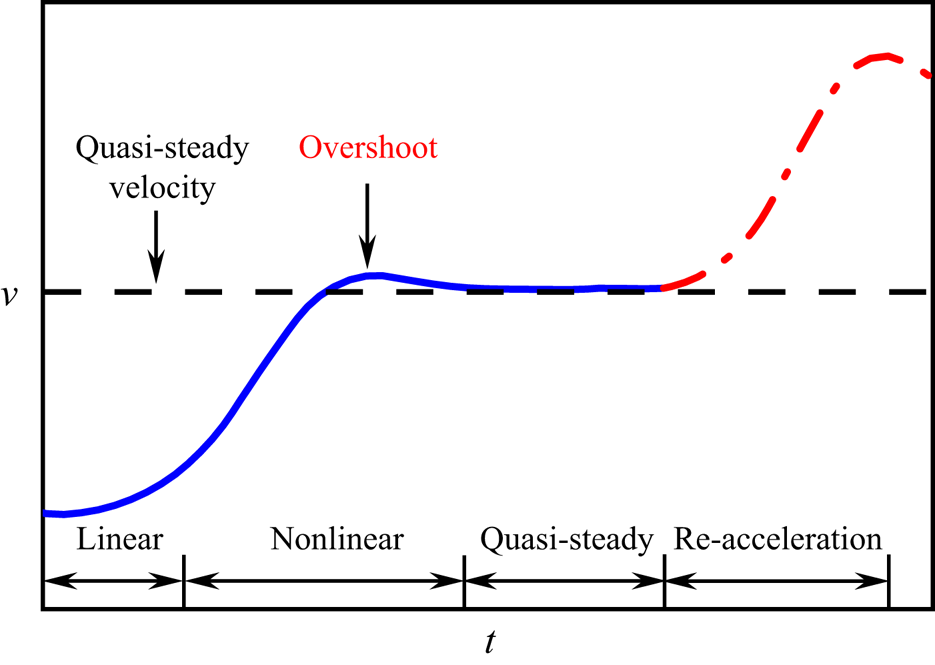
Numerous theoretical, experimental and numerical studies have been conducted for the single-mode RTI and RMI since Taylor's seminal work in 1950 (Taylor Reference Taylor1950). Rayleigh (Reference Rayleigh1883) studied the growth law of interface perturbation for the first time based on linear stability analysis, which was further developed by Taylor (Reference Taylor1950). Subsequently, a number of milestone-like investigations extended the linear stability theory into the nonlinear regime (see, e.g. Lewis & Taylor Reference Lewis and Taylor1950; Meshkov Reference Meshkov1969; Jacobs & Catton Reference Jacobs and Catton1988; Ristorcelli & Clark Reference Ristorcelli and Clark2004; Ramaprabhu, Dimonte & ANDREWS Reference Ramaprabhu, Dimonte and ANDREWS2005; Luo, Wang & Si Reference Luo, Wang and Si2013; Liu et al. Reference Liu, Liang, Ding, Liu and Luo2018; Luo et al. Reference Luo, Zhang, Ding, Si, Yang, Zhai and Wen2018; Liang et al. Reference Liang, Zhai, Ding and Luo2019; Li et al. Reference Li, Fu, Yu and Li2021; Yan et al. Reference Yan, Fu, Wang, Yu and Li2022; Lherm et al. Reference Lherm, Deguen, Alboussière and Landeau2022). Specifically, Lewis & Taylor (Reference Lewis and Taylor1950) reported the first experimental study on RTI, and Meshkov (Reference Meshkov1969) conducted the earliest RMI experiment using thin nitrocellulose membranes, which have sparked continuous interests in the experimental studies of both RTI and RMI (see, e.g. Allred, Blount & Miller Reference Allred, Blount and Miller1953; Jacobs & Sheeley Reference Jacobs and Sheeley1996; Waddell, Niederhaus & Jacobs Reference Waddell, Niederhaus and Jacobs2001; Wilkinson & Jacobs Reference Wilkinson and Jacobs2007; Renoult, Rosenblatt & Carles Reference Renoult, Rosenblatt and Carles2015). In the community of numerical simulation, Daly (Reference Daly1967) was among the first to carry out two-dimensional (2-D) simulations of RTI flow. It was Tryggvason & Unverdi (Reference Tryggvason and Unverdi1990) who conducted early three-dimensional (3-D) RTI flow. However, the computational challenges in the 3-D simulation of RTI flow led to the limitation of available numerical data. For general reviews of research advances on RTI and RMI, readers are referred to the articles by Sharp (Reference Sharp1984), Brouillette (Reference Brouillette2002), Zhou (Reference Zhou2017a,Reference Zhoub), Zhou et al. (Reference Zhou, Clark, Clark, Gail Glendinning, Aaron Skinner, Huntington, Hurricane, Dimits and Remington2019) and Zhou et al. (Reference Zhou2021). One of the main issues in these studies is to predict the growth rate of interfacial perturbation or scaling of the mixed width, which can be used as a surrogate to characterize the degree of fluids mixing, and has been widely evaluated in previous studies. It needs to be mentioned, however, the mixed mass should be a more direct indicator on the evolution of interfacial mixing due to hydrodynamic instabilities (see, e.g. Zhou, Cabot & Thornber Reference Zhou, Cabot and Thornber2016). This is because the mixed mass is monotonically increasing with time and more important for realistic applications, such as inertial confinement fusion. Previous results confirmed that the interface evolution of single-mode RTI usually underwent a linear stage, nonlinear stage, quasi-steady stages with constant growth rate, and other possible stages (see figure 1 (Wei & Livescu Reference Wei and Livescu2012; Zhang & Guo Reference Zhang and Guo2016)). In this process, the growth rate in the nonlinear stage increases nonlinearly due to the gravity and shape variation of the interface, while in the quasi-steady stage, the growth rate tends to be constant due to the balance between buoyancy and drag forces on both sides of the interface, resulting in the self-similar evolution of the finger structure. Both stages are extremely important and have received extensive attention in previous investigations.
Schematic of different development stages of RTI based on the numerical result from Wei & Livescu (Reference Wei and Livescu2012) and sketch map from Zhang & Guo (Reference Zhang and Guo2016).

The advantages of theoretical study lay in its ability to provide a profound understanding for the flow phenomena observed in experiments and numerical simulations. Several influential theories have been established since Taylor's pioneering work, including the potential-flow model (Layzer Reference Layzer1955), Padé approximation approach (Zhang & Sohn Reference Zhang and Sohn1997), vortex and vortex sheet models (Jacobs & Sheeley Reference Jacobs and Sheeley1996; Matsuoka, Nishihara & Fukuda Reference Matsuoka, Nishihara and Fukuda2003), etc. Initially proposed to study the motion of vacuum bubbles with small initial perturbations, Layzer's potential-flow model (LPM) had been extensively adopted in studying fingering instabilities (see, e.g. Layzer Reference Layzer1955; Hecht, Alon & Shvarts Reference Hecht, Alon and Shvarts1994; Alon et al. Reference Alon, Hecht, Ofer and Shvarts1995; Zhang & Sohn Reference Zhang and Sohn1996; Mikaelian Reference Mikaelian1998; Zhang Reference Zhang1998; Goncharov Reference Goncharov2002; Abarzhi, Glimm & Lin Reference Abarzhi, Glimm and Lin2003; Mikaelian Reference Mikaelian2003; Sohn Reference Sohn2003; Zhang & Guo Reference Zhang and Guo2016; Zhang, Deng & Guo Reference Zhang, Deng and Guo2018; Guo & Zhang Reference Guo and Zhang2020; Zhao et al. Reference Zhao, Wang, Liu and Lu2020; Zhang & Guo Reference Zhang and Guo2022; Liu, Zhang & Xiao Reference Liu, Zhang and Xiao2023). Then, it was extended by Hecht et al. (Reference Hecht, Alon and Shvarts1994) to investigate vacuum bubbles in RMI. Mikaelian (Reference Mikaelian1998) and Zhang (Reference Zhang1998) were among the first to give the entire evolutions of bubble and spike, respectively, in a fluid-vacuum configuration. Goncharov (Reference Goncharov2002) generalized LPM to an arbitrary density ratio, but failed to describe a spike (Mikaelian Reference Mikaelian2008). Recently, Zhang & Guo (Reference Zhang and Guo2016), Guo & Zhang (Reference Guo and Zhang2020) and Zhang & Guo (Reference Zhang and Guo2022) developed a universal theory for the evolution of fingers (both bubble and spike) with arbitrary density ratio, which was further employed to solve the RTI problem in cylindrical geometry (Zhao et al. Reference Zhao, Wang, Liu and Lu2020). More recently, Liu et al. (Reference Liu, Zhang and Xiao2023) introduced a dual-source (DS) model within the LPM framework to accurately predict interfacial fingers at all density ratios in two and three dimensions.
Under the original LPM framework, the sinusoidal potential function is employed to describe the flow immediately around the fingertip with the constraint of approximately constant surface pressure. This strategy proves a success in describing the growth rate compared with the results from numerical simulations. However, most of these theories assume that the shape of the fingertip does not change with time in the prediction of the growth rate, which conflicts with numerical simulations from Sohn (Reference Sohn2004) and Ramaprabhu & Dimonte (Reference Ramaprabhu and Dimonte2005). According to Liu et al. (Reference Liu, Zhang and Xiao2023), such an unphysical assumption accounts for the distinct inaccuracy in attempts to catch the concavity and convexity of the fingertip-growth curve as well as the so-called ‘overshoot’ phenomenon (shown in figure 1). Therefore, shape evolution can be crucial to describe the entire evolution of interfacial perturbations accurately. To this end, Liu et al. (Reference Liu, Zhang and Xiao2023) introduced a DS potential function and coupled the solution of growth rate with that of shape curvature.
The DS model (Liu et al. Reference Liu, Zhang and Xiao2023) accurately predicts growth rate and shape evolution, and reveals the nonlinear coupling interaction between them. It is also found that such nonlinear interaction leads to a time delay for the emergence of extreme values in the growth rate and shape curvature. Despite the encouraging achievements, one may raise the following questions about the physical mechanism behind the DS results, which motivates the present study. First of all, in the framework of LPM, can one find a universal mathematical expression of the coupling between the growth rate and shape evolution with arbitrary forms of velocity potential functions? Additionally, is there a decomposition method to precisely quantify the effects of potential force and interface evolution, as well as their interaction? Moreover, how do the initial parameters of the interface, e.g. the initial amplitude and shape curvature, alter the interface evolution and, as a result, influence the fingertip growth?
In this paper, it is found that the interfacial growth rate is dominated by two decoupled effects and the underlying physical mechanisms are highlighted based on the LPM framework. We quantify the inertial effect, which is induced by the density difference between fluid species, and the frontal distortion effect, which stems from interface shape evolution. High-fidelity numerical simulation data from Sohn (Reference Sohn2004) and Dimonte & Ramaprabhu (Reference Dimonte and Ramaprabhu2010) are used to verify our model. The sensitivity of interface evolution to initial parameters is also discussed in depth. The remaining paper is structured as follows. The theoretical basis and derivations of the decoupled mechanism are given in § 2. The theoretical analysis and discussions of the decoupled effects are given in § 3. The proposed mechanism is validated for both RTI and RMI flow regimes in § 4. The explanation of potential physical phenomenon through the decoupled mechanism is given in § 5. Conclusions and discussions are made in § 6.
2. Decoupled mechanisms of interface growth rate
For convenience of the subsequent discussion, it is necessary to give an introduction to the LPM. Specifically, we consider a 2-D system of incompressible, inviscid and irrotational flow subject to gravitational acceleration  ${g}$. In this system, two fluids with different densities are separated upstream and downstream by an interface in a vertically infinite strip with left and right boundaries satisfying the no-penetration condition. The initial material interface is characterized by a single-mode sinusoidal perturbation. The governing equations for the above system can be written as follows per Liu et al. (Reference Liu, Zhang and Xiao2023):
 \begin{gather} {\nabla^2}\varphi _{i} = 0; \end{gather}
 \begin{gather}\dot \eta - \varphi _{i,x} \eta_x + \varphi _{i,z} = 0{,\ z=\eta}; \end{gather}
 \begin{gather}\sum_{i
= 1}^2 {{{( - 1)}^i}} {\rho _i} \left[{-}g\eta + \dot
\varphi _i -\tfrac{1}{2}({\varphi _{i,x}^2}+{\varphi
_{i,z}^2})\right]=f(t){,\ z=\eta}.
\end{gather}
Here  $x$ and
 $z$ are the coordinates perpendicular and parallel to the acceleration
 ${g}$, the subscripts
 ${i=1,2}$ denote the upstream and downstream fluids, respectively,
 ${\varphi _{i}}$ is the velocity potential function and
 ${f(t)}$ depends only on time
 $t$. According to the LPM, the interface is approximated as a parabola of the form
 ${\eta ( x,t )=z_0(t) + \xi (t)x^2}$. Here,
 ${z_0(t)}$ and
 ${\xi (t)}$ are the vertical position and curvature of the fingertip, which capture the growth rate and shape evolution, respectively. In the present configuration, the curvature is always non-positive, i.e.
 ${\xi (t) \leq 0}$. It needs to be mentioned that the traditional LPM only describes the flow in the neighbourhood of the fingertip instead of the whole region. Therefore, (2.2) and (2.3) are solved on
 ${z = \eta ( x,t )}$, which avoids invalidity of the potential function hypothesis far away from the fingertip due to the vorticity generated in the flow field. The above 2-D LPM for RTI can be easily extended to the 3-D case with cylindrical symmetry (Goncharov Reference Goncharov2002; Guo & Zhang Reference Guo and Zhang2020). To that end, the
 $z$ axis represents the density gradient (axial) direction and the
 $x$ axis is interpreted as the radial direction by assuming a cylindrical symmetry of the fingers.
Based on the LPM, the evolution of interface growth can be solved from (2.1)–(2.3) provided that a specific expression of  ${\varphi _{i}}$ is given. Therefore, the key is to construct a proper velocity potential function
 ${\varphi _{i}}$ in the LPM. In previous studies most researchers continue to use the classical LPM potential function, which models the system with only primary modes (
 ${k}$,
 ${2k}$) and obtains a good approximation for finger growth rate (see, e.g. Mikaelian Reference Mikaelian1998; Zhang Reference Zhang1998; Goncharov Reference Goncharov2002; Abarzhi et al. Reference Abarzhi, Glimm and Lin2003; Mikaelian Reference Mikaelian2003; Sohn Reference Sohn2003). There are also some scholars who mimic the collective behaviour of all modes exceeding the primary mode
 ${k}$ in potential function to obtain a universal curve of finger growth rate (see, e.g. Zhang & Guo Reference Zhang and Guo2016; Guo & Zhang Reference Guo and Zhang2020). In addition, some other scholars introduce source(s) in the potential function to improve the predictability of finger curvature (see, e.g. Kull Reference Kull1983, Reference Kull1986; Zufiria Reference Zufiria1988; Sohn & Zhang Reference Sohn and Zhang2001). Recently, Liu et al. (Reference Liu, Zhang and Xiao2023) proposed a DS potential function to predict the growth rate and shape evolution simultaneously. Formally, all previous potential functions are subject to the same boundary conditions consistent with the general solution (part or all terms) of the Laplace equation. For a plane RTI system, the general solution of a velocity potential function that satisfies the Laplace equation (2.1) with the corresponding boundary conditions can be given in a series form,
 \begin{gather} \varphi _{i}(x,z,t)= \sum_{n=1}^{\infty}a_{i}^{n}(t)\cos[(2n-1)kx] \exp({({-}1)^i(2n-1)kz}), \end{gather}
 \begin{gather}\varphi _{i}(x,z,t)= \sum_{n=1}^{\infty}a_{i}^{n}(t){\rm J}_{0}[(2n-1)kx]\exp({({-}1)^i(2n-1)kz}). \end{gather}
Here (2.4) and (2.5) are the solutions for 2-D and 3-D cases, respectively;  ${k\equiv 2{\rm \pi} /\lambda }$ is the wavenumber,
 ${{\rm J}_{0}}$ is the Bessel function of zeroth order and
 ${a_{i}^{n}(t)}$ are unknown variables that depend only on time
 ${t}$. Meanwhile, a signed Atwood number
 ${A\equiv ( \rho _{1} - \rho _{2} )/ ( \rho _{1} + \rho _{2} )\in [ -1,1 ]}$ is introduced to realize a unified description for bubbles and spikes (Zhang & Guo Reference Zhang and Guo2016). According to such a definition, one considers bubbles by setting
 ${A>0, g>0}$ to describe light fluid penetrating into heavy fluid with a downward acceleration, and spikes by setting
 ${A<0, g<0}$ to describe heavy fluid penetrating into light fluid with an upward acceleration. We comment that
 ${a_{i}^{n}(t)}$,
 ${z_0(t)}$ and
 ${\xi (t)}$ also depend on physical parameters
 $A$,
 $g$ and
 $k$. For conciseness, we do not display them explicitly. It should be mentioned that only odd terms of
 ${n}$ are retained in (2.4) and (2.5) to avoid the imaginary component in the solution (Goncharov Reference Goncharov2002).
In this paper the aim is to explore the underlying physical mechanisms of nonlinear coupling between growth rate and shape curvature (Liu et al. Reference Liu, Zhang and Xiao2023). Therefore, the general forms of potential functions (2.4) and (2.5) are considered without exploration of the influence of the specific potential function form on the accuracy of the model. In addition, the 2-D case is taken as an example in the following theoretical analysis since there is no essential difference between 2-D and 3-D cases in theoretical solutions.
First, substituting the 2-D general solution  ${\varphi _{i}}$ (2.4) into (2.2), one can obtain
 $$\begin{gather} (v+\dot \xi x^2) -2\xi x\left(\sum_{n=1}^{\infty}a_{i}^{n}(2n-1)k\sin[(2n-1)kx] \exp({({-}1)^i(2n-1)kz_0})\right)\nonumber\\ -(({-}1)^i\sum_{n=1}^{\infty}a_{i}^{n}(2n-1)k\cos[(2n-1)kx] \exp({({-}1)^i(2n-1)kz_0}))=0. \end{gather}$$
Here,  $v\equiv {\rm d}z_0/{\rm d}t$ is defined as the growth rate of the fingertip. By expanding the trigonometric function and power series shown in (2.6) to order
 $x^{2n-1}$ (
 $n$ is the number of unknowns), the unknown variables
 ${a_{i}^{n}}$ can be solved explicitly and expressed as a function of variables
 $v$,
 ${\xi }$ and
 ${\dot \xi }$. Then, substituting the resultant expressions for
 ${\varphi _{i}}$ into (2.3), one arrives at
 \begin{align} &\sum_{i = 1}^2 {{{( - 1)}^i}} {\rho _i}\left\{g(z_0+\xi x^2)+\left(\sum_{n=1}^{\infty}\dot a_{i}^{n}(t)\cos[(2n-1)kx] \exp({({-}1)^i(2n-1)kz})\right)\right.\nonumber\\ &\qquad +\frac{1}{2}\left[\left(\sum_{n=1}^{\infty}a_{i}^{n}(2n-1)k\sin[(2n-1)kx]\exp({({-}1)^i(2n-1)kz_0})\right)^2 \right.\nonumber\\ &\qquad\left.\left. +\left(\sum_{n=1}^{\infty}a_{i}^{n}(2n-1)k\cos[(2n-1)kx]\exp({({-}1)^i(2n-1)kz_0})\right)^2\right]\right\}=f(t). \end{align}
After expanding the trigonometric function and power series in (2.7), one can obtain an ordinary differential equation for the term  $x^{2}$,
 \begin{equation} \dot{v} + F_1\ddot{\xi} + F_2 v^2 + F_3 v \dot{\xi} + F_4 \dot{\xi}^2 + F_5 g= 0. \end{equation}
Here,  ${F_{i=1,\ldots,5}(A,k,\xi )}$ are functions of the Atwood number
 $A$, wavenumber
 $k$ and curvature
 ${\xi }$, and their concrete expressions depend on the specific form of
 ${\varphi _{i}}$. Zhang & Guo (Reference Zhang and Guo2016) suggest that the curvature
 ${\xi }$ is insensitive to time and can be treated as a constant, which leads to
 ${\dot {\xi }=0}$ and
 ${\ddot {\xi }=0}$. Thus, a simplified ordinary differential equation can be obtained in the form
 \begin{equation} \dot{v} + F_2 v^2 + F_5 g= 0. \end{equation}
In this case, the interface growth rate  $v$ depends only on Atwood number
 $A$ and acceleration
 $g$ in the whole evolution process. Note that the growth rate given by (2.9) is closely associated with inertial forces and the density difference between two fluids. The velocity thereby obtained is described as the growth rate induced by inertial effects. This nonlinear differential equation is consistent with previous theories (Zhang & Guo Reference Zhang and Guo2016; Guo & Zhang Reference Guo and Zhang2020) and the specific expressions of
 ${F_{i}}$ can be written according to the corresponding velocity potential function. However, the assumption of
 ${\xi }$ as a time-insensitive constant is in conflict with numerical simulations from Sohn (Reference Sohn2004) and Ramaprabhu & Dimonte (Reference Ramaprabhu and Dimonte2005) and may cause unphysical predictions in growth rate (Krechetnikov Reference Krechetnikov2009). Furthermore, the theoretical result given by Liu et al. (Reference Liu, Zhang and Xiao2023) insists that the curvature plays a crucial role in the prediction of concavity and the overshoot phenomenon during the velocity evolution, which is consistent with existing numerical simulations. Hence, it is argued that the growth rate and shape curvature could be equally important and both should be involved in the theoretical modelling procedure of classical hydrodynamic instabilities. In light of the above consideration, attention is fixed again on the analysis of (2.8). As can be seen from (2.8), the evolution of
 $v$ is nonlinearly coupled with the frontal curvature
 ${\xi }$. Therefore, a new variable
 ${V}$ is defined as the linear combination of the growth rate
 $v$ and the curvature term
 ${F_1\dot {\xi }}$ to represent the inertial effect, which takes the form
 \begin{equation} V \equiv v - F_1 \dot{\xi}. \end{equation}
Here,  ${\dot {\xi }}$ is the first derivative of curvature and can be regarded as the interfacial curvature change rate. The term
 ${F_1 \dot {\xi }}$ in (2.10) denotes the frontal distortion induced by the shape evolution accordingly. Using the newly defined
 $V$, (2.8) can be rewritten as
 \begin{equation} \dot{V} + F_2 V^2 + F_5 g + C_0= 0, \end{equation}
where  ${C_0 = (F_3+2F_1F_2)v\dot {\xi }+(F_4-2F^2_1F_2)(\dot {\xi })^2}$ is the residual term and only determined by the property of the Laplace equation. Some useful conclusions can be drawn by comparing (2.9) with (2.11). If
 $C_0$ is a small quantity and can be ignored, the new variable
 $V$ in (2.11) can be regarded as the velocity induced by the inertial effect, which has been explained in (2.9). Additionally, the inertia term (
 $V$) and the curvature term (
 ${F_1 \dot {\xi }}$) are decoupled from each other if (2.10) is rewritten as
 ${v \equiv V + F_1 \dot {\xi }}$. Therefore, it is the linear combination of these two effects that determines the growth rate of the interface
 $v$. In § 3 the relative importance of
 $C_0$ will be verified and the analytic expressions of both effects will also be given for both RTI and RMI regimes.
3. Approximate decomposition of the nonlinear mechanism
In order to demonstrate whether  $C_0$ in (2.11) is negligible and consequently the growth rate can be decomposed into two effects in § 2, a specific velocity potential function
 ${\varphi _{i}}$ is required to obtain the analytical expression for
 ${F_{i}}$ in (2.8). As discussed in § 2, the classical LPM potential functions do not take into account the nonlinear coupling between growth rate and curvature. This is mainly due to the fact that the classical LPM potential functions apply the expansion term
 $x^2$ of the interfacial kinematic equation (2.2) for the heavy fluid to solving the curvature, which leads to an equation of the form
 ${\dot {\xi }=f(\xi,v)}$. In other words, the curvature evolution in this process is determined only by the heavy fluid and is not fully constrained by the fluids on both sides. By contrast, the strong nonlinear interaction between the growth rate and shape evolution of fingers is taken into consideration in the DS model proposed by Liu et al. (Reference Liu, Zhang and Xiao2023). Specifically, the expansion terms
 $x^2$ and
 $x^4$ of the momentum equation (2.3) are used to solve the curvature coupled with the growth rate, leading to a coupled system of equations
 ${\dot {\xi }=f(\xi,v,A)}$ and
 ${\dot {v}=g(\xi,v,A)}$. As a result, the theoretical prediction of growth rate and curvature is in good agreement with numerical results (Sohn Reference Sohn2004). Without loss of generality, the first two terms of velocity potential function
 ${\varphi _{i} (n=1,2)}$ are extracted from the general solution of the (2.4). Then, the specific velocity potential function is substituted into momentum equation (2.3) to obtain the expansion terms
 $x^2$ and
 $x^4$, which are employed to consider the constraint of both fluids on the curvature evolution. Finally, the analytical expressions of
 ${F_{i}}$ in (2.8) take the following forms:
 \begin{equation} \left. \begin{aligned} & F_1 ={-}[6A\xi-4k]/[6k^3+7Ak^2\xi-36A\xi^3] ,\\ & F_2 = [9k^4(4Ak^2-12k\xi+9A\xi^2)]/[2(4k^2-9\xi^2)(6k^3+7Ak^2\xi-36A\xi^3)], \\ & F_3 ={-}[15k^2(4Ak^2-12k\xi+9A\xi^2)]/[(4k^2-9\xi^2)(6k^3+7Ak^2\xi-36A\xi^3)], \\ & F_4 = [8(4Ak^2-12k\xi+9a\xi^2)]/[(4k^2-9\xi^2)(6k^3+7Ak^2\xi-36A\xi^3)], \\ & F_5 = [4A\xi(4k^2-9\xi^2)]/[6k^3+7Ak^2\xi-36A\xi^3] . \end{aligned} \right\} \end{equation}
Here,  ${F_{i}(A,k,\xi )}$ are functions of the Atwood number
 $A$, wavenumber
 $k$ and curvature
 ${\xi }$. It can be seen from (3.1) that only the curvature
 ${\xi }$ is unknown in a specific case. Note that the curvature evolution can be given based on the DS model (Liu et al. Reference Liu, Zhang and Xiao2023), which proves to be approximately consistent with the numerical simulation (Sohn Reference Sohn2004). Thus, combining (3.1) and the solutions for curvature evolutions (Liu et al. Reference Liu, Zhang and Xiao2023), one can obtain the evolution solutions for the four terms
 ${\textrm {d}V/\textrm {d}t}$,
 $F_2 V^2$,
 $F_5 g$ and
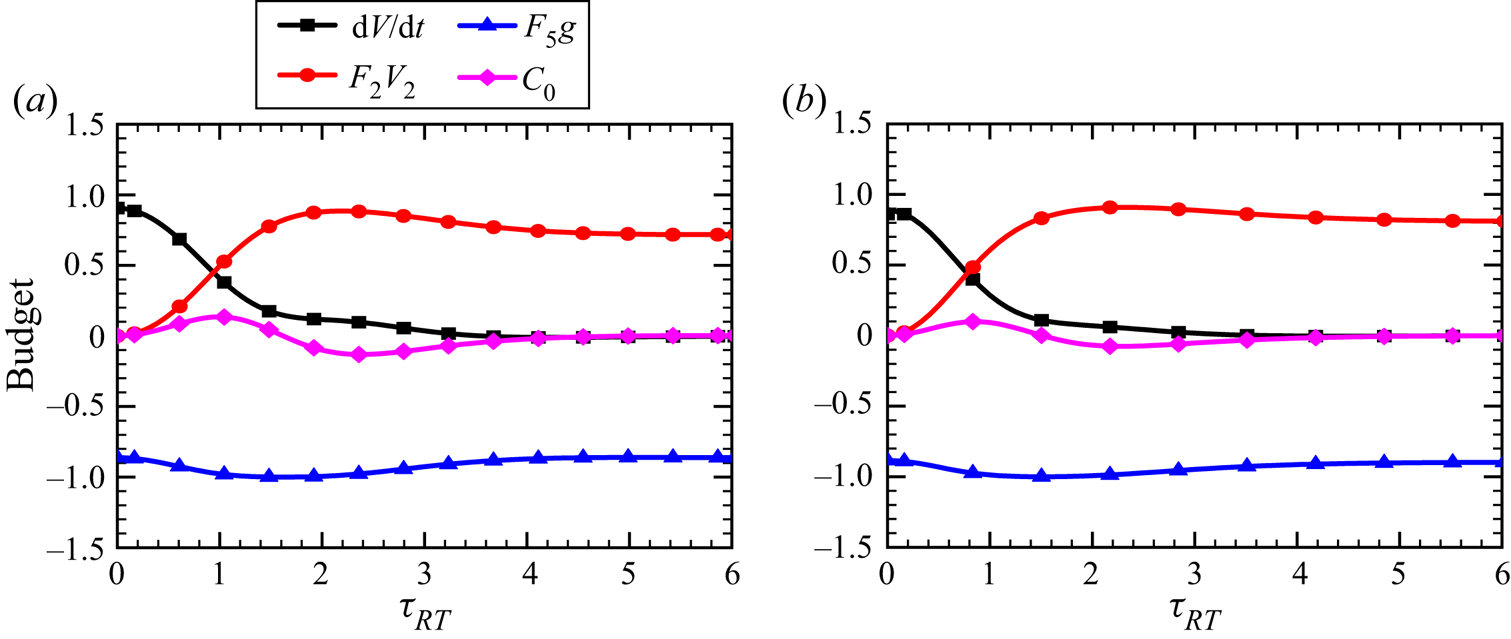
 $C_0$ in (2.11). Shown in figure 2 are temporal evolutions of these four terms for RTI flow. Note that all terms are normalized by the maximum absolute value of the gravitational acceleration term
 ${F_5 g}$. For convenience of comparison, a scaled dimensionless time is introduced in the form
 ${\tau _{RT}=\sqrt {Agk}t}$, which is the same as that suggested by Goncharov (Reference Goncharov2002). Two cases with Atwood numbers of
 ${0.3}$ and
 ${0.7}$ are selected to show that the present decomposition applies to both high and low Atwood numbers.
The budget of (2.11) for (a)  ${A=0.3}$ and (b)
 ${A=0.7}$. All terms are normalized by the maximum absolute value of gravitational acceleration term
 ${F_5 g}$.

As seen in figure 2, the absolute values of  ${F_2 V^2}$ and
 ${F_5 g}$ are much larger than that of
 ${C_0}$ except for the very early moment at which both
 ${F_2 V^2}$ and
 ${C_0}$ are close to zero. As for
 ${{\textrm {d}V/\textrm {d}t}}$, it is much larger than
 ${C_0}$ in the early stage, but gradually approaches
 ${C_0}$ during the evolution, becoming zero together with
 ${C_0}$ in the quasi-steady stage. This is due to the self-similar evolution of RTI with constant velocity in the quasi-steady stage, in which
 ${{\textrm {d}V/\textrm {d}t}}$ and
 ${C_0}$ can be neglected when they are compared with
 ${F_2 V^2}$ and
 ${F_5 g}$. As a result,
 ${{\textrm {d}V/\textrm {d}t}}$,
 $F_2 V^2$ and
 $F_5 g$ have comparable magnitude, and
 ${C_0}$ can be ignored in the early stage. In the late stage, however, the magnitudes of
 ${{\textrm {d}V/\textrm {d}t}}$ and
 ${C_0}$ are much less than those of
 ${F_2 V^2}$ and
 ${F_5 g}$ such that both can be ignored. Compared with other terms, the value of
 ${C_0}$ is small enough to be ignored in the whole evolution, which confirms that the present consideration of nonlinear coupling between the inertial force and the shape evolution is reasonable. It is easy to show that the nonlinear term
 $C_0$ from (2.11) should not depend on the specific potential function because it is derived from the generalized series form of potential function (2.4). The only possibility for the variation of
 $C_0$ may come from the truncation error to the series potential function (2.4). However, it has been manifested that the truncation approximation with the first two terms can account for approximately 95 % of the growth rate Goncharov (Reference Goncharov2002). It can also be demonstrated that the nonlinear term
 $C_0$ remains negligibly small when more terms are retained in the series potential function. For example, the magnitude of
 $C_0$ for the present approximation is comparable with that when the series is truncated after the third or fourth term (not shown here for brevity). Thus, (2.11) can be further simplified without substantial loss, which reads
 \begin{equation} \dot{V} + F_2 V^2 + F_5 g = 0. \end{equation}
Formally, (3.2) is completely consistent with the model equation obtained by Zhang & Guo (Reference Zhang and Guo2016). The difference is that the fingertip growth rate  ${v_{zg}}$ in the model equation from Zhang & Guo (Reference Zhang and Guo2016) is determined only by the inertial effect with constant curvature, while
 ${V}$ denotes the velocity induced by the inertial effect in (3.2), which is only one part of the fingertip growth rate and allows the variation of curvature. Therefore, one can solve the simplified ordinary differential equation (3.2) to obtain the analytical expression of velocity
 ${V}$ induced by the inertial effect in the cases of RMI and RTI, respectively. Furthermore, recalling the definition in (2.10), one can decompose the analytical expressions for fingertip growth rate
 $v$ into the inertial effect
 $V$ and the frontal distortion effect
 ${F_1 \dot {\xi }}$, which are written as
 \begin{gather} v_{RT} = \sqrt{-\frac{F_5}{F_2}g}\frac{1-\exp({-2\sqrt{-F_2F_5g}t})}{1+\exp({-2\sqrt{-F_2F_5g}t})}+ F_1\dot{\xi} \quad [{\rm RTI}], \end{gather}
 \begin{gather}v_{RM} = \frac{V^0}{1+F_2V^0t}+ F_1\dot{\xi} \quad [{\rm RMI}]. \end{gather}
Here, the superscript  ${0}$ indicates initial time. Equations (3.3) and (3.4) give the solutions for the RTI and RMI, respectively. For the RTI, the initial growth rate
 ${v_{RT}^0=0}$ and the first term is also 0 when
 ${t=0}$. Thus, in order for (3.3) to be satisfied, one ends up with
 ${\dot {\xi }^0=0}$ by keeping the initial shape of the interface unchanged at the initial moment. For RMI,
 ${g=0}$ in the whole evolution after the impingement of a shock wave. According to (3.2), the inertial effect (
 $V$) at the initial time can be obtained from
 ${V^0 = v^0 - F_1\dot {\xi }^0}$. Therefore, once the specific velocity potential function is given, the growth rate evolutions for RTI and RMI can be obtained through the above analytical solutions.
It should be pointed out that the results corresponding to the first term in (3.3) and (3.4) have the same form as the theoretical results given by Zhang & Guo (Reference Zhang and Guo2016) and Guo & Zhang (Reference Guo and Zhang2020), but with different meanings. Those works assume that the curvature  ${\xi }$ is a time-insensitive constant, which implies that the growth rate is dominated by the inertial acceleration
 ${g}$. The model based on such approximation can successfully predict the evolution trend of the growth rate, but with visible deviations in the nonlinear phase. The present solution suggests that there exists a physical explanation for the deviation between the growth rate and the inertia-induced velocity (the first term in (3.3) and (3.4)). The deviation observed by Zhang & Guo (Reference Zhang and Guo2016) and Guo & Zhang (Reference Guo and Zhang2020) is caused by the curvature change rate, which plays a crucial role in the evolution of growth rate at the nonlinear stage and cannot be ignored in the theoretical model.
To summarize, the underlying physical mechanisms of interface evolution in single-mode hydrodynamic instabilities are twofold. One is the inertial effect induced by the density difference of two fluids, and the other is the frontal distortion effect induced by interface shape evolution. It ought to be stressed that, although there is a nonlinear coupling between growth rate and shape curvature, the physical mechanisms can be simplified into a linear decoupled form based on reasonable approximation without significant loss, as can be seen from the analytical solutions given by (3.3) and (3.4).
4. Verification for the decoupled mechanism of interface evolution
4.1. Rayleigh–Taylor instability
The present decoupled mechanism is first validated for the RTI in comparison with the 2-D numerical simulations carried out by Sohn (Reference Sohn2004). The theoretical predictions given by Liu et al. (Reference Liu, Zhang and Xiao2023) are also presented for a comprehensive evaluation. It should be pointed out that the evolution solutions of velocity and curvature given by the DS model are used to realize (3.3). This is due to the lack of curvature evolution for spikes in numerical simulations (Sohn Reference Sohn2004). According to the above reference data, the governing parameters and initial values are set as  $g=1$,
 $k=1$,
 $\xi ^{0}=-0.25$ and
 $\dot {\xi }^{0}=0$. For convenience of comparison, a scaled dimensionless time is introduced in the form
 ${\tau _{RT}=\sqrt {Agk}t}$, and a scaled dimensionless velocity is also defined as
 ${v_{RT}=v/v_{qs}}$, with
 ${v_{qs}}$ being the quasi-steady velocity determined by (3.3), which is the same as that suggested by Zhang & Guo (Reference Zhang and Guo2016).
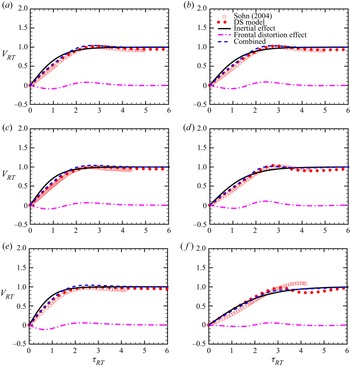
Shown in figure 3(a,c,e) are evolutions of the bubble growth rate, and figure 3(b,d,f) are the corresponding spike growth rate for the RTI at  $A=0.05$,
 $A=0.3$ and
 $A=0.7$, respectively. To shed light on the mechanism of each effect and the coupling between them, the inertial effect (
 ${V}$), frontal distortion effect (
 ${F_1\dot {\xi }}$) and the combined growth rate
 ${v_{RT}}$ are calculated and plotted together in figure 3.
Evolutions of the RTI bubble growth rate (a,c,e) and spike growth rate (b,d,f) at  $A=0.05$,
 $0.3$ and
 $0.7$, which are described by the inertial effect (black solid lines), frontal distortion effect (pink dash-dotted lines) and the total growth rate with combined effects (blue dashed lines), respectively. The results from the DS model (Liu et al. Reference Liu, Zhang and Xiao2023) (red dotted lines) and numerical simulation (Sohn Reference Sohn2004) (red circles) are included for comparison. Results are shown for (a)
 $A=0.05$ (bubble), (b)
 $A=-0.05$ (spike), (c)
 $A=0.3$ (bubble),(d)
 $A=-0.3$ (spike), (e)
 $A=0.7$ (bubble), (f)
 $A=-0.7$ (spike).

It can be seen from figure 3 that only considering the inertial velocity can roughly predict the evolution trends of both bubble and spike. Consequently, despite the different behaviours among fingers with various Atwood numbers, all fingers gradually approach the same universal curve and can be approximately described by a single equation in terms of the appropriately scaled dimensionless variables given by (3.3), which is entirely consistent with the results given by Zhang & Guo (Reference Zhang and Guo2016) and Guo & Zhang (Reference Guo and Zhang2020). However, as discussed in § 3 (see also Liu et al. Reference Liu, Zhang and Xiao2023), there exists a significant nonlinear coupling between the curvature and growth rate in the nonlinear stage, which has a crucial impact in the early stage and even changes the concavity and convexity of the growth rate. For example, the overshoot phenomenon in the nonlinear stage makes the change of interface growth rate no longer monotonic as predicted by the inertial effect, which shows the necessity to introduce the effect of curvature in the theoretical model for accurate prediction of the growth rate before the quasi-steady stage.
Figure 3 also shows that although the magnitude of the frontal distortion effect is much smaller than that of the inertial effect, it strongly affects the growth rate in the nonlinear stage. It is observed that the sign change from negative to positive in the frontal distortion effect corresponds to the alternation from suppression to promotion of velocity development. On the growth rate curve, this is reflected as concave first and then convex, which clearly reveals the modulation effect of the interfacial geometry change on the global drag-buoyancy balance. This result is in consistence with the statement given by Liu et al. (Reference Liu, Zhang and Xiao2023). Here, we comment that the frontal distortion effect always transitions from suppression to promotion of the growth rate in the nonlinear stage. In the case of a small initial perturbation amplitude, the frontal distortion effect only causes a slight overshoot phenomenon. In the case of a large-magnitude initial disturbance, the frontal distortion effect may grow to the same order of magnitude as the growth rate and ultimately change the evolution trend. To demonstrate this point, the initial curvature is altered to adjust the corresponding disturbance in § 5.
On the whole, the theoretical results through inclusion of both the inertial effect and frontal distortion effect are in good agreement with those from numerical simulation (Sohn Reference Sohn2004) and the DS model (Liu et al. Reference Liu, Zhang and Xiao2023). This further strengthens the rationality of linear decomposition of the growth rate model (3.3). Although neglect of the nonlinear interaction term  ${C_0}$ produces slight deviations, the overall results indicate that the retained terms are the dominant factors in the evolution of RTI growth rate. It should be mentioned that the results from the DS model are consistent with those from the numerical simulation (Sohn Reference Sohn2004) for bubbles at all Atwood numbers and for spikes at
 $A=0.05$ and
 $A=0.3$. However, a visible difference exists for a spike at
 $A=0.7$, as shown in figure 3(f). As argued by Liu et al. (Reference Liu, Zhang and Xiao2023), this deviation is caused by the strong vorticity at the spike side with the increase of the density ratio of the two fluids. As is clearly seen in figure 3(f), the frontal distortion effect is much weaker than those shown in other panels, which indicates that there exists appreciable error in the prediction of curvature using the DS model for spikes under the condition of high-density ratio. Therefore, the framework of LPM can be questionable on the spike side at high-(negative) Atwood numbers, which may also account for the deviation of the current theory from numerical simulation.
The two proposed mechanisms for RTI evolution indicate that the growth rate induced by acceleration is also affected by the geometric effect of shape evolution. Based on the above analyses, the mechanisms controlling the single-mode interface evolution of RTI can be described as follows. The inertial effect is induced by the density difference of two fluids, which represents the dominant features of growth rate and controls the general trend of flow. The frontal distortion effect is caused by the interface shape evolution and influences the convexity of the fingertip growth curve. According to Mikaelian (Reference Mikaelian2008), the evolution of curvature is determined by the initial condition, and there exists a relation  $\xi ^0=-k^2z_0^0/2$ between the initial curvature and the initial perturbation amplitude. In other words, it is suggested that the nonlinear stage of RTI evolution has a strong dependence on the initial perturbation.
4.2. Richtmyer–Meshkov instability
In this section it will be shown that the proposed decoupled mechanism applies not only to the evolution of the RTI but also to that of the RMI, as given by (3.4). After the impingement of a shock wave, the RMI is argued to be approximately equivalent to an incompressible RTI without an external force (Richtmyer Reference Richtmyer1960; Hecht et al. Reference Hecht, Alon and Shvarts1994). Again, the decoupled mechanism is validated for the evolution of the RMI in comparison with numerical simulations by Sohn (Reference Sohn2004) and Dimonte & Ramaprabhu (Reference Dimonte and Ramaprabhu2010). The theoretical predictions given by the DS model (Liu et al. Reference Liu, Zhang and Xiao2023) are also presented as a necessary complement. For the present decoupled theory to be applied to the RMI, the input parameters are set as  $g=0$,
 $k=1$,
 $\xi ^{0}=-0.25$ (Sohn Reference Sohn2004) and
 $\xi ^{0}=-0.0625$ (Dimonte & Ramaprabhu Reference Dimonte and Ramaprabhu2010). For the purpose of visualization, a scaled dimensionless time is introduced in the form
 $\tau _{RM}=kv^0t$, and the growth rate is normalized by the velocity after shock wave (i.e.
 $v_{RM}=v/v^0$), which is consistent with the suggestion by Zhang & Guo (Reference Zhang and Guo2016). Other settings are the same as in the RTI case.
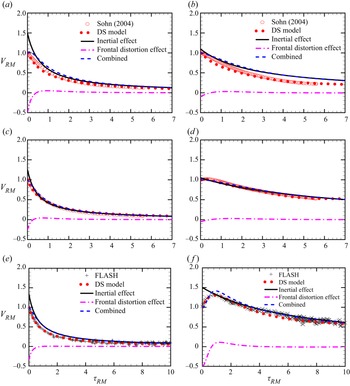
Shown in figure 4(a,c,e) are evolutions of the bubble growth rate and figure 4(b,d,e) are the corresponding spike growth rate for RMI at  $A=0.3$,
 $A=0.7$ and
 $A=0.88$, respectively. Here, the initial growth rate
 $v^0$ is taken as the rate of fingertip linear growth after the shock wave, which is consistent with the practice in numerical simulations by Sohn (Reference Sohn2004); Dimonte & Ramaprabhu (Reference Dimonte and Ramaprabhu2010). It should be noted that the present decoupled model can well predict bubbles and low-density spikes with the first two terms of velocity potential function
 ${\varphi _{i} (n=1,3)}$, but more modes are required to describe the high-density spikes with satisfactory accuracy. Therefore, the coefficients
 ${F_{i}(A,k,\xi )}$ in (3.4) are obtained by retaining the first four terms of the velocity potential function to achieve the prediction of spikes with
 $A=0.7$ and
 $A=0.88$, respectively. It should be mentioned that the discrepancy in results between the inertial effect and the universal theory of Zhang & Guo (Reference Zhang and Guo2016) are due to different definitions. Zhang & Guo (Reference Zhang and Guo2016) directly consider the inertial effect without curvature correction (i.e.
 $V^0=v^0$), while the present inertial effect comes from (3.4) (i.e.
 ${V^0 = v^0 - F_1\dot {\xi }^0}$). The summation of inertial and frontal distortion terms provides good prediction for the RMI fingertip growth compared with the DS model and numerical simulation results. The inertia term performs like an envelope of the growth rate curve, depicting the magnitude and damping trend of growth rate curve in the late stage. In the early stage, however, the frontal distortion effect tends to balance the contribution from inertial effect with a comparable magnitude. Furthermore, the rapid change in frontal distortion effect dominates the mathematical features in early time evolution of fingertip growth, such as slope, inflection point and local peak of the growth rate curve.
Evolution of the RMI bubble growth rate (a,c,e) and spike growth rate (b,d,f) with  $A=0.3$,
 $0.7$ and
 $0.88$, which are described by inertial effect (black solid lines), frontal distortion effect (pink dash-dotted lines) and the total growth rate with combined effects (blue dashed lines), respectively. The results from the DS model (Liu et al. Reference Liu, Zhang and Xiao2023) (red dotted lines), numerical simulation (Sohn Reference Sohn2004) (red circles) and numerical results (FLASH) from Dimonte & Ramaprabhu (Reference Dimonte and Ramaprabhu2010) (‘+’ and ‘
 $\times$’ signs) are included for comparison. Results are shown for (a)
 $A=0.3$ (bubble), (b)
 $A=-0.3$ (spike), (c)
 $A=0.7$ (bubble), (d)
 $A=-0.7$ (spike), (e)
 $A=0.88$ (bubble), (f)
 $A=-0.88$ (spike).

The frontal distortion effect term in the RMI starts from a negative value and rapidly approaches zero, which is different from the oscillatory behaviour in the RTI case. During its evolution, the first inflection point and the following local maximum value of this frontal distortion term occur immediately after the impingement of the shock wave (see figure 4). Such a phenomenon is named as the early time peak in the present paper and more clearly reflected for all Atwood numbers when the decoupled mechanisms of the two effects are considered. However, the early time peak phenomenon appears only in spike growth rates for the large Atwood number case of the numerical simulations (Sohn Reference Sohn2004; Dimonte & Ramaprabhu Reference Dimonte and Ramaprabhu2010) and DS model (Liu et al. Reference Liu, Zhang and Xiao2023). The reason for the discrepancy between the present decoupled model and numerical simulation might be the neglect of residual item  ${C_0}$, which makes the frontal distortion effect more prominent in the RMI regime. Generally, it is believed that the frontal distortion effect indeed causes the early time peak phenomenon, while the coupling of two effects increases the influence of nonlinear interaction item
 ${C_0}$, which makes the early time peak phenomenon weak for bubbles and low-density spikes, but relatively strong for high-density spikes. Similar results are also reported by Zhang & Guo (Reference Zhang and Guo2022), who believe that the spike curvature can strongly impact the growth rate and should be sensitive to the density ratio. This argument is consistent with our understanding that the frontal distortion effect is not obvious with a small curvature change for bubbles and low-density spikes, but is more pronounced with a drastic curvature change for high-density spikes. Likewise, the intensity of frontal distortion effect depends on the initial magnitudes of curvature and interfacial perturbation. Thus, the frontal distortion effect plays a crucial role in the early evolution of the RMI, which will be further addressed in § 5.
The temporal variations of growth rate shown in figures 3 and 4 suggest that the proposed decoupled mechanism dominates the evolution of both the RTI and RMI. Meanwhile, the comparison between the inertial and frontal distortion effects explains the overshoot phenomenon in the RTI and the early time peak phenomenon in the RMI. The difference lies in the time at which the inflection points and the following extreme values (denoting strong frontal distortion effects) appear according to the decoupled mechanism. Specifically, the overshoot phenomenon appears in the nonlinear stage of the RTI, while the early time peak phenomenon occurs in the early stage of the RMI after the passage of the shock wave.
5. Initial value sensitivity of the frontal distortion effect
It is noteworthy that although the frontal distortion effect is weak compared with the inertial effect, it produces some crucial changes in concavity and convexity of the growth rate curve, e.g. the overshoot phenomenon in the RTI and the early time peak phenomenon in the RMI. As is clearly seen in (3.3) and (3.4), the frontal distortion effect evolves through the second term  ${F_1 \dot {\xi }}$. If the independent parameters (such as the acceleration
 $g$ in the RTI and shock Mach number in the RMI) remain unchanged, and only the material interface is considered, the curvature derivative
 ${\dot {\xi }}$ in the early stage will be determined merely by the initial curvature
 ${\xi ^0}$. According to Mikaelian (Reference Mikaelian2008), the maximum allowable magnitude of initial curvature
 ${\xi ^0}$ is directly restricted by the initial perturbation in the LPM framework, which is also applicable to the present theoretical model. Therefore, reliable results for RTI and RMI evolutions can be obtained with the given initial perturbation as long as the initial curvature
 ${\xi ^0}$ is within the allowable range. Then, the influence of initial curvature on the interface growth rate is investigated by using the decoupled model in comparison with the DS model. As observed in figures 3 and 4 as well as the numerical results from Sohn (Reference Sohn2004), the dependence of growth rate on curvature effect almost remains unchanged with Atwood number. Without loss of generality, the case with an Atwood number of
 $0.3$ is taken as an example to discuss the sensitivity of interface growth rate to the initial disturbance. Other settings of the specific parameters, initial values and dimensionless methods are the same as in § 4.
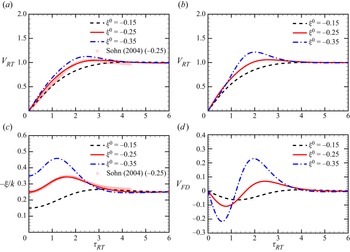
Shown in figure 5(a,c) are evolutions of the bubble growth rate and the corresponding bubble curvature from the DS model, and figure 5(b,d) are evolutions of the bubble growth rate given by the decoupled model and the corresponding frontal distortion effect for RTI at  $\xi ^0=-0.35$,
 $-0.25$ and
 $-0.15$, respectively. Here, a scaled dimensionless velocity
 ${v_{FD}=F_1 \dot {\xi }/v_{qs}}$ is defined based on the frontal distortion effect (
 ${F_1 \dot {\xi }}$) for convenience of comparison. It should be pointed out that increasing the absolute value of initial curvature from
 $0.15$ to
 $0.35$ corresponds to the increase in amplitude of the initial perturbation. the results given by the DS model compare well with those from numerical simulation (Sohn Reference Sohn2004) for the case of
 $\xi ^0=-0.25$, which supports the validity of the subsequent discussion. It is further found that, with increasing absolute values of initial curvature, the peak in evolution of the negative curvature becomes higher and is shifted to the left, which is also consistent with the observations reported by Sohn (Reference Sohn2004). The results for growth rate (figure 5a,b) imply that the overshoot phenomenon is more prominent with the increase of initial perturbation amplitude. This can also be explained by (3.3) and figure 5(c,d), which indicate that an initial curvature with larger absolute value will cause a more drastic frontal distortion effect due to the larger curvature derivative
 $\dot {\xi }$ before and after its zero-value time. Here, the discrepancy in growth rate between the DS model and the decoupled model comes from the neglect of the nonlinear interaction term
 ${C_0}$.
Evolutions of the RTI bubble growth rate predicted by (a) the DS model (Liu et al. Reference Liu, Zhang and Xiao2023) and (b) the decoupled model (3.3) at  $A=0.3$. Evolutions of (c) the bubble curvature from the DS model and (d) the frontal distortion effect from the decoupled model are plotted for discussion. The results for different initial curvatures are marked as
 $\xi ^0=-0.15$ (black dashed lines),
 $-0.25$ (red solid lines) and
 $-0.35$ (blue dash-dotted lines). The numerical simulation results from Sohn (Reference Sohn2004) at
 $\xi ^0= -0.25$ (red circles) are also included for comparison. (a) Growth rate (DS model), (b) growth rate (decoupled), (c) curvature, (d) frontal distortion effect.

According to Mikaelian (Reference Mikaelian2008), the applicability of the LPM is subject to the maximum amplitude of initial perturbations, which varies with the Atwood number  $A$. Here, we try to give a more physical description of this restriction. The absolute ratio of the frontal distortion term to the total growth rate given by the decoupled model is defined as
 $\chi =|v_{FD}/v_{RT}|$ in order to measure the relative significance of the frontal distortion effect. For the case of
 $\xi ^0=-0.15$,
 $\chi$ reaches its maximum value of 0.1 at
 $\tau _{RT}\approx 1.4$. For the case of
 $\xi ^0=-0.35$, however, the maximum value of
 $\chi$ is approximately 0.75 at
 $\tau _{RT}\approx 0.6$. The latter shows that the frontal distortion effect may grow to a magnitude comparable to the inertial effect as the initial amplitude increases. In addition, it is seen in figure 5(d) that
 $v_{FD}$ remains negative in almost the whole evolution process for the case of
 $\xi _0=-0.15$, which demonstrates that the frontal distortion effect tends to suppress the velocity development in similar cases. By contrast, the suppression stage is followed immediately by a promotion phase for the cases of
 $-0.25$ and
 $-0.35$, during which the frontal distortion effect has a positive contribution to the velocity development. By comparing figure 5(b,d), it is seen that the promotion behaviour directly causes the overshoot phenomenon of the growth rate curve. As a result, the lack of frontal distortion effect in LPM will ultimately lead to a deviation in the prediction of growth rate and an underestimation of the overshoot phenomenon.
It is also noted that there exist local maximum or minimum values of RTI bubble velocity and shape curvature during evolution of the interface, which correspond to their critical times. However, the critical times for bubble velocity and shape curvature are different from each other. The mismatch in critical times can be well explained based on (3.3) and the results shown in figure 5(c,d). Consequently, the growth rate is directly affected by the first derivative of curvature  ${\dot {\xi }}$ rather than the curvature
 ${\xi }$ itself, which causes a time delay in the evolution of RTI bubble velocity.
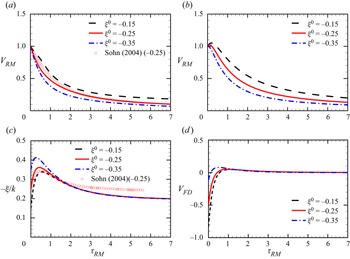
Depicted in figure 6(a,c) are evolutions of the bubble growth rate and corresponding bubble curvature from the DS model for RMI at  $\xi ^0=-0.35$,
 $-0.25$ and
 $-0.15$. Likewise, figure 6(b,d) show evolutions of the bubble growth rate given by the decoupled model (3.4) and corresponding frontal distortion effect. Similarly, the validity of the DS model is verified in comparison with the numerical simulation for the case with initial curvature
 $\xi ^0=-0.25$. The comparisons show that the DS theory can provide reasonable predictions for the RMI growth rate. As for the finger curvature, slight deviations can be observed between the present predictions and numerical simulations by Sohn (Reference Sohn2004) in the late stage. Note that the following analysis of initial amplitude influence on RMI development is restricted to the early stage after passage of the shock wave, and therefore, it is still reasonable to discuss the effect of initial curvature based on the DS model.
Evolutions of the RMI bubble growth rate predicted by (a) the DS model (Liu et al. Reference Liu, Zhang and Xiao2023) and (b) the decoupled model (3.4) at  $A=0.3$. Evolutions of (c) the bubble curvature from the DS model and (d) the frontal distortion effect from the decoupled model are plotted for discussion. The results for different initial curvatures are marked as
 $\xi ^0=-0.15$ (black dashed lines),
 $-0.25$ (red solid lines) and
 $-0.35$ (blue dash-dotted lines). The numerical simulation results from Sohn (Reference Sohn2004) at
 $\xi ^0= -0.25$ (red circles) are also included for comparison. (a) Growth rate (DS model), (b) growth rate (decoupled), (c) curvature, (d) frontal distortion effect.

It is clearly seen from figure 6(a,b) that, as the absolute value of initial curvature increases, the early time peak phenomenon of the RMI is gradually weakened. Likewise, the weakening of the early time peak in the RMI can be intuitively explained by (3.4); similar to the RTI, the early time peak phenomenon of RMI is mainly caused by the curvature derivative  $\dot {\xi }$ before and after its zero-value time. As one can see in figure 6(c,d), the peak value of the curvature increases when the absolute value of initial curvature becomes larger (corresponding to the increase in amplitude of the initial interfacial perturbation), but the initial curvature derivative decreases with the increase of initial curvature. This leads to the weakening of the frontal distortion effect and the early time peak phenomenon when the initial perturbation amplitude becomes larger. In addition, the results in figure 6(b,d) indicate that the initial curvature can change the concavity of RMI growth rates, which is essentially similar to those observed in figure 5(b,d) in the RTI. Distinct from the RTI, the combined effect of the decoupled model in the RMI needs more time to gradually approach zero as the initial amplitude increases. It should be pointed out that the discrepancy in growth rate evolution between the DS model and the present decoupled model is more pronounced in RMI, which suggests that the nonlinear coupling between the two effects is stronger in RMI than in RTI and the inclusion of
 ${C_0}$ should suppress the early time peak phenomenon.
Based on the above discussion, we comment that the appearance and intensity of the overshoot and early time peak phenomena strongly depend on the initial curvature, which significantly affects the shape evolution and the interface growth rate. Basically, the essence of these phenomena is the frontal distortion effect, which strongly depends on the initial perturbation amplitude. For a small initial amplitude, the frontal distortion effect is limited to a certain range, which causes the appearance of an overshoot phenomenon in RTI and an early time peak phenomenon in RMI, respectively. For a large initial amplitude, however, the frontal distortion effect may grow to a magnitude comparable to the inertial effect and ultimately change the growth rate trend, which can lead to the failure of all existing LPMs (Mikaelian Reference Mikaelian2008). To the authors’ knowledge, this is the first theoretical study on the effect of initial curvature, which is important to describe the local geometrical interface of single-mode RTI and RMI.
6. Conclusions and discussions
In this paper the underlying physical mechanism of finger growth rate evolution is explored based on a decoupled model for single-mode interfacial fluid instabilities. The present model takes a linear decoupling form, which is obtained by simplifying the generalized LPM without significant loss and composed of two effects. The inertial effect is induced by the density gradient of two fluids under acceleration, and the frontal distortion effect is induced by interface shape evolution. The analytically decoupled model for these two effects clearly reveal their respective contribution and physical mechanism in comparison with the results given by the DS model (Liu et al. Reference Liu, Zhang and Xiao2023) and numerical simulation (Sohn Reference Sohn2004). Specifically, the inertial effect stands for the dominant feature of interface evolution. By contrast, the frontal distortion effect realizes the details of growth rate such as the overshoot phenomenon in the RTI and the early time peak phenomenon in the RMI. The sensitivity of the frontal distortion effect to initial amplitude of perturbation is also addressed to further validate the DS model for prediction of finger growth rate and shape curvature evolution. It turns out that the overshoot phenomenon is enhanced in the RTI, while the early time peak phenomenon is suppressed with the increase of the absolute value of initial curvature, which corresponds to the increase of initial amplitude of perturbation. These phenomena can be well explained through the proposed decoupled mechanism.
It is revealed that the inertial effect represents the movement evolution of the fingertip, and the frontal distortion effect characterizes the geometric changes of the fingertip and its neighbourhood. We comment that they are both important and should be involved in the theoretical modelling of classical hydrodynamic instabilities. For a small initial perturbation amplitude, the frontal distortion effect is relatively weak compared with the inertial effect and has a limited effect on the growth rate, which leads to the occurrence of the overshoot phenomenon and early time peak phenomenon in RTI and RMI, respectively. Nevertheless, the frontal distortion effect may grow to the same order of magnitude as the inertial effect when the initial perturbation amplitude is large enough, and the neglect of curvature evolution may result in an invalid prediction of the instabilities. Therefore, the two effects must be considered simultaneously to predict the fingertip motion more accurately.
Furthermore, the decoupled mechanism proposed in this paper provides the possibility of controlling interfacial instabilities by regulating the initial perturbation amplitude. It is also anticipated that the present decoupled mechanism should be extended to regimes in cylindrical and spherical geometries, for which the geometric effect has yet to be thoroughly studied (Zhou Reference Zhou2017a,Reference Zhoub; Zhao et al. Reference Zhao, Wang, Liu and Lu2020). The present study may also pave the way for a further understanding of the re-acceleration stage in single-mode RTI.
Funding
We acknowledge the financial support provided by the National Natural Science Foundation of China (grant nos. 92152202, 11972093, 12222203 and 11988102).
Declaration of interests
The authors report no conflict of interest.