Seminal theories of parenting identify parental warmth (i.e., parents’ acceptance, caring, and positive support of children; McKee, Colletti, Rakow, Jones, & Forehand, Reference McKee, Colletti, Rakow, Jones and Forehand2008) and parental behavioral control (i.e., parents’ efforts to remain aware of, communicate clear and consistent expectations for, and redirect children's behavior; Lansford, Rothenberg, et al., Reference Lansford, Rothenberg, Jensen, Lippold, Bacchini, Biornstein and Al-Hassan2018) as parenting dimensions that significantly impact child development (Baumrind, Reference Baumrind1967; McKee et al., Reference McKee, Colletti, Rakow, Jones and Forehand2008; Pinquart, Reference Pinquart2017a, Reference Pinquart2017b). Several reviews and meta-analyses identify warmth and control as key behaviors to target in parenting interventions (McKee et al., Reference McKee, Colletti, Rakow, Jones and Forehand2008) and as robust predictors of the two most common types of mental health problems in children (Merikangas, Nakamura, & Kessler, Reference Merikangas, Nakamura and Kessler2009): child externalizing problems (e.g., aggression, noncompliance, impulsivity, and hyperactivity; Hoeve et al., Reference Hoeve, Dubas, Eichelsheim, van der Laan, Smeenk and Gerris2009; Pinquart, Reference Pinquart2017a) and internalizing problems (e.g., anxiety, depression, somatic complaints, and social withdrawal; McKee, Reference McKee, Colletti, Rakow, Jones and Forehand2008; Pinquart, Reference Pinquart2017b). Given that parental warmth and behavioral control serve as cornerstones in our modern understanding of parenting and significantly impact the development of child behavioral adjustment, continued exploration of these behaviors and their effects across time, caregivers, and cultures is warranted (Bornstein, Reference Bornstein2012; McKee et al., Reference McKee, Colletti, Rakow, Jones and Forehand2008; Pinquart, Reference Pinquart2017a).
Developmental psychopathologists have outlined four key tenets by which future cross-cultural and longitudinal studies of parenting behaviors and their effects on child mental health should be guided (Bornstein, Reference Bornstein, Bornstein and Leventhal2015; Lansford, Rothenberg, et al., Reference Lansford, Rothenberg, Jensen, Lippold, Bacchini, Biornstein and Al-Hassan2018; McKee et al., Reference McKee, Colletti, Rakow, Jones and Forehand2008). First, future studies should capture the transactional nature of parental behaviors and child mental health by identifying both the effects of parent behavior on subsequent child mental health (parent effects) and the evocative effects of child mental health on subsequent parenting behaviors (child effects; Bornstein, Reference Bornstein, Bornstein and Leventhal2015; Lansford, Rothenberg, et al., Reference Lansford, Rothenberg, Jensen, Lippold, Bacchini, Biornstein and Al-Hassan2018). Second, future studies should identify specific developmental time periods wherein parent or child effects are especially pronounced (Bornstein, Reference Bornstein, Bornstein and Leventhal2015; Pinquart Reference Pinquart2017a, Reference Pinquart2017b). Third, future studies should identify heterogeneity in these transactional processes across caregivers to further determine the extent to which reciprocal transactions between parenting and child mental health differ depending on whether mothers or fathers provide parenting (Bornstein, Reference Bornstein, Bornstein and Leventhal2015; Lansford, Rothenberg, et al., Reference Lansford, Rothenberg, Jensen, Lippold, Bacchini, Biornstein and Al-Hassan2018). Fourth and finally, given that the vast majority of investigations of parenting and child mental health occur in the United States, future studies should investigate heterogeneity in transactional processes, developmental specificity, and caregiver moderation across cultures around the world (Bornstein, Reference Bornstein, Bornstein and Leventhal2015; Causadias, Reference Causadias2013; Lansford, Rothenberg, et al., Reference Lansford, Rothenberg, Jensen, Lippold, Bacchini, Biornstein and Al-Hassan2018). Numerous studies have incorporated one or two of these tenets into their design, but virtually no studies have investigated all four tenets simultaneously. Yet, the developmental psychopathology perspective suggests that studies that incorporate all four tenets by capturing such multilevel, reciprocal transactions between children and their environment across time and culture are best situated to provide the fullest picture of parenting and child mental health over ontogeny (Causadias, Reference Causadias2013; Cicchetti, Reference Cicchetti2016). The present study examines all aforementioned tenets at once by investigating reciprocal associations between mother and father warmth and control and child internalizing and externalizing behaviors in a sample of more than 1,200 children over ages 8–13 in 12 different cultural groups. In so doing, we characterize the consistency of transactional parenting–child mental health processes over ontogeny, across caregivers, and across cultures.
Reciprocal Transactions Between Parental Warmth and Control and Child Mental Health
In accordance with the aforementioned first tenet, developmental psychopathologists have long recognized that associations between parenting behaviors and child behavioral adjustment are reciprocal (e.g., Patterson, Reid, & Dishion, Reference Patterson, Reid and Dishion1992; Sameroff, Reference Sameroff1975). That is, less parental warmth and inappropriate behavioral control predict greater subsequent externalizing and internalizing behaviors, but greater child externalizing and internalizing behaviors also predict less warmth and more inappropriate control (Pinquart, Reference Pinquart2017a, Reference Pinquart2017b).
Lack of parental warmth and positive attention for appropriate child behavior interferes with children's ability to regulate arousal (McKee et al., Reference McKee, Colletti, Rakow, Jones and Forehand2008) and can cause children to engage in increased aggressive and noncompliant behavior to obtain attention (Dishion & Patterson, Reference Dishion, Patterson, Cicchetti, Cohen, Cicchetti and Cohen2006; Rothenberg, Hussong, & Chassin, Reference Rothenberg, Hussong and Chassin2016), both of which lead to subsequent increases in child externalizing behaviors. However, children high in externalizing behavior are also more likely to evoke greater stress and dissatisfaction in their parents, making it more likely that parents respond with hostile and rejecting, as opposed to warm, parenting behavior (Lansford, Rothenberg, et al., Reference Lansford, Rothenberg, Jensen, Lippold, Bacchini, Biornstein and Al-Hassan2018; Williams & Steinberg, Reference Williams and Steinberg2011). Similarly, less parental warmth predicts increased child internalizing behaviors as children learn to withdraw from family interactions to avoid hostile, cold parenting and consequently experience loneliness, anxiety, insecurity, and dysphoria (McKee et al., Reference McKee, Colletti, Rakow, Jones and Forehand2008; Rothenberg, Hussong, & Chassin, Reference Rotherberg, Hussong and Chassin2018). However, children who experience internalizing behaviors are also less likely to evoke parental warmth, as these behaviors make it more difficult for parents to connect and play with them (Hipwell et al., Reference Hipwell, Keenan, Kasza, Loeber, Stouthamer-Loeber and Bean2008; Lansford, Rothenberg, et al., Reference Lansford, Rothenberg, Jensen, Lippold, Bacchini, Biornstein and Al-Hassan2018; Pinquart, Reference Pinquart2017b).
Associations between inappropriate behavioral control and child externalizing and internalizing problems demonstrate similar reciprocity across development. High levels of appropriate behavioral control, including appropriate monitoring and consistent limit setting, protect against the emergence of child and adolescent externalizing behaviors, including conduct problems, substance use, and delinquency (for review see McKee et al., Reference McKee, Colletti, Rakow, Jones and Forehand2008; Pinquart, Reference Pinquart2017a), possibly because such control enhances self-regulation and compliance in children and adolescents (McKee et al., Reference McKee, Colletti, Rakow, Jones and Forehand2008). However, behavioral control perceived as too intrusive or lax by children and adolescents has been found both to predict the emergence of externalizing behaviors (McKee et al., Reference McKee, Colletti, Rakow, Jones and Forehand2008) and to emerge as a result of high externalizing behaviors (Lansford, Rothenberg, et al., Reference Lansford, Rothenberg, Jensen, Lippold, Bacchini, Biornstein and Al-Hassan2018). Low levels of behavioral control have also been longitudinally associated with higher child internalizing behaviors (McKee et al., Reference McKee, Colletti, Rakow, Jones and Forehand2008; Pinquart, Reference Pinquart2017b). Theorists have speculated that such associations exist because inconsistent or overly intrusive behavioral control may cause adolescents to withdraw from, and cease seeking, parental support, leading to greater internalizing behaviors (Downey & Coyne, Reference Downey and Coyne1990; McKee et al., Reference McKee, Colletti, Rakow, Jones and Forehand2008). Child internalizing behaviors may also beget inappropriate behavioral control. Parents may alternatively engage in overly intrusive behavioral control via attempts to shield children from triggers of internalizing behaviors or lax behavioral control as they attempt to “give their children space” to avoid internalizing behaviors (Lansford, Rothenberg, et al., Reference Lansford, Rothenberg, Jensen, Lippold, Bacchini, Biornstein and Al-Hassan2018; Pinquart, Reference Pinquart2017b).
Taken together, theoretical, longitudinal, and meta-analytic work indicates that in Western cultural samples, parental warmth and behavioral control predict child externalizing and internalizing behaviors across ontogeny, and vice versa (Pinquart, Reference Pinquart2017a, Reference Pinquart2017b). Yet, the vast majority of existing studies of these reciprocal parenting and child-driven effects capture longitudinal transactions only in regard to specific developmental periods (e.g., childhood or adolescence), with regard to maternal (as opposed to paternal) parenting, and primarily within US and European samples (Bornstein, Reference Bornstein, Bornstein and Leventhal2015). The extent to which these processes generalize across childhood and adolescence, when fathering is examined, and when cross-cultural associations are investigated remains an open question.
Developmental Sensitivity in Parenting and Child-Driven Effects
The question of whether reciprocal associations between parental warmth/control and child externalizing/internalizing behaviors systematically vary across child development has elicited varying responses in extant literature. Responses are more uniform with regard to child evocative effects on subsequent parenting behavior. Numerous longitudinal studies and systematic reviews examining the effects of child externalizing behavior on subsequent parental warmth and control in children ages 6 to 17 (e.g., Burke, Pardini, & Loeber, Reference Burke, Pardini and Loeber2008; Pardini, Fite, & Burke, Reference Pardini, Fite and Burke2008), and those examining the effects of child internalizing behavior on subsequent parental warmth and control in children ages 15 months to 20 years old (e.g., Branje, Hale, Frijns, & Meeus, Reference Branje, Hale, Frijns and Meeus2010; Hipwell et al., Reference Hipwell, Keenan, Kasza, Loeber, Stouthamer-Loeber and Bean2008; Kok et al., Reference Kok, Linting, Bakermans-Kranenburg, van IJzendoorn, Jaddoe, Hofman and Tiemeier2013; Nelemans, Hale, Branje, Hawk, & Meeus, Reference Nelemans, Hale, Branje, Hawk and Meeus2014) reveal that child internalizing and externalizing behaviors appear to consistently evoke less warmth and greater control in parents across ontogeny.
However, literature investigating changes in parenting effects on child internalizing and externalizing behaviors is mixed. On the one hand, theoretical work and some longitudinal investigations and meta-analyses indicate that the effects of parenting (including warmth and behavioral control) on child behavior may be stronger in younger children, where parents play a much more primary role in socializing child behavior and child behavior is less crystallized and therefore more susceptible to parental influence (Hoeve et al., Reference Hoeve, Dubas, Eichelsheim, van der Laan, Smeenk and Gerris2009; Lansford, Rothenberg, et al., Reference Lansford, Rothenberg, Jensen, Lippold, Bacchini, Biornstein and Al-Hassan2018). These strong parenting effects may fade somewhat as children reach adolescence and other environmental (e.g., peers and school) and intrapersonal (e.g., autonomy seeking and individuation from parents) factors become effective shapers of child behavior (Albert, Chein, & Steinberg, Reference Albert, Chein and Steinberg2013; Bornstein, Jager, & Steinberg, Reference Bornstein, Jager, Steinberg, Lerner, Easterbrooks and Mistry2012; Lansford, Rothenberg, et al., Reference Lansford, Rothenberg, Jensen, Lippold, Bacchini, Biornstein and Al-Hassan2018).
On the other hand, recent meta-analytic investigations of the effects of parental warmth and control on child externalizing (Pinquart, Reference Pinquart2017a) and internalizing (Pinquart, Reference Pinquart2017b) behavior have found that associations between parental warmth and behavioral control and child externalizing and internalizing behaviors are stronger in older samples of children. Investigators speculated that these late effects may have been found due to increases in many types of externalizing (e.g., delinquency and substance use) and internalizing (e.g., depression) behavior as children age into adolescents, consequently providing more opportunities for parents to affect such behaviors by their warmth and behavioral control (Pinquart, Reference Pinquart2017a, Reference Pinquart2017b).
Theorists have also speculated that the developmental specificity of such parenting effects may differ by parent gender (De Haan, Prinzie, & Dekovic, Reference De Haan, Prinzie and Deković2012; Sijtsema, Oldehinkel, Veenstra, Verhulst, & Ormel, Reference Sijtsema, Verboom, Penninx, Verhulst and Ormel2014) and cultural group (Lansford, Rothenberg, et al., Reference Lansford, Rothenberg, Jensen, Lippold, Bacchini, Biornstein and Al-Hassan2018), given that the expression of parental warmth and the extent to which mothers and fathers are differentially involved in parenting vary across cultures (Bornstein, Reference Bornstein, Bornstein and Leventhal2015; Lansford, Rothenberg, et al., Reference Lansford, Rothenberg, Jensen, Lippold, Bacchini, Biornstein and Al-Hassan2018). Our own prior work investigating parenting and child effects in 12 cultural groups across the world found that evocative child effects on parental warmth and control are ubiquitous and consistent across ages 8–13 in all 12 cultures, whereas parenting effects on child externalizing and internalizing behaviors are more limited and occur primarily prior to age 10 in all 12 cultures (Lansford, Rothenberg, et al., Reference Lansford, Rothenberg, Jensen, Lippold, Bacchini, Biornstein and Al-Hassan2018). However, we did not examine how these cultural effects varied across mothers and fathers, and we know of no other investigations that have examined this question.
Differences in Parenting and Child-Driven Effects Across Mothers and Fathers
Due to the dearth of studies that examine associations between father parenting behaviors and child mental health outcomes, examinations of reciprocal associations between mother and father warmth and control and child externalizing and internalizing behaviors are rare (Bornstein, Reference Bornstein2012; De Haan et al., Reference De Haan, Prinzie and Deković2012; Sijtsema et al., Reference Sijtsema, Verboom, Penninx, Verhulst and Ormel2014). Existing work is largely exploratory in nature and primarily focuses on parent-driven, as opposed to child-driven, effects.
The most recent meta-analyses of effects of parental warmth and control on child externalizing (Pinquart, Reference Pinquart2017a) and internalizing (Pinquart, Reference Pinquart2017b) problems found that effects of parental warmth and control on child internalizing and externalizing behaviors did not vary between mothers and fathers. Other meta-analyses of the effects of parenting on child externalizing (Kawabata, Alink, Tseng, van IJzendoorn, & Crick, Reference Kawabata, Alink, Tseng, van IJzendoorn and Crick2011; Kuppens, Laurent, Heyvaert, & Onghena, Reference Kuppens, Laurent, Heyvaert and Onghena2013) and internalizing (McLeod, Wood, & Weisz, Reference McLeod, Wood and Weisz2007; Möller, Nikolić, Majdandžić, & Bögels, Reference Möller, Nikolić, Majdandžić and Bögels2016) behaviors support this null finding, but still other meta-analyses and investigations have differentially found stronger effects for maternal parenting (Rothbaum & Weisz, Reference Rothbaum and Weisz1994) or paternal parenting (Hoeve et al., Reference Hoeve, Dubas, Eichelsheim, van der Laan, Smeenk and Gerris2009; Khaleque & Rhoner, Reference Khaleque and Rohner2012) on child externalizing and internalizing outcomes.
Attempting to make sense of these contrasting findings, investigators have posited several explanations for why parental gender might be differentially associated with the effects parenting has on child behavioral adjustment. For instance, maternal warmth and control might be more readily associated with child behavioral adjustment because mothers, on average, more frequently provide daily caregiving and may provide such caregiving with greater sensitivity (Lewis & Lamb, Reference Lewis and Lamb2003). Therefore, mothers have more opportunity to influence child development (Pinquart et al., Reference Pinquart2017a, Reference Pinquart2017b). In contrast, paternal warmth and control might play a larger role in the development of child behavior in homes where fathers are perceived to enjoy higher interpersonal power and prestige, and whose opinion is therefore more highly valued by their children (Khaleque & Rohner, Reference Khaleque and Rohner2012). Reviewers of the literature have noted that in several studies, paternal involvement appears to predict adult adjustment better than maternal involvement (Lewis & Lamb, Reference Lewis and Lamb2003). In still other families, mother and father effects may be equally influential as children are simultaneously influenced by both the greater daily interaction and sensitivity of mothers in caregiving and the greater motivation to be viewed favorably by their fathers. Consequently, multiple investigators have called for future research to simultaneously examine mother and father parenting effects within and across cultures (Bornstein, Reference Bornstein2012; Lansford, Rothenberg, et al., Reference Lansford, Rothenberg, Jensen, Lippold, Bacchini, Biornstein and Al-Hassan2018).
Differences in Parenting and Child-Driven Effects Across Cultures
Theorists who have considered the examination of parenting processes across cultures have distinguished between aspects of parenting behaviors that are common across cultures and those that are culturally specific (Bornstein, Reference Bornstein2012; Harkness & Super, Reference Harkness, Super and Bornstein2002). Transactional models of parenting and evocative child-driven effects may demonstrate both culturally common and cultural-specific characteristics (Bornstein, Reference Bornstein2012; Causadias, Reference Causadias2013).
Extant evidence demonstrates that many associations between parental warmth and control and child externalizing and internalizing behaviors may be culturally common (i.e., demonstrate similarity across cultures). A recent meta-analysis found that parenting styles characterized by high warmth and appropriate behavioral control (i.e., authoritative parenting) were significantly associated with lower child externalizing behavior in 8 of 10 world regions (except in Eastern European or Sub-Saharan Africa), and lower internalizing problems in 8 of 10 world regions (except in Sub-Saharan Africa and Southeast Asia; Pinquart & Kauser, Reference Pinquart and Kauser2018). This meta-analysis concluded that associations between authoritative parenting and child externalizing and internalizing behaviors remained largely similar across many cultures. Similarly, our own prior work has demonstrated that parent-driven effects of warmth and control on subsequent child externalizing and internalizing behaviors are stable in direction and magnitude across 9 countries, and that the same pattern of findings emerged for child-driven effects of externalizing and internalizing behaviors on parenting (Lansford, Rothenberg, et al., Reference Lansford, Rothenberg, Jensen, Lippold, Bacchini, Biornstein and Al-Hassan2018). Vitally, however, no previous research (including our own) has examined whether these transactional and developmentally specific parent-driven and child-driven associations remain stable across culture when mother and father parenting are examined separately and simultaneously.
Though many studies support large degrees of commonality in parent and child effects across cultures, other studies indicate that transactional parenting and child-driven effects models may demonstrate culturally specific differences. A growing body of work demonstrates that these culturally specific differences may be driven by differences in normative levels of parenting behaviors across cultures (Deater-Deckard & Dodge, Reference Deater-Deckard and Dodge1997; Lansford et al., Reference Lansford, Chang, Dodge, Malone, Oburu, Palmérus and Quinn2005; Lansford, Godwin, et al., Reference Lansford, Godwin, Zelli, Al-Hassan, Bacchini, Bombi and Uribe Tirado2018). Specifically, cultural normativeness theory posits that parents’ behavior will be linked to more positive child adjustment when parents parent in ways that are normative within their cultural context (Deater-Deckard & Dodge, Reference Deater-Deckard and Dodge1997). Studies testing this hypothesis have found support for it in examining the effects of several parenting practices (e.g., parent corporal punishment, monitoring, and psychological control) on child externalizing and internalizing behaviors (Lansford et al., Reference Lansford, Chang, Dodge, Malone, Oburu, Palmérus and Quinn2005; Lansford, Godwin, et al., Reference Lansford, Godwin, Zelli, Al-Hassan, Bacchini, Bombi and Uribe Tirado2018). In all but one of these instances (the effect of psychological control on child internalizing behaviors), the effects of parenting behavior on externalizing or internalizing behaviors were magnified in cultural contexts where the parenting behavior was more normative. However, to date, cultural normativeness theory has only been applied to unidirectional models that explore parenting effects on child behavior. These models have not examined how this theory is applied in transactional models that examine bidirectional parenting and evocative, child-driven effects.
Two competing models may account for how cultural normativeness may provide a context for understanding these bidirectional associations between parents’ warmth and control, on the one hand, and children's internalizing and externalizing behaviors, on the other. One possibility, consistent with unidirectional tests of cultural normativenss theory, is that in cultural contexts in which warmth (or control) is more normative, warmth (or control) is more strongly related to fewer subsequent child externalizing and internalizing problems and that fewer child externalizing and internalizing problems are more strongly related to more subsequent parental warmth (or control). This pattern would be expected if parent effects are more pronounced in contexts in which parents behave in ways that are consistent with norms of their cultural group and if children's behavior elicits parenting that is the default way of responding within a cultural group.
An alternate possibility is that in cultural contexts in which warmth (or control) is more normative, warmth (or control) is less strongly related to subsequent child behavior problems and that fewer child behavior problems are less strongly related to more subsequent parental warmth (or control). This pattern would be expected if parenting and child effects are diminished in contexts in which parents behave in ways that are consistent with the norms of their cultural group. These diminished effects could emerge because parenting behavior then caries less personalized information for the child, and because parents may react in ways that are consistent with cultural norms regardless of children's behavior.
These two alternate patterns have not been tested in previous research as competing hypotheses, although both are plausible given previous research on how cultural normativeness of parenting behaviors is related to links between parenting and child adjustment (e.g., Lansford et al., Reference Lansford, Chang, Dodge, Malone, Oburu, Palmérus and Quinn2005). Therefore, we examine the extent to which transactional, bidirectional associations between parent warmth/control and child externalizing/internalizing problems are culturally common versus culturally specific in the present study. We do so by grouping cultures in our sample according to their cultural normativeness of both warmth and control, and examining how bidirectional associations in both mothers and fathers differ according to such cultural normativeness.
The Present Study
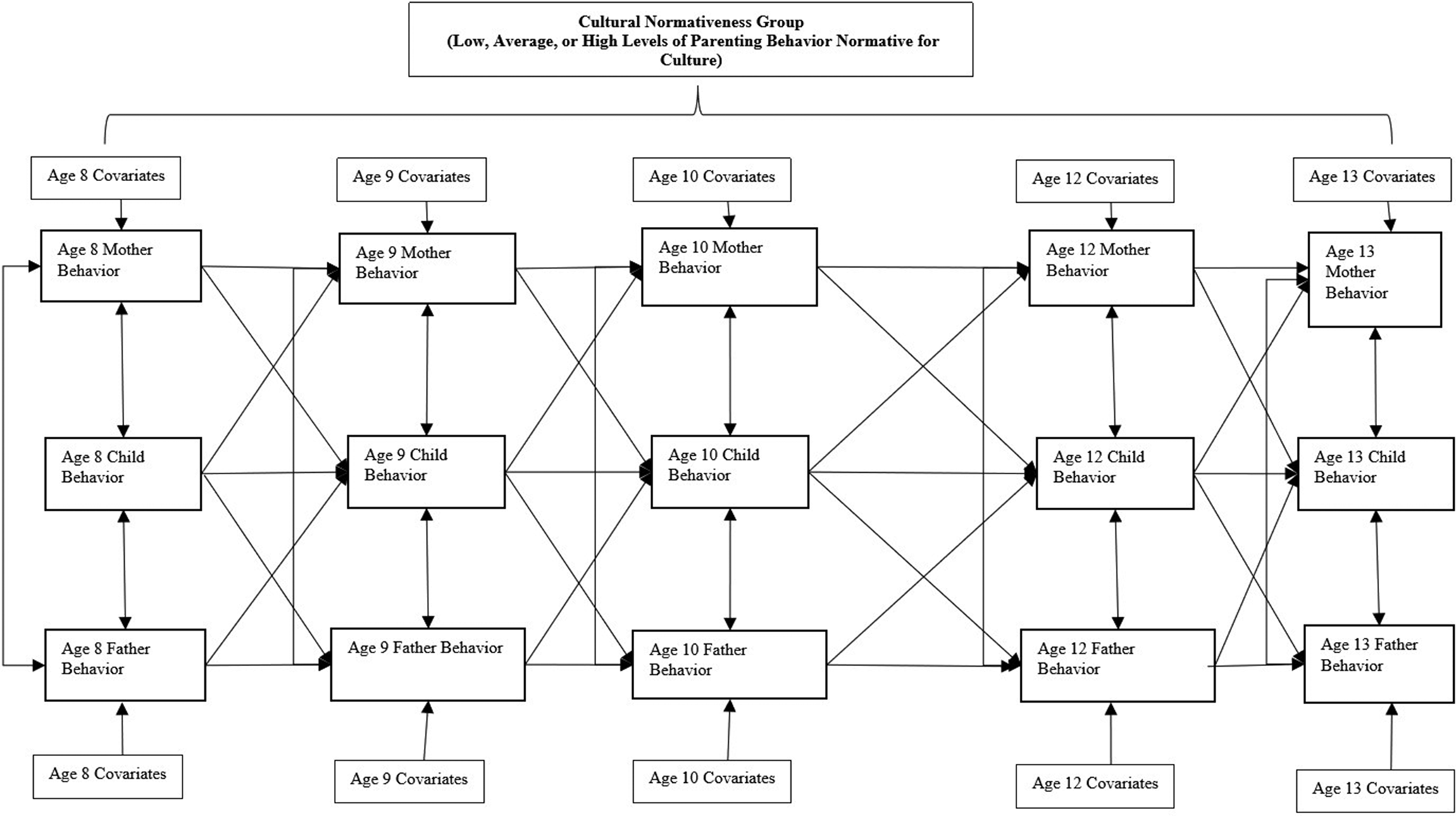
Guided by extant evidence, we make four hypotheses addressing gaps in the current literature. First, with regard to the transactional nature of parenting behaviors and child mental health, we examine four distinct models to investigate reciprocal associations between mother and father parenting and child mental health behaviors (Figure 1). In accordance with recent comprehensive meta-analyses (Pinquart, Reference Pinquart2017a, Reference Pinquart2017b), we expect to find small but statistically significant prospective reciprocal associations between parental warmth and control and child externalizing and internalizing behaviors in all models.
A conceptual model depicting the framework for study analyses. Each of the four final models examined longitudinal associations between a mother and father parenting behavior (either warmth or control) and a child behavior (either externalizing or internalizing) across cultural groups lower than average, average, or higher than average, compared to the sample as a whole, on that parenting behavior. Cross-lagged paths examined principal study hypotheses. However, to ensure the robustness of significant cross-lagged paths, other depicted paths were controlled for in all models. These include time-specific associations with study covariates (i.e., child gender, mother education, and father education), stability in parent and child behavior over time (as depicted by the autoregressive paths), and contemporaneous associations between parent and child behavior. Child behaviors were also associated with study covariates, but that association is not depicted here due to space constraints. Finally, associations between measures at nonadjacent time points (e.g., child behavior at age 8 and 10) were also controlled for but not depicted for simplicity of presentation.

Second, with regard to examining developmental specificity of reciprocal associations between parental warmth/control and child externalizing/internalizing behaviors, we expect that parent-driven effects will primarily emerge before adolescence, whereas child-driven effects will demonstrate ubiquity across ontogeny. We make this directional hypothesis based on results in our own prior work with this sample (Lansford, Rothenberg, et al., Reference Lansford, Rothenberg, Jensen, Lippold, Bacchini, Biornstein and Al-Hassan2018), while acknowledging that our prior work did not differentiate maternal and paternal warmth and control and that mixed evidence in the larger literature could support several different directional hypotheses (i.e., that parent effects strengthen in adolescence; Pinquart, Reference Pinquart2017a, Pinquart, Reference Pinquart2017b).
Third, with regard to cultural differences in these developmentally and caregiver-specific transactional models, we expect that most transactional associations, developmentally specific effects, and caregiver-specific effects will demonstrate consistency across cultures. We base this hypothesis on our own prior work (Lansford, Rothenberg, et al., Reference Lansford, Rothenberg, Jensen, Lippold, Bacchini, Biornstein and Al-Hassan2018) and recent cross-cultural meta-analytic work (Pinquart & Kauser, Reference Pinquart and Kauser2018), which demonstrate most effects of parental warmth and control on child externalizing and internalizing problems are consistent across cultures. In the instances where cultural differences may arise, however, we explore how differing levels of cultural normativeness in parenting behaviors may help explain such differences.
Fourth, with regard to mother versus father parenting effects across cultures, we make no specific hypotheses and instead engage in exploratory analysis and note differences observed across our four models. We make no specific hypotheses because the existing literature has demonstrated null effects, maternal effects, and paternal effects of parenting warmth and control on child mental health, and therefore provides no clear direction upon which to hypothesize. In addition, we examine evocative effects of child internalizing and externalizing behaviors on subsequent mother and father warmth and control. Differences in these evocative effects across mothers and fathers in different cultures are virtually unstudied. In examining these four hypotheses, we hope to shed light on when, for whom, and where parenting interventions might be most efficacious worldwide.
Method
Participants
Participants included 1,315 children (M = 8.29 years, SD = 0.66, range = 7 to 10 years; 51% girls), their mothers (N = 1,275, M = 36.93 years, SD = 6.27, range = 19 to 70 years), and their fathers (N = 1,032, M = 39.96 years, SD = 6.52, range = 22 to 76 years) at Wave 1 of six annual waves. Families were recruited from Shanghai, China (n = 121); Medellín, Colombia (n = 108); Naples, Italy (n = 100); Rome, Italy (n = 103); Zarqa, Jordan (n = 114); Kisumu, Kenya (n = 100); Manila, Philippines (n = 120); Trollhättan/Vänersborg, Sweden (n = 101); Chiang Mai, Thailand (n = 120); and Durham, North Carolina, United States (n = 111 European Americans, n = 103 African Americans, and n = 97 Latin Americans). Overall, participants represented 12 distinct ethnic/cultural groups across nine countries. Participants were recruited through letters sent from schools. Initial response rates varied across countries (from 24% to nearly 100%), primarily because of differences in the schools’ roles in recruiting. Much higher participation rates were obtained in countries in which the schools were more involved in recruiting. For example, in the United States, we were allowed to bring recruiting letters to the schools, and classroom teachers were asked to send the letters home with children. Children whose parents were willing for us to contact them to explain the study were asked to return a form to school with their contact information. We were then able to contact those families to try to obtain their consent to participate and schedule interviews to take place in participants’ homes (yielding a 24% participation rate). By contrast, in China, once the schools agreed to participate, the schools informed parents that the school would be participating in the study and allowed our researchers to use the school space to conduct the interviews. Nearly 100% of the parents in the Chinese sample agreed to participate once the schools informed them of the schools’ participation.
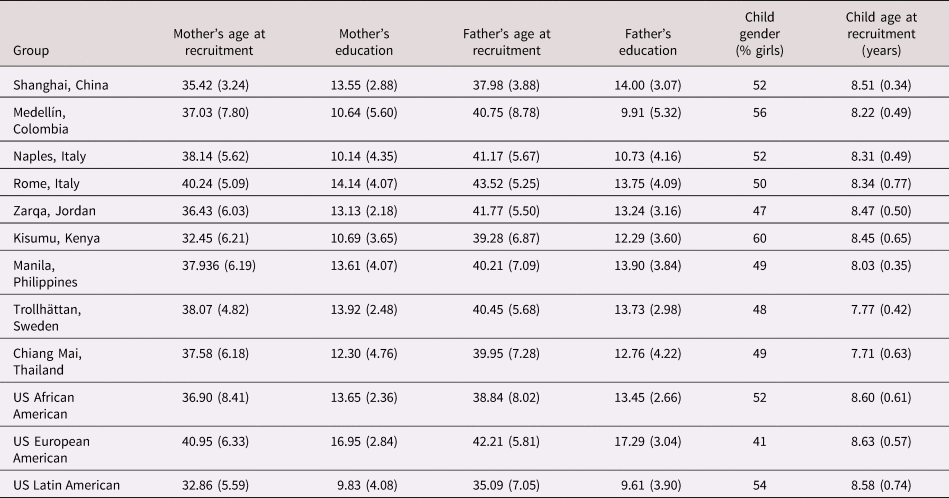
Most parents (82%) were married, and nonresidential parents were able to provide data. Nearly all were biological parents, with 3% being grandparents, stepparents, or other adult caregivers. Sampling focused on including families from the majority ethnic group in each country; the exception was in Kenya where we sampled Luo (third largest ethnic group, 13% of population), and in the United States, where we sampled equal proportions of European American, African American, and Latin American families. To ensure economic diversity, we included students from private and public schools and from high- to low-income families, sampled in proportions representative of each recruitment area. Child age and gender did not vary across countries. Data for the present study were drawn from interviews at the time of recruitment as well as 1, 2, 4, and 5 years after recruitment. Retention rates were very high: 5 years after the initial interviews, 93% of the original sample continued to provide data. Participants who provided follow-up data did not differ from the original sample with respect to child gender, parents’ marital status, or mothers’ education. Table 1 provides descriptive information about the demographics of the sample at the time of recruitment.
Descriptive statistics for demographics by cultural group

Procedure and measures
Measures were administered in the predominant language of each country, following forward- and back-translation and meetings to resolve any item-by-item ambiguities in linguistic or semantic content (Erkut, Reference Erkut2010). Translators were fluent in English and the target language. In addition to translating the measures, translators noted items that did not translate well, were inappropriate for the participants, were culturally insensitive, or elicited multiple meanings and suggested improvements (Peña, Reference Peña2007). Country coordinators and the translators reviewed the discrepant items and made appropriate modifications. Measures were administered in Mandarin Chinese (China), Spanish (Colombia and the United States), Italian (Italy), Arabic (Jordan), Dholuo (Kenya), Filipino (the Philippines), Swedish (Sweden), Thai (Thailand), and American English (the United States and the Philippines).
Interviews lasted 1.5 to 2 hr at each wave and were conducted in participants’ homes, schools, or at other locations chosen by the participants. Procedures were approved by local institutional review boards at universities in each participating country. Mothers and fathers provided written informed consent, and children provided assent. Family members were interviewed separately to ensure privacy. At the first assessment point (when children were 8 years old), all interviews for parents as well as children were conducted orally. In subsequent years, parents were given the choice of completing the measures in writing or orally, with the interviewer reading the questions aloud and recording the participants’ responses (with a visual aid to facilitate response scale understanding). The measures were administered to children orally until the age of 10; after that point, children were given the option of completing the measures orally or in writing. Children were given small gifts or monetary compensation for their participation, and parents were given modest financial compensation, families were entered into drawings for prizes, or modest financial contributions were made to children's schools.
Demographic control variables
Child gender and number of years of mother and father education at the first study time point were included in study analyses as covariates.
Child externalizing and internalizing behaviors
Mothers and fathers completed Achenbach's (Reference Achenbach1991) Child Behavior Checklist when children were ages 8–10 and 12–13. Children completed the Youth Self-Report (Achenbach, Reference Achenbach1991) at ages 8–10 and 12. Participants were asked to rate how true each item was of the child during the last 6 months (0 = not true, 1 = somewhat or sometimes true, 2 = very or often true). The externalizing behavior scale summed across 33 items (for parent reports) or 30 items (for youth reports) and captured behaviors such as lying, truancy, vandalism, bullying, drug and alcohol use, disobedience, tantrums, sudden mood change, and physical violence. The internalizing behavior scale summed across 31 items (for parent reports) or 29 items (for youth reports) and measured behaviors and emotions such as loneliness, self-consciousness, nervousness, sadness, and anxiety. The Achenbach measures are among the most widely used instruments in international research, with translations in over 100 languages and strong, well-documented psychometric properties (e.g., Achenbach & Rescorla, Reference Achenbach and Rescorla2006). Measurement invariance and consistency of the factor structure have been demonstrated in several cultural groups within and between countries (e.g., Ivanova et al., Reference Ivanova, Dobrean, Dopfner, Erol, Fombonne, Fonseca and Chen2007; Yarnell et al., Reference Yarnell, Sargeant, Prescott, Tilley, Farver, Mednick and Luczak2013). As reported by Putnick et al. (Reference Putnick, Bornstein, Lansford, Malone, Pastorelli, Skinner and Oburu2015), both internalizing behavior (α = .84 to .87) and externalizing behavior (α = .84 to .88) scale scores demonstrated strong internal consistency in the present sample. For this study, we used the family mean of child externalizing and internalizing behavior, which averaged child, mother, and father reports at each wave.
Parental warmth and control
When children were ages 8, 9, 10, 12, and 13, mothers and fathers completed the Parental Acceptance-Rejection/Control Questionnaire—Short Form (PARQ; Rohner, Reference Rohner, Rohner and Khaleque2005). Children completed the child-report version of the measure when they were ages 8, 9, 10, and 12, providing separate ratings about their mothers and fathers. The measure includes 8 items capturing parental warmth (e.g., parents say nice things to child, let child know they love them) and 5 items capturing behavioral control (e.g., parents insist child do exactly as they are told). Parents and children rated the frequency of each behavior on a modified 4-point scale (1 = never or almost never, 2 = once a month, 3 = once a week, or 4 = every day). The PARQ has been translated into 58 languages and dialects and used in more than 60 countries. Measurement invariance has been demonstrated in several cultural groups (e.g., Gomez & Rohner, Reference Gomez and Rohner2011; Senese, Bacchini, Miranda, Aurino, & Rohner, Reference Senese, Bacchini, Miranda, Aurino and Rohner2016). In a meta-analysis of the reliability of the PARQ using data from 51 studies in 8 countries, Khaleque and Rohner (Reference Khaleque and Rohner2002) concluded that internal consistency (α) reliabilities exceeded .70 in all groups, effect sizes were homogenous across groups, and convergent and discriminant validity were demonstrated (Rohner, Reference Rohner, Rohner and Khaleque2005). We found strong internal consistency for this measure across reporters in the present sample (α = .84 to .89; see Putnick et al., Reference Putnick, Bornstein, Lansford, Malone, Pastorelli, Skinner and Oburu2015, for additional information). For this study, we calculated separate measures of mother warmth and control, and father warmth and control at each time point by averaging parent and child reports on each construct. For instance, to calculate age 8 maternal warmth, we averaged mother self-reported warmth and child reports of maternal warmth at age 8. In this way, we ensured that both child and parent perspectives on parenting behavior were included in all measures of parenting behavior. Higher scores on parental warmth indicate more warmth. Higher scores on parent behavioral control indicate more behavioral control. As noted in meta-analyses, both higher warmth and higher behavioral control have been associated with lower child externalizing and internalizing behaviors (Pinquart, Reference Pinquart2017a, Reference Pinquart2017b).
Cultural normativeness of parental warmth and behavioral control
To investigate study questions examining how cultural normativeness of parent warmth or behavioral control impacts bidirectional associations between parent warmth/control and child externalizing/internalizing behavior, we grouped each of our 12 cultures. Specifically, we divided our 12 cultures into three groups when examining warmth and control associations: cultures significantly above the overall sample mean of the parenting behavior modeled (i.e., “high warmth” or “high control”), cultures not significantly different from the mean of the parenting behavior modeled (i.e., “average” warmth or control), and cultures significantly below the mean of the parenting behavior modeled (i.e., “low” warmth or control). Then we examined bidirectional associations among parent warmth or control and child externalizing or internalizing behavior in each of those three groups (see Analysis Plan section). Grouping the data in this way aligns with prior cross-cultural comparisons of parenting behaviors that take into account cultural normativeness of such behaviors (Bornstein, Putnick, & Lansford, Reference Bornstein, Putnick and Lansford2011; Lansford, Rothenberg, et al., Reference Lansford, Rothenberg, Jensen, Lippold, Bacchini, Biornstein and Al-Hassan2018).
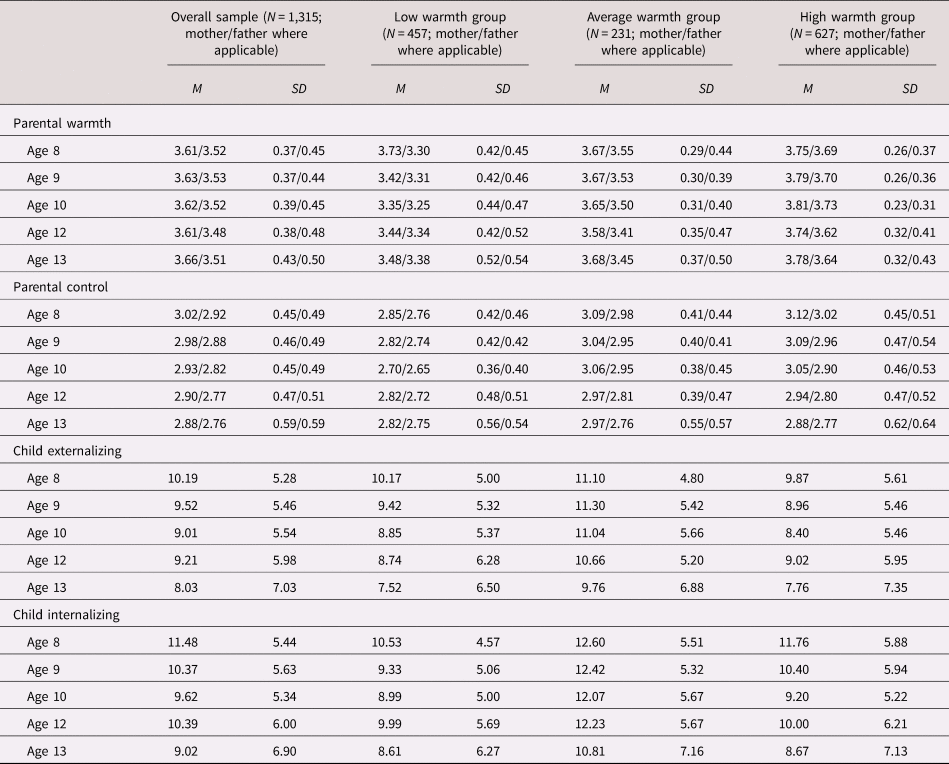
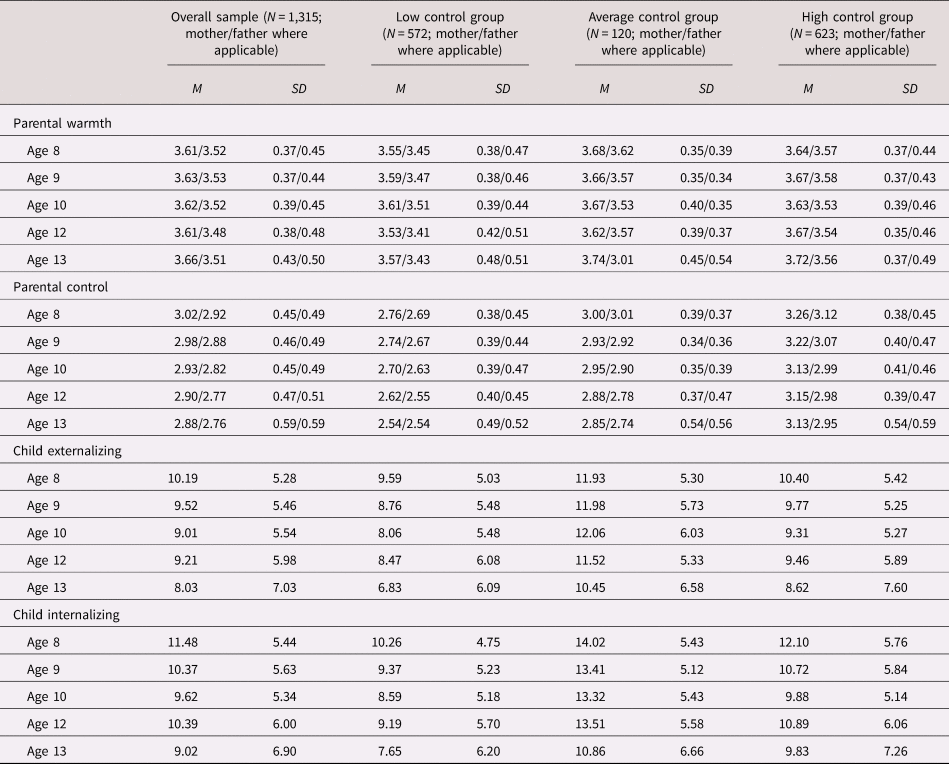
In our sample, we tested whether each cultural group mean significantly differed from the overall sample mean on warmth or control, and then Bonferroni corrected our p values (to a new significance threshold of p = .004) based on the number of comparisons we made to account for any Type I error inflation. We calculated overall sample means for warmth (M = 3.57, SD = 0.30) and control (M = 2.90, SD = 0.35) by averaging all mother, father, and child reports of warmth and control across all five waves of data, ensuring these overall means were informed by all available reports. When examining cultural group differences from the mean on overall warmth, we found that the Colombian, Italy-Naples, Sweden, US European American, US African American, and US Hispanic cultural groups had significantly higher overall warmth, and therefore fell into the “high” culturally normative warmth group, ts (98–108) = 5.83 to 16.27, ps < .004, while the Italy-Rome and Philippines groups did not significantly differ from the overall sample mean and therefore fell into the “average” group, ts (111–119) = –1.74 to 2.37, ps > .004, and China, Jordan, Kenya, and Thailand had significantly lower overall warmth, and therefore fell into the “low” culturally normative warmth group, ts (99–113) = –3.29 to –13.99, ps < .004. Similarly, the Colombian, Italy-Naples, Italy-Rome, Kenya, US African American, and US Hispanic groups fell into the “high” control group, ts (98–110) = 5.04 to 13.68, ps < .004, the Philippines group comprised the “average” control group, t (119) = 0.69, p = .49, and the China, Jordan, Sweden, Thailand, and US-European American groups comprised the “low” control group, ts (108–122) = –4.06 to –19.96, ps < .004). That so many groups significantly differed from overall warmth and control means indicates a high degree of variability in the normativeness of these behaviors across culture groups in the sample, and provides empirical support for the theoretical importance of forming different groups based upon cultural normativeness. Grouping cultures in this theoretically meaningful fashion also increases power to detect significant bidirectional associations. Tables 2 and 3 provide descriptive statistics for all substantive measures for the overall sample, and for each of the low, average, and high warmth and behavioral control subgroups at each child age.
Descriptive statistics for substantive measures in warmth groups

Descriptive statistics for substantive measures in behavioral control groups

Analysis plan
Consistent with our prior work (Lansford, Rothenberg, et al., Reference Lansford, Rothenberg, Jensen, Lippold, Bacchini, Biornstein and Al-Hassan2018), we utilized an autoregressive, cross-lagged structural equation modeling framework in Mplus Version 7 (Muthén & Muthén, Reference Muthén and Muthén1998–2015) to evaluate study hypotheses. These analyses proceeded in a series of steps. Mean scores were computed from all available mother, father, and child reports on parental warmth, parental control, child externalizing, and child internalizing behaviors at each time point. Using mean scores as observed indicators in the model helps with model estimation and power by bolstering models’ sample-size-to-parameters ratio (Kline, Reference Kline2011), which became especially important in subsequent steps of the analysis. In addition, as in our prior work (Lansford, Rothenberg, et al., Reference Lansford, Rothenberg, Jensen, Lippold, Bacchini, Biornstein and Al-Hassan2018) the decision to combine reports at each time point to compute mean scores is substantively supported by significant correlations among parent and child reports of mother warmth (r = .34–.42, p < .01), mother control (r = .25–.36, p < .01), father warmth (r = .28–.36, p < .01), father control (r = .21–.35, p < .01), child externalizing (r = .25–.60, p < .01), and child internalizing (r = .19–.43, p < .01) across all time points. This decision is further supported by high levels of interrater consistency in reporting of warmth, control, externalizing, and internalizing constructs across cultural groups, as only 2 of 48 measures of interrater consistency fell below .70 across mother, father, and child reports in each of the 12 cultural groups (see Lansford, Rothenberg, et al., Reference Lansford, Rothenberg, Jensen, Lippold, Bacchini, Biornstein and Al-Hassan2018). These significant correlations and interrater consistencies indicate mother, father, and child reports are associated closely enough to be appropriately combined to create mother parenting and father parenting mean scores across cultural groups. Alternative models where latent variables were estimated for study constructs were explored but abandoned due to difficulties with model convergence and fit as a consequence of attempting to estimate five latent variables per construct (one at each time point) in all cultural normativeness groups.
After mean scores were created, baseline path analyses testing the unique associations of study covariates (i.e., mother education, father education, and child gender) with mother and father warmth and control and child internalizing and externalizing behavior at each time point were examined (e.g., age 8 child internalizing behavior was regressed on child gender, mother education, and father education). Covariates with associations significant at p < .05 with any of our outcome variables at a particular time point were retained in subsequent analyses; all others were trimmed from further hypothesis testing to ensure model parsimony.
Next, four separate structural models exploring longitudinal associations between (a) mother and father warmth and child externalizing behavior, (b) mother and father warmth and child internalizing behavior, (c) mother and father control and child externalizing behavior, and (d) mother and father control and child internalizing behavior were each estimated utilizing full information maximum likelihood estimation procedures to handle missing data (Enders, Reference Enders2010). The framework of each of these models is depicted in Figure 1. Each model was autoregressive (e.g., age 13 father warmth was regressed on age 12 father warmth, which was regressed on wave 10 father warmth, etc.) and cross-lagged (e.g., father warmth at age 8 predicted child externalizing behavior at age 9, and child externalizing behavior at age 8 also predicted father warmth at age 9). Thus, these models allowed us to test both parent-driven and child-driven effects. In addition, to account for contemporaneous shared-method variance, correlations between contemporaneous measures were specified in each model (e.g., father warmth and child externalizing behavior at age 8 were correlated). Furthermore, to improve stability and fit, paths between different measures of each construct at nonadjacent time points were added to each model (e.g., father warmth at age 8 was associated with father warmth at ages 10, 12, and 13 in addition to predicting age 9 father warmth).
Once each of the four structural models were fit, multiple-group comparison analyses among low, average, and high warmth groups (in the two mother/father warmth models) and among low, average, and high control groups (in the two mother/father control models) were conducted to examine differences in models across levels of cultural normativeness in parenting behavior. Following procedures established in our prior work (Rothenberg et al., Reference Rotherberg, Hussong and Chassin2018; Lansford, Rothenberg, et al., Reference Lansford, Rothenberg, Jensen, Lippold, Bacchini, Biornstein and Al-Hassan2018), all paths in each of the four models were initially constrained to be equal across the cultural normativeness groups. Then, for each of the four models, paths were iteratively freed to vary across low, average, and high groups. A path was allowed to freely vary across cultural normativeness groups if a χ2 difference test revealed that the model fit significantly better with the path freed than when it was constrained to be equal across groups.
Paths were freed to vary across low, average, and high cultural normativeness groups and tested using χ2 difference tests in the same order in every model. First, all paths associating covariates with parenting and child behavior constructs were freed at once and tested. Second, all correlations between contemporaneous measures, and correlations between different measures of each construct at nonadjacent time points were freed at once and tested.
Third, all autoregressive stability paths were freed at once and tested across cultural normativeness groups. Of note, these autoregressive stability paths were freed and tested in an iterative process. Initially, paths for a particular construct (e.g., father warmth) were constrained to be equal to one another over time and cultural normativeness group (e.g., the paths predicting age 9 warmth from age 8 warmth, and age 10 warmth from age 9 warmth, etc., were constrained to be equal across time and across low, average, and high normativeness groups). Then, these paths were freed to vary over time but constrained to be equal across cultural normativeness group (e.g., paths from age 8 to age 9 warmth, and from age 9 to age 10 warmth had different values from one another, but those different values were the same across low, average, and high normativeness groups). If freeing paths to vary over time significantly improved model fit, then they were retained and subsequently compared to paths that freely varied over time and cultural normativeness group (i.e., paths from age 8 to age 9 warmth and from age 9 to age 10 warmth were allowed to have different values over time, and those values were also different across low, average, and high normativeness groups). If freeing autoregressive paths to vary over time and cultural normativeness group significantly improved model fit, then they were retained. By iteratively testing autoregressive paths in this way, we were able to empirically examine stability in paths across time and over cultural normativeness group.
Fourth and finally, each cross-lagged path was freed one at a time and tested across cultural normativeness groups. These paths were freed and varied using the exact same iterative process described above with regard to autoregressive paths, to examine stability in paths over time and across cultural normativeness group. This methodology was used to free paths (i.e., waiting to free cross-lagged paths until last) to ensure conservativeness in reporting significant findings. We wanted to ensure that, if there were any significant similarities or differences in our cross-lag paths across culture (which represented tests of our core study hypotheses), those significant differences were “real” and not just a misappropriation of variance that was better accounted for by freeing other paths across cultural groups.
Analyzing the data in this way was advantageous for answering our study hypotheses, as it allowed us to identify with precision the age-specific paths that might vary (or not) across groups of cultures with different levels of normative parenting behaviors. In addition, including both mother and father parenting behaviors in the same models directly tests the unique, bidirectional associations between parenting and child psychopathology that emerge specific to mothers and fathers. Results from the final path models are depicted in Tables 4–7.
Results
Findings from each of the four final models are discussed in turn. Skewness and kurtosis estimates for all mean scores fell in acceptable ranges (skew < 2.0, kurtosis < 7.0), suggesting no violation of the assumption of normally distributed indicators. Evaluation of model fit was based on recommended fit index cut-off values that indicate excellent model fit (comparative fit index [CFI]/Tucker–Lewis index [TLI] > .95, root square error of approximation [RMSEA] < .05, standardized root mean square residual [SRMR] < .08; Kline, Reference Kline2011). Standardized parameter estimates and standard errors are provided in Tables 4–7. Effects of demographic covariates (i.e., child gender, and mother and father education) are not presented individually in the text or tables because the vast majority of demographic covariates included in the final models were both nonsignificant and numerous. For instance, in the mother/father warmth–child externalizing model, 17 total covariate effects were found to be significant in initial path analyses and therefore estimated in each of three separate cultural normativeness groups in the final multigroup model, leading to a total of 51 covariate effects estimated. However, only 15 of those effects remained significant in the final multigroup model. Therefore, reporting each individual covariate effect seemed both inefficient and untenable (due to space limitations). Covariate effects are available upon request.
The few covariates that were significant in final models did not display any noticeable patterns of significance at particular time points, across mothers or fathers, or within particular cultural normativeness groups. When effects were significant, however, they were associated with study constructs in expected directions (Lansford, Rothenberg, et al., Reference Lansford, Rothenberg, Jensen, Lippold, Bacchini, Biornstein and Al-Hassan2018). Child gender was significantly associated with both externalizing and internalizing child behavior such that, generally, boys demonstrated greater externalizing behaviors and girls demonstrated greater internalizing behaviors. Child gender was not associated with parental warmth or control. Similarly, mother and father education were rarely but occasionally associated with both child behavior and parenting behavior. More years of education were associated with greater parental warmth, less parental control, and less child externalizing and internalizing behavior.
Mother/father warmth–child externalizing behavior model
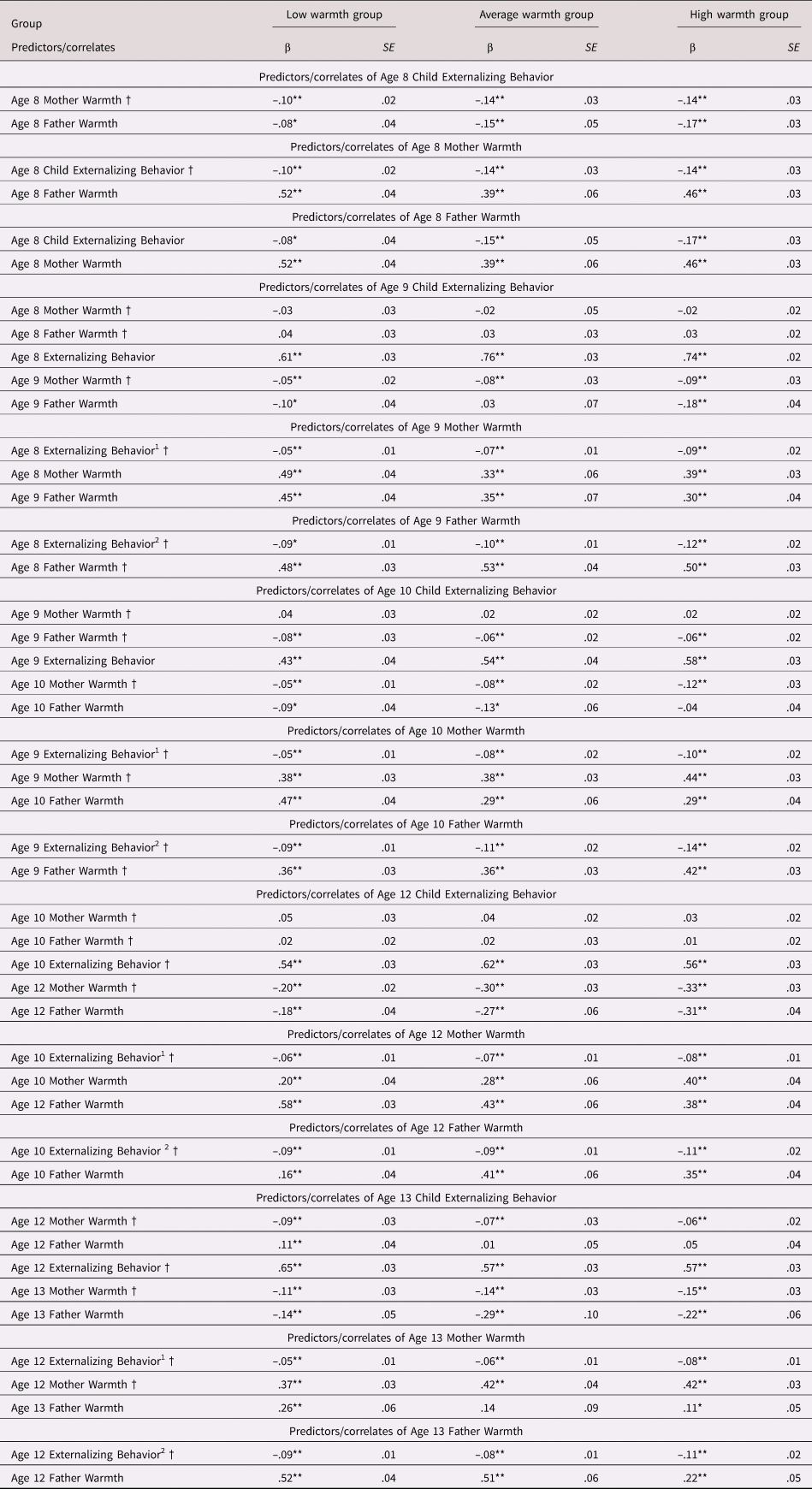
The final model (Table 4; Supplemental Figure S.1) fit the data significantly better than the initial model that was constrained to be equal across groups, χ2 (92) = 518.21, p < .01. The model fit the data well, χ2 (298) = 412.73, p < .01, RMSEA = .03, CFI = .98, TLI = .97, SRMR = .07. In the final model, 5 contemporaneous correlations, 6 autoregressive paths, and 15 of 16 cross-lagged paths were constrained to be equal across cultural normativeness groups (see Table 4). The 5 contemporaneous correlations constrained to equality were the correlations of age 8–13 child externalizing behavior with age 8–13 mother warmth. The 6 autoregressive paths constrained to equality were the paths from age 10 to age 12 externalizing behavior; age 12 to age 13 externalizing behavior; age 8 to age 9 father warmth; age 9 to age 10 father warmth; age 9 to age 10 mother warmth; and age 12 to age 13 mother warmth. The 15 cross-lagged paths constrained to equality were (4 paths) the parent effects of age 8–12 mother warmth on subsequent age 9–13 child externalizing behavior; (3 paths) the parent effects of age 8–10 father warmth on subsequent age 9–12 externalizing behavior; (4 paths) the child effects of age 8–12 externalizing behavior on age 9–13 father warmth; and (4 paths) the child effects of age 8–12 externalizing behavior on age 9–13 mother warmth. Freeing all of these aforementioned paths to take on different values across low, average, and high warmth groups did not significantly improve model fit. Of note, the child effects paths were also constrained to be equal over time, as freeing these paths to take on different values at different time points did not improve model fit. Therefore, child effects of externalizing behavior were equal over time and across low, average, and high warmth groups. The only cross-lagged path not constrained to equality across time was the effect of age 12 father warmth on age 13 child externalizing behaviors. All other contemporaneous and autoregressive paths were freed to vary across cultural groups.
Autoregressive, cross-lagged, and contemporaneous associations between mother and father warmth and child externalizing behavior across 12 cultures separated into low, average, and high warmth groups

Note: ** p < .01, *p <. 05. † Indicates paths constrained to be equal over low, average, and high warmth cultural groups. Numbered superscripts indicate paths constrained to be equal over time. Covariates (gender, father education, and mother education) were controlled for in all analyses but not presented here for simplicity of presentation (available from first author). Cultural groups in the low warmth group (significantly below average warmth compared to the overall sample mean) include China, Kenya, Thailand, and Jordan. Cultural groups in the average warmth group (not significantly different compared to the overall sample mean) include Rome-Italy and the Philippines. Cultural groups in the high warmth group (significantly above average warmth compared to the overall sample mean) include US European Americans, US African Americans, US Hispanic Americans, Naples-Italy, Sweden, and Colombia.
Model results support our first hypothesis about the transactional nature of parenting and child-driven effects, as both significant child-driven and parent-effects were found. Child-driven effects of externalizing behavior predicted subsequent parent warmth at every time point across all three of the low, average, and high culturally normative parental warmth groups, and in both mothers and fathers. In contrast, parent effects of warmth on subsequent child externalizing behavior were more time, culture, and parent specific.
With regard to parent-driven effects, father warmth at age 9 was significantly negatively associated with child externalizing behaviors at age 10, and mother warmth at age 12 was significantly negatively associated with child externalizing behavior at age 13. These effects were equivalent in low, average, and high normative warmth cultures. Therefore, higher father warmth at age 9 and mother warmth at age 12 predicted lower child externalizing behavior at age 10 and 13, respectively, regardless of the normative cultural level of warmth. Of note, these effects retained their significance even after accounting for children's previous externalizing behavior (i.e., autoregressive paths), and contemporaneous associations between warmth and externalizing behavior (e.g., correlations between age 12 warmth and child externalizing behavior). As expected, the magnitude of parenting effects on subsequent child externalizing behavior was much smaller than the magnitude of the effect of previous externalizing behavior predicting subsequent externalizing behavior. However, of interest here, in the case of both age 12 mother and age 9 father warmth, lagged parent effects were only slightly smaller in magnitude than contemporaneous associations between warmth and externalizing behavior (see Table 4).
An additional parenting effect emerged that varied across cultural normativeness groups. Specifically, age 12 father warmth was positively associated with age 13 externalizing behavior, but only in the low normative cultural warmth group. In other words, in cultures where warmth was less commonly displayed, greater father warmth at age 12 was associated with greater child externalizing behavior at age 13. Further discussion of this unexpected positive effect can be found in the Discussion section.
With regard to child effects, child externalizing behaviors at ages 8, 9, 10, and 12 were significantly negatively associated with both subsequent mother and father warmth at ages 9, 10, 12, and 13, respectively (Table 4; Supplemental Figure S.1). High child externalizing behavior at each of these ages predicts lower mother and father warmth the next year. These effects were equivalent in cultures with low, average, and high normative levels of parent warmth. Moreover, these evocative child effects retained their significance even after accounting for the strong, year-over-year rank-order stability in mother and father warmth and after accounting for contemporaneous correlations between mother and father warmth (Table 4). The magnitudes of the stable, year-over-year autoregressive paths and contemporaneous associations were much larger than those of the evocative child effects.
Model results were mixed with regard to our second hypothesis about the developmental specificity of effects. As expected, child-driven effects on mother and father warmth emerged across development. In addition, the magnitude of these effects did not vary over time or level of culturally normative warmth. However, though one parent effect (i.e., father warmth at age 9 predicting decreases in age 10 externalizing behavior) emerged before adolescence as hypothesized, two other parent effects (i.e., mother and father age 12 warmth predicting age 13 externalizing behavior) emerged later in development, contrary to our expectations.
Our third hypothesis was supported. Normative cultural levels of warmth did predict differences in one parenting effect (age 12 father warmth, as reviewed above). However, as we expected, all evocative child effects and two of three parent effects demonstrated consistency across cultures regardless of normative levels of parent warmth.
Finally, our fourth objective, to explore differences in effects across mothers and fathers, yielded notable findings. Evocative child effects of externalizing behavior on subsequent parenting warmth were similarly significant in both mothers and fathers across time (Table 4). However, parent effects of warmth on child externalizing behavior differed across mothers and fathers in their timing (i.e., age 9 and 12 father warmth emerged as a predictor of externalizing behavior, whereas mother warmth emerged as a predictor only at age 12), cultures (i.e., age 12 father warmth only emerged as a predictor of age 13 externalizing behavior in cultures with low normative warmth), and, at times, direction (i.e., at age 12 mother warmth was negatively, and father warmth was positively, associated with age 13 externalizing behavior).
Mother/father warmth–child internalizing behavior model
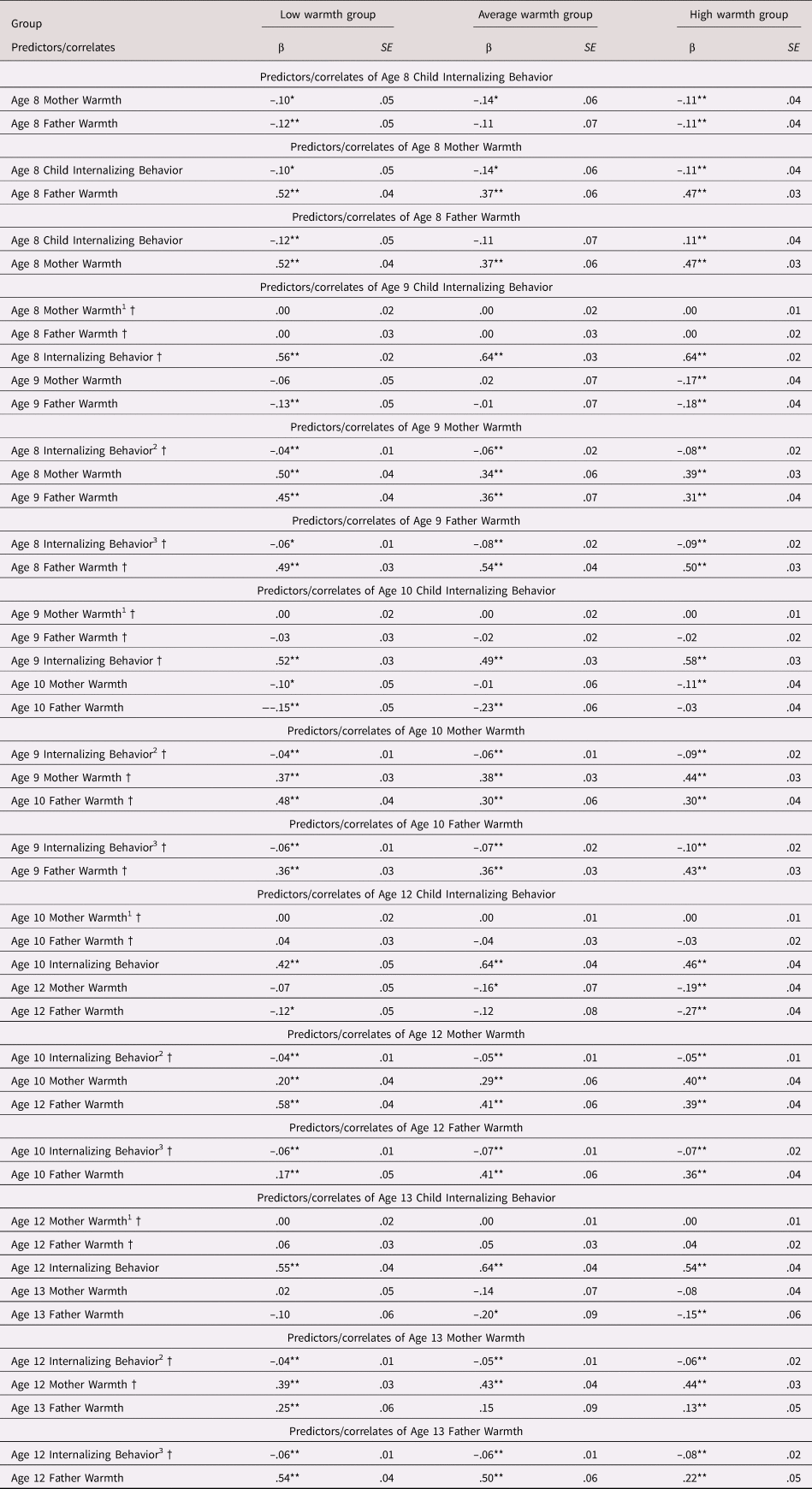
The final model (Table 5; Supplemental Figure S.1) fit the data significantly better than the initial model that was constrained to be equal across groups, χ2 (109) = 573.01, p < .01. The model fit the data well, χ2 (281) = 394.37, p < .01, RMSEA = .03, CFI = .98, TLI = .97, SRMR = .07. In the final model, 6 autoregressive paths, and all 16 cross-lagged paths were constrained to be equal across cultural normativeness groups (see Table 5). The 6 autoregressive paths constrained to equality were the paths from age 8 to age 9 internalizing behavior; age 9 to age 10 internalizing behavior; age 8 to age 9 father warmth; age 9 to age 10 father warmth; age 9 to age 10 mother warmth; and age 12 to age 13 mother warmth. All 16 cross-lagged paths constrained to equality across groups included (8 paths) the parent effects of age 8–12 mother warmth and 8–12 father warmth on subsequent age 9–13 child internalizing behavior, and (8 paths) the child effects of age 8–12 internalizing behavior on age 9–13 father and mother warmth. Freeing all of these aforementioned paths to take on different values across low, average, and high warmth groups did not significantly improve model fit. Of note, the child effects paths were also constrained to be equal over time, as freeing these paths to take on different values at different time points did not improve model fit. Therefore, child effects were equal over time and across low, average, and high warmth groups. All other contemporaneous and autoregressive paths were freed to vary across cultural groups.
Autoregressive, cross-lagged, and contemporaneous associations between mother and father warmth and child internalizing behavior across 12 cultures separated into low, average, and high warmth groups

Note: **p < .01, *p <. 05. † Indicates paths constrained to be equal over low, average, and high warmth cultural groups. Numbered superscripts indicate paths constrained to be equal over time. Covariates (gender, father education, and mother education) were controlled for in all analyses but not presented here for simplicity of presentation (available from first author). Cultural groups in the low warmth group (significantly below average warmth compared to the overall sample mean) include China, Kenya, Thailand, and Jordan. Cultural groups in the average warmth group (not significantly different compared to the overall sample mean) include Rome-Italy and the Philippines. Cultural groups in the high warmth group (significantly above average warmth compared to the overall sample mean) include US European Americans, US African Americans, US Hispanic Americans, Naples-Italy, Sweden, and Colombia.
Model results partially support our first hypothesis concerning the transactional nature of parenting and child-driven effects. Specifically, child-driven effects of internalizing behavior predicted subsequent parent warmth at every time point across all three of the low, average, and high culturally normative parental warmth groups, and in both mothers and fathers. In contrast, no significant parent effects of warmth on subsequent child internalizing behavior emerged.
Examining evocative child effects, child internalizing behaviors at ages 8, 9, 10, and 12 were significantly negatively associated with both subsequent mother and father warmth at ages 9, 10, 12, and 13, respectively (Table 5; Supplemental Figure S.1). High child internalizing behavior at each of these ages predicted lower mother and father warmth the next year. These effects were equivalent in cultures with low, average, and high normative levels of parent warmth. Moreover, these evocative child effects retained their significance even after accounting for the strong, year-over-year rank-order stability in mother and father warmth, and accounting for contemporaneous correlations between mother and father warmth (Table 5). As expected, however, the magnitudes of the stable, year-over-year autoregressive paths and contemporaneous associations were larger than those of the evocative child effects.
Model results were mixed with regard to our second hypothesis about the developmental specificity of effects. As we hypothesized, child-driven effects of internalizing behavior on mother and father warmth emerged across development. Moreover, the magnitude of these effects did not vary over time or level of culturally normative warmth. However, no parenting effects emerged at any developmental time point. Our third hypothesis was partially supported in this model; evocative child effects were consistent across cultural normativeness groups. No differences in parent or evocative child effects emerged across cultures differing in normative levels of parent warmth. Finally, our fourth objective to explore differences in effects across mothers and fathers yielded evocative child effects of internalizing behavior on subsequent parent warmth that were similar in significance and magnitude in both mothers and fathers across time (Table 5).
Mother/father behavioral control–child externalizing behavior model
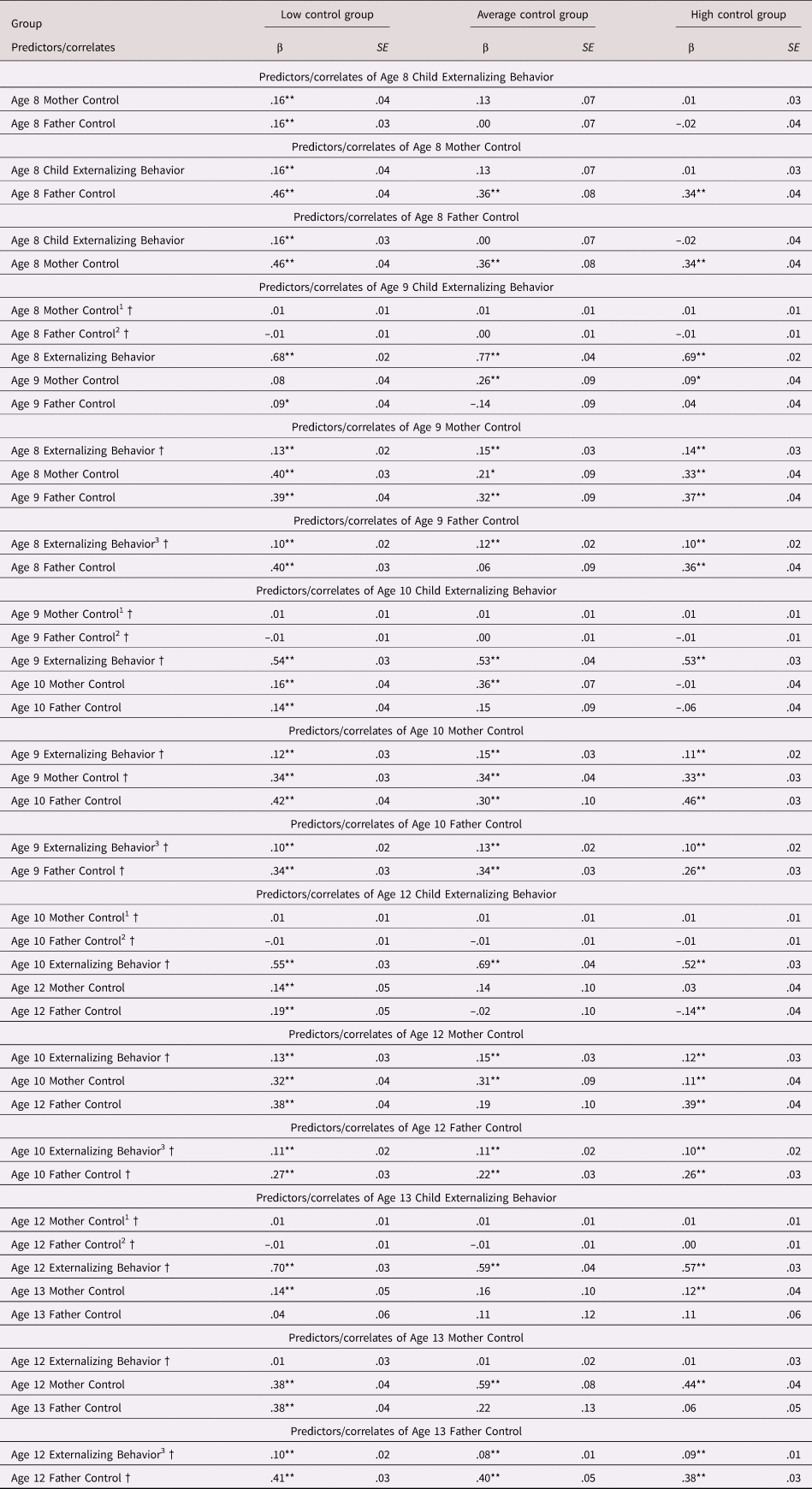
The final model (Table 6; Supplemental Figure S.2) fit the data significantly better than the initial model that was constrained to be equal across groups, χ2 (126) = 377.984, p < .01. The model fit the data well, χ2 (259) = 412.33, p < .01, RMSEA = .04, CFI = .98, TLI = .96, SRMR = .07. In the final model, 7 autoregressive paths, and all 16 cross-lagged paths were constrained to be equal across cultural normativeness groups (see Table 6). The 7 autoregressive paths constrained to equality were the paths from age 9 to age 10 externalizing behavior; age 10 to age 12 externalizing behavior; age 12 to age 13 externalizing behavior; age 9 to age 10 mother behavior control; age 9 to age 10 father behavioral control; age 10 to age 12 father behavioral control; and age 12 to age 13 father behavioral control. All 16 cross-lagged paths constrained to equality across groups included (8 paths) the parent effects of age 8–12 mother and father behavioral control on subsequent age 9–13 child externalizing behavior and (8 paths) the child effects of age 8–12 externalizing behavior on age 9–13 mother and father behavior control. Freeing all of these aforementioned paths to take on different values across low, average, and high control groups did not significantly improve model fit. Of note, all of these cross-lagged parent and child effects, except for the child effects of age 8–12 externalizing behavior on age 9–13 mother control, were also constrained to be equal over time, as freeing these paths to take on different values at different time points did not improve model fit. Therefore, these effects were equal over time and across low, average, and high control groups. All other contemporaneous and autoregressive paths were freed to vary across cultural groups.
Autoregressive, cross-lagged, and contemporaneous associations between mother and father control and child externalizing behavior across 12 cultures separated into low, average, and high control groups

Note: ** p < .01, *p <. 05. † Indicates paths constrained to be equal over low, average, and high control cultural groups. Numbered superscripts indicate paths constrained to be equal over time. Covariates (gender, father education, and mother education) were controlled for in all analyses but not presented here for simplicity of presentation (available from first author). Cultural groups in the low control group (significantly below average control compared to the overall sample mean) include US European Americans, China, Thailand, Sweden, and Jordan. Cultural groups in the average control group (not significantly different compared to the overall sample mean) include the Philippines. Cultural groups in the high control group (significantly above average control compared to the overall sample mean) include US African Americans, US Hispanic Americans, Kenya, Rome-Italy, Naples-Italy, and Colombia.
Model results partially support our first hypothesis concerning the transactional nature of parenting and child-driven effects. Specifically, child-driven effects of externalizing behavior predicted subsequent parent behavioral control at almost every time point across all three of the low, average, and high culturally normative parental behavior control groups, and in both mothers and fathers. However, no significant parent effects of behavior control on subsequent child externalizing behavior emerged.
Regarding child effects, child externalizing behaviors at ages 8, 9, and 10 were significantly positively associated with both subsequent mother and father behavioral control at ages 9, 10, and 12, respectively. Age 12 externalizing behavior was significantly positively associated with age 13 father, but not mother, behavioral control (Table 6; Supplemental Figure S.2). High child externalizing behavior at each of these ages predicted higher parent behavioral control the next year. These effects were equivalent in cultures with low, average, and high normative levels of parent behavioral control. Moreover, these evocative child effects retained their significance even after controlling for the strong, year-over-year stability in mother and father behavioral control, and accounting for contemporaneous correlations between mother and father behavioral control (Table 6). Generally, the magnitudes of the stable, year-over-year autoregressive paths and contemporaneous associations were larger than those of the evocative child effects.
Model results were mixed with regard to our second hypothesis about the developmental specificity of effects. Similar to the models presented above, child-driven effects of externalizing behavior on mother and father behavior control emerged across development. Moreover, the magnitude of these effects did not vary across cultures low, average, or high in parent behavioral control, and, in the case of child effects of externalizing behaviors on father control, also did not vary over time. However, no parenting effects emerged at any developmental time point. Our third hypothesis was largely supported in this model; the same evocative child effects emerged across cultures differing in normative levels of parent behavioral control. However, no differences in any parent or child effects were found across cultural normativeness groups.
Finally, with regard to our fourth objective to explore differences in effects across mothers and fathers, for the most part our results demonstrated similar findings across mothers and fathers. In both mothers and fathers, evocative child effects of externalizing behavior on subsequent parent behavioral control were similar in significance and magnitude across ages 8–12 (Table 5). The one difference between mothers and fathers emerged at age 13, where high age 12 externalizing behavior predicted significantly greater behavioral control in fathers, but not mothers, at age 13.
Mother/father behavior control–child internalizing behavior model
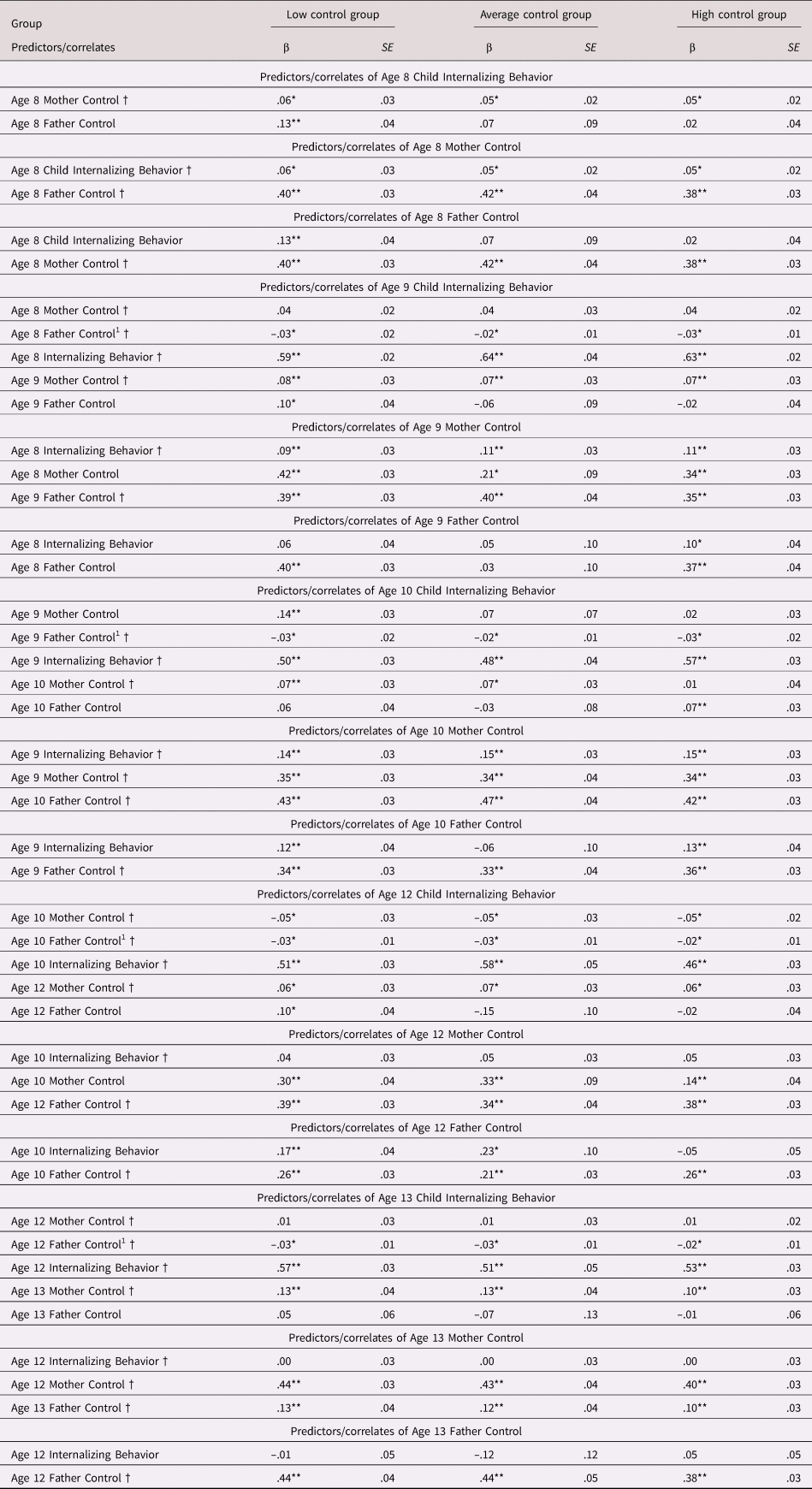
The final model (Table 7; Supplemental Figure S.2) fit the data significantly better than the initial model that was constrained to be equal across groups, χ2 (106) = 303.67, p < .01. The model fit the data well, χ2 (279) = 466.88, p < .01, RMSEA = .04, CFI = .97, TLI = .95, SRMR = .08. In the final model, 10 contemporaneous correlations, 9 autoregressive paths, and 11 of 16 cross-lagged paths were constrained to be equal across cultural normativeness groups (see Table 7). The 10 contemporaneous correlations constrained to equality were the correlations of age 8–13 mother behavioral control with (5 paths) age 8–13 child internalizing behavior and (5 paths) age 8–13 father behavioral control. The 9 autoregressive paths constrained to equality were (4 paths) from ages 8–12 internalizing behavior to ages 9–13 internalizing behavior respectively; (2 paths) from age 9 and 10 mother behavioral control to age 12 and 13 mother behavioral control, respectively; and (3 paths) from ages 9–12 father behavioral control to ages 10–13 father behavioral control, respectively. The 11 cross-lagged paths constrained to equality were (4 paths) the parent effects of age 8–12 father behavioral control on subsequent age 9–13 child internalizing behavior, (3 paths) the parent effects of age 8, 10, and 12 mother behavioral control on age 9, 12, and 13 child internalizing behavior, respectively, and (4 paths) the child effects of internalizing behavior at ages 8–12 on mother behavioral control at ages 9–13. Freeing all of these aforementioned paths to take on different values across low, average, and high control groups did not significantly improve model fit. Of note, the parent effects of age 8–12 father behavioral control on age 9–13 child internalizing behavior were also constrained to be equal over time as freeing these paths to take on different values at different time points did not improve model fit. Therefore, parent effects of father behavioral control were equal over time and across low, average, and high control cultural normativeness groups. All other contemporaneous, autoregressive, and cross-lagged paths were freed to vary across cultural groups.
Autoregressive, cross-lagged, and contemporaneous associations between mother and father control and child internalizing behavior across 12 cultures separated into low, average, and high control groups

Note: **p < .01, *p <. 05. † Indicates paths constrained to be equal over low, average, and high control cultural groups. Numbered superscripts indicate paths constrained to be equal over time. Covariates (gender, father education, and mother education) were controlled for in all analyses but not presented here for simplicity of presentation (available from first author). Cultural groups in the low control group (significantly below average control compared to the overall sample mean) include US European Americans, China, Thailand, Sweden, and Jordan. Cultural groups in the average control group (not significantly different compared to the overall sample mean) include the Philippines. Cultural groups in the high control group (significantly above average control compared to the overall sample mean) include US African Americans, US Hispanic Americans, Kenya, Rome-Italy, Naples-Italy, and Colombia.
Model results support our first hypothesis about the transactional nature of parenting and child-driven effects, as both significant child-driven and parent-effects were found. However, both parent- and child-driven effects differed to some extent across cultures low, average, and high in normative behavioral control.
When examining parent effects, effects of father behavioral control on subsequent child internalizing behavior were equivalent across time and cultural normativeness groups, while the effects of mother behavioral control varied over time and cultural normativeness groups. Father behavioral control at ages 8, 9, 10, and 12 was significantly negatively associated with child internalizing behaviors at ages 9, 10, 12, and 13. These effects were equivalent in low, average, and high normative control cultures. Therefore, higher father behavioral control at these ages predicted lower child internalizing behavior the next year regardless of the normative cultural level of control. Of note, these effects retained their significance even after accounting for children's previous internalizing behavior (i.e., autoregressive paths) and contemporaneous associations between father behavioral control and internalizing behavior (e.g., correlations between age 8 father control and child internalizing behavior). As expected, the magnitudes of father behavioral control effects on subsequent child internalizing behavior were much smaller than magnitudes of the effects of previous internalizing behavior predicting subsequent internalizing behavior (Table 7).
With regard to mother parent effects, mother behavioral control at age 10 was negatively associated with child internalizing behavior at age 12, and this effect was equivalent across low, average, and high normative behavioral control cultures. Greater mother behavioral control at age 10 predicted less child internalizing behavior at age 12. As with the father parenting effects, this effect persisted even after controlling for stability in child internalizing behavior and contemporaneous age 12 correlations between mother behavioral control and child internalizing behavior. While the magnitude of the age 10 mother behavioral control effect was much smaller than that of the age 10 child internalizing behavior effect on age 12 mother behavior, it was similar in magnitude to the contemporaneous correlation between age 12 mother behavioral control and internalizing behaviors.
Another mother parenting effect emerged that varied across cultural normativeness groups. Specifically, age 9 mother behavioral control was positively associated with age 10 internalizing behavior, but only in the low culturally normative behavioral control group. In other words, in cultures where behavioral control was less commonly displayed, greater mother behavioral control at age 9 was associated with greater child internalizing behavior at age 10, even after controlling for contemporaneous and autoregressive associations among mother behavioral control and child internalizing behavior.
With regard to child effects, child internalizing behaviors at ages 8 and 9 were significantly positively associated with subsequent mother behavioral control at ages 9 and 10, respectively (Table 7; Supplemental Figure S2). High child internalizing behavior at each of these ages predicted greater mother behavioral control the next year. These effects were equivalent in cultures with low, average, and high normative levels of parent behavioral control. Moreover, these evocative child effects retain their significance even after accounting for the strong, year-over-year rank-order stability in mother behavioral control, and after accounting for contemporaneous correlations between mother and father behavioral control (Table 7). As expected, the magnitudes of the stable, year-over-year autoregressive paths and contemporaneous associations were larger than those of the evocative child effects.
In a departure from the other three models reported above, evocative child effects of internalizing behavior on subsequent father control varied across cultural normativeness groups. Specifically, age 8 internalizing behaviors were positively associated with age 9 father control only in cultures with high normative levels of parent behavioral control, whereas age 10 internalizing behaviors were positively associated with age 12 father control in cultures with low or medium, but not high, normative levels of parent behavioral control. In addition, age 9 internalizing behaviors were positively associated with age 10 father control in cultures low or high, but not average, in normative levels of parent behavioral control.
Model results were largely unsupportive of our second hypothesis about the developmental specificity of effects. In a departure from other models reported above, significant child-driven effects of internalizing behavior on mother and father behavioral control were largely confined to preadolescence (with the effect of age 10 internalizing behaviors predicting age 12 father behavioral control in low and medium control groups being the lone exception). Moreover, father effects of behavioral control on child internalizing problems were ubiquitous and equivalent across development, as opposed to being stronger in preadolescence as we hypothesized. In addition, the effects of mother behavioral control on child internalizing behavior extended into adolescence (i.e., age 12 mother behavioral control was negatively associated with age 13 internalizing behavior).
Our third hypothesis was supported. Normative cultural levels of behavioral control predicted differences in one parenting effect (age 9 mother behavioral control, as reported above) and three evocative child effects (age 8, 9, and 10 internalizing behavior on age 9, 10, and 12 father behavioral control, as reported above). More significant differences in parent and child effects emerged in this model across levels of cultural normativeness than in our other models.
Finally, our fourth objective to explore differences in effects across mothers and fathers yielded notable findings. Parent effects of behavioral control on child internalizing behavior differed across mothers and fathers in their timing (i.e., father behavioral control emerged as a predictor at all time points, whereas mother behavioral control emerged as a predictor only at age 9 and 10), cultures (father effects were ubiquitous regardless of cultural normativeness, whereas age 9 mother behavioral control effects emerged only in cultures with low levels of control), and, at times, direction (i.e., at age 9 mother behavioral control was positively, and age 9 father behavioral control was negatively, associated with age 10 internalizing behavior). Moreover, whereas child effects of internalizing behavior on mother behavior were ubiquitous across low, average, and high behavioral control cultures at ages 9 and 10, these same effects only emerged in a few cultural groups with regard to father control. In addition, internalizing behaviors at age 10 were positively associated with behavioral control at age 12 in fathers in cultures with low and medium normative behavioral control, but no such child effect emerged as significant in mothers.
Discussion
In the present study, we examined longitudinal, cross-cultural, prospective associations among mother and father warmth and behavioral control, and child externalizing and internalizing behaviors. We sought to simultaneously capture the transactional nature of parenting and child-driven effects. We also sought to identify developmental specificity in these transactional effects. Finally, we endeavored to understand how these processes emerged in patterns of mother and father parenting, and varied across cultures.
Examining the transactional nature of parenting and child mental health
Several themes emerged in our examination of the longitudinal, transactional associations among mother and father warmth and control, and child externalizing and internalizing behaviors. In our sample, child-driven effects of externalizing and internalizing behaviors on subsequent parent warmth and control were much more common than parenting effects of warmth/control on subsequent child externalizing and internalizing behavior. Specifically, all four models contained multiple effects of child behavioral adjustment on both subsequent mother and father parenting, and in all but one parenting–child behavior pairing (the mother control/child internalizing pairing), these effects were prospectively significant for at least three time points. In total, there were 28 paths wherein child externalizing/internalizing behaviors subsequently predicted mother or father warmth/control in at least one cultural normativeness group (Supplementary Figures S.1 and S.2). In contrast, only two of four models contained parenting effects on subsequent child behavior, for a total of 9 paths wherein mother or father warmth/control predicted subsequent child externalizing/internalizing behaviors. In addition, all but 3 of the 28 significant child effects paths were significant in all three cultural normativeness groups (with the exceptions being paths from age 8, 9, and 10 internalizing behavior predicting age 9, 10, and 12 father control). Moreover, in 20 of those 28 instances (i.e., all 8 child effects of externalizing behaviors on mother/father warmth, all 8 child effects of internalizing behaviors on mother/father warmth, and all 4 effects of child externalizing behaviors on father behavioral control), child effects did not significantly differ in magnitude over the course of development. In other words, child externalizing and internalizing behaviors often levied the same effects on mothers’ or fathers’ warmth/control regardless of child age.
However, although child effects appeared numerous and consistent across cultures, it is also important to note that these effects were often somewhere between 2 and 10 times smaller than the autoregressive effects of previous mother/father warmth or control on subsequent mother/father warmth and control. Thus, prospective child effects were mostly small to moderate in size, as expected given existing literature (Pinquart, Reference Pinquart2017a, Reference Pinquart2017b, Lansford, Rothenberg, et al., Reference Lansford, Rothenberg, Jensen, Lippold, Bacchini, Biornstein and Al-Hassan2018). Nevertheless, the consistent significance of these paths even after controlling for such strong autoregressive pathways, and for contemporaneous correlations between parenting behaviors and child behaviors, is impressive.
Therefore, taken together, the present results provide strong evidence for the presence of evocative child-driven child externalizing and internalizing behavior effects on subsequent parenting behavior. These effects appeared ubiquitous across development (i.e., across ages 8–13), cultures, parenting behaviors, types of child behavioral adjustment, and caregivers (i.e., mothers and fathers) and appear mostly regardless of cultural normativeness in parenting behaviors. These findings lend support to arguments made by numerous developmental psychopathologists that child effects on parenting should be considered just as important as parenting effects on children (Yan & Ansari, Reference Yan and Ansari2016) and complement recent meta-analyses that found evocative effects of child internalizing (Pinquart, Reference Pinquart2017a) and externalizing behaviors (Pinquart, Reference Pinquart2017b) on parental warmth and behavioral control in primarily European and American samples. Our results contribute to existing literature by being the first study (to our knowledge) to demonstrate that these same evocative child effects appear in many traditionally less-studied cultures around the world, and for the most part do so regardless of levels of cultural normativeness in parenting behavior.
Evocative child-driven effects could detrimentally impact parenting behaviors because parental coping resources often become overwhelmed in the face of child behavioral maladjustment (Dishion &Patterson, Reference Dishion, Patterson, Cicchetti, Cohen, Cicchetti and Cohen2006; Hipwell et al., Reference Hipwell, Keenan, Kasza, Loeber, Stouthamer-Loeber and Bean2008). Consequently, parents may turn to maladaptive parenting strategies in desperate attempts to cope with child externalizing and internalizing behaviors (e.g., coldness and rejection in response to child internalizing behaviors; Hipwell et al., Reference Hipwell, Keenan, Kasza, Loeber, Stouthamer-Loeber and Bean2008; Lansford, Rothenberg, et al., Reference Lansford, Rothenberg, Jensen, Lippold, Bacchini, Biornstein and Al-Hassan2018, or increased hostility and control in response to delinquency and aggression; Dishion & Patterson, Reference Dishion, Patterson, Cicchetti, Cohen, Cicchetti and Cohen2006; Rothenberg et al., Reference Rothenberg, Hussong and Chassin2016). Our results suggest that worldwide investment in interventions that teach parents how to cope with, and appropriately respond to, instances of difficult child behavior may be essential in breaking cascading cycles of increased child maladjustment and decreased parenting efficacy (UNICEF, 2017). Moreover, given that many of the child effects we observed were invariant in magnitude over time, such interventions may be equally effective in helping parents cope regardless of where their children are in the transition from late childhood to early adolescence. Several behavioral parent training interventions designed for children in late childhood and early adolescence (e.g., the Triple P-Positive Parenting Program; Sanders, Reference Sanders2008) have shown cross-cultural efficacy and explicitly teach parents how to respond to difficult child behavior utilizing warmth and control. Such interventions could serve as effective starting points for considering worldwide, adaptable programs. In contrast to the ubiquitous prevalence of evocative child-driven effects across development, parenting effects were less common, and are considered next.
Developmental specificity in parenting effects
We predicted that whereas child-driven effects would be common across the entire developmental age range examined (ages 8–13), parenting effects would be developmentally specific, and demonstrate effects before adolescence. Findings did not support this hypothesis. Instead, parenting effects were distributed relatively evenly; 4 of 9 paths wherein a parenting effect was significant in at least one normativeness group predicted child behaviors at or before age 10, but the other 5 did so after age 10 (Supplementary Figures S.1–S.2). This same pattern appears regardless of the parenting behavior examined, as both models (i.e., warmth/externalizing and control/internalizing) wherein parent effects were significant contained parent effects on child outcomes both before and after age 10.
Our own prior work with the present sample found parent effects were more prevalent before age 10 (Lansford, Rothenberg, et al., Reference Lansford, Rothenberg, Jensen, Lippold, Bacchini, Biornstein and Al-Hassan2018). Yet, this prior work did not separate mother and father parenting effects and simultaneously evaluate them in the same models. By doing so in the present study, we build on this prior work by demonstrating that unique effects of mother and father parenting practices can extend into early adolescence in cultures around the world. Our current results align with recent meta-analytic findings (Pinquart, Reference Pinquart2017a, Reference Pinquart2017b) that revealed parent effects of warmth and control on child externalizing and internalizing behaviors extend into older samples of children. In addition, this work builds on these meta-analytic findings by demonstrating parenting effects of warmth and control in both mothers and fathers, even after controlling for cultural normativeness in parenting, by utilizing a sample composed of cultural groups from around the world. In sum, the current study builds upon prior cross-cultural longitudinal work by demonstrating that parenting effects of warmth (with regard to externalizing behaviors) and control (with regard to internalizing behaviors) still impact child mental health even during adolescence, when increased autonomy and independence decreases contact with one's parents (Albert et al., Reference Albert, Chein and Steinberg2013; Bornstein et al., Reference Bornstein2012). However, such cross-cultural longitudinal effects may be hidden unless father and mother parenting behaviors are both examined (Lewis & Lamb, Reference Lewis and Lamb2003).
Of interest here, in two models (those exploring the bidirectional associations between mother/father warmth and child internalizing behaviors, and mother/father control and externalizing behaviors), no cross-cultural parenting effects were observed. Past longitudinal investigations and meta-analyses have found evidence for these effects (Pinquart, Reference Pinquart2017a, Reference Pinquart2017b). However, the significant cross-lagged effects found in these meta-analyses were noted as very small by the investigators (r = –.06 for the association of parent warmth and subsequent internalizing behaviors, r = –.07 for the association of behavioral control with externalizing behaviors; Pinquart et al., Reference Pinquart2017a, Reference Pinquart2017b), and were generally one-half to one-third the size of contemporaneous correlations. In addition, these meta-analyses pulled from pooled study samples of greater than 700,000 children. Parent effects in both the mother/father warmth–child internalizing and mother/father control–child externalizing models are similarly small in the present study (Tables 5 and 6), and often demonstrate the same pattern of being less than one-half the size of these same variables within contemporaneous correlations. Therefore, it appears our findings are somewhat similar to those from recent meta-analyses, but our smaller sample affords significantly less power to count such findings as significant, especially after controlling for contemporaneous correlations. Though parental warmth and behavioral control consistently confer their effects through the teenage years in the present sample, such effects depended on who (mothers or fathers) was exhibiting warmth or control. We explore these differences next.
Considering parenting and child-driven effects in mothers versus fathers
Existing literature provides conflicting evidence concerning the differing associations between mother- and father-specific parenting practices and child behavioral adjustment, and little exploration of how evocative child-driven effects impact mother versus father parenting. Consequently, we investigated the differing associations in mothers and fathers in an exploratory fashion. Current results should be seen as preliminary and interpreted tentatively.
Evocative child-driven effects of externalizing and internalizing behavior appear to be similar in significance and magnitude regardless of whether mother or father warmth or behavioral control was investigated. Practically, this might mean that in interventions teaching parents to utilize warmth or control in response to child behavioral maladjustment, it might be best to have both parents in the room (because evocative effects are roughly equal in magnitude across parents), but even if only one parent can attend, evocative effects of child internalizing and externalizing behaviors on that parent may be buffered (because parent-specific evocative pathways are robust even after controlling for corresponding pathways in the other parent).
In contrast to evocative child-driven effects, parenting-driven effects on child behavioral adjustment appear to depend on who is providing the parenting. For instance, in our sample 6 out of 9 parent effects paths that were significant in at least one cultural normativeness group were father-specific parenting paths. In both models (warmth/externalizing and control/internalizing) where parenting effects were significant, significant father parent effects were more frequent than those of mothers. We suspect that this finding arises due to the greater variability in father, as opposed to mother, parenting practices in the current sample.
Specifically, in virtually every study wave, the standard deviation of father warmth and control was larger than that of mother warmth and control (Tables 2 and 3), indicating that the “dosage” of warmth and control that children received from their fathers was much more variable than that received from their mothers. Put another way, the gap in father warmth (or control) received by children from high warmth (or control) and low warmth (or control) fathers was larger than the gap in mother warmth received by children from high warmth and low warmth mothers. Thus, effects of warmth/control on child behaviors might be more prevalent and pronounced when fathers’ parenting behaviors are examined, precisely because differences in parenting received from one father, compared to another, are greater in magnitude. Existing literature appears to at least partially support this explanation. In several studies, father involvement was a unique predictor of child adjustment across ontogeny (Khaleque & Rohner, Reference Khaleque and Rohner2012; Lewis & Lamb, Reference Lewis and Lamb2003), despite the fact that mothers were more involved in caregiving on a day-to-day basis (Lewis & Lamb, Reference Lewis and Lamb2003). Our results suggest that in our sample, this “father involvement as a unique predictor” effect may be because father parenting is more variable than mother parenting across a variety of cultures. However, our findings need replication, especially given that both mother and father parenting effects pale in comparison to stable, autoregressive effects of child externalizing and internalizing behavior over time. Regardless, the present findings contribute to existing literature by demonstrating that father warmth and behavioral control are uniquely associated with child mental health outcomes in cultures around the world (Khaleque & Rohner Reference Khaleque and Rohner2012; Lewis & Lamb, Reference Lewis and Lamb2003). However, bidirectional associations among parent and child effects varied in some ways, but not others, depending on how normative parenting practices were within a culture. We conclude our discussion by considering these effects next.
Considering effects of culture and culturally normative behaviors
Understanding parenting in diverse cultural contexts involves the identification of parenting characteristics that are common across cultures and those that are culturally specific (Bornstein et al., Reference Bornstein2012). As mentioned throughout the discussion, most parent-driven and child-driven effects in the present sample demonstrate cross-cultural commonality. Specifically, 25 of 28 total child effects and 7 of 9 total parenting effects persisted across cultures regardless of whether a cultural was relatively high, low, or average in parental warmth or control. Cross-cultural consistency in parent- and child-driven effects aligns with both our own prior work (Lansford, Rothenberg, et al., Reference Lansford, Rothenberg, Jensen, Lippold, Bacchini, Biornstein and Al-Hassan2018) and a meta-analysis that revealed similar effects of authoritative parenting (a parenting style high in both warmth and behavioral control) on child externalizing and internalizing behaviors in most cultures around the world (Pinquart & Kauser, Reference Pinquart and Kauser2018). Moreover, the present study extends this existing work by demonstrating widespread cross-cultural consistency in these effects even when mother and father parenting practices are separately examined in the same model, and even when cultures are separated based upon their normative levels of parent warmth and control.
Nevertheless, the cross-cultural consistency in study results does not imply that parental warmth or behavioral control look the same in every culture. Myriad evidence indicates that these processes look different in different cultural groups (Bornstein et al., Reference Bornstein2012). However, it may be that as long as parents and children within a culture agree that certain culturally embedded parenting acts demonstrate warmth or behavioral control, then warmth and behavioral control, and their subsequent effects, represent ubiquitous, culturally common phenomena.
We also found isolated culturally specific parenting and child effects, wherein effects differed based on the normativeness of a particular parenting behavior. We hypothesized that when such effects arose, they might take on one of two patterns. Parenting and child effects might become pronounced in cultures where warmth or control are more normative (consistent with cultural normativeness theory; Deater-Deckard & Dodge, Reference Deater-Deckard and Dodge1997). Alternatively, parent and child effects might be diminished in cultures where warmth or control are more normative because parenting behavior carries less personalized information in such cultures, and parents might react to child behavior in ways that are consistent with cultural norms, regardless of child behavior. We discovered that the pattern that defined cultural differences varied depending on whether effects were parent-driven or child-evocative effects.
Both parenting effects that differed across cultures were generally consistent with the first, cultural normativeness theory aligned pattern, albeit with a slight variation. Instead of parenting effects becoming more pronounced the more they aligned with cultural norms of parenting behavior, in our sample, on the rare occasions when they differed across cultures, parenting effects become less pronounced (and even opposite in direction) the more they deviated from cultural norms. Specifically, in the cultural group with low normative levels of warmth, high father warmth at age 12 was associated with greater child externalizing behaviors at age 13, and in the cultural group with low levels of normative control, high control at age 9 predicted greater internalizing problems at age 10. Both of these associations were opposite those found in prior meta-analyses (Pinquart, Reference Pinquart2017a, Reference Pinquart2017b) and those found in these same father warmth–externalizing and mother control–internalizing associations at other time points in the current study. We suspect that these counterintuitive effects occasionally emerge because the effects of “countercultural” adaptive parenting behavior may take longer to manifest on child outcomes. Specifically, though high age 12 father warmth was associated with greater age 13 child externalizing behaviors in low warmth cultures, age 13 father warmth was, as expected, negatively associated with age 13 externalizing behaviors (r = –.14, p < .01) in this low group. Similarly, though high age 9 mother behavioral control predicted greater internalizing problems at age 10 in low control cultures, age 10 mother behavioral control subsequently predicted lower age 12 child internalizing behavior in this low control group. Thus, in both instances, at the very next adjacent time point 1 year later, parent effects returned to their expected direction even in the “low” normative warmth/control groups.
Therefore, it may be that in both of these instances, parents in the low normative parenting groups were changing their parenting behavior (e.g., increasing warmth and behavorial control) in hopes of ameliorating child externalizing and internalizing behaviors. However, given that high levels of such parenting behaviors are not typically observed in societies with low normative levels of these behaviors, child maladaptive behaviors may take longer to respond to such high warmth and behavioral control, given the “out-of-the-norm” nature of such behaviors. Such an explanation is admittedly speculative, but is supported by existing evidence.
In contrast, those exceedingly rare (3 total out of 28) child effects that differed across cultures fell into both hypothesized patterns with no discernable rhyme or reason. In accordance with our first hypothesized pattern, the positive association of age 8 internalizing behaviors on age 9 father control was only significant in the high control group. Yet, in accordance with our second hypothesized pattern, the positive association between age 10 internalizing behaviors and age 12 father control was significant in every group but the high control group. Finally, one child effect finding did not conform to either pattern: child internalizing behavior at age 10 was positively associated with age 12 father control in the low and high, but not average, cultural normativeness groups. Given that these were the only 3 out of 28 significant child effects to differ across cultures, and that no discernable pattern among these findings emerged, we do not speculate further on the meaning of such findings here. Instead, we simply report these results, and call for future studies to continue to investigate whether child evocative effects systematically differ across levels of cultural normativeness in parenting behaviors.
Limitations and future directions
Though the present study provides new insight into the nature of transactional and developmentally specific parenting effects across cultures in mothers and fathers, it has several limitations. Measures in the present study were reported, not observed. Leading scholars have argued that, when examining effects of parenting on child behavior across cultures, observational data are sometimes preferable (Bornstein et al., Reference Bornstein2012). We attempted to mitigate the impact of bias in reports by integrating multiple parent and child reports of parenting behavior and behavioral adjustment in all study measures. An additional limitation of the current study is that, although we examine mother and father effects in the same model, we also acknowledge that doing so introduces shared reporter bias (because child reports of both mother and father behavior were included in calculations of parenting behaviors at each time point). We controlled for such shared method variance by correlating mother and father parenting constructs at each study time point in all four models. We believe that the benefits of being the first study to simultaneously examine mother and father effects cross-culturally and longitudinally, via multiple reporters (mother, father, and child) outweigh the limitations resulting from this methodological decision. Nevertheless, conclusions drawn about differences in maternal versus paternal parenting across cultures in the current study should be considered preliminary and need replication. Finally, although the breadth of countries examined in the current sample is impressive, the national/cultural subsamples were not fully representative of the cultures in which they were embedded. Therefore, results should not be generalized countrywide.
Despite these limitations, the present study serves as a foundation upon which several future directions can be built. Future work could examine the transactional, developmentally specific, and caregiver/culturally moderated effects of parenting on more specific aspects of child behavioral adjustment. For instance, future investigations could examine whether parenting and child effects hold when specific aspects of externalizing (e.g., delinquency, substance use, or hyperactivity) and internalizing (e.g., anxiety or depression) behaviors are examined. In addition, future studies could employ methods that more proximally link parenting and child-driven effects. For instance, studies employing ecological momentary assessments might be especially helpful in understanding how daily reciprocal transactions between parenting and child behaviors inform the development of year-over-year parenting and child-driven effects seen here.
In summary, the present study advances existing literature by examining transactional, developmentally specific, and cross-cultural effects simultaneously in 12 cultures and with both mothers and fathers. Moreover, the present study rigorously examines the unique nature of parenting- and child-driven effects by controlling for prior parenting and child behaviors as well as pertinent covariates, at multiple time points across ontogeny. Results reveal that evocative child-driven effects of externalizing and internalizing behavior on warmth and control are ubiquitous across development, cultures, mothers, and fathers. Results also reveal that parenting effects on child externalizing and internalizing behaviors, though rarer than child effects, extend into adolescence when examined separately in mothers and fathers. Father-based parent effects were more frequent than mother effects, perhaps due to greater variability in father parenting across time and cultures. Most parent- and child-driven effects appear to consistently emerge across cultures. The rare culturally specific parenting effects suggested that the effects of parenting behaviors that run counter to cultural norms may be delayed in rendering their protective effect against deleterious child outcomes. We hope our findings contribute to future interventions that bolster the effects of parental warmth and behavioral control, and ameliorate the evocative effects of child externalizing and internalizing behavior, worldwide.
Supplementary Material
The supplementary material for this article can be found at https://doi.org/10.1017/S0954579419001214
Financial Support
This research has been funded by Eunice Kennedy Shriver National Institute of Child Health and Human Development Grant RO1-HD054805 and Fogarty International Center Grant RO3-TW008141. This research also was supported by the Intramural Research Program of the NIH/NICHD, and an International Research Fellowship in collaboration with the Centre for the Evaluation of Development Policies at the Institute for Fiscal Studies, London, UK, funded by the European Research Council under the Horizon 2020 research and innovation programme (grant agreement No. 695300-HKADeC-ERC-2015-AdG). The content is solely the responsibility of the authors and does not necessarily represent the official views of the NIH or the NICHD.