Introduction
North China was a major centre of independent plant domestication, primarily for foxtail millet (Setaria italica) and broomcorn millet (Panicum miliaceum). The wild progenitor of foxtail millet is green foxtail (Setaria viridis), while that of broomcorn millet is uncertain (Zhao Reference Zhao2011). Genetic studies suggest that foxtail millet was first domesticated in the middle reaches of the Yellow River (Wang et al. Reference Wang, Jia, Zhi, Niu, Chai, Li, Wang, Li, Lu, Zhao and Diao2012; Jia et al. Reference Jia, Shi, Wang, Niu, Chai, Zhi and Diao2013), but archaeological information on this issue is sparse. In the Yellow River region, the earliest evidence for processing wild Paniceae grasses, together with other wild grasses, beans, tubers and bulbs, comes from starch remains found on grinding stones at Shizitan locality 14 (c. 23000–18500 cal BP) (Liu et al. Reference Liu, Bestel, Shi, Song and Chen2013). Charred wild Setaria sp. and Echinochloa sp. (barnyard grass) have been recovered at Shizitan locality 9 (c. 13800–11600 cal BP) (Bestel et al. Reference Bestel, Crawford, Liu, Shi, Song and Chen2014). A few Setaria sp. grains of a similar morphology to foxtail millet have been found at Donghulin, near Beijing (c. 10000 cal BP) (Zhao Reference Zhao2014), and were also associated with other wild cereals, nuts and tubers (Liu et al. Reference Liu, Field, Fullagar, Zhao, Chen and Yu2010; Yang et al. Reference Yang, Wan, Perry, Lu, Wang, Zhao, Li, Xie, Yu, Cui, Wang, Li and Ge2012). These grains date to about 2000 years before the spread of domesticated millets over northern China (Liu & Chen Reference Liu and Chen2012). These findings suggest a very long history of wild millet exploitation as part of broad-spectrum subsistence strategies prior to domestication. Despite this, the earliest exploitation of wild millets and the nature of their eventual domestication both remain unclear.
Cereal domestication includes a long period of continuous selection for non-shattering rachises until this characteristic becomes dominant (Purugganan & Fuller Reference Purugganan and Fuller2010; Willcox Reference Willcox, Gepts, Famula, Bettinger, Brush, Damania, McGuire and Qualset2012). To reconstruct this process, researchers have focused on non-shattering rachises as the most important diagnostic feature when studying the domestication of wheat, barley and rice (e.g. Hillman & Davies Reference Hillman, Davies and Anderson1999; Zheng et al. Reference Zheng, Crawford, Jiang and Chen2016). No millet rachises have been recovered from flotation samples from Upper Palaeolithic and Early Neolithic sites in China. Although millet rachises are perhaps too small and fragile to survive in the archaeological record, use-wear analysis of tools may be able to shed light on cultivation practices. Selection for the non-shattering trait can be achieved by using certain harvesting methods including stone cutting tools (Hillman & Davies Reference Hillman, Davies and Anderson1999). Cereal-cutting sickle blades show very smooth and bright polish, referred to as sickle gloss, which has been used as a diagnostic trace of cereal harvesting (Unger-Hamilton Reference Unger-Hamilton1989, Reference Unger-Hamilton and Anderson1999; Anderson Reference Anderson and Anderson1999; Ibáñez et al. Reference Ibáñez, Anderson, González-Urquijo and Gibaja2016). Identifying evidence of the harvesting and processing of wild millets (in this case, green foxtail and barnyard grass) on stone tools would, therefore, be an alternative approach to identifying the beginnings of millet domestication. Employing this approach, this study investigates a long history of plant exploitation at the Shizitan site cluster during the Late Pleistocene and Early Holocene by focusing on tools used for collecting and processing plants.
Environmental and archaeological background
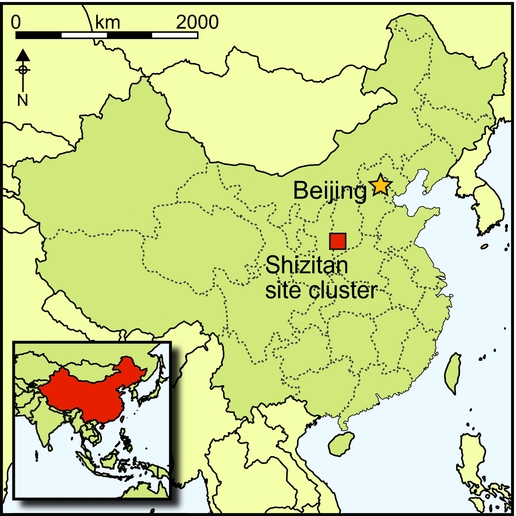
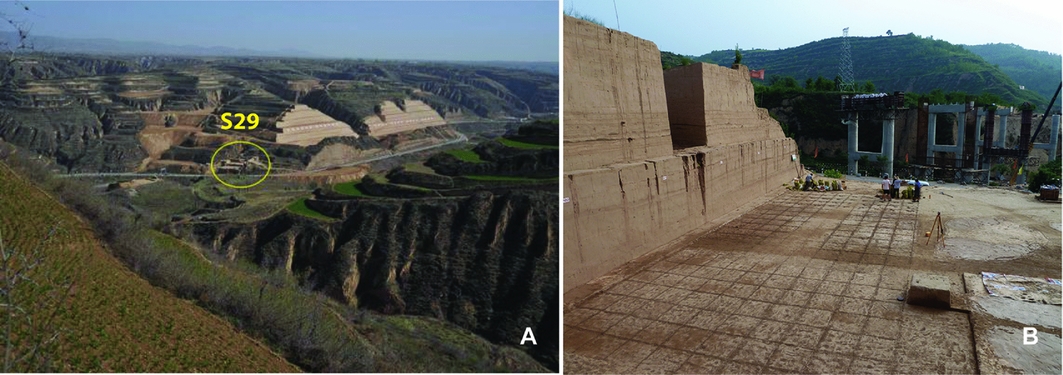
The Shizitan site cluster comprises a few dozen Upper Palaeolithic localities (c. 28000–8500 cal BP) distributed along the Qingshui River, a tributary of the Yellow River, in Jixian, Shanxi Province, on the Loess plateau (Linfen Cultural Bureau of Shanxi Province 1989; Shizitan Archaeology Team 2010, 2013, 2016; Song & Shi Reference Song and Shi2017). The current study focuses on two recently excavated localities: 1) locality 29 (hereafter SZT29; 36˚2′54″ north, 110˚35′22″ east, 723m asl; c. 28000–13000 cal BP), which provides the longest occupational sequence in the site cluster (Song & Shi Reference Song and Shi2017); and 2) the latest phase of locality 5 (hereafter SZT5; 36°02′50″ north, 110°35′17″ east, 719m asl; c. 10000 cal BP), which is one of the final occupations of the entire Shizitan area (Figures 1 & 2) (Shizitan Archaeology Team 2016).
Sites discussed in this study: 1) Shizitan; 2) Longwangchan; 3) Xiachuan; 4) Shuidonggou; 5) Donghulin. The small dots in the insert map indicate modern village localities.

Photographs showing the wider landscape of SZT29 (A), and excavation at the site (B). (Photograph A by Yanhua Song, and B by Li Liu.)
The SZT29 occupations experienced several episodes of climatic fluctuation with corresponding changes in lithic industry:
1) Stratum 8 (c. 28000 cal BP): the climate was warm and wet, the landscape was mostly covered by forest and the lithic remains are characterised by a core and flake industry.
2) Stratum 7 (c. 26000–24000 cal BP): the early part of the Last Glacial Maximum (LGM) experienced a cooler climate and steppe or semi-desert environment. Small flake tools and microliths appear in the lithic inventory, and continue to dominate lithic assemblages in the region from this time on.
3) Strata 6–4 (c. 24000–19500 cal BP): the late part of the LGM saw peak, cold and dry conditions; the region became a full desert-steppe environment.
4) Strata 3–2 (c. 20000–18000 cal BP): this period was also typified by cold, dry conditions. Stratum 2 was followed by a period of around 5000 years with little evidence of human activities.
5) Stratum 1 (c. 13000 cal BP): the climate became warmer and wetter, and forest coverage had returned (Song et al. Reference Song, Cohen, Shi, Wu, Kvavadze, Goldberg, Zhang, Zhang and Bar-Yosef2017).
Experimental research and archaeological data
In order to understand the functions of ancient tools, we have conducted experimental studies using stone tools to process plants (Fullagar et al. Reference Fullagar, Liu, Bestel, Jones, Ge, Wilson and Zhai2012; Liu et al. Reference Liu, Wang and Levin2017). The use-wear traces on experimental and archaeological tools were analysed by taking polyvinyl siloxane (PVS) impressions (Fullagar Reference Fullagar, Torrence and Barton2006), a method that produces a portable and permanent record, and which has been successfully used in our previous studies (Liu et al. Reference Liu, Field, Fullagar, Zhao, Chen and Yu2010, Reference Liu, Bestel, Shi, Song and Chen2013). We have also analysed the residues on some experimental cutting tools, and extracted starches from the stems and leaves of various plants to provide a comparative database for identifying tool functions (Liu et al. Reference Liu, Wang and Levin2017) (see the online supplementary material (OSM) for methods).
We found that starches from the stems and leaves of Panicoideae, including green foxtail, barnyard grass and Job's tears (Coix lacryma-jobi), contain some large grains, unlike transient starches, which are often described as small and not taxon-specific (Sivak & Preiss Reference Sivak and Preiss1998). These large grains, also present on cutting tools, include two morphological types, lenticular and polygonal, which are comparable in form and size to those found in seeds of Triticeae and Panicoideae, respectively. The polygonal type starch grains were found in abundance in green foxtail stems/leaves, accounting for the great majority in the starch assemblage. Large lenticular and polygonal starches were also found in stems/leaves of wild Triticeae, such as Leymus, but in very low frequencies. The presence then of a high proportion of polygonal starch grains on a cutting tool could be indicative of harvesting Panicoideae, including green foxtail (Figure S1). Based on these results, we analysed starch residues on archaeological grinding and cutting tools separately by comparing them with references from corresponding parts of the plants (seeds vs stems and leaves).
Residue analyses were conducted on control samples (nine sediment samples and five non-tool flakes). A maximum of one starch granule and a very low phytolith concentration was found in each. Therefore, starch and phytoliths on the stone tools examined are the result of tool use and not contamination from soils or post-excavation handling (see the OSM).
Results of analyses
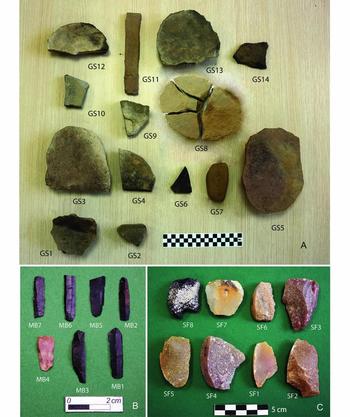
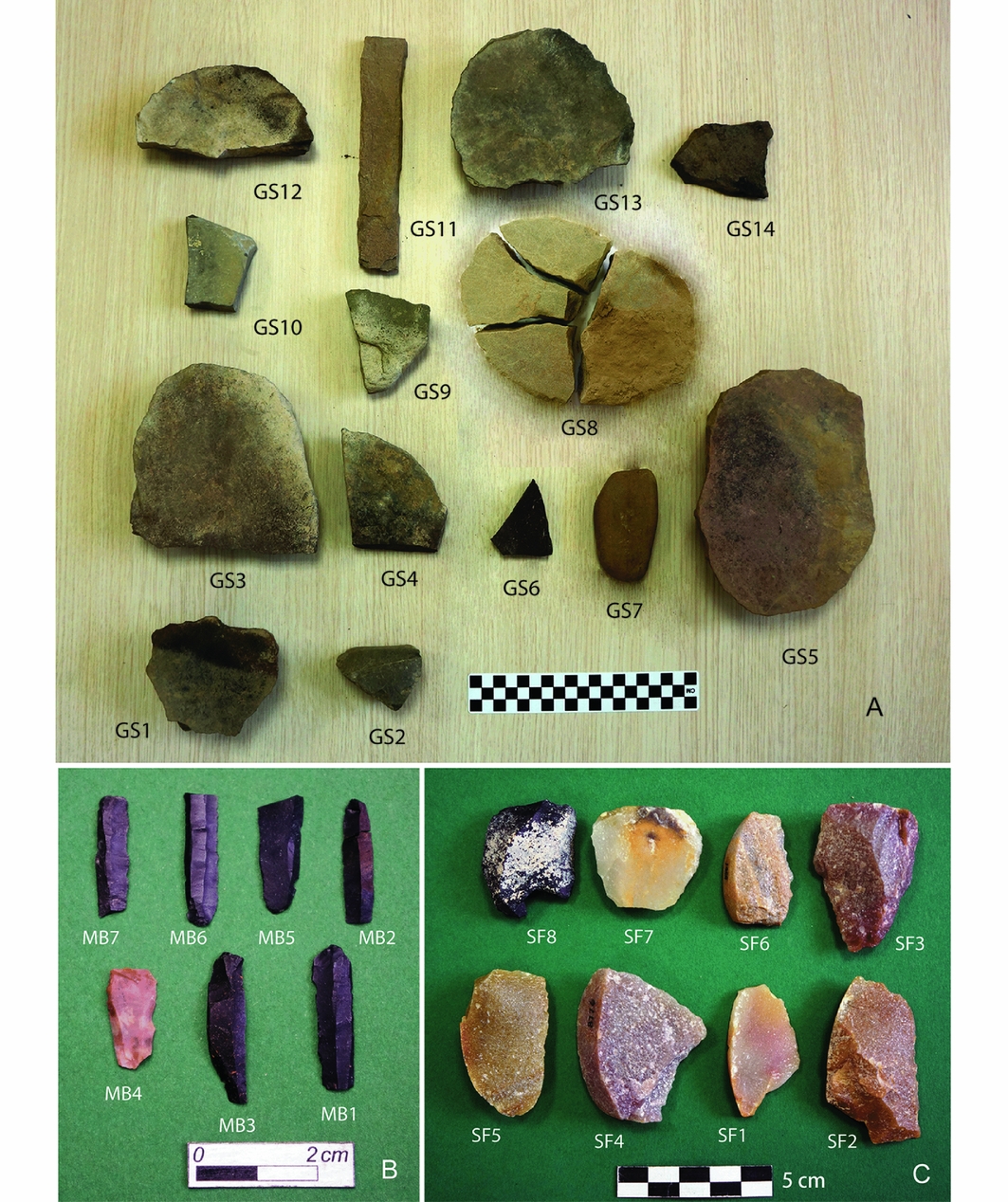
We analysed microbotanical residues and use-wear traces on two types of stone tools: grinding stones (recorded as GS) including slabs and a handstone (or quernstones and a rubber), and cutting tools (small flakes and microblades, recorded as SF and MB, respectively) from the same depositional units or nearby fireplaces. All of the grinding stones were analysed, while cutting tools were selected based upon the preliminary identification of use traces under a low-power microscope. A total of 47 lithics were subjected to further analysis, of which five were classified as non-tools, based on use-wear analysis under a high-power microscope (then used as control samples for residue analyses). Among the 42 tools, 40 are from SZT29 (13 grinding stones, 1 function-unknown slab, 8 microblades and 18 small flake tools), and 2 flake tools are from stratum 1 of SZT5 (Figure 3). These samples cover 18000 years of human history in the region (c. 28000–10000 cal BP) (for research methods, see the OSM).
Examples of tools analysed from SZT29: A) grinding stones (all slabs but one handstone, GS7); GS1 & 2 from stratum 8, GS3–7 from stratum 7, GS8–10 from strata 4–6, GS11–14 from strata 2 & 3; B) microblades; MB1–5 from stratum 7; C) flakes; SF1 from stratum 8, SF2 from stratum 7; SF3–6 from strata 4–6; SF7–8 from strata 2–3. (Photographs by Li Liu.)
Starch types
Of the 42 tools examined, 1114 starch grains were recovered from 39 tools (397 from grinding stones and 717 from cutting tools). We recorded starch counts and ubiquity measures (percentage presence) (Pearsall Reference Pearsall1989: 212–17) to indicate relative abundances of plant taxa (Table S1). Recovered starch grains can be classified into six types, some of which correspond to data from a modern reference collection comprising more than 120 species from 23 families (Figures 4 & S1, Table S2).
SZT starch types (each starch granule is shown in differential interference contrast (DIC) and polarised views) with the stone tools that they were associated with: 1) type I, Triticeae (GS1); 2) type I, lenticular (SF5); 3) type II, Panicoideae, comparable with Job's tears (GS8); 4) type II, polygonal (SF8); 5) type II, polygonal (SF7); 6) type III, wild millets (GS13); 7) type III, a starch cluster of wild millet on handstone (GS7); 8) type IV, lily (GS8); 9) type V, yam (GS2); 10) type VI, snake gourd root, damaged (GS13). (Scale: 8:20µm; others: 10µm.)

Type I starch grains (n = 220; 19.7 per cent of the total), which are lenticular in form, were found on 35 tools (ubiquity 89.7 per cent). On grinding stones, they are probably derived from seeds of Triticeae grass, such as Agropyron, Leymus and Roegneria. As the lenticular grains have also been found in the stems and leaves of both Triticeae and Panicoideae grasses, the presence of this starch on cutting tools may have come from stems or leaves.
Type II starch grains (n = 674; 60.5 per cent), polygonal or sub-round in form, were found on 31 tools (ubiquity 79.5 per cent). They resemble those found in Panicoideae seeds, including green foxtail, barnyard grass and Job's tears. Type II grains on grinding stones may have derived from the seeds of Panicoideae. Type II starch grains also resemble the polygonal type found in stems/leaves of Panicoideae and some Triticeae grasses.
Type III starch grains (n = 58; 5.2 per cent) were found on seven tools (ubiquity 18 per cent). They best match green foxtail and barnyard grass in morphology and size.
Type IV starch grains (n = 4; 0.4 per cent) were found on one tool (ubiquity 2.6 per cent). They resemble the starch from Lilium bulbs, with the best match to L. tigrinum and L. pumilum.
Type V starch grains (n = 10; 0.9 per cent) were found on 10 tools (ubiquity 25.6 per cent) and resemble the yam Dioscorea polystachya.
Type VI starch grains (n = 10; 0.9 per cent) were found on six tools (ubiquity 15.4 per cent), and resemble the root of snake gourd, Trichosanthes kirilowii.
Starch grains (n = 136; 12.2 per cent) from 31 tools (ubiquity 82.1 per cent) lacked diagnostic features comparable to taxa in our reference collection; these are classified as UNID (unidentified).
In summary, types I–III, representing wild cereals, dominate the entire starch assemblage (85.6 per cent), with high ubiquity (94.9 per cent), while tubers and bulbs (types IV–VI) account for 2.2 per cent of the total starch, with low ubiquity (28.2 per cent). All these plants have been identified in micro- or macro-botanical remains from Upper Palaeolithic sites at Shizitan and Shuidonggou (in Ningxia) on the Loess plateau (Liu et al. Reference Liu, Ge, Bestel, Jones, Shi, Song and Chen2011, Reference Liu, Bestel, Shi, Song and Chen2013; Bestel et al. Reference Bestel, Crawford, Liu, Shi, Song and Chen2014; Guan et al. Reference Guan, Pearsall, Gao, Chen, Pei and Zhou2014).
Phytolith analysis
A total of 346 phytoliths were recovered from 15 of the 42 tools examined (Table S3). Most of the grinding stones had phytolith residues (10/14), but they were less common on the flakes (4/25) and only recorded on one microblade. Overall, phytoliths on stone tools occurred in low numbers. A total of 11 phytoliths representing grasses were present on seven grinding stones, one flake and one microblade from across multiple strata. The grass phytolith forms identified are most commonly found in stems or leaves rather than in husks. Nine phytoliths from wood were recovered, including eight from grinding stones and one from a flake, suggesting that wood pestles may have been used for processing plants. Several non-diagnostic forms were also identified on flakes and grinding stones (Figure 5, Table S3).
SZT phytolith types with the stone tools that they were associated with: 1) grass bulliform (GS1); 2) grass bulliform (GS2); 3) woody sp. (GS1); 4) grass bilobate short cell (GS2); 5) orbicular echinate/scrobiculate (GS5); 6) acicular psilate hair cell (GS10); 7) tracheid cell (GS6); 8) grass elongate tuberculate (GS8).

Use-wear analysis
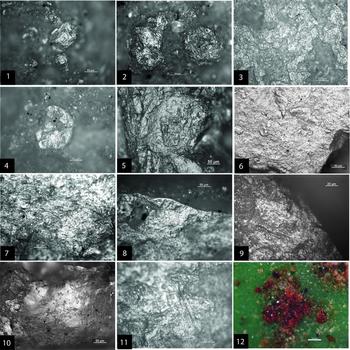
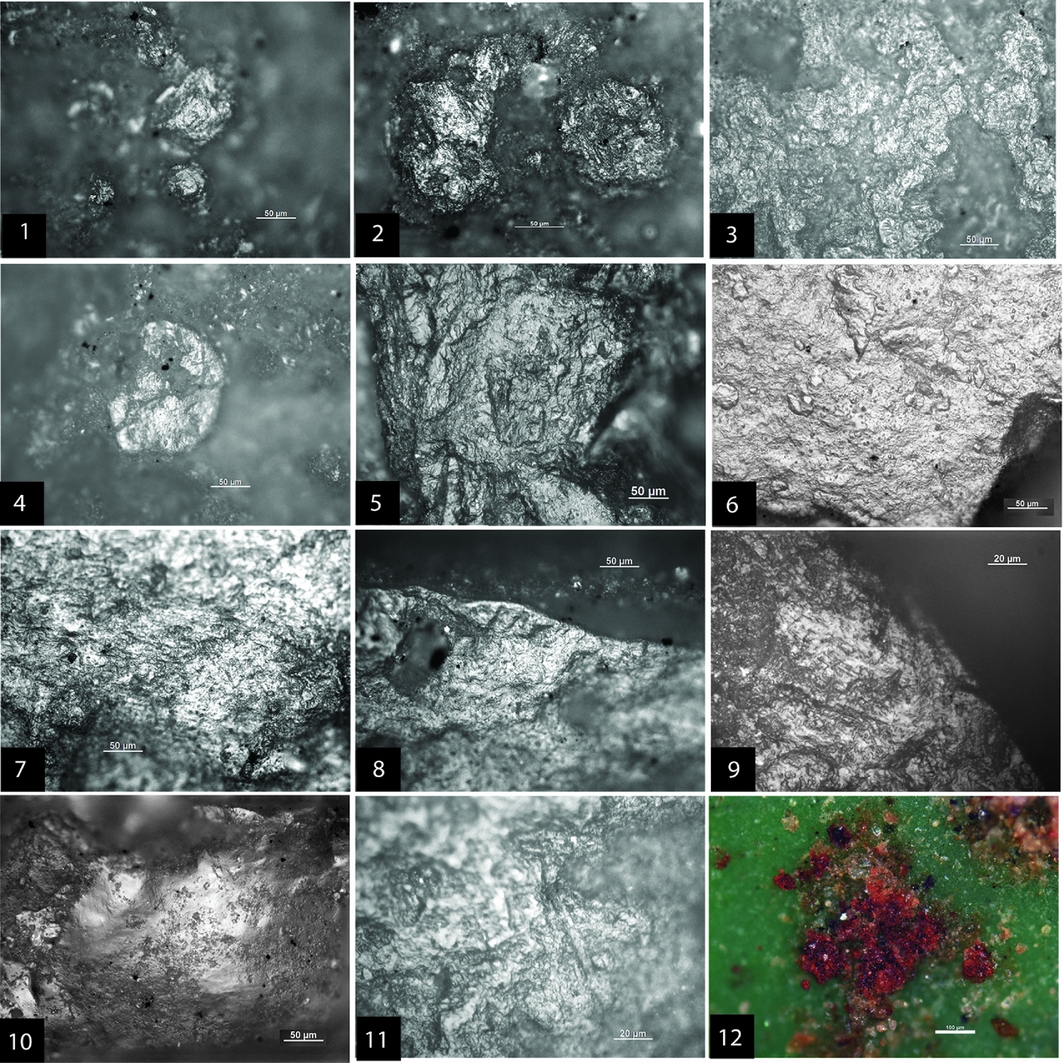
Fourteen grinding stones were examined, all of which exhibited traces of wear (Figure 6). On the slabs, low to medium levels of polish are most common, sometimes with fine striations, which resemble wear caused by grinding de-husked millet seeds in our experiment (Figure S2.1). The handstone (GS7) exhibits extensive amounts of high polish, potentially indicative of processing soft, siliceous plants (Fullagar Reference Fullagar1991). Two slabs along with the handstone also show deep furrow striations and fractures on crystal grains, indicating the grinding and pounding of hard materials (contra Figure S2.6). Small cutting tools appear to have been used for processing both soft and hard materials. One microblade and 15 flakes show traces of plant processing, such as grass cutting, exhibited through high polish and fine striations (Figure 6.6–11; Table S4). The study of non-pollen palynomorphs at SZT29 has identified remains of flax and other fibres in all strata (Song et al. Reference Song, Cohen, Shi, Wu, Kvavadze, Goldberg, Zhang, Zhang and Bar-Yosef2017), suggesting that some of these plant-cutting wear traces may be associated with processing fibres.
Examples of use-wear traces on SZT grinding stones, microblades and flakes: 1) isolated medium-polished areas without striations on slab (GS1); 2) polished areas with fine striations and pitting on slab (GS8); 3) reticulated high-polished areas without striations on handstone (GS7); 4) high-polished crystal with fracture and furrow striations on slab (GS5), for processing haematite; 5) high-polished areas on flake (SF10); 6–7) very high-polished surface near the edge of microblade, and very fine parallel striations running multi-directionally on the same microblade (MB5); 8 & 9) polished edge area without striation on side B, and fine striations running diagonally to the edge on side A of the same flake (SF8); 10) high-polished areas near the edge on flake (SF4); 11) polished area with fine and perpendicular striations near the edge on flake (SF5); 12) a cluster of haematite fragments on PVS from slab (GS5) (magnification: 9 & 11: ×500; 12: ×100; others: ×200).
Integration of use-wear and residue analyses
We divided the occupational history of SZT29 and SZT5 into six phases, consistent with the depositional chronology presented above, and the results from use-wear and residue analyses are integrated in the discussion.
Phase I (SZT29—stratum 8, pre-LGM)
Two flakes and two slab fragments were analysed. One quartzite flake (SF10) exhibits high polish and multi-directional fine striations, resembling plant cutting and scraping. Thirteen starch grains were found on the flakes, including types I and II, which probably derived from the stems or leaves of Panicoideae or Triticeae. The slabs exhibit low-level polish without clear striation, suggesting that they were used for processing soft materials. A total of 31 starch grains were recovered from the slabs, identified as Panicoideae and Triticeae grasses, as well as yam. The Panicoideae-type starch grains found on the slabs (n = 6; range 14.81–20.47µm) are much larger in size than those from the seeds of green foxtail and barnyard grass, but similar to those from Job's tears (Table S2). Eight phytoliths were recovered from slabs, including three that were probably from grass stems (bulliform and bilobate types), and one from wood. As the utricles of Job's tears, formed by modified leaves (Jain & Banerjee Reference Jain and Banerjee1974), also produce bilobate phytoliths, the combined phytolith and starch evidence suggests the early exploitation of this plant, although this needs to be confirmed through later analyses.
These lines of evidence suggest that during relatively warm and wet climatic conditions of 28000 cal BP, occupants of Shizitan collected and processed starchy plants, including Panicoideae (possibly Job's tears), Triticeae and yam. No clear evidence for wild millet collection is present.
Phase II (SZT29—stratum 7, the early part of LGM)
Seven microblades, three flakes, four slab fragments and one handstone were examined, from which a total of 136 starch grains were recovered. Four of the microblades revealed starch types I and II, and yam starch. One microblade (MB5) shows use-wear traces of cutting plants (Figure 6.6–7). It is indicated by a pattern consistent with the experimental harvesting of wild cereals with sickle blades (Anderson Reference Anderson and Anderson1999; Unger-Hamilton Reference Unger-Hamilton and Anderson1999). MB5 also yielded the highest number of starch grains (n = 12; types I and II) among microblades, confirming its use for grass cutting. One flake (SF12) exhibits high polish on one edge, also resembling plant cutting, and all three flakes revealed starch grains of types I and II.
Use-wear traces resembling plant processing appear on all grinding stones. Starch grains (n = 80) include Panicoideae, Triticeae and yam. Panicoideae starch grains (n = 24; range 13.11–28.15µm) most closely match those of Job's tears in size. The earliest instance of type III starch grains (wild millets) occurs in two clusters (n = 25; range 4.26–14.4µm) on the handstone. Two slabs (GS3, GS5) and one handstone (GS7) also show characteristics of processing minerals (Figure 6.4). The handstone use-wear indicates the pounding and grinding of hard materials.
Clusters of red mineral powders extracted from slab GS5 (Figure 6.12) were analysed using portable X-ray fluorescence spectrometry and shown to contain a significant iron component, probably from haematite (Figure S3a). Reddish-brown haematitic mudstones collected from the site's modern surface represent a potential local source, as crushed haematitic shales and mudstones are common alternatives to iron-rich, clay- or soil-based archaeological pigments (Eiselt et al. Reference Eiselt, Popelka-Filcoff, Darling and Glascock2011). The slab GS5 also bore large amounts of unidentified, orbicular, echinate forms and Artemisia pollen, in addition to one grass bilobate phytolith (Figure 5). As an indicator of a steppe environment, Artemisia is among the most abundant species in the Shizitan pollen profile during the LGM (Song et al. Reference Song, Cohen, Shi, Wu, Kvavadze, Goldberg, Zhang, Zhang and Bar-Yosef2017).
Taken together, wild cereals (e.g. Triticeae, Job's tears and wild millets), tubers and other plants were collected using flakes and microblades. Grinding stones were not only food-processing tools, but were also used for pounding and grinding haematite. The handstone, which revealed the first evidence of wild millet processing in the early LGM, was discovered in an upper layer of this stratum, dating to around 24000 cal BP.
Phase III (SZT29—strata 6–4, the late part of LGM)
Seven flakes, one microblade and three slabs were examined. Five flakes exhibit use traces from plant cutting. On flake SF4, some crystals appear to become highly polished on the high plateaus, which our experimental sample suggests represents an early stage of the sickle-gloss formation from cutting siliceous plants (Figures 6.10 & Figure S2.11). On flake SF5, some highly polished areas near the edge are associated with fine, multi-diagonal striations, resembling cutting plants, and motions of transverse cutting and vertical scraping or splitting (Figure 6.11). All flakes revealed starches, including types I and II, yam and snake gourd root. Three flakes (SF4–6) yielded abundant starch grains (>100 each). The starch assemblage from the flakes is dominated by type II (n = 352; 83.8 per cent), with some type I and tubers (n = 28 and 3, respectively). Two flakes (SF5 and SF14) bore phytoliths (n = 5), one being a bulliform (grass stem or leaf). A microblade, MB8, also revealed a bulliform phytolith. Evidently, these tools were used mainly to cut plants, including Panicoideae.
All slabs (GS8–10) show similar use-wear traces, characterised by isolated low- to medium-level polish, edge-rounding on crystal grains and, occasionally, fine striations. These wear traces are consistent with the processing of plants, based on our experimental control dataset. Micro-pitting is present on one slab (Figure 6.2), perhaps caused by pounding hard seeds or nuts. Starch grains (n = 195) include all types except yam. Type II starches have a wide size range (4.32–27.1µm), which overlap with those of wild millets and Job's tears. Type III starches (wild millets) occur in clusters (n = 19; 5.56–14.07µm). Types II and III together (n = 113; 57.9 per cent in GS) dominate the starch assemblage of the grinding stones. The phytolith count from the slabs is low (n = 7), but there are four phytoliths that were identified as pertaining to grass stems or leaves.
When combining the starch counts from all tool types, types II and III together (n = 465; 75.6 per cent of the total) dominate the assemblage. The high concentration of type II starches on both cutting and grinding tools associated with plant-related use-wear traces, and a few grass phytoliths, strongly suggest the harvesting and processing of wild cereals, and especially Panicoideae.
Phase IV (SZT29—strata 3 and 2, the terminal LGM)
Four flakes (SF7, 8, 18 and 19) and four slabs (GS11–14) were examined. All flakes show polish similar to plant cutting. Starches (n = 188) are primarily identified as type II (78.2 per cent), with small numbers of type I (7.4 per cent) and tubers (0.5 per cent; yam and snake gourd root). Starch counts from SF7 and SF8 are particularly high (120 and 58, respectively), and SF8 also exhibits high polish with fine and multi-directional striations, resembling those incurred by grass cutting (Figure 6.8–9). The phytolith count is very low (n = 2) and is non-specific.
The slabs show low- to medium-level isolated polish without visible striation, and edge-rounding appears on medium-level polished areas. These traces are similar to those sustained through the processing of plants in our previous experiment (Liu et al. Reference Liu, Bestel, Shi, Song and Chen2013). The starch assemblage (n = 91) from the slabs is predominated by grasses (74.8 per cent), including types I–III, with small numbers of yam and snake gourd root (8.8 per cent). Type II starch grains (n = 16; range 4.32–27.1µm) overlap in size with wild millets and Job's tears. The phytolith assemblage is small (n = 14) and only one phytolith is specific to grass stems. As with the earlier LGM period, this phase is characterised by the harvesting and processing of grasses, including Panicoideae and Triticeae. Tubers are much less well represented.
Phase V (SZT29—stratum 1, warmer conditions)
This is the last occupational phase of SZT29. One (SF23) of the two flakes analysed shows very high polish, which is suggestive of plant cutting. A small number of starches were recovered (n = 10) from both flakes (SF22 & SF23), including types I and II. Only one non-specific phytolith was recovered.
Phase VI (SZT5—stratum 1, Early Holocene)
Two flakes (SF24 & SF25) were analysed, revealing starches (n = 30). SF25 exhibits very high polish resembling the cutting of siliceous plants, and also revealed a cluster of type I starch (n = 20).
In summary, flakes, microblades and grinding stones were used to collect and process many taxa of wild cereals and tubers throughout the entire occupation of the SZT sites. The microblades are very small in size with a width range of between 5.4 and 8.2mm. That is considerably narrower than the sickle blades used for harvesting wild cereals in Natufian contexts, which are around 13mm in width (Unger-Hamilton Reference Unger-Hamilton and Anderson1999). Despite their small sizes, some SZT microblades were used as grass-cutting and tuber-processing tools. Wild millets, given their fine panicles, could have easily been cut using sickles and small flakes.
Most quartzite flakes show traces of plant cutting, and some revealed much higher concentrations of starch residues than did many of the chert microblades. The rough surfaces of the quartzite would have helped to protect and preserve more starch residues than the smooth-surfaced chert microblades. A few phytoliths were also present on flakes, but only one phytolith was found on a single microblade.
Grinding stones were used for processing diverse materials, including seeds, tubers, Artemisia plants, other plants (represented by orbicular echinate type phytoliths) and haematite. The tools associated with haematite powder all date to stratum 7, furnishing the earliest evidence of haematite processing reported from China. Perforated ostrich eggshell beads, some coloured with haematite powder, have been found in strata 7 and 2 (Song & Shi Reference Song and Shi2013). Haematite powders have also been identified microscopically on a slab from stratum 4 at SZT9 (12700–11600 cal BP) (Liu et al. Reference Liu, Ge, Bestel, Jones, Shi, Song and Chen2011). Two rock paintings of red pigment, possibly haematite, have been found near SZT1, but their date remains uncertain (Linfen Cultural Bureau of Shanxi Province 1989). Based on the presence of haematite residues on tools from stratum 7 at SZT29, the use of this mineral for personal decoration and ritual activities constitutes a long tradition that can be traced back to 26000–24000 cal BP in this region.
No grinding stones were recovered from the latest strata at SZT29 and 5, but flakes show evidence that grasses were collected. Tuber starches are present on tools, but in small numbers, throughout most of the cultural sequence (strata 8–2). Collecting and processing wild cereals and tubers with stone tools were important subsistence activities throughout the entire period of Shizitan occupations.
Discussion and conclusion
The analysis of the Shizitan tools sheds new light on several important issues relating to the early exploitation of wild plants in northern China. Triticeae grasses and possibly Job's tears appear to have been the earliest wild cereals exploited by Palaeolithic populations in the region, already by 28000 years ago; they were harvested using cutting flakes and processed with grinding stones. Despite such a long history of exploitation, indigenous Triticeae grasses in China have never been domesticated. Job's tears, on the other hand, is a widely cultivated crop in China today, but its domestication process is unknown. Starch from Job's tears found at SZT29 provides the earliest evidence for the exploitation of this ancient cereal.
Wild millet cutting and grinding occurred during the early part of the LGM (by c. 24000 cal BP). Wild millets produce tiny seeds (<2mm in length), much smaller than Job's tears and most wild Triticeae grasses available in this region. Collecting green foxtail seeds can be time consuming (Lu Reference Lu1998, Reference Lu2002). The initial consumption of wild millets, a subsistence strategy to exploit new ranges of plant foods, correlated with a number of social and environmental changes during the LGM. These include the first appearance of haematite processing, potentially for personal decoration and ritual activities, the introduction of microblades and expanded steppe landscapes with abundant wild millets. All these adaptations were a part of human responses to a changing ecosystem caused by colder and drier climatic conditions. Furthermore, non-pollen palynomorph analysis of a soil sample from the layer between strata 1 and 2 revealed fungi remains of Tetraploa and Glomus, which are known to grow in cultivated or disturbed soils (Song et al. Reference Song, Cohen, Shi, Wu, Kvavadze, Goldberg, Zhang, Zhang and Bar-Yosef2017: 32). It is uncertain, however, whether this phenomenon indeed indicates cultivation activities between 18000 and 13000 cal BP. The presence of Tetraploa and Glomus in a late occupation points to a potential direction for future research in identifying an anthropogenic landscape involving wild millet cultivation at Shizitan.
Tubers and bulbs (including yams, snake gourd root and lilies) were exploited throughout the entire occupation period, but with only small numbers of starch recorded. Tubers and bulbs may, however, be under-represented, as these plants could have been dug with wooden sticks, and both lilies and yams can be consumed without grinding. Their starch remains have also been found in many Palaeolithic and Neolithic sites in northern China (Liu Reference Liu2015), suggesting a long-lasting tradition of broad subsistence strategies in the region.
Two other contemporaneous Palaeolithic site clusters in the region, Xiachuan (Wang et al. Reference Wang, Wang and Chen1978) and Longwangchan (Zhang et al. Reference Zhang, Wang, Qiu, Shelach, Hu, Fu, Zhuang and Zhou2011), share many material features with Shizitan, such as microblades, grinding stones and haematite processing. Sickle gloss was also found on flakes from Xiachuan (Lu Reference Lu1999). Exploitation of various plants, especially wild millets, was a common practice among the hunter-gatherers in this region.
In conclusion, the current study provides the first hard evidence of wild millet harvesting with stone tools from 24000 years ago, some 14000 years before its initial domestication. Together with previous research on macro- and micro-botanical remains (Liu et al. Reference Liu, Ge, Bestel, Jones, Shi, Song and Chen2011, Reference Liu, Bestel, Shi, Song and Chen2013; Bestel et al. Reference Bestel, Crawford, Liu, Shi, Song and Chen2014), we have demonstrated the near-continuous exploitation of various plants in the Middle Yellow River Valley for 18000 years.
Acknowledgements
We thank Shi Xiaorun for helping with collecting samples at Shanxi Museum. The project was supported by the Min Kwaan Chinese Archaeology Funds from the Stanford Archaeology Center, Stanford University, special funds for the Sanjin Scholar Support Program and by the 131 Leading Talent Project in Shanxi Province.
Supplementary material
To view supplementary material for this article, please visit https://doi.org/10.15184/aqy.2018.36