I. INTRODUCTION
Grain refinement has a strong influence on the improvement of mechanical properties in cast alloys, and thus is important for commercial application. Recently, the application of electric current pulse (ECP) during solidification has developed into a promising technique to achieve fine structures, and successfully applied in low-melting Pb–Sn alloys, middle-melting Al-based and Cu-based alloys, and even high-melting steel and iron. Reference Nakada, Shiohara and Flemings1–Reference Zhou, Qin and Xiao8 Despite the resulting morphology for the use of both pure Al and Al-based alloys in a number of industrial applications, a number of studies have been reported in the interrelation between microstructural effects such as the morphology of the resulting grains and/or microstructural array (e.g., interdendritic spacing formation) to the corresponding properties (e.g., mechanical or corrosion behavior). Reference Osório, Freitas and Garcia9–Reference Osorio, Freire and Garcia11 It is expected that the control of the resulting microstructural array would permit to prescribe guidelines with a view to preprogramming a required property. Reference Osório, Freitas and Garcia9–Reference Osorio, Freire and Garcia11 Although much attention has been attracted to the development of structures in Al-based alloys using ECP treatment, knowledge about the mechanism of ECP treatment leading to the decrease in grain size remains fragmentary. It is well known that ECP treatment usually affects the solidification process through a series of effects: electromigration, Joule heating, electromagnetic force, etc. Based on these effects, various reasonable explanations have been suggested, such as the enhancement of nucleation rate resulting from more homogeneous liquid structure or an increase in the liquid–solid interfacial energy, Reference Nakada, Shiohara and Flemings1,Reference Zhang, Lu and Qin12–Reference Wang, Qi, Zhao, Guo and Zhao14 the fragmentation of dendrites or the falling off of crystal nuclei from the wall of mold due to the forced convection, Reference Li, Ma, Gao and Zhai15,Reference Ban, Han, Ba and Cui16 the suppression of grain growth due to Joule heating Reference Liao, Zhai, Song, Chen and Gong17,Reference Zhu, Wang, Cao, Huang, Fu and Chen18 and strong local shear forces caused by magnetic pressure gradient. Reference Nakada, Shiohara and Flemings1 However, the dominant refinement mechanisms of ECP treatment are still controversial by now.
In particular, Liao et al. Reference Liao, Zhai, Luo, Chen and Gong19 designed the experiments embedding the wire mesh tube in the mold to clarify the origin of the nucleus multiplication in pure Al under ECP. It was shown that the solidification macrostructures inside the mesh tube are coarse grains which are different from the refined grains outside the tube. Due to the skin effect of high-frequency ECP, the electromagnetic field lines become concentrated near the mold wall. The authors speculate that the magnetic pressure induced by ECP generates a large number of crystal nucleus from the wall, leading to a significant grain refinement outside the tube. However, pure Al inside the tube solidifies into the coarse grains because the tube separates the convection inside and outside the tube and prevents crystal nucleus transferring inside and outside the tube. Here, it should be pointed out that little attention was paid to the role of mesh tube in restricting melt flow under ECP during solidification. Assumed that low-frequency ECP uniformly passes through the specimens embedded in the mesh tube, the tube can restrict the forced melt flow caused by electromagnetic force inside the tube and the rest of intrinsic effects of ECP inside the tube are the same as those outside the tube. Therefore, the influence of melt flow and the rest of intrinsic effects of ECP on grain refinement can be discussed, separately.
In this study, an investigation on the cast structures of pure Al under a low-frequency alternating current pulse (ACP) was performed when the mesh tubes were embedded in molds. Due to the restricted melt flow inside the tube, we tried to reveal the influence of melt flow and the rest of effects of ACP on grain refinement of pure Al.
II. EXPERIMENTAL PROCEDURES
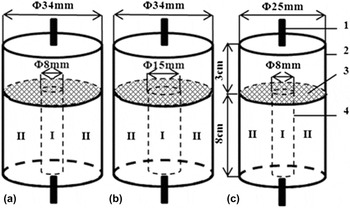
As shown in Fig. 1, three different Modes embedding a plate and a tube of 06Cr25Ni20 stainless steel mesh in each sand mold were designed. For Mode I and II, the tubes of Φ 8 mm and Φ 15 mm were embedded in the mold of Φ 34 mm, respectively. The mesh tube of Φ 8 mm was embedded in the mold of Φ 25 mm as Mode III. Previous studies found that ECP with parallel electrodes could refine the solidification structures of pure Al. Reference Li, Ma, Gao and Zhai15 They concluded that the periodic Lorenz force leads to the crystal rain from the free surface, and thus refines the solidification structures. To prevent possible crystal nucleus from the free surface moving into the tube, a plate of wire mesh was embedded in the top of tube in our experiments. Besides, the mesh tube prevented the crystal nuclei from passing the tube. In our case, the observed solidification structures were divided into region I and II by the mesh plate and tube in each mold to clarify the refinement mechanism of pure Al under ACP.
Schematic sketch of the designed molds: (a) Mode I, (b) Mode II, (c) Mode III; 1—electrodes, 2—mold, 3—the wire mesh plate, 4—the wire mesh tube.

The experimental apparatus consists of a low-voltage ACP generator, a computer-aided temperature data acquisition system, sand mold, the bottom electrode (copper cable with diameter of 20 mm), the top electrode (0Cr18Ni9 stainless steel plate with the length of 30 mm, the width of 30 mm, and the thickness of 1 mm, which was welded to one end of steel rod with diameter of 8 mm) and K-type thermocouple. The schematic illustration of experimental apparatus and the pulse shape were described elsewhere. Reference Zhang, Zhang, Chen, Wu and Li20 Pure Al (99.7%) was melted and overheated to 1113 K in an electric resistance furnace. After holding at 1113 K for 30 min, the molten metal was poured into the designed molds, and then an ACP was applied during solidification process. To obtain uniform distribution of ACP in specimens and the grain refining effect of melt flow, the low pulse frequency of 50 Hz was selected, and the different current intensities of ACP were applied. The effective values of applied ACP were 0, 990, 2070, and 2700 A, respectively. The pulse voltage depending on current intensities was less than 60 V. Under the same conditions, two samples were cast to clarify the reliability of experimental methods mentioned above.
The specimens were cut longitudinally along the central plane, and then polished for metallographic examination. The etching agent used to reveal the macrostructure was a mixture of HCl:HNO3:HF:H2O = 9:3:3:5. Photos of the macrostructure were taken on a digital camera (Canon EOS D60). To evaluate the refining efficiency by ACP, the area fraction of fine grains in region I and II was measured by software (Adobe Photoshop CS2) in terms of pixel density.
III. RESULTS AND DISCUSSION
A. Macrostructures with different tube under the condition of same ACP
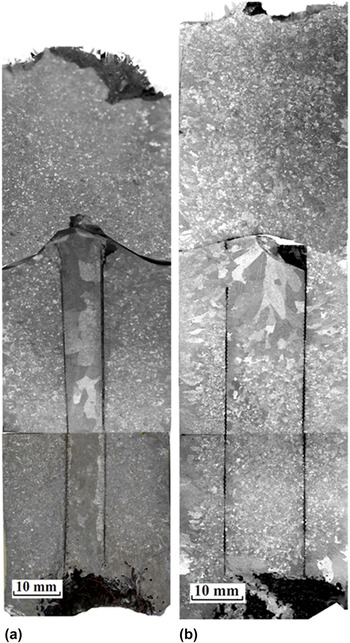
Since the mesh tube has an effect on restricting the melt flow inside the tube and protecting the crystal nucleus outside the tube from entering and the tube, the influence of the different melt flow on the grain refinement in pure Al is investigated. Figure 2 shows the digital images of the specimens with Mode I and II under ACP of 2700 A. With Mode I, the solidification macrostructures inside the tube of Φ 8 mm are coarse grains which are different from the remarkably refined grains outside the tube. When the diameter of tube increases to 15 mm, a fine equiaxed zone is generated inside the tube, and the area fraction of fine grain outside the tube with Mode II decreases compared with that with mode I.
Macrostructures on the longitudinal section of the solidified samples with Mode II and III under ACP of 2700 A: (a) Mode I, (b) Mode II.

To better understand the aforementioned difference of macrostructures with Mode I and II under the condition of same ACP, the detailed analysis of the distribution of electric current, Lorentz force and melt flow in molds are required. Skin effect of ACP needs to be taken into account since the applied ACP is an alternating signal. Here, skin effect is characterized by skin depth which can be written as Reference Barnak, Sprecher and Conrad2 :
 $$\delta = {\left( {{1 \over {\pi \mu f\sigma }}} \right)^{{1 \over 2}}}\quad ,$$
where μ is the magnetic permeability of molten metal, f is the pulse frequency (50 Hz), and σ is the electric conductivity of liquid metal (approximate 4.13 × 10⁶ S/m at 973 K).
Reference Gui, Jia, Li and Feng21
Then the skin depth is calculated to be 35 mm which far exceeds the maximal radius of mold (17 mm) used in our experiments. It implies that electric current uniformly distributes in each specimen at a transient state. Moreover, the interaction between the applied ACP and its own induced magnetic field causes a Lorentz force (F = j × B), which can drive a forced melt flow in mold. The induced magnetic field can be calculated from the equation
 $\nabla$
× B = μ0
j using the Biot–Savart law.
Reference Räbiger, Zhang, Galindo, Franke, Willers and Eckert22
It can be written as:
 $$\mathord{\buildrel{\lower3pt\hbox{$\scriptscriptstyle\rightharpoonup$}}\over B} \left( {\mathord{\buildrel{\lower3pt\hbox{$\scriptscriptstyle\rightharpoonup$}}\over r} ,t} \right) = {{\mu _0 I\left( t \right)\mathord{\buildrel{\lower3pt\hbox{$\scriptscriptstyle\rightharpoonup$}}\over r} } \over {2\pi R^2 }}\quad ,$$
where μ0 is the vacuum permeability, R is the radius of mold (17 mm for Mode I and II or 12.5 mm for Mode III), I(t) is the current intensity at a certain time (the effective values of applied ACP), and r is the distance from the field point to the axis (0 ≤ r ≤ 17 mm for Mode I and II or 12.5 mm for Mode III). It predicts a gradient distribution of Lorentz force which increases with increasing the distance from the field point to the axis line in specimens. As a consequence, the Lorentz force outside the tube is more than that inside the tube for each mold, and its driven melt flow are different inside and outside the tube. However, current density, the gradient of Lorentz force and the intrinsic effects of ACP only depending on current density such as Joule heating, liquid structure, and liquid–solid interfacial energy, etc. are same inside and outside the tube. Obviously, the experimental results and analysis reveal that the difference of grain size inside and outside the tube [Fig. 2(a)] should result from the different melt flow caused by Lorentz force, and the rest of intrinsic effects of ACP have no obvious influence on grain refinement of pure Al. In the present case, the forced melt flow increases inside the tube with increasing the diameter of the tube. It gives rise to more fine grains inside the tube of Φ 15 mm compared with macrostructures inside the tube of Φ 8 mm, which agrees well with the experimental results [Figs. 2(a) and 2(b)]. Furthermore, although there are the same gradient distribution of Lorentz force and maximal Lorentz force outside the tube with Mode I and II, the area fraction of fine grain outside the tube with Mode I is different from that with Mode II. This indicates that the typical length scale of the solidified specimen is an important factor to affect the forced melt flow under ACP.
Based on the above experimental results and discussion, it seems that the forced melt flow caused by Lorentz force should solely be responsible for grain refinement of pure Al. However, the melt flow caused by electromagnetic field is related to Lorentz force, the typical length scale of solidified specimens, and the flow velocity of liquid alloys. Reference Li, Tamura, Omura and Miwa23–Reference Kaldre, Fautrelle, Etay, Bojarevics and Buligins25 Which parameters can characterize the refining efficiency by ACP need to be further investigated. In addition, how does the melt flow refine the macrostructures of pure Al is unclear.
B. The characterization of the refining efficiency and the refinement mechanism under ACP
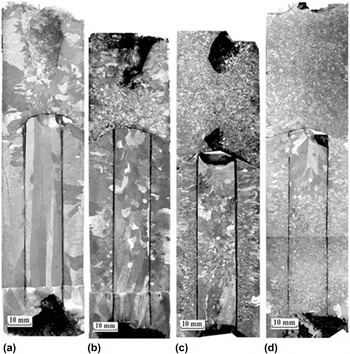
To characterize the refining efficiency and clarify the origin of fine grains under ACP, the casting molds, a small mold embedded a small tube of Φ 8 mm (Mode III) and a big mold embedded a big tube of Φ 15 mm (Mode II), were designed. The digital images of the whole specimens with Mode II under different ACP are shown in Figs. 3(a)–3(d). Without ACP, the columnar grains along axial direction inside the tube and the columnar grains along radial direction outside the tube occur [Fig. 3(a)]. The size of fine grains decreases, and the area of fine equiaxed zone inside the tube and that outside the tube increase as the effective values of ACP increase from 990 to 2700 A [Figs. 3(b)–3(d)].
The solidification macrostructures with Mode II under different ACP: (a) 0 A, (b) 990 A, (c) 2070 A, (d) 2700 A.

As indicated above, the growth of pure Al directionally solidified along axial direction inside the tube without ACP, and the forced melt flow results in the grain refinement observed in the solidified specimens. Here, the present study focuses on how the melt flow refines the grains of directionally solidified Al inside the tube of Φ 15 mm under ACP. This basically means that the same origin of refined grains inside the tube can be assumed as is considered to explain the reduction in grain size during directional solidification of alloys due to electromagnetic stirring. For instance, Räbiger et al. Reference Räbiger, Zhang, Galindo, Franke, Willers and Eckert22 investigated the effect of ECP on the grain refinement of directionally solidified Al–7 wt% Si alloys. The experimental results and numerical analysis demonstrate that the forced melt flow driven by Lorentz force promotes the remelting of dendrite arms, and refining the grains of alloys. Besides, the melt flow induced by a pulsed electromagnetic field leads to local fluctuations of both temperature and concentration within the mushy zone, provoking the increased fragmentation rates. Reference Liotti, Lui, Vincent, Kumar, Guo, Connolley, Dolbnya, Hart, Arnberg, Mathiesen and Grant26 For directional solidification of pure Al along axial direction inside the tube of Φ 15 mm, the constitutional supercooling ahead of solid–liquid interface don't occur due to the absence of fluctuation of concentration, the crystal nuclei can't form on the wall of tube and ahead of solid–liquid interface. Thus in the present case, the origin of fine equiaxed zone inside the tube should be the consequence of the fragmentation of columnar grains caused by the strong melt flow.
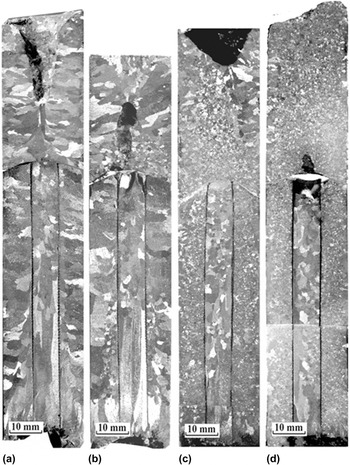
Under the condition of Mode III, the digital image of the specimen without ACP is shown in Fig. 4(a). The dominant columnar grains appear inside and outside the tube. Figures 4(b)–4(d) represents the solidification structures under different ACP. The application of an ACP generates a fine equiaxed zone outside the tube, which enlarges with increasing the effective values of ACP from 990 to 2700 A. The size of refined grains under 2070 and 2700 A is finer than that under 990 A. However, the solidification macrostructures inside the tube, which is obviously different from that outside the tube for each specimen, are main coarse grains regardless of current intensity. When ACP of 2700 A is applied to the solidified specimens with Mode II and III, the current densities are 298 A/cm2 in Mode II and 550 A/cm2 in Mode III. Compared with the solidification macrostructures inside the tube of Φ 8 mm with high current density [Fig. 4(d)], more fine equiaxed grains inside the tube of Φ 15 mm occur with low current density [Fig. 3(d)]. It further proves that the intrinsic effects of ACP, which only depend on current density such as Joule heating, liquid structure, and liquid–solid interfacial energy, etc., are the secondary factors for the grain refinement of pure Al.
The solidification macrostructures with Mode III under different ACP: (a) 0 A, (b) 990 A, (c) 2070 A, (d) 2700 A.

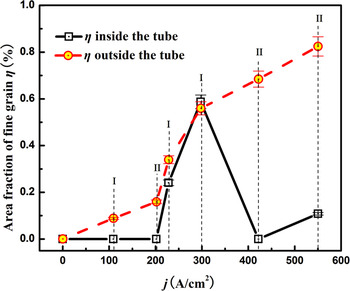
To assess the refining efficiency of pure Al under ACP, the relationships between the area fraction of fine grain (η) inside and outside the tube for each specimen and the relevant parameters (current density, Lorentz force, and Reynolds number) are quantificationally analyzed. The variation of the mean area fraction of fine grain with current densities in Mode II and III is illustrated in Fig. 5. As a result, the area fraction of fine grain outside the tube with Mode II and III increases as increasing current densities. Note that in this case the radial length scale outside the tube for Model III (8.5 mm) has no obvious difference with that for Model II (9.5 mm). The area fraction of fine grain inside the tube with Mode I and II irregularly changes with current densities, and resulting from the remarkable difference between the radius scale inside the tube for Model III (4 mm) and that for Model II (7.5 mm). It demonstrates that the typical length scale of ACP action region is also an important parameter for refining efficiency of pure Al. For the same Mode, the area fraction of fine grain inside and outside the tube increases as increasing current densities. This implies that the refining efficiency of pure Al depends on current densities under the condition of same action region for ACP.
The influence of current densities on the mean area fraction of fine grain inside and outside the tube in the solidified samples.

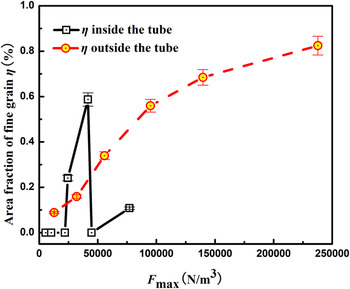
Since Lorentz force is the driving force of melt flow, the relationship between refining efficiency and Lorentz force is also worth studying. Figure 6 depicts the plots of the mean area fraction of fine grain as a function of the maximal Lorentz force inside and outside the tube for each mold. It can be seen that the area fraction of fine grain outside the tube with Model II and III monotonously increases with the maximal Lorentz force. The area fraction of fine grain inside the tube with Model II and III irregularly changes with the maximal Lorentz force. These results indicate that Lorentz force also cannot characterize the refining efficiency of pure Al.
The influence of Lorentz force on the mean area fraction of fine grain inside and outside the tube in the solidified samples.

Although both Lorentz force and current density are crucial for grain refinement of pure Al, either Lorentz force or current density is not enough to characterize refining efficiency under ACP. Reynolds (Re) number, as a characterized parameter of melt flow, may be more suitable to characterize refining efficiency of pure Al. It is well known that Reynolds number is given by:
 $${\mathop{\rm Re}\nolimits} = {{u\rho \lambda } \over \nu }\quad ,$$
where λ is a typical length scale for region I and II, ρ is the density of liquid Al (approximate 2.35 g/cm3), Reference Sklyarchuk, Plevachuk, Yakymovych, Eckert, Gerbeth and Eigenfeld27 ν is the dynamic viscosity (approximate 1.25 mPa·s), Reference Sun, Geng, Bian and Liu28 and u is the average flow velocities of liquid Al. In the present study, the average flow velocities of liquid Al (u) during a pulse period inside and outside the tube for each specimen can be estimated from the balance between the Lorentz force and inertia Reference Li, Fautrelle and Ren29 :
 $$u \approx {1 \over 2}\sqrt {{{jB\lambda } \over \rho }} \quad .$$
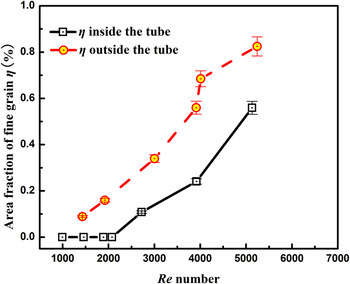
As can be seen from Eq. (4), the value of u increases as the value of Lorentz force (F = j × B) and λ increase. Reynolds number can be calculated in terms of the flow velocities. Figure 7 presents the mean area fraction of fine grain as a function of Re number. It is clearly observed that the area fraction of fine grain monotonously increases with Re number inside and outside the tube, respectively. It implies that Re number including Lorentz force and typical length scale for action region of ACP determines the refining efficiency of pure Al and provides an aim to obtain the optimal process parameters for ACP treatment.
The mean area fraction of fine grain inside and outside the tube as a function of Reynolds number with Mode I and II.

Additionally, the area fraction of fine grain outside the tube is more than that inside the tube under the same Re number. For grain refinement inside the tube, there exists a threshold value (approximately 2000). However, fine grain appears at smaller Re number outside the tube. This means that the origin of fine grain outside the tube should be more than that inside the tube. As discussed above, the origin of fine grain inside the tube is mainly ascribed to fragmentation of columnar grains due to melt flow. No doubt, the fragmentation of columnar grains is also an important reason for grain refinement outside the tube. However, the crystal nucleus first generate on the wall of mold and then grow along the radial direction outside the tube without ACP, which are different from those inside the tube. The refinement mechanism outside the tube is similar to previous studies, Reference Liao, Zhai, Luo, Chen and Gong19 when low-frequency ACP was applied through two electrodes located at the bottom and the top of the sample. Liao et al. Reference Liao, Zhai, Luo, Chen and Gong19 conducted experiments with the mold embedding the mesh tube under different ECP when two electrodes were located at the bottom and the top of the sample. Without ECP, the solidification macrostructures outside the tube are same as those outside the tube in our experiments [Figs. 2(a) and 3(a)]. Combine with the experiments such as ECP treatment on different solidification stages and preheating the sand mold to different temperatures, they concluded that high-frequency ECP makes the crystal nucleus formed on the wall of the mold fall off and move freely in the melt, promoting the multiplication of crystal nucleus. This process lasts until the formation of the solidification shell on the wall of the mold. This means falling off of the crystal nuclei formed on the wall of mold besides the columnar fragmentation is also an important origin of fine grain outside the tube. It well clarifies the difference of curves inside and outside the tube in Fig. 7.
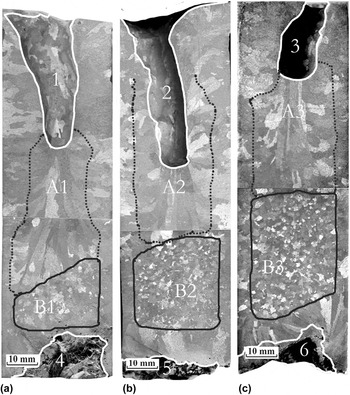
If the fine grain appears due to falling off of the crystal nuclei formed on the wall of mold caused by the forced melt flow, the speed of the formation of the solidification shell is an important parameter to control the amount of fine grains. To certify the above refinement mechanism, the experiments, preheating the sand mold to different temperatures to control the speed of the formation of the solidification, were designed under the same ACP. The sand molds were preheated to room temperature, 373 and 673 K, respectively. The same ACP parameters and pouring temperature were used for these experiments. The effective value of ACP was 990 A with a pulse frequency of 50 Hz, and the pouring temperature was 1113 K. The digital images of the specimens under the same ACP are presented in Fig. 8. Because the macrostructure at the conjunction line is not real macrostructure in this position of original specimen, an interrupt of macrostructure can be observed at the conjunction line for each specimen. However, this defect does not affect the desired effect of preheating temperature on the amount of fine grain under same ACP. It can be seen that the solidification macrostructures are shrinkage cavity at the top, columnar grains in the center of the specimen along the axial direction and the radial direction (region A1, A2, and A3), columnar grains growing from the mold wall, fine equiaxed grains (region B1, B2, and B3) and irregular electrode of bunch-strand copper cable at the bottom and the attached columnar grains for each specimen. Due to the unregularity of shrinkage cavity, shrinkage cavity of different shape and volume (region 1, 2, and 3) can be formed during solidification of pure Al. The same phenomenon is obtained by Liao et al. Reference Liao, Zhai, Luo, Chen and Gong19 The uneven bottom electrode leads to the irregular boundary between the bottom electrode and columnar grains (region 4, 5, and 6). Under current condition, the solidification macrostructures are controlled by melt flow and heat transmission along mold wall and two electrodes. Columnar grains attached to the bottom electrode form when the molten Al was poured into the molds due to good heat conduction of copper. Once ACP is applied, the forced melt flow caused by Lorentz force leads to the crystal nucleus to fall off from the mold wall, and then they move toward the center and bottom via Lorentz force and gravity and form fine equiaxed grains. The position is closer to the bottom, the higher the asymmetry of melt flow due to the uneven bottom electrode. It gives rise to the asymmetry distribution of fine grains which will weaken with the increase of the distance from the bottom. The speculation is well agreement with the experimental results (the shape of region B1, B2, and B3). Besides, the distances between the boundary line of region A1, A2, and A3 and the mold wall decrease, the area of fine equiaxed grain enlarges with increasing the preheating temperature of sand mold from room temperature to 673 K. In the present case, the effect of same melt flow on the fragmentation process of crystal growth stage is no difference due to the same ACP and mold. It implies that fine grains resulting from columnar fragmentation should be same under the condition of different preheating temperature of mold. However, the formation of the solidification shell on the mold wall is delayed by preheating the mold, leading to the delay of the stable columnar grains on the wall of mold. As a consequence, the length of columnar grains along the mold wall becomes short, and the melt flow makes more crystal nucleus dissociating from the mold wall under the condition of higher preheating temperature. Once the solidification shell forms on the mold wall, crystal nucleation is finished, and the melt flow mainly induces columnar fragmentation to generate fine equiaxed grains. It demonstrates clearly that the melt flow leads to dissociation of crystal nucleus formed on the mold wall, playing an important role in the difference of the area of fine grain under the different preheating temperature conditions.
Effect of the preheated temperature of the mold on the solidification macrostructures treated with an ACP. (a) Room temperature, (b) 373 K and (c) 673 K.

IV. CONCLUSIONS
-
(1) The application of ACP plays a great role on the formation of fine equiaxed grain in pure Al. The solidification macrostructures inside the tube of Φ 8 mm are coarse grains which are different from the remarkably refined grains outside the tube in the same specimen. Combing the theoretical analysis about the distribution of electric current, Lorentz force and melt flow, it is speculated that the intrinsic effects of ACP only depending on current density such as Joule heating, liquid structure, and liquid–solid interfacial energy have no obvious influence on grain refinement of pure Al. The solidification structure of pure Al can only be remarkably refined by the forced melt flow.
-
(2) The origin of fine equiaxed grain in pure Al is detailed analyzed. The forced melt flow can lead to the columnar fragmentation and make the crystal nucleus on the mold wall fall off and drift in the liquid, leading to grain refinement.
-
(3) Analyzed from the relationship between the area fraction of fine grain and the relevant parameters (current density, Lorentz force, and Reynolds number), it can be found that Re number can determine the refining efficiency of pure Al. It provides the basis for obtaining the optimal process parameters of metal and alloys under ACP by maximization of Re number.
ACKNOWLEDGMENTS
The authors gratefully acknowledge the support of the NPU Foundation for Fundamental Research in China (No. JC201272), the Fundamental Research Funds for the Central Universities on Northwestern Polytechnical University (GEKY1008 and No. 3102014KYJD026) and the National Natural Science Foundation of Shaanxi Province in China (No. 2015JQ5125).