Introduction
Beta-catenin is a protein that facilitates cadherin-mediated cell-to-cell adhesion; it also plays a role in downstream transcriptional activation of the WNT signalling pathway.Reference Barth, Nathke and Nelson 1 , Reference Behrens, von Kries, Kühl, Bruhn, Wedlich and Grosschedl 2 Its level is regulated by the adenomatous polyposis coli (APC) gene product. The APC tumour suppressor protein, along with glycogen synthase kinase 3 beta (GSK-3β), promotes phosphorylation of serine and threonine residues encoded in exon 3 of the beta-catenin gene.Reference Barth, Nathke and Nelson 1 , Reference Rubinfeld, Albert, Porfiri, Fiol, Munemitsu and Polakis 3 , Reference Munemitsu, Albert, Souza, Rubinfeld and Polakis 4 Phosphorylation then leads to ubiquitin-mediated degradation of the beta-catenin protein.Reference Aberle, Bauer, Stappert, Kispert and Kemler 5 , Reference Orford, Crockett, Jensen, Weissman and Byers 6 Loss of beta-catenin regulatory activity and accumulation of beta-catenin protein can occur either by altered APC gene mutation or by defunct phosphorylation.Reference Munemitsu, Albert, Souza, Rubinfeld and Polakis 4 , Reference Morin, Sparks, Korinek, Barker, Clevers and Vogelstein 7 , Reference Korinek, Barker, Morin, van Wichen, de Weger and Kinzler 8 Many colorectal adenomas and carcinomas have either revealed inactivation of the APC gene or activating beta-catenin gene mutations.Reference Kinzler and Vogelstein 9 , Reference Sparks, Morin, Vogelstein and Kinzler 10
The familial adenomatous polyposis is an autosomal-dominant condition resulting from germline mutations in the APC gene. It is mainly characterised by upper and lower gastrointestinal tract adenomas, in addition to other manifestations.Reference Gardner 11 – Reference Hamilton, Liu, Parsons, Papadopoulos, Jen and Powell 16 A strong association between juvenile nasopharyngeal angiofibroma and familial adenomatous polyposis has been suggested, with juvenile nasopharyngeal angiofibroma occurring 25 times more frequently in affected patients.Reference Giardiello, Hamilton, Krush, Offerhaus, Booker and Petersen 17 , Reference Ferouz, Morh and Paul 18 This has raised the possibility of a role of the APC/beta-catenin pathway in the pathogenesis of sporadic juvenile nasopharyngeal angiofibroma.
In support of this, a study from North America found beta-catenin up-regulation in the entire juvenile nasopharyngeal angiofibroma specimens obtained from non-familial adenomatous polyposis patients.Reference Abraham, Montgomery, Giardiello and Wu 19 In contrast, a more recent study refuted the association with familial adenomatous polyposis on the basis of the family history in a small series of 21 juvenile nasopharyngeal angiofibroma cases.Reference Klockars, Renkonen, Leivo, Hagström and Mäkitie 20 We too have not found any such association, but it is worthwhile investigating this particular molecular mechanism in the sporadic cases of an Indian population. It is possible that a beta-catenin mechanism operates independently of a familial adenomatous polyposis association or that the familial adenomatous polyposis in such cases remains subclinical. The novel finding of microRNA-218 down-regulation and its effect on beta-catenin further emphasises the significance of beta-catenin in tumour biology.Reference Lerner, Wemmert and Schick 21
We have seen a radical change in juvenile nasopharyngeal angiofibroma, with a more than four-fold increase in its ‘incidence’ at our centre in the current decade.Reference Mishra and Mishra 22 Juvenile nasopharyngeal angiofibroma is the commonest benign nasopharyngeal tumour of adolescent males, with an overall incidence of less than 0.5 per cent of all head and neck tumours. This has surgical significance as the tumour has a tendency to bleed profusely and hence poses a morbidity risk.
The pathogenesis of juvenile nasopharyngeal angiofibroma has been a subject of debate. It is possible that the tumour biology may contribute to changes in incidence or recurrence rates. Hence, an attempt was made to investigate the association of beta-catenin expression with juvenile nasopharyngeal angiofibroma in this geographical area.
Materials and methods
This prospective study comprised 20 juvenile nasopharyngeal angiofibroma patients operated on at the otorhinolaryngology department of King George Medical University, Lucknow, India. Of these patients, only 16 could be analysed in terms of their molecular expression and there was only a single case of recurrent disease. In addition to routine clinical history-taking and examination, these cases were staged radiologically as per the staging system proposed by Mishra et al.Reference Mishra, Shukla, Bhatia and Pant 23 Surgery was the primary modality of treatment for all the patients.
The clinical and surgical details were recorded for every case, and all the surgical specimens were sent for histopathological examination and were frozen at −80 °C for molecular analysis. The tumour volume was measured as per the volume of the water displaced. Tumour weight was recorded using a digital weighing balance (the readings were rounded up to the nearest whole number). Intra-operative blood loss was calculated by adding the volume of blood in the suction machine to the volume of diluted blood (obtained by wringing the blood-soaked washing sponges), adjusted to the pre-operative haemoglobin status of the patient. The actual blood loss corresponded to the formula: diluted blood = 1000 xy/z, where x = total diluted blood volume in litres, y = haemoglobin per cent of the diluted blood (measured using a haemoglobinometer) and z = pre-operative haemoglobin status of the patient.
Histopathological confirmation was carried out in the pathology department of King George Medical University, while the molecular analysis of androgen and beta-catenin expression was conducted at the Central Drug Research Institute, in Lucknow. Nasal polypoidal and mucosal tissue were taken as controls. The protocol for Western blotting adapted at the Central Drug Research Institute is described below.
Western blot analysis
A part of each tissue sample was isolated, weighed and ground into powder in liquid nitrogen. Tissue samples were homogenised in radioimmunoprecipitation assay buffer containing a protease inhibitor mixture, purchased from Sigma-Aldrich (St Louis, Missouri, USA). The homogenate was then centrifuged to remove debris, and a supernatant was used for Western blotting.
Protein concentrations were measured using a Bradford protein assay dye (Merck, Kenilworth, New Jersey, USA) on a derived standard curve. Equal amounts of proteins (30–50 mg) and molecular weight standards were then loaded and separated by sodium dodecyl sulphate polyacrylamide gel electrophoresis (‘SDS-PAGE’), and transferred to polyvinylidene difluoride membranes (Millipore, Billerica Massachusetts, USA). To ensure that the proteins were successfully transferred onto the membrane, a standard Ponceau S stain procedure was used. The membrane was then blocked for any non-specific binding using bovine serum albumin standard blocking buffer overnight at 4 °C, on a rocker. Further, the membrane was washed in buffer three times for 10 minutes each time.
Primary antibody beta-catenin (Abcam, Cambridge, Massachusetts, USA), at a dilution of 1:500, was incubated at 4 °C overnight in 1.0 per cent bovine serum albumin. The membrane was then washed three times for 10 minutes each time in phosphate buffer saline, before being incubated with secondary antibody conjugated with horseradish peroxidise at a dilution of 1:2000 (Abcam) for 2 hours. The membrane was then re-washed in phosphate buffer saline three times for 10 minutes each time.
The antibody binding to beta-catenin was revealed using an ECL Detection System (GE Healthcare Life Sciences, Lucknow, India), according to standard protocol as suggested by the manufacturer.
Follow up
These patients were followed up intermittently for two years, either in person or through telephonic conversation, to establish any symptomatic recurrence.
Ethical considerations
The institutional review board approved the project pertaining to the molecular analysis of excised juvenile nasopharyngeal angiofibroma specimens along with investigation of a clinical association. This study was also approved by the relevant department.
Results
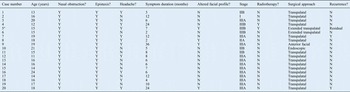
The age of patients ranged from 11 to 24 years (mean, 16.7 years). None of the patients were known or thought to have familial adenomatous polyposis. There was only one case of recurrent disease in this series. The molecular analysis results of four patients were inconclusive (hence these data were omitted). Table I depicts the clinical observations for all cases studied in this series.
Details of clinical variables

* Patient with recurrent disease was operated on following radiotherapy with residual disease in the orbit. Y = yes; N = no
All patients presented with nasal obstruction and epistaxis, but only half suffered headache. Case number five, a large irradiated juvenile nasopharyngeal angiofibroma case managed in the periphery (at a semi-urban location or a centre not well equipped to manage juvenile nasopharyngeal angiofibroma), presented to our facility for surgical excision. The tumour was extending in the posterior part of the orbit (causing proptosis) and was purposely left in that location to be excised in the next sitting. The majority of tumours were excised via a transpalatal approach and two via an extended transpalatal approach (cases five and six). Only one patient underwent a Weber–Ferguson approach (case 9) and one underwent pure endoscopy (case 10).
Molecular expression
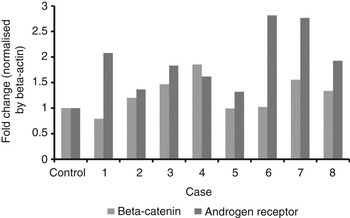
An up-regulation of androgen receptor was a universal finding in all cases, although the degree of expression varied. In contrast, the overall up-regulation of beta-catenin was evident in 69 per cent only. Figure 1 depicts a comparison of both the markers in the first eight cases; beta-catenin expression is down-regulated in one case, while it is equivocal with the control in three cases. The trend for androgen is different, with up-regulation in all cases.
Pattern of androgen receptor and beta-catenin expression in juvenile nasopharyngeal angiofibroma patient samples (for the first eight cases only) normalised with beta-actin isolated from tissue.

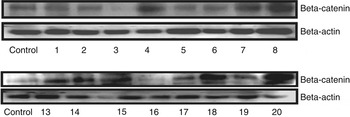
Figure 2, showing gel electrophoresis findings, depicts the beta-catenin expression in 16 cases of juvenile nasopharyngeal angiofibroma normalised with beta-actin isolated from tissue. The extremes of molecular expression were seen in cases 3 and 16 (most under-expressed) and cases 4, 8, 15 and 20 (most over-expressed). The other cases were also not homogeneous in terms of beta-catenin expression. Of note, case number 20 represents the patient with recurrent disease.
Gel electrophoresis findings showing pattern of beta-catenin expression in juvenile nasopharyngeal angiofibroma patient samples normalised with beta-actin isolated from tissue.

Clinical–molecular relations
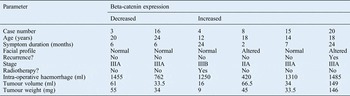
Although overall beta-catenin expression was enhanced in this series, an attempt was made to distinguish the phenotypes of those with extreme degrees of molecular expression (most over-expressed vs most under-expressed). Table II summarises the clinical and surgical features of only those patients with extreme degrees of molecular expression (cases 4, 8, 15 and 20 vs cases 3 and 16).
Clinical–molecular relations*

Regarding surgery, all underwent a transpalatal approach under general anaesthesia. *Details are shown only for patients with extreme degrees of molecular expression
As evident from the table, there were no significant differences between those patients with increased or decreased beta-catenin expression for the majority of variables. However, a somewhat absent beta-catenin expression was seen in the post-adolescent age group (young adults aged over 18 years) only. Of note, there were only two post-adolescent patients in this series. Interestingly, the patients with altered facial profiles (cheek swelling in case 8 and proptosis in case 20) showed enhanced beta-catenin expression.
Discussion
This study revealed a significant association between beta-catenin and juvenile nasopharyngeal angiofibroma, and a universal up-regulation of androgen receptor was evident too. However, beta-catenin was not universally up-regulated, as has been reported in the Western world. Enhanced beta-catenin expression has been associated with both extremes of clinical behaviour; that is, either rapidly growing or advanced disease in younger patients (aggressive), or relatively slow-growing juvenile nasopharyngeal angiofibroma (benign course). Similarly, decreased beta-catenin expression has also been associated with both extremes of disease behaviour. A near-absent beta-catenin expression was found in the post-adolescents, while all the juvenile nasopharyngeal angiofibroma patients with an expanded facial profile, and those with tumour volume or weight on the higher side, generally had increased beta-catenin expression. However, the major limitation of this study is the sample size, particularly the number of comparable cases in the two phenotype groups. Moreover, this study does not address whether the localisation of beta-catenin is intracytoplasmic (indicating defective degradation) or intra-nuclear (indicating active translation).
There are many possible explanations for different combinations of molecular and clinical behaviour. For example, increased beta-catenin expression in patients with an aggressive clinical course may suggest its role as a primary stimulator, but in patients with a relatively benign clinical outcome increased beta-catenin expression may suggest its role as a primary inhibitor. Conversely, beta-catenin under-expression in patients with an aggressive clinical course may suggest its role as a primary inhibitor, while under-expression in patients with a relatively benign clinical outcome may point towards its role as a primary stimulator. Amongst the other possibilities, increased expression in those with a relatively benign course may indicate the presence of mutated or truncated beta-catenin. Similarly, decreased expression in those with aggressive disease may suggest some alternative molecular mechanism bypassing the APC/beta-catenin pathway. Hence, it is likely that beta-catenin itself may not be the sole determinant of clinical behaviour; its complex interactions with other molecular markers may provide a better clinical–molecular association.
Tumour volume and weight were, overall, higher in cases of enhanced beta-catenin expression, except in case number four. This particular patient had undergone a full course of radiotherapy, and so the reduced tumour mass might have reflected an additional regression caused by radiation. The association between enhanced beta-catenin expression and altered facial profile in this series may suggest that the cheek swelling and proptosis, apart from being clinical markers of advanced disease, are surrogate markers of molecular aggressiveness.
The expressions of androgen receptor and beta-catenin were independent of one another. This was especially evident in the post-adolescent juvenile nasopharyngeal angiofibroma cases, wherein clinical variables were independent of beta-catenin expression but still revealed an association with enhanced androgen expression. Beta-catenin has also been suggested to function as a co-activator of androgen receptors.Reference Pawlowski, Ertel, Allen, Xu, Butler and Wilson 24 Nuclear accumulation of mutated beta-catenin and androgen receptor protein is thought to increase tumour androgen sensitivity, resulting in an exclusive adolescent presentation.
The evidence related to beta-catenin in this context is limited, but has raised a few speculations, as described below. Firstly, Abraham et al. have suggested that the APC/beta-catenin pathway is involved in the pathogenesis of juvenile nasopharyngeal angiofibroma on the basis of demonstrating nuclear beta-catenin accumulation in all juvenile nasopharyngeal angiofibroma cases and beta-catenin mutations in 75 per cent of cases.Reference Abraham, Montgomery, Giardiello and Wu 19 They have explained this interesting observation in terms of nuclear beta-catenin accumulation resulting from mutations in APC, beta-catenin or AXIN1 (axis inhibitor 1) genes. Accordingly, it is quite possible that the cases of ‘relatively indolent’ juvenile nasopharyngeal angiofibroma in our series might harbour the truncated beta-catenin protein, thereby showing enhanced expression on Western blotting. In addition, it is possible that radiotherapy-induced tumour regression (as in case four) may lead to beta-catenin gene product mutation and truncation.
Secondly, the literature suggests identical beta-catenin gene mutations in the primary and recurrent tumours.Reference Abraham, Montgomery, Giardiello and Wu 19 As there was only a single case of recurrence in our series (operated on elsewhere), with no primary specimen, we could not establish whether beta-catenin expression changed with recurrence onset. Hence, it is possible that these important genetic alterations are maintained throughout the temporal growth of juvenile nasopharyngeal angiofibroma.
Thirdly, Valanzano and colleagues presented genetic evidence that juvenile nasopharyngeal angiofibroma is an integral familial adenomatous polyposis tumour and found two frameshift mutations in the beta-catenin binding regions of the APC gene.Reference Valanzano, Curia, Aceto, Veschi, De Lellis and Catalano 25 Moreover, there has been no direct evidence from existing studies to suggest the involvement of the APC gene in juvenile nasopharyngeal angiofibroma.Reference Ferouz, Morh and Paul 18 , Reference Abraham, Montgomery, Giardiello and Wu 19 , Reference Guertl, Beham, Zechner, Stammberger and Hoefler 26 Hence, juvenile nasopharyngeal angiofibroma as a part of familial adenomatous polyposis seems to be rather uncommon as compared to the sporadic variety.
Fourthly, alterations of beta-catenin have also been reported in a variety of other tumours such as anaplastic thyroid carcinoma,Reference Garcia-Rostan, Tallini, Herrero, D'Aquila, Carcangiu and Rimm 27 prostatic carcinoma,Reference Voeller, Truica and Gelmann 28 endometrial carcinoma,Reference Fukuchi, Sakamoto, Tsuda, Maruyama, Nozawa and Hirohashi 29 – Reference Mirabelli-Primdahl, Gryfe, Kim, Millar, Luceri and Dale 31 Wilms’ tumourReference Koesters, Ridder, Kopp-Schneider, Betts, Adams and Niggli 32 and hepatocellular carcinoma,Reference Miyoshi, Iwao, Nagasawa, Aihara, Sasaki and Imaoka 33 – Reference Hus, Jeng, Mao, Chu, Lai and Peng 35 in addition to its immunolocalisation in the tumoural tissue of juvenile nasopharyngeal angiofibroma.Reference Zhang, Weber, Liang, Pasha and LiVolsi 36 Hence, a minimal role of beta-catenin in juvenile nasopharyngeal angiofibroma, possibly as a modulator, can be at least expected considering its implication in the WNT signalling pathway. WNT signalling in an ‘off’ state leads to an accumulation of intracytoplasmic beta-catenin, possibly due to altered (perhaps APC-mediated) degradation. Alternatively, with WNT signalling in an ‘on’ state, enhanced intra-nuclear beta-catenin might be responsible for transcription, leading to tumour growth or an aggressive disease state.
Although our study supports a definite association between beta-catenin and sporadic juvenile nasopharyngeal angiofibroma in North India, we feel that an alternative molecular mechanism operates in our population that is different from cases in the Western world. This belief is based on the following preliminary observations. Firstly, Western data strongly implicate the role of alterations of the APC/beta-catenin pathway in all sporadic juvenile nasopharyngeal angiofibroma cases,Reference Abraham, Montgomery, Giardiello and Wu 19 whereas our Indian data do not. Secondly, our post-adolescent juvenile nasopharyngeal angiofibroma patients did not all express beta-catenin. Thirdly, none of our cases were associated with familial adenomatous polyposis, in contrast to cases in the Western population. Fourthly, a four-fold increase in its incidence amongst our populationReference Mishra and Mishra 22 suggests some different underlying molecular mechanism to that of the rest of the world which accounts for this changing pattern of clinical behaviour.
-
• The APC/beta-catenin pathway may have a role in sporadic juvenile nasopharyngeal angiofibroma pathogenesis
-
• Beta-catenin expression was determined using Western blot analysis in 16 cases and associations with clinical details were examined
-
• In this Indian study, there was no overall association between beta-catenin expression and familial adenomatous polyposis
-
• There were no significant differences between patients with extremes of expression in terms of clinical variables
-
• Expression was absent exclusively in young adults, but was enhanced in those with an altered facial profile
-
• Up-regulation of beta-catenin expression was seen in only 69 per cent of cases, in contrast with Western literature
There are other molecular markers and pathways, including various angiogenic factors, that have been controversially implicated in the aetiology of juvenile nasopharyngeal angiofibroma. With plenty of cross-talk between these potentially instrumental factors, the role of beta-catenin may be modulated. This needs to be studied further in different phenotypes of juvenile nasopharyngeal angiofibroma. Additional validation is needed to establish our findings, and future studies with additional polymerase chain reaction or immunohistochemistry analyses are required to better delineate the definite role of beta-catenin in the cascade. This may be particularly important in an Indian context; India carries the majority of the global burden of juvenile nasopharyngeal angiofibroma cases, hence the need for targeted management here is desirable.
Conclusion
Although molecular evidence is limited, the majority of sporadic juvenile nasopharyngeal angiofibroma cases in the West are associated with beta-catenin expression. This study of an Indian population similarly suggests an association with beta-catenin, but this is limited to only a subset of sporadic juvenile nasopharyngeal angiofibroma cases. There was no association with familial adenomatous polyposis found in our regional context. In addition, the post-adolescent juvenile nasopharyngeal angiofibroma cases in our population were characterised by near-absent beta-catenin expression, further suggesting the role of alternative molecular pathway(s) for this subset.