Implications
In general, the traits studied have the potential for use as selection criteria in genetic breeding programs. The simultaneous genetic improvement of growth and reproductive traits is possible in Nellore cattle, and there seems to be no antagonism between these traits.
Introduction
Among the traits most frequently selected in beef cattle production systems, reproductive and reproduction-related traits have received growing attention from researchers and producers over the past years because of their importance for the economic performance of beef cattle farming. Substantial financial losses may occur if the cow does not calve regularly once a year during her reproductive life, and if the first calving occurs at an advanced age (Silva et al., Reference Silva, Eler, Ferraz and Oliveira2003).
In view of the relevance of reproductive traits for the production system, the traits heifer pregnancy (HP) and stayability in the herd (STAY) have been defined and evaluated in some Brazilian beef cattle breeding programs. HP at 14 months is the probability that a cow conceives after the end of the breeding season when exposed to a bull or inseminated (Doyle et al., Reference Doyle, Green, Golden, Mathiews, Comstock and LeFever1996; Evans et al., Reference Evans, Golden, Bourdon and Long1999; Eler et al., Reference Eler, Silva, Ferraz, Dias, Oliveira, Evans and Golden2002). In contrast, STAY is the probability of a cow to remain in the herd until a specific age, given the opportunity to reach this age (Hudson and Van Vleck, Reference Hudson and Van Vleck1981; Silva et al., Reference Silva, Formigoni, Eler and Ferraz2006; Van Melis et al., Reference Van Melis, Eler, Oliveira, Rosa, Silva, Ferraz and Pereira2007). Both the traits are binary, and a value of 1 is attributed for success and a value of 0 for failure.
Scrotal circumference (SC) is widely used as a male indicator trait for reproduction. This trait is easily measured and has a marked genetic component, a fact favoring its use for selection (Brinks et al., Reference Brinks, Mclnerney and Chenoweth1978; Smith et al., Reference Smith, Brinks and Richardson1989; Eler et al., Reference Eler, Ferraz and Silva1996). The SC shows favorable genetic correlations with the female reproductive traits (Toelle and Robson, Reference Toelle and Robson1985; Moser et al., Reference Moser, Bertrand, Benyshek, McCann and Kiser1996; Boligon et al., Reference Boligon, Rorato and Albuquerque2007).
Despite the importance of reproductive and reproduction-related traits, growth traits such as weight gain receive greater attention during the selection process of beef cattle, because these traits are directly associated to the main sales product of beef cattle, that is, meat. In view of the growing demands of the consumer market for meat quality, various attempts to infer carcass composition have been undertaken. Visual scores attributed to the animals are commonly included as selection criteria to meet these demands. However, studies investigating the genetic association between these scores and reproductive and reproduction-related traits are still scarce.
Various studies have showed the potential of traits as weight gain, STAY and SC to increase the production and reproduction of beef cattle herds (Snelling et al., Reference Snelling, Golden and Bourdon1995; Eler et al., Reference Eler, Silva, Ferraz, Dias, Oliveira, Evans and Golden2002; Silva et al., Reference Silva, Eler, Ferraz and Oliveira2003). In this respect, the objective of this study was to evaluate the genetic correlation between SC, postweaning weight gain (PWG), finishing visual score at 18 months of age (PREC), HP and STAY, and to determine the potential of these traits as selection criteria for the genetic improvement of Nellore cattle.
Material and methods
Data from the Genetic Breeding Program of Agro-Pecuária CFM Ltda, stored and analyzed since 1994 by the Animal Breeding and Biotechnology Group, College of Animal Science and Food Engineering, Pirassununga, State of São Paulo, were used in this study.
Data
The complete pedigree included 196 070 animals born between 1984 and 2008 on 12 farms located in the states of Mato Grosso do Sul, São Paulo and Bahia. The farms included in this study belong to the same company, which uses standard basic procedures for data collection and storage. The animals were kept on a high-quality pasture (40% Brachiaria brizantha, 50% Panicum maximum and 10% others), receiving only salt and mineral supplementation. Calves born between the end of August and December remained with their dams up to 7 months of age on high-quality pasture. The SC was measured with an appropriate metric tape at approximately 18 months of age (yearling). The PWG was defined as weight gain from weaning to 18 months of age. The PREC is a measure of the ability of the animal to store fat reserves, and is used to evaluate the capacity of the animal to reach a minimal degree of carcass finishing. This trait was evaluated by attributing visual scores ranging from 1 to 6, where 6 corresponds to animals with higher fat reserves. The scores were attributed within each contemporary group also at yearling.
The breeding season ranged from November to January for cows, and from October to January for heifers. The heifers were placed randomly in lots with a group of bulls or in some cases in lots with a single bull, for a breeding season of 90 days. In the case of HP, we do not know exactly the beginning of the breeding season because heifers are kept with bulls since weaning date or sometime after that just to be stimulated. About 60 days after the end of the breeding season, heifers (approximately 14 months of age) were evaluated by rectal palpation or ultrasound for the diagnosis of pregnancy. Heifers with a positive diagnosis (pregnant) were classified as 1, and those with a negative diagnosis were classified as 0. The heifer-to-bull ratio was approximately 35 : 1. The STAY was defined as successful when a cow calved every year up to the age of 6 years given that she had the opportunity to breed.
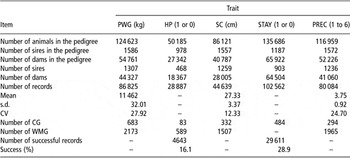
As proposed by Harville and Mee (Reference Harville and Mee1984), records for the binary traits HP and STAY of contemporary groups in which all scores were the same, that is, groups without variability, were eliminated. The PREC was considered a continuous trait (Van Melis et al., Reference Van Melis, Eler, Silva and Ferraz2003; Shiotsuki et al., Reference Shiotsuki, Silva, Tonhati and Albuquerque2009). In addition, for all traits, records of animals in contemporary groups with fewer than 20 animals, as well as data exceeding 3.5 standard deviations above or below the overall mean for SC and PWG were eliminated. The data and pedigree files of the animals were constructed using the Relax2 program with the Varcomp procedure (Strandén and Vuori, Reference Strandén and Vuori2006), which permitted to maintain only animals in the two files that would contribute to the estimation of variance components. The complete pedigree included up to seven generations. A summary of the data set is shown in Table 1.
Description of the data set for PWG, HP, SC, STAY and PREC in Nellore cattle

PWG = postweaning gain; HP = heifer pregnancy; SC = scrotal circumference; STAY = stayability at 6 years; PREC = finishing visual score; s.d. = standard deviation; CV = coefficient of variation; CG = contemporary group; WMG = weaning management group.
Model and parameter estimation
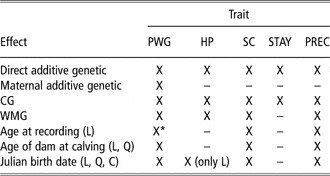
The statistical models for PWG, HP, SC and PREC included contemporary group, which was formed by farm, year of birth, sex (only PWG and PREC) and postweaning management group. The contemporary groups for STAY were formed by combining data about the farm and year of birth of the cow and the farm of birth of each of her progenies. The management groups consisted of animals that remained together during a certain phase of life. Direct additive genetic, maternal additive genetic and weaning management group (WMG) effects were included as random effects (Table 2).
Effects included in the statistical models for PWG, HP, SC, STAY and PREC in Nellore cattle

PWG = postweaning gain; HP = heifer pregnancy; SC = scrotal circumference; STAY = stayability at 6 years; PREC = finishing visual score; CG = contemporary group; WMG = weaning management group; L, Q and C = linear, quadratic and cubic covariates.
*Age at weaning and age at yearling (approximately 18 months of age) as covariates.
The Julian birth date was used to adjust the data for age differences within contemporary groups. In case of HP, the Julian birth date corresponds to the age of the animal at reproduction time, with a higher Julian birth date indicating a lower age.
The (co)variance components were obtained by multitrait analysis using a Bayesian approach. Analysis was performed with the THRGIBBS2F90 and POSTGIBBSF90 programs (Misztal et al., Reference Misztal, Tsuruta, Strabel, Auvray, Druet and Lee2002). The previous distributions for the (co)variance components were non-informative inverse Wishart distribution for all random effects. The initial values for the (co)variance components had been estimated in previous studies. Analysis consisted of a single chain of 500 000 cycles, with a conservative burn-in period of 25 000 cycles, and a thinning interval of 50 cycles. Thus, 9500 samples were effectively used to estimate the parameters and highest posterior density (HPD) intervals. The Bayesian Output Analysis package (Smith, Reference Smith2005) was used to calculate the mean, mode, median, s.d. and 95% HPD interval.
The multitrait model can be described as follows:

where y is the vector of observations, X is the incidence matrix that associates the fixed effects (contemporary group, age of dam at calving and age of recording of the respective trait, Julian birth date) and vector β of the parameters, and Z a, Z m and Z mg are matrices that associate direct additive genetic effects, maternal additive genetic effects and WMG effects with the respective vectors (u a, u m and u mg), and e is the vector of residual effects. The genetic additive direct, maternal additive genetic and WMG effects were assumed uncorrelated. The residual covariance between SC–HP and SC–STAY were set to 0 because no animal had SC, HP and STAY measured.
The HP and STAY were analyzed using the following threshold model:

where for each trait i (i = 1 or 2 for HP or STAY), wij and lij are the binary variable and underlying liability of observation j, respectively; tij is the threshold that defines the response category for each trait and ni is the total number of data for each trait studied. A probit model was used and a normal distribution was assumed for liabilities, SC, PWG and PREC:

where R is the residual (co)variance matrix, ⊗ is the Kronecker product and I is an identity matrix of appropriate order. The residual covariances between SC and liabilities and between HP and STAY were assumed to be 0 because of issues related to identifiability (Sorensen et al., Reference Sorensen, Andersen, Gianola and Korsgaard2005).
Results and discussion
Heritability estimates
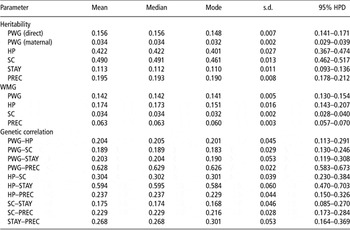
The means, medians and modes of each parameter estimate obtained were close as expected for a marginal posterior density that follows a normal distribution (Carlin and Louis, Reference Carlin and Louis2000).
The heritability estimates indicate the existence of an important genetic component mainly for HP and SC (0.42 and 0.49), with the possibility of a significant response to selection. The heritabilities obtained were similar to those reported in most studies, with estimates ranging from 0.45 to 0.71 (Bourdon and Brinks, Reference Bourdon and Brinks1986; Eler et al., Reference Eler, Silva, Evans, Ferraz, Dias and Golden2004; Silva et al., Reference Silva, Formigoni, Eler and Ferraz2006).
The PWG heritability (0.15) was lower than that reported by Marcondes et al. (Reference Marcondes, Bergmann, Eler, Ferraz, Pereira and Penna2000), Eler et al. (Reference Eler, Ferraz, Golden and Pereira2000) and Pereira et al. (Reference Pereira, Eler and Ferraz2001) in Nellore cattle (0.18 to 0.23). However, the estimate of this study is based on many more observations for this trait. The heritability for maternal additive genetic effects was of low magnitude (0.03). This finding is probably because of the fact that approximately 50% of the dams had only one progeny.
The posterior mean estimate of heritability for HP (0.42 ± 0.02; Table 3) was in the range of those reported in the literature (0.13 to 0.73; Evans et al., Reference Evans, Golden, Bourdon and Long1999; Eler et al., Reference Eler, Silva, Ferraz, Dias, Oliveira, Evans and Golden2002; Silva et al., Reference Silva, Eler, Ferraz and Oliveira2003). In addition to identifying precocious females, the most important aspect of this trait is the identification of bulls that produce precocious females, that is, females that present a higher chance of conceiving at the beginning of the breeding season (Eler et al., Reference Eler, Silva, Ferraz, Dias, Oliveira, Evans and Golden2002; Eler et al., Reference Eler, Silva, Evans, Ferraz, Dias and Golden2004). According to Eler et al. (Reference Eler, Silva, Ferraz, Dias, Oliveira, Evans and Golden2002), the genetic variability of HP in Nellore cattle (Bos indicus) is generally higher than that normally reported for Bos taurus cattle, because the latter breed has rarely been selected for sexual precocity. Selection for this trait will lead to genetic gains in the Nellore breed.
Posterior means, medians, modes, s.d. and limits of the 95% HPD intervals for heritability, WMG effect as a proportion of phenotypic variance and genetic correlation coefficients for PWG, HP, SC, STAY and PREC in Nellore cattle

HPD = highest posterior density; WMG = weaning management group; PWG = postweaning weight gain; HP = heifer pregnancy; SC = scrotal circumference; STAY = stayability at 6 years; PREC = finishing visual score.
Low heritability estimate was obtained for STAY (0.11 ± 0.01; Table 3). Similar findings have been reported by Snelling et al. (Reference Snelling, Golden and Bourdon1995) for Hereford animals, who obtained estimates of 0.09, 0.11, 0.07 and 0.20 for STAY with 2, 5, 8 and 11 calvings, respectively. Nieto et al. (Reference Nieto, Silva, Marcondes, Rosa, Martins and Torres Júnior2007) reported an estimate of 0.07 for Canchim animals (5/8 Charolais : 3/8 Nellore). Van Melis et al. (Reference Van Melis, Eler, Rosa, Ferraz, Figueiredo, Mattos and Oliveira2010) found a heritability of 0.10 ± 0.01 for Nellore cattle belonging to the same herd as the animals studied in our experiment. The genetic gain obtained by selection for STAY is therefore expected to be small.
WMG as a proportion of phenotypic variance
In previous studies involving the same population, WMG was included in the contemporary group and was considered to be fixed in the analysis model of most traits. However, a significant part of the animals was excluded from the analyses because they did not belong to a contemporary group with a minimum number of records. WMG was therefore included in the model separately from the contemporary group as a random effect. This approach permitted a smaller subdivision of contemporary groups and the consequent maintenance of a more representative number of animals in the analysis. A marked reduction in the number of contemporary groups without variability was observed for categorical traits.
According to Schaeffer et al. (Reference Schaeffer, Calus and Liu2001), if the contemporary group is considered to be random, the animals would be compared more with an overall mean rather than with the mean of the respective contemporary group, which better reflects the quality of each animal for breeders. In general, WMG explained a significant proportion of phenotypic variance and should therefore be included in genetic evaluations (Table 3).
Genetic correlations
The genetic correlation estimates between all traits studied were positive and favorable (Table 3), indicating that the five traits can be evaluated simultaneously and that selection for any of them would lead to a correlated response with the other traits. The genetic correlation between growth (PWG) and carcass (PREC) traits was 0.62, with an HPD of 0.58 to 0.67. In view of the magnitude of this correlation, the selection for PWG will contribute to increase PREC.
The posterior genetic correlations between growth/carcass and female reproductive traits indicate a favorable relationship between breeding values for growth and reproduction. MacNeil et al. (Reference MacNeil, Cundiff, Dinkel and Koch1984) found a favorable genetic correlation between carcass fat and age at puberty and conception/service (−0.29 and 0.21, respectively). The same authors also reported a genetic correlation of 0.16 between daily PWG and age at puberty. In a study on Angus and Hereford animals, Bourdon and Brinks (Reference Bourdon and Brinks1982) observed that selection for growth may reduce age at first calving. Shiotsuki et al. (Reference Shiotsuki, Silva, Tonhati and Albuquerque2009) obtained a genetic correlation of 0.18 between HP at 18 months of age and carcass finishing score. In a study on puberty in beef heifers, Hall et al. (Reference Hall, Staigmiller, Bellows, Short, Moseley and Bellows1995) verified that rapid growth large frame heifers were younger at puberty and had greater body condition score. Therefore, body composition and growth rate are related to reproductive activity of the female (Martin et al., Reference Martin, Brinks, Bourdon and Cundiff1992; Hall et al., Reference Hall, Staigmiller, Bellows, Short, Moseley and Bellows1995).
The genetic correlation between PWG and HP (0.20 ± 0.04) indicates that selection for PWG will be inefficient to increase HP in short-term selection; however, long-term selection for increase of PWG could lead to a favorable response into HP. Mercadante et al. (Reference Mercadante, Packer, Razook, Cyrillo and Figueiredo2003) compared lines of Nellore cattle, control (selected for mean yearling weight) and selected for higher yearling weight. The authors concluded that selection for BW promoted high weight response without compromising the reproductive performance of the cows with respect to days to calving and calving success. Archer et al. (Reference Archer, Arthur, Parnell and Van de Ven1998) studied the effect of divergent selection for yearling growth rate on female reproductive performance, and found that heifers from the high growth rate line were younger at puberty (mean of 324 days) than control line heifers (mean of 336 days), whereas heifers from the low growth rate line were older at puberty (mean of 355 days) than control line heifers. The authors concluded that selection for high growth rate did not compromise reproductive performance in Angus cattle. As all the correlations were favorable in this study, there is no evidence that selection for growth negatively affects reproduction in Nellore cattle.
The genetic correlation between SC and HP (0.30 ± 0.03) was higher than the estimates reported by Eler et al. Reference Eler, Silva, Evans, Ferraz, Dias and Golden2004 and Reference Eler, Ferraz, Balieiro, Mattos and Mourão2006 (0.11 to 0.27) and similar to that reported by Van Melis et al. (Reference Van Melis, Eler, Rosa, Ferraz, Figueiredo, Mattos and Oliveira2010; 0.29). The mean posterior genetic correlation between SC and STAY (0.17 ± 0.04) differed from that reported by Silva et al. (Reference Silva, Formigoni, Eler and Ferraz2006; 0.27) and Evans et al. (Reference Evans, Golden, Bourdon and Long1999; estimate close to 0). According to Van Melis et al. (Reference Van Melis, Eler, Rosa, Ferraz, Figueiredo, Mattos and Oliveira2010), SC does not show a strong genetic association with HP or STAY, and the response to selection based on the genetic merit for SC may be much slower than the response to selection based directly on genetic merit for HP. However, Eler et al. (Reference Eler, Silva, Evans, Ferraz, Dias and Golden2004) showed the importance of the inclusion of SC data to increase the accuracy of the prediction of genetic merit for HP, especially in the case of young bulls for which there is still no information regarding HP of the daughters. Martínez-Velázquez et al. (Reference Martínez-Velázquez, Gregory, Bennett and Van Vleck2003), in a study with 12 B. taurus breeds concluded that genetic response in the female reproductive traits through sire selection on yearling SC is not expected to be effective; and it is in agreement with Smith et al. (Reference Smith, Brinks and Richardson1989), who reported non-significant relationships between age at puberty in heifers and SC of yearling males. The estimates of genetic correlation between SC–HP and SC–STAY obtained in this study show that there is no antagonism between these traits and permit us to infer that selection for SC leads to little or no improvement in reproductive traits of females and vice versa.
The genetic correlation between HP and STAY obtained in this study (0.59 ± 0.06) was similar to that reported by Van Melis et al. (Reference Van Melis, Eler, Rosa, Ferraz, Figueiredo, Mattos and Oliveira2010) for Nellore cattle (0.64 ± 0.07). According to Buzanskas et al. (Reference Buzanskas, Grossi, Baldi, Barrozo, Silva and Torres Júnior2010), females that start their reproductive life early, the production costs may also be discounted early, and this may contribute toward an increase in the number of calves born per cow in a certain period of time. These results indicate that precocious cows have a higher chance of not being culled before 6 years of age. Considering the estimates of heritability and genetic correlation between HP and STAY, the ratio of correlated to direct response is greater than 1 at the same intensity. Therefore, the selection for STAY would be more effective when performed in HP.
In the present population, the bulls are selected based on an index including standardized Estimated Progeny Differences for weaning weight, PWG, SC and muscle score, weighted 20%, 40%, 20% and 20%, respectively. The results of this study indicate that the replacement of SC by HP in the index could be advantageous for the simultaneous genetic improvement of productive and reproductive traits.
Conclusion
The heritability estimates obtained in this study suggest that selection will produce, to a greater or lesser extent, genetic gain for all traits of Nellore animals studied. The studied traits generally have the potential for use as selection criteria in genetic breeding programs. The simultaneous genetic improvement of growth and reproductive traits is possible in Nellore cattle, and there seems to be no antagonism between these traits.
Acknowledgment
The authors thank Dr Shogo Tsuruta (University of Georgia, USA) for help with the use of the THRGIBBS2F90 software.