Introduction
On 16th August 1809, ninety-nine people perished in northern Scotland in what is perhaps the worst ferry disaster ever to have afflicted the country. A majority of those who drowned on the Meikle Ferry crossing that day were women and girls and came from within a few miles of the coast of the region of south-east Sutherland. Some had been traversing their nearest ‘arm of the sea’, the Dornoch Firth, to the adjacent burgh of Tain to deposit their and their family's precious savings, others to trade or enjoy the harvest (‘Lammas’) fair there, a few with the aim of moving over further stretches of land and saltwater.Footnote 1 The immense response of the Meikle Ferry Relief Fund, set up to deal with the tragedy, indicates the depth of mourning and the scale of the loss. Donations came from contributors in: Caithness, east Sutherland, Easter Ross, the Black Isle, Inverness, Moray, other parts of Scotland, London, as well as the diasporic communities of Bengal, Goa, Grenada, and the Cape of Good Hope.Footnote 2 The Meikle Ferry continued to operate, and the local, coastal setting even took on new resonance and dissonance after 1809. This article will argue, however, that the tragedy, along with a series of events which occurred within a few years on either side of it, marked the eclipse of what had been, for several centuries, a littoral community. The process has parallels in several other early modern populations along urban and rural coasts. In the case to be analysed here, this was a bilingual (Gaelic and Scots) locale, in which people coalesced not only for trade but also for social, cultural, religious and environmental reasons within a space encompassing the coast of south-east Sutherland, the Easter Ross and Black Isle peninsulas, and the Nairnshire seaboard of the ancient province of Moray.Footnote 3
The Meikle Ferry disaster coincided with the beginning of one of the darkest and most convulsive episodes in modern Scottish history: the Sutherland Clearances. Highland history in general, and Sutherland history in particular, is overshadowed by events and memories of ‘Improvers’ evicting people from inland valleys (straths or glens), forcing them into unfavourable coastal settings and a precarious and alien life of deep sea fishing, followed by emigration. There are good reasons why historians have presented these events in terms of a dichotomy between a strongly ‘Lowland’ Moray and an exclusively ‘Highland’ Sutherland.Footnote 4 As the notorious figure of Patrick Sellar set off on the new, weekly ‘packet boat’ from Burghead to Dunrobin, in the same year as the Meikle Ferry disaster, he conveyed an impression of his destination as a ‘terra incognita’.Footnote 5 His words reveal the chasm he considered to exist between the two locations, and neither this expression nor his subsequent actions suggest any sense of shared community. However, there exists a tension here in that Sellar's point of embarkation, Moray, was partly Gaelic, and his new workplace, south-east Sutherland, partially Scots. The fringe to which he was arriving, which can be seen clearly across the water from Burghead on even remotely clear days, was, by extension, sometimes considered by its own residents as distinct, socially and culturally, from the Sutherland interior.Footnote 6 This article will argue that although the east Sutherland littoral was the initial location to which many of the cleared populations from Kildonan and other glens were forced in the 1810s, it had previously been the home of a viable community with strong ties to both south and east.
South-east Sutherland comprises a part of the ‘Firthlands of Ross and Sutherland’.Footnote 7 This is a region with one tidal inlet, Loch Fleet, and three further major bodies of saltwater: the Dornoch Firth, the Cromarty Firth and the Inner Moray Firth (incorporating the Inverness, Kessock or Beauly Firths). Their landed edges have been compressed almost together at times to create indented, looping and so, at times, adjacent shores, beaches and firth-side settlements. Three protrusions or peninsulas dominate the easternmost edge, around Dornoch, Easter Ross and the Black Isle. Consequently, the coast is, in its entirety, several times its twenty-four mile, north-to-south length ‘as the crow flies’. To its west, there lies a very different, upland terrain, while, to the east, the open sea represented a more challenging environment for everyday communications.Footnote 8
Although coastal transport took centre stage in this setting, historians have underestimated its significance.Footnote 9 Works at the national level by Weir and, more recently, Veitch and Gordon, show that ferries retained and even enhanced their position as ‘an integral part’ of communications in these spaces during the early modern period.Footnote 10 This historiography has outlined vital information on government policy, proprietors, fares, skippers, and shoreside inns, although it has not yet fully explained either how ferries could knit together a broader littoral society, or how these ‘alongshore’ communities can be placed, productively, within an international context. Such a wider perspective might offer not only a contribution to Scottish History but also a route towards establishing, following Isaac Land, a ‘New Coastal History’, founded on social, cultural and environmental approaches.Footnote 11 Amphibious coastal transport has, in many locations, been ‘something so normal that it is barely mentioned’.Footnote 12 Tragic accidents aside, it developed in Europe and North America in particular as part of a communications network which changed and adapted by means of ‘transformation’ rather than being suddenly abandoned through ‘revolution’ as has been assumed.Footnote 13 Indeed, the primacy of coastal ferries has been highlighted in studies of several early modern strait, bay, gulf and estuary settings, especially in port cities such as Istanbul, Venice, Amsterdam and London.Footnote 14 Moreover, primary sources relating to the littoral bargemen, boatmen, and, less frequently, boatwomen, to whom so many passengers entrusted their time, faith and capital, have been examined along rural as well as urban coasts, in relation to estuary and inlet environments in British North America, India and Japan.Footnote 15
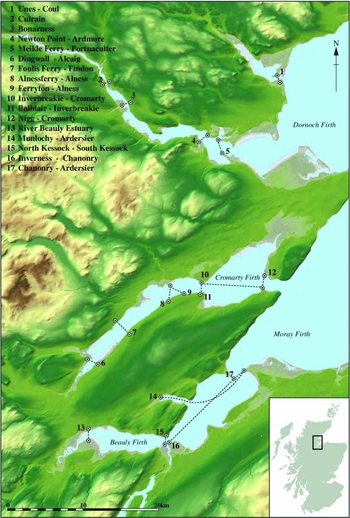
By employing a combination of church records, government sources, maps and plans, family and estate papers, surveys and travel accounts, this article will offer a microhistorical study of an amphibious, rural, early modern communications matrix.Footnote 16 It will show how the system operated, who used it and why. Key starting points towards comprehending the ferry routes in the firthlands are that: they numbered at least seventeen; they reduced the length of journeys between either end of the region by half; they avoided more challenging paths if one assumes the nearest overland route; they were each, potentially, crossings of no more than a mile's length. In this largely non-urban, coastal environment, a network operated until the early nineteenth century that advanced according to local conditions and experienced gradual transformation. This network, and the littoral world it influenced, helped develop and depended upon, only began to fade from public consciousness in the years from 1809.
‘Signals or Smokes’: the practicalities of firthland transportation
There is evidence of complaints about the quality of the firthland ferries from before the 1770s, as well as requests for better roads and bridges to interconnect or even span them. However, no suggestion is found of any alternative to the entire communications infrastructure aboard, around or ‘betwixt’ the vessels.Footnote 17 Merchants, soldiers, ministers, ordinary men, women, children, and, increasingly, tourists, moved as a matter of course through this ‘maritime cultural landscape’, to borrow from Westerdahl's account of short-range marine transport and Waley's analysis of early modern Japan.Footnote 18 In order to convey the system's import, it is essential to explore the basics of how it operated over time.Footnote 19
The ferry routes in the firthlands during the period from c. 1600 to 1809 can be seen in Figure 2.Footnote 20 There were common elements to the experience as one moved through the area. Clearly, for many travellers, it would be a mistake to see the crossings as one of single instance or simple return journeys. Instead, frequently, they were part of a longer, staged period of transit or even a temporary migration process that took people in two or more steps across the peninsulas. This comprised a regular, recognised itinerary which both simplified the terrain and halved the distance with respect to travel between Little Ferry and Ardersier. Moreover, for those seeking to go further north or south within the wider ‘Moray Firth’ arena, it had the advantage of greater frequency and reliability than open sea crossings.
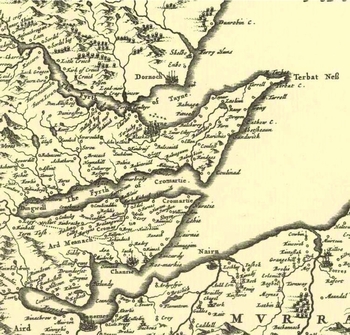
Robert Gordon and Joan Blaeu, Extima Scotiae septentrionalis ora, ubi Provinciae sunt Rossia, Sutherlandia, Cathenesia, Strath-Naverniae, cum vicinis regiunculis quae eis subsunt, etiamque Moravia / R. Gordonius à Strath-loch collegit et descripsit (Amsterdam, 1654) http://maps.nls.uk/atlas/blaeu/page.cfm?id=89. Reproduced with the permission of the National Library of Scotland.

Ferries in the Firthlands, c. 1600 to c. 1809. Contains OS data © Crown copyright 2016.

Navigation through the network, end-to-end, could still involve upwards of a day of travel. For this reason, sustenance, and, in many cases, rest and accommodation, had to be found en route. Architectural and documentary evidence informs us of numerous ferry embarkation and disembarkation points, these ‘liminal’ phases and spaces between land and sea often constituting a long pause for those on the move. Sometimes, in the absence of anywhere to wait on or around the contested foreshore, those in transit struggled to find ways to pass the time. In 1743, for example, one traveller who had been consigned to carry a ‘cask of spirits to convey to the ferry of Cromarty to be shipped to London’ could not resist temptation on Nigg beach and so ‘he and accomplices pierced it with a gimlet and embuzled 10 or 12 Scots pints’.Footnote 21 More typical gathering places may have been local girnals (storehouses) for accumulating and distributing rentals in the form of grain. There were at least eight of these along the coast from c. 1600 to 1750, most of them adjacent to ferry sites, and they could, at times, serve a social and political function.Footnote 22 Certainly, they acted as nodes, start and end points for ‘limited crossings in relation to the local seascape’.Footnote 23 There were other spaces in which to while away the time, however. Frequently integrated within the same building were beach- or pier-side inns, ‘change houses’, alehouses or ferryhouses. Sources exist for such buildings at Meikle Ferry (1762) / Cambuscurrie (1653), Invershin (1776), Nigg (1731, 1762), Inverbreakie (proposed only, 1756) / Balblair (c.1803), North Kessock (1790s) and Ardersier (1689, 1770).Footnote 24 As Veitch and Gordon have shown, the local landed family and ferry proprietor usually provided the ferryman with this building, obliging him to supply ale and food along with overnight accommodation.Footnote 25 There is a reference, from 1664, to ‘James Innes hous at the ferrie syde’ in Inverbreakie being used to sleep in, although the nearest, or, for upper class travellers, the most desirable, hostelry was sometimes at least a mile away from the foreshore.Footnote 26 In 1762, Aberdeenshire-born Robert Forbes (1708–75), episcopal bishop of Ross and Caithness, sought every possible comfort while moving through the region and, in general, seems to have found and paid for it. After alighting at Chanonry on his northwards journey, he moved on to Fortrose before stopping in ‘the house of Kenneth Mathieson, one of the best taverns I was ever in’.Footnote 27 Prior to taking the same crossing again in June 1770, Forbes settled his stomach at ‘Grant's the best Inn’ in New Campbelltown, making a ‘pretty drive of about a Mile to the Boat at Fort George’. Once on the other side, ‘Rev. Mr Allan Cameron received us on the Beach, and conducted us to Fortrose’ where he spent the night.Footnote 28 It seems then that Forbes bypassed the more basic shoreside lodgings available at Ardersier and Chanonry, perhaps on the assumption that they were scarcely more comfortable than they had been a century earlier. In the 1670s, Englishman Thomas Kirk had found, on arriving in Ardersier late one evening, ‘neither guides nor lodging to be had’ and that ‘none made reply but their dogs’ so had moved on to Inverness.Footnote 29 Moray Presbyterian minister, James Allan, had been more successful in 1689, although he was not overly impressed with his stay, prior to crossing, in a ‘smoky chamber at Elphingstoun's inn’ in Ardersier.Footnote 30
Even assuming that rest and relaxation could be found at the firthside ferryhouse, and making the most of the other services on offer there, it was not necessarily straightforward to take the next step of arranging for a boat to disembark. One barrier for those travelling from Moray, Banffshire, Aberdeenshire, Caithness or places further afield, could be language. In contrast to the bilingual burghs of Nairn, Inverness, Cromarty, Dingwall and Tain, toponyny suggests that many of the smaller coastal communities of the region had strongly Gaelic-speaking populations.Footnote 31 It was not so much the language or phrases used by the skippers but the commonality in terms of length and landscape of the most-used crossings, which led to a shared system of signs or semaphores developing.Footnote 32 Dependent on relatively clear weather, this could, nevertheless, be crucial to ensuring efficient use of the network.Footnote 33 Given the similar scale and scope of the crossings, which often involved only one vessel in service, neither a shout or cry from the opposite shore, as occurred on the Lower Thames, or the ringing of a bell, as at certain Scottish river ferry nodes, was viable. Instead, the system in place, at least at the Meikle Ferry, Nigg and Chanonry crossings, was more akin to that at the ‘signal house’ at North Quensferry, where potential passengers across the Firth of Forth created a ‘blaze’.Footnote 34 In 1689, Reverend James Allan remarked, while attempting to negotiate with the ferrymen at Ardersier, that, although he ‘kindled no smoak’ he was obliged to pay. Clearly, Allan's expectation was that signalling, made possible by ensuring the ferryhouse fire remained stoked all year round or else by provision of basic flint and steel tinderboxes, created an extra expense and that regular ferries did not require a cash payment from foot passengers if this was not specially requested. The system was not without other critics and, in some cases, ferrymen were reported to have ignored smoke or fire signals. Such a situation may have added to Bishop Forbes's indignation in 1762, at being ‘obliged to wait long at the Mickle-Ferry, as the Boats were all on the other Side’.Footnote 35 Seventeen years on from that, the system was subject to an attempted overhaul. There survives a copy of a regulation from 13th October 1779, from the Justices of the Peace and Commissioners of Supply for Ross, ordering the ferrymen at Meikle Ferry to ‘keep a Lookout and Observe and Obey all signals that may be made for their Boat’. This was in response to a letter presented by Mr Baillie of Little Tarrell on the Fearn Peninsula:
Complaining of bad service from the Ferryers of the Rossshire side of the Meikle Ferry, particularly of the practice which they have adopted of refusing to obey signals or smokes where put up on the Sutherland side, at the time that Boat may be on her passage or may happen to be neaped or while she may be repairing, as supposing themselves to have no concern with the transporting of Passengers from that side.Footnote 36
Rather than backing the more generous option of subsidising new boats and piers, the commissioners ordered that ‘Stages or Gangways’ be erected immediately on either side of the Meikle Ferry crossing so that passengers could, at least, be comforted by the prospect that a wider body of local boats might be relied on for safe boarding and alighting. Should there be future cases where signals were ignored, the ferryman or operator in question could expect to face a ‘penalty of one pound sterling for each Offence’.Footnote 37 Although all of this suggests growing demand for and professionalisation of the service, the situation may not have changed much in the long term. As late as the early twentieth century, the Meikle Ferry service, which by this time was in terminal decline, required that a flag be hoisted on the south side by northbound travellers, while in the mid-nineteenth century travellers at Cromarty continued to summon the ferry from the other side (Nigg) by bringing a fire to blaze.Footnote 38
Another point in the journey at which sparks could fly was when potential passengers and ferrymen negotiated the fare. Given that ferry proprietorship was so varied, due to the intricate family networks of the region and the legal complexities of the foreshore, costs fluctuated. Unlike, for example, in the Dutch United Provinces, where complex fiscal controls were in place for coastal transport, cash was not always required, with Hugh Miller recalling ‘ferrymoney’ in the form of peat on some of the ‘ephemeral watercraft’ plying between Nigg and Cromarty, while, on some other routes, the cost of the fare was paid in whisky.Footnote 39 The Reverend James Allan paid a ‘shilling sterling’ for his crossing at Ardersier.Footnote 40 Isaac Forsyth, towards the end of the period, complained about ‘the very considerable revenue exacted from him [the traveller] by the different proprietors of the respective ferries, above what is requisite for the support and navigation of the boats’.Footnote 41 The increasing traffic of carriages was creating a new problem by the middle of the eighteenth century, regarding which a 1765 case relating to the Scuddale ferryman is instructive. Petitioner, William MacKenzie of Belmaduthy, claimed that the fare for ‘wheel machines’ [chaises] and horses on the ‘unfit’ service across the tidal Conon was ‘grossly extravagant’ at ‘no less than two shillings and six pence sterling for each time’. He contrasted this unfavourably with the Queensferry crossing which cost the same despite being ‘within 7 miles of the Metropolis of this part of the united Kingdom’ [Edinburgh], and ‘where the fery is so broad and the Boats so good’.Footnote 42 In response, the Commissioners of Supply demanded simply that the Scuddale ferryman reduce his fares and ensure that he had a ‘good and sufficient ferry’.Footnote 43
While the issue of carriages on ferries provided a growing challenge in the eighteenth century, problems with the transportation of livestock and animals more generally were of longer standing.Footnote 44 Bishop Forbes ‘had two Crossings’ at Little Ferry ‘as the boat could not contain us and the Horse all at once’, although this problem appears to have been addressed there by the 1790s.Footnote 45 Certainly, Donald Sage, a less experienced passenger, on venturing south-eastwards from the Strath of Kildonan for the first time, did not have the same concerns once aboard.Footnote 46 Moving southwards, Bishop Forbes crossed at Meikle Ferry with all his essentials, although he was surprised to encounter ‘an abandoned Chaise’ on the north side, apparently ‘one of Lord Reay's but useless in Strathnaver’, indicating again some of the problems associated with this form of transport in the north, even when it was possible to convey it across water.Footnote 47 Yet this issue was again addressed successfully and by the 1790s the crossing had ‘a large boat for transporting carriages, horses, and other cattle; as also a yawl for the accommodation of foot passengers.’Footnote 48 Still, the Meikle Ferry and Nigg to Cromarty and Kessock services were probably the only ones on which both horses and chaises could be taken over together, even in this rather haphazard way, prior to 1809.
On the Nigg to Cromarty crossing, in the 1670s Thomas Kirk ‘took in three horses (there being scarce room for them), and before we got a hundred yards from shore, they were ready to leap overboard, and overturn the boat’ so he had to try for a second time.Footnote 49 Reverend Allan preferred to travel as a foot passenger in 1690, but even then he had to go for two miles ‘on foot to Newmore after crossing the ferrie of Inverbrackie, for I could not get a horse for hire’.Footnote 50 Further south, despite calling the Kessock ferry the ‘best in Scotland’, Forbes noted that ‘they have no good means of getting carriages on board, and there was considerable difficulty with one of the horses’.Footnote 51 He was ‘long detained’ at Ardersier too where ‘the Boat could not take over the Passengers that appeared, the Horses and the Chaise all at once’.Footnote 52 Despite the adaptation of the vessels at Little Ferry and Meikle Ferry, the inability of coastal vessels to transport chaises reliably was evidently becoming an increasingly sore point for upper class passengers. James Loch's horse and carriage were only ‘slowly and unskillfully put into the wretched boats’.Footnote 53 Well into the nineteenth century, Robert Southey claimed that passengers on the Invergordon to Cromarty service were ‘sometimes obliged to mount their horses nearly a quarter of a mile from the shore, and ride mid-leg deep in the water’.Footnote 54
Ferry skippers and passengers
A ‘pluriactive’ people?
Saunders’ work on slaves in fifteenth- and sixteenth-century Portugal reveals how diverse the skippers or crews of short-range coast-hugging or estuary vessels were and how illustrative their history can be of wider social and cultural trends.Footnote 55 Elsewere, historiography can provide diverse information about the operators and passengers of early modern waterborne coastal transport.Footnote 56 A key, general point to emerge is how frequently coastal ferrying was combined with other tasks and how politicised the profession could be. In the firthlands too, there is evidence of ‘pluriactivity’,Footnote 57 although this is difficult to research, partly due to the growth of occupational stereotypes but also because of the sheer variety of terms used to refer to the ferry operators, including ‘boatman’, ‘waterman’, and ‘ferrier’ and numerous Scots and Gaelic versions of these terms.Footnote 58 At times, however, a distinction is made between ‘Fish and Ferry Boats’ and also between ‘Ferriers and Fishers’. These two categories of vessels and people were considered separately on the Invergordon estate in the 1760s.Footnote 59 There, and it seems elsewhere, specialisation was the norm. Yet the comparative paucity of major ports, apart from Inverness and Cromarty, meant that ferries, their crew, and their passengers were still clearly linked with commerce, the military and tourism, as well as much broader social features.
Ferrymen played an often controversial role in the economy, transporting goods from larger vessels to shore, and sometimes onwards to girnal, as part of the still largely unexplored ‘coasting trade’ of the region.Footnote 60 Despite the wishes of Sir John Gordon of Invergordon, some such vessels were used for the movement of grain and fish, as well as transporting livestock, stone and other building materials, coal, peat, wood, and mail.Footnote 61 Evidently, outside the few burghs of the region, its coastal dwellers were multi-tasking members of what Gillis has termed a ‘protomaritime’ economy.Footnote 62 However, trade via the firths was treated as legally equivalent to trade by open sea, meaning that customs duties could be exceptionally demanding.Footnote 63 Disputes over this could ignite violence. In May 1733, the Customs House officer in Inverness reported that his warehouse had been broken into, his boat carried ‘across the ferry, cut in two, and half of it disposed to the waves’ while a person under suspicion of being an informer had been ‘dragged across the Firth and his ears cut out, and hints every day given to myself to take care of my life’.Footnote 64 Sometimes these disputes merged into inter-family or ethnic rivalry. In 1679, Thomas Urquhart, ferrier at Inverbreakie, was at the centre of a violent shoreside conflagration, which set Mackenzies on one side against Rosses and Munros on the other.Footnote 65 Apart from these dramatic flurries, firthland ferries were only occasionally put to military use in the early modern period: in the 1640s; in the days before the Battle of Culloden; and in the construction and development, using Black Isle stone, of the Fort George garrison near Ardersier in the years that followed.Footnote 66
In terms of tourism, Donald Sage's nervy crossing of Loch Fleet as a child, where he was ‘horror-struck, on looking over the edge of the boat’ needs to be considered alongside the simultaneous, imaginative appeal to him of the routes. Coming from inland Kildonan, Sage was fascinated by the ‘ocular feast’ provided by the east Sutherland coast and tantalised, while being ferried, by the ‘sea-ware of every size and colour’, the ‘star-fish intermingled with the long tails of the tangle which by the under-swell of the sea heaved up and down, and presented the appearance of a submarine grove, retaining its fresh look by the greenish colour of the sea-water’.Footnote 67 Indeed, the natural history of the firthlands had long attracted the attention of visitors and locals. Although he described the Inverness to North Kessock route as ‘exceeding hazardous’ and ‘rugged’, with ‘luxuriant tides, and aggravating winds, that violently contract the surff of the sea’, mid-seventeenth century visitor, Richard Franck, spent more time expressing his wonder at the ‘porposses’ [porpoises or dolphins] that he thought were in danger of leaping into the boat, in his account.Footnote 68 Thomas Kirk from Yorkshire remarked, in the 1670s, on ‘the good boat’ with which he had crossed from Chanonry to Ardersier, which had allowed him to spot ‘many polarks, sharks, or porpoises, for they are called by all these names’, seeing ‘four of them several times leap up together a yard above water’.Footnote 69 Likewise, in the 1760s Bishop Forbes devoted as much of his text to extolling the coastscape, ‘one of the finest Prospects in the World’ with ‘pretty Bays opening here and there’, as he did to complaining about delayed, expensive or ramshackle ferries.Footnote 70 Other attempts were made to bring visitors in to enjoy the local environment. At Inverbreakie in the 1740s and 1750s, Sir John Gordon clearly considered the firthland's transport network to have potential as a way of attracting travellers for leisure. Gordon sought to erect ‘Bath Machines’ on the fashionable Scarborough model, costing them, clearing the beachside of all ‘Cobles and Crieves’, and planning the precise sizes and locations for several ‘large stone Houses at the Shore’, each of which would function as a ‘Pleasure Boat House’.Footnote 71
Of course, the local environment was a threat at times, perhaps exacerbated as the climate changed in line with the later phase of the Little Ice Age. This is shown in the case of the Culbin estate in the 1690s and just a handful of years earlier James Allan had reported sand-drifts while en route to Ardersier from Moray.Footnote 72 Certainly, any analysis of the firthland ferries and their users reveals a multiplicity of functions and an interplay with ecology and environment. The final part of this article will concentrate on one further function, which is revealed by the Church of Scotland's presbytery and kirk session records: the use of ferries both within religious networks and, intersecting that, for religiously proscribed reasons, by ordinary people.
‘Church Ferries’
An insight can be gleaned into the role of ferries through examining their significance in the transportation of Protestant clergy and parishioners around the region following the Reformation. Ferries promoted the movement of bishops and other men of the cloth in the case of the Episcopal church, and of ministers and elders in the case of the Presbyterian kirk that would cement its place from 1689 and become the Established Church in 1690. In the case of the Episcopalian church, officers in the three relevant dioceses of Moray, Ross and Caithness required ferry transport at times, partly due to their lack of numbers, as seen in Bishop Forbes's efforts to travel through the north Highlands. This situation was exacerbated when the three dioceses were united into one bishopric in 1777. Meanwhile, in the Presbyterian church, parishes towards the east coast of the northern Highlands in the synods of Sutherland, Ross and Cromarty and Inverness, tend to become smaller and smaller around the littoral, suggesting that these areas had relatively sizable, Presbyterian congregations. Extant presbytery and kirk session minutes and other records for the period reveal something of the geographic mobility of the Church of Scotland's ministers and elders. Records also survive of more radical, itinerant Presbyterian activity, including ‘conventicling’ or open-air preaching, spanning out by ferry from Easter Ross, emphasising that, from early on in the Scottish Reformation, the influence of reforming ideas could be from north to south as well as from south to north, and was sea-borne as much as land-borne.
Thomas Hog (1628–92) was a Tain born and Aberdeen (Marischal College) educated chaplain to the earldom of Sutherland from 1654, later minister of the Easter Ross parish of Kiltearn, and active thereafter in western parts of Moray, being imprisoned, notoriously, in Forres, in 1668.Footnote 73 Once in Moray, he influenced Katherine Ross (c.1635–97), the evangelical memoirist, while he is also mentioned in the diary of Alexander Brodie as part of a small stream of Presbyterian passengers who passed into the Lowlands and back again via the Black Isle.Footnote 74 Local memory of Hog and those influenced by him was retained into the eighteenth century, while the itinerant, cross-firth nature of his preaching features in other, later reports relating to Cromarty Firth parishes. The diary of Rosskeen minister John Calder (1743–83) records his taking for granted the availability of transport across the firth to Findon, Culbokie and Balblair, sometimes just for an evening and also on the Sabbath, during the 1770s.Footnote 75 By the 1790s, it seems that ‘church ferries’ were functioning.Footnote 76 This kind of travel appears to have been used by Donald Sage on his becoming minister in the Black Isle parish of Resolis, just across the firth from Kiltearn. Using various tidal water routes, Sage had travelled back and forth between Sutherland and Moray to attend university in Aberdeen and he had also ‘slept and supped at the Inn of Balblair in this parish [Resolis]’ when only fifteen, so that, on becoming a minister there later, he was renewing an earlier familiarity with the communications network within this littoral environment.Footnote 77
The Presbytery records of Chanonry show the movement of ministers to supply parishes from Ardersier to Kirkmichael, as well as a focus on repairing manses around the Black Isle and into Easter Ross for which ferries must have been key.Footnote 78 In 1712, their Dornoch equivalent reported on a case when a Mr Brodie, a local minister, ‘was necessitate to stay in Ross and preach at Tain for Mr Hugh Munro’ the latter being ‘necessarlie called to Kincardin to see his brothers family’.Footnote 79 As for parishioners, they too sometimes used ‘church ferries’, and by the end of the eighteenth century were able to do so without fear of any social consequences. They had certainly long relied on short-range marine transport to attend weddings and funerals, to take part in ‘profane’ activities, and to attend fairs and markets. The estate papers of the major families of the region with cross-firth ties, both Episcopalian and Presbyterian, might shed further light on this. Episcopalian families seem to have favoured firthland ‘progresses’, regarding which one gains an insight from an account of the Lovat Frasers from November 1666.Footnote 80 Lovat returned home from this jaunt for a ‘solem, handsom, opulent Christmas feast’ to which again, neighbours travelled over land and sea from other parts of the region, while upon the death of his wife, Anna Mackenzie, in 1667 the funeral guests similarly included ‘all Ross and Murray gentlemen, and their two bishops present’.Footnote 81
Presbytery records and, more particularly, kirk session minutes, illuminate the travel through the firthlands of a wider variety of people. This emerges as a widespread concern, being associated with Sabbath profanation for trade, drunkenness, adultery, or other illicit acitivity.Footnote 82 In 1731, the Nigg Old Kirk session was taken up with the case ‘Anent Colin Simpson, Donald Gally and Robert Dallas’, who had crossed from Cromarty on the Lord's Day, and then met with the crew of a visiting English vessel. The Englishmen had offered to buy two of Simpson's cows, a negotiation which led to them diverting to ‘the Change House at the Ness’ for refreshment, albeit this hiatus allowed the English crew to take two of the cows and put them aboard their boat.Footnote 83 At Kirkhill, on the south shore of the Beauly Firth, a case from 1779 relates to ‘breach of sabbath by drunkenness’ when a group of local men and women:
Having crossed the ferry of Beauly and returning late that evening towards Drumchardnie went into the house of John Urquhart shoemaker at Newton and drank ale and aquavita until they were intoxicated that many of them had their clothes so dreged with dubs and clay as if they had been drawn through it.Footnote 84
Such behaviour became especially pronounced, or at least was most remarked on by kirk sessions, on market days and fairs. In 1689, ‘a fatal accident fell out in this parochin [Kirkhill]’ when ‘two young women able servants Christian Rain and Margaret nicklauchline in Phopachy’ were drowned in the inner firth returning from a market at what appears to be Ferintosh on the Black Isle, although it is not clear if they had been attempting to swim or wade, or had been aboard a boat.Footnote 85 In 1782, Tain Presbytery dealt with the case of Alexander and Christian MacKenzie, from Cromarty, and Robert Ross, a farmer from Wester Rarichies north of Nigg where the annual ‘Hugh's Fair’ took place. Ross had entertained Alexander MacKenzie and a woman presumed to be Christian, his wife, at his house during the festivities, although it was alleged by Alexander MacWilliam, in Cromarty, that the woman who had taken the ferry with MacKenzie over to Nigg was in fact ‘a widow in Cromarty and that there was no good report of her’.Footnote 86 Further north, in 1734 the Golspie kirk session considered the paternity of the child of local woman, Ann Macleod, agreeing to conduct a search for ‘Robert Baxter, a married man, who had been guilty with her in the Time of Barsfair [St. Barr's Fair] last by the way coming from Dornoch’.Footnote 87 Eight years later, Katherine Gun in Coxtown ‘confessed that she had been guilty of uncleanness in Tain with Hugh Ross, merchant there when in his service and that about the time of Michaelmas market’.Footnote 88 In a 1750 case, Angus Murray and Margaret Bain were ‘reported to have crossed the ferry Solus cum Sola under the silence of the night after the people of Ferryoons [Unes, Little Ferry] had gone to bed’ when returning from a ‘Session for Scandalous Cohabitations’ in Dornoch and then with a Robert Murray and Isobel Bain who had ‘crossed the ferry at unseasonable hour Solus cum Sola when returning from Dornoch’ where they had been attending the Session ‘on a process of Scandal against them’.Footnote 89 George Murray in Pronsie declared, in 1708, that his wife had left him in the mid-1690s but ‘that she died in Ross about Lochslin thirteen year ago and that Alexander Merchant in the paroch of Tarbat was in knowledge of her death’. However, the session was unconvinced and sent Murray across the firth to ‘go to Ross and get testificate of his wife's death’.Footnote 90 Other accounts refer to both ‘fugitives’ from the region living in other parishes and newcomers entering the firthlands by ferry, suggesting the potential of the records as a source for studies of eighteenth-century migration.Footnote 91
Conclusion
In 1808, George Dempster of Dunnichen (1732–1818), agricultural improver and then resident at Skibo on the northern edge of the Dornoch Firth, just inland from the Meikle Ferry, wrote a ‘Familiar Epistle’ to his well-known friend, Sir John Sinclair (1754-1835). It contained a message about the inadequacy of ferry boats that was very much of its time and also troublingly prophetic. As he wrote:
The growing embarrassment and shame associated with the firthland ferries, detectable from the late eighteenth century in relation to their unreliability when carrying the most modern carriages, was already coming to a head before the Meikle Ferry disaster. That tragedy coincided with a shift away from amphibious modes of transport in the firthlands. Spreading from the south-west, the building of the Caledonian Canal (opened in 1822), the Mound over Loch Fleet (completed in 1816), Conon Bridge (1809), Bonar Bridge (1812) and Lovat Bridge (1814), the advance of roads and, eventually, railways, while not avoiding the use of ferries entirely, led to the creation of more land-based itineraries for those heading from the south or west and encouraged the creation of less ‘pluriactive’ fishing communities. The eastern edges of the Black Isle, Easter Ross and Dornoch lost out. Meanwhile, the growth of a ‘packet boat’ service linking Burghead with Little Ferry caused travellers from the south-east to approach and enter the far north of the Highlands directly from lowland Moray, thereby again circumnavigating the bicultural, transitional, littoral world of the eastern Black Isle and Fearn Peninsula. For all concerned with the firthlands, all of this lessened dramatically the sense of a common community ‘betwixt the ferries’Footnote 93 and minimised the agency of the peoples of the region's more northerly part, in particular, in defining their connection with the outside world.
As late as 1776, Charles Cordiner had noted at Invershin, just a few miles to the west of the Meikle Ferry:
A pleasant prospect: the rich banks of the firth, crowded with farms, and animated with all the appearances of industry; small vessels sailing up and down; people busy for preparing and unloading them; fishermen attending their nets; the ferry boats ready at a call; the extensive prospects of the rich-lands in Rossshire and a good inn seen among trees on the opposite shore.Footnote 94
The system of tidal water transport which has been outlined in this article, and was extolled by Cordiner, left a mixed and, in many ways, a troubled legacy, a record of human tragedy as well as of agency and entrepreneurialism. Comparative studies of the social and cultural pasts of littorals elsewhere will develop from the New Coastal History. While urban coasts and port towns are currently attracting attention and some exceptional work, in time, new research trends will allow for greater examination of the interplay with the countryside, as well as firmer conclusions around the wider role of ferries, their skippers and users.Footnote 95 In terms of rural history, was it only along the winding, adjacent shores of the firthlands, that the early nineteenth century marked the end of an enduring mode of countryside, foreshore and offshore travel by foot, horse and boat? What is certain is that, in this case, it was an interdependence which had been crucial in the early modern period. Ferries were paramount in providing a form of communication which was inspiring fondness and nostalgia, as well as bewilderment and dismay, long before it beached on its final shore.
Acknowledgements
I would like to thank the staff at the Highland Archive Centre, National Library of Scotland (Manuscripts Division and Map Reading Room), National Records of Scotland, Dingwall Library, and also Professor Isaac Land, Dr Amy Todman, Dr Thomas Brochard, Dr Elizabeth Ritchie, Wade Cormack, James Miller, Dave Selkirk, Jim Mackay, Crane Begg and Verity Walker.