INTRODUCTION
Tiredness, fatigue or absolute exhaustion can be distressing and devastating to individuals who have long term illnesses, palliative care conditions or cancer (Wagner & Cella, Reference Wagner and Cella2004). There is a high prevalence of fatigue related to many long term or progressive illnesses affecting between 76–99% of some populations (Curt, Reference Curt2000; Radbrusch et al., Reference Radbrusch, Strasser, Elsner, Gonçalves, Løge, Kassa, Nauck and Stone2008). Yet, health care professionals are often unable to offer effective treatment or relief. Addressing underlying anaemia is efficacious as it addresses a single treatable cause. However empirical evidence in support of pharmacological treatments such as psycho-stimulants, antidepressants and central nervous system agents is inconclusive and weak (Peuckmann-Post et al., Reference Peuckmann-Post, Elsner, Krumm, Trottenberg and Radbruch2010). Non-pharmacological approaches vary widely in terms of effectiveness and feasibility (Radbrusch et al., Reference Radbrusch, Strasser, Elsner, Gonçalves, Løge, Kassa, Nauck and Stone2008; Kirshbaum, Reference Kirshbaum2010). Examples from published literature include music therapy and reflexology (Magill & Berenson, Reference Magill and Berenson2008), cognitive behaviour therapy (van Weert et al., Reference van Weert, May, Korstjens, Post, van der Schans, van Borne, Mesters, Ros and Hoeskstra-Weebers2010), progressive relaxation training to improve sleep (Demiralp et al., Reference Demiralp, Oflaz and Komurcu2010), client education programmes (Cooper et al., Reference Cooper, Reynolds and Bateman2009; Purcell et al., Reference Purcell, Fleming, Bennett and Haines2010) and multi-modal psychosocial care programmes (Jacobsen et al., Reference Jacobsen, Donovan, Vandaparampil and Small2007; Abernethy et al., Reference Abernathy, Herndon, Coan, Staley, Wheeler, Rowe, Smith and Lyerly2010). However, according to the recently updated Cochrane Review (Cramp & Byron, Reference Cramp and Byron-Daniel2012) only aerobic exercise, not resistance training or low intensity mind-body interventions, can significantly improve fatigue for people who have breast or prostate cancer. According to Cramp and Byron (Reference Cramp and Byron-Daniel2012) evidence was not sufficiently strong enough to recommend exercise for those who had haematological malignancies. The most robust and structured exercise programmes demonstrated benefits in generalised quality of life, aerobic capacity, decreased heart rate, and reduction in reported fatigue (Kirshbaum, Reference Kirshbaum2007; Cramp & Byron, Reference Cramp and Byron-Daniel2012). Comparable studies of patients affected by other cancer and long term conditions are less robust, rigorous or extensive, but demonstrate promising findings that concur in terms of reducing the severity of patient reported fatigue and improving general well-being, quality of life, resting heart rate and muscle tone.
However, there remains a clinically significant proportion of the global population for whom a prescription to undertake moderate aerobic would not be advisable nor reasonable; for example, people with mobility, muscle strength and flexibility limitations or specific restriction due to respiratory, cardiac, or advanced cancer conditions. In a recent study on the perceptions of fatigue in advanced cancer (Kirshbaum et al., Reference Kirshbaum, Olson, Pongthavornkamol and Graffigna2012), this last point was noted first-hand. Participants in the study were all experiencing moderate to advanced levels of fatigue, but were constrained by their advancing limitations; it would have been completely inappropriate to advise increasing their levels of aerobic activity. The problem of not being able to suggest an evidenced-based, non-exercise intervention was concerning. The unfortunate absence of an alternative was particularly noticeable for those individuals who had always been active and exercised regularly – they would have loved to do more, but were unable.
Attention Restorative Theory (ART) was developed by an American environmental psychologist (Kaplan, Reference Kaplan1995; Reference Kaplan2001), who distinguished between two types of attention. Directed attention requires effort, concentration, keeping focused and ignoring peripheral stimuli and thoughts. This will be familiar to us all when we are working or engaged in other responsibilities, particularly for long periods of time without a break. This type of attention leads to ‘directed attention fatigue’. Involuntary attention is characterised by fascination, curiosity and exploration; it is more spontaneous and effortless and restores mental functioning and well-being. According to Kaplan, restorative activities have four overarching attributes: being away (being distinct from the everyday, routine environment), fascination (containing patterns that hold one's attention effortlessly), extent (having scope and coherence that allow one to remain engaged) and compatibility (fitting with and supporting what one wants or is inclined to do) (Kaplan, Reference Kaplan1995).
Research on ART has followed Cimprich's (Reference Cimprich1993) exploratory article within the context of cancer (Scopelli & Giuliani, Reference Scopelliti and Guilian2004; Berto, Reference Berto2008, Reference Berto2007; Korpela et al., Reference Korpela, Ylén and Tyrväinen2008; Norling et al., Reference Norling and Ruddell2008; Berto et al., Reference Berto, Baroni, Zainaghi and Bettella2010; Staats & Van Gemerden, Reference Staats, Van Germerden and Hartig2010). This series of work developed the notion of ‘natural restorative environmental interventions’ (e.g. a walk along a river, visiting a botanical garden) and their beneficial effects. Although the evidence is weak in terms of measurable indicators, the literature provides a foundation from which to develop, test and extend ART further.
The aim of this study was to determine if ART could be used to develop an effective non-pharmacological intervention to reduce fatigue. Specific objectives were:
1. To identify activities perceived as being enjoyable by individuals who have moderate to severe fatigue related to advanced illness.
2. To determine core attributes of potentially beneficial interventions.
3. To analyse reported ‘enjoyable’ experiences within the ART framework by mapping emergent themes to the attributes of attention restoration.
4. To develop the prototype for a self-management intervention tool.
METHODS
A qualitative methodology was used. The purposive sample of 25 participants was recruited from a hospice day unit, a service user group within the National Health Service (NHS) and an independent podiatry clinic. For inclusion in the study participants needed to identify fatigue as a significant symptom of their condition, impacting upon their everyday life, equating with a score of 4–10 on the Edmonton Symptom Assessment System (ESAS) (Bruera et al., Reference Bruera, Kuehn and Miller1991), indicating at least a moderate level of fatigue. Other inclusion factors included being medically diagnosed with a long term illness or cancer, living at home and having the ability and desire to participate in a research interview lasting up to one hour. Individuals with an acute mental illness or were under 18 years old were excluded.
Data were collected during open ended, face-to-face interviews lasting no more than 45 minutes. Following written informed consent, interviews were digitally recorded and transcribed verbatim. The interviews were aimed at identifying, describing and exploring the characteristics of activities enjoyed by the participants, rather than dwelling on the limitations placed upon them due to excessive tiredness or fatigue. Once settled in a quiet room where there would be minimal interruptions, participants were provided time to ask questions and express any concerns they may have had about their involvement in the study prior to signing the informed consent form. Audio recording equipment was set up and tested beforehand.
The interview probed two main questions: ‘Which activities do you enjoy doing?’ ‘What is it about the activity that you particularly enjoy?’ Participants were encouraged to describe each identified activity in detail. Additional questions such as: ‘Is it an activity you would do on your own?’, ‘How often?’, ‘Where?’ were asked to promote exploration of the qualities and characteristics of potentially restorative activities.
Framework analysis (Miles & Huberan, Reference Miles and Huberman1994; Ritchie & Spencer Reference Ritchie, Spencer, Bryman and Burgess1994; Braun & Clarke, Reference Braun and Clarke2006) was used systematically, reflexively, analytically and interpretively to draw out information relevant to the objectives of the study, discover emergent themes and patterns and interpret their meanings relative to ART. Participant quotations associated with each activity were highlighted on interview transcripts and then recorded onto individual charts, with a column added for preliminary conceptual or thematic observations (Table 1). When all transcripts were reviewed in this way, a full list of activities was made, which was reduced during further analysis, discussion and consultation. Regular meetings took place throughout the study period with the research team of academic staff (nursing, occupational therapy, physiotherapy, psychology) and the research governance group of the local hospice.
Example of individual data chart
ARA Study: 21MS age 66 COPD

RESULTS
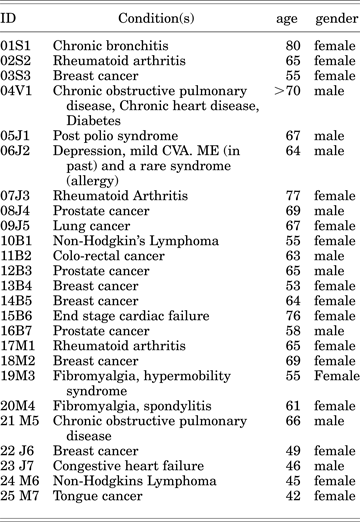
The 25 participants consisted of 16 women and nine men, ranging from 42–80 years of age. Thirteen (52%) of the group had been diagnosed with cancer while others had rheumatoid arthritis, chronic obstructive pulmonary disease, chronic heart disease, chronic bronchitis, diabetes and fibromyalgia (Table 2). In total, 75 examples of enjoyable activities were identified.
Participant characteristics
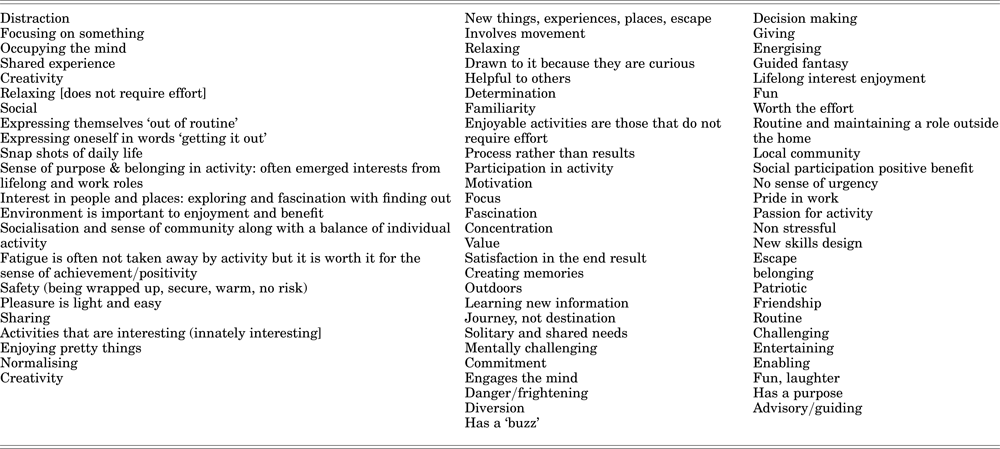
Proposed concepts and themes (Table 1) that reflected attributes of enjoyable activities were listed together (Table 3) and synthesised into four latent (conceptual) themes: Belonging (socially engaging), Expansive (opportunities for creativity and learning), Nurturing (comforting and relaxing) and Purposeful (linked to achievement). In addition, recognition of physical limitations and the importance of safety were mentioned by most participants and substantially influenced how participants in the study spent their time.
Proposed concepts and themes generated from interviews
BELONGING
The sense of belonging and being a part of the greater community highlighted the value of social engagement and seemed to underlie some of the pleasurable experiences expressed by many participants. This was evident in descriptions of watching and coaching a football match going out for a meal, or dressing up to go to the theatre, as expressed by one woman:
In a theatre you get yourself dolled up, you make an effort on your appearance, you are going out and you are mixing with other people. Live performance has got a definite atmosphere that you can absorb and be a part of… I think you come back energised somehow from it. [17M1]
Another woman described how she enjoyed walking in the village and interacting with her neighbours:
I like just seeing people outside and saying hello. I use to be involved in so many social activities so, yes, yes yes, it is the social aspect of walking in a group and being outside and out of the house. [11B3]
Interaction with others and being sociable was identified in diverse circumstances.
I enjoy conversation. And I like being out and about with people. [05J1]
It's not so much the football I enjoy, its meeting friends and seeing new places. And at times the football is the excuse to go to a new place. [23J7]
EXPANSIVE
Instead of being bored or frustrated by the limitations that fatigue may have placed upon their daily lives, there was a substantial subgroup that thrived through seeking out new quests or going forth to learn and develop new talents or abilities. This was described in the account of a mother who described with a bit of a sly smile that she took great pleasure in learning the art of making (and eating) designer cupcakes with her daughter.
We have bought books and done different things…it is quality time together and feeling that we are actually achieving something. [25 M7]
Another example relates to singing in a choir:
When I sing it fills me with a bit of enthusiasm and energy really… What fascinates me is certain musical phrasing and certain notes that are put together and certain sounds that are made when all three parts sing them together. [24 M6]
Learning within formal classes, sometimes receiving a qualification was expressed as the joy of being exposed to something new, different and fascinating.
I've just completed the ECDL, The European [IT] Driving Licence with some extra qualification in it as well. I now know more about computers. I know, about spread sheets … I know what it all is now and I know how it works. So that's been great. [23J7]
I am always fascinated by live productions, perhaps it is also the costumes. Out of nothing people can produce costumes and out of makeup they can make people look totally different. [17M1]
I love clouds. I'm forever looking at the colours and how the light comes through. You know, I was really into the clouds one minute and I thought, instead of just looking at them why don't you paint them. So that's my next step. [16B7]
You can make a figure out of just a few lines, which I found fascinating… it gives you like a lift, it gives you a buzz… It just lifts you. [16B7]
I tend to read books that are informing me about something, whether it's computing, or photography or engineering or whatever, anything that's stimulating my engineering mind and my ideas, and I like to look at art books because sometimes you can pick up a nice idea [and] integrate that into this design. I just like to be stimulated and then create something from that point. [08J4]
PURPOSEFUL
Involvement in voluntary work and going out of one's way was an unexpected finding. There were many varied examples such as:
My voluntary work, [gives me] regular motivation which makes me want to get up in the morning. [05J1]
My main occupation is church work visiting the sick, the elderly taking Holy Communion to people who are house bound. [07J3]
My massive way forward was working on behalf of other people. I started a support group and did a lot of work towards that… If it is not helpful then why bother I might as well go to sleep. [17M1]
To me unless I'm actually doing something, unless I'm creating something, unless I'm changing something, there is no fun. [06J2]
NURTURING
In contrast to the individuals that took great pleasure in tackling new challenges, many participants preferred to spend their time in more solitary and comforting ways. The delights of reading, listening to music and escapism were well represented and are exemplified in the following excerpts:
My husband likes reading as well. So, we will put some music on, I will curl up in the chair, he will curl up and we can be a couple of hours and we won't say a word. But we will both be in our books. Now that is pleasure. [17M1]
I discovered that I had a love of music. It's me giving myself permission to switch off… for escape and I can actually do it without playing the music. I might sit in my living room and think about a piece of music while watching the birds and it has the same effect.' [05J1]
or watching cricket on a sunny day:
I enjoy the relaxation… It's the process of the sitting there, the cricket and ambience, the gentleness. [08J4]
Pleasant restorative and nurturing experiences were expressed in relation to Reiki therapy offered by the hospice:
[Reiki is] a bit like hands on healing. They have this way of snuggling you up and it's just with the hot towels and just the heat and everything and I just feel myself as they are wrapping me up going ahhhhhh, you float away somewhere. Very relaxing. [22J6]
It's the main time that I feel I can just try and switch my head off a little bit and just relax…whereas I feel very anxious when I am at home, especially out and about because I am struggling with physical effects of what I have had done … It's just like finding a magic button and turning your head off [that] I have found very difficult. But I do find when I have been here I do get that peaceful sleep. [25 M7]
DISCUSSION
This study aimed to determine if Attention Restorative Theory (ART), established to improve general wellbeing, could be clinically relevant to the management of illness related fatigue. The intention was to approach the multidimensional, complex, common and persistently distressing symptom from a positive platform, where the emphasis would be upon engaging a person's interest and personal preferences in relation to daytime behaviours. In framing the interviews with the question ‘Which activities do you enjoy?’ participants were led towards describing an array of pleasurable experiences, which was usually an agreeable and cheerful experience for them. However, several people struggled with expressing recent gratifying accounts and were saddened by the realisation that they could only explore enjoyment in terms of referring to their distant past before illness took its toll on their physical and mental health. These disheartening interviews, although few, were upsetting for the novice researchers who, upon de-briefing mentioned that they had asked the question in the past tense e.g. which activities did you enjoy? This would have led the participant to place themselves in the past and reflect upon how their health and functional abilities have changed.
After many months of continued analysis of the transcripts and consultation within the research team, four overarching attributes of enjoyable activities for this sample were proposed: Belonging, Expansive, Nurturing and Purposeful. When mapped against attributes of restorative activities specified in ART (Kaplan Reference Kaplan1995), there was some congruence and variation. It was clear that the participants expressed a great need to be safe and in a nurturing environment. Some participants placed a high value in and received great joy from contributing to the community; this was not noted in previous ART literature.
Belonging encapsulates the value of sharing and contributing to the community but also feeling a part of a social gathering such as being with one's family or as part of a theatre audience. Kaplan's Extent is most relevant here because it emphases that engagement with an external event or activity is determined by its scope and coherence. There was an aspect of ‘normalising’ and ‘balancing’ in relation to social coherence.
The attribute of Expansive cuts across Being away, Extent, Compatibility and Fascination because it is grounded in discovering a particular pursuit that is unique to the individual. It is largely fascinating because it is directly compatible with and dependent upon a person's interests (Extent) and provides opportunities for learning and creativity, which take a person away from the mundane and into a new and different place.
The attribute of Nurturing in this study resonated most closely with Kaplan's notion of Being away, as observed in pleasurable accounts of relaxation, Reiki therapy and being wrapped up warmly. A certain vulnerability and need for security, safety, compassion and care was observed through the participants' words and demeanours. In addition to accrediting restored attention to something that is effortlessly fascinating or eye-catchingly beautiful, respondents in this study frequently stated their commitment and desire to engage with something that had a purpose. It was clear that they took pride in their achievements and efforts, even if it meant that they would need to rest completely for a day or two afterwards to recuperate. In terms of Kaplan's terminology, Compatibility and Extent appear to be most relevant in terms of the perceptions of purpose. The attribute of Purposeful appears to overlap with the themes of Expansive and Belonging as they relate to the effect and impact of the activity.
This study has extended Kaplan's insightful work on restorative behaviours by revealing the value that purposeful, engaging and safe activities hold for people who live with fatigue as a result of advanced cancer or a long term illness. Furthermore, we conclude that ART has inspired the research team to develop a self-management intervention tool to guide health care practitioners in promoting a non-pharmacological approach to manage fatigue. The prototype of the tool comprises a short interview, an analysis of activities and a co-planning section. Following on from the findings of this study, it is intended to be used to address illness related fatigue through exploring, discovering and promoting experiences which engage, excite, nurture and challenge the person. Further research is needed to advance this approach to strengthen the evidence-base so that a beneficial intervention can be integrated into clinical practice.
ACKNOWLEDGMENTS
This study was funded and supported by the University of Huddersfield, Huddersfield, UK. I would like to thank Brigid Purcell, Vicky Kaye, Stephen Phillips and Jackie Malone for their invaluable contributions in searching the literature, data collection, preliminary analysis and critical discussion. A very special thank you is extended to Kirkwood Hospice, Huddersfield UK, particularly Elaine Gill, senior nurse/sister of the Support and Therapies Centre, for her help in recruiting participants to the study. I could not have done this study without her.