


INTRODUCTION
In the past three decades, maize has spread rapidly into the moist savannas of West Africa, replacing traditional cereal crops such as sorghum and millet, particularly in areas with good access to fertilizer inputs and markets (Manyong et al., Reference Manyong, Smith, Weber, Jagtap and Oyewole1996). Due to the availability of short-season early maturing varieties, cultivation has also gradually spread to the Sudan savanna where the growing period is 90–100 days (Badu-Apraku et al., Reference Badu-Apraku, Menkir, Ajala, Akinwale, Oyekunle and Obeng-Antwi2011). On the other hand, soybean cultivation is increasing in the savannas of Nigeria because of its importance as a major food and cash crop and its wide use in the food and feed industry (Sanginga et al., Reference Sanginga, Okogun, Vanlauwe and Dashiell2002). It contributes to improving soil fertility and reducing Striga infestation on farmers’ fields (Franke et al., Reference Franke, Schulz, Oyewole and Bako2004). Soybean fixes between 44 and 103 kg N ha–1 of their total N and have an estimated net N balance input from fixation following grain harvest ranging from –8 for the traditionally grown varieties to +43 kg N ha–1 for some improved soybean varieties (Sanginga et al., Reference Sanginga, Okogun, Vanlauwe and Dashiell2002).
Cropping systems in the Nigerian savannas is intensifying because of high population pressure. Increasing crop yield is essential and this will lead to pressure on natural resources and threaten sustainability of farming systems (Amjadian et al., Reference Amjadian, Latift, Farshadfar and Gholipoor2013). Where farmers practice intercropping, they mostly intercrop cereals (maize, millet and sorghum) with cowpeas or groundnut. Although sole-cropped cowpea produces higher yields when insecticide spray is used, most farmers traditionally practice mixed cropping (Blade et al., Reference Blade, Shetty, Terao, Singh, Singh, Mohan Raj, Dashiell and Jackai1997). In general, intercropping has been reported to be more productive than monocropping (Ghosh et al., Reference Ghosh, Manna, Bandyopadhyay, Ajay Tripathi, Wanjari, Hati, Misra and Acharya Subba Rao2006). This may be through efficient use of light energy and other growth resources. Also, optimization of land resource use could be achieved when crops are grown under intercropping and plant population density increased. Intercropping offers potential advantages for resource utilization, decreased inputs and increased sustainability in crop production (Egbe et al., Reference Egbe, Alibo and Nwueze2010).
Because of increasing population, there is a shortage of farmland in northern Nigeria and Land ownership by farm is less than one ha (Ayanwale et al., Reference Ayanwale, Abdoulaye, Ayedun and Akinola2013). Farmers are forced to plan their crop enterprises to fit into the limited land they have every year. In order to grow both maize and soybean in the same cropping season on the limited available land, farmers in the northern Guinea savannas of Nigeria have started inter-cropping maize with soybean especially in areas too wet for cowpea. Cereals like maize, sorghum and pearl millet can be used for intercropping with soybean (Singh et al., Reference Singh, Singh, Rao and Shekhar2008) due to their dissimilar growing patterns, morphology, phenology and nutrient requirement. Legumes, with their adaptability to different cropping patterns and ability to fix atmospheric N offer minimum competition for N nutrition and greater opportunities to sustain productivity (Sanginga et al., Reference Sanginga, Okogun, Vanlauwe and Dashiell2002).
Despite the advantages of cereal-legume intercropping, the prevailing production practice for maize–soybean intercropping in Nigeria is basically traditional. In most cases, maize is grown in mixtures with soybean at arbitrary spacing that result in low yields (Futuless, Reference Futuless2010). In fact, combinations of certain crops result in increased competition among the component crops and this causes low yields, which may make some crop species unsuitable for intercropping. Increased competition may be for water, nutrients, light or any combination of the three, ultimately leading to changes in crop productivity levels (Carruthers et al., Reference Carruthers, Prithiviraj, Fe, Cloutler, Martin and Smith2000). According to Layek et al. (Reference Layek, Ramkrushna, Das, Ghosh, Krishnappa, Panwar, Azad Thakur, Ngachan, Zodape, Buragohain and Mawlong2014), several indices such as land equivalent ratio (LER), crop equivalent yield, relative crowding coefficient, competition ratio, aggressivity, actual yield loss, intercropping advantage and monetary advantage index (MAI) have been suggested to describe competition and economic advantage of intercropping compared to monocropping. Higher LER (>1), indicating advantage in intercropping, has been reported with maize–soybean intercropping in comparison to monocropping (Matusso et al., Reference Matusso, Mugwe and Mucheru-Muna2013). Although farmers in the Guinea savannas of Nigeria have increasingly resorted to intercropping maize with soybean, there is no reported information regarding intercropping advantages and monetary advantages of soybean-based intercropping system in this region. Hence, the present study was undertaken to determine the productivity of maize–soybean intercropping system in the Guinea savannas of northern Nigeria.
MATERIALS AND METHODS
Experimental site
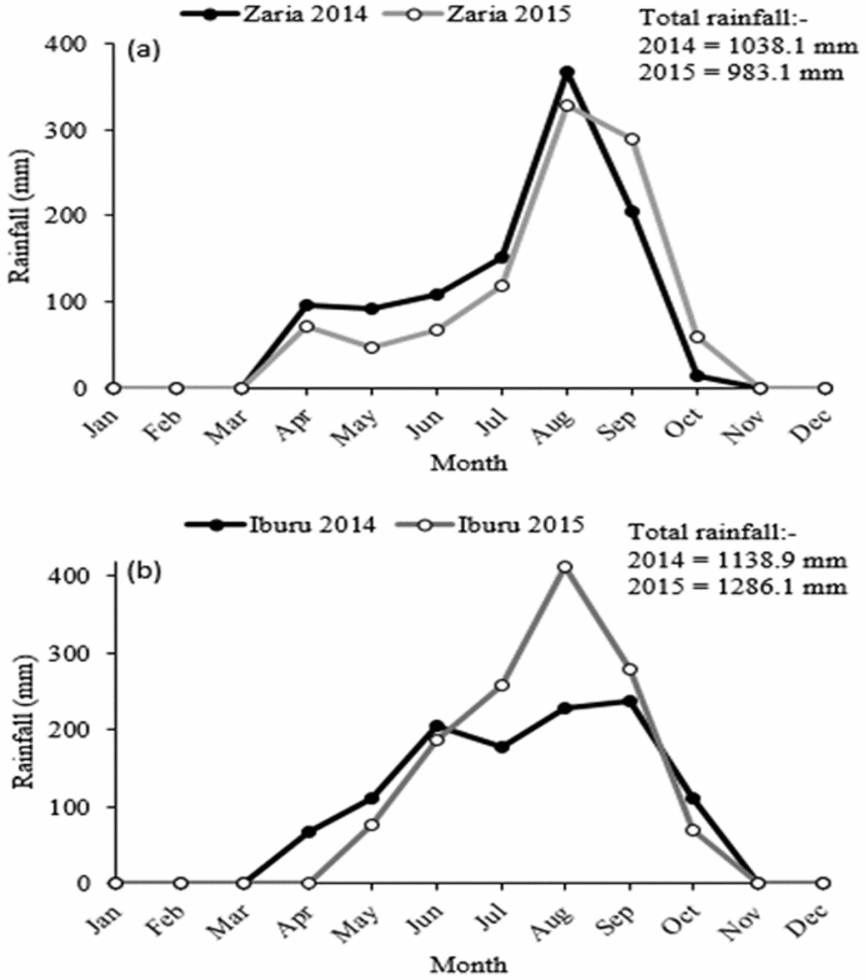
A two-year (2014 and 2015 growing seasons) study was carried out at the International Institute of Tropical Agriculture (IITA) experimental stations at Zaria (11°11’N, 7°38’E, 686 m asl) in the northern Guinea savanna and at Iburu(10o16’N, 7o46’E, 662 m asl) in the southern Guinea savanna. In 2014, the minimum and maximum air temperatures during the experimental period were 20.1 and 30.9°C (Zaria) and 20.8 and 31.2 °C (Iburu), respectively. In 2015, minimum and maximum air temperatures were 20.8 and 31.4°C, respectively in Zaria. In Iburu, minimum air temperature was 21.1°C and maximum temperature was 31.2 °C. The total rainfall received during the experimental period in 2014 was 941.6 mm in Zaria and 1071.0 mm in Iburu. In 2015, total rainfall was 911.6 mm in Zaria and 1285.0 mm in Iburu (Figure 1). Weather information was collected using WatchDog 2000 Series Weather Stations (Spectrum Technologies, Aurora, Colorado, USA), installed at the trial sites. Prior to establishment of the trials, soil samples were taken from each location in both years and analyzed using routine procedures prescribed by IITA (1982). The dominant soil type in Zaria was chromic acrisols while that of Iburu was cambic umbrisols (World Reference Base-FAO http://www.fao.org/soils-portal/soil-soey/soil-classification/world-reference-base/en/). The results of soil analysis showed that in Zaria, the soil had 490 g kg−1 sand; 330 g kg−1 silt; 180 g kg−1 clay; organic C of 8.6 g kg−1; N, 0.79 g kg−1; Mehlich P, 12.7 mg kg−1; K, 0.26 cmol kg−1 and pH 6.5. In Iburu, the soil had 560 g kg−1 sand; 240 g kg−1 silt; 200 g kg−1 clay; organic C of 5.5 g kg−1; N,0.65 g kg−1; Mehlich P, 2.9 mg kg−1; K, 0.16 cmol kg−1 and pH 5.
Monthly rainfall during the growing periods in (a) Zaria (b) lburu.
Treatments and experimental layout
There were four treatment combinations in the experiment: sole maize (M); sole soybean (S); maize spaced at 50 cm and intercropped with soybean (MS50); and maize spaced at 65 cm and intercropped with soybean (MS60). Early maturing maize (Zea mays L.) variety 2009 EVDT (mature between 80–85 days) and a medium maturing soybean ({Glycine max (L.) Mer.} variety TGX1951-3F (mature between 100– 110 days) obtained from IITA were used in this study. The experiment was laid out in a randomized complete block design with three replications. The experimental field was disc-harrowed and ridged before planting. Each treatment plot had four 5 m-long rows with spacing of 0.75 m between rows. For sole and intercropped maize, planting dates in 2014 were June 21 at Zaria and June 17 at Iburu. In 2015, planting dates were June 30 in Zaria and July 1 in Iburu. Sole maize was planted on the ridges at an intra-row spacing of 50 cm between plants stand with four maize seeds sown per stand and later thinned to two plants per stand. This gave a plant population of 53,333 plants ha−1. Soybean was also planted at the same time maize was planted. For sole soybean, seven seeds were planted per stand at intra-row spacing of 10 cm and later thinned to four plants per stand to give a final population of 533,333 plants ha−1. For MS50 intercrop treatment, the maize optimum population was maintained at 53,333 plants ha−1. Soybean was planted between maize having 50 cm spacing between plant stands. Seven seeds of soybean were sown between the maize stands at intra row spacing of 10 cm and later thinned to four plants per stand one week after planting. Similarly, for the MS65 intercrop treatment, soybean was planted between maize spaced at 65 cm between stands at intra row spacing of 10cm per stand. The maize population at intra-row spacing of 65 cm was 41,000 plants ha−1.
Cultural practices
For maize, the recommended fertilizer rate of 120:60:60 of NPK was applied using a compound fertilizer (NPK 15:15:15) to supply 60 kg each of N, P and K ha−1 at two weeks after planting (WAP) as basal application and urea (46% N) to supply the remaining dose (60 kg N ha−1) of nitrogen at 4 WAP. For soybean, recommended rate of 40 kg P2O5 ha−1 in the form of Single Super Phosphate was applied to both sole and intercropped soybeans at planting. Gramaxone (1:1-dimethyl-4,4-bipyridinum dichloride, Syngenta Crop protection AG, Switzerland) at a rate of 1 L ha−1 was applied immediately after planting maize using a knapsack sprayer. This was followed by hoe weeding at 4 WAP.
Measurements for IPAR and leaf area index
Leaf area index (LAI) and intercepted photosynthetically active radiation (IPAR) were measured at the flowering stages for both maize and soybean using AccuPAR model LP-80 PAR/LAI Ceptometer (Decagon Devices, Pullman WA, USA). Measurements of incident light above and below the canopies were used to estimate IPAR. Five above and below canopy measurements were taken from each plot and the displayed average was recorded. Three profiles of incident light below canopy were taken: (i) below maize canopy, but above soybean canopy for intercropped maize; (ii) below maize and soybean for intercropped soybean and (iii) the solar radiation measured on top and below the canopy of the sole crops for each plot. The sensor was placed diagonally across the two inner rows, such that the end of the sensor coincided with the line of the plants in each row. LAI of both crops were simultaneously recorded. Measurements were taken under cloud free conditions between 12:00 and 14:00 h. IPAR was calculated as unity minus the fraction of the average below canopy to above canopy measurements of each plot, as follows:
 $$\begin{equation}
{\rm{IPAR}} = \left[ {1.0-\left( {{\rm{PARb}}/{\rm{PARa}}} \right)} \right]
\end{equation}$$
where IPAR is intercepted PAR, PARa is PAR (μmol m−2 s−1) measured above maize/soybean canopy and PARb is PAR (μmol m−2 s−1) measured below maize/soybean canopy.
Yield and its components of maize and soybean
Data were collected from the two middle rows of each plot leaving the outside rows as borders. Maize was harvested at 90% physiological maturity. For maize, all the plants in a quadrat (1 × 1.5 m) placed across the two middle rows were harvested for dry matter determination. The samples were separated into leaves, stems and cobs. Leaves and stem were then sun-dried to constant weight. The cobs were shelled, weighed, counted and the grain moisture at harvest was then determined using a Farmex MT-16 grain moisture tester (Farmcomp Oy, Tuusula, Finland). Leaf, stem and grain weight were expressed as g m−2, which was then used to calculate total dry matter (TDM). The number of grains m−2 was also estimated. For grain yield determination, the remaining maize plants from the two middle rows excluding the quadrat area were hand-cut at the soil surface. Maize ears were removed, sun-dried for one week and shelled. Grains were weighed and added to those from the quadrat area and final grain yield was expressed as kg ha−1.
Soybean was harvested at pod maturity. A quadrat (1 × 1.5 m) was placed across two middle rows for the measurement of yield components and dry matter. The samples in the quadrats were separated into leaves, stem, pods and grain and sun-dried to constant weight. The weights of leaf, stem, empty pods and grain were expressed as g m−2 and summed to obtain TDM. The pods in each quadrat were harvested and counted before threshing. The number of pods and seeds in the quadrat were counted and expressed as units m−2. Pods from all the other plants from the two middle ridges excluding the quadrat area were harvested, threshed and weighed for grain yield. Grain yield (kg ha−1) was calculated based on assumed 12% moisture content. The moisture content of grain samples was determined with the Farmex MT-16 grain moisture tester.
Land equivalent ratio
The relative advantage of intercropping compared to sole cropping was calculated for each proportion using total LER. LER (LER) was calculated as the sum of the ratios of yield of each component crop in intercropping systems to its corresponding yield under sole crop (Mead and Willey Reference Mead and Willey1980):
 $$\begin{equation}
{\rm{LER}} = \left( {{\rm{Yab}}/{\rm{Yaa}}} \right) + \left( {{\rm{Yba}}/{\rm{Ybb}}} \right)
\end{equation}$$
where Yaa and Ybb are the sole crop yields of crops a and b, respectively, Yab is the intercrop yield of crop a, and Yba is the intercrop yield of crop b. In this calculation crop a is maize and crop b is soybean.
Gross monetary value and monetary advantage index
Gross Monetary Value (GMV) and MAI were calculated from the yield of maize and soybean in order to measure the productivity and profitability of intercropping as compared to sole cropping of the associated component crops. Crop value in the systems was calculated by converting the Naira value (₦, Nigerian currency; 1 USD = ₦ 200) to US dollars Monetary returns’ values were estimated based on the current market price of produce during the harvest period. Therefore, GMV was calculated by multiplying yields of the component crops by their respective current market price. MAI was computed as
MAI = (value of combined intercrops) × (LER – 1)/LER ((Layek et al., Reference Layek, Ramkrushna, Das, Ghosh, Krishnappa, Panwar, Azad Thakur, Ngachan, Zodape, Buragohain and Mawlong2014).
Statistical analysis
Combined analysis of variance (ANOVA) across years was performed for each location using the PROC Mixed procedure of SAS (SAS Institute, 2012). The significance of the treatment effect was determined using F-test. Differences between two treatment means were compared using LSMEANS statement (with option pdiff) of PROC MIXED code of SAS at 5% level of probability. The statement calculates the difference between two means and the standard error of the difference (SAS Institute, 2012).
RESULTS
Sole and intercropped maize
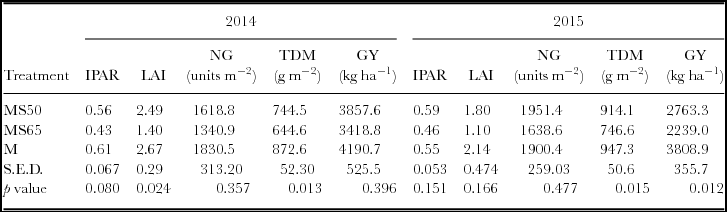
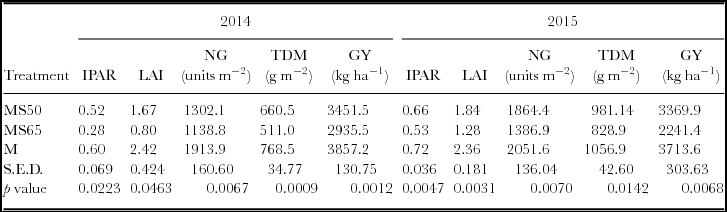
In Zaria, IPAR and LAI were similar for sole and intercropped maize spaced at 50 cm in both years (Table 1). Intercropped maize spaced at 65 cm had IPAR and LAI significantly lower than those of sole and intercropped maize spaced at 50 cm (Table 1). In Iburu, IPAR and LAI were significantly higher for sole maize than for intercropped maize irrespective of maize spacing (Table 1). Intercropped maize spaced at 50 cm also had IPAR and LAI that were significantly higher than that of intercropped maize spaced at 65cm (Table 1). Number of grains m−2 was significantly higher for sole maize than intercropped maize spaced at 65 cm in Zaria in 2014. In 2015, differences among the treatments were not significant (Table 1). In Iburu, sole maize produced number of grains that were significantly higher than that of intercropped maize in both years. The number of grains was significantly higher for intercropped maize spaced at 50 cm than that of intercropped maize spaced at 65 cm (Table 2).
Intercepted photosynthetically active radiation (IPAR), leaf area index (LAI), number of grains per m2 (NG), total dry matter (TDM) and grain yield (GY) of maize as influenced by intercropping in Zaria: maize + soybean-50 cm (MS50); maize + soybean-65 cm (MS65) and sole maize (M).
S.E.D. = standard error difference of least squares means.
Intercepted photosynthetically active radiation (IPAR), leaf area index (LAI), number of grains per m2 (NG), total dry matter (TDM) and grain yield (GY) of maize as influenced by intercropping in Iburu: maize + soybean-50 cm (MS50); maize + soybean-65 cm (MS65) and sole maize (M).
S.E.D. = standard error difference of least squares means.
TDM ranged from 645g m−2 for intercropped maize spaced at 65 cm to 872.2 g m−2 for sole maize in 2014 in Zaria. In 2015, TDM ranged from 746.6 for intercropped maize spaced at 65 cm to 947.3 g m−2 for sole maize (Table 1). In Iburu, TDM ranged from 511g m−2 for intercropped maize spaced at 65cm to 768.5 g m−2 for sole maize in 2014 and ranged from 828.9 g m−2 for intercropped maize spaced at 65 cm to 1056.9 g m−2 for sole maize in 2015 (Table 2). In both years, TDM was significantly higher for sole maize than intercropped maize in both locations. Intercropped maize spaced at 50 cm produced higher TDM than that of intercropped maize spaced at 65 cm in both locations and years (Tables 1 and 2).
In Zaria, grain yield for sole maize was not significantly higher than that of intercropped maize in 2014 (Table 1). In 2015, grain yield of sole cropped maize was significantly higher than that of intercropped maize and grain yield of intercropped maize spaced at 50 cm was also significantly higher than grain yield of intercropped maize spaced at 65 cm (Table 1).
In Iburu, sole maize produced higher grain yield than intercropped maize in 2014 (Table 2). Grain yield of intercropped maize spaced at 50 cm was also higher than that of intercropped maize spaced at 65 cm. In 2015, intercropped maize spaced at 65 cm produced the least grain yield (2241.4 kg ha−1) and grain yield of sole cropped maize was not statistically different from that of intercropped maize spaced at 50 cm (Table 2).
Sole and intercropped soybean
IPAR, LAI, number of pods m−2 for sole soybean were significantly higher than those of soybean intercropped with maize in both locations in both years (Tables 3 and 4). Intercropped soybean with maize spaced at 65 cm had IPAR and LAI higher than that of soybean intercropped with maize spaced at 50 cm in both years in both locations (Tables 3 and 4). Soybean intercropped with maize spaced at 65 cm produced more number of pods m−2 than those of soybean intercropped with maize spaced at 50 cm. Sole soybean produced number of grains m−2 that was significantly higher than those of intercropped soybean irrespective of maize population in both locations for both years (Tables 3 and 4). In Zaria, soybean intercropped with maize spaced at 65 cm produced more grains m−2 than soybean intercropped with maize spaced at 50 cm in both years (Table 3). In Iburu, soybean intercropped with maize spaced at 65 cm produced number of grains m−2 that was significantly higher than that of soybean intercropped with maize spaced at 50 cm in 2014. However, difference between soybeans intercropped with maize spaced at 50 and 65 cm was not significant for number of grains m−2 in 2015 (Table 4). TDM for sole soybean was significantly higher than that of soybean intercropped with maize in both locations and years (Tables 3 and 4). Difference in TDM between the intercropped soybeans was not significant except in Zaria in 2014, when soybean intercropped with maize spaced at 50 cm produced 13% lower TDM than soybean intercropped with maize spaced at 65 cm (Table 3). Grain yield of sole soybean was generally higher than that of soybean intercropped with maize in both locations and years (Tables 3 and 4). Soybean intercropped with maize spaced at 65 cm produced grain yield that was significantly higher than that of soybean intercropped with maize spaced at 50 cm in the 2015 growing season in both locations (Tables 3 and 4). In 2014, there was no significant difference between maize spacing with respect to soybean grain yield.
Intercepted photosynthetically active radiation (IPAR), leaf area index (LAI), number of pods per m2 (NP), number of grains per m2 (NG), total dry matter (TDM) and grain yield (GY) of soybean as influenced by intercropping in Zaria: maize + soybean-50 cm (MS50); maize + soybean-65 cm (MS65) and sole soybean (S).

S.E.D. = standard error difference of least squares means.
Intercepted photosynthetically active radiation (IPAR), leaf area index (LAI), number of pods per m2 (NP), number of grains per m2 (NG), total dry matter (TDM) and grain yield (GY) of soybean as influenced by intercropping in Iburu: maize + soybean-50 cm (MS50); maize + soybean-65 cm (MS65) and sole soybean (S).

S.E.D. = standard error difference of least squares means.
Land equivalent ratio and monetary advantage index
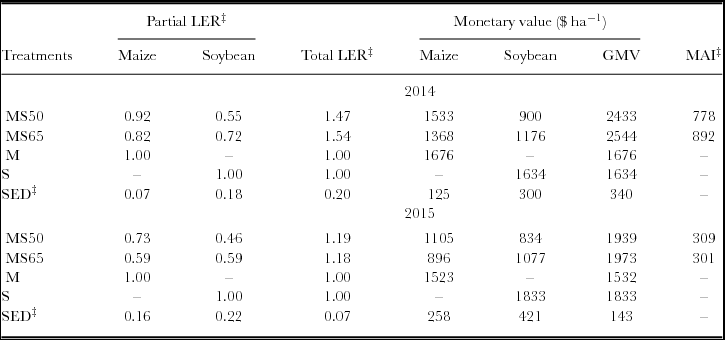
In both locations, the LER was greater than 1.0 in all the intercrop treatments (Tables 5 and 6). In Zaria, the LER was 1.54 in maize–soybean intercrop with maize spaced at 65 cm and 1.47 for maize-soybean intercrop with maize spaced at 50 cm in 2014. In 2015, though LER values were greater than 1, they did not significantly differ between maize spacing in the intercropping systems. The LER values were 1.18 for maize spaced at 65 cm and 1.19 for maize spaced at 50 cm (Table 5). In Iburu, LER for the maize–soybean intercrop was 1.33 for maize spaced at 50 cm and 1.23 for maize spaced at 65 cm in 2014. In 2015, LER was generally lower than the values in 2014 (Table 6).
Partial and total land equivalent ratio (LER), gross monetary value (GMV) and monetary advantage index (MAI) as affected by intercropping system in Zaria: maize + soybean-50 cm (MS50); maize + soybean-65 cm (MS65); sole maize (S) and sole soybean (S).
‡SED-standard error difference of least squares means.
Partial and total land equivalent ratio (LER), gross monetary value (GMV) and monetary advantage index (MAI) as affected by intercropping system in Iburu: maize + soybean-50 cm (MS50); maize + soybean-65 cm (MS65); sole maize (S) and sole soybean (S).
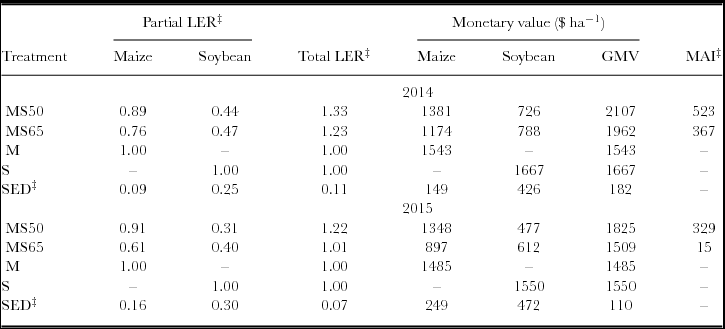
‡SED-standard error difference of least squares means.
In Zaria, the GMV was higher for the intercrops than the individual sole crops of maize and soybean in 2014 (Table 5). In 2015, GMV was also similar for the intercrops but higher for the intercrops than the sole crops. GMV for sole maize was significantly lower than that of sole soybean (Table 5). In Iburu, GMV was significantly higher for maize–soybean intercrops than the sole crops and differences between sole maize and sole soybean were not significant in 2014 (Table 6). In 2015, GMV for maize-soybean intercrop with maize spaced at 50 cm was significantly higher than those of the sole crop and intercropped maize spaced at 65 cm (Table 6). MAI was positive for all the intercropping systems in both locations and years (Tables 5 and 6). In Zaria, maximum MAI was obtained with intercropped maize spaced at 65 cm. In 2015, MAI for maize–soybean intercrop with maize spaced at 50 cm was not significantly different from the MAI of maize–soybean intercrop with maize spaced at 65 cm (Table 5). In Iburu, maize–soybean intercropping with maize spaced at 50 cm gave higher MAI than that of maize spaced at 65 cm in both years (Table 6).
DISCUSSION
IPAR and LAI were higher for sole maize in both locations and intercropped maize spaced at 50 cm than intercropped maize spaced at 65 cm in Zaria (Tables 1 and 2). This was because sole maize and intercropped maize spaced at 50 cm were planted at optimum population of 53,333 plants ha−1 and this population was 29% higher than intercropped maize spaced at 65 cm. High LAI increases light interception that translates into high dry matter and grain yield. For maximum crop growth rate, enough leaves must be present in the canopy to intercept most of the incident PAR. When crops are planted at high densities, the efficiency of light interception is improved as a consequence of increases in LAI (Xinyou et al., Reference Xinyou yin Egbert, Schapendonk and Xuhua2003) and a reasonable LAI is critical to maintain high photosynthetic rates and yield (Xiaolei and Zhifeng, Reference Xiaolei and Zhifeng2002).
Number of grains, TDM and grain yield of sole maize were generally higher than those of intercropped maize spaced at 65 cm and the performance of intercropped maize spaced at 50 cm was statistically similar to that of sole maize in Zaria in 2014 (Tables 1 and 2). The better performance of sole maize can be attributed to the fact that the population of maize was optimal. The comparable yield of intercropped maize spaced at 50 cm with that of sole maize may be due to the relatively higher rainfall in Zaria in 2014 than in 2015. This result shows that intercropped soybean did not affect maize performance under favourable conditions in 2014. In 2015, when rainfall was lesser in Zaria and in Iburu where soils are poorer, sole cropped maize outperformed all the intercropped maize (Tables 1 and 2). This may be due to competition for water and nutrients in the intercrop system and we already know that increased competition for water, nutrients, light or any combination of the three ultimately leads to changes in crop productivity levels (Carruthers et al., Reference Carruthers, Prithiviraj, Fe, Cloutler, Martin and Smith2000). The results are contrary to ones reported by Singh et al. (Reference Singh, Singh, Rao and Shekhar2008), which showed that cereals like maize, sorghum and pearl millet can be used for intercropping with soybean due to their dissimilar growing patterns, morphology, phenology and nutrient requirement.
Sole soybean had higher IPAR, LAI, number of pods m−2, number of grains m−2, TDM and grain yield than intercropped soybean (Tables 3 and 4). This may be due to competition with the taller maize plant for light as shown by reduced IPAR, nutrients and water. This finding agrees with Muneer et al (Reference Muneer, Fida, Mumtaz and Muhammad2004), who had reported higher seed yield of sole over intercropped soybean. Accordingly, Osang et al. (Reference Osang, Richard and Degri2015) found that shading by the taller plants in mixture could reduce the photosynthetic rate of the lower growing plants and thereby reduce their yields. Wider spacing of maize to 65 cm between stands increased intercropped soybean yield probably due to less shading and competition for resources with maize plants. Competition for water, nutrients and light are probably the two factors that reduced soybean yield under higher maize density in intercrop (Lesoing and Francis, Reference Lesoing and Francis1999).
The productivity of intercropping was evaluated using the partial and total LER as indices (Tables 5 and 6). According to Matusso et al. (Reference Matusso, Mugwe and Mucheru-Muna2013) and Egbe et al. (Reference Egbe, Alibo and Nwueze2010) if the LER is equal to 1.0, there is no difference in yield between growing the crop in pure or mixed stand. If the LER is greater than 1.0, there is a yield advantage when both crops were grown as mixed, as compared to pure stands. If however, the LER is less than 1.0, it will be better in terms of yield to grow both crops separately, as it indicates yield disadvantage. Herein, LER was greater than 1.0 for all the intercrop treatments, indicating that it is advantageous to grow maize and soybean in association as compared to pure stands. This shows that intercropping maize with soybean was better than their respective sole cropping. Maize spaced at 65 cm produced higher LER than that of maize spaced at 50 cm in Zaria 2014 because of high partial LER of soybean in the intercrop with maize spaced at 65 cm (Table 5). In 2015, LERs were greater than 1.0 for the intercrops and similar for the two intercrop spacings. This suggests that under the prevailing conditions, maize spacing in the intercrops was not significant. In Iburu, LER was also higher than 1.0 in both years (Table 6). Values were higher for maize spaced at 50 cm than maize spaced at 65 cm in 2014. In 2015, only maize spaced at 50 cm showed any significant advantage over sole crop components. LER higher than 1.0 was already reported in maize–soybean intercropping as compared to monocropping (Matusso et al., Reference Matusso, Mugwe and Mucheru-Muna2013; Muneer et al., Reference Muneer, Fida, Mumtaz and Muhammad2004; Solanki et al., Reference Solanki, Singh and Sumeriya2011). The higher productivity of the intercrop system compared to the sole crop may have resulted from complementary and efficient use of resources by the component crops (Liu et al., Reference Liu, Zeng, Jiao, Hu, Wang and Li2006). LER value of 1.01 for maize spacing at 65 cm suggests that intercropping did not confer significant advantage over sole cropping. The maize component contributed more to the total LER of the mixture as shown by the partial LER of maize (Table 6). Ghaffarzaeh et al. (Reference Ghaffarzaeh, Prechac and Cruse1994) reported that soybean yield tends to be lower whilst maize yield tends to be higher under soybean–maize intercropping systems. In cereal–legume intercropping, the cereal components usually tend to have greater competitive ability because of their relatively high growth rate, height advantage and larger root system.
The high GMV for all intercrops in Zaria in both years and in Iburu in 2014 and for intercropped maize spaced at 50 cm in Iburu in 2015 suggest that intercropping maize and soybean is profitable. Our results corroborate findings of Seran and Berintha (Reference Seran and Brintha2010), who reported that intercropping system gave higher cash return to smallholder farmers than growing as the monocrops. The non-significant GMV for intercropped maize spaced at 65 cm in Iburu in 2015 was due to poor performance of component crops during this year as confirmed by the low LER of 1.0.
Profitability of intercrops depends on the prevailing price of component crops and may also depend on the productivity of component crops. In this study, the prices of maize and soybean were favourable and this made intercropping profitable for all intercrops in Zaria in both years and in Iburu in 2014. Maize–soybean intercropping with maize spaced at 65 cm was less profitable because of low productivity of both the maize and soybean crop. Based on the economic analysis, intercropping of soybean with maize was more advantageous than sole cropping. In agreement to this, Solomon and Kibrom (Reference Solomon and Kibrom2014) reported that GMV of intercrops was higher than sole maize and Sibhatu et al. (Reference Sibhatu, Belete and Tessema2015) reported higher LER and GMV for sorghum–cowpea intercropping system as compared to sole cropping in Ethiopia.
MAI was positive for all intercrop in both locations and years (Tables 5 and 6), which shows definite yield and economic advantages compared to the sole cropping systems tested in our study. The highest MAI (US$892) was observed with maize–soybean intercropping at maize spacing of 65 cm in Zaria, 2014 (Table 5), being a consequence of high crop value of soybean. In 2015, MAI was similar for the two maize spacings in Zaria because LER values for the two maize spacings in the intercrop system were also similar. MAI was generally lower in Iburu than in Zaria because of low crop yields and low monetary value of the component crops in Iburu (Table 6). Maize–soybean intercrop with maize spaced at 50 cm gave higher MAI than maize spaced at 65 cm. The lowest MAI of US$15 obtained with maize spaced at 65 cm in 2015 is not surprising because LER for the 65 cm spacing was very low. Accordingly, Ghosh et al. (Reference Ghosh, Manna, Bandyopadhyay, Ajay Tripathi, Wanjari, Hati, Misra and Acharya Subba Rao2006) reported that if LER values were higher, there was also economic benefit expressed with MAI values.
CONCLUSION
The results of this study showed that the productivity of maize-cropping systems can be improved by intercropping soybean between maize plants as confirmed by high LER and GMV. The calculated LER exceeded unity in both maize spacings, indicating that intercropping was advantageous due to higher exploitation of the limited environmental resources. MAI was positive for all intercrops in both locations and years, which shows definite yield and economic advantages compared to the sole cropping systems tested.


 Open access

