Introduction
Bankruptcy colloquially denotes failure: an inability to repay one’s debts, but the term also denotes a precise legal process set out, ex ante, to structure the terminal relationship between a firm or person and the creditors. In this context, the rules relating to bankruptcy represent a state-sponsored mechanism to solve a collective action problem that occurs when there are too few assets to meet the obligations.Footnote 1 In a world without a bankruptcy regime, each creditor would have to individually negotiate with the debtor. In the event that a creditor believes that the borrower might be in financial difficulty, this can lead to a race to acquire all the assets before other creditors, with more powerful or well-connected creditors having greater power than smaller or less-connected creditors, resulting in an inefficient allocation.
The anticipated outcome from any contract between borrowers and lenders is that all creditors will be repaid in full; if this does not happen, however, then bankruptcy procedures prescribe the distribution of remaining assets among the various creditors. These rules are important because they have implications for the level of risk-taking and entrepreneurship in the economy by affecting the willingness of creditors to lend and of investors to borrow, and therefore the level of economic growth. In an examination of the role of exemptions (assets to remain with the bankrupt) in U.S. Chapter 7, Wei and White demonstrate that potential entrepreneurship is positively related to the extent of state-level exemptions allowed to the bankrupt, with higher levels of exemptions by the state positively correlated with higher entrepreneurship in that state.Footnote 2 In 2012, querying a lack of European entrepreneurs, The Economist similarly argued that the role played by state bankruptcy rules and the time to discharge or exit from bankruptcy was equally as important as labor law and availability of venture capital in promoting business start-ups.Footnote 3
Failure is, of course, a fundamental component of risk-taking. Not all new ventures will succeed and, indeed, the very process of “creative destruction” means that there will be churning in mercantile, manufacturing, or industrial sectors, and that not all failures or cases of insolvency result in bankruptcy proceedings. When they do, though, the procedures become important. There is another aspect to the rules, however. As Hart has argued, bankruptcy rules influence how easily or otherwise a failed entrepreneur can restart a business or have a fresh start; thus, the greater the barriers that a bankrupt faces prior to restarting a business, the lower the level of human capital in the economy.Footnote 4 This is documented also by Di Martino in his examination of entrepreneurial failure in early twentieth-century England.Footnote 5 Thus, if the rules are too harsh, borrowers will borrow less; if they are too lenient, creditors will be less willing to lend, with the resulting equilibrium determining the flow of funds, entrepreneurial activity, and economic growth.Footnote 6
In this article we examine these issues of failure, exemption, and fresh start through the lens of a change in English bankruptcy rules in the early eighteenth century. In particular, we examine a change that took place in 1706 related to the statutory rights of bankrupts. Until 1706, English bankrupts had no rights. They were required to fully repay all debts before they could be discharged from the state of bankruptcy, and if the assets did not cover the debts (which is the definition of being bankrupt), any future income could be claimed by the creditors. The 1706 statute allowed for both a financial exemption of 5 percent of the estate recovered up to £200 (previously a bankrupt was left with zero assets) and for creditors to voluntarily discharge a debtor from bankruptcy prior to full repayment of his or her debts (previously a discharge required full repayment of the debts owing). In essence, the new law potentially allowed a bankrupt the possibility of a fresh start with some wealth left in hand. We say potentially because a discharge required that four-fifths of the creditors by number and value of debts voluntarily relinquish remaining debts owed to them. If four-fifths of creditors agreed, then this would be binding on all remaining creditors. The law increased benefits from compliance, and thus increased the incentive to comply (the statute also increased the penalty for noncompliance by bankrupts, as we discuss below). However, if creditors refused to issue a discharge, then the old rules applied.
Using previously unexamined ledger books from The National Archives in England, we document creditors’ willingness to discharge in the aftermath of the statute change. Relative to the extant literature, which is discussed below, we show that this institutional and legal change was quickly embraced by the mercantile community with high rates of discharge being granted to bankrupts. Because of the limited surviving evidence related to those who were discharged, we could look only indirectly at evidence of the impact on second chances for discharged bankrupts, the return of human capital into the economy, and entrepreneurial risk-taking. We argue that, by combining the rapid response to the legal changes in bankruptcy with the indirect evidence on the impact of this change on entrepreneurial activity, discharge can be seen as part of the Financial Revolution that promoted and encouraged the English economic growth that was manifested by the end of the eighteenth century. Other changes included the growth of the stock market, creation of the Bank of England, and recoinage of the currency.
The article is structured as follows. We first provide a short review of the literature pertaining to the role of institutions, the legal framework, and economic growth in order to give context to our discussion of the statute law and literature pertaining to bankruptcy in England, from Henry VIII to Anne I. We then describe the data we used to examine the extent of discharge. These data allowed us to measure the rate at which bankrupts received a discharge, and because we had the names of both bankrupts and at least four-fifths of the creditors, we also explored possible connections between creditors and debtors. We asked why creditors might have been interested in granting a discharge and thus abrogating their right to a future stream of income. In the final section, we offer some concluding remarks.
Creditors, Debtors, and the Role of Bankruptcy
Exchange occurs when individuals see the opportunity for mutual gain and have the wealth or credit to facilitate the interaction; as a result, domestic and international trades have a long history. Equally long is the history of disputes over repayment, lack of payment, theft, or default, with rules developed to reduce, mitigate, or arbitrate those disputes. The literature on the development of rules regarding contracts and contract enforcement is very large, so here we touch only tangentially on the subject. For example, Milgrom, North, and Weingast discuss the role of the law merchant in mediating conflict at the Fairs of Champagne.Footnote 7 More recently, Greif elaborates on the development of the community responsibility system, found in many areas of Europe from the eleventh to the fourteenth centuries.Footnote 8 Central to this system was the role of the “community,” which is embodied in the understanding that if any one merchant defaulted, a creditor could seek recourse from any other merchant within the same community. For example, in 1323, when Henry Nasard, a London merchant, failed to repay his debt to William Virgil, a merchant in Dover, Virgil confiscated the goods of John de Grantham, another London merchant.Footnote 9 In response, the London merchant community took action to ensure that Nasard repaid his debt, Virgil received his money, and de Grantham had his goods returned.
This system allowed creditor–debtor resolution between any pair of merchants within the same merchant community, even if they did not know one another, because, in essence, the goods of every individual member had been posted as bond for the conduct of every other member. However, as the range and number of independent traders grew, such a system broke down and was eventually replaced with greater use of the legal system, with merchants registering their credit relations in local courts using their own goods and property as collateral.Footnote 10 The use of local courts, in turn, gave rise to the state as a third-party enforcer.
The rise of the state as a third-party enforcer is in line with North’s contention that for an economy to grow beyond sets of personal or quasi-personal relationships, “societies need effective, impersonal contract enforcement, because personal ties, voluntaristic constraints, and ostracism are no longer effective as more complex and impersonal forms of exchange emerge.”Footnote 11 The role of legal institutions as impersonal contract enforcement mechanisms is explored by, among others, La Porta, Lopez-de-Salines, Schleifer and Vishny, and Glaeser and Schleifer, who, among others, focus on the differential impact of the legal origins of countries on subsequent economic growth: in particular, the impact of a common law relative to a civil law tradition.Footnote 12 Focus on the role of legal origins and its implications for bankruptcy and growth can be found in the work of Safley, Sgard, Hautcoeur and Di Martino, and Vause, who examine these issues in the European context across different centuries.Footnote 13 In this article, we follow in this tradition but focus only on a particular change in English statute law in the early eighteenth century.
Economic growth requires not only the development of anonymous relationships but also the development of legal structures that guarantee impersonality—treating everyone the same without regard to their individual identity. Wallis would argue that along with security of property rights, impersonality ranks near the top of good institutional outcomes in what he calls the pantheon of growth theory.Footnote 14 Although impersonality is not a characteristic often associated with early modern England, it is displayed, at least in part, in the operation of its bankruptcy statutes that we discuss below.
Bankruptcy, as we noted above, is a state-sponsored dispute resolution settlement system that lays out ex ante the rules that apply in the event that a borrower abrogates his or her debt. What is fundamental about any bankruptcy system is that the actual rules are critical in that they prescribe how the debtor’s assets, insufficient to fully repay the debts, will be allocated among the creditors. Will all creditors be treated equally? Will some debts have seniority? Will the firm itself will be sold as an ongoing concern? Will sanctions be levied against the bankrupt? Will any assets be left with the bankrupt?Footnote 15 The impact on economic growth depends on both the ex post outcomes and ex ante behaviors theoretically modeled by Hart and clearly described in Di Martino. For any bankruptcy system, the ex post objectives are twofold: to maximize the payout to creditors and to avoid loss of entrepreneurial skill in the economy. The ex ante objectives are to attenuate debtor misconduct and to support entrepreneurship.Footnote 16 Finding the balance between protecting creditors (or encouraging lending) and encouraging entrepreneurs (or reducing the costs of failure) continues to be addressed in bankruptcy rules and systems across countries even today.
Indeed, as the Economist noted in 2012, rules vary greatly across countries, with some more creditor-friendly (i.e., with harsher bankruptcy rules) and others more debtor-friendly (i.e., with more lenient bankruptcy rules). Legal systems that have harsher treatment of bankrupts often view failure as an implicit manifestation of fraudulent behavior—borrowing money with the intention perhaps of never repaying, or as de facto evidence of not handling others’ money with sufficient care and attention. The countervailing view allows that failure to be the result of misfortune or accident. The tension that has to be navigated by the bankruptcy code is that for any set of bankruptcies, some will likely be the result of fraud and others the result of misfortune due to some negative exogenous shock. In the next section, we describe the history of English bankruptcy statutes from their inception to the change in 1706, which allowed creditors to differentiate between malfeasant and misfortunate borrowers by voluntarily granting a discharge to some but not all bankrupts, creating an incentive for self-revelation.
English Bankruptcy Statutes
The most comprehensive work on English bankruptcy statutes and the relevant court rulings is by Jones.Footnote 17 Hoppit examines the extent of bankruptcy filings by occupation, decade, and regional location over the eighteenth century.Footnote 18 However, he does not focus on discharge. Bankruptcy is generally the final step in a potentially lengthy period of debt-repayment extensions and renegotiations. Indeed, some insolvents were able to amend the terms of the contract to arrive at a composition with their creditors, and, eventually, to repay the debt without being declared bankrupt. Others were ineligible to be declared bankrupt, and their creditors would have to pursue other avenues for debt repayment, such as debtor’s prison. Here we examine only that subset of all insolvent debtors who were formally declared bankrupt.
Bankruptcy represents a business failure that comes historically and in many countries even today with a social stigma or social exclusion that attenuates the willingness of parties to declare bankruptcy. At the end of the eighteenth century, the stigma was such that Adam Smith wrote of bankruptcy as “the greatest and most humiliating calamity which can befall an innocent man. The greater part of men, therefore, are sufficiently careful to avoid it.”Footnote 19 Not all were able to do so, regardless of social standing. Sir Stephen Evance was a goldsmith banker who, in the aftermath of the Glorious Revolution, was one of the main domestic lenders to the crown. However, during the 1700s, he undertook a number of unsuccessful private ventures and was declared bankrupt on December 31, 1711, by Peter Percival, esquire, of London, a former partner and creditor, for reputedly owing more than £100,000 (nearly £14 million in 2018 pounds).Footnote 20 The formal notice appeared in the Financial Gazette on January 3, 1711.Footnote 21 This was to be a very complicated bankruptcy situation, with the case still being adjudicated in 1744, thirty years after Evance’s death by his own hand in March 1712.Footnote 22
Facing insolvency, some debtors might borrow more to pay off loans coming due or renegotiate contracts with individual lenders or with sets of lenders, all of which could make the situation worse. In some cases, debtors looked to Privy Council and Chancery courts to encourage creditors to reorganize or agree to a composition of the debts that would be binding on all creditors. In England, the ability of debtors to use the authority of the King, the Privy Council, and the Chancery to impose a renegotiated contract on recalcitrant creditors was abolished first by royal proclamation in 1621 and then by parliamentary statute in 1624.Footnote 23 While borrowers could try to persuade creditors to renegotiate their contracts, without the power of the legal system, any one single creditor held the authority to have the debtor declared bankrupt—an action that was then binding on all other creditors.
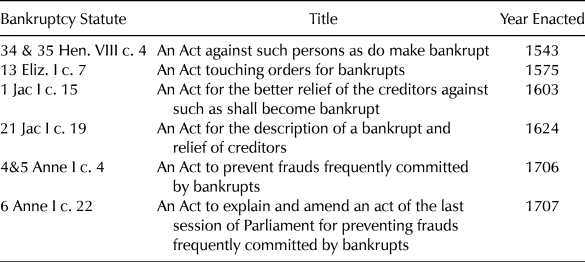
The actual procedures, rules, and rights of creditors and debtors in a bankruptcy situation were set out in statutes in 1543 (Henry VIII), 1572 (Elizabeth I), 1603 and 1624 (James I), and Anne 1 (1706). The statutes from 1543 to 1706 defined and underpinned the security of property rights for a subclass of creditors and debtors (Table 1).The first general statute, passed in 1543, set out the procedure that would carry through to the middle of the nineteenth century, at which time there was a major restricting of the bankruptcy code. “An Act Against Such Persons As Do Make Bankrupt” (34&35 Hen. VIII c. 4) stated that in the event of a failure to repay, any single creditor of the borrower who made a complaint in writing to the Lord Chancellor may set in motion a commission of bankruptcy. The law noted what constituted an act of bankruptcy, such as fleeing the country, closing one’s door to creditors, or lying in prison. Here we use the term failure-to-repay as shorthand for any of these actions. It then set out the commission’s powers. Thus, in response to any written complaint, the Lord Chancellor was required to create a commission comprising five individuals well known in the local merchant community, whose responsibility it was to ensure a search, seizure, and sale of all of the debtor’s assets and then to divide the proceeds on an equal pro-rated basis among the creditors. Commissions were instituted for each individual case, and the members were prominent business men who understood the world of debt and credit and could read the account books. All creditors, regardless of social status, size of the debt, or seniority received (or were compounded at) the same number of shillings per pound. No creditor was required to take part, but if he or she made that choice he or she could only recoup debts from any subsequent earnings or assets of the bankrupt. With this legislation, every creditor was treated impersonally, placed on the same horizontal platform, and had the same rights as any other, including the right to bring about a bankruptcy. The bankrupt could only be discharged from the legal state of bankruptcy when all debts were repaid in full. It would not be until the sweeping changes in the mid-nineteenth century that a debtor could self-declare bankruptcy and the use of bankruptcy court began; until that time, a debtor had to be declared bankrupt by a creditor.
Bankruptcy statutes in early modern England

Source: British History Online, The Statutes of the Realm.
Subsequent statutes amended the eligibility for bankruptcy by occupation, gender, size of debt, or nationality, with certain statutes either broadening or restricting access. In 1572 it was declared that only those debtors who were a “merchant or other person using or exercising the trade of Merchandise way of bargaining exchanging recharge barter Chevisance or otherwise, in gross or by retail, or seeking his or her trade by buying and selling” were eligible (13 Elizabeth I c. 7, §1). In 1603, the occupation classes were expanded to include scriveners and those “receiving other men’s money or estates into his trust or custody” (I James I c. 15, §2). The application of the statute by occupation would not change until the sweeping changes of the mid-nineteenth century. It is often incorrectly stated that the statute applied only to merchants; in fact, the statute applied to those who made their living by buying and selling, which is much broader than how the term merchant was understood in early modern England. The definition of those who made their living by buying and selling, and which occupations were covered, exercised the English courts and Parliament throughout the seventeenth and eighteenth centuries.Footnote 24
With 21 James I (1624), access to bankruptcy was restricted even within those who made their living through buying and selling by requiring that the debt owed be greater than £100. In real terms, this is the equivalent of £17,300 today. In income value, it is £455,100.Footnote 25 At the same time, the statute was expanded to cover both citizens and aliens; in all cases, the statute covered both male and female debtors and creditors. Creditors of insolvent debtors not covered by the bankruptcy law were forced to use suasion, debtors’ prisons, or an inefficient race to get the remaining assets before the other creditors. For very small loans less than £2, the equivalent of a small claims court could be used. Another piece of important legislation passed in the final years of the James’s reign made state-sponsored compositions illegal. These were renegotiations of the debt across the majority of the creditors, in which the state imposed the renegotiation on the minority.Footnote 26
Thus, if and only if the insolvency met these conditions, the rules regarding bankruptcy were available to all regardless of social status, gender, or citizenship. These rules applied throughout the seventeenth century and were only amended in the first decade of the eighteenth century in 4&5 Anne 1 c. 4, which we discuss below.
The situation facing a bankrupt in the seventeenth century was harsh and unvarnished. A bankrupt had no legal rights to any personal assets, whether house, clothes, or furniture, and no legal exit from the state of bankruptcy until and unless all debts were fully repaid. The bankrupt could be imprisoned, placed in the stocks, or have an ear cut off. Until his or her debts were fully repaid, creditors had a claim on all future earnings and the legal right to dun or importune the bankrupt or the bankrupt’s estate, as mentioned above regarding Sir Stephen Evance.
Being stripped of all income, wealth, assets, and house meant that a bankrupt faced a life of penury and poverty unless family and/or friends stepped in. For those facing the threat of a bankruptcy by any single creditor, such a situation created an incentive for the bankrupt to hide assets, to lie about the extent of assets remaining, or to flee the country. Additionally, the creditors’ legal right to attach all future earnings reduced the incentive for anyone declared bankrupt to go back into business—or at least to do so in an area in which the bankrupt was known. Thus, the mechanics of the system created an incentive for potential bankrupts to hide assets, but the very hiding was an act of fraud against the creditors. Even if there had been nothing fraudulent in the actual operation of the business, the attempts to hide assets to pay for food, lodging, and clothing left a bankrupt open to such a charge.
The harsh and uncompromising nature of the seventeenth bankruptcy code changed with the passage of 4&5 Anne I c. 4 and 6 Anne I c. 7. Under 4&5 Anne, the decision to award a discharge was left to the commissioners without input from creditors. Passage of 6 Anne the following year changed this provision by requiring that a full four-fifths of creditors by number and value of the debt agree. If no objection was lodged, the discharge was granted. If there was an objection, the case would be forwarded to the courts for adjudication.
Despite the title of 4&5 Anne I c. 4—“An act to prevent frauds frequently committed by bankrupts”—and a continuity of language about a debtor’s “intent to defraud and hinder their creditors,” what is striking is a statement in the act that bankruptcy could be the result of “unavoidable misfortunes.” This was a fundamental shift in legal position. Indeed, the bill sent to Parliament did not contain a clause on discharge; instead, it emerged with an added proviso that discharge could be granted. The act contained a second added provision, too: commissioners should not be paid for any expenses out of the estate.
The Anne statutes made a number of very important changes. Most importantly, they specified that if the debtor was found to have complied with the bankruptcy proceedings and four-fifths of the creditors by number and value of debts agreed, the bankrupt would receive a discharge from the state of bankruptcy, with all remaining debts expunged. Compliant referred to the willingness of the bankrupt to work with the bankruptcy commissioners, truthfully revealing the extent of remaining assets. Such compliance would be attested to by the commissioners, who were prominent merchants in the community, but it was for the creditors to decide. The statutes also specifically allowed for an exemption of 5 percent of the value of the estate, or up to £200, for those bankrupts who were compliant. Regardless of how compliant a bankrupt might be, a discharge could not be issued if the bankruptcy was the result of gambling. For bankrupts who flagrantly and deliberately sought to hide assets or to evade the commissioners, the statute specified that such conduct, if proven in a court of law, could result in capital punishment. There were perhaps six people hanged over the century, not for being bankrupts but for committing fraud and theft.
This shift from an assumption of malfeasance to allowance for misfortune reflects a century-long discourse on the causes of bankruptcy, best presented by McCoid, who calls discharge the most important development in bankruptcy history.Footnote 27 Whereas McCoid looks at the history of the discourse throughout the seventeenth century and sees the legal changes in 1706 as its culmination, Kadens argues that it was the fraud attempted in the Pitkin Affair in 1705 that led to the discharge amendment in this bill.Footnote 28 Regardless of whether proximate events or more incremental movements were more important, there is a history of attempts throughout the seventeenth century to allow for less harsh treatment of bankrupts, prompted by bankruptcies resulting from negative exogenous shocks such as the outbreak of plague mid-century, the Great Fire in 1666, the Stop of the Mint in 1672, and the sinking of the Assyrian fleet in 1696 (which led to the bankruptcies of many who had insured the fleet). Together with a growing understanding of probability and risk and a changing perception of the structure of economic growth, all of these events led to more focused attention on bankruptcy seen in the pamphlets and broadsheets of the period, exemplified by Daniel Defoe in his Review.Footnote 29 Thus, while pressure for discharge was growing, Leonard argues that the actual structure found the 1706 statute mirrors that suggested for the bankruptcies following the sinking of the Assyrian fleet ten years earlier.Footnote 30
Important also is our understanding of the term “fraud.” As used in the seventeenth and early eighteenth centuries, the word had two very different meanings. The first meant, as it does today, criminal deception. An excellent example of this is Kadens’s description of the Pitkin Affairs, in which the parties were found to have acted fraudulently and the creditors took them to court for recourse.Footnote 31 The second meaning of fraud, as used then but much less often today, is “a quality of disposition of being deceitful; faithlessness, insincerity.”Footnote 32 Here, the use conveys individuals who were not legally or criminally fraudulent but rather did not make the interest of others’ resources paramount in their actions. We would argue that the Anne statute sought to differentiate between those who were misfortunate, those who were perhaps somewhat deceitful, and those who were legally fraudulent. Of course, those found legally fraudulent would be handed over to the courts and tried; if found guilty, they could be hanged, as in the case of Richard Towne.
No one was hanged for being a bankrupt; rather, they had to act in a way that left them open to a charge of grand theft. This is best exemplified in a bankruptcy from 1712 when a writ was issued against Richard Towne, a tallow chandler. Towne, rather than complying with the commissioners and documenting his remaining assets, decided to abscond. According to the Old Bailey record, Towne tried to flee to Holland with all his assets and his account books. Unfortunately, the weather turned foul and the boat returned to London, where Towne was arrested on the docks and found to have jewels and his account books on his person. He was arraigned at the Old Bailey where he was found guilty of deception and grand theft, and hanged.Footnote 33 Towne was obviously a bankrupt who, through his actions, declared himself to be a bad debtor and thus ineligible for a discharge. Those whose debts were caused by gambling were also ineligible, but the issue facing the creditors was whether all others were deserving of a discharge.
Clearly, the procedure whereby a letter to the Lord Chancellor from any single creditor resulted in a writ of bankruptcy being issued was itself open to malfeasance by third parties. No debtor wanted to be declared bankrupt because his or her name, reputation, and standing suffered. Yet, until 4&5 Anne, there was nothing to prohibit one merchant from destroying a competitor’s reputation in this way. With this statute, each creditor was required to post a bond of £200, which would be lost in the event that the bankruptcy was not proven or their debts not proven. Given that creditors were swearing to monies owed, claiming nonexistent debts was also fraud in the legal meaning of the term. It should be noted that the act also required that the declaration of bankruptcy and all subsequent matters relating to the case be posted on multiple occasions in the London Gazette. Writs of bankruptcy are still posted in the Financial Gazette.
Empirical Evidence of Discharge
Discharge of bankruptcy was made a possibility in 4&5 Anne, which granted authority to the commissioners to grant a Certificate of Conformity if they alone deemed the bankrupt worthy independent of the creditors. Meanwhile, 6 Anne, passed in the subsequent year, gave that authority back to the creditors. It did not, however, give any one creditor veto power but rather required only four-fifths of the creditors by number and value approve in order for a discharge to occur. The granting of a discharge required a number of steps. First, the bankruptcy commissioners had to determine if the bankrupt had complied with all that was required of him or her in the bankruptcy proceedings. Had the bankrupt handed over the account books? Had the bankrupt declared or revealed all known assets? Had the bankrupt answered all questions? Had the bankrupt’s problems arisen from gambling? If the commissioners deemed that the bankrupt had behaved appropriately and conformed to the requirements of the statute, the creditors were then asked if they agreed. If commissioners agreed (4&5Anne) and then four-fifths (6 Anne) assented and signed off (binding on all creditors), then a Certificate of Conformity was issued and sent to the Lord Chancellor, who would issue the writ of discharge.
Nothing in the statutes forced creditors to grant a discharge. Indeed, what the granting of a discharge meant for the creditors was that they gave part of the debts owed to them back to the bankrupt in the form of an allowance (exemption) and agreed not to pursue the unpaid portion of the debt. The fact that discharge was a voluntary relinquishment of assets by creditors may be why it has been assumed to happen infrequently. For example, in its Glossary of Bankruptcy Terms, which describe a Certificate of Conformity, The National Archives writes, “Creditors frequently withheld consent until they had been paid what they considered a reasonable proportion of their debts and many, it is said, refused for spite or because they thought bankrupts had acted fraudulently.”Footnote 34 Marriner writes, “Many bankrupts were never granted certificates.”Footnote 35 Similarly, Duffy, in describing its operation, argues, “[The] power thus given to the minority of vengeful creditors ensured that deserving bankrupts were frequently denied their discharges for years.”Footnote 36
Description of the Ledgers
To what extent discharge was granted is an empirical question. Fortunately, two unexamined and unexplored Certificate of Conformity ledger books exist for the first half of the eighteenth century.Footnote 37 These ledgers document the final phase of the discharge procedure—the granting or not of a Certificate of Conformity by the creditors. These two ledgers, which are rare, provide quantitative evidence on the extent of discharge. The first ledger set covers the period almost immediately after the passing of the Anne legislation, from September 1710 to April 1714. This ledger set takes the form of a preset, fill-in-the-blank template in which the clerk filled in the required information. The second ledger set covers from 1733 to 1751, by which time the Anne statute was in operation for three decades. The original Anne statute was passed with a finite life of only three years. Legislation was extended over the course of the next three decades, until it was passed with a perpetual life in 1740. The continuing extension of the statute provides clear evidence of its value to bankrupts and creditors. The benefit of the earlier ledger is that it allows us to see if, how quickly, and to what extent creditors responded to the change in the law and, correspondingly, whether bankrupts benefited from the change.
Both ledgers give the same information: name of the bankrupt (and thus gender by virtue of the first name), location, occupation, and date of issue of the Certificate of Conformity. The information for the earlier ledger is more complete and interesting in that it also lists the names of the commissioners involved, providing some documentary evidence on the role of large and important merchants in overseeing the process, as well as the names of the creditors who signed off on the discharge. What is not given, with two exceptions discussed below, is the amount of the debts owed. Because bankruptcy was handled by a commission struck separately for each case rather than in a bankruptcy court environment, there is no central archive holding the documents for each case. Because of the lack of existing documentation, it is impossible to compare the activities of different commissions. A formal bankruptcy court structure only emerged with the wide-ranging changes in bankruptcy in the mid-nineteenth century.
Although the existence of these ledgers is de facto evidence that at least some discharges were granted in response to the passing of the Anne statute, their existence alone does not tell us about the extent of discharge. The Anne statute became law in 1706, and our first ledger starts a few years later, covering forty-four months: from September 1710 to April 1714. In total, 549 separate certificate entries were recorded. Twenty certificates were issued in the last four months of 1710, but that number doubled over the first four months of 1714. Across the three full years, there were approximately 160 certificates per year. All but forty of these resulted in the file being forwarded to the Lord Chancellor; those forty were forwarded to the courts for adjudication at the request of the creditors; it is likely that in some of these adjudicated cases, a Certificate of Discharge was issued.
One notable feature of the 1710–1714 ledger is the listing of the creditors by name (Figure 1). The clerk entered the names of those who signed with their names and, interestingly, for those who were illiterate, he entered the mark used and then the name. From 6 Anne, we know that the listed creditors must represent at least four-fifths of all creditors by number and value, though they could represent more. For those entries in which very few creditors were listed, the clerk noted when all the creditors signed or if there was only one creditor writing one to show if there was only one, or all, or the exact numbers of creditors. No creditors were listed if the file was challenged and sent for adjudication. Indeed, there are twenty-five cases with only one creditor, which speaks to the value of a formal bankruptcy process, even when the negotiation is between two individuals. Without the legal ability to capture the debtor’s assets, this one creditor might have had to resort to debtors’ prison and the attendant dissipation of assets, given, we must assume, moral suasion for repayment had not worked.
Entry from the Register of Conformity 1710–1714.
Source: The National Archives, Kew, England, Office of the Commissioners of Bankrupts and Court of Bankruptcy. Used with permission under Open Government Licence 3.0.

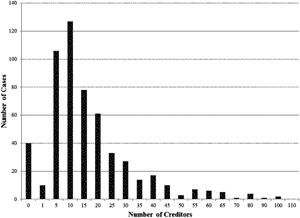
For the four years and 549 certificates, 8,424 creditors were represented, which is an average of sixteen creditors per bankrupt. Each Certificate of Conformity testified to the intricate web of debt and credit so well discussed each by Muldrew and Finn for somewhat earlier periods.Footnote 38 However, the distribution is skewed with a long right tail on the number of creditors: nineteen cases had sixty or more creditors, and two had more than 100 creditors (Figure 2). It is unlikely that any bankrupt began by borrowing from more than 100 creditors; more likely, when they found themselves in difficulty, they probably looked for other sources of credit. Eventually, this edifice collapsed when at least one of the creditors filed for a commission of bankruptcy.
Distribution of cases by the number of creditors.
Source: Authors’ calculations based on data from The National Archives, Kew, England, Office of the Commissioners of Bankrupts and Court of Bankruptcy.

If only four-fifths of the creditors signed, the 8,424 names in the ledger is a lower-bound estimate on the number of creditors. Because we know there were twenty-five discharges with only a single creditor, using the four-fifths as a lower bound for the remaining certificates, there could easily have been more than 10,000 creditors involved with these 549 failed businesses. Creditors were predominantly male; only 7 percent were female. Indeed, in fully half of the entries, there were no women creditors. Women’s presence rose with the number of creditors; conditioning on there being a woman creditor, women comprised 10 percent of creditors. That there are so few women should not be read to imply a female absence from the credit market.
Women were involved as creditors and borrowers in money lending, the mortgage market, buying and selling, and the financial sector, and they too benefited from these changes. Johanna Cock, for example, was a broker in joint-stock company shares. She acquired her shares on the death of her husband in 1713, and by 1720 she was the thirteenth-largest purchaser of Bank of England bank shares and the twenty-first-largest seller by book value. However, she appears to have bought in a declining market in the last few months of 1720 and a writ of bankruptcy appears in the London Gazette on December 20 of that year. A Certificate of Conformity was granted on May 28, 1723.Footnote 39 The case of Johanna Cock shows that women too were granted discharge under the new legislation.
Among the 8,424 creditors, 121 could not sign their names. In Figure 1, at the top of the right-hand column, Thomas Rodbard made his mark and the clerk noted this with his name. Women creditors were no more likely than men to be illiterate. Although unable to sign their names, creditors were able to prove their debts by oral testimony from those who had heard the agreement made when the debt was taken out. While obviously illiterate, these creditors were not innumerate. There are some comments in the literature of bankrupts being unscrupulous, such as having friends pose as creditors to get a share of the assets to be given back to the bankrupt. However, little proof exists that this was a widespread practice, and the standing of the commissioners in the mercantile community make it unlikely that they would allow such fraudulent conduct to take place.
The number of creditors implicated in each bankruptcy points to the collective action problem facing creditors. Prior to the bankruptcy, each creditor could try to extract repayment from the debtor, imposing pseudo-seniority on the debts owed. For a creditor with less access to the debtor, a writ of bankruptcy protected small creditors and stopped more socially senior or larger creditors from taking all the assets. At the discharge phase, only a creditor whose debt was greater than one-fifth of the total amount owed had the potential legal power to withhold a discharge. Small creditors could do this only if they banded together and agreed that each would not sign a discharge, something that could be difficult to enforce.
The occupational structure of bankrupts was, of course, circumscribed by the legislation. Only those who made their living by buying and selling or having use of other men’s money could be declared a bankrupt. The law, however, covered all wholesalers, retailers, and everyone in the financial services sector. Each certificate in the ledgers gives the occupation of the bankrupt. In total for the first ledger, there are 110 occupations listed; among them, for example, are apothecaries, rope-makers, pawnbrokers, chapmen and chapwomen, butchers, carpenters, drapers, haberdashers, mercers, salters, scriveners, merchants, and goldsmiths. Individuals could have more than one occupation, but the one listed can be taken to represent the occupation seen through the lens of the creditors. The occupational titles document the social stratification of businesses in which “merchant” generally referred to someone involved in overseas trade, a position that presumably had higher entry (start-up) costs than chapman or carpenter, for example. It is tempting, however, to think of a chapman or carpenter as small-scale, but the legislation required that the debt owed be more than £100 if there was only one creditor and £200 if more than three creditors. Therefore, none of these bankrupts were small-scale businessmen or businesswomen. Of course, the legislation put only a lower bound on the size of the debts owed; for example, as noted earlier, Evance reputedly owed more than £100,000 in 1712.
In his detailed study of bankruptcy activity in eighteenth-century England, Hoppit finds that seven out of ten bankruptcies were in textiles, food and drink, and the distribution sectors, and one in four in the production and distribution of textiles.Footnote 40 Textiles alone accounted for 26 percent of bankruptcies from 1701 to 1720. Across the 110 different occupations listed in the 549 discharge certificates, just over half are the food and drink, textiles, and distribution sectors, and just under one-third of the discharges are awarded to merchants, goldsmiths, scriveners, and factors. There is no reason to believe that the occupational breakdown of overall bankruptcies and the occupational breakdown of discharge should map one-to-one. Discharge depended on the actions and conduct of the bankrupt, the creditors themselves, and the source of the bankruptcy (misfortune, malfeasance, or gambling).
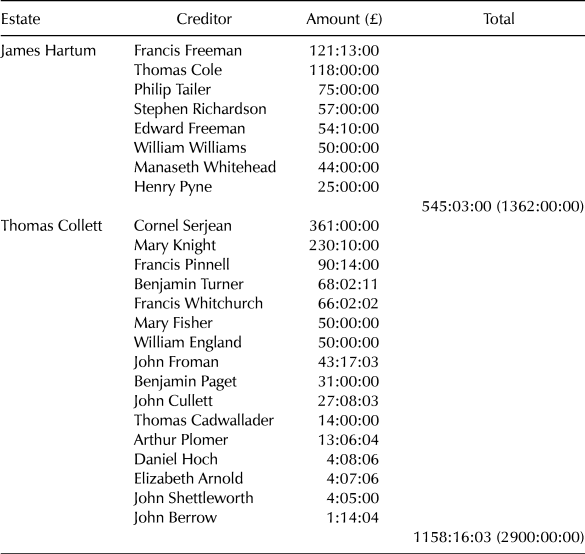
In only two cases is the amount paid to each creditor listed. Both bankrupts lived in Bristol: James Hartum was listed as a merchant and Thomas Collett a distiller. Hartum’s eight creditors received a total of £543:03:00 and Collett’s sixteen creditors £1158:16:03, (Table 2). In Hartum’s case, the lowest amount paid to a creditor was £25 (to Henry Pyne) and the two largest were £118:0:0 (to Thomas Cole) and £121:13:0 (to Francis Freeman). In Collett’s case, the largest two creditors, Cornel Serjean and Mary Knight, received £361:00:00 and £230:10:0, respectively, while John Berrow received merely £1:14:04. If these sums just meet the 8/- in the pound (where a pound has 20 shillings) to get the maximum allowance, then in 1711 Collett must have owed close to £3,000 and Hartum £1,375. These are very large sums of money in a world where the annual laboring wage was roughly £20.
Amounts paid to creditors from two bankruptcy cases in Bristol

Note: The amount in parenthesis represents the total debt owed if the actual payout represents 8/- in the pound.
Source: Authors’ calculations based on Certificate of Conformity ledger books, Office of the Commissioners of Bankrupts and Court of Bankruptcy, The National Archives, Kew, England.
Rate of Discharge
The existence of the conformity ledger book documents that Certificates of Conformity and discharge were granted. That in itself, however, does not invalidate Marriner’s assessment that “many bankrupts were never granted certificates,” or Duffy’s that “vengeful creditors” denied “deserving bankrupts” for years.Footnote 41 To assess the extent to which Marriner is correct, we need to be able to say something about the rate of discharge; that is, the number of discharges relative to the annual number of bankruptcies. The rate of discharge would also allow us to make inference about deserving creditors worthy of a second chance, which we discuss in the final section.
The number of bankruptcy writs issued per year can be estimated from the Bankruptcy Docket Books, which record every bankruptcy writ issued throughout the eighteenth century and form the basis of Hoppit’s work on eighteenth-century bankruptcies. For the years 1710–1714, there were roughly 250 writs per year issued.Footnote 42 A simple estimate of the concurrent yearly flow of bankruptcies compared to the yearly flow of discharges over these four years says that 65 percent, or two-thirds, of bankrupts were discharged. This suggests that creditors quickly endorsed the change in the law and voluntarily chose to discharge bankrupts.
We recognize that 65 percent is probably an upper bound. First, some bankrupts were ineligible due to gambling. Second, the rate of discharge depends crucially on the measurement of the stock of bankruptcies. A 65 percent discharge rate is determined by the contemporaneous number of bankruptcies and discharges from September 1710 to April 1714, but the change in the legislation was available to those declared bankrupt after 1705. To take this into account, we reestimate the rate of discharge taking the stock of bankrupts from 1705. There was a spike in the number of bankruptcies in 1706 with 500 in that year, which is double the annual number from 1710 to 1714. This spike is a direct result of the conformity procedure set out in in 4&5 Anne I c. 4, which delegated the power to grant a discharge solely to the commissioners and abrogated the role of the creditors in this decision. Daniel Defoe wrote that in response to both the possibility of discharge and the exclusion of the creditors, some debtors arranged for a friendly creditor to declare himself or herself bankrupt, as apparently did Defoe himself.Footnote 43 The following year, 6 Anne I c. 7 passed, which legislated that power to grant a discharge lay with the creditors and allowed for discharge only if four-fifths by number and value of debts agreed. We have no record of the number of discharges granted between 1705 and 1710, so we assume that the discharges granted from 1710 to 1714 cover only those who were declared bankrupt in the five years prior. In this situation, the discharge rate is 37 percent. If we allow all 2,500 declared bankrupts from 1706 to 1714 to be the stock that could potentially receive a discharge in the 1710–1714 period, the discharge rate falls to 23 percent. Because we have constrained the number of discharges to only occur between 1710 and 1714, these are lower bounds of the true rate of discharge. Not all bankrupts were eligible for discharge, thus the true rate of discharge lies somewhere within these bounds.
How we dealt with the stock of bankruptcies influenced our estimate of the rate of discharge. To narrow the range, we turned to the Certificate of Conformity ledger books from 1730 to 1750 in relation to the number of bankruptcies over that same period. By 1730, the legislation had been available for most of that period. Again, using Hoppit’s data on the number of bankruptcies for these two decades and relating this to the number of Certificates of Conformity issued, we obtain a discharge rate of 50 percent, which means that half of all those declared bankrupt received a discharge prior to full repayment of their debts.Footnote 44 If some bankruptcies were the result of fraud, theft, or gambling, then the rate of discharge for the honest, misfortunate bankrupt would be higher than 50 percent, and it is this bankrupt that one wants to treat leniently. Thus, it appears that creditors responded both very quickly to the change in the legislation, allowing more than half of all bankrupts to exit bankruptcy prior to the repayment of all debts; and rather than being granted rarely, discharge was granted frequently.
Relationships between Creditors and Debtors
The Certificate of Conformity ledger book for 1710–1714 provides a window into the varied networks of credit in early modern England. We focus here, of course, only on the credit networks among those debtors who were declared bankrupt but granted a discharge. We use the names of bankrupts and creditors to assess a number of different aspects of the credit network. The first was the role of family, which was often the primary credit source for borrowers. Indeed, it is interesting to study the family—which was often seen as part of an informal credit network—in the formal and legal bankruptcy environment.
Family and kin networks are important sources of credit, and family can work as a monitoring agent to keep the borrower on track. More informative, perhaps, are the certificates in which there are very few creditors listed and yet a family name still appeared. First, we ask how often a bankrupt’s surname appears on the list of creditors for the individual bankrupt. We assume that the same last name implies a family connection, although, of course, there might not be any. It also means that looking at family connections in this way misses all credit connections from the maternal line. We find that of the 549 conformity certificates, 156 have the same surname of the bankrupt in the list of creditors. Thus, in 28 percent, or more than one-quarter of the certificates, we find the same surname in this most formal of contexts.
We also consider those cases in which very few creditors were listed and yet we find a family name. One example is John Perry (February 4, 1711). There are only two creditors listed, so we presume these are the only two creditors. One creditor was William Perry, who could be a father, brother, uncle, or cousin. In the case of Jasper Whitter (May 16, 1712), for whom seven creditors are listed, two had the surname Whitter—Trisham Whitter and Trisham Whitter Junior. Thus, a formal bankruptcy structure with a discharge potential provided a legal recourse for family when moral or informal pressures failed. This legal recourse might have been of particular value when the creditor was a mother, aunt, or sister, who might have had less suasion over their male relatives.
The extent of commercial relationships in mercantile and financial communities is documented in the more than 8,000 creditors involved in these 549 bankruptcies. Within this community, a person could be both a debtor and creditor simultaneously. When a merchant was declared bankrupt, his or her assets and loans outstanding became part of the estate, and those outstanding loans needed to be collected to pay back the creditors. To the extent that the bankrupt’s debtors could not repay, they too could be declared bankrupt. Knowing that the discharge ledger provides only a partial picture of these links, we look at how many times a bankrupt appears as a creditor in another bankrupt’s case. Obviously, the more common the name, the more often we expect that name to be in the list of creditors. Take the example of John Smith, an oilman living in Houndsditch, London, who received a discharge in November 1710. A John Smith is listed as a creditor in fourteen other bankruptcies. Obviously, we have no way of knowing if this is the same John Smith, and the presumption must be that it is not. (This follows best practices in the linking of historical records.)
For the less common names, for example, John Tenison or Joseph Pereira, it is more likely that we have the same person. In the case of Tenison, who received his certificate on September 30, 1710, there were twenty-eight creditors, none of whom had the same surname. However, a John Tenison (September 3, 1710) is listed as a creditor in the bankruptcy of Alexander Reed and James Reed (late of Dublin, Ireland), who were business partners. In this case, the relationship between these two cases is very clear because the creditor entry in the Reed bankruptcy is listed as: “Nathaniel Newnham and Richard Cocke assignees to a commission of Bankruptcy against John Tenison.” Thus, the assignees assigned to the search and seizure of Tenison’s assets were looking to the bankruptcy assets of the Reed partners to collect some percentage of the monies owed to John Tenison to pay out to his creditors. The bankruptcy of Joseph Pereira, who was part of the Sephardic community in London, is also interesting. He received a Certificate of Conformity on October 5, 1710. His name then appears as a creditor in two other discharged bankruptcy cases: (1) Francisco Soares, alias Solomon de Chaves, and Manuel Corea Pinto (April 8, 1711) and (2) Leon Caracosa (January 11, 1714). Pereira was not an uncommon name in financial circles, again showing the interconnectedness of the credit market. At issue must be the timing, because if Pereira was also a creditor, then any assets should have been pulled to pay off his own debts; thus, it looks as if Pereira became a creditor of Francisco Soares after his own discharge. In total, across this particular population of discharges, we find the bankrupt is also named as a creditor in 121 of the discharges, or one in every five certificates listed. While the majority of the cases were from London, ours is a national database. Given that the bankruptcy of any one person may have had an unraveling effect on the structure of credit within the mercantile community, it is not surprising that bankruptcy would be a last resort by creditors in reclaiming debts owed.
In the following section we explore varied implications for creditors, bankrupts, investment, and economic growth that may have resulted from the change in the law. There are many facets to any change in bankruptcy legislation, as we discuss below; what is feasible in our particular situation is very much a result of the limitations of the data we have available from the early eighteenth century.
A Discussion of Creditors’ Motives
The legal changes in the bankruptcy statute that occurred with 4&5 Anne and 6 Anne made possible discharge and an exemption for compliant bankrupts, but nothing in the law compelled a creditor to grant a discharge and, to this point, the extant literature assumed that discharge was not granted. Indeed, it seems reasonable to expect that if a creditor had a choice between granting a discharge and allowance (which would come out of the assets that were owed) and maintaining the right to seek redress for all debts owed, the creditor would retain the right to have all the debt repaid. The data presented here instead document that the majority of creditors chose to grant a discharge and provide an allowance.
To understand why creditors would be willing to waive full repayment of the debts owed to them, we need to understand the objectives embodied in the bankruptcy rules. The optimal outcome was that the debtor repaid the contract on time, but when that did not happen, the world of bankruptcy was entered.
Theoretical models “suggest that, except in special cases, no bankruptcy procedures result in economically efficient outcomes along all the dimensions considered.”Footnote 45 These include defaulting strategically, concealing firm assets, or choosing to invest in assets rather than pay liabilities.Footnote 46 In other words, creditors are not going to get paid the full amount of their loans and, as White notes, this creates incentives that might not be in the best interests of the creditors, for example, if the debtors try to hide assets.Footnote 47 Indeed, at the heart of the discussion in the contemporary literature is the issue of asset revelation. How does one induce a debtor to declare the full extent of assets in order to generate the largest payout for the creditor? If the result is destitution, the debtor will likely hide assets for the future. Looking forward, if the creditors can garnish all future income, this reduces the debtor’s incentive to go back into business and the overall level of human capital in the economy. A bankrupt is unlikely to try hard in the business world if all future earnings are garnished.
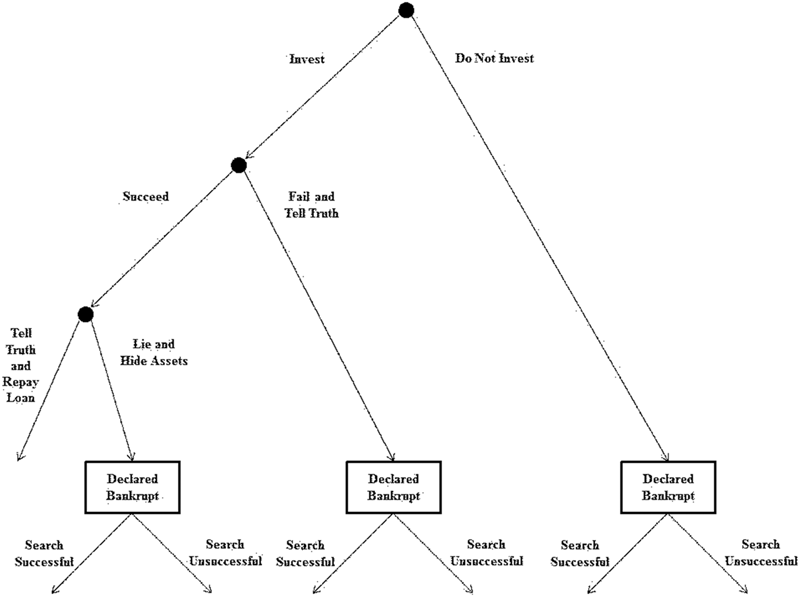
Discharge made the risk of failure more attractive. Using the variability in state levels of exemptions in the United States, Fan and White, as noted earlier, documented higher levels of entrepreneurship in states with higher levels of exemptions, even with a reduction in lenders.Footnote 48 In our context, the data are not available to undertake an explicit examination of the extent of entrepreneurship and lending prior to and after 1706, but we can consider the environment more conceptually. In Figure 3, we lay out a simple game tree of the varied possibilities that faced a hypothetical borrower. It shows that the change in bankruptcy law could affect borrower behavior and thus increase the level of investment.Footnote 49 It does not seem to us to stretch reality to suggest that entrepreneurship probably increased as a result of this legal change and contributed to the increased growth seen in the eighteenth century. However, what is important to understand is not the change in the statute per se but how borrower behavior changed in the face of the possibility of a discharge that would lead creditors to issue a discharge.
Game tree of debtor choices.

Having received funding from a creditor, a borrower’s first decision is whether to actually make the investment or not. It could be that the borrower intended to invest when he borrowed but gambled the money away, or used it for a lavish lifestyle, or realized the business opportunity had changed. That would lead eventually to being declared a bankrupt (presuming no other funds available). Another group of borrowers will invest and will fail. They too will be unable to repay the loan and thus also be declared a bankrupt. A third group of borrowers could successfully invest yet decide not to repay, also leading to being declared a bankrupt. Conceptually, in this game tree it is straightforward to conceive of these three different types of bankrupts. Borrowers who failed to invest in their businesses and those who lied about succeeding so as not to repay are clearly malfeasant bankrupts. Those who invested but failed could be misfortunate or malfeasant bankrupts.
Indeed, writing in 1606, Thomas Dekker used “politick bankrupt” to describe the first type of bankrupt: “After he hath gotten into his hands so much of other men’s goods or money … away he syles with it, and politickly runnes himself on ground, to make the world believe he had suffered shipwreck.”Footnote 50 For the creditors, the issue was to identify who failed to invest, who had nothing, and who hid assets. Thus, the focus of the actual bankruptcy procedure was that of search, seizure, and assessment of the compliance of the bankrupt with the bankruptcy commission. Intuitively, if the probability of a successful search was sufficiently high, or the penalty for being caught having lied is sufficiently high, then a bankrupt would be more likely to truthfully reveal assets. Unfortunately, we know little about the actual process of search, seizure, and sale of assets. What we do know is that the commissioners in each writ of bankruptcy were well-known merchants who would have the ability to interrogate the bankrupt’s records and account books and question the bankrupt. They, in conjunction with the creditors and bankrupt, would agree on a set of individuals to act as “assignees,” whose job it was to find all goods, chattels, and house property; to sell the assets; and to hand over the proceeds to the commissioners for disbursement. Having a penalty in which bankrupts could be hanged, pilloried, or mutilated (the use of the pillory and the cutting off of an earlobe was allowed under the James legislation, for example) was as likely to reduce borrowing overall as it was to make bankrupts more compliant. Using a carrot instead of a stick, such as the promise of a discharge and an exemption and allowance, could entice the misfortunate borrower to truthfully reveal assets. The old statute punished misfortunate bankrupts as much or more than malfeasant bankrupts; the new statute provided a mechanism by which misfortunates could self-identify their type, and creditors (or commissioners) could make a judgement about borrower type. Additionally, monetary rewards paid to third parties for information leading to hidden assets could also lead to greater payouts for creditors. The Anne 1 legislation provided for such a monetary compensation, which created a greater incentive for more truthful asset revelation by the bankrupt.
Thus, the prospects of a discharge and an exemption and allowance, as well as the threat of the death penalty for the truly uncompliant bankrupt, created an incentive for asset revelation and truth telling on the part of the bankrupt and, by their actions, clarified who was misfortunate. The incentives created were strong enough to make this signaling credible. As a result of greater asset revelation, the creditor received a larger upfront payment on the debts owed. The quid pro quo for that larger upfront payout was that the creditor allowed the bankrupt to be discharged; in other words, the creditor relinquished the right to dun the bankrupt for any remaining debt. If a creditor never issued a discharge, then a bankrupt would continue to hide assets. Passage of the Anne statute led to creditors quickly adopting discharge, regardless of the reasons, which allowed more than half of the bankrupts to exit the legal state of bankruptcy prior to full repayment of all debts owing in the early eighteenth century. The allowance in turn provided finance for rent, food, and clothing, but also perhaps some capital for future business investments.
Hart argues that well-structured bankruptcy rules should both maximize the proceeds paid to the creditor in the minimum amount of time and maintain entrepreneurial talent, skills, or human capital by getting the bankrupt back into the workforce.Footnote 51 The granting of a discharge was most certainly a mechanism that allowed former bankrupts the possibility of a second chance in the business world. Due to the constraints imposed by early eighteenth-century records, we cannot know how many of those who received a discharge returned to the workforce, but we anticipate that those who were declared bankrupt due to undercapitalization or inexperience, or some negative exogenous shock such as the sinking of the Assyrian fleet, might be more likely than not to go back into business. The case study of Thomas Griggs is one such example.
Thomas Griggs was born in 1701, and was probably apprenticed in the worsted industry in the early 1710s. He began his career as a yarn dealer, but the few account books relating to his operation suggest that his capital resources and scale of operations were small. He was declared a bankrupt within a few years, which was probably not an uncommon occurrence. His assets paid his creditors 7/6 in the pound (or 37.5 percent), and they granted him a discharge, voluntarily relinquishing the other 12/6 in the pound. He subsequently opened a grocer shop in another part of the country with money he received from an uncle. Indeed, without the discharge, that money would have gone to repay his debts, if he had received it. Griggs subsequently went back into the textile trade, and this time was successful. When he died in 1760, he left an estate of £8,000 (£1 million in 2017 pounds).Footnote 52 While this is only one example, there were undoubtedly many like Thomas Griggs.
Conclusion
Bankruptcy rules matter. Even today, countries differ in terms of the severity of their bankruptcy codes. In this article, we explored a major change in English bankruptcy law. In 1706, Parliament passed 4&5 Anne 1, which allowed for the possibility of a discharge from the state of bankruptcy prior to full repayment of debts owing. The statute also allowed for an allowance to be paid to the bankrupt. This change, however, required that creditors voluntarily relinquish rights to part of the estate owed to them. We have shown that in the years immediately following the passage of the law, creditors quickly responded by offering a discharge to more than half of those declared bankrupt, despite the popular wisdom in the extant literature that discharge did not occur.
There is little doubt that England’s growth increased over the eighteenth century. The capital market grew, whether measured by number of people, volume of transactions, or types of activity, making England the dominant world power by the end of the eighteenth century.Footnote 53 Many forces contributed to the increased rate of growth. We suggest here that the changes in the laws regarding bankruptcy must have contributed in some small part to that growth. The rise of discharge not only encouraged more investment but also the willingness of creditors to grant discharge led to the return of assets for further reinvestment and for the reentry of entrepreneurial talent into the economy.