


Democracy, according to a large body of research, contributes to human development by improving citizens’ lives (Boix Reference Boix2001; Brown and Hunter Reference Brown and Hunter2004; Gerring et al. Reference Gerring, Knutsen, Skaaning, Teorell, Coppedge and Staffin2015; McGuire Reference McGuire2010). Broad evidence demonstrates that democracies provide more public goods and higher standards of living, on average, for citizens than authoritarian countries (Besley and Kudamatsu Reference Besley and Kudamatsu2006; Lake and Baum Reference Lake and Baum2001; Przeworski et al. Reference Przeworski, Alvarez, Cheibub and Limongi2000, 264–5).Footnote 1 But, what is it about democratic practice that enhances citizens’ lives? Proponents argue that competitive elections and citizens’ ability to exercise political rights contribute to responsive, accountable government. Citizens demand public goods and democratic governments provide them, resulting in greater well-being, on average (Diamond Reference Diamond1999; Fox Reference Fox2015; Rueschemeyer et al. Reference Rueschemeyer, Stephens and Stephens1992; Sen Reference Sen1999). However, weak party systems, low voter knowledge, entrenched clientelistic practices, fragmented states, and partial protection of the rights that constitutions formally guarantee beset many new democracies. These difficulties often combine to limit democratically elected governments’ ability to improve basic well-being (Cleary Reference Cleary2007; Gibson Reference Gibson2013; O'Donnell Reference O'Donnell1998; Ross Reference Ross2006; Weyland Reference Weyland1996).
Despite these challenges, some new democracies are improving and expanding the public goods provision, which enhances citizens’ basic capabilities and well-being (Gerring et al. Reference Gerring, Knutsen, Skaaning, Teorell, Coppedge and Staffin2015; Sen Reference Sen1999). By well-being, we follow Sen (Reference Sen1999) to mean “our ability to live as we would like” (Reference Sen1999, 13).Footnote 2 Wide variation in well-being across and within democracies presents a puzzle: How does democracy promote well-being? Addressing this puzzle is important because well-being is connected to many benefits including those associated with citizens’ health, employment, family life, and economic conditions. For example, scholars connect higher levels of well-being to lower risk of disease or illness, increased longevity, and greater economic productivity (Diener et al. Reference Diener, Lucas, Schimmack and Helliwell2009; Frey and Stutzer Reference Frey and Stutzer2002). We focus on infant mortality as a proxy for well-being in this article because survival at birth is a necessary precondition to lead one's chosen life (Gerring et al. Reference Gerring, Knutsen, Skaaning, Teorell, Coppedge and Staffin2015; Nussbaum Reference Nussbaum2011, 33).
We argue that a broad understanding of democracy allows for the best explanation for variation in well-being. Specifically, we provide robust empirical analysis to show how the introduction of an extensive public participation architecture, the expansion of public goods provisioning, and improvements in subnational state capacity explain variation in infant mortality in Brazil. Our theoretical contribution expands the democratic canon beyond elections to include participatory institutions, social programs, and state capacity.
In the remainder of the article, we first draw on democratic theory to tie a broader conceptualization of democracy to well-being. Then we describe how Brazil serves as a natural laboratory to test linkages between democracy and infant mortality rates, a critical outcome associated with well-being. Next, we describe the data and methods we use to estimate these relationships. Finally, we analyze the results of estimation, and discuss their implications for democratic theory and practice.
DEMOCRACY AT WORK
Like its practice, democracy is a rich, muddied, and highly contested concept. Many democratic theorists highlight the central role of contestation, participation, and citizenship as core principles (Dahl Reference Dahl1971; Marshall Reference Marshall1950; Pateman Reference Pateman2012).Footnote 3 Dryzek reminds us that democracy is “dynamic and open-ended” (Dryzek Reference Dryzek2000, 29). We capture the complexity of democratic politics by illuminating how multiple features of democracy contribute to well-being. Much of the empirical literature evaluating democracy's effects focuses on how elections influence government performance and citizens’ well-being (Avelino et al. Reference Avelino, Brown and Hunter2005; Boix Reference Boix2001; Gerring et al. Reference Gerring, Knutsen, Skaaning, Teorell, Coppedge and Staffin2015). We acknowledge elections’ role in aggregating preferences and promoting accountability in decision-making, but we focus our theoretical and empirical attention on ongoing forms of citizen participation, inclusive social policies, and state reform as crucial factors for citizens’ well-being.
We begin with the role of citizenship in the democratic project because of its centrality in democratic theory (Dahl Reference Dahl1971; Marshall Reference Marshall1950; Somers Reference Somers2008). Our understanding of democratic citizenship stems from Marshall's three complementary dimensions: civil, political, and social rights.Footnote 4 Ensuring access to these rights is central to democratic politics because citizens must have unimpaired opportunities to formulate preferences, engage in individual and collective action, and participate in deliberative processes in pursuit of their interests (Avritzer Reference Avritzer2002; Dahl Reference Dahl1971; Dryzek Reference Dryzek2000; Fung and Wright Reference Fung and Wright2003). Marshall's seminal work on citizenship highlights wide variation in citizens’ ability to effectively use these rights; variation occurs across the three dimensions he identifies, across different social groups, and over time. Meaningful access to political rights includes citizens’ ability to engage in political competition, contestation, and formal electoral processes. Meaningful access to civil rights protects citizens’ liberty from excessive state intrusion. Beyond civil and political citizenship lies social citizenship, which involves “the right to a modicum of economic welfare and security to the right to share to the full in the social heritage and to live the life of a civilized being according to the standards prevailing in society” (Marshall Reference Marshall1950, 8). For countries transitioning to democracy, the extension of full citizenship must overcome decades or even centuries of practices that have left vulnerable groups subject to semifeudal and authoritarian social relations (O'Donnell Reference O'Donnell1998).
How do democracies construct meaningful citizenship? Democratic institutions create opportunities for citizens to gather information, organize, and advocate for their interests. Electoral politics is one possible democratic avenue because it permits citizens to select candidates and parties who they believe will represent their interests (Ferraz and Finan Reference Ferraz and Finan2011; Gerring et al. Reference Gerring, Knutsen, Skaaning, Teorell, Coppedge and Staffin2015; Huber and Stephens Reference Huber and Stephens2012). Representative government provides citizens with accountability mechanisms to encourage elected officials to enact inclusionary policies and programs. Some researchers find that electing ideologically driven parties, especially leftist parties, is likely to result in expanded political access (Rueschemeyer et al. Reference Rueschemeyer, Stephens and Stephens1992) and produce more progressive outcomes related to poverty, inequality, and social spending (Sandbrook et al. Reference Sandbrook, Edelman, Heller and Teichman2007).
Participation, including ongoing dialogue and deliberation among government officials, individuals, and organized actors, represents another democratic avenue toward citizenship. These forms of participation occur in multiple venues such as public hearings, policy conferences, and street demonstrations at both subnational and national levels (Dryzek Reference Dryzek2000; Snyder Reference Snyder2001; Tarrow Reference Tarrow1998). Social accountability expands when citizens and civil society organizations (CSOs) can publicly deliberate with government officials, propose alternative policies, and monitor public goods provision (Fox Reference Fox2015; Putnam et al. Reference Putnam, Leonardi and Nanetti1994; Smulovitz and Perruzzoti Reference Peruzzotti and Smulovitz2000).
THREE PATHWAYS TO WELL-BEING
We move beyond elections to connect democracy to well-being through three main pathways. Participatory institutions serve as one pathway by promoting deliberative decision making that forges new relationships—among citizens, CSOs, and public officials—establishing the basis for investment in public goods that poor citizens need. Participatory institutions are state-sanctioned institutional processes that devolve decision-making authority to venues that incorporate both citizen and government officials (Abers and Keck Reference Abers and Keck2013; Avritzer Reference Avritzer2002; Baiocchi et al. Reference Baiocchi, Heller and Silva2011; Cornwall and Coelho Reference Cornwall and Coelho2007; Fung and Wright Reference Fung and Wright2003; Wampler Reference Wampler2015). The proliferation of these types of incremental policy-making bodies now allows citizens to focus narrowly on policy implementation and more broadly on public goods provisioning.
The richness—and messiness—of democratic politics is directly related to the multiple venues for competition over scarce resources. Political contestation and competition permit citizens, organized groups, and elected governments to expand access to civil, political, and social rights through the establishment of new institutions and social policies (Marshall Reference Marshall1950; Sen Reference Sen1999; Somers Reference Somers2008; Yashar Reference Yashar2005). More recent scholarship on participation and deliberation acknowledges a broader range of processes and institutions, including extensive experimentation with new democratic institutions and increased emphasis on transparency and open government (Fox Reference Fox2015; Pateman Reference Pateman2012). Such approaches allow citizens and government officials to overcome democratic deficits associated with democratic regimes (e.g., low participation, minimal voter knowledge, unresponsive bureaucracies). In this way, citizen engagement in democratic politics and expansion of social rights are reinforcing.
Social policies designed to empower citizens represent our second pathway to well-being. Development, conceived through a human capabilities approach, emphasizes “the crucial role of social opportunities to expand the realm of human agency and freedom, both as an end in itself and as a means of further expansion of freedom” (Drèze and Sen 2002, 8). Research on older democracies reveals how citizen engagement and expanded social provisioning work together to create policy feedback effects that restructure subsequent politics (Pierson Reference Pierson1993). Skocpol reveals how, in the U.S., the post–Civil War expansion of benefits for veterans and widows, known as “mothers’ pensions,” structured maternalist social welfare in the progressive era and beyond (Skocpol Reference Skocpol1995). Importantly, she reveals how policy was linked to women's voluntary organizations that took shape prior to the expansion of women's suffrage. Mettler's work on the GI Bill demonstrates how social policies create feelings of inclusion to construct citizens (Mettler Reference Mettler2007). Social policy can thus create a sense of belonging that is vital for full citizenship. Within less-developed countries, social policy can be a pathway for the deepening of citizenship in its fullest sense (Hunter and Sugiyama Reference Hunter and Sugiyama2014).
Governments in the developing world grappled with dual pressures, to expand social inclusion while facing fiscal constraints associated with neoliberal economic reforms (Huber Reference Huber and Esping-Andersen1996). Rather than expand social welfare through universalist principles, new democracies have focused on inclusion through targeted programs, aiming for greater efficiency and effectiveness (Teichman Reference Teichman2004). Conditional cash transfer (CCT) programs best exemplify this approach. These programs target resources to the poor while also inducing behavioral changes thought to promote human development (Fiszbein and Schady Reference Fiszbein and Schady2009). CCTs have spread throughout the developing world since the late 1990s (Sugiyama Reference Sugiyama and Hunter2013). Social policy research reveals that governments need not spend large sums of money to achieve marked improvements in poverty relief, education, and health. Policy design and progressive investment in areas that affect the poor, such as primary school and preventive health care, are more important than absolute spending levels (McGuire Reference McGuire2010; Sugiyama Reference Sugiyama and Hunter2013). This is particularly true for developing countries that have historically prioritized expensive services such as hospitals and universities, rather than more basic services that the poor depend upon.
State capacity in democracies is our third pathway to well-being. Much contemporary scholarship on the developmental state is rooted in Sen's work on fostering human capabilities as a means to promote productivity, the foundation for economic growth (Evans and Heller Reference Evans and Heller2015). A human capabilities approach broadens the scope of action to all citizens and highlights the state's ability to deliver public goods (Sen Reference Sen1999), rather than using collaboration with a narrow group of potential industrialists to incentivize industrial investment (Kohli Reference Kohli2004). Democratic institutions support a human capabilities approach in several ways, including the expansion of civil society through the protection of civil and political rights, a broadening of access points into the state, and the expansion of social rights (Evans and Heller Reference Evans and Heller2015; Ostrom Reference Ostrom1996; Sen Reference Sen1999). Low levels of state capacity (e.g., poorly trained personnel, poor access to telecommunications and equipment) can make it difficult to execute even well-designed public policy. The state's capacity to engage citizens and deliver policy reforms is therefore intricately tied to a larger democratic process of inclusion and participation.
Among large third-wave democracies, decentralization was thought to address gaps in state capacity. Local governance would render local authorities more responsive to voters, corruption more visible and thus easier to control, resulting in improvements in local service provision (Faguet Reference Faguet2004; Grindle Reference Grindle2007, 7–8). Yet, decentralization has not lived up to expectations in many settings (Gibson Reference Gibson2013; Giraudy Reference Giraudy2013) and entrenched clientelism often distorts governing in ways that perpetuate poverty and harm the poor (Diaz-Cayeros et al. Reference Diaz-Cayeros, Estevez and Magaloni2016; Weyland Reference Weyland1996). Subnational authoritarian enclaves continue to hinder governance and impede the construction of meaningful citizenship in many federal democracies.
We argue that democracies’ ability to direct local state capacity toward service provision is integral to promoting well-being. Local governments deliver nationally guaranteed services, which results in complex coordination processes. For example, these local governments may not prioritize services for some citizens or may even use state capacity to harm them. Citizens’ and nationally elected governments’ ability to harness state capacity and use it to deliver services is a crucial third pathway to improving well-being—especially in new democracies where the local state faces myriad problems with coordination, oversight, and accountability.
The emergence of participatory institutions, innovative social programs, as well as the need to harness local state capacity to deliver services all highlight the complexity of democratic practice. Despite this complexity, political scientists have devoted the lion's share of their attention to the role of national-level elections to explain democratic achievements in well-being (Gerring et al. Reference Gerring, Knutsen, Skaaning, Teorell, Coppedge and Staffin2015; McGuire Reference McGuire2010). Most of the democratic canon begins with the fundamental role of “free and fair” elections; without them democratic politics is absent (Dahl Reference Dahl1971). From an empirical standpoint, election data are publicly available, measurable, and comparable, which enables cross-national research. Unfortunately, a focus on elections obscures the diverse ways that public contestation and participation help to construct citizenship and promote citizens’ ongoing involvement in quotidian democratic activities. This focus also has the potential to hang too much on one representative institution, suggesting that if competitive elections do not produce better outcomes for citizens, democracy itself may be at fault.
THE BRAZILIAN DEMOCRATIC CONTEXT
Brazil's experience with democracy offers a rich theoretical basis to examine a more expansive conceptualization of democracy. Brazilian democracy emerged after a lengthy political opening following military rule (1964–1985). The country resurrected its previous political institutions and federal system while also strengthening local subnational autonomy through decentralization. Observers cautioned that the country's political institutions would create challenges to governability; problems included presidentialism, a malapportioned Congress, ideologically inchoate parties, a weakly institutionalized party system, and open list proportional representation (Ames Reference Ames2001; Lamounier and Meneguello Reference Lamounier and Meneguello1986; Mainwaring Reference Mainwaring1999; Power Reference Power2010). Further, Brazil's institutional design was thought to promote clientelistic politics across the federal system (Abrucio Reference Abrucio, Fernando2005; Hagopian Reference Hagopian1996; Samuels Reference Samuels2003). Despite these shortcomings, the electorate has experienced competitive municipal, state, and national elections. Between 1994 and 2014, presidential elections stabilized into regular competitive patterns between two parties, the center-right Brazilian Social Democratic Party (PSDB) and the center-left Workers’ Party (PT).
The democratic transition also forced elected officials to confront pent-up social demands amid serious economic constraints. The national government adopted neoliberal economic reforms based on fiscal austerity due to anemic economic growth and hyperinflation in the late 1980s and early 1990s. Policymakers were starved of revenue they needed to address a complex mosaic of historic social exclusion. The military dictatorship (1964–1985) benefitted from a relatively strong economy from the mid-1960s to the late 1970s, but public investments in education and health fell behind those of other nations experiencing similar economic growth.Footnote 5 By 1991, the Brazilian government classified about 45% of the population as poor and 20% as indigent (Ipeadata 2016). Brazil was also one of the most unequal countries in the world, with a Gini coefficient of 0.61 in 1991 (World Bank 2016). Other social indicators, such as life expectancy and infant mortality rates, were also relatively poor given the country's middle-income status (McGuire Reference McGuire2010). These macroindicators obscure uneven regional economic development—geographic pockets of deep poverty resulted from concentrated industrial development in the south and southeast, while the north and northeast were left behind. The historic exclusion of Afro-Brazilians and women has also produced gendered and racial features to socioeconomic exclusion and rights violations.Footnote 6
Civil society expanded greatly during redemocratization to advance democratic inclusion. Social movements mobilized to secure greater access to public goods, participate in policymaking venues, and broaden citizenship (Avritzer Reference Avritzer2002). Movements, including the sanitaristas (public health activists), students, women, and Afro-Brazilians, advocated for the expansion of social rights at the Constitutional Assembly (1987–8). The 1988 Constitution enshrined new social rights to housing, employment, health care, and education as well as political rights that would permit the development of a broader democratic architecture. Many new rights were aspirational as the government struggled to deliver public goods under fiscal austerity (Huber Reference Huber and Esping-Andersen1996, 171–2).
Limiting our study to Brazil leverages the benefits that come from a subnational, single-country study, which holds national institutions and electoral politics constant (King et al. Reference King, Keohane and Verba1994; Snyder Reference Snyder2001). Brazilian municipalities (N = 5570) are responsible for delivering many services and there is remarkable variation in local experiences with participatory institutions, coverage of new social programs, and local administrative performance—meaning that local quality of life and individuals’ potential to develop agency also vary. Wide municipal variation also makes our research applicable across broader contexts because some less affluent, rural municipalities face challenges resembling those in less affluent countries around the world, whereas more affluent municipalities more closely resemble those in older, wealthier democracies. Brazilian federalism renders municipalities independent and politically autonomous units, representing ideal laboratories for examining the role of democratic mechanisms on human development outcomes. But municipalities also rely on the federal government for financial transfers, thus allowing the federal government significant opportunities to induce municipalities to adopt new policies and institutions.
DEMOCRACY AT WORK IN BRAZIL
Brazil has experienced high rates of infant mortality like other developing and middle-income countries at the start of democratization (World Health Organization 2016). Importantly, these rates have fallen much farther in some cities and regions relative to others and subnational governments have taken different approaches to experimenting with social programs (Brazilian Ministry of Health 2016). Scholars and practitioners still do not know the extent to which new democratic institutions, social programs, expansion of state capacity, and democratic elections are responsible for Brazil's reductions in infant mortality, especially in the context of rapid economic growth that should also reduce infant mortality. Explaining variation in infant mortality is essential for understanding well-being in a broader sense. There is now a global consensus on the vital importance of infant mortality for development (Nussbaum Reference Nussbaum2011; Sen Reference Sen1999; United Nations Development Programme (UNDP) 2015). Infant mortality is a strong proxy for well-being because surviving beyond one's first year represents a necessary condition for pursuing one's chosen life (McGuire Reference McGuire2010; Nussbaum Reference Nussbaum2011). Brazil's government collects municipal-level data on new democratic institutions, new social programs, budget management, elections, and infant mortality that help us connect these isolated areas. Brazil thus offers a unique opportunity to test connections between participatory institutions, policy, and managerial aspects of democracy on local well-being at a level of breadth and depth that has never been achieved previously.
Participatory Institutions
Brazil's participatory architecture expanded in the 1990s and 2000s. Public policy management councils, policy conferences, and participatory budgeting emerged as the most commonly used institutions (Avritzer Reference Avritzer2002; Cornwall and Coelho Reference Cornwall and Coelho2007; Pires and Vaz Reference Pires and Vaz2012; Wampler Reference Wampler2015, 245–71). Although the roots of the policy councils and conferences date to the 1940s, social movements resurrected them in the 1980s in an explicit attempt to expand citizens’ voice and deepen the quality of democracy during transition to democratic rule. Prevalent at the municipal level, there are vibrant state and federal policy councils and conferences as well. For example, Brazil's federal government hosted nearly 9 million individuals at 100 national policy conferences between 2003 and 2015 (Avritzer and Souza Reference Avritzer and de Souza2013; Pogrebinschi and Samuels Reference Pogrebinschi and Samuels2014). The National Health Conference is among the most established, with regular meetings as part of the establishment of the Unified Health System (SUS). The national and state health councils also engage with local policy management councils to assess the performance of social programs.Footnote 7 Participatory budgeting programs began in Porto Alegre immediately following the democratic transition. These programs incorporate citizens in municipal budget-making processes and have spread across Brazil and to many countries around the world (Avritzer Reference Avritzer2002; Baiocchi et al. Reference Baiocchi, Heller and Silva2011; Wampler Reference Wampler2015).
Public policy management councils are the most common type of participatory institution, with nearly 60,000 municipal-level councils and at least 300,000 citizens elected to hold positions on them (Wampler Reference Wampler2015, 264). Council membership is typically comprised of equal parts representation from civil society and the government. Civil society representation on these councils is fairly heterogeneous as participants come from community associations, social movements, third sector service delivery organizations, and labor unions (Almeida et al. Reference Almeida, Cayres and Tatagiba2015). Members have the right to propose new policies and they must approve year-end reports on government compliance with the appropriate legal and policy frameworks. Councils’ decision-making authority is constrained, however, as final approval is in the hands of government officials (Cornwall and Coelho Reference Cornwall and Coelho2007; Wampler Reference Wampler2015). Despite the potential weakness of these venues, recent scholarship identifies policy councils as new interfaces between state and society, given their equal composition of representatives from government and civil society (Pires and Vaz Reference Pires and Vaz2012).Footnote 8 There is growing evidence of participatory institutions’ effectiveness that accounts for why the Brazilian government now encourages the adoption of policy councils at the local, state, and federal level (Avritzer and Souza Reference Avritzer and de Souza2013; Pires Reference Pires2011; Pogrebinschi and Samuels Reference Pogrebinschi and Samuels2014; Touchton and Wampler Reference Touchton and Wampler2014).
The federal government encourages the adoption of education, health care, and social assistance policy councils through fiscal incentives or regulatory controls. However, there are at least 18 additional councils (e.g., women's, food security, children's rights) that are voluntary and not strongly induced by the federal government (Gurza Lavalle et al. forthcoming). Extensive single case and small-N analyses demonstrate that councils are likely to be adopted when a reformist mayoral administration and an active civil society are politically aligned (Almeida et al. Reference Almeida, Cayres and Tatagiba2015; Abers and Keck Reference Abers and Keck2013; Baiocchi et al. Reference Baiocchi, Heller and Silva2011; Wampler Reference Wampler2015). Mayors may lead this process or CSOs may push mayoral administrations to adopt these councils. We focus on policy management councils, rather than policy conferences or participatory budgeting, because they exist across all Brazilian municipalities.
New Social Programs
Brazilian social sector reforms reflect the developing world's need to design social programs targeted to serve the poor. Since the mid-1990s, social policy reforms have spread across the country as public officials and citizens developed creative solutions to address enduring social problems (Sugiyama Reference Sugiyama and Hunter2013; Tendler Reference Tendler1997). Many of these programs have their roots in municipal-level reforms but Brazil's Federal Government later replicated them to varying degrees. The Bolsa Escola (School Grant) program emerged as a locally implemented CCT program providing poor mothers with cash grants tied to educational attendance (Sugiyama Reference Sugiyama and Hunter2013). This early model inspired the national government to develop larger-scale CCTs. Many credit the implementation of the Unified Health System (Sistema Único de Saúde, SUS), a free and universal heath care system, with raising health care outcomes (Schramm and Szwarcwald Reference Schramm and Szwarcwald2000). The SUS facilitated an expansion of the Family Health Program (Programa Saúde da Família, PSF), which best reflects the vision that preventive health care is paramount and should be universally accessible (Viana and Poz Reference Viana and dal Poz1998).
Since the late 1990s, two notable social policy programs have advanced social inclusion through targeted service delivery. The first, PSF, provides primary health by focusing on geographically defined preventive care through a team of health care practitioners (Viana and Poz Reference Viana and dal Poz1998). Implemented in 1994 and expanded after 1998, the program is widely credited with advances in health care outcomes (Macinko et al. Reference Macinko, Guanais and de Souza2006). Today, PSF represents a major strategy for health care within the SUS. The second, Bolsa Família, established in 2003, is the world's largest CCT program. Bolsa Família provides poor and indigent families with cash grants on the condition they meet requirements that are thought to enhance human development.Footnote 9 For example, children must attend school regularly, receive vaccinations and regular check-ups, and mothers must receive prenatal and postnatal care. Bolsa Família is the government's most visible and far-reaching poverty alleviation program, including about a quarter of the population. Despite conditionality requirements, the government's discourse surrounding the program emphasizes rights-based access to the grant (Hunter and Sugiyama Reference Hunter and Sugiyama2014). Like PSF, Bolsa Família has contributed to human development, including areas related to education and health (Rasella et al. Reference Rasella, Aquino, Santos, Paes-Sousa and Barreto2013; Soares et al. Reference Soares, Ribas and Osório2010).
Brazil is a large federal country, requiring significant intergovernmental coordination to implement social policy. National ministries coordinate both the PSF and the Bolsa programs. The ministries draw from subnational and international examples to craft policies designed to improve citizens’ access to the social rights the 1988 Constitution formally guarantees (Sugiyama Reference Sugiyama and Hunter2013). Federal social policies are not directly subject to voters through referenda. Yet, scholars argue that the expansion of pro-poor policies in Brazil and in Latin America reflects a sustained democratic experience, which includes competitive elections and the emergence of democratic values among public officials (Huber and Stephens Reference Huber and Stephens2012; McGuire Reference McGuire2010). These pro-poor social programs are also politically popular, and highlight the importance of incentives for Kosack's “political entrepreneurs” to organize poor citizens, deliver public goods, and gain their votes (Kosack Reference Kosack2012).
State Capacity
Brazil's municipalities feature uneven economic development and varying experiences with local patronage and clientelism (Ames Reference Ames2001; Hagopian Reference Hagopian1996). Decentralized governance therefore poses serious challenges for standardized, universal delivery of social benefits.Footnote 10 Several changes have improved service delivery since Brazil's return to democracy. First, the Fiscal Responsibility Law, enacted in 2000, improves fiscal transparency, and implements rules on spending. Local governments must now spend 50% of their annual budget on health care and education and report end-of-year fiscal information to federal authorities. Second, the establishment of the Federal Accounting Tribunal and the executive's Federal Comptroller's Office ensures ongoing monitoring of policy implementation (Speck Reference Speck, Power and Taylor2011). Finally, innovations in ministerial management practices, such as those within the Ministry of Social Development, connected administrative oversight of local management to financial incentives for “good performance” (Lindert et al. Reference Lindert, Linder, Hobbs and de la Brière2007). In the context of Bolsa Família, the policy's design and federal administrative oversight of local authorities has not only insulated the policy from local clientelism and corruption but also promoted local capacity building (Lindert et al. Reference Lindert, Linder, Hobbs and de la Brière2007; Sugiyama and Hunter Reference Sugiyama and Hunter2013). Taken together, incorporating new public management (Grindle Reference Grindle2007) along with Constitutional guarantees represents a reframing of social provisioning in terms of social rights and access to the state (Hunter and Sugiyama Reference Hunter and Sugiyama2014).
Interactive Effects
We argue that participatory institutions, new social programs, and state capacity interact to explain variation in well-being. First, participatory institutions influence social program performance and the capacity of the local government to deliver services by expanding the policy debate and allowing citizens to propose new policies and reforms, and engage in policy implementation oversight (Baiocchi et al. Reference Baiocchi, Heller and Silva2011; Pogrebinschi and Samuels Reference Pogrebinschi and Samuels2014). Participatory venues also permit citizens to bring local knowledge to bear on intricate policy discussions (Wampler Reference Wampler2015). Second, participatory institutions serve as a hub linking state to society and a forum for disseminating information about poor municipal performance in social program administration (Abers and Keck Reference Abers and Keck2013). The policy councils constitute part of a new web of “interlocking institutions” through which participatory institutions, state agencies, and government bodies interact and buttress one another through formal and informal connections (Wampler Reference Wampler2015). Once made aware of problems, members of policy councils can raise pressure on local officials to improve service delivery (Fox Reference Fox2015). For example, in the large Brazilian city of Belo Horizonte, community leaders elected to councils assume multiple roles that are transforming state-society relations. Within councils, leaders formally deliberate over and vote on the annual agency-level budgets and year-end reports, which allows these citizens to represent their communities’ interests. Community leaders also forge new connections to civil servants responsible for administering project-level implementation programs, which permit them to gather information about these programs for their communities as well as to inform these civil servants of their community's needs. Community leaders also strengthen their connections to each other through this ongoing contact (Wampler Reference Wampler2015).
Social policies also influence the usefulness of participatory institutions and state capacity. As Pierson (Reference Pierson1993) notes, public policies can create feedback effects by creating new groups of actors and redefining the political space for contestation. Programs like PSF and the Bolsa Família can empower citizens as they not only experience gains in well-being but also become invested in the quality of state services. As Hunter and Sugiyama (Reference Hunter and Sugiyama2014) argue, Bolsa Família contributes to citizenship as beneficiaries express a sense of agency and claim rights to state benefits. Furthermore, field research in Pau Brasil, a small rural town, demonstrates how social provisioning and participation go hand in hand. For example, the Friends of Justice Association, a local CSO, investigated a failure to deliver cash transfers to 200 eligible families. The CSO accessed publicly available information on local beneficiaries, wrote to elected officials, and requested an investigation by the Public Ministry. As a result, the city later invited the CSO's leader to join the local social assistance council to monitor Bolsa Família's local operations (Sugiyama and Hunter Reference Sugiyama and Hunter2013).
Finally, local state capacity improves the performance of participatory institutions and social programs. The ability of the local administration to implement policies and engage with policy councils is critical for the councils’ credibility and sustainability, since councils have weaker influence if their chosen policies are never implemented. Moreover, a more capable local state is better able to provide better quality information to inform deliberation. Second, the ability of the local government to administer federal social programs relates directly to local capacity and buy-in with programmatic goals. The belief that access to public goods is a social right, rather than a personal favor, needs to be reinforced through federal policy design and enacted locally (Hunter and Sugiyama Reference Sugiyama and Hunter2013). Technocratic provisioning of constitutionally guaranteed social services thus has the power to elevate the poor's living standards and transform them into full citizens.
The role of economic growth
Since democratization, Brazil has experienced periods of economic decline and growth. In the mid-1990s, neoliberal reforms resulted in state downsizing. A period of rapid economic growth followed during the 2000s as part of the commodities boom and the return of a neodevelopmental state. This growth produced an infusion of income into the poorest households and brought new capital into the country. For poor Brazilians, the 2000s brought the greatest upward mobility in generations (Ipeadata 2016). The potential connections between economic growth and improvements in well-being have occupied the center of recent debates in economics (Dollar and Kraay Reference Dollar and Kraay2001; Rodrik Reference Rodrik2000). Some studies tie increases in growth to decreases in poverty (Dollar and Kraay Reference Dollar and Kraay2001; Ferreira Reference Ferreira2010), while others find growth has little impact on poverty (Xue Reference Xue2012). Many studies in this area are unable to account for confounding variables on a global scale. However, some focus on a subset of countries or on one country in particular to resolve this issue (Ravallion and Chen Reference Ravallion and Chen2007). Our focus on Brazil follows this approach and controls for cross-nationally confounding variables such as trading regime, exposure to globalization, or regional growth. We include local economic control variables in our statistical models of infant mortality because others also connect local growth to poverty and well-being within Brazil (Lustig et al. Reference Lustig, Lopez-Calva and Ortiz-Juarez2013; McGuire Reference McGuire2010). We include measures of low-income wages and local per capita health care spending to better separate any independent influence from new democratic institutions and social programs on well-being from the potential benefits of economic expansion.
RESEARCH DESIGN AND CASE SELECTION
We draw on an original dataset covering Brazil's 5,570 municipalities to evaluate connections between local participatory institutions, federal social programs, and infant mortality. As discussed above, we focus on infant mortality as a proxy for well-being because surviving birth represents a necessary condition for comfort, health, and happiness while pursuing one's chosen life (McGuire Reference McGuire2010; Nussbaum Reference Nussbaum2011). Moreover, infant mortality is a useful proxy for testing our arguments because it can change quickly due to both policy intervention and neglect (Aquino et al. Reference Aquino, de Oliviera and Bareto2009). If participation and social programs are related to well-being, it should be apparent with infant mortality.
Our data on local democracy, social policies, state capacity, and economic growth represents one of the largest datasets on subnational policies in the developing world and the only one aligning key local aspects of participation, social programs, and administrative capacity with local outcomes. Our data covers all Brazilian municipalities from 2006 to 2013, which translates to models with up to 28,618 municipal-year observations.
We base our strategy on previous efforts to explain variation in infant mortality and that of other health outcomes. Both Rasella et al. (Reference Rasella, Aquino, Santos, Paes-Sousa and Barreto2013) and Macinko et al. (Reference Macinko, Guanais and de Souza2006) use conditional negative binomial models with municipal fixed effects to test hypotheses connecting Brazil's Bolsa Família and PSF to infant mortality at the municipal level. We follow suit in our study; negative binomial regression models resolve several statistical challenges in estimating models of infant mortality. Specifically, negative binomial regressions provide improved estimation in cases where count and rate outcome data is widely dispersed—as in our case, where the unconditional mean of infant mortality is much smaller than its variance (Cameron and Trivedi Reference Cameron and Trivedi2009; Hilbe Reference Hilbe2007). We then use panel data models with municipal fixed effects to account for correlations between unobserved, time-invariant characteristics of the panel and our independent variables.Footnote 11
VARIABLES AND METHODOLOGY
Dependent Variable: Infant Mortality per 1,000 Live Births
We use the Brazilian Ministry of Health's estimate for the annual rate of infant mortality per 1,000 live births in each municipality from 2006 to 2013. The mean is 21.14 with a standard deviation of 22.21. Source: www.datasus.gov.br.
Independent Variables: Adoption of Health-Related Policy Councils
We use the Brazilian Institute of Geography and Statistics’ survey data on the presence of 21 different local policy councils among Brazil's municipalities (Brazilian Institute for Geography and Statistics 2016). These councils include health councils, women's councils, housing councils, and cultural councils among others. Municipalities adopt some councils, such as health and education councils, at very high rates due to federal financial incentives. For example, the mean health council adoption rate in our data is 80% and adoption rates in 2013 approach 100%. Thus, the presence of a health council is an inappropriate measure for testing our arguments due to the very low variation. However, many other councils could relate to infant mortality, since it is a problem that disproportionately impacts poor citizens, women, Afro-Brazilians, indigenous peoples, and children. Six of the councils in our dataset (women's, children's rights, food security, sanitation, women's health, and urban policy) focus on causes of infant mortality, meaning that participants deliberate over issues that directly affect infant mortality.
The presence of these six councils also allows for a better test of our arguments than health councils because their adoption is not required. We treat the councils that carry no federal funding as being more “voluntary” than those for which there is a clear financial benefit for municipal adoption. We also hypothesize that adopting these more voluntary councils represents a greater municipal and civil society commitment to democratic participation than does adopting councils with federal inducements. This argument is consistent with scholarship connecting the growth of a stronger civil society and an interested mayoral administration with the voluntary adoption of additional councils (Pires and Vaz Reference Pires and Vaz2012; Gurza Lavalle et al. 2015). Finally, voluntary council adoption signals that CSOs and public officials also seek collaborative relationships to improve policy outputs.
Two dummy variables account for local policy councils. The first is coded “1” if a municipality features all six voluntary policy councils that could relate to infant mortality in a given year and “0” if it does not.Footnote 12 Of these observations, 17% are coded “1” and 83% are coded “0”. The second variable records whether municipalities have the councils that do carry federal funds with them and may be related to health care. These are health councils, housing councils, education councils and environment councils. Sixty-three percent of municipal observations feature all four policy councils and are coded “1”. The remainder are coded “0”. Finally, we record the frequency of health council meetings. Many municipalities adopt health councils to gain federal funds, but may not promote active councils or sustain them over time. We capture variation in commitment to using these councils through the number of meetings they hold on an annual basis. The mean number of meetings is 10.4 and the standard deviation is 5.4.
Our primary models use dummy variables for public policy management councils rather than continuous variables, such as the number of councils, to represent the concept of commitment to participatory institutions. Dummy variables allow us to incorporate our understanding of commitment based on structural breaks in the data: municipalities tend to have either fewer than two of these voluntary policy councils or all of them. Those municipalities with all of these voluntary policy councils have made a much clearer commitment to participatory institutions than those that have only adopted one or two. A dummy variable for this concept allows us to capture the full or empty nature of municipal commitment to policy councils.Footnote 13
Bolsa Família Coverage
Our models include an indicator for municipal Bolsa Família coverage, the percentage of eligible families that receive benefits from the Bolsa Família.Footnote 14 The mean coverage level is 83% in our data and the standard deviation is 31. This is the same variable used in Rasella et al. (Reference Rasella, Aquino, Santos, Paes-Sousa and Barreto2013) and Macinko et al. (Reference Macinko, Guanais and de Souza2006).
Family Health Program (PSF) Coverage
We incorporate data from Brazil's Ministry of Health on municipal PSF coverage into our models of infant mortality. The Ministry collects annual data on the percentage of eligible families that receive benefits from the PSF. The mean coverage level is 81% and the standard deviation is 29.
Bolsa Família Management Quality
The Bolsa Família program is administered at the municipal level and management quality varies considerably. We use operational data from the Ministry of Social Development (MDS), called the Index of Decentralized Management (IGD), to capture this variation. The MDS rates each municipality on how well it administers program elements, such as updates to the Unified Registry and tracking of beneficiaries’ compliance with conditionality requirements. The MDS offers greater funding to cities that perform better on the IGD. Quality of local management should reflect a combination of local political commitment as well as existing municipal state capacity. Quality of local management is likely to influence local outcomes independently from the broad Bolsa Família coverage, which is often high in municipalities where management is poor, such as settings with dense poverty. This variable is continuous from zero to one and each municipality receives an annual score; better management results in scores closer to one and worse management closer to zero. The mean score is 0.76 and the standard deviation is 0.15.
Per Capita Municipal Health Care Spending
We evaluate the extent to which public spending contributes to well-being. We follow previous literature on public goods spending and poverty to assess whether local health care spending has at least some connection to medical service provision at the municipal level. Brazil spends a comparatively high level of resources on public goods provision, but has not consistently produced high-quality outcomes related to human development indicators (McGuire Reference McGuire2010; Sugiyama Reference Sugiyama and Hunter2013). Economic growth might increase local revenue that facilitates increased health care spending. There is a noted disparity in health care spending between wealthier cities and poorer cities in Brazil, which we expect to help explain variance in health care provision in these cities. We include an indicator for per capita health care spending to capture this possibility and account for spending variation among Brazil's cities. This measure also lets us account for increasing revenue and greater general spending throughout the time frame of our study. The measure is in constant Brazilian Reais and comes from Brazil's Health Ministry.
Low Income Wages
Economic trends could also influence infant mortality rates through several channels at the individual level. First, malnutrition and poor sanitation are chief causes of infant mortality (Rasella et al. Reference Rasella, Aquino, Santos, Paes-Sousa and Barreto2013). Higher income expands citizens’ access to clean water, formula, and food. Thus, higher wages among low-income citizens are associated with lower levels of infant mortality. Second, citizens’ wages influence their ability to purchase private goods. Access to quality care through the universal health system is uneven; formal sector employers and middle- and upper-income citizens often rely on private health insurance. Thus, we hypothesize that the risk of infant mortality decreases as wages increase. We include a measure of median municipal wages for the lowest quintile of earners in our models to account for this prospect. The measure is in constant Reais and comes from Brazil's IBGE.
Competitive Elections
We code data on the relative competitiveness of municipal elections in several ways. First, we code a dummy variable with a score of “1” if the winning mayoral candidate received less than 45% of the first-round vote and a “0” if they received greater than 45%.Footnote 15 Receiving less than 45% of the first-round vote reflects a competitive electoral environment where the mayor might have to worry about re-election. Next, we record data on the overall mayor's share of the vote in the previous election's first round. Finally, we create a dummy variable to record whether mayors ran unopposed in the previous election (“1” indicates an unopposed mayor). These measures come from Brazil's Superior Electoral Tribunal: http://www.tse.jus.br/.
PT and Left-leaning Mayor
Previous studies have connected mayors from Brazil's Workers’ Party (PT) to low infant mortality levels (Touchton and Wampler Reference Touchton and Wampler2014). PT mayors have historically supported local political participation. Similarly, subnational research on health and education reforms finds that left and center-left parties are more likely to adopt progressive social policies (Sugiyama Reference Sugiyama and Hunter2013). We code a dummy variable as “1” if municipalities have a PT mayor in a given year, with mayors from all other parties receiving a score of “0” to account for this prospect.
Presidential Vote
We include a measure of municipal support for PT presidential candidates, who were elected in 2002, 2006, and 2010. These PT Presidents promoted participatory institutions and social programs; we control for the possibility that some municipalities and their residents are more committed to specific programs and institutions associated with these presidents.
RESULTS AND DISCUSSION
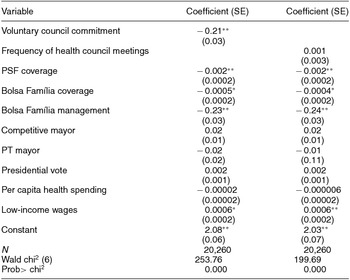
The model in Table 1 features several important findings. First, voluntary policy councils have a strong, negative, statistically significant connection to infant mortality in Brazil. We estimate that the presence of these voluntary councils is associated with a 0.21 decrease in infant mortality per 1,000 births. This may seem like a small influence relative to the mean infant mortality rate of 21.15 per 1,000 births in the data, but the effects are important. These coefficients reflect the difference in the logs of the expected counts of the infant mortality indicator. A 0.21 coefficient translates to a 1.62 reduction in infant mortality per 1,000 births, representing a 14% reduction from current mean rates. On average, we estimate that voluntary councils related to health care save approximately 380 lives per year across Brazil and over 3,000 for the years in our study. By extension, our results also highlight the importance of committing to local, demand-side participatory institutions for improving well-being.Footnote 16
Explaining Variation in Infant Mortality, 2006–2013

Notes: This model uses cross-sectional time series negative binomial estimation with municipal fixed effects. *Significance at better than 0.05 (two-tailed test). **Significance at better than 0.01 (two-tailed test).
We use a variable recording the frequency of health council meetings in the second model in Table 1, because many municipalities may accept federal funds to create a council but do not guarantee it meets regularly. The second set of results in Table 1 shows no relationship between municipalities with health councils that meet more than once a month and infant mortality.Footnote 17 There are several potential reasons for these results. The first is that institutions imposed from the top down tend not to perform well compared to those adopted from the bottom up, as previous research on democratic innovations suggests (McNulty Reference McNulty2011). The second is that our measure of meeting frequency may not capture a municipality's commitment to participatory institutions. Almost all of Brazil's municipalities now have health councils and holding more meetings in those councils may not indicate progress toward policy reform or health care service delivery. Finally, our indicator for health council meetings contains considerably less variation than that for voluntary councils: more than half of the induced health councils meet monthly or bimonthly. All to say, we do not find support for our arguments using health council meeting frequency as an independent variable, but do find support for other scholarship on top-down participatory institutions (McNulty Reference McNulty2011).
Federal Social Programs
Our second finding showcases the importance of top-down, federal social programs representing expert-led approaches to service delivery. Higher levels of municipal Bolsa Família and Family Health Program coverage are both associated with lower levels of infant mortality. These results replicate prominent findings in the literature on both programs such as those in Rasella et al. (Reference Rasella, Aquino, Santos, Paes-Sousa and Barreto2013) and Macinko et al. (Reference Macinko, Guanais and de Souza2006). Importantly, we also underscore the importance of local management of the Bolsa Família program. The federal indicator for the quality of local Bolsa Família management, “IGD,” is also a statistically significant determinant of infant mortality rates. We estimate that moving from the mean municipal management score (0.76) to two standard deviations above the mean (0.99) results in an important estimated reduction in infant mortality. This reduction is lower than for the voluntary councils, but we still estimate that very good Bolsa Família management saves approximately 200 lives per year across Brazil and 1,800 for the years in our study. This estimate is independent of participatory institutions and Bolsa Família coverage and speaks to the considerable importance of local state capacity for improving well-being. It is not simply a matter of having a program, such as Bolsa Família or the Family Health Program, which matters on its own, but also of administering these programs well, which contributes additionally to reducing infant mortality.
It is important to note that these results control for per capita municipal health care spending and low-income wages. Health care spending is not connected to infant mortality in our data. Thus, as McGuire (Reference McGuire2010) argues, reducing infant mortality is not simply a matter of how much municipalities spend on health care, but how well they spend their own money (as monitored by policy councils) and how well they spend federal Bolsa Família money (as evident through management scores). Surprisingly, low-income wages have a positive and statistically significant relationship with infant mortality. This could reflect higher wages in the lowest quintile of earners in agrarian, commodity producing regions that tend to be poorly governed.
Elections
We find mixed support for connections between competitive elections and infant mortality in our data. First, we find no relationship between competitive elections and infant mortality as measured by a dummy variable. Unexpectedly, we find that higher vote shares for the mayor in local elections, suggesting less competition, are associated with lower infant mortality rates when we use a continuous vote share measure. Finally, we find that mayors who run unopposed are associated with systematically higher levels of infant mortality, which is consistent with arguments connecting a total lack of political competition with clientelism and poor government performance.Footnote 18 None of the other variables directly related to elections are statistically significant determinants of infant mortality. Despite the mixed results for electoral variables, our models do not impugn previous scholarship on elections, democracy, and well-being in a cross-national context. Instead, our results highlight the importance of democratic complexity beyond elections.
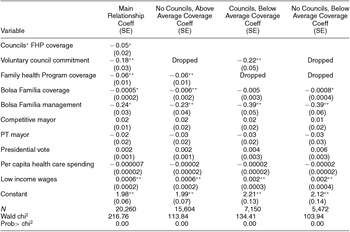
Finally, our results show that the strongest influence on infant mortality stems from the ongoing interaction of three main components—the active presence of participatory institutions, innovative social programs, and a more capable municipal state. Local monitoring, local program coverage, and local capacity interact with one another through connections between citizen participation in local politics, the presence of CSOs, and the presence of motivated municipal officials to generate strong municipal governance. The results in Table 2 show how an interaction between voluntary policy councils and PSF coverage is associated with infant mortality levels in our data. There are other interactions among our independent variables, but we present the results of those surrounding policy councils and PSF coverage because infant mortality, a health care outcome, is our dependent variable. Municipalities in the top quintile of PSF coverage and with a commitment to voluntary policy councils related to health care are associated with a 1.17 lower annual infant mortality rate per 1,000 births. This corresponds to a mean estimated reduction in infant mortality of 15%, but as much as a 30% in some municipalities—translating to an estimated 1,400 lives saved per year among the municipalities in our dataset, 14,000 over the entire time frame we cover in our study. Thus PSF works best when the local administration is able to properly enroll eligible families and to ensure that recipients are embedded into a larger network of policy support programs, such as related policy councils.
Explaining Variation in Infant Mortality (2006–2013)

Notes: These models use an interaction term and different configurations of policy councils and family health program coverage. *Significance at better than 0.05 (two-tailed test).** Significance at better than 0.01 (two-tailed test).
There are many differences among Brazilian municipalities beyond the presence of local policy councils and PSF coverage. However, hypothetically, let us suppose all municipalities had shown a commitment to participatory institutions and high PSF coverage while holding all else constant. The estimate for total lives that would be saved over the time frame of our study if all municipalities were in this position is 112,000, or approximately 22% of total infant deaths from 2006 to 2013.
ROBUSTNESS CHECKS
We perform a variety of tests to assess the robustness of our results.Footnote 19 First, our results are robust to different lags of the dependent variables, model specification, and exclusion of outliers. For example, models that use per capita municipal spending or per capita municipal GDP instead of per capita municipal health care spending also produce results that are broadly similar to those in Tables 1 and 2. Geographic dummy variables are sometimes significant determinants of infant mortality, especially the North and the Northeast compared to the South. However, the central explanatory variables retain their significance, magnitude, and direction in models with geographic dummies, too. Next, we present the results of models excluding the Bolsa Família management variable, which limits our data coverage to 2006–13 in our primary models. Dropping this variable extends our coverage back to 2000 and increases the number of observations in each model. The results for our central remaining variables are broadly similar to those in our primary models.
Next, we address the potential for nonlinear relationships between our central explanatory variables and infant mortality. Simple measures to improve medical, education, and sanitation services may quickly reduce infant mortality in municipalities where it is very high. However, these services may already exist in municipalities with low infant mortality rates and new efforts targeting infant mortality further may produce diminishing marginal returns. We split our sample into municipalities with low, medium, and high levels of infant mortality to address this possibility and present new models of infant mortality in Table I(i) of the Appendix. The results for our central explanatory variables do vary some across each tercile of infant mortality. We find the most support for our arguments in municipalities with low and medium levels of infant mortality. The results for the political variables in our models also vary across terciles. For instance, having a mayor from the PT is systematically associated with lower levels of infant mortality among municipalities in the lowest tercile (lowest infant mortality rates) and competitive mayoral elections are associated with low infant mortality rates in the highest tercile. These results suggest that having a partisan champion that promotes health care, education, and sanitation for the poor is important in many municipalities in our dataset. It also suggests that political competition influences well-being under many circumstances.
We account for endogeniety in our models in several different ways. Specifically, it is possible that previous levels of infant mortality influence municipalities’ future choices surrounding health care spending and service provision. For example, a municipality struggling with infant mortality might have adopted health care-related councils and increased health care spending to address this problem. Macinko et al. (Reference Macinko, Guanais and de Souza2006) address a similar endogeneity issue surrounding infant mortality and federal social programs through instrumental variable regression using the mayor's party as an instrument for Bolsa Família and PSF coverage. However, previous scholarship connects the mayor's party directly to infant mortality rates in Brazil (Touchton and Wampler Reference Touchton and Wampler2014), which suggests that this variable violates the exclusion restriction for instrumental variables and would therefore be inappropriate to include as an instrument in our models (Wooldridge Reference Wooldridge2013). Instead, we use Arellano-Bond dynamic panel models to account for this potential concern.Footnote 20 These models use the “system” generalized method of moments (GMM) with one lag of the dependent variable. We then use the policy council variables, Bolsa Família and PSF coverage, Bolsa Família management, per capita health care spending, and low-income wages as instruments, beginning with the second lag and going back as far in time as the data exists for each variable. The direction of the coefficients and the general levels of statistical significance are all similar to those in the primary models. We also use dummy variables for each year to ensure the assumption of no correlation across units holds. The results in Table I(j) of the Appendix thus provide supporting evidence for Table 1.
An additional, important consideration is that certain municipalities might be predisposed to target infant mortality more than other municipalities for some unobserved reason. These municipalities might then promote participatory governance and strong management of federal programs as means to an infant mortality-reducing end, along with many other unobserved programs or policies. Any relationships between participatory governance, state capacity and infant mortality could therefore only reflect municipal predispositions, as opposed to any impact from the specific institutions or programs. We find little evidence to support such a scenario; there are only low correlations between municipalities with voluntary policy councils related to health care, social program coverage, and management of these social programs.Footnote 21 This suggests that municipalities do not tend to excel in all three areas simultaneously and that a commitment to participatory governance, social program coverage, and social program management do not stem from an unobserved penchant for reducing infant mortality. Results for propensity score matching corroborates this argument for policy councils (Table I(k)) and provides support for their independent role in improving well-being.
CONCLUSION
How does democratic practice work to improve well-being? We move beyond a conventional focus on elections to explore a fuller conceptualization and operationalization of democratic practice. Our approach illuminates the multifaceted way in which citizens gain access to basic rights. Political rights, including voting and direct participation, help citizens to claim social rights and monitor service delivery. State delivery of social policies broadens poor citizens’ capabilities, thus increasing the likelihood that they can live a dignified life. Harnessing state capacity to deliver social policies that correspond to citizens’ basic needs strengthens political and social components of democratic citizenship because it also broadens citizens’ capabilities (Sen Reference Sen1999). In this way, a layered, multidimensional process constructs democratic citizenship. This process includes building new institutions, broadening rights protections, and using the state to meet constitutional guarantees.
Our large, original dataset allows us to establish new empirical ground and move beyond elections and economic growth to connect democracy to well-being. We evaluate whether participatory institutions, federal social programs, and local administrative capacity contribute to infant mortality to test our theoretical argument. First, we find that the presence of participatory institutions is associated with improvements in infant mortality; this is the first study to quantitatively demonstrate a strong and positive relationship between participatory institutions and well-being over such a large number of cases. The second empirical finding is that the presence of innovative social policies contributes to improvements in infant mortality; furthermore, we find that greater state capacity in the area of social provisioning also contributes to improvements in well-being. Previous scholarship examined each factor in isolation, whereas we demonstrate how these practices work independently and interactively to explain variation in infant mortality. Infant mortality is lowest in municipalities with greater commitments to participatory institutions and social policies that expand basic rights. These results are important because they imply that participatory institutions, social programs, and local capacity reinforce one another to improve well-being. High performance in one aspect of democracy may reduce infant mortality, but a constellation of democratic practices, programs, and a capable state work best.
More broadly, this evidence indicates that democratic advocates should use a multidimensional approach to activate citizenship and improve well-being. Free and fair elections represent one important mechanism for citizens to achieve well-being, but not necessarily the most important one. Public policy and institution-building, including new democratic institutions, innovative social policies, and democratic state capacity, are also central to efforts to reduce infant mortality. In this way democracies can move beyond elections to improve well-being.
SUPPLEMENTARY MATERIAL
To view supplementary material for this article, please visit https://doi.org/10.1017/S000305541600068X




Comments
No Comments have been published for this article.