

This exhibition at Tate Modern, curated by Osei Bonsu and Bilal Akkouche, was a unique opportunity to encounter more than a century’s worth of visual creativity from Nigeria, a survey that encompassed individuals, schools and less formal movements, painting, sculpture, print and other art forms. The exhibition brought together a rich selection of artworks from fifty artists, including numerous pieces from private collections. It was extraordinary to see the range and quantity of artworks side by side. In this review, as someone working with archives, I focus on an underlying dissonance in the representation of histories of Nigerian modernism as told by the artworks themselves, and as generated by the archival materials that were used in the display.
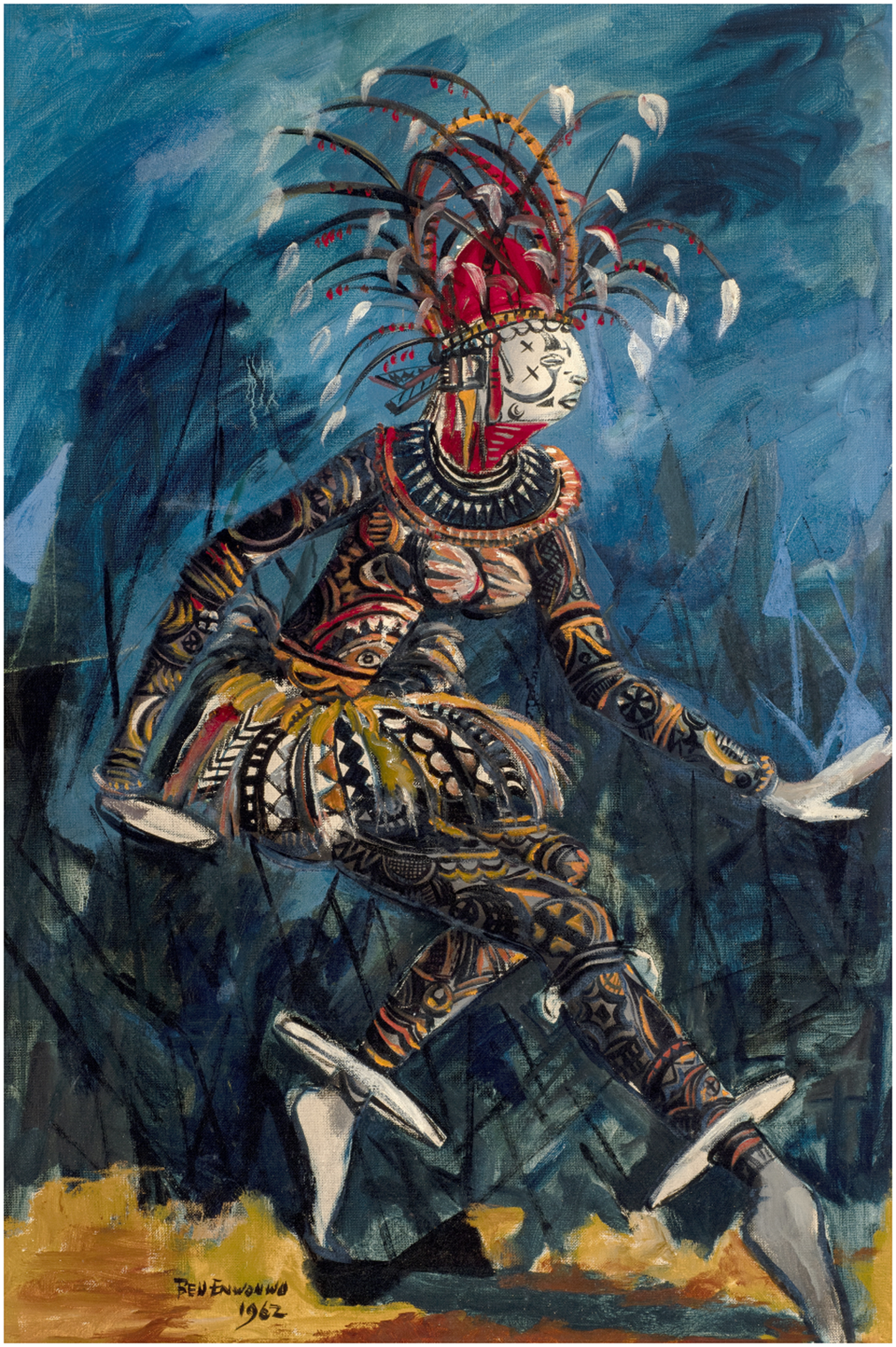
The exhibition was organized broadly chronologically, with some rooms focusing on single individuals such as those dedicated to painter and sculptor Ben Enwonwu (1917–94) (Figure 1), ceramicist Ladi Kwali (1925–84) and British Nigerian artist Uzo Egonu (1931–96). Other rooms brought together the visual work of theatre-makers such as the Ladipo Theatre Company and other groups of artists such as those that worked at the Osun Osogbo Sacred Grove. The effect of the experience was spectacular, with a diversity of styles and creative responses that was breathtaking. It was an exhibition to be remembered for a generation or more.
Ben Enwonwu, The Dancer (Agbogho Mmuo-Maiden Spirit Mask) 1962. Reproduced by permission of Tate © Ben Enwonwu Foundation, courtesy Ben Uri Gallery & Museum.

Figure 1. Long description
A painting of an Agbogho Mmuo dancer wearing costume, white-painted mask and a tall, elaborate headdress. The dancer is depicted in a dynamic pose, with detailed designs covering their body and clothing. The background features abstract, criss-cross patterns in shades of blue and green, enhancing the overall movement and energy of the scene. The painting is signed ʼBen Enwonwu 1962ʼ in the lower left.
In the choice of artworks and in the interpretative signage the curators laid out two overarching themes: the ‘variety of responses to the country’s shifting cultural and political identity’ and how they ‘fused Nigerian, African and European techniques and traditions to create vibrant, multidimensional works’.Footnote 2 Rather than starting the story of modernism in Europe and situating Nigeria as an outpost, the curators centred Nigeria as a key location in the development of artistic styles in the twentieth century.
That is a lot of history to convey. The captioning and information panels assumed that many of the visitors would not be familiar with Nigerian history or culture, and the challenge of using a short caption to simultaneously describe an individual artwork, the artist’s biography and the political and cultural context was evident. The visitor was guided through the timelines of the struggle for independence and the Biafran war 1967–70 but the brief captions could not, of course, convey the extent of the political, linguistic and cultural diversity (and conflict) of the region and the formation of Nigeria as a nation during that period.
Archival materials from newspapers to photography to ephemera were used throughout to support the visitors’ understanding about the contexts for visual practices and traditions. A highlight was the presence of archival photographs and film footage of the artists themselves, either at work in studios or in other contexts. The exhibition also displayed the work of nineteenth-century West African studio photographers such as Jonathan Adegogo Green from the Unilever archives (and other collections). The archives on display included newspapers, particularly political cartoons, and relatively rare exemplars of magazines including illustrations from literary journals such as Black Orpheus, and the colonial (then postcolonial) magazine Nigeria. The curators also displayed show listings and other ephemera from significant UK exhibitions such as publications from the former Commonwealth Institute, that now form part of Tate’s own special collections. Finally, the curators also drew from colonial ethnographic photography from the Museum of Archaeology and Anthropology, Cambridge, and beyond.
On the one hand it was satisfying to see a really well-researched selection of archival records put to new narrative uses. On the other, however, the weight of use of the archive-as-explanation shifted the emphasis in the historical narrative back towards Europe, and particularly to the UK. The archival records were more often from European collections (with some important exceptions) and offered a more European lens on the art scenes and activity that the exhibition was representing – the influences of Europe, connection to Europe and reception in Europe.
In choosing how to explain the artworks to the visitor, the curators prioritized Nigerian perspectives and stories in writing the captions and signage. As Carol Ann Dixon had previously noted in her review, these often included the artists’ own words.Footnote 3 I learned about the shifting influences of art scenes in Nigeria itself. For example, the curators identified the founding of the Zaria Art Society at the Nigerian College of Arts Science and Technology in 1960 as a key moment in which Nigeria artistic identity was affirmed, with its members carrying that legacy to the art scenes of Ibadan and Osogbo over subsequent years. The captions explored the influence of symbolism and storytelling from diverse communities in Nigeria within the content and the visual form of the artworks. This was particularly clearly explored in the presentation of various works by Ben Enwonwu, that reached into a range of visual traditions, such as his painting of the Igbo maiden spirit masquerade in Figure 1. The curators also pointed to the ways in which Nigerian artists recombined and exchanged different cultural references from across the country and worked within pan-African movements.Footnote 4 However, these aspects of the historicization of the artworks did not have such extensive archival ‘support’.
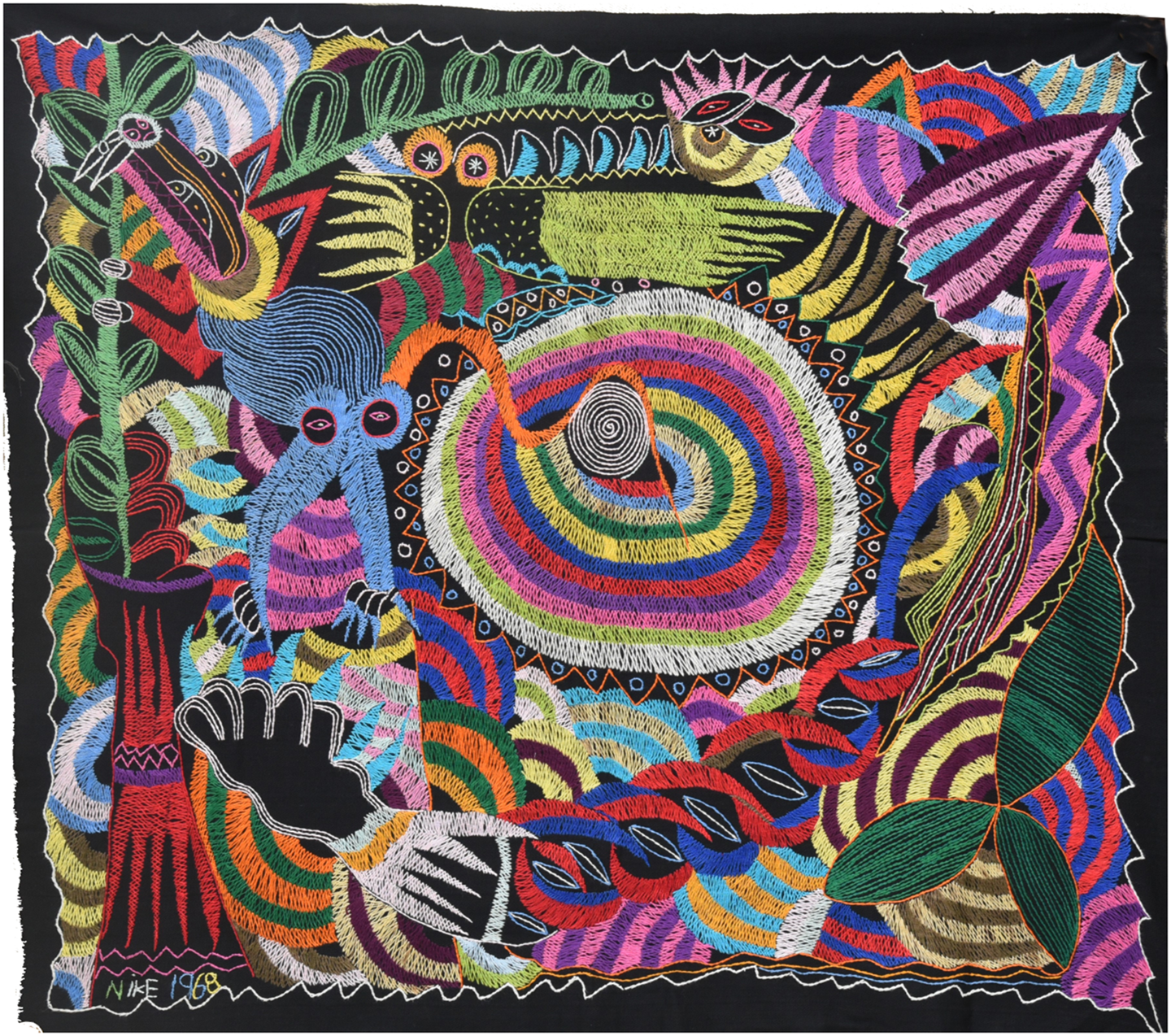
In the exhibition, I found myself asking what sources might exist to provide a similar evidential basis for learning how modernism unfolded within Nigeria. Perhaps they could be found in the papers of individual artists and activists held by families? The personal archives of individuals who live in or across the diaspora are more at risk, and success continues to draw individual creative practitioners away from West Africa. Or perhaps engaging with those histories requires the work of oral history and memory? The short video published by Tate that explores the work and legacy of Chief Nike Davies-Okundaye (Figure 2) is a beautiful example of this.Footnote 5 I would have really enjoyed more of this kind of archival source within the exhibition either as audio or video.
Nike Davies-Okundaye, Animal World 1968. Reproduced by permission of Tate © Nike Davies Okundaye. Kavita Chellaram. Image courtesy of kó, Lagos.

The exhibition drew a line in the sand for awareness of twentieth-century Nigerian art among UK audiences and vividly argued for new understandings of ‘modernism’. As I’ve described above, I feel the exhibition also highlighted the need for new centres and modes of documentation to record histories of creativity on the African continent, beyond the colonial infrastructures for historical narrative that survive in the UK and Europe. In researching around the exhibition, I found that in November 2024 the curator, Osei Bonsu, led a workshop at Guests Artists Space Foundation, Lagos, championing the importance of artists’ estates and artist-led institutions in preserving the legacy of Nigerian artistic heritage. I hope that this endeavour will result in more initiatives to create and preserve documentation that will support further elaboration of these histories and heritage in the coming decades.Footnote 6