I. INTRODUCTION
Recently, olivine structure lithium transition-metal phosphates LiMPO4 (M = Fe, Mn, Co, Ni) has become a research topic as a new type of potential cathode material for next generation of lithium-ion batteries due to their high energy capacity, nontoxicity, low cost and high electrochemical, and thermal stabilities.Reference Padhi, Nanjundaswamy and Goodenough1–Reference Wang, Buqa, Crouzet, Deghenghi, Drezen, Exnar, Kwon, Miners, Poletto and Gratzel3 Among the reported lithium metal phosphate cathode materials, the voltages of LiCoPO4 and LiNiPO4 materials are 4.9 V and 5.1 V (versus Li+/Li) respectively, beyond the stable electrochemical windows of present electrolytes,Reference Delacourt, Laffont and Bouchet4 thus developing LiMnPO4 (4.1 V versus Li+/Li) seems to be more promising. LiMnPO4 is less studied compared with LiFePO4, although it exhibits a higher operating voltage (4.1 V) and a larger theoretical energy density (684 Wh/kg) than those of LiFePO4.Reference Zhou, Cococcioni, Kang and Ceder5
However, the fatal flaw of LiMnPO4 material is inherently low ionic and electronic conductivities, which render it difficult to achieve excellent electrochemical activity.Reference Delacourt, Laffont and Bouchet4 Additionally, possible key rate limiting factors, such as passivation phenomenon upon delithiation, Jahn–Teller anisotropic lattice distortion in Mn3+, interface strain due to the large volume change between LiMnPO4 and MnPO4, and the metastable nature of the delithiated MnPO4 phase, were suggested causes and are still under debate.
Inspired by the previous research on LiFePO4, the strategies include carbon coating,Reference Martha, Markovsky, Grinblat, Gofer, Haik, Zinigrad, Aurbach, Drezen, Wang, Deghenghi and Exnar6 particle size reduction,Reference Doan, Bakenov and Taniguchi7–Reference Drezen, Kwon, Bowen, Teerlinck, Isono and Exnar9 and cation doping.Reference Shiratsuchi, Okada, Doi and Jamaki10–Reference Wang, Ouyang and Drézen13 Among them, the particle size reduction and the carbon-coated LiMnPO4 are main methods. In spite of those tremendous efforts, the electrochemical performance of LiMnPO4 prepared is not sufficient for application to commercial cells. Especially, large polarization during charging has been a significant problem for achieving reasonable rate. For LiMnPO4 cathode material, crystallinity is as important as particle size, but widely known nanomaterial synthesis methods are generally designed for liquid-phase routes to avoid grain growth and agglomeration, which may lead to Mn2+ disorder on the Li+ sites in LiMnPO4 and thus limit the electrochemical activity. Additionally, high-potential cathode materials require a higher sintering temperature to form a more thermodynamically stable structure with stronger bonding. Therefore, a relatively low-temperature route to obtain well-dispersed uniform nanoparticles with good crystallinity is vital for LiMnPO4 synthesis.
Recently, graphene has shown great potential in Li ion battery application. Improvement on specific capacity and cycling stability of LiFePO4 and metal oxide anode materials was reported when modified by graphene.Reference Paek, Yoo and Honma14–Reference Wu, Ren and Wen16 Our group have also successfully prepared only graphene-modified Li3V2(PO4)3 composite by spray-drying process with an improved electrochemical performance.Reference Jiang, Xu, Chen, Jiao, Zhang, Ma, Cai, Zhao and Chu17 Here, it should also be ascribed to the high conductivity and structural flexibility of graphene sheets, which are much better than that of pyrolytic carbon.
In this paper, we report on the preparation of a novel graphene-modified LiMnPO4 composite by spray-drying process. Compared with other methods, spray-drying technology is well known to be an attractive route to synthesize fine homogeneous and multicomponent powders with high yield, high crystallinity, at the same time with low cost and energy-consuming.Reference Zhou and Liu18 In this composite, the LiMnPO4 sheets are attached to the graphene sheets in pieces. First, graphene sheets serve as a conducting network for fast electron transfer between the active materials and charge collector. Second, they provide buffered spaces to accommodate the volume expansion/contraction during the discharge/charge process. The graphene-modified LiMnPO4 composite shows high specific capacity and excellent cycling stability.
II. EXPERIMENTAL
The nanostructured pure phase LiMnPO4 was synthesized using the polyol synthesis reported in previous paper.Reference Wang, Buqa, Crouzet, Deghenghi, Drezen, Exnar, Kwon, Miners, Poletto and Gratzel3 All chemicals were of analytical grade (Sinopharm Chemical Reagent Co., Ltd., Shanghai, China) and used directly without any purification. First, 0.06 mol manganese acetate tetrahydrate (Mn(CH3COO)2·4H2O) was dissolved into 30 mL deionized water and poured into a three-neck round-bottom flask containing 200 mL diethylene glycol (DEG). This mixed solution was vigorously stirred and heated to 100 °C, kept for 1 h, and then 30 mL of 2 mol/L lithium dihydrogen phosphate (LiH2PO4) aqueous solution was dropped into this system at a speed of 1 mL/min. Then, the above suspension was kept for another 4 h at this temperature. After cooling down to room temperature, the LiMnPO4 material was separated by centrifugation and washed three times with ethanol to remove the residual DEG and organic remnants. Finally, the achieved material was dried in an oven in air at 120 °C overnight. To maintain platelet-structural LiMnPO4 material, 0.095 g polystyrene was dissolved into 10 mL acetone and then 1 g LiMnPO4 was added to the above solution. After ultrasonically exposed for 1 h and dried at 60 °C overnight, the achieved precursor was ground for 20 min and heated to 450 °C at a rate of 5 °C/min for 4 h under N2 atmosphere to form carbon coated LiMnPO4 material (denoted by LiMnPO4/C).
Graphite oxide (GO) sheets were prepared from natural graphite powder via a modified Hummer's method as described in our previous work.Reference Zhao, Liu, Jiang, Pan, Tao, Song, Fang and Xu19,Reference Pan, Wang, Zhao, Wu, Zhang, Wang and Jiao20 Typically, graphite powder (3 g) was put into an 80 °C solution of concentrated H2SO4 (12 mL), K2S2O8 (2.5 g), and P2O5 (2.5 g). The mixture was kept at 80 °C for 4 h and then cooled to room temperature, diluted with deionized water (DI, 0.5 L), and left overnight. The mixture was centrifuged, washed with DI water, and dried. The preoxidized graphite was further oxidized in concentrated H2SO4 (120 mL) and KMnO4 (15 g) for 2 h under stirring and ice bath. Then, the mixture was diluted with DI water (250 mL) in an ice bath to keep the temperature below 50 °C for 2 h and further diluted with DI water (700 mL); 30% H2O2 (20 mL) was then added to the mixture, and a brilliant yellow product was formed. The product was centrifuged and washed with 1:10 HCl (1 L) aqueous solution and DI water (1 L) to remove the metal ions and acid. At last, the suspension was centrifuged at 4000 rpm for 15 min to remove the few layers GO. The concentration of the resultant GO suspension was determined by determining the concentration of GO in the slurry. A known amount of the slurry was dried over P2O5 for 1 week in a vacuum desiccator. From the weight of the dry GO product, the concentration of GO in the slurry was found to be about 3 mg/mL.
The graphene-modified LiMnPO4 composite was prepared with LiMnPO4/C and GO suspension by spray-drying and annealing processes. First, the above-mentioned LiMnPO4/C was dissolved into 170 mL GO suspension under continued stirring. After stirred for 1 h at room temperature, the achieved mixture was ultrasonically exposed for 10 min, and then spray-dried at 200 °C to form a solid composite. The solid composite was heated to 550 °C at a rate of 5 °C/min for 4 h under N2 atmosphere to form the active cathode material [denoted by LiMnPO4/(G + C)], the carbon content was controlled to be ∼15 wt%.
The morphology and microstructure of obtained products were characterized by x-ray power diffraction (XRD, Rigaku D/max-2500, Rigaku Co., Japan, Cu Kα radiation, λ = 1.50405 Å), field-emission scanning electron microscopy (FE-SEM, JSM-6700F, JEOL Ltd., Tokyo, Japan), and transmission electron microscopy (TEM, JEOL 200CX, JEOL Ltd., Tokyo, Japan) in the Instrumental Analysis and Research Center, Shanghai University. The carbon contents in the final cathode materials were determined by Carbon & Sulfur Determinator (CS444LSc).
The electrochemical test of the obtained composites was carried out in 2016 coin-type cells. The working electrodes were prepared by mixing 85 wt% active materials, 10 wt% acetylene black, and 5 wt% polytetrafluoroethylene (PTFE). The lithium metal foil was used as the anode, whereas the electrolyte was a solution of 1 M LiPF6 in dimethyl carbonate (DMC) and ethylene carbonate (EC) (1:1 by weight). The coin-cells were assembled in an argon-filled glove box and tested on a LAND CT2001A cell test system (Wuhan, China) with galvanostatic charge and discharge in the voltage range of 2.5–4.4 V under different current densities at room temperature.
III. RESULTS AND DISCUSSIONS
Figure 1 shows x-ray diffraction patterns of (a) pure phase LiMnPO4, (b) LiMnPO4/C, and (c) LiMnPO4/(G + C) composites. From the XRD patterns, the olivine-type LiMnPO4 phase is formed devoid of any impurity. No featured peaks of other possible impurities such as Li3PO4 (JCPDS 25–1030), Mn2P2O7 (JCPDS 35–1497), and MnO (JCPDS 78–424) are observed. All patterns are identified as well-crystallized olivine orthorhombic structures with space group of Pnma. (JCPDS No.: 01-072-7844). Carbon is not detected based on XRD analysis, which indicates that the residual carbon is an amorphous structure and/or the thickness of the residual carbon layer on the particles is too thin to be detected by the powder XRD.Reference Shin, Cho and Jang21 No evidence of diffraction peaks for graphene in the LiMnPO4/(G + C) composite is detected [Fig. 1(c)], which may be that the regular lamellar structure of the graphene has been broken in the as-prepared composite, forming exfoliated monolayer graphene sheets.Reference Wang, Yang, Liang, Cui, Casalongue, Li, Hong, Cui and Dai12 Moreover, the polystyrene or GO aqueous solution in the preparing process does not influence the structure of LiMnPO4.
X-ray diffraction patterns of (a) pure phase LiMnPO4, (b) LiMnPO4/C, and (c) LiMnPO4/(G + C) composites.

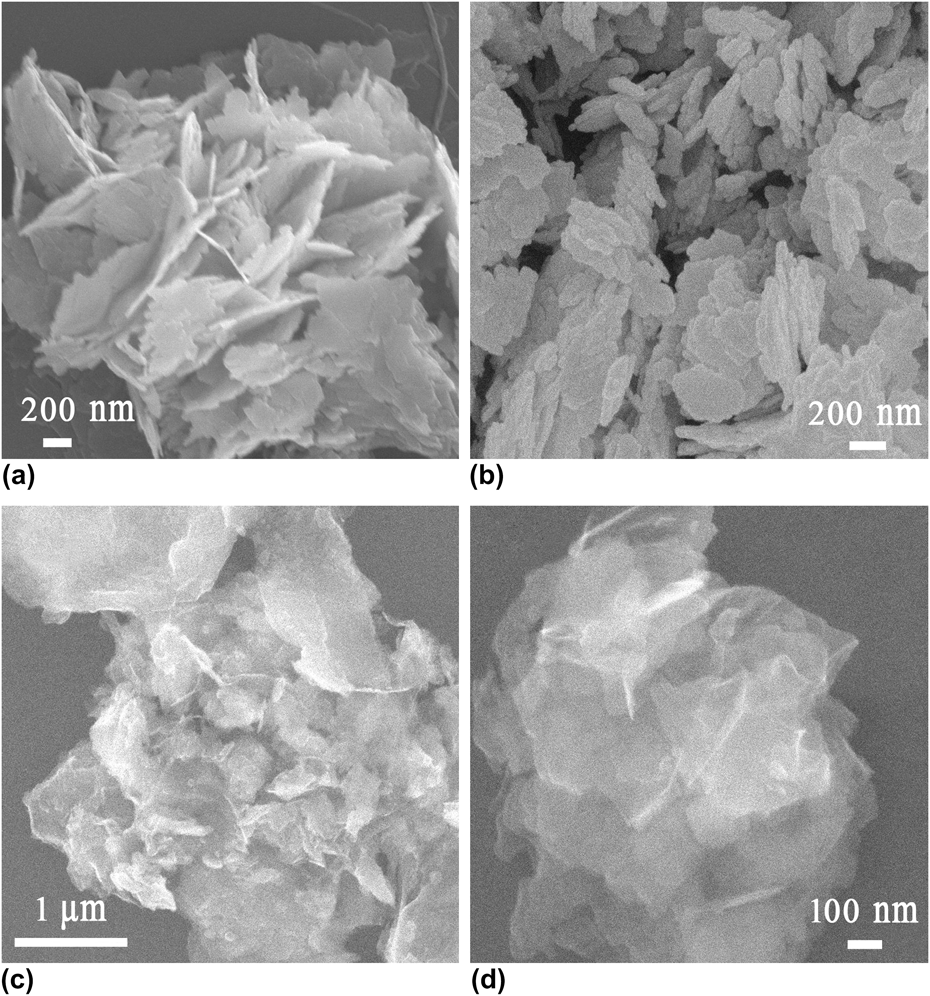
Figure 2 shows SEM micrographs of (a) pure phase LiMnPO4, (b) LiMnPO4/C, and (c) LiMnPO4/(G + C) composites. The SEM observation of Fig. 2(a) shows that the pure phase LiMnPO4 material processes a platelet structure with a width of 0.5–1 μm and a thickness of 20–30 nm. Figure 2(b) shows that the width of platelet-structural LiMnPO4 reduces to about 200 nm after carbon coating, it may be that the LiMnPO4 sheets smash to pieces during the process of ultrasonic or high temperature sintering. As can be seen from Figs. 2(c) and 2(d), through spray-drying and annealing processes, the flexible graphene sheets are formed with a width of ∼1 μm and interweave with LiMnPO4 sheets, generating a novel LiMnPO4/(G + C) composite in pieces. Moreover, there are no existing individual or conglomerate LiMnPO4 sheets in the composite.
SEM micrographs of (a) pure phase LiMnPO4, (b) LiMnPO4/C, and (c, d) LiMnPO4/(G + C) composites.
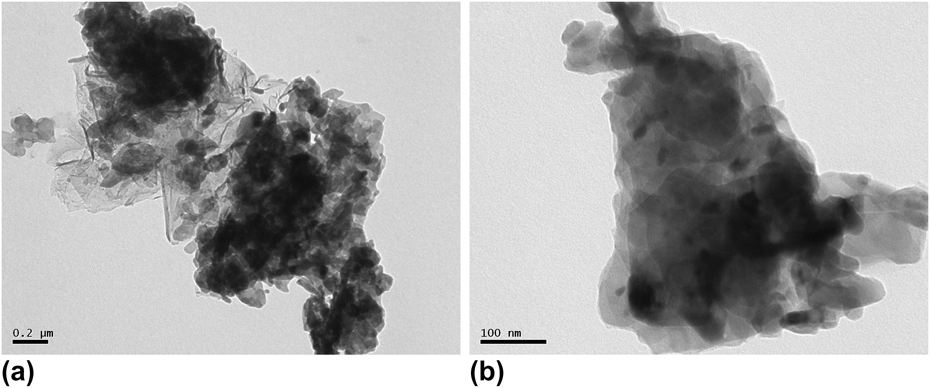
To further investigate the morphology and microstructure of LiMnPO4/(G + C) composite, the TEM characterization was performed and the result is shown in Fig. 3. It can be obviously seen that the forming flexible graphene sheets interweave with LiMnPO4 sheets with a width of 100–200 nm. On one hand, the pyrolytic carbon coating on the surface of LiMnPO4 sheets could limit the growth or gathering, prevent regathering of LiMnPO4 sheets caused by volume shrinking and expanding in the charge–discharge process. On the other hand, the graphene with high conductivity and excellent mechanical properties contacts tightly with LiMnPO4 sheets, acting as the electronic conducting skeleton of the composite.Reference Zhao, Song, Liu, Xu, Fang, Jiao, Zhang and Jiang22
TEM images of LiMnPO4/(G + C) composite.
Figure 4 shows the initial charge–discharge curves of LiMnPO4/C and LiMnPO4/(G + C) composites at 0.05 C rate in the voltage range of 2.5–4.4 V. These samples exhibit a reversible plateau around 4.1 V versus Li/Li+, which is the typical redox potential of Mn(II)↔Mn(III) in olivine manganese phosphate. The difference between charge and discharge voltage plateaus for the LiMnPO4/(G + C) is smaller than LiMnPO4/C, indicating lower polarization for the LiMnPO4/(G + C) sample. Furthermore, the discharge curve of LiMnPO4/(G + C) composite is more flattened than that of LiMnPO4/C, which means energy can be used more effectively in LiMnPO4/(G + C) composite.Reference Ding, Jiang and Xu23 The initial discharge specific capacity of LiMnPO4/(G + C) is 105.1 mAh/g, whereas the LiMnPO4/C delivers an initial discharge capacity of 60.1 mAh/g, and the first coulombic efficiencies are 94.1% and 82.8%, respectively. Similar to the previous reports,Reference Doan, Bakenov and Taniguchi7–Reference Drezen, Kwon, Bowen, Teerlinck, Isono and Exnar9 the reversible capacity of the prepared LiMnPO4 is much lower than its theoretical value (171 mAh/g), even though a low charge–discharge rate was applied. This limited capacity is the result of extremely low intrinsic electronic conductivity and slow lithium diffusion kinetics within the LiMnPO4 grains.Reference Delacourt, Laffont and Bouchet4
The initial charge–discharge curves of LiMnPO4/C and LiMnPO4/(G + C) composites at 0.05 C rate in the voltage range of 2.5–4.4 V.
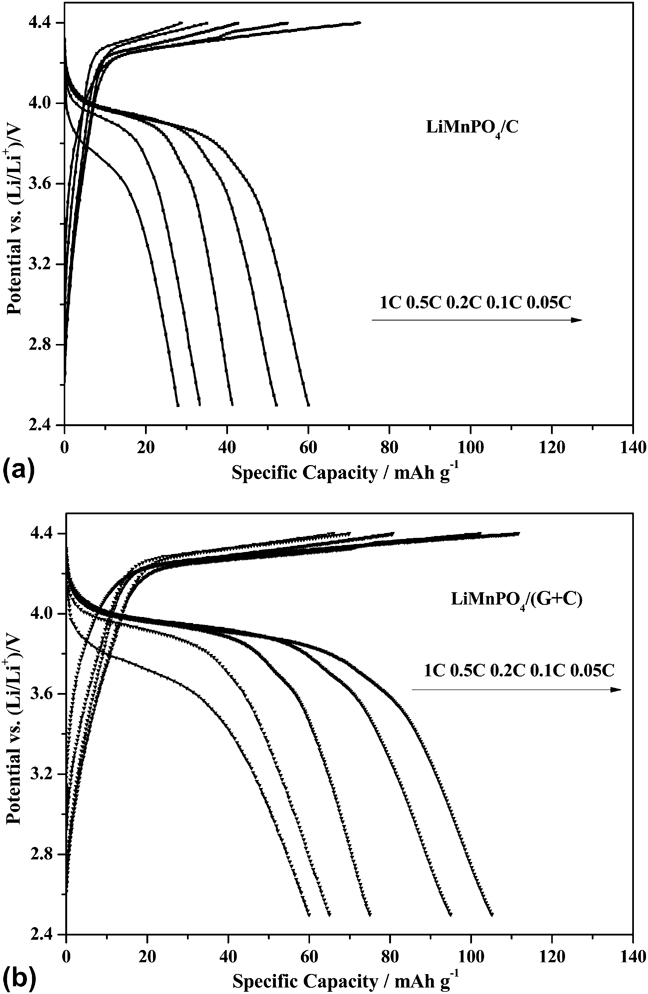
The charge–discharge curves of (a) LiMnPO4/C and (b) LiMnPO4/(G + C) composites at different discharge rates in the voltage range of 2.5–4.4 V are shown in Fig. 5. The cells were charged at 0.1 C rate between 2.5 and 4.4 V before each discharge and then were discharged at rates ranging from 0.1 to 1 C except when charged and discharged at the same rate of 0.05 C. The capacity of LiMnPO4/(G + C) decreases from 105.1 to 60.2 mAh/g by increasing the discharge rates from 0.05 to 1 C, which can be ascribed to the Li+ diffusion in the interface between LiMnPO4 and MnPO4.Reference Ding, Jiang and Xu23 Apparently, the rate performance and charge-discharge efficiency of LiMnPO4/(G + C) increase dramatically with low content of graphene nanosheets. The confinement effect and excellent electron conductivity of graphene sheet obviously play an important role. First, compared with LiMnPO4/C, the smaller LiMnPO4 sheets in size in LiMnPO4/(G + C) with high surface area yield a decrease in the Li ion concentration and electron transport length and may ease the strain associated with the two-phase boundary of LiMnPO4 and MnPO4. Second, the graphene nanosheets act as conducting routes between the LiMnPO4 sheets and the contact resistance is reduced.Reference Qin, Zhou, Xia, Tang and Liu24 It is also able to accommodate the strain induced by volume change of LiMnPO4 and maintain the integrity of the electrode during charge/discharge, which is responsible for the good cycling stability and rate capability.
The charge–discharge curves of (a) LiMnPO4/C and (b) LiMnPO4/(G + C) composites at different discharge rates in the voltage range of 2.5–4.4 V.
Figure 6 shows the cycling performances of LiMnPO4/C and LiMnPO4/(G + C) composites at 0.05 C rate in the voltage range of 2.5–4.4 V. For LiMnPO4/C, the discharge specific capacity fades gradually down to 46.4 mAh/g after 50 cycles with a capacity retention of only 75.4%. In contrast, the LiMnPO4/(G + C) shows much better cycling stability with a capacity retention of 91.4%. Similar to the above analysis, it could be ascribed to the LiMnPO4/(G + C) composite in pieces providing buffered spaces to accommodate the volume expansion/contraction during discharge/charge process and promises the cyclical stability.
The cycling performances of LiMnPO4/C and LiMnPO4/(G + C) composites at 0.05 C rate in the voltage range of 2.5–4.4 V.
IV. CONCLUSIONS
In summary, we have successfully prepared a novel graphene-modified LiMnPO4 composite as a performance-improved cathode material for lithium-ion batteries with LiH2PO4, Mn(CH3COO)2·4H2O, and GO suspension by spray-drying method and annealing processes. The graphene nanosheets are used as scaffolds for fast electron transfer between the active materials and charge collector, as well as buffered spaces to accommodate the volume expansion/contraction during discharge/charge process. The discharge capacity of the LiMnPO4/(G + C) composite could achieve 105.1 mAh/g in the voltage range of 2.5–4.4 V at 0.05 C discharge rate, with faint capacity decay after 50 cycles.
ACKNOWLEDGMENTS
This work was supported by the Natural Science Foundation of China (Grant Nos. 11275121 and 21241002), Science and Technology Committee of Shanghai (Grant Nos. 11DZ110020, 13DZ1200502, and 13XD1424600), and Shanghai Leading Academic Disciplines Project (Grant No. S30109).