Introduction
This article reports on a research project that explored Western classical music instrumental tuition in higher music education (HME). The project included an interview study, in which data was collected from individual qualitative interviews with 11 international students and one Norwegian student studying at a music academy in Norway. In sum, these students had experiences from a range of different HME contexts in America, Europe and Asia. The methodological idea behind the interview study was to explore and reflect on these students’ stories about instrumental tuition in order to deepen our understanding of musical instrumental tuition as an educational practice. The main aims of the current article are to identify the ways in which instrumental tuition practices are different and what these differences involve and to critically discuss the assumptions of learning and pedagogy underlying these differences.
An increasing number of research studies look into the characteristics of instrumental tuition in HME. Performance specialism and one-to-one tuition were identified by Perkins (Reference PERKINS2013b) as main features of the learning cultures of conservatoires, in addition to learning cultures of social networking, musical hierarchies and vocational position taking. Research studies also indicate that students have high regard for one-to-one tuition and the individual attention it provides, as demonstrated by Gaunt (Reference GAUNT2009). Instrumental tuition in HME is not restricted to one-to-one tuition, and several studies explore and advocate alternatives. Many of these studies seek to understand the potential of collaborative teaching and learning in groups. Bjøntegaard (Reference BJØNTEGAARD2015) and Hanken (Reference HANKEN2016) submit that group lessons open up a promising space for student initiatives and peer learning. Luff and Lebler (Reference LUFF, LEBLER, Gaunt and Westerlund2013) argue that ensemble group lessons should be considered a necessary component in developing horn players. Wöllner and Ginsborg (Reference WÖLLNER and GINSBORG2011) and Haddon (Reference HADDON2011) examined team teaching and saw that it gave valuable exposure to new ideas and feedback but also that students could experience problems regarding loyalty and had to find ways of handling perceived differences between teachers’ approaches. In one study (Sætre & Zhukov, Reference SÆTRE and ZHUKOV2021), chamber music staff joined as playing members of the student ensembles, which was experienced very positively by both students and staff and changed the very nature of learning itself, from instruction to joint participation, the authors argue. These studies reveal in sum that there exists a range of available lesson formats in instrumental tuition and that there is much to gain by expanding the social range of instrumental teaching and learning, compared to the one-to-one setting, by adding, for example, group lessons, peer learning and team teaching.
Other studies investigate what forms of pedagogy can be found in instrumental tuition practices. Australian researchers identified 2 different pedagogical approaches, transformative pedagogy and transfer pedagogy, in a study of 74 one-to-one lessons with 6 staff and 12 students (Carey et al., Reference CAREY, BRIDGSTOCK, TAYLOR, MCWILLIAM and GRANT2013). Transformative pedagogy is, according to Carey and Grant (Reference CAREY and GRANT2016, p. 54), student-oriented, flexible, responsive, explorative and context-rich. Transfer pedagogy, on the other hand, is characterised by instruction, scaffolding that promotes mimicry, less flexibility, orientation towards assessment and its object is ‘defined excellence’ (Carey et al., Reference CAREY, BRIDGSTOCK, TAYLOR, MCWILLIAM and GRANT2013, p. 362). These scholars argue in favour of transformative pedagogy, as it has the potential to ‘improve short- and long-term learning outcomes, to increase student engagement and motivation in learning, to support students’ personal and professional growth, and to help them develop strong career and life skills’ (Carey & Grant, Reference CAREY and GRANT2016, p. 55). Importantly, they underlined that no teacher in the study represented only one approach but leaned more or less towards one of them. They also stated that there were students who wanted both types but that the majority preferred transformative pedagogy. Burwell (Reference BURWELL2021) investigated a neighbouring topic, authoritative discourses in instrumental tuition, which can be seen to be close to transfer pedagogies in the sense of representing instruction and strong teacher authority. Burwell demonstrated in this case study that authoritative teaching can be a viable approach if the subject matter and the student–teacher relationships are right. These studies can be seen as examples of music-specific exploration of the struggle between student-centred and teacher-centred pedagogies and philosophies, which is a key debate in educational theory in general (Mascolo, Reference MASCOLO2009). This debate concerns the question of who should have ownership, initiative and defining power in educational settings and, accordingly, the question of choosing student-led or teacher-led ways of working in the classroom. It also concerns whether learning should be understood as transmission of knowledge from teacher to student or as co-construction of knowledge through student engagement, participation and collaboration.
Furthermore, an important body of research has identified challenging issues of power in instrumental tuition. Burwell’s (Reference BURWELL2019) case study of two students who reported dissatisfaction with their current teachers is one example. Gaunt (Reference GAUNT2009) found in a study of conservatoire students that they all considered one-to-one tuition extremely important but also that some students became dependent on their teacher and on having a good relationship with the teacher. Gaunt argues that measures should be taken to avoid students becoming passive in their own learning process and too aligned with their teacher. One way of accomplishing this, according to Gaunt, is to give senior students more than one teacher. Wagner (Reference WAGNER2015) gave further evidence of the close relationship between instrumental teachers and students. In her study of the ‘Russian Violin School’, she uncovered a school of instrumental tuition that builds on specific traditions and musical practices, certain assumptions about learning and teaching and a particular power relationship between teachers and students. One of Wagner’s main findings was the very strong personal and professional bond between teachers of the Russian School and their most prominent student virtuosos. This bond functioned as a career coupling where each party gained prestige by the success and status of the other. Bull (Reference BULL2019, Reference BULL2021) argues that power is exercised to a large degree in music performance and education settings and shows that power relations and hierarchies intersect with social inequalities and are reproduced by invisible practices. Perkins (Reference PERKINS2013a) found that hierarchies (of musical styles, performance quality, performer roles) affect the possibilities of learning; they relate to what and how students learn. Students learn, according to Perkins, where they fit in the conservatoire hierarchies and how to respond to, and maximise or mitigate against, their position. These studies suggest that there exist social and professional norms in HME, regulating what is valued, desired and considered normal in music performance and music education and which affects how students see themselves and how they navigate in their learning and in their professional choices. According to Leech-Wilkinson (Reference LEECH-WILKINSON2016), this is not only the case in educational contexts but also in the field of Western classical music performance at large. He argues that classical music practice functions as a police state, where teachers, examiners, adjudicators, critics, agents, promoters and record producers define and control what is the perfect representation and interpretation of classical music.
These studies suggest that instrumental tuition differs when it comes to issues such as organisation, forms of and views on learning and pedagogy and power relations. This may be differences between individual teachers, as demonstrated by Nerland (Reference NERLAND2004), or institutional differences (see, e.g. Papageorgi et al., Reference PAPAGEORGI, HADDON, CREECH, MORTON, DE BEZENAC, HIMONIDES, POTTER, DUFFY, WHYTON and WELCH2010), and it could be differences on a broader level. Meyer (Reference MEYER2014), for example, has researched the field of business and argues that there exist several cultural differences in leadership and decision-making globally and that it makes sense to speak of different international leadership styles. Alexander (Reference ALEXANDER2001) found the same tendencies in the area of general schooling. Primary school discourses in countries such as Russia focused on a Vygotskian notion of learning as acceleration (which gave room for a teacher-oriented practice), while England and the United States, in contrast, represented an egalitarian and Piagetian notion of learning as facilitation and negotiation, encouraging student-oriented practices.
It is differences such as the ones presented above that the present article is interested to examine more closely, and we present as a result the following research question:
What categories of difference can be found in higher music education students’ stories about Western classical instrumental tuition across the range of practices involved, and how do these differences relate to issues concerning learning, pedagogy and power?
Research methodology
In order to gain access to information about different HME instrumental tuition practices, the researchers chose to conduct interviews with international students at a Norwegian academy who had HME studies from one additional country. These students would, in other words, have experiences and insights from HME studies in a minimum of two countries and thus represent valuable knowledge about differences in HME instrumental tuition. The research study thus employed qualitative research methodology, which is useful when trying to understand complex and contemporary phenomena (Yin, Reference YIN2009), and used individual, semi-structured interviews of students as the method of data collection. To focus solely on student interviews provided one perspective on the topic and omitted others. If we had interviewed teachers or observed actual lessons, we would have captured other perspectives and provided additional information (Fangen, Reference FANGEN2010).
Qualitative interviews are seen as a good tool for providing rich descriptions of the participants’ experiences (Kvale & Brinkmann, Reference KVALE and BRINKMANN2009), in this case, the students’ experiences from instrumental tuition. Interviews can value the voices and life world of the participants and give descriptions of and meaning to the researched phenomenon (Brinkmann, Reference BRINKMANN and Leavy2014). However, we underline that there is considerable philosophical debate of whether (and if so, how) qualitative interviews represent reality and whether one ‘finds’, ‘produces’ or ‘constructs’ knowledge through interview research (Alvesson, Reference ALVESSON2003; Qu & Dumay, Reference QU and DUMAY2011).
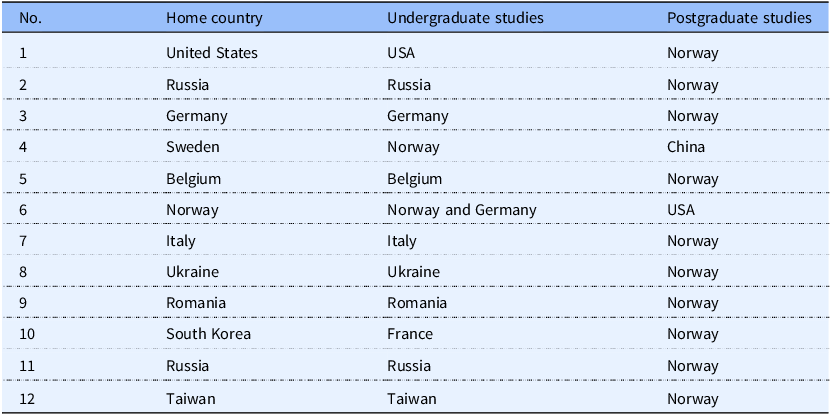
In order to recruit students, the authors compiled a list of students they knew had undertaken HME in a minimum of one country in addition to Norway. We then consulted other staff who suggested more students. The researchers selected participants in order to compose a group of students that represented geographical, instrumental and gender variation and asked these to participate. We ended up with 12 students with 11 different nationalities. The first author conducted individual interviews with these students. All participants studied classical Western music, and they played a variety of instruments: violin, viola, harp, piano, guitar, clarinet, bassoon, French horn and voice. The majority of the participants were master’s students at the time of the interviews. Six were female, and six were male. Table 1 displays the number of participants, their home country and the countries where they had undertaken higher-level music education. Seven participants talked about male instrument teachers only, while five mentioned female instrumental teachers as well.
Interview study participants

The study received ethical clearance from the Norwegian Centre for Research Data (www.sikt.no) to interview students and to record and transcribe interview material. All participants received information about the aims and nature of the project and were informed that they could withdraw from the project at any time.
The interviews followed a semi-structured interview guide (Kvale & Brinkmann, Reference KVALE and BRINKMANN2009), which is presented as Appendix 1. The interviews lasted from around 30 min to around 1 h. Eight interviews were conducted in English and four in Norwegian. A research assistant transcribed the interviews, after which the first author went through all transcriptions and made necessary corrections and adjustments. The first author has translated quotations from interviews in Norwegian (nos. 3, 4, 6 and 11) to English. The transcriptions (or quotations) were not presented back to the participants for comments since several of them had left Norway before the transcriptions were ready.
The authors conducted a thematic analysis of the interview data inspired by the approach presented by Braun and Clarke (Reference BRAUN and CLARKE2006). The three authors first read through the interview data individually and then met and discussed their interpretations and categorisations. Also, both the design of the interview guide and the development of the categories were inspired by Carlsen (Reference CARLSEN, Gies and Sætre2019), who discusses differences between a maestro model and a mentor model in instrumental tuition when it comes to teacher positions, communication and subject matter issues. The joint discussion led us to decide on five main themes in the interview data (master positions, responsibility, forms of communication, organisation and subject matter). The first author continued analysing the interview data more closely by coding the interview data in each category in search for sub-categories and refinement of the labelling of the main categories (as demonstrated in Braun & Clarke, Reference BRAUN and CLARKE2006), which in the end resulted in the following four themes:
-
Teacher positions
-
Lesson formats and social organisation
-
Responsibility and student voice
-
Subject matter focus
Below, we present the results of our analyses, which present differences in musical instrumental tuition in these four areas. In each area, we have discovered practices that seem to take or represent different stands on the issue in question, and we present these differences as sub-themes. When quoting participants, we include the participant number from Table 1 and insert the country in which the quoted experience happened (e.g. not necessarily the nationality of the teacher). We emphasise that every quote should be seen as an individual, personal experience or opinion and not as a common characteristic of the practice in question or as an unquestionable account of reality (Alvesson, Reference ALVESSON2003).
Interview findings
Teacher positions
The category of the teacher position concerns differences in teaching styles and teacher roles. There are several positions in the interview data, which we suggest fall under three main positions.
The first position, the master, is perhaps primarily characterised by authority. ‘The teacher [Germany] is the authority and I am the student. It is very much like… You are not at the same level. This is not to say that there is anything wrong with that’ (3). In the interview with Student 6, the master position is also evident.
I feel it has been very similar all the places I have been. Professor is professor, in a way. But I think it depends on your teacher. The first one I had was very much the professor type [Norway]. You were always a bit frightened, and had great respect for him, and I think it was a choice he made that was very reasonable. You were never really close, because he was kind of the wise one and you were the stupid one. The rest were also like that. Everything that the professor says is fine, in a way. (6)
The master, in this description, is someone who holds the expertise, is on a higher level and who induces respect and sometimes anxiety on the students. Both Students 3 and 6 find this to be a reasonable position to take. In the story of Student 2, however, we find a master who is critical and whose authority in the eyes of the student is used for punishment instead of guidance.
So, basically, my relationship with him was ruined [Russia]. I’m actually still curious about what happened, because I don’t think that I did something to him, or anything. But lessons became, like, five to fifteen minutes … And there was a lot of criticism, but usually when someone criticizes you, it’s like: ‘this and this is not good. So you should do this and this, and you will fix it’. It was not like that. It was just: ‘This is horrible. Go home!’ That’s it. (2)
A different type of master is evident in interview 7. Here, the teacher [Italy] takes the form of a Renaissance master. ‘Every time he had a new student, there was always “the court”, I called it’ (7). The teacher sat in front of all his students like in a Renaissance masterclass, and all ‘learn from what happens to the other’. He asked ‘strong’ questions about motivation and interpretation, but he always told them how to interpret the musical works. In his view, musicians must approach interpretation from an academic or scientific angle (history, form, harmony) ‘Music as a scientific part, and regarding that, no discussion, “that’s how things are”’ (7).
Other students describe the instrument teacher as a mentor, and the student–teacher relationship as a ‘mentorship, if it is done right’ (1). ‘My teacher [USA], when I was a bachelor student, was like a mentor. He was definitely aware of my development as an adolescent, and how that impacted music’ (1). The mentor ‘is not only an instrumental teacher; he [Norway] really guides me and his other students through life’ (5). ‘She [Romania] is very passionate about student psychology, and how they develop at different levels’ (9). Two students use family metaphors to describe their teachers. ‘He [Italy] made a poem in rhyme, giving me suggestions for life and for music. In rhyme! (…) It was more a father, somehow’ (7). Student 8 describes bursting into tears in a lesson and the teacher [Norway] saying ‘It’s all fine. Everything will be okay, you don’t have to cry’ (8) and the student continues: ‘Sometimes I feel that he is my grandfather, you know. (…) We don’t have many lessons, but I have immense trust in him’ (8). Guidance, care and an interest in the students’ general life situation seem to be characteristics of the mentor position.
A third and rather special teacher position in the interview data is the co-learner, which we find in the story of Student 2 (this position could also be viewed as a sub-category of the mentor position).
But I feel like, when I’m practicing with Teacher A or with Teacher B [Norway], that we are colleagues. Like, we both try to figure out, again for him, how to do it. Like, if I pick up a Mozart concerto. I play it, and, of course, it is not new for me, and it is certainly not new for him, but he learns it again together with me. Helping me, leading me, like, you know, taking one heavy, heavy ship, and try to put it in the right harbour. (2)
The teacher and student are here more like colleagues when it comes to musical learning, and there is mutual respect between them. ‘It is not just that I am respecting the teacher, the teacher respects me, as well’ (2).
The interviews present different teacher positions spanning from the authoritarian master to the personal mentor and the egalitarian co-learner, and they corroborate previous research that identified instrumental tuition practices that were troublesome (Burwell, Reference BURWELL2019; Bull, Reference BULL2019) and well-functioning (Burwell, Reference BURWELL2021; Gaunt, Reference GAUNT2009). The teacher positions seem to create student–teacher relationships that are different when it comes to power issues. That is, to use Meyer’s (Reference MEYER2014) terminology, the student–teacher relationships span from practices that are characterised by strong hierarchical ordering and large power distance (master position) to practices that are egalitarian with short power distance (mentor and co-learner positions). Alexander (Reference ALEXANDER2001) found similar tendencies in his study of primary education in five countries. According to the arguments by Leech-Wilkinson (Reference LEECH-WILKINSON2016) and Perkins (Reference PERKINS2013a), the context of Western classical music (both industry and HME) could itself be considered a hierarchical structure, where some agents and practices decide what is considered acceptable and desirable. Moreover, the identified teacher positions seem to allow different forms of power, ranging from punishment to subtler disciplinary forms of power (Foucault, Reference FOUCAULT and Sheridan1979; Bull, Reference BULL2019). We notice that some students tell stories about punishment, fear, anxiety and respect (master position). Other teachers are described as caring and as teachers who are seen just as much as (male) family members and to whom they have ‘immense trust’ (mentor) or by whom they are treated with respect (co-learner).
Another aspect of the differences between the student–teacher relationships is their potential correspondence with differing views on learning and teaching. For example, transformative pedagogy, as described by Carey et al. (Reference CAREY, BRIDGSTOCK, TAYLOR, MCWILLIAM and GRANT2013), seems to correspond to a teacher role that is in line with the mentor and co-learner positions described above, in the sense of being student-oriented and supporting students’ personal and professional growth (Carey & Grant, Reference CAREY and GRANT2016, p. 55).
Lesson formats and social organisation
Instrumental tuition practices also differ when it comes to the choice of lesson format and social organisation. The interviews include descriptions of practices that differ when it comes to the number of students included in the lesson and also the number of teachers involved in instrumental tuition.
Some practices make use of one-to-one lessons only: ‘It is all the time one-to-one’ (8). ‘Only one-to-one teaching. My teacher [Germany] said all the time that we were going to have class lessons, but it never happened’ (6). Other teachers open up the one-to-one lessons and invite fellow students to observe or to take part. ‘We had mostly individual lessons, but it was always possible, if you played duets or quartets, to bring the ensemble [Germany]’ (3). Other lesson formats that are described in the interviews are group lessons, class lessons and master classes. Some practices make use of a mix of lesson formats.
In addition to one-to-one and one-to-several formats, the interviews also include practices of team teaching. Student 5 describes a practice where he receives lessons from three teachers playing the same instrument at the same time [Norway], a sort of mono-instrumental team teaching. Student 1 explains that she takes lessons from teachers playing a different instrument [Norway], which can be seen as cross-instrumental team teaching: ‘It was quite irregular to receive lessons from a teacher that plays a different instrument than you [USA]. So that is something that I have been doing here [Norway]’ (1). There are also cross-genre team teaching practices. The teacher of Student 10, for example, arranges seminars with a jazz musician who plays a particular version of the instrument in question [Norway] and who brings perspectives that are not covered in the regular one-to-one lessons or group lessons with her main teacher.
Student 5 describes a particular practice [Belgium], where he, for example, could ‘take 50% of my lessons with this teacher, and fill in the other 50% with another teacher from school’ (5), or find a teacher outside campus. ‘So from the master’s programme out, it was really encouraged to have lots of lessons with other teachers’ (5). Consulting other teachers is encouraged in some of the practices described in the interviews, ‘but you have to be always careful’ [Norway] (1). Student 3 thinks it is a ‘perfect combination’ to have three different teachers playing the same instrument at the same time [Norway]. In other practices, consulting other teachers is problematic and discouraged. ‘It is definitely not okay in Romania’ (9), and according to Student 7, ‘Italy has a huge problem with this. Do you know how many students who would hide in secret going to masterclass? Because [the teachers] could have been offended’ (7).
The interviews identify practices that seem to differ in the sense of ranging from individual practices (one-to-one only) to collective practices (one-to-one plus group lessons and team teaching). Again, there is reason to believe that these choices reflect assumptions about learning and teaching. Student-centred teaching and learning approaches would conceptualise learning as a social phenomenon, where participation, collaboration and communication in rich learning environments characterise not only a pedagogical ideal but how learning actually takes place (Nerland, Reference NERLAND, Gies and Sætre2019; Mascolo, Reference MASCOLO2009; see also Vygotsky, Reference VYGOTSKY1978). A student-centred approach would therefore both welcome and require a range of student-active components. A teacher-centred approach could, in contrast, emphasise learning as transmission (Alexander, Reference ALEXANDER2001) or transfer (Carey et al., Reference CAREY, BRIDGSTOCK, TAYLOR, MCWILLIAM and GRANT2013) and teaching as instruction from teacher to student (Burwell, Reference BURWELL2021) and would, as a result, not need more than the one-to-one setting.
There is however another aspect that concerns hierarchy or power more than assumptions about learning: the question of consulting other teachers. We see from this issue that student–teacher relationships in instrumental tuition for many of the involved is a matter of honour and ownership. This resonates with the notion of career coupling between instrumental teachers and their most promising students, which creates a bond of mutual dependency (Wagner, Reference WAGNER2015; see also Gaunt, Reference GAUNT2009). The teacher agrees to invest time and expertise in the student in exchange for getting professional credit for the student’s artistic accomplishments. In practices where this is going on, it makes sense to ‘own’ and keep the student for yourself and to discourage visiting other teachers. Career coupling may be understood as a way of earning mutual currency (or symbolic capital, in the terminology of Bourdieu, Reference BOURDIEU1996) that works to maintain the hierarchy in the social field of music education and the position and power of the master musician.
Responsibility and student voice
The interview data suggests that practices of instrumental tuition differ when it comes to who has the responsibility for the learning process and for making decisions about repertoire, interpretation, technique and artistic development. Further, the material indicates that there are differences on the matter of whose voices are included.
In the interviews, we find many traces of teacher responsibility. Student 12 claims that in Taiwan, ‘Teachers give you too much advice. Then you don’t have the time to think about what you want. You just have to follow all the time’ (12). Students 3, 6 and 7 all describe teachers who told them ‘how the things are [Italy]’ (7). ‘There were many rules [Germany]. “This is the way you play Mozart”; “This is how it is done”’ (3). Student 6 thought she was not smart enough to make her own interpretational decisions. She often went to a lesson and put aside her own ideas
because I was afraid of making mistakes. I made a simple version instead, so he [Germany] could shape it afterwards. That way I avoided making mistakes and having to alter my playing afterwards. Sometimes he asked, ‘Why don’t you do it like this’, and I had to say, ‘I actually do it like that, but I did not dare’. (6)
We find a special form of teacher responsibility in interview 4. If this teacher [China] discovered that his student had a basic problem, he would say ‘okay, you have problems with this. Let us start from the beginning. I will teach you’, without any blame.
If you come and are completely green, they will accept it. It is their job to get you to the next level, but if you do not do everything you can to follow their plan, then the teacher will be extra hard. Because then it is a matter of the teacher’s honour, that the person in question can manage to lift the student, and that the student slows down the process where the teacher actually has the necessary capacity. (4)
Here, the teacher takes full responsibility for the learning process and the student’s overall musical development, and he sees it as a matter of honour, according to Student 4. At least in the first instance, the teacher is to blame for student failure.
There are also many traces of student responsibility, or rather shared responsibility, in the interviews. First, they indicate that there is a difference between bachelor and master’s levels when it comes to responsibility. ‘I think there is a huge difference between studying bachelor and masters. And I think across the board, anywhere that you go in the world, when you reach masters you do have more freedom’ (1). This student is a master student, and she experiences that she has the ‘freedom to explore’ the repertoire of her choice and ‘authority’ over her artistic development and the focus of her lessons (prepare an audition, a particular concert, etc.) [Norway], which is, she thinks, ‘actually quite overwhelming if you are given that as a bachelor student’. The story of Student 8 supports this impression: ‘I don’t think my opinion really mattered when I was younger. Then, as I grew older, I started to develop my own personality, and suddenly teachers kind of backed down’, and she was allowed to focus on her own choice of repertoire.
The interviews give information about who is talking in the lessons. In some of the practices described by the participants, there is only teacher feedback and no peer feedback in instrumental lessons. According to Student 3, peer feedback never happened during her stay in Germany, ‘no, I never got positive or negative critique from peers that way’ (3). In Russia, according to both Students 2 and 11, peer feedback never happened, even though peers often attended fellow students’ instrumental lessons. Student 4 did not experience peer feedback in China. His teacher was used to peer feedback from abroad but omitted this approach in China (Student 4 actually asked his teacher about this). ‘He was afraid that the students would be too shy to give open and honest criticism, and afraid to help each other because they themselves did not have teacher status and that it could have led to backbiting which could thus create a bad atmosphere’ (4). He wanted to avoid his students ‘losing face’.
Other practices include peer feedback in open individual lessons, group lessons or masterclass settings. Student 5 had never experienced peer feedback before but found it very helpful.
The nice thing about that is that we were also encouraged to comment on our co-students [Norway]. Like, when they played a first movement of Mozart, he would say: ‘what did you think about it? Can you give some feedback?’ Which was really a way of teaching I had never experienced yet, I have to say. The individual lessons are comparable, but the group lessons, especially, were completely new. (5)
The main positive effect, according to this student, is that it affects the way he listens. ‘Because when I know I have to say something, I start listening in a different way, like, “OK, I like what he’s doing here” or “what’s coming now? It’s a difficult passage”. It’s a different way of listening, sometimes, I must say’ (5). Student 7 also experienced peer feedback, but not all kinds of feedback were allowed, though.
Opinions were OK [Italy], if scientifically supported, and scientifically means culturally supported. There was no space for amateur, easy-going, low-level romantic, non-supported images, ‘This harmony reminds me of anger’. Doesn’t mean anything to us! (7)
Student 7 supports these claims and thinks feedback should be scholarly supported and not just build on personal opinions and impressions.
The interviews clearly suggest that many teachers take responsibility for both decisions and talking in instrumental tuition, which together with the power of the master position and the individualistic forms of organisation in sum render instrumental tuition as potentially strongly teacher-centred. Other practices in the material are more student-centred, in the sense of opening up for student authority and exploration and for the freedom to talk, which seem to be values that align with the mentor and co-learner positions and with an understanding of learning as a social phenomenon.
These differences could be a result of different power relations in the student–teacher relationships, as previously argued. And it can be a result of teachers providing an adequate pedagogy for young students (teacher-centred) and older students (student-centred). However, they also align to a large extent with the two forms of pedagogy identified by Carey and colleagues (Reference CAREY, BRIDGSTOCK, TAYLOR, MCWILLIAM and GRANT2013), transfer pedagogy and transformative pedagogy, which again suggest that assumptions about learning and teaching are a potential overarching factor explaining differences in instrumental tuition. Transfer pedagogies, and also authoritative discourses as described by Burwell (Reference BURWELL2021), point at instruction, imitation and defined excellence as key characteristics of instrumental tuition (Carey et al., Reference CAREY, BRIDGSTOCK, TAYLOR, MCWILLIAM and GRANT2013; Carey & Grant, Reference CAREY and GRANT2016), which seem to either require or create the idea of a master teacher position that has the responsibility and the right answers. Transformative pedagogies, on the other hand, point at student understanding and ownership, collaboration, exploration, pedagogical agility and flexibility, expansive excellence and long-term objectives as key pedagogical characteristics (Carey et al., Reference CAREY, BRIDGSTOCK, TAYLOR, MCWILLIAM and GRANT2013, p. 361) and would require (or shape) a teacher position in line with the mentor and co-learner positions above.
Subject matter foci
Finally, the interviews point at differences when it comes to subject matter foci in instrumental tuition, which seem to revolve around the relationship between general technique and musical interpretation on the one hand and the knowledge base for interpretation on the other hand.
Some practices focus on technique and building a technical foundation. According to Student 2, for example, there is ‘a lot of focus on technique’ in Russia, on building a general technical base. To him, this can be problematic since different musical works require different technical solutions. In his stay in China, Student 4 experienced a strong emphasis on technique. At the end of each winter term, they had a technique exam, where they were supposed to play scales, triads and other technical etudes after a certain model and in set tempi. Here, it was important to build a technical baseline first:
They believed that it is easier to start building a technical foundation, and instead accept a few interpretational insecurities and errors [China]. And when you are more mature in your head, and receptive to it, you can begin reflecting on what you can, what you want and why it works. To do it the other way around, is to them a really tough way to go. (4)
In contrast, some practices do just that, concentrate on the musical works and interpretation. ‘I feel that it is very music-oriented [Norway]. Only music. I felt that I, and many students around me, lacked the tools to be able to play what we wanted to hear. Many were perhaps a bit frustrated, because you know what you want to hear, but you are not able to do it’ (6).
Student 7 describes a practice where the relationships between technique, music and theory are more intricate:
It was never random [Italy]. It was very scientific from the first to the last. […] He said: ‘OK, this is a fugue. That’s the structure. That’s the dominant. That’s the contra subject. You need to be aware of this, and this is a lied form, so listen to this, to that, and always put all the theoretical information into music!’ (7)
This practice is further an example of defining scholarly knowledge as the knowledge base for interpretation. Two other rationales are more common, we suggest. Some practices in the interview data focus on ‘the right way’ to perform a particular musical work (see the section on responsibility above), in some instances even close to a sort of interpretational coercion (e.g. Student 2). Other practices focus instead on interpretational flexibility and personal freedom by nurturing student voice and developing personal, interpretational decision-making.
The first end of this continuum between interpretational fixity and coercion on the one hand and interpretational flexibility and freedom on the other can be understood in the light of the arguments of Leech-Wilkinson (Reference LEECH-WILKINSON2016). He argues that the practice of Western classical music functions as a policing system, where certain agents, including HME teachers, decide what is the correct representation of its music. Therefore, the two main types of practices and pedagogies described above (the teacher-centred transfer pedagogy and the student-centred transformative pedagogy) are probably not only a result of differing assumptions about learning but also a matter of confining to or opposing powers in the field.
Concluding discussion
The analyses of interview data, which is however small in size, have suggested that there are several ways in which instrumental tuition practices in HME are different and that the differences could relate to both overarching factors (see Figure 1) as well as individual factors. First, teachers seem to take on or represent different teacher positions: the master, the mentor or the co-learner, which construct different student–teacher relationships and power relations. These findings are in accordance with previous research that claims that instrumental tuition can be a troublesome and harsh endeavour but also a good example of adaptive teaching (e.g. Bull, Reference BULL2019; Burwell, Reference BURWELL2019; Gaunt, Reference GAUNT2009). Second, the findings suggest that some instrumental tuition practices make use of one-to-one lessons only, while other practices include group, peer and collaborative learning and team teaching as part of instrumental tuition, as demonstrated in an increasing number of research studies (e.g. Hanken, Reference HANKEN2016; Bjøntegaard, Reference BJØNTEGAARD2015; Luff & Lebler, Reference LUFF, LEBLER, Gaunt and Westerlund2013; Haddon, Reference HADDON2011; Gaunt, Reference GAUNT2011 and Reference GAUNT2009). Third, the practices students talked about in the interviews differ when it comes to responsibility and voice. Some revolve to a large degree around the teacher, while others revolve around the student in the sense of including the students’ voices and encouraging them to take ownership and responsibility over their own learning and development. Fourth, the practices seem to differ when it comes to subject matter issues such as handling the potential separation or integration of technique and interpretation and the rationales for musical interpretation (interpretational traditions and fixity, personal freedom or scholarly knowledge).
Structures and differences in instrumental tuition.

Together, these differences present a picture where instrumental tuition practices could be seen as various manifestations of and negotiations between two broad archetypes in education: a teacher-centred archetype and a student-centred archetype (Mascolo, Reference MASCOLO2009; Nerland, Reference NERLAND, Gies and Sætre2019). The discussions in the previous sections suggest that the identified variation in instrumental tuition could be understood in the light of differences in social structures, power distance, assumptions about learning and teaching that surround and embed educational practices, in addition to the field of Western classical music itself. That means that there is an affinity or possible correspondence between the social, musical and pedagogical structures on the left hand of Figure 1 and the characteristics of instrumental tuition on the same side of the figure. Together, this makes up what is called a teacher-centred archetype of education in the figure. There is also a potential correspondence between the features of the right, student-centred side of the figure.
This interview study suggests that there could be a great deal of variation in instrumental tuition practices internationally, and there are certainly more differences than the ones highlighted in this study. A framework such as Figure 1 could be used to analyse such a variety. Some instrumental tuition practices at the Norwegian institution presented in this study, for example, seem to be positioned on the student-centred side, insofar as they include egalitarian student–teacher relations, collective formats such as group and class settings, inclusion of student voice, peer learning and team teaching and so on. Other practices – probably most practices – in the present study seem in contrast to be teacher-centred by representing characteristics on the left side of the figure. This is no surprise if we are to believe the arguments of Leech-Wilkinson. If the field of Western classical music functions as a policing system, and where instrumental teachers play – or are supposed to play – an important role as interpretational gatekeepers (Leech-Wilkinson, Reference LEECH-WILKINSON2016), teacher-centred practices are a natural consequence.
Knowledge about the distribution and variety of practices is potentially a crucial matter in the field of HME. Researchers in the academic field of HME are explicitly warning against certain teacher-centred manifestations of instrumental tuition, where students become overly dependent on their teachers (Gaunt, Reference GAUNT2009) and where student–teacher relationships become troublesome and potentially damaging (Bull, Reference BULL2019; Reference BULL2021, Burwell, Reference BURWELL2019). According to these studies, there is a need for the joint field to counteract these tendencies (see especially Bull, Reference BULL2021). Many research studies are also quite clear in their recommendation of student-centred manifestations of instrumental tuition (see the introduction) by giving research-based evidence for the need of equal power relations, student responsibility and ownership, collaborative learning, transformative teaching and interpretational flexibility. Importantly, the present study also includes statements where students describe student-centred practices as sloppy and too full of freedom and teacher-centred versions as very positive.
The framework in Figure 1 can also be used to analyse educational practices on an institutional and individual level. There are certainly interesting similarities and differences between colleagues and practices in the same institution, as demonstrated by, for example, Papageorgi et al. (Reference PAPAGEORGI, HADDON, CREECH, MORTON, DE BEZENAC, HIMONIDES, POTTER, DUFFY, WHYTON and WELCH2010) and Nerland (Reference NERLAND2004). We also know from previous research that many teachers are drawn between different educational foundations, such as the ones presented in this article, and could represent a mix of them just as much as a purer position (Carey et al., Reference CAREY, BRIDGSTOCK, TAYLOR, MCWILLIAM and GRANT2013; Carey & Grant, Reference CAREY and GRANT2016). Moreover, this mixing of approaches could have something to do with student development or maturation. Perhaps students do need an approach characterised more by direction than by freedom in their early stages and a different approach later on. The study of Burwell (Reference BURWELL2021) demonstrated as well that certain processes in instrumental tuition, such as learning a new piece within a clear stylistic idiom, function well in an educational setting that she labelled authoritative and instructional. Analysis of individual practices could therefore be very valuable in the sense of providing knowledge about which pedagogical approaches are being used and suitable for what kind of purposes for which students.
The variety of differences in instrumental tuition is striking and deserves further research and action. How is it for students to cope with and face different teachers and settings? Are we right to assume that some teaching practices are potentially damaging to students? What does it take from institutions and teachers to make students ready to give peer feedback if they have little experience or come from contexts where this is difficult? Do students even want peer feedback? How is it for teachers to be able to cope with the explicit and implicit requirements from the field of classical music? Is the choice of including group lessons and team teaching a matter of cost and not one of pedagogy? The variety also calls for conversations between fellow teachers and between teachers and students and for continuous professional development for HME staff and leadership. As demonstrated in this study, international students could serve as an important resource since they have experienced differences between cultural and educational settings.
Jon Helge Saetre is an associate professor in music education at the Norwegian Academy of Music and the former Director (2016–2021) of the Centre for Excellence in Music Performance Education. He also has more than 15 years’ experience from teacher education at Oslo Metropolitan University. Saetre is the author and editor of several scholarly articles and books on music education topics, published nationally and internationally. Saetre’s research interests are music education in schools, creative music making, assessment in music education and higher music education studies, including both specialist music education and music teacher education.
Morten Carlsen is a professor of viola at the Norwegian Academy of Music. He studied at the University of Music in Vienna, and his career as a performer involved orchestral positions, top-level chamber music and solo performances and recordings. Professor Carlsen is fascinated by the philosophic aspects of teaching and performing and has written articles and lectured on subjects such as instrumental practice, performer history and talent education. Together with Henrik Holm, he has written a book On the Interpretation of Music [Å tolke musikk].
Henrik Holm is an associate professor in education and art at Oslo Metropolitan University and a professor in philosophy at the Rudolf Steiner University College in Oslo. He is also affiliated with the Norwegian Academy of Music and was a currently visiting researcher at the Centre for Ibsen Studies/University of Oslo. He is the author of several books and articles published in Norwegian, German and English. His main interests in research and teaching are philosophy and poetry/literature, education and art, aesthetics, philosophy of religion and musical performance research.
Appendix 1
Interview guide
1. Demographic questions:
-
Home country?
-
Instrument?
-
Present level of study (bachelor, master)
-
When did you start playing an instrument/singing, and how did this happen? Short description of previous education (type of programmes, institutions, length, level)
2. Previous education
-
Describe your previous education with a particular focus on instrumental tuition (main instrument, chamber music, orchestra).
If necessary, ask the following questions (creates a link to question 3 below):
-
Describe the communication between student and teacher in instrument classes (instruction, questions, responsibilities, power relations, etc.).
-
What was the relationship between the fellow students like?
-
How was the instrumental tuition organised (one-to-one, group lessons, whole class/masterclass, other)?
3. Current education
-
Describe your current education with a particular focus on instrumental tuition (main instrument, chamber music, orchestra), and compare it with your previous experiences (strengths, weaknesses).
-
What is the relationship between the fellow students like?
-
How is instrumental tuition organised (one-to-one, group lessons, whole class/masterclass, other)?
-
Is it possible to go to other teachers?
-
Can you have more than one formal teacher (the money follows the student)?
4. Quality in education
-
What is good and less good music education to you?
-
What do you need to grow musically (artistically, technically), and do you have any examples?
5. Other comments
-
If foreign student: with whom do you spend most of your time?
-
Have we missed out any important questions?