INTRODUCTION
The study of focus has been an important area of linguistic inquiry in the past forty years. There is now a considerable literature discussing the properties of focus (e.g. Breul, Reference Breul2004; Jackendoff, Reference Jackendoff1972; Krifka, Reference Krifka1991; Rochemont, Reference Rochemont1986; Rooth, Reference Rooth1985). It is generally agreed that the interpretation of focus structures involves multiple levels of linguistic knowledge: syntax, semantics and pragmatics, as well as phonology. Therefore, children's emerging knowledge of focus structures could offer insights into the development of these different levels of linguistic knowledge. In this paper, we investigate how Mandarin-speaking children understand contrastive focus. Two main questions were discussed: (i) whether or not Mandarin-speaking children have adult-like knowledge of focus interpretation; and (ii) if they don't have adult-like knowledge, then what are the sources of observed differences?
The paper is structured as follows. First we introduce two contrastive focus constructions in Mandarin Chinese. Then we review previous studies on children's understanding of focus structures. Finally, we present three experiments investigating how Mandarin-speaking children and adults interpret these two focus constructions.
CONTRASTIVE FOCUS IN MANDARIN CHINESE
Kiss (Reference Kiss1998) distinguished two types of focus, which she termed identificational focus and information focus (cf. Rochemont, Reference Rochemont1986). What Kiss called identificational focus is more commonly known as contrastive focus, so we will use this more conventional term. According to Kiss (Reference Kiss1998), the focused elements in the only-construction and the cleft construction express contrastive focus, which presents an exhaustive identification performed on a set of contextually given entities, whereas the information focus simply conveys new, non-presupposed information without expressing exhaustive identification. Information focus also receives a pitch accent. Sentences (1), (2) and (3) are used to illustrate.
(1) Only [John]F ate an apple.
(2) It is [John]F who ate an apple.
(3) [JOHN]F ate an apple.
The focused element is indicated by F-brackets and the pitch accent is indicated by capitals. The foci in (1) and (2) express exhaustive identification, which means that of a set of people present in the context, it was John and nobody else who ate an apple. The focus in (3), on the other hand, merely presents JOHN as non-presupposed information, without suggesting that JOHN was the only person who ate an apple. In the remainder of this section, we discuss the syntactic and semantic properties of the corresponding Chinese only-construction and cleft construction, as illustrated in (4) and (5).
(4) Zhiyou Yuehan chi-le pingguo. only John eat-ASP apple ‘Only John ate an apple.’
(5) Shi Yuehan chi-de pingguo. be John eat-DE apple ‘It is John who ate an apple.’
The focus operator zhiyou in (4) corresponds to the English only. Syntactically, the focus operator zhiyou associates with the elements in its c-command domainFootnote 1 (e.g. Jackendoff, Reference Jackendoff1972; Reinhart, Reference Reinhart2004; Reference Reinhart2006). This means that when zhiyou appears in presubject position, as in (4), it can only associate with the subject noun phrase (NP) John, as illustrated in (6a), since John is the only element in its c-command domain. It cannot associate with the entire verb phrase (VP) ate an apple or with the object NP inside the VP an apple. These prohibitions are indicated in (6b) and (6c) respectively. When the focus operator zhiyou occurs in preverbal position, as in (7), it is often reduced to zhi.Footnote 2 In that position, zhi (or zhiyou) can associate with the entire VP, as in (7a), or with an element within the VP, i.e. the object NP an apple in (7b). But it cannot associate with the subject NP John, as indicated in (7c), since John is outside the c-command domain of the focus operator zhiyou.
- (6)
a. Only [John]F ate an apple.
b. *Only John [ate an apple]F.
c. *Only John ate [an apple]F.
(7) Yuehan zhi chi-le pingguo. John only eat-ASP apple ‘John only ate an apple.’
a. John only [ate an apple]F.
b. John only ate [an apple]F.
c. *[John]F only ate an apple.
Semantically, focus operators partition the semantic structure of the sentences into two meaning components, a presupposition and an assertion (Horn, Reference Horn1969). The presupposition states that the property denoted by the predicate applies to the focused element, whereas the assertion states that this kind of property doesn't apply to any member of the contextually established alternative sets being contrasted with the focused element. Consider (4), for example, repeated here as (8).
(8) Zhiyou Yuehan chi-le pingguo. only John eat-ASP apple ‘Only John ate an apple.’
a. Presupposition: John ate an apple.
b. Assertion: Everyone other than John didn't eat an apple.
Suppose there are three people in the context, John, Mary and Bill. For sentence (8) to be true, the property of eating an apple must apply to the focused element John, as indicated in (8a), and must not apply to any of the alternatives to the focused element, Mary and Bill, as in (8b). In other words, the property of eating an apple must be true of John and must be false of Mary and Bill.
In Mandarin Chinese, cleft constructions of the sort illustrated in (5) are another kind of contrastive focus structures. They are usually referred to as shi…de constructions. There has always been controversy on the analysis of the properties of shi and de in this construction. The details will not be our concern here. For an overview, please see Lee (Reference Lee2005a; Reference Lee2005b). In this paper we will treat shi as the focus operator (e.g. Huang, Reference Huang1982; Lee, Reference Lee2005a; Teng, Reference Teng1979) and de as an aspect markerFootnote 3 (e.g. Huang, Reference Huang1982; Shi, Reference Shi1994). To form a Chinese cleft sentence is simply to insert the focus operator shi directly in front of the constituent in focus. Unlike their English counterparts, it involves no overt dislocation of the focused element in the syntax, as illustrated in the following sentences.
(9) Shi Yuehan zuotian chi-de pingguo. be John yesterday eat-DE apple ‘It was John who ate an apple yesterday.’
(10) Yuehan shi zuotian chi-de pingguo. John be yesterday eat-DE apple ‘It was yesterday that John ate an apple.’
(11) Yuhan zuotian shi chi-de pingguo. John yesterday be eat-DE apple ‘It was eat an apple that John did yesterday.’
As can be seen in the above sentences, we can simply put the focus operator shi immediately preceding the focused element without changing the order of the constituents in the entire sentence (Huang, Reference Huang1982; Xu, Reference Xu2004). Once the focus operator is removed, all of them are reduced to a non-cleft, as shown in (12).
(12) Yuehan zuotian chi-de pingguo. John yesterday eat-DE apple ‘John ate an apple yesterday.’
On the other hand, note how different their English counterparts in (9)–(11) are from each other in their surface form. Syntactically, then, Chinese clefts and English clefts differ. Chinese cleft constructions are more like only-constructions, in the sense that the focus operator associates with the element in its c-command domain in both structures. However, Chinese and English clefts convey similar semantic function (Lee, Reference Lee2005a). Sentences (2) and (5), repeated here as (13) and (14), are used to illustrate.
(13) It is John who ate an apple.
a. Presupposition: x ate an apple.
b. Assertion: x=John; everyone else didn't eat an apple.
(14) Shi Yuehan chi-de pingguo. be John eat-DE apple ‘It is John who ate an apple.’
a. Presupposition: x ate an apple.
b. Assertion: x=John; everyone else didn't eat an apple.
The presuppositions, as in (13a) and (14a), are existential propositions which state that someone (indicated by the variable x) has the property mentioned in the predicate, i.e. eating an apple. In the assertions, (13b) and (14b), the focused element John has replaced the variable x in the presupposition, and a negative assertion is made about the alternative possible values of the variable, that is, the individuals in the context being contrasted with John. In other words, for sentences (13) and (14) to be true, it must be true that John ate an apple and must be false that anyone other than John ate an apple.
To sum up, in both the zhiyou-construction and the shi…de construction, the focus operator associates with the element in its c-command domain. When computing the meaning, both constructions can be decomposed into two conjoined propositions, the presupposition and the assertion. In this study, we investigated how Mandarin-speaking children understand these two constructions. For a child to understand these two focus structures, he or she first has to identify the correct focus associated with the focus operator. Once the focus is identified, then the relevant sets can be computed, i.e. the focused element and the contrastive set. In other words, two steps are required in order to understand focus structures. The first step is to identify the focus, and then to compute the relevant presupposition and assertion. So children may make errors at either of the two steps. In the next section, we review previous studies on children's understanding of focus structures.
ONLY AND ZHIYOU IN CHILD LANGUAGE
Crain, Ni & Conway (Reference Crain, Ni, Conway, Clifton, Frazier and Rayner1994) investigated how three- to six-year-old children understand English only-constructions. They used a picture verification task, in which children were asked to judge whether or not each test sentence was an accurate description of a picture. For example, children were asked whether or not sentences like (15) and (16) were accurate descriptions of a picture in which a cat was holding a flag, a duck was holding a flag and a balloon, and a frog was holding a balloon.
(15) Only the cat is holding a flag.
(16) The cat is only holding a flag.
The results showed that the majority of the children accepted both (15) and (16) as true descriptions of the picture. Similar results were obtained by Philip & Lynch (Reference Philip, Lynch, Howell, Fish and Keith-Lucas2000). In their experiment, both children and adults were asked to judge whether or not sentence (17) was an accurate description of a picture in which a dog was holding an octopus and a starfish, and two cats were holding nothing.
(17) Only the dog is holding an octopus.
It was found that adults judged the sentence to be a true description of the picture, whereas over one-third of the children judged it to be false, and they justified their responses by making reference to the fact that the dog was also holding a starfish.Footnote 4 Using a similar task, Yang (Reference Yang2002) investigated how Mandarin-speaking children interpret zhiyou-constructions like (18) and (19). She found that four- to six-year-old Mandarin-speaking children interpreted (18) as having the same meaning as (19).
(18) Zhiyou xiaonanhai ti-zhe shuitong. only boy carry-ASP bucket ‘Only the boy is carrying a bucket.’
(19) Xiaonanhai zhi ti-zhe shuitong. boy only carry-ASP bucket ‘The boy is only carrying a bucket.’
These findings lead Crain et al. (Reference Crain, Ni, Conway, Clifton, Frazier and Rayner1994) to formulate, as a descriptive generalization, that children are initially VP-oriented, in the sense that they tend to associate the focus operator (i.e. English only, Chinese zhiyou) with the VP regardless of its surface position in the sentence. However, an alternative account was advanced by Paterson, Liversedge, Rowland & Filik (Reference Paterson, Liversedge, Rowland and Filik2003). According to these researchers, children interpret sentences with only as having the same meaning as their counterparts without only; in other words, the claim is that children only mentally represent the presupposition meaning component of sentences with only, and not the assertion. On this account, the reason why children accepted both (15) and (16) as true descriptions of the picture in Crain et al. (Reference Crain, Ni, Conway, Clifton, Frazier and Rayner1994), is not because they are VP-oriented, but rather because they compute the sentence with only in the same way as they compute the corresponding sentence without only, namely, the cat is holding a flag. This is a plausible account of some of the data, since the cat is holding a flag is a true description of the picture of a cat holding a flag, a duck holding a flag and a balloon, and a frog holding a balloon.
In summary, the two proposals diverge on how to account for children's non-adult interpretation. On one account, children's non-adult interpretation is attributed to errors in identifying the correct focus (Crain et al., Reference Crain, Ni, Conway, Clifton, Frazier and Rayner1994), whereas the other account attributes children's non-adult responses to a failure to compute the assertion associated with the contrast sets (Paterson et al., Reference Paterson, Liversedge, Rowland and Filik2003).Footnote 5 To adjudicate between the two proposals and to bring further clarity to our understanding of children's emerging knowledge of focus structures, we conducted three experiments investigating how Mandarin-speaking children and adults interpret contrastive focus structures.
EXPERIMENT 1
In this experiment, we investigated how Mandarin-speaking children and adults interpret zhiyou-constructions like (4), repeated here as (20), with zhiyou in presubject position.
(20) Zhiyou Yuehan chi-le pingguo. only John eat-ASP apple ‘Only John ate an apple.’
METHOD
Subjects
We tested twenty Mandarin-speaking children between the ages of 4 ; 5 and 4 ; 10 (mean age 4 ; 7). They were recruited from the kindergarten at Beijing Language and Culture University. In addition, twenty Mandarin-speaking adults were tested as controls, all postgraduate students at Beijing Language and Culture University.
Procedures
We tested child subjects using the Truth Value Judgement Task. This research technique is designed to investigate which meanings children can and cannot assign to sentences (Crain & Thornton, Reference Crain and Thornton1998). The task involves two experimenters – one acting out the stories with toy characters and props, and the other playing the role of a puppet who watches the stories alongside the child subject. At the end of the story, the puppet explains to the child subject what he thinks happened in the story. The child's task is to decide whether the puppet said the right thing or not. If the child informs the puppet that he was wrong, then he is asked to explain: ‘What really happened?’ The child subjects were introduced to the task individually and then tested individually. They were given two practice items before the actual test, one in which the puppet's statement was obviously true and one in which it was obviously false, so that children knew that the puppet could say something wrong. These practice items were also used to familiarize children with the task. Only those children who correctly rejected the puppet's statement were included in the actual test.
The twenty adult subjects were tested on the same stories but using a questionnaire. All the stories were written out and they were asked to indicate, for each story, whether the puppet was right or wrong; and if they judged the puppet to be wrong, they were also asked to justify their answers.
Materials
Two kinds of scenarios were constructed. In one scenario, test sentences like (20) were predicted to be true for adults; and in the other scenario, they were predicted to be false for adults. We will refer to these scenarios as the ‘adult-true’ and ‘adult-false’ scenarios, respectively. Test sentences like (20) were presented following either of the two scenarios. Thus subjects were tested in two conditions: (i) zhiyou-construction in the ‘adult-true’ scenario, and (ii) zhiyou-construction in the ‘adult-false’ scenario. There were three trials in each condition, yielding six test items. The following two examples are used to illustrate.
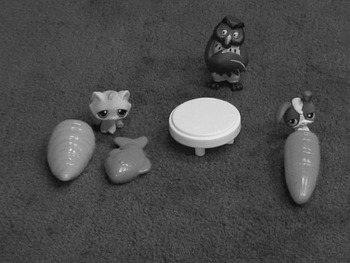
On a typical trial in the ‘adult-true’ condition, the experimenter acted out the following story: “Mr Horse and Mr Pig are going to have a running race. At the far end of the track, there are three coins – two gold coins and one silver coin. They look very shiny. But only the one who runs faster can get these coins. Mr Pig is not very fast. Mr Horse is a fast runner, but he goes to eat a cake in the middle of the race. After eating a cake, he eats a banana. The food makes him sleepy so he decides to take a nap. When he wakes up, Mr Pig has finished the race. Mr Horse feels so sad that he cannot help crying. But Mr Pig is a nice guy. He takes a gold coin and a silver coin for himself, and leaves the other gold coin to Mr Horse.” Figure 1, which corresponds to the scene at the end of the story, illustrates this condition.
Zhiyou-construction, ‘adult-true’ condition.

After the story was finished, the puppet described what he thought had happened in the story, using the test sentence in (21).
(21) Zhiyou zhu xiansheng nadao-le yinse yingbi. only pig sir get-ASP silver coin ‘Only Mr Pig got a silver coin.’
Here is a typical trial in the ‘adult-false’ condition: ‘Mr Cat and Mr Rabbit are having lunch at Mr Owl's restaurant. Only two kinds of food are served here, fish and carrots. Mr Cat orders a fish and Mr Rabbit orders a carrot. They soon eat them up. But Mr Rabbit feels like having one more carrot, so he orders another one. When he is about to eat it, he smells a fish-flavour from the carrot. He always thinks that fish taste yucky, so he gives the carrot to Mr Cat. Mr Cat likes this fish-flavoured carrot. He soon finishes it.’ Figure 2, which corresponds to the scene at the end of the story, illustrates this condition.
Zhiyou-construction, ‘adult-false’ condition.

When the story concluded, the puppet presented the test sentence, as in (22).
(22) Zhiyou mao xiansheng chi-le huluobo. only cat sir eat-ASP carrot ‘Only Mr Cat ate a carrot.’
Four filler items were also included. On these items, the puppet produced statements like (23) and (24), which were either obviously true or obviously false.
(23) Tiaotiaohu zhaodao-le zhu, danshi meiyou zhaodao tuzi. Tigger find-ASP pig but not find rabbit ‘Tigger found the pig, but he didn't find the rabbit.’
(24) Nanhai he nühai qizhe ma qu mai dongxi le boy and girl ride horse go buy thing ASP ‘The boy and the girl rode a horse to go shopping.’
These filler items were included to verify that the child could answer both ‘yes’ and ‘no’ correctly, as well as to obscure the purpose of the experiment. Test and filler items were presented in a pseudo-random order. All the test stimuli are provided in Appendix A.
Before we present the results, let's turn to the two proposals discussed in the previous section, to see how the present study can be used to adjudicate between the two. As discussed, the two proposals differ in their explanations of children's non-adult interpretation. One suggests that children interpret the presubject only and the preverbal only in the same way, because children tend to associate the focus operator only with the VP (Crain et al., Reference Crain, Ni, Conway, Clifton, Frazier and Rayner1994), whereas the other attributes children's non-adult interpretation to their difficulty in computing the assertion associated with the contrast set (Paterson et al., Reference Paterson, Liversedge, Rowland and Filik2003). These two proposals will make different predictions about children's performance in our experiment.
On Crain et al.'s (Reference Crain, Ni, Conway, Clifton, Frazier and Rayner1994) account, children should be expected to reject the test sentences in both ‘adult-true’ and ‘adult-false’ conditions. Because if children are VP-oriented, they will interpret sentences like (21) and (22) with presubject zhiyou as their counterparts with preverbal zhiyou, as in (25) and (26), both of which are false in these two conditions. If, on the other hand, Paterson et al.'s (Reference Paterson, Liversedge, Rowland and Filik2003) analysis is on the right track, then we should expect children to accept the test sentences like (21) and (22) in both conditions, since they can only compute the presuppositions of the focus structures, as indicated in (27) and (28), both of which are true in these two conditions. A third possibility, of course, is that children have adult-like knowledge of focus structures. If so, then we should see children accept the test sentences in the ‘adult-true’ condition and reject them in the ‘adult-false’ condition.
(25) Zhu xiansheng zhi nadao-le yinse yingbi. pig sir only get-ASP silver coin ‘Mr Pig only got a silver coin.’
(26) Mao xiansheng zhi chi-le huluobo. cat sir only eat-ASP carrot ‘Mr Cat only ate a carrot.’
(27) Zhu xiansheng nadao-le yinse yingbi. pig sir get-ASP silver coin ‘Mr Pig got a silver coin.’
(28) Mao xiansheng chi-le huluobo. cat sir eat-ASP carrot ‘Mr Cat ate a carrot.’
RESULTS AND DISCUSSION
The dependent measure in the study was the proportion of ‘yes’ responses to the puppet's statements in each condition. Both children and adults gave correct responses on filler items 100% of the time.
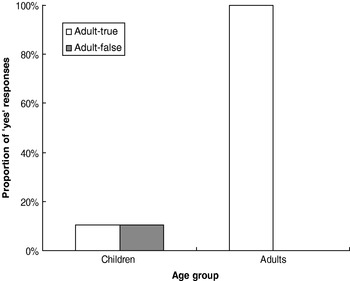
A Mann–Whitney test was used to compare the patterns of responses by children and adults in each condition. A significant difference was found between children and adults in the ‘adult-true’ condition. As expected, Mandarin-speaking adults accepted presubject zhiyou-constructions 100% of the time; Mandarin-speaking children, by contrast, only accepted them 10% of the time (Z=5·65, p<0·001). Children rejected the test sentences 90% of the time. When asked why the puppet was wrong, they all justified their answers by citing the fact that the character in question performed another action besides the one mentioned in the test sentences. Consider (21), for illustration. Children's stated reason for rejecting (21) in the ‘adult-true’ condition was that Mr Pig also got a gold coin. In the ‘adult-false’ condition, there was no significant difference in the acceptance rates of the test sentences by adults (0%) versus children (13·30%) (Z=2·08, p=0·11). Both children and adults rejected the test sentences to a high degree (adults 100% vs. children 86·70%), but they rejected them for different reasons. Sentence (22) is used to illustrate. Adults rejected (22) by making reference to the fact that Mr Rabbit also ate a carrot, whereas children rejected the sentence by pointing out that Mr Cat also ate a fish.
Within each group, a Wilcoxon signed ranks test was used to compare the response patterns across the two conditions. For children, no significantly different patterns were observed in the ‘adult-true’ condition versus ‘adult-false’ condition (Z=1·41, p=0·50); adults, by contrast, exhibited distinct patterns in these two conditions (Z=4·47, p<0·001), as illustrated in Figure 3.
Proportions of ‘yes’ responses to the puppet's statements in the ‘adult-true’ and ‘adult-false’ conditions by children and adults, Experiment 1.

The results from this experiment showed that children rejected presubject zhiyou-constructions in both ‘adult-true’ and ‘adult-false’ conditions for the same reason, i.e. because the character in question performed another action besides the one mentioned in the test sentences. This is compelling evidence that Mandarin-speaking children are VP-oriented; they tend to associate the presubject zhiyou with the VP. And it is evidence that children had no difficulty in computing the assertion in both cases. To illustrate, consider sentence (22), repeated here as (29).
(29) Zhiyou mao xiansheng chi-le huluobo. only cat sir eat-ASP carrot ‘Only Mr Cat ate a carrot.’
(a) Presupposition: Mr Cat ate a carrot.
(b) Assertion: Mr Cat didn't eat anything except a carrot.
(c) Assertion: Everyone other than Mr Cat didn't eat a carrot.
As noted earlier, when children rejected sentence (29), they justified their rejection by pointing out that Mr Cat ate something else in addition to a carrot, namely a fish. This justification is a clear indication that children were computing the relevant presupposition and assertion, as in (29a) and (29b). Only the assertion they computed was different from that of adults, as in (29c), due to the different focused elements they identified (VP vs. subject NP). These findings support Crain et al.'s (Reference Crain, Ni, Conway, Clifton, Frazier and Rayner1994) proposal that children initially associate the focus operator with the VP.
In the next experiment, we examined how Mandarin-speaking children and adults understand shi…de constructions. As we have discussed, syntactically shi…de constructions are more like zhiyou-constructions (i.e. the focus operator shi has to c-command the focused element), though semantically they are interpreted as English clefts. Therefore, if children are VP-oriented, they should be expected to associate the focus operator shi with the VP.
EXPERIMENT 2
In this experiment, we investigated how Mandarin-speaking children and adults interpret focus structures like (5), repeated here as (30).
(30) Shi Yuehan chi-de pingguo. be John eat-DE apple ‘It is John who ate an apple.’
METHOD
Subjects
Twenty Mandarin-speaking children (mean age 4 ; 7, range 4 ; 5 to 4 ; 10) and twenty Mandarin-speaking adults participated in this experiment. None of the subjects had participated in Experiment 1 and there was no significant difference in the age of the child subjects in this experiment and those of Experiment 1 (t(38)=0, p=1).
Procedures
As in Experiment 1, we tested child subjects using a Truth Value Judgement Task. They were given two practice items before the actual test, one in which the puppet's statement was obviously true and one in which it was obviously false, so that children knew that the puppet could say something wrong. Adult controls were tested on the same stories but using a questionnaire.
Materials
The test stimuli used in this experiment were the same as those in Experiment 1 except for the test sentences. Zhiyou-constructions were replaced by shi…de structures following each scenario. Test and filler items were presented in a pseudo-random order (see Appendix B for all the test sentences). Sentences (31) and (32) are used to illustrate.
(31) Shi zhu xiansheng nadao-de yinse yingbi. be pig sir get-DE silver coin ‘It is Mr Pig who got a silver coin.’
(32) Shi mao xiansheng chi-de huluobo. be cat sir eat-DE carrot ‘It is Mr Cat who ate a carrot.’
As in Experiment 1, test sentences like (31) were presented in an ‘adult-true’ condition, in which Mr Pig got a gold coin and a silver coin, and Mr Horse only got a gold coin. Test sentences like (32) were presented in an ‘adult-false’ condition, where Mr Cat ate a carrot and a fish, and Mr Rabbit only ate a carrot.
RESULTS AND DISCUSSION
The dependent measure in this experiment was the proportion of ‘yes’ responses to the puppet's statements in each condition. The data of one child was eliminated from the final analysis, because she didn't give correct answers to the filler items. The remaining nineteen children and twenty adults answered correctly 100% of the time on the filler items.
A Mann–Whitney test was used to compare the response patterns between children and adults in each condition. In the ‘adult-true’ condition, adults accepted the test sentences 100% of the time. By contrast, children only accepted it 10·50% of the time. This difference was highly significant (Z=5·56, p<0·001). Mandarin-speaking children rejected the test sentences 89·50% of the time by citing the fact that the character in question performed another action besides the one mentioned in the test sentences, i.e. they rejected (31) by pointing out that Mr Pig also got a gold coin. In the ‘adult-false’ condition, no significant difference was found in their acceptance rates (adults 0% vs. children 10·50%; Z=1·47, p=0·23). Both Mandarin-speaking adults and children rejected the test sentences to a high degree (adults 100% vs. children 89·50%), but they rejected them for different reasons. Consider (32), for example. Adults rejected it by making reference to the fact that Mr Rabbit also ate a carrot. Children, on the other hand, rejected it for the same reason as in the ‘adult-true’ condition, i.e. because Mr Cat also ate a fish. Within each group, a Wilcoxon signed ranks test was used to compare the response patterns across the two conditions. For children, no significantly different patterns were observed in the ‘adult-true’ condition versus the ‘adult-false’ condition (Z=0, p=1); adults, by contrast, exhibited distinct patterns in these two conditions (Z=4·47, p<0·001), as displayed in Figure 4.
Proportions of ‘yes’ responses to the puppet's statements in the ‘adult-true’ and ‘adult-false’ conditions by children and adults, Experiment 2.

Similar response patterns were obtained in this experiment, as compared to Experiment 1. In both ‘adult-true’ and ‘adult-false’ conditions, children rejected presubject shi…de constructions by citing the fact the character in question performed another action besides the one mentioned in the test sentences. These results provide further evidence for the proposal by Crain et al. (Reference Crain, Ni, Conway, Clifton, Frazier and Rayner1994) that children are VP-oriented.
To recap, convergent data were obtained in Experiment 1 and Experiment 2. Mandarin-speaking children and adults differ in the interpretation of focus structures. In both constructions, where adults associated the focus operator with the subject NP, children were found to associate the focus operator with the VP. As discussed earlier, the understanding of focus structures is a two-step procedure. The first step is to identify the focused element, and then to compute the relevant presupposition and assertion. The findings indicate that the children's problem lies only in the first step. Children produce non-adult responses because they do not associate the focus operator with the same constituent as adults do. The question to raise now is why children tend to associate the focus operator with the VP, instead of the subject NP. What is the source of this VP-orientation?
Based on the above findings, we suggest that in adult Mandarin, focus operators zhiyou and shi can either be used to modify an NP or a VP, depending on the position of the focus operator in the sentence structure. But in child Mandarin, the focus operators zhiyou and shi are normally treated as adverbials. Sentences (4) and (7) are used to illustrate, repeated here as (33) and (34).
- (33)
(a) Zhiyou Yuehan chi-le pingguo. only John eat-ASP apple ‘Only John ate an apple.’
(b)

(c)
- (34)
(a) Yuehan zhi chi-le pingguo John only eat-ASP apple ‘John only ate an apple.’
(b)

For adults, when the focus adverb zhiyou appears in presubject position, as in (33a), it is used to modify the subject NP, as illustrated in the tree diagram (33b), where zhiyou c-commands the subject NP John, but not the VP. In this case, zhiyou is treated as a determiner and forms a constituent with the subject NP John, which we have labelled Quantified Noun Phrase (QNP). One source of evidence that they form a constituent comes from the fact that zhiyou Yuehan ‘only John’ constitutes a perfectly acceptable fragment answer to wh-questions like (35) and (36)Footnote 6 (see Radford (Reference Radford1997: 108) for discussion of this sentence fragment test of constituency).
- (35)
(a) Zhiyou shei chi-le pingguo?only who eat-ASP apple ‘Only who ate an apple?’
(b) Zhiyou Yuehan. only John ‘Only John.’
- (36)
(a) Shei chi-le pingguo?who eat-ASP apple ‘Who ate an apple?’
(b) Zhiyou Yuehan. Only John ‘Only John.’
When zhiyou occurs in preverbal position, as in (34a), it is treated as an adverbial, which c-commands and is adjoined to the VP, as indicated in (34b). In contrast to adults, children initially treat zhiyou as an adverbial both when it occurs in a presubject position, and when it appears in a preverbal position. When it occurs in a presubject position, the focus structure is represented as in (33c), in which zhiyou is adjoined to the whole sentence as a sentential adverbial, rather than a determiner which forms a constituent with the subject NP as in adult language.
Our motivation for this analysis of the child grammar is based on the observation that many adverbs of quantification, like sometimes, usually, funnily, interestingly, and so on, tend to take sentential scope and are not typically associated with the subject NP. If children form the (incorrect) generalization that zhiyou is a sentential adverb, then it too will tend to take sentential scope. And the association of sentential adverbs with the VP is attested across a variety of human languages. So our proposal is that children initially analyse focus adverb zhiyou in the same way as these typical sentential adverbs and, therefore, tend to associate it with the VP.
In the next experiment, we attempted to provide empirical support for our analysis of child Mandarin, by using a structure with negation positioned between the focus operator and the VP. We hypothesized that the presence of negation would block the association between the focus operator and the VP, thereby encouraging children to associate the focus operator with the subject NP.
EXPERIMENT 3
According to Relativized Minimality, as proposed by Rizzi (Reference Rizzi1990; Reference Rizzi, Baltin and Collins2001), core linguistic relations are local in the sense that they must be satisfied in a minimal configuration in which they can be satisfied; local relations between two elements are blocked if a third element intervenes and this element has the potential of participating in the relevant relation.
(37) Relativized Minimality Condition (RMC) (Rizzi, Reference Rizzi, Baltin and Collins2001: 90)
Y is in a Minimal Configuration with X iff there is no Z such that
(i) Z is of the same structural type as X
(ii) Z intervenes between X and Y
The notation of intervention is defined in terms of c-command: Z intervenes between X and Y iff Z c-commands Y and Z does not c-command X. Thus, the RMC has the effect of ruling out the configuration in (38), if Z c-commands Y, Z does not c-command X, and X and Z are of the same structural type.
(38) *… X … Z … Y …
With the RMC as background, Experiment 3 investigated how Mandarin-speaking children and adults interpret focus structures with negation in preverbal position, as in (39a).
- (39)
(a) Zhiyou Yuehan meiyou chi pingguo. only John not eat apple ‘Only John didn't eat an apple.’
(b)
From Experiments 1 and 2, we know that children treat the focus operator zhiyou in presubject position as a sentential adverbial and thus tend to associate it with the VP, as indicated in (33c). The addition of negation meiyou ‘not’ in preverbal position should, therefore, block this association, since the negation intervenes between the focus operator and the VP, and the negation and the focus operator are of the same structural type, i.e. an adjunct in an A′-position. In this construction, therefore, children may be able to access the adult-like reading, i.e. associating the focus operator with the subject, since the only element that remains in its c-command domain and can be associated with is the subject NP. This expected change in the association of the focus operator is graphically depicted in (39b).
METHOD
Subjects
The subjects in this experiment were sixteen Mandarin-speaking children (mean age 4 ; 7, range 4 ; 6 to 4 ; 9) and sixteen Mandarin-speaking adults. The age of the child subjects in this experiment didn't differ significantly from those of Experiment 1 (t(34)=1·09, p=0·28) or those in Experiment 2 (t(34)=1·04, p=0·31) and none of them had participated in either Experiment 1 or Experiment 2.
Procedures
Child subjects were tested using a Truth Value Judgement Task. They were given two practice items before the actual test, one in which the puppet's statement was obviously true and one in which it was obviously false, so that children knew that the puppet could say something wrong. Adult controls were tested on the same stories but using a questionnaire.
Materials
Two types of test sentences were created.Footnote 7 One was the sentence structure we discussed above, as illustrated in (39a) (Type 1). The other was the simple zhiyou-construction, as in (4), repeated here as (40) (Type 2).
(40) Zhiyou Yuehan chi-le pingguo only John eat-ASP apple ‘Only John ate an apple.’
Type 2 sentences were used as a control to see how children understand them in the same scenarios as were used for Type 1 sentences with negation. These two types of sentences were presented following a scenario, which made (39a) false and (40) true. An example is given as follows.
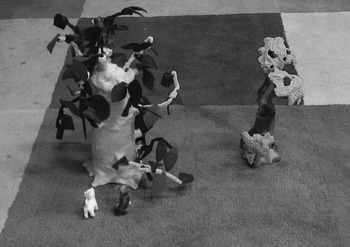
Three dogs (a white dog, a black dog and a brown dog) are going to have a tree-climbing contest. They are all very good at tree climbing. This time, they need to climb a big tree and a small tree. They start with the small tree. They all made it to the top easily, as illustrated in Figure 5. Then they come to the big tree. It is much taller than the small tree. The black dog is a really good climber. He reaches the top of tree easily. But the white dog and the brown dog have trouble getting into the branches. Each time they lift their front paws, their back paws slide off the branches. No luck: they didn't climb to the top. They failed. Figure 6 illustrates the last scene of the story.
The addition of negation, Experiment 3.

The addition of negation, Experiment 3.

Since the test sentences involve negation, it is important that our test scenarios satisfy the felicity conditions associated with the use of negation. Crain, Thornton, Boster, Conway, Lillo-Martin & Woodams (Reference Crain, Thornton, Boster, Conway, Lillo-Martin and Woodams1996) proposed the Condition of Plausible Dissent. This condition is based on Russell's (Reference Russell1948) observation that a negative judgment is appropriate only when the correlative positive judgment has already been made or considered. In the Truth Value Judgement Task, children are asked to say whether sentences are true or false. Following Russell's observation, it is appropriate to ask children for a negative judgment of a sentence only if the corresponding positive judgment has been under consideration at some point in the story. In order to satisfy this condition, the puppet produced a positive lead-in before the test sentences, which corresponded to the first half of the story. In this scenario, the positive lead-in was San-zhi gou dou pa-shang-le xiaoshu ‘All the three dogs climbed up the small tree’. After the positive lead-in, the puppet explained to the child subject how each individual dog performed, using the test sentences in (41) and (42).Footnote 8
(41) Zhiyou bai gou mei you pa-shang da shu. only white dog not climb-up big tree ‘Only the white dog didn't climb up the big tree.’
(42) Zhiyou hei gou pa-shang-le da shu. only black dog climb-up-ASP big tree ‘Only the black dog climbed up the big tree.’
Following each test sentence, the child subject was asked to judge whether the puppet said the right thing about the relevant dog. There were altogether four test scenarios with eight test sentences.
In addition to the test scenarios, each subject also witnessed three control scenarios. Following each scenario, the puppet produced statements like (43) and (44), which were either obviously true or obviously false. These items were included to verify that children had no difficulty understanding simple negation, as well as to obscure the purpose of the experiment. The experimenter playing the role of the puppet had a choice between two different statements for each of the control scenarios. One statement was true in the scenario and the other was false. If the child subject had answered ‘yes’ to a given test sentence, the experimenter was instructed to pick the statement for the following control scenario corresponding to a ‘no’ answer, and vice versa. This ensured that the number of ‘yes’ and ‘no’ answers was balanced. All the test stimuli can be found in Appendix C.
(43) Hei mao mei you mai yu. black cat not buy fish ‘The black cat didn't buy fish.’
(44) Bai mao meiyou mai yu. white cat not buy fish ‘The white cat didn't buy fish.’
The sixteen child subjects were then divided into two groups with eight in each group. One group was presented with zhiyou-constructions with preverbal negation, as in (41), followed by simple zhiyou-constructions like (42). The other group was presented with the same test sentences in reverse order. Similarly, for the sixteen adult controls, two versions of questionnaires were used; one in which the zhiyou-constructions with preverbal negation preceded the simple zhiyou-constructions, and the other version presenting them in reverse order. The sixteen adult subjects were then randomly assigned to each version.
Before we report the results of Experiment 3, we wish to comment further on the properties of the test sentences in this experiment, as compared to those of Experiment 1.Footnote 9 Because the test sentences in Experiment 3 involved negation, it is important to ask whether or not these sentences differed appreciably in length from the affirmative sentences in Experiment 1. The concern is that if the negative sentences are longer (due to the additional negative particle), this may have altered the intonation units of the test sentences. That is, both the focus operator zhiyou and the subject NP might have been in the same intonation unit in the test sentences in Experiment 3, in contrast to the affirmative sentences in Experiment 1, where the focus operator and the subject NP may have been in different intonation units. If so, children may have been unknowingly led, by prosodic information, to interpret the scope of zhiyou differently in the two experiments. Critically, having zhiyou and the subject NP in the same intonation unit might have encouraged children to associate them semantically in Experiment 3, in contrast to Experiment 1.
We wish to note, first, that there was only a slight difference in length between the positive and negative sentences in these experiments. Sentences (39a) and (40) are used to illustrate. The positive sentence (40) is Zhiyou Yuehan chi-le pingguo ‘Only John ate an apple’ and the negative one (39a) is Zhiyou Yuehan meiyou chi pingguo ‘Only John didn't eat an apple’. The positive sentence lacks the negative marker meiyou, but it includes an aspect marker le, which is absent in the negative sentence. So the difference in length is a single morpheme. It seems unlikely that such a small difference in length could have consistently resulted in different intonation units. Two further points about prosodic cues are worth making. One is that Mandarin relies more heavily on syntactic structure than on prosodic information to mark the element in focus in sentences with focus operators. For example, consider the sentences Zhiyou Yuehan chi-le pingguo ‘Only John ate an apple’ and Zhiyou Yuehan meiyou chi pingguo ‘Only John didn't eat an apple’. English normally marks focus by phonological prominence, so the subject NP John would be stressed in the English counterparts of these sentences. However, phonological prominence is not a strongly favoured strategy in Mandarin, so the focused element Yuehan would not typically be prosodically marked in either of these sentences. The second observation regards children's sensitivity to prosodic cues in associating the focus operator zhiyou with different expressions. It has been found that English-speaking children younger than about six years old are not sensitive to prosodic cues in resolving ambiguities involving sentences with the focus operator only. This finding was documented in several studies investigating children's interpretation of dative constructions with the focus operator only (e.g. Gualmini, Maciukaite & Crain, Reference Gualmini, Maciukaite, Crain, Arunachalam, Kaiser and Williams2002; Halbert, Crain, Shankweiler & Woodams, Reference Halbert, Crain, Shankweiler and Woodams1995). Both observations would appear to reduce the risk that prosodic cues were responsible for children's different patterns of responses in Experiment 1, as compared to Experiment 3. A related concern is whether or not the experimenter who produced the test sentences might have inadvertently encouraged an association between zhiyou and the subject NP, again by providing prosodic cues that this association was intended. In our experiment, the experimenter who produced the test sentences was blind to the experimental hypothesis. He was trained to produce the test sentences using normal intonation, but was not informed about the experimental hypothesis under investigation.
RESULTS AND DISCUSSION
The dependent measure in this experiment was the proportion of ‘yes’ responses to each sentence type produced by the puppet. All the subjects responded correctly to the control sentences 100% of the time.
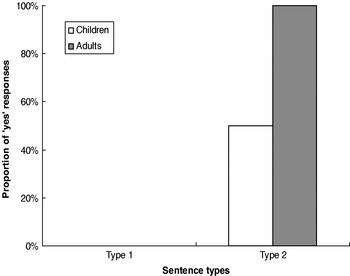
A Mann–Whitney test showed that children and adults differed significantly in their acceptance rates of Type 2 test sentences, whereas no significant difference was found in their acceptance rates of Type 1 test sentences. None of the subjects accepted Type 1 test sentences. Both children and adults rejected them (the zhiyou-construction with preverbal negation) 100% of the time. And, this time, children and adults rejected them for the same reason, namely that in addition to the character mentioned in the test sentences, another character didn't perform the relevant action either. In the example scenario, both adults and children rejected (41) by citing the fact that the brown dog didn't climb up the big tree either. In response to Type 2 test sentences (the simple zhiyou-construction), adult accepted them 100% of the time. However, children accepted them only 50% of the time. This difference reached significance (Z=3·22, p<0·01). As before, when those children who rejected these test sentences were asked why the puppet was wrong, they justified their answers by referring to the fact that the character in question performed another action besides the one mentioned in the test sentences. In the example scenario, they rejected (42) by pointing out that the black dog also climbed up the small tree. Figure 7 illustrates the proportion of ‘yes’ responses to the two types of test sentences by children and adults.
Proportion of ‘yes’ responses to the two types of test sentences by children and adults, Experiment 3.

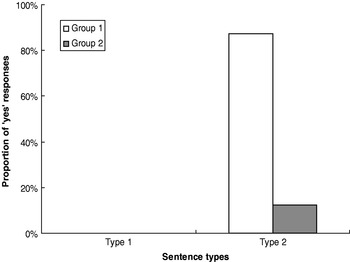
When the child data were examined further by group, a significant effect of the order of presentation was observed. The group of children who were presented Type 1 test sentences first (Group 1) accepted Type 2 test sentences significantly more often than the group who heard Type 2 test sentences first (Group 2) (87·50% vs. 12·50%; Z=2·77, p=0·01), though both of the two groups rejected Type 1 test sentences 100% of the time. Figure 8 displays the proportion of ‘yes’ responses to the two types of test sentences by the two groups of children.
Proportion of ‘yes’ responses to the two types of test sentences by Group 1 and Group 2, Experiment 3.
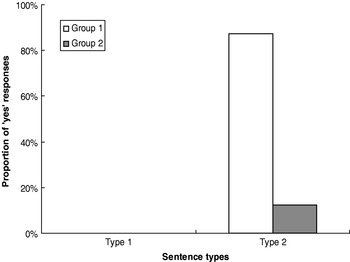
The results indicate that the addition of negation does block the association between the focus operator and the VP. The presence of negation assists children in accessing an adult-like interpretation, i.e. associating the focus operator with the subject NP. The findings support our analysis that Mandarin-speaking children treat contrastive focus operators like zhiyou as adverbials. And once children learn that presubject zhiyou can associate with the subject NP, based on the evidence from zhiyou-constructions with preverbal negation, they more freely associate it with the subject NP in simple zhiyou-constructions. This is shown by the effect of the order of presentation. However, there is one more step children must make to reach the adult grammar. We turn to this in the concluding discussion.
GENERAL DISCUSSION AND CONCLUSION
We began the present study by investigating how Mandarin-speaking children and adults understand contrastive focus constructions like Zhiyou Yuehan chi-le pingguo ‘Only John ate an apple’ and Shi Yuehan chi-de pingguo ‘It is John who ate an apple’. It was found that children tended to associate the focus operators zhiyou and shi with the VP, whereas adults uniquely associate them with the subject NP (Experiment 1 and Experiment 2). The findings indicate that children have no difficulty computing the meaning components of focus operators, i.e. the presupposition and the assertion. Children and adults differ only in identifying the element in focus. This supports Crain et al.'s (Reference Crain, Ni, Conway, Clifton, Frazier and Rayner1994) proposal about the source of children's non-adult interpretation. However, previous research does not tell us the whole story. One thing that has remained unspecified is a detailed account of why children are VP-oriented. Another missing piece is an account of children's transition to the adult grammar.
As for the source of children's VP-orientation, we propose that children initially treat focus operators as adverbials. When a focus operator appears in a presubject position, it is treated as a sentential adverbial, thus ending up associating with the VP. In order to assess our proposal, a third experiment was conducted in which we examined children's understanding of zhiyou-constructions with negation in preverbal position like Zhiyou Yuehan meiyou chi pingguo ‘Only John didn't eat an apple’. The basic idea is that if children analyse the focus operator as a sentential adverbial in this situation, the negation should block its association with the VP, according to the Relativized Minimality Condition proposed by Rizzi (Reference Rizzi1990; Reference Rizzi, Baltin and Collins2001). We hypothesized, therefore, that the presence of negation could guide children to an adult-like interpretation, i.e. associating the focus operator with the subject NP, since the only element left in its c-command domain and which it can be associated with is the subject NP. This is exactly what we found in Experiment 3. Just like adults, children consistently associated the focus operator zhiyou with the subject NP. Perhaps the most interesting finding in this experiment was the effect of the order of presentation on children's interpretation. The group of children who were presented with zhiyou-constructions with negation in preverbal position, like Zhiyou Yuehan meiyou chi pingguo ‘Only John didn't eat an apple’, followed by simple zhiyou-constructions like Zhiyou Yuehan chi-le pingguo ‘Only John ate an apple’, interpreted simple zhiyou-constructions in the same way as adults did, consistently associating the focus operator zhiyou with the subject NP. By contrast, the other group of children who were presented with the test sentences in reverse order still associated the focus operator with the VP in simple zhiyou-constructions. These findings indicate that the presence of intervening negation could guide children to associate the presubject focus operator with the subject NP and, once this kind of association was established, children continued to associate the focus operator with the subject NP, even in simple positive sentences. In other words, the presence of negation could assist children in reaching the adult grammar, by revealing that there is an alternative to the VP which can be associated with the focus operator like zhiyou. Nevertheless, children's grammar cannot become equivalent to that of the adults based on this observation alone. Sentence (39a) is used to illustrate, repeated here as (45a). Though the presence of negation assists children in accessing an adult-like interpretation, i.e. associating the focus operator with the subject NP, the focus operator could still remain in the position of a sentential adverb, as represented in (45b), which is different from that of adults, as indicated in (45c), where the focus operator zhiyou and the subject NP Yuehan form a constituent zhiyou Yuehan ‘only John’.
- (45)
(a) Zhiyou Yuehan mei chi pingguo. only John not eat apple ‘Only John didn't eat an apple.’
(b)
(c)
Therefore, to converge on the adult grammar, children require further primary linguistic data revealing that a presubject focus operator zhiyou forms a constituent with the subject NP, since sentence structures like (45a) do not reveal this constituent relation between them. We contend that one such kind of primary linguistic data are readily available to children in the form of fragment answers to wh-questions, as discussed in (35) and (36), repeated here as (46) and (47). This, in combination with a ‘uniqueness’ constraint on form/meaning correspondence,Footnote 10 informs children that the presubject focus operator is uniquely associated with the subject NP. This completes our account of children's convergence on a grammar that is equivalent to that of the adults in the same linguistic community.
- (46)
(a) Zhiyou shei chi-le pingguo?only who eat-ASP apple ‘Only who ate an apple?’
(b) Zhiyou Yuehan. only John ‘Only John.’
- (47)
(a) Shei chi-le pingguo?who eat-ASP apple ‘Who ate an apple?’
(b) Zhiyou Yuehan. Only John ‘Only John.’
One question remains to be answered, however. If fragment answers to wh-questions inform children that the presubject focus operator can be associated with the subject NP, then children apparently have ample evidence to converge on the adult grammar. Why, then, does it take so long for children to attain the target grammar?
We have two responses to this question. First, fragment answers should suffice to inform Mandarin-speaking children that presubject zhiyou can associate with the subject NP, but they do not suffice to eliminate the alternative VP-association from children's grammars. To jettison the non-adult association, children could conceivably appeal to a ‘uniqueness’ constraint on form/meaning correspondence, as we have just discussed. In the present case, however, the ‘uniqueness’ constraint does not clearly apply, since sometimes the preverbal focus operator is homophonous with the presubject one, i.e. both in the phonological form of zhiyou. Conflicting cues like this may prolong children's convergence on the target grammar. We wish to note also that similar delays are widely attested. Children take months, even years, to recover from other mistaken generalizations. For example, young English-speaking children initially hypothesize that reflexive pronouns (e.g. herself, myself, yourself) are formed by combining the bound morpheme -self with a possessive pronoun (e.g. her, my, your). This generalization is incorrect, as attested by the counter-examples himself and themselves. Despite never encountering the incorrect forms, children produce the non-adult forms hisself and theirself until they are four or five years old. Similarly, children continue to produce erroneous past participles, such as flied (instead of flown) and rided (instead of ridden) for an extended period, lasting years, despite the absence of these forms in the parental input. Apparently, once a generalization is formed, children are loath to abandon it despite the absence of supporting evidence. Perhaps, the same reluctance to abandon a generalization is at work in the case of zhiyou.
APPENDIX A: TEST STIMULI FOR EXPERIMENT 1
TEST STORIES
Story 1
Plot:
This is a story about Piglet and Donald Duck. They are going to compete in a weight-lifting contest to see who is the stronger. They have to try and lift a banana and a car. Mr Elephant is the winner of last year's competition, so this year he gets to be the judge. Now Piglet and Donald Duck are ready to try and lift the two things. Donald Duck comes to compete first. He thinks he is strong, so he starts with the heavier, the car. He goes to the car, stretches his wings and tries to lift the car. But he fails. Too bad. He must have slept too much this year. Then he tries the banana. This time he succeeds. Now it is Piglet's turn. He stretches all his muscles and comes directly to the car. Heave ho, heave ho. He makes a big effort to pick up the car. Oh, great job. He is now holding the car in the air. He made it. Then he goes to the banana and lifts it with one hand. Mr Elephant declares that the winner is Piglet.
Test sentence: Zhiyou Piglet juqi-le xiaoqiche. only Piglet lift-ASP car ‘Only Piglet lifted the car.’
Story 2
Plot:
This is a story about Mr Turtle and Mr Goat. They are going to have a swimming competition. At the far end of the pool there are three shells – two purples and one blue. They look so shiny. But only the one who swims faster can get these shells. Now Mr Turtle and Mr Goat are lined up at the start. Ready go! Mr Turtle slips easily into the pool. Mr Goat jumps into the pool too. Mr Turtle is swimming really fast. Mr Goat is not bad. He is right behind Mr Turtle. But Mr Turtle is really a good swimmer and now he is very close to the end of the pool. Mr Turtle is so excited that he starts to sing (I am going to get all these shells …). But bad luck. When he is about to get to the finish line, he has a cramp. So he has to slow down. Just at this moment, Mr Goat catches up to him and wins the game. Mr Turtle is so sad. But Mr Goat is really a good guy. He takes a blue shell and a purple shell, and leaves the other purple shell to Mr Turtle. Mr Turtle is now moved into tears.
Test sentence: Zhiyou shanyang xiansheng nadao-le lanse beike. only goat sir get-ASP blue shell ‘Only Mr Goat got a blue shell.’
Story 3
Plot:
This is a story about Mr Horse and Mr Pig. They are going to have a running race. At the far end of the track, there are three coins – two golds and one silver. They look so shiny. But only the one who runs faster can get these coins. Ready go! Mr Horse and Mr Pig start running. Mr Horse is really a fast runner. He leaves Mr Pig far behind him. But Mr Pig is running really hard (Mr Pig ate too much this morning and now he is too fat). Mr Horse almost gets to the finish line. Now he feels kind of hungry and he thinks that Mr Pig moves like a turtle, so he will have plenty of time. He goes to buy a cake without finishing the race. After eating a cake, Mr Horse eats a banana. Now the food makes him sleepy and he decides to take a nap. When he wakes up, Mr Pig has finished the race. Mr Horse feels so sad that he can't help crying. But Mr Pig is always a nice guy. He takes a gold coin and a silver coin, and leaves the other gold coin to Mr Horse. Now a happy smile is on Mr Horse's face.
Test sentence: Zhiyou zhu xiansheng nadao-le yinse yingbi. only pig sir get-ASP silver coin ‘Only Mr Pig got a silver coin.’
Story 4
Plot:
This is a story about Mr Monkey and Mr Dog. Look. There are two oranges and one pear on the tree. They are now ripe and look tasty. Mr Monkey and Mr Dog are now under the tree. They are going to climb up the tree to pick these fruits. They start climbing. Mr Monkey swings easily into the tree. He is really going fast. When he touches the top of the tree, Mr Dog is still under the tree. He is having trouble getting into the branches. He has too many legs to think about. Every time he lifts his front paws up, his back paws slide off the branches. Mr Monkey has already got a pear and an orange. When he is reaching for the other orange with his right foot, Mr Dog suddenly has an idea. He is now shaking the tree very hard. Not before long, the last orange drops off the tree and right into Mr Dog's front paws. He has now got something to eat too.
Test sentence: Zhiyou houzi xiansheng nadao-le juzi. only monkey sir get-ASP orange ‘Only Mr Monkey got the orange.’
Story 5
Plot:
This is a story about Tigger and Winnie the Pooh. They are going to have a jumping game to see who is the better. They have to jump over two things, a fence and a house. Winnie the Pooh comes to compete first. He thinks that the fence would be too easy for him. So he starts with the house. He is now running towards the house. But as he gets closer, he realizes that it is much too high for him. He gives up. Then he tries the fence. It is easy. He clears the fence. Now comes Tigger. He starts with the house too. He is doing some warm-ups. Ready go! He is getting closer. Wow, what a great jump! He made it. The fence is easy for him. He jumps over it without any effort. Tigger is a better jumper.
Test sentence: Zhiyou tiaotiaohu tiao-guo-le liba. only Tigger jump-over-ASP fence ‘Only Tigger jumped over the fence.’
Story 6
Plot:
This is a story about Mr Cat and Mr Rabbit. It is lunch time now. Mr Cat and Mr Rabbit come to Mr Owl's restaurant. Only two kinds of food are served here, fish and carrot. They are now ready to order. Mr Cat wants a fish and Mr Rabbit wants a carrot. These food are their favourites. They soon eat them up. But Mr Rabbit feels like having one more carrot. So he orders another one. When he is about to eat, he smells a fish-flavour from the carrot. He hates fish and he always thinks that fish will taste yucky. So he gives it to Mr Cat. Mr Cat likes this fish-flavoured carrot. He soon finishes it. It is the most delicious carrot he has even eaten. This meal is awesome for him. Poor Mr Rabbit. He is still hungry.
Test sentence: Zhiyou mao xiansheng chi-le huluobo. only cat sir eat-ASP carrot ‘Only Mr Cat ate a carrot.’
(NOTE: Test sentences in stories 1, 2 and 3 are true on the adult reading; test sentences in stories 4, 5 and 6 are false on the adult reading.)
Filler stories
Story 1
Plot:
This is a story about two rats (a white rat and a black rat). They both are very good at car racing. Today they are going to have a car racing game. Look. There is a big carrot on the way to the finish line. If someone hits the carrot, then he is out. Only the one who avoids the carrot and reaches the finish line will win the game. Now they are ready. Go! Their cars start running. The white rat is so excited that he doesn't see the carrot is right in front of him and his car bumps into the carrot directly. He is out. Too bad. He should have been more careful. The black rat is really good at this game. His car doesn't hit the big carrot. In a few minutes, he reaches the finish line. Good job. He is the winner.
Filler sentence: Bai laoshu zhuangdao-le huluobo, hei laoshu meiyou zhuangdao. white rat hit-ASP carrot black rat not hit ‘The white rat hit the carrot, but the black rat didn't hit the carrot.’
Story 2
Plot:
This is a story about Tigger and his two friends, the rabbit and the pig. They are going to play hide and seek. Tigger is very good at this game. He is always a good seeker. So this time he gets to be the seeker. Game starts. Tigger covers his eyes and starts counting a hundred while the rabbit and the pig go hide. The rabbit hides himself under the tree. The pig tries to climb up the tree. But he is too fat. He has to give up. Then he tries to get into the house, but the door is too small for him. He sticks himself in the door. Now Tigger starts seeking. He first inspects the small tree, but he finds no one. Then he sees a tail in the door. It is the Pig. He found him. Now Tigger tries to find the rabbit. He examines the big tree, top of it, behind it, but he fails to find the rabbit. The rabbit is really well hidden. Tigger has to give up.
Filler sentence: Tiaotiaohu zhaodao-le zhu, danshi meiyou zhaodao tuizi. Tigger find-ASP pig but not find rabbit ‘Tigger found the pig, but he didn't find the rabbit.’
Story 3
Plot:
This is a story about three girls (G1, G1 and G3). They live in a small village. This morning their mother needs to work. When she leaves the house, she tells her three girls to remember to feed the dog and the cat. After G1 got up, she feeds the cat a fish. When she is about to feed the dog, she feels hungry, so she goes to eat a cake, and then forgets to feed the dog. G2 feeds the cat after eating a cake, and when she is ready to feed the dog, her friend comes and they go out to play, and of course she forgets to feed the dog. G3 also feeds the cat a fish, and then she feels so sleepy that she forgets to feed the dog and goes to bed. Poor doggie. He is now hungry and needs a bone. So he walks into G3's bed and tries to make some noises. It works. G3 wakes up and sees the poor doggie. She then feeds the dog a bone. The dog is now enjoying his meal.
Filler sentence: San-ge nühai dou wei-le mao, danshi dou wang-le wei gou. three-CL girl all feed-ASP cat but all forget-ASP feed dog ‘The three girls fed the cat, but they forgot to feed the dog.’
Story 4
Plot:
This is a story about a boy and a girl. They want to go shopping. But the shopping centre is far away from their home. So they decide to ride an animal to go there. They have two animals, a horse and a turtle. They want to ride the horse, because it runs much faster than the turtle. They try to get on the horse's back, but the horse is too tall. They try for several times, but all fail. Now they decide to ride the turtle. This time it is much easier. They get on the turtle's back with no effort. The turtle starts moving towards the shopping centre slowly.
Filler sentence: Nanhai he nühai qizhe ma qu mai dongxi le. boy and girl ride horse go buy thing ASP ‘The boy and the girl rode a horse to go shopping.’
(NOTE: Filler sentences are obviously true in stories 1 and 2, and obviously false in stories 3 and 4.)
Appendix B: test stimuli for Experiment 2
The test stories used in Experiment 2 are the same as those in Experiment 1. The test sentences are as follows
Test sentence for story 1: Shi Piglet juqi-de xiaoqiche. be Piglet lift-DE car ‘It is Piglet who lifted the car.’
Test sentence for story 2: Shi shanyang xiansheng nadao-de lanse beike. be goat sir get-DE blue shell ‘It is Mr Goat who got a blue shell.’
Test sentence for story 3: Shi zhu xiansheng nadao-de yinse yingbi. be pig sir get-DE silver coin ‘It is Mr Pig who got a silver coin.’
Test sentence for story 4: Shi houzi xiansheng nadao-de juzi. be monkey sir get-DE orange ‘It is Mr Monkey who got an orange.’
Test sentence for story 5: Shi tiaotiaohu tiao-guo-de liba. be Tigger jump-over-DE fence ‘It is Tigger who jumped over the fence.’
Test sentence for story 6: Shi mao xiansheng chi-de huluobo. be car sir eat-DE carrot ‘It is Mr Cat who ate a carrot.’
The filler stories and sentences used inExperiment 2are the same as those inExperiment 1.
Appendix C: test stimuli for Experiment 3
Test stories
Story 1
Plot:
This is a story about three dogs (a white dog, a black dog and a brown dog). They are all very good at tree climbing. Today they are going to compete in a tree climbing contest to see who is the best. They need to climb a big tree and a small tree. They start with the small tree. They all made it to the top easily. Now they come to the big tree. It is much taller than the small tree. The black dog is really a good climber. He touches the top of the tree easily. But the white dog and the brown dog are having trouble getting into the branches. They have too many legs to think about. Each time they lift their front paws, their back paws slide off the branches. No luck, they didn't climb to the top. The white dog is the best climber.
Positive lead-in: San-zhi gou dou pa-shang-le xiao shu. three-CL dog all climb-up-ASP small tree ‘All the three dogs climbed up the small tree.’
Test sentence 1: Zhiyou bai gou meiyou pa-shang da shu. only white dog not climb-up big tree ‘Only the white dog didn't climb up the big tree.’
Test sentence 2: Zhiyou hei gou pa-shang-le da shu. only black dog climb-up-ASP big tree ‘Only the black dog climbed up the big tree.’
Story 2
Plot:
This is a story about three horses (a white horse, a red horse and a black horse). They are all very good at jumping. This time they are going to have a jumping game to see who is the best. They need to jump over two things, a fence and a house. They start with the fence. It is easy. They all clear the fence. Now they are going to try the difficult one, the house. They start galloping towards the house, but as they get closer, they realize that it is much taller than they expected. So the white horse and the black horse gave up. The red horse still wants to give it a try. He is now doing some warm-ups. Ready, go! Wow, what a great jump. He made it. The red horse is the best jumper.
Positive lead-in: San-pi ma dou tiao-guo-le liba. three-CL horse all jump-over-ASP fence ‘All the three horses jumped over the fence.’
Test sentence 1: Zhiyou bai ma meiyou tiao-guo fangzi. only white horse not jump-over house ‘Only the white horse didn't jump over the house.’
Test sentence 2: Zhiyou hong ma tiao-guo-le fangzi. only red horse jump-overt-ASP house ‘Only the red horse jumped over the house.’
Story 3
Plot:
This is a story about three pigs (a white pig, a black pig and a yellow pig). They are all very strong. This time they are going to compete in a weight-lifting contest to see who is the strongest. They need to try and lift a banana and a car. They start with the banana. It is easy for them. They all made it. Now they come to the heavier, the car. The white pig stretches his arms, and tries to lift it, but he fails. Then comes the black pig. He also stretches his arms and tries to pick up the car. But no luck, he fails too. Our last competitor is the yellow pig. He stretches all his muscles and makes a big effort to pick up the car. Heave ho, heave ho. Oh, great job. He made it. The yellow pig is the strongest.
Positive lead-in: San-zhi zhu dou ju-qi-le xiangjiao. three-CL pig all lift-up-ASP banana ‘All the three pigs lifted the banana.’
Test sentence 1: Zhiyou hei zhu meiyou ju-qi qiche. only black pig not lift-up car ‘Only the black pig didn't lift the car.’
Test sentence 2: Zhiyou huang zhu ju-qi-le qiche. only yellow pig lift-up-ASP car ‘Only the yellow pig lifted the car.’
Story 4
Plot:
This is a story about three dwarfs (D1, D2 and D3). They are going to have a treasure-hunting game. They are all very good at this game. But this time they want to see who is the best treasure hunter. They need to find two things, a shell and a coin. Only the one who finds both a shell and a coin can be the winner. Now they start hunting treasures. D1 found a shell under the tree. D2 found a shell in the box. D3 found a shell behind the door. But they all have trouble finding a coin. The coins are really well hidden. D1 and D2 finally gave up. But D3 is still searching. Suddenly it occurred to D3 that there is a place no one has searched yet, the yard behind the house. So he walks into the yard. He is a lucky guy. He found two coins there. D3 is the winner.
Positive lead-in: San-ge xiaoairen dou zhaodao-le beike. three-CL dwarf all find-ASP shell ‘All the three dwarfs found the shell.’
Test sentence 1: Zhiyou diyi-ge xiaoairen meiyou zhaodao yingbi. only first-CL dwarf not find coin ‘Only the first dwarf didn't find the coin.’
Test sentence 2: Zhiyou disan-ge xiaoairen zhaodao-le yingbi. only third-CL dwarf find-ASP coin ‘Only the third dwarf found the coin.’
Control stories
Story 5
Plot:
This story is about three cats (a white cat, a yellow cat and a black cat). They are going to buy some fish and some biscuits for lunch. They first come to a fish shop. Only three fish are left. The white cat picks a big fresh one. The yellow cat chooses a small fresh one. So the black cat has to take the last one, but just at that moment he found that the fish has a big bruise. He decides not to buy it. Then they come to a biscuit shop. The black cat bought some fish-flavoured biscuits. The yellow cat bought some shrimp-flavoured biscuits. And the white cat bought some lobster-flavoured biscuits. Now they all have something to eat.
Positive lead-in: San-zhi mao dou mai-le binggan. three-CL cat all buy-ASP biscuit ‘All the three cats bought biscuits.’
Control sentence: Hei mao meiyou mai yu. (True) black cat not buy fish ‘The black cat didn't buy fish.’
or
Bai mao meiyou mai yu. (False)white cat not buy fish ‘The white cat didn't buy fish.’
Story 6
Plot:
This story is about three boys (B1, B2 and B3). They always want to go to the zoo to pet the animals there. Today they are going to pet two animals, a koala and a tiger. B1 comes to pet these two animals first. He approaches the koala and pets it. The koala is so cute. He then walks to the tiger to try to pet it. But the tiger starts growling at B1 and he cannot even get close to it. Then comes B2. After petting the koala, he gets close to the tiger. The tiger starts growling again. But he is brave. He still pets it. Now it is time for B3. He pets the Koala first. Then he approaches the tiger. This time the tiger is very quite. He just enjoys the petting of B3.
Positive lead-in: San-ge nanhai dou mo-le kaola. three-CL boy all pet-ASP Koala ‘All the three boys petted the Koala.’
Control sentence: Diyi-ge nanhai meiyou mo laohu. (True) first-CL boy not pet tiger ‘The first boy didn't pet the tiger.’
or
Dier-ge nanhai meiyou mo laohu. (False)second-CL boy not pet tiger ‘The second boy didn't pet the tiger.’
Story 7
Plot:
This is a story about three girls (G1, G2 and G3). They are having a bad cold. Their mother asks them to take some pills. After leaving the pills on the table, she goes to work. Now it is time for pills. These three girls walk to the table. But when they see the pills, they don't want to eat them because they think the pills will taste bad. So they decide to eat an ice cream first. Now they all had an ice cream. It should be the time for pills. But G2 still doesn't want to eat them. So she goes to bed instead. G1 and G3 manage to take the pills, because they want to get better.
Positive lead-in: San-ge nühai dou chi-le bingjiling. three-CL girl all eat-ASP ice cream ‘All the three girls ate an ice cream.’
Control sentence: Diyi-ge nühai meiyou chi yao. (True) first-CL girl not eat pill ‘The first girl didn't take pills.’
or
Dier-ge nühai meiyou chi yao. (False)second-CL girl not eat pill ‘The second girl didn't take pills.’