1. INTRODUCTION
In the standard of living debate, there is a wide gap between the gloomy image of dearth and hunger coming from the analysis of long-term trends in prices, wages and indices of real wages on the one hand, and the bright prospect of material advancement shining from the pages of tens of thousands of probate inventories all over Europe and its overseas colonies on the other hand.Footnote 1 An optimistic or pessimistic view might stem from the available sources and information, the methodological assumptions, the application of certain statistical techniques, or even from the historian's nature, but in this case, it most probably originated in the subject matter itself.Footnote 2
In this debate the first group of historians has mainly focused on the consumption of basic foodstuffs. The rationale behind the neglect of durables and the general negation of the existence of a consumer society before the industrial revolution was that amongst the general population, relative expenditure on food and other necessities such as housing, heating, lighting and clothing was so high that virtually no income remained to be spent on anything else. Numerous pre-industrial household budget reconstructions have revealed that expenses on food absorbed up to 80 per cent of a poor and 50 per cent of a middle-class household's income.Footnote 3 The proponents of an early modern consumer revolution, on the other hand, have mainly directed their attention to the consumption of durables and of groceries imported from the colonies such as sugar, tea, coffee and tobacco. The common denominator shared by these studies is the conclusion that by the second half of the eighteenth century a growing group of consumers – including those of modest means – was both able and willing to spend part of their income on an expanding range of products which were often imported from overseas and prone to obsolescence due to frequent changes in fashion.Footnote 4 Parallel to changes on the demand side of the economy, historians of retailing have been equally optimistic in proclaiming an early modern retail revolution. It speaks to an increased relative and sometimes even absolute importance of shop retailing and the development of ‘modern’ marketing techniques in times of inverse economic development and urbanisation.Footnote 5 It implies the existence of a kaleidoscopic retail network, in which various circuits (shops, markets, fairs, itinerant peddlers and second-hand dealers) catered to the needs of an equally kaleidoscopic clientele of consumers, from the courtier to the peasant.Footnote 6 In his recent synthesis of the pre-modern European economy, Paolo Malanima synthesises both views in his conclusion that ‘By the end of the 18th century, a large part of the European population had a greater variety of durable goods at its disposal, [but] less food, and of poorer quality was consumed’.Footnote 7
This article fills this relative lacuna in the historiography of early modern retailing by focusing on the distribution of basic foodstuffs. The historiography of retailing in the early modern period has originated in the second tradition, and is therefore mainly concerned with the distribution of novelties. Historians of retailing have been frantically searching for discontinuity and change before the industrial revolution, thereby directing their attention to modern aspects of retailing.Footnote 8 The provision of basic foodstuffs, which dominated older studies of consumption, was neglected in favour of shopkeepers because of its – presumed – traditional character.Footnote 9 This void will be filled by scrutinising the ‘system of provision’ – a concept developed by Ben Fine and Ellen Leopold to designate ‘the inclusive chain of activity that attaches consumption to the production that makes it possible’ – for one particular foodstuff, namely bread.Footnote 10 In pre-industrial Europe, bread was an essential component of every meal. Before the mid-eighteenth-century breakthrough of the potato, bread took up to 50 per cent of the household budget and supplied 80 per cent of the necessary calories.Footnote 11 Its significance also extended beyond nutrition; independent of real standards of living – measured by composite indices of a whole array of necessities – the price of bread served as a symbolic indicator of the perceived standard of living for early modern town dwellers.Footnote 12
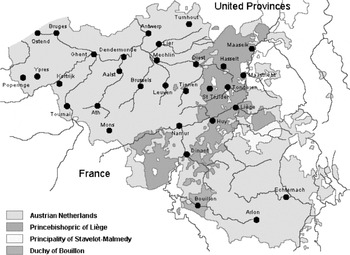
The setting for our case study is the medium-sized town of Leuven (Louvain) in the southern Low Countries (present-day Belgium, Figure 1). For the greater part of the seventeenth and eighteenth centuries, Leuven's population remained fairly stable at around 14–15,000 inhabitants. The city was located in a densely urbanised region, in the vicinity of Antwerp (40 km) and Brussels (30 km). Apart from the eighteenth-century brewing industry, Leuven developed no important export trades and the town traditionally functioned as the major grain market for the eastern and southern part of Brabant. In the 1720s, Leuven expanded its central role in this respect when it acquired staple rights for the hinterland of Tienen. In the seventeenth and eighteenth centuries, the function of the local economy was essentially that of a provider for the town, the university, and its vast, rural hinterland. Food, drink and textiles were the dominant sectors, accounting for 72 per cent of the guild population around 1700.Footnote 13
Austrian Netherlands, eighteenth century.

As in most early modern towns, bread in Leuven was produced and sold in different circuits. Guild-organised bakers were but one of these circuits, next to home baking and the marketplace. As in many other cities, the Leuven guild bakers were relatively well-off members of urban society. During the early modern period, however, they went through several challenges. First, there were periodic grain shortages and price inflations due to bad weather and war. Second, there was the transformation of consumer demand. In Leuven too, the consumption of durables and groceries (the sale of which was the monopoly of the mercers-grocers' guild) was increasing.Footnote 14 Utensils for hot drinks – as markers of a new consumption culture – were recorded in 15.8 per cent of the Leuven probate inventories c. 1680. By 1730 this percentage had risen to 75.5 and by 1780 even to 97.6 per cent.
This article is particularly concerned with the collective actions of the bakers' guild and the business strategies of individual bakers in response to the external shocks of crisis and changing consumer demand. Whereas the collective reaction of bakers in the guild was aimed at the conservation and enforcement of their privileges as opposed to non-guild bakers, individuals bakers were looking ahead and responded by diversifying their assortment through the addition of a wide variety of basic provisions, groceries, and even clothing and durables. While it is appealing to attribute this particular business strategy primarily to the growing demand for novelties, the available evidence suggests that diversification was equally stimulated by subsequent subsistence crises that gave impetus to alternative bread-provisioning circuits.
2. COMPETING CIRCUITS OF BREAD PROVISIONING
Throughout the southern Low Countries, the urban bread supply was organised in different circuits or networks of production and distribution. Masters of the bakers' guild provided bread on an everyday basis in shops or at the Bread Market. Still, guilds controlled only part of the bread provisioning. On fixed days (Monday in Leuven, Tuesday in Hasselt, Friday in Ghent and Antwerp, Saturday in Liège), bread could freely be brought into the town and sold in the marketplace. Outside these legal circuits, a substantial secondary market system existed which was difficult to control. It was supplied by illicit bakers and itinerant peddlers, who sold bread at home or at improvised and continually changing locations.
In the majority of towns, the production and distribution of bread on an everyday basis were the exclusive privilege of bakers' guilds, established mostly in the fourteenth century.Footnote 15 In Ghent, the bakers formed an autonomous guild, whereas in Antwerp they shared a corporation with millers and mill drivers.Footnote 16 The bakers of the fortified city of Mons were incorporated into a larger guild of cooks and pastry cooks which was controlled by military commanders.Footnote 17 Citizens who completed an apprenticeship, passed the examination, paid all due charges and swore an oath to the sovereign, the guild and the city acquired the right to sell bread publicly. Bakers' guilds drew up regulations concerning the price and quality of bread, defended the interests of its members against outsiders (generally called ‘unfree bakers’) and attempted to reduce internal competition. Countryside bakers, on the other hand, were not organised in guilds or granted exclusive privileges.Footnote 18 Neither does it appear that certain small towns developed bakers' guilds as such, yet other forms of corporate organisation also existed in these communities. In Poperinge and Ath, for instance, religious confraternities dedicated to St Aubert – patron of the bakers – regulated the price and quality of bread.Footnote 19 In other small towns such as Turnhout and Bouillon, guild statutes were granted as late as 1692 and 1694.Footnote 20
According to an official inquiry of 1784, the Leuven bakers' guild was established in 1426, although other sources push its foundation back in time to the fourteenth century.Footnote 21 The inquiry reveals that the guild bakers provided bread in three ways.Footnote 22 Most obvious is the baker taking responsibility for the whole baking process, from preparing the dough and putting it in the oven, to selling the bread in their shop or stall at the Bread Market. Bread sold in shops was appropriately called ‘shop bread’ or ‘baker's bread’. Besides buying loaves at the shop, citizens could hire the service of the Leuven bakers and their baking infrastructure. It was not allowed for Leuveners to bake bread themselves, without intervention of a guild baker. Master bakers therefore provided a door-to-door baking service, but burghers could also bring flour or proofed dough to the bakery and appeal to the baker for the further completion of the bread. Bread baked this way was called ‘slide-in bread’.Footnote 23 In the sixteenth century, however, it became customary for Leuveners to bake their own bread, in their own ovens, without intervention of a master baker (‘self-made bread’).Footnote 24 Vehement protest notwithstanding, the aldermen seemed to have tolerated this practice. A petition from 1516, in which the bakers objected against the small profit margins on slide-in bread, the excessive excise tariffs, and the illegal practice of self-made bread only received a favourable response with regards to the issue of profit margins.Footnote 25 In 1561, the guild concluded that the burghers ‘are almost self-supporting’.Footnote 26
Unfree bakers could legally sell bread in Leuven during the weekly Monday Market and the annual fair in September. At these occasions, the guilds' trading privileges were temporarily suspended and merchants, peasants and other persons were allowed to retail durables and foodstuffs, prerogatives that normally belonged to the craft guilds.Footnote 27 Although it is impossible to estimate the volume of bread that was sold during the free markets, a substantial amount must have been brought in from the surrounding countryside or from neighbouring towns.Footnote 28 In the eighteenth century, there were between one and two countryside bakers for every 1,000 inhabitants of the Brabantine countryside.Footnote 29 Unfree bakers were operating shops just outside the town's walls.Footnote 30 Therefore, in 1566, an agreement between the Leuven magistrate and the duke of Aarschot obliged bakers and other craftsmen from the hamlets of Egenhoven, Heverlee and Oud-Heverlee in the town's immediate surroundings to register in the appropriate guilds and comply with their regulations.Footnote 31 Aside from this, each village had its tenant farmers (‘pachters’) who owned bake houses and ovens which were rented out to peasants and cottagers. These facilities were also used for baking bread for the urban Bread Market.Footnote 32
The bakers complained, however, that many persons secretly continued their dealings outside the free market days. Burghers with ovens baked for relatives and neighbours, while others tried to make a living or an additional income via the sales of bread and pastry.Footnote 33 The accounts of the bakers' guilds testify of this widespread practice. In 1669, for instance, the guild paid four guilders to a city servant for seizing bread at a blacksmith's shop, for arresting a woman selling cakes on the stairs of St Peter's church, and for chasing a waffle cart from the marketplace.Footnote 34 This single entry illustrates how craftsmen, burghers and well-equipped pedlars flooded the local market and competed with the guild circuit.Footnote 35
Each circuit had its own characteristics in terms of product and price. Bakers' shops furnished mainly wheat bread. From time to time they also supplied bread composed of wheat and spelt, and a limited amount of rye bread. Customers found more than just bread on the shelves. Bakeries offered a wide selection of cakes, flans, waffles, biscuits, maslin rolls and pies (even meat and fish pies). Some bakers traded wheat flour as well.Footnote 36 As a counterbalance against unfree bread, guild bakers presented the quality of their product as superior to that of unfree bakers.Footnote 37 Theirs was depicted as ‘bad bread’, baked in ‘ramshackle ovens’, and their pies ‘spoiled one's appetite’.Footnote 38 To distinguish rye bread from the bakery from unfree bread, guild bakers drove their mark in the crust.Footnote 39 Nevertheless, market bread was substantially cheaper than shop bread. This was not only because the majority of market bread (as well as slide-in bread and self-made bread) was kneaded from the less expensive rye, but also because loaves coming from the countryside were exempt from town excises. Slide-in bread was cheaper than shop bread as well. Bakers were subjected to excises on the quantity of grain milled and baked, whereas burghers who purchased grain or flour themselves and brought it to the bakery were subjected to milling excises only.Footnote 40 As part of the fiscal immunity of the clergy, religious institutions were exempted from baking and milling excises. In the seventeenth century, monasteries were largely self-supporting.Footnote 41 In 1609–1610, the milling of wheat entailed charges of 1.25 stuiver a halter, while rye only 0.375 stuiver. Based on the revenues of the baking and milling excises of that year, one can deduce that bakers' shops provided only 31.5 per cent of the bread supply in Leuven; 68.5 per cent of the bread provisioning consisted of self-made bread and slide-in bread.Footnote 42 The real market share of the guild bakers might have been even lower, since these figures do not include the supply of the free market and the illegal circuit.Footnote 43
The guild bakers' rather small market share supposedly resulted from the sixteenth-century ‘price revolution’.Footnote 44 We argue that the pressure of subsequent subsistence crises in the seventeenth and eighteenth centuries affected their market share even more. The threat of income loss proved an incentive for the bakers to reposition themselves in the market, making use of corporate as well as individual strategies to achieve this end.
3. BAKING IN TIMES OF CRISIS
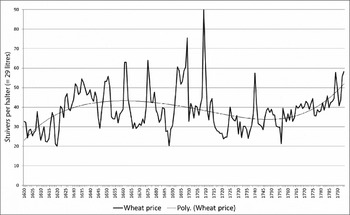
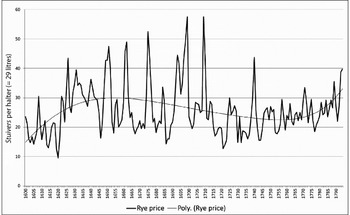
Leuven witnessed a remarkable number of grain shortages and inflationary upsurges in the early modern period, caused by extreme weather and wartime conditions (Figures 2 and 3).Footnote 45 In the tail end of the sixteenth-century price revolution, wheat and rye prices generally continued to rise until 1640. Between 1640 and 1680, the price trend was stagnant at a high level, then slightly decreasing until 1760. From the 1760s onwards, wheat and rye prices were on the rise again, culminating in the depression during the years of the Revolution. Throughout the entire period, grain prices intermittently peaked at levels as high as 50 to 100 per cent above preceding years. Especially the seventeenth century burdened down with a sequence of fierce inflationary shocks (1626, 1631, 1649–1652, 1661–1662, 1675–1676, 1693–1694, 1697–1699). Prolonged periods of high prices occurred in 1622–1652 (except for an intermezzo in 1645–1647) and 1692–1699. During the eighteenth century, subsistence crises happened less frequently. Peaks were only noted in 1709–1710, 1740 and near the end of the Old Regime. The rye price of 1709–1710 equalled the peak level of 1699, whereas wheat inflation proved much more severe, exceeding all upsurges of the previous century.
Wheat price, Leuven 1600–1794. Poly., polynomial trendline. (Source: Rijksarchief, Leuven, Tolkamer (Chambre de Tonlieux), 24–25; Gisèle Van Houtte, Leuven in 1740, een krisisjaar. Ekonomische, sociale en demografische aspekten (Brussels, 1964), 41; Jan Ulens, ‘De crisisjaren rond 1700 te Leuven. Economische, sociale en demografische aspecten’ (unpublished Master's thesis, University of Leuven, 1967), 50.)

Rye price, Leuven 1600–1794. Poly., polynomial trendline. (Source: Rijksarchief, Leuven, Tolkamer (Chambre de Tonlieux), 24–25; Gisèle Van Houtte, Leuven in 1740, een krisisjaar. Ekonomische, sociale en demografische aspekten (Brussels, 1964), 41; Jan Ulens, ‘De crisisjaren rond 1700 te Leuven. Economische, sociale en demografische aspecten’ (unpublished Master's thesis, University of Leuven, 1967), 50.)

In times of scarcity and high prices, the central government in Brussels and the Leuven aldermen issued special measures to guarantee that the citizens had sufficient grain. These measures were sometimes specific to Leuven, at other times those generally applied to the southern Low Countries. In line with widespread notions of a moral economy, government and aldermen directed their grain policy towards the preservation of the common good of the city and its inhabitants.Footnote 46 During the fierce inflation of 1699, for instance, the government acted against the grain merchants – those ‘enemies of the common good’ who, ‘imbued with avarice and a desire for personal gain’, tried to uphold high prices. By nullifying all current contracts and agreements for grain export between merchants, the government intended to regain control over the fixing of prices.Footnote 47 More than anything else, the price of grain and bread vexed the nerves of the urban community.Footnote 48 Rumours about unfair marketing practices intended to create artificial shortages in hopes of forcing up prices were sufficient cause for social unrest and riot. On 6 May 1740, for instance, a batch of disgruntled Leuveners attacked and pillaged several shops and homes belonging to bakers and grain merchants.Footnote 49 Bakers, millers and grain merchants were the usual suspects of fraudulent trading activities (and hence the usual victims of violent outbreaks), but institutions were equally responsible for driving up prices. Monasteries, hospitals and university colleges speculated by storing the harvests from their farmsteads, as well as tithes and leases paid in kind in anticipation of future shortages.Footnote 50
The extraordinary measures of the central and municipal authorities aimed to promote the import of grain, to reduce the export and to regulate the market. Bounties were given to private persons who brought grain into the city. Imported grain was exempted from taxes on the use of paved roads, and import duties – to be paid at the city gates – were suspended or seriously tempered. The export of grain was repeatedly prohibited (offences were even punishable by death), or at least discouraged by introducing crisis taxes. Between 1739 and 1794, 28 years saw a full ban on grain export; for 8 years a partial export ban was effective, leaving only 18 to 19 years during which grain could be traded freely. Exportation of substitute grain (oats, barley), other essential food articles (buckwheat, beans, peas, coleseed, dripping) and fuel was restricted as well. To prevent forestalling and off-market transactions (‘uuytte merckten’, e.g. in the countryside, outside the jurisdiction of the aldermen), grain from the countryside had to be stapled in one of the ‘closed’ (walled) cities (Leuven, Antwerp, Brussels, Mechlin, Diest and Tienen) before it could be brought on the market. Hamlets, villages and ‘open’ cities were not allowed to organise grain markets. Residents of open cities and villages were only permitted to trade some grain for daily consumption among themselves. For the rest, they were reliant on the closed cities.Footnote 51 Civic militia guarded the city gates of Leuven to make sure no cornstalk was smuggled out. The Leuven magistrate further ordained that grain could only be traded at the official, public market or at the Cornhouse on the appointed days and hours.Footnote 52 The quantity of grain a person could purchase was restricted. Foreigners, beggars, vagabonds and ‘ledighgangers’ (people without a craft or trade) were expelled from the market and the town in order to reduce the number of consumers. To banish excessive consumption, the craft guilds had to put their lavish guild meals on hold.Footnote 53 Furthermore, the aldermen held several inspections of grain stocks of both private persons and institutions in order to combat engrossing (the practice of forcing up prices by holding grain back from the market).Footnote 54
Reasoning from the normative and irrefutable argument of the common good,Footnote 55 the central and municipal authorities issued a series of measures that directly ran counter to the private interest of the Leuven guild bakers.Footnote 56 By the royal edict of 1660, the number of free market days was temporarily augmented to three days a week.Footnote 57 By adding Wednesday and Friday to the already existing Monday Market, a weekly market cycle was created that was able to fully meet the demand in bread. After the crisis, extraordinary measures were only partly abolished: ordinances from 1676 and 1738 mention Monday and Friday as market days.Footnote 58 During the sieges of Leuven in 1635 and in 1674, when Dutch and Spanish armies camped around the city, the bakers' monopoly on the sale of bread outside free market days was suspended, thereby opening the market for unfree bakers from the city and the countryside.Footnote 59 Similar augmentations of free market days and suspension of guild privileges occurred in other cities throughout the southern Low Countries (e.g. Antwerp, Ghent, Hasselt, Diest, Liège, Namur and Dendermonde). In Hasselt, Ghent, Liège and Namur, the expansion of the free market remained permanent in the eighteenth century.Footnote 60 During the rye crisis of 1608, Leuven citizens acquired the right to bake and sell rye bread for half the admission fee to the bakers' guild.Footnote 61 By reserving the right to sell cakes, flans and pies above half a stuiver to the guild bakers in 1677, the aldermen provided unfree bakers with the space to sell small pastries freely.Footnote 62 Soon, this decision proved sufficient competition, because in 1682, the guild bakers petitioned for a full prohibition on the sales of cakes, flans and pies by non-guild members.Footnote 63 To make matters worse, the aldermen tried to restrict the access of bakers and other grain-processing guilds to the grain market. The general public could make its purchases at the Grain Market or the Cornhouse from 7 a.m. in summertime or 8 a.m. in wintertime. Bakers, brewers and millers were not allowed to make purchases before 10 a.m. (in 1630 and 1661 before 11 a.m.); distillers, grease mongers and merchants could not trade before 11 a.m. or 12 a.m. In order for these measures to be effective, dealers had to remain in the proximity of their merchandise. It was strictly forbidden to keep bags and barrels shut for customers, or to make trade agreements with bakers, millers, brewers or other merchants.Footnote 64 Due to these restrictions, the bakers complained in 1699 that they were unable to collect enough grain to continue their production.Footnote 65
The policy of the aldermen was not always laid down in measures and by-laws. Offences against the bakers' privileges were more easily tolerated in years of scarcity. Especially the sale of bread by unfree bakers from town and countryside, in shops or in taverns, at home, or at improvised markets was winked at. Hence, an important part of the restoration policy of the bakers' guild after a period of scarcity was aimed at obtaining ratifications of the privileges that were violated during the preceding crisis. In addition to policies by the authorities, the Leuven bakers were also troubled in their business by the billeted garrisons. In 1747, the guild bakers complained that their ovens were occupied by the bakers of the French army. While they were prepared to overlook this requisition, they did protest against the army bakers selling loaves to burghers in the Bread Market or along the streets, in full sight of the guild. Neither were they ready to accept that ordinary citizens and other craftsmen made use of the confusion to sell bread as well.Footnote 66 A similar infringement of the guild's privileges had already occurred in 1693. As in Bruges and Namur,Footnote 67 several Leuven citizens who were not enrolled in the bakers' guild were caught selling bread to the quartered troops. Likewise, people from the countryside smuggled bread into the city under the pretext of being part of the army forage. Protest from the bakers' guild was only partially successful. As long as the garrison was billeted in the city, ordinary citizens were allowed to bake and sell rye bread to the troops.Footnote 68
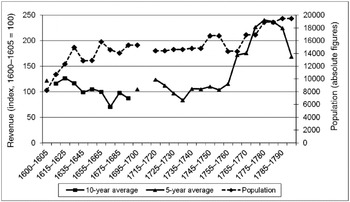
The extraordinary measures of the central government and the Leuven aldermen gave impetus to the market share beyond control of the bakers' guild. In years with acceptable grain prices such as 1609–1610, shop bread accounted for only 31.5 per cent of the bread supply in Leuven. Excise revenues reveal that in hard times, shop bread was readily substituted for cheaper self-made bread or slide-in bread.Footnote 69 As mentioned before, bread was subject to two excises. The baking excise concerned shop bread alone, whereas the milling excise charged both shop bread, self-made bread and slide-in bread. During the inflationary epoch of 1600–1642, the revenues from the baking excise were falling considerably faster than the revenues of the milling excise, which implies that a growing share of the Leuven bread market was provisioned with slide-in and self-made bread (Figure 4).Footnote 70 From 1643 till the end of the Old Regime, only the aggregated revenues of both excises are registered in the city accounts. Figure 4 clearly shows the seventeenth-century inflation translated into decreasing revenues for the town's treasury, as well as for the guild bakers. Since it is highly improbable that the amount of grain charged during the seventeenth century sufficed to feed the growing population,Footnote 71 periodic grain shortages and following price peaks must have stimulated the consumption of excise-free bread smuggled in from the countryside or sold legally during free market days. The same process can be witnessed in the second quarter of the eighteenth century, when the crisis of 1740 even forced burghers to substitute potatoes for bread. Moderate grain prices and increasing revenues in the first quarter of the eighteenth century on the other hand suggest that under more favourable circumstances the market share of unfree bread diminished.
Revenue of the baking and milling excise, Leuven 1600–1795. (Source: Jozef Roelants, ‘Aspecten van de Leuvense economie in de 17e eeuw. De voeding en de dranken’ (unpublished Master's thesis, University of Leuven, 1979), I, 87, 90; Leon Van Buyten, ‘“Verlichting” en traditie: de Leuvense stadsfinanciën en hun economische grondslagen onder het Oostenrijks Regiem (1713–1794)’ (unpublished D.Phil. thesis, University of Leuven, 1970), 169.)

4. THE GUILD'S POLICY
The guild's reaction to the shift towards consumption of unfree bread was twofold. First, in between successive crises, when the aldermen and the government withdrew their extraordinary measures, the guild tried to restore its privileges. Second, it tried to limit the number of guild masters by raising the entrance fee.
During years of scarcity of the first half of the seventeenth century, the magistrate had accepted that some unfree bakers could bake and sell rye bread.Footnote 72 Only in 1655, when the crisis of the 1620s–1652 had been somewhat mitigated (soon to flare up again), the bakers managed to put a check on this accommodating policy. Giving in to the objections of the bakers, the aldermen revoked their 1608 decision which allowed ordinary citizens to bake and sell rye bread for half the admission fee of the bakers' guild. From now on, no new ‘brown bread bakers’ were accepted anymore.Footnote 73 In 1669, after the crisis years of the first half of the 1660s, the bakers' guild acquired an ordinance that forbade the sales of bread in taverns and inns. In the future, victuallers could no longer sell more bread than the amount consumed in the tavern. Like in Namur, the bread they offered their guests had to be delivered by a guild baker.Footnote 74 In 1682, in between the price peaks of the 1670s and 1684–1685, the bakers succeeded in reversing the aldermen's decision of 1677, which gave ordinary citizens the right to sell small pastries outside free market days. The new ordinance limited this right to Anthoon Del Theun alone, who had practised this craft his entire life.Footnote 75 Around the same time, the magistrate came to a similar solution concerning the guild's plea for a restitution of the monopoly on buckwheat bread. The guild bakers were restored in their exclusive privilege, but those individuals who were actually dealing in buckwheat bread retained the right to do so.Footnote 76 In 1764, a year with moderate grain prices, bakers, brewers and millers solicited the aldermen to reconsider the market legislation which forbade them to enter the grain market before 10 a.m., and to grant them free market access.Footnote 77 In Diest, the bakers even attempted to buy the exclusive privilege to sell bread in 1675, at the expense of unfree bakers who would lose the right to sell bread on free market days. The precarious situation of the treasury notwithstanding, the magistrate declined their offer of 50 reales.Footnote 78 On several occasions, the Leuven bakers requested – and obtained – approbations of their statutes, prohibiting anyone who was not a member of the guild to bake and sell bread loaves. Such confirmations were granted in 1607, 1669, 1675, 1682 and 1725, each time shortly after a period of crisis, when government intervention was no longer required.Footnote 79 On each of these occasions, however, the aldermen reserved themselves the right to withdraw the statutes and by-laws, and to alter or expand them whenever they deemed necessary. The request of the Turnhout bakers to be formally recognised as a guild in 1692 was equally motivated as a protective measure against ‘bread coming from other villages […], even by heavily loaded carts’. Guild statutes would provide them with a legal framework to sanction unfree bread sellers.Footnote 80 In Bouillon, however, the guild was established in 1694 by the duke to keep control over the bread provisioning in times of war.Footnote 81
The growth of the market share beyond the guild's control cost the bakers a lot of thought. In particular, the illegal circuit proved a thorn in the flesh. The frequent raising of fines should have had a deterrent effect on potential offenders against the guild's statutes. Fines for selling unfree bread outside market days increased fivefold between 1607 and 1671. For second and third offenders, the fine was doubled or tripled.Footnote 82 Penalties for fraudulent innkeepers quadrupled between 1614 and 1669. Again, recidivists were punished more severely.Footnote 83 Guild deans who consciously tolerated outsiders to practise the craft of baker forfeited 25 guilders.Footnote 84 To catch as many infringers as possible, the guild maintained a system of informers based on reciprocal relations between the baker and his neighbourhood clientele. Bakers provided consumer credit, in return for which local residents reported breaches of their privileges.Footnote 85 Despite the guild's numerous efforts to discourage illicit bread dealers with high penalties, the aldermen again reduced fines in 1725.Footnote 86 Considering the ample opportunities for selling cheap bread, unfree bakers might have perceived these rather low fines as part of their transaction costs, that did not counterbalance their potential profits.
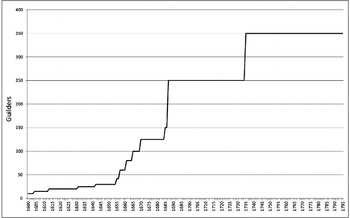
Besides trying to control the bread provisioning of Leuven, the bakers' guild also attempted to preserve their share of the market for themselves and their descendants.Footnote 87 The most common means of doing so was raising the guild's admission fee. In the course of the seventeenth century, a series of entry fee increments was implemented (Figure 5). In particular in the second half of the century, the guild successfully besieged the city council with requests for fee adjustments. Therein, the guild explicitly expressed their concerns about the excessive number of bakers in Leuven. In 6 stages between 1642 and 1685, the entrance barrier was raised from 30 to 150 guilders. In 1687, only 2 years after the last upgrade, the guild scored a major success when it was heightened to 250 guilders. The last revision was recorded in 1735, when the fee was set at 350 guilders (which was the equivalent of 636 days of work for an unskilled labourer).Footnote 88 These tariffs, however, were not due for sons of current masters. In 1667, the guild's assembly agreed that the oldest son of a master could enrol with a presentation of wine only. Younger sons were allowed entry for half the admission fee, unless the oldest son had ceded his right to one of his younger brothers.Footnote 89 Only three years later, the guild decided that all masters' sons were exempt from the admission fee. This privilege was confirmed in 1725.Footnote 90 By vote in 1740, the bakers' assembly agreed that their sons would be freed of all the admission charges, including the cost of the examination meal.Footnote 91
Admission fee to the bakers' guild, Leuven 1600–1795. (Source: Stadsarchief, Leuven, 11700–11701.)

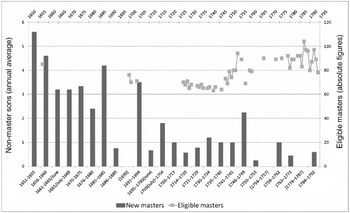
The effect of the guild's policy of restricting admission can be gauged from the average annual number of newly enrolled non-masters' sons (Figure 6). From 1681–1685 or 1691–1694 onwards, the registration of new non-masters' sons quickly decreased. In the eighteenth century, the number of non-masters' sons accounted for only one-half to one-third of the number of the seventeenth century. In a petition of 1657 (for what it is worth), on the other hand, the bakers mentioned that their guild consisted of 80 to 90 active masters.Footnote 92 Lists of masters eligible for election as the guild's representative in the city council provide figures for the eighteenth century. These figures should be regarded as strict minima, however, since some masters were excluded from elections (Figure 6).Footnote 93 In the eighteenth century, on average 79 masters were simultaneously active as guild bakers. In the first half of the eighteenth century, the figure fluctuated between 63 and 76, while in the second half of the century the figure rose to between 74 and 104. These opposite trends imply that a larger number of masters' sons filled the vacuum left by the decreasing number of non-masters' sons. Whether this decreasing number must be attributed to the guild's admission policy remains unclear. Obviously, since the annual average of new non-masters' sons did not surpass the number of one master a year (with exception of the 1746–1749 interval), not much effect was to be expected anyway. The only conclusion that can be deduced from the figures is that in the course of the seventeenth and eighteenth century, the bakers' guild evolved into a corporation in which membership was primarily based on heredity. The more-or-less linear decrease of the number of non-masters' sons might be due to the guild's admission policy, but delayed entrances might just as well have been caused by crisis periods and shrinking market opportunities.
Annual average number of admitted non-masters' sons and eligible masters in the bakers' guild, Leuven 1651–1792 and 1700–1795. (Source: Stadsarchief, Leuven, 467, 469, 474, 476, 11 700, 11 703–11 704; Dominique Dewit, ‘Bijdrage tot de sociale geschiedenis van het Leuvense ambachtelijke milieu: het bakkersambacht (1700–1795)’ (unpublished Master's thesis, University of Leuven, 1984).)

5. NOT BY BREAD ALONE
Besides actions organised by and emanating from the guild, individual bakers also developed creative strategies to compete with the Bread Market in times of repeated subsistence crises. While the guild's actions were principally ‘protectionist’ or defensive in nature, intended to preserve corporate privileges and to combat external competition, the bakers' individual solutions were oriented towards the consumer, intended to secure and enhance their bakery shops' attractiveness with regards to cheaper alternatives. Still, however, both solutions were intertwined. The constraints posed on the acquisition of master status were directed first and foremost to outsiders (non-masters' sons). Insiders (hereditary masters) – who constituted the bulk of the Leuven guild bakers by the eighteenth century – were not harmed by the guild's restrictive policy. Instead, they could take advantage of the privileges that guild membership offered.
As a first answer to the challenges of the marketplace, guild bakers aligned their assortment of bread with the Bread Market. In times of high prices, Leuveners converted to a diet of cheaper but high-protein foodstuff consisting of pulses, buckwheat and inferior cereals (barley, spelt). The breakthrough of potato consumption must also be situated in this context. During the crises of 1693, 1709 and especially 1740, the population was compelled to eat potatoes out of pure necessity. In the second half of the eighteenth century, the potato became an indispensable component of the diet because of the upward trend of grain prices.Footnote 94 Citizens who were still able to maintain their bread consumption converted to bread of a less tasty composition, such as rye bread. During the crisis of 1740, the guild bakers solicited for a reduction of the bakers' impost, arguing that ‘the consumption of wheat among the community is not as high as it used to be in earlier times’.Footnote 95 The Leuven bakeries responded to these changes in consumption patterns by directing their business to the demand for lower-budget food. Whereas bakers of the sixteenth and first half of the seventeenth century mainly processed wheat, by the middle of the eighteenth century the amount of processed rye outweighed the quantity of processed wheat almost six to one. In 1755, 85 per cent of the grain processed by the guild bakers consisted of rye; wheat bread by that time only accounted for 15 per cent of their production.Footnote 96
Second, the Leuven guild bakers expanded their merchandise beyond the usual range expected in a baker's shop.Footnote 97 In the first half of the eighteenth century, bakers were selling all sorts of groceries, beverages, clothing, merceries and haberdashery. The probate inventory of Michiel Wouters (master baker in 1691–1694, died 1729), for example, partly consisted of what one might expect to find in a bakery: a furnace and large copper and cast iron kettles, a kneading trough, tin oven plates and a store of flour and wheat. However, going through the rest of his stock, one comes across candles, oil, cheese, dripping, soap, sugar, tea, rice, figs, pepper, coriander, saffron, ginger and other spices, as well as ribbons, pins, combs and other clothing accessories.Footnote 98 The same goes for the shop assortment of Catharina Schoeps (died 1738), the widow of Jacobus Van Dormael (baker before 1704, died 1733). Her shop not only hosted a small, well-equipped bakery, but also a stock of butter, oil and exotic spices and a hosier's shop crammed with 388 pairs of stockings, 332 el of lace and 1,300 el of linen fabric of varying quality, colours and patterns.Footnote 99 The guild's ledgers revealed that Wouters bought a mastership of the mercers-grocers' and the grease mongers' guild around the same time he acquired his mastership in the bakers' guild. Van Dormael, who bequeathed his shop to his wife, was likewise a member of both the mercers-grocers' and the grease mongers' guild.
The cases of Wouters and Van Dormael reveal a common practice among the Leuven bakers to register in more than one guild. In Leuven, ‘a person was free to exert several, even six, seven, or more crafts’.Footnote 100 There are some indications that multiple guild membership was widely spread in other small- and medium-sized towns throughout the southern Low Countries. In Aalst, for instance, 65 per cent of the bakers registered in the guild ledgers between 1738 and 1790 were simultaneously member of the mercers' guild.Footnote 101 In Turnhout too, many bakers joined the mercers' guild.Footnote 102 In large cities, on the contrary, this practice was often forbidden or at least restricted. In Antwerp, for instance, combining crafts was not allowed.Footnote 103 In Bruges, it was stated in 1442 that ‘no man could be freed in two craft guilds’, while bakers were reminded not to sell groceries in 1777.Footnote 104 Ghent bakers were prohibited to combine their craft with milling.Footnote 105 Although multiple guild membership among bakers was quite common in Liège as well, a combined membership in the bakers' and brewers' guilds was forbidden in 1721.Footnote 106 Scattered evidence suggests, however, that these restrictions were not always observed and that craftsmen still exercised several crafts.Footnote 107
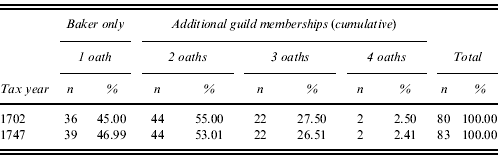
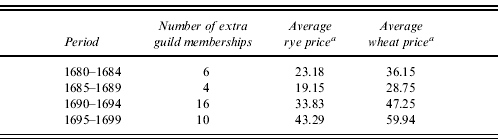
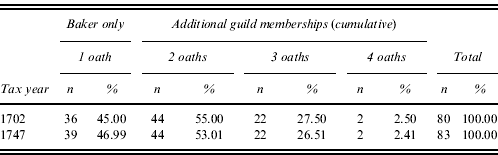
Poll tax registers of 1702 and 1747 show a relatively high, but remarkably stable degree of multiple guild membership amongst the Leuven bakers. Well over half the number of the masters was a member of at least two guilds (Table 1). A quarter of the bakers even combined three crafts. The mercers-grocers' guild, the grease mongers' guild and the brewers' guild were the most sought after. Occasionally, a baker might also enter the millers' or gardeners' guild. Table 2 enumerates all extra guild memberships of bakers mentioned in the 1702 poll tax within the five-year interval in which the extra guild membership was acquired (limited to 1680). This overview makes clear that membership of other guilds was pursued especially during the crisis years of the 1690s, when guild bakers lost ground to competing circuits.
Multiple guild membership among bakers, Leuven 1702 and 1747
Source: Stadsarchief, Leuven (hereafter SAL), 3364–3365; Rijksarchief, Anderlecht, Staten van Brabant: cartons, 402/34, 402/45, 404/18, 406/1, 406/2. Data on guild membership completed with data from database, compiled on the basis of guilds' ledgers and accounts: SAL, 11641–11643, 11653, 11700, 11703–11704, 11724, 11728–11729; Dewit, ‘Bijdrage’; Hildegarde Saenen, ‘Bijdrage tot de sociale geschiedenis van het Leuvens ambachtelijke milieu: het ambacht van de kremers (1675–1725)’ (unpublished Master's thesis, University of Leuven, 1981); Petra Mangelschots, ‘Een sociale studie van de leden van het vettewariërsambacht te Leuven tijdens de tweede helft van de achttiende eeuw’ (unpublished Master's thesis, University of Leuven, 1983); Magda Saenen, ‘Bijdrage tot de sociale studie van het Leuvense ambachtelijke milieu: het kramersambacht (1725–1795)’ (unpublished Master's thesis, Leuven, 1984).
Bakers with extra guild memberships active in 1702, Leuven 1680–1699
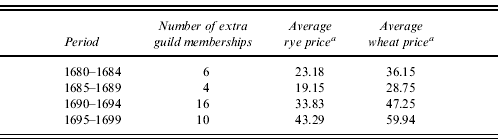
a Prices are given in stuivers per halter (=29 litres).
Source: Stadsarchief, Leuven, 3364–3365.
By combining different professions, bakers had better chances of earning a decent income in times of economic downturn.Footnote 108 The addition of other products beyond the usual bread and pastry gave them a competitive advantage over the Bread Market. An expanded assortment offered customers an attractive space were they could satisfy various needs. The sale of beverages next to bread, butter, dripping, bacon, cheese and spices gave the bakers access to the market for foods and liquids at large, as such concentrating a larger share of the food provisioning into one outlet. In addition, consumers could find fuel, candles and cloth as well. Membership of the mercers-grocers' guild also gave the bakers access to the market for novelties, since the mercers' guild was particularly successful in appropriating the right to sell ‘everything the industry of the people of this and other countries daily invented’.Footnote 109 Already in 1677, the mercers-grocers enjoyed the exclusive privilege to sell snuffboxes, cotton textiles, stockings, ribbons, laces and sugar. Tea, coffee and chocolate were added in 1694.Footnote 110 Since such novel commodities were not sold in the marketplace, they could serve as touts, making the baker's shop more attractive for potential customers.Footnote 111 The retail strategies of the Leuven bakers were intended to intercept customers on their way to the marketplace,Footnote 112 by offering them an alternative: a general store were they could make their purchases in a serene ambience, shielded from the noise and the chaos of the marketplace.Footnote 113
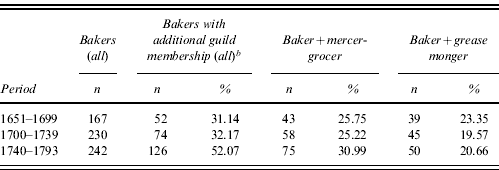
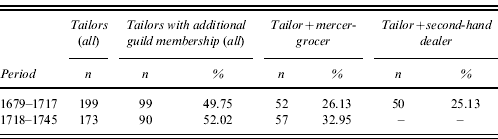
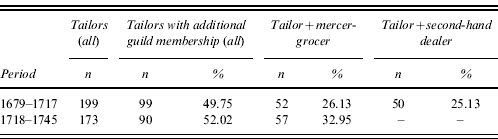
To study the interference of bakers with other guilds more profoundly, several guild ledgers and account books were cross-referenced to compile a comprehensive prosopographical database. Tables 3 and 4 show a remarkable continuity in the practice of combining several crafts. Both in the second half of the seventeenth and the eighteenth century, a significant minority of bakers was a member of the mercers-grocers' guild or the grease mongers' guild, although the figures suggest membership of the latter declined somewhat in favour of the former (Table 3). The figures are even comparable with those in guilds from the clothing sector. In 1679–1717, 26 per cent of the tailors in Leuven were members of the mercers-grocers' guild; in 1718–1745 this percentage had risen to 33 (Table 4). In the detailed census of 1597–1598, however, no bakers with additional professions were encountered.Footnote 114 In sixteenth-century Ghent too, multiple guild membership was common practice amongst tailors, hosiers and second-hand dealers, as well as between cheese makers, candle makers and grocers. Combinations with baking, however, were not customary yet, and in some cases even forbidden.Footnote 115 Subsistence crises and the enduring involvement of the town government to safeguard the supply of bread in the (second half of the) seventeenth century caused a structural shift in the balance between the various provisioning circuits in Leuven. Our analysis suggests that the diversification strategy adopted by a significant number of bakers was a response to the increasing competition from the Bread Market in times of crisis and afterwards.
Multiple guild membership among bakers, Leuven 1651–1793Footnote a
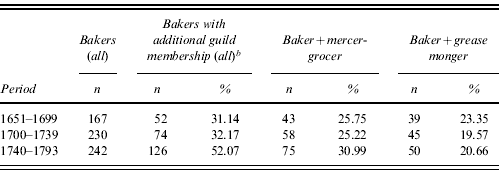
a Since we lack membership lists of the brewers' guild, they are not included in this table.
b The percentages in this table are lower than the percentages presented in Table 1, due to incomplete guild records and difficulties encountered when examining the records on similarities (e.g. homonyms).
Source: See Table 1.
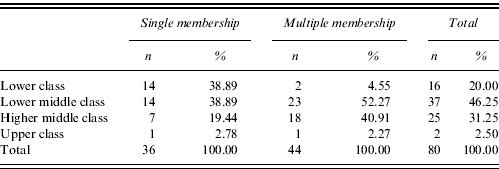
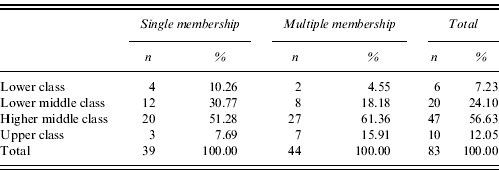
But to what extent was multiple guild membership an adequate response to the competition of alternative circuits? To answer this question, we equalled business success with social position, which can be deduced from the poll tax assessments of 1702 and 1747. An extensive methodological overview of these sources and their analysis is provided in the Appendix to this article. Tables 5 and 6 reveal a relationship between multiple guild membership and economic performance. As mentioned before, in 1702 and 1747 an almost equal number of bakers were members of the bakers' guild alone (45.00 per cent and 46.99 per cent, respectively). However, during the first half of the eighteenth century, the distribution of ‘pure’ bakers over the various fiscal classes somewhat changed. In 1702 almost 40 per cent fell outside the middle class; in 1747 this share dropped to 10 per cent. This meant that, in the scarcity years leading to 1702, a substantial part of the Leuven bakers experienced difficulties to live from the sales of bread alone, whereas in more moderate times, bakeries could generate enough profit to uphold middle-class status. On the other hand, bakers who supplemented their usual shop assortment found it easier to attract customers in hard times. Under good market circumstances, multiple guild membership seemed to have functioned as a mover (or marker) of social status: in 1702 43.18 per cent of the bakers who combined several guild memberships belonged to the higher level of society, whereas in 1747 this had risen to 77.27 per cent. The well-documented changes in consumer preferences which positively affected demand for novelties which fell under the monopoly of the mercers-grocers' guild might have given bakers with an expanded array of goods a competitive advantage over their colleagues, and compensated for the loss of income from diminishing bread sales (or the shift towards cheaper rye bread).
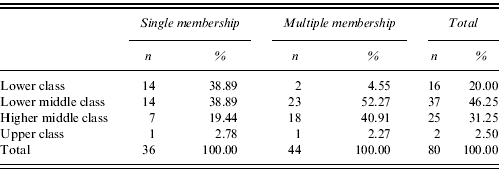
Social inequality among bakers, Leuven 1747
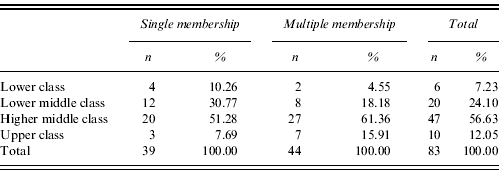
Source: Rijksarchief, Anderlecht, Staten van Brabant, cartons, 402/34, 402/45, 404/18, 406/1, 406/2; Table 1.
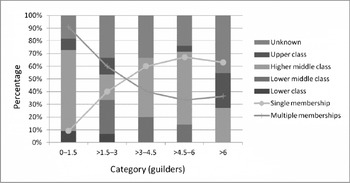
According to Steven Kaplan, it was ‘virtually impossible’ to combine the demanding profession of baker with another job. Bakers in Paris supplemented their earnings with grain, beer and wine trade, catering or the sale of charcoal (a remnant of the baking process). All of these activities were closely related to the bakery, or to the food industry at large; mercery appeared less natural to Kaplan.Footnote 116 In Leuven, however, the combination baker–mercer, baker–grease monger or baker–brewer was quite common, comparable with the clothing sector. The revenues of the ‘heytsel’ excise make clear how Leuven bakers succeeded in combining their demanding profession with other crafts. Introduced by the aldermen in 1754, the ‘heytsel’ or heating excise was a production tax of 1.50 or 0.75 stuiver for every barrel of processed wheat or rye.Footnote 117 The excise register of 1755 allows us to examine production statistics for individual bakers. Figure 7 distributes the Leuven bakers over five categories, arranged in ascending order from small to large producers. The columns show that there is no obvious relationship between production and social position or economic performance. Poor bakers are found at the low production side but well-off, higher middle- and upper-class bakers are encountered in all categories. Figure 7 demonstrates that business success cannot be fully understood by contemplating production statistics alone. A large share of bakers was able to uphold higher middle- and upper-class status with a limited production of bread only. The graph, then, does reveal a relationship between multiple guild membership and production.
Production, social position and guild membership among bakers, Leuven 1755. (Source: Stadsarchief, Leuven, 11705 (13/01/1755–6/02/1755); Table 6.)

Bakers with several master titles tended to produce significantly less bread than bakers with only one. Relative to other foodstuffs and commodities, bread probably occupied only a secondary position in their shops. Another solution to the inconsistency between Kaplan's conclusion and the business strategies of the Leuven bakers might be that bakers who combined a small production with other trades sold bread delivered by colleagues with a large production. Their bread might even have been baked by unfree bakers: the text of the new guild oath of 1725 forbade bakers from making secret deals for bread deliverances with unfree persons.Footnote 118 Such specialisation offered advantages for both ‘retailers’ and ‘producers’. While ‘retailers’ could concentrate efforts on marketing and customer service, ‘producers’ could concentrate on baking, save space on shop infrastructure and make use of specialised bread outlets for the distribution – much in the same way that tailors made use of the commercial networks of mercers and second-hand dealers to market their products.Footnote 119 This would also allow large ‘producers’ to bypass the ban on running more than one shop or employing unfree ‘retailers’ (imposed by the statutes of 1725).Footnote 120
6. CONCLUSION
The supply of bread to the urban community was organised in several, complementary circuits. The sale of bread in fixed shops was the privilege of guild-organised bakers. They sold mainly wheat bread, whereas cheap rye bread was (at least partly) prepared at home or bought from unfree bakers in the Bread Market during free market days. Each circuit was affected differently by the subsequent subsistence crises of the seventeenth and eighteenth centuries. In times of grain shortage, the authorities took measures that went directly against the interest of the bakers' guild or tolerated infringements on its privileges. The bakers' access to the grain market was limited, and they suffered from the competition of cheaper rye bread provided by those market segments beyond the guild's control. In times of dearth, the sale of bread in the Bread Market, as well as home baking was tolerated, if not stimulated by the magistrate. Moreover, in the uncertain times of war and military occupation, secondary (illegal) bread markets blossomed. The bakers' reaction was twofold. On the one hand, the bakers' guild attempted to regain at least part of their lost territory by appealing to the town's magistracy. In various petitions, they requested and obtained the restoration of their privileges, as well as more severe punishment for trespassers. Moreover, access to the guild was limited by increasing the admission fee. Individual bakers, on the other hand, made flexible use of the advantages that guild membership offered. Not only did they substitute wheat bread for rye bread by the middle of the eighteenth century, they also acquired membership of other guilds in times of high prices. This allowed them to sell other traditional provisions (such as butter, oil, cheese and salt), groceries and even durables (the sale of which was the exclusive privilege of other guilds). It is quite appealing to attribute changes in consumer demand (such as the spread of the use of hot drinks) with an important role in the diffusion of this practice. However, the considerable degree of continuity in multiple guild membership between the second half of the seventeenth and the eighteenth centuries most probably points in the direction of the continuing competition from the Bread Market and the home as a prime mover of stock differentiation. In this respect, the ‘push factor’ (the pressure of the marketplace) seemed stronger than the ‘pull factor’ (the appeal of new goods). By concentrating a variety of commodities in one outlet, bakers' shops gained a competitive advantage over the marketplace where this practice was prohibited. Changes in consumer preferences might not have been the driving force behind the practice of enrolling in more than one guild; they did, however, produce social distinction among the bakers. Social inequality between single-occupation bakers and bakers who were members of the grease mongers' and/or mercers-grocers' guild increased between 1702 and 1747. This not only illustrated the success of diversification as a business strategy, but might also be an indication of the increased importance of retailing groceries and durables (which is also evident from the growth of the mercers-grocers' guild).
By way of conclusion, a number of possible implications of the results of this article for the wider research into retail networks and practices are presented. First, when mapping the retail sector, one needs to keep in mind that a diverse assortment of provisions, groceries and durables might be hidden behind seemingly unproblematic categories such as ‘baker’. Multiple guild membership allowed producers to sell goods they did not produce themselves. ‘Traditional’ craftsman–retailers supplemented or replaced the products of their own labour with imported goods and goods produced by other craftsmen. By consequence, the so-called retail revolution was not limited to retailers pur sang – the mercers in particular – but was expanded more broadly, affecting also the circuits considered more traditional such as that of producer–retailers. Second, ‘traditional’ retailing circuits such as the marketplace as well as household production not only kept playing an important role in the provisioning of foodstuffs, but presumably also fashioned ‘modern’ retail outlets such as the shop. Both the absolute and relative presence of market stall holders in retailers' guilds might have diminished in the course of the seventeenth and eighteenth centuries, but in the food trade, competition of the marketplace forced sedentary retailers to diversify their stock.Footnote 121 By focusing solely on ‘modern’ forms of retailing (in an urban setting usually dominated by mercers' and grocers' guilds), these practices remain shrouded. Finally, combining several crafts and trades should not merely be qualified as a survival strategy.Footnote 122 In the case of Leuven, stock diversification offered traditional craftsman–retailers a chance at maintaining and even improving a relative standard of living. Economic and subsistence crises, changing consumer preferences, or competition from other retail circuits might have been a ‘push factor’ for adopting new business strategies, but the ‘lure of the new’ also offered opportunities for those who had access to the guild system. When considering the growth, even in times of economic and urban decline, of the urban retailing sector, organised through guilds, we need to ask who these new retailers were and what their backgrounds were.
Many studies have demonstrated the socially broad diffusion of hot drink consumption and other novelties by the middle of the eighteenth century. The mercer and the grocer have been accorded a key role as middle-men in the alignment of supply and demand.Footnote 123 To this, we can now add a chain of food outlets dispersed over the town.Footnote 124 The familiarity of those food retailers and (neighbourhood) outlets through which these novelties were distributed might have contributed to the recognisability of the product, thereby facilitating the assimilation process.Footnote 125
ACKNOWLEDGEMENTS
The text has greatly benefitted from the comments of Professors Erik Aerts and Johan Verberckmoes and our colleagues of the Early Modern History Research Unit (University of Leuven). We also like to thank Christian Pistor (whose name appropriately means ‘baker’) for revising our text. Note on currency: the currency of the Duchy of Brabant was the Brabantine guilder, which was composed of 20 stuiver of 12 penningen or 4 oord each.
APPENDIX
A social stratification of Leuven based on the poll taxes of 1702 and 1747
The poll tax was a tax levied on the occupation of the household head. Although the tariffs were established beforehand by the government, the capitation offers a sturdy approximation of real wealth. The instruction letters prescribed at least 11 different tax rates for craftsmen, shop owners, caterers and merchants in 1702, and no less than 24 in 1747. Moreover, tax assessments were bumped up by external signs of wealth such as domestic servants and horses, as well as chimneys, furnaces and ovens (a proxy for the size of house and workshop).Footnote 126 In short, the poll taxes of 1702 and 1747 allow us to make social distinctions and to assign each household a place within the Leuven social structure.
On the basis of the tax assessments recorded in the capitation registers, Leuveners were categorised in four wealth classes (lower, lower middle, higher middle, and upper class). Rather than portraying ‘social classes’, with a common identity, axiology and shared class-interest, these classes should be considered ‘fiscal categories’, meant as an analytical tool to scrutinise the changing position of the bakers within the social structure. In this respect, classes are not defined arguing from some shared cultural properties or mental universe, but on the basis of the (fiscal) distance between groups. In both tax years, the line between the upper and higher middle class is fixed on the 90th percentile, which means that the 10 per cent wealthiest inhabitants are categorised as elite. Given that wage labourers (journeymen, unskilled labourers) can hardly be regarded as middling groups, the median tax value of the wage labourers was chosen as the upper limit of the lower class. As such, the lower limit of the middle class in 1702 can be fixed on the 40th percentile and in 1747 on the 60th percentile. As separator between the lower middle and higher middle class, the median tax value of all middle-class households was employed.Footnote 127