Introduction
A shopping center (SC) is defined as a group of retail and other commercial establishments that is planned, developed, owned, and managed as a single property, typically with on-site parking provided. 1 These centers are characterized by the hosting of a great number of people who spend a certain time of the day there. Mass gathering is defined as events attended by a vast number of people (usually between 1,000 and 25,000) for a specific purpose. Reference Arbon2,Reference Arbon, Bridgewater and Smith3 When the definition and the number of visitors of SCs are taken into account, SCs can be considered as places hosting a daily routine mass-gathering event. Emergency Medical Intervention Units (EMIUs) are mandatory for prompt diagnosis and intervention in SCs located in Turkey.
To the best of the authors’ knowledge, there is no report investigating medical conditions encountered in SCs so far. The present study aimed to analyze medical conditions and provided health care in nine grand SCs in Ankara, Turkey.
Materials and Methods
The present study comprised SCs located in Ankara, the capital city of Turkey. The population of Ankara in 2018 was 5,503,985. 4 Medical records in nine grand SCs from January 1, 2018 through December 31, 2018 were obtained and analyzed retrospectively. The SCs were open between 10:00am-10:00pm every day. Customers were screened by manual detectors and x-ray devices during entrance to SCs. The number of customers entering and leaving SCs was detected by sensors located in these access points. All of the SCs in the study were indoors. Lifts, escalators, and stairs were present in all SCs. Indoor temperature was climatized by air conditioners according to seasonal weather conditions. Public alcohol consumption was not permitted in any SCs. Parking lots and garages were available in all SCs except one.
Each SC included an EMIU with an easily accessible location, which aimed for both prompt intervention in urgent medical conditions and also transfer to the nearest hospital when required. A post with “Emergency Medical Intervention Unit” sign was placed on the entrance door in each EMIU. There were also guidance signs for the EMIU. Health services were provided by EMIU staff in SCs. These EMIU staff consisted of paramedics and emergency medicine technicians (EMTs). One SC recruited not only paramedics and EMTs, but also nurses. Nurses were on duty from 10:00am to 5:00pm and one doctor and nurse were on duty from 5:00pm to 10:00pm. Automatic external defibrillators were not located in easily accessible points in the SCs; defibrillators were only available in EMIUs.
Patients presented to EMIUs on their own, or EMIU staff were invited to a scene by a security officer’s mobile call or pushing of emergency medical condition button located in each store. Patients were treated in EMIUs or at the scene, or were transported to hospitals via 112 Emergency Medical System ambulances. None of the SCs recruited an ambulance on duty. Health services including transfer-to-hospital by ambulance were free of charge in all SCs. Data regarding admission date, demographic characteristics, diagnosis, treatment, and disposition were obtained from a readily-prepared logbook and recorded as an Excel file (Microsoft Corp.; Redmond, Washington USA). Patients with filled up medical record forms were included. Exclusion criteria included patients with missing data in medical records and repeated presentations in the same day after index procedure. Patient data including demographic characteristics, diagnosis, treatment, discharge, and transfer-to-hospital by ambulance were analyzed. Diseases were categorized as traumatic conditions or medical conditions. Conditions caused by traumatic injury were defined as traumatic conditions, while non-traumatic medical health conditions were defined as medical conditions. Localizations of traumas were denoted by numbers. Interventions and medications used in EMIUs were provided as numbers. Information regarding the number of customers visiting SCs were obtained from SC administrators. Center names are specified as SC-numbers for privacy reasons. In order to be consistent with previous mass-gathering reports in the literature, patient presentation rate (PPR) was calculated by dividing the number of patients by the number of customers multiplied by 1,000. Similarly, transfer-to-hospital rate (TTHR) was calculated by dividing the number of patients transferred-to-hospital by total number of customers multiplied by 1,000. Daily customer number data were obtained from EMIUs in SCs. However, only data about annual customer numbers were available, not daily customer numbers. Numerical data were obtained in Table 1 by calculation of annual total number of patients, customers, and patients transferred via ambulance and could not calculate 95% confidence interval. Statistical Package for the Social Sciences (SPSS version 11.0, SPSS Inc.; Chicago, Illinois USA) was used. The study was approved by Ankara Numune Education and Research Hospital Ethical Committee (Ankara, Turkey; Number: E.Committee-E-19-2672, study 2672).
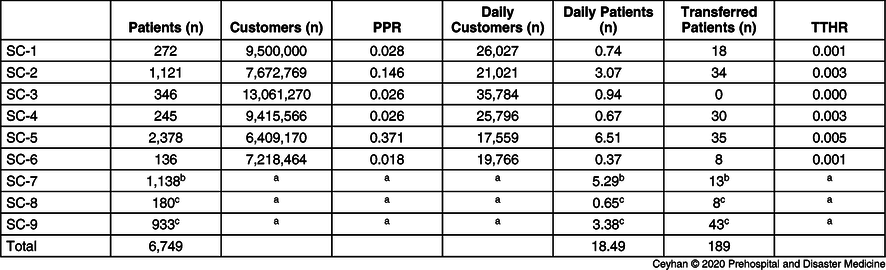
Total and Daily Number of Customers and Patients in the SCs with Calculated PPR and TTHR Values

Abbreviations: PPR, patient presentation rate; SC, shopping center; TTHR, transport-to-hospital rate.
a Not Available.
b Time range in which patient data are available: June 1, 2018-December 31, 2018.
c Time range in which patient data are available: March 1, 2018-December 31, 2018.
Descriptive statistics were used to present data set. Continuous variables were expressed as median (interquartile range [IQR]). Categorical data were shown as frequencies and percentages. The data were not normally distributed and the skewness and kurtosis ratios are appropriate with nonnormality distribution. Normality was tested with both skewness and kurtosis tests and Kolmogorov-Smirnow test.
Results
Patient data from nine SCs were used for analysis. One of the SCs was put on service in June 2018, so patient medical records were only available for six months. The EMIU staff in two different SCs were replaced, therefore medical records were unavailable for two months. The PPR and TTHR could not be calculated due to unavailability of total customer numbers from these three SCs. The annual total number of the other six SCs for 2018 was 53,277,239. A total of 6,749 patients sought or needed health care. The number of patients seeking health care in six SCs with known number of customers was 4,498 and PPR was from 0.018 to 0.381 patient per 1,000 attendants (Table 1). Revisiting to the same EMIU for follow-up in the subsequent days after index admission was noticed in 299 patients (4.4%). Some of these patients had multiple revisits, and the total number of multiple revisits of 299 patients was 679 (10.1%). The most common reasons for revisiting were dressing, measurement of blood pressure or glucose, and request for injection of a prescribed medication.
Of the admitted patients, 3,611 (53.5%) were female and 2,795 (41.4%) were male, but information about gender of 343 (5.1%) patients was missing. The number of patients younger than 18 was 519 (7.7%) while 71 patients (1.1%) were older than 65. The number of patients aged between 18 and 65 was 3,475 (51.4%). Records of 2,684 patients (39.7%) did not include age information. The age data were not normally distributed and the median of age of 4,065 (60.2%) patients with age data was 28 (IQR: 38-21). The number of patients seeking health care on working days and vacation days (116 days including Saturday, Sunday, and national and religious holidays) was 4,153 (61.5%, 16.6 patients per day) and 2,330 (34.5%, 20.8 patient per day), respectively. The number of patients lacking admission date records was 266 (3.9%). The number of patients seeking health care on working days was more than vacation days.
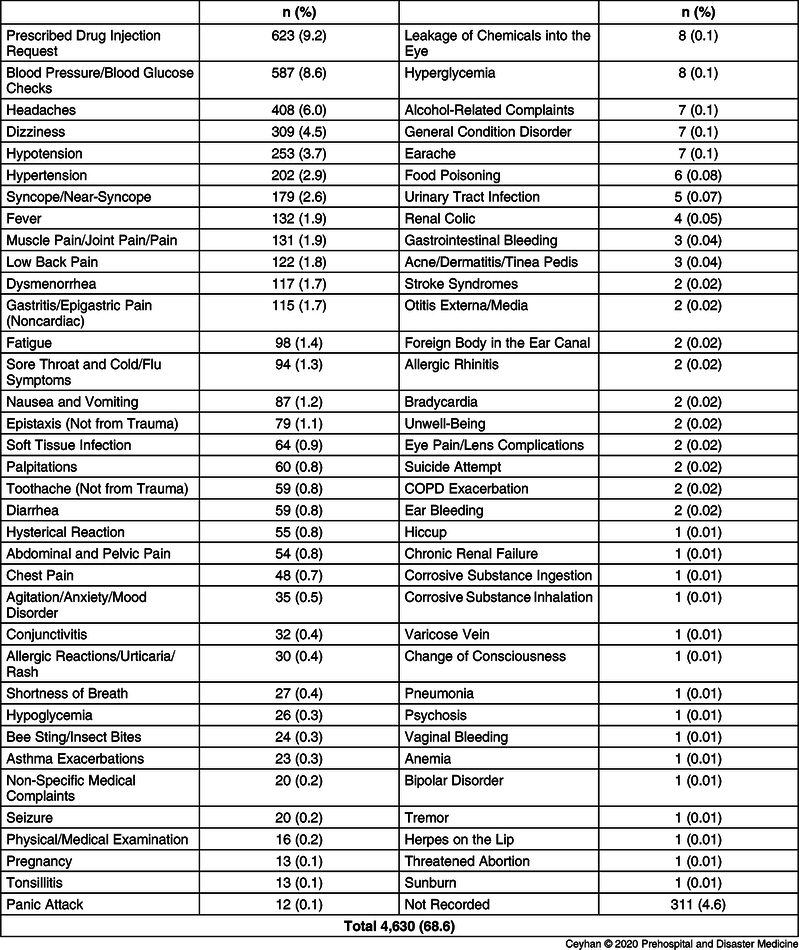
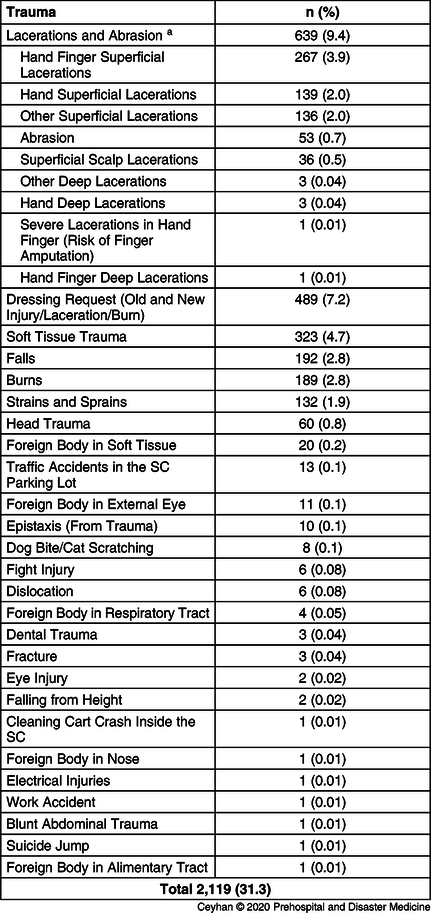
Medical conditions were the most common cause (4,630 patients, 68.6%) of EMIU admissions. Medical conditions included prescribed drug injection request (623 patients, 9.2%); blood pressure/blood glucose checks (587 patients, 8.6%); headache (408 patients, 6.0%); and dizziness (309 patients, 4.5%). The number of patients seeking health care due to traumatic conditions was 2,119 (31.3%). Traumatic conditions included lacerations and abrasions (639 patients, 9.4%); dressing request (489 patients, 7.2%); soft tissue trauma (323 patients, 4.7%); and falls (192 patients, 2.8%). Diagnosis was not recorded in 311 patients (4.6%; Table 2 and Table 3). No sudden cardiac death or arrest occurred.
List of Medical Complaints of Patients Who Presented to EMIUs

Abbreviations: COPD, chronic obstructive pulmonary disease; EMIU, Emergency Medical Intervention Unit.
Traumatic Complaints of Patients Who Presented to EMIUs

Abbreviations: EMIU, Emergency Medical Intervention Unit; SC, shopping center.
a Localization of lacerations.
The number of patients transported via ambulance to the emergency department (ED) was 189 (2.8%). The number of patients transported via ambulance from six grand SCs with known customer numbers was 125 (1.9%) and TTHR ranged from 0.000 to 0.005 patients per 1,000 attendants (Table 1). All patients were transported via ground ambulance. A total of 4,634 patients (68.6%) were treated and discharged in EMIUs and 299 patients (4.4%) were referred to hospitals for further medical care with their own means. The number of patients who left EMIU against medical advice was 24 (0.3%) and medical disposition data were missing in 1,603 patients (23.7%).
Of the patients, 1,826 patients (27.0%) were SC employees, 831 patients (12.3%) were customers, while the status of the remaining 4,092 patients (60.6%) was not recorded.
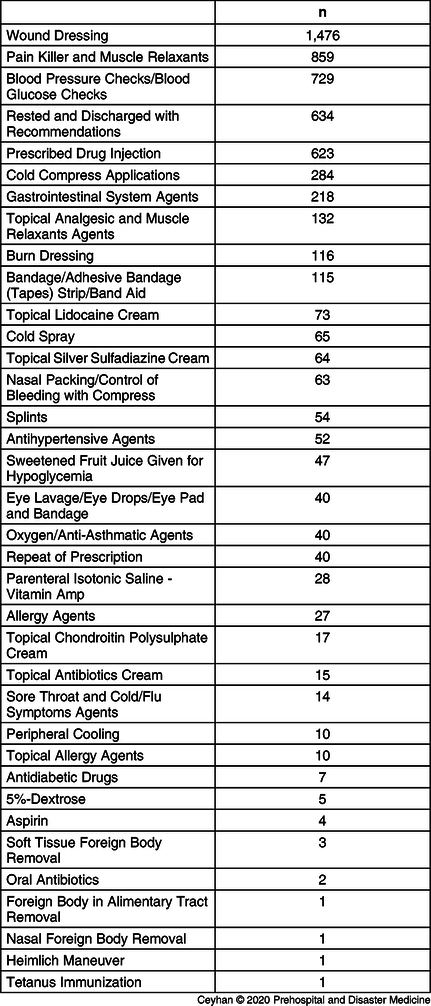
The most common treatments and medications provided by EMIU staff were wound dressing (1,476, 41.8%) and pain killers and myorelaxants (859, 12.7%). Some patients required concomitant different treatments (ie, cold pack application to a patient with ankle sprain followed by topical analgesics and brace application; Table 4).
The Most Common Treatment and Medication Provided by EMIU Staff

Abbreviation: EMIU, Emergency Medical Intervention Unit.
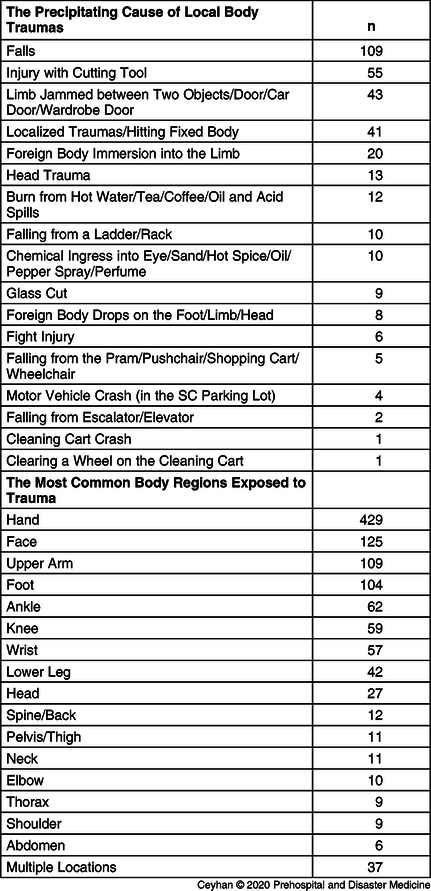
The most common body regions exposed to trauma were hands (429 patients) and facial area (125 patients). The precipitating causes of local body traumas were falls (109 patients) and sharp object injury (55 patients; Table 5).
The Most Common Body Regions Exposed to Trauma and Causes of Traumas that Occur in the Body

Abbreviation: SC, shopping center.
Discussion
A comprehensive analysis of emergency health problems and health care services provided in SCs were targeted in the present study. To the authors’ knowledge, this is the most extensive study investigating health care services provided in SCs and might contribute to future planning of health care services in SCs.
The majority of patients seeking health care in EMIUs of SCs were female, in consistence with previous mass-gathering reports. Reference Hnatow and Gordon5‐Reference Moreno Millán, RaposoTriano and ÁlvarezLeiva15 Steffen, et al reported association between female gender and increased risk of injury/disease in mass gatherings. Reference Steffen, Bouchama and Johansson16
Previous mass-gathering reports demonstrated a wide distribution in patient age and increased sensitivity of young children and elderly people to injuries and medical conditions in mass-gathering events. Reference Hnatow and Gordon5,Reference Grant, Nacca, Prince and Scott6,Reference Grange, Green and Downs8,Reference Steffen, Bouchama and Johansson16,Reference Pérez-Gómez, Ramos-Zúñiga and Gutiérrez-Padilla17 Similarly, the age of patients seeking health care in SCs exposed a wide distribution. On the other hand, the number of presenting patients aged between 18 and 65 was higher than children and elderly population, and median age of the patients was 28. Therefore, presentation of patients of all ages should be taken into account during arrangement of health care services in SCs and training of EMIU staff.
The PPRs in SCs were lower than PPRs reported in previous mass-gathering events. Reference Grant, Nacca, Prince and Scott6,Reference Moreno Millán, RaposoTriano and ÁlvarezLeiva15,Reference Pérez-Gómez, Ramos-Zúñiga and Gutiérrez-Padilla17–Reference Anikeeva, Arbon and Zeitz24 The PPRs of only two SCs in the present study were within the range of previous reports and in proximity of lower limit (Table 1). The present study constituted the report with the lowest PPR associated with mass gatherings in the literature. Reference Arbon, Bridgewater and Smith3,Reference Alquthami and Pines20,Reference Michael and Barbera22,Reference Anikeeva, Arbon and Zeitz24,Reference Milsten, Maguire, Bissell and Seaman25 Low PPR might also be related with relatively low daily number of patients in SCs. Nonetheless, mass gathering in SCs should be considered as mass gathering with the highest total attendance since it is repeated every single day in a year. Previous reports by Pietro and Emilio, et al suggest international congresses as the long-lasting mass-gathering event which lasted six months. Reference Marino, Albergoni and Andreassi14,Reference Moreno Millán, RaposoTriano and ÁlvarezLeiva15 Daily patient numbers in both reports were higher than those in the present study. The SCs provided ideal common living space when compared with other multi-day mass-gathering events, and also were less dependent on factors such as weather, alcohol use, and crowd mood, which are related with the number of patients seeking health care. Reference Arbon, Bridgewater and Smith3,Reference Locoh-Donou, Yang and Berry23 Air conditioners help the maintenance of a controlled indoor temperature, thus minimizing negative effects of heat and moisture. Other factors related with low numbers of patients and PPRs might include easy access to water, food and resting spaces, prohibition of alcoholic beverages in SCs, different time windows of each customer spent in SC, lack of a shared psychological mood with protest or violence content, and lack of groups of densely packed people in spite of high numbers of customers.
The number of patients who presented on working days was found to be higher than those who presented on holiday days. However, the number of patients per day on holidays was higher than the number of patients per day on working days. Similarly, previous mass-gathering reports revealed increased number of patients presented on holiday days than those on working days. Reference Moreno Millán, RaposoTriano and ÁlvarezLeiva15,Reference Zeitz, Schneider, Jarrett and Zeitz26,Reference Ceyhan, Demir and Güler27 Increased daily number of customers on holiday days in SCs might be closely associated with increased number of patients.
Demographics about whether the patient was SC staff or visitor were not regularly recorded in patients admitted in EMIUs. The majority of the recorded ones consisted of SC staff, in consistence with previous mass-gathering reports. Reference Varon, Fromm, Chanin, Filbin and Vutpakdi9,Reference Dutch, Senini and Taylor11,Reference Moreno Millán, RaposoTriano and ÁlvarezLeiva15,Reference Zhang, Wang, Chen, Ma and Dai28 Non-acute treatments (health care services) such as injection of prescribed medications, wound dressing, and measurement of blood pressure or glucose were provided in EMIUs, which also served as workplace health units of SCs. This choice of staff might be related with a contract between SC administration and staff, which might be offering workplace health coverage for people working in SCs. Nevertheless, it was previously reported that health care services free of charge and prevention of time loss during hospital visits and return periods are the primary causes for seeking medical advice of SC staff in EMIUs. Reference Varon, Fromm, Chanin, Filbin and Vutpakdi9,Reference Michael and Barbera22
The present study detected greater numbers of patients presenting with medical conditions than with traumatic conditions in SCs. Minor medical conditions and injuries were the most common presentations, in consistence with the literature. Reference Arbon2,Reference Arbon, Bridgewater and Smith3,Reference Varon, Fromm, Chanin, Filbin and Vutpakdi9,Reference Steffen, Bouchama and Johansson16,Reference Milsten, Seaman, Liu, Bissell and Maguire18-Reference Alquthami and Pines20,Reference Zeitz, Schneider, Jarrett and Zeitz26,Reference Krul, Sanou, Swart and Girbes29
The most common causes of traumatic conditions were lacerations and abrasions. Arbon, et al declared laceration as the most common injury requiring urgent intervention. Reference Arbon, Bridgewater and Smith3,Reference Sanders, Criss, Steckl, Meislin, Raife and Allen30 Injuries such as lacerations and falls were shown to be more frequent in outdoor events, concerts, or fairs. Reference Arbon2,Reference Arbon, Bridgewater and Smith3,Reference Grant, Nacca, Prince and Scott6,Reference Grange, Green and Downs8,Reference Pakravan, West and Hodgkinson12 Although SCs have indoor setting with a flat surface, lacerations and falls were not uncommon. Causes of injuries were not recorded in the majority of the data used for the present study. The recorded ones determined falls and sharp object injuries as the most common causes of injuries. Accidental injuries in kitchens of SC restaurants were assumed to be solely recorded as lacerations. Furthermore, falls and injuries were mostly associated with the use of common areas such as escalators, lifts, automatic doors, or wet and slippery grounds. Headache was the most frequent cause of medical conditions in EMIUs, as reported in several mass-gathering reports. Reference Varon, Fromm, Chanin, Filbin and Vutpakdi9,Reference Pakravan, West and Hodgkinson12,Reference Milsten, Seaman, Liu, Bissell and Maguire18,Reference Alquthami and Pines20,Reference Zeitz, Schneider, Jarrett and Zeitz26,Reference Sanders, Criss, Steckl, Meislin, Raife and Allen30
Mental health-related presentations (107 patients, 1.6%) were similar with the number of patients in large-scale rave events reported by Jan Krul. Reference Krul, Sanou, Swart and Girbes29 Suicidal attempts were three of the mental health-related presentations, so it may be reasonable to provide psychological training to EMIU staff for psychiatric emergencies.
Cardiac arrest or sudden cardiac death is uncommon in mass-gathering events. Reference Arbon2,Reference Varon, Fromm, Chanin, Filbin and Vutpakdi9,Reference De Lorenzo19,Reference Alquthami and Pines20 No cardiac arrest or sudden cardiac death occurred in SCs, despite relatively much higher attendance. However, when delay in intervention occurs as reported in previous mass-gathering reports, it is possible that medical conditions seen in SCs including chest pain, asthma, shortness of breath, allergy, and falling down from height have the potential of a life-threatening scenario. Reference Arbon, Bridgewater and Smith3,Reference Milsten, Seaman, Liu, Bissell and Maguire18–Reference Alquthami and Pines20,Reference Zeitz, Schneider, Jarrett and Zeitz26 Besides, health care providers in SCs should definitely be equipped with Advanced Life Support training and automatic external defibrillators niched. Reference Steffen, Bouchama and Johansson16 Additionally, automatic external defibrillators should be placed in easily accessible locations in each SC.
The TTHR in the present study was significantly lower than TTHRs of previous mass-gathering reports. Reference Arbon, Bridgewater and Smith3,Reference Grant, Nacca, Prince and Scott6,Reference De Lorenzo19,Reference Alquthami and Pines20,Reference Michael and Barbera22,Reference Zeitz, Schneider, Jarrett and Zeitz26 The majority of patients in SCs were treated in EMIUs. A small portion of patients were directed to hospitals on their own or via ambulance. Furthermore, previous mass-gathering event studies demonstrated that injuries and medical conditions encountered in mass gatherings mainly consisted of minor medical conditions or injuries and were treated in first aid units, which thus resulted in decreased transport of patients to hospitals. Reference Arbon2,Reference Arbon, Bridgewater and Smith3,Reference Varon, Fromm, Chanin, Filbin and Vutpakdi9,Reference Milsten, Seaman, Liu, Bissell and Maguire18-Reference Grange, Baumann and Vaezazizi21,Reference Zeitz, Schneider, Jarrett and Zeitz26
The most common treatment and medication provided by EMIU staff were wound dressing (1,476 procedure, 41.8%) and pain killer and myorelaxants (859, 12.7%), in consistence with the literature. The treatments administered in SCs were not complex. Reference Varon, Fromm, Chanin, Filbin and Vutpakdi9,Reference Thierbach, Wolcke, Piepho, Maybauer and Huth10,Reference Pérez-Gómez, Ramos-Zúñiga and Gutiérrez-Padilla17,Reference Milsten, Seaman, Liu, Bissell and Maguire18,Reference Ceyhan, Demir and Güler27
Medical and traumatic conditions encountered in SCs were adequately and appropriately treated, and if required, rapidly transported to hospital EDs by EMIU staff, not including physicians within the context of this study. Concurrently, previous mass-gathering reports revealed competence of non-physician health care providers in the setting of emergency medical conditions and triage. Reference Varon, Fromm, Chanin, Filbin and Vutpakdi9,Reference De Lorenzo19,Reference Grange, Baumann and Vaezazizi21,Reference Sanders, Criss, Steckl, Meislin, Raife and Allen30–Reference Feldman, Lukins, Verbeek, Burgess and Schwartz32 However, regulations included some treatments for which paramedics or EMTs are not authorized. Yazawa, et al underlined the need for regulatory revision with regard to authorization of EMTs in treatment options other than epinephrine injection in cardiopulmonary arrest. Reference Yazawa, Kamijo, Sakai, Ohashi and Owa33 If not, SCs should recruit physicians, and all patients requiring oral or parenteral medications should be referred to hospitals, which will result in time waste and labor loss.
Study Limitations
Like previous mass-gathering reports, medical record forms lacked standard characteristics for diagnosis, treatment, and patient outcomes. Missing or inadequate data were detected in some medical records. Similarly, information of patients leaving SCs before EMIU arrival or seeking health care in centers outside SCs could not be detected. Detailed information about traumatic conditions was not available. Symptoms were not classified according to acute or chronic setting. Follow-up of the transferred patients and their final diagnosis in the hospital were missing. Although this study investigated a huge sample size of SCs with total customer numbers expressed in millions, retrospective analysis of these data might be considered as a limitation.
Conclusions
Lacerations are the most common health problems in SCs. Automatic external defibrillators should be placed in easily accessible locations in each SC. Majority of urgent medical conditions in SCs can be managed by non-physician health care providers in EMIUs.
Conflicts of interest
none