


The U.S. president sits at the apex of a massive public bureaucracy. Yet, despite this formal position of power, the efficacy of the administrative processes used by the president to manage, control, or even direct policy change within public sector agencies remains far from settled. One such process is the president's use of the Office of Management and Budget (OMB) to review government regulations (called “OMB review”).Footnote 1 Over time, OMB review has emerged as the clearest example of a president's effort to centralize decision making within the Executive Office of the President and to institutionalize presidential influence over agency policy decision making (West Reference West2005; Reference West2006). As Bagley and Revesz (Reference Bagley and Revesz2006, 1260) write, OMB review has developed into “the most important institutional feature of the regulatory state.” Yet, despite a great deal of attention, the efficacy of OMB review and, in particular, the points of entry for politics that it may facilitate remain open questions.
Most political scientists are likely aware that the OMB reviews significant regulatory proposals on behalf of the president, but many may not know that the executive orders governing rule review also allow the public to provide feedback directly to OMB.Footnote 2 Put differently, the public may lobby OMB for policy change during its rule review process. But does this lobbying matter? Despite significant normative debate, we know little about the policy influence, if any, attached to lobbying during OMB review. In fact, to date, there have been no large-scale studies investigating whether or not such lobbying leads to content changes on legally binding regulations.Footnote 3 What existing research does tell us, however, is that interest groups—not the “general public”—are the main entities lobbying OMB (Balla, Deetz, and Maltzman Reference Balla, Deets and Maltzman2011; Croley Reference Croley2003; Steinzor, Patoka, and Goodwin Reference Steinzor, Patoka and Goodwin2011).Footnote 4
This lack of knowledge about interest group lobbying during OMB review is surprising for three main reasons. First, as suggested earlier, there is a broad consensus that OMB review is critical to both American policymaking and presidential politics (Bueno de Mesquita and Stephenson Reference Bueno de Mesquita and Stephenson2007; Furlong Reference Furlong1998; Lewis Reference Lewis2009; Mayer Reference Mayer2001; Moe Reference Moe, Chubb and Peterson1985; Nathan Reference Nathan1983; Wiseman Reference Wiseman2009). Indeed, Croley (Reference Croley2003, 821) calls OMB review among the most important recent “developments in domestic policymaking generally,” and West (Reference West2005, 78) suggests that it is “arguably the most significant constitutional extension of executive power in decades.” This import is undoubtedly connected to the widely held—but currently untested—impression that OMB often directs public agencies to make content changes to regulations during its review process.
Second, this lack of attention is surprising because, generally speaking, we know little about the mechanisms by which presidents and interest groups interact. In fact, one scholar recently characterized the knowledge of the “institutional linkages between Presidents and interest groups” as “scant” (Cohen Reference Cohen2012, 432). Although there are exceptions to this characterization (e.g., Holyoke Reference Holyoke2004; Peterson Reference Peterson1992; Pika Reference Pika, Cigler and Loomis1983; Schlozman and Tierney Reference Schlozman and Tierney1986), the broader point is that the relationship between interest groups and the president is a fruitful path for further inquiry. This is especially true given that the opacity and obscurity of OMB review for many rules (Cooper and West Reference Cooper and West1988; Shapiro Reference Shapiro2011) may present the president and his or her representatives a rare pathway in which to provide policy benefits or concessions to actively lobbying organized interests.
Third, this lack of knowledge about interest group lobbying during OMB review is also startling because, since the inception of OMB review, the policy influence of interest groups has been hotly contested. One of the central criticisms of OMB review in the 1980s was the belief that outside parties held private and influential meetings with OMB officials during the opaque OMB review process (DeMuth and Ginsburg Reference DeMuth and Ginsburg1986). Although proponents of OMB review discounted the normative implications of this criticism, President Clinton responded to it directly by changing the executive order governing OMB review to require that all lobbying of OMB be publicly logged and thus made transparent (Croley Reference Croley2003). Yet, this action in 1993 did not settle the controversy, with Kerwin, Furlong, and West (Reference Kerwin, Furlong, West and Durant2010) calling for new research on interest group lobbying at OMB.
We theorize that interest groups, at times, can use OMB review to influence the content of government regulations. We specifically argue that OMB—which we view throughout this article as a representative of the president—uses lobbying as a signaling device to help understand the degree to which the lobbying community is concerned about the political, technical, and policy ramifications of a proposed regulation. We suggest that OMB reads the strength and clarity of these signals and, under certain conditions, uses its review process to make policy adjustments to mitigate or to ameliorate interest group criticism—either by providing policy benefits or by removing concerns. We also hypothesize that, ceteris paribus, OMB will be less likely to seek agency changes to proposed regulations when it is subjected to contentious lobbying, which we define as lobbying by groups with rival regulatory interests. In those cases, opposing groups have demonstrated that they care strongly about the underlying regulation by choosing to incur the organizational costs of an OMB lobbying effort, and OMB would be unable to grant a regulatory change to one side without angering the other. In short, the signal sent by the interest group community is less clear. However, when the lobbying pressure on OMB is more cohesive, OMB has comparatively less to lose from intervening in the regulatory process, in part because it receives a clearer signal. Thus, we expect to see more policy change during OMB review when there is consensus across the lobbying messages.
We provide two illustrative examples suggesting that lobbying may drive content shifts during OMB review. Given these contextual findings, we then use a large-scale quantitative strategy to study all Final Rules that were reviewed by OMB between January 1, 2005, and June 30, 2011. Specifically, we use a selection model on more than 1,500 regulations, where the first stage models an interest group's decision to lobby and the second stage assesses whether or not lobbying drives policy change. Our second-stage dependent variable compares the text of Draft-Final Rules (i.e., fully formed policy documents delivered by the originating agency to OMB for OMB Final Rule review) to the text of Final Rules (i.e., legally binding government regulations promulgated in the Federal Register). We use automated content analysis software to make the comparisons, which allows us to look past minor punctuation, formatting, and reordering changes. We find that, under certain conditions, interest group lobbying is associated with greater policy change during OMB review.
THEORETICAL FOUNDATIONS AND ARGUMENT
One of the central political challenges faced by the U.S. president is controlling the massive policy output created by public sector administrative agencies. Modern presidents have clear incentives to steer and to influence these agencies, and as Moe's (Reference Moe, Chubb and Peterson1985) seminal treatment suggests, they often pursue a dual strategy of centralizing decision making and politicizing the bureaucracy. The primary presidential “centralizing” mechanism is the mandatory review of significant agency regulatory proposals by the OMB (West Reference West2006).Footnote 5 In sum, the “OMB has emerged as a major presidential institutional resource for controlling contemporary federal administration” (Newbold and Rosenbloom Reference Newbold and Rosenbloom2007, 1052).
Agency Rulemaking
OMB review occurs within the context of U.S. agency rulemaking, and to understand its importance, it is necessary to appreciate the importance of the rulemaking process more broadly. Modern American policymaking is primarily regulatory rather than legislative. Congress routinely requires agencies to decide substantively important and politically and technically difficult issues, and bureaucratic policy determinations of these issues are essential for governance. The chief way in which public agencies accomplish these determinations is through agency rulemaking (Coglianese Reference Coglianese2006; Golden Reference Golden1998; Kerwin and Furlong Reference Kerwin and Furlong2011; Wagner Reference Wagner2010; West Reference West2004). Indeed, one scholar estimates that 90% of all U.S. “laws” are of the agency rather than the legislative type (Warren Reference Warren2004), whereas another writes that almost 70 separate federal agencies issue regulations annually (Kerwin Reference Kerwin2007).
Under the main statute regulating notice and comment rulemaking, the Administrative Procedure Act, federal agencies are typically required to solicit public comments on regulatory proposals (formally called “Notice of Proposed Rulemakings”) and to consider those comments when drafting a final regulation (formally called “Final Rules”). On publication, these Final Rules are legally binding; as one scholar writes, they “are the generic equivalent of legislation” (Rosenbloom Reference Rosenbloom2011, 523). Prior research on the notice and comment process suggests that public comments, at times, can influence the substance of regulations (McKay and Yackee Reference McKay and Yackee2007; Yackee Reference Yackee2006; Reference Yackee2012). Research has also found that interest groups, rather than members of the general public, dominate comment submission (Croley Reference Croley1998; Golden Reference Golden1998; Kerwin and Furlong Reference Kerwin and Furlong2011; West Reference West2004) and that the notice and comment process tends to favor business interests over so-called public interest groups (Yackee and Yackee Reference Yackee and Yackee2006). Yet, although comment submission has received the majority of recent scholarly attention, it is but one tactic that interest groups may use to lobby for policy change during the rulemaking process. For instance, although this tactic is less recognized, interest groups may also lobby OMB during OMB review (Schlozman and Tierney Reference Schlozman and Tierney1986; Steinzor, Patoka, and Goodwin Reference Steinzor, Patoka and Goodwin2011).
OMB Review and Lobbying
Beginning with Executive Order 12291 issued by President Reagan in 1981, the OMB has played a pivotal role in organizing presidential oversight over the notice and comment rulemaking process (Moe Reference Moe, Chubb and Peterson1985; Nathan Reference Nathan1983). This executive action was hotly contested, with one of the key normative criticisms of OMB review being that “off the public record” meetings between interest groups and OMB officials occurred during the rule review process (DeMuth and Ginsburg Reference DeMuth and Ginsburg1986). As West (Reference West2005) writes, some had the particular complaint that business groups held undue influence during this opaque administrative process. President Clinton's Executive Order 12866 in 1993 directly addressed this complaint by requiring that all meetings between interest groups and OMB officials on rules during OMB review be publicly logged and that all written communications from outside parties to OMB on rules be placed within the public record (Croley Reference Croley2003; West Reference West2005).
Despite these and other minor adjustments, the basic character of OMB review has been consistent across presidential administrations, both Democratic and Republican, since the early 1980s (Dudley Reference Dudley2011; Mayer Reference Mayer2001; Tozzi Reference Tozzi2011). At the core of OMB review is the requirement that most agencies submit to OMB their substantively important regulatory proposals for review (Bueno de Mesquita and Stephenson Reference Bueno de Mesquita and Stephenson2007; Wiseman Reference Wiseman2009). OMB reviews these regulations for compliance with “presidential priorities,” among other goals. Although the rate of OMB's review has varied by president, OMB routinely reviews hundreds of agency regulations each year, concentrating since 1993 on significant regulations (Yackee and Yackee Reference Yackee, Yackee, Provost and Teske2009). Importantly, it is up to OMB, not the agencies, to decide which rules to review. That said, OMB does not have the formal power to force an agency to change the content of an agency rule as part of the rule review process; however, compliance with OMB's suggested policy changes to agencies is believed to be standard practice (see Rosenbloom Reference Rosenbloom2003). As West and Raso (Reference West and Raso2013, 501) conclude about OMB review, “[T]his program has allowed the Executive Office of the President (EOP) to identify, modify, and occasionally block initiatives that are inconsistent with the priorities of the White House and its key constituents.” Surprisingly, even though scholars and practitioners frequently attribute this high degree of policy influence to OMB during its review process, there have been no large-scale empirical studies documenting the magnitude of change that occurs during this administrative process.
Much of the existing scholarship theorizes about the role OMB may play in facilitating presidential management over the public bureaucracy (Kagan Reference Kagan2001; Moe Reference Moe, Chubb and Peterson1985; Moe and Wilson Reference Moe and Wilson1994; Nathan Reference Nathan1983; Rudalevige Reference Rudalevige2009). From this perspective, OMB officials, acting as agents of the president, monitor agency activities and advocate for regulatory changes when agency proposals fail to reflect presidential priorities, which may or may not include cost containment across government or even deregulation. This literature often focuses on a debate surrounding the president's use of OMB to impose cost-benefit principles on agency decision making (Bagley and Revesz Reference Bagley and Revesz2006; Cooper and West Reference Cooper and West1988; DeMuth and Ginsburg Reference DeMuth and Ginsburg1986; Elliott Reference Elliott1994; Kagan Reference Kagan2001; McGarity Reference McGarity1991; Pildes and Sunstein Reference Pildes and Sunstein1995; Shapiro Reference Shapiro2011). However, it is worth noting that a large number of rules reviewed by OMB are not subjected to formal cost-benefit analysis.Footnote 6
Although the presidential management perspective is important and pervasive, the literature often neglects the extent to which OMB review may contain points of entry for other types of political calculations and policy considerations, including attention to interest group lobbying messages. The principal exception is Croley's legal analysis (Reference Croley2003), which used cross-tabulations and correlations to look at lobbying during OMB review in the 1990s. He found that most rules that are the subject of lobbying are changed during OMB's review process; however, he did not conclude that lobbying served as the driver of these changes. Another effort by Balla, Deets, and Maltzman (Reference Balla, Deets and Maltzman2011, 168), drew a similar conclusion: They found little evidence that lobbying OMB “as a general matter” changes agency regulations.Footnote 7 Both studies, however, relied on OMB's self-reported change measure, making conclusions regarding the degree of policy shifts occurring during OMB review difficult or impossible.Footnote 8
Argument
We theorize that interest groups use OMB review as a point of entry for lobbying and, under certain conditions, are able to influence public policy outputs. In this argument, we view OMB officials as political actors who are representatives of the president. However, we do not mean to suggest that the president personally directs the majority of OMB review decisions. In many cases, OMB review decisions are both formally and actually made by OMB employees, who are mostly civil servants, albeit under the direction of political appointees (West and Barrett Reference West and Barrett1996). At the same time, these top-level OMB administrators, as presidential appointees, are likely to be selected, at least in part, because of their loyalty to the president and commitment to his or her agenda (Lewis Reference Lewis2008), and all other OMB employees are expressly instructed to consider presidential priorities during the OMB review process.Footnote 9 Indeed, drawing on his interviews with numerous OMB employees and administrators, West (Reference West2006, 444) concludes that “OMB officials are naturally defined to a large extent by the administration's policy preferences.”
The push toward the politicizing of OMB by the president has, if anything, increased with time (Kagan Reference Kagan2001; Moe Reference Moe, Chubb and Peterson1985; Nathan Reference Nathan1983), making it more likely that OMB officials would provide some weight to presidential political and policy considerations during the review process. As Peterson (Reference Peterson1992, 622) writes, OMB has evolved from an office that was once focused exclusively on “neutral competence” and bureaucratic independence “to one of explicit responsiveness to the President.” Similarly, as Newbold and Rosenbloom (Reference Newbold and Rosenbloom2007, 1052) conclude, “The President remains highly influential in the daily operations of the agency [OMB] and determines how it interacts with other executive branch departments and agencies” (but see Bressman and Vandenbergh Reference Bressman and Vandenbergh2006). In fact, Shapiro (Reference Shapiro2005) argues that presidential political factors almost always take precedence over analysis factors—including costs and benefit analysis—when the two come into conflict. In Duffy's (Reference Duffy1997, 79) words, “OMB reviews agency rules to determine their compatibility with the President's goals.”
In this context, we theorize that OMB sees interest group lobbying as a signaling device that can help it understand the degree to which the active lobbying community is concerned about an agency's regulatory proposal. Interest group lobbying can thereby convey critical political information to OMB, such as the strength of group opposition and the potential backlash against the president and his or her priorities, given the content of the rule. Additionally, such lobbying can provide OMB with technical and policy data on the content and/or ramifications attached to proposed agency policy changes. When provided lobbying information—frequently in the form of in-person lobbying meetings at OMB—we anticipate that OMB officials, being policy generalists as opposed to policy specialists, are likely to view these signals as useful. Put differently, OMB reads the strength of the lobbying and, under certain conditions, instructs agencies to make policy adjustments to agency rules in an effort to mitigate or to ameliorate interest groups’ criticism or concerns. Given the fact that OMB can stall an agency's regulation indefinitely or require it be withdrawn entirely (West and Raso Reference West and Raso2013), we follow most observers in our expectation that agency officials typically modify their regulatory proposals to respond to OMB's suggested policy changes during OMB review.
OMB review provides OMB officials, as representatives of the president, one of the few opportunities for the Executive Office of the President to respond to lobbying. As Holyoke (Reference Holyoke2004, 225) puts it, “Presidents, whose lives are subject to a high degree of public scrutiny, have a powerful incentive not to become closely identified with organized interests.” OMB review, in contrast, is a highly opaque administrative process that is “off the radar screen” of the vast majority of the public (Cooper and West Reference Cooper and West1988; Mayer Reference Mayer2001) and, perhaps, even most interest groups. In many cases, that opacity, we suggest, allows OMB to intervene in the regulatory process on behalf of select interest groups without attracting much or any public attention. Indeed, McGarity (Reference McGarity1991) has argued that the opacity, complexity, and uncertain science of cost-benefit analysis, which is employed on some rules during the OMB review process, may provide cover for the president's political considerations to surreptitiously enter into OMB's supposedly technocratic review process (see also Cooper and West Reference Cooper and West1988).
Thus, we suggest that OMB review may provide a market for implicit and informal interest group-presidential exchanges. Interest groups largely exist to move public policy toward the preferences of their clients and members (Baumgartner and Leech Reference Baumgartner and Leech1998). They do so by asking politicians, including the president and his or her institutional representatives, for policy favors or concessions. Politicians may respond favorably to those requests under the expectation that the recipient will support their policy or political agenda or at least will refrain from publicly criticizing their policy choices or larger agenda (see broadly, Holyoke Reference Holyoke2004; Peterson Reference Peterson1992; Pika Reference Pika, Cigler and Loomis1983). Although these kinds of exchanges are rarely explicit, and there is no formal enforcement mechanism for such informal exchanges during OMB review, reputational and repeat-player dynamics may render them effectively enforceable (see Glance and Huberman Reference Glance and Huberman1994). Furthermore, this type of dynamic may be particularly likely during a policy-making process like regulatory review, given the type of “insider” groups that tend to lobby OMB (Peterson Reference Peterson1992; Schlozman and Tierney Reference Schlozman and Tierney1986).
That said, we do not mean to imply that interest group lobbying is the sole factor driving decision making during OMB review. Other critical factors include presidential/OMB interest, the politics attached to the agency writing the rule, and the rule's significance and technical complexity. However, in the context of these other considerations, OMB review may also serve to give the president and OMB a low-cost opportunity to mitigate interest group criticism and to provide interest groups with regulatory benefits, including the scaling back of unwanted regulatory initiatives. Specifically, we hypothesize that more regulatory change during OMB review will occur when there is more interest group lobbying. We also hypothesize that more experienced and more resourced lobbying entities will be better positioned to convey the ramifications of proposed agency policy changes to OMB officials. The literature suggests that a small number of experienced and resourced groups tend to lobby OMB (Peterson Reference Peterson1992; Schlozman and Tierney Reference Schlozman and Tierney1986); however, even among this subset of interest groups, we argue that more experienced and more resourced lobbying entities will send a stronger signal to OMB officials and thus condition OMB's response.
Finally, we hypothesize that, ceteris paribus, OMB will be less likely to seek agency changes to proposed regulations when it is subjected to contentious lobbying, which we define as the direct lobbying by groups with opposing regulatory interests. Contentious lobbying sends mixed signals to OMB officials. Moreover, in these cases, opposing groups have demonstrated that they care strongly about the underlying regulation by choosing to incur the organizational costs of an OMB lobbying effort, and thus OMB intervention in the regulatory process on behalf of one side or the other is likely to be controversial, putting the president at risk of political blowback. We hypothesize that in these instances, OMB will be less likely to interfere with the agency's proposal because doing so will clearly risk alienating one side in the regulatory battle. This line of argumentation is supported by West's (Reference West2006, 446) conclusion: “Problems [during OMB review] from the President's perspective are agency initiatives that create significant conflict.” Moreover, the “risk” is the unflattering and negative attention that would be cast on the president by the actively lobbying, aggrieved side. It is also true, however, that in the presence of contentious lobbying, the signal sent from interest groups is simply less clear and thus harder for OMB to discern, making an OMB response more difficult. In either case, we may expect a weaker OMB response. In contrast, we suggest that OMB review is more likely to provide interest groups with regulatory benefits when the interests lobbying OMB are relatively unified and consensual. In these cases, OMB can direct the relevant agency to make changes to the proposed regulatory text without alienating mobilized, competing interests. Thus, when lobbying pressure on OMB is more unified, the signal is clearer, but there is also comparatively more to gain and less to lose from intervening in the regulatory process. Put differently, OMB can more safely extend a regulatory favor without alienating an engaged and opposing side.
TESTING THE ARGUMENT
We undertook a large-scale quantitative assessment of OMB's Final Rule review process to better understand these relationships and provide information on our testable hypotheses. In so doing, our study is the first to investigate the magnitude—and in sensitivity analyses the substantive importance—of rule change occurring during OMB review. From a research design standpoint, we chose to focus our analysis on OMB's Final Rule review process. As shown in Figure 1, OMB's Final Rule review occurs just before an agency proposal is published as a Final Rule. Thus, as mentioned previously, OMB receives a fully fleshed out document to review—a document that already contains the agency's responses to any public feedback it received during the notice and comment period. Focusing on this stage is vital because it allows us to net out any policy changes that the agency wished to make as a result of the public comment process, leaving us to concentrate on changes made during OMB's Final Rule review period.
Stylized Timeline of the Notice and Comment Rulemaking Process

Additionally, our research design choice to focus on OMB's Final Rule review also allows us to control for president/OMB rule interest. Indeed, at this late point in the regulatory process, the president and OMB have already had at least two opportunities to influence the content of an agency's draft rule: (1) OMB may formally review an earlier version(s) of the agency's rule and send suggested policy changes to the agency (and when this occurs we can control for it in our models), and (2) OMB may also informally provide its feedback directly to agency officials throughout rule development. These earlier opportunities are critical because they suggest that key president/OMB interests would have been voiced and largely incorporated into the draft rule's text by the time of OMB's Final Rule review. Of course, it is possible that lobbying of OMB by interest groups also occurred during these earlier stages of OMB review and drove some change earlier in the process. Yet, if and when this occurred, it ought to reduce the likelihood—not increase the likelihood—of us finding any association between group lobbying and rule change during OMB's Final Rule review. Put differently, our focus on OMB's Final Rule review is a conservative one, providing a “floor” by which to gauge potential group influence during OMB review, but not a “ceiling.”Footnote 10
Background Examples
Before discussing the model specifications, we provide two illustrative examples to give some contextual background for the quantitative analyses. In both of these cases, substantive and important policy change occurred during OMB review. Several of these changes appeared to respond to specific lobbying messages brought up by interest groups during OMB review, which we take as suggestive but not confirmatory evidence of a relationship. Our first example is drawn from OMB's Final Rule review of a U.S. Food and Drug Administration proposal (RIN 0910-AF93).Footnote 11 A number of pharmaceutical-related groups lobbied OMB on this rule, and one entity shared a lobbying document with OMB officials, which, in the first substantive paragraph, requested a delay in the rule's effective date for an often-used asthma drug. Between the Draft-Final Rule and the Final Rule, several changes were made, including a one-year extension in the rule's effective date for the asthma drug. No public interest groups lobbied OMB on this rule.
In the second example, OMB reviewed a Draft-Final Rule from the Social Security Administration (SSA) that limited the discretion available to SSA administrative law judges in their handling of cases and set new hearings requirements for SSA judges (RIN 0960-AG61).Footnote 12 The main entity lobbying OMB on this rule was the union representing administrative law judges. No written documents were shared with OMB at the lobbying meeting, but within the public comments submitted to SSA, many union members had earlier expressed serious concerns about placing limits on SSA judges’ discretion and the new hearing requirements. Between the Draft-Final Rule and the Final Rule, numerous changes occurred. For instance, one mandatory program established by SSA in the Draft-Final Rule—a program that would have taken hearing scheduling authority away from the administrative law judges and placed it in the hands of SSA—emerged in the Final Rule as a three-year pilot program. Another change was the removal of language found in the SSA's Draft-Final Rule that set a yearly minimum requirement for the number of cases that had to be processed by the administrative law judges.
Selection Strategy: Stage One Data and Results
These examples raise the possibility that interest group politics may enter the OMB review process. To investigate this possibility more closely, we used a two-stage Heckman selection strategy (Heckman Reference Heckman1979; Vella Reference Vella1998). In the first stage, we modeled why groups lobby OMB on some Final Rules but not on others. In the second stage—which is the focus of this article—we modeled the selection of Final Rules reviewed by OMB that received some lobbying. A selection strategy is necessary here because it corrects for any bias resulting from the possibility that OMB-reviewed rules that are not subject to lobbying differ systematically from those that are subject to lobbying.
In stage one of our selection model, we predict why interest groups lobby OMB on some Final Rules but not on others, using OMB records to identify the population of 1,526 Final Rules reviewed by OMB between January 2005 and June 2011.Footnote 13 The rules in the dataset cover a wide variety of subject areas, including regulation of the environment, workplace safety, transportation, and financial markets. Other administrative records collected by OMB provide information regarding which rules received lobbying during OMB Final Rule review and which rules did not.Footnote 14 This dichotomous measure served as our stage one dependent variable. Following the standard Heckman two-step procedure, we utilized probit regression.
We drew the predictor variables for stage one from a variety of sources, including the Unified Agenda of Federal Regulatory and Deregulatory Actions, the Federal Register, and the OMB. These measures include Rule Significance, which is whether or not a rule is considered economically significant by OMB, and Other Significant, which measures whether or not the originating agency lists the rule to be significant—but not economically significant—in the Unified Agenda. The Unified Agenda also provides a word count for each rule's abstract, which proxies for Rule Complexity in the first stage. We also include whether or not the rule had a Judicial Deadline or Statutory Deadline imposed on it or required a Regulatory Flexibility Analysis.Footnote 15 From the OMB files, we created three variables: OMB Review Time and OMB Review Time Squared, which capture the number of days OMB spent with the rule during its Final Rule review, and OMB/Presidential Interest, which sums the number of times OMB formally reviewed the rule, signaling OMB's and therefore the president's interest in a regulation. At each review occasion, the OMB/president may formally request that policy changes be made to the agency proposal as well. Finally, to account for department-specific heterogeneity we generated a series of indicator variables identifying the department responsible for the rule.
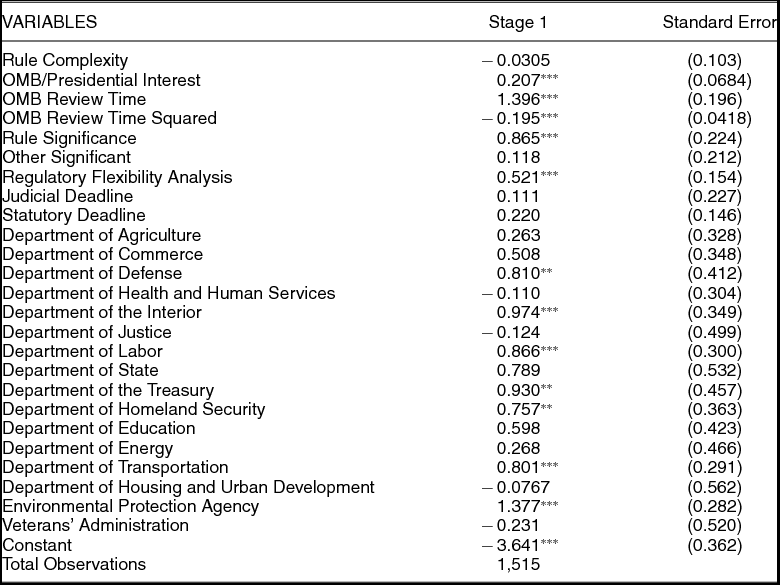
The first-stage results are displayed in Appendix A and are only briefly discussed here. In sum, we find evidence of interest group lobbying during OMB's Final Rule review period. However, only 126 of 1,526 rules (8.3%) were lobbied on.Footnote 16 This rate of lobbying, which is similar to that found by Croley (Reference Croley2003) using data drawn largely from the 1990s, may be evidence that interest groups do not view OMB lobbying as influential, which is what Croley (Reference Croley2003) largely concluded. We believe that it is equally possible, however, that groups strategically choose to lobby OMB on rules when they view this lobbying as more likely to be influential, thereby avoiding the costs of lobbying when it is unlikely to provide benefits. Indeed, the use of a selection model strategy is specifically designed to take this possibility into account.
Selection Strategy: Stage Two Data and Variables
In stage two of the selection model, we predict whether interest group lobbying is associated with policy change during OMB Final Rule review.Footnote 17 Our second-stage dependent variable, Rule Change, compares the text of Draft-Final Rules (submitted by the agency to OMB for review) to the text of Final Rules (published by an agency after OMB review).Footnote 18 We used automated content analysis software, which allowed us to look past minor punctuation, formatting, and reordering changes in the documents. It also enabled us to generate a “percent difference” comparison, ranging from 0% (no difference) to 100% (completely different).Footnote 19 The score captures the addition of new text, as well as, importantly, the removal of text. This measurement strategy is a significant step beyond existing work because OMB's current rule change metric reveals little, equating “minor, perhaps even cosmetic” rule modifications with “substantial” policy changes (Sunstein Reference Sunstein2013, 1847). Additionally, in sensitivity analyses, we took the extra step of validating the results presented later in the article by incorporating a measure of the substantive importance of the policy change occurring during OMB review.Footnote 20
We used two key control variables in this second stage. The first is the previously described OMB/Presidential Interest variable. This measure is critical because it quantifies earlier OMB and presidential interest in a rule, as well as the formal opportunities when the OMB and president could have affected a rule's content earlier in the regulatory process. We also incorporated a variable tapping the average number of OMB Personnel Present at a rule's lobbying meeting(s).Footnote 21 More OMB officials at the meetings may indicate a greater interest on behalf of the OMB and president in the underlying regulation, or it may point to a more complex policy topic. Other control variables for this stage included OMB Review Time, Rule Significance, and Rule Complexity; the last variable is measured in stage two as the length in thousands of words of the published Final Rule.Footnote 22 Additionally, we controlled for Bush Administration, which scores a 1 if President George W. Bush's administration issued the rule and 0 if President Barack Obama's administration issued it. Finally, we controlled for the politics associated with the agency writing the regulation. To do so, we included a variable called Department Preference. This variable scores a 1 for departments that are coded by Clinton and Lewis (Reference Clinton and Lewis2008) as either liberal or conservative, whereas a 0 is recorded for neutral departments.Footnote 23
To this base model, we then added a variety of indicators to assess the article's hypotheses. Our first hypothesis states that more interest group lobbying will lead to more regulatory change during OMB review. To capture the volume of interest group lobbying, we included the Total Number of Interest Groups lobbying OMB during its Final Rule review. Lobbying generally occurs via face-to-face meetings, and OMB officials meet with any concerned individual or interest group that requests a meeting on a rule (Croley Reference Croley2003). Such lobbying allows an interest group to reiterate the points it may have brought up during the rule's public comment period, as well as provides a forum to bring new arguments and data directly to OMB. Thus, this measure quantifies the degree to which the watchful and active lobbying community remains concerned about an agency's rule proposal.Footnote 24
In the second hypothesis, we expect that more experienced and more resourced lobbying entities will be better positioned to signal the ramifications of proposed agency policy changes to OMB officials. We used a variety of constructs to capture this multifaceted notion, but formally present the results for two measures. First, we counted the Number of Lobbying Firms, which we operationalize as those lobbying firms registered under the Lobbying Disclosure Act and that also lobby OMB in our data.Footnote 25 The lobbying firm data were obtained from Open Secrets, which collects data on campaign contributions and outside spending from the Federal Election Commission (FEC), as well as lobbying disclosure data under the Lobbying Disclosure Act.Footnote 26 Lobbying firms are generally more experienced and more resourced than other participant types. Second, we estimated a model that includes the variable Top Candidate Contributor. These data were also obtained from Open Secrets. The variable is a count of the number of campaigns in which an interest group lobbying OMB in our dataset is also listed as the top contributor to either a member of Congress or a candidate for office. We expect that groups that actively lobby in other political settings (in this case, congressional campaigns) and do so at a high level will be more successful in driving regulatory change during OMB review.
Finally, in the third hypothesis, we argue that OMB will be less likely to seek agency changes to proposed regulations when it is subjected to contentious lobbying, which we define as lobbying by groups with opposing regulatory interests. We operationalized this relationship in two distinct ways.Footnote 27 In the first specification, we used an organizational-type strategy—making use of the fact that business groups and public interest groups are often at odds with each other during the agency policy-making process. Specifically, we used the nonprofit Center for Progressive Reform (CPR) database of organizations active in OMB review, which separately categorizes “industry group” and “public interest group.”Footnote 28 From this, we developed a rule-level variable, Lobbying Consensus, which scores a 0 when different types of interest groups lobbied OMB on the rule, and a 1 when all of the groups lobbying were of the same organizational type. To investigate these patterns further, we developed two additional measures: Lobbying Consensus-Industry, which is a count of the number of OMB lobbying meetings when only industry groups were present, and Lobbying Consensus-Public Interest Groups, which is a count of the number of meetings when only public interest groups were present. This differentiation allowed us to pinpoint whether one type of group is disproportionately successful.
The second way in which we operationalized the hypothesis was to use a political approach—making use of the fact that lobbying groups often lean toward the politics attached to one of the two main political parties. Thus, Republican-leaning interest groups tend to desire similar regulatory outcomes, which are often at odds with the regulatory outcomes favored by groups that tend to support the Democratic Party. Thus, here we reconceptualized the rule-level variable, Lobbying Consensus, to score a 0 when groups of different political leanings lobbied OMB on the rule, and a 1 when all of the groups lobbying were of the same political orientation. Specifically, we identified Democratic- and Republican-leaning interest groups using the Open Secrets political campaign contribution data. We labeled a group as Democratic in cases where more than 80% of the group's campaign donations went to Democratic candidates. We coded interest groups as Republican similarly.Footnote 29 We also created Lobbying Consensus-Democrats and Lobbying Consensus-Republicans, which are counts of the number of OMB lobbying meetings where only one type of interest group was present.
RESULTS
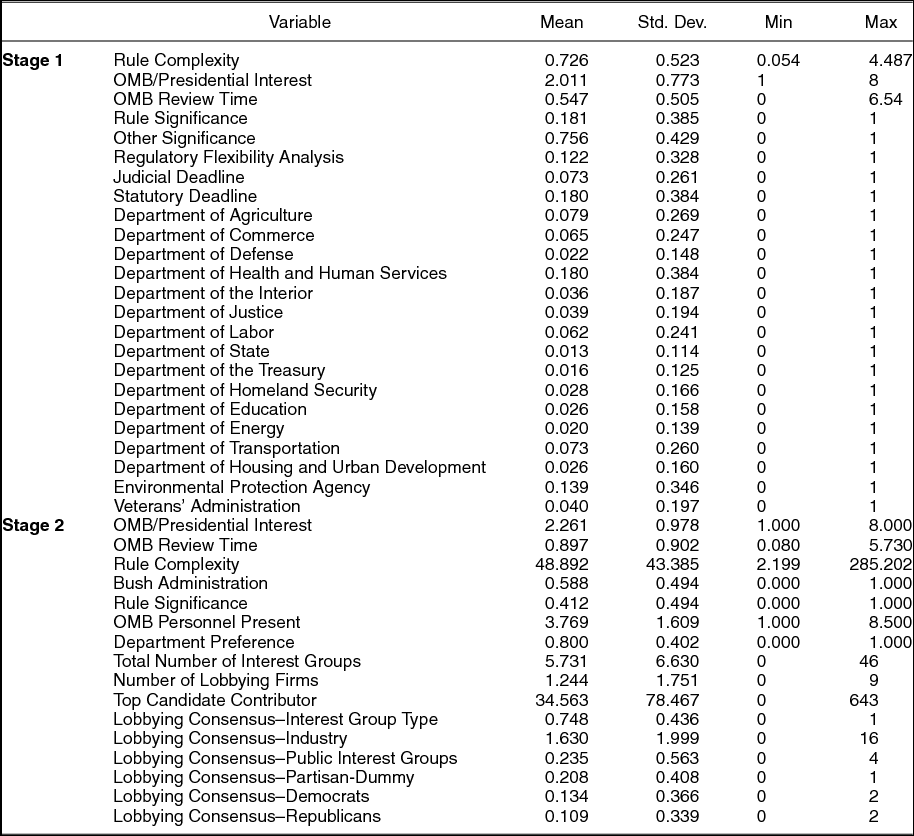
Our second-stage quantitative analyses model the conditions under which interest group lobbying is associated with regulatory changes made during OMB Final Rule review.Footnote 30 The dependent variable, Rule Change, has a mean of 18.4, a median of 11, standard deviation of 20.2, and a range of 1 to 86.Footnote 31 These statistics demonstrate that there is significant variation in the magnitude of rule change, with a number of rules displaying at least moderate changes during OMB Final Rule review. To assess our argument, we used Heckman OLS estimation techniques; however, our results are robust to MLE estimation techniques as well.Footnote 32 It is worth noting here that the standard tests in the Heckman models indicate that selection modeling is not required; however, several of the models near the level of required use for the Heckman and given the strong theoretical rationale for a selection approach, we retain it here.Footnote 33 A full list of descriptive statistics can be found in Appendix B.
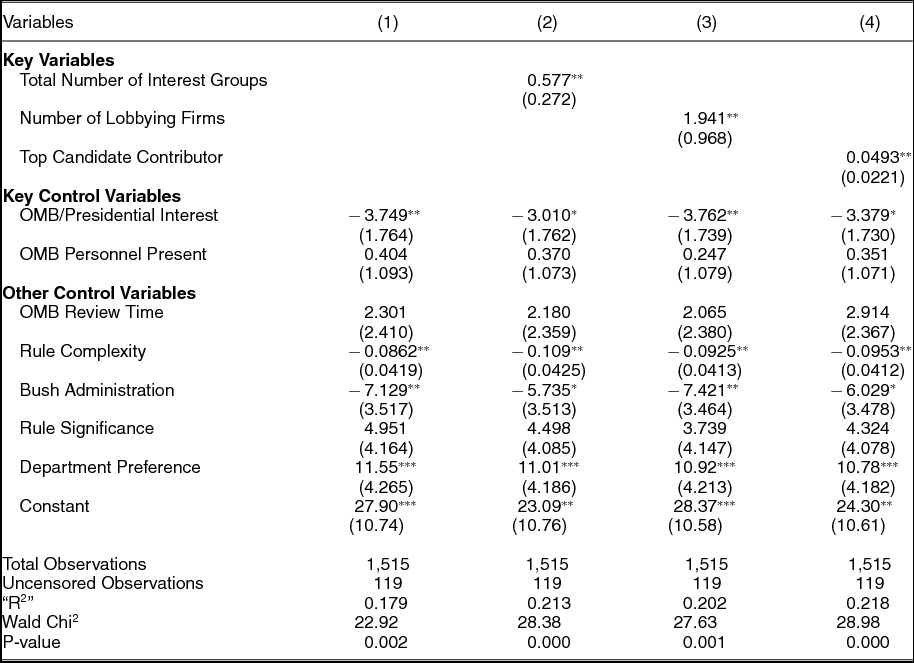
Model 1 provides results for the basic model specification, whereas Model 2 provides traction on whether or not more interest group lobbying is associated with greater regulatory change during OMB Final Rule review. In Model 2, the key variable is Total Number of Interest Groups; the coefficient for this variable is positive and statistically significant.Footnote 34 Substantively, this relationship suggests that, for every additional interest group lobbying OMB during its Final Rule review, we see a 0.6 percentage point increase in Rule Change. This result suggests that when, for example, 20 groups lobby OMB on a rule, it equates with a 12% increase in Rule Change during OMB Final Rule review.We also hypothesized that more experienced and resourced lobbying entities will be better positioned to bring about change during OMB Final Rule review. To assess this, Model 3 focuses on the Number of Lobbying Firms, which provides a count of more highly experienced and resourced lobbyists active during OMB Final Rule review. This variable is positive and significant, suggesting, for instance, that an increase of five firms lobbying OMB leads to a 10 percentage point augmentation in Rule Change. Model 4 focuses on the number of entities lobbying OMB during its Final Rule review that were also a Top Candidate Contributor—meaning that this variable taps the number of groups lobbying OMB on a rule that were also very active political campaign donors. The positive and statistically significant coefficient on Top Candidate Contributor suggests there to be a 16 percentage point increase in Rule Change associated with this predictor variable when set to its midpoint.
Across Table 1, the control variables work largely as expected. Of the two key control measures, OMB/Presidential Interest is consistently significant and meaningful. OMB Personnel Present, however, fails to reach statistical significance in any of the specifications. In all models, the indicator variable for the Bush Administration is negatively signed. Overall, these results thus suggest that rules promulgated under the Bush administration were less likely to change during OMB Final Rule review than under the Obama administration. Finally, the coefficient for Department Preference suggests that rules originating in agencies that are considered by outside observers to be more partisan in their orientation are subject to larger changes during OMB Final Rule review than those promulgated by agencies that are perceived to be less partisan.
Heckman Selection Model Results: More and More Sophisticated Lobbying

Standard errors in parentheses. No standard R2 measure is available for Heckman selection models. Here we used the squared correlation between actual and predicted observations in the estimation. ***p <0.01, **p<0.05, *p≤0.1.
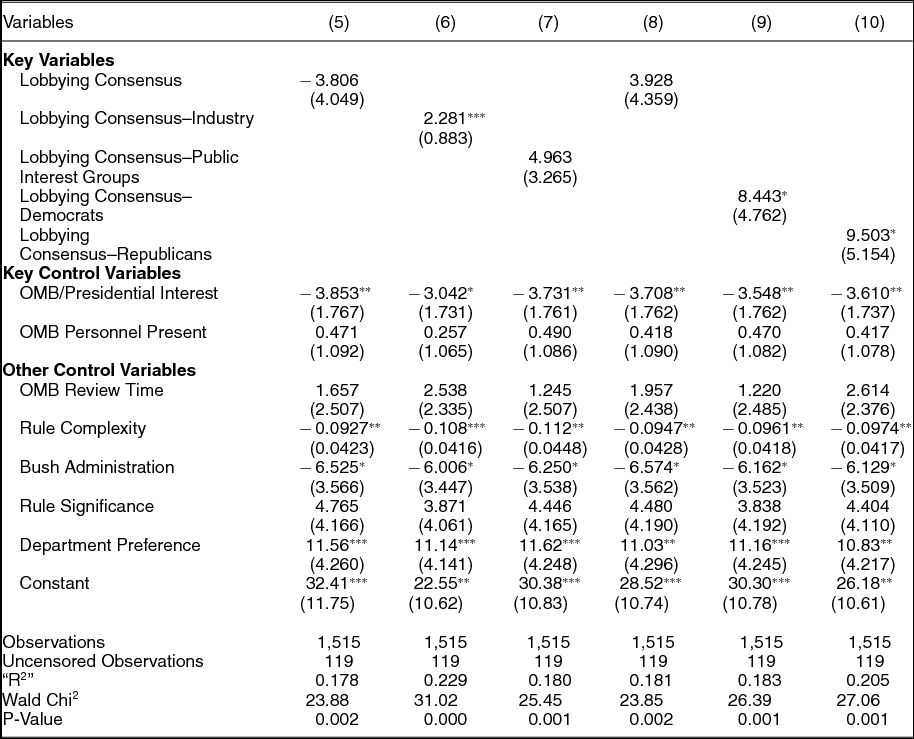
Table 2 presents the results for the third hypothesis. Specifically, we aim to test the argument that OMB will be less likely to seek agency changes to proposed regulations when it is subjected to contentious lobbying. Conversely, more regulatory change is expected in rules where lobbying is more cohesive. Model 5 begins to assess this logic by adding Lobbying Consensus to the base model. Recall that, in this first operationalization, rules that are dominated by industry groups and rules that were dominated by public interest group are combined together. Under this measurement strategy, our expectations are not borne out in the data; the coefficient does not reach statistical significance. Models 6 and 7, however, may begin to answer why this is the case.
Heckman Selection Model Results: Contentious Lobbying

Standard errors in parentheses. No standard R2 measure is available for Heckman selection models. Here we used the squared correlation between actual and predicted observations in the estimation.
***p<0.01, **p<0.05, *p≤0.1.
Model 6 incorporates Lobbying Consensus-Industry into the base model, and the results return a positive and statically significant coefficient. Substantively, the Model 6 results predict that every additional lobbying meeting with only industry groups present yields a 2.3 percentage point increase in Rule Change. Thus, when considered at the Lobbying Consensus-Industry variable's midpoint, there is an associated 18 percentage point rise in regulatory change during OMB Final Rule review. However, the same type of relationship does not materialize in Model 7, which incorporates Lobbying Consensus-Public Interest Groups. When taken together, the Models 6 and 7 results suggest that, when the voices of industry groups are not countered or countered at a lower rate by lobbying from what is traditionally the “the other side” of the issue, then industry group lobbying is statistically and substantively associated with solid agency policy change during OMB Final Rule review. However, the voices of public interest groups do not appear to have the same type of political influential during OMB Final Rule review. The results are analogous when accounting for consensus by using the political leanings of interest groups to measure general preferences. Again, the joint model, Model 8, fails to reach statistical significance. However, when lobbying is one-sided politically, statistically and substantively significant results are obtained (Models 9 and 10, respectively). The results hold across both group types; however, the effect is slightly stronger for Republican-leaning interest groups (Model 10).
CONCLUSION
The U.S. President's use of OMB to review government regulations is among the most important institutional changes within the federal policymaking process in past decades (Croley Reference Croley2003; Kagan Reference Kagan2001; Kerwin and Furlong Reference Kerwin and Furlong2011; West Reference West2005). Surprisingly, although OMB review is regularly debated on normative grounds, often for improperly injecting “politics” into what ought to be the “technocratic” regulatory process, scholars know little about what drives OMB review decision making. Despite the ubiquity of this complaint, there has been little empirical work designed to understand the mechanisms through which, or the extent to which, politics may enter into OMB's review process.
Our theoretical argument suggests that politics can enter into OMB decision making, specifically through interest group lobbying. Our expectation—that interest group lobbying matters, especially when there is unity across groups—focuses on the ability of such lobbying to signal political and technical policy-related information to OMB officials. We hypothesize that more regulatory change during OMB review will occur when there is more interest group lobbying, as well as when the lobbying is overwhelming on one side of the policy issue. We also expect that more experienced lobbying entities will be better positioned to convey the ramifications of proposed agency policy changes to OMB officials.
We assessed these hypotheses in a study of more than 1,500 Final Rules that were reviewed by OMB. We did so by comparing the pre-OMB and post-OMB rule texts using automated content analysis software to identify regulatory shifts, thereby identifying the addition and the removal of text. In the evaluation, we employed a Heckman selection model on data drawn from a wide variety of sources, including from the White House (via OMB), the agencies (via the Unified Agenda), and interest groups (via the Federal Election Commission and the Lobbying Disclosure Act). In so doing, ours is the first quantitative study to investigate the magnitude (and in sensitivity analyses the substantive importance) of policy change during OMB review. The main independent variables tap the volume of interest group lobbying, both overall, as well as for select types of lobbying entities. We find that more interest group lobbying is associated with more regulatory change. We also demonstrate that, when only industry groups lobby, we are more likely to see rule change; however, the same is not true for public interest groups. Similarly, when lobbying is tilted toward either Republican- or Democratic-leaning groups, more policy change occurs.
These results hold several important implications for our understanding of executive power and of interest group politics more generally. For instance, political scientists often list OMB review as one of the president's key tools for controlling the bureaucracy. Yet, until now, the policy impact, if any, of this tool was largely unknown and untested. We know now that noteworthy and important policy change frequently occurs during OMB's Final Rule review. This conclusion is valuable because it begins to answer Rudalevige's (Reference Rudalevige2009, 10, emphasis original) question: “How do presidents seek to control the bureaucracy?” In fact, Rudalevige (Reference Rudalevige2009) specifically calls for large-scale quantitative research on the impact of OMB review as a means to better understand the connections between the administrative presidency and bureaucratic control.
Moreover, the conclusion that substantively important policy change can occur during OMB review is all the more significant when combined with West's (Reference West2005, Reference West2006) conclusion that OMB officials act as the president's representatives during the rule review process. Scholars, including Nathan (Reference Nathan1983), Kagan (Reference Kagan2001), and Rudalevige (Reference Rudalevige2005), have long argued that appreciating the president's deployment of administrative tools is critical to our understanding of the power of the modern presidency, with Moe (Reference Moe, Chubb and Peterson1985) famously theorizing that presidents often pursue a dual strategy of politicizing the bureaucracy and centralizing decision making (see also Cooper and West Reference Cooper and West1988). Yet, as Lewis's (Reference Lewis2009) work implies, it is incumbent on scholars to revisit and to reassess the assumptions common to the administrative presidency literature. Lewis (Reference Lewis2008, Reference Lewis2009) begins to do so in his excellent research on the politicization of presidential appointments; yet, before this article, too little corresponding work has assessed the efficacy of the president's main centralizing tool. This study provides new insights and understandings into what West (Reference West2006, 434) calls “the furthest extension to date of centralized executive influence over administrative policymaking”: OMB review.
Among these insights is that existing research too often neglects the extent to which presidential control strategies may contain points of entry for other types of political and policy considerations, including attention to interest group lobbying signals. Importantly, this article's conclusions hold true for rules reviewed both during George W. Bush's and Barack Obama's presidencies, suggesting, among other conclusions, that business interests may hold influence across both Republican and Democratic administrators. The results also imply that consensus in the lobbying messaging sent to OMB may be an important driver of interest group influence, especially when only business interests are lobbying. As such, our theory and findings build on those of Yackee and Yackee (Reference Yackee and Yackee2006), who suggest a “bias towards business” during the notice and comment rulemaking period. More broadly, this article suggests that presidents and the OMB use interest group lobbying as a signaling mechanism, which, depending on the consensus or contentiousness present within that signal, may provide the president an opportunity to provide policy benefits or concessions to actively engaged organized interests.
We hasten to say, however, that we are agnostic as to the normative implications of possible interest group influence during OMB review. After all, on the one hand, the process is open to all those who desire to participate and thus is “accessible,” in the same way in which the notice and comment rulemaking process is also accessible to all types of interests. Moreover, our findings imply that OMB officials often respond to the number of active interest group participants, as well as, in some cases, the consensus across those messages. Given this, the results may imply a common representation model of governance, in which the “squeaky wheel gets the grease.” But, on the other hand, there may be such a high level of specialized knowledge necessary to participate effectively that many interests are essentially unable to do so or are unable to marshal the resources necessary to do so. This suggests a model that is further way from standard treatments of democratic voice and closer to suggesting the importance of privilege and resources to getting one's voice heard—and acted on—in politics. Teasing out these theoretical implications will be an important next step for the literature because, as detailed earlier, there has been rampant, normative argumentation since the 1980s surrounding the role of interest group influence during OMB review (DeMuth and Ginsburg Reference DeMuth and Ginsburg1986). Furthermore, such speculation has been particularly attuned to the role that business influence may play during the rule review process (West Reference West2005). In fact, as Sunstein (Reference Sunstein2013, 1860) summarizes, observers frequently conclude that OMB review is compromised by lobbying, leading some to suggest either “a form of interest group ‘capture,’ or at least capitulation.” Given that this supposition has survived now for more than 30 years, it is all the more important for generalizable research—such as the work here, as well as future extensions—to move the public discourse forward.
In close, our investigations suggest a statistically and substantively meaningful association between interest group lobbying and regulatory policy change during OMB Final Rule review. That said, like most quantitative analysis strategies in political science, ours relies on observational data, and thus we demonstrate an association, which may or may not be causal. Additional work is necessary. However, our confidence in the suggestive nature of the results is increased both by the fact that they emerge from models that statistically control for the other likely drivers of policy change during OMB Review, such as rule significance and complexity, and by our research design choice to focus on a late stage in the rulemaking process (i.e., OMB Final Rule review). Given the importance of OMB review to American politics and policy making, as well a general lack of even observational data analysis on OMB review before this article, these findings push knowledge forward. It is our hope that additional work will follow, focusing on such critical questions as the regulatory or deregulatory direction of rule changes occurring during OMB review and further fleshing out interest group lobbying motivations during regulatory review. After all, in the modern administrative state, it is well known that critical policy decisions occur during the designing of legally binding government regulation and that interest group lobbying is commonplace (Golden Reference Golden1998; West Reference West2004; Yackee Reference Yackee2006). What has not been well known or appreciated is how these things may come together within the president's OMB review process.
HECKMAN SELECTION MODEL: FIRST STAGE RESULTS

DESCRIPTION OF COVARIATES





Comments
No Comments have been published for this article.