Most scholars agree China is a rising power, but there is less consensus about the consequences of its rise, especially on how its increasing power will affect the American-led institutional order.Footnote 1 For some, a significant revisionist challenge to liberal institutions is inevitable.Footnote 2 Already Beijing has pressured security institutions in the Asia-Pacific, contested territorial norms in the South China Seas, and established new economic institutions, such as the Asian Infrastructure Investment Bank (AIIB). Others argue the future of the institutional order is not so grim. Over the last two decades, China has integrated into international institutions. As a result, while the state may seek minor revisions to the status quo, it will ultimately work to strengthen, not overturn, the liberal international order.Footnote 3
At the core of this debate lies a significant theoretical question: under what conditions do revisionist states challenge the institutional order? What, in essence, drives the intensity of revisionist behavior in world politics? Historically, states have varied wildly in their revisionist ambitions. While some states attempt to revise institutions through negotiation, others choose to exit them altogether, building an alternative system in its place.Footnote 4 At the extreme, revisionists seek to destroy existing institutions through hegemonic war.Footnote 5 Most of the existing literature suggests intentions drive revisionist strategies—that whether a revisionist accepts or challenges the institutional order depends on whether it holds limited or revolutionary aims. But ultimately, a revisionist's strategy cannot be reduced to interests. To challenge the institutional order, a state also must be able to mobilize significant material and ideological resources in pursuit of its aims. Ironically, access to these resources depends on the very institutional system a revisionist hopes to overturn.
A state's position in the existing institutional order shapes its revisionist strategies. Like institutionalist explanations, my argument suggests that the international order profoundly shapes revisionist behavior. But institutions do not merely restrain revisionists, forcing them to conform to the status quo. By providing resources and opportunities, institutions also enable challenges to the international order, affecting not only whether but how it is a revisionist will attempt to transform the existing institutional order. To explain how institutions drive revisionist behavior, I adopt a relational-network approach to states and the international order. I conceive of the “institutional order” as a network structure—as patterns of social and cultural transactions among states. Revisionists build these networks strategically, seeking power and influence through their ties with other states. Over time, however, states find themselves in complex network positions that then exert significant effects on revisionist strategies. Network positions alter the costs and benefits of revisionist strategies, making certain forms of revisionism more attractive than others. They modify the possible pathways of revisionism, creating opportunity structures that enable and constrain certain types of revisionist behavior. Network positions can even change preferences for revisionism. In these cases, revisionist preferences become endogenous to network position, and inseparable from structural effects.
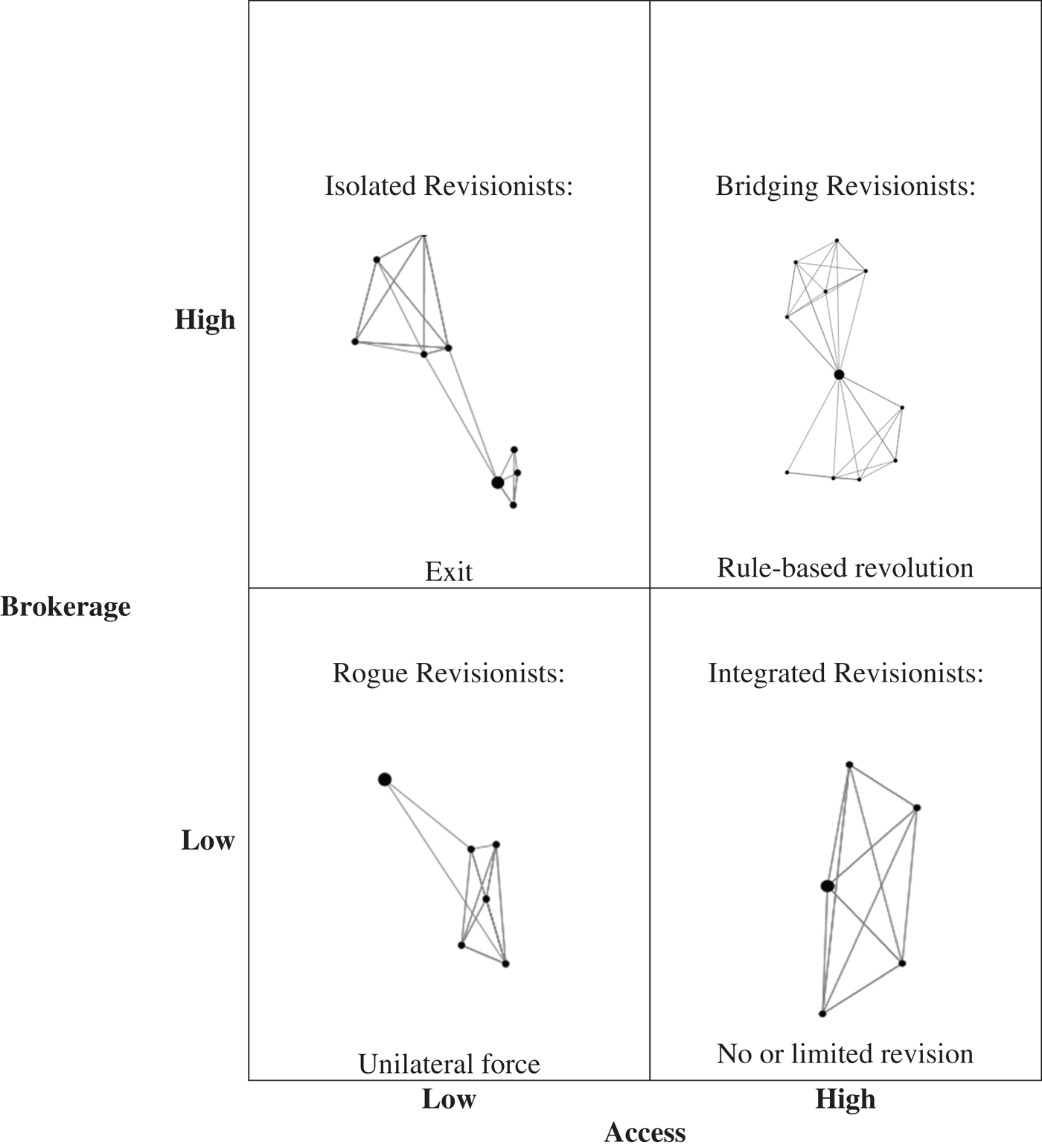
Two forms of network position—access and brokerage—are particularly significant. Access—the extent to which a state is embedded in institutional networks—gives revisionists power to demand internal institutional change. Brokerage—whether states bridge different networks—gives revisionists military, economic, and social power outside of existing institutional networks. Combining these two metrics produces four ideal types of revisionism. Integrated revisionists, those with high access and low brokerage, will engage in institutional engagement: deeply integrated in the existing order, revisionist strategies become costly, even illegitimate, and thus unattractive to the state. Bridging revisionists have high access and high brokerage. With the ability to mobilize resources both within and outside the existing institutional order, these revisionists will attempt rule-based revolution, seeking radical change within the existing institutional order. Isolated revisionists, with high brokerage and low access, are likely to turn to exit. Without the resources to pursue their demands within the institutional order, they will attempt to establish an exclusive sphere of influence. Finally, rogue revisionists have low access and low brokerage. Lacking any form of power, these actors will turn to hegemonic violence to upend the international order.
What's Your Type? Reform, Revolution, and the International Institutional Order
Revisionists are states that seek to challenge, in whole or in part, the international institutional order—the “settled rules and arrangements between states that define and guide their interaction.”Footnote 6 These orders are created by and privilege the powerful. They are, as Rapkin and Thompson write, established by “states at the top of the system's hierarchy” who “take advantage of their elite status and establish rules, institutions and privileges that primarily benefit themselves.”Footnote 7 For that reason, they become vulnerable to revisionist efforts, especially as new powers rise and the old fall. Whereas the “status quo” powers at the top of the system will strive to preserve institutions, revisionists, dissatisfied with their subordinate position, hope to “redraft the rules by which relations among nations work.”Footnote 8
While all states harbor some revisionist goals, not all revisionists are created equal. Most scholars argue that there are two types of revisionist states: “limited-aims revisionists and unlimited-aims revisionists or revolutionary powers.”Footnote 9 Limited-aims revisionists are dissatisfied with their position but hope to alter institutions in ways that preserve the foundations of the existing order. They may seek adjustments to territorial boundaries, but still abide by the rules and norms that govern sovereignty and regulate conquest. They may demand more resources, but ask for redistribution within the confines of economic institutions. They may seek recognition of their growing prestige, but accept the legitimacy of an existing status hierarchy. Revolutionary revisionists, by contrast, challenge not the distribution of power or goods within the system, “but the system itself.”Footnote 10 There is no within-system change acceptable to revolutionaries. For these revisionists to be satisfied, the institutional order itself must be transformed. At the extreme, revolutionary revisionists will destroy an existing system even at the cost of hegemonic war.
This distinction between “limited” and “revolutionary” revisionists implies a stark dichotomy, a world where states either accept existing institutions or reject them violently. But the historical record reveals revisionist behavior is far more variegated than conventional approaches suggest. Certainly some revolutionaries—Napoleonic France or Hitler's Germany—engage in hegemonic revisionism, aiming to destroy existing international institutions and put new ones in their place. But some revolutionary states seek to transform institutions from within the order, through what we might call rule-based revolution. States such as Prussia in the mid-nineteenth century and the United States after World War II sought far-reaching ends, yet relied on existing institutional pathways to achieve their revolutionary aims. Still other revisionists turn to institutional exit. Both the United States of the early nineteenth century and the Soviet Union of the twentieth century sought significant changes in the institutional order. Rather than challenge institutions, these states crafted alternative systems to govern their spheres of influence.
Also questionable is the proposition that variation in revisionism is caused largely, if not entirely, by processes internal to the state itself. For example, some argue that regime type drives hegemonic violence.Footnote 11 Others argue that revolutionary ideologies, or elite belief systems, determine the choice of revolutionary strategies.Footnote 12 Still others suggest the intensity of revisionism stems from dissatisfaction with the current order: revolutionary states are those most displeased with the material or normative structure.Footnote 13 In each of these cases, a direct causal line is drawn between preferences and revisionist strategies. But reducing revisionism to preferences is problematic. Empirically there is often a chasm between a revisionist state's aims and its behavior. In the 1930s Japan arguably harbored limited territorial demands—the domination of Manchuria—yet before the decade was out the state initiated a catastrophic war in pursuit of its aims. Likewise, 1860s Prussia held conservative preferences, yet its revisionism would revolutionize European politics. In contrast, both the United States and Soviet Union were revolutionary, with both envisioning an international order fundamentally at odds with the status quo. Yet neither used hegemonic force to achieve these ends.
This disjuncture between preferences and revisionist behavior should not be surprising. Revisionism, like any form of action, is not reducible to aims; strategies also depend on the degree to which that state can mobilize military, economic, and social capital in pursuit of revisionist ends. Opportunities and constraints for mobilization are shaped, in part, by the existing institutional order, and thus variation in a revisionist's resources and constraints depends on the very institutional system it hopes to overturn.
Institutions and Revisionism: A Relational-Network Approach
I argue that a revisionist's institutional position affects their revisionist type, influencing a state's choice for exit, rule-based revolution, hegemonic violence, or institutional engagement. Institutional position is not the only cause of revisionist behavior: certainly states have preferences that develop exogenously to institutional orders, such as interests in expansion that stem from domestic politics, history, geopolitical position, and so forth. But institutional orders have powerful, independent effects on revisionism. They shift the costs and benefits of revisionist behavior, making some types of revisionism more attractive than others. They alter the opportunities and constraints revisionists face in pursuit of their aims. Under some conditions, institutional position can even transform a state's interests and identity.
To explain how institutional position affects revisionism, I draw from relational-network approaches to actors and institutions.Footnote 14 We can conceive of the institutional order as a network structure, made up of “ties” among states, the “continuing series of transactions to which participants attach shared understandings, memories, forecasts, rights, and obligations.”Footnote 15 These ties have both form and content: they include “real” material transactions, such as alliances and trade transactions, as well as ideational relations, such as narratives and repertoires that define appropriate behavior, legitimate authority, and give meaning to behavior in world politics.Footnote 16 Patterns of transactions—those that persist among actors over time—can be conceptualized as network structures, which Hafner Burton, Montgomery, and Kahler define as “emergent properties of persistent patterns of relations among agents [states] that can define, enable, and constrain those agents.”Footnote 17
Within the international system, there is often one dominant institutional order, the network structure containing the most great powers in the international system. Many of these institutional ties are built in the wake of major conflict “to reconstruct the system on lines that would enable them, or so they believed, to avoid a further war.”Footnote 18 These relations become institutionalized in alliances, legal economic agreements, and official diplomatic relations. While there may be one dominant order in the international system, network structures are not homogenous. Alongside this dominant network structure are subgroups composed of networks representing regional alliances, local economic agreements, or socio-cultural ties that cross state boundaries.Footnote 19
Networks provide states with power and influence within the institutional order. They affect how revisionists mobilize alliances; they augment or constrain the economic resources revisionists can muster to support their revisionist aims; and they provide or deny revisionists the cultural resources to justify the transformation of the institutional order. Not surprisingly, then, states invest in relations that maximize their strategic interests; revisionist states especially desire ties that increase their power and influence relative to status quo states. They may seek alliances with other powers or attempt to wedge apart existing alliances. They may pursue economic ties that maximize wealth, and diplomatic relations that strengthen their spheres of influence.
While states have some control over their relations, they face significant limits on their power to determine their network positions. Most obviously, the construction of ties is always a two-way street: states may seek ties, but find their efforts to build relationships rebuffed. To make matters more complicated, states rarely build ties on virgin ground. Network ties, once formed, are sticky. Even when new ties are created, they “do not replace the old but are layered atop prior patterns.”Footnote 20 Where and how revisionists build ties thus will be highly path dependent. And while revisionists can control ties at the micro-level, they cannot determine or even anticipate the systemic evolution of their network position. States often seek ties in response to local strategic concerns: they pursue trade agreements to optimize regional trade or forge bilateral alliances to mitigate security fears. A state's network position, by contrast, represents the entirety of its ties. While ties might reflect preferences in one specific domain, at the systemic level these networks are “sometimes in competition, sometimes in symbiosis, sometimes in contradiction.”Footnote 21 At the systemic level network positions rarely, if ever, reflect a coherent set of preferences.
Once a revisionist's network position is established, it produces powerful feedback effects, operating through mechanisms that drive or dampen revisionist behavior in world politics. First, network positions can alter the costs and benefits of revisionist strategies, making certain forms of revisionism more attractive than others. Second, network positions modify the possible pathways of revisionism, creating opportunity structures that enable certain types of revisionist behavior and constrain others.Footnote 22 Finally, network positions can change a state's preferences for revisionism itself. In such cases, revisionist preferences become endogenous to network position, inseparable from structural effects.
Because networks have feedback effects, variation in network position should have a profound influence on revisionism in world politics. Drawing from Hafner-Burton, Kahler, and Montgomery I suggest that two types of network position are critical in shaping revisionism in world politics: “access” positions and “brokerage” positions.
Access
By “access” I mean the extent to which a revisionist is integrated into the dominant network, measured by the density and frequency of its institutionalized relations.Footnote 23 For example, states with strong ties to most of the great powers in the institutional order have high access to the dominant institutional system. Those with fewer ties to these great powers are marginal. Access is important because it gives a state institutional power. With access, a state can leverage material and ideational ties to give it influence within the existing institutional system. Dense ties, for example, may allow states to mobilize alliances during a conflict. Access increases social capital—the cultural resources that give states authority to make legitimate demands, to “set agendas, frame debates,” and define the rules of the game in the international system.Footnote 24 Access confers unique coercive power as well. As Hafner-Burton and Montgomery argue, actors with high levels of access can “withhold social benefits such as membership and recognition or enact social sanctions such as marginalization as a method of coercion.”Footnote 25
It seems likely that revisionists would seek to increase their access to an institutional order: with access, revisionists could use institutional power to pursue their expansionist aims, drawing from resources within the system to further their interests. But revisionists cannot build access at will. States cannot control the creation of ties. Great powers might deny revisionists access to institutionalized networks: they can refuse to sign trade agreements, withhold diplomatic recognition, and in general force states to the sidelines of the international order. A revisionist's access is also path dependent, depending as much on historical relations as present ones. Even cultural networks can shape a state's access in unanticipated ways. Scholars argue, for example, that both Japan and Turkey were denied access to dominant institutions because of their “non-Western” status.Footnote 26
Once a revisionist has access to institutions, this position has significant feedback effects on revisionist type. To begin with, access changes the costs and benefits of revisionist behavior. As institutionalists have argued, access may provide influence, but over time it can make revisionist behavior costly. Revisionists with access are likely to reap significant benefits from the existing international order. Challenging the system thus carries serious costs.Footnote 27 This suggests that even states harboring expansionist aims may come to believe the revisionist game is not worth the candle. It is unlikely, for example, that China has changed its preferences about unification with Taiwan, but access to economic institutions has made aggressive approaches far more costly, and far less likely. Second, access transforms a revisionist's opportunity structure, enabling certain types of revisionist behavior and constraining others. Most notably, states with high access are likely to face binding effects. When revisionists participate in institutions, they orient their own security, economic, and normative systems toward the institutional order. While this augments institutional power, it also binds revisionists to those institutions, limiting a revisionist's capacity to mobilize against that order in the future.Footnote 28
By altering the costs and benefits and restructuring pathways for action, access shapes revisionism: a state's revisionist preferences are exogenously given, but its choice of strategies is shaped by institutional position. Access can also change these preferences themselves. Over time, states with access are more likely to be socialized into the existing institutional order. At first, a revisionist might adopt the norms of an order strategically, to sate other powers in the system. Eventually these practices can become internalized, as leaders change their beliefs about what constitutes appropriate and legitimate behavior in world politics.Footnote 29 The greater the access a revisionist has, the more likely revisionists will view other members of that network as part of its own community. Under these conditions, revolutionary revisionism becomes less likely as revisionists come to believe maintaining the status quo is integral to their own sense of identity.
In sum, access affects revisionism either by influencing the choice for strategy or by transforming the very preferences of the revisionist state. The argument here parallels the broader institutional literature, which argues that states integrated into institutions are less likely to engage in revisionist behavior. But “access” is not synonymous with constraint. Access accords revisionists significant power within the institutional order: they will be able to call on alliances, mobilize economic resources, and use their institutional authority to achieve expansionist aims. Access does not eliminate revisionist challenges, then, but it does channel them within the institutional order.
Brokerage
Revisionists can occupy brokerage positions in institutional orders. In a brokerage position, a revisionist bridges structural holes in institutional networks, acting as an exclusive conduit between subgroups in the international system. For example, a broker might have ties with great powers in the dominant institutional order, but also hold exclusive ties with another cohesive subgroup in the international system.Footnote 30
Brokerage positions are significant sources of entrepreneurial power. By giving revisionists resources outside of the institutional order, they provide material and cultural resources that can be mobilized in pursuit of change.Footnote 31 If alliances are hard to come by in the existing institutional order, brokers can mobilize new allies from outside dominant institutions. If they face sanctions from status quo actors, they can offset costs through closer economic ties with other states. Armed with diverse sources of ideational power, brokers have the ability to introduce novel repertoires of institutional order, proposing new rules and norms that challenge ideological foundations of the international system.
For all of these reasons brokerage positions play a significant role in system transformation. It seems likely then that revisionists will seek brokerage positions when they harbor revolutionary aims. But as with access, revisionists cannot build a brokerage position at will. Brokerage positions may be even more difficult to acquire than access because their acquisition requires ensuring exclusive ties with multiple groups in the system. Attempts to build brokerage positions are likely to be met with intense competition from other great powers. For example, in the nineteenth century both Prussia and Austria invested in ties with the German states; it was in part a matter of luck that Prussia ended up with exclusive economic ties and a potent bridging position between the Concert of Europe order and German nationalists. The ability to create exclusive ties outside of the dominant order is often contingent on factors outside of the revisionist's control. Geography for example, can determine brokerage: actors proximate to a regional subgroup are more likely to build bridging positions than others. Brokerage positions can also emerge as historical accidents: as alliances break apart, or as trade agreements falter, states can find themselves in a brokerage position not of their choosing.
But once a state occupies a brokerage position, its structural effects are significant. Brokerage positions decrease the cost of acting outside the system. This means that even revisionists with “limited” aims will be tempted to pursue strategies that circumvent or challenge the existing institutional order. For example, territorial expansion condemned within the dominant network might bring accolades from excluded states. Under these conditions, even conservative revisionists might be tempted to reap the benefits of expansionist strategies. Likewise brokerage can create opportunity structures that push states toward revolutionary strategies. Armed with entrepreneurial power, states with limited aims are tempted to mobilize new alliances, muster economic relations, or challenge established norms in pursuit of their strategic aims. Finally brokerage can change preferences through what scholars refer to as “role strain.”Footnote 32 When states become embedded in multiple networks, this produces cross pressures on their interests, even their identities. As states strive to decrease role strain, they may significantly redefine their preferences for revisionist strategies in the process.
By altering the costs and benefits of revisionism, restructuring pathways for action, and changing the preferences of states, access and brokerage shape revisionism. Combining these two positions of access and brokerage creates four “types” of revisionists and strategies: integrated revisionists, who pursue institutional engagement; bridging revisionists, who will be drawn toward rule-based revolution; isolated revisionists, who seek exit from the order; and rogue revisionists, who are most likely to engage in hegemonic revisionism. In each of these four quadrants, revisionists face particular configurations of resources and constraints, producing unique feedback mechanisms that drive variation in revisionism.
Integrated revisionists
In the bottom-right quadrant of Figure 1 are integrated revisionists—states with high access and low brokerage. Under these conditions, the mechanisms of access dominate. To begin with, integrated revisionists face a world where their attempts to challenge the status quo will be costly. Dependent upon existing institutions, integrated revisionists are extremely vulnerable to military, economic, and social sanctions by status quo states. They are also effectively “bound” to institutions. Their own power is connected to the existing institutional order. Without alternative military resources, for example, these revisionists are unlikely to find alliances to support claims. If these revisionists’ only possible alliance partners are also committed to the international order, they are unlikely to be mobilized to overturn it. Finally, because they are embedded within the existing order, they are more likely to be socialized. Lacking alternative cultural resources, integrated revisionists find it difficult to challenge the legitimacy of existing institutions, or appeal to counternarratives that might justify a change in the institutional order. At the extreme, integrated revisionists come to identify with the status quo, unable to imagine a world beyond the boundaries of existing norms and rules of the system.
Four worlds of revisionism

It is in this quadrant that we find states acting like institutionalists suggest. Once integrated into institutions, even revisionists with revolutionary preferences will learn that such efforts are costly, impossible, and illegitimate. This is not to say, however, that any revision is impossible. Because integrated revisionists hold substantial institutional power, they have both the social resources and the authority to use “institutional engagement,” relying on existing institutional resources to affect change. Integrated revisionists are constrained, but so too are their status quo counterparts who rely on the satisfaction of their peers for their own wealth and security. Status quo states are likely to see the revisionist's satisfaction as essential to the continuity of the system. Moreover, because states in the network share a commitment to similar standards of legitimacy, status quo states are likely to listen to the revisionist's claims, provided they seem consistent with existing norms and rules. For this reason, while an integrated revisionist is unlikely to overturn the system, it is able to gain small concessions, either through negotiation or even a limited use of force.
Bridging revisionists
In the top-right-hand quadrant are “bridging revisionists,” actors with high access and high brokerage. These states are deeply embedded in existing institutional networks, yet have strong and exclusive relations with network subgroups. Bridging revisionists will be pulled toward strategies of rule-based revolution—seeking substantial transformation within the dominant order. Like their integrated counterparts, they have institutional power. They can draw from existing social relations, such as alliances or trade networks, in pursuit of their aims. Their position gives them social capital to legitimate their challenges within the existing institutional order. Yet unlike integrated revisionists, these states have entrepreneurial power as well. Their ties outside of the institutional order give these revisionists access to new allies, alternative economic ties, and diverse cultural resources, all of which the revisionist can mobilize in support of its revisionist goals.
It is this ability to mobilize across institutional boundaries that moves bridging revisionists toward rule-based revolution. It is not simply that bridging positions give already-revolutionary revisionists the freedom to pursue expansive aims. Bridging structural holes has significant feedback effects that can push even conservative states toward a revolutionary agenda. Bridging positions lower the costs, and may even increase the benefits, of challenging the institutional order. Bridging positions open up new opportunities for mobilization outside of the system. Efforts to bind a bridging revisionist will prove difficult because these states can mobilize alternative networks to slip the leash of existing institutions.Footnote 33 The possibility of exit gives these revisionists coercive bargaining power since the defection of an integrated member would undercut the stability of the existing system. Over time a bridging revisionist's position between multiple groups will produce role strain and competing pressures on a state's identity. To ease these cross-pressures, bridging revisionists will seek to transform existing institutions in ways that better accommodate their multiple networks. For all of these reasons, bridging positions pull states toward “rule-based revolution,” even if their preferences seem limited in scope.
Isolated revisionists
In the upper-left quadrant, we find isolated revisionists—states with low access and high brokerage. These revisionists have less institutional power than other powers in the network. Because they sit on the sidelines of existing networks, these states are likely to find their attempts to negotiate in pursuit of revisionist aims ignored. Efforts to wedge apart the status quo states are likely to backfire. However, isolated revisionists have entrepreneurial power and can mobilize resources for revision outside of the existing institutional order. With only sparse ties to an existing framework, these revisionists are not “bound” to existing institutional resources: neither their economic nor political security depends upon continued cooperation with the status quo powers. Isolated revisionists are not subject to mechanisms of socialization: their identities and legitimacy depend little on maintaining their position within an institutional order.
Because these states have strong, exclusive ties with other actors in the international system, their position pushes them toward an exit strategy. Isolated revisionists come to recognize that the costs of extra-systemic behavior are low because their position provides them with alternative cultural and material resources to shore up their revisionist agenda. Exit strategies are attractive because they offer a pathway to revision that can avert major-power war. Exit strategies also satisfy a state's search for status: denied institutional authority within the dominant system, these revisionists can claim more prestige if they work within a new, exclusive domain. For all of these reasons, these revisionists are likely to avoid challenging the status quo powers on their own turf, instead choosing to exit to their own exclusive sphere.
Rogue revisionists
In the lower-left-hand quadrant, revisionists occupy positions with low access and low brokerage. These “rogue” revisionists are marginal within the dominant group of status quo great powers, and have few ties with other subgroups; they thus have very little institutional or entrepreneurial power. With so few resources, these revisionists will find their efforts to pursue their aims—even limited ones—within the institutional order undermined at every turn. Attempts to mobilize military alliances or deploy economic levers within an existing institution will provoke swift and effective countermobilization. If a revisionist appeals to the dominant institutional ideology to justify revision, its claims are likely to fall on deaf ears. Because these states are tied to the dominant network of states, they are likely to perceive themselves as part of a closed “status group” of existing great powers yet their marginal position means that they will be denied the same prestige as the other powers in the system.Footnote 34 Deprived of material and cultural resources, rogue revisionists cannot negotiate limited expansion within the institutional order. Their lack of alternative resources means that there is no route for transformation or exit.
All of this means that achieving even limited revisionist aims requires extraordinary efforts. Denied institutional resources, rogue revisionists turn inward, attempting to mobilize their own domestic resources in pursuit of their aims. Rogue revisionists are more likely than other states to engage in expansive military spending and arms racing, increasing pressures for offensive action in pursuit of their aims. Without stable economic ties, rogue revisionists will seek autarky, even if these efforts require imperial conquest. Unable to legitimate revisionism to an international audience, they will turn to the home front, using hypernationalist rhetoric to mobilize their populations at home, even rejecting the international order as incompatible with domestic demands.Footnote 35 All of these efforts pull rogue revisionists toward more aggressive, expansionist behavior. With their military power mobilized, economic pressures increasing, and domestic populations galvanized, rogue revisionists are likely to press their claims with the only resource left at their disposal: hegemonic force.
Testing the Theory: The Four Worlds of Revisionist Strategies
What I define as revisionist “type” is thus situational as well as dispositional, as much a matter of network position as it is of preferences and agency. None of this is to say that preferences do not matter. Structure is not destiny; it does not force states to adopt particular expansionist goals. But all else being equal, different configurations of access and brokerage should create different types of revisionism. Because network position changes the costs and benefits of revisionism, shapes opportunities and constraints, and even changes preferences, it should be a powerful input into revisionism in international politics.
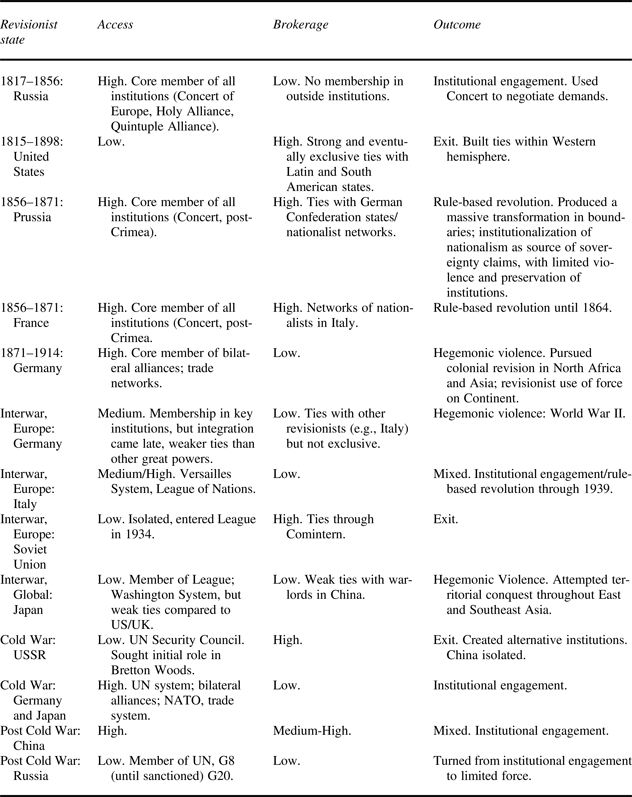
Table 1 outlines the universe of revisionist states in the international system from 1815 to the present day. Relying on secondary historical literature, I coded revisionists, their position, and their strategies.Footnote 36 This overview suggests the relational-network theory here is plausible. Most of the cases fit the theory's expectations, with revisionist strategies correlating with a state's network position. But network analysis should be not just descriptive and correlational, but causal, demonstrating that network position has unique and significant causal effects on revisionism. To test the network theory, I selected four historical cases of revisionism from this set of cases: Russia in the early nineteenth century, Prussia in the mid-nineteenth century, Japan in the 1930s, and the Soviet Union in the late 1940s. I chose the cases for their historical significance and scope. If the theory sheds light on significant cases, at different times and places over a period of two centuries, then this should build confidence in the utility of a network approach.
Great power revisionists, 1815–2015

Each of the cases defines the revisionist's network position, the origins of that network position, and how that position shaped revisionism in ways irreducible to state interests. I use both qualitative and quantitative measures to identify network position. Quantitative data come from the Alliance Treaty Data Obligations and Provisions (ATOP) data set.Footnote 37 Using ATOP is useful: all of the institutional orders under investigation, from the Concert to the American post-World War II order, contained an alliance component. But there are also serious limitations to using ATOP data to map institutional orders. The data do not capture economic and diplomatic relations, ties that might create a different picture of network structures. Moreover, the data model material structures, not the ideational content of the systems. ATOP data provide a first cut at networks, not the last word. The causal analysis relies primarily on the existing historiography to map economic and diplomatic ties, as well as ideational content.
The case studies seek to demonstrate how network position shapes revisionism. As I argued earlier, while revisionists often seek to build ties strategically, they are unable to fully predict or control their own network position. For that reason, each case demonstrates that, for whatever reason actors initially built their ties, over time their access and brokerage reconstructed revisionist strategies and aims. If network position has feedback effects, then the cases should show not just a static relationship between agency and structure but moments when structure changes the strategies and preferences of the revisionist state.
The Curious Case of the Restrained Revisionist: Russia and the Concert
In the early nineteenth century Russia held revisionist aims, looking to expand into Ottoman territory. In 1821, the Greek revolt against Ottoman rule provided Russia with a significant opportunity to dominate the Near East. As the sultan struggled to maintain control over the Greek Christians, his troops occupied principalities and shut down shipping in areas vital to Russian interests. Military action against the Porte, Tsar Alexander's advisers argued, was necessary, even if a “Russo-Turkish war would destroy the Ottoman Empire in Europe.”Footnote 38 As the revolt intensified, Greek elites were executed, thousands were slaughtered, and Easter Sunday found the Greek patriarch of Constantinople hanged at the door of his cathedral. The Ottoman's brutal repression angered the Russian public. The tsar could not “ignore the opinion of his [own] people, the general cry of the Russian nation.”Footnote 39 By July of 1821, “Europe lived in expectation of a war, with many leading Russians looking forward to it and most Europeans fearing it.”Footnote 40
Alexander ultimately eschewed a revisionist strategy, and instead opted for institutional engagement, negotiating with its Concert partners to end the Greek revolt. Why is it that a state with long-held revisionist aims adopted a strategy of institutional engagement, seeking revision only within the institutional order? Some suggest that this is a simple story of balancing and that, facing Austrian and British opposition, Russia could not pursue its expansionist aims.Footnote 41 There is little evidence that Russia feared outright military opposition. Russia believed it could achieve an easy victory against the Porte, and Austria and Britain deployed few coercive measures to stave off Russian advances in the region.Footnote 42 As Canning remarked, the Concert could deploy diplomatic tools to contain Russia, but if Russia chose to flex its military might Russia could “conquer Greece and Turkey as she pleases.”Footnote 43
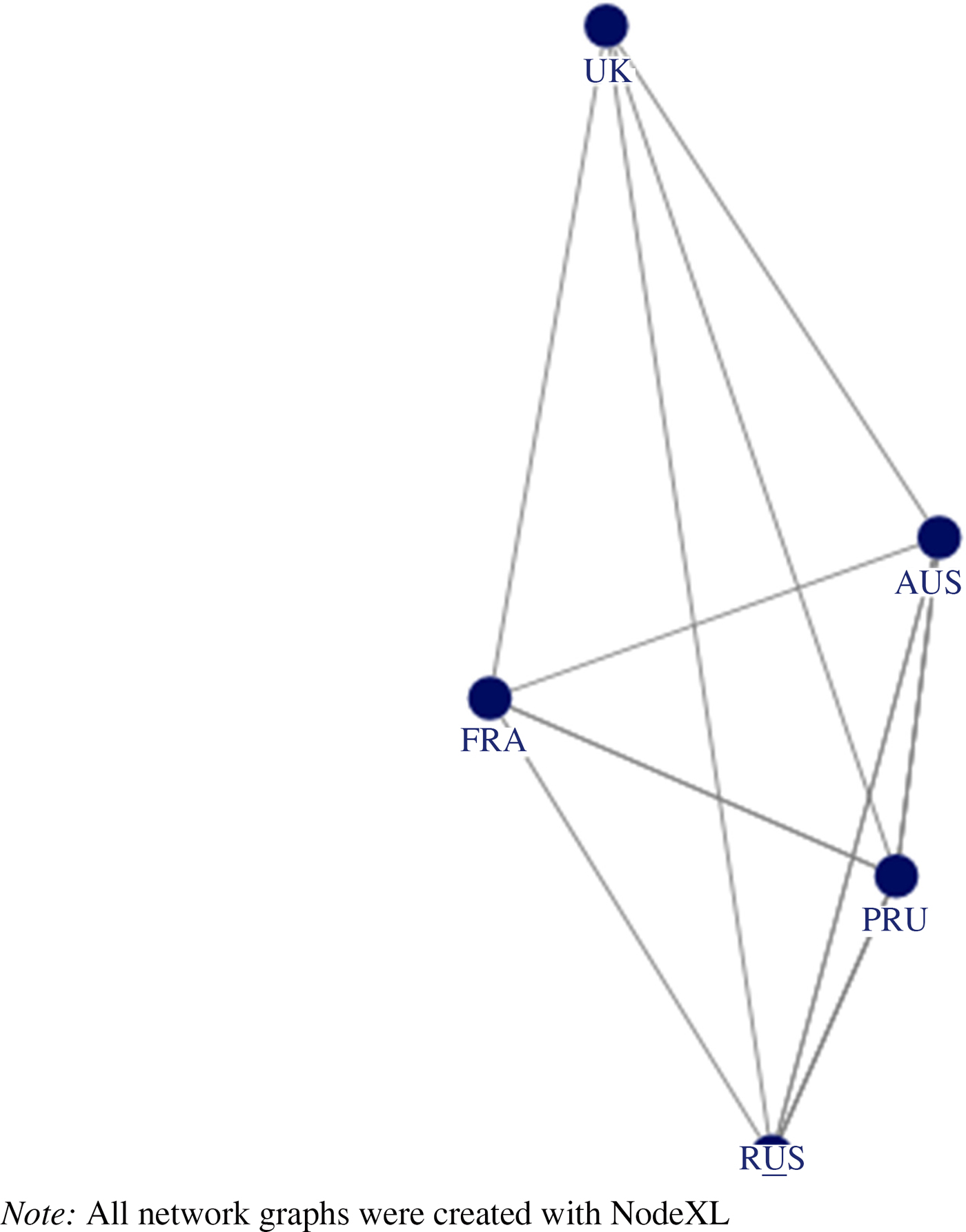
It was Russia's position as an integrated revisionist that pushed it away from force and toward institutional engagement. Figure 2 models the great powers and their institutionalized relations in 1821.Footnote 44 During the Greek revolt, Russia had high access to Concert institutions, and few ties outside of these institutions, positioning the state as an integrated revisionist. Russia's position was no accident. Following the Napoleonic wars, Russia was among the European states that created formal treaties that would serve as a “basis for the reciprocal relations of the European States” and ensure “the participating powers [would] not … begin a war without exhausting all means of mediation.”Footnote 45 Russia was eager for access to these institutions, believing close ties established a bulwark against revolutionary nationalist movements that threatened the stability of the European order. Russia's pursuit of the Concert treaties, as well as its drive to enmesh conservative governments with the Holy Alliance, all reflect its desire to maintain the status quo.
Russia's networks, 1821

What Russia's leaders failed to foresee was that its access to Concert institutions would restrain its revisionism outside of Europe. While Russia believed Concert networks restrained it on the continent, in Poland, the Balkans, and in the Near East, Russia still sought domination.Footnote 46 Russia's beliefs about the limits of Concert networks were not unreasonable. At Vienna, the European powers had explicitly excluded relations with the Ottoman Empire from “European affairs.”Footnote 47 Early on in the crisis, Russia argued there was no need to consult the Concert about its revisionist plans—that it had every right to respond to Ottoman violations of a bilateral treaty and protect Christians from the sultan's wrath.Footnote 48
But Russia's position as an integrated revisionist had unanticipated feedback effects, pushing Russia toward institutional engagement even where it harbored revisionist aims. First, Russia's access to the Concert imposed unexpected costs on revisionism in the Near East. When Alexander first contemplated intervening in the Greek revolt, he believed his Concert allies were unlikely to get involved in a conflict outside of Europe's boundaries. Metternich and Castlereagh, however, insisted the Greek revolt was a European issue. To support the Greek revolt against a legitimate ruler, Castlereagh and Metternich argued, was to support nationalist revolutions across Europe. As Castlereagh wrote to the tsar, the Ottomans were engaging in “barbarism” but “any attempt to introduce order by external interference … might expose the whole frame of our system to hazard.”Footnote 49 These linkages changed Russia's calculations about the costs of revisionism in the Near East. If Russia itself were to act on behalf of the Greek nationalist movement, this threatened the European order, and could provoke revolutions across Europe. Once Russia's gains against the Ottomans were linked to costs in Europe, the power was reluctant to act alone.Footnote 50
Second, Russia's position created binding effects, limiting opportunities for revisionism. Integrated states rely on institutional pathways for power, meaning that even strong states have only a limited capacity for collective mobilization. During the crisis, Russia initially hoped to exploit balance-of-power logics, and attempted to gain France and Prussia's support as potential counterweights to Austria and Britain.Footnote 51 France, unwilling to risk its own institutional position in the Concert, ignored Russia's advances. Prussia, while initially signaling support for intervention, quickly denied assistance.Footnote 52 Without ties outside of the Concert, Russia was left without allies to support its revisionist aims.
Perhaps most profoundly, Russia's position in the Concert shaped its leaders’ preferences, not merely constraining its strategies but changing its fundamental interests. Scholars often point to Alexander's status quo interests as the font of Russian restraint.Footnote 53 However, these interests were not a given, especially in the Near East and Balkans. Historically, Russia's interests in the Ottoman Empire were revisionist, even hegemonic. Pre-Vienna Russia was “bent on destroying the Ottoman empire or at least gobbling up large tracts of its territory and exploiting its internal problems and weaknesses.”Footnote 54 The defeat of Napoleon had left Russia “so powerful that Alexander briefly considered the hegemonic option.”Footnote 55
Finally, access changed Russia's preferences for revisionism. As I argued, access increases pressures to socialize, and for states to accept norms of legitimate action. During the crisis, the great powers strategically deployed ideological appeals designed to change Russia's interests. In a letter to the tsar, for example, Castlereagh urged Alexander to put the alliance first and “remain unalterably true to the fundamental obligations of the alliance,” so “that the present European system … will long continue to subsist for the safety and the repose of Europe.”Footnote 56 Evidence also suggests that Alexander seemed to internalize the restraining norms of the Concert.Footnote 57 Faced with the specter of norm violation, Alexander hesitated: “I should be the first,” the tsar proclaimed, “to show myself convinced of the principles on which I founded the alliance.”Footnote 58 Russia would continue to uphold the foundations of Europe, putting Europe's interests before its own parochial aims. And as Nesselrode wrote, “Whatever divergence of opinions has arisen in Europe, and whatever the nuances in the determinations of the different cabinets … His Imperial Majesty could not subordinate [his] great aims … to these secondary considerations.”Footnote 59
In short, Russia's position as an integrated revisionist pushed it toward institutional engagement. This is not to say that Russia abandoned revisionist aims entirely. As I argued earlier, integrated revisionists do have institutional power—the ability to pursue aims within the institutional order. In the wake of the Greek revolt, Russia used its institutional power to persuade and coerce its Concert partners. It pushed the European great powers to recognize its right to enforce bilateral treaty obligations, and persuaded the great powers that persecution against Greek Christians was a European concern. When it did deploy force against the Ottomans, as it did in 1828, it insisted that these were limited actions to support existing treaty obligations, not revolutionary challenges to conservative rule. Whatever revisionism Russia pursued, it avoided challenging the institutional order. Preserving Concert institutions even became a primary objective of Russian foreign policy.
Beyond Bismarck: Prussia, Bridging, and Rule-Based Revolution
From 1864 to 1871 Prussia pursued “rule-based revolution” to challenge the foundations of European institutions from within the order itself. In less than a decade, and with little cost, it unified the German states under Prussian rule. German unification not only upended European boundaries—it laid the groundwork for the German industrial revolution, which would vault Germany into the top tier of great powers by the end of the century. Ideologically, German unification ripped apart the conservative foundations of Concert institutions, leaving in its stead an order with nationalism as the legitimate basis for sovereign claims. Yet Prussia achieved revolution without sacrificing its position as a core member of European institutions.
Prussia's revolutionary revisionism poses a significant puzzle. At the beginning of the 1860s Prussia seemed to have neither the capacity nor will for an expansive revisionist project. Its revolution was accomplished despite the fact that Prussia was a relatively weak power. Its military seemed no match for its likely rivals, Austria and France. Its economy was overpowered by Britain's. Domestically it was torn between national-liberals and conservative parties. These parties were so polarized that, on the eve of its war with Denmark, Prussia seemed headed toward a civil war. Prussia's leaders embraced the status quo. While they might have sought some increased influence in the German Confederation, they were steadfastly opposed to a nationalist revolution.
Scholars often attribute Prussia's puzzling strategy to its minister-president, Otto von Bismarck. It was his genius and his own revisionist preferences that overcame normal constraints. There can be no doubt that Bismarck's diplomacy was critical in ensuring Prussia's success, but Prussia's revolution cannot be reduced to his skill.Footnote 60 As Bismarck himself insisted, “By himself the individual can create nothing; he can only wait until he hears God's footsteps resounding through events and then spring forward to grasp the hem of his mantle.”Footnote 61 Less ephemerally, Prussia's position as a bridging revisionist gave Bismarck some powerful structural cards to play. Prussia's network position gave it both institutional and entrepreneurial power: it could exploit military, economic, and social power both within and outside of existing institutions. Prussia's network position even pushed its preferences toward revolutionary aims.
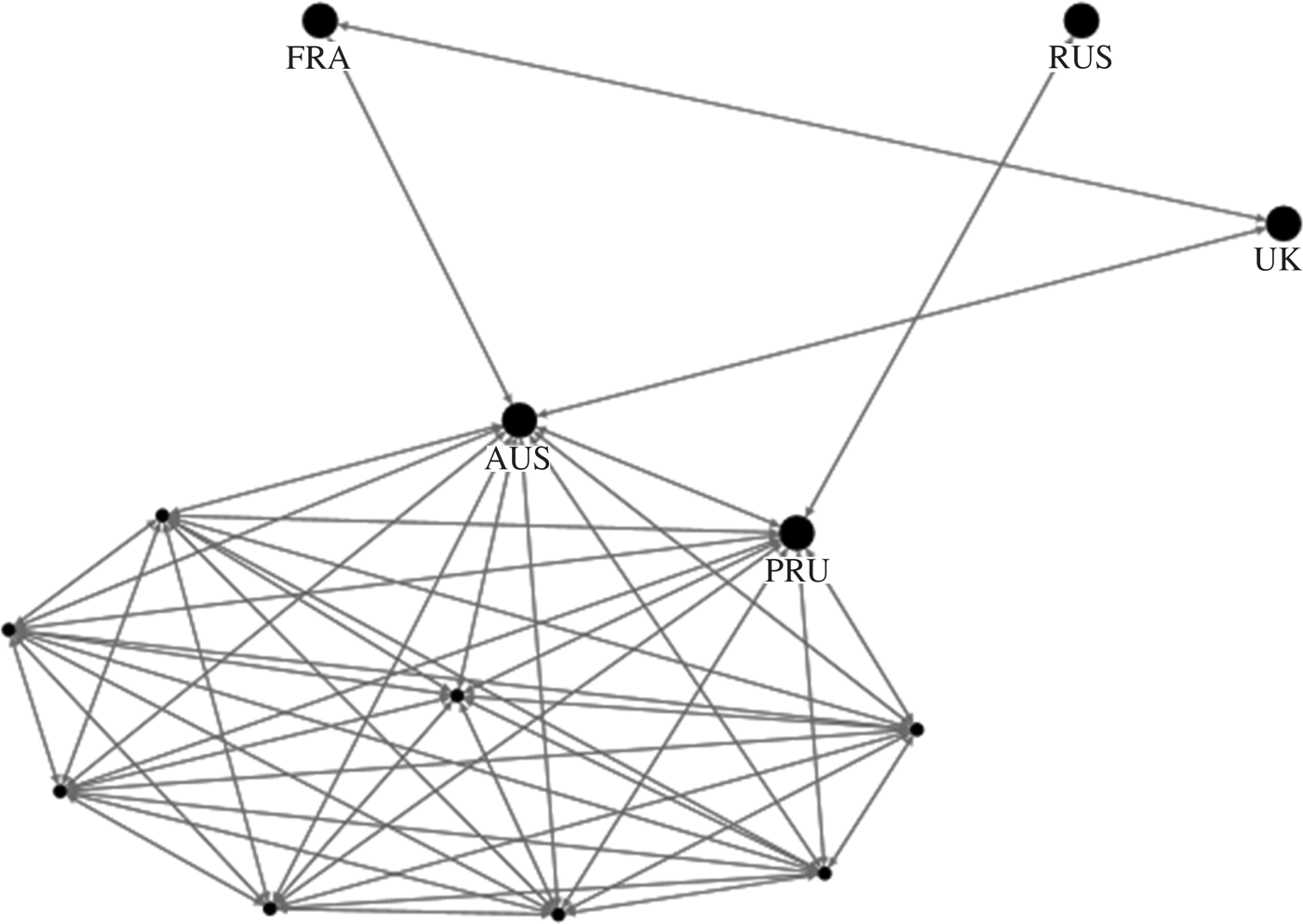
Figure 3 illustrates Prussia's network of institutionalized alliances in 1863 Europe. On the one hand, Prussia had access to the dominant institutional order, which was still composed largely of alliances established during the Concert of Europe.Footnote 62 Prussia also maintained strong social and cultural ties with the conservative powers, Russia and Austria: its ruling family, the Hohenzollern dynasty, was firmly embedded in dynastic political networks. At the same time, Prussia was a broker with significant access to a subgroup of German nationalists. Prussia's ties with each of the German states emerged in part through the German confederation. Those ties are captured in the ATOP data. Not captured by the data are the political, economic, and cultural networks that increasingly tied Prussia to German nationalist networks. While itself a conservative power, members of the Prussian monarchy and cabinet maintained strong ties with the transnational liberal-nationalist movement.Footnote 63 Finally, Prussia maintained exclusive relations with German states through the Zollverein, a German customs union formed in 1834 to manage tariffs among the German states.Footnote 64 The Zollverein not only provided economic ties but it also forged a Kleindeutsch ideology, which held that there could be a legitimate national German state led by Prussia and excluding Austria.
Prussia's networks, 1863

Prussia's bridging position cannot be reduced to a single set of interests; it was brought about by a complex and often contradictory pursuit of aims. Some relations, such as its ties with Austria, were based in long-standing dynastic politics. Other ties were built in response to local strategic or economic interests. Prussia constructed the Zollverein both as a means to enhance Prussia's own economic standings and as a buffer against a revisionist France.Footnote 65 There is little evidence that Prussia intended to use the Zollverein to exclude Austria from these networks. Rather, Austria's protectionist policies made the customs union unattractive.Footnote 66 That the Zollverein's economic networks linked with German nationalist ties was unexpected. Prussia saw the rise of German nationalism as antithetical to its interests.
Prussia may not have built a bridging position with the aim of revolutionary revisionism. Over time this combination of access and brokerage pushed the conservative state toward radical aims. Prussia's position gave it expansive institutional and entrepreneurial power, both of which were evident in the early years of German unification. First, these ties decreased the costs of expansion, most notably by ensuring other states would not oppose Prussia's aims.Footnote 67 For example, Prussia used the threat of institutional exit to ensure that Austria, rather than opposing the war, would ally with it against Denmark in the war over Schleswig-Holstein. Austria had no interest in upsetting the status quo in the German Confederation, and worried that war would upset the European order. Yet Austria feared that, if Prussia were to go it alone in Denmark, this would tear apart the German Confederation and the conservative principles that underpinned existing institutions.Footnote 68 Threats of exit also proved effective in sidelining Russia, who feared a “revolutionary grouping” between Prussia and revisionist states. Keeping Prussia bound to conservative institutions would prevent a revisionist coalition.Footnote 69
Second, Prussia's bridging position created opportunities for mobilization outside of the dominant order. By supporting Prussia, Austria had hoped to keep Prussia bound to Concert institutions, and “with each successive step of the dual powers in the Danish affair Rechberg and his colleagues sought to put the Prussians into this restraining harness.”Footnote 70 Instead, Prussia's bridging position gave it entrepreneurial power, allowing it to mobilize alternative networks. For example, Prussia used its ties with the German states to appeal to a “conservative nationalism” that unified previously opposed dynastic and nationalist networks.Footnote 71 This was nothing less than a revolutionary appeal that directly attacked the legitimacy of conservative Concert institutions (and the legitimacy of Austria's position). Even as it did so, however, Prussia insisted it was still playing by the rules of the Concert order. Each of Prussia's revisionist efforts, for example, was accompanied by a European-wide congress to protect European equilibrium. Prussia's mobilization did not make it an institutional pariah—it reinforced its position at the center of the institutional order.
Prussia’s bridging position, by lowering costs and creating new pathways for revisionism, enabled rule-based revolution. Perhaps most profoundly, Prussia's bridging position shaped its preferences for revolutionary behavior as well. Throughout the nineteenth century, Prussia identified itself as a conservative power committed to maintaining the status quo in Europe. Over time, however, Prussia's ties with German nationalists—however unintentional—increased role strain, creating intense cross-pressures on Prussia's identity as a conservative state. Even before the rise of Bismarck, the Prussian monarchy found itself pressured to support German nationals while it struggled to maintain its position as a conservative European power. As these pressures increased, Prussia looked for strategies that would appeal to its multiple constituencies simultaneously; acting as a “rule-based revolutionary” could sate both identities. In its expansion into Schleswig-Holstein, and its wars against Austria and France, Prussia's leaders found it possible to claim it was both behaving as a good European, one committed to upholding conservative and Concert institutions, and taking on the mantle of German leadership simultaneously. Prussia's position did not merely allow rule-based revolution; its bridging position constituted it as a revolutionary actor in European politics.
Exit from Order: The Soviets and Isolated Revisionism in the Early Cold War
During the Cold War, the Soviet Union pursued an exit strategy. In the years following World War II, especially after the Marshall Plan, the Soviets turned away from Western institutions, choosing instead to pursue revisionist aims in an exclusive sphere of influence. Concretely, this meant a decisive turn to exit and the creation of an alternative institutional order—what historians refer to as the “Sovietization” of Eastern Europe. Roberts argues that in the wake of the Marshall Plan in 1947, “isolating the Soviet bloc from subversive outside influences now set Stalin's agenda for postwar Europe rather than the maintenance of the grand alliance.”Footnote 72 Stalin hoped to increase Soviet power, not by overtly challenging Western alliances, but through political purges in Eastern European states, and hierarchical security and economic arrangements in its sphere of influence. When the Soviets would challenge institutions, they would do so either covertly, or in areas geographically outside the core of the dominant order.
That the Soviets adopted an exit strategy may not seem surprising. Well before the Marshall Plan, the Soviets seemed drawn toward exit. After World War I, the Soviet Union adopted a policy of diplomatic isolation, refusing to join the League of Nations or to recognize foreign debts.Footnote 73 Through most of its early existence, the Soviet Union remained outside formal internationalized networks, for example, joining the League of Nations only in 1934. The Western states initially refused to recognize the Soviet Union, excluding it from routine diplomatic exchange. Even in the shadow of a German threat, Britain failed to build an alliance with the revolutionary state. Excluded from most “status quo” institutions, the Soviets invested heavily in ties outside the Western order. Most notably, the Communist International—the Comintern—evolved into a “machine of huge dimensions, which for over a decade extended its activity and its tentacles over a geopolitical scenario that was more or less global.”Footnote 74 As Silvio Pons argues, the links between the Soviet government and local communist parties were often contentious at best, yet the Comintern formalized Soviet relations with communist parties in Eastern and Western Europe, Asia, and even Latin America, creating a vast network of communist emissaries.Footnote 75
The Soviet Union thus seemed destined to build an isolated revisionist position that would allow it to pursue revolutionary aims without Western interference. But this narrative ignores the fact that the Soviet Union entered the post-World War II world with the aim of gaining access to dominant institutions.Footnote 76 While it's true that it sought a sphere of influence, when Soviet diplomat Maxim Litvinov wrote of establishing spheres of influence, he stressed that the Soviets must “divide the world into separate zones of security within the framework of an overarching international organization.”Footnote 77 Litvinov's policies, outlined in preparation for meetings among the allies at Dumbarton Oaks in 1944, were specific in the details of institutionalization. The great powers—Britain, the Soviet Union, and the United States—would manage postwar affairs through a unified committee. These powers would oversee those regional substructures—the spheres of influence—where they had a vested national interest.Footnote 78 Spheres of influence were not isolationist—they required institutional management.
In the immediate postwar era, the Soviets sought access to economic networks as well. Stalin was never happy with the Marshall plan, but first advocated for reforming it internally to give the Soviets access to Western resources on their own terms: “Soviet diplomats were instructed to play an active role in founding the Bretton Woods system and creating the United Nations.”Footnote 79 The Soviets encouraged its Eastern European allies to participate in the Marshall Plan to further postwar reconstruction efforts. Western states seemed ready to grant access, believing the best way to preserve the status quo was to tie the Soviet Union to emerging institutions. It was for this reason that Roosevelt pursued a strategy designed to turn the grand alliance of World War II into the bedrock of the postwar order. The Soviets would join the United States as one of the “Four Policemen,” working cooperatively to preserve the stability of emerging institutions.Footnote 80
To say that the Soviets pursued access to dominant networks does not mean that they accepted them as legitimate tools of global governance. To the contrary, at the end of World War II, the Soviets believed that access to the dominant order would facilitate rule-based revolution, an ability to work within democratic, liberal institutions to achieve their revolutionary aims. With all of Europe engulfed in postwar economic chaos, the Soviets believed that democratic transitions to communist rule were likely, especially in France and Italy where parties were growing increasingly powerful.Footnote 81 No overt challenge to liberal principles was necessary: Leningrad party secretary Andrei Zhdanov assured his colleagues that Austria, Hungary, and Germany would make a “peaceful transition to socialism.”Footnote 82 In Eastern Europe, Moscow could rely on “alien elements” in “national soil” as a mechanism for revolution.Footnote 83 To achieve revolution, the Soviets could mobilize their existing communist institutions and gain power within democratic and liberal institutions. Confident in their strategy, the Soviets instructed communist parties to back multiparty national governments, and refused to support overt insurrection.
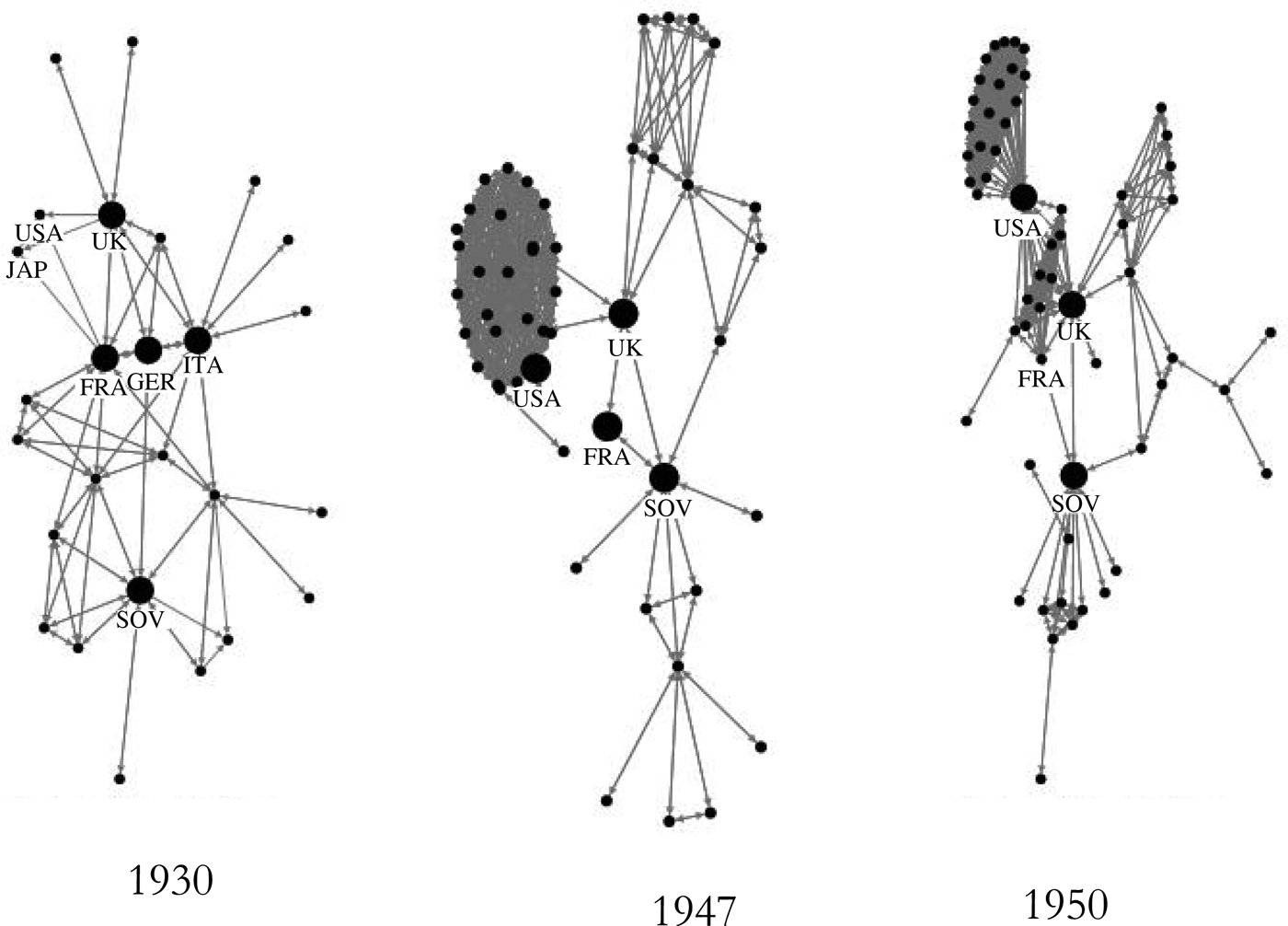
Whatever their aims, the Soviet structural position denied them the resources needed for rule-based revolution. From 1930 to 1950, the Soviet Union was positioned as an isolated broker. While it maintained its strong ties to communist parties throughout Europe, its relations with the Western status quo powers were relatively sparse. World War II represented the height of Soviet access to institutions, with the Soviets positioned as an indispensable ally of Britain and the United States against Hitler's Germany. Yet ties between the United States and Britain remained far more dense than relations between these great powers and the Soviet Union. Stalin may have downplayed Anglo-American conflict when he said that he did “not believe in divergences between the English and Americans” but he was correct that “they are closely connected to each other.”Footnote 84 At the same time, the Soviets held a brokerage position, building ties with subgroups in the international system. Alliances tied the state to Eastern Europe and East Asia, creating an exclusive sphere of influence dominated by the Soviet power. The Soviet economy was a fundamentally closed economy, with only a small fraction of its gross domestic product (GDP) tied to exports, few imports, and miniscule amounts of foreign investment. With the exception of its UN membership and status on the Security Council, the Soviets remained isolated from emerging institutions of global governance.
Figure 4 depicts the Soviet's evolving network position from 1930 to 1950. The Soviet's isolated position, with its low access, meant its attempts at rule-based revolution proved futile. Instead, the costs of revising institutions, the lack of opportunities, and the possibilities of mobilizing within an exclusive order, all pulled the Soviets toward an exit strategy. Its low access gave the Soviets little institutional power among the Western states, creating high costs and few opportunities to pursue revisionist aims. For example, its demands for reparations from Germany were soundly rejected by the United States, Britain, and France. Likewise, at the Paris Conference in 1947 Molotov attempted to revise the terms of the Marshall plan, rejecting the multilateral format of the institution, and proposing a bilateral system where states would submit their national requests directly to Washington.Footnote 85 Moscow found it lacked the access to convince other Western European countries to accept this proposal. The British and French representatives refused to even consider the Soviet plan. Soviet efforts to pursue political revolution also failed. When the Soviets attempted to secure electoral victory in France and Italy for communist parties, they found themselves outflanked by the Western powers, which used their own access positions to expel the parties from government. The Soviet's isolated position also meant that, far from being socialized into institutions, they perceived themselves as marginal, even inferior to the other great powers. They were, as Molotov put it, “regarded as an inferior race.”Footnote 86
The evolution of Soviet networks, 1930–1950

While the Soviets saw their efforts frustrated within institutions, their position as a broker pulled them toward exit. This was not Stalin's initial strategy. There is little evidence that Stalin sought a division of Europe, or had a master plan of “Sovietization.”Footnote 87 It was the process of attempting to revise within the emerging Western system that changed Soviet preferences, pulling Stalin toward the goal of leading an isolated communist revolutionary network, operating outside of dominant institutions. In September of 1947, the Soviets unveiled the successor to the Comintern, the Cominform, which would establish single-party communist regimes throughout the Soviet sphere of influence. It used these networks to secure its political hegemony in Eastern Europe, establishing single-party communist regimes throughout. At the Cominform conference, a speech by Zhadnov signaled the end of the peacetime alliance, and the creation of two rival “camps” in Europe. The Soviets worked to secure its economic domination through “the coordination of trade and economic policies throughout Eastern Europe,”Footnote 88 policies that guaranteed the dependence of client states on the central government. By 1947, the Soviets had abandoned “within system revolution” and chose exit, pursuing its aims through a distinct institutional order.
“Force Is Spirit”: Japan and the Dilemma of the Rogue Revisionist
Interwar Japan demonstrates the dynamics of the rogue revisionist.Footnote 89 Throughout the 1930s, Japan turned to offensive military power in pursuit of revisionist aims. Over the decade, Japan's territorial claims grew ever more expansive, as it moved to conquer China, subdue southeast Asia, and drive the United States out of the Pacific. Japan's challenges to the order were not simply territorial. As early as 1933, Japanese officials were proclaiming a new institutional order. Japan “now defiantly rose from her traditional diplomacy characterized by servility,” and would build an institutional order in the Asia-Pacific that would “return to the Japanese spirit.”Footnote 90 By the end of the decade, Japan had embraced a hegemonic revisionist strategy.
Japan's hegemonic revisionism is extremely puzzling. In the years after World War I, Japan positioned itself as a status quo power largely satisfied with its place in the institutional order. Even as it began its expansion, Japan perceived its aims as limited and achieved within the institutional order. Conventional international relations accounts thus blame Japan's erratic domestic politics, arguing the collapse of the liberal internationalist government and the rise of the national-militaristic right pushed the country toward irrational revisionist aims.Footnote 91 But these explanations are insufficient. Even as Japan's rightist parties took power, they still harbored limited aims. For this reason, historians argue that it is difficult, if not impossible, to have “foreseen the scope and scale of Japanese aggression” on the basis of its interests alone.Footnote 92
It was Japan's position as a rogue revisionist that drove its turn to hegemonic revisionist strategies. In the 1930s, Japan lacked both access and brokerage within institutionalized networks. This description of Japan as a marginalized actor may seem misplaced—Japan had worked tirelessly since the end of World War I to gain access to the institutional order. Japan was among the five great powers (with Britain, the United States, France, and Italy) that set the agenda for the Paris Peace Conference in 1919. It joined the League in 1920 as a charter member and one of the four members of the League Council. It was a core actor in the Washington System, working with Britain, the United States, France, and Italy to limit its naval procurements, settle disputes in the Pacific through consultation, and affirm China's sovereignty and territorial integrity.Footnote 93 Throughout the 1920s, Japan integrated into global economic networks as well.
But despite these efforts, Japan found its access limited, marginal relative to other great powers in the system. In each of these networks described earlier, asymmetry dominated. At Versailles, for example, Japan found that the “big three”—the United States, Britain, and France—controlled interactions. In the Washington system Japan was a mere junior partner compared to Britain and the United States.Footnote 94 Its economic ties were asymmetric, with Japan far more dependent on imports than the great powers depended on Japan's exports. Scholars also suggest that racialized ties excluded Japan from dominant institutions.Footnote 95 Like the Soviets, Japan believed there was “an Anglo-American conspiracy to isolate Japan” in an “attempt to oppress the non-Anglo-Saxon races, especially the coloured races, by the two English-speaking countries, Britain and the United States.”Footnote 96 In the Soviet case this lack of access led to exit, not hegemonic violence. But unlike the Soviets, Japan lacked ties outside of the system—it had no brokerage position. Its regional ties were weak, limited to unreliable warlords in China.Footnote 97 Its economic and military ties remained inside the dominant order. Only in the late 1930s would it seek alliances with other revisionist states, such as Germany, and those ties remained weak throughout the war.
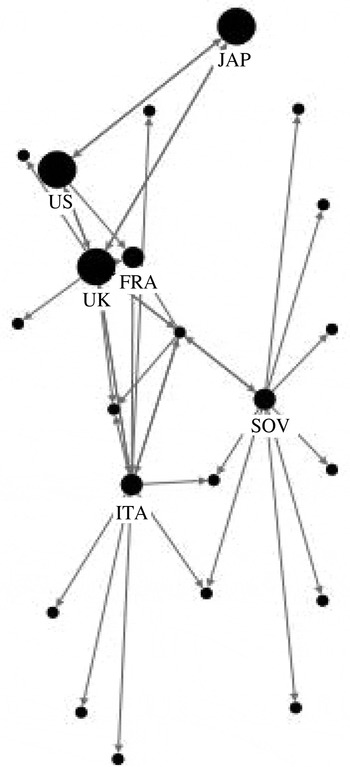
Figure 5 illustrates Japan's network position. With low access and brokerage, Japan had neither the institutional nor entrepreneurial power to pursue even limited revisionist demands. When it tried to achieve its goals within institutions, Japan found its aims blocked. At the Paris Conference, Britain and the United States undercut Japan's goal of a “racial equality” clause. Throughout the 1920s, the United States communicated that it would not accept Japan's demands for special status in Manchuria. At the London Conference of 1930 the United States and Britain dismissed Japan's arguments for a larger navy. Leaders in Britain and the United States believed that Japan would remain bound to institutional rules. Given Japan's dependence on institutions for its military and economic well-being, as well as its domestic and international legitimacy, they believed extensive revisionism was unlikely. Japan had demonstrated, as Stimson reminded his colleagues, an “exceptional record of good citizenship in the life of the world.” It was likely to understand that its role in institutions made revisionism too costly.Footnote 98
Japan's network position, 1930

But Japan came to recognize that pursuing institutional engagement would reap few benefits, and threatened high costs. For this reason, Japan attempted exit, hoping to mobilize support for its aims outside of the system, working with Chinese warlords who could provide indigenous resources for their pursuits in Manchuria. However, their weak ties in China provided no path for revision. Unlike the Soviets, these were not reliable external alliances and economic networks to mobilize. The absence of brokerage denied Japan ideological resources as well. Japan had long relied on the rhetoric of liberal internationalism to justify its foreign policy. When it tried to develop alternative ideological justifications, such as its increasing promises after 1933 to build an anticolonial, “pan-Asianist” world order, Japan's neighbors dismissed the claims as mere gloss on imperial aggression.Footnote 99
By raising the costs of expansion and denying Japan pathways to achieve its aims, then, Japan's position as a rogue revisionist made a strategy of limited revisionism impossible. Over time, these constraints changed Japan's own preferences, pushing the country away from limited territorial expansion and toward challenging dominant institutions. As Japan's leaders saw their aims thwarted, they turned toward the rhetoric, and then the reality, of hegemonic revisionism. The denial of claims in Manchuria, for example, empowered military coalitions to claim that their more liberal counterparts should be ousted, allowing “the ‘hot-headed’ superpatriots … to win new converts with their arguments that Japan, a ‘have–not’ nation, was denied its legitimate interest.”Footnote 100 Lacking either institutional or entrepreneurial power, Japan turned inward to its own military and economic resources, developing risky offensive strategies for preventive war and autarkic existence. Like status approaches, then, the network theory here suggests that Japan's “type” of revisionism was as much situational as dispositional. Without the institutional or entrepreneurial power to challenge the order, Japan turned to risky, unilateral strategies to revise the system. Hegemonic revisionism was a catastrophic strategy of last resort.
Institutions and the Dynamics of Revisionism in World Politics
The fundamental argument here is that institutional position shapes revisionist type. Revisionist states with access and no brokerage will remain ensconced in the international order. By contrast, existing institutions give bridging revisionists the ideational and material resources to overturn the status quo. Likewise, when access is limited and brokerage strong, revisionists are likely to exit the institutional system and construct an alternative in its place. And finally, revisionists that lack access or brokerage may choose to challenge the international order, even at the cost of hegemonic war.
Revisionism thus cannot be reduced to intentions. Institutional positions affect the costs and benefits of revisionist behavior, the pathways available for revisionist action, and even the preferences of the revisionist itself. As a result, revisionism is intimately tied to the existing institutional order. The theory also questions the standard institutionalist argument that suggests institutions are a restraint on revisionist behavior. Much of the literature suggests that the current order has bound participating states, making revisionist behavior too costly.Footnote 101 For this reason, these scholars suggest China is likely to find itself constrained by the current institutional order. China reaps enormous benefits from the order and its leaders understand both the financial and political benefits of cooperation, and the catastrophic costs of using violence to overturn the order. But a relational-network approach suggests that liberal institutions may overstate the constraining effects of institutional orders. Even integrated states, such as nineteenth-century Russia, were able to pursue revisionist demands within institutional orders. Other integrated states, like Prussia, found other opportunities for revision.
Even if China is constrained in the present, this might not always be the case. The theory draws attention to the dynamics of revisionism—how structures can change a revisionist's type over time. Both the theory and the cases suggest a complex interplay among interests, network position, and strategy. Russia found itself pushed away from its revisionist agenda, while Japan's position pulled it toward hegemonic revisionism. In changing costs, shifting opportunities, and transforming preferences, network position creates or stifles revisionism.
This suggests that network positions might have similar effects on the aims of contemporary revisionists. Much debate about the future of the liberal order has centered on states’ intentions. Does China aim to challenge the institutional order, or is it interested in working within the boundaries of existing institutions? Is Putin's Russia simply a force of disruption, or does he aim to overturn the liberal order? If the theory here is correct, it may be that the extent of contemporary revisionism might rest, not on these states’ intentions, but on their emerging positions. China, arguably, is an emerging bridging revisionist. It has forged new economic and political ties through institutions like the Shanghai Cooperation Organization, the Belt and Road Initiative, and the AIIB. Scholars are right that these ties do not necessarily signal revisionist aims: they were largely formed in response to specific demands, not as a means to challenge the liberal order. But over time, these ties will shape the costs and benefits of revisionism, the opportunities China sees for change, and even China's identity. Using the theory here, we can imagine China's emerging position as a bridging revisionist pulling it toward revolutionary strategies.
Similar feedback effects might also account for Russia's shifting revisionist strategy. In the wake of the Cold War, Russia sought access to liberal institutions, becoming a member of the World Trade Organization and the G8. But even at the height of cooperation, Russia was marginal to these organizations. Unlike China, Russia has few alternative exclusive economic and security ties to actors in the international system. Without access or brokerage, Russia's revisionist projects have faltered. It has been outflanked by NATO and the EU in Eastern Europe, and China competes for influence in Central Asia. Perhaps it is not surprising, then, that Russia has increasingly turned to violent action in its near abroad, and become more vocal in its overt challenge to the international order. As recent commentators argue, it is difficult to see Russia's expansion as driven by static intentions: there are few signs of “a systematic expansionist project.”Footnote 102 Russia, instead, improvises and gambles when presented with what are quite limited structural opportunities: its revisionism is driven by supply more than demand.Footnote 103
Ultimately, no institutional order transcends power politics, ushering in a world where revisionism falls by the wayside. But to conclude that global governance does not matter would also miss the point. Revisionists, like status quo states, play power politics within the structure of the institutional order. And while structure is not destiny, it has, and will continue to exert, a profound influence on revisionists and their strategies in world politics.
Supplementary Material
Supplementary material for this article is available at <https://doi.org/10.1017/S0020818318000206>.