Introduction
Behavioral and psychological symptoms of dementia (BPSD) occur frequently in people with the condition, affecting 90% of people with the condition at some point (Ballard et al., Reference Ballard, Corbett, Chitramohan and Aarsland2009). In particular, agitation, aggression, psychosis, and depression are major causes of distress for people with dementia and those caring for them, presenting a significant challenge for treatment and care. BPSD often lead to the prescription of antipsychotics and other psychotropic drugs, and are a key trigger for institutionalization (Steele et al., Reference Steele, Rovner, Chase and Folstein1990). There is an urgent need to develop, evaluate, and implement safe and effective psychosocial interventions which confer benefit in the treatment of BPSD and related distress, and which could offer a safe and effective alternative to antipsychotic medication. Over the last 10–15 years there has been a growing focus on a personalized approach to delivering these interventions.
In the 10-year period from 1993–2003 Livingston and colleagues (Livingston et al., Reference Livingston, Johnston, Katona, Paton and Lyketsos2005) identified 1,632 studies and included 162 studies in their review of psychological approaches to the management of neuropsychiatric symptoms of dementia, and only nine of these were high quality studies with control conditions. Similarly, Aylward and colleagues (Aylward et al., Reference Aylward, Stolee, Keat and Johncox2003) included 53 studies in their review on continuing education in long-term care, and found only three randomized controlled trial (RCT) studies that met the inclusion criteria. In the last decade several important systematic reviews and meta-analyses focusing on psychosocial interventions have been undertaken. Cochrane reviews and other meta-analyses published between 2000 and 2009 have identified a substantial number of studies investigating psychosocial interventions for people with dementia. For example, Kverno et al. (Reference Kverno, Black, Nolan and Rabins2009) identified 3,826 studies published in the period from 1998 to 2008. The majority of these were pharmacological interventions, but 215 studies focused on psychosocial interventions, of which only 21 (9.8%) evaluated treatments for people with moderate to severe dementia and BPSD. A second review screened 1,313 studies focusing on psychosocial interventions for dementia published prior to September 15, 2008 (Olazaran et al., Reference Olazaran2010). They included 179 studies from which only 13 were rated as providing high quality evidence according to a graded rating system.
Importantly, of the recent systematic reviews only O'Neil et al. (Reference O'Neil, Freeman, Christensen, Telerant, Addleman and Kansagara2011) focused on the treatment of individual symptoms of BPSD, and none specifically focused on the benefits of personalized, psychosocial interventions for BPSD. In addition, despite several studies investigating the effect of psychosocial interventions on antipsychotic drug use and the high profile of this issue in clinical practice, none of the existing systematic reviews have considered this key question (Fossey et al., Reference Fossey2006). A considerable number of new studies have been published since the period covered by the most recent systematic reviews, which although published more recently only include studies published prior to September 2009 (O'Neil et al., Reference O'Neil, Freeman, Christensen, Telerant, Addleman and Kansagara2011). The aim of this systematic review is therefore to address and update these gaps in the evidence base. The review will analyze the literature on personalized psychosocial interventions and interventions to promote person-centered care for the treatment of BPSD in people with dementia living in care homes, including key recently published studies. The review will also focus on studies reporting the effect of such interventions on BPSD symptoms including depression, anxiety, and agitation, in addition to impact on antipsychotic medication prescribing.
Methods
A preliminary search was undertaken using a broad range of search terms and non-pharmacological interventions to examine their impact on key BPSD and the use of antipsychotic drugs in people with dementia living in care homes. The search terms and the grouping and selection of interventions were subsequently refined based on the advice of an expert advisory group consisting of both UK and international representatives. This work was undertaken as part of a National Institute for Health Research (NIHR) programme grant (WHELD study: Improving Well-being and Health for People with Dementia). The panel recommendations ensured a more specific focus on personalized psychosocial interventions.
Criteria for studies considered for this review
Search terms
Search terms encompassing individual dementias, behavioral interventions, and nursing homes were used. In all key words all subthemes were included, i.e. “nursing homes” included “residential facilities, assisted living facilities, group homes, halfway houses, and home for the aged.” The following intervention key words were used: Education & training, Education, Training, Physical training, Exercise, Social interaction, Positive events, Non-pharmacological treatment, Care planning, Psychosocial intervention, Personalized, Person centered, Creative therapies, Life story, History, Resolution, Resolution therapy, Engagement, Art, Art therapy, Activity, Stories, Storytelling, Reminiscence, Music, Music therapy, Dance, Dolls and toys, and Simulated presence therapy.
Exclusion criteria
Studies including psychosocial interventions related to insomnia, palliative care, feeding skills, activities of daily living (ADL), therapeutic touch, aromatherapy, caregiver interventions, nutritional intervention, outside nursing home, home care, home-based intervention, medical intervention, cognitive intervention, use of restraint, light therapy, and non-dementia related therapies were excluded. Studies with crossover design were excluded.
Type of sources
Studies were first identified through searches of the following electronic databases: MEDLINE, PsycINFO, Web of Science, EMBASE, Central (Cochrane Central Register of Controlled Trials), CINAHL (Cumulative Index to Nursing and Allied Health Literature), Clinical trials, British Nursing Index, and Cochrane Library, which were obtained from electronic databases.
Types of studies
Studies published between 2000 and December 2012 in English language, peer-reviewed journals were included. All care home and nursing home studies including individual and cluster RCT and pre-/post-test studies with control conditions where participants were allocated either to an intervention group or a control group, were included in the initial search.

Types of participants
The search included studies focusing on psychosocial treatment of people diagnosed with dementia living in care homes or nursing homes.
Types of outcome measures
The search included studies that measured changes on specific variables. The primary outcomes were key BPSD defined as depression, agitation, and anxiety, in addition to impact on antipsychotic medication prescribing.
Study selection
Initial search
A qualified librarian and one review author performed the initial search. Two review authors examined these results and excluded irrelevant papers, based on the selection parameters above.
Types of intervention
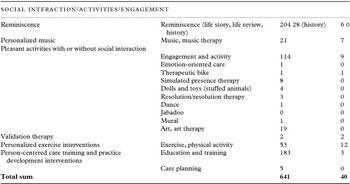
The goal was to identify personalized psychosocial interventions. Based upon the recommendations of the expert advisory group, the personalized psychosocial interventions were grouped into six categories of interventions, which formed the focus of the study. These were reminiscence, personalized music, personalized pleasant activities with or without social interaction, validation therapy, personalized exercise/physical activity, and person-centered care training and practice development. These interventions are further described in the text box. The description of the intervention was reviewed by three authors (IT, CB, AC) to determine whether they fulfilled the study definitions. Interventions for family caregivers were not included.
Data analysis
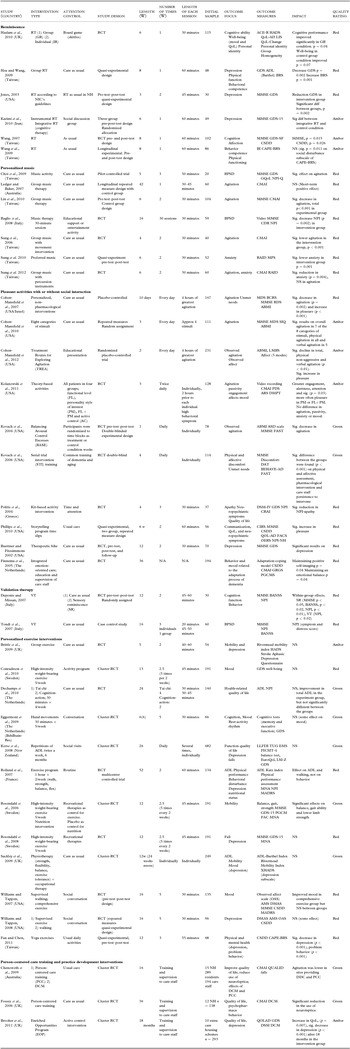
Methodological quality was assessed based the Cochrane criteria as operationalized by Corbett et al. (Reference Corbett2012). Studies were graded red (R), amber (A), and green (G) for defined methodological criteria. Study scores are shown in Table 2. Papers scoring 0–1G were rated red, those scoring 2–3G were amber and those scoring 4–5G were rated green. The PRISMA Statement 2009 has been used as a guide in this review (http://www.prisma-statement.org)
The characteristics of each study are described in detail, including design of the study, number of participants, duration, type, length, and frequency of intervention. A descriptive summary is provided for the impact of each type of intervention on the specific outcomes of interest (key BPSD symptoms, antipsychotic use). Where available for four or more studies, the effect size of the intervention is also described (range, median) using Cohen's d.
Results
641 studies were identified in the initial search, of which 601 were excluded. 40 studies were included (Table 1). There were 49 duplicates, 445 studies did not meet the inclusion criteria because they either did not focus on the symptoms of interest, were not undertaken in care homes/nursing homes, or were not RCTs or other study designs with a control group. Based on a detailed review of the interventions, a further 107 studies were excluded as the interventions did not meet the criteria for any of the six categories of personalized psychosocial intervention identified as the focus of the study.
Inclusion of studies (steps 1 and 2)

A quality assessment was undertaken for each of the 40 included studies (Table 2), 9 were rated as green, 8 studies as amber, and 23 were rated as red.
Studies meeting criteria for this review

ABMI = Agitation Behaviour Mapping Instrument, ACE-R = Addenbrooke's Cognitive Examination-Revised, ADL (Barthel) = Activity of Daily Living, AMS = Alzheimer's Mood Scale, ARS = Affect Rating Scale, ASD scale = Arousal States in Dementia Scale, BANSS = Bedford Alzheimer Nursing Severity Scale, BCRS = Brief Cognitive Rating Scale, BEHAVE-AD = Behave Alzheimer's Disease, BI = Barthel's Index, BRS = Behavioral Rating Scale, CAPE = The Clifton Assessment Procedures for the Elderly, CAPE-BRS = Clifton Assessment Procedures for the Elderly Behavior Rating Scale, CDR = Clinical Dementia Rating scale, CIRS = Cumulative, Illness Rating Scale, CMAI = Cohen-Mansfield Agitation Inventory, CMAI (14 items) = Cohen-Mansfield Agitation Inventory (short list), CRAI = Copper Ridge Activity Index, CSDD = Cornell Scale for Depression in Dementia, DCM = Dementia Care Mapping, Discomfort-DAT = Discomfort-Dementia of the Alzheimer's Type, DMAS = Dementia Mood Assessment Scale, DMPT = Dementia Mood Picture Test, DSM-IV = Diagnostic and Statistical Manual of Mental Disorders, DSSI = Duke Social Support Index, EMS = Elderly Mobility Scale, EuroQol = European Quality of life group, FAC = Functional Ambulation Categories, FACS = The Functional Assessment of Communication Skills, FAST = Functional Assesment Staging Scale, GDS = Geriatric Depression Scale, GDS-15 = Geriatric Depression Scale (14 items), GDS-SF = Geriatric Depression Scale (short form), GQoL = Geriatric Quality of Life, GRGS = Geriatric Resident Goal Scale, HADS = Hospital Anxiety and Depression Scale, LMBS = Lawton's Modified Behavior Stream, LIS = Life Improvement Scale, LLFDI = late life function and disability instruments, LSI-Z = life satisfaction index, MADRS = Montgomery_Asberger, MDS = Minimum Data Sheet, MMSE = The Mini Mental State Examination, MNA = Mini-Nutritional Assessment, MPS = Music Preference Survey, NPI = The UCLA Neuropsychiatric inventory, NPI-NH = Neuropsychiatric inventory (nursing home), NPI-Q = Neuropsychiatric Inventory-Questionnaire, NS = Not Significant, OAS = Observed Affect Scale, OERS = Observed Emotion Rating Scale, PDS = Passivity in Dementia Scale, PGCMS = Philadelphia Geriatric Center Morale Scale, QoL-AD = Quality of life - Alzheimer's Disease, QoL-Change = Quality of life – Change, QUALID = Quality of life in late-stage dementia, RAID = Rating Anxiety in Dementia, RDS = Raskin Depression Scale, SIQ = Self-Identity Questionnaire, TUG = Timed up and go
Description of studies
The 40 studies included 26 RCTs and 14 studies with quasi-experimental designs (Table 2). The studies were performed in 13 different countries, using 66 different outcome measures. 20 (50%) were published in the last four years. The intervention period ranged from 1 to 78 weeks, with a frequency of interventions varying from once a week to twice daily, and with a duration of individual treatment sessions ranging from 30 minutes to 4 hours. The studies were distributed into the six categories: Reminiscence (six studies), Personalized music (seven studies), Personalized pleasant activities with or without social interaction (ten studies), Validation therapy (two studies), Personalized exercise/physical activities (twelve studies) and Person-centered care training and practice development (three studies).
A full summary of all of the included studies is shown in Table 2.
Reminiscence
Six RCTs or studies with a control condition (Jones, Reference Jones2003; Wang, Reference Wang2007; Hsu and Wang, Reference Hsu and Wang2009; Wang et al., Reference Wang, Yen and OuYang2009; Haslam et al., Reference Haslam, Haslam, Jetten, Bevins, Ravenscroft and Tonks2010; Karimi et al., Reference Karimi, Dolatshahee, Momeni, Khodabakhshi, Rezaei and Kamrani2010) evaluated reminiscence as an intervention. Only two of the studies had a parallel group RCT design (Haslam et al., Reference Haslam, Haslam, Jetten, Bevins, Ravenscroft and Tonks2010; Karimi et al., Reference Karimi, Dolatshahee, Momeni, Khodabakhshi, Rezaei and Kamrani2010). There was substantial variability within the sample size (varying from 30 to 115 participants – median: 67) study duration (varying from three to eight weeks – median: seven weeks), the frequency of each intervention varied from once to twice per week, and the length of each session varied from 30–60 minutes. The results were very consistent for depression, with all four studies focusing on this as an outcome, indicating that reminiscence conferred significant benefit in improving mood (Jones, Reference Jones2003; Wang, Reference Wang2007; Hsu and Wang, Reference Hsu and Wang2009; Karimi et al., Reference Karimi, Dolatshahee, Momeni, Khodabakhshi, Rezaei and Kamrani2010). The median effect size of reminiscence on depression in these studies was 0.33. All studies indicated significant benefit, and it makes it difficult to draw conclusions about the beneficial “dose” of the intervention. Other outcomes were less consistently evaluated across studies, and evidence of benefit was more variable. One of the two studies examining overall BPSD reported benefit (Wang et al., Reference Wang, Yen and OuYang2009). None of the studies evaluated agitation as a specific outcome.
Personalized music
Personalized music was examined in seven RCTs or studies with a control condition (Sung et al., Reference Sung, Chang, Lee and Lee2006; Ledger and Baker, Reference Ledger and Baker2007; Raglio et al., Reference Raglio2008; Choi et al., Reference Choi, Lee, Cheong and Lee2009; Lin et al., Reference Lin2010; Sung et al., Reference Sung, Chang and Lee2010; Sung et al., Reference Sung, Lee, Li and Watson2012), including four studies (Sung et al., Reference Sung, Chang, Lee and Lee2006; Raglio et al., Reference Raglio2008; Choi et al., Reference Choi, Lee, Cheong and Lee2009; Sung et al., Reference Sung, Lee, Li and Watson2012) using a parallel group RCT design. The studies included between 20 and 104 participants (median 55.5), with durations varying from 4 to 42 weeks (median: six weeks), the frequency of each intervention varied from once to three times per week, and the length of each session varied from 30–50 minutes. Significant advantage compared to comparison group was identified in three of the six studies examining agitation (Sung et al., Reference Sung, Chang, Lee and Lee2006; Choi et al., Reference Choi, Lee, Cheong and Lee2009; Lin et al., Reference Lin2010), including two of the three RCTs examining this outcome. There was no difference in treatment “dose” between studies reporting significant benefit and those that did not. The effect size of personalized music on agitation ranged from 0.43 (in favor of control)–0.66, with median 0.21. Other outcomes were less frequently evaluated, but there was some evidence of benefit for the treatment of overall BPSD (significant benefit in the only study with this as an outcome (Choi et al., Reference Choi, Lee, Cheong and Lee2009)), and anxiety (two out of two studies showing benefit; Sung et al. (Reference Sung, Chang, Lee and Lee2006); Sung et al. (Reference Sung, Lee, Li and Watson2012)). The only study reporting depression (Choi et al., Reference Choi, Lee, Cheong and Lee2009) did not indicate a significant advantage compared to the comparison group.
Personalized pleasant activities with or without social interaction
Ten studies were included (Buettner and Fitzsimmons, Reference Buettner and Fitzsimmons2002; Kovach et al., Reference Kovach, Taneli, Dohearty, Schlidt, Cashin and Silva-Smith2004; Politis et al., Reference Politis, Vozzella, Mayer, Onyike, Baker and Lyketsos2004; Finnema et al., Reference Finnema2005; Kovach et al., Reference Kovach2006; Cohen-Mansfield et al., Reference Cohen-Mansfield, Libin and Marx2007; Reference Cohen-Mansfield, Marx, Dakheel-Ali, Regier, Thein and Freedman2010; Reference Cohen-Mansfield, Thein, Marx, Dakheel-Ali and Freedman2012; Phillips et al., Reference Phillips, Reid-Arndt and Pak2010; Kolanowski et al., Reference Kolanowski, Litaker, Buettner, Moeller and Costa2011), of which seven were RCTs and three had other designs with a control comparison. The studies had between 37 and 231 participants (median: 147.5) and duration of 1 to 36 weeks (median: 4), the frequency of each intervention varied from once to twice per week, and the length of each session varied from being individualized, 30–60 minutes to 4 hours. Four of the six studies (Kovach et al., Reference Kovach, Taneli, Dohearty, Schlidt, Cashin and Silva-Smith2004; Cohen-Mansfield et al., Reference Cohen-Mansfield, Libin and Marx2007; Reference Cohen-Mansfield, Marx, Dakheel-Ali, Regier, Thein and Freedman2010; Reference Cohen-Mansfield, Thein, Marx, Dakheel-Ali and Freedman2012) examining agitation as an outcome reported significant benefit compared to the control condition. The effect size of personalized pleasant activities with or without social interaction on agitation ranged from 0.24–0.91 with median of 0.46. The only study evaluating depression (Buettner and Fitzsimmons, Reference Buettner and Fitzsimmons2002) reported the intervention to confer significant benefit compared to control, with four additional studies (Cohen-Mansfield et al., Reference Cohen-Mansfield, Libin and Marx2007; Reference Cohen-Mansfield, Thein, Marx, Dakheel-Ali and Freedman2012; Phillips et al., Reference Phillips, Reid-Arndt and Pak2010; Kolanowski et al., Reference Kolanowski, Litaker, Buettner, Moeller and Costa2011) reporting an improvement in pleasure, positive mood, or a reduction in negative affect.
Validation therapy
Two studies analyzed the benefit of validation therapy (Deponte and Missan, Reference Deponte and Missan2007; Tondi et al., Reference Tondi, Ribani, Bottazzi, Viscomi and Vulcano2007). One trial of 30 patients, intervention given twice a week for 12 weeks, each session lasting from 45–60 minutes, showed significant improvements in behavioral disturbance in groups receiving validation therapy and sensorial reminiscence compared to control (Deponte and Missan, Reference Deponte and Missan2007). A trial of 50 patients, with 16 weeks of intervention with both individual sessions (20 minutes, three times a week) and group sessions (45–50 minutes once a week), also saw benefit to BPSD, in particular, agitation, apathy, irritability, and night-time behavior (Tondi et al., Reference Tondi, Ribani, Bottazzi, Viscomi and Vulcano2007).
Personalized exercise/physical activity
12 trials of exercise interventions were identified (Rosendahl et al., Reference Rosendahl2006; Rolland et al., Reference Rolland2007; Williams and Tappen, Reference Williams and Tappen2007; Reference Williams and Tappen2008; Kerse et al., Reference Kerse2008; Rosendahl et al., Reference Rosendahl, Gustafson, Nordin, Lundin-Olsson and Nyberg2008; Brittle et al., Reference Brittle, Patel, Wright, Baral, Versfeld and Sackley2009; Eggermont et al., Reference Eggermont, Knol, Hol, Swaab and Scherder2009; Sackley et al., Reference Sackley2009; Conradsson et al., Reference Conradsson, Littbrand, Lindelof, Gustafson and Rosendahl2010; Dechamps et al., Reference Dechamps2010; Fan and Chen, Reference Fan and Chen2011), including 11 RCTs reporting one or more BPSD as an outcome, although four (Rosendahl et al., Reference Rosendahl2006; Reference Rosendahl, Gustafson, Nordin, Lundin-Olsson and Nyberg2008; Williams and Tappen, Reference Williams and Tappen2007; Reference Williams and Tappen2008) of the papers appeared to be different papers from the same trials but reporting different outcomes. Only four of the studies (Kerse et al., Reference Kerse2008; Brittle et al., Reference Brittle, Patel, Wright, Baral, Versfeld and Sackley2009; Sackley et al., Reference Sackley2009; Dechamps et al., Reference Dechamps2010) met the study criteria for a personalized approach to exercise interventions. The studies had between 56 and 682 participants (median: 205) and a duration of 5 to 26 weeks (median: 15), the frequency of interventions varied from twice to daily per week and the length of each session varied from 30–60 minutes. The pattern of limited benefit for personalized exercise interventions was also evident in the full range of studies examining exercise (Table 2).
Person-centered care training and practice development
Only three studies focusing on person-centered care training were identified, all of which were cluster-RCTs (Fossey et al., Reference Fossey2006; Chenoweth et al., Reference Chenoweth2009; Brooker et al., Reference Brooker, Argyle, Scally and Clancy2011). The studies had between 289 and 349 participants (median: 293) and duration of 16 weeks to 18 months. Two of the studies evaluated the impact of person-centered care training on antipsychotic use, with one of the two indicating a significant reduction (Fossey et al., Reference Fossey2006). Similarly, one of the two studies evaluating agitation as an outcome reported a significant improvement (Chenoweth et al., Reference Chenoweth2009). All three studies examined mood, but only one reported a significant benefit (Brooker et al., Reference Brooker, Argyle, Scally and Clancy2011).
Further evaluations were undertaken for interventions where there was significant evidence of benefit in order to explore factors associated with a favorable treatment response. This was defined as at least four studies examining the same outcome, with more than 50% of the studies indicating significant benefit. As individual patient data were not available, this further evaluation was largely descriptive based on the trial populations of different studies. Using this definition, the impact of reminiscence on mood and the use of personalized pleasant activities with or without social interaction for the treatment of agitation, were explored further. Reminiscence had a beneficial impact on mood in all studies. Most studies focused on a general group of individuals living in care homes, including those with mild dementia or specifically focused on people with mild to moderate dementia. However, there was no specific comparison of outcomes for people with or without significant cognitive impairment. The studies had a balanced gender mix and the mean age of participants was 75–80 in the majority of studies. Overall this indicates a broad spectrum of benefit, but further work is needed to clarify whether reminiscence benefits people living in their own homes, and whether younger individuals and individuals with more severe dementia also derive benefit.
With respect to interventions involving personalized pleasant activities with or without social interaction, four of the six studies examining agitation as an outcome, reported significant benefit compared to the control condition. These studies were all conducted in nursing homes or other long-term care facilities, in all studies the average age of participants was more than 80 and the majority of participants were female. The mean Mini Mental State Examination (MMSE) ranged from 5.1 to 7.3 across studies. The two studies with no significant benefit on agitation (Finnema et al., Reference Finnema2005; Kolanowski et al., Reference Kolanowski, Litaker, Buettner, Moeller and Costa2011) generally focused on very similar settings and participants to those included in the four studies demonstrating benefit, although one of the studies did include participants with less severe cognitive impairment (MMSE > 12). Overall, the results across studies indicate significant benefit for people with moderate to severe dementia living in nursing homes. Further work is needed to clarify whether there are benefits in other settings, in people with severe/profound dementia or in younger individuals. The only study focusing on people with mild–moderate dementia did not indicate significant benefit. Only one study in either category (Kolanowski et al., Reference Kolanowski, Litaker, Buettner, Moeller and Costa2011) did follow-up rating after the intervention to assess duration of effect, and which demonstrated no benefit with respect to agitation one week after the conclusion of the intervention. This is however difficult to interpret given the absence of benefit over the intervention period in this particular study.
Discussion
In total 641 studies of psychosocial interventions for people with BPSD in care homes were identified, of which 40 studies fulfilled the inclusion criteria. Studies have investigated a wide variety and combination of psychosocial interventions which were grouped into Reminiscence (six studies), Personalized music (seven studies), Personalized pleasant activities with or without social interaction (ten studies), Validation therapy (two studies), Personalized exercise/physical activities (twelve studies) and Person-centered care training and practice development (three studies). More than half of the studies used an RCT design, although many used limited control conditions and were of small sample size. There was also great diversity in the approaches to outcome measures. Almost half of the included studies were published the last four years.
Although previous reviews have indicated benefits conferred by psychosocial interventions, this review has taken forward our understanding of the potential differential benefits of different personalized psychosocial interventions on specific BPSD. The best evidence of benefit was for the use of reminiscence therapy in improving mood and symptoms of depression, with all four studies (Jones, Reference Jones2003; 2007; Hsu and Wang, Reference Hsu and Wang2009; Haslam et al., Reference Haslam, Haslam, Jetten, Bevins, Ravenscroft and Tonks2010) reporting significant benefits for reminiscence in comparison to the control treatment, with a median standardized effect size of 0.33. There was also strong evidence to support the benefit of personalized pleasant activities with and without social interaction as a treatment for agitation, where four of the six studies reported a significant benefit compared to the control condition, with a median standardized effect size of 0.46 (Kovach et al., Reference Kovach, Taneli, Dohearty, Schlidt, Cashin and Silva-Smith2004; Cohen-Mansfield et al., Reference Cohen-Mansfield, Libin and Marx2007; Reference Cohen-Mansfield, Marx, Dakheel-Ali, Regier, Thein and Freedman2010; Reference Cohen-Mansfield, Thein, Marx, Dakheel-Ali and Freedman2012). This provides valuable new evidence and will begin to enable the more focused use of specific personalized psychosocial interventions in an evidence-based way for the treatment of specific BPSD.
Only three RCTs were identified which evaluated person-centered care training interventions (Fossey et al., Reference Fossey2006; Chenoweth et al., Reference Chenoweth2009; Brooker et al., Reference Brooker, Argyle, Scally and Clancy2011). Although all three of the studies reported benefit in at least one key outcome, the benefits were inconsistent between studies. One reported a reduction in antipsychotic use (Fossey et al., Reference Fossey2006), one reported an improvement in agitation (Chenoweth et al., Reference Chenoweth2009) and the other study reported an improvement in mood (Brooker et al., Reference Brooker, Argyle, Scally and Clancy2011). Further work is needed to optimize these interventions in order to confer more consistent benefits.
Evidence regarding personalized music was inconsistent and mainly focused on the treatment of agitation. The large range in effect size on agitation varying from 0.43 in favor of control to 0.66 in favor of active treatment also makes interpretation difficult and further work is needed to understand the differences between individual studies. Interestingly, both studies of personalized music focusing on anxiety as an outcome reported significant benefits in comparison with the control treatment, and this merits further evaluation as a treatment approach.
Despite the presence of a larger evidence base for exercise interventions, only four of the studies focused on personalized approaches to exercise or physical activity and evaluated BPSD as an outcome. There is limited evidence of benefit for the treatment of any BPSD.
Importantly, there is no evidence that any of the interventions specifically conferred benefit in the treatment of psychosis.
Limitations
A number of limitations should be noted for this review. The outcome measures and trial duration in included studies varied considerably, precluding a meta-analysis of most outcome measures. We also did not examine health economic outcomes. Only one study examined continued benefit beyond the period of the intervention, which is a key area for further research. It should be noted that the study limited the period of inclusion to studies published since 2000. This decision was made as the overall quality and consistency of interventions, study design and outcome measures have dramatically improved over that period, and there has been an increased focus on personalized interventions. Although there were only a modest number of high quality studies before 2000 our approach introduced the limitation that key studies conducted prior to 2000 were excluded from the review. Key studies before 2000 were however consistent with the conclusion of the current review, for example, benefits were reported from social interaction (one-to-one interaction; Cohen-Mansfield and Werner, Reference Cohen-Mansfield and Werner1997), personalized pleasant activities without social interaction (Cohen-Mansfield and Werner, Reference Cohen-Mansfield and Werner1997), personalized physical activity (Buettner et al., Reference Buettner, Lundegren, Lago, Farrell and Smith1996), an educational program (Proctor et al., Reference Proctor1999) and preliminary early studies of reminiscence before 2000 were also consistent with an improvement in mood (Goldwasser et al., Reference Goldwasser, Auerbach and Harkins1987). A specific challenge for the reminiscence studies was when they included a mixed group of participants, including people with mild dementia, but also including individuals without significant cognitive impairment and did not report the outcomes separately.
An additional limitation is that the interventions within each category employed similar but not identical approaches with some differences in the theoretical frameworks, and the frequency, length of individual treatment sessions and the duration of the interventions varied between studies. Although the interventions within each group are not identical, the current review does enable us to pull together the evidence base and present clear information to inform clinical practice and clinical research. This work is valuable in improving the targeting of individual BPSD with specific personalized psychosocial interventions and in driving key research questions.
In future studies it will be important to focus on health economics, to improve understanding of the impact of duration and frequency of specific interventions on effect size, and to develop a more detailed understanding of the impact of the conceptual frameworks on outcome, and whether this can be used to optimize interventions. It will also be essential to develop a better understanding of the level of care staff education needed to deliver specific interventions effectively and the impact of the care environment and leadership on the implementation process of the intervention.
Conclusions
This review has highlighted valuable differential effects between different personalized psychosocial interventions that could have implications for the tailoring of care packages according to the symptoms a person is experiencing. In particular, the review has highlighted the importance of pleasant activities with and without social interaction for the treatment of agitation and the use of reminiscence therapy to improve mood.
Conflict of interest
None.
Description of authors’ roles
CB, DAA, and IT conceived and designed the study. IT and DAA analyzed the data and prepared the first draft. All authors examined these results and were involved in analysis and interpretation of data. All authors participated in the writing of this paper.