INTRODUCTION
In this paper, we explore how managers experience and respond to challenges in hybrid organisations. Managers often find themselves practising their tasks and duties within hybrid settings that combine different principles or logics of management, organisation, governance, work and performance (Pollitt, Bathgate, Caulfield, Smullen, & Talbot, Reference Pollitt, Bathgate, Caulfield, Smullen and Talbot2001; Pollitt, Talbot, Caulfield, & Smullen, Reference Pollitt, Talbot, Caulfield and Smullen2004; Makadoff & Coff, Reference Makadok and Coff2009). Hybrid contexts, comprising two or more institutional logics, present managers with a range of managerial challenges that must be addressed in ways that secure the organisation’s ability to solve complex problems (Jay, Reference Jay2013). The organisation’s exposure to institutional logics is not stable and will continuously create new challenges for managers.
We conceptualise hybrid organisations as meeting places for diverse institutional logics. Institutional logics can be defined as ‘the socially constructed historical patterns of cultural symbols and material practices, assumptions, values and beliefs by which individuals produce and reproduce their material subsistence, organize time and space, and provide meaning to their daily activity’ (Thornton, Ocasio, & Lounsbury, Reference Thornton, Ocasio and Lounsbury2012: 51). This approach differs from definitions that emphasise conflicts between different institutional logics (e.g., Jay, Reference Jay2013). Defining hybrid organisations solely in terms of conflict would restrict our ability to understand the full range of possible responses and outcomes. Instead, conflict should be seen as one outcome among many (Thornton, Ocasio, & Lounsbury, Reference Thornton, Ocasio and Lounsbury2012).
Institutional logics guide organisational actors on ‘how to interpret organizational reality, what constitutes appropriate behavior, and how to succeed’ (Thornton, Reference Thornton2004: 70). When organisations are exposed to different and sometimes competing institutional logics (Greenwood, Díaz, Li, & Lorente, Reference Greenwood, Días, Li and Lorente2010; Greenwood, Raynard, Kodeih, Micelotta, & Lounsbury, Reference Greenwood, Raynard, Kodeih, Micelotta and Lounsbury2011), organisational actors have to cope with different interpretations of reality, different norms of appropriate behaviour and different success criteria. However, multiple institutional logics represent not only a challenge but also an opportunity for managers to find new and innovative ways to handle them.
Managers respond on behalf of organisations and try to make sense of, explain, reconcile or combine different institutional logics or principles. For example, Gaskin, Ockerby, Smith, Russell, and O’Connell (Reference Gaskin, Ockerby, Smith, Russell and O’Connell2012) describe the challenges experienced by managers of acute care wards and the strategies they use to address them. The role conflicts these managers experience can be explained by the multiplicity of logics they are exposed to. Battilana and Lee (Reference Battilana and Lee2014) describe how institutional logics frame the development of identities and thereby create a link between logics and individual behaviour. Managers’ responses to multiple institutional logics may depend on their degree of identification with the various logics (Pache & Santos, Reference Pache and Santos2013b). In our study, we focus on the managers’ responses, since managers are actors who feel the pressure from diverse institutional logics in their everyday work and need to implement strategies on behalf of the organisation. Existing research has helped us to understand managerial responses to multiple institutional logics. However, Pache and Santos (Reference Pache and Santos2013b) call for studies that explore why these responses occur. Our intention is to contribute to the literature on individual responses to multiple institutional logics (Pache & Santos, Reference Pache and Santos2013b) by highlighting the managers’ perceptions of their hybrid situations and the ways in which they individually respond. Managers’ descriptions of their hybrid situations may help us understand how the nature of the meeting between institutional logics and the inherent managerial challenges form their managerial responses. Managers’ roles in making sense of and aligning different logics have become increasingly important due to ever more complex and turbulent environments and a highly educated and specialised workforce.
The coexistence of different institutional logics (Reay & Hinings, Reference Reay and Hinings2009; Jay, Reference Jay2013) presents challenges and opportunities to managers. Managers must normally respond to various and sometimes incompatible expectations from different external and internal stakeholders (Jay, Reference Jay2013), as well as develop strategies that reconcile different and sometimes conflicting interests. However, when these stakeholders are also carriers and advocates of different institutional logics, managers will experience even greater challenges. The specific character and severity of these challenges will depend on the nature of, and the internal relations between, the institutional logics at play in an organisation. Simply describing organisations as hybrid provides us with little information about the organisation as a context of management. As a result, we need more knowledge about how the presence of multiple logics affects the inner workings of organisations (Napshin & Azadegan, Reference Napshin and Azadegan2012). While the coexistence of different institutional logics may sometimes present few challenges, similarly coexistence can in other circumstances cause serious problems. Moreover, understanding how managers interpret and respond to meetings between institutional logics, provides us with insights into the micro-processes through which institutional logics and hybrid organisations are constructed and reproduced (Friedland & Alford, Reference Friedland and Alford1991).
In this paper, we address three related research questions: (1) how do managers describe meetings between institutional logics and the managerial challenges that follow?; (2) how do managers handle these managerial challenges?; and (3) what are the relationships between the type of challenges displayed and the different responses? We explore these questions in three different mature hybrid organisations. While much of the literature on logics multiplicity focus on institutional change (e.g., Reay & Hinings, Reference Reay and Hinings2009; Lok, Reference Lok2010; Jay, Reference Jay2013), handling multiple logics is part of every-day life for managers in mature organisations.
In the remainder of the paper, we first outline our theoretical framework. Second, we describe the research setting and research methods applied. Third, we present and analyse our empirical findings, case-by-case and then as a comparison of the cases. The final section briefly reviews the contribution of the paper, discusses the interpretation of the findings, including possible limitations and outlines implications for further research.
THEORETICAL FRAMEWORK
To understand how managers perceive the meeting between institutional logics, the ensuing managerial challenges, and how they handle such challenges, we focus on the content of institutional logics, which we see as the basic building blocks of hybridity. Based on this we describe theoretically managerial challenges in hybrid contexts along with possible strategies to address these challenges.
Institutional logics include and are reproduced through material practices, assumptions, values and beliefs (Thornton, Ocasio, & Lounsbury, Reference Thornton, Ocasio and Lounsbury2012). Scott’s (Reference Scott2001) framework may serve as an apposite model of an institutional logic by distinguishing between three institutional pillars: the regulative, normative and cultural–cognitive. Scott defines institutions as ‘… composed of cultural-cognitive, normative, and regulative elements that, together with associated activities and resources, provide stability and meaning to social life’ (Scott, Reference Scott2001: 48). By applying Scott’s framework to institutional logics, we argue that the perspective on meetings between institutional logics broadens from a focus on cognition, sensemaking and identity (Pratt & Foreman, Reference Pratt and Foreman2000; Lok, Reference Lok2010; Jay, Reference Jay2013; Pache & Santos, Reference Pache and Santos2013b) to also include other aspects of institutions. Existing contributions often fail to differentiate between the different pillars or devote most of their attention to the cultural–cognitive pillar, often in contexts comprising new organisations or organisations undergoing major changes or reorientations. This, however, may ignore the fundamental importance of the other pillars for understanding hybrid organisations and management processes within them.
The meeting of institutional logics is likely to be shaped by the composition of strengths and weaknesses in pillars underpinning the institutional logic. While some institutional logics can rest on pillars of approximately equal strength, others may have their strength in two or just one pillar. The strength of institutional logics, meaning the effects institutional logics have in guiding behaviour, is likely to be a function of all three pillars and the relationships between them. Strong institutional logics are thus backed by well-defined rules and authority structures, cognitive schemas as well as strongly internalised and socially shared norms and values (Jepperson, Reference Jepperson1991; Oliver, Reference Oliver1992; Kostova, Reference Kostova1999; Schein, Reference Schein2004).
Recent studies show how different institutional logics tend to coexist in organisations over long periods of time (Reay & Hinings, Reference Reay and Hinings2009; Jay, Reference Jay2013; Pache & Santos, Reference Pache and Santos2013a), reflecting multiple, and sometimes conflicting, demands on organisations and managers. In hybrid organisations, the interpretation of success and failure will be subject to discussion because different institutional logics suggest their own definitions (Smith & Lewis, Reference Smith and Lewis2011; Jay, Reference Jay2013). In such contexts, we identify the main managerial challenges within each pillar of the institution (Scott, Reference Scott2001) related to performance: efficiency, legitimacy and meaning.
Scott (Reference Scott2001) identifies the logic in the regulative pillar as one of instrumentality. The main managerial challenge within the regulative pillar of institutions can be identified as efficiency, in terms of economy and purposive agency, as well as legality (Scott, Reference Scott2001). The time horizon of efficiency evaluations differs, depending on the organisation’s degree of market exposure: most public organisations cannot, for instance, be declared bankrupt.
The logic in the normative pillar of institutions is appropriateness (Scott, Reference Scott2001). The main managerial challenge in the normative pillar relates to legitimacy drawn from appropriate conduct in relation to prevailing values, norms and social obligations. Here we may also differentiate between private and public organisations; while profit-seeking is expected in business, striving for equity, equality and justice gives legitimacy in the public sector.
In the cultural–cognitive pillar, Scott (Reference Scott2001) highlights orthodoxy as the main logic. We suggest that the main managerial challenge associated with the cultural–cognitive pillar of institution is the creation of meaning. Meaning is created through sharing and shaping of categories, typologies, causal explanations, cultural codes, social routines and scripts (Jepperson, Reference Jepperson1991; Zilber Reference Zilber2008). The decisive step in meaning creation is the internalisation of these elements to such a degree that they are more or less taken for granted.
An institutional logic thus suggests definitions of efficiency, legitimacy and meaning. When different institutional logics meet, managers may experience challenges associated with different forms and different definitions of efficiency, legitimacy and meaning. This is what Jay (Reference Jay2013) describes as ‘paradoxes of performing’. The following questions illustrate challenges for managers in interpreting performance standards: should, for instance, efficiency in a hospital be understood in terms of economic instrumentality or in terms of medical instrumentality? What about legitimacy in the same type of organisation? Is it more appropriate to cancel or postpone a planned surgical procedure than to exceed budget limits? In a hospital, the goal of patient welfare is more or less taken for granted among the health professionals and helps them to make sense of their work. How do they interpret the meaning of the hospital’s mission when these accepted assumptions are challenged by strong economic pressure imposed by various reforms?
Upholding and developing legitimacy and meaning could represent a greater challenge for managers in hybrid organisations than securing efficiency. Legitimacy and meaning normally come as a result of long-term efforts, while efficiency seems to be easier to obtain within a shorter time range. On the other hand, these three challenges interact and influence each other in different patterns, making it difficult to untangle them in practice. This means that it can be difficult to tie managerial responses to each of these challenges. Rather, managerial responses may be seen as a pool of strategies suitable in different hybrid contexts.
Managerial responses to multiple internal demands and identity claims caused by multiple logics (Jay, Reference Jay2013) have in previous research been described as deletion, compartmentalisation, aggregation, integration (Pratt & Foreman, Reference Pratt and Foreman2000) or ignorance, compliance, defiance, compartmentalisation or combination (Pache & Santos, Reference Pache and Santos2013b). Since these categorisations are quite similar, we chose to apply the categorisation offered by Pratt and Foreman (Reference Pratt and Foreman2000). Deletion in hybrid settings means that the manager deliberately rejects one or more of the multiple institutional logics. For example, managers in a hospital resist relating to a new economic logic. Compartmentalisation describes a strategy where the manager adheres to different logics but in diverse situations or settings. For example, a manager can follow an economic logic in relation to specific decisions, but patient welfare logic in other decisions. Aggregation of multiple logics is about retaining all logics ‘while forging links between them’ (Pratt & Foreman, Reference Pratt and Foreman2000: 32). In our hospital example this may include the development of new organisational practices that merge the economic and patient welfare logics. Integration means to fuse multiple logics ‘into a distinct new whole’ (Pratt & Foreman, Reference Pratt and Foreman2000: 30), that is, to create an overall logic including previous different logics, in a way where the multiple logics are no longer perceived as different logics but rather as one logic. This could be achieved by hiring employees with a weaker affiliation to one of the logics, and socialising them into the hybrid setting instead of into one of the differing logics (Battilana & Dorado, Reference Battilana and Dorado2010).
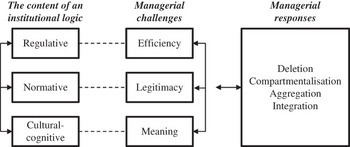
We draw on the framework of Pratt and Foreman (Reference Pratt and Foreman2000), using their classification as a basis from which we analyse our data. The relationships between the content of an institutional logic, the inherent managerial challenges and possible managerial responses are described in our analytical framework, see Figure 1. This analytical framework illustrates our research questions by highlighting the content of institutional logics, the managerial challenges and possible managerial responses in situations where institutional logics meet.
Analytical framework

RESEARCH DESIGN AND RESEARCH METHODS
In order to address our research questions, we focused on how managers in mature organisations in diverse industries describe their experiences in hybrid organisational contexts and how they respond to managerial challenges. Pache and Santos (Reference Pache and Santos2013b: 5) call for ‘a deeper exploration of how individuals get exposed to institutional logics and how they relate to them’. We chose to focus on individuals in managerial positions because managers are exposed to multiple institutional logics in their daily work, for example, when striving to reach goals of efficiency, legitimacy and meaning.
We expect that managers in mature hybrid organisation, that is organisations with a long history of having to cope with logics multiplicity, are able to describe the meetings of institutional logics, the managerial challenges they encounter and how they respond. Mature organisations, after having reached a kind of modus vivendi between different institutional logics, experience externally initiated pressures from new logics such as regulation, national concerns and managerialism. These new pressures may revive or challenge the original institutional logics. Even though challenges inherent in hybrid organisations may be greater for managers in new organisations (Battilana & Dorado, Reference Battilana and Dorado2010), our choice of mature organisations is grounded in their managers’ extensive experience in identifying various meetings between multiple institutional logics. Thus, we expect that they can describe such meetings, the challenges they imply and their responses.
We chose mature organisations that display a variety of multiple institutional logics. As Greenwood et al. (Reference Greenwood, Raynard, Kodeih, Micelotta and Lounsbury2011) show, studies of responses to a multiplicity of logics have focused on one organisation, one sector or one organisational field. In order to capture a greater range of hybridity, we included Norwegian organisations from various sectors in order to identify and compare managerial challenges in different hybrid organisational contexts. The organisations are a public hospital, a municipality and a local savings bank. All organisations are important in their local communities: they have a long history (dating back to 1900, 1926 and 1904, respectively) and can be considered mature organisations that have had to deal with hybridity over long periods of time.
Public hospitals are characterised by strong professional influences. Managers in public hospitals face demands of handling increased expectations of quality of care within severe budget constraints. Municipalities represent an example of public governance. In municipalities, managers tell stories about increasing responsibilities and tasks without increasing budgets. Banks represent an industry in the for-profit sector, which has to comply with increasing national and international regulation in a way that does not compromise goals of profitability. However, in a savings bank, the ownership structure also brings a different institutional logic into the for-profit activities of the bank. On this basis, we expected that managers in these three organisations experience or have experienced challenges in meetings between different institutional logics.
We invited managers from these organisations to participate in focus group interviews as part of a workshop. The main purpose was to ‘facilitate a comprehensive exchange of views in which all participants are able to speak their minds and to respond to the ideas of others’ (Walker, Reference Walker1985: 5). Three of the authors served as process facilitators. The focus group interviews took place in September 2011 and lasted for 3 hours. A total of 12 managers participated: three from the savings bank, four from the municipality and five from the public hospital. The participants included a member of the top management team and middle managers from each organisation. Three of the managers hold master’s degrees, seven hold bachelor’s degrees and two have completed various courses at university level. All managers have varied experience within their organisations spanning from 9 to 28 years, and they were between 37 and 61 years old.
We started by providing a short introduction, explaining the concept of multiple institutional logics and how they may coexist in an organisation. In this introduction, we used language that the participants recognised and tried not to reveal our interpretations of their hybrid contexts. Next, the participants were divided into three focus groups, one for each of the organisations. We asked the focus groups to discuss three questions reflecting our research questions: (1) Have you experienced or do you experience that you must relate to different organisational principles or logics in your daily work? Please give examples; (2) To what degree do you experience this as a managerial challenge?; and (3) How do you handle such managerial challenges?
Next, we rearranged the focus groups by mixing managers from different organisations. In the new focus groups, the participants were unknown to each other and this created new dynamics in the discussions (Patton, Reference Patton2002). The new focus groups were asked to follow up on the three questions by comparing the experiences from the three organisations. Subsequently, the participants reconvened in their first focus groups, discussed the input from others and prepared a presentation, which was to answer the three questions. The main points from the discussions were documented in three ways: first, the participants wrote their main points on large pieces of paper that were provided to each focus group; second, the participants summarised the discussion on flip-overs; and third, the authors made notes during the focus group discussions.
We then analysed the data in several steps. First, all the participants’ notes, which summarised their comments during the discussions, were transcribed verbatim and the researchers wrote out their notes immediately afterwards. Second, data were grouped along organisational lines: the bank, the municipality and the hospital, i.e. the three cases represented in our data set. Third, we categorised the transcripts from each organisation according to our analytical framework. Fourth, we compared the organisations to explore possible relationships between managerial challenges in different meetings of institutional logics, and managers’ responses.
WITHIN-CASE ANALYSIS
In this section, we present our findings where managers themselves describe the multiple institutional logics they meet in their daily work, what kind of managerial challenges these differing principles raise and finally, how they handle them.
The local savings bank
Historically, Norwegian savings banks have played a central part in the development of their local communities by serving the market for households and small and medium-sized businesses (The Norwegian Savings Bank Association, 2014). Norwegian savings banks, like savings banks in other countries, are traditionally organised as foundations. This means that they do not have owners who can demand dividends from the savings bank’s surplus.
The savings bank in our study was established in 1904 and is situated in a medium-sized Norwegian city. The bank has 27 employees (2013). Total assets amount to NOK 2.6 billion in 2010. The bank forms part of a Norwegian savings bank alliance of 79 local savings banks. The bank supports a number of local projects through donations and prizes.
Meetings of institutional logics
The managers from the local savings bank describe a main logic affecting their operations: commercial interests and profits. This main logic is sometimes challenged, which leads to a number of tensions. For example, the managers highlighted the tension between profitmaking, on the one hand, and extensive reporting to The Financial Supervisory Authority of Norway, on the other hand. In their own words, this tension concerns ‘the commercial operations’ versus ‘regulation’. The managers felt that the reporting demands of the Financial Supervisory Authority are too extensive for small banks. At the same time, they know they have no choice but to abide by governmental regulations, notwithstanding that the reporting ‘steals’ time and resources from their commercial activities. Another example concerns tensions between what they describe as ‘the commercial operations’ versus ‘the public purpose’. The local savings bank, in line with savings banks’ traditions, makes contributions annually to different community organisations, which can be interpreted as part of their corporate social responsibility. This would not have been possible without an economic surplus, illustrating that profitmaking and community development are not necessarily incompatible. In addition, this tension is visible when assessing applications for loans from local businesses. On the one hand, the savings bank needs to assess the risks associated with the loan, but, on the other hand, there is a question about developing new jobs in the local community.
Managerial challenges when there is one strong main logic
The managers in the local savings bank express the main challenge connected to the tensions described above as one related to prioritising. By prioritising, they explain a need ‘to allocate time and focus between different tasks’ implied by the business logic and the other ideals they feel obliged to adhere to. The number of tasks and activities is always greater than the time available. Challenges arise because they feel obliged to heed different interests and values, for example, abiding by rules and regulations, reorganisation measures, evaluations of risk and profitability, annual donations to community organisations and the need to uphold their specific identity as a savings bank. Also, the tradition of making donations seems to be so deeply rooted that it could be described as a practice, which is taken for granted, and the reputation lost by cancelling this tradition could be greater than the possible economic gain.
In this case, ‘commercial interests’ seems to be an institutional logic that is built on all three institutional pillars, but where the regulative one is somewhat more prominent than the normative and the cultural–cognitive pillars because of its direct linkage to organisational survival, at least in the short run. The regulative aspect of ‘commercial interests’ is linked to efficiency, since efficiency is necessary in order to be able to pay interest on customer deposits, and to accumulate sufficient capital to balance loans. If the bank is not able to meet these obligations, it will lose customers, and it could also lose the necessary public permission to continue working as a bank. Survival in the long run, however, seems to depend very much on the legitimacy and meaning of profit-making. The local savings bank’s legitimacy survives as long as its operations are carried out in accordance with basic norms in the community. Also, the meaning of banking as a commercial activity is to make profits. At the same time, if profits are made at the expense of customers and community and only serve the interests of banks, legitimacy could evaporate and the basic meaning of what a savings bank is or should be could crumble.
This line of reasoning points to other institutional logics that meet ‘the commercial operations’, namely ‘the public purpose’ of banking and public ‘regulation’. Public purpose logic rests primarily on the normative and cultural–cognitive pillars, while public regulation may be associated with the regulative pillar. Public regulation logic is more legally oriented, securing the interests of savers and customers, rather than securing the interests of the wider local community. The managers in the local savings bank in our study understand the ‘commercial operations’ as a main logic that will guide behaviour, even in situations where other institutional logics come into play. Based on our data, we relate their main managerial challenge of prioritising to instrumentality and efficiency.
Managers’ responses
When it comes to ways of handling the managerial challenges of hybridisation, managers describe two strategies. We have labelled these strategies as the ranking strategy and the multi-tasking strategy. The ranking strategy is exemplified through comments such as ‘the commercial interest has first priority’ and ‘the need to say yes and no’. As to the challenge of time pressure, the managers try to improve their time management through better prioritising. The managers repeated several times that ‘profit making has first priority’. If a ranking strategy is not possible, as in the case of public regulation, one follows a multitasking strategy. The employees have to handle several different areas or tasks and master diverse skills simultaneously. For example, they need to fulfil reporting requirements to the Financial Supervisory Authority while at the same time serving customers.
These responses can be related to Pratt and Foreman’s (Reference Pratt and Foreman2000) strategies of deletion and compartmentalisation. In our study, the managers state that they handle prioritising using a ranking strategy. This implies that the main logic’s definition of efficiency is the one that guides decisions and actions, and that the competing logic’s definition of efficiency is deleted in the sense that it is not top priority. Sometimes it will not be possible or feasible to completely ignore efficiency in the ‘public purpose’ sense. In such a situation, the managers explain that they employ a multitasking approach. This can be compared with compartmentalisation (Pratt & Foreman, Reference Pratt and Foreman2000), which implies that both logics will be taken care of in the performance of different tasks simultaneously or in sequence.
The municipality
The municipalities are the prime implementers of national policy and, as such, integrated parts of the country’s public administration. At the same time, they are separate legal entities, ruled by autonomous, democratically elected bodies and free to take on any tasks they wish, except for those that are assigned to other institutions.
The municipality in this study was established in 1926 and is, in the Norwegian context, characterised as a small one with ∼2,900 inhabitants. The municipality provides its inhabitants with basically the same services as larger municipalities. The services include schools, kindergartens, social services, primary health care, technical infrastructure and fire protection. The municipality’s administration and service-providing bodies are led by the CEO supported by a central staff. In 2011, the municipality had 296 employees contributing 237 man-years (The Norwegian Association of Local and Regional Authorities KS, 2013).
Meetings of institutional logics
The managers of the municipality describe two different meetings of institutional logics. They describe different institutional logics that seem to be of the same relative strength, but unlike the local savings bank, there seems to be a less clear winner. The first meeting concerns the meeting between national, sectored (i.e., divided along ministerial lines) policies versus local autonomy and democracy. Each ministry (Ministry of Education and Research, Ministry of Health and Care Services, etc.) focuses primarily on its own policy without much coordination taking place at the central level. In contrast, municipalities try to mobilise their authority and autonomy to weigh different needs against each other and prioritise their limited means in a coordinated way. The managers explain that this meeting materialises in rights for inhabitants, defined at the national level and expected to be fulfilled at the municipal level but within existing budgets. For example, the managers describe ‘the patients’ right to single rooms at nursing homes’ versus ‘limited municipal budgets’ and ‘the pupils’ right to help with homework’ versus ‘limited municipal budgets’. The second meeting that the managers highlight, is the meeting of the logics of managerialism versus professionalism. The professionals in the municipalities normally represent and advocate the national sectorial logic at the local level, while the municipal CEO plays the role of striving to balance and safeguard the total budget of the municipality. These logics meet when, for instance, professionals press for extra money for special educational support for a child with specific needs, as per the Education Act, while the CEOs refers to their obligations to balance the budget according to the Local Government Act.
Managerial challenges when two strong logics meet
The managers in the municipality describe the main challenge connected to the tensions between these logics mainly as one of conflict of loyalty and identity. Loyalty and identity are, among other things, dependent on which of these logics to adhere to when making decisions on an everyday basis. One of the managers commented dryly on the situation in this way: ‘We often have to decide what law to break today’. The managers describe several decisions where two laws cannot be abided by at the same time. In situations like these, identity may inform which law to prioritise. As the managers explain, these situations are guided by the question ‘who am I?’ For example, ‘am I a teacher or an administrative manager?’. The identity of teacher points to adhering to a professional logic (pupils first) and sector-specific laws, while the identity of administrative managers points to adhering to an administrative logic and the Local Government Act.
The conflict ‘loyal implementers of national policies versus local democratic autonomy’ is closely linked to the intimate and, at times, tense relationship between national government and municipalities. The logic of ‘loyal implementers of national policies’ builds on a solid regulative, normative and cultural–cognitive foundation. The sectors have strong regulative backing in national laws and regulations, they can draw on legitimate norms of equality (equal services for all), and they can base their arguments on professional, specialised knowledge. In such a setting, compliance with national laws and regulations will be interpreted as efficient, successful implementation of national policies that result in equal services for all inhabitants, will be considered legitimate, and implementation based on professionals’ knowledge creates meaning. The logic of ‘local democratic autonomy’ seems to rest on a somewhat weaker foundation (Pettersen & Rose, Reference Pettersen and Rose1997). Autonomy for instance has no formal support in the Norwegian Constitution, and in 1992, the term ‘local autonomy’ was removed from the new Local Government Act and replaced by ‘local democracy’. This implies that the regulative aspect of this institutional logic is weakened. Furthermore, a series of studies have uncovered only medium normative founding for the institutional logic of local autonomy and democracy (Rose & Skare, Reference Rose and Skare1996; Pettersen & Rose, Reference Pettersen and Rose1997; Rose, Reference Rose2011). On the other hand, there seems to be substantial cognitive backing among local politicians, some political parties and local government experts. This implies that even though the regulative and the normative pillars seem to decrease, strong cognitive backing makes the municipal managers in our study understand this as a strong institutional logic. Empirical data shows that the managers understand the meeting between ‘loyal implementers of national policies versus local democratic autonomy’ as one where there is no clear winner as to which institutional logic should guide behaviour. Based on our data, we relate the municipal managers’ main challenge of conflicts of loyalty and identity to appropriateness and legitimacy.
Managers’ responses
Managers in the municipality try to meet the conflict of loyalty and identity in different ways. We have categorised the responses in three strategies labelled stretching, forsaking and clarifying. The stretching strategy describes a situation where the manager tries to adhere to both logics. For example, they describe how they strive to re-prioritise within existing budgets and carefully document the need for increased resources in order to stay in the black. The forsaking strategy could be seen as a prioritising strategy, but with a subtle twist. To openly forsake something is different from choosing something. One of the managers commented that ‘sometimes we have to forsake issues in the right ethical order’ knowing that they deliberately fail to take important things into consideration. The clarifying strategy is used to separate roles and tasks in a way that overcomes the conflicts of loyalty and identity. This strategy is about clarifying and tying roles to one of the logics and giving others responsibility to adhere to the other logic. In other words, this is a conflict-handling strategy, which ensures survival in a situation where two strong logics compete for attention.
Managers’ responses can be related to Pratt and Foreman’s (Reference Pratt and Foreman2000) strategies of deletion and compartmentalisation, but in different ways to the local savings bank. The municipal managers in our study describe that they handle these conflicts of loyalty and meaning by deletion, in the sense of forsaking, and by compartmentalisation, in the sense of stretching and clarifying strategies. In the municipality, the managers describe two equally strong logics which make a ranking strategy, which the local savings bank managers employed, as impossible. Instead they describe that they deliberately have to forsake one logic at the expense of the other when making specific decisions. The two other strategies of stretching and clarifying imply that the managers try to take both logics into consideration in line with the compartmentalisation strategy (Pratt & Foreman, Reference Pratt and Foreman2000).
The hospital
Norwegian hospitals have, for the last 10–15 years, undergone a radical transformation. These changes reflect similar changes in several other countries that are often associated with New Public Management (Greenwood et al., Reference Greenwood, Días, Li and Lorente2010). Thus, in 1997, hospitals were introduced to activity-based financing, which today comprises about 40% of hospital budgets. The calculation of this percentage was linked to the number of patients treated, types of illnesses and length of treatments (the Diagnosis Related Groups system). In 2002, the ownership of public hospitals was transferred from the counties to the state, as part of the Hospital Enterprise Reform, which established a system of regional and local hospital enterprises. These radical changes have introduced new organisational and management accounting principles into the sector.
The hospital in our study was established as a hospital enterprise in 2002, but before that, it had a history dating back to 1900 as a local hospital for the region. In 2007, this and another local hospital were merged with a large university hospital enterprise. The three hospitals in the newly merged hospital are situated 120–300 km apart and have ∼6000 employees as of 2013.
Meetings of institutional logics
The managers of the hospital describe meetings between a new strong logic, which challenges the established strong logics. They describe in particular two meetings of institutional logics: (1) managerialism versus professionalism; and (2) politics versus hospital autonomy. The first meeting is triggered by the reforms’ intent to rationalise the hospital sector, and a strong focus on management control and leadership. This rationalistic view is often in conflict with the strong professional values and identities among professional health workers. Examples described by the managers include ‘management control, indicators, reporting routines and focus on budgets, take time from the treatment of patients’. Another example deals with the priority of building space: ‘for example administrative offices are prioritised over rooms for patients’. The second meeting, politics versus hospital autonomy, is illustrated by ‘new tasks are assigned to hospitals without more money’. This weakens the hospital’s autonomy because they have to follow national political priorities.
Managerial challenges when a new strong logic challenges an established strong logic
First, the managers describe challenges related to prioritising based on professional values. The challenge arises because the priority of patient welfare often exceeds the available budgets. The conflict becomes evident in cases where the patient is cured, which is a success according to the professional logic, but a failure according to the economic logic, because the budget has been exceeded. Second, they also report challenges connected to increasing conflicts of loyalty. Hospital reforms have introduced a new logic based on managerial principles. This is in conflict with the professional values of putting the patient first. However, the conflict of loyalty described by the hospital managers is of a different kind to the municipal managers’ challenge of ‘which law to break today’. Since the central government is directly responsible for the economy of the hospitals, the hospitals do not break any laws by exceeding the budget, as is the case in the municipalities, although they violate their contracts with their Regional Health Authority.
In the hospital, managerialism implies business-like health care while professionalism highlights health care from the perspective of medical professional autonomy (Reay & Hinings, Reference Reay and Hinings2009). Managerialism rests on all three of Scott’s (Reference Scott2001) pillars of institutions. The regulative pillar defines efficiency in terms of economising linked to net income and economic efficiency, the normative aspects connect hospital operations to legitimacy when hospitals succeed in creating an efficient organisation, and the cultural–cognitive pillar is connected to the realisation of production aims and how these aims should be fulfilled. A consequence of the reforms in the hospital sector over the past decade, the regulative aspects of economic efficiency have become very strong and infuse the definitions of legitimacy and meaning. As such, managerialism seems to dominate operations in hospitals. However, professionalism still seems to be a very strong institutional logic that guides the behaviour of health personnel. Professionalism links efficiency to sufficient numbers of qualified health personnel and legitimacy to the professional values and treatment of patients, and the meaning of a hospital is linked to evidence-based patient treatment. The managers in our study understand the meetings between these strong institutional logics, but the logic of professionalism is anchored in their norms, values and actions. As such, professionalism appears to be the winning logic. Based on our data, we relate the hospital managers’ challenge of prioritising to instrumentality and efficiency. We relate their challenge of increasing conflicts of loyalty and identity to appropriateness and legitimacy as well as to orthodoxy and meaning.
Managers’ responses
Based on the managers’ descriptions of how they handle these challenges, we identified two strategies: the ranking strategy and the organisational development strategy. The ranking strategy is similar to that which we found in the local savings bank, but the ‘winning’ logic in this ranking is different. The hospital managers describe this as ‘patient first, then the economy’. The organisational development strategy tries to establish structures and meeting points for managers in different parts of the hospital, in order to promote an understanding of the different logics and to establish developmental projects that over time may unite the logics. For example, they describe the implementation of lean management as a way to organise the treatment of patients in a way that promotes good quality for the patient as well as good economy for the hospital. There are some similarities to the clarifying strategy identified in the municipality, but the organisational development strategy is managed by the organisation in order to establish new organisational principles. In the municipality, the managers describe more explicitly how to solve individual cases.
These responses can be related to Pratt and Foreman’s (Reference Pratt and Foreman2000) strategies of deletion and aggregation. The deletion strategy is similar to the strategy in the context of a strong main institutional logic. The managers state that questions of priority are based on the established institutional logic. Aggregation (Pratt & Foreman, Reference Pratt and Foreman2000) is illustrated by the organisational development strategy, which seeks to unite the logics so that definitions of efficiency, legitimacy and meaning from both logics are taken care of, for example, in new ways of organising the patient flows (or care pathways) throughout the hospital.
A summary of managerial challenges and strategies
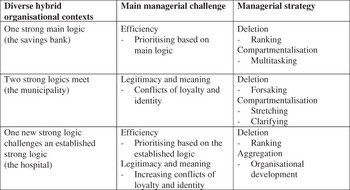
In the theoretical framework, we highlight three different managerial challenges relating to each of Scott’s (Reference Scott2001) three institutional pillars: efficiency, legitimacy and meaning. Our data illustrate that in hybrid settings, managerial challenges can be related to efficiency, legitimacy and meaning, and to the strategies they implement in order to handle these challenges (see Figure 2).
Managerial challenges and strategies in diverse hybrid organisations

BETWEEN-CASE ANALYSIS
In order to better understand the managerial challenges in hybrid organisations, we shift from focusing on each of the individual organisations, to looking at variations and relations across the three cases.
More specifically, we consider the strength of the institutional logics (Jepperson, Reference Jepperson1991) that meet in our empirical setting. A strong logic has well-defined rules, cognitive schemas and shared norms and values (Jepperson, Reference Jepperson1991; Oliver, Reference Oliver1992; Kostova, Reference Kostova1999; Schein, Reference Schein2004). These characteristics of a strong logic relate to Scott’s (Reference Scott2001) three pillars of institutions and entail different managerial challenges: efficiency, legitimacy and meaning. In this section, we compare the managerial challenges and the managers’ responses across three diverse hybrid contexts that we identify through our data. The managerial challenges in these diverse contexts can be understood as a hierarchy of tensions and responses. First, in a hybrid context with a main strong institutional logic guiding behaviour, the main managerial challenge of efficiency is handled by deletion and compartmentalisation. Second, in a hybrid context where two strong logics meet and there is no clear winner as to which institutional logic should guide behaviour, the main managerial challenge of legitimacy is also handled by deletion and compartmentalisation. Third, in a hybrid context where one strong logic challenges an established strong logic, the main managerial challenges of legitimacy and meaning are handled by deletion and aggregation.
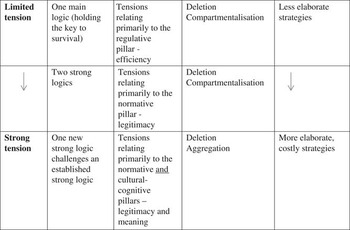
The findings and the analysis between organisations suggest a hierarchy of tensions and responses. The extreme points in this hierarchy are: (1) one main logic and (2) where one new strong logic challenges an established logic. Meetings between one strong central logic and a weaker more peripheral logic seem largely to involve the regulative pillar, raising questions of efficiency or effectiveness. Relevant responses are deletion and compartmentalisation. On the other hand, meetings between two strong logics where one is established and the other is new, seem to involve not just the regulative pillar but increasingly also the normative and cultural–cognitive pillars. Relevant responses include deletion and aggregation strategies that tend to be more open-ended, less time-restricted strategies, that have less certain or immediate outcomes. The hierarchy is shown in Figure 3.
Hierarchy of tensions and strategies

An interpretation of these findings then would be that meetings involving values, norms and professional paradigms tend to be more complicated, more time-consuming, and often unsolvable within the short timeframe of day-to-day operations, and are hence avoided or postponed if possible. Thus, a new and conflicting institutional logic will need to be of some strength and have a certain disruptive capacity in order to overcome the attention threshold and challenge the established logic(s). This capacity could be significantly strengthened if backed by, for instance, statutory regulation.
As an extension to this, we might also reason that managers, for as long as possible, will tend to uphold normalcy beliefs and downplay difficult issues regarding norms, values and paradigms, preferring instead to find pragmatic solutions that will not disrupt operations. To the extent that meetings between strong logics involve different professions (the hospital example) as opposed to different concerns (the savings bank example), the tensions between their differing values, norms and professional paradigms are likely to intensify and potentially erupt into open conflict. The combination of intragroup and intergroup dynamics is hence likely to aggravate conflicts in meetings between different institutional logics.
In day-to-day interaction, people seek to create and uphold a sense of normalcy and predictability (Garfinkel, Reference Garfinkel1967, Reference Garfinkel2002). Through a series of breaching experiments, Garfinkel showed how the failure to reproduce hidden interactional structures resulted in confusion, frustration and in many cases anger (Garfinkel, Reference Garfinkel1967). Thus, a very preliminary hypothesis would be that managers, all things equal, will seek to preserve a sense of normalcy and predictability as far as possible. Issues relating to norms, values and professional paradigms will only erupt in situations where different institutional logics are incompatible and in which both logics are too strong to be ignored, or subsumed under one logic. Thus, drawing on Pratt and Foreman’s (Reference Pratt and Foreman2000) framework, managing identities constitutes only one of several strategies available to managers.
Finally, there is a conspicuous difference between the savings bank, on the one hand, and the two public organisations, i.e. the municipality and the hospital, on the other, when it comes to meetings of logics, managerial challenges and strategies. For the bank, prioritising the commercial logic seems necessary and indisputable since this constitutes its basis for survival. Neither the municipality nor the hospital depends on a single logic for its survival. Although they are autonomous legal entities, they are deeply integrated into public administration and wider political processes. The meetings of different logics in these organisations are, therefore, not isolated phenomena but involve system-wide processes, leaving managers within single entities with much less leeway than in private businesses. These findings illustrate the importance of studying organisations from different industries and sectors in order to uncover how and why they choose different strategies when having to deal with multiple institutional logics.
CONCLUDING COMMENTS
The current paper contributes to our understanding of hybrid organisations by looking at how managers manage hybridity on a day-to-day basis. Whereas much of the literature tends to equate hybridity with change and transience, many hybrid organisations have long been stable organisational fixtures – in some cases for over a century.
Managing hybridity is often likened to managing meaning, or the cultural–cognitive pillar in Scott’s framework. Our study shows the relevance of other institutional pillars. In this article, we argue that managing hybridity extends beyond managing meaning, and that managing meaning may be even less important than issues revolving around efficiency. At the same time, strategies that purport to enhance or produce efficiency may reproduce established norms and meaning structures, yet without questioning the predominant logic. Finally, the paper not only broadens the canvas, it also suggests a tentative hierarchy between different types of meetings and their corresponding strategies.
Previous contributions highlight the roles of sensemaking and identities. Issues of sensemaking and identities may only come to the fore when the incongruence between different logics becomes unmanageable. This suggests a hierarchy of different adaptations, highlighting different institutional pillars and different strategies. Truly understanding the role of identity management actually requires that we understand the relationship between identity-management and other responses to institutional complexity.
The findings, while interesting, have a series of limitations. The focus group interviews only included a limited number of participants. The focus group interviews were organised in a way that produced stories of meetings of institutional logics from each organisation. Even though the participants were recruited to represent various positions in each organisation, the data does not allow us to draw conclusions about each individual manager’s story. Professional experience or background may influence their descriptions of different events in ways that were not captured through the study. Studies of this kind may also be influenced by a desire by participants to present themselves and their organisation in a more favourable light, and thus to tone down conflicts or differences. However, where we find variation, it is in the expected direction and in a form consistent with previous studies. To the extent that people may censor their responses, we may perhaps expect to see even greater conflicts and variation between the different types of organisations.
The study raises a series of new research questions. We recommend carrying out studies that contribute to more insight into the rationale underlying the different responses, or choices between specific responses. The study, moreover, presents a cross-sectional view of three organisations. Ideally we would like to study the relationship between different institutional logics, the corresponding strategies and the effects of such strategies over time. For example, do different strategies tend to reduce possible conflicts, disclose them or enable managers and organisations to reconcile the different strategies?
The findings should be of interest to managers and practitioners, such as the participants in our study. A greater appreciation of different institutional logics, and how they are managed and combined, is likely to be more, not less, important as organisations face a series of demands from a variety of stakeholders both inside and outside the organisation.
Acknowledgements
The authors wish to thank the anonymous reviewers and the editor for their most constructive comments, the participants in the focus group interview for sharing their experiences and participants at the British Academy of Management Conference 2011 for feedback in an early phase of this work.