

Introduction
In potato marketing the form and size of the tubers is crucial for assessing the quality. The tuber size, alongside the cooking type and general intactness is a main feature for the trade (Gröschl, Reference Gröschl2012). For example, if a potato-producing farm markets its tubers to a packaging company, specifications regarding the tuber grades to be supplied may have to be observed. Currently the grading sizes required lie between 35 and 65 mm measure. However, in future preferred grading will shift towards 40 to 60 mm, as this corresponds to the tuber size that German consumers favour (AMI, 2012). The farmer must bear in mind that in the case of such a shift, all tubers that do not meet the requirements of “normal grading” have to be marketed separately and generally achieve lower prices on the market.
Targeted influencing of the yield and the value-determining properties in potato growing could be achieved by altering the spacing during planting. Findings gained in the sugar beet sector demonstrate the potential here (Isensee and Reckleben, Reference Isensee and Reckleben2008). For sugar beets the seed densities influences the form of the beet, yield and sugar yield per hectare. The authors therefore decided to examine the influence of planting width on the yield and the share of marketable produce in a trial of their own.
Materials and methods
In the following trial the planting distance was varied depending on the soil quality and analysed scientifically under practical conditions (Heege, Reference Heege2013). The potato planting machine (Grimme GL34 K, 3 m working width and 75 cm seed row distance) of the trial farm used for this on-farm trial was one that still had to be adjusted mechanically, five strips of 3 m with double repetition and different planting widths were planted constantly over the entire track length. The long-term objective is for the potato planting machine to adapt the planting widths automatically within a row, depending on the soil quality. For this an algorithm must be developed to create the application map and planting equipment and machinery that set the planting widths hydraulically and infinitely variably (Reckleben and Schulz, Reference Reckleben and Schulz2014).
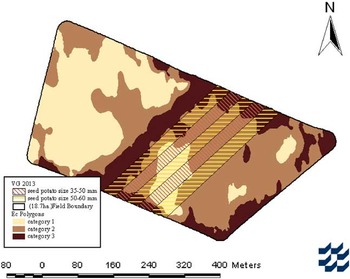
For this experiment the soil properties were recorded using apparent soil electromagnetic conductivity (ECa). The ECa is a measurement of various properties. The clay content, the water content, the nutrient content and the organic substance influence the measurement substantially (Gebbers et al., Reference Gebbers, Lück, Dabas and Domsch2009). The method has been introduced in science and in practice and is used equally by farmers, service providers and experimental institutions to describe the site heterogeneity (Schwark and Reckleben, Reference Schwark and Reckleben2006) (Figure 1).
Test site with EM38-Measurement zones/categories under different seed densities.

Especially in drier years, correlations of measured grain yields and soil conductivities show high coefficients of determination for yield potential estimation too (Reckleben, Reference Reckleben2004; Schwark and Reckleben, Reference Schwark and Reckleben2006; Heege, Reference Heege2013).
The study site is characterised by medium soil quality and is additionally irrigated. In the vegetative period (2013) May to August, precipitation on the field totalled 227 mm, and an additional 200 mm of irrigation was provided in July and August. The temperatures in this period were on average 16.2 °C.
For the trial the EM38 measurements, which fluctuated on the field in a range of 11 to 29 mS/m, were interpolated in a GIS using kriging (Webster and Oliver Reference Webster and Oliver2001) and subsequently classified into three soil classes of the same width. Class 1 stands for the lightest and Class 3 for the heaviest soil type on the trial field.
The farm’s customary planting width of 27.5 cm was varied for the experiment – by up to 8 cm downwards and up to 9 cm upwards (Table 1). The planting widths were selected on the basis of the farm manager’s experience and initially planting was carried out in strips over the field sections.
Seed potato size and planting width on the row in field trials from 2013 to 2015

* The farms customary planting width
All further practices such as irrigation, fertilising and plant protection were always carried out constantly on all field subsections. The field sections were harvested in a number of sub-steps. On 20 and 21 September 2013 the areas in front of and behind the 30 parcels were exposed by hand and the tubers were then lifted from the ridge with a two-row lifter. After this the tubers were picked by hand and bagged. Two weeks later they were graded and subsequently weighed. The yield shares of the grading’s <40 mm, 40–60 mm and >60 mm were determined. In the following years 2014 and 2015 the planting machine was replaced by a new Grimme GL 420 with a hydraulic drive for every planting element (3 m, 4 rows). The parcels were picked also by hand and bagged. In addition a yield measurement system was installed on the potato harvester. This yield monitor is a belt weighting system YM410 (Trumpf, Reference Trumpf2016) supplied by SoilEssentials Ltd (Brechin, UK).
Results
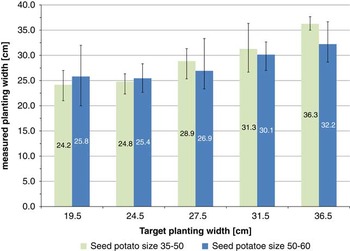
The planting widths were checked again after planting. It was found that for both planting material types a planting width of 19.5 cm could not be achieved (Figure 2)–the lowest case was 24.5 cm and the highest 25.5 cm, attributable to an excessively high planting speed for this planting size. The planting width of 19.5 cm was therefore not considered further.
Difference between target planting width and realized planting width.

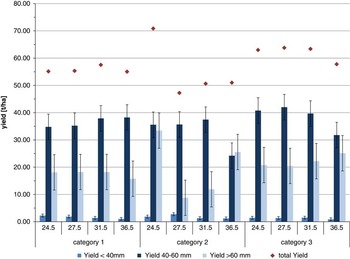
As regards the gross yield of potatoes harvested from the different soil categories, differences can be established both for the planting material grading 35–50 mm and the grading 50–60 mm. However, as not only the overall yield is significant in potato growing, it is necessary to examine the yield composition of the various grade sizes more exactly. For this purpose, Figure 3 shows the results of the planting material lot 35–50 mm as a function of the respective planting width and soil category.
Yield results 2013 in different planting width on the three soil classes for seed potato size 35–50 mm.

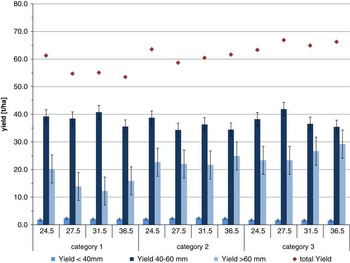
Figure 3 show that the share of tubers <40 mm in the planting material grade 35–50 mm fluctuates between 0.9 and 2.8 t/ha. The yields within the calibration range 40–60 mm also vary strongly–depending on the soil class and planting width, between 24.2 and 42 t/ha. Considerable differences can also be seen in the yields of grading size >60 mm. In some field sections only 8.8 t/ha oversized tubers and in others up to 33.4 t/ha were harvested. Differences in the yield compositions can also be seen in the different soil classes and planting widths for the planting material grade 50–60 mm (Fig. 4).
Yield results 2014 in different planting width on the three soil classes for seed potato size 50–60 mm.

The harvested quantities of undersized tubers for this planting material grade lay between 1.6 and 2.4 t/ha. The standard deviation of 0.31 t/ha here lies well below that of the smaller planting material grade at 0.54 t/ha. The standard deviation of the normal grade for this planting material grade also lies below the standard deviation for the normal grade of smaller planting material sizes: with yields between 34.3 and 41.9 t/ha the standard deviation for this grading is 2.44 t/ha, while for the smaller planting material grade it was 4.69 t/ha. For the yields of the oversized tubers, the standard deviation of the planting material grade 50–60 mm is also distinctly smaller than that of the smaller planting material grade. With oversize yields between 12.2 and 29.2 t/ha, the standard deviation is 5.07 t/ha. By comparison, that of the oversize yields of the smaller planting material grade was 6.49 t/ha. Optimal planting widths on the three soil classes were found to be 31.5 cm on the light locations, 24.5 cm on the medium locations and 27.5 cm on the heavy locations.
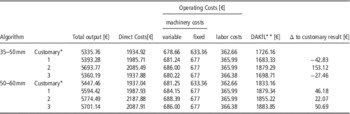
Building on these data, different planting algorithms were developed in order to compare the cost-efficiency of this working method in different market situations. Algorithm 3 is directed solely to the yields of the normal grading, algorithm 2 to the yields of grading 40+ (>40 mm), and a third to specifications of the farm manager, who would vary planting between 27 and 34 cm, as at narrower spacing the planting material costs rise steeply, and at wider spacing the risk of failures or weed competition increases.
For the economic assessment of the precision method, all algorithms were related to the costs and performance (farm data) that had been determined with the aid of the trial. From this all variants of performance after deducting direct operating (input and machinery) costs (German acronym DAKfL) could be determined and compared with farming without precision planting (Table 2), customary 1 and 2.
Performance of different economic scenarios

* Not site specific
** Performance after deducting direct and operating costs
The performance after deducting direct operating (input and machinery) costs is calculated from the market performance, from which the direct costs, the variable and fixed work performance costs and the personnel costs are deducted. The costs of work performance and personnel costs of the precision variants vary in some items by comparison with the customary variants. The following costs were supplemented or adapted: The EM 38 mapping, the creation of an application map, GIS software, a GPS aerial, the machinery costs for a hydraulically powered planting machine and a potato harvester with yield recording for monitoring the result. As these costs can partly be divided among other production methods too, they only account for about € 50 extra per hectare. On the other hand, higher additional costs are caused by a higher planting material requirement for planting widths that are narrower than the customary 27.5 cm at the site. By way of example, for the planting algorithm 3 of planting material calibration 50–60 mm, these costs account for an extra 150 €/ha, as long as planting is carried out at 31.5 cm on light field sections, 24.5 cm on medium field sections and 27.5 cm on heavy field sections. Thus for this variant altogether about 200 €/ha extra had to be earned in order to achieve the same performance after deducting direct operating (input and machinery) costs as without precision farming. In this first experiment, it proved possible to cover these extra costs and a further 50 €/ha of performance after deducting direct operating costs was achieved.
As the potato market has a great influence on the prices and thus also on the performance after deducting direct operating costs, the results can vary considerably if the prices on both the cost side and the yield side change. That is why all algorithms were subjected to a stability test in order to simulate the effects of changing producer or planting material prices. In the same way, the effects of more difficult marketing opportunities for different tuber grades were examined. For example, years in which oversizes can be sold at higher prices on the free market were also examined.
In this stability analysis, four of the six precision farming variants outstrip the variants of growing without precision farming. Above all the planting material grade 50–60 mm comes off better in all precision variants than in the customary variant. This makes it clear that such a working method has great potential for increasing the share of normal size tubers and hence of maintaining or even improving the commercial success of the operation.
Conclusions
After three years of investigation, planting widths of 31.5 cm on light soil, 24.5 cm on medium soil and 27.5 cm on the heavy soil sections proved to be optimal for both planting material lots. Both the overall yield and the share of marketable produce were improved. Depending on the strategy applied, differences compared with the results customary so far of up to € 153 per hectare higher earnings can be achieved in the planting material grade 35–50 mm. In the planting material grade 50–60 mm, the precision adjustments of the planting widths led to higher performance after deducting direct operating costs of € 50 per hectare.