Introduction
Early trauma is linked to a higher prevalence of bipolar (Daruy-Filho et al. Reference Daruy-Filho, Brietzke, Lafer and Grassi-Oliveira2011; Aas et al. Reference Aas, Henry, Andreassen, Bellivier, Melle and Etain2016b ; Agnew-Blais & Danese, Reference Agnew-Blais and Danese2016; Palmier-Claus et al. Reference Palmier-Claus, Berry, Bucci, Mansell and Varese2016) and psychotic (Varese et al. Reference Varese, Smeets, Drukker, Lieverse, Lataster, Viechtbauer, Read, van Os and Bentall2012; Bonoldi et al. Reference Bonoldi, Simeone, Rocchetti, Codjoe, Rossi, Gambi, Balottin, Caverzasi, Politi and Fusar-Poli2013; Gibson et al. Reference Gibson, Alloy and Ellman2016; Longden and Read, Reference Longden and Read2016) disorders, and a more severe course and outcome. Individuals with bipolar and psychotic disorders and early trauma report more severe symptoms (Garno et al. Reference Garno, Goldberg, Ramirez and Ritzler2005; Daruy-Filho et al. Reference Daruy-Filho, Brietzke, Lafer and Grassi-Oliveira2011; McCabe et al. Reference McCabe, Maloney, Stain, Loughland and Carr2012; van Dam et al. Reference van Dam, van Nierop, Viechtbauer, Velthorst, van Winkel, Bruggeman, Cahn, de Haan, Kahn, Meijer, Myin-Germeys, van Os and Wiersma2015; Aas et al. Reference Aas, Andreassen, Aminoff, Færden, Romm, Nesvåg, Berg, Simonsen, Agartz and Melle2016a ), in particular more mood episodes (Garno et al. Reference Garno, Goldberg, Ramirez and Ritzler2005; Etain et al. Reference Etain, Aas, Andreassen, Lorentzen, Dieset, Gard, Kahn, Bellivier, Leboyer, Melle and Henry2013; Agnew-Blais & Danese, Reference Agnew-Blais and Danese2016) and psychotic features (Hammersley et al. Reference Hammersley, Dias, Todd, Bowen-Jones, Reilly and Bentall2003; Upthegrove et al. Reference Upthegrove, Chard, Jones, Gordon-Smith, Forty, Jones and Craddock2015; Etain et al. Reference Etain, Lajnef, Bellivier, Henry, M'Bailara, Kahn, Leboyer and Fisher2017) in bipolar disorder, and higher levels of depression in psychotic disorders (van Nierop et al. Reference van Nierop, Viechtbauer, Gunther, van Zelst, de Graaf, ten Have, van Dorsselaer, Bak and van Winkel2014b; van Dam et al. Reference van Dam, van Nierop, Viechtbauer, Velthorst, van Winkel, Bruggeman, Cahn, de Haan, Kahn, Meijer, Myin-Germeys, van Os and Wiersma2015; Aas et al. Reference Aas, Andreassen, Aminoff, Færden, Romm, Nesvåg, Berg, Simonsen, Agartz and Melle2016a ). Early trauma is thought to be important in the aetiology of both affective and psychotic disorders (Matheson et al. Reference Matheson, Shepherd, Pinchbeck, Laurens and Carr2012), and patients with experiences of early trauma experiences seem to develop an illness characterised by combinations of multiple symptom domains, including depression, mania, anxiety and psychosis (van Nierop et al. Reference van Nierop, Viechtbauer, Gunther, van Zelst, de Graaf, ten Have, van Dorsselaer, Bak and van Winkel2014b ). A recent study indicates that early trauma and psychotic symptoms could be linked through affective symptoms (Isvoranu et al. Reference Isvoranu, van Borkulo, Boyette, Wigman, Vinkers, Borsboom and Investigators2017), emphasising that research needs to consider the interplay between these areas. However, despite the evidence of a relationship between early trauma and bipolar and psychotic disorders – and its clear clinical relevance – relatively few studies have focused on the mechanisms connecting early trauma and clinical outcomes across the disorders (Gibson et al. Reference Gibson, Alloy and Ellman2016).
It has been theorised that mechanisms linking early trauma, depression and psychosis could involve unhelpful cognitive emotional regulation strategies, including rumination and worry (Upthegrove et al. Reference Upthegrove, Marwaha and Birchwood2017). This is in line with the self-regulatory executive function (S-REF) model (Wells & Matthews, Reference Wells and Matthews1996), which proposes that individuals vulnerable to affective instability hold more unhelpful metacognitive beliefs – i.e. assumptions that outline the perceived importance or consequences of specific thoughts (Wells & Matthews, Reference Wells and Matthews1996). When responding to unwanted cognitive or emotional experiences, metacognitive beliefs trigger a counterproductive cognitive style where threat-focused attention and ineffective coping strategies such as rumination and worry strain-limited cognitive resources. This cognitive style may thus prolong emotional distress. Patients with bipolar and psychotic disorders report more unhelpful metacognitive beliefs than healthy controls (Varese & Bentall, Reference Varese and Bentall2011; Sarisoy et al. Reference Sarisoy, Pazvantoğlu, Özturan, Ay, Yilman, Mor, Korkmaz, Kaçar and Gümüş2013; Batmaz et al. Reference Batmaz, Kaymak, Kocbiyik and Turkcapar2014; Østefjells et al. Reference Østefjells, Melle, Hagen, Romm, Sönmez, Andreassen and Røssberg2015; Sellers et al. Reference Sellers, Varese, Wells and Morrison2016; Østefjells et al. Reference Østefjells, Melle, Aminoff, Hellvin, Hagen, Lagerberg, Lystad and Røssberg2017). Further, specific metacognitive beliefs about thoughts being uncontrollable or dangerous are linked to, or contribute to, higher levels of anxiety and depression in both bipolar and psychotic disorders (Sarisoy et al. Reference Sarisoy, Pazvantoğlu, Özturan, Ay, Yilman, Mor, Korkmaz, Kaçar and Gümüş2013; van Oosterhout et al. Reference van Oosterhout, Krabbendam, Smeets and van der Gaag2013; Batmaz et al. Reference Batmaz, Kaymak, Kocbiyik and Turkcapar2014; Bortolon et al. Reference Bortolon, Larøi, Stephan, Capdevielle, Yazbek, Boulenger, Gely-Nargeot and Raffard2014; Østefjells et al. Reference Østefjells, Melle, Hagen, Romm, Sönmez, Andreassen and Røssberg2015; Østefjells et al. Reference Østefjells, Melle, Aminoff, Hellvin, Hagen, Lagerberg, Lystad and Røssberg2017).
Metacognitive abilities mature gradually within normal cognitive development (Kuhn, Reference Kuhn2000), and could thus potentially be influenced by early trauma experiences. While this relationship remains largely unexplored, four studies offer corroborating evidence: A study of patients with bipolar and psychotic disorders found that those with a history of trauma reported more beliefs about thoughts being uncontrollable or dangerous, compared with patients without a trauma history (Scherer-Dickson, Reference Scherer-Dickson2010). Rumination, which is part of the dysfunctional regulation in the S-REF model, mediated the relationship between early emotional abuse and symptoms of depression in children (Raes & Hermans, Reference Raes and Hermans2008) and college freshmen (Spasojevic & Alloy, Reference Spasojevic and Alloy2002). Metacognitive beliefs about thoughts are uncontrollable and dangerous have indeed been shown to mediate affective responses to early emotional abuse in a non-clinical sample (Myers & Wells, Reference Myers and Wells2015). This raises the question of whether a similar relationship can be found in clinical populations.
In summary, the literature supports a complex relationship between early trauma, the symptomatology of bipolar and psychotic disorders and metacognitive beliefs. However, studies in bipolar and psychotic disorders have often overlooked emotional abuse (Daruy-Filho et al. Reference Daruy-Filho, Brietzke, Lafer and Grassi-Oliveira2011; Varese et al. Reference Varese, Smeets, Drukker, Lieverse, Lataster, Viechtbauer, Read, van Os and Bentall2012). Including early emotional abuse is important, as reviews indicate that this trauma subtype might be a particularly strong predictor of both bipolar (Palmier-Claus et al. Reference Palmier-Claus, Berry, Bucci, Mansell and Varese2016) and psychotic (Varese et al. Reference Varese, Smeets, Drukker, Lieverse, Lataster, Viechtbauer, Read, van Os and Bentall2012; Gibson et al. Reference Gibson, Alloy and Ellman2016) disorders. Emotional abuse also consistently relates to cognitive emotion regulation strategies, including metacognitive beliefs, suggesting it might be of particular relevance to affective dysregulation. There is thus an evidence-based rationale to expect metacognitive beliefs to mediate the relationship between early emotional abuse and affective symptoms. Given that affective symptoms link early trauma and positive symptoms it is further possible that affective symptoms mediate the effect of early emotional abuse on psychotic symptoms in bipolar and psychotic disorders. In light of this, the primary aims of the current study were to examine the relationships between early trauma, metacognitive beliefs and clinical symptoms of depression/anxiety and psychosis in patients with bipolar and psychotic disorders. Gender composition has been related to diagnostic group in previous studies we have conducted with overlapping samples (Østefjells et al. Reference Østefjells, Melle, Hagen, Romm, Sönmez, Andreassen and Røssberg2015; Østefjells et al. Reference Østefjells, Melle, Aminoff, Hellvin, Hagen, Lagerberg, Lystad and Røssberg2017), and symptoms of depression/anxiety and psychosis might not be equally distributed between patients with bipolar and psychotic disorders. There is also some indication that metacognitive beliefs might be linked to positive symptoms in more chronic samples (Austin et al. Reference Austin, Mors, Nordentoft, Hjorthøj, Secher, Hesse, Hagen, Spada and Wells2015), but not necessarily in early psychosis when controlling for depression/anxiety (Østefjells et al. Reference Østefjells, Melle, Hagen, Romm, Sönmez, Andreassen and Røssberg2015). Gender, main diagnostic group and duration of treatment should therefore be controlled for as potential confounders. More specifically, we aimed to answer the following research questions:
-
(1) Do metacognitive beliefs mediate the effect of early emotional abuse on symptoms of depression/anxiety, when controlling for relevant confounders?
-
(2) Do metacognitive beliefs and symptoms of depression/anxiety mediate the effect of early emotional abuse on positive symptoms, when controlling for relevant confounders?
Method
Participants
Participants were recruited through the on-going multi-centre Thematically Organised Psychosis (TOP) Study at NORMENT KG Jebsen Centre for Psychosis Research at Oslo University Hospital and the University of Oslo. Inclusion criteria were age 18–65 and a primary diagnosis of a bipolar disorder [bipolar types I, II, or not otherwise specified (NOS)] or a psychotic disorder (schizophrenia, schizophreniform disorder, schizoaffective disorder, delusional disorder, brief psychotic disorder or psychosis NOS) based on the Diagnostic and Statistical Manual of Mental Disorders, fourth edition (DSM-IV) (APA, 1994). Participants also had to be able to give informed consent, and speak a Scandinavian language. Exclusion criteria were a history of severe head injury, neurological or developmental disorders, or IQ <70. The TOP study is completed in accordance with the Helsinki Declaration, and is approved by the Regional Ethics Committee and the Norwegian Data Protection Authority.
Measurements
Diagnosis was assessed with the structured clinical interview for the DSM-IV, axis I disorders (APA, 1994).
Global functioning was measured by the Global Assessment of Functioning (GAF) scale (Endicott et al. Reference Endicott, Spitzer, Fleiss and Cohen1976), split version (Pedersen et al. Reference Pedersen, Hagtvet and Karterud2007), where symptoms and function are assessed separately.
Early trauma experiences were self-rated with the Norwegian translation of The Childhood Trauma Questionnaire-Short Form (CTQ-SF) (Bernstein et al. Reference Bernstein, Stein, Newcomb, Walker, Pogge, Ahluvalia, Stokes, Handelsman, Medrano, Desmond and Zule2003), using a 5-point scale ranging from 1 (never true) to 5 (very often true). It measures five distinct traumatic experiences (emotional, physical and sexual abuse, and emotional and physical neglect) before the age of 18, with subscales ranging from 5 to 25. A higher score indicates more frequent trauma experiences. This study used the emotional abuse subscale for detailed analysis. The authors have suggested cut-off scores to classify frequency of emotional abuse into categories of none, mild, moderate, severe or extreme. We defined presence of emotional abuse (EA+) as a classification of moderate or higher (i.e. scores of 13–25), while participants who reported no or mild levels (i.e. scores ⩽ 12) were classified as not having experienced emotional abuse (EA−). Internal consistency for the emotional abuse subscale was strong in our sample, with a Cronbach's alpha of 0.87.
Current symptoms were assessed with the Positive and Negative Syndrome Scale Score (PANSS) (Kay et al. Reference Kay, Fiszbein and Opler1987). Items are clinician-rated ranging from 1 (not present) to 7 (severe impairment), assessing the past seven days. The present study used two of the five factors suggested by a consensus structure (Wallwork et al. Reference Wallwork, Fortgang, Hashimoto, Weinberger and Dickinson2012), namely the depression/anxiety subscale (items G2, G3, G6) and the positive symptoms subscale (items P1, P3, P5, G9). Mean item scores are reported for each subscale (range 1–7).
Duration of treatment was defined as months of treatment prior to inclusion in the study. Treatment was defined as starting at first treatment contact with primary or secondary health services, or start of adequate medication, that explicitly targeted a psychotic or bipolar disorder.
Metacognitive beliefs were self-rated with the Norwegian translation of the Metacognitions Questionnaire-30 items (MCQ-30) (Wells & Cartwright-Hatton, Reference Wells and Cartwright-Hatton2004), using a 4-point scale ranging from 1 (Do not agree) to 4 (Agree very much). The MCQ-30 comprises five subscales representing distinct metacognitive beliefs (positive beliefs about worry; negative beliefs about the uncontrollability and danger of worry thoughts; cognitive confidence; beliefs about the need to control thoughts; and cognitive self-consciousness). In this study, we only used the subscale measuring negative beliefs about the uncontrollability and danger of thoughts (MCQ-UD), because it assesses metacognitions found in most forms of distress (Wells, Reference Wells, Briñol and DeMarree2012), and is thus likely to be relevant to both outcome variables. This also allows a direct comparison with the study showing that such metacognitive beliefs mediated the effect of early emotional abuse on general negative beliefs in a non-clinical population (Myers & Wells, Reference Myers and Wells2015). The subscale score ranges from 6 to 24, and a higher score indicates more unhelpful beliefs about thoughts being uncontrollable or dangerous.
Procedures
Patients were interviewed by clinical psychologists or psychiatrists/MDs in psychiatric training, who had completed general training and reliability checks for the TOP Study protocol, using the UCLA programme (Ventura et al. Reference Ventura, Liberman, Green, Shaner and Mintz1998). For DSM-IV diagnostics, mean overall κ was 0.77 for both training videos and a randomly drawn subset of actual study patients [confidence interval (CI) 0.60 to 0.94]). Healthy control participants were screened by trained research assistants over the phone to establish eligibility for study participation. Those eligible were later assessed in person by the clinical interviewers.
Missing data
Three patients had a missing item on MCQ-UD; these were replaced with the individual's relevant subscale mean. Six patients had at least one missing item on the CTQ emotional abuse subscale. To prevent inflated rates of trauma experiences, missing items were assumed to not have been present and scored at the lowest value. Duration of treatment was unknown for six patients, which excluded them from the mediation analyses when this confounder was included.
Data analysis
Analyses were conducted using IBM SPSS v. 22 (IBM, 2013) with the addition of the PROCESS tool for mediation/moderation analyses (Hayes, Reference Hayes2013). Significance level was 5% for all analyses. Differences between the two diagnostic groups (bipolar v. psychotic disorder) in gender and group assignment of level of emotional abuse (EA− v. EA+) were analysed with Chi-square tests, while differences in metacognitive beliefs were assessed with a t test. Correlations between CTQ, MCQ-UD and other characteristics were calculated using Spearman's rank correlations (r s).
The role of early emotional abuse in metacognitive beliefs in relationship to other childhood early trauma subtypes was explored in a linear regression analysis where MCQ-UD was the dependent variable and all five subtypes of early trauma (scales) were entered simultaneously as independent variables.
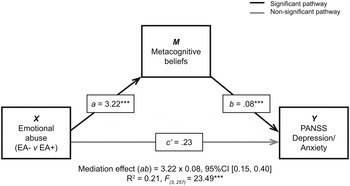
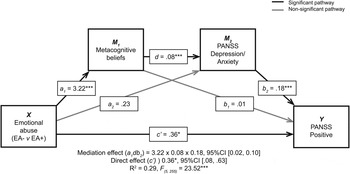
Two mediation analyses were conducted using ordinary least-squares regressions with PROCESS (see Figures 1 and 2 for conceptual diagrams). The first analysis examined whether metacognitive beliefs mediated the relationship between early emotional trauma and symptoms of depression/anxiety in a simple mediation model. The second analysis examined whether metacognitive beliefs and symptoms of depression/anxiety mediated the relationship between early emotional trauma and positive symptoms in a serial mediation model. For mediation analyses, bias-corrected confidence intervals (CIBC) for formal tests of direct and indirect effects were calculated with a bootstrapping procedure, with iteration set to 10 000 (as recommended by Hayes, Reference Hayes2013). Standard errors (s.e.) were heteroscedasticity-consistent for scale variables. Initial analyses of tentative models included a direct model in which emotional abuse predicted the outcome variable alone (PANSS depression/anxiety and PANSS positive, respectively), and mediation models where gender, main diagnostic group and duration of treatment were included as possible covariates. The mediation model was then re-estimated for each of the two analyses, including only confounders that contributed to the indirect or total effect (i.e. the first model statistically controlled for the effect of gender, while the second model controlled for gender and diagnostic group). The results reported in Section 3 are from the re-estimated models, contrasted with the direct models. To aid interpretation, scales that did not include the value zero were rescaled before analyses to make zero the lowest value (i.e. PANSS scores used in analyses ranged 0–6, and MCQ-UD was rescaled to 0–18).
The effect of emotional abuse on symptoms of depression is mediated through specific metacognitive beliefs about thoughts being uncontrollable/dangerous, controlling for gender. Path coefficients are unstandardised. ***p < 0.001.

The effect of emotional abuse on positive symptoms is mediated through specific metacognitive beliefs about thoughts being uncontrollable/dangerous and symptoms of depression/anxiety, controlling for gender and core diagnosis. Path coefficients are unstandardised. ***p < 0.001, *p < 0.05.

Results
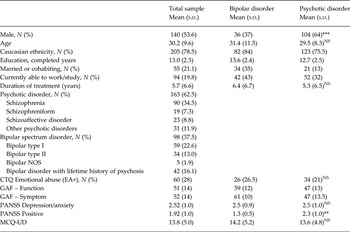
A total of 261 patients met inclusion criteria for the current study. Table 1 summarises the demographic and clinical characteristics of the sample, and group comparisons. A total of 73 patients were currently clinically depressed, as defined by PANSS G6 Depression ⩾4 (bipolar disorder = 32; psychotic disorder = 41).
Demographic and clinical characteristics

CTQ, Childhood Trauma Questionnaire; GAF, Global Assessment of Functioning Scale; MCQ-DU, Metacognitions Questionnaire – Beliefs about thoughts being uncontrollable or dangerous; NOS, not otherwise specified; PANSS, Positive and Negative Syndrome Scale; s.d., standard deviation.
***p < 0.001; **p < 0.01; NS, not significant. Comparisons without notes were not tested.
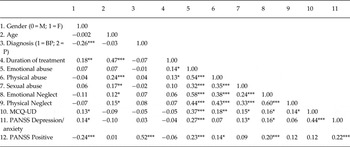
Bivariate correlations are reported in Table 2. Of note, we found weak but significant positive relationships between levels of emotional abuse and metacognitive beliefs (r s = 0.37), symptoms of depression/anxiety (r s = 0.27) and positive symptoms (r s = 0.23). All subtypes of trauma correlated significantly with metacognitive beliefs, but only emotional abuse and neglect showed additional relationships with both depression/anxiety and positive symptoms.
Bivariate correlations (Spearman's ρ)

BP, bipolar disorder; F, female; M, male; MCQ-UD, Metacognitive Beliefs Questionnaire – Beliefs about thoughts being uncontrollable or dangerous; P, psychotic disorder; PANSS, Positive and Negative Symptoms Scale.
* p < 0.05, ** p < 0.01, *** p < 0.001.
A linear regression analysis with MCQ-UD as the dependent variable and all five subtypes of early trauma (scales) entered simultaneously as independent variables showed that early trauma significantly influenced variance in MCQ-UD (F = 7.4, p < 0.001) with emotional abuse as the only significant variable (B = 0.42, CI95% 0.24 to 0.61). The results did not differ substantially if gender and diagnostic group were included in the analysis.
Figure 1 illustrates the first mediation analysis, and shows that early emotional abuse influenced levels of depression/anxiety through its effect on metacognitive beliefs, when controlling for gender as a potential confounder. Patients with EA+ had increased scores on metacognitive beliefs (a = 3.22, CIBC = 1.9 to 4.6). Patients with higher metacognitive beliefs reported increased symptoms of depression/anxiety (b = 0.08, CIBC = 0.06 to 0.10). Both the indirect effect (ab = 0.26, CIBC = 0.15 to 0.40) and the total effect of the model was significant (0.46, s.e. 0.14, CIBC = 0.20 to 0.75). There was no evidence that early emotional abuse influenced symptoms of depression/anxiety independent of its effect on metacognitive beliefs (c′ = ns). Female gender was associated with higher beliefs about thoughts being uncontrollable/dangerous (1.3, CIBC = 1.3 to 2.5), but did not influence levels of depression/anxiety. Compared with the direct model where emotional abuse predicted depression/anxiety alone (0.48, R 2 = 0.04, p = 0.001), the mediation model explained a much larger variance (R 2 = 0.21, p < 0.001).
Figure 2 shows that early emotional abuse indirectly influenced levels of positive symptoms through its effect on beliefs about thoughts being uncontrollable or dangerous, and a further effect of beliefs about thoughts being uncontrollable/dangerous on symptoms of depression/anxiety, when controlling for gender and diagnostic group as potential confounders. Patients with EA+ had increased levels of metacognitive beliefs (a 1 = 3.22, CIBC = 1.9 to 4.6). Patients with higher metacognitive beliefs further reported increased symptoms of depression/anxiety (d = 0.08, CIBC = 0.06 to 0.10). Patients with higher levels of depression/anxiety in turn reported more positive symptoms (b 2 = 0.18, CIBC = 0.06 to 0.30). Both the indirect effect (a 1 db 2 = 0.05, CIBC = 0.02 to 0.10) and the total effect (0.46, s.e. 0.14, CIBC = 0.19 to 0.75) of the model was significant. There was no evidence that early emotional abuse influenced positive symptoms through metacognitive beliefs alone (a 1 b 1 = 0.02, CIBC = −0.05 to 0.10) or through depression/anxiety alone (a 2 b 2 = 0.04, CIBC = −0.0003 to 0.12). Early emotional abuse still influenced positive symptoms independent of the indirect effects (c′ = 0.36, CIBC = 0.08 to 0.64). Female gender was associated with higher levels of beliefs about thoughts being uncontrollable/dangerous (1.3, CIBC = 1.3 to 2.5) and lower levels of positive symptoms (−0.23, CIBC = −0.45 to −0.02), but did not influence levels of depression/anxiety. Patients with a psychosis spectrum diagnosis had more positive symptoms (0.88, CIBC = 0.69 to 1.1), but diagnosis did not influence levels of metacognitive beliefs or symptoms of depression/anxiety. Compared with the direct effect model where emotional abuse predicted positive symptoms alone (0.39, R 2 = 0.03, p = 0.02), the mediation model explained a much larger variance (R 2 = 0.29, p < 0.001).
Discussion
This study is the first to demonstrate that metacognitive beliefs mediate the effect of early emotional abuse on depression/anxiety and positive symptoms in a large sample of individuals with bipolar and psychotic disorders. Our results suggest that specific metacognitive beliefs about thoughts being uncontrollable/dangerous function as a mechanism through which early trauma influences levels of depression/anxiety, and in turn, positive symptoms of psychosis. This replicates the findings by Myers & Wells (Reference Myers and Wells2015) in patients with bipolar and psychotic disorders, and expands on previous research showing an intrinsic relationship between metacognitive beliefs and affective symptoms in severe mental disorders (Varese & Bentall, Reference Varese and Bentall2011; Sarisoy et al. Reference Sarisoy, Pazvantoğlu, Özturan, Ay, Yilman, Mor, Korkmaz, Kaçar and Gümüş2013; van Oosterhout et al. Reference van Oosterhout, Krabbendam, Smeets and van der Gaag2013; Batmaz et al. Reference Batmaz, Kaymak, Kocbiyik and Turkcapar2014; Bortolon et al. Reference Bortolon, Larøi, Stephan, Capdevielle, Yazbek, Boulenger, Gely-Nargeot and Raffard2014; Østefjells et al. Reference Østefjells, Melle, Hagen, Romm, Sönmez, Andreassen and Røssberg2015; Østefjells et al. Reference Østefjells, Melle, Aminoff, Hellvin, Hagen, Lagerberg, Lystad and Røssberg2017). The results are consistent with the S-REF model, which proposes that negative experiences can activate unhelpful metacognitive processes that in turn cause prolonged negative emotions. It is, however, of note that the indirect effect of metacognitive beliefs accounts for substantially less of the variance in depression/anxiety in our clinical sample than the findings by Myers and Wells in their non-clinical sample (21 v. 56%). It is possible that that the link between early emotional abuse and depression/anxiety may be more complex in established severe mental disorders. While Myers and Wells found that beliefs about uncontrollability/danger were only linked to emotional abuse, our correlational analyses show that all types of trauma were linked to metacognitive beliefs. Emotional abuse and neglect were additionally both linked to depression/anxiety and positive symptoms. Patients with severe mental disorders often report multiple traumas (Janssen et al. Reference Janssen, Krabbendam, Bak, Hanssen, Vollebergh, De and Van2004; Etain et al. Reference Etain, Mathieu, Henry, Raust, Roy, Germain, Leboyer and Bellivier2010; Trauelsen et al. Reference Trauelsen, Bendall, Jansen, Nielsen, Pedersen, Trier, Haahr and Simonsen2015), and bipolar and psychotic episodes can constitute traumatic experiences in themselves (Kennedy et al. Reference Kennedy, Dhaliwal, Pedley, Sahner, Greenberg and Manshadi2002). It is therefore possible that early emotional abuse only captures part of the traumatic experiences that can contribute to depression and anxiety in our sample, though the regression analysis indicates that this is the most important trauma subtype in our sample. Depression/anxiety and positive symptoms are also present in patients with bipolar and psychotic disorders who have not experienced early trauma.
Emotional abuse seems to be a specific predictor of bipolar disorders (Etain et al. Reference Etain, Mathieu, Henry, Raust, Roy, Germain, Leboyer and Bellivier2010; Palmier-Claus et al. Reference Palmier-Claus, Berry, Bucci, Mansell and Varese2016), and is increasingly acknowledged in psychotic disorders (Gibson et al. Reference Gibson, Alloy and Ellman2016), but few studies have aimed to elucidate its effect in psychosis. Our results indicate that early emotional abuse is relevant for affective symptoms in psychotic disorders. Further, the effect of early emotional abuse on positive symptoms was mediated serially through metacognitive beliefs and depression/anxiety. This is in line with a recent study suggesting that trauma is linked to positive symptoms through an affective pathway (Isvoranu et al. Reference Isvoranu, van Borkulo, Boyette, Wigman, Vinkers, Borsboom and Investigators2017). In our sample this pathway depended on metacognitive beliefs about thoughts being uncontrollable or dangerous. This result holds when controlling for differences in clinical diagnosis, despite higher positive symptoms in psychosis spectrum patients. It is also of note that this pathway was statistically significant despite low mean levels of positive symptoms in the total sample (average PANSS positive score = 1.92), which reduces the variability in the data. This could explain why the effect of this path from early emotional abuse to positive symptoms is relatively small (increased average PANSS positive item score = 0.05 from early emotional trauma alone).
Taken together, our results thus provide further support for an affective pathway to positive symptoms (Freeman & Garety, Reference Freeman and Garety2003; Myin-Germeys & van Os, Reference Myin-Germeys and van Os2007; Freeman & Fowler, Reference Freeman and Fowler2009; Upthegrove et al. Reference Upthegrove, Marwaha and Birchwood2017), and indicate that specific metacognitive beliefs could play a key role. It is possible that an affective pathway to psychosis could be stronger when there is a history of early emotional abuse. However, a recent review of the importance of depression in schizophrenia (Upthegrove et al. Reference Upthegrove, Marwaha and Birchwood2017) finds that affective and psychotic symptoms seem to interact, not just in established psychotic disorders, but also in sub-threshold individuals. Psychotic-like experiences are common in individuals with depressive and anxiety disorders (Hanssen et al. Reference Hanssen, Peeters, Krabbendam, Radstake, Verdoux and van Os2003; Wigman et al. Reference Wigman, van Nierop, Vollebergh, Lieb, Beesdo-Baum, Wittchen and van Os2012). Individuals at risk of developing psychosis also have high rates of depression and anxiety (Yung et al. Reference Yung, Buckby, Cosgrave, Killackey, Baker, Cotton and McGorry2007; McAusland et al. Reference McAusland, Buchy, Cadenhead, Cannon, Cornblatt, Heinssen, McGlashan, Perkins, Seidman, Tsuang, Walker, Woods, Bearden, Mathalon and Addington2015), and affective symptoms are linked to increased risk of transitioning to first-episode psychosis (Yung et al. Reference Yung, Stanford, Cosgrave, Killackey, Phillips, Nelson and McGorry2006; Velthorst et al. Reference Velthorst, Nieman, Becker, van de Fliert, Dingemans, Klaassen, de Haan, van Amelsvoort and Linszen2009). This interplay between affective and positive symptoms suggests that affective symptoms could be relevant to positive symptoms of psychosis generally, and further be exacerbated by early trauma and beliefs about thoughts being uncontrollable/dangerous.
We found that being female was significantly associated with higher levels of metacognitive beliefs about thoughts being uncontrollable/dangerous, which in turn affected depression/anxiety and positive symptoms. There are no studies of gender differences in metacognitive beliefs, but some studies suggest gender differences in severity and outcome of bipolar and psychotic disorders. In bipolar disorders, greater associations have been reported between trauma and clinical characteristics in females (Etain et al. Reference Etain, Aas, Andreassen, Lorentzen, Dieset, Gard, Kahn, Bellivier, Leboyer, Melle and Henry2013), including more depressive episodes and more rapid cycling. In psychotic disorders, the findings are inconsistent, but a recent review suggests that women may be more sensitive to stress and trauma, and hence more disposed to disorders closely linked to dysregulation of stress, including affective and psychotic disorders (Gibson et al. Reference Gibson, Alloy and Ellman2016). Our results suggest that women could be more prone to an affective pathway to positive symptoms due to elevated levels of metacognitive beliefs.
However, the direct effect of emotional abuse on psychotic symptoms was still significant in our model, suggesting that its effect on positive symptoms is also mediated through additional mechanisms. Interactions between biological, psychological and social factors have been proposed to underlie both bipolar and psychotic disorders (Zubin & Spring, Reference Zubin and Spring1977; Alloy et al. Reference Alloy, Abramson, Walshaw, Keyser and Gerstein2006; Walker & Tessner, Reference Walker and Tessner2008). At a biological level, models implicate early dysfunction in biological systems regulating stress response, with long-term developmental effects on higher-order cognitive processes and stress-reactivity later in life (Green et al. Reference Green, Girshkin, Teroganova, Quidé, Pariante and Lapiz-Bluhm2014). Parallel psycho-social mechanisms may include insecure attachment styles (Read & Gumley, Reference Read and Gumley2008), threat-biased information processing (Gibson et al. Reference Gibson, Alloy and Ellman2016), stress sensitivity (Lardinois et al. Reference Lardinois, Lataster, Mengelers, Van Os and Myin-Germeys2011), negative other-beliefs (Hardy et al. Reference Hardy, Emsley, Freeman, Bebbington, Garety, Kuipers, Dunn and Fowler2016), social defeat (van Nierop et al. Reference van Nierop, van Os, Gunther, van Zelst, de Graaf, ten Have, van Dorsselaer, Bak, Myin-Germeys and van Winkel2014a ) and dissociation (Braehler et al. Reference Braehler, Valiquette, Holowka, Malla, Joober, Ciampi, Pawliuk and King2013). It is, however, also likely that genetic and neurobiological mechanisms operate somewhat independently of cognitive and affective processes.
Some methodological limitations to our study should be noted. Although mediation analyses assume a causal pathway, our data are cross-sectional. While the underlying theory clearly supports a causal pathway in which specific metacognitive beliefs relay the effect of previous trauma on symptoms, as found by a longitudinal study of the role of metacognitive beliefs in depression and anxiety (Yılmaz et al. Reference Yılmaz, Gençöz and Wells2011), our results should be replicated in a longitudinal design before conclusions about causality can be drawn. We also asked about trauma retrospectively, using a self-report measure. While studies of early trauma using retrospective self-reports are often questioned with regard to the potential influence of recall bias and possibly low reliability, studies investigating this have found that the CTQ-SF is a valid and reliable measure of early trauma for both psychotic (Kim et al. Reference Kim, Bae, Han, Oh and MacDonald2013) and bipolar (Shannon et al. Reference Shannon, Hanna, Tumelty, Waldron, Maguire, Mowlds, Meenagh and Mulholland2016) disorders. It is also important to mention that we had no measure of trauma experiences in adulthood. As both bipolar and psychotic episodes can constitute traumatic experiences (Kennedy et al. Reference Kennedy, Dhaliwal, Pedley, Sahner, Greenberg and Manshadi2002), the differential or cumulative effects of early v. later trauma experiences on affective and positive symptoms are important to address in future studies.
In sum, this is the first study to examine the relationships between early trauma, metacognitive beliefs, and symptoms of depression/anxiety in a large, well-characterised, population representative sample of people with bipolar and psychotic disorders. Our results suggest that holding beliefs about thoughts being uncontrollable or dangerous mediate the effect of early emotional abuse on depression/anxiety, and that this pathway extends to influence positive symptoms. Our results are in line with numerous studies arguing that early trauma experiences should be routinely assessed in clinical practice, and underscore the relevance of early emotional abuse in relation to symptoms of depression/anxiety as well as positive symptoms of psychosis. The potential mediating role of metacognitive beliefs about thoughts being uncontrollable or dangerous suggest that targeting such beliefs can be an effective strategy to reduce depression/anxiety. The interplay between affective and positive symptoms suggests that targeting affective symptoms could prevent positive symptoms from emerging, or limit the risks for symptom exacerbation and relapse.
Acknowledgements
This work was supported by the Research Council of Norway (SFF NORMENT grant number 223273). The funding source had no further role in study design, data collection, analysis or interpretation of data, writing, or in the decision to submit the paper for publication. The authors would like to thank all participants who took part in this study, and the health professionals and TOP Study/NORMENT clinical assessment team, for facilitating our work. We also wish to thank Thomas Bjella, Seyran Khalili and Ibrahim Akkouh for their invaluable help in preparing the data set.
Declaration of Interests
The authors have declared that there are no conflicts of interest in relation to the subject of this study.