




No CrossRef data available.
Long-term association between articulation quality and phoneme sensitivity: A study from age 3 to age 8
Published online by Cambridge University Press: 01 October 2004
Abstract
The role of articulation quality in the development of phonological sensitivity was examined in a 5-year longitudinal study. A sample of 80 children was assessed at age 3. They were assessed yearly to age 6. Forty-three of the original sample were traced and reassessed at age 8. As predicted, the results revealed that articulation quality of the phoneme /r/ predicted phoneme sensitivity for the phoneme /r/ at ages 3–5 after controlling for vocabulary, letter knowledge, and phoneme sensitivity for a control phoneme. Later analyses showed that articulation quality at age 3 explained unique variance in phoneme sensitivity and decoding at age 8, after entering appropriate control variables. These findings are consistent with the hypothesis that weakened phonological representations for specific phonemes linger after articulation has normalized.
Information
- Type
- Articles
- Information
- Copyright
- © 2004 Cambridge University Press
Young children who have poor phonological sensitivity skills are more likely to experience difficulties in the acquisition of reading (e.g., Muter & Snowling, 1998; Stanovich, 1992). Fortunately, phonological sensitivity can be enhanced, and, as a consequence, at-risk children can experience better reading outcomes (see the meta-analysis by Bus & van IJzendoorn, 1999). These two issues—establishing the role of phonological sensitivity in the acquisition of reading and testing whether training programs to enhance phonological sensitivity affect the acquisition of reading—have received most of the research attention in the past 20 years. The present study addresses a different, albeit related, issue: it examines how early individual differences in phonological sensitivity arise.
Following Stanovich (1992), several researchers have adopted the term phonological sensitivity to refer to the global concept of sensitivity to the units of spoken language. This sensitivity may be measured at all linguistic levels, including the word, syllable, onset and rime, and phoneme levels. Phonological sensitivity at the level of the phoneme will be referred to as phoneme sensitivity or phonemic sensitivity in this paper. Recent work by Treiman, Broderick, Tincoff, and Rodriguez (1998) suggests that such sensitivity may even extend to the linguistic features of phonemes. These researchers found that children made more errors on a phoneme recognition task when the target phonemes differed only in the feature of voicing than when they differed only in place of articulation, even when the place-different stimuli differed in just one feature, that is, coronality. They concluded that voicing was less salient than coronality in children's phonological systems, implying less sensitivity to the former than the latter. The present paper adopts the view of phonological sensitivity as a continuum from global to specific linguistic levels and assumes that more specific sensitivity develops with age.
This paper reports on a longitudinal study designed to investigate the relation between the quality of articulation at age 3 and the development of phoneme sensitivity. Stage 1 of the study, which was reported earlier (Thomas & Sénéchal, 1998), found evidence for a positive association between early articulation quality and concurrent specific phoneme sensitivity in young pre-readers. The following four stages of the study, which are reported here, examined the hypothesis that early articulation quality at age 3 predicts phoneme sensitivity in the preschool and early school years. The question of interest was whether the relation between articulation quality for a specific phoneme at age 3 and subsequent phoneme sensitivity for that phoneme holds after articulation had normalized. The last stage of the study, conducted when the children were 8 years of age, also explored the hypothesis that early specific articulation quality predicts specific decoding skills.
PHONOLOGICAL REPRESENTATIONS
Fundamental to the present research is the notion that the quality of the phonological representations in memory is an important determinant of both phonological sensitivity and speech production quality in children. Deficient phonological representations would be expected to interfere with both, at all linguistic levels. Early phonological representations are thought to be holistic in nature by many researchers and clinicians (e.g., Fowler, 1991; Jusczyk, 1993; Walley, 1993), with lexical items being stored as high level units such as phrases or words early in phonological development. As phonological development advances, lexical representations become increasingly segmental, with words, then syllables, then subsyllabic units, and eventually individual phonemes being represented (Walley, 1993). Phonological representations at the level of the phoneme will be referred to as phonemic representations in this paper. Several researchers have proposed that the accuracy and segmental organization of underlying phonological representations is the principal determinant of phonological sensitivity and ultimately of reading acquisition (e.g., Elbro, 1998; Metsala, Stanovich, & Brown, 1998; Thomas, 1997; Thomas & Sénéchal, 1998). Some have argued that failure on phonological sensitivity tasks may be caused by inaccuracies in the phonological representations of the items in those tasks (e.g., Fowler, 1991; Hulme & Snowling, 1992; Swan & Goswami, 1997; Thomas, 1997; Thomas & Sénéchal, 1998; but see Foy & Mann, 2001).
Swan and Goswami (1997) provided relevant evidence of the role of phonemic representations in phoneme sensitivity, in their study of phonological sensitivity deficits in a sample of dyslexic children. They were attempting to determine whether the precision of the phonological representations of these children contributed to their performance on phonological sensitivity tasks. They used picture-naming accuracy to measure the accuracy of the children's phonological representations for the target words, and then used these same words in a series of tasks that tested sensitivity at several linguistic levels. They found that after adjusting for representational accuracy, dyslexics performed the same as chronological age and reading age controls on sensitivity tasks at the level of syllables and onsets and rimes, demonstrating that their skill at performing the tasks was not impaired. However, the dyslexic group performed well below both control groups on tasks that tested for phonological sensitivity at the level of the phoneme, despite having the necessary processing skills. Swan and Goswami (1997) interpreted their findings as evidence that the precision of underlying phonological representations influenced performance on the sensitivity tasks.
Swan and Goswami (1997) noted that their picture-naming procedure was an insensitive measure of the accuracy of phonological representations, in that the accurate retrieval of a lexical item does not provide information about the segmental nature of the representation of that item or about the precision of representations at sublexical levels. The authors also pointed out that dyslexics were very successful as a group on some items in their tasks, such as judgment of initial phonemes in words like stop/swing or final phonemes in coat/bat and tapping phonemes in words like box, gun, cap, and bud. It is of interest that those items in their task that included phonemes like /r/ and /l/, which are very often misarticulated by young children early in language development, were not successful items for poor readers. These two points are relevant to the present research. A bidirectional causal relationship between articulation and phonemic representations is proposed here. Early misarticulation may both reflect weaknesses in phonemic representations and cause them by interfering with the development of correct and precise representations. It is proposed that these weakened representations may linger after articulation has normalized, undermining phonemic sensitivity and hence reading acquisition in the early school years. If this is the case, lingering deficiencies in the representations underlying phonemic sensitivity would not be identified by a picture-naming task of the type used by Swan and Goswami (1997) for phonemes that had been misarticulated previously but were currently produced correctly. Furthermore, the fact that poor readers were least successful for phonemes that are known to be difficult for young language learners to articulate is consistent with a hypothesis that early misarticulation and deficiencies in phonemic sensitivity are linked through the medium of imprecise phonemic representations in memory.
Speech perception, phonemic representations, and phonemic sensitivity
Speech perception and phonemic sensitivity are difficult to separate theoretically or empirically. Errors in speech perception may both cause and be caused by erroneous phonemic representations. Speech perception problems may be primary, in that they may arise when the child fails to distinguish between the acoustic features of sounds (Locke, 1980a, 1980b; Winitz, 1989). In this case, the deficient perception of the sound would determine that the representation of that sound would not develop normally. On the other hand, speech perception problems may be secondary in that the perception of speech sounds may be biased by existing deficient or defective phonemic representations (Locke, 1980a, 1980b; Winitz, 1989). These erroneous representations may or may not have developed initially as a result of speech perception problems. In other words, the relation between speech perception deficits and erroneous phonemic representations may be one of reciprocal causality. If phonemes and distinctions between phonemes are not clearly perceived during the learning of language for whatever reason, clear and accurate representations of those phonemes cannot develop in long-term memory. Speech perception, then, is an important force in the development of phonemic representations and hence in the development of the phonemic sensitivity and articulation that are based on these representations. Indeed, speech perception can be both a precursor of phonological sensitivity as it is defined here and an ongoing component of phonemic and other phonological sensitivity tasks.
Many phonemic and phonological sensitivity tasks used with very young children include a large perceptual component, in that they focus on recognition, identification, and discrimination of speech sounds. Such tasks include the phoneme judgment task of Chaney (1992), the speech discrimination task used by Scarborough (1990), and the rhyme and alliteration detection oddity task first developed by Bradley and Bryant (1983, 1985; Maclean, Bryant, & Bradley, 1987), and since used by many others (e.g., Lonigan, Burgess, & Anthony, 2000; Lonigan, Burgess, Anthony, & Barker, 1998; Webster & Plante, 1995). Ceiling effects may be found when such tasks are used to test older children unless the items in the tasks are made linguistically complex (e.g., Wagner et al., 1997). With children of kindergarten age and older, researchers have used activities that are less perception dependent, including tasks that require the manipulation of phonemes, such as phoneme blending (e.g., Lonigan et al., 1998, 2000; Stahl & Murray, 1994), phoneme isolation (Stahl & Murray, 1994), phoneme segmentation (e.g., Wagner et al., 1997), and phoneme deletion tasks (e.g., Stanovich, Siegel, & Gottardo, 1997). Speech perception is a smaller component of performance on these tasks relative to phonological sensitivity in the usual sense.
ARTICULATION AND PHONEMIC SENSITIVITY
The relation between articulation and phonological sensitivity has been studied among children with articulation disorders. Studies by Rvachew and Jamieson (1989), Magnusson (1991), Bird, Bishop, and Freeman (1995), Webster and Plante (1995), and Larrivee and Catts (1999) have found that children with deviant speech production performed more poorly on certain phonemic perception and other sensitivity tasks than those with standard articulation patterns.
The limited number of studies available involving normally developing children have found similar evidence that articulation quality and phonemic perception and sensitivity are linked. An early study by Monnin and Huntington (1974) used a speech-sound identification task involving contrasting word pairs that differed in one phoneme, including the /r/–/w/ contrast in word-initial position. The consonant stimuli in this study were presented in distorted and undistorted forms. The distorted forms were created using center clipping, a process whereby the center part of the sound wave is eliminated. Intelligibility of the sound deteriorates as the level of center clipping is increased. Monnin and Huntington found that the children who had difficulty producing /r/ had difficulty identifying that phoneme but succeeded in identifying all other phonemes that they did not misarticulate. Strange and Broen (1980) trained young children to label pictures whose names consisted of sets of minimal pairs, with only their initial phonemes contrasted. The phonemes they examined were /r/ versus /l/, /r/ versus /w/, and /w/ versus /b/. After training, they assessed recognition of the stimulus words by having the children choose the picture that matched the presented labels. Those whose articulation of the target phonemes was accurate outperformed the less accurate articulators. Velleman (1988) used a similar task that contrasted /s/, /l/, and /f/ and found that articulation and task performance were correlated for /l/, but not the other phonemes. In all of these articulation studies the tasks can be seen as testing both speech perception and other dimensions of phonemic sensitivity. These studies provide some evidence for an association between misarticulation of specific phonemes and deficient perception of and sensitivity to those specific phonemes in nonclinical populations. None of these studies, however, tested whether there would be links between early misarticulation and later specific phonemic sensitivity arising from lingering weaknesses in phonemic representations that remained even after articulation had normalized. The present study followed a sample of children from age 3 to age 8 to test the possibility of such lingering effects.
Chaney (1992, 1994) looked at articulation quality in her study of phonological sensitivity in very young children. However, her articulation measures and sensitivity tasks did not focus on specific phonemes, and she did not find a link between articulation and phonological sensitivity. Similarly, Foy and Mann (2001) found no link between articulation errors measured using a comprehensive standardized measure of articulation on the one hand and general phonological sensitivity tests on the other. A search of the scientific literature revealed no studies that found a link between general articulation quality and general phonological sensitivity. General measures, however, do not provide an adequate test of the potential relation between articulation and phonemic sensitivity because they are not sensitive to the particular articulation difficulties that occur normally during language development. We argue that an appropriate test of the relation between articulation and phonemic sensitivity in normally developing children can only be achieved by testing specific phonemes.
Development of phonological sensitivity
Phonological sensitivity and reading acquisition are known to be causally linked, and this relation is believed to be reciprocal by many researchers (e.g., Bowey, 1996; Chaney, 1998; Gottardo, Stanovich, & Siegel, 1996; Lonigan et al., 2000; Lundberg, 1998; Muter & Snowling, 1998; Perfetti, Beck, Bell, & Hughes, 1988; Wagner & Torgesen, 1987). Recent research has found a similar reciprocal relation between phonological sensitivity and letter knowledge among young prereaders (Burgess & Lonigan, 1998). This suggests that the relation between articulation and phonemic sensitivity is best examined before reading instruction has begun, with attention being paid to the letter knowledge of the children under study.
Some very young children demonstrate phonological sensitivity. When tasks are used that are appropriate for the cognitive abilities of young children, sensitivity has been demonstrated at various linguistic levels (e.g., Bradley & Bryant, 1985; Chaney, 1992, 1994; Lonigan et al., 1998, 2000; Scarborough, 1990; Strange & Broen, 1980; Thomas & Sénéchal, 1998; Velleman, 1988; Webster & Plante, 1995). Many of these tasks involve a considerable perceptual component, as discussed earlier.
THE PRESENT STUDY
The present longitudinal study examined the link between articulation and phonemic sensitivity for specific articulation patterns and specific phonemes, rather than for general articulation quality and general phonological sensitivity. The phoneme chosen for study was the frequently misarticulated liquid /r/. According to the Iowa–Nebraska Articulation Norms Project (Smit, 1993), the phoneme /r/ demonstrates a high rate of misarticulation among children at age 3; and the articulation of this phoneme improves between the ages of 3 and 6. When it is misarticulated in the word-initial position, the predominant error type is that of gliding; that is, the substitution of /w/ for the target phoneme. The phoneme /m/ was also assessed in this study. It was included as a control phoneme on one of the three phoneme sensitivity tasks at ages 3 and 4 and on all tasks at age 5 and onward. The phoneme /m/ was selected as a control phoneme because it is articulated accurately by a high proportion of 3-year-olds (Smit, 1993). In addition, /m/ shares at least some phonetic features with /r/; and it occurs in spoken English with roughly the same frequency as that phoneme (Shriberg & Kwiatkowski, 1983). It was assumed that phoneme sensitivity performance on /m/ should provide a reasonable index of phoneme sensitivity that is not influenced by the articulation history of the phoneme. In other words, the sensitivity scores for /m/ could be used to control for general phonological sensitivity. The phoneme /l/ was also included in the first two stages of this study, at ages 3 and 4. The original research plan was to study both /r/ and /l/ as target phonemes, because both are misarticulated by many 3-year-olds, /r/ more so than /l/. Because the rate of misarticulation of /l/ was considerably lower than for /r/ in our sample, a result consistent with Smit's findings (1993), and because the error type was not consistently that of gliding, the number of children in the original sample who misarticulated /l/ by gliding was too low to support the planned longitudinal analyses. Therefore, the phoneme /l/ was not analyzed as a target phoneme, and was excluded from further testing beyond age 4. The control phoneme /m/ had not been included in two of the three phoneme sensitivity tasks at ages 3 and 4, because the original analysis plan was to compare mean scores of misarticulators and nonmisarticulators on those tasks. It was later recognized that including a measure of general phonological sensitivity would strengthen the analyses considerably. Therefore, the phoneme sensitivity scores for /l/ that were available at ages 3 and 4 were used as controls for general phonological sensitivity for those two tasks, where /m/ had not been tested. As noted above, the phoneme /l/ itself is often misarticulated by young children. If a relation exists between /l/-articulation and /l/-phoneme sensitivity, as would be predicted from the model underlying the present study, that relation would tend to depress /l/-sensitivity scores. Therefore, using /l/ as a control phoneme for /r/ was a conservative approach in the analyses reported here, in that it would tend to underestimate phonemic sensitivity differences.
The present longitudinal study included normally developing children drawn from a nonclinical population. At stage 1 of the study, 34% of the children, who were 3 years 1 month (3;1) on average, produced the phoneme /r/ accurately, consistent with Smit's finding of 22% for the children aged 2;0–4;0 (Smit, 1993). Forty-eight percent of these children always substituted /w/ or “wr” whereas 19% of them sometimes did, also consistent with Smit. Similarly, 96% produced the phoneme /m/ accurately, compared with 98% accuracy in the Smit study.
As reported earlier, at stage 1, evidence was found that early articulation patterns were associated with corresponding speech discrimination and phonemic sensitivity patterns in these young children (Thomas, 1997; Thomas & Sénéchal, 1998). Their articulation of /r/ was classified as high accuracy, mixed accuracy, or low accuracy, depending on whether the child produced /r/ accurately for all, some, or none of the items in the articulation task. As predicted, the group with high articulation accuracy for /r/ scored significantly higher on the /r/ phoneme items for the speech discrimination and phoneme recognition tasks than the low articulation accuracy group, after controlling for performance on a control phoneme and for cognitive abilities.
Stages 2–5 of the study assessed whether early articulation quality was associated with later phonemic sensitivity and early decoding ability, as predicted by the theoretical model underlying this research (Thomas & Sénéchal, 1998). Phonemic sensitivity was assessed at ages 4, 5, and 6 and phoneme sensitivity and decoding ability were assessed at age 8. Articulation of the target phonemes was assessed at all stages of the study.
METHOD
Participants
Eighty 3-year-old children (mean age=36.7 months, range=35–39 months, 38 boys, 42 girls) from English-speaking homes were recruited for stage 1 of this study. They were drawn from day care centers and nursery schools that served a variety of socioeconomic groups in an urban area in Ontario, Canada. These families were contacted again for stages 2–5 of the study when the children were 4, 5, 6, and 8 years of age. The total number of children seen at each age was 80 at age 3, 74 at age 4, 65 at age 5, 57 at age 6, and 43 at age 8. The number included in the analyses at each age was 72 at age 3, 68 at age 4, 59 at age 5, 51 at age 6, and 37 at age 8. Children were excluded from the analyses for the following reasons: 1 child spoke a language at home other than English, 5 children were identified later as having a speech–language problem requiring therapy, and 2 children were excluded at stage 1 because of missing data. Because the attrition levels were a concern in the present study, the performance on phoneme sensitivity tasks, vocabulary, and letter knowledge at age 3 of children who were followed and those who were lost were compared at each test time. These analyses failed to reveal statistically significant differences between the two groups on any measure; p values for the multiple analyses of variance (MANOVAs) were .81, .29, .10, and .56 for testing at ages 4, 5, 6, and 8, respectively. Notwithstanding the lack of differences between the children followed and lost, the attrition between testing at age 3 and 8 was 49%; consequently, the age 8 results should be considered as exploratory.
The mean age and gender breakdown of the children at each stage of the study appears in Table 1. At age 3 all of the children were attending a day care center, and most of them were still attending the center when they were seen at age 4. At age 5 over 60% of the children attended a junior kindergarten program in a public school or nursery school setting, and at age 6 all were in a kindergarten or other school program. At age 8 all were in Grade 2 (94%) or Grade 3 (6%) at school.

Tasks and measures
The tasks were designed to assess children's performance on the phoneme /r/ and on control phonemes, as described above. All phonemes were examined as consonant singletons in the word-initial position. All task items are presented in Appendix A. The tasks used at each stage of the study are described below. Note that for each task item that included the letter r, this letter represented a distinct phoneme in Canadian English.
Articulation tasks
The articulation assessment procedure varied according to the age of the children at each stage. At ages 3 and 4 the children's articulation of the letters r, l, m, z, and j in the word-initial position was assessed using a simple elicitation procedure. The children were asked to name a series of familiar objects whose names fall within the normal vocabulary of this age group (e.g., rock, leaf, money). The tester wrote down each response, representing the child's production using letters of the alphabet. For words beginning with the letter r, the tester represented the production as either r, in the case of a clearly accurate pronunciation of that letter, w in the case of a clear /w/ substitution, or wr where the production was intermediate between the two. All responses were tape-recorded so that items could be checked later in cases of doubt. At ages 5 and 6 the same procedure was followed, but only articulation of /r/ and /m/ was assessed. At age 8 the procedure was similar, but pictures were used to elicit names, rather than objects. The phoneme /r/ was the only one assessed at this age. For 8-year-olds the items were chosen to elicit two productions of /r/ in each of the word-initial, -medial, and -final positions, and as part of initial and final consonant clusters.
Reliability of the articulation assessments was measured in two ways. First, 17% of the children's audiotapes for /r/ articulation were scored by a second person, and interscorer agreement was 87%. Second, an analysis was undertaken to track the articulation of /r/ of individual children from age 3 to age 4. This analysis revealed consistency or an advance in articulation for 84% of the children, whereas 16% showed a slight change toward less accurate articulation, a finding to be expected, given the fluctuating nature of articulation quality at this age. The results of this analysis as well as the consistency between the obtained error rates and those in published norms (Smit, 1993) provide evidence about the reliability of the assessment procedure used (Thomas, 1997; Thomas & Sénéchal, 1998).
Children's production of the /r/ phoneme at age 3 was coded on a 3-point scale to represent the normal progression toward accurate production. On this scale, accurate production received a score of 3, wr substitution a score of 2, and /w/ substitution a score of 1. A measure of articulation quality was obtained by calculating the average score obtained on the items attempted.
Phoneme sensitivity tasks
Different tests of phonemic sensitivity representing a range of difficulty were used to accommodate the growing competencies of children as they aged from stage 1 to stage 5 of the study (Chaney, 1992), to avoid ceiling and floor effects in the data. All tasks were characterized by appropriate levels of vocabulary and linguistic structure, avoidance of linguistic terminology, and the use of demonstration and practice. The words chosen were known to be understood or produced by children in the age range tested. The words were chosen to represent as wide a phonetic range as possible for the phoneme, with different vowel sounds following the initial target consonant, as recommended in clinical reports (e.g., Locke 1980a, 1980b; Winitz, 1989). It proved very difficult to find targets and foils that met the criteria above, and consequently, each task had a limited number of items. To ensure reliability, multiple tasks were administered at each age level, and composite scores were calculated by adding children's performance on each task. Live-voice presentations were used for all phonemic sensitivity tasks in order to maximize interest and engagement on the part of these young children. The decision to use live-voice was supported by the findings of Strange and Broen (1981) who compared live-voice, recorded voice, and synthetic tests in the phoneme perception tasks in their study of 3-year-old children. They found no significant differences in performance among the three tasks. Because live-voice tasks imply a lack of precise stimulus control, we tested for systematic biases linked to tester in the phoneme sensitivity results. No such biases were found because there were no statistically significant tester effects for the phoneme sensitivity tasks. A brief description of each task follows.
PHONEME DISCRIMINATION (AGES 3–6)
The phoneme discrimination task, which was called auditory discrimination in an earlier report (Thomas & Sénéchal, 1998), assessed whether children who misarticulated by substitution could distinguish between the target and substitute phonemes when they were presented together. The child's task was to indicate whether two animals shown in pairs of pictures had the same “given name.” For example, children were shown two drawings of dogs, one with a blue ribbon and one with a yellow ribbon, and told that one was ruh and the other wuh. For ages 3 and 4, the task included 12 pairs. The “names” included 8 pairs of syllables that were rhyming minimal pairs. One of the names began with either /l/ (e.g., luh) or /r/ (e.g., ruh), and one began with the substitution phoneme /w/ (e.g., wuh). The names of the remaining pairs were the same. The score on the task was the number correct for each phoneme (maximum=4). Where an item was missed for extraneous reasons, the score was weighted to reflect accuracy out of four. For ages 5 and 6, the task included 8 minimal pairs. The control phoneme, /m/, replaced /l/ at these ages. One of the names in each pair began with either /m/ (e.g., muh) or /r/ (e.g., ruh), and one began with the substitution phoneme, /w/ (e.g., wuh). The names in 2 of the 8 pairs were the same. The score on the task was the number correct for each phoneme (maximum=3). Phoneme discrimination was not assessed at age 8 because strong ceiling effects were expected on this task for normally developing children of this age.
PHONEME JUDGMENT TASK (AGES 3 AND 4)
This task, based on one described by Chaney (1992), assessed children's ability to detect articulation errors involving the phonemes /l/, /r/, and the control phoneme /m/ in the speech of others. A puppet named 16 pictures correctly or incorrectly. The incorrect pronunciation was identical to the correct one except that the initial phoneme /l/, /r/, or /m/ was replaced by /w/, the phoneme most often substituted for the target phoneme /r/. For example, the puppet was shown a picture of rain and named it “wain.” The child told the puppet whether or not its pronunciation was correct. The score on the task was the number correct for each phoneme (maximum=4). Only results for the control phoneme /m/ and the target phoneme /r/ are dealt with in the present report. Where an item was missed for extraneous reasons, the score for the phoneme was weighted to reflect accuracy out of four.
PHONEME RECOGNITION TASK (AGES 3 AND 4)
This task tested whether children were able to identify a target phoneme when it was presented to them, even if they did not produce it in everyday speech. This task was similar in concept to the speech-sound identification task used by Monnin and Huntington (1974). The children were shown sets of three pictures. Each set included two pictures that represented a rhyming minimal pair, one beginning with either /l/ or /r/ and the other /w/. The third picture was a nonrhyming foil. The child pointed to the picture named by the experimenter. For example, the child was shown a picture of a ring, a bird wing, and a bed and was asked to “Show me ring” or “Show me wing.” The task included four minimal pairs involving /l/ and /w/ in the initial position, and four involving /r/ and /w/. The child's score on the task was the number correct for the four /l/ items (lock, letter, light, a lake) and the number correct for the four /r/ items (rock, ring, write, a rake), with a maximum of 4 for each set.
PHONEME MATCHING TASK (AGES 5 AND 6)
This task assessed the child's ability to select from a set of words the one that started with the same phoneme as a given word. The child's ability to do this for both the target phoneme, /r/, and the control phoneme, /m/, was assessed. Children were shown a series of four pictures, two of which shared the same initial phoneme, either /r/ or /m/. They were told the name of the first picture, which was one of the two that began with the same phoneme. They were then told the names of the remaining three pictures, and were asked which one started with the same sound as the first. The score was the number correct for each phoneme (maximum=4).
PHONEME CATEGORIZATION TASK (AGES 5 AND 6)
This task assessed the child's ability to identify the word in a set of words that started with a different phoneme. The child's ability to do this was assessed for both the target phoneme, /r/, and the control phoneme, /m/. Children were presented with sets of four pictures: three shared the same initial phoneme, and the fourth started with either /r/ or /m/. They were told the names of the pictures and were asked which one started with a different sound than the others. The score was the number correct for each phoneme (maximum=4).
PHONEME SEGMENTATION TASK (AGE 8)
This task was based on the rationale and procedures of the Segmenting Words subtest of the Comprehensive Test of Phonological Processing (CTOPP, Wagner, Torgesen, & Rashotte, 1999). The subtest asks the child to segment words of increasing complexity into their individual constituent phonemes. The child's task is to repeat each word and then to say the word one sound at a time (e.g., “Say pig one sound at a time. p-i-g”). Feedback is given for each item, whether correct or incorrect. The Segmenting Words subtest was administered to children in the present study, followed by the specific phoneme segmentation test as a continuation of that subtest, using the same instructions. In the specific phoneme segmentation task, the child was asked to segment 16 words, 8 of which included /r/ and 8 /m/ or another control phoneme as initial, medial, or final phonemes or as part of consonant clusters. The /r/ and control items were selected to be as similar to each other as possible in phoneme position and word structure. Because of the difficulty of finding appropriate pairs matching /r/ and /m/, one control item used /l/ and one used /n/ as control phonemes. Feedback was given for each item, whether correct or incorrect, as for the CTOPP subtest. The score was the number correct for each phoneme (maximum=8).
PHONEME DELETION TASK (AGE 8)
The specific phoneme deletion task was based on the rationale and procedures of the Elision subtest of CTOPP (Wagner et al., 1999). The subtest asks children to say a word and then say it again without a part of the word, either a syllable (e.g., “Say popcorn without saying corn.”) or a phoneme (e.g., “Say cup without saying /k/.”) Feedback is given in training and for the first five items only. The Elision subtest was administered to the children in this study, followed immediately by the specific phoneme deletion task as a continuation of the subtest, using the same instructions. In the specific phoneme deletion task, the child was asked to delete a phoneme from each of 16 words. The phoneme to be deleted for 8 words was /r/, for 7 was /m/, and for 1 was /n/. The target phoneme was in initial, medial, or final position in the word or was part of a consonant cluster. For each phoneme /r/ item, the letter r represented a distinct phoneme in Canadian English, and, consequently, could be deleted without reliance on the orthography of the word. No feedback was given. The child's score was the number correct for each phoneme (maximum=8).
Decoding task (age 8)
Children's decoding of the phonemes /r/ and /m/ was assessed at age 8. A task that assessed ability to decode letters representing specific phonemes was developed using the rationale and procedures of the Word Attack subtest of the Woodcock Reading Mastery Tests—Revised (WRMT-R; Woodcock, 1998). The subtest measures the child's ability to decode and say pseudowords. The child is asked to read words “that are not real words,” and then to tell the researcher “how they sound.” The Word Attack subtest was administered to children in this study, followed immediately by the specific phoneme-decoding task as a continuation of the subtest, using the same instructions. In the specific phoneme decoding task the child was asked to read and say pseudowords that contained the letters r and m, representing the phonemes /r/ and /m/. Twenty pseudowords were presented, 10 containing the letter r and 10 containing m in initial, medial, or final position or as part of consonant clusters. The items were selected to be as similar as possible, except for the target letters. The child's score was the number correct for each target letter read in the appropriate position in the word (maximum=10).
Cognitive and control measures
VOCABULARY
Receptive vocabulary was assessed at ages 3, 5, and 8 using the Peabody Picture Vocabulary Test—Revised (Dunn & Dunn, 1981).
ALPHABET KNOWLEDGE
To determine whether the children at age 3 and 4 had any knowledge of printed letters, they were asked to name seven brightly colored plastic uppercase letters. The letters included the child's first initial followed by A, L, B, R, M, and H; D was used if the child's initial was one of the original six (Thomas & Sénéchal, 1998, p. 375).
WORD IDENTIFICATION
Early reading ability was assessed at ages 4, 5, and 6. The Letter–Word Identification subtest of the Woodcock–Johnson Psycho-Educational Battery—Revised (Woodcock & Johnson, 1990) was administered at age 4, the Basic Reading subtest of the Wide Range Achievement Test—Revised 3 (Jastak & Wilkinson, 1984) was administered at ages 5 and 6, and the Word Identification subtest of the WRMT-R, Form H (Woodcock, 1998), was administered at age 8.
DECODING
Decoding ability (i.e., reading pseudowords) was assessed at age 8 using the Word Attack subtest of the WRMT-R, Form H (Woodcock, 1998).
PHONEME SENSITIVITY
As described earlier, the Segmenting Words subtest and Elision subtest of the CTOPP (Wagner et al., 1999) were administered at age 8 to provide standardized assessments of children's overall phonological sensitivity.
Procedure
Details of the testing procedures at age 3, the first stage of the study, have been presented elsewhere (Thomas, 1997; Thomas & Sénéchal, 1998). At all ages, the children were seen individually by the first author or a trained research assistant. At age 3, most of the children were seen three times in sessions lasting 20–30 min. At age 4, 5, and 6, most of the children were seen in a single session lasting 25–35 min. At age 8, most of the children were seen in a single session lasting 50–60 min. At age 3, all of the children were seen at day care centers. At age 4, most of the children were seen at day care centers but a small number were seen in their homes. At ages 5 and 6, children were seen at their homes (38 and 60%) or at a day care center or other child care setting (58 and 37%), but two children at each age were seen elsewhere. Finally, at age 8, children were seen during the summer months in their homes (85%) or at child care settings (9%) with two being seen elsewhere. Tasks were administered in the same order for most of the children at each age. Flexibility in ordering tasks was required for a small number of children to maintain interest and attention, especially at the younger ages. Responses were recorded on detailed response protocols. Both the scored protocols and taped articulation assessments were checked as reported elsewhere for stage 1 (Thomas, 1997; Thomas & Sénéchal, 1998).
RESULTS
The analysis for the sample of children tested at age 3 was described in a previous report (Thomas & Sénéchal, 1998). Thomas and Sénéchal used a dichotomous scale (high vs. low) to measure articulation quality, excluding 15 children who could not be classified as high or low on articulation quality. The present report used a continuous scale of articulation quality that allowed the inclusion of these 15 children. The present report excluded 8 other children who had not been excluded in Thomas and Sénéchal, as described above. The analyses for the revised sample at age 3 are presented below to confirm that they are consistent with the results reported previously. The age 3 data are relevant to the question of whether a concurrent statistical relation exists between specific articulation quality and phoneme sensitivity. The longitudinal analyses from ages 4 to 8 examine the question of whether early articulation quality predicts later phoneme sensitivity at the level of the specific phoneme.
Twenty-seven missing data points out of 2,071 data points were replaced with the mean for the sample (Tabachnick & Fidell, 1989). Two children were excluded from stage 1 because they had not completed two of the three phoneme sensitivity tasks at age 3. In all other cases, missing data did not show any clear pattern. The data for children who failed to show any variability within an experimental task were replaced with chance performance for that task to avoid any bias in the distribution of scores. Performance on the phoneme sensitivity tasks was not corrected for chance performance because all analyses for the target phoneme /r/ included, as a control measure, performance on a control phoneme. This analysis strategy is more stringent than correcting the data for chance performance.
Articulation
The production errors of children in the revised sample at age 3 (N=72, M age=3;1, age range=2;11–3;3) were consistent with error rates in the Iowa–Nebraska Articulation Norms Project (Smit, 1993), as they had been for the full sample of 80 children (Thomas, 1997; Thomas & Sénéchal, 1998). At age 3, 32% of the children in the revised sample produced /r/ accurately. In contrast, 47% of the children always substituted /w/ for /r/. Finally, an additional 21% of children sometimes produced /r/ accurately.
It was of interest to monitor children's articulation of /r/ longitudinally. Table 1 presents the percentage of children who articulated /r/ accurately at each age tested. This pattern of slow development toward accurate articulation of this phoneme is fairly consistent with Smit (1993). At age 8, all children articulated /r/ accurately in word-initial position, but two children still misarticulated /r/ in non-word-initial positions (e.g., saying “cawrot” for carrot or “gveen” for green). An examination of their performance on the phoneme sensitivity tasks revealed that none of the errors recorded were due to mispronunciations of the phoneme /r/. Consequently, the data for these two children were kept in all analyses.
Articulation quality
A measure of articulation quality at age 3 was obtained by averaging children's articulation of /r/ where each attempt was scored on a 3-point scale (3=accurate pronunciation; 2=wr substitution; 1=w substitution). Children's articulation errors were almost exclusively w or wr substitutions. Only one child produced some other pronunciation on 2 of 6 /r/ items (the child produced w substitutions on all others). Scoring children's articulation on a 3-point scale was closely related to their overall accuracy rate (r=.96), but proved to be a more sensitive measure than simple accuracy in the following analyses.
Articulation quality and phoneme sensitivity
Fixed-order hierarchical regression analyses were conducted to test for the predicted association between articulation quality and phoneme sensitivity measures at each stage of the study. In each analysis, vocabulary, letter knowledge or reading, and phoneme sensitivity performance on the control-phoneme items were entered first in the equation, with articulation quality being entered last. Performance on the /r/-phoneme items was the dependent measure. Composite scores for phoneme sensitivity were computed by adding children's performance on the phoneme sensitivity tasks at each stage. Given the a priori prediction that articulation quality would explain unique variance in phoneme sensitivity, one-tailed tests of statistical significance were used.
Age 3 and 4 analyses
Because several children were excluded from the present analyses due to speech–language difficulties diagnosed later and because 15 children were excluded from the analyses presented in Thomas and Sénéchal (1998), the data for children at age 3 were reanalyzed on the revised sample to determine whether they replicated the earlier findings.
The descriptive statistics are reported in Table 2, and the results of the hierarchical regression analyses are reported in Table 3. A composite score for phoneme sensitivity was computed by adding the scores on the phoneme discrimination, judgment, and recognition tasks. An examination of the means presented in Table 2 reveals that performance on /r/ items was generally inferior to that of control items. Children, on average, had good vocabulary skills but knew very few letter names. A test of the predicted association between articulation quality and phoneme sensitivity was conducted using a fixed-order regression analysis that controlled for children's vocabulary, letter knowledge, and general phoneme sensitivity (as measured by phoneme sensitivity on a control phoneme). This stringent regression model, presented in Table 3, showed that articulation quality explained 7% of the unique variance when entered last in the equation. These results, obtained with the revised sample, replicated the pattern of findings previously reported in Thomas and Sénéchal (1998) and supported the prediction of a positive association between specific articulation quality and phoneme sensitivity. Children who did not articulate /r/ accurately tended to have more difficulty on phoneme sensitivity tasks for that specific phoneme.


As indicated in Table 2, children's performance on all tasks administered increased from age 3 to 4. Nonetheless, the pattern of findings at age 4 replicates and extends that obtained at age 3. The stringent regression model in Table 3 showed that articulation quality at age 3 explained 5% of statistically significant unique variance in phoneme sensitivity for /r/ at age 4 after controlling for vocabulary (measured at age 3), letter–word reading, and phoneme sensitivity for a control phoneme. These results are consistent with the prediction of lingering effects of early articulation quality on the development of phoneme sensitivity.
Age 5 and 6 analyses
Two years after the beginning of the study, at age 5, 82% of the children in the age 3 sample were administered age-appropriate phoneme sensitivity tasks and control measures. The decrease in mean phoneme sensitivity scores between age 4 and 5 seen in Table 4 for /r/ and for the control phoneme indicates that the two tasks added to the composite score to replace two earlier tasks were relatively more difficult for 5-year-olds than the two earlier tasks had been for the 4-year-olds. The descriptive statistics reported in Table 2 show that the children, on average, continued to have good vocabulary skills and were acquiring early literacy skills. The issue of long-term association between early articulation quality and phoneme sensitivity was addressed with a fixed-order regression analysis that controlled for concurrent vocabulary, letter–word reading, and general phoneme sensitivity. This rigorous equation revealed that articulation quality measured at age 3 explained a statistically significant 4% of the unique variance in phoneme sensitivity for the phoneme /r/ measured 2 years later. These findings replicate and extend those obtained at earlier stages of the study.

In the summer after their kindergarten year, at age 6, 51 children were administered the same phoneme sensitivity tasks as at age 5. As indicated in Table 5, articulation quality accounted for 2% of the unique variance, but that percentage was not statistically significant. An examination of the descriptive statistics presented in Table 2 revealed that ceiling effects on the phoneme sensitivity tasks restricted the range of responses. Hence, it is possible that articulation quality would account for statistically significant unique variance in more advanced phoneme sensitivity tasks.

The results obtained for ages 5 and 6 also revealed a different pattern of significant predictors than those for ages 3 and 4. Early literacy skills, at ages 5 and 6, made an important contribution to children's phoneme sensitivity, explaining 26 and 24% of the variance, respectively. This was not the case at ages 3 and 4. In contrast, phoneme sensitivity for a control phoneme was a strong predictor at all ages.
Age 8 analyses
In the summer following their Grade 2 year, at age 8, 37 (51%) children of the original 72 children were successfully retraced. Preliminary analyses revealed that the children who remained in the sample did not differ from those who were lost on measures of vocabulary, letter knowledge, or phoneme sensitivity assessed at age 3. Hence, these children were tested again, even though their results must be treated with caution, given the important reduction in sample size. Conducting this follow-up analysis would allow further assessment of the long-term relation between articulation quality and phoneme sensitivity as well as provide a test of whether there are lingering effects of articulation on children's decoding skills.
The descriptive statistics for the follow-up sample are reported in Table 5, and the regression analyses are reported in Table 6. An examination of the performance on the control variables revealed that the remaining children had, on average, good language and literacy skills.

Regression analyses were conducted to address two questions. The first question was whether articulation quality measured at age 3 would predict unique variance in phoneme sensitivity measured 5 years later. The regression equation included controls for vocabulary, a composite measure of standardized tests of reading and decoding, a standardized phonological sensitivity test, as well as phoneme sensitivity for the control phoneme /m/. In this analysis, articulation quality of /r/ predicted a statistically significant 3% of the unique variance in phoneme sensitivity for /r/. This pattern of findings replicated and extended the results obtained during the previous stages of the study.
The second question addressed in the regression analyses was whether there would be a long-term association between articulation quality for /r/ and decoding skills for that specific phoneme. The results supported this prediction. Articulation quality at age 3 accounted for a statistically significant 7% of the unique variance in decoding the phoneme /r/ after controlling for vocabulary, a general measure of reading (i.e., composite measure of standardized tests of reading and decoding), a general measure of phoneme awareness (i.e., composite measure of standardized tests of phoneme segmentation and deletion), and decoding the control phoneme /m/. These findings are in accord with the idea that patterns in phonemic representations that are revealed and further influenced by early articulation patterns linger after articulation has normalized, and undermine reading acquisition.
Additional analyses
Two sets of additional analyses were conducted. The first series of analyses tested whether a more general measure of articulation could account for the effects attributable to the articulation of the phoneme /r/. It may be the case that children's articulation of /r/ reflects children's general phonological development rather than a specific effect for that phoneme. To test this possibility a general measure of phonological development was derived by computing the percentage of accurate articulation for the letters m, l, j, and z, corresponding to the phonemes /m, l, dz, z/, measured at age 3. Children's mean percent accuracy on these phonemes was 86% (SD=18%). The regression analyses at each age were run again, this time controlling for articulation accuracy of /m, l, dz, z/. These analyses revealed that articulation of /m, l, dz, z/ did not account for the effects. In fact, articulation of /m, l, dz, z/ was not a statistically significant predictor when entered in the penultimate position in the regression equations, whereas the pattern of findings for the articulation of /r/ was identical to that described above.
A second series of analyses were conducted to test whether children who misarticulate /r/ have a general phonemic sensitivity weakness rather than a specific phoneme sensitivity weakness for the phoneme /r/. If children who misarticulate /r/ have a general weakness, then they should perform more poorly on phoneme sensitivity tasks for other phonemes. To test this possibility, children's phoneme sensitivity for the phoneme /m/ was examined. Because /m/ is infrequently misarticulated, it should be a reasonable index of general phoneme sensitivity. In these analyses, the phoneme sensitivity of /m/ for children who misarticulated /r/ at age 3 was compared to the performance of children who articulated /r/ accurately. A series of ANOVAs conducted to test this possibility at each age level revealed that children who misarticulated /r/ did not have more difficulty on the phonemic sensitivity tasks for /m/ as compared to the children who articulated /r/ accurately. Because two phoneme sensitivity tasks at ages 3 and 4 included the control phoneme /l/, not /m/, another series of ANOVAs were conducted to test whether r-articulation status would affect children's performance on /l/ items. It did not: there were no statistically significant differences between the children who misarticulated /r/ and those who did not. Taken together, these results lend further support to the notion that the relation between articulation and phonemic sensitivity is phoneme specific.
DISCUSSION
In this research it was proposed that articulation and phoneme sensitivity depend on a common underlying network of phonemic representations and that the link between articulation and these phonemic representations is one of bidirectional causality (Thomas, 1997; Thomas & Sénéchal, 1998). The findings of the present 5-year longitudinal study are consistent with this theoretical claim.
The articulation patterns for a specific phoneme were linked to phoneme sensitivity patterns for this same phoneme among normally developing 3-year-old children (Thomas & Sénéchal, 1998). Those who misarticulated the phoneme /r/ had more difficulty with phoneme sensitivity tasks for /r/ after controlling for vocabulary level, alphabet knowledge, and general phoneme sensitivity (i.e., the control phoneme). These concurrent results are in agreement with several studies in the speech perception field involving nonclinical samples (e.g., Monnin & Huntington, 1974; Strange & Broen, 1980; Velleman, 1988), in which specific phoneme perception, measured in different ways, was related to articulation of that phoneme among small samples of young, normally developing children. The present results are also consistent with the findings of researchers in the field of phonological development, who found that auditory or speech discrimination (Winitz, 1989) and phonological sensitivity measures (Bird et al., 1995; Larrivee & Catts, 1999; Magnusson, 1991; Rvachew & Jamieson, 1989; Webster & Plante, 1995) were related to articulation quality in clinical samples. Although only the phoneme /r/ was considered here, similar findings would be predicted for other phonemes that are frequently misarticulated by normally developing young children, as found by Velleman (1988) for /l/.
Articulation predicting later phoneme sensitivity
Articulation quality of a specific phoneme at age 3 was found to predict specific phoneme sensitivity of that phoneme at ages 4, 5, and 8, after controlling for relevant cognitive variables. These longitudinal findings provide evidence for the theory underlying the present study, which proposes the hypothesis of a causal link between early articulation and later phoneme sensitivity. The findings are consistent with the hypothesis that weaknesses in specific phonemic representations linger even after children can articulate the specific phonemes accurately. It was proposed that children who misarticulate /r/ at age 3 retain their weak phonemic representations for the phoneme /r/, even though most can articulate it accurately by age 5. Evidence for weaker phonemic representations was found in poorer performance on phoneme sensitivity and decoding tasks that included the phoneme /r/ after controlling for vocabulary, early literacy, and general phoneme sensitivity. This evidence suggests that weak or distorted phonemic representations associated with early articulation inaccuracies linger after articulation has normalized, to undermine reading acquisition in the early school years. As such, these findings extend neuropsychological case studies that show a link between underlying speech problems and spelling acquisition (Snowling, Hulme, Wells, & Goulandris, 1992; Stackhouse & Snowling, 1992).
The findings of the present study support the phonological representations hypothesis described earlier (e.g., Elbro, 1998; Metsala et al., 1998; Thomas, 1997; Thomas & Sénéchal, 1998) and provide evidence in favor of the proposal that failure on phonological sensitivity tasks may be caused by inaccuracies in the phonological representations of the items in those tasks (e.g., Elbro, 1998; Metsala et al., 1998; Thomas, 1997; Thomas & Sénéchal, 1998). They undermine the conclusion of Foy and Mann (2001) that links found between phoneme sensitivity and “phonological strength” can be accounted for by cognitive variables. The Foy and Mann results, however, must be interpreted cautiously because their small sample (N=40) included children varying in age from 4 to 6, thus confounding articulation quality, early literacy, and age. Moreover, the Foy and Mann conclusion applies to findings based on tests of general awareness and strength, but has not been shown to apply to more specific assessments.
Specificity and appropriateness of tasks
The importance of task specificity must be emphasized for researchers examining phonological representations. In the present study, articulation patterns for specific phonemes were identified, and phoneme sensitivity was studied for these specific phonemes. The focus was on specific phonemes that are commonly misarticulated by very young children rather than on general articulation quality. Sensitivity to those specific misarticulated phonemes was assessed, rather than general phonological sensitivity. The findings here support reports in the clinical literature that when children are tested appropriately using relevant items that involve their own specific misarticulations, the relation is strong between speech perception and discrimination on the one hand and articulation on the other (Locke, 1980a, 1980b; Winitz, 1989). The findings are consistent with studies by Monnin and Huntington (1974), Strange and Broen (1980), and Velleman (1988), who focused on articulation of specific phonemes, and found that articulation quality was associated with specific phoneme perception and sensitivity among normally developing children.
Developing appropriate tasks for children in their preschool years is difficult for two reasons. First, finding test items that are real words familiar to young children proved very difficult. As a consequence, the tasks used for ages 3 to 6 included only four items for each phoneme tested. This limited number of test items surely constrains the reliability of each individual task. To increase the reliability of the findings, we opted to include a variety of tasks at each test time. The tasks administered at age 3 and 4 included phoneme discrimination, recognition, and judgment tasks; those used at age 5 and 6 included phoneme discrimination, matching, and categorization tasks; and those at age 8 were phoneme segmentation and deletion tasks.
The second difficulty in developing age-appropriate tasks is to ensure the right level of difficulty. The phoneme discrimination, matching, and categorization tasks used to assess phoneme sensitivity at age 6 in the present study were too easy for many of the children. The failure to find statistically significant differences in phoneme sensitivity at age 6 arose in part from the resulting constrained variability in the data.
In the present study, the phoneme sensitivity tasks developed for the youngest children included a strong perceptual component, as discussed earlier (also see Chaney, 1992). It will be important for future research to clarify the relation among early articulation, speech perception, and phoneme sensitivity skills.
Vocabulary and early literacy skills
The findings of the present study do not rule out the possibility that an unknown confounding variable linked early articulation and later performance on the phonemic sensitivity tasks, and that the apparent relation between them was mediated by a third variable, such as specific vocabulary knowledge or early literacy skills. Variables such as phonological short-term memory and nonverbal intelligence are related to vocabulary level in young children (e.g., Adams & Gathercole, 1995; Gathercole & Baddeley, 1989; Gathercole, Willis, Emslie, & Baddeley, 1992; Sénéchal, LeFevre, Thomas, & Daley, 1998), which in turn may be related to articulation. If young children select words they produce on the basis of their own articulation competence and comfort (e.g., Schwartz, 1988, 1991), limitations in expressive vocabulary may be the result. Because vocabulary tests that focus on specific phonemes are not available, the possibility that expressive vocabulary and articulation quality are related cannot be tested. Similarly, links between receptive vocabulary and articulation have not been demonstrated (Chaney, 1992), nor are receptive vocabulary tests available that focus on specific phonemes. In the present study, general receptive vocabulary knowledge did not mediate the association between articulation and phoneme sensitivity.
Letter knowledge was tested at age 3 and letter knowledge and word identification at age 4 to establish whether the children in the study had developed any prereading skills that might contribute to phoneme sensitivity. It was considered important to test for this ability, because early phonological sensitivity on the one hand and early reading skills like letter knowledge on the other are known to be causally linked and reciprocal causation has been demonstrated by several researchers (e.g., Bowey, 1996; Chaney, 1998; Gottardo et al., 1996; Lundberg, 1998; Muter & Snowling, 1998; Perfetti et al., 1988; Wagner & Torgesen, 1987). Letter knowledge has been linked to reading acquisition (e.g., Badian, 1998; Lonigan et al., 1998; Muter, Hulme, Snowling, & Taylor, 1998; Perfetti et al., 1988; Wagner et al., 1997) and associated with phonological sensitivity (e.g., Bowey, 1994; Muter et al., 1998; Stahl & Murray, 1994). In the present study, it was of particular interest to control for differences in early literacy skills like letter knowledge. Such differences, if they existed, might explain the relation between articulation and phoneme sensitivity that was found, either concurrently or longitudinally. In fact, early literacy skills were not a significant predictor of phoneme sensitivity at ages 3 and 4, nor did reading skills mediate the association found between articulation quality and phoneme sensitivity at ages 5 and 8. Hence, the stringent tests conducted ruled out early literacy skills and reading as explanations for the link between early articulation and phoneme sensitivity.
Of note in the present study is the finding that although many of the children demonstrated at least some phoneme sensitivity at age 3, few of them knew more than one letter, which was usually their first initial. At age 4, although phoneme sensitivity had increased considerably, letter knowledge had increased only slightly overall, and word identification ability was low (as is expected for this age group). These tendencies suggest that at very young ages phoneme sensitivity develops without knowledge of the written symbols that represent those sounds. This finding contradicts that of Burgess and Lonigan (1998) who found that letter knowledge both predicted and was predicted by phonological sensitivity in a 1-year longitudinal study of 4- and 5-year-old children. This apparent contradiction may be due to the ages of the children studied, since the 4-year-old children in the present study were younger, with a mean age of 46.1 months (range=44–49 months) and their letter knowledge was low, with a mean of 1.9 letters (range=0–7). It was obvious during testing that most of the children were aware of what letters were, even if they were unable to name them. Such children may be aware of the symbolic relevance of letters, and this knowledge may contribute in some abstract way to the development of phonemic sensitivity, a possibility to be considered in future research.
CONCLUSION
A longitudinal analysis found evidence that early articulation quality, measured when children were 37 months old, predicted phoneme sensitivity measured from 1 to 5 years later, after controlling for vocabulary, early literacy, and general phonological sensitivity. The findings are consistent with the hypothesis that early articulation plays a causal role in the development of phoneme sensitivity and that lingering representational weaknesses linked to early misarticulation may weaken reading acquisition. The findings underline the importance of using specific rather than general tasks to assess phonology, phonological sensitivity, and phonological representations.
APPENDIX A
Items used for the articulation, speech discrimination, phoneme sensitivity, and decoding tasks.
ARTICULATION TASKS
Articulation for ages 3–6
Training items: cat, car

Substitute items: rat, ribbon; money, mirror; lamp, light, lemon; jar

Articulation for age 8
Test items: car, red, carrot, orange, green, horse, brown, four, ring, bird
PHONEME SENSITIVITY TASKS
Phoneme discrimination for ages 3 and 4
Training pairs: mip mip; sub mub; hab hab; kit nit

Phoneme discrimination for ages 5 and 6
Training pairs: mo mo (mow); wa ja (wam)

Phoneme judgment for ages 3 and 4
The first item in each pair corresponds to the picture shown and the second item corresponds to what the puppet says.
Training items: bed–bed, knife–kife, horse–borse, hammer–hammer (additional items: nose–nose, bike–yike)

Phoneme recognition for ages 3 and 4
Training items: deer, moon; target items: bold; correct answers: italic

Phoneme matching for ages 5 and 6
Training items: pan, ball, donkey; target items: bold; correct answers: italic

Phoneme categorization for ages 5 and 6
Correct answers: italic; target phonemes: bold

Specific phoneme segmentation for age 8

Specific phoneme deletion for age 8

Specific decoding task for age 8

ACKNOWLEDGMENTS
This research was supported by a doctoral and postdoctoral fellowship to Eleanor Thomas from the Social Sciences and Humanities Research Council of Canada and by a research grant to Monique Sénéchal from the Natural Sciences and Engineering Research Council of Canada as well as the Canadian Language and Literacy Research Network. We thank Karen Colton, Karen Daley, Elaine Ho, Shelley Johnston, and Tina Leclaire for their assistance with the data collection.
References
Adams A. M., &
Gathercole S. E.
1995.
Phonological working memory and speech production in preschool children.
Journal of Speech and Hearing Research,
38,
403–
414.Google Scholar
Badian N. A.
1998.
A validation of the role of preschool phonological and orthographic skills in the prediction of reading.
Journal of Learning Disabilities,
31,
472–
481.Google Scholar
Bird J.,
Bishop D. V. M., &
Freeman N. H.
1995.
Phonological awareness and literacy development in children with expressive phonological impairments.
Journal of Speech and Hearing Research,
38,
446–
462.Google Scholar
Bowey J. A.
1994.
Phonological sensitivity in novice readers and nonreaders.
Journal of Experimental Child Psychology,
58,
134–
159.Google Scholar
Bowey J. A.
1996.
Phonological sensitivity as a proximal contributor to phonological recoding skills in children's reading.
Australian Journal of Psychology,
48,
113–
118.Google Scholar
Bradley L., &
Bryant P. E.
1983.
Categorizing sounds and learning to read—A causal connection.
Nature,
301,
419–
421.Google Scholar
Bradley L., &
Bryant P.
1985.
Rhyme and reason in reading and spelling.
Ann Arbor, MI:
University of Michigan Press.
Burgess S. R., &
Lonigan C. J.
1998.
Bidirectional relations of phonological sensitivity and prereading abilities—Evidence from a preschool sample.
Journal of Experimental Child Psychology,
70,
117–
141.Google Scholar
Bus A. G., &
van IJzendoorn M. H.
1999.
Phonological awareness and early reading: A meta-analysis of experimental training studies.
Journal of Educational Psychology,
3,
403–
414.Google Scholar
Chaney C.
1992.
Language development, metalinguistic skills, and print awareness in three-year-old children.
Applied Psycholinguistics,
13,
485–
514.Google Scholar
Chaney C.
1994.
Language development, metalinguistic awareness, and emergent literacy skills of 3-year-old children in relation to social class.
Applied Psycholinguistics,
15,
371–
394.Google Scholar
Chaney C.
1998.
Preschool language and metalinguistic skills are links to reading success.
Applied Psycholinguistics,
19,
433–
446.Google Scholar
Dunn L., &
Dunn L.
1981.
Peabody Picture Vocabulary Test—Revised.
Circle Pines, MN:
American Guidance Services.
Elbro C.
1998.
Predicting dyslexia from kindergarten—The importance of distinctness of phonological representations of lexical items.
Reading Research Quarterly,
33,
36–
60.Google Scholar
Fowler A. E.
1991.
How early phonological development might set the stage for phonological awareness.
In S. Brady &
D. Shankweiler (Eds.),
Phonological processes in literacy: A tribute to Isabelle Y. Liberman
(pp. 97–
117).
Hillsdale, NJ:
Erlbaum.
Foy J. G., &
Mann V.
2001.
Does strength of phonological representations predict phonological awareness in preschool children?
Applied Psycholinguistics,
22,
301–
325.Google Scholar
Gathercole S. E., &
Baddeley A. D.
1989.
Evaluation of the role of phonological STM in the development of vocabulary in children: A longitudinal study.
Journal of Memory and Language,
28,
200–
213.Google Scholar
Gathercole S. E.,
Willis C. S.,
Emslie H., &
Baddeley A. D.
1992.
Phonological memory and vocabulary development during the early school years: A longitudinal study.
Developmental Psychology,
28,
887–
898.Google Scholar
Gottardo A.,
Stanovich K. E., &
Siegel L.
1996.
The relationships between phonological sensitivity, syntactic processing, and verbal working memory in the reading performance of third-grade children.
Journal of Experimental Child Psychology,
63,
563–
582.Google Scholar
Hulme C., &
Snowling M.
1992.
Deficits in output phonology: An explanation of reading failure.
Cognitive Neuropsychology,
9,
47–
72.Google Scholar
Jastak S., &
Wilkinson G. S.
1984.
Wide Range Achievement Test—Revised.
Wilmington, DE:
Jastak Associates Inc.
Jusczyk P. W.
1993.
From general to language-specific capacities: The WRAPSA model of how speech perception develops.
Journal of Phonetics,
21,
3–
28.Google Scholar
Larrivee L. S., &
Catts H. W.
1999.
Early reading achievement in children with expressive phonological disorders.
American Journal of Speech–Language Pathology,
8,
118–
128.Google Scholar
Locke J. L.
1980a
The inference of speech perception in the phonologically disordered child. Part I: A rationale, some criteria, the conventional tests.
Journal of Speech and Hearing Disorders,
45,
431–
444.Google Scholar
Locke J. L.
1980b
The inference of speech perception in the phonologically disordered child. Part II: Some clinically novel procedures, their use, some findings.
Journal of Speech and Hearing Disorders,
45,
445–
468.Google Scholar
Lonigan C. J.,
Burgess S. R., &
Anthony J. L.
2000.
Development of emergent literacy and early reading skills in preschool children: Evidence from a latent-variable longitudinal study.
Developmental Psychology,
36,
596–
613.Google Scholar
Lonigan C. J.,
Burgess S. R.,
Anthony J. L., &
Barker T. A.
1998.
Development of phonological sensitivity in 2-year-old to 5-year-old children.
Journal of Educational Psychology,
90,
294–
311.Google Scholar
Lundberg I.
1998.
Why is learning to read a hard task for some children?
Scandinavian Journal of Psychology,
39,
155–
157.Google Scholar
Maclean M.,
Bryant P., &
Bradley L.
1987.
Rhymes, nursery rhymes, and reading in early childhood.
Merrill–Palmer Quarterly,
33,
255–
281.Google Scholar
Magnusson E.
1991.
Metalinguistic awareness in phonologically disordered children.
In M. S. Yavas (Ed.),
Phonological disorders in children: Theory, research and practice
(pp. 87–
120).
New York:
Routledge.
Metsala J. L.,
Stanovich K. E., &
Brown G. D. A.
1998.
Regularity effects and the phonological deficit model of reading disabilities: A meta-analytic review.
Journal of Educational Psychology,
90,
279–
293.Google Scholar
Monnin L. M., &
Huntington D. A.
1974.
Relationship of articulatory defects to speech-sound identification.
Journal of Speech and Hearing Research,
17,
352–
366.Google Scholar
Muter V.,
Hulme C.,
Snowling M., &
Taylor S.
1998.
Segmentation, not rhyming, predicts early progress in learning to read.
Journal of Experimental Child Psychology,
71,
3–
27.Google Scholar
Muter V., &
Snowling M.
1998.
Concurrent and longitudinal predictors of reading—The role of metalinguistic and short-term memory skills.
Reading Research Quarterly,
33,
320–
337.Google Scholar
Perfetti C. A.,
Beck I.,
Bell L. C., &
Hughes C.
1988.
Phonemic knowledge and learning to read are reciprocal: A longitudinal study of first grade children.
Merrill–Palmer Quarterly,
33,
283–
319.Google Scholar
Rvachew S., &
Jamieson D. G.
1989.
Perception of voiceless fricatives by children with functional articulation disorder.
Journal of Speech and Hearing Research,
54,
193–
208.Google Scholar
Scarborough H. S.
1990.
Very early language deficits in dyslexic children.
Child Development,
61,
1728–
1743.Google Scholar
Schwartz R. G.
1988.
Phonological factors in early lexical acquisition.
In M. D. Smith &
J. L. Locke (Eds.),
The emergent lexicon: The child's development of a linguistic vocabulary
(pp. 185–
222).
San Diego, CA:
Academic Press.
Schwartz R. G.
1991.
Interactions among language components in phonological development and disorders.
In M. S. Yavas (Ed.),
Phonological disorders in children: Theory, research and practice
(pp. 65–
86).
New York:
Routledge.
Sénéchal M.,
LeFevre J.-A.,
Thomas E. M., &
Daley K. E.
1998.
Differential effects of home literacy experiences on the development of oral and written language.
Reading Research Quarterly,
33,
96–
116.Google Scholar
Shriberg L., &
Kwiatkowski F.
1983.
Computer-assisted natural process analysis (NPA): Recent issues and data.
In J. Locke (Ed.),
Seminars in Speech and Language: Vol. 4. Assessing and training phonological disorders: Current approaches.
New York:
Thieme–Stratton.
Smit A. B.
1993.
Phonologic error distributions in the Iowa–Nebraska Articulation Norms Project: Consonant singletons.
Journal of Speech and Hearing Research,
36,
533–
547.Google Scholar
Snowling M. J.,
Hulme C.,
Wells B., &
Goulandris N.
1992.
Continuities between speech and spelling in a case of developmental dyslexia.
Reading and Writing,
4,
19–
31.Google Scholar
Stackhouse J., &
Snowling M. J.
1992.
Barriers to literacy development in two cases of developmental verbal dyspraxia.
Cognitive Neuropsychology,
9,
273–
299.Google Scholar
Stahl S. A., &
Murray B. A.
1994.
Defining phonological awareness and its relationship to early reading.
Journal of Educational Psychology,
86,
221–
234.Google Scholar
Stanovich K. E.
1992.
Speculations on the causes and consequences of individual differences in early reading acquisition.
In P. B. Gough,
L. C. Ehri, &
R. Treiman (Eds.),
Reading acquisition
(pp. 307–
342).
Hillsdale, NJ:
Erlbaum.
Stanovich K. E.,
Siegel L. S., &
Gottardo A.
1997.
Converging evidence for phonological and surface subtypes of reading disability.
Journal of Educational Psychology,
89,
114–
127.Google Scholar
Strange W., &
Broen P. A.
1980.
Perception and production of approximant consonants by 3-year-olds: A first study.
In G. H. Yeni–Komshian,
J. F. Kavanagh, &
C. A. Ferguson (Eds.),
Child phonology: Vol. 2. Perception
(pp. 117–
154).
New York:
Academic Press.
Strange W., &
Broen P. A.
1981.
The relationship between perception and production of /w/, /r/, and /l/ by three-year-old children.
Journal of Experimental Child Psychology,
31,
81–
102.Google Scholar
Swan D., &
Goswami U.
1997.
Phonological awareness deficits in developmental dyslexia and the phonological representations hypothesis.
Journal of Experimental Child Psychology,
66,
18–
41.Google Scholar
Tabachnick B. G., &
Fidell L. S.
1989.
Using multivariate statistics
(2nd ed.).
New York:
Harper Collins.
Thomas E. M.
1997.
The role of articulation in phonological development and phonological awareness.
Unpublished doctoral dissertation,
Carleton University,
Ottawa.
Thomas E. M., &
Sénéchal M.
1998.
Articulation and phoneme awareness of 3-year-old children.
Applied Psycholinguistics,
19,
363–
391.Google Scholar
Treiman R.,
Broderick V.,
Tincoff R., &
Rodriguez K.
1998.
Children's phonological awareness—Confusions between phonemes that differ only in voicing.
Journal of Experimental Child Psychology,
68,
3–
21.Google Scholar
Velleman S. L.
1988.
The role of linguistic perception in later phonological development.
Applied Psycholinguistics,
9,
221–
236.Google Scholar
Wagner R. K., &
Torgesen J. K.
1987.
The nature of phonological processing and its causal role in the acquisition of reading skills.
Psychological Bulletin,
101,
192–
212.Google Scholar
Wagner R. K.,
Torgesen J. K., &
Rashotte C. A.
1999.
Comprehensive Test of Phonological Processing.
Austin, TX:
Pro-Ed.
Wagner R. K.,
Torgesen J. K.,
Rashotte C. A.,
Hecht S. A.,
Barker T. A.,
Burgess S. R.,
Donahue J., &
Garon T.
1997.
Changing relations between phonological processing abilities and word level reading as children develop from beginning to skilled readers—A 5-year longitudinal study.
Developmental Psychology,
33,
468–
479.CrossRefGoogle Scholar
Walley A.
1993.
The role of vocabulary development in children's spoken word recognition and segmentation ability.
Developmental Review,
13,
286–
350.Google Scholar
Webster P. E., &
Plante A. S.
1995
Productive phonology and phonological awareness in preschool children.
Applied Psycholinguistics,
16,
43–
57.Google Scholar
Winitz H.
1989.
Auditory considerations in treatment.
In N. A. Creaghead,
P. W. Newman, &
W. A. Secord (Eds.),
Assessment and remediation of articulatory and phonological disorders.
New York:
Macmillan.
Woodcock R. W.
1998.
Woodcock Reading Mastery Tests—Revised. Form H.
Circle Pines, MN:
American Guidance Services.
Woodcock R. W., &
Johnson M. B.
1990.
Woodcock–Johnson Psycho-Educational Battery—Revised.
Allen, TX:
DLM Teaching Resources.
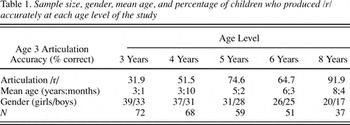
Sample size, gender, mean age, and percentage of children whoproduced /r/ accurately at each age level of the study
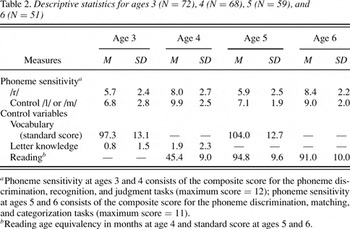
Descriptive statistics for ages 3 (N=72), 4 (N=68), 5 (N=59), and 6 (N=51)
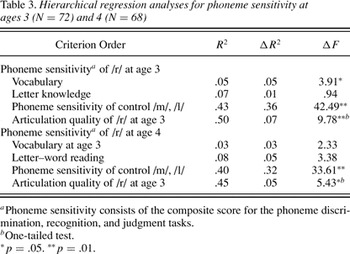
Hierarchical regression analyses for phoneme sensitivity at ages 3 (N=72) and 4 (N=68)
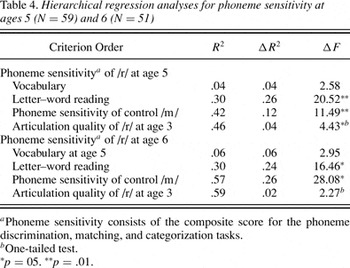
Hierarchical regression analyses for phoneme sensitivity at ages 5 (N=59) and 6 (N=51)
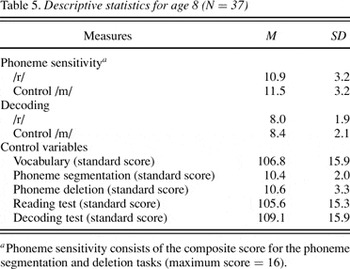
Descriptive statistics for age 8 (N=37)
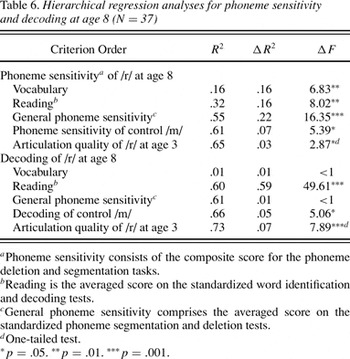
Hierarchical regression analyses for phoneme sensitivity and decoding at age 8 (N=37)
 You have
Access
- 14
- Cited by