Introduction
The Antarctic shag Phalacrocorax bransfieldensis Murphy breeds along the Antarctic Peninsula and at the South Shetland Islands (Orta Reference Orta, del Hoyo, Elliot and Sargatal1992) during the summer in colonies of up to several hundred breeding pairs (Bernstein & Maxson Reference Bernstein and Maxson1985). Several studies deal with the foraging and reproductive behaviour and population trends of breeding Antarctic shags (see review in Casaux & Barrera-Oro Reference Casaux and Barrera-Oro2006). However, due to limitations in logistic support as well as to adverse environmental conditions, little is known about this shag during the non-breeding period. It is believed that during winter these birds remain in the proximity of the breeding sites (Holdgate Reference Holdgate1963, Tomo Reference Tomo1970, Glass Reference Glass1978). Interestingly, an Antarctic shag which had been ringed as juvenile in 1989 at the South Shetland Islands, was found in the winter of 1997 at Sao Salvador do Bahia, Brazil (M. Favero personal communication 1998).
A steady declining trend in the number of breeding Antarctic shags has been reported for the last eighteen years at several colonies in the South Shetland Islands and the Antarctic Peninsula (Casaux & Barrera-Oro Reference Casaux and Barrera-Oro2006). Whether individuals disperse or remain close to the colonies, the post-breeding foraging strategy is crucial to restore body condition in preparation for migration or for the harsher Antarctic winter conditions. An adequate foraging performance is essential to reduce post-breeding adult mortality and improve recruitment, both factors strongly related to the population trend of this bird.
Despite the importance of studying this aspect of the biology of the Antarctic shag, only one study, published almost four decades ago (Tomo Reference Tomo1970), reported on their post-breeding foraging behaviour. However, the information provided is very limited and there is not detail on the type and number of samples analysed and on the methodology followed. Thus, the aim of this study is to provide new information on the post-breeding diet of P. bransfieldensis from an unstudied area at the Antarctic Peninsula such as the Danco Coast.
Material and methods
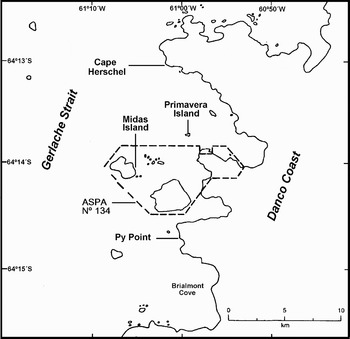
A total of 399 pellets (regurgitated casts) of post-breeding Antarctic shags (adults and newly fledged chicks) were collected from 25 February–23 March 1998 (150 pellets) and from 16 February–29 March 2000 (249 pellets) at roosting areas surrounding four colonies in the Danco Coast, Antarctic Peninsula: Cape Herschel (64°05′S 61°02′W; surveyed only in 2000), Primavera Island (64°09′S 60°59′W; surveyed only in 1998), Midas Island (within the Antarctic Specially Protected Area No 134, 64°10′S 61°05′W) and Py Point (64°13′S 61°00′W) (Fig. 1). During the 1997–98 breeding season all the breeding individuals and fledging chicks from the colonies located within the studied area were ringed. Given that during the 1998 post-breeding period only ringed specimens were observed at the roosting sites, we assumed that, at least for this season, the samples collected were produced by post-breeding individuals and not by juveniles or immature adults. For the analysis of the samples we followed the methods described in Casaux et al. (Reference Casaux, Baroni and Barrera-Oro2002).
Map showing the location of the colonies studied in the Danco Coast, Antarctic Peninsula, and the extension of the Antarctic Specially Protected Area (ASPA) No. 134.

Results
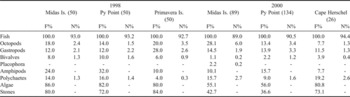
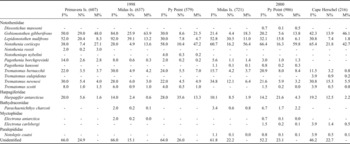
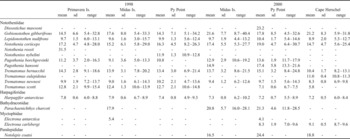
In both seasons shags preyed almost exclusively on fish; invertebrates, mainly molluscs, were poorly represented in the samples (Table I). Amongst fish, benthic-demersal species of the family Nototheniidae largely predominated in the diet. Notothenia coriiceps Richardson or Gobionotothen gibberifrons (Lönnberg), depending on the colony and season, were the most important prey both by number and mass. Except for Harpagifer antarcticus Nybelin, fish from the remaining families represented in the samples (Bathydraconidae, Myctophidae and Paralepididae) contributed little to the diet (Table II). The differences in the composition of the diet between both post-reproductive seasons were statistically significant for Midas Island (χ142 = 150.9; P < 0.00001) and Py Point (χ142 = 31.3; P < 0.01) (Table II). Compared to the previous breeding season (see Casaux et al. Reference Casaux, Baroni and Barrera-Oro2002), post breeders from all the colonies considered in 1998 increased the consumption of G. gibberifrons and decreased the consumption of N. coriiceps and H. antarcticus which resulted in significant differences in the composition of the diet (χ132 > 28.0; P < 0.01). The size of the fish ingested differed statistically between both post-breeding seasons (ANOVA, F = 4.77, df 1, P < 0.05). The fish ingested in 1998 (mean 11.9 ± 5.6 cm) were smaller than those ingested in 2000 (mean 12.4 ± 5.9 cm) (Table III). As observed in the 1997/98 breeding season, in the 1998 post-breeding period we observed marked differences in the size of the fish ingested at the different colonies (ANOVA, F = 21.6, df 2, P < 0.0001); shags from Py Point preyed on the smallest fish compared to Midas and Primavera islands (Newman-Keuls, P < 0.0001). This was mainly influenced by the number of specimens of the smallest fish species, H. antarcticus, consumed at Py Point. These differences among colonies in the size of the fish ingested were not observed in 2000. During the 1998 post-breeding period shags from Py Point and Primavera Island consumed fish larger than those consumed during the previous breeding season (Mann-Whitney, U > 306329, P < 0.0001). Post-breeders preyed on larger Trematomus newnesi Boulenger (Mann-Whitney, U = 1642, P < 0.01) and H. antarcticus specimens (U = 92701, P < 0.00001) at Py Point and on larger N. coriiceps (U = 3051, P < 0.01) and H. antarcticus (U = 3414, P < 0.00001) specimens at Primavera Island.
Diet of post-breeding Antarctic shags in the Danco Coast, Antarctic Peninsula, as reflected by the analysis of 399 pellets collected during February–March 1998 and 2000. Percentage frequencies of occurrence (F%) and number (N%). Number of pellets analysed in parenthesis.

Fish represented in 399 pellets of post-breeding Antarctic shags collected during February–March 1998 and 2000 at four colonies at the Danco Coast, Antarctic Peninsula. Percentage frequencies of occurrence (F%), number (N%) and mass (M%). Number of fish represented in the samples in parenthesis.

Mean total length, standard deviation and length range of the fish represented in 399 pellets of post-breeding Antarctic shags collected during February–March 1998 and 2000 at four colonies at the Danco Coast, Antarctic Peninsula.

Discussion
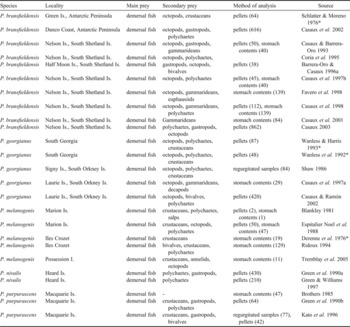
As has been reported for breeding individuals belonging to other shag species distributed in sub-Antarctic and Antarctic areas, and also for the Antarctic shag at the South Shetland Islands and the Antarctic Peninsula (Table IV), demersal-benthic fish were the main prey of post-breeding Phalacrocorax bransfieldensis at the four colonies investigated in this study (Table I). The only other study that provided information on the diet of post-breeding Antarctic shags surprisingly indicated that from autumn to spring this bird foraged solely on macroalgae (Tomo Reference Tomo1970). Although in our study macroalgae were frequently represented in the samples (Table I), we only found very small fragments which were always associated with fish remains. Thus, we consider that macroalgae are an indirect alimentary item (i.e. the macroalgae remains come from the stomachs of the fish consumed instead of being directly ingested by shags). This hypothesis is supported by the fact that during the study period algae were a frequent alimentary item of fish at the Danco Coast and constituted the bulk of the diet of N. coriiceps (Casaux et al. Reference Casaux, Barrera-Oro, Baroni and Ramón2003), one of the main fish preys of the Antarctic shag. Unfortunately, Tomo (Reference Tomo1970) did not provided information on the number and type of samples collected or on the methods used to analyse the samples, preventing further discussion on the differences in the results obtained.
Summary of published information on diet composition of breeding Antarctic and sub-Antarctic Phalacrocorax species, with indication of the geographical area, the methodology used and the number of samples analysed (in parenthesis). Asterisks indicates those papers where strict identification of fish represented in shags diet is not provided, but it is assumed that fish prey were mainly demersal species. Modified from Casaux & Barrera-Oro Reference Casaux and Barrera-Oro2006.

Regarding other shag species, Espitalier-Noel et al. (Reference Espitalier-Noel, Adams and Klages1988) reported for Phalacrocorax melanogenis (Blyth) at Marion Island that from April to July invertebrates constituted 50% of the diet by mass. Green et al. (Reference Green, Williams, Woehler, Burton, Gales and Jones1990b) commented that at Heard Island non-breeding P. nivalis Falla foraged predominantly on polychaetes. These last authors also indicated that at the end of the breeding season breeders (whose main prey are fish) and newly fledged birds join non-breeders at roosting sites where they probably change their diet, also preying predominantly on polychaetes. In the present case, fish and not polychaetes constitute the main part of the diet. In this perspective, these differences between localities in post-breeding diet would represent differences in resource availability between sites. Green et al. (Reference Green, Williams, Woehler, Burton, Gales and Jones1990b) indicated that the high occurrence of polychaetes in the diet suggest that this prey must occur in very high numbers at Heard Island. We consider that a relatively higher fish availability at the Danco Coast might explain why post-breeding Antarctic shags do not change their feeding strategy to forage on less profitable resources such as invertebrates.
Amongst fish, nototheniid species predominated in the diet, whereas those from the families Harpagiferidae (except at Py Point), Channichthyidae, Bathydraconidae, Myctophidae and Paralepididae were scarcely represented (Table II). Gobionotothen gibberifrons and N. coriiceps were the two main prey at all the colonies in both seasons. Except for the markedly higher contribution of G. gibberifrons to the diet, the pattern of fish consumption observed in this study is similar to that reported for breeding Antarctic shags at the South Shetland Islands (see Casaux & Barrera-Oro Reference Casaux and Barrera-Oro2006). The high importance of G. gibberifrons as prey of shags at the Danco Coast reflects the higher availability of this fish observed in trammel-net catches (Barrera-Oro et al. Reference Barrera-Oro, Marschoff and Casaux2000, Casaux et al. Reference Casaux, Barrera-Oro, Baroni and Ramón2003) in a site that is far away from the main historical fishing grounds of the South Shetland Islands (Elephant Island and north of Livingston/King George islands) and the Antarctic Peninsula (Joinville Island) (see also Casaux et al. Reference Casaux, Baroni and Barrera-Oro2002).
Although most of the fish prey co-occurred in both periods, the composition of the diet observed at the Danco Coast during the 1997/98 breeding season (Casaux et al. Reference Casaux, Baroni and Barrera-Oro2002) and during the following post-breeding period (this study) was markedly different. This was mainly related to an increase in the consumption of G. gibberifrons as well as to a decrease in the consumption of N. coriiceps and H. antarcticus during the post-breeding period. Casaux & Barrera-Oro (Reference Casaux and Barrera-Oro2002) observed that the structure of the populations of fish with marked site fidelity, like N. coriiceps and H. antarcticus (Everson Reference Everson1970, Barrera-Oro & Casaux Reference Barrera-Oro and Casaux1996b, North Reference North1996), may be affected by a constant catch rate. Based on that finding, and as it was also reported for other seabirds (Birt et al. Reference Birt, Birt, Goulet, Lairus and Montevecchi1987, Leopold et al. Reference Leopold, van Damme and van der Veer1998), Casaux et al. (Reference Casaux, Favero, Silva and Baroni2001) suggested that the Antarctic shag can deplete fish stocks in waters close to their colonies. We suggest that during the non-breeding season when birds are not constrained in time by the food for chick provisioning, shags might exploit more frequently areas further away or deeper waters than during the breeding season. This would preserve the feeding grounds close to the colonies and perhaps even improve feeding performance. This hypothesis is supported by 1) as reported by Green et al. (Reference Green, Williams, Woehler, Burton, Gales and Jones1990b) for P. nivalis, post-breeders abandoned the colonies and moved to roosting sites, 2) data from trammel-net catches obtained at the area studied showed that the abundance of G. gibberifrons increases with depth (Casaux et al. Reference Casaux, Barrera-Oro, Baroni and Ramón2003), 3) Casaux & Barrera-Oro (Reference Casaux and Barrera-Oro2002) reported that one of the effects of a constant catch rate is a continuous decrease in the size of the fish prey populations. Compared to the previous breeding season, post-breeders in 1998 consumed larger fish. This could be explained by the fact that post-breeders preyed less intensively on the small sized H. antarcticus than during the breeding period (Table II, Casaux et al. Reference Casaux, Baroni and Barrera-Oro2002), but also by the fact that they preyed on larger Trematomus newnesi, H. antarcticus and N. coriiceps specimens, which also suggests that these birds might exploit alternative feeding grounds.
As commented above, the foraging strategy used during the post-breeding period might depend on the prey availability around colonies. This study was carried out at a locality far from the main historical commercial fishing grounds (Kock Reference Kock1992) where the littoral fish availability is higher and more diverse than observed in exploited areas such as around the South Shetland Islands (Barrera-Oro et al. Reference Barrera-Oro, Marschoff and Casaux2000, Casaux et al. Reference Casaux, Barrera-Oro, Baroni and Ramón2003). Thus, in order to understand better the foraging behaviour of post-breeding Antarctic shags, future studies should include areas with contrasting fish availability.
Acknowledgements
We would like to thank M. Favero, P. Silva, N. Coria and G. Shandikov for field assistance. We thank the members of Primavera Station for their logistic support. This is contribution to the Laboratorio de Investigaciones en Ecología y Sistemática Animal (LIESA) No 41.