

Since the mid-2000s, a series of social mobilizations have shaped Chilean politics and society. Students, workers, environmentalists, local activists, and other actors have staged various demonstrations across the country. Although social movements rarely have a direct impact on political reforms (Tarrow Reference Tarrow2011), the actions carried out by Chilean activists have had repercussions. As Donoso and von Bülow (2017b, 4) explain, “these social movements have repoliticized many aspects of Chile's development path and have forced a debate on pending political reforms.” Moreover, an unprecedented protest wave that began on October 18, 2019 has so far resulted in a series of tax, pension, and constitutional reform processes (Somma et al. Reference Somma, Matías, Rodolfo and Rodrigo2020). The rise in unconventional political participation has also resulted in a veritable explosion in the amount of scholarship studying different aspects of protests. However, and reflecting the general state of the literature on social movements, few of these works have focused on the consequences of mobilizations. How do protests influence political processes, and particularly political attitudes?Footnote 1
This article explains differences in political attitudes using a relatively understudied factor: the geographic and temporal location of protest events. The argument advanced herein is that proximity to protests has a significant effect on individual political attitudes. The size of the effect, however, depends on the type of attitude: the effect tends to be larger on the more sensitive, weak attitudes and to be smaller on the more stable, strong attitudes. To test this claim, this article combines data from the 2008, 2010, and 2012 LAPOP Chile surveys and a dataset of student protest events in Latin America (Disi Reference Disi2017) using Geographic Information Systems (GIS). The combined data create several measures of the number of student protest events close to each respondent, geographically as well as temporally. Regression analysis finds that proximity to these college student protests has statistically significant effects on several political attitudes, both weak and strong.
Studying the proximity effects of mobilizations on political attitudes is relevant for at least two reasons. First, several studies evidence a growing decline in political interest, trust, satisfaction with democracy, and other attitudes associated with the health of Chilean democracy (Disi and Mardones Reference Disi and Roberto Mardones2019; Toro et al. Reference Toro, Carolina and Nathalie2016). It is important, therefore, to assess whether the effects of mobilization in recent years have been significant or not, and positive or negative, on political culture and disaffection. Second, mobilizations tend to shape the policymaking process through the effect they have on public opinion (Agnone Reference Agnone2007; Amenta et al. Reference Amenta, Neal, Elizabeth and Yang2010, 299). In Chile, for example, student mobilizations have influenced electoral campaigns and platforms, which has resulted in new public policies and laws regarding higher education funding (Palacios-Valladares and Ondetti Reference Palacios-Valladares and Gabriel2018). Analyzing the way protests shape public policy is increasingly interesting for both activists and policymakers as they resort to mobilizations to advance or incorporate social demands.
There is an emergent literature on the effect of spatial and temporal proximity on public opinion. These works have shown that protest proximity can have significant (and sometimes lasting) effects on various political and policy attitudes (Banaszak and Ondercin Reference Banaszak and Heather2016; Branton et al. Reference Branton, Valerie Martínez-Ebers and Tetsuya2015; Lee Reference Lee2002; Mazumder Reference Mazumder2018; Muñoz and Anduiza Reference Muñoz and Eva2019; Wallace et al. Reference Wallace, Chris and Michael2014). However, their insights are limited, for two reasons. First, most of the studies using survey data use only one survey wave (Branton et al. Reference Branton, Valerie Martínez-Ebers and Tetsuya2015; Ketchley and El-Rayyes forthcoming; Wallace et al. Reference Wallace, Chris and Michael2014) or are limited to measuring the attitudes of a specific subpopulation (Andrews et al. Reference Andrews, Kraig and Tuneka2016; Branton et al. Reference Branton, Valerie Martínez-Ebers and Tetsuya2015; Wallace et al. Reference Wallace, Chris and Michael2014), a certain location (Muñoz and Anduiza Reference Muñoz and Eva2019), or episodes during particularly contentious periods (Andrews et al. Reference Andrews, Kraig and Tuneka2016; Ketchley and El-Rayyes forthcoming; Mazumder Reference Mazumder2018). Most, therefore, do not analyze the effect of protest proximity on nationally representative samples across the years and with significant variation in protest exposure over time. Second, with some exceptions in authoritarian settings (Frye and Borisova Reference Frye and Ekaterina Borisova2019; Ketchley and El-Rayyes forthcoming; Tertytchnaya and Lankina Reference Tertytchnaya and Tomila2020), most draw evidence from the United States and other developed countries, which limits the generalizability of their findings. To my knowledge, the effect of protest proximity on attitudes has not been studied in democracies in the developing world by matching survey and protest data.
Protests, Attitudes, and the Effect of Protest Proximity on Attitude Change
Although intuition would suggest that mobilization can have tangible effects, scholarship on the consequences of mobilization is still somewhat underrepresented (Wallace et al. Reference Wallace, Chris and Michael2014, 435). In the Chilean case, for example, the evidence is limited to Donoso's suggestion that the 2011 student movement coincided with a change in public opinion in favor of signaling education as the country's most pressing problem (2016, 185–86). Consequently, several public opinion surveys fielded in Chile changed their instruments in moments of large-scale mobilizations by adding questions related to the movements and their demands. Nevertheless, although there seems to be a consensus that mobilizations do shape political outcomes, how protests effect change in public opinion remains an open question. Does proximity to protests shape political attitudes? Does the effect vary by attitude? These are the questions that this study seeks to tackle.
The literature on the effect of proximity to protests on political attitudes has made important strides in recent years. Wallace et al. (Reference Wallace, Chris and Michael2014), for example, find that large demonstrations during the 2006 immigrant rights marches in the United States increased Latinos' political alienation, while increased numbers of nearby small events had a positive effect on their sense of political efficacy. These marches also shaped Latinos' immigration policy preferences (Branton et al. Reference Branton, Valerie Martínez-Ebers and Tetsuya2015). Meanwhile, Andrews et al. (Reference Andrews, Kraig and Tuneka2016) show that proximity to civil rights protests in the Deep South had a positive effect on certain White Southerners' attitudes toward mobilizations in 1961. This social movement also appears to have had a lasting impact on political culture: Whites in counties that experienced historical civil rights protests are today more likely to identify with the Democratic Party (Mazumder Reference Mazumder2018). In the Egyptian case, Ketchley and El-Rayyes (forthcoming) find that protests in post-Mubarak Egypt decreased Egyptians' support for democracy.
All these works rely on the fact that bystanders' exposure to mobilizations causes them to “witness, hear about, and become aware” (Wallace et al. Reference Wallace, Chris and Michael2014, 436) of protests, their protagonists and framings and, in some cases, government repression. Some emphasize the psychological mechanisms through which protest proximity affects attitudes. Demonstrators can use mechanisms like priming and persuasion to gain the public's sympathy (Mazumder Reference Mazumder2018, 923–24). More generally, increased exposure to protests may improve observers' attitudes toward them because “increased perceptual fluency of a repeatedly presented stimulus (that is, increased ease of its identification on reexposure) is misattributed to liking, yielding a positive evaluation of the stimulus” (Greenwald and Banaji Reference Greenwald and Mahzarin1995, 10).
Other studies argue that protests have “information revelation effects” that generate “awareness about issues that may not feature prominently in the national media” (Tertytchnaya and Lankina Reference Tertytchnaya and Tomila2020, 2), acting “as a heuristic that individuals draw on to form opinions” (Ketchley and El-Rayyes forthcoming). Protests, especially peaceful ones, also generate information about their participants' intentions through a costly signal that is credible because of the risk of repression (Stephan and Chenoweth Reference Stephan and Erica2008).Footnote 2 Likewise, trust in government can increase when protests break out but the authorities decide not to repress them (Frye and Borisova Reference Frye and Ekaterina Borisova2019). By contrast, violent and disruptive actions can decrease support for the movement (Muñoz and Anduiza Reference Muñoz and Eva2019) and its goals (Ketchley and El-Rayyes forthcoming) because bystanders tend to reject violence and disruption. Similarly, I theorize that college student mobilizations might have also had significant effects on political attitudes in Chile.
Hypothesis 1. Proximity to protests has significant effects on political attitudes
Not all political attitudes are equally sensitive to events such as protests, however. As Albarracin and Shavitt (Reference Albarracin and Sharon2018, 302) explain, “attitudes are partly memory based and partly constructed on the fly,” so the effect of mobilizations may be unequal. A key feature of attitudes emphasized in the psychological literature is that they vary in their strength (Krosnick and Petty Reference Key1995). “Strong” attitudes are defined as those “that are durable in the sense of being stable and resistant to attack, and that have an impact by influencing thought and guiding behavior” (Bassili Reference Bassili, William and Radmila2008, 238). As Bohner and Dickel (Reference Bohner and Nina Dickel2011, 394) explain, “strong attitudes are more stable across situations and over time and, hence, can consistently be recalled from memory, whereas weak attitudes are less accessible and thus more susceptible to context influences.” My argument is that, while protests may shape all attitudes, their impact may be larger on “weak” attitudes.
Strong attitudes are shaped and crystallize during childhood and adolescence through political socialization in the family, at school, and among peers. These attitudes, which include political interest, trust, ideology, party identification, and racial attitudes (Alwin and Krosnick Reference Alwin and Jon1991; Hooghe and Wilkenfeld Reference Hooghe and Britt2008; Prior Reference Prior2010; Sears and Funk Reference Sears and Carolyn1999), tend to remain stable in the long run, and make up the political culture of a certain place at a certain time (Almond and Verba Reference Almond and Sidney2015).Footnote 3 These strong attitudes “are said to be acquired before the adult is fully mature, to be relatively stable through the life course, to be consistent with related attitudes, and to influence the formation of attitudes toward new attitude objects such as new issues and political candidates” (Sears and Funk Reference Sears and Carolyn1999, 1–2). Prior (Reference Prior2010, 763), for example, finds that “people return to their stable long-term political interest levels quickly after perturbations caused by political or personal events,” and that interest in politics “behaves like a central element of political identity, not like a frequently updated attitude.”
Weak attitudes, by contrast, tend to be more sensitive to the political context and events later in life. These attitudes, which are akin to latent opinions (Key Reference Key1964) and include policy positions and evaluations of political figures, tend to change over time, and are usually informed by people's strong attitudes, which are used as cognitive heuristics (Lau and Redlawsk Reference Lau and David2001).Footnote 4 These opinions are also context-dependent, as they are more likely to be formed from “implicit influences of peripheral information” (Greenwald and Banaji Reference Greenwald and Mahzarin1995, 10) and to retain “residues of experience of such a nature as to guide, bias, or otherwise influence later behavior” (Campbell Reference Campbell1963, 97). For example, an outbreak of street riots in Barcelona in 2016 had an overall negative effect on public support for the Indignados movement, but the effect was null for its core supporters (Muñoz and Anduiza Reference Muñoz and Eva2019).
The psychological literature on the effect of political and historical events on weak attitudes has increased considerably in the past decade (Albarracin and Shavitt Reference Albarracin and Sharon2018, 315–16). For instance, attitudes toward the “Muslim ban” changed rapidly and significantly after a protest wave denouncing the policy (Collingwood et al. Reference Collingwood, Nazita and Kassra2018). In the case of attitudes toward certain politicians or institutions, perceived political or economic performance also determines, to a great extent, these weak opinions (Finkel et al. Reference Finkel, Edward and Mitchell1989). Specific events are also important: surveys fielded after Hurricanes Sandy and Irene in New Jersey showed a positive effect on attitudes toward a Green political candidate, compared with respondents surveyed before the natural disasters (Rudman et al. Reference Rudman, Meghan and Martin2013).
The distinction between weak and strong attitudes resonates with that between diffuse and specific support, which focus on different types of political objects (Easton Reference Easton1965; Reference Easton1975).Footnote 5 Conceptually, weak attitudes include (but are not limited to) specific support, which refers to how people evaluate the performance of the current authorities, while strong attitudes include diffuse support measures that evaluate the political system as a whole. In other words, weak attitudes “are closely related to what the political authorities [and other actors] do and how they do it,” while strong attitudes “represent more enduring bonds and thereby make it possible for members to oppose incumbents of offices and yet retain respect for the offices themselves, for the way in which they are ordered, and for the community of which they are a part” (Easton Reference Easton1975, 437).
Hypothesis 2. Proximity to protests has a larger substantive effect on weak attitudes than on strong ones
Data and Variables
To analyze the effect of mobilization on political attitudes in Chile, this work combines protest event analysis and survey data. More specifically, the analysis relies on a dataset of protests with college student participants in Latin America (Disi Reference Disi2017), and the 2008, 2010, and 2012 Chile waves of the Latin American Public Opinion Project (LAPOP 2015).Footnote 6
The dataset, which recorded more than 4,700 protest events in Latin America between 2000 and 2012 (of which 461 occurred in Chile), provides information about the location of each event. Meanwhile, the LAPOP dataset is used because, unlike other surveys fielded in Chile (such as Latinobarómetro, CEP, Nacional Bicentenario, and Nacional UDP), it is the only one that contains all of the following information: the dates of interview, location of fieldwork (at the comuna level), and questions about both weak and strong attitudes across several survey waves.Footnote 7 Three different waves are used to introduce more temporal variation in the analysis, which a single survey could not capture. Residents of a neighborhood near a major campus may, on average, be more sensitive to student demands (amounting to a “neighborhood effect”); however, including information from distinct time periods with different levels of protest may distinguish the effect of living near college students from the effect of exposure to protests.
Independent Variables: Calculating the Number of Nearby Student Protests
To quantify the effect of protests, each of the 461 events recorded in Chile was mapped using ArcGIS at the commune level.Footnote 8 While most events occurred in one location (and thus in a single commune), some events occurred in up to 33 different districts. The same procedure was done with the LAPOP data, with more than 5,000 survey respondents geocoded. Then the two geodatabases were combined to calculate the number of protests in the respondent's commune or in bordering communes in four different time periods: one, two, four, and eight weeks before the date of fieldwork.Footnote 9
The four time periods were used to determine whether the effects of protest proximity on attitudes depend on the amount of time passed after the events.
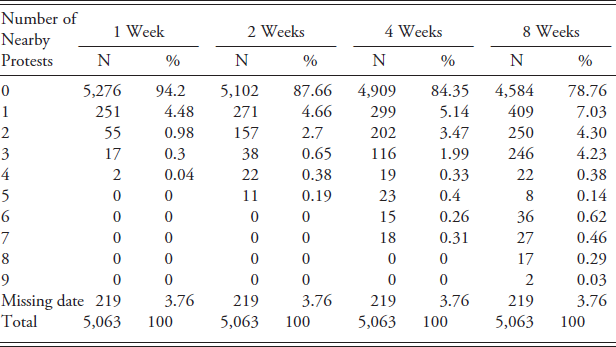
As table 1 shows, most respondents were not close to a protest event in any of the measures. However, the share of respondents who were not near a student protest decreases as the time frame is extended. The maximum number of nearby protests grows as the time period becomes longer, going from four (one week) to nine (eight weeks). The number of nearby demonstrations also varies markedly by survey wave (not shown). The number of respondents with no nearby events in the 2008 wave ranges from 99.8 percent (one week) to 89.7 percent (eight weeks); in the 2010 wave from 87.6 percent (one week) to 78.5 percent (eight weeks); and in 2012, from 85.4 (1 week) to 68.2 percent (eight weeks).
Number of Nearby College Student Protests in LAPOP surveys in Chile, 2008, 2010, and 2012

Source: LAPOP surveys (1, 2, 3, and 4 weeks before date of interview)
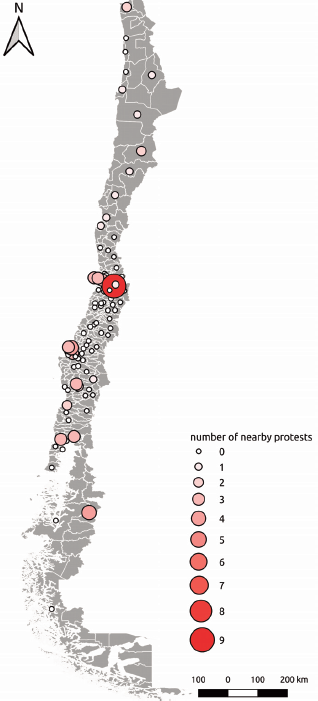
Map 1 displays the geographic distribution of the respondents and their number of nearby protests up to eight weeks before the date of interview. As would be expected from a predominantly urban actor, the respondents with the largest number of nearby student protests reside in the largest cities (Santiago, Valparaíso, Concepción) and in other regional capitals (Arica, Antofagasta, Temuco, Puerto Montt, Coyhaique), where most of the higher education institutions are located. Respondents in small towns and rural areas, by contrast, were less likely to be directly exposed to student protests.
Geographic Distribution of Nearby College Student Protests in LAPOP Surveys in Chile, 2008, 2010, and 2012

Dependent Variables: Weak and Strong Political Attitudes
Seven weak and eight strong attitudes are regressed on the four protest proximity variables.Footnote 10 The first weak attitude is to consider education the country's most important problem. This variable is derived from a survey item with more than 40 alternatives.Footnote 11 Only a small share of respondents (3.4 percent) opined that education was Chile's most serious issue. More frequently mentioned issues included crime, the 2010 earthquake (included in that year's wave), unemployment, the economy, transportation, and inequality. Since Chilean students' claims are predominantly related to education policy (Disi Reference Disi2018; Somma Reference Somma2012), we would expect proximity to their protests to increase the likelihood that respondents identified education as the top public priority, since recurrent proximity to protests could make bystanders more sympathetic to movement claims (Mazumder Reference Mazumder2018).
The next four weak variables deal with respondents' approval of protests, measured using ten-point scales. The variables are support of government critics' right to protest peacefully and approval of legal demonstrations, occupying private properties, and roadblocks. Most respondents strongly disapproved of occupations and roadblocks, while the majority neither approved nor disapproved peaceful and legal demonstrations. We would expect closeness to mobilizations to have a positive effect on political attitudes toward protests because “individuals that have greater contact with protest may develop more tolerance for it” (Andrews et al. Reference Andrews, Kraig and Tuneka2016, 1026).
The last two weak attitudes variables are presidential approval and trust, which are measures of specific support. Most interviewees considered presidential performance to be fair or good and had medium-high levels of trust in the president. More nearby protests are expected to be negatively associated with the executive's ability to solve problems, and hence to have a negative effect on presidential approval and trust. We also would expect protests to affect these attitudes because presidential approval is negatively associated with mobilizations in other contexts (Newman and Forcehimes Reference Newman and Andrew2010).
The effect of protest proximity is also assessed on eight strong attitude variables. The first one is political interest. Most Chileans have little interest or are outright uninterested in politics. Protest proximity, however, is expected to increase conversations about, engagement with, and thus interest in politics. The other six strong attitudes are measured as seven-point Likert scales. Most respondents have low levels of external but higher levels of internal efficacy.Footnote 12 Following Wallace et al. (2014), we expect protests in the vicinity to have a positive effect on both types of efficacy. The last five variables are measures of diffuse support. The levels of national pride, respect for political institutions, and political system support should decrease, as protests signal poor political performance, which has negative effects on regime support (Finkel et al. Reference Finkel, Edward and Mitchell1989). Respondents show relatively high levels of support for, and a positive perception of, democracy (a three-category variable).Footnote 13 As the number of nearby protests increase, attitudes toward democracy should improve—particularly when understood in its deliberative and participatory dimensions (Donoso Reference Donoso2016).
Control Variables
Ten control variables (at the individual, commune, and wave levels) are incorporated into the analyses to account for other theoretically relevant factors. Retrospective economic evaluations (better, same, or worse) are entered because they have significant effects on different types of weak and strong attitudes (Arriagada et al. Reference Arriagada, Patricio and Martin2010; Evans Reference Evans2002; Lau and Redlawsk Reference Lau and David2001). The first sociodemographic covariate is education, measured as the number of years of formal schooling (from 0 to 17). Higher levels of education are associated with increased political engagement (Hillygus Reference Hillygus2005) and more positive attitudes toward politics (Carlin Reference Carlin2006; Galston Reference Galston2001). Education is also important because people who are more educated tend to be more unvarying in their opinions (Feldman 1989). At the same time, however, more education is associated with lower levels of nationalism (Coenders and Scheepers Reference Coenders and Peer2003), and hence may have a negative effect on national pride. Student status and having children are incorporated because students and parents may be more likely to consider education as an important issue (Garritzmann Reference Garritzmann2015).Footnote 14 Additionally, students' (and their parents') own opinions may be particularly sensitive to student mobilizations. Age (continuous) and gender (dichotomous) are also entered as controls.
The last four covariates are commune- and wave-level controls. Commune-level variables are added because “the socioeconomic context in which a respondent lives affects his/her views of the political system” (Hiskey and Bowler Reference Hiskey and Shaun2005, 62).Footnote 15 These aggregate variables are the yearly percentage of inhabitants living in poverty, yearly population size, and yearly percentage of urban dwellers in the respondent's commune.Footnote 16 The latter two are also entered because they affect the likelihood of being exposed to student protests. The last covariate is a survey wave dummy, which is added to make sure that the effect of protest proximity is independent from other time-varying trends in public opinion.Footnote 17
Results
The hypotheses were tested using different regression models. In the case of the education variable, a logistic regression was used; the rest of the dependent variables were analyzed using ordered logistic regressions. Robust standard errors were clustered at the comuna level to account for nonindependence in responses within these districts. All models were regressed using STATA 15 (StataCorp 2017) and used survey weights, so that no wave counted more than the other two.
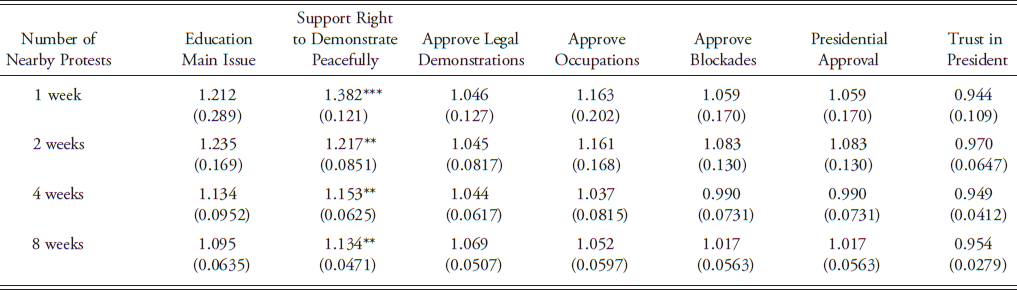
Table 2 summarizes the effects of the protest proximity variables on weak political attitudes. The number of nearby student protests has a statistically significant effect only on approving government critics' right to demonstrate peacefully. This effect is in the expected direction, and is significant across all four measures of the protest proximity variable. The results suggest that the effect of protest proximity tends to fade in time, as the size of the effect diminishes with longer time spans. For example, each additional protest during the week before the survey increases the odds of strongly approving government critics' right to demonstrate peacefully by about 38 percent; when the protests up to two months are counted, every additional event increases these odds by approximately 13 percent. Overall, the odds ratios suggest that the effect of protest proximity is relatively larger for weak attitudes (when significant).
Main Results: Effects of Student Protest Proximity on Weak Political Attitudes

***p < 0.001, **p < 0.01, *p < 0.05
Notes: Each cell corresponds to a different regression model. Robust standard errors clustered at the comuna level in parentheses. Odds ratios reported instead of coefficients. For the full results, see tables A9 and A10 in the appendix.
The effect on approving other types of mobilizations (legal demonstrations, occupations, and blockades) is not statistically significant, which suggests that the effect of student protest proximity on attitudes about demonstrations depends largely on whether they are peaceful or not. Presidential approval and trust, on the other hand, seem to vary independently from the number of nearby student protests, which is in line with evidence from the United States (Newman and Forcehimes 2010, 151). Furthermore, although Chilean college students usually mobilize for education demands, protest proximity does not affect identifying education as the country's top priority.
Several control variables also have significant effects on these attitudinal variables. Perhaps unsurprisingly, schooling, being a student, and being younger have major positive effects on considering education the country's most pressing problem. Compared to 2008, the 2012 wave has a major positive effect on saying that education is the most pressing issue, which makes sense in light of that and the previous year's major student mobilizations. Men are less likely to approve occupations and peaceful and legal demonstrations, while living in urban areas is associated with higher levels of approving barricades and lower levels of presidential trust.
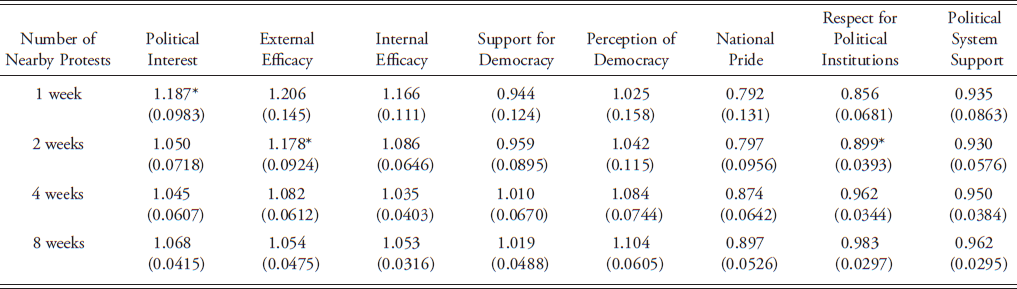
The effects on strong political attitudes are shown in table 3. In this case, vicinity of mobilizations has significant effects on three variables, all of which are in line with the theory. The effect is positive on one measure each of political interest and external efficacy (one and two weeks, respectively), while it is negative on one measure of respect for political institutions (two weeks). Specifically, each additional protest one week before the date of survey is associated with a 19 percent increase in the odds of being very interested in politics, while every additional event within two weeks of the fieldwork is associated with an 18 percent increase in the odds of having the highest level of external efficacy. Meanwhile, increases in nearby protest events up to two weeks before the survey lower the odds of respecting political institutions “a lot”—by about 10 percent. The effect on the rest of the strong attitudes is generally in the expected direction but is not statistically significant. Overall, and as hypothesized, the effects of protest proximity on strong political attitudes tend to be relatively smaller.
Main Results: Effects of Student Protest Proximity on Strong Political Attitudes

***p < 0.001, **p < 0.01, *p < 0.05
Notes: Each cell corresponds to a different regression model with controls. Robust standard errors clustered at the comuna level in parentheses. Odds ratios reported instead of coefficients. For the full results, see tables A11 and A12 in the appendix.
Some theoretically informed variables also shape strong political attitudes. Older age is positively associated with both types of efficacy, support and perception of democracy, national pride, respect for political institutions, and political system support. Meanwhile, positive economic evaluations are significantly associated with higher values in most measures of all the dependent variables. Additional years of schooling have a positive effect (when significant) on most strong attitudes, with the exception of national pride: respondents with fewer years of schooling tend to be prouder, which is in line with the literature (Evans 2002). Urban dwellers tend to show higher levels of internal efficacy and lower levels of respect for political institutions.
Postestimation and Endogeneity Concerns
These results show that different definitions of protest proximity have significant effects on both weak and strong political attitudes. It may be, however, that the effects are not completely exogenous; many protests occur in communes where residents and bystanders are particularly open and sensitive to mobilizations. As mentioned, there may also be a “neighborhood effect” of university campuses on their neighbors' attitudes, for example. To tackle this endogeneity issue, this study used the six models from tables 2 and 3, in which the protest proximity variable has a statistically significant effect, and added interaction terms between the protest proximity variable and the survey wave variables.Footnote 18
The rationale for adding this interaction is that the effects of protest proximity should vary by survey wave, because the frequency, visibility, and contentiousness of mobilizations vary over time. The evidence shows there was an upward trend between 2003 and 2012 in both college student mobilizations (Disi Reference Disi2018, 453) and the overall number of protest events and participants in Chile (Somma and Medel Reference Somma and Rodrigo2017, 35). There may be, therefore, a long-term, cumulative effect of protests on public opinion as people become more exposed to protests over time, which should be reflected in the interaction terms.
Additionally, the three LAPOP waves were fielded in different times of the year. According to the dataset, the 2008 wave was fielded between December 2007 and January 2008 (when summer break in the Southern Hemisphere begins); in 2010 it was carried out between April and June of that year; in 2012, fieldwork occurred between March (when the school year starts) and May. The specific timing of the surveys matters because student protests in Chile have a “marked seasonality,” with most events occurring between April and September (Garretón et al. 2017, 25). According to a former student leader, college students follow a “ritualistic cycle,” wherein they “mobilized until May or June, and then left for the [winter] break” (Former Student Leader 2014). The interaction terms should also reflect these short-term, seasonal differences.
The expectation, therefore, is that there is a difference in the effect of protest proximity on political attitudes in 2008 versus 2010 and 2012, for two reasons. First, the cumulative effect of protests in the long run is weaker in 2008; second, the 2010 and 2012 waves were fielded in relatively contentious moments of the year, compared to the 2008 wave. The effects of protest proximity, therefore, may be moderated by the time periods when the survey was fielded, even if mobilizations tend to occur in the same locations.
The results show that the effect of the interaction term is significant for all the attitudes where the protest proximity variables had significant effects in the models above.Footnote 19 The effect of the interaction on approving the right of government critics to demonstrate peacefully, however, is only significant in one out of the four models (one week).
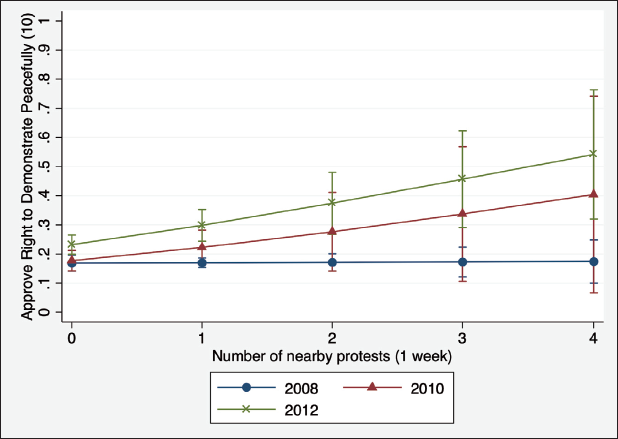
Figure 1 illustrates the predicted effects of the number of nearby protests (up to one week before the date of interview) on the probability of approving government critics' right to demonstrate peacefully. The 2010 and 2012 surveys clearly slope upward, while the curve in the 2008 wave is virtually flat. For example, with no nearby student protests, the probability of strongly approving the right to protest peacefully is 16.9 percent in 2008, 17.7 percent in 2010, and 23.2 percent in 2012; this probability increases with four nearby protests to 40.4 percent in 2010 and 54.2 percent in 2012, while it barely increases to 17.4 percent in 2008. Thus, protests can have relatively large effects on weak attitudes (confirming hypothesis 2), but this effect is also very context-sensitive.
Predicted Effects of Protest Proximity on Strongly Approving Right of Government Critics to Demonstrate Peacefully
Time period: 1 week, with 95 percent CIs. All other variables held at their mean values.

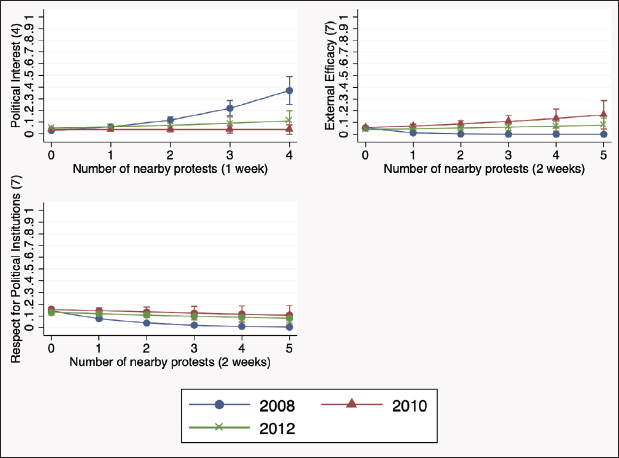
Figure 2 shows the predicted probabilities of protest proximity on strong attitudes. As expected, the effect of protest proximity is relatively smaller but is different in the 2008 wave compared to the other two. The effect of protest proximity on political interest is positive across the waves, although it is relatively larger in 2008. For example, the probability of being interested “a lot” in politics grows with a zero-to-four increase in nearby events from 2.93 to 37.38 percent (2008), 3.73 to 3.74 percent (2010), and 4.87 to 11.11 percent (2012). Thus, although the effect in the 2008 wave differs from the other two waves (as expected), the effect on political interest of protest proximity in the 2008 wave is more akin to the effect on weak attitudes, which contradicts theoretical expectations (hypothesis 2).
Predicted Effects of Protest Proximity on Selected Strong Attitude Values
Note: 95 percent CIs. All other variables held at their mean values.

On the other two attitudes, the effect of protest proximity is minor across the survey waves. The effect of protest proximity on external efficacy is positive in 2010 and 2012 and negative in 2008 but always relatively small. For example, the probability of having the highest level of external efficacy in 2010 and 2012 rises moderately, from 5.6 and 3.99 percent with no protests to 16.52 and 7.8 percent with five nearby events. Meanwhile, this probability in 2008 decreases from 5.55 percent with zero protests to about 0.0002 percent with four protests. In the case of respect for political institutions, the effect of protest proximity is negative across the years, but the slope is somewhat steeper in 2008. The probability of respecting political institutions “a lot” decreases with a zero to five increase in protests, from 14.29 to 0.51 percent in 2008, 15.53 to 10.65 percent in 2010, and 13.16 to 7.96 percent in 2012. The relatively small effects of protest proximity on these two strong attitudes are in line with hypothesis 2.
Why are strong attitudes more sensitive to protest proximity in the 2008 waves? Perhaps because they were fielded in a more contentious period, respondents in 2010 and 2012 had previous predispositions toward protests, so the effect of additional nearby protests yields, in a way, diminishing returns. By contrast, respondents in the 2008 wave were surveyed in a context in which protests were relatively less prominent, so fewer respondents had preexisting attitudes toward them, causing each nearby event to make a bigger (and opposite, depending on the attitude) impression. Thus, the effect of protests on attitudes is in line with the “resonance model” (Iyengar and Simon 2000, 158–60) of political communication, where the effect of distinct messages interacts with and is moderated by prevailing opinions. The results, therefore, are not due solely to the “neighborhood effect” of living near college campuses or other location-related dynamics.
Conclusions
This study seeks to understand the spatial and temporal effects of college student protests on political attitudes in Chile. It theorizes that, at the individual level, geographic and temporal proximity to student mobilizations can significantly shape political attitudes (hypothesis 1). However, it also hypothesizes that the impact of protest proximity depends on the type of attitude: the effect should be larger on weak attitudes, which are more sensitive to exogenous stimuli, and smaller on strong attitudes, which tend to remain stable over time (hypothesis 2).
Combining data from three LAPOP waves and student protest event data, the article uses regression analyses to test these claims. The findings support hypothesis 1 for a few (though not all) attitudinal variables analyzed, as the number of events near respondents significantly correlated with attitudinal differences. In the case of weak attitudes, protest proximity has a significant effect only on opinions about peaceful demonstrations. Meanwhile, protest proximity has significant effects on three strong attitudes: political interest, external efficacy, and respect for political institutions.
Hypothesis 2 also receives support, as the magnitude of the significant effects is relatively larger for the weak attitude versus the effect on strong attitudes. Protests can, therefore, affect both fleeting opinions (Branton et al. 2015; Muñoz and Anduiza 2019) and some of the more ingrained attitudes that constitute individual political identities (Andrews et al. 2016; Mazumder 2018) and diffuse support (Easton 1975). An additional insight, derived from the inclusion of interaction terms between protest proximity and the three survey waves, is that the size—and direction—of the effect of protest proximity on certain political attitudes may depend to a great extent on the prevailing attitudes of the time.
Why does protest proximity have a significant effect on a larger proportion of strong attitudes? The effect on supporting the right to demonstrate peacefully is the only effect on weak attitudes that is statistically significant across all the measures of protest proximity; this suggests that protest proximity is more influential on weak attitudes directly related to student protests, like those toward the protests themselves, perhaps because people are more likely to use new information from nearby protests to form this type of opinions. By contrast, in the face of protests, people seem to update a wider range of strong attitudes, although the effect is smaller (as hypothesized) and is limited to one measure of protest proximity.
The findings have important implications for the study of social movements and public opinion. The evidence supports the general claim that movements can shape public opinion and influence the policymaking process (Giugni 2004) and the specific argument that student mobilizations in Chile have had a significant effect on public opinion (Donoso Reference Donoso2016; Kubal and Fisher Reference Kubal and Eloy2016; Palacios-Valladares and Ondetti Reference Palacios-Valladares and Gabriel2018; Silva Reference Silva2017). The results also show that instead of being completely stored in memory (Fazio Reference Fazio2007; Petty et al. Reference Petty, Pablo and Kenneth2007) or determined by the context (Gawronski and Bodenhausen Reference Gawronski and Galen2007; Schwarz Reference Schwarz2007), political attitudes vary in their sensitivity to external stimuli. However, the results also indicate that some attitudes (at least in the Chilean case) are not as strong as previously theorized. This is in line with the claim that certain strong attitudes, like party identification, experience important variation, in both the long (Bargsted and Maldonado Reference Bargsted and Luis2018) and the short run. Thus, the findings contribute to our understanding of macro-micro bridges (Dogan and Rokkan Reference Dogan and Stein1969), which are relatively understudied in social movement research (Walgrave and Rucht Reference Walgrave and Dieter2010).
The results also suggest that protests have opposing effects on different dimensions of political disaffection (Disi and Mardones Reference Disi and Roberto Mardones2019; Montero et al. Reference Montero, Richard and Mariano1997). While protest proximity boosts political interest and external efficacy, it also diminishes political engagement through its negative effect on respect for political institutions. Thus, exposure to protests can simultaneously politically engage and alienate public opinion.
This study has several limitations, which future research may address. As other studies using survey data point out (Muñoz and Anduiza Reference Muñoz and Eva2019, 11–12; Ketchley and El-Rayyes forthcoming), panel data would be ideal to analyze the effect of protest proximity on attitudes over time and to address endogeneity issues. Ad hoc survey sampling should also ensure that particularly (un)eventful periods and places are not overrepresented. Since protest data come from college student mobilizations, the findings may not be generalizable to other social actors or to social mobilization in general. Likewise, future research may investigate whether peaceful, cultural, disruptive, and violent tactics (Medel and Somma Reference Medel and Nicolás2016) have particular effects on specific political attitudes, as Ketchley and El-Rayyes (forthcoming) indicate. Furthermore, while these results show that protest proximity shapes some attitudes, future works may explore how lasting these effects may actually be and how the effect of protests on weak attitudes interacts with the effect on strong ones (Muñoz and Anduiza Reference Muñoz and Eva2019). There is, therefore, ample room for further research on the attitudinal effects of spatial and temporal proximity to events such as protests.
Supporting Information
Additional supporting materials may be found with the online version of this article at the publisher's website: Appendix. For replication data, see the author's file on the Harvard Dataverse website: https://dataverse.harvard.edu/dataverse/laps