Introduction
Depression in old age is associated with a set of biological, psychological and social factors. Gerontological literature points to significant relationships between depressive symptoms and variables such as the number of clinical comorbidities, declines in autonomy and in functional abilities, poor subjective health assessments, and low schooling and income levels (Blazer, Reference Blazer2003; Alexopoulos and Kelly, Reference Alexopoulos and Kelly2009).
With age, older individuals tend to suffer from a greater number of chronic diseases and, consequently, face the negative effects of these conditions. Constant stressful situations associated with chronic diseases, declining well-being, functional disability, and poor subjective health assessment can be linked to a greater incidence of depressive symptoms among the elderly (Fiske et al., Reference Fiske, Gatz and Pedersen2003; Nguyen and Zonderman, Reference Nguyen and Zonderman2006). Research studies indicate that there is no direct relationship between age and depressive symptoms. Thus, the negative effects a given chronic condition will bring about in old age will depend on a combination of sociodemographic, biological and psychosocial variables (Blazer, Reference Blazer2003; Fiske et al., Reference Fiske, Wetherell and Gatz2009).
Research also suggests that low schooling and low family income are key risk factors for depression among the elderly. Individuals with low schooling tend to earn less and are more likely to experience hardship and stress. Additionally, they have less access to health care, which could lead to more severe social or functional limitations. Studies have indicated that facing these adverse contingencies may be associated with the onset of depressive symptoms in old age (Ohayon, Reference Ohayon2007; Fiske et al., Reference Fiske, Wetherell and Gatz2009).
In Brazil, this trend was detected by the Brazilian Institute of Geography and Statistics (IBGE, 2009) in the data collected for the 2009 National Household Research, which found that poorer older adults had higher rates of physical disability. In addition, the incidence of functional decline caused by a disease decreased as income increased. Income was also linked to differences in perceived health as underprivileged subjects recorded poorer subjective health assessments compared to those with higher incomes.
Previous Brazilian aging studies have demonstrated higher prevalence of depressive symptoms among women, older adults with low income, low education, multiple illnesses and disability. In a longitudinal evaluation of elderly residents in São Paulo (Epidoso Project) researchers found a strong association between income level and physical and mental health. There was a significantly higher proportion of elderly with medical comorbidities, depression and disability among females and the ones with low income (Ramos, Reference Ramos2003).
A previous epidemiological study carried out across the whole district of São Paulo, coordinated by the Pan American Health Organization (PAHO), described a higher presence of depressive symptoms among older women. In the overall sample, there was a prevalence of 18.1% of depressive symptoms, yet, there was a substantial gap between men and women (12.7% and 22.0%, respectively) (Lebrão and Laurenti, Reference Lebrão and Laurenti2005).
Maia et al. (Reference Maia, Durante and Ramos2004), in a research study conducted in the state of Minas Gerais, showed that a higher prevalence of mental disorders was associated with being female, with low income, with the number of clinical conditions and functional disability. Moreover, after conducting a descriptive analysis of different urban sectors, the authors found that among residents of slum (the lowest per capita income) there was the highest percentage of self-reported diseases (71.4%) and mental disorders (57.1%).
Considering the multifactorial nature of depression in old age, the present paper aimed to study a representative sample of community-dwelling older adults in Ermelino Matarazzo, a poor subdistrict of the city of São Paulo, in order to examine the association of depressive symptoms and (i) sociodemographic variables (age, gender, income and education); (ii) clinical variables (presence of self-reported chronic diseases and health problems); and (iii) perceived health. This study is justified by the lack of data on elderly subjects living in impoverished areas in developing nations.
Methods
Participants
The district of Ermelino Matarazzo is located in the eastern area of the city of São Paulo, and has a population of around 106,000 inhabitants. It is characterized as a region of low socioeconomic status. According to the State Foundation for Data Analysis (SEADE, 2010), it has an area of 8.7 km2, divided into 143 urban census tracts, with a population density of 12,551 inhabitants/km2. The elderly population (≥ 65 years) represents 4.5% of the residents of the district.
The present study was a population-based survey, using data from the FIBRA study (Frailty Profile of Older Adults in Brazil). The organization of the sample was based on a multistage procedure which took into account the primary sampling units (PSU) and the households. Sixty-six PSUs were randomly drawn, and a team of trained recruiters identified all households within each PSU. These households were visited to identify seniors aged 65 and older. Seniors were invited to participate if they met the inclusion criteria and did not satisfy the exclusion criteria. Recruiters explained the objectives of the study and if the person agreed to participate, he/she received an appointment card indicating the time and place for data collection. The minimum sample size was estimated at 385 participants in order to be representative of the subdistrict.
To be invited to participate, the older adult needed: (i) to be aged 65 years and older, (ii) to understand instructions, (iii) to agree to participate, and (iv) to be a permanent resident in the household and census tract. The exclusion criteria were: (i) having a severe cognitive impairment suggestive of dementia, (ii) needing a wheelchair or being bedridden, (iii) having sequelae of a stroke, with localized loss of strength and/or aphasia, (iv) having Parkinson's disease at the severe or unstable stage, (v) severe deficits in hearing or vision, which greatly hinder communication, and (vi) being terminally ill. These inclusion and exclusion criteria were adapted from the Cardiovascular Health Study (CHS), according to Ferrucci et al. (Reference Ferrucci, Guralnik, Studenski, Fried, Cutler and Walston2004).
In 2008 and 2009, 654 seniors were identified as being eligible within their households, according to inclusion and exclusion criteria, and they were invited to participate in a data collection session at a nearby community center. A total of 384 seniors came to the session and completed data collection procedures (response rate 58.72%); however, in the analyses reported here, 303 participants were included, as 81 participants scored below the cut-off point for the Mini-Mental State Examination (MMSE). As this study depends on self-reported information, participants with low MMSE scores might have provided unreliable answers. The cut-off points were established by subtracting one standard deviation from the mean values proposed by Brucki et al. (Reference Brucki, Nitrini, Caramelli, Bertolucci and Okamoto2003), and rounding down the value. Cut-off scores were: 17 for those who were illiterate; 22 for those with 1–4 years of schooling; 24 for those with 5–8 years of schooling; and 26 for those with 9 years or more. Besides lower MMSE scores, excluded participants were on average three years older (p = 0.002). However, there were no significant differences between included and excluded participants in education level or family income.
Data collection procedures
After signing an informed consent form, participants were interviewed by trained gerontology students, who collected information regarding: sociodemographic variables, cognitive status, health status, CHS frailty criteria, anthropometric characteristics (weight, height, waist size), systolic and diastolic pressure (averaged across six measures), chronic diseases, use of health services, oral health, functional status, perceived social support, depressive symptomatology, and life satisfaction. Procedures lasted from 90 to 120 minutes. After participation, seniors received health counseling based on the information provided. They also received a booklet with health tips and information on healthy lifestyles. This research was approved by the Research Ethics Committee of the School of Medical Sciences at the State University of Campinas (UNICAMP).
Instruments
The present study analyzed information regarding age, gender, income, schooling, self-reported chronic diseases and health problems, perceived health status, and depressive symptoms. Sociodemographic information was collected by means of a structured questionnaire.
Self-reported chronic conditions were assessed by means of a closed question on chronic diseases diagnosed by a physician in the previous 12 months. The participant could check either “yes” or “no” for eight conditions: heart disease; hypertension; stroke/ischemia; diabetes mellitus; malignant tumor/cancer; arthritis/rheumatism; lung diseases; and osteoporosis. Affirmative answers were counted and respondents were grouped into three categories: no diseases, one or two diseases, and three or more diseases.
Health problems were assessed by means of a questionnaire on health problems experienced by the individual in the previous 12 months. These were also “yes”/“no” questions about eight different problems, such as: urinary and fecal incontinence; falls; fractures; being bedridden; and having memory problems. Affirmative answers were counted and respondents were grouped into three categories: no health problems, one or two problems, and three or more health problems.
Perceived health was assessed with a question regarding the subjects' opinion about their own health status at the time of data collection. Answer choices were given in the form of a scale, in descending order from five to one, for excellent, very good, good, moderate and poor, respectively.
The variable regarding depressive symptoms was obtained by applying the Geriatric Depression Scale (GDS) with 15 items (Yesavage et al., Reference Yesavage1983; Almeida and Almeida, Reference Almeida and Almeida1999). It consists of a questionnaire on the presence of depressive symptoms during the previous week, with “yes”/“no” answer choices. Scores above five on this scale were considered suggestive of depression.
Statistical analysis
The GDS score was defined as the dependent variable. The independent variables were: sociodemographic data (age, gender, schooling, and income); self-reported chronic diseases and health problems; and perceived health.
To describe the profile of the sample, frequency tables for the categorical variables were presented. Comparison of major categorical variables was carried out with the χ2 or Fisher's exact test (for estimated values below five). The Mann-Whitney test was used to compare numerical variables between two groups, as variables did not follow a normal distribution. In order to examine the relationship between the independent variables and GDS scores, univariate and multivariate linear regression analyses were used, with stepwise criteria for variable selection. Statistical analysis was carried out using the SAS System for Windows (Statistical Analysis System) software, version 8.02. The adopted significance level was 5% (p<0.05).
Results
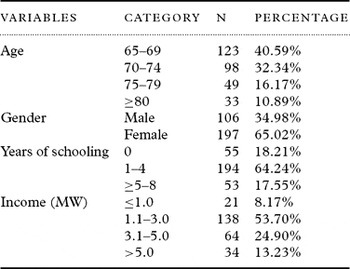
In the sample (N = 303), there was a higher presence of participants who were aged 65 to 69 years (40.59%, M = 71.78, SD = 5.38), and of women (65.02%). The majority of participants had completed one to four years of schooling (64.24%, M = 3.32, SD = 2.61) and had a family income of 1–3 minimum wages (53.70%, M = 3.34, SD = 2.95). The characterization of the sample is shown in Table 1.
Sociodemographic variables in frequencies and percentages (N = 303)

MW = minimum wage.
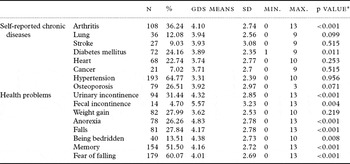
With regard to health-related variables, most subjects had one or two self-reported chronic diseases (56.86%; M = 2.19; SD = 1.54), whereas 30.10% reported suffering from three or more, and 13.04% reported having no diseases. Hypertension was the most prevalent self-reported chronic disease (64.77%), followed by diseases related to the musculoskeletal system, arthritis (36.24%), osteoporosis (26.51%), and diabetes (24.16%). In terms of self-reported health problems, 44.48% of the sample had three or more problems (M = 2.46, SD = 1.62), 46.15% had one or two, and 9.36% reported to have no health problems. Table 2 details the self-reported chronic diseases and health problems.
GDS score (mean and SD) according to self-reported diseases and health problems

*P-value refers to Mann-Whitney test, applied to compare GDS scores among participants who did and did not self report each disease or health problem.
GDS = Geriatric Depression Scale; SD = standard deviation; Min. = minimum; Max. = maximum.
There was a higher proportion of participants who reported good perceived health (40.27%), followed by respondents who indicated moderate (38.59%), poor (8.39%), excellent (7.05%), and very good (5.70%) health status.
As to GDS scores, most participants reported five or fewer depressive symptoms (79.21%, M = 3.42, SD = 2.60). A significant difference was noted in GDS scores when we compared individuals who reported to have diabetes, arthritis, urinary incontinence, fecal incontinence, loss of appetite, to have fallen one or several times, being bedridden, to have memory problems, or to have fear of falling, with individuals who did not report these problems. These results are shown in Table 2.
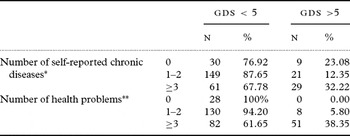
Table 3 includes the percentages and number of participants with GDS scores five and lower and higher than five stratified by the number of self-reported chronic diseases and health problems. There is a higher proportion of participants with GDS scores suggestive of depression among those with more than three chronic conditions (32.22%) and with more than three health problems (38.35%). It is important to highlight that among those participants who did not report health problems there were no individuals with a GDS higher than five (Table 3).
Percentages and number of participants with GDS suggestive of depression (> 5) stratified by the number of self-reported chronic diseases and health problems (N = 299)

* χ2 = 14.98; df = 2; P<0.001; ** χ2 = 52.90; df = 2; P<0.001.
GDS = Geriatric Depression Scale.
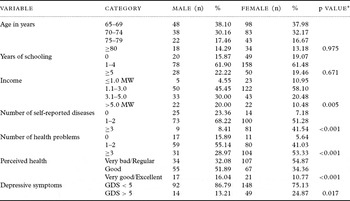
The main variables were also compared in relation to gender. There were significant differences for family income (greater frequency of lower income among women), number of self-reported chronic diseases and health problems (more frequent among women), perceived health (worse among women), and GDS score (higher among women). These data are presented in Table 4. Among women there was a higher presence of hypertension (73.20%), arthritis (47.42%) and osteoporosis (38.14%), loss of appetite (32.47%), falls (32.11%) and fear of falling (74.23%).
Comparisons of main study variables by gender

* χ2 test.
GDS = Geriatric Depression Scale; MW = minimum wage.
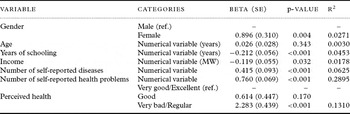
Univariate linear regression analyses were carried out to investigate the relationship between each variable of interest with GDS scores. These analyses indicated a significant relationship between level of schooling, income, gender, health problems, number of self-reported diseases, and GDS scores (Table 5). The multivariate linear regression analyses, in which variables were selected according to stepwise criteria, indicated that there was a significant concomitant relationship between the number of health problems, perceived health status, and education with GDS scores. Aged persons with more depressive symptoms were those with more health problems, poorer self-perceived health and fewer years of schooling (Table 6).
Univariate linear regression analysis for GDS scores (N = 303)

Beta = value of angular coefficient (slope) in linear regression; SE = beta's standard error; R2 = coefficient of determination (%) for variability of answers explained by the independent variable; Ref = reference level; MW = minimum wage.
Multivariate linear regression analysis for GDS score

Stepwise criteria for variable selection. Beta = value of angular coefficient (slope) in linear regression; SE = beta's standard error; R2 = coefficient of determination; R2 Total = 0.3212; Intercept (SE) = 1.365 (0.468); p = 0.004; Ref = reference level.
The regression analyses described above were also performed for each gender separately. For men, in the multivariate analyses, the number of self-reported health problems (Beta/SE = 0.72/0.15; p<0.001; R2 = 0.27), perceived health (Beta/SE = 1.67/0.63; p = 0.01; R2 = 0.09), and schooling (Beta/SE = -0,15/0.07; p = 0.048; R2 = 0.03) were associated with GDS scores. For women, the number of self-reported health problems (Beta/SE = 0.76/0.11; p<0.001; R2 = 0.21) and family income (Beta/SE = −0.22/0.09; p = 0.02; R2 = 0.03) were concomitantly associated with GDS scores.
Discussion
Previous research has established that the presence of depressive symptoms in old age is influenced by biological and psychosocial variables. Gender, socioeconomic and educational level, and the occurrence of chronic health conditions are linked to the etiology of depressive symptoms (Riso et al., Reference Riso, Miyatake and Thase2002; Blazer Reference Blazer2003; Castro-Costa et al., Reference Castro-Costa, Lima-Costa, Carvalhais, Firmo and Uchoa2008; Alexopoulos and Kelly, Reference Alexopoulos and Kelly2009). The aim of the present study was to investigate these issues among community-dwelling elders in a poor subdistrict of São Paulo, Brazil. Results have corroborated previous findings of higher depressive symptoms among seniors who reported having arthritis, diabetes, and health problems such as incontinence, falls or loss of appetite. In the multivariate regression analysis, the number of self-reported health problems (but not self-reported chronic diseases) was strongly associated with depressive symptoms in the total sample and for each gender analyzed separately.
In the current study, univariate regression analyses revealed that gender, education, income, number of self-reported diseases and health problems, and perceived health were associated with the GDS scores. Results on gender converge with previous findings on depression in old age, with women reporting a higher number of depressive symptoms (Blazer, Reference Blazer2003). In a literature review on the subject, Alvarado and colleagues (Reference Alvarado, Zunzunegui, Béland, Sicotte and Tellechea2007) found that socioeconomic status is one of the main risk factors for depressive symptoms among women. According to the study, older women tend to have fewer years of schooling, to be financially and socially dependent, and to be restricted to the domestic environment. Their exposure to less favorable living conditions over the years increases women's vulnerability to developing depressive symptoms. Present results support these findings: in the regression analyses that featured women only, family income was associated with GDS scores, with lower income being associated with more depressive symptoms. Family income was not associated with GDS scores among men.
Results also confirm findings in the literature concerning the association between low education and depressive symptoms. Education and family income are interrelated and are key indicators of social risk factors for depression. Individuals with lower levels of schooling tend to experience greater deprivation and to be more uncertain about the future. Ladin et al. (Reference Ladin, Daniels and Kawachi2010) suggested that lower educational levels were linked to higher poverty levels and to a greater prevalence of depressive symptoms among the elderly in European countries. Everson et al. (Reference Everson, Maty, Lynch and Kaplan2002) established that underprivileged elders in the USA were twice as likely to suffer from psychological disorders, as well as from physical disabilities, and chronic diseases. Seniors with lower education and income may also have less access to health services, whether curative or prophylactic, making them more vulnerable to developing depressive symptoms (Fiske et al., Reference Fiske, Wetherell and Gatz2009).
In the surveyed sample, GDS scores were higher among those who reported having chronic diseases and health problems likely to cause functional impairment, social and leisure restrictions, weakened sense of self-efficacy, and diminished quality of life (Hong et al., Reference Hong, Zarit and Malmberg2004; Santos et al., Reference Santos, Lebrão, Duarte and Lima2008), such as arthritis, diabetes, urinary and fecal incontinence, and falls.
It is important to highlight that chronic diseases related to the musculoskeletal system – arthritis and osteoporosis – are among the leading causes of impaired functional capacity and loss of independence in activities of daily living (ADL), magnifying loss of quality of life (Kanton Reference Kanton2003; Hong et al., Reference Hong, Zarit and Malmberg2004; Santos et al., Reference Santos, Lebrão, Duarte and Lima2008). Musculoskeletal diseases may restrict daily activities, and their presence has been associated with depressive symptoms among older persons in the literature (Braam et al., Reference Braam2005; Lyness et al., Reference Lyness, Niculescu, Xin, Reynolds and Caine2006; Ohayon and Schatzberg, Reference Ohayon and Schatzberg2010).
Present results also point to increased depressive symptoms with lower perceived health. Subjective health assessments have been used in gerontological research because it is an excellent proxy measure for other variables, such as subjective well-being and physical functioning (Pinquart, Reference Pinquart2001; Ruthig and Chipperfield, Reference Ruthig and Chipperfield2007). Ruthig and Chipperfield (Reference Ruthig and Chipperfield2007) found that individuals who had high perceived health – regardless of their objective health – scored higher in psychological well-being, perceived sense of control and physical functioning. Conversely, aged individuals who assessed their health more negatively were less satisfied with their own lives, displayed more negative emotions and were more predisposed to functional decline.
According to the literature, depressive symptoms, such as somatic complaints and a perceived sense of poor social and physical functioning, are correlated with diminished contentment with one's own health (Ohayon and Hong, Reference Ohayon and Hong2006; Chang-Quan et al., Reference Chang-Quan, Xue-Mei, Bi-Rong, Zhen-Chan, Ji-Rong and Qing-Xiu2010). In the present sample, it was noted that perceived health and self-reported health problems were important indications of subjective well-being, as a higher number of health problems was associated with a higher frequency of depressive symptoms.
The number of reported health problems was the variable most strongly correlated with variations in GDS scores. Perceived health and education were also significantly associated with GDS scores in the multivariate analysis. Results indicate that subjective health assessments were more closely linked to depressive symptoms than previous diagnoses given by physicians.
Results confirmed that within a population of older individuals with low income and low levels of schooling, depressive symptoms occur as a multifactorial phenomenon correlated with sociodemographic and health-related variables. Results highlight the fact that health problems such as falls and incontinence produce a more marked effect on mood than having certain diseases. These results also suggest that health professionals should seriously consider that the presence of the aforementioned health problems may increase the risk of developing depression.
There are some limitations to the present study. First, the sample was small and it cannot be considered representative of Brazilian elderly people. Brazil has a vast territory with striking cultural and socioeconomic differences and thus the current results may be generalized only to samples with similar characteristics. In addition, some of the exclusion criteria may have limited participation in the study to elderly people with chronic illnesses that were not severe or disabling. Future studies on the association of chronic diseases with depressive symptoms should include those subjects with severe, incapacitating and terminal diseases. A further limitation is the fact that the questions used to assess self-reported chronic diseases and health problems restricted the number of possible answers as they did not include the “other” alternative. Therefore, it was not possible to examine the impact of the full range of possible diseases and health problems on depressive symptoms.
Future investigations should continue to examine the relationship between subjective perceptions of health and depressive symptoms in old age, particularly in the context of adverse socioeconomic conditions.
Conflict of interest
None.
Description of authors' roles
G. Nicolosi designed the study and wrote the paper. D. Falcão, S. Batistoni, A. Lopes and M. Cachioni collected the data, supervised the data collection and revised the paper. A. Neri designed the study and revised the final version of the paper. M. Yassuda designed the study, collected the data, supervised the data collection, assisted with writing the article, and revised the final version of the article.