Clostridium difficile infection (CDI) results in substantial morbidity and mortality and presents a significant clinical challenge. One of the most challenging aspects of CDI is its propensity to recur. Recent data indicate that 15% to 35% of patients with an incident CDI experience recurrent CDI (rCDI) after discontinuation of antibiotic therapyReference Vardakas, Polyzos, Patouni, Rafailidis, Samonis and Falagas 1 – Reference Johnson 3 and the risk increases with each episode, with risk being greater than 60% in patients with 2 or more episodes.Reference McFarland, Surawicz, Rubin, Fekety, Elmer and Greenberg 4 , Reference Kelly 5 Of major concern, the increase in cases of rCDI undoubtedly leads to substantial morbidity, mortality, and economic burden. In fact, it is estimated that the annual US incidence of rCDI is 75,000 to 175,000 cases.Reference Shields, Araujo-Castillo, Theethira, Alonso and Kelly 6
Management of rCDI remains challenging. In response, considerable efforts have recently been dedicated to developing novel preventive and treatment strategies, including vaccines, monoclonal antibodies, such as bezlotoxumab (MK6072), an investigational drug directed against the C. difficile toxin B, and fecal transplantation.Reference Youngster, Russell, Pindar, Ziv-Baran, Sauk and Hohmann 7 – Reference Bagdasarian, Rao and Malani 9 However, evidence of the impact of rCDI on patient healthcare utilization and outcomes is limited. A better understanding of the consequences of rCDI is particularly important when assessing the possible benefits and cost-effectiveness of novel therapies aimed at prevention among high-risk populations and treatment among those who develop recurrence.
We sought to quantify outpatient and inpatient utilization among adults with rCDI and to identify variations in healthcare utilization and mortality among patients with rCDI, nonrecurrent CDI, and no CDI.
METHODS
This project was approved by the Kaiser Permanente Northern California (KPNC) Institutional Review Board for the Protection of Human Subjects.
We conducted our study among all adult Kaiser Foundation Health Plan (KFHP) members in Northern California who receive care from salaried physicians of the Permanente Medical Group at facilities owned by Kaiser Foundation Hospitals. All KPNC facilities, including 21 hospitals and their associated outpatient clinics, utilize the same information systems with a common medical record number and can track care covered by the plan but delivered elsewhere.Reference Selby 10 – Reference Liu, Kipnis, Rizk and Escobar 14
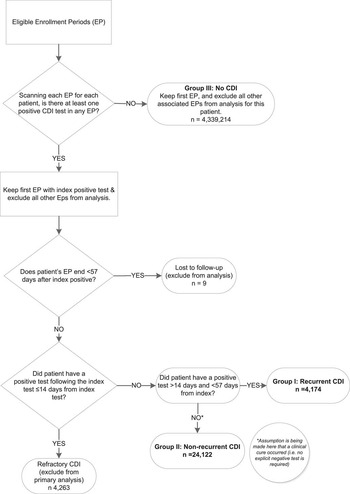
The study cohort was assembled as shown in Figure 1. We identified all individuals with a KFHP medical record number who met the following criteria: (1) at least 18 years of age between September 1, 2001, and December 31, 2013 and (2) at least 18 months of health plan membership during a continuous 24-month period. For the purposes of our study and throughout this manuscript, we refer to this 18-month membership period as the enrollment period, or EP.
Selection of the study population. CDI, Clostridium difficile infection.

We considered a patient as a member if she or he was listed as being a member for a given month or had utilization in a KPNC facility during a given month. Utilization events included acute inpatient hospital stays, non-acute institutional stays, emergency department (ED) encounters, ambulatory visits, radiology or laboratory encounters, and miscellaneous encounters (eg, hospice visits, home health visits paid for by KFHP). After establishing the inception cohort, we ensured that all included members had a “clean period” without CDI by excluding members who had a CDI diagnosis at any time during the first 4 months of their EP. For patients who had multiple EPs (ie, periods where the individual was not covered by KFHP but that were preceded or followed by 1 or more EPs), we selected the first EP.
We employed 2 definitions for CDI. First, we used International Statistical Classification of Disease, Ninth Revision, diagnosis code 008.45 (“Intestinal infection due to C. difficile”) during an outpatient or inpatient encounter to identify CDIs. Second, we identified patients with a CDI through the presence of a positive laboratory test result. We used both the International Statistical Classification of Disease, Ninth Revision, diagnosis and a positive laboratory test result to establish a “clean period,” as described above. We used this approach to ensure that we were not including patients who may have ongoing or unresolved CDI in the absence of testing. To identify CDI beyond the “clean period,” we used only positive laboratory test results. Before May 2011, KFHP diagnosed CDI by detecting the presence of C. difficile toxin in stool using an enzyme-linked immunoassay test (Premier Toxins A&B; Meridian Bioscience). In May 2011, KFHP transitioned to a 2-step testing algorithm that used glutamate dehydrogenase enzyme-linked immunoassay (C. diff Chek-60; Techlab) as the first step, and if that test was positive, polymerase chain reaction testing (Xpert C. difficile; Cepheid). Patients were defined as having CDI if they had a positive result on both tests.
Upon identification of CDI, we divided patients into 3 groups. Patients with rCDI constituted group I. We defined patients with rCDI as those who developed CDI in the 14–57 days after an initial CDI infection. Based on recommended surveillance definitions, this length of time allows for the successful treatment of the initial infection and CDI-free period.Reference McDonald, Coignard, Dubberke, Song, Horan and Kutty 15 We defined refractory CDI as infections characterized by repeated positive CDI tests within 10 to 14 days of each other. In the absence of detailed clinical data, we made the inference that this type of testing pattern indicated that patients were not cured within usual therapy time frames. Patients with refractory CDI were excluded from the primary analyses. The “nonrecurrent CDI,” group II, consisted of patients who had an initial CDI but who did not develop rCDI. Patients who never had a positive laboratory test for C. difficile and who did not have an outpatient or inpatient encounter with International Statistical Classification of Disease, Ninth Revision, code 008.45 were included in the “no CDI,” or group III. The classification algorithm is detailed in the Online Supplemental Appendix.
Our primary analyses compared (1) group I (cases) to group III (controls); (2) group I (cases) to group II (controls); and (3) group II (cases) to group III (controls). Because patients develop CDI at different times or never develop CDI, we assigned a time zero (T0) to each patient. This T0 serves as the starting point for the matching process. For rCDI patients (group I), T0 was the date of first positive CDI test in the 14 to 57 days after the patient’s initial positive test. For nonrecurrent CDI patients (group II), T0 was 14 days after their index positive test for C. difficile. For patients in the “no CDI” group (group III), T0 was the start date of the patient’s EP plus the number of days from its matched pair’s start of EP to its matched pair’s T0. As sensitivity analyses, we (1) employed a 14–85 days recurrence period, an end point used in several other investigations on rCDI,Reference Lowy, Molrine and Leav 8 , Reference Musher, Aslam and Logan 16 and (2) included patients with refractory CDI. These results, which were directionally consistent with our other findings, are reported in the Online Supplemental Appendix.
We included the following independent and dependent variables in our analyses: age, sex, occurrence of overnight hospitalization with or without the use of the intensive care unit (ICU),Reference Escobar, Greene, Gardner, Marelich, Quick and Kipnis 13 occurrence of outpatient and ED encounters, and mortality. We also collected 2 measures of comorbidity burden that are generated for all KFHP members on a monthly basis: Diagnostic Cost Groups and the COmorbidity Point Score (COPS). The Diagnostic Cost Groups score predicts future utilization and cost, with a higher score being associated with higher resource consumption for the patient in the following 12 months.Reference Ellis and Ash 17 – 20 The COPS is a longitudinal comorbidity burden measure based on a patient’s diagnoses in the preceding 12 months.Reference Escobar, Greene, Scheirer, Gardner, Draper and Kipnis 11 , Reference van Walraven, Escobar, Greene and Forster 21 We used COPS values for patients that were based on preexisting diagnoses over the 12-month period prior to their T0. In general, the COPS is calibrated for inpatient mortality, with a higher score indicating a higher risk for mortality. Specifically, a COPS less than 50 is associated with a mortality risk of less than 1%; a COPS less than 100 is associated with a mortality risk of less than 5%; and, a COPS greater than 145 is associated with a mortality risk of 10% or more.Reference Lowy, Molrine and Leav 8
Statistical Methods
Patients with CDI differ from the general population in regard to their demographic characteristics and comorbidity. A comparison of utilization and outcomes of CDI patients with other patients requires control for these important baseline confounders that have an effect on the utilization and outcomes. Case-control, multivariate matchingReference Rosenbaum 22 is a well-known statistical method used for adjusting for these differences by comparing the cases with controls with the same values of the observed confounders. We used this method to compare the exposed cohort subjects (eg, rCDI) to those unexposed (no CDI or nonrecurrent CDI). In this study we refer to the exposed cohort subjects as “cases” and the unexposed subjects as “controls.”
Using an optimal matching algorithm,Reference Kosanke and Bergstralh 23 we matched 2 controls to each case. However, in some instances, we were limited to a single matched control when appropriate controls were not available. Optimal matching minimizes the total absolute distance between matched case and control subjects. We defined eligible controls for each case within the study group and time frame as patients who were members at T0 and who remained members for at least the following month. We selected matched controls within age of patient at the start of their EP, sex, KPNC membership within the same year, and CDI group as those with the lowest absolute value of the difference between the COPS of the case and the control. Given the large number of controls available for every case, no caliper was used in the matching.
We compared sex, age, and COPS between cases and controls, for each CDI group, before and after matching using the t test or the χ2 test, as appropriate. We compared the risk scores (COPS and Diagnostic Cost Groups) between the cases and matched controls by CDI group at T0 and 1 year after T0. We also compared mortality rate, hospitalizations, hospital-days, ICU stays, ICU-days, and ED visits per patient at T0 and 1 year after T0. We calculated the relative risk of mortality using generalized estimating equations methodsReference Ziegler 24 and calculated the corresponding confidence intervals with robust error variances.Reference Zou 25 The relative risks for hospitalizations, ICU stays, and ED visits per patient were also obtained using generalized estimating equations but assuming a negative binomial distribution and a log link function and adjusting for number of eligibility months after T0. The same method was used to obtain the relative risk of hospital-days and ICU-days per patient assuming a normal distribution and an identity link function. We ran all generalized estimating equations models both adjusting and not adjusting for the matched pair design to explore the need for such adjustment. Both methods showed similar results so we report the unadjusted results only. Lastly, we calculated the mean excess utilization and mortality per member per year by calculating the difference between the mean adjusted utilization yearly rate for the cases and controls.
RESULTS
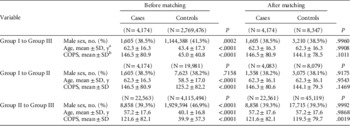
We identified 4,334,214 patients who did not have a positive CDI test (ie, the “no CDI” study group), 24,122 patients who met the criteria for the nonrecurrent CDI group; and 4,174 patients who met the criteria for the rCDI group (Figure 1). Table 1 shows the sex, age of patient at the start of their EP, and COPS at T0, first, for the study groups before matching and, second, for cases and corresponding controls after matching. By design, cases and controls had the same distribution in terms of sex, age, and comorbidity. Comparisons between the characteristics of cases and matched controls show a robust matching schema, as P values for the statistical comparisons of patient characteristics were no longer significant (at a level of .005) after matching. The 1 exception occurred when matching patients with nonrecurrent CDI and no CDI on the COPS value (P=.0019); however, this was clinically nonsignificant (only 2 points).
Baseline Characteristics of Recurrent CDI Patients (Group I), Nonrecurrent CDI Patients (Group II), and Patients Without CDI (Group III), Before and After Matching

NOTE. CDI, Clostridium difficile infection; COPS, COmorbidity Point Score.
a Patients were matched on age at the start of their enrollment period. This does not reflect the mean age of matched patients at their T0. See text and Online Supplemental Appendix for more details on the enrollment period.
b COPS quantifies patients’ comorbid illness burden on the basis of the patient’s preexisting diagnosis over the 12-month period preceding hospitalization. For purposes of this study, COPS was calculated using preexisting diagnosis over the 12-month preceding T0 .The unadjusted relationship of COPS and mortality is as follows: a COPS <50 is associated with a mortality risk of <1%, <100 with a mortality risk of <5%, and >145 with a mortality risk of 10% or more. See text and references 11 and 21 for additional details.
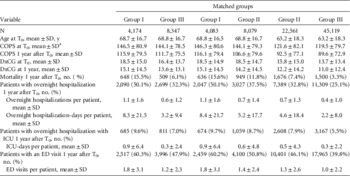
The mean age of patients at T0 ranged from 63.2 years among matched pairs of patients with nonrecurrent CDI (group I) and no CDI (group III) to 68.8 years among patients with rCDI (group I) and their matched controls (Table 2). Across all study groups, most patients were women and the level of comorbidity, as measured by COPS, was substantial. Fifty percent of rCDI patients had at least 1 overnight hospitalization during the 1-year follow-up period, whereas their matched nonrecurrent and no-CDI controls experienced hospitalization rates of 38% and 32%, respectively. ED visits and hospitalizations (both those that did and did not include intensive care) also occurred more frequently among patients with rCDI than among their matched nonrecurrent and no-CDI controls (Table 2). Furthermore, a 1-year mortality rate of nearly 16% was observed among rCDI patients, whereas their matched controls with nonrecurrent CDI and without CDI experienced mortality rates of 12% and 6%, respectively (Table 2).
Demographic and Unadjusted Utilization Rates for Matched Cases and Corresponding Controls

NOTE. CDI, Clostridium difficileinfection; COPS, COmorbidity Point Score; DxCG, diagnostic cost groups; ED, emergency department; ICU, intensive care unit.
a COPS quantifies patients’ comorbid illness burden on the basis of the patient’s preexisting diagnosis over the 12-month period preceding hospitalization. For purposes of this study, COPS was calculated using preexisting diagnosis over the 12-month preceding T0 .The unadjusted relationship of COPS and mortality is as follows: a COPS <50 is associated with a mortality risk of <1%, <100 with a mortality risk of <5%, and >145 with a mortality risk of 10% or more. See text and references 11 and 21 for additional details.
Comparison Between rCDI patients and Patients With Nonrecurrent CDI or Without CDI
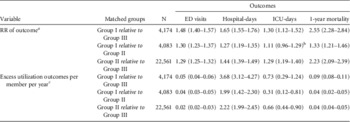
In matched comparisons of healthcare utilization, we found that patients with rCDI had consistently higher utilization than both patients with nonrecurrent CDI and patients with no CDI (Table 3). After matching, patients with rCDI had a greater risk for ED visits (relative risk, 1.48 [95% CI, 1.40–1.57]), hospital-days (1.65 [1.55–1.76]), ICU-days (1.30 [1.12–1.52]), and 1-year mortality (2.55 [2.28–2.84]) than patients who had a nonrecurrent CDI. Thus, when matched, patients who have rCDI have a 48% higher rate of ED visit than patients with nonrecurrent CDI. Patients with rCDI also had a greater relative risk for these outcomes than patients with no CDI (Table 3). The greatest increase in risk was for mortality. In fact, when matched, patients with rCDI had a 155% higher rate of 1-year mortality than patients with no CDI (Table 3).
Relative Risk for Healthcare Utilization and Mortality and Adjusted Excess Healthcare Utilization and Mortality Among rCDI Patients (Group I), Nonrecurrent CDI Patients (Group II), and Patients Without CDI (Group III)

NOTE. CDI, Clostridium difficileinfection; ED, emergency department; ICU, intensive care unit; rCDI, recurrent CDI; RR, relative risk.
a The rate of utilization patients have in one group relative to patients in another group (eg, when matched, patients in group I have a 48% higher rate of ED visit than patients in group III).
b All values show P<.0001 except this item.
c Impact of outcomes refers to the excess amount of ED visits, hospital-days, ICU-days, or deaths that one group of patients experiences over 1 year following T0 compared with its matched group of patients.
We also compared the amount of utilization (ie, ED visits, hospital-days, ICU-days, or deaths) that rCDI patients experience in the 1 year following index date with the amount of utilization for matched controls with nonrecurrent CDI or no CDI. Recurrent CDI patients experienced more ED visits, more hospital-days, more ICU-days, and greater mortality in the 1 year following index than matched controls with either nonrecurrent CDI or no CDI (Table 3). The greatest difference in utilization occurred when comparing hospital-days; on average, rCDI patients experienced nearly 2 more hospital-days (95% CI, 1.4–2.3) than matched controls with nonrecurrent CDI and nearly 4 more hospital-days (95% CI, 3.1–4.3) than patients with no CDI. Furthermore, on average, when matched, patients who have rCDI have a 4% higher 1-year mortality rate (95% CI, 2%–5%) than patients with nonrecurrent CDI and a 9% higher mortality rate (95% CI, 8%–11%) than patients with no CDI (Table 3).
Healthcare Utilization Among Nonrecurrent CDI Patients and Patients Without CDI
Consistent increases in utilization were also observed for patients with nonrecurrent CDI compared with matched controls who did not have CDI. After matching, patients with nonrecurrent CDI had a greater risk for ED visits (relative risk, 1.29 [95% CI, 1.25–1.32]), hospital-days (1.44 [1.39–1.49]), ICU-days (1.29 [1.19–1.40]), and 1-year mortality (2.23 [2.09–2.39]) than patients who did not have CDI. In addition, nonrecurrent CDI patients have greater utilization and experience greater mortality than matched controls with no CDI. The greatest difference in utilization occurred when comparing hospital-days; on average, rCDI patients experienced more than 2 additional hospital-days (95% CI, 2.0–2.5) than matched controls without CDI (Table 3).
DISCUSSION
We found that patients with rCDI consistently had substantially higher levels of healthcare utilization in a number of different settings and greater 1-year mortality risk than both patients who had nonrecurrent CDI and patients who did not have a CDI. Increased utilization was pronounced even after controlling for underlying chronic illness burden. Thus, we have shown that patients with rCDI experience even greater adverse consequences of their disease than patients who do not experience recurrent infection, regardless of underlying illness. These results indicate the need for continued emphasis on the identification and use of novel approaches to the prevention and treatment of rCDI.
Extensive attention has been paid to utilization and healthcare costs associated with nonrecurrent, or incident, CDI.Reference Zimlichman, Henderson and Tamir 26 – Reference Shah, Aitken and Barragan 30 In contrast, few studies have addressed similar outcomes among patients who experience rCDI. The studies that are available report significant increased likelihood of hospital readmission and mortality among patients with rCDI compared with those who do not experience rCDI.Reference Aitken, Joseph and Shah 31 – Reference Olsen, Yan, Reske, Zilberberg and Dubberke 33 Our results point to similar conclusions. However, our study, which was conducted in a large population permitting multivariate matching, gives a more complete picture of both the excess burden of incident CDI and recurrence of infection. Our results also suggest that patients with rCDI experience greater exposure to the healthcare system, which may suggest the need for more systematic monitoring of patients who are at high risk for or already have rCDI owing to the potential transmission of C. difficile to other patients.
There are considerations to take into account when interpreting our results. First, a number of approaches have been employed to define rCDI. In smaller clinical trials, rCDI has been defined as a recrudescence of symptoms after improvement and after discontinuation of antibiotics plus or minus a repeat positive toxin test.Reference Lowy, Molrine and Leav 8 , Reference Barbut, Richard, Hamadi, Chomette, Burghoffer and Petit 34 Rather than performing individual medical chart reviews, which is impractical for large studies like ours, we adapted the currently recommended surveillance definitions for use in electronic health record data.Reference McDonald, Coignard, Dubberke, Song, Horan and Kutty 15 Also, after 2011, our criteria for CDI included polymerase chain reaction testing, an approach that does not distinguish between colonization and active infection and, as a result, may lead to overdiagnosis of CDI in some patients. However, during that time, KFHP used a 2-step testing algorithm that included glutamate dehydrogenase enzyme-linked immunoassay as the first step, with polymerase chain reaction testing to follow if the initial test was positive. Patients were defined as having CDI if they had a positive result on both tests, thus reducing the potential for misclassification.
Second, we did not restrict utilization among CDI patients during our follow-up period to be associated with a CDI diagnosis. Thus, our results provide estimates of the overall, rather than CDI-specific, elevation in utilization among patients with CDI. Finally, while our study did focus on excess utilization among patients with rCDI, we did not examine the economic burden of utilization. These analyses would provide additional information to use in decision-making related to the development of new treatments for CDI that have the potential to reduce recurrence. More research is also needed to examine the immediate impact of rCDI on patient quality of life as well as the long-term impact on overall patient health.
The optimal management of rCDI is not established. Most healthcare providers follow the current guidelines and use the same antimicrobials indicated for treatment of an initial infection for a first recurrence.Reference Johnson 3 , Reference McFarland, Surawicz, Rubin, Fekety, Elmer and Greenberg 4 Increasingly, these regimens are being acknowledged as ineffective at treating rCDI or reducing subsequent recurrence.Reference Johnson 3 , Reference McFarland, Elmer and Surawicz 35 In response, rCDI has become a target for the development of novel prevention and treatment strategies, including but not limited to new antimicrobials, vaccines, immunotherapy such as monoclonal antibodies, and fecal transplantation.Reference Youngster, Russell, Pindar, Ziv-Baran, Sauk and Hohmann 7 – Reference Bagdasarian, Rao and Malani 9 However, clinicians and healthcare systems may lack necessary evidence to support a commitment to new approaches that are often expensive and that have not been widely used in current clinical practice. Our study demonstrates the excess utilization associated with rCDI and supports the need for strategies that classify patients by risk and identify which patients should receive new approaches to prevention and treatment, some of which are expensive, uncomfortable, or both.
ACKNOWLEDGMENTS
We are grateful to Tracy Lieu, MD, for reviewing the manuscript; and Rachel Lesser, for assistance with editing.
Financial support. Merck Sharp & Dohme Corp. and Kaiser Foundation Research Institute; and the National Institutes of Health (grant K23 GM112018 to V.L.).
Potential conflicts of interest. Y.X. and S.M. report that they are employed by Merck, Sharpe & Dohme. All other authors report no conflicts of interest relevant to this article.
SUPPLEMENTARY MATERIAL
For supplementary material/s referred to in this article, please visit http://dx.doi.org/doi:10.1017/ice.2016.232