INTRODUCTION
Foxtail millet (Setaria italica (L.) P. Beauv.) is a diploid, self-pollinated, C4 monocot grass in the sub-family Poaceae. It is an important strategic reserve crop (i.e. the government reserves seeds in order to ensure that some crops are available to people in case of natural disasters) owing to its high drought resistance, photosynthetic ability and nutritional quality (Muthamilarasan & Prasad Reference Muthamilarasan and Prasad2015). Recently, the Beijing Genomics Institute (BGI) in China (Zhang et al. Reference Zhang, Liu, Quan, Cheng, Xu, Pan, Xie, Zeng, Yue, Wang, Tao, Bian, Han, Xia, Peng, Cao, Yang, Zhan, Hu, Zhang, Li, Li, Li, Wang, Wang, Wang, Guo, Cai, Liu, Xiang, Shi, Huang, Chen, Li, Wang, Zhao and Wang2012) and the Joint Genome Institute (JGI) of the Department of Energy in the USA (Bennetzen et al. Reference Bennetzen, Schmutz, Wang, Percifield, Hawkins, Pontaroli, Estep, Feng, Vaughn, Grimwood, Jenkins, Barry, Lindquist, Hellsten, Deshpande, Wang, Wu, Mitros, Triplett, Yang, Ye, Mauro-Herrera, Wang, Li, Sharma, Sharma, Ronald, Panaud, Kellogg, Brutnell, Doust, Tuskan, Rokhsar and Devos2012) have independently sequenced the S. italica genome. Its size is approximately 515 Mb, larger than the rice genome (430 Mb) but smaller than pearl millet (2352 Mb) and maize (2500 Mb) genomes. The availability of S. italica sequence data has made it a useful model for studying related panicoid plants, including bioenergy crops such as switchgrass (Panicum virgatum L.) and pearl millet (P. glaucum L.) (Bennetzen et al. Reference Bennetzen, Schmutz, Wang, Percifield, Hawkins, Pontaroli, Estep, Feng, Vaughn, Grimwood, Jenkins, Barry, Lindquist, Hellsten, Deshpande, Wang, Wu, Mitros, Triplett, Yang, Ye, Mauro-Herrera, Wang, Li, Sharma, Sharma, Ronald, Panaud, Kellogg, Brutnell, Doust, Tuskan, Rokhsar and Devos2012).
The WRKY transcription factors consist of about 60 highly conserved amino acids, characterized by the WRKYGQK motif in the N-terminus and the CysCysHisCys (C2HC)- or CysCysHisHis (C2H2)-type zinc finger motif in the C-terminus (Eulgem et al. Reference Eulgem, Rushton, Robatzek and Somssich2000; Rushton et al. Reference Rushton, Somssich, Ringler and Shen2010). The WRKY proteins regulate gene expression by binding to the W-BOX motif (TTGACC/T) in gene promoters (Rushton et al. Reference Rushton, Torres, Parniske, Wernert, Hahlbrock and Somssich1996; Eulgem et al. Reference Eulgem, Rushton, Robatzek and Somssich2000). WRKY family members are divided into three groups based on the number of WRKY domains and the pattern of zinc finger motifs. The first group typically includes two WRKY domains and a C2H2-type zinc finger motif. Most WRKY proteins contain only one WRKY domain and belong to the second or third groups. The zinc finger motifs from the second group are identical to the first group, whereas the third group possesses the C2HC zinc finger motif. Group II WRKY proteins are further divided into IIa + IIb, IIc and IId + IIe, whereas group III WRKYs are classified as IIIa and IIIb (Zhang & Wang Reference Zhang and Wang2005; Rushton et al. Reference Rushton, Somssich, Ringler and Shen2010).
WRKY transcription factors play key roles in plant defence against various biotic stresses, including bacterial, fungal and viral pathogens (Yang et al. Reference Yang, Chen, Wang, Fan and Chen1999; Marchive et al. Reference Marchive, Mzid, Deluc, Barrieu, Pirrello, Gauthier, Corio-Costet, Regad, Cailleteau, Hamdi and Lauvergeat2007; Mukhtar et al. Reference Mukhtar, Deslandes, Auriac, Marco and Somssich2008; Tao et al. Reference Tao, Liu, Qiu, Zhou, Li, Xu and Wang2009; Gallou et al. Reference Gallou, Declerck and Cranenbrouck2012; Wang et al. Reference Wang, Dang, Liu, Wang, Eulgem, Lai, Yu, She, Shi, Lin, Chen, Guan, Qiu and He2013). Recent evidence also supports their roles in response to abiotic stressors, such as drought, salinity and cold (Jiang & Deyholos Reference Jiang and Deyholos2009; Zou et al. Reference Zou, Jiang and Yu2010; Jiang et al. Reference Jiang, Liang and Yu2012; Okay et al. Reference Okay, Derelli and Unver2014; Wang et al. Reference Wang, Zhu, Fang, Sun, Su, Liang, Wang, Londo, Li and Xin2014; Yan et al. Reference Yan, Jia, Chen, Hao, An and Guo2014). Moreover, they are involved in the regulation of major plant growth and development processes, such as seed development, trichome initiation and senescence (Ülker & Somssich Reference Ülker and Somssich2004; Rushton et al. Reference Rushton, Somssich, Ringler and Shen2010). Therefore, there has been immense interest in studying WRKY transcription factors as potential candidates for agricultural enhancement. Several WRKY families have been identified in a variety of plants, including Arabidopsis thaliana (L.) Heynh. (Eulgem et al. Reference Eulgem, Rushton, Robatzek and Somssich2000), rice (Oryza sativa L.; Xie et al. Reference Xie, Zhang, Zou, Huang, Ruas, Thompson and Shen2005), maize (Zea mays L.; Wei et al. Reference Wei, Chen, Chen, Wu and Xie2012) and bread wheat (Triticum aestivum L.; Okay et al. Reference Okay, Derelli and Unver2014). Recently, a global analysis of the WRKY family was conducted in S. italica, demonstrating the involvement of four genes in abiotic stress (Muthamilarasan et al. Reference Muthamilarasan, Bonthala, Khandelwal, Jaishankar, Shweta, Nawaz and Prasad2015).
The present study describes a more extensive analysis of 103 WRKY genes (SiWRKYs) from S. italica under drought stress. First, a phylogenetic tree was constructed and the genes were classified into three main groups. In addition, the conserved motifs of individual SiWRKYs were analysed and genomic distribution of the genes was estimated. Moreover, tissue-specific gene expression patterns were profiled with publicly available RNA sequencing data. A comprehensive analysis of SiWRKY expression in response to dehydration was also performed, to understand how drought affects gene expression in a stress-tolerant plant. The present study aims to provide an overview of SiWRKY genes and generate data that will help identify potential candidates for improving selection of stress tolerance in crops.
MATERIALS AND METHODS
Database queries
Two different approaches were applied to identify putative WRKY proteins from S. italica. First, the S. italica genome sequence database in Phytozome version 9.1 (www.phytozome.net) was searched using ‘WRKY’ and ‘Setaria italica’ as keywords. In addition, 472 WRKY transcription-factor protein sequences of four species (A. thaliana [90], rice [109], sorghum: Sorghum bicolor (L.) Moench [110] and maize [163]) were downloaded from the Plant Transcription Factor Database version 3.0 (http://planttfdb.cbi.pku.edu.cn/family.php?fam=WRKY). These sequences were used to identify homologous peptides from S. italica through a Basic Local Alignment Search Tool for Proteins (BLASTP) search in the Phytozome database, using default parameters (Goodstein et al. Reference Goodstein, Shu, Howson, Neupane, Hayes, Fazo, Mitros, Dirks, Hellsten, Putnam and Rokhsar2012). All hits with Expect (E) values <1·0 were retrieved and redundant sequences were removed manually. Each non-redundant sequence was checked in the Simple Modular Architecture Research Tool (SMART) database (http://smart.emblheidelberg.de) for presence of the conserved WRKY domain.
The hits with E value <1 × 10⁻⁵ and over 80% identity were considered orthologous. The comparative orthologous relationships of WRKY genes among foxtail millet, sorghum, maize and rice were illustrated using the circular visualization software Circos (Krzywinski et al. Reference Krzywinski, Schein, Birol, Connors, Gascoyne, Horsman, Jones and Marra2009). To estimate synonymous (Ks) and non-synonymous (Ka) substitution rates, the corresponding amino acid and cDNA sequences of orthologous WRKY proteins were analysed using PAL2NAL (http://www.bork.embl.de/pal2nal/) (Suyama et al. Reference Suyama, Torrents and Bork2006).
Setaria italica and Arabidopsis WRKY protein sequences alignment and phylogenetic tree construction
The full protein sequences of WRKY transcription factors from Arabidopsis and S. italica were used in a multiple sequence alignment. The alignment was then used to construct a neighbour-joining phylogenetic tree in the Molecular Evolutionary Genetics Analysis (MEGA) 5·0 program. Bootstrap values were calculated with 1000 iterations. Based on the multiple sequence alignment and the previously reported classification of Arabidopsis AtWRKY proteins (Eulgem et al. Reference Eulgem, Rushton, Robatzek and Somssich2000), the SiWRKY proteins were assigned to three different groups.
Analysis of the conserved amino acid sequence domains for SiWRKY transcription factors
Protein motifs were identified using the Multiple EM (Expectation Maximization) for Motif Elicitation (MEME) (http://meme.nbcr.net/meme/). The analysis was performed with the following settings: number of repetitions, any; maximum number of motifs, 15; and optimum width of the motif, 10–60.
Chromosomal localization of the SiWRKYs and estimation of their genomic duplication
For each SiWRKY gene, the chromosome number plus the gene start and end positions were identified in Phytozome version 9.1 (Table S1, available from https://multimediafluids.uam.elogim.com/core/journals/journal-of-agricultural-science). The SiWRKY genes were then plotted onto the respective chromosomes according to the ascending order of their physical position (in base pairs, bp). The resultant physical map was created using MapChart version 2.2 (Voorrips Reference Voorrips2002).
Tandem duplication was defined as gene clusters located within 30 kb of each other on a chromosome (Shiu & Bleecker Reference Shiu and Bleecker2003; Puranik et al. Reference Puranik, Sahu, Mandal, Suresh, Parida and Prasad2013). Segmental duplication was analysed via a BLASTP search against the complete peptide sequences of S. italica, and the first five matches with E value <1 × 10⁻⁵ were chosen as potential anchors. Collinear blocks were assessed in Multiple Collinearity Scan (MCScan) version 0.8 and alignments with E value <1 × 10⁻⁵ were considered significant matches (Tang et al. Reference Tang, Bowers, Wang, Ming, Alam and Paterson2008; Puranik et al. Reference Puranik, Sahu, Mandal, Suresh, Parida and Prasad2013).
In silico expression profiling
RNA sequencing data from four S. italica tissues types, namely spica, stem, leaf and root, were retrieved from the European Nucleotide Archive (http://www.ebi.ac.uk/ena SRX128226 [spica], SRX128225 [stem], SRX128224 [leaf], SRX128223 [root)]) (Cochrane et al. Reference Cochrane, Alako, Amid, Bower, Cerdeño-Tárraga, Cleland, Gibson, Goodgame, Jang, Kay, Leinonen, Lin, Lopez, McWilliam, Oisel, Pakseresht, Pallreddy, Park, Plaister, Radhakrishnan, Rivière, Rossello, Senf, Silvester, Smirnov, Ten Hoopen, Toribio, Vaughan and Zalunin2013). All paired-end Illumina reads from the four different tissue samples were mapped onto the foxtail millet gene sequences using Bowtie2 (Langmead & Salzberg Reference Langmead and Salzberg2012), and the number of mapped reads was normalized with the reads per kilobase per million (RPKM) method (Pepke et al. Reference Pepke, Wold and Mortazavi2009). Based on the RPKM value of each SiWRKY gene in the respective tissues, a heat map showing tissue-specific expression was generated using The Institute for Genomic Research (TIGR) Multi Experiment Viewer (MeV4·9·0) (Saeed et al. Reference Saeed, Bhagabati, Braisted, Liang, Sharov, Howe, Li, Thiagarajan, White and Quackenbush2006). Approximately 2 kb of genomic DNA sequence, upstream of each SiWRKY gene, was retrieved from Phytozome, and the cis-regulatory elements were identified using the plant cis-acting regulatory DNA elements (PLACE) database (http://www.dna.affrc.go.jp/PLACE/signalup.html).
Plant material and stress treatments
Seeds of foxtail millet ‘Jingu21’ were obtained from the Shanxi Agriculture University, Shanxi, China, and grown in pots (diameter 20 cm and height 50 cm) containing vermiculite, in a greenhouse under a 14-h photoperiod. The temperature was set to 28 °C during the day and 20 °C at night, with relative humidity set to 70%. For stress treatments, the plants were carefully pulled out and the roots of seedlings were immersed in solutions containing 0·2 g/ml polyethylene glycol 6000 for 1, 6, 12 and 24 h. After the treatments, roots were collected, frozen immediately in liquid nitrogen, and stored at −80 °C until RNA isolation. Three independent replicates were collected for each time point to ensure precision and reproducibility.
RNA isolation and quantitative real-time polymerase chain reaction analysis
Total RNA was isolated from collected samples using a Plant Total RNA Isolation Kit (TIANGEN, Beijing, China) and treated with RNase-free DNase I (RQ1, Promega, Madison, USA). SuperScript III Reverse Transcriptase (Invitrogen) with Oligo(dT)18 (Promega) was used to synthesize cDNA, following manufacturer protocol. The quantitative real-time polymerase chain reaction (qRT-PCR) primers (Table S2, available from https://multimediafluids.uam.elogim.com/core/journals/journal-of-agricultural-science) for SiWRKY genes were designed with the GenScript Real-time PCR Primer Design tool (https://www.genscript.com/ssl-bin/app/primer). The StepOne™ Real-Time PCR System (Applied Biosystems, Delaware, USA) was used for PCR reactions, and the thermocycling procedure was as follows: 40 cycles (95 °C for 15 s and 60 °C for 1 min). The size of PCR products was checked with agarose gel electrophoresis. A constitutive 18sRNA gene was used as an endogenous control. Three biological replicates were performed.
RESULTS
Identification of SiWRKY genes in Setaria italica
The keyword search in Phytozome yielded 109 SiWRKY genes. Verification of WRKY domain presence using SMART resulted in the exclusion of four genes lacking the conserved WRKY domain (Si032748m, Si003876m, Si013326m and Si027982m) and two genes with incomplete C-terminal zinc finger motifs (Si002957m and Si014936m). The BLASTP search against the S. italica genome database using 472 WRKY protein sequences from A. thaliana, O. sativa, S. bicolor and Z. mays identified 106 SiWRKYs (E value <1·0). Transcripts Si036581m, Si029764m and Si030012m were redundant with Si036565m, Si029245m and Si029342m, respectively. The final number of SiWRKYs genes obtained from the two methods was identical.
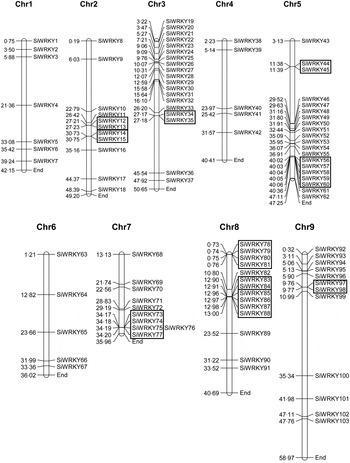
The final 103 transcripts were named SiWRKY1 to SiWRKY103, following their order on the chromosomes (Fig. 1; Table S1, available from https://multimediafluids.uam.elogim.com/core/journals/journal-of-agricultural-science). The predicted sizes of 75 out of 103 SiWRKY proteins were between 200 amino acids (aa) to 400 aa. Si028710m was predicted to be the longest protein sequence (1291 aa), whereas Si038955m was predicted to be the shortest protein (94 aa).
Distribution of 103 SiWRKY genes on nine foxtail millet chromosomes. Graphical representation of physical locations for each SiWRKY gene on foxtail millet chromosomes (numbered Chr1–9). Tandem-duplicated genes on a particular chromosome are indicated with black boxes. Chromosomal distances are given in Mb.

Genomic distribution of SiWRKY genes reveals gene clustering and tandem duplications.
All 103 SiWRKYs genes were physically mapped onto nine chromosomes of S. italica (Fig. 1). The map revealed a non-random distribution of SiWRKYs genes in the genome. Two to five SiWRKY gene clusters were identified (black boxes, Fig. 1). The largest cluster of five SiWRKY genes was on chromosomes 5 and 7. In total, 30 SiWRKY genes were tandem duplicates. Twenty-six of these were in group III, suggesting that tandem duplication contributed to the expansion of the SiWRKY family.
Phylogenetic classification of SiWRKYs and identification of motif conservation
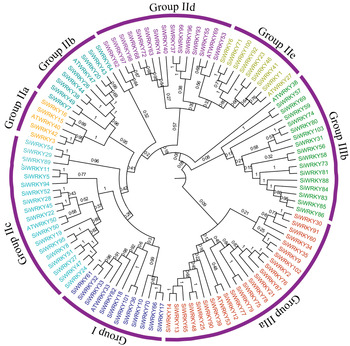
To examine the phylogenetic relationships of SiWRKYs, a phylogenetic tree was constructed based on the whole protein sequences of 103 SiWRKYs and seven AtWRKYs (Arabidopsis WRKY proteins). Seven groups (I, IIa, IIb, IIc, IId, IIe and III) were categorized in Arabidopsis and seven AtWRKYs were selected: group I (AtWRKY33), group IIa (AtWRKY40), group IIb (AtWRKY47), group IIc (AtWRKYY50), group IId (AtWRKY69), group IIe (AtWRKY27) and group III (AtWRKY53). The 103 SiWRKY proteins were categorized into seven groups according to the Arabidopsis categories. The largest group in S. italica was group III, which was further divided into two subgroups (IIIa and IIIb; Fig. 2). Group I contained two WRKY domains and SiWRKY10, with one WRKY domain, was also categorized into group I. The group IIc proteins were close to group I in the phylogenetic tree, but contained only one WRKY domain. Among groups II, IIa and IIb shared a close evolutionary distance, whereas subgroups IId and IIe were closer (Fig. 2).
Phylogenetic tree of WRKY proteins from foxtail millet (SiWRKYs) and Arabidopsis (AtWRKYs). The sequences were aligned with Clustal W in MEGA5 and the phylogenetic tree was constructed using the neighbour-joining method. Proteins were classified into three distinct clusters and each group was assigned a different colour. Group (I, II and III) and subgroup (IIa, IIb, IIc, IId and IIe) names are indicated around the outside of the circle. Colour online.

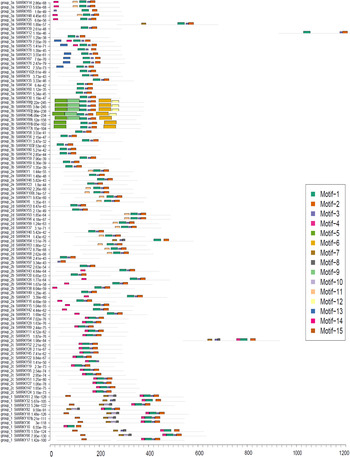
From the protein sequences of 103 SiWRKYs, 15 conserved motifs were identified (Table S3, available from https://multimediafluids.uam.elogim.com/core/journals/journal-of-agricultural-science). The motif distribution corresponding to the SiWRKY gene family revealed that SiWRKY proteins in the same sub-family had similar motifs (Fig. 3). All SiWRKY proteins contained motifs 1, 2 and 3. Motif 4 was observed in the more closely related groups I and IIc (Fig. 3). Motifs 5 and 6 were specifically found in SiWRKY73, 81, 83, 84, 85, 86 and 88 of group III. Motif 7 was the N-terminal WRKY domain of group I proteins and was therefore primarily found in that group.
Schematic representation of amino acid motifs in SiWRKY proteins from different groups. Motif analysis was performed using Meme 4·0 software as described in the Materials and Methods. The selected WRKY proteins are listed on the left. The black solid line represents the corresponding WRKY protein and its length. The differently colour boxes represent separate motifs and their position in each WRKY sequence. Colour online.

Syntenic relationships of SiWRKY genes among foxtail millet, rice, sorghum and maize
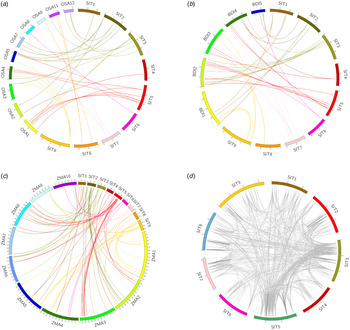
To obtain the syntenic relationships of SiWRKYs, comparative maps were constructed with SiWRKY genes, as well as orthologous rice, sorghum and maize genes (Fig. 4). The ratios of Ka v. Ks substitution (Ka/Ks) were estimated for the orthologous genes of SiWRKY with those of sorghum (25), maize (19) and rice (11). This analysis showed that the SiWRKY family experienced strong purifying selection, as Ka/Ks ratios of the duplicated genes equalled one. Among the orthologous gene pairs of SiWRKYs and WRKYs of other grass species, the average Ka/Ks value was highest between foxtail millet and rice (0·24) and lowest between foxtail millet and maize (0·13; Table S4, available from https://multimediafluids.uam.elogim.com/core/journals/journal-of-agricultural-science).
Comparative physical mapping showing the degree of orthologous relationships of SiWRKY genes located on nine chromosomes of foxtail millet with (a) sorghum, (b) maize, (c) rice, (d) S. italica. Colour online.

In silico tissue-specific expression profiling of SiWRKY genes
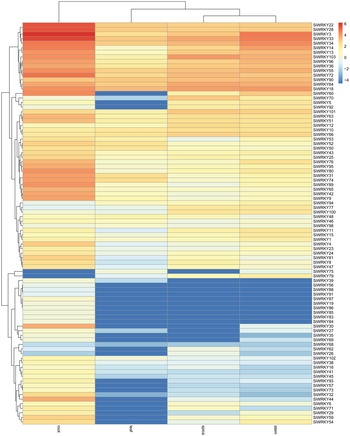
Gene expression with high tissue specificity is generally considered a strong indication for a specific role in the tissue involved. The strong drought resistance of S. italica means that SiWRKY gene specificity in roots is of special interest, because roots are the key organ perceiving drought signals. The results of SiWRKY gene specificity analyses in the root, leaf, stem and spica revealed that the expression of 84 SiWRKY genes was higher in the root than in the other tissues examined. Among those, SiWRKY19, 56, 83, 84, 85, 86, 87, 88 and 91 were specifically expressed in the root (Fig. 5; Table S5, available from https://multimediafluids.uam.elogim.com/core/journals/journal-of-agricultural-science). However, the heat map showing tissue-specific expression revealed that over half of the genes were expressed in all four tissues, suggesting constitutive expression (Fig. 5; Table S5, available from https://multimediafluids.uam.elogim.com/core/journals/journal-of-agricultural-science).
Heat map showing the expression patterns of SiWRKY genes in four tissues: leaf, root, stem, and spica. The colour scales for fold-change values are on the right. Eighty-four out of 103 SiWRKYs were highly expressed in root tissue. Note that expression values mapped onto a colour gradient from low (blue) to high (orange). Colour online.

Analysis of SiWRKY gene expression in response to drought stress
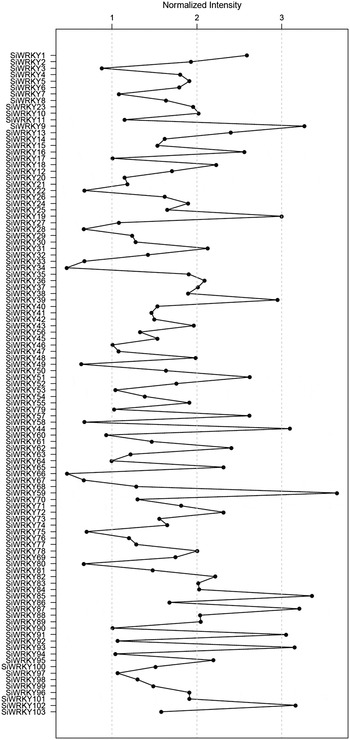
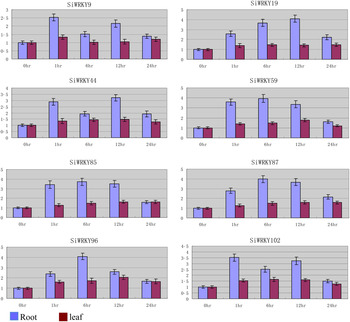
To further investigate SiWRKYs in response to drought stress, the roots of seedlings treated with 1-h drought stress were used for qRT-PCR expression analysis of all 103 SiWRKYs. The results showed that most genes were up-regulated after drought stress; however, several genes were down-regulated (Fig. 6). To identify putative drought-response genes, eight genes (SiWRKY9, 19, 44, 59, 85, 87, 96 and 102) with expression two-fold higher than the control were further examined with qRT-PCR at 0, 1, 6, 12 and 24 h of dehydration. These SiWRKY genes exhibited tissue-specific responses to drought stress (Fig. 7) with increased expression in roots but little change in leaves. Most gene expression (SiWRKY19, 59, 85, 87 and 96) in roots peaked at 6 h, but became down-regulated afterwards. In contrast, the remaining genes exhibited a more variable expression pattern with double peaks: one at 1 h and the other at 12 h (Fig. 7). Interestingly, the expression of root-specific genes (SiWRKY85 and SiWRKY87) was low under normal environmental conditions but became highly up-regulated once drought was detected.
Pairwise comparisons of SiWRKY gene expression profiles in response to drought. The signal intensities of qRT-PCR results were normalized to the mean expression values and plotted in log-scale for all SiWRKY genes.

The relative expression ratio of eight SiWRKY genes analysed with qRT-PCR at 0, 1, 6, 12 and 24 h of dehydration. For all graphs, relative amounts of selected RNA were evaluated for gene expression using the 2^(−ΔΔC t ) method. Error bars indicate standard errors of the mean among replicates. Significant differences between treated samples and control sample (0 h under stress) were examined with t-tests. If P < 0·01, SiWRKY genes were considered differentially expressed. 18sRNA was used as an internal control to normalize the data. Colour online.

DISCUSSION
Characterization and phylogenetic relationships of WRKY proteins in Setaria italica
The present study facilitated the characterization and phylogenetic relationships of S. italic WRKY transcription factors family proteins, which are important regulators of major plant processes such as growth, development and stress responses. Thus, these proteins have been subjected to intensive investigations in various crop plants. In the present study, 103 SiWRKY genes were identified, after excluding two genes with incomplete C-terminal zinc finger motifs (Si002957m and Si014936m). In addition, a phylogenetic tree was constructed via a multiple sequence alignment using whole-protein sequences of SiWRKYs and seven Arabidopsis WRKYs (AtWRKYs). Phylogenetic analysis revealed that SiWRKY and AtWRKY proteins can be classified into three major groups (I, II and III). Group III contained only 14 AtWRKYs out of 90 in the AtWRKY family (Eulgem et al. Reference Eulgem, Rushton, Robatzek and Somssich2000), but 39 out of 103 SiWRKY proteins were in group III, indicating an expansion of WRKY genes in this group during S. italica evolution. The current results are in agreement with a recent global analysis of WRKY transcription factors in S. italica, which provided an overview of SiWRKY transcription factors structure and potential function in abiotic stress signalling (Muthamilarasan et al. Reference Muthamilarasan, Bonthala, Khandelwal, Jaishankar, Shweta, Nawaz and Prasad2015). Muthamilarasan et al. (Reference Muthamilarasan, Bonthala, Khandelwal, Jaishankar, Shweta, Nawaz and Prasad2015) identified 105 SiWRKY genes and also noted the expansion of SiWRKY genes in one group. The mechanism behind SiWRKY family expansion may at least partially involve tandem duplication of paralogous group III genes, as most of the 30 tandemly duplicated genes identified in the current work were from group III. Tandem duplication of WRKY genes also occurs in maize and Brachypodium (Tripathi et al. Reference Tripathi, Rabara, Langum, Boken, Rushton, Boomsma, Rinerson, Rabara, Reese, Chen, Rohila and Rushton2012; Wei et al. Reference Wei, Chen, Chen, Wu and Xie2012), suggesting that it may be a common mechanism in grasses for the expansion of this gene family.
The present study found that several SiWRKY genes were syntenic with WRKY genes in rice, sorghum and maize. A previous investigation aiming to infer grass genome evolution uncovered key chromosome shuffling events between these three crops, after using whole-genome sequences to examine collinear relationships between S. italica, Brachypodium, rice, sorghum and maize (Zhang et al. Reference Zhang, Liu, Quan, Cheng, Xu, Pan, Xie, Zeng, Yue, Wang, Tao, Bian, Han, Xia, Peng, Cao, Yang, Zhan, Hu, Zhang, Li, Li, Li, Wang, Wang, Wang, Guo, Cai, Liu, Xiang, Shi, Huang, Chen, Li, Wang, Zhao and Wang2012). Similarly, comparative mapping of WRKY orthologues between S. italica, maize, switchgrass and sorghum demonstrated syntenic relationships between them (Muthamilarasan et al. Reference Muthamilarasan, Bonthala, Khandelwal, Jaishankar, Shweta, Nawaz and Prasad2015). Together, these results suggest that chromosomal rearrangements predominantly shaped WRKY gene distribution and organization in these genomes, providing insight on WRKY family evolution among grasses. In addition, the present study should be helpful in selecting candidate WRKY genes for the genetic improvement of related grass family members.
Expression profiles of SiWRKY genes under drought stress
The function of WRKY transcription factors in drought stress tolerance is fairly well established across various species (Golldack et al. Reference Golldack, Lüking and Yang2011; Tripathi et al. Reference Tripathi, Rabara and Rushton2014), but none of the examined crops is naturally drought-tolerant plants. Thus, drought-resistant S. italica is a useful model plant for understanding WRKY genes involvement in the genetic mechanisms of improved dehydration tolerance. In the present study, most SiWRKY genes were up-regulated in the roots after 1 h of drought stress. These results are in accord with recent findings in 21-day-old S. italica seedlings, which exhibited up-regulation of four SiWRKY genes after a 7-h drought treatment (Muthamilarasan et al. Reference Muthamilarasan, Bonthala, Khandelwal, Jaishankar, Shweta, Nawaz and Prasad2015). Together, the data strongly suggest that SiWRKY genes are involved in the high drought resistance of S. italica, with most SiWRKYs responding quickly to low water availability. Studies in other plants indicate a similar role of WRKY genes. For example, OsWRKY45 overexpression increased drought and salt tolerance in rice (Qiu & Yu Reference Qiu and Yu2009). Moreover, transgenic Arabidopsis overexpressing soybean WRKYs exhibited increased drought tolerance (Zhou et al. Reference Zhou, Tian, Zou, Xie, Lei, Huang, Wang, Wang, Zhang and Chen2008; Luo et al. Reference Luo, Bai, Sun, Zhu, Liu, Ji, Cai, Cao, Wu, Hu, Liu, Tang and Zhu2013), and AtWRKY57 has been implicated in natural Arabidopsis drought resistance (Jiang & Deyholos Reference Jiang and Deyholos2009).
The results of in silico expression profiling provide further indication that WRKY genes affect S. italica response to drought stress. Specifically, 85 out of 103 SiWRKY genes were highly expressed in roots and nine genes were specifically expressed in root tissues. As roots adopt structural and functional modifications during stressful periods (Ghosh & Xu Reference Ghosh and Xu2014), root-specific expression of most SiWRKYs hints at the genes’ potential role in abiotic stress detection and response. Previous studies in other plant species have also linked WRKYs function to the roots. In Arabidopsis, root-specific AtWRKY46 plays an important role during lateral root development (Ding et al. Reference Ding, Yan, Li, Li, Wu and Zheng2015). Additionally, physic nut (Jatropha curcas L.) JcWRKYs from group IIe were highly expressed in roots and up-regulated under drought stress (Xiong et al. Reference Xiong, Xu, Zhang, Wu, Chen, Li, Jiang and Wu2013). Finally, modulation of OsWRKY8 gene expression in rice altered root architecture and led to improved drought response (Song et al. Reference Song, Jing and Yu2009). Notably, the number of SiWRKYs expressed in S. italica roots is higher than in other plants, indicating that the crop's natural stress tolerance may be attributable to these transcription factors.
CONCLUSION
The present study characterized SiWRKY genes in foxtail millet (S. italica), enhancing existing knowledge of this major reserve crop and providing potential tools for breeding varieties with improved stress tolerance in this species and in major related crops. The expression profile analysis of SiWRKY genes in four different tissues, under both normal growth conditions and drought stress, demonstrated that many SiWRKY genes were highly expressed in the roots. These root-specific SiWRKY genes should be useful in future investigations of mechanisms behind root development and drought tolerance. Finally, estimation of the syntenic relationship in S. italica and related crops clarified WRKY family evolution among grasses. These results should provide a foundation for future phylogenetic studies using a greater number of crop species, which may potentially yield important insights on how artificial selection affected WRKY evolution.
This study was funded by the Natural Science Foundation of China (NSFC) under projects (Grant numbers 31401430 and 31501323), the Natural Science Foundation of Shanxi Province (Grant no. 2013021024-1) and a Research Project Supported by the Shanxi Scholarship Council of China (Grant no. 2016-070). GF XING was the recipient of a China Postdoctoral Science Foundation grant (No. 2012M520600). In addition, we would like to thank Editage (http://www.editage.cn) for English language editing.
SUPPLEMENTARY MATERIAL
The supplementary material for this article can be found at https://doi.org/10.1017/S0021859616000873.