

INTRODUCTION
This research studies the health of elderly populations in racially and ethnically diverse cities and counties in Xinjiang, China. Two indicators of elder health aggregated to county and city level are reported: percentage healthy and percentage in poor health.
Racial conflict has been on the rise in Xinjiang in recent years. The study on the variation of health in areas that are inhabited by various ethnic groups and that have different economic conditions may provide important information on the source of racial conflict, because, as Sen (Reference Sen1998) points out, good health is one of the key requirements for fulfilling human capabilities and existence. This study also contributes to the literature on health, ethnicity, and socioeconomic conditions with samples from a non-Western country.
LITERATURE REVIEW ON RACE/ETHNICITY, ECONOMIC DEVELOPMENT, AND HEALTH
A growing body of literature has shown that race and ethnicity are among the most important factors that directly impact public health. Members of minority ethnic groups suffer from poorer health status compared with those of dominant groups in both Western and non-Western societies (Schuster Reference Schuster2009; Williams and Collins, Reference Williams and Collins1995; Williams et al., Reference Williams, Gonzalez, Williams, Mohammed, Moomal and Stein2008). Communities and areas where ethnic minorities are concentrated suffer from a more diminished public health compared with areas predominantly inhabited by dominant ethnic groups.
Research has repeatedly shown that health status is closely related to a series of other macrolevel factors including community and regional variations in socioeconomic conditions. In both Western and non-Western countries, residents in poverty-stricken communities are found to have poorer health compared with residents of wealthy communities, especially when health is measured in terms of mortality and morbidity (Robert Reference Robert1998; Williams and Collins, Reference Williams and Collins1995).
Nonetheless, there does not seem to be consensus on the detailed specifics of how community socioeconomic status influences individual health. For example, researchers are still not certain why the correlation between societal wealth and public health is not significant once the wealth is accumulated to a certain threshold level, particularly if wealth is distributed unequally. Some suggest that the key in the explanation of health within the large societal and structural framework is to find mechanisms through which the community and societal factors are transformed into behaviors, practices, and mind-sets at the individual level that ultimately determine the individual's health (Dorsten and Li, Reference Dorsten and Li2010; Robert Reference Robert1998).
China offers an interesting and important case for the study of community socioeconomic conditions, discrimination associated with increasing racial inequality (particularly in the northwestern region), and public health. China's economy has been developing at an extremely rapid but also extremely uneven rate. The coastal region has benefitted significantly more from the economic boom than the approximately 64% of China's territory that is predominantly inhabited by ethnic minorities (Li and Dorsten, Reference Li and Dorsten2010).
The Chinese government has committed a huge investment to help with the economic development of the western region where the vast majority of ethnic minorities reside in China. Yet according to studies, many of the campaigns have followed top-down processes designed by the government with priority and emphasis devoted to achieving economic efficiency (Li and Qian, Reference Li and Qian2006; Shih Reference Shih2004). The emphasis includes, for instance, the construction of infrastructure for industrial development, foreign trade, and the development of high-tech industries. Health care, particularly in remote and minority areas such as Xinjiang, receives very little, if any, attention in the blueprint for economic development (Potter Reference Potter2010).
The health of populations in ethnic minority regions has been neglected by researchers as well. In order to study the rapid aging of the Chinese population and the health of elderly in China, demographers and public health scholars have conducted a series of large-scale surveys in recent years. These surveys have intentionally excluded Xinjiang and other areas predominantly inhabited by ethnic minorities on the grounds that the elderly of some ethnic minorities, notably the Uyghur, tend to misreport their age (Zeng et al., Reference Zeng, Vaupel, Zhenyu, Chunyuan and Yuzhi2001).
There are many similarities between the Han, the dominant ethnic group in China, and Uyghur populations in terms of health-care practices and caring for the elderly. Both traditional Han and traditionally agriculture-based Uyghur populations are extremely family and community oriented (Rudelson Reference Rudelson1997). They follow the traditional gender-based division of labor, whereby women tend to be caretakers of family members. The elderly in the Uyghur community tend to be cared for by families and children.
BACKGROUND OF RACIAL ISSUES IN XINJIANG
Administrative Structure and Racial Composition
With a population of twenty million people, Xinjiang, the largest territory in China, has the fifth smallest population in China's twenty-seven provinces/regions. At least fifty of the fifty-six officially designated ethnic nationalities in China have members living in Xinjiang, with the following five making up 96% of Xinjiang's total population: Uyghur (46%), Han (39%), Kazak (5.6%), Hui (3.9%), and Kirgiz (1.3%) (Xinjiang Statistical Yearbook Reference Wang2005). With the exception of Han, which is the dominant ethnic population in China, all the other major ethnic groups in Xinjiang follow Islamic religion.
Xinjiang was officially declared a province of China by the Qing Dynasty in 1884. Following the Soviet model of administrative arrangement of regions and areas inhabited by minority ethnic groups, the Chinese government changed the status of Xinjiang from a regular province to the Xinjiang Uyghur Autonomous Region in 1954. Similarly, areas or districts within Xinjiang that are inhabited by various ethnic groups were designated as autonomous prefectures or counties. Examples of such administrative units include Ili Kazak Prefecture and Tashkurgan Tajik Autonomous County.
There is a wide range of population concentrations and patterns of minority ethnic groups in the prefectures, counties, and cities in Xinjiang. For example, in the prefectures of Hotan and Kashgar in southern Xinjiang, more than 90% of the population consists of Uyghurs. In Yli Kazak Prefecture, there is a relatively more balanced mix of the various ethnic populations including Kazaks, Han, Uyghur, Hui, Mongol, and Manchurian.
Racial Tension Between Han and Uyghur
Racial tension among various ethnic groups in Xinjiang has a history of thousands of years. In recent decades, racial conflict has been dominated by anti-Han demonstrations by the Muslim groups. The Uyghur, the demographically dominant Muslim group, which currently makes up 78% of all non-Han ethnic populations in Xinjiang, has been involved with anti-Han protest and violence since the founding of the People's Republic of China (PRC).
The rapid increase of the Han population in the last six decades is one of the major issues over which the Uyghur population is resentful of the Han (Li Reference Li2009). The proportion of Han ethnic Chinese changed from 5% during the 1940s to a current 39% of the total population. At the same time, the proportion of the Uyghur population has dropped from 78% in the early 1950s to a current 46% of the total population in Xinjiang (Toops Reference Toops and Starr2004). The dramatic rise in the Han population is due mostly to the large-scale government-organized migration to the region in the past six decades for the purposes of developing the region and, more importantly, of keeping control of the region by the Han, according to some researchers (Becquelin Reference Becquelin and Goodman2004; Gladney Reference Gladney and Starr2004).
Racial conflict in Xinjiang is most likely also related to some of China's institutional structures that further marginalize minority groups. The severe discrepancy in socioeconomic well-being between urban and rural populations and sectors in China, which was established and maintained by mechanisms such as the hukou system, a residential registration arrangement, is a prime example (Unger Reference Unger2002; Wang Reference Wang2005). The Han make up about two-thirds of the urban population but less than 40% of the rural population in Xinjiang. Several counties in southern Xinjiang with at least 90% Uyghur population are among the poorest counties in China (Li Reference Li and Keiner2008). Availability and quality of health care are among the key elements that divide urban and rural areas. Urban populations enjoy much more desirable health care than rural populations. Since the reform, health care affordability became a crisis issue for both urban and rural populations, but it is significantly more severe for rural populations than for urban populations (Blumenthal and Hsiao, Reference Blumenthal and Hsiao2005; Hsiao and Liu, Reference Hsiao and Liu1996). Since there is a heavier concentration of ethnic minority populations in rural areas, they consequently suffer more than the Han as a result of the privatization of health care in China (Hannum and Xie, Reference Hannum and Xie1998).
Hypotheses
In this paper we limit our study to the effects of Han and Uyghur concentrations on two measures of community-level health.
1. We anticipate that a high concentration of Uyghur has a negative impact on our two community-level indicators of the quality of elder health.
2. We expect that high economic development level in counties and cities has a positive impact on community-level measures of elderly health.
DATA AND METHODS
Data are from the One Percent Population Survey of Xinjiang Uyghur Autonomous Region collected in 2005, hereafter called “the Survey” (National Bureau of Statistics of China 2007); the Xinjiang Statistical Yearbook (Wang Reference Wang2005); and the Urumqi Statistical Yearbook 2006 (Zhu and Chen, Reference Zhu and Chen2006).Footnote 2 Our unit of analysis is counties, cities, and other communities of similar administrative status (n = 96). Twenty-one of these units are cities and seven of them are districts in Ürümqi, the capital and the largest city of Xinjiang. The other sixty-eight units are counties that are under the administrative management of the cities or prefectures. Hereafter, we refer to these ninety-six units as “communities.”
The Survey measures the health status of the elderly population by asking subjects whether they “are healthy,” “can maintain normal work and can take care of themselves,” or “cannot maintain normal work and cannot take care of themselves.”Footnote 3 We use two health status variables as the dependent variables: the percentage of the elderly in each of the ninety-six communities aged sixty and older who report themselves as “being healthy,” and the percentage of elderly in poor health (those who consider themselves not being able to maintain normal work or take care of themselves). In preliminary analysis we examined the effects of converting the health measures to estimates of the mean of a latent continuous self-assessment of health by computing the inverse normal (quantile) function. Each percentage divided by one hundred was input to the SPSS probit function for this calculation. We also tried the log normal distribution to adjust for the skews of the health measures. Neither procedure provided results differing from those we report in this paper.
The independent variables in this study are classified into two categories. One category measures community socioeconomic status and includes gross domestic product (GDP) per capita, percentage of nonagricultural population (whose income is typically higher than agricultural workers), and percentage of elderly population with medical insurance. The second category measures racial and ethnic concentration. Three predictor variables are included: percentage of the population which was Han, percentage of the population which was Uyghur, and percentage of the population which was neither Han nor Uyghur. Given the well-known need for health care as age increases and its potential to affect community-level resources, we also include a variable for density of oldest-old, measured as the percentage of individuals at least eighty years old among those aged sixty years and older in each community.
FINDINGS
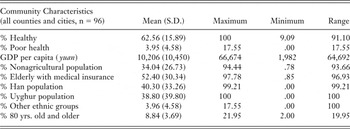
Table 1 presents descriptive statistics. On average, 4% of the elderly in Xinjiang communities consider themselves in poor health, while nearly two-thirds consider themselves healthy, although there is wide variation across communities. There also is much variation in SES, as indicated by the three variables in Table 1. The average GDP per capita in Xinjiang for 2004 was 10,206 yuan, which was slightly below the national average figure of 10,561 yuan (National Bureau of Statistics of China 2005). However, there is extreme variation in per person GDP, with more than thirty-two times difference between the highest GDP per capita (64,692 yuan for Karamay, an oil producing city with 75% Han) and the lowest GDP per capita (1,982 yuan for Pishan County of Hotan Prefecture, with 99.9 % Uyghur). Variations across communities also are evident in the percentage of nonagricultural population and elderly with medical insurance.
Descriptive Statistics for Communities in Xinjiang Uyghur Autonomous Region, China

Sources: 2005 One Percent Population Sample Survey, Xinjiang Uyghur Autonomous Region (National Bureau of Statistics of China 2007); the Xinjiang Statistical Yearbook (Wang Reference Wang2005); and the Urumqi Statistical Yearbook 2006 (Zhu and Chen, Reference Zhu and Chen2006)
Regression Analysis
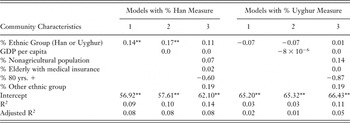
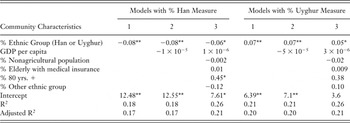
In Tables 2a and 2b, regression estimates are presented for both health status variables. Employing our model derived from prior theory and research, the first estimate (Model 1) includes only the race/ethnic variable. GDP per capita is added next (Model 2), and the remaining variables are added in Model 3. The left panel of each subtable uses percentage Han as the ethnicity measure, and the right panel uses percentage Uyghur.
Regression Estimates for Effects on Self-Rated Good Health by Ethnicity

* p < .05,
** p < .01.
Regression Estimates for Effects on Self-Rated Poor Health by Ethnicity

* p < .05,
** p < .01.
Table 2a shows the regression estimates for self-rated good health. Consistent with our hypothesis, models including percentage of Han population have a significant positive effect on elder good health, both as a total effect (Model 1), and as a direct effect (Models 2 and 3). None of the SES variables have a significant net impact on good health, reinforcing the strong influence of the concentration of Han in communities.
Models for percentage of Uyghur population also are included in Table 2a. This measure has a negative coefficient on good health (Model 1), as expected, but it is not statistically significant. Adding the other SES variables does not change the pattern. However, a higher percentage of nonagricultural population has a positive direct effect on good health. We do not have measures to test other community characteristics that might be related to SES and health (e.g., employment situation), although we examined the effect of illiteracy (an available indicator of SES) in preliminary analysis (data not shown), which had no impact on either measure of elder health.
For poor health, models including Han and Uyghur as indicators of ethnicity (Table 2b) show that total and direct effects on poor health are consistent with, but in the opposite direction of, our estimates of good health in Model 1, as expected. Unlike the models in the right panel of Table 2a, percentage Uyghur remains significant controlling for GDP, nonagricultural population, percentage elder with medical insurance, percentage of the population eighty years old or older, and percentage of the population which was neither Uyghur nor Han (Models 2 and 3 in Table 2b). Table 2b also shows that a higher percentage of oldest-old residents (eighty years or older) increases the likelihood of poor health in both Han and Uyghur models.
Finally, we added two measures in preliminary analysis to see whether the more Uyghur encounter Han, the more likely discrimination would be to occur: (1) a product term (Uyghur * Han), and (2) the squared difference between percentage Uyghur in each community (which assumes Han is the dominant group) and the overall mean. Neither measure was significant in any model. Also, we ran simulations of different means for Uyghur density to see whether there might be a density ‘tipping point’ difference in health status, which did not emerge.
SUMMARY, IMPLICATIONS, AND LIMITATIONS
Our study provides insights into how community elder health can be affected differentially by social factors. In Xinjiang, our two aggregate measures of elder health are significantly affected by the racial/ethnic compositions in the communities. Communities with Han as the numerically dominant and power-dominant inhabitants have healthier elder populations than do communities with a higher percentage of Uyghur, the primary minority population in Xinjiang, who are more likely to report poor health.Footnote 4
Based on the literature about the tendency of Uyghur elderly to significantly over-report their age (Coale and Li, Reference Coale and Li1991; Gu and Dupre, Reference Gu, Dupre, Yi, Poston, Vlosky and Gu2008; Jowett and Li, Reference Jowett and Li1992; Zeng et al., Reference Zeng, Vaupel, Zhenyu, Chunyuan and Yuzhi2001), it is reasonable to speculate that the health of Uyghur elderly is even worse than what our data have suggested. It is possible that elderly Han are compared with elderly Uyghur whose age may actually be younger than what is being reported. Although we have conducted in-person interviews with Xinjiang's Uyghur elders (Dorsten and Li, Reference Dorsten and Liforthcoming), at this time we can neither confirm nor refute possible age misreporting.
We do not find that SES indicators are significant independent predictors in the explanation of community elder health. This is probably a confirmation of the research findings reviewed in the discussions above. The zestful pursuit of economic efficiency that constitutes the core of China's economic development plans, without adequate attention to overall social and cultural well-being, is not likely to help the quality of life or support improved public health, which benefits all citizens regardless of age, social status, or ethnicity. Researchers have pointed out that many aspects of economic policies in Xinjiang may, in the long run, damage the intricate social, cultural, and environmental integrity that has sustained the existence of endogenous populations and cultures for centuries (Toops Reference Toops and Starr2004). Such disturbance may have negative effects on population health through mediating variables such as psychological distress and/or racial tension. For example, some studies have found negative effects of unhealthful environments on health at the community level (Zeng et al., Reference Zeng, Gu, Purser, Hoenig and Christakis2010).
The effects reported in this paper for a community-level unit of analysis are the sum of individual-level and aggregate-level effects in an individual-level model containing, for example, both the ethnic identity of each individual and the community-level concentration of the ethnic groups, as often represented in multilevel models. The strong effects of ethnic concentration on our measures of community elder health provide important incentive to conduct individual-level work that separates the effects of individual status (for example, Uyghur ethnicity) from the effects of living in a community with a high percentage Uyghur. Effects associated with an individual-level Uyghur measure likely would represent discrimination against individuals, under appropriate controls. Effects of percentage Uyghur in the present paper more likely represent institutional factors that depress the health of the Uyghur minority.
Further examination of the impact of socioeconomic conditions on health in ethnic minority areas in China and elsewhere might consider a composite health measure unavailable for our current study. Also, although we believe our aggregate measure provides important insights about differential minority health outcomes at city/county levels, we look forward to further research that incorporates measures at more micro levels, such as village or neighborhood, including the rich detail that qualitative research contributes.