Introduction
Reef tanks, public aquaria and aquaculture facilities are commonly invaded by pest organisms, such as the glass-anemone (Aiptasia pallida), the fireworm (Hermodice carunculata) and the bubble algae (Valonia spp. and Ventricaria ventricosa). Bubble algae are greenish, grapelike clusters of small (usually less than 1 cm in diameter), single-cell, fluid-filled spheres. Often living on the surfaces of sponges, soft corals, coral rock and other algae (Chetirkin, Reference Chetirkin1987), these green algae cover hard substrates and corals, blocking light to zooxanthellae and may cause coral bleaching and death (Marzano et al., Reference Marzano, Liaci, Fianchini, Gravina, Mercurio and Corriero2003).
In an effort to minimize or eliminate the impacts and spread of pest organisms in reef tanks and public aquaria, a wide range of control techniques have been established including: (1) physical removal; (2) chemical treatments; and (3) bio-control (Rhyne et al., Reference Rhyne, Lin and Deal2004). Physical removal has been deemed ineffective as many of these species, when inappropriately removed, can result in the spread of the pest. For example, glass-anemones A. pallida and fireworms H. carunculata are known for their regenerative capability from a cut piece (Hunter, Reference Hunter1984; Hickman et al., Reference Hickman, Roberts and Larson1997; Rhyne et al., Reference Rhyne, Lin and Deal2004). Chemical treatments such as fresh water or KOH injection into Aiptasia gastro-vascular cavity through the oral disc has also been used (Rhyne et al., Reference Rhyne, Lin and Deal2004) but this technique is ineffective if anemones are small, dispersed throughout the aquarium and/or in areas difficult to access (e.g. crevices).
Increasing recognition of the problems posed by non-native or exotic species has led to an interest in the potential of biological control (bio-control) as a sustainable management strategy (Louda, Reference Louda2005). Bio-control is frequently used to control pests in natural aquatic and terrestrial environments (Thibaut et al., Reference Thibaut, Meinesz, Amade, Charrier, De Angelis, Ierardi, Mangialajo, Melnick and Vidal2001; Smith, Reference Smith2003), aquaculture facilities (Friedlander et al., Reference Friedlander, Weintraub, Freedman, Sheer, Snovsky, Shapiro and Kissil1996), as well as private and public aquaria (Kempf, Reference Kempf1991; Southwood & Kempf, Reference Southwood and Kempf1991; Rhyne et al., Reference Rhyne, Lin and Deal2004; Calado & Narciso, Reference Calado and Narciso2005). Examples of bio-control include the enhancement of native sea-urchins in an effort to reduce macroalgae such as Kappaphycus alvarezii which has been causing coral death as a result of overgrowth and shading in Hawaii (Smith, Reference Smith2003), and the use of sea slug Elysia subornata as a control agent of the killer algae Caulerpa taxifolia (Chlorophyta) in the Mediterranean Sea (Thibaut et al., Reference Thibaut, Meinesz, Amade, Charrier, De Angelis, Ierardi, Mangialajo, Melnick and Vidal2001). In aquaculture facilities bio-control is also used, e.g. fish for controlling epiphyte and copepods in pond culture of Gracilaria spp. (Friedlander et al., Reference Friedlander, Weintraub, Freedman, Sheer, Snovsky, Shapiro and Kissil1996). In both small home tanks and large public aquaria, cleaner shrimp Lysmata wurdemanni and L. seticaudata, the butterflyfish Chelmon rostratus and Chaetodon kleini, and the nudibranch Berghia verrucicornis are used to control the anemone A. pallida (Kempf, Reference Kempf1991; Southwood & Kempf, Reference Kempf1991; Rhyne et al., Reference Rhyne, Lin and Deal2004; Calado & Narciso, Reference Calado and Narciso2005). Success of bio-controls depends on their number, behaviour, and particularly their feeding rate and preferences; however, other factors must be considered. After eliminating the pest, the bio-controller may attack/negatively impact other animals or plants in the aquarium. In extreme cases, the controller feeds exclusively on the pest and starves after eliminating it (Gleibs & Mebs, Reference Gleibs and Mebs1999); for example, the nudibranch B. verrucicornis (Mollusca: Opisthobranchia) only feeds on Aiptasia sp. (Kempf, Reference Kempf1991). Most bio-controls consume the pest as well as other food items. In these cases, it is important to evaluate how the presence of alternative foods affects the controller's performance efficiency.
Mithraculus spp. (Decapoda: Brachyura: Majidae) crabs are used to control nuisance algae, particularly bubble algae (Valonia spp. and Ventricaria ventricosa) in marine reef aquaria (Penha-Lopes et al., Reference Penha-Lopes, Rhyne, Lin and Narciso2005; Rhyne et al., Reference Rhyne, Penha-Lopes and Lin2005). Most members of the genus Mithraculus appear to be herbivorous having modified, spooned-shaped chelae to feed on both fleshy and filamentous algae (Warner, Reference Warner1977; Coen, Reference Coen1988a). However, Mithraculus species are able to consume a wide variety of animal feeds such as frozen and formulated food (Penha-Lopes et al., Reference Penha-Lopes, Rhyne, Lin and Narciso2006). The objective of this work was to study the efficiency of Mithraculus sculptus controlling the pest bubble alga V. ventricosa in the presence of alternative foods commonly used in reef aquaria (mysids and commercial pellets). Mithraculus sculptus feeding behaviour on V. ventricosa was described and the effect of crab size and sex on first prey chosen by the crab and bubble algal consumption was tested. Animals are selective consumers, i.e. the frequency they consume a certain prey is not necessarily equal to the frequency that prey is found in its surrounding environment (Chesson, Reference Chesson1978); prey selection indices have been developed by Chesson (Reference Chesson1978, Reference Chesson1989) and Manly (Reference Manly1974, Reference Manly1993). According to the prey choice model, prey selection is determined by the maximization of energy per unit of handling time (Elner & Hughes, Reference Elner and Hughes1978). In this study, the prey choice model was used as a conceptual framework to study the mechanisms underlying active selection; food energy content and handling time were measured and food profitability was calculated.
MATERIALS AND METHODS
Test organisms
Mithraculus sculptus were purchased from an aquarium trade company (Doctors Foster and Smith™). Bubble algae Ventricaria ventricosa (J. Agardh, 1887) (formerly Valonia ventricosa, see Olsen & West, Reference Olsen and West1988) were collected from a heavily infested reef aquarium. Crabs and algae were maintained in a 210 l aquarium at 26°C, 35 g. l−1 salinity and 14 light:10 dark photoperiod. Only crabs with both chelae and all pereiopods intact were used and each crab was used only once. Commercial pellets with approximately 2–3 mm3 (MarineGro, Red Sea Fish Pharm Ltd.) and 0.5–1 cm long frozen mysids (unfrozen previous to feeding, Gamma foods, Tropical Marine Centre) were used as alternative foods since they are commonly used to feed ornamental fish and invertebrates in reef tanks.
FEEDING BEHAVIOUR ON VENTRICARIA VENTRICOSA
Three Mithraculus sculptus crabs were acclimated for one week in experimental 40 l tanks (1 crab per tank) prior to the study. Crabs were fed with bubble algae and then starved for 2 d before the beginning of each trial, to standardize hunger levels. For each trial, one bubble alga was introduced to the tank and feeding behaviour was recorded using digital high-speed video (Redlake Motion Scope PCI).
FIRST PREY CHOICE AND ALGAL CONSUMPTION
Mithraculus sculptus were previously maintained in an indoor 210 l recirculating seawater tank and fed bubble algae, mysids and pellet food to ensure crabs had feeding experience with all food items. Crabs were then moved to experimental 40 l tanks (1 crab per tank, squared bottom area with 0.16 m2) and held for 1 d prior to the experiments. During this period, no food was provided to standardize the hunger levels.
Crabs of both sexes and three size-classes—small (carapace width (CW) <1 cm), medium (1 cm ≤ CW <1.5 cm) and large (CW ≥1.5 cm)—were used in the following treatments: (1) control: each crab was offered Ventricaria ventricosa (A); (2) Diet 1: each crab was offered simultaneously V. ventricosa and mysids (A + FM); and (3) Diet 2: each crab was offered simultaneously V. ventricosa and pellet food (A + P). All food items were provided in excess (1 g wet weight). In the treatments with more than one food item (treatments 2 and 3), both food items were placed simultaneously into the aquaria with equal distance between the crab and food items (approximately 10 cm). At least five replicates were conducted for each treatment.
The first prey chosen/eaten by each crab was recorded. At the end of each trial (6 h), uneaten bubble algae were removed from each tank, and re-weighed (wet weight) with a digital balance to the nearest 0.001 g; algal consumption was calculated by subtracting the final weight from their initial weight (1 g).
HANDLING TIME, ENERGY CONTENT AND MAXIMUM CLAW GAPE
Small, medium and large crabs (see above) of both sexes were moved to a finger-bowl with 1 l seawater (1 crab per finger-bowl with 0.015 m2 of bottom area) 1 d prior to the start of the experiment, and during this time no food was provided. Crabs were offered one of the following five food items: (1) one small bubble alga V. ventricosa (≤0.25 cm diameter) (SA); (2) one medium bubble alga V. ventricosa (0.25 < diameter ≤0.5 cm) (MA); (3) one large bubble alga V. ventricosa (>0.5 cm diameter) (LA); (4) one frozen mysid (FM); and (5) one pellet (P). At least three replicates were conducted for each treatment in each combination of crab size and sex. Handling time was estimated from the recorded video footage (digital video camcorder Canon NTSC ZR90) as the time since crab made physical contact with the prey to the end of its consumption (Hughes & Seed, Reference Hughes and Seed1981; Mistri, Reference Mistri2004; Dudas et al., Reference Dudas, McGaw and Dower2005; Wong & Barbeau, Reference Wong and Barbeau2005) and standardized as sec. g−1 (wet weight) of food consumed to allow comparisons.
Water content of each food item was measured as weight loss after freeze-drying it for 24 h with a Savant Vapornet VN100 Freeze Dryer. The energy content (cal.g dry weight−1) of each food item was measured in tetraplicates with a Parr-1425 Semimicro Oxygen Bomb calorimeter (previously calibrated with benzoic acid). Samples ranging in weight from 50 to 190 mg were burned in oxygen in the calorimeter. In order to further understand food preference of Mithraculus sculptus, profitability (energy intake per unit handling time) of each food item was calculated by dividing mean energy content (cal. g fresh weight−1) by mean handling time (sec. g−1) for each combination of crab size and sex (Elner & Hughes, Reference Elner and Hughes1978; Stephens & Krebs, Reference Stephens and Krebs1986); this calculation assumes that all energy was assimilated (Wong & Barbeau, Reference Wong and Barbeau2005). Right and left maximum claw gapes of 30 crabs of each size-class and both sexes were measured (from the tip of the propodus to the tip of the dactylus) to the nearest 0.1 mm using digital callipers.
DATA ANALYSIS
Contingency tables (3×2×3) were used to test the hypothesis of mutual independence (χ2-test Square test) of crab size, sex and first prey choice by the crab (alga, alternative food or no choice) for the experiments A + FM and A + P. A three-way analysis of variance (ANOVA) was used to test the influence of crab size, sex and diet (A, A + FM and A + P) on algal consumption. Post-hoc tests (Tukey test for unequal sample sizes) were performed if significant differences were detected.
Three-way ANOVAs were used to test the effect of crab size, sex and diet (SA, MA, LA, FM and P) on handling time and profitability, followed by Tukey's multiple comparisons test (for unequal sample sizes) if significant differences were detected. A one-way ANOVA was used to compare energy content among the food items (SA, MA and LA, FM and P). A multiple regression analysis was used to relate crab CW and sex with maximum claw gape (average between right and left claw).
Prior to all parametric tests, data were checked for homoscedadicity (Cochran's test) and normality (Shapiro–Wilk's test), and when necessary, data were appropriately transformed (Pestana & Velosa, Reference Pestana and Velosa2006). All results were considered statistically significant when P-values were lower than 0.05 (Sokal & Rohlf, Reference Sokal and Rohlf1995).
RESULTS
Feeding behaviour on Ventricaria ventricosa
Mithraculus sculptus grasped and tore the bubble cell of Ventricaria ventricosa with their chelae and mandibles and ingested the alga. Review of the high-speed video suggests that the liquid inside the bubble alga, that contains juvenile cytoplasmatic spheres which result from a modified segregative division (Olsen & West, Reference Olsen and West1988), was released into the water when the bubble was broken.
FIRST PREY CHOICE AND ALGAL CONSUMPTION
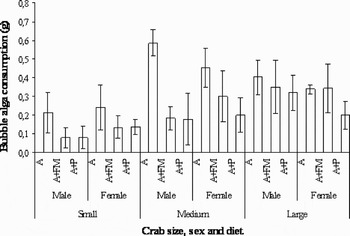
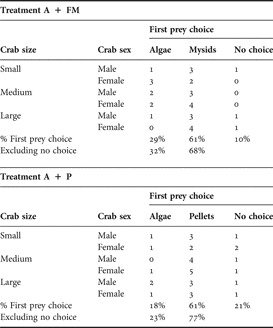
Results of first prey choice are presented in Table 1. In both experiments (A + FM and A + P), the hypothesis of mutual independence between the variables first prey choice, crab size and sex was not rejected (N = 31, X23,2,3 = 7.46, d.f. = 12, P > 0.80 and N = 33, X23,2,3 = 4.07, d.f. = 12, P > 0.98, respectively for A + FM and A + P experiments). In A + FM experiments, crabs first chose 69% of the time mysids to bubble algae and in A + P experiments, crabs first chose 76.9% of the time pellets to bubble alga (excluding cases of no choice, Table 1). Sex did not significantly influence the amount of bubble algae consumed (N = 98, F = 0.06, d.f. = 1 and P > 0.80). Algal consumption increased significantly with crab size (N = 98, F = 6.00, d.f. = 2 and P < 0.004); small crabs consumed significantly less than medium and large sized crabs (P < 0.04 and 0.004, respectively); medium and large size crabs did not differ significantly in the amount of algae consumed (P > 0.69) (Figure 1). Algal consumption significantly differed when different diets were provided (A, A + FM, and A + P) (N = 98, F = 5.66, d.f. = 2 and P < 0.005). Compared to the case where only algae were provided, algal consumption decreased significantly when pellets were provided (P < 0.01). The consumption of algae when mysids were supplied was neither significantly different if only algae were provided (P > 0.10), nor if both algae and pellets were provided (P > 0.71).
Bubble algae Ventricaria ventricosa consumption (average ± standard error) of 3 different size-classes of crabs (small, medium and large) of both sexes when provided with bubble algae (A), bubble algae and mysids (A + FM) and bubble algae and pellets (A + P).

Mithraculus sculptus first prey choice on treatment of bubble algae and mysids (A + FM) and on treatment of bubble algae and pellets (A + P), according to their size and sex. The percentage of times that a certain food item was first chosen/eaten is presented including and excluding the cases when no choice was observed.

HANDLING TIME, ENERGY CONTENT AND PROFITABILITY
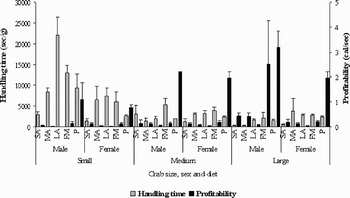
While sex did not significantly affect handling time (N = 101, F = 0.70, d.f. = 1, P > 0.41), crab size and diet did (N = 101, F = 27.14, d.f. = 2, P < 0.001 and N = 101, F = 0.70, d.f. = 4, P < 0.001, respectively). Handling time decreased significantly with increasing crab size, with small crabs spending significantly more time to consume a prey than medium and large crabs (both P < 0.001); medium crabs also displayed a longer handling time than larger crabs (P < 0.009). Mithraculus sculptus handling time of small bubble alga was significantly lower than for all the other food items (P < 0.05, P < 0.001, P < 0.001 and P < 0.03, respectively for MA, SA, FM and P). Handling time of medium bubble alga did not differ significantly from large bubble alga (P > 0.13) or pellet (P > 0.83) but was significantly lower than for mysid (P < 0.04). Handling time of a mysid is not significantly different from a pellet (P > 0.36) or a large bubble alga (P > 0.99); handling time of pellet was also not significantly different from a large bubble alga (P > 0.62) (Figure 2).
Handling time and profitability (average ± standard error) of small bubble alga (SA), medium bubble alga (MA), large bubble alga (LA), mysids (FM) and pellets (P) for crabs of 3 different size-classes (small, medium and large) of both sexes.

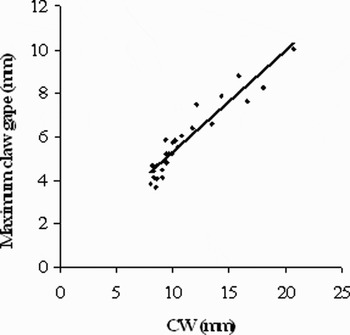
Maximum claw gape (average of right and left claws) increased significantly with crab size (F = 25.25, d.f. = 2 and P < 0.001), but was not significantly affected by crab sex (F = 0.37, d.f. = 1, P > 0.55). Maximum claw gape (mm) and crab CW (mm) relation can be expressed by the following linear regression model:

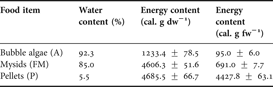
Energy content of the food items differed significantly (F = 4739.3, d.f. = 3, P < 0.0001) (Table 2). The pellets had the highest energy content (average ±SE, 4427.8 ± 63.1 cal. g fresh weight−1), followed by the mysids (691 ± 7.7 cal. g fresh weight−1) and then Ventricaria ventricosa (95 ± 6 cal. g fresh weight−1) (all P < 0.001). Profitability differed significantly between diets (N = 101, F = 35.2, d.f. = 4, P < 0.001) and was significantly affected by crab size (N = 101, F = 11.66, d.f. = 2, P < 0.001), but not by crab sex (N = 101, F = 3.8, d.f = 1, P > 0.051) (Figure 2). Food profitability was significantly higher for a larger crab than for medium or small crab (P < 0.04 and P < 0.001, respectively); food profitability was similar for medium and small crabs (P > 0.31) (Figure 2). Pellets had significantly higher profitability than all the other food items (all P < 0.001). The profitability of the other food items was not significantly different from each other (P > 0.99, P > 0.93, P > 0.84, P > 0.99, P > 0.59, P > 0.35 for profitability comparisons of SA and MA, SA and LA, SA and FM, MA and LA, MA and FM, and LA and FM, respectively).
Water content and energy content (average ± standard error, N = 4) of bubble algae, mysids and pellets (dw, dry weight; fw, fresh weight).

Discussion
Differences in diets, handling time and prey size preferences between crabs of different sizes and sexes have been reported for several species (Ropes, Reference Ropes1968; Paul, Reference Paul1981; Jewett & Feder, Reference Jewett and Feder1982; Choy, Reference Choy1986; Rangeley & Thomas, Reference Rangeley and Thomas1987; Lin, Reference Lin1991; Mascaró & Seed, Reference Mascaró and Seed2000a, Reference Mascaró and Seedb). These differences are usually attributed to sexual differences in chelae size and shape (Warner, Reference Warner1977; McDermott, Reference McDermott1998; Lee & Seed, Reference Lee and Seed1992). Although the consumption of Ventricaria ventricosa by M. sculptus increased with crab size, neither crab size nor sex influenced first prey choice, which may be explained by the lack of sexual dimorphism in maximum claw gape (between male and female crabs with similar CW) (unpublished data). As the crab size increased, handling time decreased, probably due to the larger size of their chelae (and, consequently, greater maximum claw gape (MCG)) allowing for increased processing ability (Lee & Seed, Reference Lee and Seed1992). While smaller crabs can still burst and eat a bubble alga larger than their MCG, this requires a greater time and probably more complex and time-consuming handling techniques, possibly leading to rejection of this food item. Crabs with a MCG smaller than the bubble alga diameter might not be able to burst it or it might require significantly more time to do it. By making a parallel between crabs' MCG and bubble alga diameter, Figure 3 gives us an idea of the critical bubble alga size that a crab with a certain CW can successfully control. The overall reduction in handling time required to consume small size bubble alga can be explained by the fact that all crabs utilized in the experiments had an MCG larger than the diameter of a small bubble alga.
Relationship between crabs' maximum claw gape (mm) and carapace width (CW) (mm) (N = 30).

According to Brosseau & Baglivo (Reference Brosseau and Baglivo2005), food choice among most brachyuran crabs is influenced by a complex array of species-specific factors including relative abundance and availability of the resource in the environment (Kennish et al., Reference Kennish, Williams and Lee1996), prey profitability (Mascaró & Seed, Reference Mascaró and Seed2000a; Reference Mascaró and Seed2000b), time available for foraging (Choy, Reference Choy1986; Deplege, Reference Depledge1989), risk of predation (Hughes & Seed, Reference Hughes and Seed1981), handling time (Dudas et al., Reference Dudas, McGaw and Dower2005) and prey attractability (chemical, visual, tactile, etc.). Despite the fact that Mithraculus sculptus appear to be herbivorous (based on their chelae shape and grazing behaviour) (Coen, Reference Coen1988a, Reference Coenb), their algal consumption reduced significantly when pellets were supplied. Mithraculus sculptus strongly first chose the alternative prey provided to the algae, suggesting that these might be chemical, tactile and/or visually more attractive than the algae. The majority of crabs are omnivorous and their herbivorous or carnivorous tendencies depend on food availability (Wolcott & O'Connor, Reference Wolcott and O'Connor1992; Dahdouh-Guebas et al., Reference Dahdouh-Guebas, Giuggioli, Oluoch, Vannini and Cannicci1999; Romero et al., Reference Romero, Lovrich, Tapella and Thatje2004; Brosseau & Baglivo, Reference Brosseau and Baglivo2005). Penha-Lopes et al. (Reference Penha-Lopes, Rhyne, Lin and Narciso2006) noted that Mithraculus forceps also eats animal feeds which is in agreement with the suggestion of an opportunistic and omnivorous feeding behaviour for at least some species of the genus Mithraculus.
The prey choice model can be a useful conceptual framework for studying active selection and in determining the mechanisms underlying it (Wong & Barbeau, Reference Wong and Barbeau2005); this model is based on the energy maximization premise and states that given an array of prey that differ in size, energy content, or ease of accessibility, a predator consumes prey items of higher profitability (ratio of energy gain to handling time) (Elner & Hughes, Reference Elner and Hughes1978; Hughes & Seed, Reference Hughes and Seed1981; Stephens & Krebs, Reference Stephens and Krebs1986; Mistri, Reference Mistri2004; Wong & Barbeau, Reference Wong and Barbeau2005). In the present study, the alga consumption reduced when crabs were offered pellets and alga, but it did not reduce when offered mysids and algae. These could mean that energy maximization per unit of handling time (profitability) might explain the variation in algal consumption when alternative diets are provided: pellets have a higher profitability than algae, so algal consumption decreases; mysids have a similar profitability to algae, so algal consumption does not decrease.
Conclusions
Mithraculus sculptus actively feed on Ventricaria ventricosa. In case of infestation with bubble alga, if we use mysids as aquaria food, M. sculptus may render efficient bubble alga bio-controllers; the use of pellets is not advised. Mithraculus sculptus of both sexes might be considered equally efficient as controllers. Since larger crabs can consume greater quantities of bubble algae and are able to exploit a wider size-range of V. ventricosa (Lee & Seed, Reference Lee and Seed1992), they may be considered more efficient bio-controllers. While less efficient, smaller crabs may be effective in controlling algae in areas difficult to access, such as crevices. When emerald crabs rupture the Ventricaria ventricosa bubble, the cell-liquid that contains juvenile cytoplasmatic spheres (Olsen & West, Reference Olsen and West1988) is released into the water and may contribute to algal dispersal. However, by taking into account that: (1) bubble algae juveniles may be removed and eliminated by tank filtration; (2) fish are fed few times a day while crabs are continuous foragers; and (3) the greatest amount of food is consumed by fish while still in the water column (in this way inaccessible to crabs), we suggest the bio-control efficiency of M. sculptus could be improved by increasing density of crabs, along with not providing food in excess and using an effective filtration (mechanical filtration, skimmers and ultraviolet sterilizer to trap bubble algal juvenile cytoplasmatic spheres). Future research on these topics should be addressed in order to test M. sculptus bio-control efficiency.
The cell division type of bubble algae species from the genus Valonia is different from the one displayed by Ventricaria ventricosa. Valonia species cells undergo a lenticular cell division (Olsen & West, Reference Olsen and West1988), and in this way their dispersal might not be enhanced when the alga cell is burst; M. sculptus bio-control efficiency of Valonia species may prove to be more efficient than with Ventricaria ventricaria.
ACKNOWLEDGEMENTS
We thank J. Anto, S. Jones and N. Sciullo for help on experimental design, technical support and comments on the manuscript, J.R. Kerfoot and T. Samarco for assisting in digital high speed video filming and anonymous referees for their constructive criticism and valuable suggestions. The authors would also like to thank Fundação para a Ciência e a Tecnologia (scholarship #SFRH/BD/17130/2004) for their financial support.