INTRODUCTION
Engagement in L2 learning has received increasing attention in recent years in response to a growing recognition of the dynamic, highly individual, and contextual nature of the L2 learning process. Engagement is shown to be key to academic success (Klem & Connell, Reference Klem and Connell2004) and L2 learning (Dörnyei, Reference Dörnyei and Robinson2001; Philp & Duchesne, Reference Philp and Duchesne2016). Correspondingly, there has been an ongoing attempt among L2 researchers to find means to enhance it. One prominent variable hypothesized to have an impact on engagement is choice (Flowerday & Schraw, Reference Flowerday and Schraw2003; Reeve, Reference Reeve, Christenson, Reschly and Wylie2012). It is postulated that providing learners with choice leads to a greater sense of control and intrinsic motivation, which in turn can have a positive effect on their engagement in the learning activities (Flowerday & Schraw, Reference Flowerday and Schraw2003; Zuckerman et al., Reference Zuckerman, Porac, Lathin, Smith and Deci1978). This notion is also supported by empirical findings in task-based studies (e.g., Butler, Reference Butler2017; Lambert et al., Reference Lambert, Philp and Nakamura2017; Phung, Reference Phung2017).
At the same time, various operationalizations of choice and outcome measures have contributed to inconclusive findings. In a meta-analysis by Patall et al. (Reference Patall, Cooper and Robinson2008), the manipulation of choice ranged from choices between activities and choices between multiple versions of a single activity to choices about the reward participants receive for the task. They found the effects of choice on effort and task performance were in both positive and negative directions. Another emergent issue in L2 engagement research is the theoretical and empirical conceptualization of engagement. Philp and Duchesne (Reference Philp and Duchesne2016) argue that “in applied linguistics research there is little principled understanding of this overused term although there is a shared intuitive recognition of ‘engagement’ as optimal for learning” (p. 50).
Thus, the current study sought to contribute to our understanding of the effect of choice by employing the model of task engagement proposed by Philp and Duchesne (Reference Philp and Duchesne2016), which is composed of behavioral, cognitive, social, and emotional dimensions. We hope the findings will help researchers and teachers to identify how to effectively design tasks that enhance L2 learners’ engagement.
LITERATURE REVIEW
ENGAGEMENT AND LEARNING
Since the publication of the pioneering work by Mosher and MacGowan (Reference Mosher and MacGowan1985), engagement has received increasing interest in the fields of educational psychology, general education, and second language acquisition (SLA). Engagement in the educational literature has typically been described as energy, action, effort, and active participation (e.g., Christenson et al., Reference Christenson, Reschly and Wylie2011; Oga-Baldwin & Nakata, Reference Oga-Baldwin and Nakata2017; Reeve, Reference Reeve, Christenson, Reschly and Wylie2012; Skinner et al., Reference Skinner, Kindermann, Connell, Wellborn, Wenzel and Wigfield2009a, Reference Skinner, Kindermann and Furrer2009b) and studied using a range of definitions and operationalizations in four contexts: school, community, classroom, and learning activity (Philp & Duchesne, Reference Philp and Duchesne2016; Skinner & Pitzer, Reference Skinner, Pitzer, Christenson, Reschly and Wylie2012). Regardless of this variety, there is a growing consensus that engagement is a multidimensional construct that drives learning (Christenson et al., Reference Christenson, Reschly and Wylie2011; Dörnyei, Reference Dörnyei and Robinson2001; Philp & Duchesne, Reference Philp and Duchesne2016). The following section further discusses this multidimensional characteristic of engagement in the context of task-based instruction, which is the focus of the current study.
A MULTIDIMENSIONAL MODEL OF TASK ENGAGEMENT
In task-based instruction, engagement can be defined as “a state of heightened attention and involvement, in which participation is reflected not only in the cognitive dimension, but in social, behavioral, and affective dimensions as well” (Philp & Duchesne, Reference Philp and Duchesne2016, p. 3). Behavioral engagement can be described in terms of time on task or participation (Philp & Duchesne, Reference Philp and Duchesne2016). Correspondingly, studies (e.g., Dörnyei & Kormos, Reference Dörnyei and Kormos2000; Lambert et al., Reference Lambert, Philp and Nakamura2017; Phung, Reference Phung2017) have employed the amount of time on task, the number of words, and/or turn as the measures of behavioral engagement.
Cognitive engagement concerns sustained attention and alertness (Helme & Clarke, Reference Helme and Clarke2001; Svalberg, Reference Svalberg2009). The degree of elaboration in language-related episodes is one of the most commonly adopted measures in studies of language awareness (e.g., Baralt et al., Reference Baralt, Gurzynski-Weiss, Kim, Sato and Ballinger2016; Storch, Reference Storch2008; Svalberg, Reference Svalberg2009) while verbal indicators specific to peer interaction, such as co-completion, negotiation of meaning or form, and self-correction, are adopted in the analysis of task-based instruction (e.g., Bygate & Samuda, Reference Bygate, Samuda, Mackey and Polio2009; Lambert et al., Reference Lambert, Philp and Nakamura2017; Phung, Reference Phung2017).
Social engagement concerns the relationship among learners whereby they interact and affiliate with one another (Lambert et al., Reference Lambert, Philp and Nakamura2017; Phung, Reference Phung2017). In other words, learners, when socially engaged, “listen to one another, draw from one another’s expertise and ideas, and provide feedback to one another” (Philp & Duchesne, Reference Philp and Duchesne2016, p. 10). Accordingly, backchanneling is one of the most widely used measures to indicate learners’ active listening behaviors (Phung, Reference Phung2017).
Emotional engagement has been defined with reference to various affective constructs. Skinner et al. (Reference Skinner, Kindermann, Connell, Wellborn, Wenzel and Wigfield2009a, Reference Skinner, Kindermann and Furrer2009b), for example, defined emotional engagement as motivated involvement during learning activities, while Baralt et al. (Reference Baralt, Gurzynski-Weiss, Kim, Sato and Ballinger2016) included purposefulness and autonomy. Other definitions include specific types of positive emotion, such as enjoyment, interest, excitement, curiosity, and enthusiasm as “task-facilitating” emotions as well as negative emotions, such as anxiety, boredom, anger, frustration, and fear, as “task-withdrawing” emotions (Reeve, Reference Reeve, Christenson, Reschly and Wylie2012, p. 150).
One key aspect of this multidimensional model is that these dimensions overlap, interact, and manifest differently in different contexts (Philp & Duchesne, Reference Philp and Duchesne2016). It is therefore critical for more studies to take into account all the dimensions and investigate their interdependence to capture the full complexity of engagement.
CHOICE AND ENGAGEMENT
The discussion of choice has a rich theoretical history in learning and human motivation, particularly as a concept of perceived choice (Deci, Reference Deci1975). Perceived choice has been identified as an important experiential quality in relation to self-determination, the underlying theoretical concept of autonomy (Deci & Ryan, Reference Deci and Ryan1987). Self-determination theory posits that some environments provide individuals with opportunities to choose among options with flexibility in their decision-making process while others obligate them toward a prescribed course of action (Reeve et al., Reference Reeve, Nix and Hamm2003). The former can enhance the perception of choice and, in turn, self-determination and intrinsic motivation (Reeve et al., Reference Reeve, Nix and Hamm2003; Williams et al., Reference Williams, Grow, Freedman, Ryan and Deci1996).
As a growing recognition of these critical characteristics of choice, educational researchers have begun to explore its effects on engagement. They have hypothesized that choice increases cognitive engagement and learning as it helps learners feel more motivated to learn (Flowerday & Schraw, Reference Flowerday and Schraw2003; Ryan & Deci, Reference Ryan and Deci2000). Empirical findings have been mixed. In a meta-analysis by Patall et al. (Reference Patall, Cooper and Robinson2008), a positive overall effect of choice was found on subsequent learning, task performance, effort, intrinsic motivation, and other related outcomes. In studies on choice and cognitive engagement by Flowerday and Schraw (Reference Flowerday and Schraw2003), however, choice was shown to have no effect in the first experiment and a negative effect in the second experiment. They concluded that “There is no evidence in any of these studies that choice increases or deepens cognitive engagement or task performance” (Flowerday & Schraw, Reference Flowerday and Schraw2003, p. 214).
In the field of task-based language teaching (TBLT), the construct of choice has not yet been addressed much; TBLT studies have by and large focused on task complexity, which is operationalized according to Robinson’s (Reference Robinson2001a, Reference Robinson and Robinson2001b) triadic componential framework, under the assumption that increasing task complexity promotes greater interaction and thus facilitates L2 development (cognition hypothesis, Robinson, Reference Robinson2001a, Reference Robinson and Robinson2001b). Nevertheless, an increasing interest in the notion of choice can be observed among recent TBLT research. For example, Butler’s (Reference Butler2017) study on digital instructional game tasks found that providing students with choice in designing and playing games was one of the key elements in making tasks engaging for young Japanese learners of English. Phung’s (Reference Phung2017) study also indicated that allowing learners to choose from comparable tasks based on preferences may help to promote engagement. On the contrary, a study by Mozgalina (Reference Mozgalina2015) showed that a task with no choice condition, compared with limited choice and free choice, was the most optimal for task engagement.
These contradictory findings call for further investigation of the effect of choice on engagement. For example, choice is likely to have a positive effect on learners’ task engagement but only when provided along some form of instructional structure or guidance (e.g., more or less constraint with choices). The four elements of engagement can be differently affected by factors in task design and other contextual factors. This study thus set out to explore these underresearched issues of multifaceted L2 learner task engagement in relation to choice.
RESEARCH OBJECTIVE AND QUESTION
The aim of this study was to investigate the effect of choice by addressing the following research question:
How do L2 learners’ social, behavioral, cognitive, and emotional engagement differ in the +constraint and −constraint tasks?
In reference to Robinson’s framework (Reference Robinson2001a), the tasks in this study were intentionally designed to be equivalent in their complexity, conditions, and learner factors (due to the within-subject design). The only difference was the different options within the same topic that learners were asked to discuss and express their opinions on, as well as how learners used their two-minute planning time. Learners in the −constraint task were instructed to come up with their own buildings to propose and reasons to support their proposals while learners in the +constraint task were given a list of buildings to discuss. We argued that these differences reflect different levels of choice in the two tasks and hypothesized that the learners would demonstrate higher levels of engagement in the −constraint task.
METHOD
PARTICIPANTS
Participants were 23 Thai (15 male, 8 female) and 1 Korean (1 female) learners of English as a foreign language (L2) at a university in Bangkok. Of those, 2 were in their second year, 2 in their third, and 20 in their fourth year of undergraduate studies (Mean = 21.8, SD = .61) in engineering (n = 17), science (n = 4), or technology (n = 3). They were all enrolled in an elective academic writing course, which was taught by the first author at the English department of the School of Liberal Arts. Their proficiency level was deemed to be approximately CEFR B1/B2 based on their completion of foundational English courses and the first author’s observations. At the time of the study, the students had been in the course for 2 months.
MATERIALS
Tasks
The tasks used in the study were two opinion-gap tasks, each providing learners with choices with different degrees of freedom. We labeled these +constraint and −constraint tasks. In both tasks, students worked in groups of three and were instructed to discuss and choose three new buildings they would like for the university to build on campus. In the +constraint task, each student was given a different set of three buildings (i.e., a total of nine buildings) to choose from, defend to their peers, and negotiate to reach an agreement on the final choice of three buildings. In the −constraint task, each student was instructed to first come up with three buildings by themselves (i.e., a total of nine buildings) and then negotiate with each other to reach agreement on the three buildings. In the task instructions, we provided a range of descriptions about the kinds of buildings that could be included with examples, which was intended to help students come up with buildings by themselves. In this way we reduced the possibility of participants completing the second task in the same way as the first. In both tasks, students were given 2 minutes preparation time before the discussion. Students were instructed to spend as much time as they needed to reach an agreement. According to Robinson’s (Reference Robinson2001a, Reference Robinson and Robinson2001b) triadic componential framework, both tasks can be classified as single, open, two-way, divergent-oriented tasks, involving the same number of elements, planning time, and reasoning skills, and requiring learners to have similar prior knowledge. The task instructions and building choices are provided in Appendix A.
MEASURES
We operationalized measures of engagement based on Philp and Duchesne’s (Reference Philp and Duchesne2016) multifaceted model and selected nine measures by reviewing TBLT studies on engagement in the literature. Behavioral engagement was measured by (a) time on task, (b) number of words produced, and (c) number of turns. Time on task referred to the amount of time that each learner spent on completing the tasks. The number of words referred to the words produced in pruned discourse (Ellis & Barkhuizen, Reference Ellis and Barkhuizen2005), which discards minor, one-word utterances (e.g., ah, yes, yeah), “you know” used as fillers, self-repetitions, false starts, self-reformulations, and self-replacement to retain only substantive ideas expressed by the participants. A turn was defined as a “string of utterances produced by a single speaker and bounded by other speakers’ turns” (Gumperz & Berenz, Reference Gumperz, Berenz, Edwards and Lampert1993, p. 95). Accordingly, backchannels and minor utterances were not regarded as turns.
Cognitive engagement was measured by (d) the number of moves produced for negotiation of meaning and/or form and (e) the number of self-repairs. Moves produced for negotiation of meaning and/or forms were identified based on the definition, “negotiation of conversational exchanges that arise when interlocutors seek to prevent a communicative impasse occurring or to remedy an actual impasse that has arisen” (Ellis & Barkhuizen, Reference Ellis and Barkhuizen2005, pp. 166–167). Such examples included co-constructions, confirmation checks, clarification requests, and metalinguistic exchanges. Self-repairs were defined as “occasions where the speaker attempts to make changes to what is being said, rather than simply having problems saying it” (Skehan, Reference Skehan2014, p. 20). Our operationalization of self-repairs therefore included self-corrections, self-repetitions, self-reformulations, self-replacements, and false starts.
Social engagement was measured by (f) the number of overlaps and turn completions and (g) the number of backchannels. An overlap was regarded as an occurrence of utterances by more than one speaker at a time (Sacks et al., Reference Sacks, Schegloff and Jefferson1974). Turn completion was regarded as a speaker completing the other speaker’s turn. A response from the listener, such as uh-huh, mmm, and yeah, without claiming the floor from the speaker (Ellis & Barkhuizen, Reference Ellis and Barkhuizen2005) was considered a backchannel. Each of these variables, except for time on task, were converted to a count-per-minute, and all measures were calculated for each learner for each task.
Emotional engagement was measured by self-reported levels of (h) enjoyment and (i) anxiety through a 6-point Likert scale questionnaire immediately after the tasks. Enjoyment was selected as an indication of positive task-facilitating emotion while anxiety was selected as an indication of negative task-withdrawing emotion, based on Reeve’s (Reference Reeve, Christenson, Reschly and Wylie2012) conceptualization of emotional engagement. The items were adapted from the learning-related emotion scales (Pekrun et al., Reference Pekrun, Goetz, Titz and Perry2002, Reference Pekrun, Goetz and Perry2005) and modified to address the emotions within the specific task context. Five items assessed enjoyment (e.g., “I thought the task was enjoyable”) and four items anxiety (e.g., “I was anxious while doing this task”). Cronbach’s alpha coefficients were .86 for enjoyment and .87 for anxiety, indicating good internal consistency for the items (Dörnyei & Taguchi, Reference Dörnyei and Taguchi2010). The items are listed in Appendix B.
PROCEDURES
Prior to the study, consent was obtained from all the participants. First, the students were randomly assigned into groups of three (i.e., a total of eight groups). Counterbalanced design was used to control for performance effects. Four groups completed the +constraint task while the other four groups completed the −constraint task, followed by the questionnaire. Three weeks later, they completed the other task and the questionnaire. Their task performance was audio-recorded and transcribed.
DATA CODING AND ANALYSIS
The data consisted of 16 audio-recorded task performances (hereinafter, interactional data) and two sets of questionnaire responses (hereinafter, questionnaire data). Task performance was transcribed in two different ways for data coding and analysis: using pruned (Ellis & Barkhuizen, Reference Ellis and Barkhuizen2005) and unpruned transcripts.
INTERACTIONAL DATA
The interactional data were used to measure behavioral, cognitive, and social engagement. Of the three measures of behavioral engagement, time on task was calculated in seconds, from the onset of the first syllable uttered by a student, to the last syllable produced before the students’ indication of task completion. The number of words and turns in the pruned transcripts were counted using Excel. Cognitive and social engagement measures were hand-coded by the researchers. To ensure the validity and reliability of measures and coding, the first and second authors first separately coded one transcript after the agreement of the constructs’ definition and operationalization (see “Measures” section). They then met and discussed any differing coding and clarified any issues that arose during the first coding. They then coded another three sets of transcripts and went through the same process. Krippendorff’s Alpha revealed interrater reliability of α = .83, which is above the required α value (Krippendorff, Reference Krippendorff2004). Each author coded half of the remaining scripts.
These interactional data were converted to words, turns, negotiation moves, self-repairs, overlaps and turn completions, and backchannels per minute for each learner in each task. They were entered into SPSS for analysis, and descriptive statistics were generated. The data were explored to see if they met normality assumptions. Many variables were positively skewed. Log 10 transformations were carried out for negotiation, self-repairs, overlaps and turn completions, and backchannels. After the transformations, they were negatively skewed, but the level of skewness was less serious. A series of paired samples t-tests was conducted on the seven dependent variables in two conditions (−/+constraint) with an adjusted alpha using the Bonferroni correction.
QUESTIONNAIRE DATA
Enjoyment and anxiety scores were calculated for each learner and each condition. Examination of the kurtosis and skewness scores, histograms, and boxplots indicated that the data met normality assumptions. A paired samples t-test was then conducted on these two dependent variables for the two conditions.
RESULTS
BEHAVIORAL, COGNITIVE, AND SOCIAL ENGAGEMENT
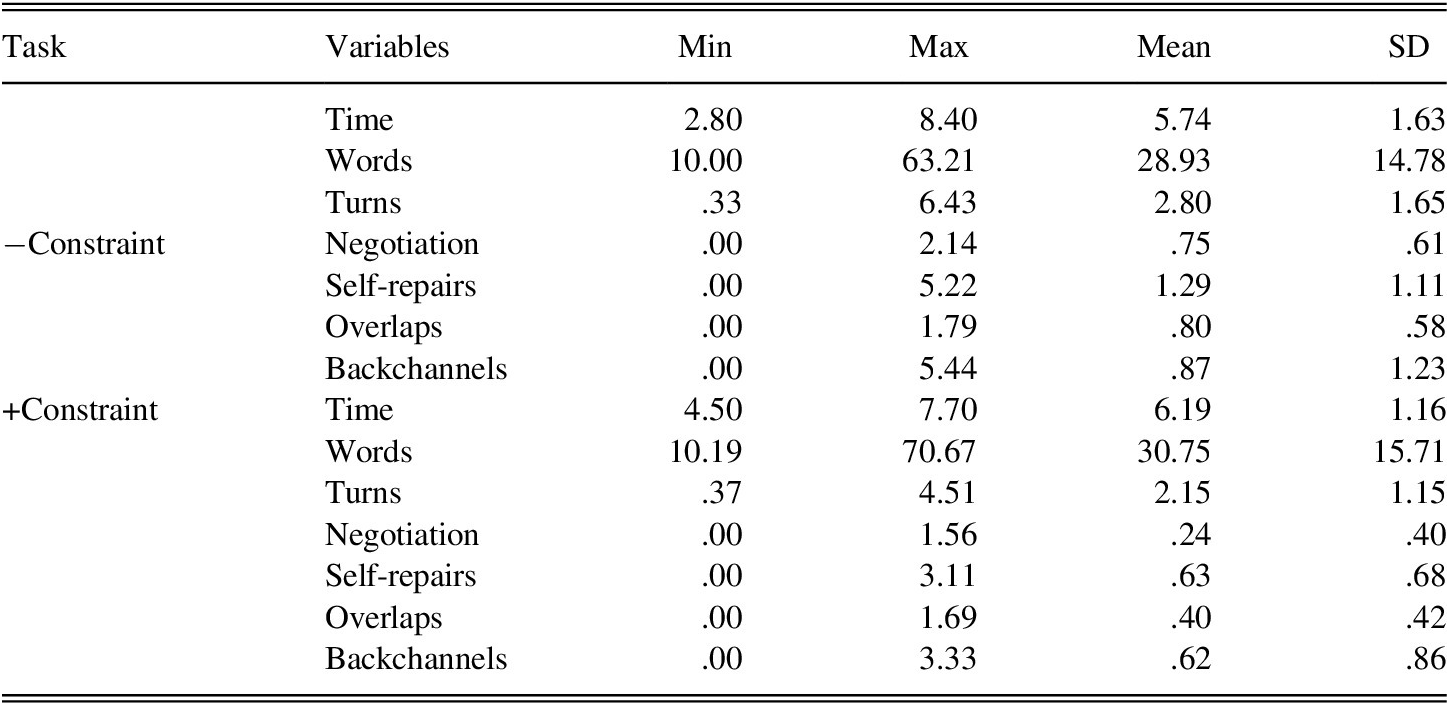
Table 1 shows the descriptive statistics for the seven engagement measures by the −constraint and +constraint conditions. The results indicated that on average learners spent more time and generated more words in the +constraint condition. On the contrary, they generated more turns, negotiation moves, self-repairs, overlaps and turn completions, and backchannels in the −constraint condition.
Descriptive statistics for engagement measures in the −constraint and +constraint tasks (N = 24)

Note. Each variable, except for time on task, was converted to a count-per-minute.
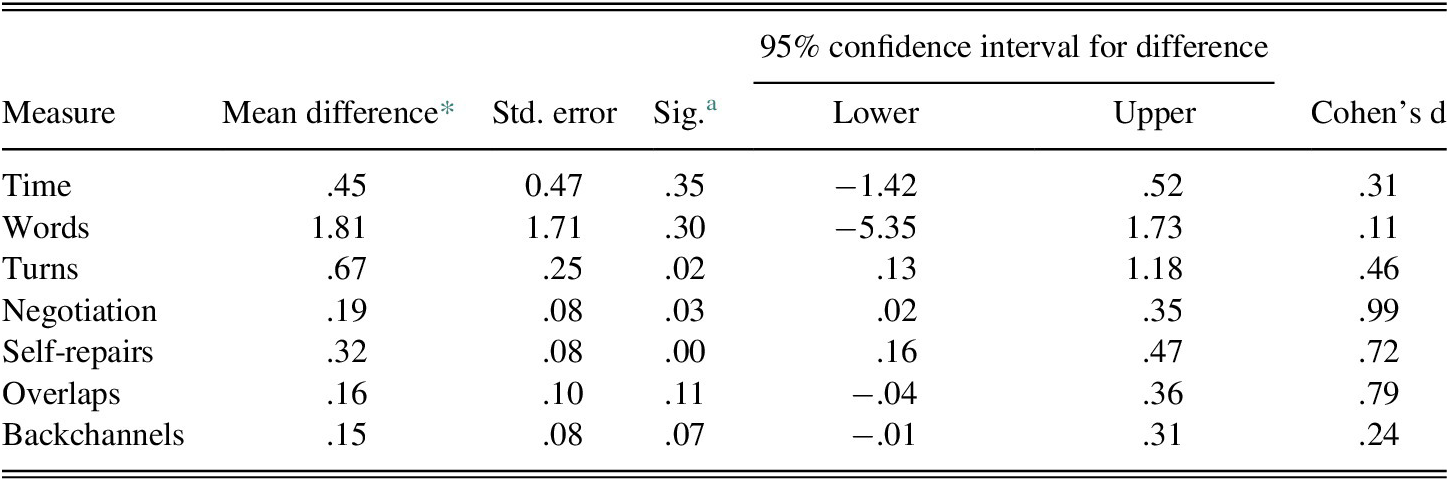
As shown in Table 2, a series of paired-sample t-tests with Bonferroni correction revealed that there was a statistically significant difference between the tasks in turns (mean difference = .67, p = .02), with a small effect size (d = .31), negotiation moves (mean difference = .19, p = .03) with a large effect size (d = .99), and self-repairs (mean difference = .32, p = .00) with a medium effect size (d = .72). A difference in overlaps (mean difference = .16, p = .11) was found with a medium effect size (d = .79). No statistically significant difference was found in time on task (mean difference = .45, p = .35, d = .31), words (mean difference = 1.81, p = .30, d = .11), and backchannels (mean difference = .15, p = .07, d = .24). Effect sizes were interpreted based on the benchmark: .40 = small; .70 = medium; 1.00 = large, proposed by Plonsky and Oswald (Reference Plonsky and Oswald2014).
Results of paired-sample t-tests with Bonferroni correction for the difference in engagement measures between the –constraint and +constraint tasks (N = 24)

Note. Based on estimated marginal means.
* The mean difference is significant at the .05 level.
a Adjustment for multiple comparisons: Bonferroni.
EMOTIONAL ENGAGEMENT
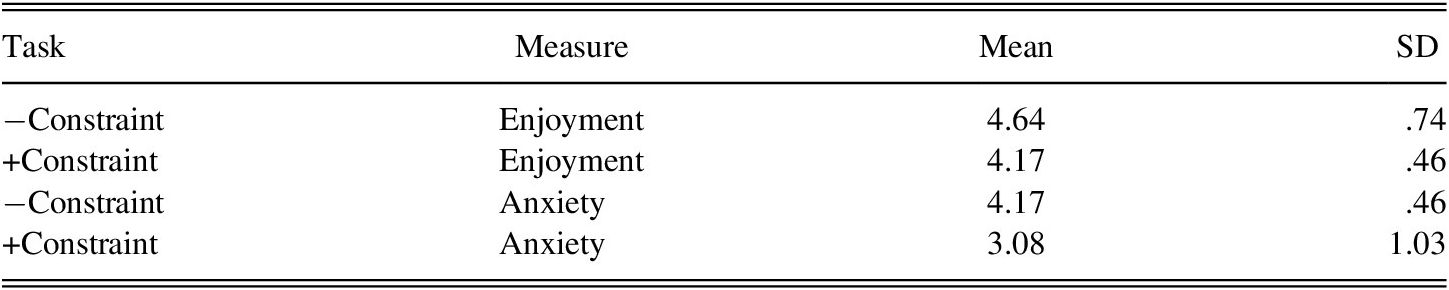
Table 3 shows descriptive statistics of the enjoyment and anxiety scores in the two task conditions. The reported level of enjoyment was higher in the −constraint task (M = 4.64, SD = .74) than in the +constraint task (M = 4.17, SD = .46). The reported level of anxiety was also higher in the −constraint task (M = 4.17, SD = .46) than the +constraint task (M = 3.08, SD = 1.03).
Descriptive statistics for enjoyment and anxiety scores in the −constraint and +constraint tasks (N = 24)

The paired samples t-test showed this difference to be significant for both enjoyment (t(23) = 3.30, p = .00) and anxiety (t(23) = 4.36, p = .00), as shown in Table 4. The effect size was medium for both enjoyment (d = .67) and anxiety (d = .89).
Results of the paired-sample t-test for the difference in enjoyment and anxiety scores between the −constraint and +constraint tasks (N = 24)

DISCUSSION
The results showed a statistically significant positive effect of choice on cognitive engagement, as measured by the amount of negotiation of meaning and form and self-repairs, thus lending support to the theoretical link between choice and cognitive engagement (Flowerday & Schraw, Reference Flowerday and Schraw2003; Ryan & Deci, Reference Ryan and Deci2000). Choice also had a significant effect on turns (behavioral engagement), overlaps (social engagement), and enjoyment and anxiety (emotional engagement).
This positive effect of choice can be explained by examining the role that choice may have played in the tasks. In the −constraint task, the learners were given a greater freedom to generate and contribute their own ideas, as opposed to the +constraint task where their discussion had to be based on the options given by the teacher. In other words, the −constraint condition could have promoted learners’ personal investment, that is, a learner’s decision, persistence, and willingness to work on the task and continued motivation to perfect their work, which is shown to increase task engagement (Lambert et al., Reference Lambert, Philp and Nakamura2017; Maehr, Reference Maehr, Ames and Ames1984). It is also likely that the learners felt that they had more control over what to choose and how to go about the choices they had made when performing the −constraint task. Mercer (Reference Mercer, Gao, Davison and Leung2019) indeed suggests that learners’ perceived sense of control, as a form of autonomy, is one of the psychological antecedents of engagement.
There was no statistically significant effect of choice on time on task and words (behavioral engagement) and backchannels (social engagement), which highlights the complex multidimensional characteristics of engagement and provides empirical evidence to the theoretical discussion that each dimension of engagement can manifest differently (Philp & Duchesne, Reference Philp and Duchesne2016). This mixed finding can be explained through a further examination of the task design and involved constructs. The fact that learners produced an approximately equal proportion of words in both tasks but more turns in the −constraint is an indication that learners were indeed more interactive in the −constraint task.
The lack of a statistically significant difference in backchannels between the two tasks may be explained by social and contextual factors. Backchanneling behavior has long been regarded as a central aspect of active listening (Bjørge, Reference Bjørge2010; Yngve, Reference Yngve and Campbell1970), and for this reason it has been used as a measurement of engagement. At the same time, research has found substantial differences in the frequency and quality of backchannel signals among different languages (Miyata & Nisisawa, Reference Miyata and Nisisawa2007; Wannaruk, Reference Wannaruk1997). In a study by Wannaruk (Reference Wannaruk1997), it was found that Thai speakers produced a greater number of backchannels in their paired conversation than Americans did. It is therefore possible that the students’ backchanneling behavior was in line with their L1 behavior irrespective of the task type.
In regard to emotional engagement, the learners reported higher levels of both anxiety and enjoyment, together with higher levels of engagement in the −constraint task.Footnote 1 This finding may seem counterintuitive. However, viewing the two emotions within a multidimensional model of affect (Linnenbrink, Reference Linnenbrink, Schutz and Pekrun2007) may help account for this result. In the model, affective states are described along the two intersecting dimensions of valence (pleasant vs. unpleasant) and activation (activating vs. deactivating), and enjoyment and anxiety belong to the same category as activated affect. As such, it may be possible for the two emotions to be associated with high levels of engagement. In other words, it can be speculated that learners in the −constraint task exercised heightened attention, involvement, and effort (i.e., cognitive engagement) to defend their own choices, negotiate with peers, and reach agreement, which led them to experience both high anxiety and enjoyment. This shows the interaction of the cognitive and affective dimensions of engagement (Philp & Duchesne, Reference Philp and Duchesne2016).
PEDAGOGICAL IMPLICATIONS, LIMITATIONS, AND FUTURE RESEARCH
The findings suggest that teachers and material developers can design tasks to foster learner engagement by offering choice that allows them to personalize some elements in the task (e.g., what content to discuss). The results also suggest teachers may want to be cautious about the link between heightened attention and activated unpleasant affect such as anxiety. As demonstrated in our study, it may be natural for students, when they are highly engaged in performing a task, to experience activated emotions, some of which may occasionally be perceived as anxiety. Such perceived anxiety can be overcome, for example, by having a supportive teacher and peers, together with positive emotions such as enjoyment.
The study has several limitations. First, due to its small sample size, it cannot be confirmed that the study did not commit a type II error in determining that choice did not have an effect on three of the nine measures of task engagement. A replication with a larger and more strongly generalized sample size will extend this line of inquiry and help demonstrate the validity of these results. Another concern is with the task anxiety questionnaire with modified items. Although it indicated a good internal consistency, it can be argued that learners’ various affective states were oversimplified into one construct, anxiety. We also acknowledge possible disadvantages of within-group comparisons, such as carry-over effects, although we sought to minimize such effects through the counterbalanced design and careful design of task instructions (see the “Materials” section). Lastly, the nonrandom sampling technique used in selecting the participants requires caution in generalizing the findings (Bornstein et al., Reference Bornstein, Jager and Putnick2013).
Several propositions can be made for future studies. The findings indicating both high anxiety and enjoyment along with high engagement during task performance call for more empirical studies to further investigate possible links between emotions, particularly negative ones, and engagement (see, Linnenbrink, Reference Linnenbrink, Schutz and Pekrun2007; Pekrun et al., Reference Pekrun, Goetz, Frenzel, Barchfeld and Perry2011). Future research on task engagement also needs to consider the validity and quality of engagement measures. Such consideration includes whether the simple frequency count of verbal backchannels without taking into account their quality can be a good indication of social engagement. This issue is particularly important in the investigation of engagement at the activity level because, as some scholars have argued, it is possible for learners to demonstrate behavioral engagement without cognitively or affectively engaged (Mercer, Reference Mercer, Gao, Davison and Leung2019; Trowler, Reference Trowler2010).
CONCLUSION
The current study set out to contribute to the understanding of the effect of choice on L2 task engagement through the implementation of two types of opinion-exchange tasks. The results indicated that providing learners with a greater degree of choice can be one means of promoting their engagement and that a high degree of engagement may involve the experience of negative emotions. These findings, while contributing to the domain of research on engagement in task-based language learning, call for further investigation of the complex nature of learners’ affective states and engagement.
APPENDIX A
TASK MATERIAL
Situation: <The university name, deleted> wants to become the number 1 university in Thailand for students from other countries. To do this, it will spend money on its buildings to make them more attractive for students. <The university name, deleted> has money to build three new buildings on campus. The new buildings can be places to study, eat, relax, exercise, get support, or meet other international students (for example, cafes, restaurants, offices, gyms). The university would like to hear from you about which three buildings you want to have on our campus.
Building options given to three students in a group in the +Constraint Task

APPENDIX B
Questionnaire items
Enjoyment
E1. I enjoyed doing this task.
E2. Doing the task was fun.
E3. I thought the task was enjoyable.
E4. This task was interesting.
E5. This task was boring. (Revered item)
Task Anxiety
TA1. Doing this task made me nervous.
TA2. I was anxious while doing this task.
TA3. I got tense while doing this task.
TA4. Doing this task made me feel anxious.