Implications
This study presents a new metaphylactic strategy aimed to reduce the intensity of negative energy balance (NEB) in postpartum dairy cows. Unlike previous studies, the current protocol consists of five injections of cyanocobalamin and butaphosphan at 5 days interval during the first 20 days in milk (DIM), the period of greatest metabolic challenge for dairy cows. The results of this experiment indicate that this protocol can improve metabolic adaptation in the early postpartum period, by reducing adipose tissue mobilization and increasing milk production.
Introduction
The transition from gestation to lactation is considered a critical period for high-producing dairy cows (Goff and Horst, Reference Goff and Horst1997). The transition period is an important homeoretic event, in which several physiological modifications occur in a coordinated manner to support postpartum milk production (Drackley, Reference Drackley1999). During this period, the increase in dry matter intake (DMI) is not able to attend the rapidly increasing energy demand for maintenance and production (Vazquez-Anon et al., Reference Vazquez-Anon, Bertics, Luck, Grummer and Pinheiro1994), leading to a state of negative energy balance (NEB) and the activation of catabolic pathways. As a consequence, there is an enhanced lipolysis in early lactation, that is, followed by an increase in plasma concentration of non-esterified fatty acids (NEFA; Adewuyi et al., Reference Adewuyi, Gruys and van Eerdenburg2005). High plasmatic concentrations of NEFA might exceed the capacity of mitochondrial oxidation in the liver, resulting in the formation of ketone bodies, such as β-hydroxybutyrate (BHB), acetoacetate and acetone (Drackley et al., Reference Drackley, Overton and Dowlen2001). Both NEFA and BHB can be used as markers to indicate NEB intensity during the peripartum period (Chung et al., Reference Chung, Pickett, Cassidy and Varga2008).
Most of the metabolic disorders occur postpartum (Drackley, Reference Drackley1999), decreasing the milk production, impairing the reproductive performance and increasing the risk of culling (Huzzey et al., Reference Huzzey, Veira, Weary and von Keyserlingk2007). Several strategies have been attempted to reduce the effects of NEB, including supplementation with glycerol (DeFrain et al., Reference DeFrain, Hippen, Kalscheur and Jardon2004), nicotinic acid (Pires et al., Reference Pires, Pescara and Grummer2007), cis-linoleic acid (Mosley et al., Reference Mosley, Shahin, Williams, McGuire and McGuire2007), fat (Moallem et al., Reference Moallem, Katz, Arieli and Lehrer2007), methionine (Preynat et al., Reference Preynat, Lapierre, Thivierge, Palin, Matte, Desrochers and Girard2009), choline (Chung et al., Reference Chung, Brown, Martinez, Cassidy and Varga2009), carnitine (Carlson et al., Reference Carlson, McFadden, D'Angelo, Woodworth and Drackley2007) and monensin (Duffield et al., Reference Duffield, Rabiee and Lean2008). Overall, current treatments had limited success, and more research is needed. One potential alternative is the use of butaphosphan and cyanocobalamin (BTPC; vitamin B12) injections after calving, which have shown positive effects up to now (Furll et al., Reference Furll, Deniz, Westphal, Illing and Constable2010; Rollin et al., Reference Rollin, Berghaus, Rapnicki, Godden and Overton2010).
Cyanocobalamin is the synthetic form of vitamin B12. Methylmalonyl-CoA mutase, a mitochondrial enzyme, involved in the conversion of propionate to succinyl-CoA, is an important vitamin B12-dependent gluconeogenic substrate (Kennedy et al., Reference Kennedy, Cannavan, Molloy, O'Harte, Taylor, Kennedy and Blanchflower1990). An inadequate supply of vitamin B12, especially in the early lactation, could possibly lead to decreased function of methylmalonyl-CoA mutase, and hinder energy production from propionate, thus leading to enhanced ketogenesis in the animal.
The butaphosphan is a compound used as an organic source of phosphorus for animal supplementation. In dairy cattle, the phosphorus content of liver tissue is decreased in early lactation (Grunberg et al., Reference Grunberg, Staufenbiel, Constable, Dann, Morin and Drackley2009). Phosphorus plays an important role in hepatic carbohydrate metabolism, as several intermediates in the gluconeogenic pathway must be phosphorylated. Thus, the rates of gluconeogenesis and glycolysis are regulated by phosphorus availability (Berg et al., Reference Berg, Tymoczko and Stryer2006). In addition, phosphorus is an important component of nucleic acids, ATP and AMP (Cunningham, Reference Cunningham2002), thereby it is also implicated in energy metabolism.
Recently, a study has shown that cows treated with BTPC at calving and 1 day later had lower incidence of ketosis (Rollin et al., Reference Rollin, Berghaus, Rapnicki, Godden and Overton2010). Another study also demonstrated that BTPC improved the energetic status of dairy cows during the peripartum period based on concentration of glucose, NEFA, BHB and cholesterol (Furll et al., Reference Furll, Deniz, Westphal, Illing and Constable2010).
The aim of this study was to test the effect of BTPC on plasma concentrations of metabolites and on milk production in postpartum dairy cows. Our results indicate that supplementation of BTPC during the first 20 days postpartum reduced the severity of NEB and increased milk production in a dose-dependent manner.
Material and methods
Animal welfare
The Committee for Ethics in Animal Experimentation from the Pelotas Federal University has approved all procedures performed in this experiment.
Animals, experimental protocol and treatments
For this study, 52 multiparous Holstein cows kept under semi-confinement management (concentrate and pasture fed) in a commercial dairy herd in southern Brazil (328.16′S, 528.32′E) were used. Cows calving between December 2008 and May 2009 were enrolled in the study. Cows were milked twice daily and received concentrate supplementation after every milking. The concentrate was formulated to meet the nutritional needs (National Research Council (NRC), 2001) of post-calving Holstein cows, composed of 35% of soybean hulls, 30% of sorghum, 17% rice meal, 13% of soybean meal, 4% of mineralized salt and 0.5% of urea. Between milkings, cows had ad libitum access to water and were kept under grazing of Sorghum bicolor L. Moench and Lotus corniculatus pasture. Immediately, post-calving cows were randomly assigned to one of three groups: (1) Control Group (n = 16), which received 10 ml of saline (i.m., NaCl 0.9%), every 5 days from calving to 20 days in milk (DIM); (2) 1000 mg of butaphosphan and 0.5 mg of cyanocobalamin (i.m., 10 ml of Catosal B12®, Bayer Health Care, São Paulo, Brazil; BTPC1 Group, n = 18) and (3) 2000 mg of butaphosphan and 1.0 mg of cyanocobalamin (BTPC2 Group, n = 18). Both, BTPC1 and BTPC2 groups received i.m. injections of BTPC every 5 days from calving to 20 DIM.
Body condition score (BCS) and blood sampling
At the beginning (0 DIM) and end of the experiment (75 DIM) BCS was determined by the same technician, based on a five-point scale, where obese equals 5 (Wildman et al., Reference Wildman, Jones, Wagner, Boman, Troutt and Lesch1982). Blood samples were collected from jugular vein every 15 days from calving to 75 DIM. Blood samples were collected in two heparinized 10 ml vacutainer tubes (Vacutainer Systems; Becton-Dickinson, Franklin Lakes, NJ, USA), either with EDTA or 15 mg NaF and 12 mg potassium oxalate. Blood samples were immediately centrifuged (1500 × g for 15 min). Plasma from tubes containing EDTA was frozen at −80°C for analysis of blood urea nitrogen, NEFA and BHB. Plasma from tubes containing NaF was frozen at −20°C for glucose assay.
Biochemical analysis
The concentrations of glucose, urea, calcium (Ca), phosphorus (P), magnesium (Mg), γ-glutamyltransferase (GGT), aminotransferase aspartate (AST) and cholesterol, were analyzed by enzymatic colorimetric assay quantified by a spectrophotometer (FEMTO 700 Plus, Femto Ind. e Com. de Instrumentos Ltda., São Paulo, Brazil). The reagents were handled according to the manufacturer's instructions (Labtest®, Lagoa Santa, Brazil). NEFA and BHB were analyzed by a commercial kit (Wako NEFA-HR, Wako Chemicals USA®, Richmond, EUA and Randox®, Randox Laboratories E.U.A.®, Oceanside, CA, USA, respectively), according to Ballou et al. (Reference Ballou, Gomes, Juchem and DePeters2009). Coefficients of variation were below 10% for all assays.
Milk production and composition
Milk production was evaluated daily (ALPRO® Windows, DeLaval, Kansas City, MO, USA) from 2 to 12 weeks postpartum, and weekly averages were generated for statistical analysis. Composite milk samples were collected every 15 days from 15 to 75 DIM to determine concentrations of fat, lactose and protein by IR spectrophotometry (Bentley 20000, Bentley Instruments Inc., Chaska, MN, USA), and calculation of the total solids.
Statistical analysis
Data were analyzed using MIXED procedure of SAS. All independent variables were analyzed as repeated measures and considered cow within treatment as a random effect. Models included treatment, cow within treatment, time and the interaction between treatment and time. Additional covariables such as parity, month of parturition and BCS at calving were included when P < 0.10. Effects of supplementation (control v. BTPC1 + BTPC2) and effects of dose (BTPC1 v. BTPC2) were analyzed by orthogonal contrasts. Linear and quadratic relationships between treatments and independent variables were evaluated by orthogonal polynomial contrasts.
Results
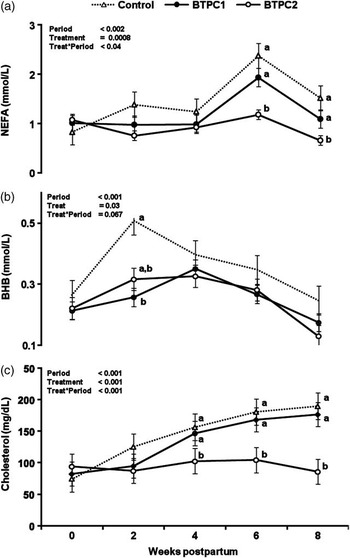
The concentration of NEFA was higher (P = 0.0008) in the Control group compared with treated groups and had a linear decrease (P = 0.0002) with the increasing concentration of BTPC injected. The levels of NEFA increased on the 2nd week and remained elevated until the 6th week on BTPC1 and control group (Figure 1A). The concentration of BHB was only higher (P = 0.03) in control group compared with treated groups, with no dose effects. The peak of BHB concentration (P < 0.001) was on the 2nd week postpartum and reduced gradually up to 8 weeks postpartum (Figure 1B). Cholesterol also decreased (P < 0.001) as the dose injected increased. The BTPC1 and Control Groups had a gradual increase of cholesterol from 1 to 8 weeks postpartum (Figure 1). The concentration of glucose, urea, P, Mg, AST and GGT were not different among groups (P > 0.05).
Plasma concentration of non-esterified fatty acids (NEFA) (a) β-hydroxybutyrate (BHB) (b) and cholesterol (c) of cows treated with placebo (Control Group; n = 16), 10 ml of butaphosphan and cyanocobalamin (BTPC1 Group; n = 18) or 20 ml of butaphosphan and cyanocobalamin (BTPC2 Group; n = 18) at 0, 5, 10, 15 and 20 days in milk. Different superscripts indicate differences at P < 0.05 between groups.

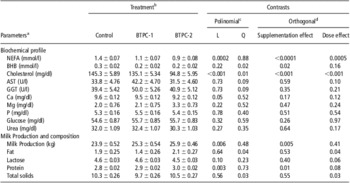
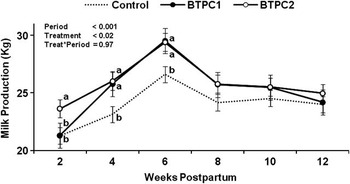
Milk production was also linearly affected by treatment (P = 0.006), being higher (P = 0.005) for treated groups in comparison with control group (Table 1). Milk production peaked (P < 0.001) on the 6th week postpartum and decreased gradually on the subsequent weeks (Figure 2). Regarding the milk composition, a linear increase in protein content was observed (P = 0.003). For fat and total solids content, a quadratic effect of the supplementation (P = 0.04 and P = 0.03, respectively) was observed. The lactose content was not different among treatments. The BCS of cows ranged from 2.0 to 3.5, but did not significantly differ among groups (P = 0.71).
Plasma metabolites, milk production and composition of postpartum dairy cows treated with placebo (Control group, n = 16), with butaphosphan + cyanocobalamin (BTPC1 group, n = 18; BTPC2 group, n = 18)

NEFA = non-esterified fatty acids; BHB = β-hydroxybutyrate; AST = aminotransferase aspartate; GGT = γ-glutamyltransferase; Ca = calcium; Mg = magnesium; P = phosphorus; DIM = days in milk.
aPlasma concentration of NEFA, BHB, cholesterol, AST, GGT, Ca, Mg, P, glucose, urea, milk production and milk composition (fat, lactose, protein and total solids) every 15 days from calving to 75 DIM.
bTreatments consisted on a five injections administered on days 0, 5, 10, 15 and 20 postpartum. Control = saline solution (n = 16); BTPC1 = 1000 mg of butaphosphan and 0.5 mg of cyanocobalamin (n = 18); BTPC2 = 2000 mg of butaphosphan and 1.0 mg of cyanocobalamin (n = 18).
cL = linear effect of the treatment; Q = quadratic effect of the treatment.
dSupplementation effect: Control v. BTPC; dose effect: BTPC1 v. BTPC2.
Milk production (kg) from week 2 to 12 postpartum of cows treated with placebo (Control Group; n = 16), 10 ml of butaphosphan and cyanocobalamin (BTPC1 Group; n = 18) or 20 ml of butaphosphan and cyanocobalamin (BTPC2 Group; n = 18) at 0, 5, 10, 15 and 20 days in milk. Different superscripts indicate differences at P < 0.05 between groups.

Discussion
The metaphylactic therapy used in this study, consisting of five injections of BTPC, reduced NEB intensity during the transition period, as indicated by the lower plasmatic concentrations of NEFA and BHB, and increased milk yield in treated cows. Although several studies had shown the positive effect of butaphosphan in reducing NEB intensity in high-producing dairy cows during the transition period (Furll et al., Reference Furll, Deniz, Westphal, Illing and Constable2010; Rollin et al., Reference Rollin, Berghaus, Rapnicki, Godden and Overton2010), its mode of action is not clear yet. What is known about the pharmacokinetics of this molecule is that it is rapidly eliminated from the organism after i.v. injection, with a half-life of 116 min in dairy cows (EMEA, 2000).
Some studies have indicated (Furll et al., Reference Furll, Deniz, Westphal, Illing and Constable2010; Rollin et al., Reference Rollin, Berghaus, Rapnicki, Godden and Overton2010) that the injection of butaphosphan (2 to 8 g/cow) and cyanocobalamin (1 to 4 mg/cow) in dairy cows, can reduce NEB intensity in a dose-dependent fashion with at least three injections of 2 g of butaphosphan and 1 mg of cyanocobalamin. Our results indicate that the use of 1 g of butaphosphan/cow, that is, half of the minimum dose used in other studies, is still able to induce positive effects on NEB and milk production.
During the peripartum period of dairy cows, there is an increase in serum NEFA concentration (Drackley, Reference Drackley1999; Douglas et al., Reference Douglas, Overton, Bateman and Drackley2004), which leads to liver triacylglycerol (TAG) accumulation and is detrimental to milk production and reproductive performance (Grummer, Reference Grummer1993). The linear and dose-dependent reduction in the concentration of NEFA in cows treated with BTPC can be attributed to the ability of butaphosphan to improve ATP synthesis (Deniz et al., Reference Deniz, Westphal and Illing2008). Moreover, cyanocobalamin, by acting as an enzymatic co-factor to methylmalonyl-CoA mutase enzyme, can also contribute to reduced circulating NEFA (Kennedy et al., Reference Kennedy, Cannavan, Molloy, O'Harte, Taylor, Kennedy and Blanchflower1990). The cyanocobalamin is a vitamin B involved in the synthesis of methionine, a donator of methyl for choline and carnitine. These two substances participate in the metabolism and transport of fat in the body (Rollin et al., Reference Rollin, Berghaus, Rapnicki, Godden and Overton2010). Recently, a study showed that supplementation of dairy cows with folic acid and vitamin B increased glucose availability and reduced hepatic lipid accumulation during the transition period (Preynat et al., Reference Preynat, Lapierre, Thivierge, Palin, Matte, Desrochers and Girard2009).
As stated before, the concentrations of NEFA and BHB were linearly reduced in cows treated with BTPC. This indicates that the current protocol can help to control the incidence of subclinical ketosis. In agreement with those reported by Lohr et al. (Reference Lohr, Brunner, Janowitz, Hummel, Seeger, Weber, Wittek, Schmidt and Hellmann2006), which detected reduced concentrations of BHB in cows that already developed secondary ketosis and were treated with BTPC. Furthermore, the injection of 2.5 mg of butaphosphan and 1.0 mg of cyanocobalamin, at calving day and one day later reduced the incidence of subclinical ketosis on the 1st week postpartum in multiparous cows (Rollin et al., Reference Rollin, Berghaus, Rapnicki, Godden and Overton2010).
The current study demonstrated the effect of BTPC on lipid metabolism and on the ability of the liver to metabolize NEFA and reduce BHB formation. The reduction in cholesterol concentration was dose dependent for BTPC-treated cows and follows the same fashion, possibly because cholesterol can be transported with TAG in the bloodstream, and because hepatic secretion of lipoproteins is associated with NEFA conversion into TAG. Thus, high concentrations of NEFA increase the secretion of lipoproteins and consequently of circulating cholesterol (Grummer, Reference Grummer1993). The present study demonstrated that the dose of 2000 mg of butaphosphan and 1 mg of cyanocobalamin can keep serum cholesterol concentration stable during early postpartum period.
Cows treated with BTPC had a linear increase in milk production. This result can be due to the detected reduction in NEB intensity that, in turn, can be associated with an increased DMI, and consequently, increased milk production. During intense NEB, when high serum NEFA concentration is detected, an excessive release of cytokines may occur and inhibit DMI and milk production (Allen et al., Reference Allen, Bradford and Harvatine2005). Thus, more studies are necessary to indicate whether BTPC can increase DMI or whether they have a direct effect on milk production.
In summary, the results of this study indicate that the metaphylactic injection of BTPC after calving increased milk production and reduced NEB intensity in Holstein cows, by reducing the plasma concentrations of NEFA and BHB.
Acknowledgments
The authors thank the Coordenação de Aperfeiçoamento de Pessoal de Nível Superior (CAPES), the Conselho Nacional de Desenvolvimento Científico e Tecnológico (CNPq) and Bayer Animal Health, for the financial support.