Opera DVDs should be handled with care. At first sight they may seem trivial, if not dangerous, objects for academic enquiry. Storage devices do not have much of a musicological pedigree, and focusing on ‘things’ always carries risks of fetishism (methodological or otherwise), potentially obscuring the human and social context within which they gain significance. Yet, as an object woven into the discourses of digital media and the pleasures of home viewing, the Digital Versatile Disc, a once cutting-edge format, offers extended opportunities for studying the meeting of opera and key themes of late twentieth- and early twenty-first-century culture.Footnote 1 In particular, its material presence has much to tell us about the complex status and cultural placement of opera videos.
The term ‘opera videos’ is typically used to indicate a range of phenomena such as VHS and DVD releases of live performances, as well as TV and cinema broadcasts, both live and relayed. Thus defined, these videos are placed within the broader paradigm of the ‘televisual’, a category that Philip Auslander famously uses to indicate what he sees as the dominant mode of media production today. Auslander's approach has been extremely influential and provides useful theoretical tools for the analysis of opera videos, but part of my argument here will be concerned with suggesting that his emphasis on the televisual as ‘the cultural context’ of our age runs the risk of obscuring the complexity of the early twenty-first-century mediascape, and, consequently, of opera's placement within it.Footnote 2 Writing in the late 1990s (just at the time when DVDs were making their mark on the market), and taking as a starting point the relationship between live and (what he calls) ‘mediatised’ performance, Auslander showed a range of ways in which, within the framework of the televisual, the mediatised is priced for producing a feeling of ‘liveness’, just as live performance increasingly includes the mediatised.
Scholars have noted the way in which opera videos regularly tap into the ‘ideology of authenticity’ that underpins this mechanism.Footnote 3 The very use of tags such as ‘live on DVD’, ‘live in HD’ (the motto of the extremely successful MET HD cinema broadcasts) or, more recently, ‘live in 3D’ (employed by ENO's first broadcast of opera in three dimensions, in 2011), has the effect of insisting that opera on-screen can be a valuable surrogate for live experience, the latter assumed to be ontologically prior and superior.Footnote 4 As Emanuele Senici has shown, this assumption is articulated, in a more or less explicit form, by prominent opera directors, critics and media theorists. Thus, Jürgen Kühnel's theorisation of opera videos as visual documents that do ‘not narrate an opera but rather “relate” a performance of an opera’, is matched by the intention expressed by Brian Large, one of opera's most prominent video directors, ‘not to get in the way by being a director’.Footnote 5 The discourse largely finds confirmation in the standard practice that developed in opera videos from the 1950s through the 1980s:Footnote 6 in their deliberately impassive camerawork, the camera's parameters are set a priori, based primarily on traditional formal patterns rather than specific narrative considerations. Although in part influenced by pragmatic limitations (in particular by the presence of a live audience during recording), this impassive style is in keeping with the aim of providing a surrogate of the live experience: the unobtrusiveness of the camera is part of the medium's attempt to efface its own presence. Over the last few years, scholars such as Melina Esse, Christopher Morris, Roger Parker and Senici have deconstructed this discourse of ‘liveness’ from two complementary standpoints. They have alerted us to the specificity of the video experience (the way in which the video constructs the performance), and they have warned us of the danger of radicalising ontological differences between live and mediated performances.Footnote 7
My aim here is to build on this analysis by taking a slightly different approach. Rather than focusing on the relationship between the live and the mediatised, I intend to consider other models of visual mediation at play in opera videos. I begin by exploring the sense in which I see the televisual to be problematic. And by this I do not mean that it is ideologically fraught (even though its political implications certainly deserve closer attention). The problems that concern us here have to do with a particular reliance on a conceptual separation between medium and content that comes with undesired consequences both for the producers of opera videos and for our understanding of the video's cultural placement.
A first problem has to do with the fact that, within a context where unobtrusiveness is the rule, the camera is at constant risk of drawing attention to itself. A detailed study of this has yet to be undertaken, but the public reception of opera videos features recurring complaints that the presence of the camera, and particularly its proximity to the singers and the mise-en-scène, runs the danger of interfering with the theatrical experience. As Esse has noticed, there is a marked ‘squeamishness about the uncanny proximity made possible by the camera’, with critics ‘disturbed by its intrusive physicality and presence’.Footnote 8 Particularly emblematic in this sense is a series of online reviews, discussed by Senici, which includes comments by bloggers that provocatively suggest links between opera videos and the aesthetics of hardcore pornography, with the camera focusing upon the singers, ‘porn style, in the most exciting moments’.Footnote 9
This insistence on the intrusive and fetishising qualities of the camera's eye draws attention to the problem of its presence as a matter not just of proximity but also of phenomenology; it is a consequence of what we understand to be the relationship between medium and subject matter.Footnote 10 After all, the disgruntled reviewers quoted by Senici do not compare the close-ups of videoed opera with, for example, 1960s European art cinema, where the use of facial icons is a central stylistic feature, or with classical Hollywood melodrama, where shot size and distance is typically part of broader patterns of emotional intensification. In both these instances, the camera's proximity is what we might call narratively motivated. In the porn close-up, on the other hand (and notwithstanding the fact that the pornographic scene usually has a fictional premise), the emphasis is not on representation but on the showing of the sexual act. Without wanting to radicalise these differences, we might say that, from a phenomenological point of view, the emphasis of the televisual camera is on authentication rather than on representation (to paraphrase Roland Barthes's famous analysis of photography).Footnote 11 The televisual camera has an ‘indexical’ function that is a direct consequence of its association with the ‘live’, the documentary and the non-fictional, which puts it at constant risk of parasitising the staged fiction. We can thus start seeing the implications of conceiving opera videos in keeping with a ‘televisual’ logic as opposed to, for example, a ‘cinematic’ model of visual mediation. The very fact that the camera functions within an overall discourse of televisual transparency makes its presence intrusive because it is alien to the subject matter. It does so in a way that does not enter the discourse of the ‘cinematic’, where medium and content are highly integrated – considerations about framing and editing being firmly rooted within the film's overall system of signification. A second, related problem of the televisual is that this upholding of a conceptual separation between medium and content would seem to prevent opera from resonating with a significant sphere of contemporary visual culture that has to do less with liveness and more with the pleasures of mediation.
Yet opera videos do show traces of competing discourses and aesthetics. I want to suggest that, while operating within a broader framework of the televisual, opera video producers find ways of composing out this tension between medium and content (however briefly), aligning opera with a wider range of visual styles and genres. The desire to go beyond these conceptual separations and place opera in a richer dialogue with contemporary visual culture is particularly visible in the materials that surround opera videos. It is to these marginal materials that I turn here. In particular, I focus on the paratexts that, as Gérard Genette would put it, enable the videoed performance to become a DVD, surrounding and extending the text, ‘in order to present it’ and prepare its reception.Footnote 12
Framing the Frame
To show some of the ways in which the paratexts of opera videos mobilise broader discursive matters, my discussion is limited to a single opera – Verdi's Don Carlo.Footnote 13 This focus is intended as a heuristic tool, a way of bringing into relief the process of accommodation between the forms and materials of opera and those of new media. It is also meant to raise some questions about the identity of the operatic text (famously unstable in the case of Don Carlo), and the ways in which the videos' paratexts can complicate its boundaries. I focus, in particular, on four versions: a 2005 Deutsche Grammophon release of a 1983 production at the Metropolitan Opera House; a 2005 NVC Arts/Warner Classics release based on a 1985 performance at the Royal Opera House; a 2000 NVC Arts/Warner Classics based on a 1996 production at the Théâtre du Châtelet; and a 2009 Hardy Classics release of a 2008 production at the Teatro alla Scala.
This list in itself conveys something of the complex, layered nature of opera DVDs, giving a sense of their multiple agencies and chronologies. The first example, the 2005 Grammophon DVD, is a good case in point. The video was originally conceived as a telecast for PBS's ‘Live at the Met’ series and directed by Brian Large with a suitably unobtrusive visual style. Clearly born under the aegis of the televisual, it was then released on VHS by Bel Canto Society in 1987, prior to its later DVD release. This periodic process of remediation offers an opportunity to explore the different ways in which the VHS and the DVD present the same video. In other words, it allows us to explore any change in the discourse activated by the paratexts.
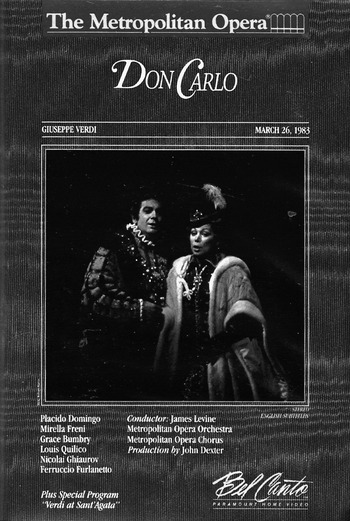
The front cover of the 1987 opera VHS (Fig. 1), like all others released by Bel Canto Society at the time, adopts a picture-frame design. It features Plácido Domingo and Mirella Freni, as Don Carlo and Elisabetta, side by side, singing their love duet from Act I. The photograph is square-shaped, framed by a double yellow line, and laid at the centre of the cover against a green background. On this background, which takes up more than half the surface area, is overlaid the textual information. Immediately above the picture, respectively aligned with its left- and right-hand margins, are Verdi's name and the date of the performance (26 March 1983). Immediately below, in three columns, are the names of the six principal performers (on the left), those of conductor, stage director and orchestra and chorus (in the middle), technical details concerning sound and subtitles (on the right) and information about video extras (below the performers' names). At the top of the cover is a purple Metropolitan Opera logo, which spans the exact length of the photo. At the bottom, aligned to the right-hand margin of the photo, is the logo of the video production company. The opera's title is placed between the MET logo and the top of the photograph. Plain white text is used for the performers, with various combinations of font styles, sizes and colours to differentiate the other kinds of textual information.
Front cover, 1987 Bel Canto VHS of Verdi's Don Carlo.

The primary aim of covers is not to make propositions about the ontology of the image, but to foreground prominent singers while putting forward an idea of what the opera is about. In this case, Don Carlo is allied to a readily available iconography of operatic passion, while Domingo and Freni guarantee the international status of the performance and the historical relevance of the VHS as an archival document.Footnote 14 In the process of providing a snapshot of the opera, however, this cover also says something about the nature of the video itself. The picture frame, which seems to invoke the near-square ratio of television screens at the time, highlights both limitations and value. On the one hand, by cropping the photograph, it implicitly acknowledges that the video can only present us with a partial view of the live performance, reinforcing a notion of the latter's ontological priority. On the other, it amplifies the video's documentary value by means of presenting its mediation, quite literally, as a matter of framing. In keeping with a discourse prizing the video for interfering as little as possible with the performance, limiting itself to recording the event with precision, the photograph is kept clear of all textual and graphic elements and tagged with a date. The picture frame, imagining a conceptual separation between the medium and its content, allows the video to be presented as an unmediated recording. The proliferation of font style-based information (as the geometrical layout that graphically compensates for such proliferation) plays into this attempt to make clarity between the various materials and layers of mediation – the work, the performance, the staging, the video's features and extras. The medium's minimal interference is also signified, indirectly, by the strong geometrical layout, with all the text symmetrically arranged around a photo that, in turn, is centred on the two main characters. In this sense, although the discourse of the cover is, in principle, independent from the actual visual codes employed by the director, it powerfully anticipates Large's style.
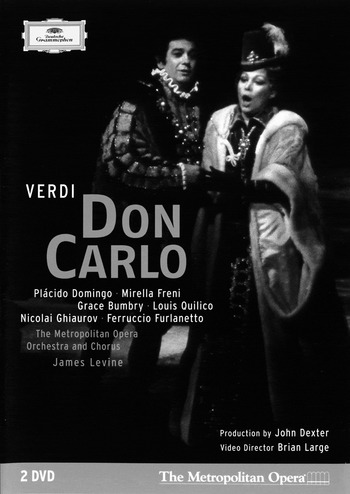
The 2005 DVD remediation of Large's video uses a very similar production still from the love duet (Fig. 2). As with the picture-frame design, this cover epitomises a generic type. Its layout is shared by many Deutsche Grammophon DVD productions of the time. The image, now full length, occupies the whole front cover of the DVD. Indeed, owing to the spine and back covers being as black as the stage behind the singers, the impression is that of the photograph stretching across the whole case. The only exception is an orange stripe with the MET logo, placed at the bottom of the front cover.
Front cover, 2005 Deutsche Grammophon DVD of Verdi's Don Carlo.

The textual information is laid out on the left-hand side of the photograph. In comparison with the VHS cover, the amount of information and the range of colours and font styles are reduced, and the graphics avoid any clear alignment; each line of text is offset in relation to the others. The date of the performance has disappeared, and so has technical information about the video and its extras. The text colours are reduced to white, for the names of performers, production manager and video director (Brian Large is now credited), and to orange (in keeping with the colours of the MET logo), for the orchestra and chorus, the conductor and the opera's title.
Of course, it is hardly surprising that the style of opera's paratexts, as with any marketing material, would change over the nearly twenty years between these two presentations of the MET video. The picture-frame design has today all but disappeared from opera videos. The DVD cover is in keeping with a more fluid combination of image and text and foreground and background facilitated by major developments in graphic-design software during the late 1980s. The keyword here is ‘convergence’, a term typically used in media studies to indicate synergies between various digital technologies, but which has also been used to describe an aesthetic of integration of visual (and, as discussed below, audiovisual) materials made possible by those technologies.Footnote 15 In this sense, and however slightly, the DVD cover aligns itself with the aesthetic of convergence favoured by the introduction of computers in the production and post-production of all visual design.
What I want to suggest is that such changes in design (thus in both software and aesthetics) are connected to new ways of making sense of opera on-screen. In this case, by downplaying the notion of mediation as framing, the DVD design tempers the rhetoric of the video as a neutral vehicle for the performance. We could thus say that the cover prepares us differently for the style of Large's video. If the VHS reinforced connotations of streamlining, neutrality and objectivity, the DVD deliberately avoids symmetry and vertical alignments: its overlaying of text onto a historical photograph communicates a slightly different set of qualities, ones that could suggest a more dynamic, distinctive approach to the material. The inclusion of Large's name, and the disappearance of the date of the performance as a guarantee of authenticity, might also play into this greater acknowledgement of the layers of mediation. It is possible to conceive of this relationship between design and discourse in two ways. In a weak sense, we could say that changes in graphic-software technology, by promoting an aesthetic of convergence, lead to designs that just happen to soften the televisual rhetoric. However, a stronger connection could be argued if we accept that such an aesthetic of convergence, which is facilitated by extended possibilities for manipulating all media, comes with ways of thinking about objects which make the conceptual safeguarding of boundaries such as those between medium and content less fashionable, let alone less tenable.
The disappearance of the picture frame can also be understood in relation to the process of remediation. As Bryan Sebok reminds us, the introduction of DVDs played a central role in explaining to the public the shift from analogue to digital platforms, and, as such, it was associated with an argument for progress that was evolutionary in nature and had the promise of better definition and greater immediacy.Footnote 16 This promise was at one with the DVD's proclaimed ‘Hollywood-ness’, a connection reinforced by the major role played by the film industries in the so-called format wars.Footnote 17 DVD immediacy was about bringing the home theatre closer to cinema's fictions. In keeping with DVDs' broader cultural association with the viewing pleasures of the ‘Big Screen’, the design of the Don Carlo cover does not address the screen's limitations. Indeed, those very limitations were being stretched as part of the promise of transforming home theatres into immersive systems. So whereas the VHS cover constructed the act of viewing as one in which the viewer is in front of a screen-sized picture frame looking at a document of the performance, the DVD cover places the frame outside the viewer's sight. The camera is so close to the singers that we cannot see the proscenium arch; the viewer is too close to the image to see its borders.
In this sense, the VHS and the DVD designs put forward two different models of immediacy: one linked to a notion of objective framing, and another that makes the medium transparent by suturing the viewer to the image. These two models, tied both to the evolutionary discourse of remediation and to changes in the tools and aesthetics of graphic design, in turn, have different implications for the material qualities of the VHS and the DVD. Whereas the picture-frame model is a design rich in ‘neutral’ elements – a template that would be shared by all Bel Canto Releases – the DVD is specific to the particular opera in question. The image of the opera, by stretching all around the case, as a widescreen, or as wrapping paper, coincides with the physical boundaries of the object.
Lovers and Cloisters, Glitches and Loops
These subtle and subtly shifting relationships between medium and content are visible in the next threshold of opera DVDs, the menu. The menu is essentially an interface, a multimedia paratext of the new generation, allowing users to interact with a limited set of options. This ‘closed interactivity’ introduces a new kind of temporality: a pocket of time of varying length during which the user might linger at the margins of the video, navigating through options and title chapters, exploring the DVD's branching structure. This new, expendable and expandable pocket of time is accompanied by images and sound. In this sense the interface also functions as an enhanced ‘cover’, giving us an audio-visual preview of the event to come. This dual function as cover and as interactive platform is crucial when it comes to fitting the opera to the formal features of the menu. To accommodate the particular temporality of the menu while circumventing the storage limitations of the DVD, video and audio materials are looped. In programming language, we would say that the menu relies on a control structure affecting the linear flow of data. This structure becomes a critical point for opera's meeting with the aesthetics of computer interfaces, providing an opportunity for us to consider cultural meanings which lie beyond the framework of the televisual.
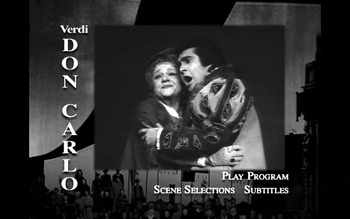
The particular pressures that the loop puts on the presentation of opera are visible in the 2005 NVC release. This is a DVD deriving from a video of a 1985 performance at the Royal Opera House, based on an original production by Luchino Visconti and again directed by Large. A video sample from the same love duet, framing Luis Lima and Ileana Cotrubas as Carlo and Elisabetta in mid-shot, is presented in a frame within a frame, roughly positioned in the middle of the screen, laid onto a still of the wider stage – a long shot of the famous auto-da-fe moment (Fig. 3). The textual elements are arranged around the frame: the title is spelled vertically, along the left-hand side of the video, with the menu options at the bottom. This design is a variation of the picture-frame layout noted in the Bel Canto VHS.
Main menu, 2005 NVC Arts/Warner Classics DVD of Verdi's Don Carlo.

The background to the love duet is here provided by a second image, a solution that combines two of the opera's most distinctive scenes, but with similar televisual rhetoric: the emphasis is squarely on framing and on the video's ability to capture an operatic moment, with a distinctive passage foregrounded and kept clear from all other textual elements. Within the multimedia menu, the logic of the photographic moment is turned into one of operatic highlights. The cantabile ‘sparì l'orror della foresta’, a passage in the duet characterised by the tight interweaving of the singers' lines, is pulled out of the scene and looped to accommodate the cyclic temporality of the interface. After a minute, the music skips back to the beginning. The passage ends in the tonic of E major and restarts from that same chord, with the two singers jolting back into position, and the camera, which slightly zoomed in as the phrase unfolded, zooming back, trapping the lovers inside an eternal climax.
In the process of turning a snapshot into a video sample, the televisual rhetoric here comes into obvious friction with the temporality of the menu. As with the ‘digital failures’ cherished by so-called post-digital artists and musicians, this glitch has undesired deconstructive powers.Footnote 18 It calls attention to the DVD as a thing, laying bare its digital body, making explicit the process of repetition and the limitations of the format, not to mention the low production values of this NVC release. Most importantly, the glitch highlights frictions in the process of accommodation. It dramatises a mismatch between the DVD and the forms of nineteenth-century opera, an awkward attempt to fit the temporality of the operatic climax onto a loop. In this sense, the menu is unsuitable for putting forward a televisual preview of the opera video. It calls for a set of formal operations that depend on a particular manipulation of the audio-visual materials and that have the power of opening up a different understanding of what opera videos are.
This can be seen in an earlier release by NVC Arts, a 2001 DVD of a 1996 performance of Don Carlo at the Théâtre du Châtelet. The chosen musical sample is an excerpt from the orchestral prelude to Act II (in the 1867, five-act version used in the Châtelet production). In the opera, the prelude introduces a scene set at dawn, in a monastery housing the tomb of Carlo V, Don Carlo's grandfather. The horns, as well as playing important thematic material (a distinctive four-note motif heard throughout the opera), establish the dark ‘tinta’ by means of a powerful, resonant unison and a chorale-like harmonic progression.Footnote 19 In this sense, the DVD produces an interesting variation on the textual history of Verdi's opera. Although the Châtelet performance of the five-act version starts with offstage, major-mode fanfares and galloping triplets, the menu starts with music from Act II as does the four-act version of Don Carlo, using the thematic material and iconography of the monastery scene to establish the opera's soundscape and dramatic tone.
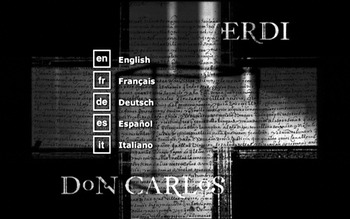
The music is separated from its visual source of production but set to images that are pertinent to its dramatic placement within the opera. We see a series of elements of the mise-en-scène melding into one another: a calligraphic manuscript fades in and out, illuminated by shafts of light in the shape of a cross; a skeletal cube slowly revolves on its axis, projecting a complex shadow; the outline of a monk in a white cowl emerges from the depths of a cloister. As the last of these fades into the background, the calligraphic manuscript again comes to the fore (Fig. 4). The menu options are overlaid on the shifting images, with the title of the opera barely visible on the bottom left, partially transparent, and changing colour with the slides of images, from gold and ochre to green and blue, and back.
Main menu, 2000 NVC Arts/Warner Classics DVD of Verdi's Don Carlos.

In keeping with an ideal of convergence, this menu pursues an integration between the various component media. The colour animations, the transitions, the fading in and out, and the slight lack of focus put the emphasis on mediation as layering and minimise the camera's indexical function. The latter is also a result of avoiding a focus on singers, lingering instead on mise-en-scène elements with strong textural and pictorial features. The process of layering is further complicated by the multimedia interaction in that the image and sound tracks have different phasing patterns, with three cycles of the former spanned by one phrase of the latter, which is cut so that a perfect cadence takes place across the edit.
The chosen excerpt suits the formal demands of the menu well. The musical material assists the interface's dual purpose as multimedia ‘cover’ and interactive structure. As well as being a representative instance of Don Carlo's sound world, thus aptly promoted to the role of atmospheric ‘main theme’, it is suitable for sampling. It is a closed section that starts and finishes on the same material, and has much internal repetition. The way in which Verdi develops the material, expanding it to an irregular period of twenty-five bars, and the way in which it is slightly varied on each return help make musical sense of the loop and further conceal the exact point of mechanical repetition. The loop is thus not just presented as grammatical, but as musically motivated. The choice of video footage seems to follow a similar logic. That the images contain circular patterns plays into the looping process, and their layered textures motivate the crossfading between shots.
This aestheticisation of the interface brings this particular video in contact with an important trend of late 1990s visual culture; it is an example of what media theorist Lev Manovich would call ‘transcoding’, a move from the technological properties of computing language to design.Footnote 20 The loop is turned into a meaningful motif, woven into the opera's plot and materials; and potentially the exchange of meanings can stretch further, as the semantics of rituals, religious chanting, prayer and penitence are mapped on to the control structure of the menu, and thus on to the temporalities of browsing and repeated viewing. This greater investment in the look of the interface goes hand in hand with conceiving the DVD as a portal to a wider kind of interactivity. It suggests different kinds of viewers and viewing situations. Whereas the options in the Royal Opera House DVD were limited to subtitles and audio settings, the Châtelet DVD imagines a viewer who spends time at the margins. As well as including information regarding the cast and the opera synopsis, the menu opens up to the functions of the PC and the interactivity of the web, at least as these were conceived in 2001: the DVD functions as a CD ROM, offering the chance to ‘view/print a full libretto in French as well as an article and biographies’ and, ‘if you also have a web connection’, a link to the NVC Arts' website.
What is significant in this case is not so much the chronology of the DVD releases but the way in which they place themselves in the home-video market. The Châtelet DVD targets an ‘enthusiast’, someone who, as Sebok puts it, would invest more in an ‘activity and interactivity with the technology’, ‘much more likely to explore the content of the disc, finding hidden features … playing with random access functionality’.Footnote 21 With this ‘enthusiast’ consumer in mind, instead of foregrounding the performance's production values (sampling, say, one of Roberto Alagna's solos, or a profile of Antonio Pappano conducting the prelude), the DVD puts on display the medium's own production values. The interface in this sense becomes a way of aestheticising both the product and the opera's intersection with digital culture. It is an opportunity to present opera video as conversant with the aesthetics and temporalities of new media, stressing opera's own relationship to contemporary culture as a matter of convergence, integration and interactivity.
Places of Fiction and Fictional Places
As we move from the menu to the video itself, we find one last textual threshold: the opera house. In spite of the video's potential to extricate the work from the broader social and cultural context of opera-going,Footnote 22 or rather precisely because of that, its paratexts typically work hard to contextualise the performance, dedicating some screen time to the venue's exteriors and interiors. Large's video of the 1983 performance at the MET provides a typical example. In a way characteristic of the MET telecasts of the time, the video starts with an external shot of the opera house, centrally framed on its famous façade. In front of the wall of glass, with its five soaring arches, the fountain reflects the electric lights of Lincoln Center. A voiceover (‘The Metropolitan Opera House Presents’) and the superimposed text (‘The Metropolitan Opera’) firmly anchor the referent of the image. Soon the camera starts a slow zoom into the building, closing in on a crystal chandelier visible through the façade, and then cross-fading to a shot of the same object, this time from inside the house. For a moment, the camera lingers on the staircase, looking over into the lobby, one of those crucial transitional spaces described by Christopher Small: a space ‘through which we pass in the progression from the outer everyday world to the inner world of the performance … a place to eat and drink and socialize, to see and be seen’.Footnote 23 Then, through another cross-fade, we find ourselves in the auditorium, where patrons are starting to sit down.
The discourse of the televisual is here at its strongest. Openings such as these testify to a desire (whether real or assumed) to be present (or, as a second best, ‘telepresent’), to the rituals of opera-going; they also draw on the cultural prestige of the venue as a way of suggesting vicariously the video's value as a cultural product. Indeed, the approach to the opera house is central to the very definition of opera videos in terms of a ‘radical conceptual difference’ from opera films, as Kühnel puts it.Footnote 24 Whereas in the latter the operatic text typically coincides with the filmic text, stretching from the opening to the closing credits, in the former there is a ‘buffer zone’ separating the two.Footnote 25 It is in this buffer zone that the camera's indexical function is most emphatically established. The camera's eye acts as a pointing finger: ‘this is the MET’. Clearly its job is not to tell fictions but to take us to the place where fictions are told. In the same way that the picture frame on the VHS cover functions metaphorically as a line of demarcation between medium and content, so too does the approach to the opera house. It maps out the conceptual divisions of the televisual. Yet there is a particular visual code used here by Large, the cross-fade, that immediately has the potential to complicate this division. This gesture taps into a cinematic discourse, at least to the extent that, by compressing time and space, it represents the journey to the auditorium. The drive towards a narrative mode is, admittedly, minimal. It is more a possibility intrinsic to the textualisation of opera (and, more specifically, to the practice of filming the approach to the venue) than something fully carried out by this example.
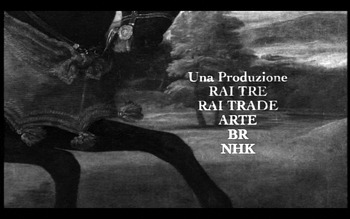
Its fuller implications for a conceptualisation of opera videos can, however, be studied in relation to the 2009 DVD of Don Carlo at La Scala. The opening of the La Scala video – directed by Patrizia Carmine, a household name at the theatre – presents some clear televisual markers. After a brief, extreme close-up of a painting (Fig. 5), in which the camera tracks along the canvas to reveal details of a horse clothed in regalia, we are presented with the ‘obligatory’ location shot: a crane shot of the opera house by night, with the superimposed text ‘Dal Teatro alla Scala di Milano’. From the start, however, a number of factors invoke alternative visual discourses. The use of a widescreen adds a cinematic ‘feel’ to the proceedings, and the footage immediately calls attention to the video's production values by engaging the camera in two contrasting, ‘marked’ shots. The partial view of the painting, by withdrawing information, also has the effect of opening a gap. In this sense, the use of a close-up is a trigger of narrative desire.Footnote 26
Opening credits, 2009 Hardy Classics DVD of Verdi's Don Carlo.

Crucially, this narrative desire is here fuelled by music. The approach to the opera house is underscored by the orchestral prelude to the last act, where the opera's dénouement infamously leads to Carlo V's return from the grave. The prelude opens with a juxtaposition of A-minor and A-major triads in the trombones, horns and ophicleide, a re-orchestration of a chorale-like gesture previously sung by monks in the prelude to Act I of the 1884 four-act version adopted by the La Scala production. (Opening the video with the prelude to the final act in this sense adds to the circular qualities of this version of Don Carlo, further adding to the opera's fatalistic tone.) The solemn and enigmatic qualities of this gesture, which is twice repeated, are mapped on to the two opening shots. The brass fanfare suits the approach to the prestigious venue, as well as the iconography of the painting. The passage's unstable, under-defined harmonic ambitus plays into the ambiguity created by that painting and by the use of music and ‘cinematic’ signifiers in what, by convention, should have been a televisual approach to the venue.
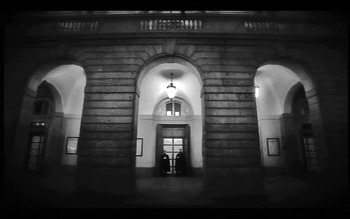
As the video unfolds, the use of cinematic codes becomes stronger. We cut to a perception shot (Fig. 6): a slightly unsteady steady-cam moves towards the main entrance of La Scala. The edges of the image are masked, and its contours are slightly off focus, the use of a wide-angle lens distorting the lines of the building and exaggerating the sense of depth.Footnote 27 Welcomed by the opening of three sets of doors, and allowed inside the empty auditorium, the viewer is treated like a special guest. The prelude marks the camera's progress. When we enter the first set of doors, a new phrase in C-sharp major starts; as we walk along the corridor there is a tonic-dominant alternation, building in dynamic level and underpinned by a long timpani roll. Then, as the camera crosses the threshold to the main auditorium, the harmony reaches a decisive cadence in A minor, returning to the initial fanfare.
Entrance to Teatro alla Scala, Milan, opening credits, 2009 Hardy Classics DVD of Verdi's Don Carlo.

After this, one more close-up reveals the painting in full: it is Titian's famous portrait of Carlo V on a horse. From a close-up of the king we cross-fade to shots of the statue of Verdi in the lobby. A number of complex tracking shots around Verdi's bust, set against walls that are flooded with light, alternate with extreme close-ups of the composer's eyes, of floral decorations on the pedestal, and of light reflections, with much use of soft focus. The editing is cut to the music in a way that sets off a range of iconic and symbolic relationships across media. A timpani stroke matches the cut to a dramatic, low-angle, full-size shot of the statue. Generic signifiers of lyricism instil the statue's gaze with a generic, undefined dramatic intensity: a new musical element, a descant of broken phrases for violins and cellos at the octave, featuring prominent melodic suspensions, is cut to the close-up of the composer's eyes; the strains of a  -
 resolution are synchronised with the intensification and dissolution of white sunlight through a blue window.
Music and visuals thus converge to dramatise the approach to the opera house. This is a trait of Carmine's videos, found in her other DVDs for La Scala, and one that resonates with the broader aesthetics of music video. Images are edited to the pre-existing soundtrack in such a way as to invest the music, in a typical inversion of hierarchies, with the function of underscore. This has the effect of storytelling without a specific story, a move that, as Carol Vernallis has shown, is common in music video, or at least in a certain type of music video that draws on cinematic techniques and gestures to ‘flaunt narrativity’, creating ‘the appearance of narrative rather than delivering one’.Footnote 28 This resonance with the aesthetics of music video also extends to extreme close-ups and soft focus to create a sense of open-ended suggestion. The music's presence, favouring the establishment of an iconic relationship with the visual patterns and the editing, motivates many of these pictorial techniques, allowing the camera to transcend its indexical form.
This ‘appearance of narrative’ has the effect of confusing levels of fictionality. The opera house, seen through a perception shot and wide-angle lens, and underscored by music that brings connotations of chorales and military fanfares, is constructed as a strange, quasi-fictional place, with the very open-endedness of the audio-visual relationship playing into its mysteriousness. The music, matched with the ‘marked’ camerawork in a way that invokes generic notions of authority and awe, seems to be about the status of the venue, about the importance of the visitor and about the subjectivity of the composer. For viewers familiar with Don Carlo, the confusion of fictional levels is augmented by the way in which Carlo's return from the dead resonates with the solemn entry into the opera house and the use of Verdi's statue as a dramatic persona.
In this sense, if the style of this visual prelude can be compared to that of music videos in general, its function is what, in video-game terminology, would be called ‘cinematics’.Footnote 29 In keeping with the conventions of video games, Carmine's opera video features an opening sequence that, thanks to its freedom from the pragmatic constraints of the genre in question (here, the ‘live’ element of the performance, in gaming, the ‘interactive’ element), draws on cinema's language to suture in the viewer. Manovich talks about ‘cinematics’ as one of the ways in which cinema, in late twentieth- and early twenty-first-century culture, ‘teaches’ us how to relate to new media. As he puts it, ‘cinematic ways of seeing the world, of structuring time, of narrating a story, of linking one experience to the next, have become the basic means by which computer users access and interact with all cultural data’.Footnote 30 The ‘cinematic’ is thus not about cinema, just as the ‘televisual’ (in Auslander's framework) is not about television. It is rather a ‘cultural interface’, a term that Manovich uses to emphasise the centrality of cinema as a mode for interacting with digital culture at large.
In the case of the La Scala DVD, the invocation of a cinematic rhetoric has the effect of dramatising the act of video-watching. Opera-going, which in the 1983 MET telecast was presented as a social ritual, is here a unique and private experience. The notion of cultural privilege still applies, but it is taken to extremes, with ushers at the service of a sole patron who is welcomed into the special place of the theatre and immediately comes in contact with the composer's subjectivity. In this sense, the sequence prepares Don Carlo for home consumption. Instead of simulating telepresence at a live event, it narrativises the experience of watching opera on-screen – placing viewers, metaphorically, inside the space of the opera video, ushering each of them to an ideal, privileged point of vision and audition. This puts a particular spin on the relationship between the social and the aesthetic dimensions of opera-going. If the televisual emphasis on the opera house is a reminder that the aesthetic experience of the work and its performance is not everything that there is to concert-going, this cinematic approach comes full circle, as it were, making that social dimension part of the aesthetic experience of the text.
Conclusion
By zooming in on covers, menus and opening credits, I have tried to explore how the paratexts of opera DVDs can prepare the reception of the video; how they take part in a broader discourse about the music's mediation and put in place various templates for making sense of the performance on-screen and of the viewer's spectatorial position. One of the methodological implications of this ‘paratextual analysis’ has consisted in placing a degree of emphasis on the materiality of the DVD, whether its packaging or its processual qualities. At a time when there is much talk of the perceived immateriality of digital data and of the convergence between disparate media platforms, it might seem counter-intuitive to insist on the medium-specificity of opera videos, particularly considering that the medium in question is on the wane. Yet precisely because of its increasing historicity, and its role in the popularisation of home theatre systems and digital culture, the DVD proves to be a good starting point for studying opera's journey through a shifting mediascape.
This takes us to a second methodological consideration and to a broader, if provisional, conclusion regarding the current status of opera videos. What I have been implicitly suggesting, following an analytical trope with an illustrious tradition, is that the margins of a text are a privileged place for identifying emergent, and often contested, cultural meanings. In the case in question, the framing (both literal and metaphorical) of the opera invites us to look beyond the televisual and alerts us to the role played by the cinematic as a cultural interface. In the video's paratexts the cinematic is not just the model for specific visual gestures or for the use of instrumental excerpts as main themes in menus and opening credits. Rather it is, more broadly, an alternative model for engaging with opera videos, one in which the camera transcends its indexical role and the music becomes one of the mediating elements. In other words, it is a model that bridges over the gap between medium and content, opening up opera videos to a wider range of resonances in ways that can redefine their cultural placement and value.
If it is true that the importance of the cinematic becomes clearer by focusing on the paratexts, it is also true that this use of the cinematic complicates the very boundary between text and paratext. Practices of suturing (whether connected with the promises of remediation, the aesthetics of digital convergence or the blurring of fictional and extra-fictional levels) by means of eroding the buffer zones between medium and content, shift our understanding of what should be considered the text of reference. Minimising the recurring graphic features on covers, aestheticising the menu and dramatising the approach to the opera house cause a conceptual slippage between the medium as a neutral container of the performance and the DVD as the ‘thing’. And this comes with a foregrounding of the production values of the video itself, values which add to and, as we have seen, are potentially in conflict with, a televisual presentation of a performance's production values. The cinematic thus acts as a temporary, local antidote to the conceptual strictures of the televisual, facilitating links with competing visual genres and aesthetics that in most cases remain at the level of suggestion. In this sense the paratexts are most useful for understanding the shifting cultural meanings of opera videos precisely because they remind us that these meanings often remain on the surface – they cannot (or maybe they cannot yet) carry over into the main body of the performance. That these alternative notions of opera videos often remain at the level of framing is partly a function of the DVDs' material qualities, and of the fact that the discourse activated by the paratexts is not the result of systematic theorisation but of multiple agencies operating at different stages and with different agendas. Glitches and aesthetic ‘mismatches’ in this sense draw attention not just to the way in which different visual paradigms differently shape opera's materials, but also to the amount of ‘work’ needed to present the relationship between opera and digital culture as a matter of integration and convergence. The hybrid qualities of these paratexts thus speak to their value as a testing ground. Exposed to the demands of marketing, and relatively free from pragmatic limitations and from the abstract pressures set by performing traditions and the ontology of the work of music, the margins of the video become a privileged space for imagining opera's media future.