



1 Introduction
Given a number field K and a prime p, the pioneering work of Iwasawa [Reference IwasawaIwa73] initiated a systematic study of the growth of p-primary class groups in infinite towers of number fields. If
$K_\infty /K$
 is a
$\mathbb {Z}_p$
 -extension with finite layers
$K_n$
 , then the inverse limit of the p-primary parts of the class groups,
$X(K_\infty ):=\varprojlim _n \mathrm {Cl}(K_n)[p^\infty ]$
 , is naturally a module over the Iwasawa algebra which is a power series ring in one variable over
$\mathbb {Z}_p$
 . Via this algebraic perspective, Iwasawa proved that for sufficiently large values of n, the growth of the p-part of the class group is governed by the formula

where
$\mu , \lambda \geq 0$
 , and
$\nu \in \mathbb {Z}$
 are invariants attached to the extension
$K_\infty /K$
 . Among these, the
$\mu $
 -invariant measures the depth of p-power divisibility in the characteristic power series of
$X(K_\infty )$
 . Iwasawa conjectured that in the cyclotomic
$\mathbb {Z}_p$
 -extension of any number field,
$\mu =0$
 . This conjecture is established by Ferrero and Washington [Reference Ferrero and WashingtonFW79] when
$K/\mathbb {Q}$
 is abelian, however is wide open in general.
Over the decades, Iwasawa theory has been studied in a broader framework. In this context, Selmer groups encode arithmetic information attached to elliptic curves, modular forms, and more general motives which give rise to Galois representations. Their structure as modules over Iwasawa algebras is conjecturally governed by analytic invariants of p-adic L-functions. Within this framework, the fine Selmer group occupies a particularly subtle yet important position. By construction, it is obtained from the usual p-primary Selmer group by imposing the strictest possible local conditions at the primes above p, thereby encoding only the most delicate global arithmetic information. Coates and Sujatha conjectured [Reference Coates and SujathaCS05, Conjecture A] that the fine Selmer group is always a cotorsion module over the relevant Iwasawa algebra, and moreover, that its
$\mu $
 -invariant vanishes. This may be viewed as a far-reaching generalization of Iwasawa’s original
$\mu =0$
 conjecture for class groups.
In recent years, there has been an increase in interest in the relationship between Iwasawa theory and explicit operations in Galois cohomology. Classical cup products already play a significant role in controlling Selmer groups, but their higher-order generalizations called Massey products have emerged as a powerful tool for uncovering a more refined arithmetic structure. The breakthrough work of McCallum and Sharifi [Reference McCallum and SharifiMS03] demonstrated explicit connections between cup products in Galois cohomology and Iwasawa
$\lambda $
 -invariants of cyclotomic fields. Massey products offer a natural language for encoding deeper structural information in Iwasawa theory (see, e.g., [Reference QiQi25, Reference SharifiSha07b]). They also naturally arise in various other related contexts. For instance, Massey products are known to capture information concerning the rank of the Eisenstein ideal [Reference Wake and Wang-EricksonWWE20]. The study of higher-order Massey products has revealed deep connections with the structure of absolute Galois groups and class groups of number fields (cf. for instance, work of Minác and Tân [Reference Mináč and TânMT15, Reference Mináč and TânMT17a, Reference Mináč and TânMT17b]).
The present article develops these themes by integrating the study of Iwasawa cohomology with the generalized Bockstein maps introduced in the work of Lam et al. [Reference Lam, Liu, Sharifi, Wake and WangLLS+23]. Our main result shows that Conjecture A in [Reference Coates and SujathaCS05] can be reformulated in terms of Massey products. For details and precise notation, see Section 6.2 and Theorem 7.1.
Theorem A (Theorem 7.1)
Let K be a number field and
$K_\infty /K$
 a
$\mathbb {Z}_p$
 -extension, and let S be a finite set of primes containing those above p. Assume that all primes
$v \mid p$
 of K are totally ramified in
$K_\infty $
 , and that all primes in S are finitely decomposed in
$K_\infty $
 . Let
$\mathcal {K}/\mathbb {Q}_p$
 be a finite extension with valuation ring
$\mathcal {O}$
 , and let
$\rho :\mathrm {Gal}(\bar {K}/K)\to \mathrm {GL}_d(\mathcal {O})$
 be a continuous Galois representation which is unramified outside S. Let
$\bar {\rho }$
 be the residual representation of
$\rho $
 , and
$\bar {\rho }^*$
 denote the Tate-dual of
$\bar {\rho }$
 . Let

be the canonical surjection. Then, the following are equivalent:
-
(1) The fine Selmer group of $\rho $
 over
$K_\infty $
is
$\Lambda $
-cotorsion with vanishing
$\mu $
-invariant.
-
(2) For some $n>0$
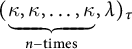
, the Massey products
$(\underbrace {\kappa , \kappa , \dots , \kappa }_{n-\text {times}}, \lambda )_\tau $
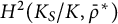
span
$H^2(K_S/K,\bar {\rho }^*)$
, where
$\tau $
ranges over certain defining systems and
$\lambda $
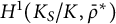
ranges over
$H^1(K_S/K, \bar {\rho }^*) $
.




Given a number field K, one considers the set of all
$\mathbb {Z}_p$
 -extensions of K. Greenberg endowed this set with a topology. We now mention a striking consequence of the above result. Suppose that condition (1) is satisfied for
$\rho $
 over a
$\mathbb {Z}_p$
 -extension
$K_\infty /K$
 . We then show that the same is true for a uniform large Greenberg neighborhood of
$K_\infty /K$
 . Indeed, if there are two
$\mathbb {Z}_p$
 -extensions
$K_\infty ^1$
 and
$K_\infty ^2$
 which agree at the first layer, then (1) holds for
$\rho $
 over
$K_\infty ^1$
 if and only if (1) holds for
$\rho $
 over
$K_\infty ^2$
 .
Theorem B [Theorem 7.3] Let K be a number field, S a finite set of primes of K containing those above p, and
$\rho :\mathrm {G}_{K,S}\to \mathrm {GL}_d(\mathcal {O})$
 a continuous Galois representation. Let
$K_\infty ^1, K_\infty ^2$
 be
$\mathbb {Z}_p$
 -extensions of K such that:
-
(1) all $v|p$
are totally ramified and all
$v\in S$
are finitely decomposed in in
$K_\infty ^i$
, for
$i=1,2$
, -
(2) $K_1^1=K_1^2$
.


If the fine Selmer group for
$\rho $
 over
$K_\infty ^1$
 is cotorsion with
$\mu =0$
 , then the same holds for the fine Selmer group for
$\rho $
 over
$K_\infty ^2$
 . In particular, the vanishing of the
$\mu $
 -invariant is a property which is locally constant in the Greenberg topology in uniformly large Greenberg neighborhoods.
We also explore the broader consequences of Conjecture A of Coates and Sujatha [Reference Coates and SujathaCS05] for the deformation theory of Galois representations considered over a
$\mathbb {Z}_p$
 -extension. We illustrate a bridge between two a priori distinct frameworks: the structure theory of Iwasawa modules and the geometry of deformation spaces. Specifically, Proposition 4.6 establishes that the unobstructedness of certain deformation rings over
$K_\infty $
 is equivalent to the vanishing of the
$\mu $
 -invariant of the fine Selmer group attached to the Tate-twist of the adjoint representation. The study of deformation theory in infinite towers of number fields has its origins in the work of Hida [Reference HidaHid06], who investigated deformations of p-adic Galois representations over the cyclotomic
$\mathbb {Z}_p$
 -extension. Burungale and Clozel [Reference Burungale and ClozelBC23] and Burungale et al. [Reference Burungale, Clozel and MazurBCM24], further analyzed ordinary deformations over p-adic Lie extensions. To recall their setting, let
$\mathbb {F}_q$
 be a finite field with ring of Witt vectors
$\mathrm {W}(\mathbb {F}_q)$
 , let F be a totally real number field, and let
$F_{\mathrm {cyc}}$
 denote its cyclotomic
$\mathbb {Z}_p$
 -extension. Suppose that
$\bar {r}:\mathrm {Gal}(\bar {F}/F)\to \mathrm {GL}_2(\mathbb {F}_q)$
 is a p-ordinary residual representation satisfying certain natural hypotheses. Then, Burungale and Clozel show that the ordinary deformation problem for
$\bar {r}|_{\mathrm {Gal}(\bar {F}/F_{\mathrm {cyc}})}$
 is pro-representable by a universal deformation ring
$R_\infty $
 , which arises as the inverse limit
$\varprojlim _n R_n$
 of the ordinary deformation rings
$R_n$
 associated with the finite layers
$F_n$
 of
$F_{\mathrm {cyc}}/F$
 . Each
$R_n$
 is a Noetherian
$\mathrm {W}(\mathbb {F}_q)$
 -algebra, but this does not automatically guarantee that
$R_\infty $
 itself is Noetherian. The main theorem of [Reference Burungale and ClozelBC23] shows that, provided
$R_\infty $
 is Noetherian and certain additional conditions are satisfied, one can in fact identify
$R_\infty $
 with a power series ring of the form
$ \mathrm {W}(\mathbb {F}_q)[\![ T_1,\dots ,T_s]\!] $
 . Burungale–Clozel–Mazur later demonstrate that s can in fact be arbitrarily large. In Proposition 5.6, we prove that in this setting, the universal deformation ring
$R_\infty $
 is Noetherian if and only if the
$\mu $
 -invariant of the Greenberg Selmer group of the adjoint representation of
$\rho $
 vanishes. Moreover, Corollary 5.8 asserts that
$R_\infty $
 is a formal power series ring in a finite number of variables if and only if the
$\mu $
 -invariant of the adjoint representation is zero.
Beyond the immediate implications for the geometry of deformation rings, this perspective also suggests the possibility of more refined results, since Massey products in Galois cohomology provide a powerful framework for probing the structure of Galois groups. Given that deformation problems are governed by obstruction classes, it is natural to expect that Massey products should play a significant role in their description. We believe that the connections uncovered in this work will serve as a starting point for future developments along these lines.
2 Cup products and Iwasawa theory of class groups
Let K be a number field. Fix an algebraic closure
$\overline {K}$
 of K, and set
$\mathrm {G}_K := \mathrm {Gal}(\overline {K}/K)$
 . Let
$\Omega _K$
 denote the set of finite primes of K. For each
$v \in \Omega _K$
 , fix an algebraic closure
$\overline {K_v}$
 of
$K_v$
 , and write
$\mathrm {G}_{K_v} := \mathrm {Gal}(\overline {K_v}/K_v)$
 . For
$n\geq 1$
 , let
$\mu _{p^n}\subset \overline {K}$
 denote the
$p^n$
 -th roots of unity and set
$\mu _{p^\infty }:=\bigcup _{n\geq 1} \mu _{p^n}$
 . The field
$K(\mu _{p^\infty })=\bigcup _{n\geq 1} K(\mu _{p^n})$
 is a
$\mathbb {Z}_p$
 -extension of
$K(\mu _p)$
 . The cyclotomic
$\mathbb {Z}_p$
 -extension of K is the unique
$\mathbb {Z}_p$
 -extension
$K_{\mathrm {cyc}}/K$
 which is contained in
$K(\mu _{p^\infty })$
 .
Let
$K_\infty /K$
 be a
$\mathbb {Z}_p$
 -extension. For
$n\geq 0$
 , let
$K_n\subset K_\infty $
 be the subfield such that
$\mathrm {Gal}(K_n/K)\simeq \mathbb {Z}/p^n \mathbb {Z}$
 . Thus, we have a tower of Galois extensions:

and refer to
$K_n$
 as the n-th layer. Set
$\Gamma :=\mathrm {Gal}(K_\infty /K)$
 and identify
$\mathrm {Gal}(K_n/K)$
 with
$\Gamma /\Gamma ^{p^n}$
 . The Iwasawa algebra
$\Lambda $
 is defined to be inverse limit of finite group rings:

Let
$\gamma $
 be a topological generator of
$\Gamma $
 and set
$T:=\gamma -1\in \Lambda $
 . Then,
$\Lambda $
 is identified with the formal power series ring
$\mathbb {Z}_p[\![ T]\!] $
 . Given a finitely generated
$\Lambda $
 -module
$\mathfrak{M}$
 , there exists a
$\Lambda $
 -module homomorphism

with finite kernel and cokernel (see [Reference WashingtonWas82, Chapter 13]). Here,
$\alpha := \mathrm {rank}_\Lambda \mathfrak{M}$
 , and each
$f_j(T)$
 is a distinguished polynomial, that is, a monic polynomial in
$\mathbb {Z}_p[T]\subset \Lambda $
 whose non-leading coefficients are all divisible by p. Note that
$\mathfrak{M}$
 is a torsion
$\Lambda $
 -module if and only if
$\alpha =0$
 . The
$\mu $
 -invariant of
$\mathfrak{M}$
 is defined as the sum
$\sum _{i=1}^s \mu _i$
 , and taken to be
$0$
 when
$s=0$
 . On the other hand, the
$\lambda $
 -invariant is given by

Suppose
$\mathfrak{M}$
 is a torsion
$\Lambda $
 -module. Then, it is straightforward to verify that
$\mathfrak{M}$
 is finitely generated as a
$\mathbb {Z}_p$
 -module if and only if
$\mu (\mathfrak{M}) = 0$
 . In particular,
$\mu (\mathfrak{M}) = 0$
 if and only if the quotient
$\mathfrak{M}/p\mathfrak{M}$
 is finite. In this case, the
$\lambda $
 -invariant of
$\mathfrak{M}$
 equals the
$\mathbb {Z}_p$
 -rank of
$\mathfrak{M}$
 and satisfies

with equality if and only if
$\mathfrak{M}$
 contains no nontrivial finite
$\Lambda $
 -submodules.
Given any
$\Lambda $
 -module
$\mathfrak{M}$
 , let
$\mathfrak{M}^\vee $
 denote its Pontryagin dual
$\mathrm {Hom}_{\mathbb {Z}_p}(\mathfrak{M}, \mathbb {Q}_p/\mathbb {Z}_p)$
 . We say that
$\mathfrak{M}$
 is cofinitely generated (resp. cotorsion) if
$\mathfrak{M}^\vee $
 is finitely generated (resp. torsion) as a
$\Lambda $
 -module. When the context makes this unambiguous, we shall write
$\mu (\mathfrak{M})$
 (resp.
$\lambda (\mathfrak{M})$
 ) to mean the
$\mu $
 -invariant (resp.
$\lambda $
 -invariant) of
$\mathfrak{M}^\vee $
 . This is the convention we adopt for fine Selmer groups over
$\mathbb {Z}_p$
 -extensions, which are the main objects of interest in this article.
Let
$S_p(K)$
 denote the set of primes of K lying above p, and let S be a finite set of primes of K containing
$S_p(K)$
 . Given an algebraic extension
$F/K$
 , denote by
$S(F)$
 the set of primes of F lying above primes in S. Note that all primes of K are finitely decomposed in
$K_{\mathrm {cyc}}$
 , and thus
$S(K_{\mathrm {cyc}})$
 is a finite set of primes. On the other hand, for an arbitrary
$\mathbb {Z}_p$
 -extension
$K_\infty /K$
 , the set
$S(K_\infty )$
 may be infinite. For instance, this is indeed the case when K is an imaginary quadratic field,
$K_\infty $
 is the anticyclotomic
$\mathbb {Z}_p$
 -extension of K and S contains a prime
$v\nmid p$
 which is inert over
$\mathbb {Q}$
 . Let
$\mathrm {Cl}_S(F)$
 denote the S-class group of F, and let
$H_p^S(F)$
 be the maximal abelian p-extension of F in which all primes in
$S(F)$
 split completely. By class field theory, there is a natural isomorphism

Define
$H_p^S(K_\infty ) := \bigcup _n H_p^S(K_n)$
 and set
$ \mathcal {X}^S(K_\infty ) := \mathrm {Gal}(H_p^S(K_\infty )/K_\infty )$
 . Note that

where the last inverse limit is taken with respect to norm maps. For ease of notation, we set
$\mathcal {X}(K_\infty ):=\mathcal {X}^\emptyset (K_\infty )$
 . Iwasawa [Reference IwasawaIwa73] proved that
$\mathcal {X}(K_\infty )$
 is a torsion
$\Lambda $
 -module and that there are constants
$\mu \in \mathbb {Z}_{\geq 0}$
 ,
$\lambda \in \mathbb {Z}_{\geq 0}$
 , and
$\nu \in \mathbb {Z}$
 such that for all sufficiently large values of n,

where
$\mu =\mu (\mathcal {X}(K_\infty ))$
 and
$\lambda =\lambda (\mathcal {X}(K_\infty ))$
 . The
$\nu $
 -invariant on the other hand is an integer which is possibly negative. Moreover, for the cyclotomic
$\mathbb {Z}_p$
 -extension, the
$\mu $
 -invariant of
$\ \mathcal {X}(K_{\mathrm {cyc}})$
 is conjectured to be zero. Ferrero and Washington [Reference Ferrero and WashingtonFW79] proved this when
$K/\mathbb {Q}$
 is an abelian extension.
We now specialize to the case where
$K = \mathbb {Q}(\mu _p)$
 is the p-th cyclotomic field and
$K_\infty = \mathbb {Q}(\mu _{p^\infty }) = K_{\mathrm {cyc}}$
 is its cyclotomic
$\mathbb {Z}_p$
 -extension. In this setting, the Herbrand–Ribet theorem relates the nontriviality of certain eigenspaces of the p-part of the class group of K to the divisibility of Bernoulli numbers by p. The subgroup
$C_K \subset \mathbb {Z}[\mu _p, 1/p]^\times $
 of cyclotomic p-units embeds via Kummer theory into Galois cohomology, where cup product pairings capture subtle information about class groups. Building on this, McCallum and Sharifi [Reference McCallum and SharifiMS03] introduced a pairing on cyclotomic p-units that relates the nontriviality of class group eigenspaces to the behavior of certain cup products in Galois cohomology. They further showed that the Iwasawa
$\lambda $
 -invariants governing the growth of class groups in the cyclotomic tower can be characterized in terms of the vanishing of these cup products. We now describe this connection in more detail.
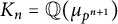
Note that
$K_n=\mathbb {Q}(\mu _{p^{n+1}})$
 . Let
$\Delta := \mathrm {Gal}(K/\mathbb {Q}) \cong (\mathbb {Z}/p\mathbb {Z})^\times $
 denote the Galois group of K over
$\mathbb {Q}$
 , which is cyclic of order
$(p-1)$
 . The mod-p cyclotomic character
$\bar {\chi }: \Delta \xrightarrow {\sim } (\mathbb {Z}/p\mathbb {Z})^\times $
 is an isomorphism by construction, and we write
$\omega : \Delta \hookrightarrow \mathbb {Z}_p^\times $
 for its Teichmüller lift. For convenience, let us denote the p-primary part of the class group of K by
$A_K := \mathrm {Cl}(K)[p^\infty ]$
 .
A prime p is said to be irregular if it divides the class number of
$\mathbb {Q}(\mu _p)$
 and said to be regular otherwise. The Galois action of
$\Delta $
 on
$A_K$
 allows us to decompose
$A_K$
 into a direct sum of eigenspaces under the characters
$\omega ^i$
 , for
$i \in \{0,1,\dots ,p-2\}$
 :

where
$A_K(\omega ^i) := \{x \in A_K : \sigma x = \omega (\sigma )^i x \text { for all } \sigma \in \Delta \}$
 . We refer to
$A_K(\omega ^i)$
 as the i-th eigenspace of
$A_K$
 . These eigenspaces are customarily classified as even or odd depending on the parity of i, that is, the even (resp. odd) eigenspaces correspond to even (resp. odd) i. Accordingly, one has that

A famous conjecture due to Vandiver asserts that
$A_K^+ = 0$
 , that is, the plus part vanishes for all odd primes p. Let
$f(x) := \frac {x}{e^x - 1}$
 , and define the Bernoulli numbers
$B_n$
 via the Taylor expansion

These numbers play a central role in algebraic number theory. In particular, for positive integers
$n \geq 1$
 , the special values of the Riemann zeta function at negative integers are given by the identity
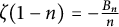
$ \zeta (1 - n) = -\frac {B_n}{n} $
 . The Herbrand–Ribet theorem states that for even integers k with
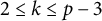
$2 \leq k \leq p - 3$
 , the
$(p - k)$
 -th eigenspace
$A_K(\omega ^{p-k})$
 is nonzero if and only if p divides
$B_k$
 . This connection was made more precise by Mazur and Wiles, who showed that the order of this eigenspace is given by

where
$B_{1, \omega ^{k-1}} := \frac {1}{p} \sum _{a=1}^{p-1} a \omega ^{k-1}(a)$
 is a generalized Bernoulli number, which satisfies the congruence

Define
$E_K:=\mathbb {Z}[\mu _p, 1/p]^\times $
 , the group of units in the ring of p-integers of
$K = \mathbb {Q}(\mu _p)$
 . Within
$E_K$
 , we consider the subgroup
$ C_K \subseteq E_K $
 of cyclotomic p-units, defined to be the subgroup generated by
$-1$
 and elements of the form
$\zeta _p^i - 1$
 , where
$\zeta _p := \exp (2\pi i/p)$
 is a fixed primitive p-th root of unity and
$(i,p)=1$
 . A fundamental theorem in the theory of cyclotomic fields states that the index
$[E_K : C_K]$
 is finite, and its p-part equals
$\# A_K^+$
 . Let
$S_p=\{(1-\zeta _p)\}$
 be the prime of K which lies above p and
$K_{S_p}\subset \bar {K}$
 be the maximal extension of K in which all primes
$\ell \neq p$
 are unramified. By Kummer theory,

where

We note that
$\mathrm {Gal}(K_{S_p}/K)$
 acts trivially on
$\mu _p$
 , nonetheless, there is a natural action of
$\Delta $
 on
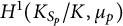
$H^1(K_{S_p}/K, \mu _p)$
 . Furthermore, there is a
$\Delta $
 -equivariant cup product pairing

As an
$\mathbb {F}_p[\Delta ]$
 -module, we identify
$H^2(K_{S_p}/K, \mu _p^{\otimes 2})$
 with
$H^2(K_{S_p}/K, \mu _p)\otimes \mu _p$
 . Let
$A_{K}$
 be the p-primary part of the class group of K. There is a natural
$\Delta $
 -equivariant isomorphism:

(cf. [Reference McCallum and SharifiMS03, Equation (9)]. Thus, one has a cup-product pairing

which in turn induces a cup product pairing on cyclotomic p-units:

The following is a rephrasing of [Reference McCallum and SharifiMS03, Conjecture 5.3].
Conjecture 2.1 (McCallum–Sharifi)
For all primes p, the pairing
$\langle \cdot , \cdot \rangle _p$
 is nontrivial.
It is shown in [Reference SharifiSha07a] that the conjecture is true for primes
$p<1,000$
 .
The above pairing has various connections to Iwasawa theory and is related to deep conjectures like Greenberg’s pseudo-nullity conjecture. Recall that the cyclotomic
$\mathbb {Z}_p$
 -extension of K is given by
$K_{\mathrm {cyc}}=K(\mu _{p^\infty })$
 and
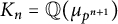
$K_n=\mathbb {Q}(\mu _{p^{n+1}})$
 . Let
$A_n:=\mathrm {Cl}(K_n)[p^\infty ]$
 , note that
$A_0=A_K$
 . Then, for
$n\gg 0$
 ,

Suppose that i is odd and
$A_K(\omega ^i)\neq 0$
 , then Vandiver’s conjecture predicts that
$A_K(\omega ^i)$
 is either trivial or cyclic. Let
$G:=\mathrm {Gal}(K_{S_p}/K)$
 and

be the natural quotient map. Denote by
$\bar {\kappa }:G\rightarrow \mathbb {Z}/p\mathbb {Z}$
 the mod-p reduction of
$\kappa $
 . Since
$A_K(\omega ^i)$
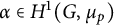
 is cyclic, it follows that it gives rise to a class
$\alpha \in H^1(G, \mu _p)$
 . The cup product
$\bar {\kappa }\cup \alpha \in H^2(G, \mu _p^{\otimes 2})$
 gives an element in
$A_K\otimes \mu _p$
 .
After choosing a primitive p-th root of unity
$\zeta _p$
 , the mod-p cyclotomic character
$\bar {\kappa }:G\to \mathbb {Z}/p\mathbb {Z}$
 may be identified with the Kummer class of
$\zeta _p$
 , viewed as an element of
$H^1(G,\mu _p)$
 . Under this identification, the cup product
$\bar {\kappa }\cup \alpha $
 takes values in
$H^2(G,\mu _p^{\otimes 2})$
 . Since K contains
$\mu _p$
 , the action of G on
$\mu _p$
 is trivial. Thus, after choosing an identification
$\mu _p\simeq \mathbb {Z}/p\mathbb {Z}$
 , this is only a matter of normalization.
Theorem 2.2 (McCallum–Sharifi)
Assume that i is odd and
$A_K(\omega ^i)\neq 0$
 is cyclic. Then,
$\lambda _i\geq 1$
 . Further, we have that

Proof See Proposition 4.2 and ll. 12–13 on p. 282 in [Reference McCallum and SharifiMS03].
The McCallum–Sharifi conjecture and the above theorem illustrate a connection between the structure of cyclotomic class groups and Galois cohomology via the cup product pairing. The theorem shows that the vanishing of a specific cup product class precisely controls whether the
$\lambda $
 -invariant in a given eigenspace exceeds the minimal expected bound. This interplay between Iwasawa theory and the pairing above motivates further investigation connecting fine Selmer groups, Iwasawa modules, and Massey products, which are the main themes of this article.
3 Fine Selmer groups and the
$\boldsymbol{\mu =0}$
conjecture

In this section, we fix an odd prime number p and introduce the main objects of study in this article: the fine Selmer groups associated with Galois representations considered over a
$\mathbb {Z}_p$
 -extension
$K_\infty $
 of a number field K. For a comprehensive introduction to fine Selmer groups, the reader may refer to [Reference Coates and SujathaCS05]. Let S be a finite set of primes of K containing
$S_p(K)$
 .
Assumption 3.1 We assume that the primes
$v\in S_p(K)$
 are totally ramified in
$K_\infty $
 and that all primes
$v\in S$
 are finitely decomposed in
$K_\infty $
 .
Throughout, for any field F of characteristic zero, set
$\mathrm {G}_F:=\mathrm {Gal}(\bar {F}/F)$
 . We use the shorthand notation
$H^i(F, \cdot ) := H^i(\mathrm {G}_F, \cdot )$
 . Let
$K_S\subset \overline {K}$
 be the maximal extension of K in which all primes
$v \notin S$
 are unramified. We shall set
$\mathrm {G}_{K,S}:=\mathrm {Gal}(K_S/K)$
 and adopt the notation

for any field L such that
$K\subseteq L \subseteq K_S$
 . For
$v\in \Omega _K$
 , set

where w runs through the primes of L which lie above v.
Definition 3.2 Let M be a p-primary
$\mathrm {G}_{K,S}$
 -module and L be an extension of K which is contained in
$K_S$
 . The fine Selmer group over L associated with M is defined as follows:

Thus, the fine Selmer group consists of all cohomology classes with values in M that are unramified at the primes outside S and trivial at all primes of L that lie above S. Apriori,
$\mathcal {R}_{p^\infty }(M/L)$
 depends on the choice of primes S.
Proposition 3.3 Let
$L/K$
 be an infinite algebraic extension which contains a
$\mathbb {Z}_p$
 -extension
$K_\infty $
 of K satisfying Assumption 3.1. Then,
$\mathcal {R}_{p^\infty }(M/L)$
 does not depend on the choice of primes S.
Proof In order to emphasize the dependence of the fine Selmer group on S, we set

Let
$S'$
 be a finite set of primes containing S such that all
$v\in S'$
 are finitely decomposed in
$K_\infty $
 . We show that

Set
$S":=S'\setminus S$
 and for
$v\in S"$
 , let w be a prime of L which lies above v and denote by
$\mathrm {G}_w$
 (resp.
$\mathrm {I}_w$
 ) the decomposition (resp. inertia) group at w and
$\kappa _w$
 its residue field. Note that
$\mathcal {R}_{p^\infty }^{S'}(M/L)$
 consists of classes
$f\in \mathcal {R}_{p^\infty }^{S}(M/L)$
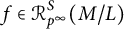 which when restricted to each decomposition group
$\mathrm {G}_w$
 is zero for
$w\in S"$
 . Let
$f\in \mathcal {R}_{p^\infty }^{S}(M/L)$
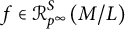 . Then, f is zero when restricted to
$\mathrm {I}_w$
 for all
$w\in S"$
 . Thus, the restriction of f to
$H^1(L_w, M)$
 lies in

which can be identified with
$H^1(\kappa _w, M^{\mathrm {I}_w})$
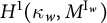 . Since v is finitely decomposed in
$K_\infty $
 , it follows that
$\overline {\kappa _w}/\kappa _w$
 is a prime to p-extension and hence
$H^1(\kappa _w, M^{\mathrm {I}_w})=0$
 . Thus, we find that f is indeed
$0$
 when restricted to
$\mathrm {G}_w$
 . It follows that
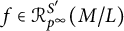
$f\in \mathcal {R}_{p^\infty }^{S'}(M/L)$
 . This shows that

We shall study the algebraic structure of fine Selmer groups over
$\mathbb {Z}_p$
 -extensions of K satisfying Assumption 3.1. The module M considered will be a p-divisible module associated with an integral Galois representations. Such representations arise naturally in geometry, in the following contexts:
-
(a) Galois representations arising from the p-adic Tate module $\mathbf {T}_p A=\varprojlim _n A[p^n]$
of an abelian variety A defined over
$\bar {\mathbb {Q}}$
. -
(b) Galois actions on the étale cohomology groups $H^i(X, \mathbb {Z}_p)$
of algebraic varieties X defined over
$\overline {\mathbb {Q}}$
, which yield natural integral Galois representations. -
(c) Through the Langlands correspondence, Galois representations are attached to certain algebraic, essentially self-dual automorphic representations. In particular, Galois representations arising from Hecke eigencuspforms provide a rich source of two-dimensional Galois representations.



Let
$\mathcal {K}$
 be a finite extension of
$\mathbb {Q}_p$
 , and let
$\mathcal {O}$
 denote its valuation ring. Given a continuous integral Galois representation
$\rho : \mathrm {G}_{K,S} \rightarrow \mathrm {GL}_d(\mathcal {O})$
 , let
$\mathbf {T}_\rho $
 denote the underlying free
$\mathcal {O}$
 -module of rank n on which
$\mathrm {G}_{K,S}$
 acts via
$\rho $
 . Set
$\mathbf {V}_{\rho }:=\mathbf {T}_\rho \otimes _{\mathbb {Z}_p} \mathbb {Q}_p$
 and consider the p-divisible discrete
$\mathrm {G}_{K,S}$
 -module

Note that when
$\mathbf {T}_\rho $
 is the Tate-module
$\mathbf {T}_pA$
 of an abelian variety A, then
$\mathbf {A}(\rho )=A[p^\infty ]$
 . The main object of study in this article is the fine Selmer group
$\mathcal {R}_{p^\infty }(\mathbf {A}(\rho )/K_\infty )$
 , we set
$Y(\mathbf {A}(\rho )/K_\infty )$
 to be its Pontryagin dual. We let
$\mu _\rho $
 be the
$\mu $
 -invariant

Note that the fine Selmer group depends on the choice of lattice
$\mathbf {T}_\rho $
 in
$\mathbf {V}_{\rho }$
 . When
$K_\infty $
 is the cyclotomic
$\mathbb {Z}_p$
 -extension of K, [Reference Coates and SujathaCS05, Conjecture A] predicts that the
$\mu _\rho =0$
 . Denote by
$\rho ^\vee $
 the contragredient representation and let
$\rho ^*:=\rho ^\vee (1)$
 be the Tate-dual of
$\rho $
 . Let
$\varpi $
 be a uniformizer of
$\mathcal {O}$
 and
$\mathbb {F}:=\mathcal {O}/(\varpi )$
 . Given an
$\mathcal {O}$
 -module M, set
$M[\varpi ^n]:=\mathrm {ker}(M\xrightarrow {\varpi ^n} M)$
 and set
$M[\varpi ^\infty ]:=\bigcup _n M[\varpi ^n]$
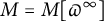
 . Say that M is p-primary if
$M=M[\varpi ^\infty ]$
 . We set
$\mathbf {V}_{\bar {\rho }}:=\mathbf {T}_\rho \otimes _{\mathcal {O}} \mathbb {F}$
 and
$\mathbf {V}_{\bar {\rho }^*}:=\mathbf {T}_{\rho ^*}\otimes _{\mathcal {O}} \mathbb {F}=\mathbf {V}_{\bar {\rho }}^\vee (1)$
 .
Conjecture 3.4 (Weak Leopoldt conjecture for
$\rho $
)

We have that

We refer the reader to [Reference Perrin-RiouPR00, Appendix B] for a compilation of cases in which the weak Leopoldt conjecture has been established.
Let M be a p-primary module over
$\mathrm {G}_{K,S}$
 and let
$H^i_{\mathrm {Iw}}(K_S/K_\infty , M)$
 be the Iwasawa cohomology group, which is defined as the inverse limit
$\varprojlim _n H^i(K_S/K_n, M)$
 taken with respect to corestriction maps.
Proposition 3.5 Assume that
$\rho ^*$
 satisfies the weak Leopoldt conjecture 3.4 over
$K_\infty $
 . Then, the following conditions are equivalent:
-
(1) $H^2(K_S/K_\infty , \mathbf {V}_{\bar {\rho }^*})=0$
; -
(2) $H^2(K_S/K_\infty , \mathbf {V}_{\bar {\rho }^*})$
is finite.


Proof For ease of notation, set
$M:=\mathbf {A}(\rho ^*)$
 and identify
$M[\varpi ]$
 with
$\mathbf {V}_{\bar {\rho }^*}$
 . Consider the short exact sequence of Galois modules

Note that we assume that
$H^2(K_S/K_\infty , M)=0$
 and hence we find that
$H^2(K_S/K_\infty , M[\varpi ])^\vee $
 is a submodule of
$H^1(K_S/K_\infty , M)^\vee $
 . It follows from [Reference Ochi and VenjakobOV02, Theorem 4.7] that
$H^1(K_S/K_\infty , M)^\vee $
 contains no nonzero finite submodules.
We define the residual fine Selmer group as follows:

The Poitou–Tate sequence gives us a four term exact sequence:

(cf. [Reference Coates and SujathaCS05]).
Theorem 3.6 Let
$K_\infty /K$
 be a
$\mathbb {Z}_p$
 -extension such that all primes
$v\in S_p(K)$
 are totally ramified in
$K_\infty $
 . Let S be a finite set of primes of K containing
$S_p(K)$
 such that all primes
$v\in S$
 are finitely decomposed in
$K_\infty $
 . Let
$\mathcal {O}$
 be the valuation ring of a p-adic field and let
$\rho :\mathrm {G}_{K, S}\rightarrow \mathrm {GL}_d(\mathcal {O})$
 be a continuous Galois representation and let
$\bar {\rho }$
 be its residual representation. Then, the following are equivalent:
-
(1) The fine Selmer group $\mathcal {R}_{p^\infty }(\mathbf {A}(\rho )/K_\infty )$
is cotorsion over
$\Lambda $
and
$\mu _\rho =0$
. -
(2) The Iwasawa cohomology group $H^2_{\mathrm {Iw}}(K_S/K_\infty , \mathbf {V}_{\bar {\rho }^*})$
is finite. -
(3) $H^2(K_S/K_\infty , \mathbf {V}_{\bar {\rho }^*})$
is finite.





Proof Let
$\varpi $
 be a uniformizer of
$\mathcal {O}$
 . We note that (1) holds if and only if
$\mathcal {R}_{p^\infty }(\mathbf {A}(\rho )/K_\infty )[\varpi ]$
 is finite. We identify
$\mathbf {V}_{\bar {\rho }}$
 with
$\mathbf {A}(\rho )[\varpi ]$
 and consider the Kummer sequence:

and the associated short exact sequence of cohomology groups:

We note that kernel of
$\beta $
 is clearly finite.
For
$w\in S(K_\infty )$
 , let
$\gamma _w$
 be the map

induced from the Kummer sequence. Let

be the direct sum of maps
$\gamma _w$
 as w ranges over the primes of
$K_\infty $
 which lie above v. This set of primes is finite by assumption and it follows that for
$v\in S$
 , the kernel of
$\gamma _v$
 is finite. Let
$\gamma :=\bigoplus _{v\in S} \gamma _v$
 be the map

Consider the commutative diagram:

Since the kernels of
$\beta $
 and
$\gamma $
 are finite, it follows that the kernel and cokernel of
$\alpha $
 are both finite. Thus, we have shown that
$\mathcal {R}_{p^\infty }(\mathbf {A}(\rho )/K_\infty )[\varpi ]$
 is finite if and only if
$\mathcal {R}(\mathbf {V}_{\bar {\rho }}/K_\infty )$
 is finite. Thus, (1) is equivalent to
$\mathcal {R}(\mathbf {V}_{\bar {\rho }}/K_\infty )$
 being finite. On the other hand, it follows from the exact sequence (3.1) that
$\mathcal {R}(\mathbf {V}_{\bar {\rho }}/K_\infty )$
 is finite if and only if (2) holds. Thus, we have shown that (1) and (2) are equivalent. The equivalence (2) and (3) follows from the argument in the proof of [Reference Deo, Ray and SujathaDRS23, Theorem 3.2].
Corollary 3.7 Let
$\rho $
 be as in Theorem 3.6 and assume that
$H^2(K_S/K_n, \mathbf {V}_{\bar {\rho }^*})=0$
 for some value of
$n\geq 0$
 . Then, we have that
$\mathcal {R}_{p^\infty }(\mathbf {A}(\rho )/K_\infty )$
 is cotorsion over
$\Lambda $
 and
$\mu _\rho =0$
 .
Proof Since
$\Gamma ^{p^n}=\mathrm {Gal}(K_\infty /K_n)$
 has p cohomological dimension
$1$
 , the implication

holds (cf. [Reference Neukirch, Schmidt and WingbergNSW00, Exercise 4(ii), p. 119]). Since
$\mathrm {Gal}(K_\infty /K_n)$
 is a pro-p group, we have the following implication:

Finally, by Theorem 3.6,
$H^2(K_S/K_\infty , \mathbf {V}_{\bar {\rho }^*})=0$
 implies that
$\mathcal {R}_{p^\infty }(\mathbf {A}(\rho )/K_\infty )$
 is cotorsion over
$\Lambda $
 and
$\mu _\rho =0$
 .
Theorem 3.8 Let
$K_\infty $
 and
$\rho $
 be as in Theorem 3.6 and assume that the weak Leopoldt conjecture holds for
$\rho ^*$
 over
$K_\infty $
 . Then, the following are equivalent:
-
(1) The fine Selmer group $\mathcal {R}_{p^\infty }(\mathbf {A}(\rho )/K_\infty )$
is cotorsion over
$\Lambda $
and
$\mu _\rho =0$
, -
(2) $H^2(K_S/K_\infty , \mathbf {V}_{\bar {\rho }^*})=0$
.




Proof It follows from Theorem 3.6 that (1) is equivalent to the finiteness of
$H^2(K_S/K_\infty , \mathbf {V}_{\bar {\rho }^*})$
 . On the other hand, Proposition 3.5 asserts that (2) is also equivalent to the finiteness of
$H^2(K_S/K_\infty , \mathbf {V}_{\bar {\rho }^*})$
 . Thus, (1) and (2) are equivalent.
Proposition 3.9 Assume that the conditions of Theorem 3.6 are satisfied. Then, we have that

Proof The result follows from the exactness of (3.1).
Remark 3.10 Consider the special case in which
$\bar {\rho }$
 is the trivial one-dimensional representation. Denote by
$\mathcal {F}_S$
 the maximal pro-p abelian extension of
$K_\infty $
 in which all primes of
$K_\infty $
 are unramified and the primes
$w\in S(K_\infty )$
 are completely split. Set
$\mathcal {Y}_S$
 to denote the Galois group
$\mathrm {Gal}(\mathcal {F}_S/K_\infty )$
 and note that the
$\mu $
 -invariant of
$\mathcal {Y}_S$
 vanishes if and only if
$\mathcal {Y}_S$
 is finitely generated as a
$\mathbb {Z}_p$
 -module. Moreover, if
$\mu (\mathcal {Y}_S)=0$
 , then

Moreover, we have equality if and only if
$\mathcal {Y}_S$
 has no nontrivial finite submodules. If
$K_\infty =K_{\mathrm {cyc}}$
 is the cyclotomic
$\mathbb {Z}_p$
 -extension of K, then the above result states that

4 Galois deformations and unobstructedness
In this section, we explore the interplay between the deformation theory of Galois representations considered over a
$\mathbb {Z}_p$
 -extension and the structure of fine Selmer groups introduced in the previous section. Let
$\mathbb {F}_q$
 be a finite field of characteristic p, where
$q = p^k$
 for some integer
$k \geq 1$
 , and let
$\mathcal {O} := \mathrm {W}(\mathbb {F}_q)$
 denote the ring of Witt vectors over
$\mathbb {F}_q$
 . The ring
$\mathcal {O}$
 is a complete discrete valuation ring with uniformizer p and residue field
$\mathbb {F}_q$
 .
Let G be a profinite group, and let N be a closed normal subgroup of G such that the quotient group
$\Gamma := G/N$
 is isomorphic to
$\mathbb {Z}_p$
 , the additive group of p-adic integers. For each integer
$m \geq 0$
 , define the finite quotient
$\Gamma _m := \Gamma / \Gamma ^{p^m} \cong \mathbb {Z}/p^m\mathbb {Z}$
 . Let
$G_m \subseteq G$
 denote the preimage of
$\Gamma ^{p^m}$
 under the quotient map
$G \twoheadrightarrow \Gamma $
 , so that
$G/G_m \cong \Gamma _m$
 . In particular, we set
$G_0 := G$
 .
Let V be a finite-dimensional
$\mathbb {F}_q$
 -vector space of dimension d, and let

be a representation. For each
$m \geq 0$
 , we write
$\bar {r}_m := \bar {r}|_{G_m}$
 for the restriction of
$\bar {r}$
 to the open subgroup
$G_m \subseteq G$
 , and similarly define
$\bar {r}_\infty := \bar {r}|_N$
 to be the restriction of
$\bar {r}$
 to N. Let
$\mathcal {C}_{\mathcal {O}}$
 denote the category whose objects are Artinian local
$\mathcal {O}$
 -algebras
$(R, \mathfrak{m}_R)$
 with residue field
$R/\mathfrak{m}_R \cong \mathbb {F}_q$
 , and whose morphisms are local homomorphisms of
$\mathcal {O}$
 -algebras. For each such R, there is a unique
$\mathcal {O}$
 -algebra surjection
$R \twoheadrightarrow \mathbb {F}_q$
 compatible with the given structure. We also consider the larger category
$\mathrm {CL}_{\mathcal {O}}$
 of complete local
$\mathcal {O}$
 -algebras
$(R, \mathfrak{m}_R)$
 with residue field
$\mathbb {F}_q$
 , where morphisms are continuous local
$\mathcal {O}$
 -algebra homomorphisms. Let
$\mathrm {CNL}_{\mathcal {O}}$
 be the subcategory of
$R\in \mathrm {CL}_{\mathcal {O}}$
 which are Noetherian.
We now define what it means to lift or deform the residual representation
$\bar {r}$
 .
Definition 4.1 Let
$(R, \mathfrak{m}_R) \in \mathrm {CL}_{\mathcal {O}}$
 . A lift of
$\bar {r}$
 to R is a continuous representation
$r_R : G \to \mathrm {GL}_d(R) $
 such that the reduction
$\bar {r}_R := r_R \mod \mathfrak{m}_R$
 equals
$\bar {r}$
 . Two lifts r and
$r'$
 are said to be strictly equivalent if there exists an element
$g \in \ker \left (\mathrm {GL}_d(R) \to \mathrm {GL}_d(\mathbb {F}_q)\right )$
 such that
$r' = g r g^{-1}$
 . An R-deformation of
$\bar {r}$
 is a strict equivalence class of lifts to
$\mathrm {GL}_d(R)$
 .
Let
$\mathrm {Def}_{\bar {r}}(R)$
 be the set of deformations of
$\bar {r}$
 to R. Varying R over
$\mathcal {C}_{\mathcal {O}}$
 defines a functor
$\mathrm {Def}_{\bar {r}} : \mathcal {C}_{\mathcal {O}} \to \mathrm {Sets}$
 , which assigns to each Artinian local
$\mathcal {O}$
 -algebra R the set of deformations of
$\bar {r}$
 to R. Given a morphism
$\varphi : R_1 \to R_2$
 in
$\mathcal {C}_{\mathcal {O}}$
 , and a deformation
$r_1 : G \to \mathrm {GL}_d(R_1)$
 of
$\bar {r}$
 , we obtain a deformation

where
$\mathrm {GL}_d(\varphi ): \mathrm {GL}_d(R_1)\rightarrow \mathrm {GL}_d(R_2)$
 is obtained by applying
$\varphi $
 entry-wise to the matrix entries of
$r_1$
 . The condition that
$\varphi $
 is a local
$\mathcal {O}$
 -algebra homomorphism ensures that this construction respects strict equivalence and compatibility with the residual representation. Likewise there are deformation functors associated with
$\bar {r}_m$
 and
$\bar {r}_\infty $
 , denoted
$\mathrm {Def}_m$
 and
$\mathrm {Def}_\infty $
 , respectively.
In many cases, the deformation functor
$\mathrm {Def}_{m}$
 is representable or pro-representable by a complete Noetherian local ring, in the following sense.
Definition 4.2 The deformation functor
$\mathrm {Def}_m$
 is pro-representable if there exists
$\mathcal {R}_m\in \mathrm {CNL}_{\mathcal {O}}$
 and a universal deformation

such that for every
$R \in \mathcal {C}_{\mathcal {O}}$
 , the natural map

given by composition with
$\varrho _m$
 is a bijection. Thus, deformations of
$\bar {r}_m$
 to R correspond precisely to local
$\mathcal {O}$
 -algebra homomorphisms from
$\mathcal {R}_m$
 to R.
Suppose that
$\mathrm {Def}_m$
 is pro-representable for all m, the system of rings
$\{\mathcal {R}_m\}_{m \geq 0}$
 admits natural transition maps
$\mathcal {R}_m \to \mathcal {R}_n$
 for
$m \geq n$
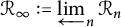
 . We may then form the inverse limit
$\mathcal {R}_\infty := \varprojlim _n \mathcal {R}_n$
 . We note that even if each algebra in the inverse system is Noetherian, the inverse limit
$\mathcal {R}_\infty $
 need not be.
Proposition 4.3 Assume that each of the deformation functors
$\mathrm {Def}_m$
 is pro-representable by
$\mathcal {R}_m$
 . Then,
$\mathrm {Def}_\infty $
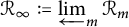
 is pro-represented by the inverse limit ring
$ \mathcal {R}_\infty := \varprojlim _m \mathcal {R}_m $
 .
Proof Consider the exact sequence of profinite groups

Choose a topological generator
$\gamma $
 of
$\Gamma $
 , and fix a continuous section (i.e., a splitting of the above exact sequence)
$ s: \Gamma \to G, $
 sending
$\gamma \mapsto \tilde {\gamma } \in G$
 . This allows us to view G as a semidirect product
$ G \cong N \rtimes \Gamma , $
 with
$\Gamma $
 acting on N by conjugation. That is, the conjugation action of
$\gamma \in \Gamma $
 on N is given by
$g \mapsto \tilde {\gamma } g \tilde {\gamma }^{-1}$
 .
Let A be an object of
$\mathcal {C}_{\mathcal {O}}$
 , and let
$ \rho : N \to \mathrm {GL}_d(A) $
 be a deformation of
$\bar {r}_\infty $
 . Note that
$N_1:=\ker (\rho )$
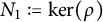 is an open normal subgroup of N, and hence of finite index.
We show that there is a finite index subgroup
$\Gamma '$
 of
$\Gamma $
 which normalizes
$N_1$
 . Let E be the fixed field of
$N_1$
 . Thus,
$E/K_\infty $
 is a finite Galois extension, and

Since
$E/K_\infty $
 is finite and
$K_\infty =\bigcup _m K_m$
 , there exists an integer m and a finite extension
$E_m/K_m$
 such that

Let
$\widetilde {E_m}$
 be the Galois closure of
$E_m$
 over
$K_m$
 . For any element
$\eta \in \Gamma ^{p^m}=\mathrm {Gal}(K_\infty /K_m)$
 and any lift
$\widetilde {\eta }\in G$
 , the field
$\widetilde {\eta }(E)$
 is of the form

As
$\widetilde {\eta }$
 fixes
$K_m$
 , the field
$\widetilde {\eta }(E_m)$
 is one of the finitely many
$K_m$
 -conjugates of
$E_m$
 contained in
$\widetilde {E_m}$
 . Hence, the orbit

is finite. Since
$\Gamma ^{p^m}$
 has finite index in
$\Gamma $
 , it follows that

is finite. Therefore, the stabilizer

has finite index in
$\Gamma $
 . Note that for every
$\eta \in \Gamma '$
 , one has

Since
$\Gamma \simeq \mathbb Z_p$
 , there exists an integer
$n_0\geq 0$
 such that
$\Gamma ^{p^{n_0}}= \Gamma '$
 . Thus,
$\widetilde {\gamma }^{p^{n_0}}$
 acts on the finite quotient
$N/N_1$
 . In particular, the image of
$\widetilde {\gamma }^{p^{n_0}}$
 in
$\mathrm {Aut}(N/N_1)$
 has finite order. Hence, there exists an integer
$n\geq n_0$
 such that
$\widetilde {\gamma }^{p^n}$
 acts trivially on
$N/N_1$
 .
Let
$G_n$
 denote the inverse image in G of
$\Gamma ^{p^n} \subset \Gamma $
 , so that
$G_n = \langle N, \tilde {\gamma }^{p^n} \rangle $
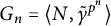 . Let
$H_1 := \Gamma ^{p^n} \subset \Gamma $
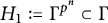 . By construction, for every
$\sigma \in H_1$
 and
$g \in N$
 , we have
$ \rho (\sigma g \sigma ^{-1}) = \rho (g) $
 . This condition ensures that
$\rho $
 extends in a natural way to a representation of the semidirect product
$G_n = N \rtimes H_1$
 , where we define
$ \rho (g \cdot \sigma ) := \rho (g) $
 for
$g \in N$
 ,
$\sigma \in H_1$
 . Thus,
$\rho $
 extends to a deformation of
$\bar {r}_n$
 to A, that is, to an element of
$\mathrm {Def}_n(A)$
 . Recall that
$\bar {r}_\infty :=\bar {r}_{|N}$
 . Thus, every deformation of
$\bar {r}_\infty $
 to A arises as the restriction to N of a deformation of
$\bar {r}_n$
 for sufficiently large n. This implies that there is a natural identification

where the colimit is taken over the directed system of functors
$\mathrm {Def}_n$
 as
$n \to \infty $
 . The transition maps in this system are induced by the inclusions
$G_n \subseteq G_m$
 for
$m \geq n$
 , and hence by the corresponding maps of representing rings
$\mathcal {R}_m \to \mathcal {R}_n$
 .
Since each
$\mathrm {Def}_n$
 is pro-represented by
$\mathcal {R}_n$
 , and limits of functors correspond to inverse limits of pro-representing objects, it follows that the colimit functor
$\mathrm {Def}_\infty $
 is pro-represented by the inverse limit
$ \mathcal {R}_\infty := \varprojlim _n \mathcal {R}_n$
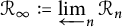 . This completes the proof.
For
$R\in \mathrm {CL}_{\mathcal {O}}$
 and a continuous representation
$r:G\to \mathrm {GL}_d(R)$
 , the adjoint representation
$\mathrm {Ad}r$
 is the
$R[G]$
 -module of
$d\times d$
 matrices with G-action
$\sigma \cdot M:=r(\sigma ) M r(\sigma )^{-1}$
 . Because scalar matrices are fixed by conjugation, the trace map
$\mathrm {tr}:\mathrm {Ad}r\to R$
 is G-equivariant and splits
$\mathrm {Ad}r\cong \mathrm {Ad}^0 r\oplus R \cdot \mathbf {I}_R$
 , where
$\mathrm {Ad}^0 r=\ker \mathrm {tr}$
 are the trace zero endomorphisms and
$R\cdot \mathbf {I}_R$
 is the trivial one-dimensional representation spanned by the identity matrix
$\mathbf {I}_R$
 . One has that

Consider the ring of dual numbers
$D:=\mathbb {F}_q[\varepsilon ]=\mathbb {F}_q[x]/(x^2)$
 , with
$\varepsilon ^2=0$
 . An infinitesimal lift of
$\bar {r}$
 is a lift
$r:G\to \mathrm {GL}_d(\mathbb {F}_q[\varepsilon ])$
 whose reduction modulo
$\varepsilon $
 is
$\bar {r}$
 . Writing such a lift in the form

for
$c(\sigma )\in \mathrm {Ad}\bar {r}$
 , the condition that r is a homomorphism is equivalent to the cocycle condition

This sets up a bijection between infinitesimal lifts of
$\bar {r}$
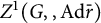
 and cocycles
$Z^1(G, , \mathrm {Ad}\bar {r})$
 . This in turn gives a bijection:

Moreover, deformations with determinant equal to
$\mathrm {det}\bar {r}$
 are in bijection with
$H^1(G, \mathrm {Ad}^0\bar {r})$
 . Let
$R\in \mathcal {C}_{\mathcal {O}}$
 and
$R':=R/J$
 be a quotient of R. The quotient map
$R\rightarrow R'$
 is said to a small extension if the ideal J is generated by a single element t such that
$t\cdot \mathfrak{m}_R=0$
 . For instance, the quotient map
$\mathcal {O}/p^{m+1}\rightarrow \mathcal {O}/p^{m}$
 is a small extension. Given a small extension
$\pi : R\rightarrow R'$
 , the fibers of the induced map

are an
$H^1(G, \mathrm {Ad}\bar {r})$
 pseudo-torsor. In other words, let
$r\in \mathrm {Def}_{\bar {r}}(R')$
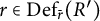 and suppose that the fiber
$(\pi ^*)^{-1}(r)$
 is nonempty and
$r_1, r_2\in (\pi ^*)^{-1}(r)$
 . Then, there is a unique cohomology class
$c\in H^1(G, \mathrm {Ad}\bar {r})$
 such that
$r_2=(1+t c) r_1$
 . Moreover,
$\mathrm {det}r_1=\mathrm {det}r_2$
 if and only if
$c\in H^1(G, \mathrm {Ad}^0\bar {r})$
 .
We record the following standard identification, which will be used in the obstruction-theoretic discussion below. Let
$\pi :R\longrightarrow R'$
 be a small extension with kernel
$J=(t)$
 . If
$A\in M_d(\mathbb F_q)$
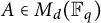 and
$\widetilde A$
 is any lift of A to
$M_d(R)$
 , then
$t\widetilde A$
 is independent of the choice of lift since
$t\mathfrak m_R=0$
 . We shall therefore denote it simply by
$tA$
 . The map

defined by
$A\longmapsto I+tA$
 gives an isomorphism from the additive group
$M_d(\mathbb F_q)$
 to the multiplicative kernel. Indeed,

since
$t^2=0$
 . Under this identification, conjugation by a lift of
$\bar r(\sigma )$
 corresponds to the usual adjoint action of
$\sigma $
 on
$\mathrm {Ad}\bar r$
 . We shall therefore identify the above kernel with
$\mathrm {Ad}\bar r$
 .
We now recall the obstruction class attached to a small extension. Let
$r\in \mathrm {Def}_{\bar r}(R')$
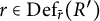 , and choose a set-theoretic lift

of r. This lift need not be a homomorphism. The defect of multiplicativity is measured by

Since r is a homomorphism modulo J, the element
$c_{\widetilde r}(\sigma ,\tau )$
 lies in

Thus, there is a uniquely determined map

such that

The map
$o_{\widetilde r}$
 is a continuous
$2$
 -cocycle, and its cohomology class

is independent of the choice of the set-theoretic lift
$\widetilde r$
 . This class is the obstruction to lifting r across
$\pi $
 : it vanishes if and only if r admits a lift to R which is a group homomorphism.
Definition 4.4 The deformation functor
$\mathrm {Def}_n$
 (resp.
$\mathrm {Def}_\infty $
 ) is unobstructed if
$H^2(G_n, \mathrm {Ad}\bar {r}_n)=0$
 (resp.
$H^2(N, \mathrm {Ad}\bar {r}_\infty )=0$
 ).
We note that the above definition makes sense even when the deformation functors
$\mathrm {Def}_n$
 are not known to be pro-representable.
Proposition 4.5 Suppose that
$\bar {r}_n$
 is unobstructed for some
$n\geq 0$
 , then it follows that
$\bar {r}_\infty $
 is also unobstructed.
Proof The result follows from the proof of Corollary 3.7.
Now let K be a number field and
$K_\infty $
 be a
$\mathbb {Z}_p$
 -extension of K in which all primes
$v\in S_p(K)$
 are totally ramified. Let S be a finite set of primes containing
$S_p(K)$
 and assume that all primes
$v\in S$
 are finitely decomposed in
$K_\infty $
 . Let
$r:\mathrm {G}_{K, S}\rightarrow \mathrm {GL}_d(\mathcal {O})$
 be a continuous Galois representation and
$\rho :=(\mathrm {Ad} r)(1)$
 . Observe that
$\rho ^*=\mathrm {Ad}r$
 . We shall now set
$G:=\mathrm {Gal}(K_S/K)$
 and
$N:=\mathrm {Gal}(K_S/K_\infty )$
 and
$\Gamma =G/N$
 .
Proposition 4.6 Suppose that the weak Leopoldt conjecture holds for
$\rho =\mathrm {Ad}r(1)$
 . Then, the following are equivalent:
-
(1) $\bar {r}_{\infty }$
is unobstructed; -
(2) the fine Selmer group $\mathcal {R}_{p^\infty }(A(\rho )/K_\infty )$
is cotorsion over
$\Lambda $
and
$\mu _\rho =0$
.




Proof As a consequence of Theorem 3.8, condition (2) is equivalent to the vanishing of
$H^2(K_S/K_\infty , \mathbf {V}_{\bar {\rho }^*})$
 . Since
$\rho ^*=\mathrm {Ad}r$
 , (2) is equivalent to (1).
5 Ordinary deformations over the
$\mathbb {Z}_p$
-extension

In this section, we refine certain results in [Reference Burungale and ClozelBC23] concerning the unobstructedness of ordinary deformation rings in the cyclotomic limit. The main theorem in loc. cit. establishes unobstructedness under two separate hypotheses: first, that the deformation ring in the cyclotomic limit is Noetherian, and second, that the
$\mu $
 -invariant of the relevant Selmer group vanishes. We prove that the Noetherian property is equivalent to the vanishing of the
$\mu $
 -invariant of the Greenberg Selmer group of the adjoint representation. In fact, the tangent space of the deformation ring over the cyclotomic
$\mathbb {Z}_p$
 -extension can be naturally identified with the residual Selmer group of the adjoint representation, which is finite if and only if the
$\mu $
 -invariant vanishes. This result fits into the broader theme of the article, since it elucidates the relationship between Galois deformation rings over
$\mathbb {Z}_p$
 -extensions and the Iwasawa theory of Selmer groups.
Throughout this section, K will be a totally real number field and p will denote an odd prime number which is unramified in K. Let
$v\in S_p(K)$
 be a prime of K. Denote by
$K_{\mathrm {cyc}}/K$
 the cyclotomic
$\mathbb {Z}_p$
 -extension of K and let
$K_n\subset K_{\mathrm {cyc}}$
 be its n-th layer. Note that v is totally ramified in
$K_{\mathrm {cyc}}$
 . We fix a finite set of primes S containing the primes of K which lie above p. Let
$\mathbb {F}_q$
 be a finite field of characteristic p and let
$\mathcal {O}$
 be the valuation ring of a p-adic field with residue field isomorphic to
$\mathbb {F}_q$
 . Let
$\mathrm {W}(\mathbb {F}_q)$
 denote the ring of Witt vectors with residue field
$\mathbb {F}_q$
 . Fix a uniformizer
$\varpi $
 of
$\mathcal {O}$
 . We let
$r: \mathrm {G}_{K, S}\rightarrow \mathrm {GL}_d(\mathcal {O})$
 be a continuous representation and let
$\bar {r}:=r\pmod {(\varpi )}$
 denote its residual representation. Assume that
$\det r$
 is the p-adic cyclotomic character
$\chi $
 .
Definition 5.1 Let r be a deformation of
$\bar {r}$
 and
$v\in S_p(K)$
 . Then,
$\varrho $
 is said to be ordinary of weight
$2$
 at v if the restriction of r to
$\mathrm {G}_{K_{v}}$
 is isomorphic to
$\left (\begin {array}{cc}\!\!\! {\chi \alpha }{\ast }\\{0}{\alpha ^{-1}} \!\!\! \end {array}\right )$
 , where
$\alpha $
 is a finite order unramified character. We say that r is ordinary of weight
$2$
 if it is ordinary of weight
$2$
 at each prime
$v\in S_p(K)$
 .
Throughout we make the following assumptions:
-
(1) r (and thus $\bar {r}$
) is ordinary of weight
$2$
; -
(2) $\bar {r}_{|\mathrm {G}_{K(\mu _p)}}$
is irreducible; -
(3) the restriction of $\bar {r}$
to each prime
$v\in S_p(K)$
is absolutely indecomposable.


Let
$R_n$
 be the deformation ring parameterizing ordinary liftings of
$\bar {r}_{|\mathrm {G}_{K_n}}$
 over
$\mathrm {W}(\mathbb {F}_q)$
 .
Proposition 5.2 Under the conditions above,
$R_n$
 belongs to
$\mathrm {CNL}_{\mathrm {W}(\mathbb {F}_q)}$
 and the natural map
$R_{n+1}\rightarrow R_n$
 is surjective for all n.
Proof The result follows from [Reference Burungale and ClozelBC23, Theorem 1.1 and Lemma 1.2].
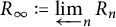
Proposition 5.3 The inverse limit
$R_\infty :=\varprojlim _n R_n$
 represents the functor of ordinary deformations of
$\bar {r}_{|\mathrm {G}_{F_{\mathrm {cyc}}}}$
 .
Proof See [Reference Burungale and ClozelBC23, Corollary 1.5].
Let
$\rho :=\mathrm {Ad}r$
 be the adjoint representation associated with r. We point out that the notation here is different from that in the previous section, where
$\rho $
 was taken to be Tate-twist of
$\mathrm {Ad}r$
 . For
$v\in S_p(K)$
 , since
$\rho $
 is v-ordinary, there is a short exact sequence of
$\mathrm {G}_{K_{v}}$
 -modules:

such that the inertia group at v acts on the semi-simplification of
$\mathbf {A}(\rho )^+$
 (resp.
$\mathbf {A}(\rho )^-$
 ) via positive (resp. nonpositive) powers of the cyclotomic character. Then, the ordinary Selmer group
$\mathrm {Sel}_{\mathrm {Gr}}(\mathbf {A}(\rho )/K_{\mathrm {cyc}})$
 consists of cohomology classes
$f\in H^1(K_S/K_{\mathrm {cyc}}, \mathbf {A}(\rho ))$
 which are unramified at all primes
$v\nmid p$
 and ordinary at the primes
$v|p$
 of
$\mathrm {K}_{\mathrm {cyc}}$
 . In greater detail, given a prime
$v\in \Omega _K$
 such that
$v\nmid p$
 , let

where w ranges over the primes of
$K_{\mathrm {cyc}}$
 which lie above v. On the other hand, for a prime
$w|p$
 of
$K_{\mathrm {cyc}}$
 , let
$H^1_{\mathrm {ord}}(K_{\mathrm {cyc}, w}, \mathbf {A}(\rho ))$
 consist of the cohomology classes which give unramified classes on
$\mathbf {A}(\rho )^-$
 . For
$v|p$
 , set

where
$w_v$
 is the unique prime of
$K_{\mathrm {cyc}}$
 which lies above v.
Definition 5.4 With respect to notation above, the Greenberg Selmer group associated with
$\mathbf {A}(\rho )$
 is defined as follows:

Likewise, we may define a Greenberg Selmer group associated with the residual representation:

where

Identifying
$\mathbf {V}_{\bar {\rho }}$
 with
$\mathbf {A}(\rho )[\varpi ]$
 , the Kummer sequence

induces a natural map

Lemma 5.5 The map
$\alpha $
 has finite kernel and cokernel.
Proof The map
$\alpha $
 fits into a commutative diagram:

where the map
$\gamma $
 is a direct sum of maps

The map
$\beta $
 is surjective and its kernel is isomorphic to

In particular, the kernel of
$\beta $
 is finite. It follows that the kernel of
$\alpha $
 is also finite. It is easy to see that each of the maps
$\gamma _v$
 has finite kernel. The cokernel of
$\alpha $
 is contained in the kernel of
$\gamma $
 , which is finite.
Proposition 5.6 With respect to notation above, the following conditions are equivalent:
-
(1) The ordinary deformation ring $R_\infty $
is Noetherian. -
(2) The residual Selmer group $\text{Sel}_{\text{Gr}}(\mathbf {V}_{\bar {\rho }}/K_{\text{cyc}})$
is finite. -
(3) The ordinary Selmer group $\mathrm {Sel}_{\mathrm {Gr}}(\mathbf {A}(\rho )/K_{\mathrm {cyc}})$
is a cotorsion
$\Lambda $
-module and its
$\mu $
invariant vanishes.





Proof The equivalence of (1) and (2) follows since
$\mathrm {Sel}_{\mathrm {Gr}}(\mathbf {V}_{\bar {\rho }}/K_{\mathrm {cyc}})$
 can be identified with the mod-p tangent space of
$R_\infty $
 (see the proof of [Reference Burungale and ClozelBC23, Theorem 5.3]). From Lemma 5.5, the condition (2) is equivalent to the finiteness of
$\mathrm {Sel}_{\mathrm {Gr}}(\mathbf {A}(\rho )/K_{\mathrm {cyc}})[\varpi ]$
 . This is in turn equivalent to condition (3).
Let us now recall the main result of [Reference Burungale and ClozelBC23], which asserts that
$R_\infty $
 is formally smooth provided it is Noetherian and some further conditions are satisfied. We say that
$\bar {\rho }$
 is adequate if
$\bar {\rho }(\mathrm {G}_{K(\mu _p)})$
 is an adequate subgroup in the sense of [Reference AllenAll16, Definition 3.1.1].
Theorem 5.7 (Burungale–Clozel)
Assume that
$\rho $
 is automorphic and adequate. Further assume that the
$\mu $
 -invariants of
$H^1(K_S/K_{\mathrm {cyc}}, A(\rho ))_{\mathrm {tors}}$
 and
$H^1(K_S/K_{\mathrm {cyc}}, A(\rho ^*))_{\mathrm {tors}}$
 both vanish. Then, if
$R_\infty $
 is Noetherian, then it is formally smooth, that is,

As a consequence of Proposition 5.6, one obtains the following result.
Corollary 5.8 Let
$\rho $
 be as in Theorem 5.7 and let
$r:=\mathrm {Ad}\rho $
 . Then, the following are equivalent:
-
(1) The ordinary Selmer group $\mathrm {Sel}_{\mathrm {Gr}}(\mathbf {A}(\rho )/K_{\mathrm {cyc}})$
is a cotorsion
$\Lambda $
-module and its
$\mu $
invariant vanishes. -
(2) $R_\infty $
is a power series ring
$\mathrm {W}(\mathbb {F}_q)[\![ X_1, \dots , X_s]\!] $
.




Proof That the condition (1) is equivalent to the condition that
$R_\infty $
 is Noetherian is the assertion of Proposition 5.6. The condition (2) then follows from Theorem 5.7. This shows that (1) implies (2). The condition (2) implies that
$R_\infty $
 is in particular, Noetherian and thus by Proposition 5.6, condition (1) follows from (2). We have thus shown that (1) and (2) are equivalent.
The unobstructedness of the deformation ring follows from Theorem 5.7 once the Noetherian property is established. On the other hand, Proposition 4.6 from the previous section is a condition for unobstructedness which does not guarantee that the deformation ring
$R_\infty $
 is Noetherian.
6 Bockstein maps and Massey products
In the next section, we establish the main theorems of the article, demonstrating that the vanishing of the
$\mu $
 -invariant of the fine Selmer group is equivalent to a criterion formulated in terms of higher Massey products. Our strategy is to translate the Iwasawa-theoretic problem into a question about the structure of certain Galois cohomology groups, where Massey products naturally arise. This is made possible by the work of Lam et al. [Reference Lam, Liu, Sharifi, Wake and WangLLS+23], who analyzed the fine structure of Iwasawa cohomology groups and clarified their connections with Bockstein maps and higher Massey products. In this section, we set up relevant notation (consistent with loc. cit.) and recall some important results in this context.
6.1 Bockstein-maps
Let G be a profinite group with cohomological dimension d and H be a pro-p quotient of G by a closed normal subgroup N. Assume throughout that G has finite p-cohomological dimension. Define the completed group algebra

where the inverse limit ranges over all open normal subgroups U of finite index in H. Let V be an
$\mathbb {F}_p[\![ G ]\!] $
 -module that is finite dimensional as an
$\mathbb {F}_p$
 vector space. Let
$\alpha : \Omega \to \mathbb {F}_p$
 be the augmentation map sending each group-like element
$g \in H$
 to
$1 \in \mathbb {F}_p$
 , and let
$I := \ker (\alpha )$
 denote the augmentation ideal of
$\Omega $
 .
The short exact sequence of
$\mathbb {F}_p [\![ G ]\!] $
 -modules

induces the connecting homomorphism

on passing to cohomology. Since G acts trivially on
$I^{n} / I^{n+1}$
 , there is a natural isomorphism

Definition 6.1 Define

to be the resulting composite map and refer to it as the generalized Bockstein map.
Recall that, given a short exact sequence of G-modules

there is a connecting homomorphism

called the Bockstein homomorphism. The above map arises as the connecting homomorphism in cohomology associated with a short exact sequence of coefficients, and hence is a natural generalization of the classical Bockstein homomorphism. For
$i>0$
 , define the i-th Iwasawa cohomology group as follows:

where U ranges over open normal subgroups of G which contain N.
Theorem 6.2 (Lam, Liu, Sharifi, Wake, and Wang)
For each
$n \geq 1$
 , there is a canonical isomorphism

of R-modules, where d is the p-cohomological dimension of G.
Proof See [Reference Lam, Liu, Sharifi, Wake and WangLLS+23, Theorem 2.2.4].
Remark 6.3 In our applications, K will be a number field and
$S \subset \Omega _K$
 is a finite set of primes containing all primes of K which lie above p. Let
$K_\infty /K$
 be a
$\mathbb {Z}_p$
 -extension such that:
-
• all primes $v\in S_p(K)$
are totally ramified in
$K_\infty $
; -
• all primes $v\in S$
are finitely decomposed in
$K_\infty $
.


Setting

we find that
$H=\Gamma =\mathrm {Gal}(K_\infty /K)$
 and
$\Omega =\Lambda /(p)=\mathbb {F}_p[\![ T]\!] $
 . Note that I is the maximal ideal
$(T)$
 . Let
$\rho :\mathrm {G}_{K,S}\rightarrow \mathrm {GL}_d(\mathcal {O})$
 be a continuous Galois representation and
$V:=\mathbf {V}_{\bar {\rho }^*}$
 . Then, (6.1) specializes to

In particular,
$H_{\mathrm {Iw}}^{2}(K_S/K_\infty , \mathbf {V}_{\bar {\rho }^*})$
 is finite if and only if there exists
$n>0$
 such that the image of
$\Psi ^{(n)}$
 spans
$H^{2}(K_S/K, \mathbf {V}_{\bar {\rho }^*}) \otimes _{\mathbb {F}_p} I^{n} / I^{n+1}$
 .
Coming back to the general situation, assume for simplicity that
$ H \cong \mathbb {Z}_p^r $
 . We fix an isomorphism

where each
$ A_i = \mathbb {Z}_p $
 for
$ i = 1, \ldots , r $
 . For each
$ i $
 , let

denote the composition of the canonical projection
$ G \twoheadrightarrow H $
 with the projection onto the
$ i $
 -th summand
$ H \twoheadrightarrow A_i $
 . The image of
$ \Psi ^{(1)} $
 may be described in terms of cup products involving these homomorphisms, as we now explain.
Choose generators
$h_1, \ldots , h_r \in H$
 such that the image of
$h_i$
 in
$A_i$
 under the isomorphism (6.2) is
$1 \in A_i$
 . Then, setting
$x_i = [h_i] - 1 \in I$
 , where I is the augmentation ideal in
$\Omega = \mathbb {F}_p[\![ H ]\!] $
 , we obtain an isomorphism

sending the image of
$x_i$
 to
$h_i \otimes 1$
 .
Proposition 6.4 With respect to notation above, for any 1-cocycle
$f: G \rightarrow V$
 , we have

Proof This result is a special case of [Reference Lam, Liu, Sharifi, Wake and WangLLS+23, Proposition 2.3.3].
6.2 Massey products
For
$n \geq 2$
 , the image of
$\Psi ^{(n)}$
 is described in terms of
$(n+1)$
 -fold Massey products, which may be regarded as higher-order generalizations of the cup product in cohomology. These products were first introduced by Massey [Reference MasseyMas58] to show that two topological spaces can possess isomorphic cohomology rings without being homotopy equivalent, thereby revealing that the ring structure alone may not capture all homotopical information. In the setting of Galois cohomology, Massey products similarly detect relations among cohomology classes that are invisible to the ordinary cup product, and they encode higher-order extension data.
Let
$ r \geq 2 $
 , R be a profinite commutative ring, G be a profinite group and let
$ T_1, \dots , T_r $
 be
$ R[\![ G]\!] $
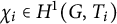
 -modules. Given cohomology classes
$ \chi _i \in H^1(G, T_i) $
 for
$ i = 1, \dots , r $
 , the associated Massey product is an element

with respect to a choice of a defining system
$ \rho $
 . The construction of this product depends on choices made in specifying
$ \rho $
 , but the resulting ambiguity is controlled in a well-understood manner.
We now recall the structure underlying the algebraic framework used to define these products, following the notation and conventions of [Reference Lam, Liu, Sharifi, Wake and WangLLS+23]. Let
$ n \geq 1 $
 be an integer. In our applications, we specialize to the case
$ R = \mathbb {F}_p $
 . An
$ n $
 -dimensional upper-triangular generalized matrix algebra over
$ R $
 , or
$ R $
 -UGMA, is an
$ R $
 -algebra
$ \mathcal {A} $
 determined by the following data. For each pair
$ 1 \leq i \leq j \leq n $
 , let
$ A_{i,j} $
 be a finitely generated
$ R $
 -module, with
$ A_{i,i} = R $
 for all
$ i $
 . For each triple
$ 1 \leq i \leq j \leq k \leq n $
 , there are composition maps

which are
$ R $
 -bilinear and agree with scalar multiplication when
$ i = j $
 or
$ j = k $
 . These maps are required to satisfy an associativity condition: for all
$ 1 \leq i < j < k < l \leq n $
 , the two natural ways of composing

must yield the same result. The underlying
$ R $
 -module of
$ \mathcal {A} $
 is

and multiplication in
$ \mathcal {A} $
 is defined via the composition maps. For elements
$ a = (a_{i,j}) $
 and
$ b = (b_{i,j}) $
 in
$ \mathcal {A} $
 , the
$(i,j)$
 -entry of the product
$ ab $
 is given by

Definition 6.5 Let
$ R $
 be a profinite ring and
$ G $
 a profinite group. A profinite
$ (R, G)\text {-UGMA} $
 is a profinite
$ R $
 -UGMA
$ \mathcal {A} $
 equipped with a continuous action of
$ G $
 on each
$ A_{i,j} $
 , such that:
-
• the action on $ A_{i,i} = R $
is trivial for all
$ i $
, and -
• each composition map $ \varphi _{i,j,k} $
is a homomorphism of
$ R[\![ G ]\!] $
-modules, where
$ A_{i,j} \otimes _R A_{j,k} $
carries the diagonal
$ G $
-action.


We set
$\mathcal {U}=\mathcal {U}(\mathcal {A})$
 to consist of matrices
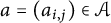
$a=(a_{i,j})\in \mathcal {A}$
 with
$a_{i,i}=1$
 for
$i=1, \dots , n$
 . Let
$\mathcal {U}^{\prime }=\mathcal {U}^{\prime }(\mathcal {A})$
 denote the quotient of
$\mathcal {U}$
 by its central subgroup
$\mathcal {Z}=\mathcal {Z}(\mathcal {A})$
 of unipotent central elements, that is, those
$a \in \mathcal {U}$
 with
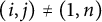
$a_{i, j}=0$
 for all
$(i, j) \neq (1, n)$
 .
Let
$T_{1}, \ldots , T_{n}$
 be compact
$R [\![ G ]\!] $
 modules that are R-finitely generated for simplicity, and let
$\chi _{i}: G \rightarrow T_{i}$
 be continuous 1-cocycles for
$1 \leq i \leq n$
 .
Definition 6.6 A defining system for the Massey product of
$\chi _1, \ldots , \chi _n$
 consists of a continuous 1-cocycle
$\rho : G \to \mathcal {U}'$
 , where
$\mathcal {U}'$
 is the group of units in a profinite
$(n+1)$
 -dimensional upper-triangular
$(R, G)$
 -UGMA
$\mathcal {A}$
 , such that
$A_{i,i+1} = T_i$
 for
$1 \leq i \leq n$
 , and the composition of
$\rho $
 with the projection to
$A_{i,i+1}$
 equals
$\chi _i$
 .
Given such a defining system
$\rho $
 , there exists a unique lift
$\tilde {\rho }: G \to \mathcal {U}$
 to the full unit group of
$\mathcal {A}$
 , such that the
$(1, n+1)$
 -entry of
$\tilde {\rho }(g)$
 is zero for all
$g \in G$
 . For each
$i < j$
 , define
$\rho _{i,j}: G \to A_{i,j}$
 to be the map sending g to the
$(i,j)$
 -entry of
$\tilde {\rho }(g)$
 .
Given a defining system
$\rho $
 , the n-fold Massey product
$\left (\chi _{1}, \ldots , \chi _{n}\right )_{\rho } \in H^{2}\left (G, A_{1, n+1}\right )$
 is the class of the 2-cocycle

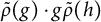
that sends
$(g, h)$
 to the
$(1, n+1)$
 -entry of
$\tilde {\rho }(g) \cdot g \tilde {\rho }(h)$
 . The Massey product
$\left (\chi _{1}, \ldots , \chi _{n}\right )_{\rho }$
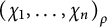 vanishes if and only if
$\rho $
 may be lifted to a cocycle
$\widetilde {\rho }:G\rightarrow \mathcal {U}$
 .
We shall in our applications work with certain defining systems that can be associated with a finitely generated R-module M. Let m be a positive integer less than n. We define an n-dimensional R-UGMA
$\mathcal {A}_{n}(M, m)$
 as follows. Set

and take the maps
$\varphi _{i, j, k}$
 to be the R-module structure maps. This makes sense since, given
$i \leq j \leq k$
 , at least one of
$A_{i, j}$
 and
$A_{j, k}$
 must be R, as m cannot satisfy both
$m<j$
 and
$j \leq m$
 .
Let us write
$\mathcal {U}_{n}(M, m)$
 for
$\mathcal {U}\left (\mathcal {A}_{n}(M, m)\right )$
 and
$\mathcal {U}_{n}^{\prime }(M, m)$
 for
$\mathcal {U}^{\prime }\left (\mathcal {A}_{n}(M, m)\right )$
 . To make this easier to visualize, note that we can write
$\mathcal {U}_{n}(M, m)$
 in “block matrix” form as

where
$\mathrm {U}_{k}(R) \leqslant \mathrm {GL}_{k}(R)$
 denotes the group of upper-triangular unipotent matrices and
$\mathrm {M}_{k, l}(M)$
 denotes the additive group of k-by- l matrices with entries in M for positive integers k and l.
Let T be an
$R[\![ G]\!] $
 -module that is finitely generated as an R-module. Let
$n \geq 2$
 be an integer, and let
$a, b \geq 0$
 be such that
$a + b = n$
 . For any profinite
$R[\![ G]\!] $
 -module M, denote by
$Z^i(G, M)$
 the R-module of continuous i-cocycles
$f: G \to M$
 . Let
$\alpha = (\alpha _1, \dots , \alpha _a) \in Z^1(G, R)^a$
 and
$\beta = (\beta _1, \dots , \beta _b) \in Z^1(G, R)^b$
 .
Definition 6.7 An (a,b)-partial defining system for
$(n+1)$
 -fold Massey products of the form
$(\alpha , \cdot , \beta )$
 consists of a pair of continuous homomorphisms

such that the entries along the first superdiagonal of
$\phi $
 and
$\theta $
 are given by
$\phi _{i, i+1} = \alpha _i$
 and
$\theta _{i, i+1} = \beta _i$
 , respectively.
Given a continuous
$1$
 -cocycle
$\lambda : G \to T$
 , a proper defining system for the
$(n+1)$
 -fold Massey product
$(\alpha , \lambda , \beta )$
 relative to the partial defining system
$(\phi , \theta )$
 is a continuous
$1$
 -cocycle

of the form

where
$\kappa : G \to M_{a+1, b+1}'(T)$
 is a continuous map satisfying
$\kappa _{a+1,1} = \lambda $
 .
Proper defining systems can be interpreted as cocycles, which we now describe. Let
$\mathfrak{U}_{n+2}(R)$
 consisting of strictly upper-triangular
$(n+2) \times (n+2)$
 matrices with entries in R. The group
$\mathrm {U}_{n+2}(R)$
 of upper triangular
$(n+2)\times (n+2)$
 unipotent matrices acts continuously on
$\mathfrak{U}_{n+2}(R)$
 via conjugation. Let
$\mathfrak{U}_{a,b}(R)$
 denote the
$R[\![ \mathrm {U}_{n+2}(R) ]\!] $
 -submodule of
$\mathfrak{U}_{n+2}(R)$
 given by

Equip
$\mathfrak{U}_{a,b}(R)$
 with a G-module structure via the continuous homomorphism

As an R-module,

with G acting via

where
$x \in M_{a+1, b+1}(T)$
 ,
$g x$
 denotes the G-action on entries of x, and
$\cdot $
 is matrix multiplication. Note that
$\mathfrak{U}_{\phi , \theta }(T)$
 contains a copy of T as an
$R [\![ G ]\!] $
 -submodule, embedded as the
$(1, b+1)$
 . We set
$\mathfrak{U}_{\phi , \theta }^{\prime }(T) := \mathfrak{U}_{\phi , \theta }(T) \big / T$
 .
Lemma 6.8 Let
$(\phi , \theta )$
 be a partial defining system for the Massey products
$(\alpha , \cdot , \beta )$
 . Then, the map that sends a continuous
$1$
 -cocycle
$\kappa ': G \rightarrow \mathfrak{U}_{\phi , \theta }^{\prime }(T)$
 to the map
$\tau : G \rightarrow \mathcal {U}_{n+2}^{\prime }(T, a)$
 given by
$ \tau = \begin {pmatrix} \phi & \kappa ' \theta \\ 0 & \theta \end {pmatrix} $
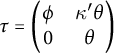 is a bijection between
$Z^{1}(G, \mathfrak{U}_{\phi , \theta }^{\prime }(T))$
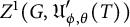 and the set of proper defining systems in T relative to
$(\phi , \theta )$
 .
Proof This result is [Reference Lam, Liu, Sharifi, Wake and WangLLS+23, Lemma 3.3.3].
Let
$e \in \mathfrak{U}_{a,b}(R)$
 denote the matrix whose
$(a+1,1)$
 -entry is
$1$
 and all other entries are zero. There exists a continuous
$R [\![ G ]\!] $
 -module homomorphism

defined on the cosets of images of group elements by

Moreover, the image of
$I^{n}$
 is contained in the submodule of matrices whose entries vanish outside the
$(1,b+1)$
 -position. The following result shows that the image of
$\Psi ^{(n)}$
 is closely related to certain Massey products. However, due to the dependence on the map
$p_{\phi , \theta }$
 , this relationship does not, in general, fully determine the image of
$\Psi ^{(n)}$
 .
Theorem 6.9 Suppose
$\phi : G \to \mathrm {U}_{a+1}(R)$
 and
$\theta : G \to \mathrm {U}_{b+1}(R)$
 restrict to the cocycles
$\alpha \in Z^1(G, R)^a$
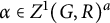 and
$\beta \in Z^1(G, R)^b$
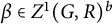 , respectively, as described above. Let
$f \in Z^1\left (G, T \otimes _{\mathbb {F}_p} \Omega / I^n\right )$
 , and let
$\rho $
 be the proper defining system relative to
$(\phi , \theta )$
 associated with
$p_{\phi , \theta } \circ f$
 , as in Lemma 6.8. Then, we have the identity

in
$H^2(G, T)$
 .
Proof See [Reference Lam, Liu, Sharifi, Wake and WangLLS+23, Theorem 4.1.2].
We now assume that G has p cohomological dimension
$2$
 and that
$H\simeq \mathbb {Z}_p$
 . Let
$\kappa : G\twoheadrightarrow \mathbb {Z}_p$
 be a surjective map which factors through the quotient map
$G\twoheadrightarrow H$
 . In the special case, where
$\alpha = (\kappa , \kappa , \dots , \kappa )$
 , partial defining systems can be constructed explicitly using unipotent binomial matrices, which we now recall. Let
$u_{n}$
 denote the
$(n+1)$
 -dimensional nilpotent upper triangular matrix

Let
$ \left [\!\!\! \begin {array}{c}\cdot \\ n\end {array} \!\!\! \right ] : \mathbb {Z}_p \to \mathrm {U}_{n+1}(\mathbb {Z}_p) $
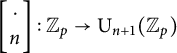 denote the unique continuous group homomorphism such that
$ \left [\!\!\! \begin {array}{c} 1 \\ n \end {array} \!\!\! \right ] = 1 + u_n $
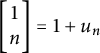 . Then, for any
$m \in \mathbb {Z}$
 , we have

which equals

Let
$(\phi , \theta )$
 be the
$(n, 0)$
 -proper defining system with
$\phi =\left [ \!\!\! \begin {array}{c}\kappa \\ n\end {array} \!\!\! \right ].$
 We have
$\alpha =(\kappa , \ldots , \kappa ) \in Z^{1}(G, R)^{n}$
 , which we denote by
$\kappa ^{(n)}$
 . We denote
$\mathfrak{U}_{\phi , \theta }(T)$
 by
$\mathfrak{U}_{\left [ \!\!\! \begin {array}{l}\kappa \\ n\end {array} \!\!\! \right ]}(T)$
 . the proper defining system
$\tau _{x^{n}}$
 relative to
$\left [\!\!\! \begin {array}{c}\kappa \\ n\end {array} \!\!\! \right ]$
 that is attached to
$p_{n} \circ f$
 , where

satisfies
$\left (\tau _{x^{n}}\right )_{n+1-k, n+2}=\lambda _{k}$
 for
$0 \leq k \leq n-1$
 . In particular, the element
$\lambda =\lambda _{0}=\left (\tau _{x^{n}}\right )_{n+1, n+2}$
 is the image of f under the map

induced by the augmentation
$\Omega / I^{n} \mapsto \Omega / I=R$
 .
Theorem 6.10 For
$f \in Z^{1}\left (G, T \otimes _{\mathbb {F}_p} \Omega / I^{n}\right )$
 , we have

where
$\tau _{x^{n}}$
 is the proper defining system relative to
$\left [ \!\!\! \begin {array}{c}\kappa \\ n\end {array} \!\!\! \right ]$
 attached to f, and
$\lambda $
 is the image of f in
$Z^{1}(G, T)$
 .
Proof This result is [Reference Lam, Liu, Sharifi, Wake and WangLLS+23, Theorem 4.3.1].
Corollary 6.11 Suppose that G is p-cohomologically finite of p-cohomological dimension
$2$
 and that
$H\simeq \mathbb {Z}_p$
 . Let
$P_{n}(H)$
 denote the subgroup of
$H^{2}(G, T) \otimes _{\mathbb {F}_p} I^{n} / I^{n+1}$
 generated by all
$\left (\kappa ^{(n)}, \lambda \right )_{\tau } \cdot x^{n}$
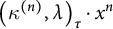 for proper defining systems
$\tau $
 relative to
$\left [ \!\!\! \begin {array}{c}\kappa \\ n\end {array} \!\!\! \right ]$
 and
$\lambda =\tau _{n+1, n+2}$
 . We have a canonical isomorphism of R-modules

Proof See [Reference Lam, Liu, Sharifi, Wake and WangLLS+23, Corollary 4.3.3].
7 Main results
In this section, we establish the main results of this article. The following theorem establishes a criterion for the vanishing of the
$\mu $
 -invariant of the fine Selmer group stated in purely in terms of Massey products. This result has striking consequences to establishing the constancy of the
$\mu $
 -invariant in Greenberg neighborhoods of a
$\mathbb {Z}_p$
 -extensions of a given one, which we will subsequently explore.
Theorem 7.1 Let K be a number field,
$K_\infty /K$
 be a
$\mathbb {Z}_p$
 -extension, and S be a finite set of primes containing the primes of K which lie above p. Assume that all primes
$v|p$
 of K are totally ramified in
$K_\infty $
 and all primes in S are finitely decomposed in
$K_\infty $
 . Let
$\mathcal {K}$
 be a finite extension of
$\mathbb {Q}_p$
 with valuation ring
$\mathcal {O}$
 and let
$\rho :\mathrm {G}_{K,S}\rightarrow \mathrm {GL}_d(\mathcal {O})$
 be a continuous Galois representation. Then, the following are equivalent:
-
(1) The fine Selmer group $\mathcal {R}_{p^\infty }(\mathbf {A}(\rho )/K_\infty )$
is cotorsion with vanishing
$\mu $
-invariant. -
(2) There exists $n>0$
such that the Massey products
$(\kappa ^{(n)}, \lambda )_\tau $
span
$H^2(K_S/K, \mathbf {V}_{\bar {\rho }^*})$
, where
$\tau $
ranges over defining systems relative to
$\left [ \!\!\! \begin {array}{c}\kappa \\ n\end {array} \!\!\! \right ]$
and
$\lambda =\tau _{n+1, n+2}\in H^1(K_S/K, \mathbf {V}_{\bar {\rho }^*})$
.







Proof The
$\mu $
 -invariant of the fine Selmer group
$\mathcal {R}_{p^\infty }(\mathbf {A}(\rho )/K_\infty )$
 vanishes if and only if the Iwasawa cohomology group
$H^2_{\mathrm {Iw}}(K_S/K_{\infty }, \mathbf {V}_{\bar {\rho }^*})$
 is finite. Thus, (1) is equivalent to the condition that there exists some
$n>0$
 such that

It then follows from Corollary 6.11 that (1) and (2) are equivalent.
Remark 7.2 At this point, some remarks are in order.
-
• Specialize to the case when $\rho =1$
is the trivial one-dimensional representation,
$\mathcal {R}_{p^\infty }(\mathbf {A}(\rho )/K_\infty )$
is the Pontryagin dual of
$\mathcal {Y}_S$
, considered in Remark 3.10. Theorem 7.1 then extends the
$\mu $
-invariant vanishing criterion in [Reference QiQi25], where it is assumed that
$H^2(K_S/K, \mu _p)$
is one-dimensional. -
• When one specializes to the case when p is a regular prime, $K=\mathbb {Q}(\mu _p)$
and
$K_\infty =\mathbb {Q}(\mu _{p^\infty })$
is the cyclotomic
$\mathbb {Z}_p$
-extension of K, the maximal pro-p quotient of
$\mathrm {Gal}(K_S/K)$
is free pro-p. In general, this quotient is minimal generated by
$r:=\dim _{\mathbb {F}_p} H^1(K_S/K, \mathbb {F}_p)$
elements modulo
$s:=\dim _{\mathbb {F}_p} H^2(K_S/K, \mathbb {F}_p)$
relations. When p is a regular prime, $$\begin{align*}H^2(K_S/K, \mathbf{V}_{\bar{\rho}^*})=H^2(K_S/K, \mu_p)=H^2(K_S/K, \mathbb{F}_p)=0\end{align*}$$
and the condition (2) in Theorem 7.1 is vacuously true.
-
• Suppose that $\rho _1$
and
$\rho _2$
are two representations
$\mathrm {G}_{K,S}\rightarrow \mathrm {GL}_d(\mathcal {O})$
such that
$\bar {\rho }_1\simeq \bar {\rho }_2$
. Then, condition (1) is true for
$\rho _1$
if and only if condition (1) is true for
$\rho _2$
. Indeed, condition (2) depends only on the residual representation. This is seen more directly from Theorem 3.6.




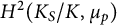











Let K be a number field of degree
$n=[K:\mathbb {Q}]=r_1+2r_2$
 , with
$r_1$
 real places and
$r_2$
 pairs of complex conjugate places. Fix a prime p. Let
$\widetilde {K}$
 denote the compositum of all
$\mathbb {Z}_p$
 -extensions of K. Then,
$\mathrm {Gal}(\widetilde {K}/K)\simeq \mathbb {Z}_p^{t}$
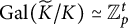 , where
$ t=r_2+1+\delta _p(K)$
 , and
$\delta _p(K)$
 is the Leopoldt defect of K at p. The standard bound
$\delta _p(K)\le r_1+r_2-1$
 yields
$ r_2+1\le t\le r_1+2r_2=n $
 . Write
$\widetilde {\mathcal {F}}$
 for the maximal abelian unramified pro-p extension of
$\widetilde {K}$
 , and set
$\widetilde {\mathcal {X}}:=\mathrm {Gal}(\widetilde {\mathcal {F}}/\widetilde {K})$
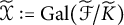 . The Iwasawa algebra attached to
$\Gamma $
 is

After choosing topological generators
$\sigma _1,\dots ,\sigma _t$
 of
$\Gamma $
 and writing
$T_i:=\sigma _i-1$
 , we obtain a noncanonical identification
$ \widetilde {\Lambda }\simeq \mathbb {Z}_p[\![ T_1,\dots ,T_t]\!] $
 . Via the natural conjugation action of
$\mathrm {Gal}(\widetilde {K}/K)$
 on
$\widetilde {\mathcal {F}}$
 , the group
$\widetilde {\mathcal {X}}$
 acquires a canonical structure of a
$\widetilde {\Lambda }$
 -module. A theorem of Greenberg [Reference GreenbergGre73, Theorem 1] shows that
$\widetilde {\mathcal {X}}$
 is in fact a Noetherian torsion
$\widetilde {\Lambda }$
 -module.
Let
$\mathscr {E}$
 be the set of all
$\mathbb {Z}_p$
 -extensions of K. Let
$K_\infty ^1$
 and
$K_\infty ^2$
 be
$\mathbb {Z}_p$
 -extensions of K. Let
$K_n^i/K$
 be the n-th layer of
$K_\infty ^i$
 . Set

with the convention that
$n_0(K_n^1, K_n^2):=\infty $
 if
$K_\infty ^1=K_\infty ^2$
 . The distance between
$K_\infty ^1$
 and
$K_\infty ^2$
 is then defined as follows:

This gives a topology on
$\mathscr {E}$
 , it is easy to see that
$\mathscr {E}$
 is indeed compact and hausdorff. Let
$K_\infty \in \mathscr {E}$
 and let n be a positive integer. Let
$\mathscr {E}(K_\infty , n)$
 consist of all
$K_\infty '\in \mathscr {E}$
 such that

or equivalently,

Then,
$\{\mathscr {E}(K_\infty , n)\mid K_\infty \in \mathscr {E}, n\in \mathbb {Z}_{\geq 1}\}$
 gives a basis for the topology on
$\mathscr {E}$
 . We refer to a basic open set of the form
$\mathscr {E}(K_\infty , n)$
 is referred to as a Greenberg neighborhood of
$K_\infty $
 .
Let Y be a Noetherian torsion
$\widetilde {\Lambda }$
 -module. Let
$K_\infty \in \mathscr {E}$
 and let
$\Lambda _{K_\infty }$
 be the associated Iwasawa algebra. Denote by
$\widetilde {\Lambda }\twoheadrightarrow \Lambda _{K_\infty }$
 the natural surjection and set
$Y_{K_\infty }:=Y\otimes _{\widetilde {\Lambda }} \Lambda _{K_\infty }$
 . Then,
$Y_{K_\infty }$
 is Noetherian as a
$\Lambda _{K_\infty }$
 -module but need not be torsion. Let
$\mathscr {E}(Y)$
 be the set of
$\mathbb {Z}_p$
 -extensions
$K_\infty $
 for which
$Y_{K_\infty }$
 is a torsion
$\Lambda _{K_\infty }$
 -module. Then,
$\mathscr {E}(Y)$
 is an open subset of
$\mathscr {E}$
 (cf. [Reference GreenbergGre73, Proposition 1]). For
$K_\infty \in \mathscr {E}(Y)$
 , denote by
$\mu (Y_{K_\infty })$
 the
$\mu $
 -invariant of
$Y_{K_\infty }$
 . This defines a function

on
$\mathscr {E}(Y)$
 , which Greenberg proved is locally bounded (see [Reference GreenbergGre73, Theorem 2]). Moreover, if the
$\mu $
 -invariant vanishes at
$K_\infty $
 , then it vanishes on a Greenberg neighborhood of
$K_\infty $
 (cf. [Reference GreenbergGre73, Theorem 3]). The following result shows that if two
$\mathbb {Z}_p$
 -extensions
$K_\infty ^1$
 and
$K_\infty ^2$
 agree at the first layer itself, this can be sufficient condition to deduce that

Theorem 7.3 Let K be a number field and let S be a finite set of primes of K containing the primes of K which lie above p. Let
$\rho : \mathrm {G}_{K, S}\rightarrow \mathrm {GL}_d(\mathcal {O})$
 be a continuous Galois representation. Let
$K_\infty ^1$
 and
$K_\infty ^2$
 be two
$\mathbb {Z}_p$
 -extensions of K such that:
-
(1) the primes $v|p$
of K are totally ramified in both
$K_\infty ^1$
and
$K_\infty ^2$
; -
(2) all primes $v\in S$
are finitely decomposed in
$K_\infty ^1$
and
$K_\infty ^2$
; -
(3) the first layers of $K_\infty ^1$
and
$K_\infty ^2$
coincide, that is,
$K_1^1=K_1^2$
.


Suppose that
$\mathcal {R}_{p^\infty }(\mathbf {A}(\rho )/K_\infty ^1)$
 is cotorsion with
$\mu \left (\mathcal {R}_{p^\infty }(\mathbf {A}(\rho )/K_\infty ^1)\right )=0$
 . Then,
$\mathcal {R}_{p^\infty }(\mathbf {A}(\rho )/K_\infty ^2)$
 is cotorsion with
$\mu \left (\mathcal {R}_{p^\infty }(\mathbf {A}(\rho )/K_\infty ^2)\right )=0$
 .
Proof Theorem 7.1 applies to both
$(\rho , K_\infty ^1)$
 and
$(\rho , K_\infty ^2)$
 . Condition (2) is satisfied for
$(\rho , K_\infty ^1)$
 if and only if it is satisfied for
$(\rho , K_\infty ^2)$
 . This is because the Massey products are taken with respect to
$\mathbb {F}_p$
 -coefficients and thus only depend on the reduction of
$\kappa $
 modulo p. Since the first layers of the two extensions coincide, the Massey products in the formulation of (2) also coincide. Thus, by Theorem 7.1, we find that condition (1) of Theorem 7.1 is true for
$(\rho , K_\infty ^1)$
 if and only if it is true for
$(\rho , K_\infty ^2)$
 .
The result is significant because it provides an explicit Greenberg neighborhood of a
$\mathbb {Z}_p$
 -extension in which the
$\mu =0$
 condition continues to hold. This goes beyond Greenberg’s general theorem, which guarantees only the existence of some neighborhood where the
$\mu =0$
 condition is satisfied, without specifying it explicitly.
Acknowledgments
The authors thank the referee for the careful reading of the manuscript, the helpful comments, and the valuable suggestions for improvement.
Competing interests
We have no competing interests to report .
Data availability statement
The article has no associated data.



