The field of elder abuse research has progressed over the past decade, with proliferation of national and regional prevalence studies and increased attention to sub-types of abuse such as financial exploitation and psychological abuse. However, there is consensus in the field that a major hindrance to better research is the lack of reliable and valid measures of elder mistreatment (Pillemer et al., Reference Pillemer, Mueller-Johnson, Mock, Suitor, Lachs and Doll2006; Cooper et al., Reference Cooper, Selwood and Livingston2008). A particularly pressing need is for measures of abuse that occurs in long-term care facilities. Although the prevalence of interpersonal aggression is well documented in nursing homes, few attempts have been made to resolve the difficulties of measuring abuse in these settings (Pillemer et al., Reference Pillemer2012).
This paper focuses on the potential of systematically combining a set of qualitative methods to develop close-ended survey items to measure Resident-to-Resident Elder Mistreatment (R-REM), a subject about which knowledge is scarce. First, we present a contextual framework for measure development, including a brief background on R-REM and the challenges associated with its assessment. The purpose and results of each qualitative method used for item development follows. Finally, the benefits and limitations of this approach are discussed.
Qualitative methods can augment the quality of quantitative survey items by offering insight into the interpretation and conceptualization of items (Krause, Reference Krause2006). Qualitative methods for measure development are particularly beneficial in comparative research because they are focused on the assessment of conceptual equivalence across groups that represent populations with diverse socio-demographic profiles (e.g., race, ethnicity, age, education level). Although the use of qualitative methods for measure development has increased in social research, it is relatively rare to find a detailed description of how methods were implemented for the development of measures of elder mistreatment. This paper addresses this gap, providing a methodology for creating better measurement of the pressing and complex problem of R-REM.
Background
Over the past two decades, there has been a growing body of knowledge addressing violence experienced by older persons either as victims or perpetrators. Nearly all of the literature on elder mistreatment, however, has focused on community-dwelling populations. Mistreatment in long-term care facilities has received much less attention, despite evidence that it occurs relatively frequently between staff and residents in nursing homes (Pillemer and Moore, Reference Pillemer and Moore1989; Goergen, Reference Goergen2001; Cohen et al., Reference Cohen, Halevy-Levin, Gagin, Priltuzky and Friedman2010).
One area that has been virtually unexplored is aggressive interactions between nursing home residents, which in this paper we term resident-to-resident elder mistreatment. Preliminary findings suggesting that R-REM is prevalent are from a study conducted by Shinoda-Tagawa and colleagues (Reference Shinoda-Tagawa2004). They addressed the phenomenon of R-REM in long-term care facilities by examining reports to the Massachusetts ombudsman of residents involved in physical violence that resulted in injury to another resident. In this study, research instruments were not designed specifically to measure R-REM; instead administrative data from the Minimum Data Set (Morris et al., Reference Morris1990) were used to identify incidents. Notably, Shinoda-Tagawa and colleagues (Reference Shinoda-Tagawa2004) found that the consequences of R-REM could be severe, including lacerations, bruises, and fractures.
More recently, four relevant studies have been published. The first is based on police contacts and incident reports in nursing homes (Lachs et al., Reference Lachs, Bachman, Williams and O'Leary2007); the second is a focus group study of nursing home staff members and residents that characterized a range of resident-to-resident aggression (Rosen et al., Reference Rosen2008a); the third is of typologies of R-REM (Pillemer et al., Reference Pillemer2012), and the most recent documents R-REM as reported by nursing assistants using a mailed questionnaire (Castle, Reference Castle2012). All of these studies provide evidence that R-REM is observed in nursing homes and is a daily component of the lives of both residents and staff. In no case, however, is the development of measures of R-REM addressed in detail.
The importance of the problem of R-REM is also supported by the large body of research on disruptive behaviors in the nursing home. Over half of long-term care residents have dementing illnesses (Magaziner et al., Reference Magaziner2000) and the majority of residents (80%–90%) have some cognitive impairment (Teresi et al., Reference Teresi, Morris, Mattis and Reisberg2000). These illnesses are frequently accompanied by a variety of behavioral disturbances, including verbal and physical aggression. Similarly, violent behaviors against staff in nursing and other healthcare facilities by residents have been documented, primarily from interviews with staff (Pillemer and Moore, Reference Pillemer and Moore1989; Sloane et al., Reference Sloane2004; Ramirez et al., Reference Ramirez, Teresi and Holmes2006).
In summary, there is compelling evidence that R-REM is a prevalent and potentially damaging phenomenon for nursing home residents as well as stressful for those who provide care for them, and is thus worthy of intensive study. However, no published measure of R-REM exists, which is a significant barrier for research. Methodologies have been developed, however, to measure behavioral disturbances among nursing home residents that include interpersonal aggression. Broadly, two major strategies have been used: direct intensive observation of residents or resident groups for brief time periods by research staff (Burgio, Reference Burgio1997; Van Haitsma et al., Reference Van Haitsma, Lawton, Kleban, Klapper and Corn1997), or instruments completed by research or nursing home staff (Cohen-Mansfield et al., Reference Cohen-Mansfield, Werner and Marx1989b; Burgio and Leon, Reference Burgio and Leon1997). The third method is examination of medical records and incident reports. Although none of these instruments are devoted to resident abuse (most ask about violent or agitated behaviors), they provide a foundation for R-REM measurement.
The goal of this paper is to contribute to knowledge of elder mistreatment in long-term care – and specifically the one which occurs between residents in nursing homes – by documenting the development strategy for a new measure of R-REM using qualitative methodology. Beyond the specific topic of R-REM, we believe that the methods used are transferable to the broader study of elder mistreatment in nursing homes and could be used in a number of related contexts. In the research described in this paper, we sought to overcome some of the major difficulties in the measurement of elder mistreatment in nursing homes, including lack of (a) operationalization of the concept of mistreatment, and (b) standardization in measuring abusive actions, and obtaining comparable assessments from the culturally diverse participants (Rosen et al., Reference Rosen, Pillemer and Lachs2008b).
Methods
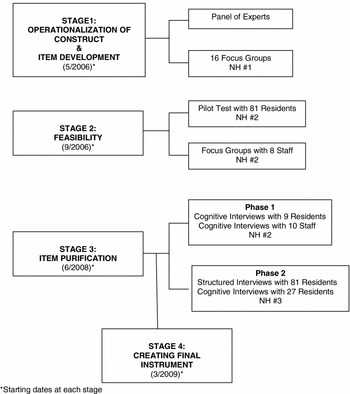
The overarching goal of this project was to develop a comprehensive set of items to measure R-REM among residents in long-term care facilities that are applicable for both residents’ self-reports and assessments by staff informants. A four-stage methodological approach for developing close-ended R-REM items was implemented sequentially: (1) Operationalization of the construct and item development through the use of focus groups and a panel of experts; (2) determination of the feasibility of a self-report methodology in the assessment of R-REM through pilot testing with residents and focus groups with staff; (3) phase 1: item purification via cognitive interviews with residents and staff, and phase 2: structured pilot interviews augmented with in-depth cognitive interviews with residents; and (4) creation of the final instrument (see Figure 1). These stages along with the methodological procedures used in their implementation are described below. Institutional Review Board approval was obtained by the respective organizations from which data were collected.
Methodological approach for item development.

Stage 1. Operationalization of R-REM and item development
Step 1: Operationalizing r-rem
To assure that all facets of R-REM were measured systematically, a crucial step was the operationalization of the construct. A panel of five experts in clinical geriatrics and social gerontology with specific interest and experience in elder abuse was convened for this task. The benchmark for their deliberation was the National Research Council (2003) definition of elder mistreatment: “Intentional actions that cause harm or create a serious risk of harm (whether or not harm is intended) to a vulnerable elder by a caregiver or other person who stands in a trust relationship to the elder, or failure by a caregiver to satisfy the elder's basic needs or protect the elder from harm.” After considering the applicability of this definition for long-term care residents, and focusing only on abusive events between residents, the panel of experts developed a consensus definition of R-REM: “Negative and aggressive physical, sexual, or verbal interactions between long-term care residents that would likely be construed as unwelcome and have high potential to cause physical or psychological distress in the recipient.” This definition guided the development of the R-REM measures.
Step 2: Focus group study
Focus groups were conducted with nursing home residents and staff in a 402-bed nursing home in New York City (nursing home 1) using the methodology developed by Morgan (Reference Morgan1988). The purpose was to assess the face-validity of the R-REM operational definition. The intent was to determine whether or not the examples gathered from the focus groups fit the expert-derived definition, types, and dimensions. This information was also gathered to improve item content.
A total of 16 focus groups were conducted by staff type and included individual session groups with nurses, nursing assistants, physicians, housekeeping, food service, physical therapists, and virtually all other employee types. Separate sessions were conducted with evening and night shift workers to capture events that might reflect different typologies at different times of the day. The focus group facilitator asked staff or residents to describe their personal experiences with R-REM (for a complete description, see Rosen et al., Reference Rosen2008a).
The focus groups averaged 45 minutes and resulted in 510 pages of written transcripts, analyzed using nVivo 7 (Bazeley, Reference Bazeley2007). Thirty-five different types of verbal, physical, and sexual R-REM were identified by staff; yelling or screaming at another resident was the most common R-REM. Participants described 29 distinct antecedents or triggers of R-REM; episodes were described as occurring most commonly in the dining room or residents’ rooms and in the afternoon (although virtually all knew of events occurring throughout the facility at all times of night or day). Staff reported that managing R-REM was stressful, but also identified 25 distinct management techniques, such as selectively congregating or separating residents who had proclivities to engage in R-REM (see Rosen et al., Reference Rosen2008a for details).
Step 3: Item creation
The approach to item creation for measuring and categorizing R-REM was derived from a well-established measurement strategy in the field of interpersonal aggression. A number of methods have been developed by family violence researchers that focus on enumerating aggressive or violent acts committed toward another individual. Two categories of actions were included for item development: (1) verbal actions that symbolically hurt the other person (e.g., cursing) and the use of threats (verbal aggression); and (2) acts of physical force, performed with the intention of causing pain or injury. The best known of these instruments is the Conflict Tactics Scale (CTS) developed by Straus and colleagues (Reference Straus, Hamby, Boney-McCoy and Sugarman1996), which has also been used extensively in studies of family abuse, including elder mistreatment. The strength of the CTS approach is behavioral specificity in its measurement of aggressive/violent acts or events. Since its inception, the CTS has been adapted for use in a wide range of settings, providing another advantage to using this scale in elder mistreatment research.
However, the contexts of family violence are clearly different from the long-term care environment. An innovative aspect of our approach was combining the CTS approach to measuring aggressive actions with the Cohen-Mansfield Agitation Inventory (CMAI) (Cohen-Mansfield et al., Reference Cohen-Mansfield, Marx and Rosenthal1989a). To our knowledge, this is the first attempt to integrate the measurement approach of the interpersonal violence field with that of nursing home resident aggression. The original version of the instrument contained modified items from the CMAI. This new set of items was cross-referenced with the descriptive information acquired from the focus groups to give it contextual relevance; that is, by adding elements, behaviors, and examples pertinent to long-term care facilities.
The resulting set of items (named the R-REM-Interview) ranged from less consequential aggressive actions (such as screaming) to increasingly serious aggressive tactics involving physical violence. Originally, many of the items were designed to be administered to staff. The R-REM-Interview resident version had simple queries about aggressive behavior (e.g., “In the past two weeks, have you been hit by another resident?”), and clear descriptors of the verb in the question stem (e.g., “When I say ‘hit’ I mean someone striking or banging you”).
The next iteration in the development of the R-REM instrument was intended to measure episodes of R-REM that could be elicited from either nursing home residents or staff caregivers. The instrument included 17 R-REM items: 9 physical, 3 verbal, and 5 other actions, e.g., trespassing, stealing, or damaging property. To provide an example of the format, one item read: “In the past two weeks, has another resident kicked you?” Response categories were: “never,” “less than once weekly,” “once or twice a week,” “several times per week,” “once or twice daily,” or “several times a day.” Specific descriptors were used to explicate behaviors; for example, the descriptor for “kicked” was “striking forcefully with feet at you.” When a respondent endorsed an event as occurring, a follow-up “distress” question was added: “How disruptive was this to your activities?” Response categories were: “not at all,” “a little,” “moderately,” “very much,” and “extremely.”
Stage 2. Feasibility of resident reports
Because it was unclear as to whether or not R-REM was a suitable phenomenon to be captured through self-reports by long-term care residents, a feasibility pilot study using face-to-face resident interviews was undertaken.
The resident instrument was piloted for feasibility on four floors of a not-for-profit long-term care facility (nursing home 2) that houses residents with mild-moderate to no cognitive impairment (n = 81). The majority of respondents were female (69%) and white (89%); the mean age was 85 years (SD = 7.0). The mean length of stay in the facility was 7.9 months (SD = 3.3). Half of the subjects had mild (33%) or moderate (17%) cognitive impairment as measured by the CAREDiag (Golden et al., Reference Golden, Teresi and Gurland1984).
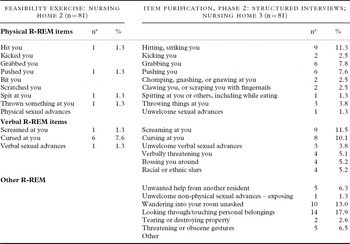
The instrument was successful in eliciting self-reports of R-REM (Table 1): four physical and eight verbal; seven unique individuals sustained some form of R-REM. Respondents also reported high disruption of activities due to R-REM. Data from this phase demonstrated that interviewing residents directly about R-REM is feasible and that an instrument to codify those reports is viable.
Item endorsement during the feasibility stage and at the item purification stage

Note: an = number of events, not unique individuals.
Staff informant interviews are a common method used to collect resident-related data in long-term care settings (see Cohen-Mansfield et al., Reference Cohen-Mansfield, Werner and Marx1989b; McCusker et al., Reference McCusker2011). Thus, less extensive qualitative examination to test its feasibility to gather R-REM data from staff as compared with residents was deemed necessary. Face validity of the staff instrument was assessed via focus groups with eight staff nurses at the same facility (nursing home 2). Similar to the focus groups conducted for item development, nursing staff showed substantial experience with R-REM, were able to relate to types and triggers of R-REM, and provided examples of management strategies.
Based on the feasibility and focus group data, the research team and panel of experts decided to add several exploratory items to the R-REM-Interview, and to modify one item. An example of “ramming with a wheelchair” was added to the description of “hitting,” and the item stem was broadened to include, “hitting or striking you.” In addition, several exploratory items were added to an “Other” category. These included, “wandering into your room, uninvited,” “rummaging through your things,” “tearing or destroying your property,” “threatening you with a cane or other object; waving an object at you in a threatening manner, but not actually touching you.”
Stage 3. Item purification: cognitive interviews and pilot testing of close-ended items
Once the set of preliminary close-ended items was developed, item purification was accomplished in two phases. Phase 1 consisted of cognitive interviews with residents and staff; phase 2 consisted of a pilot test of the structured interview and supplemental cognitive interviews with residents. Cognitive interviews were implemented at this juncture because the question–answering process used for nontrivial survey questions, such as those included in the R-REM-Interview, may be complex and involve multiple cognitive steps (see Jobe and Herrmann, Reference Jobe, Herrmann, Herrmann, Johnson, McEvoy, Hertzog and Hertel1996).
In-depth cognitive interviews contained open-ended probes to obtain insight into different aspects of item comprehension and the response process, including (a) comprehension of the question intent: What does the respondent believe the question to be asking?; (b) the meaning of terms: What do specific words and phrases in the question mean to the respondent?; (c) the recallability of information: What types of information does the respondent need to recall in order to answer the question; (d) how the responses are mapped: Can the respondent match his/her internally generated answer to the response categories given by the survey question?; (e) motivation of the respondent: Does the respondent devote sufficient mental effort to answer the question accurately?; and (f) sensitivity/social desirability: Does the respondent want to tell the truth or say something that makes him/her look “better”? (see Tourangeau's (Reference Tourangeau, Jabine, Straf, Tanurand and Tourangeau1984) survey response model).
The face-to-face cognitive interviews and the pilot structured interview conducted for item purification (see phases 1 and 2 below) were performed following the funnel approach logic used in focus groups (Morgan, Reference Morgan1998). Phase 1 (cognitive interviews) included general, broad probes in 19 (10 staff, 9 residents; nursing home 2) individual in-depth cognitive interviews to examine how the R-REM-Interview items were interpreted and answered. Phase 2 of the item purification process, with input from that learned in phase 1, consisted of structured interviews using close-ended items administered to 81 nursing home residents (nursing home 3), complemented by in-depth cognitive interviews with 27 of those residents. Specific concurrent and retrospective probes were included. Each phase of the item purification exercise is presented below:
1. Item purification, phase 1: cognitive interviews. Phase 1 of the item purification process examined structured verbal probes. Responses were analyzed and modifications to the R-REM-Interview items were implemented accordingly. A written protocol for administration of the R-REM-Interview and the probes, modeled after Nápoles-Springer and colleagues (Reference Nápoles-Springer, Santoyo-Olsson, O'Brien and Stewart2006), was used to assure adherence to the scripted interview. Scripted open-ended questions usually preceded the close-ended R-REM-Interview items so as not to influence the interviewee's interpretation of items, as item definitions were offered as part of the close-ended items. Open-ended questions or probes were used to assess interviewees’ interpretation of items. Word probes were used for comprehension of specific words; paraphrase probes were used for question comprehension. Examples of recall probes were: “You said the incident occurred two weeks ago; how did you remember back to two weeks ago?” Examples of comprehension paraphrase probes were: “Using your own words, can you ask me the question that I just asked you?” Respondent's behaviors when answering open probes and the R-REM-Interview items were documented using systematic behavior coding (e.g., interviewee requested clarification) as an additional approach to identify problematic items.
Ten residents were originally selected based on specified selection criteria: mild to moderate cognitive impairment with ability for verbal communication. Nine interviews were completed: eight in English, one in Spanish (by a bilingual interviewer). All the interviewees were females. The interviews with an average length of 45 minutes (ranging from 30–90 minutes) were conducted primarily in the residents’ rooms. Similar interviews lasting 30–45 minutes were conducted with ten female certified nurse assistants (CNAs) from different units across nursing home 2.
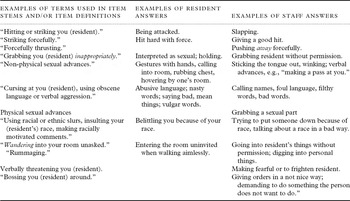
The results of cognitive interviews showed that staff and residents appeared to understand the intended meaning of the vast majority of items as asked. However, the phrasing of some items was deemed unclear: “hurling,” “tipping off surfaces,” and “inappropriate caregiving” were not well understood (see Table 2). Residents evidenced difficulties framing the occurrence of reported incidents within the indicated time-period (“last two weeks”) and with the location of incidents, i.e., some reported incidents might have occurred outside of the facility.
Examples of answers provided by residents and staff during the item purification-cognitive interviews

Confusing terms were substituted with those offered via the cognitive interviews. For example “hurling” was deleted from the definition of “throwing things at you”; “tipping off surfaces” was substituted with “tipping objects over”; “inappropriate caregiving” was changed to “unwanted help by other residents.” To address problems with recall within the requested time frame (i.e., framing the occurrence of reported incidents within the “last two weeks”), a question measuring item occurrence within the last year was added to each of the items. This aided the interviewee to focus on narrowing time frames. Furthermore, the phrase “here in the home” was added to every question to reinforce clarity regarding the location of the reported event(s).
A conglomerate of behaviors tapped by distinct items could potentially constitute a single R-REM event, thus two segregated questions were developed: (1) “You just told me about several things that happened to you within the past two weeks. Did this all happen at one time?” (Yes or No); (2) “If No, all together, about how many separate, distinct incidents were you describing that occurred at different times during the past two weeks?”
2. Item purification, phase 2: pilot test of structured interview with supplemental cognitive interviews. Besides focusing on the clarity and comprehension of the items, phase 2 of the item purification process aimed to examine the flow of the interview, i.e., the organization of the items based on substantive areas, and the sequence and format of the questions. This phase consisted of 81 (61% females; mean age = 77.4 years, SD = 11.9) structured face-to-face interviews reflecting item modifications from phase 1 cognitive interviews augmented with 27 cognitive interviews utilizing specific, concurrent, and retrospective probes. These structured- and in-depth cognitive interviews were conducted with residents only. The participating 81 residents were selected based on race/ethnicity and English language proficiency (30 White, 30 Black, and 21 Latinos) from units that housed mild to moderate cognitively impaired individuals. Frequency counts showed reports of physical events ranging from 1–9, verbal events from 3–9; and “other” events from 1–14. Twenty-eight unique individuals (35%) reported experiencing any R-REM; 13 (16.3%) physical, 13 (16.3%) verbal, and 26 (32.5%) “other” types (see Table 1).
The 27 residents (out of the 81) who participated in the in-depth cognitive interviews were also selected based on race/ethnicity. Interviews were completed in English with ten White, ten Black, and seven Latino residents. The cognitive interviews in phase 2 of item purification were implemented using a different methodology than that used in phase 1. Applying the funnel approach using information learned from phase 1, more specific probes were implemented after the full structured interview was conducted. In addition, a combination of concurrent and retrospective probing was used assessing recall, e.g.: “You said the incident occurred two weeks ago, how did you remember back to two weeks ago?”; “Where were you when the incident happened?”
This range of activities further helped to flag items that were still problematic with regard to definition and/or interpretation, and highlighted areas for improvement. Some item stems and definitions remained a source of confusion because of lack of clarity about their meaning, for instance “unwanted help.” Others, such as “banged” and “rammed,” were found to be too similar and thus repetitive. Discomfort was expressed regarding the use of terms such as “hitting, striking, attacking.” In addition, because some examples that were included as part of an item definition, such as “pushing your wheelchair,” or “removing IV tube” were those associated with staff roles, they caused confusion about who initiated the R-REM event, that is, another resident or staff. Intent was also a source of confusion when endorsing some items because, for instance, “banging or ramming with a wheelchair” might be accidental, and a frequent occurrence in crowded hallways. Likewise, the wording of the follow-up item for each behavior tapping the level of disturbance was modified from “How disturbing was this to you?” to “How much did it bother you?”
Stage 4. Creating the final instrument
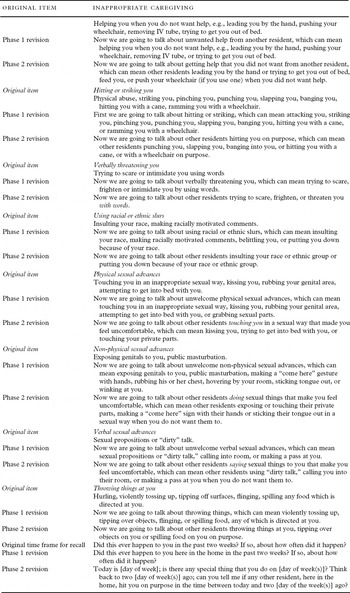
Items were modified once again based on information obtained through this iteration of cognitive interviews. Table 3 presents examples of item enhancement in terms of relevance and comprehension after each iteration of cognitive interviews. As shown in Table 3, the items reflect more accurately interviewee descriptions and thoughts about R-REM by adopting familiar language and examples, and/or by adding/deleting specific words or phrases to enhance comprehension, thus addressing sources of confusion.
Examples of item modification after two iterations of cognitive interviews (stage 3)

The combination of concurrent and retrospective probes used in phase 2 proved to be particularly useful in improving the recall process. The following sentences: “Today is [day of week]; is there any special thing that you do on [day of week(s)]? Think back to two [day of week(s)] ago” were introduced preceding the recall question to serve as an anchor to the required timeframe for event reporting. Table 3 (bottom) shows how the recall timeframe for response was modified based on the responses obtained through the two iterations of cognitive interviews.
Response categories were simplified. The frequency of occurrence was changed from seven categories (“never” to “several times an hour”) to recording the actual number of times occurred. Similarly, the 5-point Likert scale (“not at all” to “extremely”) for “bother” was reduced to three points: “not at all,” “a little,” and “a lot.”
Information regarding the organization and flow of the survey was also gleaned. Most salient was that the least egregious categories (i.e., verbal R-REM) should be placed earlier in the protocol (leaving those perceived as most egregious toward the end) to ease residents into the subject matter. In addition, some items were found to be best represented under a different domain than that originally assigned, e.g., from the physical to the sexual domain.
The final version of the R-REM resident and staff Interview contains a total of 22 items descriptive of R-REM behaviors, five “verbal” (e.g., Now we are going to talk about other residents trying to scare, frighten or threaten you with words); seven “physical” (e.g., . . .hitting you on purpose); three “sexual” (e.g., . . .touching you in a sexual way that made you feel uncomfortable); and seven “other” (e.g., . . .going into your room without asking you). The staff version was worded similarly but with respect to the residents. Staff was instructed that the incident involving the residents had to be directed at one or more specific residents.
To facilitate the assessment of R-REM prevalence, a separate “Summary Section” was developed. Given that behaviors are captured individually, a summary of all behaviors involved in any single incident was needed. Thus, reiterating all items endorsed previously, the interviewee is asked to report how many distinct incidents happened in the past two weeks. A verbatim description of the incident(s) is recorded. In addition, all behaviors contained as part of the item definition are listed to provide the opportunity for flagging (and later codification) when mentioned by the interviewee as part of each single incident. Questions tapping the level of bother and the most bothersome aspect of the incident(s) were included. Descriptors of the incident(s), e.g., location, time of occurrence, and the identity and gender of the perpetrator were also gathered. Finally, instructions for interviewers and skip-pattern questions were inserted throughout the protocol.
Discussion
The purpose of this paper was to describe in detail the qualitative methods used in the development of close-ended survey items to examine R-REM in long-term care. The wealth of data gathered from the multiple methods, including the collaborative work of a panel of experts, focus groups, and structured and cognitive interviews were instrumental to item development, revision, and enhancement. Not only did this information aid in flagging problematic items, it also helped to highlight the nature of problem(s) and provided ideas for item improvement. Item wording and phraseology were modified to represent language consonant with that used by the targeted population. Examples of the evolution of items were presented to illustrate how the combination of methods enabled item improvement at each step. This approach clearly supersedes the use of any of these methods for item development in isolation, providing the benefit of triangulation as well as fidelity in the interpretation of the concepts and terms allowing for incremental validation of the results.
Despite the benefits of this qualitative, multi-methods approach to item development, there are limitations. For instance, there is no guarantee, using any combination of qualitative methods, that the implemented item modifications are applicable to all individuals in any targeted study population. It is possible that a “perfect” item may be problematic once modified because the implemented revisions were in response to information pertinent or relevant to individuals of a specific culture, education level, etc. (see Nápoles-Springer et al., Reference Nápoles-Springer, Santoyo-Olsson, O'Brien and Stewart2006). Therefore, the multi-method approach presented here does not represent a stand-alone effort in measure development. There will always be other languages or sub-groups for which additional problems with items may be identified. However, given the large number of ethnically diverse respondents from the targeted assessment population and numerous iterations, it is argued that the measure is adequate to assess R-REM in many long-term care populations.
In addition, all measure development efforts (and/or adaptation processes) require a combination of qualitative methods, complemented and supplemented by quantitative methods for an adequate examination of measure performance (see Teresi et al., Reference Teresi, Stewart, Morales and Stahl2006). Additional steps used in the R-REM item development strategy is the subject of a separate paper in which classical and modern psychometric analyses, including both exploratory and confirmatory factor analyses, and item response theory methods are presented and discussed (see Teresi et al., in press).
It is acknowledged that there are limitations to the use of this measure like any measure that relies on self-reports of nursing home residents. These limitations are as follows: (1) The measure is limited in use mostly to those residents with mild-to-moderate cognitive impairment who are capable of meaningful communication and participation in research projects, and (2) information might need to be cross-referenced with an independent source or a proxy particularly for those individuals with severe mental disorders. For this reason it is recommended that both the staff and resident versions be used to obtain a comprehensive assessment from the resident and staff perspectives.
Despite these limitations, we suggest that our model for developing improved measures of R-REM is highly relevant for researchers working in other areas of elder mistreatment. As noted at the outset of this paper, one of the major barriers to understanding the prevalence and consequences of elder mistreatment is the lack of reliable and valid measures in the field. It is widely acknowledged that elder mistreatment is difficult to measure; barriers include respondent's unwillingness to acknowledge abusive behavior, differing definitions of what constitutes mistreatment, and problems distinguishing intentional actions from unintentional ones that nevertheless cause harm. The process we propose here represents a comprehensive approach to addressing these problems. Strengths include the use of an expert panel to frame the initial operationalization of mistreatment; integration of two measures that focus on clearly observable behaviors that can ultimately be quantified; and extensive use of focus groups and cognitive testing to develop and refine the content of specific items. Such an approach is likely to be useful not only in future research in long-term care but also in the various other contexts in which elder mistreatment occurs.Footnote 1
Conflict of interest
None.
Description of authors’ roles
Mildred Ramirez was a member of the panel of experts, contributed to all aspects of the design and implementation of the study, conducted cognitive interviews, and was the lead author of the paper. Beverly Watkins conducted cognitive interviews and assisted with writing the paper. Jeanne A. Teresi was the principal investigator of the subcontract for data collection, supervised all aspects of study design and implementation, was a member of the panel of experts, and contributed to writing the paper. Stephanie Silver was the study coordinator and assisted with writing of the paper. Gail Sukha was responsible for the training of the interviewers and for data collection. Gabriel Bortagis was the field coordinator for the study responsible for the supervision of the data collection. Kimberly Van Haitsma was a member of the panel of experts and contributed to writing the paper. Mark S. Lachs was the principal investigator of the study, a member of the panel of experts, supervised all aspects of study design and implementation, and contributed to writing the paper. Karl Pillemer was a co-principal investigator of the study, a member of the panel of experts, supervised all aspects of study design and implementation, and contributed to writing the paper.
Acknowledgments
The preparation of this manuscript was supported in part by the following grants: NIA 2RO1 AG014299-06A2, Resident-to-Resident Elder Mistreatment (R-REM) in Long-Term Care Facilities; NIJ FYO 42USC3721, Documentation of Resident-to-Resident Mistreatment in Residential Care Facilities; the NYSDOH Dementia Grant Program contract #C-022657, Staff Training in Resident-to-Resident Elder Mistreatment, the Harry & Jeanette Weinberg Center for Elder Abuse Prevention, and by an NIA Edward R. Roybal Center Grant, 1 P30 AG022845-02).The opinions expressed in this paper do not reflect those of the funding agencies.