




No CrossRef data available.
Article contents
- Abstract
- INTRODUCTION
- FROM SUGARCANE TO OIL: SETTLEMENT AND ECONOMICS
- CREOLE IDENTITY: ETHNIC TIES IN LOUISIANA
- BILINGUALISM: LANGUAGE USE OVER TIME
- OPELOUSAS AND PARKS
- THE ABSENCE OF GLIDING IN CAAVE VOWELS
- DISCUSSION
- GRASPING THE NETTLE
- THE PERSISTENCE OF CAAVE
- APPENDIX 1: RURAL CREOLE AFRICAN AMERICANS
- APPENDIX 2: SPECTOGRAPHIC DISPLAY OF [au] AS MONOPHTHONG (FIRST TRANSCRIPT) AND DIPHTHONG (SECOND TRANSCRIPT)
- References
The English Vernacular of the Creoles of Louisiana
Published online by Cambridge University Press: 17 March 2004
Article contents
- Abstract
- INTRODUCTION
- FROM SUGARCANE TO OIL: SETTLEMENT AND ECONOMICS
- CREOLE IDENTITY: ETHNIC TIES IN LOUISIANA
- BILINGUALISM: LANGUAGE USE OVER TIME
- OPELOUSAS AND PARKS
- THE ABSENCE OF GLIDING IN CAAVE VOWELS
- DISCUSSION
- GRASPING THE NETTLE
- THE PERSISTENCE OF CAAVE
- APPENDIX 1: RURAL CREOLE AFRICAN AMERICANS
- APPENDIX 2: SPECTOGRAPHIC DISPLAY OF [au] AS MONOPHTHONG (FIRST TRANSCRIPT) AND DIPHTHONG (SECOND TRANSCRIPT)
- References
Abstract
The English spoken by Creole African Americans in southern Louisiana reveals language change in the shift from French to English and the persistence of local forms of English. The overview of the socioeconomic history of Louisiana details the number of ethnic groups and the fluctuating social and linguistic relations among them over time. The study sample consists of 42 African Americans with French ancestry living in Opelousas in St. Landry Parish and Parks in St. Martin Parish. The high rate of the absence of glides in the vowels (ai, au, oi, i, u, e, o) is maintained across all generations of the 24 male speakers described. A possible source of glide absence, such as foreign language influence, is explored but found unconvincing. A more plausible explanation is that glide absence was part of the English brought to the area by native speakers in the early 19th century.We acknowledge the generous support of the National Science Foundation (BSR-0091823) as well as the coding work done by two research assistants Vicky Polston and David Herrell. We also like to thank the two anonymous reviewers for their careful reading of the text and their valuable comments.
Information
- Type
- Research Article
- Information
- Copyright
- © 2003 Cambridge University Press
INTRODUCTION
Language and social variation in Louisiana has a long and complex history, and any account of the present day varieties of English must begin with a historical overview of the ways in which language, ethnicity, race, and socioeconomic structure have been interwoven to form the intricate tapestry that is Louisiana. There is no straightforward story to be told. Ethnicity is complicated by race, race is complicated by language, and ethnicity, race, and language are complicated by the continual restructuring of the economic base, from a plantation economy to a sharecropping one and from manufacturing to the boom economy following the discovery of oil. The social upheavals over the centuries have had substantial consequences for the diverse speech communities in Louisiana, not least of which was the loss of the French language that had for so long marked this state as unique in the United States. The outstanding linguistic characteristic of Louisiana is its regional and social dynamism, and it comes as no surprise that there are few linguistic descriptions of spoken varieties of English in Louisiana, and even dialect atlas projects of Southern English have been satisfied with a few token speakers or have preferred to sidestep the state altogether.1
There are growing numbers of studies on the English spoken by Cajuns (Cheramie, 1999; Dubois & Horvath, 1998a, 1998b, 1999, 2002; 2003a, Scott, 1992; Smith, 1936; Walton, 1994); Rubrecht (1971) is the only descriptive study of the English spoken by Louisianians who speak English as a first language. Bailey & Bassett (1986) and Lambert (1995), however, do note the presence of particular Southern features in Louisiana.
The focus of this article is on the English currently spoken by African Americans of French ancestry who live in southern Louisiana in the prairie area of the French Triangle. The Louisiana Creole African American Vernacular English Corpus was constructed in 2001. The database is designed to include a representative sample of bilingual speakers of English and French living in two geographical areas in southern Louisiana (see Figure 1). The first set of interviews was collected in and around Opelousas (Leonville, Washington, Frilot Cove, and Bois Mallet) in St. Landry Parish; the other set was conducted in Parks in St. Martin Parish. The aim of the project is to investigate specific phonological and morphological features, some of which are associated with Southern White Vernacular English (SWVE; see Bailey, 2001) and/or African American Vernacular English (AAVE), and some of which are likely to be particular to the English spoken in the Louisiana French Triangle. A comparison of Creoles and Cajuns is also an important goal of the study and our research design calls for bilingual speakers. Some older speakers in our corpus learned English late in life and their parents were unilingual in French. Others learned English first but also mastered French as well when they were young.

Map of southern Louisiana.
The sample is made up of 42 Creole African American speakers who were born, raised, and still live in their home parish. Only age and gender were considered in the design of the sample, although we have also been able to investigate other social factors, such as the level of education and early language learning experiences. The 24 men are equally divided into four age groups (old: born between 1915–1920; seniors: 1932–1940, middle-aged: 1945–1955; young: 1966–1980), whereas the 18 women formed three age groups (old: 1912–1931; middle-aged: 1941–1951; young: 1969–1981). Only the 24 men will be reported on here.
Sociolinguistic interviews in English of approximately one hour were conducted by two African American speakers from southern Louisiana. Some interviews were also conducted in French with older monolinguals not included in the sample to collect historical background information. The interviews dealt mainly with sociodemographic topics concerning the speaker and his/her family (residence, work, education, parents' origins), social and cultural practices, the use of English with family members, relatives, and friends, and their attitudes toward the variety of English spoken by the local and general White and Black populations.
The ways people from Louisiana live, work, present themselves to the world, and, more importantly, how they express themselves have periodically undergone fundamental transformation. Before describing the speech community and some aspects of its English, we will explore three historical themes that are essential to our understanding of the dialect spoken by these people. The first theme we explore concerns the socioeconomic changes that have taken place over the last two centuries that have substantially transformed people's lives, including the fall of the plantation system, the Civil War and its aftermath, and the Civil Rights Movement, all of which had a strong impact on these French-speaking, rural Black communities. The second theme has to do with Creole ethnicity; in particular, we examine this problematic ethnic category as it wavers between inclusivity and exclusivity, positive and negative identity. Which groups were or were not identified as Creoles, or even at times which groups were prohibited from identifying as Creoles, fluctuated over the two centuries until Creole finally came to refer most frequently to African Americans with French ancestry who live in rural Louisiana. The third theme is about bilingualism and how the relationship between French and English is interwoven with race, ethnicity, social class, and economics. The replacement of French by English, a process that began not so long after the beginning of the 19th century and which is only now reaching completion, is a fundamental sociolinguistic change in the history of Louisiana. A chronological overview of the three historical themes is given in the appendix.
Following the historical overview, we provide demographic information on the two communities, Parks and Opelousas, and describe sociolinguistic differences among speakers in each age group. The absence of glides (ai, au, oi, i, u, e, o) is analyzed; we find that glide absence remains high across all age groups. In the discussion we explore the potential sources of glide absence; we try to explain the persistence of these dialect forms despite massive sociocultural changes affecting the Creole African American people of southern Louisiana.
FROM SUGARCANE TO OIL: SETTLEMENT AND ECONOMICS
The social structure, based on race and socioeconomic status, was well established during the French and Spanish regimes. As Maguire (1989:39) observed, the plantation economy of rural Louisiana determined the relationship of people with land and with each other. At the top of a social pyramid were the White landowners, who owned both the land and the people who worked it, and a powerful elite, also White, made up of politicians, bankers, civil officials, and so forth, who had access to and control over land, labor and, most importantly, capital. Below them, were Whites of different ethnic origins (French, Acadians, etc.) and modest means who were teachers, small-scale merchants, craftsmen, artisans, mid-sized and small farm owners. At the bottom of the pyramid were the Black slaves, who came from diverse places and who for a long time were more numerous than the White population.2
The slave trade brought close to 6000 Africans from within a relatively homogeneous cultural area (the Senegambia region) between 1717 and 1731 (Hall, 1992:55–60). See Hall (1992), Berlin (1998), and Ingersoll (1999) for an extensive description of the French slave trade and the African American history of colonial Louisiana. In addition, 3,225 slaves came to Louisiana, along with White Frenchmen and Colored people, during 1809 and 1810 in the aftermath of the slave revolt in Haiti in 1802 (LaChance, 1996:265). From 1790 to 1860, thousands of slaves were brought to Louisiana sugarcane and cotton plantations from the Upper South and the east coast of the South (Berlin, 1998). The clandestine slave trade in Texas also channeled hundreds of slaves to Louisiana between 1838 and 1859 (Daniels, 1990).
As always in Louisiana, the social pyramid metaphor, which neatly accounts for the social positions of Blacks and Whites, is complicated by the position of “Colored” people, who were smaller in numbers compared to other groups, but who are extremely important in Louisiana history. Colored people were the free descendents of mixed unions (usually between White men and Black women). They were “highly stratified both economically and socially” (Brasseaux, 1996:76), and are to be found at all levels of the social pyramid—an aspect that is frequently forgotten by reseachers who usually refer only to those who were wealthy. A small number of them were wealthy planters and enjoyed social and economic privileges, including access to education, and they shared the top of the pyramid with the White elite. On the second tier with the less wealthy Whites were many Colored farmers or skilled craftsmen and artisans with little or no land. Some of the Colored people were fieldhands and mill laborers and were on the third tier with the Black slaves, although they were distinguished among them because they were free.
The plantation economy grew stronger after the Louisiana Purchase in 1803. Cotton cultivation into marginal lands expanded enormously (Gray, 1933). The tiny village of Parks, for example, had two cotton gins. Although both Opelousas and Parks and the surrounding areas had small farms that had mixed crop operations, Opelousas came to be dominated by large-scale cotton and corn cultivation and small farms growing vegetables, whereas monocrop sugarcane enterprises dominated employment in Parks and along the Bayou Teche. English-speaking planters and their English-speaking slaves migrated from the Upper South (Virginia, Maryland, North Carolina, central Kentucky, central Tennessee) and from areas along the Carolina/Georgia coast (Bailey, 2001:58).
Once the Civil War was over and the slaves were emancipated, massive changes took place in Louisiana. The plantation industry almost collapsed; fields were abandoned or undercultivated. Many White planters were financially ruined and left Louisiana. And because of mounting hostility towards the entire non-White population, some members of the Colored elite who had lost their land-holdings, Colored farmers and laborers, and freed slaves fled Louisiana as well. Moreover, Anglo-Americans continued to migrate to the area so that they formed a significant proportion of the population (Spletstoser, 1978), and many took over indebted or bankrupt plantations, especially along the Mississippi. Maguire (1989:68) calculated, using surnames of registered sugar growers, that a third of the sugar planters in St. Martin Parish (Parks) were Anglo-Americans. They invested capital and improved technology so that the plantations and sugarhouses slowly regained their strength, although it was not until the mid-20th century that the large agricultural holdings finally became successful.
When the Federal Government began to control the states of the Southern Confederacy, the number of mid-sized and small farms increased. Competition for land among White, Colored, and Black populations was fierce. Maguire (1989:187) mentions that in the aftermath of the Civil War, White “landowners, often short of capital or ruined by the war, sold land for as little as $.50 an acre” in St. Martin. To save what was left from the agricultural industry, many disadvantageous financial dealings at high rates were conducted with northern banks. The Colored elite who still had some capital, poor White and Colored farmers, and freed slaves who had managed to accumulate capital, bought parcels of land in rural areas.
For most people, however, life was a struggle. The detrimental effects of the Civil War, such as the high cost of replacing animals and farm implements that had been destroyed, had a lasting impact (Brasseaux, 1996:81–83); diseases, weather catastrophies, falling cotton prices, and low prices for their crops all brought a large proportion of the farming population to their knees in the last decades of the 19th century. Brasseaux argued that both White and Black farmers who had secured credit at 10 and 15 percent to start farming were unable to meet their payments to the banks. A huge proportion of White, Black, and Colored farmers lost their farms and were forced into tenantry (Schweninger, 1990). The most spectacular decline was experienced by the once prosperous Colored elite.3
For instance, the average decline in the value of ten Colored families' estates in St. Landry was a shocking 88% in ten years. “By 1910, most [Colored from the elite] had been reduced to tenantry in both St. Landry and St. Martin” (Brasseaux, 1996:83). While the number of people who controlled sugarcane plantations and farms decreased, the agriculture industry was rationalized and land holdings were further consolidated.
Despite movements of freed slaves out of the sugarcane area and toward cities, many remained in rural areas. Maguire (1989:71) convincingly argued that the majority of former slaves after the end of the Civil War continued to be economically dependent on the plantation or agricultural system; therefore, they found themselves excluded from participating in changes that were going on in the local postwar agricultural economy. A majority of freed slaves did not have the money to purchase or work the land. Moreover, few had the skills needed to secure the few nonagricultural jobs available. The revitalization of the agricultural economy after the Civil War increased the demand for them as laborers, particularly during planting and harvest seasons. In addition, they, along with poor Whites and Coloreds, were sharecroppers or tenant farmers.
Many of the people on the bottom of the social pyramid became field workers and were heavily dependent on the gang labor system and were forced to accept the wages established by landowners. They earned little, the payments were erratic, and they lived in workers' compounds (usually former slave cabins) or in houses mostly owned by White landlords. Field hands followed the crop “through its cycles, in between seasons they would sell their services to local small farmers. During the cold postharvest dead season, they were forced to live off resources accumulated during times of peak farm activity” (Maguire, 1989:69). Even tenant farmers often worked in the cane field and at the mills during harvest to supplement their incomes. The whole farming population, regardless of race or whether they were small farm owners, tenant farmers, or sharecroppers, became indebted to landowners and merchants.4
As Bailey (2001:63) mentioned, general stores acted as the credit distributors between the farmers and the banks.
At the end of the 1930s, agriculture slowly but steadily became mechanized and was almost completely mechanized by the 1960s. This had a tremendous impact on the Black and White communities who had moved off the land to local subdivisions in rural cities and larger urban centers. An overwhelming number of Blacks left Louisiana, primarily for Texas.5
The movement off the land was widespread throughout the South, not only in Louisiana. Bailey (2001:58–66) observed that in 1910, 89% of Blacks lived in the South and more than 75% were in rural areas. By 1970, 47% of the Black population lived outside the South and 77% lived in cities. Using a sample of families, Maguire (1989:253) discussed the massive migration of the young adult population in Parks. Of Blacks who were around 18 years old between 1960 and 1969, 29% still live in Parks or the vicinity, 54% no longer live in either Parks, St. Martin Parish or surrounding parishes, and 39% of them who left now live in Texas. Maguire's results on the place of residence of siblings or children of Blacks born between 1927 and 1942 is even more astonishing. Almost half of two generations of former inhabitants no longer live in and around Parks and 41% of those who left lived in Texas in 1979. When Louisiana areas such as Lake Charles, Shreveport, and so forth, are considered, this percentage rises to 50%. The migration of Blacks is testimony to a desperate employment situation.
There were 1,208 farms in 1964 compared to 393 in 1982 in St. Martin parish but the farm size almost doubled between 1972 and 1982. In the 1980s, close to 70% of the land was rented from nonfarming landlords. Maguire (1989:248–249) mentioned that only a few, if any, whose ancestors worked almost exclusively in agriculture were working in the farming industry by 1980.
The Civil Rights struggle was strongly supported by Creole African American communities. The social and political changes that occurred at the local and national levels allowed members of these communities to begin to move marginally up the economic scale. The Voting Rights Act drew Black people together and created an effective political force (Hirsch, 1992:288–291). Title VII of the Civil Rights Act of 1964, which banned job discrimination against race, religion, national origin, or sex, allowed many young Blacks to secure decent employment. Without a doubt, the most influential development in recent times in the part of Louisiana with which we have been concerned has been the economic boom associated with the development of the oil and gas industry. Growth in related service sectors and in transportation, manufacturing, and administrative operations was experienced in and around Lafayette, the urban center closest to both Parks and Opelousas. Maguire (1989:269–270) reported that a former sharecropper in his late 30s became the first non-White from Parks to be hired by an oil company to work on an offshore rig in 1966. Even so, as Maguire (1989:272) reminded us, “the boom of the state's oil and gas industry did not wipe away decades of marginality for the poor of the parish.” In the early 1980s, African Americans still represented the overwhelming majority of unemployed and impoverished people in Louisiana. Northern textile industries also began to open manufacturing plants in the South to take advantage of the pool of nonunionized, cheap labor. Maguire (1989:276–288) described how parishes fiercely competed with each other to get the textile plants to build in their towns. With an exodus of African American citizens reaching close to 50%, local politicians looked to the textile industry to stem the tide. Factories opened in many parishes in Louisiana under advantageous settlements, and the exodus of the middle-aged and young residents stopped. The textile industry became the most important employer in rural areas, even though the passage of NAFTA has now curtailed the number of employees in many textile plants, as the manufacturers continue their trek south in search of cheaper labor.
CREOLE IDENTITY: ETHNIC TIES IN LOUISIANA
Anyone interested in ethnic labelling should find the story of the Louisiana Creoles particularly captivating. Of all the migrants to America, Louisiana Creoles may be the only group where the label has remained constant for hundreds of years, but the constituency has changed dramatically several times (Dominguez, 1986; Dormon, 1996; Dubois & Melançon, 1998, 2000; Melançon, 2000). At the beginning of the French colony, being a Creole had no racial interpretation; it was applied to first generation and native-born colonials, whether White, Black, or ethnically and racially mixed, as well as descendants of endentured servants or slaves. “Nativity was all, because its sanction of local birth as a claim upon preferential civic power had evolved in a society which knew only white men as political persons…. Unchallengeable white supremacy, in short, had made it possible to accommodate a pan-racial creolism” (Tregler, 1992:172). When the Spanish took over the colony around 1763, the colonials in opposition to the new regime began to stress the importance of French ancestry to being a Creole. However, in time the Creole label gradually became associated with connotations of wealth and high status (White Creoles and Colored Creoles). Although Whites, Coloreds, and Blacks of modest means who thought of themselves as Creoles were tolerated by the elite, the enslaved ‘Creoles’ were excluded.
The onset of American rule after the Louisiana Purchase brought with it a strict sense of racial purity. When the White population started to exclude the Colored Creole elite from the social and economic power bases they formerly had access to, the long-standing White–Colored–Black racial spectrum gradually turned into a binary White/Black system. Nervous White Creoles perceived both Colored and Black Creoles to be a threat to the maintenance of their own status, and not surprisingly they imposed the requirement of “pure white blood” for Creole identity, denying non-White populations from calling themselves Creoles. The response of the Colored Creoles and Black Creoles was to cling fiercely to their French heritage, the French language, and the Catholic religion. The aftermath of the Civil War further polarized the White and non-White populations and provoked the rapid growth of racist groups. A massive exodus of Colored and Black Creoles coincided with the arrival of many Americans and foreign migrants. Louisiana became predominantly White for the first time and remained so. The impact of Reconstruction and the Jim Crow Laws were to ensure that those in Louisiana with any Black ancestry, whether French or not, were assigned to a single racial group.
By the turn of the 20th century, Colored Creoles who could not pass for “white” (Arthe, 2000:29), no matter if they were planters who had lost their land holdings or were poor farmers, were regarded by the White population as Blacks. For Whites, the final coalesence of all non-White people finally erased the distinction between Black Creoles of French ancestry and Blacks without French ancestry. Although it is true that the differentiation between Coloreds and Blacks became more blurred through intermarriage, linguistic assimilation, and social mobility (Fairclough, 1995:17), they continued to make the distinction between themselves, at least in rural areas, until the 1960s. The former Colored Creole elite also continued to distinguish themselves from poor Colored Creoles (and some isolated Creole communities still do, according to Mills, 1977; Woods, 1972). Even in the most remote communities like Parks, some Colored Creoles had more land, acquired some formal education, had nonagricultural jobs, and travelled beyond the limits of their parish. Moreover, the entire Colored population was regarded as an awkward group of people by the English-speaking Black population with no French ancestry, and even by those Black Creoles with remote French ancestry who were by then embracing Black affiliation as a cohesive force and were only speaking English. Whether or not Colored Creoles occupy a unique position is a heated topic among the Louisiana African American population today. Creoles' maintenance of French and French cultural identity is viewed by some as undermining the Blacks' political struggle.
In the forerunner to our present study, a sociolinguistic survey on identity and language attitudes was conducted in 1997 in the Louisiana Creole community, involving 240 respondents from Breaux Bridge and Opelousas (Dubois & Melançon, 1998, 2000). Further extensive work was carried out by Melançon (Melançon, 2000). The latest twist found in the reidentification of Black people of Louisiana is not whether they are Creoles, but whether they are African Americans. Louisiana's Black population no longer claims any form of French ancestry, even if a large proportion no doubt could do so: only 1.2% of African Americans in Louisiana did so for the 1990 Census. The survey found that an overwhelming proportion of Blacks with French ancestry identified themselves as African Americans rather than Creoles, regardless of age. (See also Brasseaux et al., 1994; Dormon, 1996.) Identifying oneself as an African American is probably a tribute to the tremendous impact of the Civil Rights Movement. All of the respondents, however, agreed that Creole identity includes one fundamental characteristic: a Creole is someone who has Creole ancestors, grandparents, or parents who spoke French. Race, religion, or location are not considered necessary characteristics. Although three-quarters of the respondents fit the definition, those who identified themselves as Creoles still speak French. Therefore, for those who do call themselves Creole, fluency in French remains the key characteristic. The more fluent in French, the more likely a person is to identify as being a Creole, regardless of age. Because the speakers in our corpus still speak French, call themselves Creoles, but also recognize the importance of the label African Americans for their community, we defer to their understanding of their identity by using the label Creole African Americans and call the variety of English they speak Creole African American Vernacular English (CAAVE).
BILINGUALISM: LANGUAGE USE OVER TIME
One fascinating aspect of Louisiana sociolinguistic history is the speed of the shift from French to English within high-status social groups compared to the gradual change within lower status groups. After the Louisiana Purchase, Anglo-Americans arrived in force and the French elite lost its hegemony over language, along with the loss of political, economic, social, and eventually numerical dominance.7
No official action was taken to curb the language shift, and what resistance to the shift there was, proved not to be vigorous enough to preserve even the dialect of the Louisiana elite (Dubois, 2003).
The process of adding English to their linguistic repertoire began in and around New Orleans. English-speaking Americans of Irish and Scottish origin, as well as migrants from other European countries, arrived in large numbers after the Louisiana Purchase. From 1830 to 1840, the population of New Orleans expanded from 46,082 to 102,193. By 1860, the French population ranked only third in New Orleans, following the Irish, who were the most numerous, and the Germans (Spletstoser, 1978:299). In the same year, of the free population living in the Vieux Carré in New Orleans, just over half were foreign-born, less than a fifth were American-born, and a third were Louisiana-born (Tregler, 1992:165). Teachers were recruited from the North and the number of schools expanded. Tregler (1992:160–161) mentioned that by 1839, Anglo-Americans outnumbered all other groups in law and medical schools in New Orleans by a ratio of three and a half to one, “and no evidence of a fall off from this tendency appears in the years which followed.” He also observed that the use of French in newspapers, business, and official proceedings began to diminish rapidly in the 1840s and even the press and literary circles that did use French were dominated by Continental French people.
After the Civil War, the social boundaries between the new and ever-growing English-speaking population and the French-speaking population began to blur. Intermarriage between Anglo-Americans and Creoles of all social classes and racial groups in New Orleans and urban centers became frequent. Members of the upper class, who had clung tenuously to the precarious prestige afforded by their French ancestry, began to mingle economically and socially with the English-speaking population, something they had shunned before (Hamel, 1984:271). Fearing the rise of Colored Creoles into power, the White Creole upper-class also began to embrace the racial political agenda of the Anglophones. The switch to English by the New Orleans Colored Creole elite was one among many other strategic moves they made in order to combat legalized segregation and racism. As Fairclough noted (1995:3) they were an educated, “skilled, assertive and self-confident group who resisted all legal sanctions imposed on them (by English-speaking Whites) by all means available to them.”8
They established the first branch of the National Association for the Advancement of Colored People (NAACP) in New Orleans in 1915, which provided legal aid and monetary support when possible. They also established a network of doctors, lawyers, bankers, and insurance agents that helped Blacks who were unable to access these services elsewhere. Their involvement in the Commission on Interracial Cooperation allowed dramatic improvements in the number and quality of schools that were established for non-Whites (Dubois & Melançon, 2000:243).
The history of English and French for the people we are concerned with, the Creole African American rural population, is more complex. From the Louisiana Purchase until the end of the Civil War, two distinct linguistic groups of planters emerged: the English speaking Anglo-Americans and French-speaking Whites and the Colored Creoles along with newly arrived French colonists from France and Haiti. It was usual for the slaves to be identified by the surname of the plantation owner and to speak his language as well; thus, there were both French- and English-speaking slaves in southern Louisiana. The French plantations were established earlier so that there were generations of French-speaking slaves, free farmers, and laborers (Chaudenson, 1992).
Bailey (2001:59–60) gave an account of the movement of slaves into the interior South, a much larger region than we are concerned with here, and presented an account that is not complicated by the presence of French speakers, in which he said that a substantial proportion of the imported slaves came from the East Coast. The majority were from the Upper South and used 19th century varieties of English more like those of local Whites, but many also came from the South Carolina/Georgia coast, where Gullah was spoken. Deerr (1949) also mentioned the arrival of thousands of slaves to Louisiana from Virginia farms in 1835.9
In his study of the state of birth of 487 settlers who came to North Central Louisiana before 1900, Trout (1996:473) reported that 25% were from Georgia and 48% came from four states: Alabama, South Carolina, Tennessee, and Mississippi.
Both French-speaking and English-speaking sugarcane and cotton plantations of different sizes were established in Louisiana, including the vast prairie area where the Creole communities we are studying, Opelousas and Parks, are situated. However, Hillard's maps (1884, cited in Bailey, 2001:60–62) showed that more English plantations were established in the north of Louisiana in the three decades before 1860. It is likely that the number of English-speaking slaves in Louisiana was higher than the French-speaking slaves overall, but the uneven distribution of English/French plantations would mean that most of the French-speaking slaves were in southern Louisiana, although they were not the majority.10
Even in New Orleans in 1850, 2,246 out of 6,616 former salves were from Delaware, Maryland, Kentucky, and Missouri (Chenault & Reinders, 1996:438).
In the decades following the Civil War, four non-White groups living in rural areas came into contact: 1) an undetermined number of illiterate French-speaking former slaves; 2) an undetermined number of illiterate English-speaking former slaves; 3) a relatively large French-speaking Colored population of modest means; and 4) a smaller group of English-speaking or bilingual, educated Colored Creoles who were by then reduced to tenancy. They were surrounded by two large populations: the French-speaking population made up of French colonists and Acadians, some of whom were wealthy and many of whom were poor, and an English-speaking ruling class. With so many different sociolinguistic groups, an endless number of language shift or language maintenance processes can be imagined. The following scenarios, some of which are based on information obtained in interviews, seem to us to be the most likely given the historical accounts of the populating of this region and the linguistic situations that can be observed today.
Two linguistic periods can be distinguished: 1) that period between the end of the Civil War and the turn of the 20th century, and 2) the period from the early 1900s to the 1960s. Within the first period, bilingualism was introduced to the Creole African American communities, followed in a minority of cases by language shift. People had little or no schooling, so it does not seem likely that schooling was sufficient to learn English. English was spoken within the community or else there would have been no need to learn English. Brasseaux et al. (1994:112) mentioned that, in 1910, approximately 59% of Colored Creoles in Wards 1–3 of St. Landry and 46% in Ward 1 in St. Martin spoke English. But, more importantly, English was present at all social levels. During this period, English speakers and French speakers were drawn into each other's speech community. English-speaking former slaves married French speakers and they and their descendants spoke French or English, but probably were bilingual; French-speaking former slaves and some among the Coloreds learned English through intermarriage, through work relationships, or during seasonal work outside of Louisiana.11
The grandmother of one elderly speaker (born in 1925) was an English-speaking slave from Virginia who married a French-speaking local sharecropper. This speaker and his wife learned French as their first language but learned English when they were very young. One speaker (born in 1918) learned English from his grandfather who only spoke English until he moved to a small town named Crowley where he learned French. Elderly speakers with English-speaking ancestors report that both English and French were spoken depending on the circumstances and the interlocutors. Many elderly speakers have fathers who learned English with other coworkers while working in the field and later married English-speaking spouses. The grandmother of one speaker grew up in a family that could afford to send her to school where she learned English. She later married a bilingual and they decided to raise their children in English.
During this period, however, some groups of speakers maintained only English or only French. As usual for Louisiana, the story of language maintenance is complex. The groups who maintained French, ranging from Colored farmers and laborers to French-speaking former slaves, shared several characteristics. They were very poor, they were fieldworkers, they lived in southern Louisiana in rural towns or coastal areas, and in general they never attended school. Those who did, never went further than the third grade. The speakers who maintained English can be divided into two groups. The first consists of educated English-speaking or bilingual Colored Creoles who were conscious that English was replacing French in all domains. More politically astute compared to others, they educated their children in English in order to give them social and economic advantages. This, of course, represents language shift and then the maintenance of English or at least English dominance in this group of speakers. The second group consists of the former English-speaking slaves who came around 1830–1860, most of whom were in northern Louisiana. Northern Louisiana was heavily populated by English speakers from a wide social spectrum who were mostly from the Upper South, as we have seen. Avoyelles Parish, situated at the northern edge of the Louisiana French Triangle, had a large proportion of the English-speaking plantations. Those English-speaking slaves who decided to stay after the Civil War had no incentive to speak French, given the prominence of English. Rubrecht (1971) showed that many Black English speakers in particular areas in Louisiana have an unbroken line of English-speaking ancestors.
Within the second period, the French-speaking communities in rural Louisiana whose location or demographics had slowed down the need to learn English finally succumbed. During this second period English was strongly institutionalized. There were a whole series of local social changes that foreshadowed the switch in Louisiana and made the survival of French in Louisiana in the long-term improbable. School became mandatory in the 1930s; only English was taught and the usual stories about being punished for speaking French abound. Working environments demanded the knowledge of English; industrialization and the revival of the Louisiana economy, first from the oil and gas industry, later from the textile industry, meant climbing up the socioeconomic ladder and access to further education. English was learned, but French retreated to the privacy of the family, in contrast to the first period.
OPELOUSAS AND PARKS
Opelousas in St. Landry Parish and Parks in St. Martin Parish are situated near one another, and the closest urban area is Lafayette. Figure 2 shows that there has been little variation in population over the last century for either parish. Population increased in St. Landry between 1920 and 1960 but remained almost unchanged until 1990. In St. Martin, there was nearly zero growth between 1910 and 1960, but the number of residents has steadily increased since 1970. The population figures indicate a great deal of out-migration.

Population (over time) in St. Landry and St. Martin Parishes.
Opelousas was founded around 1720 by the French as a trading post. Black and White people have always lived in close proximity since the town was first founded. After World War II, however, Opelousas became predominantly Black. Census data for 2000 showed 69% African Americans and 29% Whites (many are Cajuns). Once a bustling town, downtown Opelousas is now “somewhat decrepit and striving for rejuvenation” (Melançon, 2000:110). Fast food restaurants and grocery stores are numerous; two hospitals, a vocational-technical school, two radio stations, a small cable television station, and a daily newspaper serve the population. As Melançon (2000:111) described it, the push to attract tourists is strong “beginning with the mayor's office and going all the way through to the owners of the local zydeco clubs.” Opelousas and its surroundings are widely known as the home of the first zydeco music festival, a major event for both African Americans and Whites living in southern Louisiana. It is also known for having the largest Black Catholic church in the United States (the White Catholic church is nearby). Opelousas and the surrounding areas were home to a large number of Colored Creoles, both wealthy and poor. Despite living in close proximity and often sharing the economic disasters that were to visit the region, racial relationships between the White population and the Colored and Black communities was always strained. In 1850 attempts were made to repatriate Blacks, and vigilantes and riots were often seen (Brasseaux, 1996:77). Pro-Creole activists today express their concern that Cajuns have highjacked the Louisiana French heritage and work toward the revival of Creole culture, language, and music as well as recognition of their contribution to their French heritage.
Parks is a tiny rural village located along Bayou Teche, north of St. Martinville, the biggest town in St. Martin Parish. Maguire (1989) lived in, worked, and studied Parks for three years and has written a valuable account of the history and current life of its residents. Parks appeared for the first time as a distinct entity in the U.S. Census in 1910, with a population of 466 inhabitants.12
Maguire mentioned that aerial pictures in 1940 show only 109 structures in the village and census data indicate a population of 460. “Parks had only two thoroughfares: Bridge Street, which led to the bridge crossing the bayou, and Governor Mouton Street along which were the house lots bought after 1927” (Maguire 1989:201). Only a few side streets intersect the thoroughfares. A black subdivision called Promised Land is adjacent to Parks.
Table 1 gives a demographic description of Opelousas and Parks, but is of limited use because it does not separate Blacks and Whites. Parks has the characteristics typically associated with a rural, closed community: a high rate of married-couple family households, home ownership, and residential stability. The median income is relatively high: 40% of family households in Parks earn between $35,000 and $75,000. Notice that in Parks more people claim to speak a language other than English at home than in Opelousas. The more urban Opelousas, by contrast, is more disadvantaged. Close to half of the residents do not own their own home and have moved since 1995. The medium income is half ($19,966) that of Parks; there are more female heads of household and 37% of family households earn less than $10,000. The number of people living below the poverty line is very high, especially in women-headed households.
Sociodemographic and economic characteristics of Opelousas and Parksa

In our corpus, we find Creole African American speakers with well-known Colored Creole surnames as well as English surnames. The speakers from Opelousas and Parks are similar in that almost all live most of their lives within close-knit networks. Along with their spouses, they have always lived and worked in town, they take part in leisure activities not too far from their town, and all of their friends live nearby. Every speaker in our corpus has siblings or relatives who have moved to Texas. Each community also provides an identical profile in terms of language acquisition and generational profile.
The old generation, born between 1915 and 1920, were mostly tenant farmers, sharecroppers, or plantation workers. Until the 1950s in rural Louisiana, most fieldwork was done by animals and by hand. Most of them have French as their first language, but the majority learned English very young. Almost all have no more than four or five years of schooling. The senior generation, born between 1932 and 1940, had to move off the land to local subdivisions in rural towns and larger urban centers, as agriculture became mechanized. They saw their Creole African American community changing from being a population historically tied to the land to a mobile population desperately in need of employment. The only viable option was to leave, and an overwhelming number of them left Louisiana, primarily for Texas, a trend which continued in the 1970s and 1980s. The seniors shared the pattern of low education and French language with the previous generation.
The middle-aged generation, born between 1945 and 1955, participated in the Civil Rights struggle. With the development of the oil and gas industry, higher paying jobs became available. The expansion of the oil and gas industry did not, however, eradicate racist patterns of employment. Those middle-aged men who could not secure a job in the oil and gas industry turned to the textile factories that had moved into the South or were part of the Great Migration. This generation was raised bilingually and most of these speakers are more at ease in English than French. Many of them went to high school.
The young generation, born between 1966 and 1980, continue to live in poverty, but some have begun to participate in the more positive social changes that resulted from the Civil Rights Movement. For some of the young speakers in our sample, college became an option. There is a revival of Creole culture, as evidenced by a sense of renewed pride in being Creole and the resurgence of zydeco music. Like the so-called Cajun renaissance, being Creole has become a marketable commodity, although not to the same extent. The young speakers learned English as their first language, and almost all but one use French emblematically.
THE ABSENCE OF GLIDING IN CAAVE VOWELS
CAAVE is a variant of Southern American English that has not received any serious attention in the sociolinguistic literature. This variety of English spoken by Creole African Americans in Louisiana shares many of the phonological features found throughout the South and in those places all over the United States where Southerners have migrated to since the end of the World War. In addition, CAAVE also shares some manners of speech with its sister Louisiana dialect of English spoken by Whites of French ancestry, notably Cajun Vernacular English (CVE). However, we will concentrate in this description on a set of vocalic variables which appear to be unusual for a Southern American English dialect. The seven vowel variables that we have studied (ai, au, oi, i, u, e, o) all show an unusual amount of glide absence. The variable reduction or elimination of the glide of the English diphthongs (ai, oi) in particular linguistic contexts has long been associated with Southern White Vernacular English (SWVE) as well as African American Vernacular English (AAVE). The monophthongal variants of (e, o) are listed by Bailey (2001:76) as early AAVE and rare in SWVE. Although these and some other examples of glide absence can be found, we will argue that glide absence in all seven vowel variables makes CAAVE stand out among American English dialects.
A comparison of the impressionistic coding and acoustic analysis of the vowels was conducted during the coding process. A team consisting of a phonetician, Janna Oeting, an honors thesis student, Leigh Ann Fontenot, and Sylvie Dubois performed acoustic analysis of twenty-nine vowel tokens previously coded by David Herrell who did the impressionistic coding for both CAAVE and CVE.13
David Herrell is a Cajun from Avoyelles Parish and a Ph.D. candidate studying variation in Cajun vowels.
Following Thomas (2001; personal communication), F1 and F2 values were calculated at 35 ms from the onset and offset of each vowel, and F2 difference scores (onset − offset) were calculated to measure the amount of diphthongization (i.e., gliding). The mean F2 difference score (onset − offset) for the 14 vowels perceived as monophthongs was 179 Hz (SD = 151). The mean F2 difference score for the 15 vowels perceived as diphthongs was 436 Hz (SD = 319). The difference between these two values was statistically significant (t test (27) = 2.8, p = .01). For the CSL analysis, a maximum F2 difference score (onset − offset) of 250 Hz was used to classify vowels as monophthongs. Any difference score that was greater than 250 Hz was classified as a diphthong. These results were compared to the vowel classifications that were generated from the listener judgment method.
The rate of agreement between the coder's judgment classifications and CSL classifications was 86% for the monophthongs and 53% for the diphthongs. The relationship between the two coding methods was statistically significant when tested with a chi-square (χ2 (1) = 7.14, p = .008). This finding indicates that Harrell's judgments of glide absence were conservative. In other words, the perceived unglided vowels had no glide or a very reduced glide, whereas some of the vowels perceived as diphthongs showed glide weakening. Appendix 2 shows the formant values and spectrographic display of (au) as monophthong (transcript #7) and diphthong (transcript #11) (transcripts 7 and 11 originally presented in Fontenot, 2003).
Basic descriptive statistics were calculated using the statistical package statview, and variable use analyses were carried out using the logistic regression application goldvarb. We began our description with separate goldvarb analyses of each of the vowel variables; however, it soon became apparent that the results were repetitious: there was no linguistic conditioning on glide absence for any of the vowels, and the small amount of variability associated with age groups was primarily associated with level of education. We, therefore, decided to look at the variability in glide absence among the seven vowels themselves (Table 2). The two linguistic contexts were rejected: open versus closed syllables14
Open or closed syllables appeared to be a conditioning factor for (ai), but on closer examination, it was the over-representation of the first person pronoun I that accounted for the effect found by goldvarb. This finding is similar to the effects that Eckert (2000:98) found.
Contribution of social factors selected as significant to the overall probability of glide absence for (ai, au, oi, i, e, o, u) in CAAVE

Figures 3 and 4 give the percentage of glide absence by age group. In Figure 3, the young men are separated into those who have attended high school and those who have gone to college. In order to examine the effect of education, we have removed all speakers with some college education in Figure 4. As we can see, college education is associated with the beginnings of glide insertion, which becomes quite apparent with the young. Although it is generally true that (i) has the lowest percentage of glide absence across the age groups, as the goldvarb results showed, the more interesting finding is the lack of differentiation among these vowels. Even though there is apparently a distinction introduced by young high-school-educated speakers for (oi, au, and o), this is largely the result of the extensive use of discourse markers such as boy, now, and you know.

Glide absence across generations (including young college-educated).

Glide absence across generations (excluding college-educated from all groups).
Table 3 shows the effect of the following phonological environment on all seven vowels according to the age groups. When there is a sufficient number of tokens, the general pattern is that all environments have high rates of glide absence. Table 4 summarizes the relationship between voiced and voiceless obstruents, that is, whether they have an equal effect or whether one has a stronger effect than the other. We look at these separately, because it is that environment, at least for (ai), that has been focussed on. In general, both voiced and voiceless obstruents favor glide absence; where this is not the case, the pattern is erratic. Both the goldvarb results and our closer examination of the data confirm that there is no phonological conditioning.
Cross-tabulation between following phonological context and age groups

Summarized results of the following phonological environment in Table 3: Voiced/voiceless patterns

DISCUSSION
We began by suggesting that the absence of glides in the CAAVE vocalic system was unusual. We would now like to examine just how unusual glide absence is in dialects of English. If we look at the sociolinguistic work on American English, most of it relates to monophthongization of (ai) in Southern English or AAVE. In her recent account of speakers in Robeson County in North Carolina, for example, Schilling-Estes (2000:156–157) found that the rate of the monophthongal variant of (ai) differs among the three ethnic groups in that county. Although her focus is on the Lumbee Native Americans, it is the description of the Whites and the Blacks that is most interesting to us. As Table 5 shows, the Whites compare favorably with CAAVE speakers in terms of both rate and the lack of a distinction between pre-voiced and pre-voiceless environments. Blacks have a lower overall rate, and context does play a strong role in the conditioning of monophthongizaton.
Robeson County (ai) monophthongization

Thomas (2001:37) believed that there are two contextual distributional patterns for monophthongal (ai): in the first pattern, [a:] occurs in all phonetic contexts except before voiceless consonants. He claimed that this pattern is presumably the older one and is usual in African American speech and also in White speech in those parts of the South associated with plantation culture. In these former plantation areas, Whites have strong glides before voiceless consonants and monophthongal or weak glides in other contexts (Thomas, 2001:105). In the second pattern, (ai) is weak-gliding or monophthongal in all contexts and is found in some parts of the North Carolina coastal plain and in rural Texas (Thomas, 1997:317).15
The Schilling-Estes (2000) study appears to provide evidence for both patterns in the same area of North Carolina, unless of course Thomas would describe both of them as being the first pattern. If so, the distinction between the two patterns is not fine enough for sociolinguistic analyses.
Variation in the glide for /au/ is not well documented. Thomas (2001:39) suggested that glide weakening (with /o/ the target) is likely to be influenced by foreign languages (German, Scandinavian, or French). For some African Americans, the glide for (au) approaches monophthongal, especially before voiceless consonants. The most recent study of /au/ (Johnstone et al., 2002) suggested that monophthongization was present in Pittsburgh in the speech of people born at the beginning of the 20th century, and perhaps the researchers are suggesting a foreign language influence when they point out that these speakers were likely to be the descendents of immigrants. The only linguistic conditioning that is mentioned is that the monophthongization never occurs in word final position (how/now).
Because the total number of tokens for (oi) is low overall, our study of the conditioning of glide absence is limited. Thomas (2001:38) noted that glide weakening or lowering in the South is most frequent for African Americans and is much less common in White speech. Voicing does not seem to have an effect on glide production but he notes, as our data confirm, the sparseness of tokens precludes firm conclusions.
Studies of the monophthongization of (i e o u) in Southern American English are more difficult to find. We have found only one study that reports on the quantitative variation in monophthongization of the stressed vowels

. Using the LAMSAS materials, Dorrill (1986) matched pairs of Black and White speakers in the Upper South, Maryland, Virginia, and North Carolina, for age, education, and social class and found a very high rate of monophthongization for Blacks for all of the vowels and a substantial rate for all of the vowels except for /e/ for the Whites (Table 6).
Percentages of monophthongal stressed vowels

Dialect geographers have reported a number of places in North America and the Caribbean where /e o/ monophthongization is found. Thomas (2001:16–18) discussed only the monophthongization of /e/ and /o/, as do most accounts that we will canvass, and claimed that in American English in most dialects of the North, as well as the speech of African Americans and most White Southerners born in the 19th century, the usual pronunciation for /e/ is [ei]. Monophthongization of /e/ to [e:], according to Thomas, is usually associated with dialects that have been influenced by other languages. Thomas (2001:30–31; author's citations omitted) noted that it “occurs in Minnesota and adjacent states, in the Pennsylvania German area, in Irish-influenced Newfoundland speech, in Louisiana, among older Japanese Americans in California, among Hispanic groups, in Caribbean English and English-based creoles, in old-fashioned African American, and in old-fashioned white speech of the Low Country of South Carolina and Georgia and sporadically elsewhere in the South Atlantic states.” (See Thomas, 2001:17, in which he specifically mentions that monophthongization is found in the Virginia Piedmont.) He cited German and Scandinavian languages for the presence of the feature in Minnesota, and also noted that Rubrecht (1971) reported it in Louisiana Cajun English; its presence in Caribbean English and English-based creoles and in very old-fashioned African American speech is said to be a result of the influence of African languages. According to Thomas, monophthongization of /o/ is like the monophthongization of /e/ and it occurs in the same dialects. The languages suspected of being influential in this process are German, Irish, French, Japanese, Spanish, Caribbean English and English-based creoles, old-fashioned AAVE, and old-fashioned White speech in South Carolina and Georgia (Thomas, 2001:30–31). Given this account, the most obvious conclusion to draw about CAAVE is that its unusual degree of glide absence is somehow related to the influence from French. But before exploring this explanation, we will look further abroad at the fuller range of English dialects.
In his survey of English accents, Wells (1982:141–142) found monophthongal /e o/ in General American, for example, in unstressed syllables (vacation) and in the areas of the United States already mentioned by Thomas (2001). Outside of American English, he noted that it is found in both rural and conservative urban working-class speakers in the north of England, more generally in Wales and Ireland and very generally in Scotland. Monophthongal /e o/ are also found in Cultivated West Indian speech, in Indian English, and often in African and some other kinds of Third World English (Wells, 1982:211). Wells (1982:140) also described a monophthongal variant of /i/ and /u/ “in more conservative accents, such as those of the Celtic countries and the West Indies.”
We are particularly interested in the Irish and Scots English dialects because of any possible influence they may have had, given the number of Irish and Scots settlers in Louisiana.16
Niehaus (1996a:360–368) mentioned that prior to 1830 Scots and Irish in New Orleans were intensively engaged in the import and export business, many were cloth merchants and shopkeepers. They played an important role in supplying plantations with all sorts of goods. They were well represented in banking, in medicine, and in education. Records also indicate that the Irish immigrants married with descendants of French colonists. Although a significant proportion of the “old” Irish (1803–1830) came from Ulster and were Presbyterian, Niehaus (1996b:379–383) argued that the records reveal that the Irish in Louisiana came from all counties of Ireland, especially the southern counties. Between the 1830s and 1860, over half of those who arrived in New Orleans (more than half a million immigrants) were Irish. This second Irish emigration (called the new Irish) mostly were proletarian. Irish, both old and new, were dispersed in all municipalities of New Orleans, as well as in rural areas such as St. Martinville and Opelousas (Labbé, 1996:464). The Irish community was also divided into “distinct social and economic classes” (idem, 388).
GRASPING THE NETTLE
In a discussion of current varieties of Irish English today, Harris (1991:41) claimed that it has preserved linguistic features that were once current in vernacular Early Modern English, including monophthongal /e o/. In fact, one of the interesting changes that is going on in Irish English is the diphthongization of these vowels, for example, in Dublin (Harris, 1991:46). Collins (1997:154) said that monophthongs are a strong feature of Galway and that diphthongization is a language change in progress. In Claddagh, for instance, speakers over 70 years old use monophthongs at a rate of 80%, and teenagers are not far behind with a rate of 72% (N = 163).17
Another feature of Irish English that is an icon of Southern English is the merger of short e and short i (pin/pen) (O'Baoill, 1997:86).
As Harris (1991:41) noted, what has happened in the development of Irish English bears on the origins of particular linguistic features in New World Englishes because of the considerable Irish presence in the New World during the early years of settlement. He also noted that there is some controversy about whether American Black English can be traced to Irish English. Certainly, Montgomery (1997:231) is quite clear about the effect of Irish English on early American English when he said that they “can make a strong claim for a prominent role as input to colonial AmE, their speakers comprising perhaps one-quarter of all English speaking immigrants before the American Revolution.” This is especially true in the “back country,” the western or interior parts of Pennsylvania, Maryland, Virginia, the Carolinas, and Georgia. Given their numbers, the tendency of the Irish to associate with one another, and other social factors, it would [be] unwise to assume that all, or even most, distinctive elements of their speech were necessarily leveled or quickly assimilated by contact with other, “dominant” varieties of English.
The historical account given by Wells for /e o/ is that all but the most conservative dialects of English underwent the Long Mid Diphthonging change, a process which involved initially the lengthening of the mid vowels and then later the addition of a closing offglide. Long mid vowels did not become part of educated speech in England until the 18th century but were found in so-called vulgar, careless speech well before 1700 (Dobson, 1968, No. 102 is cited by Wells, 1982:210). Long /e/ gave way to diphthongal /e/ at the beginning of the 19th century, probably first in free monosyllables (day) and later in closed monosyllables (gate). Wells is uncertain of how much of this history is shared between British English and American English, but he suggested that it may have been adopted as a new fashion from England even after American English had been established as a separate dialect (Wells, 1982:210).
What we can conclude from this brief survey of English dialects is that CAAVE glide absence is unusual but not unique in North American English, and that monophthongal mid vowels, at least, are found all over the world where English has spread. Monophthongal variants of /e o/ are current in many varieties of English in England, Ireland, and Scotland. And finally, the depiction of glide absence as “monophthongization” may be a misconception. These vowels, if they are changing, are acquiring diphthongs.
How did Creole African Americans in Parks and Opelousas develop a variety of English that is (presumably) unusual for their geographical region and for mainstream American English? How did they develop a variety that resembles—at least with respect to the high rate of glide absence in vowels—the English dialects found in North Carolina and Georgia or in the Virginia Piedmont or, for that matter, any of the other New World dialects or even Scots or Irish English? One possible source for this apparently divergent American English dialect, as we have already mentioned, is that CAAVE is the result of language contact and shift; that is, the specific realizations of the English vowels are the result of interference from the first language, French. As we have seen, Thomas (2001:17) gave foreign language influence as the explanation for monophthongal variants of /e o/ for all of the varieties he listed. On the face of it, it does not seem plausible that such a diverse range of contact languages as German, Swedish, Finnish, French, Spanish, Japanese, as well as unspecified African languages, can be the source of the monophthongal vowels. In the case of the Irish-influenced Newfoundland English, it certainly is not an “other” language influence. If it is language interference that accounts for these “divergent” dialects of English, then transference is unlikely to be a sufficient explanation, because one would expect to find a wider variety of ESL responses to learning English vowels, not just glide reduction/absence. If some other language learning strategy is accountable, then the case needs to be argued. The claim is even made for Irish English that foreign language influence is accountable for many of its nonstandard characteristics, but Harris (1991:41) argued that they “are more likely to represent archaic English forms.”
If the source of glide absence in CAAVE (and all of the other varieties of American English mentioned) is not the result of second language learning, then where did it come from? The answer to this question is of wider concern than just the one we are dealing with here; Bailey (2001) and Thomas and Bailey (1998) have also used language influence as the source of vocalic glide absence in the current debate on the origins of AAVE. Bailey (2001:76–77) showed monophthongal /e o/ to be part of early AAVE, rare in SWVE, except in the historically Francophone areas of Louisiana, and is now obsolete in AAVE. However, Thomas and Bailey (1998) regarded monophthongal variants to be crucial in the reconstruction of the history of AAVE; the link of monophthongal /e o/ to the influence of African languages is offered as support for the creolist hypothesis. They explicitly excluded any English source: “A Scotch-Irish source (or any British source, for that matter) would not account for the social and spatial distribution of monophthongal /e/ and /o/ in earlier American English” (Thomas & Bailey, 1998:283). For their argument to hold, the foreign language influence explanation is crucial, and the presence of monophthongal /e o/ in White speech is the result of borrowing. C.-J. Bailey (1982:238), in a response to a much earlier debate on the creole origins of AAVE, cautioned against historical arguments that excluded the possibility of Irish English as a source “if the phenomenon first appeared in an area where fifty thousand Irishmen were resident.” If a source is rejected, “one must show in detail the exact alternative source in other languages that one advocates; things must come from somewhere.”
Let us focus now on CAAVE and what we can reconstruct about the sociolinguistic context in which it developed. We know with certainty that speakers of English and French were present in St. Landry and St. Martin Parishes beginning in the early 19th century, and both were to be found at all levels of society from the top to the bottom of the social pyramid. We also know that many African Americans switched from French to English, although the timing is less certain. Although many older generations of speakers in our sample had learned French first, monolingual English speakers currently make up a large percentage of speakers in the traditional Francophone areas. Nevertheless, the speakers in our sample are fluent in English (i.e., they do not speak a variant of ESL) and most use English in most, if not all, of their daily interactions. Their fluency leads us to suspect that a lengthy period of bilingualism may have existed from the earliest days of contact. This scenario would mean that the switch to English as the only language was a very gradual process.
Having doubts about the language interference hypothesis, we need to explore the possibility that all of these people learned English from people who spoke English in and around their communities, not only as adults but as children as well, and that the English speakers had glide absence as a feature of their speech.18
Anecdotal accounts of how English entered Francophone districts often credit the schools with making English dominant. It must be remembered, however, that most of the oldest people in our sample had very little schooling, some only a few years. It is unlikely that they became fluent in English under such circumstances; experience with teaching English in the underdeveloped world would certainly cast doubt on this scenario.
It seems possible and even likely that the source of CAAVE glide absence is in the English that was spoken within their larger communities—not only Irish and Scottish English, but also the so-called old-fashioned White and Black English brought to the district by the American migrants. This may not be the only explanation of the source of CAAVE, but this is a scenario which deserves further consideration and investigation, especially as the foreign language influence hypothesis seems to be inadequate. The interference explanation presumes that when learning English, CAAVE speakers simplified the complex structures of the vocalic system of English, resulting in only unglided vowels with no or very little contextual conditioning. Even if this were true for the first generation of English speakers, however, we must explain how this ESL variety was passed on to succeeding generations, especially in places where native English speakers lived from the earliest days, some of whom occupied positions of authority and prestige, both White and Black.
THE PERSISTENCE OF CAAVE
What is unusual about CAAVE is not just the absence of vowel glides, but the maintenance of the divergent dialect when it is disappearing elsewhere in Southern American English (Bailey, 2001:77). We need to try to explain the persistence of dialect features despite massive sociocultural change, rather than the more usual sociolinguistic enterprise of explaining language change.19
Although we will not discuss this further in this article, the persistence of the dialect takes quite a different form in Cajun English (Dubois & Horvath, 2003b). It also is critical to note that even though the speakers in our sample are bilinguals, most young speakers have switched from being bilingual to being monolingual in English, which is an enormous lingustic change.
Can we describe Opelousas and Parks as isolated, insular, or enclaves? Certainly not before the Civil War, when the influx of migrants from different backgrounds meant that there was a great deal of contact between White, Colored, and Black people from a variety of social, ethnic, and language groups. After the Civil War, a long period of economic decline characterized by out-migration isolated these communities; people were barely able to sustain a living working in the fields. The towns became enclaves. The socioeconomic changes that came with the discovery of oil and the successes of the Civil Rights Movement brought with them some means of sustaining themselves as a community economically and opened up more educational opportunities. Roads and bridges were built and there is now easier contact between places; outsiders and tourists pass through nowadays. They could hardly be described as enclaves today.
What cannot be overlooked is that the major language change that is taking place is the imminent demise of bilingualism; it is abundantly clear that only English will survive in Parks and Opelousas. But how do we understand the persistence of the English dialect features in the context of rapid social change? We have only begun to study CAAVE and must be cautious about drawing conclusions that may turn out to be facile. Nevertheless, what we will continue to explore is the notion that these people “continue to talk to people who talk like them.” In other words, it is true that there were massive changes in the 19th century, and the linguistic response was the development of bilingualism and the development of a dialect of English that was perhaps influenced by local speakers of 19th century English. It is true today that the linguistic response is the dropping of French.
Massive social changes took place throughout the 19th and 20th centuries, which saw the rise and fall of bilingualism; the English dialect that developed probably was influenced by Irish, Scots, and American settlers from the Upper South and the Atlantic Coast. The persistence of glide absence would suggest that, despite all the changes that have taken place, there is little change in the patterns of social intercourse. We begin to see some small change happening only when the people of Parks and Opelousas begin to interact with a wider range of interlocutors, when they go to college. What we will need to consider in the future are the barriers to full participation as a result of racism. While the lot of all of the French speakers of Louisiana has improved, there is no denying that racial differences persist. Although all of their lives have improved economically and educationally, the Creole African Americans are still at the bottom of the social pyramid. As Maguire (1989:20) noted, they are “living both on the fringe of America and the edge of another world.”
APPENDIX 1: RURAL CREOLE AFRICAN AMERICANS
APPENDIX 1: RURAL CREOLE AFRICAN AMERICANS

APPENDIX 2: SPECTOGRAPHIC DISPLAY OF [au] AS MONOPHTHONG (FIRST TRANSCRIPT) AND DIPHTHONG (SECOND TRANSCRIPT)

APPENDIX 2: SPECTOGRAPHIC DISPLAY OF [au] AS MONOPHTHONG (FIRST TRANSCRIPT) AND DIPHTHONG (SECOND TRANSCRIPT)
References
REFERENCES
Arthe, Anthony.
(2000).
Lost boundaries: Racial passing and poverty in segregated New
Orleans. In
Sybil Kein (ed.),
Creole: The history and legacy of Louisiana's free people of
color.
Baton Rouge:
Louisiana State University Press.
295–316.
Bailey, Charles-James N.
(1982).
Irish English and Caribbean Black English: Another rejoinder.
American Speech
57:237–239.Google Scholar
Bailey, Guy.
(2001).
The relationship between African American Vernacular English and
White Vernaculars in the American South: A sociocultural history and
some phonological evidence. In
Sonja L. Lanehart (ed.),
Sociocultural and historical contexts of African American English.
Amsterdam:
Benjamins.
53–92.
Bailey, Guy, &
Bassett, Marvin.
(1986).
Invariant BE in the Lower South. In
Michael Montgomery &
Guy Bailey (eds.),
Language variety in the South.
Tuscaloosa:
University of Alabama Press.
158–179.
Berlin, Ira.
(1998).
Many thousands gone: The first two centuries of slavery in North
America.
Cambridge, MA:
Belknap.
Brasseaux, Carl.
(1992).
Acadian to Cajun: Transformation of a People, 1803–1877.
Jackson:
University Press of Mississippi.
Brasseaux, Carl.
(1996).
Creoles of color in Louisiana's Bayou Country. In
James Dormon (ed.),
Creoles of color of the Gulf South.
Knoxville:
University of Tennessee Press.
67–86.
Brasseaux, Carl,
Fontenot, Keith, &
Oubre, Claude.
(1994).
Creoles of color in the Bayou Country.
Jackson:
University of Mississippi Press.
Chaudenson, Robert.
(1992).
Des iles, des hommes, des langues: Essais sur la creolisation
linguistique et culturelle.
Paris:
L'Harmattan.
Chenault, William W., &
Reinders, Robert C.
(1996).
The northern-born community of New Orleans in the 1850s. In
Carl Brasseaux (ed.),
A refuge for all ages: Immigration in Louisiana history
(vol. 10).
Collection.
Lafayette:
The Louisiana Purchase Bicentennial Series in Louisiana History.
437–450.
Cheramie, Deany.
(1999).
Cajun Vernacular English and the influence of vernacular on student
writing in South Louisiana.
Doctoral dissertation.
University of Southwestern Louisiana.
Clarke, Sandra.
(1997).
The Role of Irish English in the formation of New World Englishes:
The case from Newfoundland. In
Jeffrey Kallen (ed.),
Focus on Ireland. Varieties of English around the world.
Philadelphia/Amsterdam:
Benjamins.
207–225.
Collins, Alma.
(1997).
Diphthongization of (o) in Claddagh Hiberno-English. In
Jeffrey Kallen (ed.),
Focus on Ireland. Varieties of English around the world.
Philadelphia/Amsterdam:
Benjamins.
153–170.
Daniels, Roger.
(1990).
Coming to America: A history of immigration and ethnicity in
American life.
New York:
Harper Perrinial.
Deerr, Noël.
(1949).
The history of sugar.
London:
Chapman and Hall.
Dobson, E.J.
(1968 [1957]).
English pronunciation 1500–1700
vol. 2. Phonology.
Oxford:
Oxford University Press.
Dominguez, Virginia.
(1986).
White by definition: Social classification in Creole Louisiana.
New Brunswick, NJ:
Rutgers University Press.
Dormon, James.
(1996).
Ethnicity and identity: Creoles of color in twentieth century
South Louisiana. In
James Dormon (ed.),
Creoles of color of the Gulf South.
Knoxville:
University of Tennessee Press.
166–179.
Dorrill, George.
(1986).
A comparison of stressed vowels of Black and White speakers in the
South. In
Michael B. Montgomery &
Guy Bailey (eds.),
Language variety in the South: Perspectives in Black and White.
Tuscaloosa:
University of Alabama Press.
149–157.
Dubois, Sylvie.
(2003).
Letter-writing in French Louisiana: Interpreting variable spelling
conventions, 1685–1840.
Written Language & Literacy
6(1):31–70.Google Scholar
Dubois, Sylvie, &
Horvath, Barbara.
(1998a).
Let's tink about dat: Interdental fricatives in Cajun English.
Language Variation and Change
10:245–261.Google Scholar
Dubois, Sylvie, &
Horvath, Barbara.
(1998b).
From accent to marker in Cajun English: A study of dialect
formation in progress.
English World-wide
19(2):161–188.Google Scholar
Dubois, Sylvie, &
Horvath, Barbara.
(1999).
When the music changes, you change too: Gender and language change
in Cajun English.
Language Variation and Change
11:287–313.Google Scholar
Dubois, Sylvie, &
Horvath, Barbara.
(2002).
Sounding Cajun: The rhetorical use of dialect in speech and writing.
American Speech
77(3):264–287.Google Scholar
Dubois, Sylvie, &
Horvath, Barbara.
(2003a).
Verbal morphology in Cajun Vernacular English: A comparison with
other varieties of Southern English.
Journal of English Linguistics
31:34–59.Google Scholar
Dubois, Sylvie, &
Horvath, Barbara.
(2003b).
Creoles and Cajuns: A portrait in black and white of Louisiana.
American Speech.
192–207.
Dubois, Sylvie, &
Melançon, Megan.
(1998).
Creole French maintenance in Louisiana. In
Denise Deshaies,
Diane Vincent,
Claude Paradis, &
Marty Laforest (eds.),
Papers in sociolinguistics: Proceedings of NWAV-26.
Montreal:
Nota Bene.
31–39.
Dubois, Sylvie, &
Melançon, Megan.
(2000).
Creole is, Creole ain't: Diachronic and synchronic attitudes
toward Creole identity in South Louisiana.
Language in Society
29(2):237–258.Google Scholar
Eckert, Penelope.
(2000).
Linguistic variation as social practice.
Oxford:
Blackwell.
Fontenot, Leigh Ann.
(2003).
Cajun English: A study of monothongization.
Unpublished Honors Thesis.
Baton Rouge:
Louisiana State University Press.
Fairclough, Adam.
(1995).
Race and democracy.
Athens:
University of Georgia Press.
Gray, Lewis.
(1933).
History of agriculture in the Southern United States to 1860.
Washington, DC:
Carnegie Institute.
Hall, Gwendolyn Midlo.
(1992).
Africans in colonial Louisiana.
Baton Rouge:
Louisiana State University Press.
Hamel, Reginald.
(1984).
La Louisiana creole, litteraire, politique et sociale.
Ottawa:
Lemeac.
Harris, John.
(1991).
Ireland. In
Jenny Cheshire (ed.)
English around the world: Sociolinguistic perspectives.
Cambridge:
Cambridge University Press.
37–50.
Hillard, Sam Bowers.
(1884).
Atlas of antebellum Southern agriculture.
Baton Rouge:
Louisiana State University Press.
Hirsch, Arnold.
(1992).
Simply a matter of Black and White: The transformation of race and
politics in twentieth-century New Orleans. In
Arnold R. Hirsch &
Joseph Logsdon (eds.),
Creole New Orleans: Race and Americanization.
Baton Rouge:
Louisiana State University Press.
262–319.
Ingersoll, Thomas.
(1999).
Mammon and Manon in early New Orleans: The first slave society in
the Deep South, 1718–1819.
Knoxville:
University of Tennessee Press.
Johnstone, Barbara,
Bhasin, Neeta, &
Wittkofski, Denise.
(2002).
“Dahntahn” Pittsburgh: Monophthongal /aw/ and
representations of localness in Southwestern Pennsylvania.
American Speech
77(2):148–166.Google Scholar
Labbé, Dolores E.
(1996).
Anglo-Americans in antebellum Attakapas and Opelousas. In
Carl Brasseaux (ed.),
A refuge for all ages: Immigration in Louisiana history
(vol. 10).
Collection.
Lafayette:
The Louisiana Purchase Bicentennial Series in Louisiana History.
463–469.
LaChance, Paul.
(1996).
The 1809 Immigration of Saint-Domingue refugees to New Orleans. In
Carl Brasseaux &
Glenn Conrad (eds.),
A refuge for all ages: Immigration in Louisiana history.
Lafayette:
Center for Louisiana Studies.
258–286.
Lambert, Sage.
(1995).
The r-ful truth of the matter: An analysis of the constriction of
/r/ in Mississippi and Louisiana.
Doctoral dissertation.
University of Memphis.
Maguire, Robert.
(1989).
Hustling to survive: Social and economic change in a South
Louisiana Creole community.
Projet Louisiane Collection. Quebec City:
Department of Geography.
Melançon, Megan.
(2000).
The sociolinguistic situation of Creoles in South Louisiana.
Doctoral dissertation.
Louisiana State University.
Mills, Gary.
(1977).
The forgotten people: Cane River's Creoles of color.
Baton Rouge:
Louisiana State University Press.
Milroy, Lesley.
(1980).
Language and social networks.
Oxford:
Blackwell.
Montgomery, Michael.
(1997).
A tale of two Georges: The language of Irish Indian traders in
colonial North America. In
Jeffrey Kallen (ed.),
Focus on Ireland. Varieties of English around the world.
Philadelphia/Amsterdam:
Benjamins.
227–254.
Niehaus, Earl F.
(1996a).
The old Irish, 1803–1830. In
Carl Brasseaux (ed.),
A refuge for all ages: Immigration in Louisiana history
(vol. 10).
Collection.
Lafayette:
The Louisiana Purchase Bicentennial Series in Louisiana History.
357–377.
Niehaus, Earl F.
(1996b).
The new Irish 1830–1862. In
Carl Brasseaux (ed.),
A refuge for all ages: Immigration in Louisiana history
(vol. 10).
Collection.
Lafayette:
The Louisiana Purchase Bicentennial Series in Louisiana History.
378–389.
O'Baoill, Donall.
(1997).
The emerging Irish phonological substratum in Irish English. In
Jeffrey Kallen (ed.),
Focus on Ireland. Varieties of English around the world.
Philadelphia/Amsterdam:
Benjamins.
75–87.
Poplack, Shana, &
Tagliamonte, Sali.
(2001).
African American English in the diaspora.
Oxford:
Blackwell.
Pringle, Ian, &
Padolsky, Enoch.
(1981).
The Irish Heritage of the Ottawa Valley.
English Studies in Canada
8(3):338–351.Google Scholar
Rubrecht, August.
(1971).
Regional phonological variants in Louisiana speech.
Doctoral dissertation.
Florida:
University of Florida.
Schilling-Estes, Natalie.
(2000).
Investigating intra-ethnic differentiation: /ay/ in Lumbee
Native American English.
Language Variation and Change
12(2):141–174.Google Scholar
Schweninger, Loren.
(1990).
Black property owners in the South, 1790–1915.
Urbana:
University of Illinois Press.
Scott, Ann Marie (ed.).
(1992).
Cajun Vernacular English: Informal English in French Louisiana.
Lafayette:
University of Southwestern Louisiana.
Smith, Harley.
(1936).
A recording of English sounds at three age levels in Ville Platte,
Louisiana.
Doctoral dissertation.
Baton Rouge:
Louisiana State University.
Spletstoser, Frederick.
(1978).
Backdoor to the land of plenty: New Orleans as an immigrant port,
1820–1860.
Doctoral dissertation.
Baton Rouge:
Louisiana State University.
Thomas, Erik R.
(1997).
A rural/metropolitan split in the speech of Texas Anglos.
Language Variation and Change
9:309–332.Google Scholar
Thomas, Erik R.
(2001).
An acoustic analysis of vowel variation in New World English.
Publication of the American Dialect Society. Durham:
Duke University Press.
Thomas, Erik, &
Bailey, Guy.
(1998).
Paralleles between vowels subsystems of African American Vernacular
English and Caribbean Anglophone Creoles.
Journal of Pidgin and Creole Languages
13(2):267–296.Google Scholar
Tregler, Joseph G.
(1992).
Creoles and Americans. In
Arnold R. Hirsch &
Joseph Logsdon (eds.),
Creole New Orleans: Race and Americanization.
Baton Rouge:
Louisiana State University Press.
131–185.
Trout, Robert.
(1996).
The origin of the pioneer population of North Central Louisiana
Hill Country. In
Carl Brasseaux (ed.),
A refuge for all ages: Immigration in Louisiana history
(vol. 10).
Collection.
Lafayette:
The Louisiana Purchase Bicentennial Series in Louisiana History.
470–477.
U.S. Bureau of Census.
(2000).
Census of the population: General, social and economic
characteristics—Louisiana.
Washington, DC:
Department of Commerce.
Walton, Shana.
(1994).
Flat speech and Cajun ethnic identity in Terrebonne Parish,
Louisiana.
Doctoral dissertation.
New Orleans:
Tulane University.
Wells, J.C.
(1982).
Accents of English.
Cambridge:
Cambridge University Press.
Wolfram, Walt, &
Thomas, Erik R..
(2002).
The development of African American English.
Oxford:
Blackwell.
Woods, Frances Jerome, Sr..
(1972).
Marginality and identity: A Colored Creole family through ten
generations.
Baton Rouge:
Louisiana State University Press.
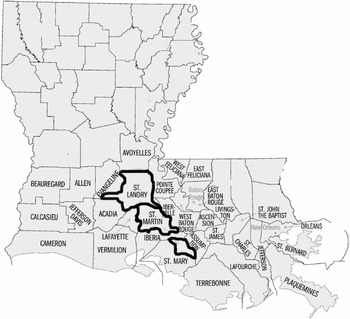
Map of southern Louisiana.
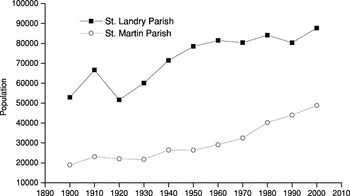
Population (over time) in St. Landry and St. Martin Parishes.
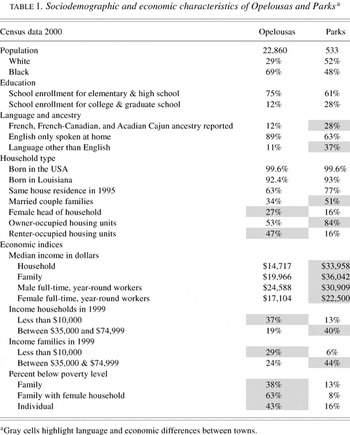
Sociodemographic and economic characteristics of Opelousas and Parksa
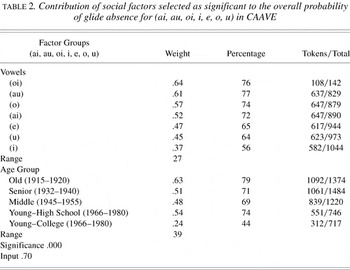
Contribution of social factors selected as significant to the overall probability of glide absence for (ai, au, oi, i, e, o, u) in CAAVE
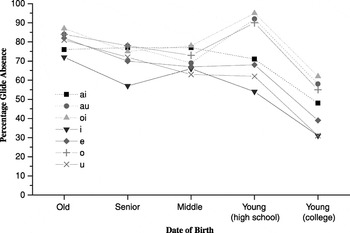
Glide absence across generations (including young college-educated).
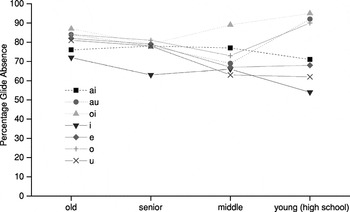
Glide absence across generations (excluding college-educated from all groups).
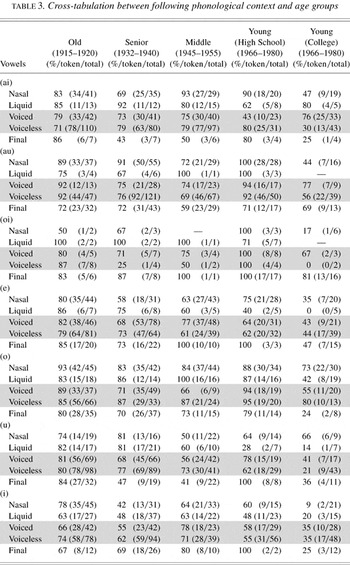
Cross-tabulation between following phonological context and age groups
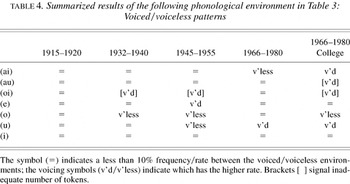
Summarized results of the following phonological environment in Table 3: Voiced/voiceless patterns
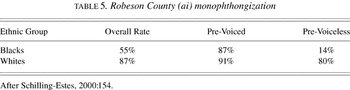
Robeson County (ai) monophthongization
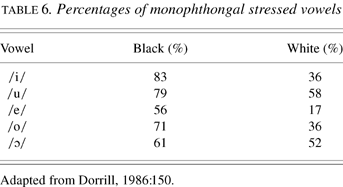
Percentages of monophthongal stressed vowels
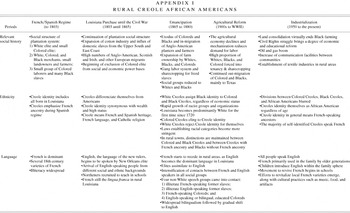
APPENDIX 1: RURAL CREOLE AFRICAN AMERICANS

APPENDIX 2: SPECTOGRAPHIC DISPLAY OF [au] AS MONOPHTHONG (FIRST TRANSCRIPT) AND DIPHTHONG (SECOND TRANSCRIPT)
 You have
Access
- 7
- Cited by