




No CrossRef data available.
Article contents
Abstract
An abstract is not available for this content. As you have access to this content, full HTML content is provided on this page. A PDF of this content is also available in through the ‘Save PDF’ action button.
Information
- Type
- ASSOCIATION NEWS
- Information
- Copyright
- © 2003 by the American Political Science Association
Returning to Philadelphia for the first time since 1945, APSA celebrated its centenary with a near record gathering in the Pennsylvania Convention Center and Philadelphia Marriott hotel. The meeting was marked by four days of sunny weather and well attended panels. Total attendance, including members of the press, exhibitors, and guests, numbered 5,936.
The 2003 program, organized by 50 division chairs who reviewed proposals for 47 divisions, was led by Program Co-Chairs Henry Brady and Margaret Weir, both from the University of California, Berkeley. Brady and Weir developed a program that spoke to the centennial milestone, using the title “Facing Forward and Looking Back: Democracy and Justice in a Century of Change.” The theme panels developed under this title provided an opportunity to reflect on the discipline's history, while also examining key issues of democracy and justice, and taking stock of the discipline's future.
On Thursday evening, APSA President Theda Skocpol delivered her presidential address to a standing room only crowd exceeding 600 people. Her address, “Voice and Inequality: The Transformation of American Civil Democracy,” examined how centralized, staff-driven, memberless advocacies have forsaken mobilization in favor of fundraising, showing the content and direction of policy toward the interests and values of the wealthy and less educated. It will be printed in the March 2004 issue of Perspectives on Politics.
Upon exiting the event, attendees were greeted by the music of the band Sound Shift, kicking off the festivities of the Centennial Celebration Reception. Swinging to the music, attendees reveled with potent Hurricane beverages, an assortment of food, and plenty of Mardis Gras beads—-all designed to reflect the birthplace of the Association, New Orleans. Tulane University, on whose campus APSA's founding members gathered to create the Association, generously sponsored the reception.
The Association's annual awards ceremony featured a new luncheon format that brought together award winners, their guests, and members of the selection committees. The ceremony saw 19 prizes awarded for recognition of careers, dissertations, books, articles, and papers. The event was hosted by Program Co-Chairs Henry Brady and Margaret Weir.


At the reception honoring teaching on Friday evening, the Association, along with event cosponsor Pi Sigma Alpha, the political science national honor society, commended political scientists who received campus-wide teaching awards during the 2002–2003 academic year. More than 100 political scientists received such honors at institutions across the country. Rowman and Littlefield Publishing Company, another sponsor of the event, presented its 2003 prize to six members of the Temple University political science department: Richard Deeg, Robin Kolodny, Janice Mattern, Gary Mucciaroni, Sandra Suarez, and Conrad Weiler, Jr. The group was recognized for integrating service learning and civic education into a traditional undergraduate curriculm. The Rowman and Littlefield prize, created in 1997, recognizes political scientists who have developed effective new approaches to teaching in the discipline. The event also recognized Sheilah Mann for her three decades of service to the Association and for her contributions to political science education. Mann retired as APSA's Director of Education and Professional Development in March 2003.
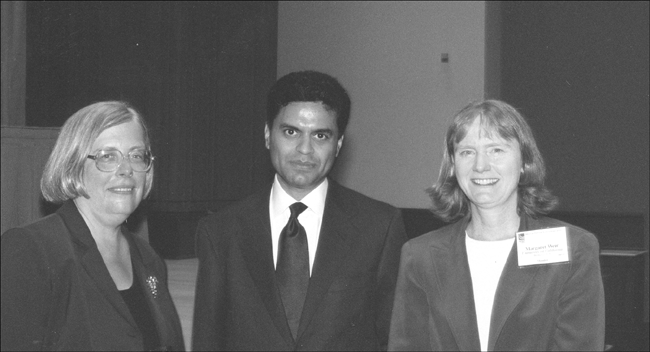
Panels and plenaries developed around the meeting theme drew the largest crowds. On Thursday, nearly 150 participants attended “One Hundred Years of Dissent in Political Science.” The panel, chaired by former president Ted Lowi of Cornell University, provided a look at the impact of race and gender in the study of political science, as well as commentary on why political scientists avoid the study of politics, and the profession's history of “nonpartisan” political science. An equally large crowd was in attendance to listen to a gathering of former APSA presidents dissect what political science has been over the past one hundred years and what it should be in the next one hundred. Commentator Kevin Phillips drew nearly 300 attendees to hear his perspective on inequality and the erosion of democracy. A look at America's role in the world over the past century was a major draw as Robert Keohane, John Mearsheimer, and William Kristol shared their views. Political commentator and Brookings Institution Resident Scholar E. J. Dionne reflected on “National Service and the Future of Citizenship” in a plenary that also brought together several leading voices in civic engagement and democracy. A session that featured a conversation with former Federal Reserve Chairman Paul Volcker was also a major draw.
The major evening plenaries featured a commentator on international affairs and the leader of organized labor. On Friday night, Fareed Zakaria, editor of Newsweek International, delivered the Ralph Bunche Centennial Lecture on “Democracy and American Foreign Policy.” On Saturday night, AFL-CIO President John Sweeney offered “Can We Be a Democracy if Democracy Ends at the Workplace Door.”
The annual John Gaus Lecture was delivered by Johan Olsen of ARENA, the University of Oslo, who explored “Citizens, Public Administration, and the Search for Foundations.” Olsen's lecture will be printed in the January issue of PS. The Pi Sigma Alpha Guest Lecture featured Lyndon Johnson biographer Robert Caro, whose narrative on LBJ provided the audience a rare glimpse at legislative power as wielded by a master.
APSA will gather for its 100th Annual Meeting in Chicago next year. The site is fitting as the first APSA Annual Meeting was held on the campuses of the University of Chicago and Northwestern University in 1904. Look to PS for more details throughout the year ahead.
 You have Access