We can know more than we can tell.1
Most theories of social action focus on what agents think about at the expense of what they think from. In International Relations (IR), rational choice theorists primarily emphasize representations and reflexive knowledge in explaining political action. In the rationalist equation (desire + belief = action), ideas factor in an individual calculation informed by intentionality. Agents deliberately reflect on what are the most efficient means to achieve their ends. For their part, several constructivists theorize that norms and collective identities reflexively inform action. Intersubjective representations of reality, morality, or individuality determine socially embedded cognition and action. In a related fashion, Habermasian constructivists concentrate on collective deliberation and truth-seeking as a form of communicative action. Overall, the three logics of social action that have the most currency in contemporary IR theory—the logics of consequences, of appropriateness, and of arguing2
See March and Olsen 1998; and Risse 2000.
—all suffer from a similar bias toward representational knowledge. Conscious representations are emphasized to the detriment of background knowledge—the inarticulate know-how from which reflexive and intentional deliberation becomes possible.
In and of itself, this focus on representational knowledge is not necessarily a problem: the logics of consequences, appropriateness, and arguing cover a wide array of social action, as a special issue of IO about socialization in Europe recently demonstrated.3
The problem rests with the many practices that neither rational choice nor rule-based and communicative action theories can explain properly. Take the case of diplomacy, arguably the most fundamental practice in international politics. For most IR theorists, diplomacy is primarily about strategic action, instrumental rationality, and cost-benefit calculations. Yet this scholarly understanding is at odds with that of practitioners, who rather emphasize the very practical and inarticulate nature of diplomacy. A former diplomat turned professor argues that diplomacy is “not a matter of mathematical calculation; it is not an exact science; it remains a matter of human skills and judgments.”
4 Watson 1991, 52. See also Kissinger 1994.
In fact, seasoned diplomats are at pains to explain their craft in abstract, social scientific terms: Nicolson contends that “commonsense” is the essence of diplomacy, while Satow defines it as “the application of intelligence and tact to the conduct of official relations between the governments of independent states.”
5 See Nicolson 1963, 43; and Satow 1979, 3.
Clearly, commonsense, intelligence, and tact cannot be learned in books through formal schemes; nor are they strictly the result of conscious deliberation or reflection. The diplomatic skills identified by practitioners and which constitute the social fabric of international politics are background dispositions acquired in and through practice.
6 This article starts from the premise that most of what people do, in world politics as in any other social field, does not derive from conscious deliberation or thoughtful reflection—instrumental, rule-based, communicative, or otherwise. Instead, practices are the result of inarticulate, practical knowledge that makes what is to be done appear “self-evident” or commonsensical. This is the logic of practicality, a fundamental feature of social life that is often overlooked by social scientists. In so arguing, this article joins a larger trend advocating a “practice turn” in social theory.7
Schatzki, Knorr Cetina, and von Savigny 2001.
To simplify a bit, practice theorists seek “to do justice to the practical nature of action by rooting human activity in a nonrepresentational stratum.”
8 Against the representational bias that pervades most theories of social action, practice theory brings background knowledge to the foreground of analysis. In IR, a few pioneering scholars are already part of this theoretical fray. Neumann entices students of world politics to move away from the “armchair analysis” of discourse to study social action as enacted in and on the world.
9 Hopf suggests that social identities (and foreign policies) thrive on a “logic of habit” that generates unreflexive action.
10 Adler uses the concept of “community of practice” to theorize the background knowledge that cements constellations of agents across borders.
11 Williams takes inspiration from Bourdieu to reconceptualize security practices as cultural strategies in the international field.
12 Mitzen emphasizes routine and unthinking action in the international drive for ontological security.
13 Building on these works, I pursue two main objectives in this article. First, I seek to bolster the practice turn in IR theory by offering an in-depth discussion of the logic of practicality.14
Though inspired by Bourdieu's “logic of practice,” the notion of practicality is meant to theorize a more specific dimension of social action, namely, nonrepresentational practices. To Bourdieu, the “logic of practice” covers both representational and nonrepresentational action. See Bourdieu 1990.
Second, I demonstrate the analytical pregnancy of the logic of practicality with a crucial case in world politics: international peace. The argumentation unfolds as follows. The first part levels a theoretical critique at the dominant strands of social and IR theory. I argue that both rationalism and constructivism suffer from a representational bias whose epistemological roots run deep into Modernity. The second section takes inspiration from other human and social sciences that have already taken the practice turn. Insights from philosophy, psychology, and sociology not only reinforce the call for a practice turn in IR theory but also provide important clues as to how to conceptualize the logic of practicality in world politics. In the third part of the article, I define practical knowledge and distinguish it from representational knowledge. Using Bourdieu's conceptual apparatus, I assert the ontological priority of the logic of practicality in relation to the mutually constitutive dynamics between agency and structure. Overall, the relationship between practicality, consequences, appropriateness, and arguing is one of complementarity. The fourth section seeks to illustrate this point with the case of security communities. I argue that peace exists in and through practice when security officials' practical sense makes diplomacy the self-evident way to solving interstate disputes. Finally, the conclusion addresses the peculiar methodological challenges raised by the logic of practicality in world politics.
The Representational Bias
In this first section, I critique contemporary theories of social action for their inability to account for nonrepresentational practices. The logics of consequences, appropriateness, and arguing tend to focus on what agents think about (reflexive and conscious knowledge) at the expense of what they think from (the background know-how that informs practice in an inarticulate fashion). This representational bias, which pervades both modern and postmodern social theory, finds its epistemological roots in the evolution of Western thinking since the Enlightenment and the scientific revolution. In an illuminating book, Toulmin laments that the epistemic revolution of Modernity gave birth to an imbalance between universal Rationality and contextual Reasonableness. Local knowledge that makes sense in particular contexts is dismissed in favor of generalizable and abstract precepts; so much so that nowadays “the human values of Reasonableness are expected to justify themselves in the Court of Rationality.”15
Against this powerful tide, Toulmin advocates everyday experience as the necessary complement to “desituated” and “disembedded” logic.
The epistemic shift that led Western thinkers away from practical knowledge over the past few centuries is well illustrated with the practice of mapmaking.16
During the Middle Ages, “maps” consisted of rectilinear routes from an origin to a destination, comprising the different steps to go through (places to eat, to shelter, to pray, and so on) and walking distances in days between them. In other words, medieval maps were performative itineraries that reproduced the knowledge learned in and through practice. Starting in the fifteenth and sixteenth centuries, however, maps began to evolve into the geographical representations from above that still exist today. This epistemic transformation, of course, took place over centuries. For a while, maps conveyed both practical and representational knowledge: in premodern maps, for instance, “ships drawn on the sea convey the maritime expedition that made representations of the coast possible.”
17 But progressively the godlike posture of modern science, which looks at the world from above, triumphed over practical knowledge. As “totalizing representations,” contemporary maps do not convey the practical operations that made them possible. The entire modern scientific enterprise can be interpreted as a similar movement away from practical knowledge and toward formal and abstract representations of the world.
The representational bias in modern thinking is reinforced by the logic of scientific practice and its institutional environment. In trying to see the world from a detached perspective, social scientists put themselves “in a state of social weightlessness.”18
Bourdieu 2003, 28. This and additional translations from French are the author's.
Looking at the world from above and usually backwards in time implies that one is not directly involved in social action and does not feel the same proximity and urgency as agents do. Contrary to practitioners, who act in and on the world, social scientists spend careers and lives thinking about ideas, deliberating about theories, and representing knowledge. As a result, they are enticed “to construe the world as a
spectacle, as a set of significations to be interpreted rather than as concrete problems to be solved practically.”
19 The epistemological consequences of such a contemplative eye are tremendous: what scientists see from their ivory tower is often miles away from the practical logics enacted on the ground. For instance, what may appear to be the result of rational calculus in (academic) hindsight may just as well have derived from practical hunches under time pressure. This “ethnocentrism of the scientist”
20 Bourdieu and Wacquant 1992, 69.
leads to substituting the practical relation to the world for the observer's (theoretical) relation to practice—or, to use Bourdieu's formula, “to take the model of reality for the reality of the model.”
21 Bourdieu, 1987, 62. See also Pouliot 2008, for an epistemological discussion.
To return to diplomacy, Kissinger, whose career spanned the divide between the academic and the policy worlds, concurs that “there is a vast difference between the perspective of an analyst and that of a statesman…. The analyst can choose which problem he wishes to study, whereas the statesman's problems are imposed on him. The analyst can allot whatever time is necessary to come to a clear conclusion; the overwhelming challenge to the statesman is the pressure of time…. The analyst has available to him all the facts…. The statesman must act on assessments that cannot be proved at the time that he is making them.”22
As a result, diplomacy is an art not a science.
23 It is a practice enacted in and on the world, in real time, and with actual consequences for the practitioner. As such, the practicality of diplomacy cannot be fully captured by detached, representational observation.
From this perspective, the epitome of the representational bias is rational choice theory and its tendency to deduce from the enacted practice (opus operatum) its mode of operating (modus operandi). The problem is deeper than the well-known tautology of revealed preferences. By mistaking the outcome of practice for its process, rational choice “project[s] into the minds of agents a (scholastic) vision of their practice that, paradoxically, it could only uncover because it methodically set aside the experience agents have of it.”24
While social scientists have all the necessary time to rationalize action post hoc, agents are confronted with practical problems that they must urgently solve. One cannot reduce practice to the execution of a theoretical model. For one thing, social action is not necessarily preceded by a premeditated design. A practice can be oriented toward a goal without being consciously informed by it. For another, in the heat of practice, hunches take precedence over rational calculations. In picturing practitioners in the image of the theorist, rational choice theory produces “a sort of monster with the head of the thinker thinking his practice in reflexive and logical fashion mounted on the body of a man of action engaged in action.”
25 Bourdieu and Wacquant 1992, 123.
In IR, the literature on the rational design of international institutions best exemplifies this representational bias.
26 Koremenos, Lipson, and Snidal 2001.
It is correct that states seek to mold international institutions to further their goals; but it does not follow that this design is instrumentally rational. The outcome of political struggles over institutions and the process of struggling over institutions follow two different logics—observational versus practical. One cannot impute to practitioners a theoretical perspective that is made possible by looking at social action backward and from above.
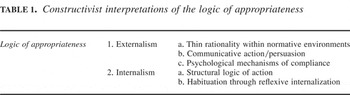
In IR, the representational bias is not the preserve of rational choice theory, however; most constructivist interpretations of rule-based behavior also fall victim to it. In March and Olsen's seminal formulation, the logic of appropriateness deals with norm- and rule-based action conceived “as a matching of a situation to the demands of a position.”27
March and Olsen 1989, 23.
This definition, however, encompasses two distinct modes of social action.
28 On the one hand, the logic of appropriateness deals with rules that are so profoundly internalized that they become taken for granted. On the other hand, the logic of appropriateness is a reflexive process whereby agents need to figure out what behavior is appropriate to a situation.
29 March and Olsen lean toward this second interpretation when they write that in order to enact appropriate behavior, actors pose questions such as “Who am I?” or “What kind of situation is this?” See March and Olsen 1989, 23.
Sending calls these two possible interpretations “motivationally externalist” versus “motivationally internalist,”
30 a distinction that hinges on whether agents reflect before putting a norm into practice. Problematically from a practice theory perspective, a vast majority of constructivist works fall in the former camp, according to which norm-based actions stem from a process of reflexive cognition based either on instrumental calculations, reasoned persuasion, or the psychology of compliance. Here the representational bias shows very clearly. But even those few constructivists who theorize appropriate action as nonreflexive assimilate it to the output of a structural logic of social action or a habit resulting from a process of reflexive internalization. Nowhere in these interpretations is there room for properly theorizing practical knowledge.
Three main strands of constructivist research construe appropriateness as a motivationally externalist logic of social action. A first possibility is to introduce “thin” instrumental rationality in the context of a community, that is, a norm-rich environment. Keck and Sikkink's “boomerang model” is one of the best-known frameworks of this genre: state elites' compliance with transnational norms first comes through strategic calculations under normative pressure; only at a later stage do preferences change.31
Schimmelfennig's notion of rhetorical action—“the strategic use of norm-based arguments”
32—follows a similar logic of limited strategic action constrained by constitutive communitarian norms and rules. A second possibility is to conceive of appropriateness as a logic that relies on reasoned persuasion. Building on Habermas's theory of communicative action, several constructivists theorize that the “logic of arguing” leads actors to collectively deliberate “whether norms of appropriate behavior can be justified, and that norms apply under given circumstances.”
33 Other constructivists build on the notion of “social learning” to explain the workings of argumentative persuasion in social context.
34 Finally, a third externalist interpretation of appropriateness emphasizes cognitive processes that take place at the level of the human mind. Relying on psychological notions such as the acceptability heuristic, omission bias, and images, Shannon argues that “[a]ctors must feel justified to violate a norm to satisfy themselves and the need for a positive self-image, by interpreting the norm and the situation in a way that makes them feel exempt.”
35 Shannon 2000, 300. See also Johnston 2001, on social identity theory.
Overall, most constructivists construe appropriateness as a reflexive logic of action based on thin rationality, reasoned persuasion, or the psychology of compliance.
Constructivist interpretations of the logic of appropriateness
Meanwhile, a few constructivists take the externalist route and prefer to emphasize the nondeliberative nature of the logic of appropriateness. Yet, even though this understanding seems better in tune with the practice turn advocated in this article, it fails to capture the practicality of social life because internalist constructivists construe appropriateness either as a structural logic devoid of agency or as a form of habituation that is reflexive in its earlier stages. To begin with the former, some constructivists claim that the internalist logic of appropriateness is plagued with a “structuralist bias” that renders it “untenable as a theory of individual action.”36
In this account, the essence of agency rests with choice and the capacity to deliberate among options before acting: “If the [logic of appropriateness] is to be individualistic in structure, the individual actor must be left with a reasonable degree of choice (or agency).”
37 Ibid., 451. Sending also writes that “[i]t is thus a central feature of structuration theory, which is a key building block of constructivist theory, that the actor is always in a position to evaluate, reflect upon and choose regarding what rules to follow and how to act”; ibid., 458. On a closer look, however, there is nothing in Giddens's definition that restricts agency to choice: “Agency concerns events of which the individual is the perpetrator”; Giddens 1984, 9.
But this restrictive notion of agency seems unwarranted within the structurationist ontology that characterizes constructivism. Agency is not simply about “defying” structures by making choices independently of them. It is a matter of instantiating structures, old or new, in and through practice. Without practice, intersubjective realities would falter; thus agency (or the enactment of practice) is what makes social reality possible in the first place. In introducing contingency, agency need not be reflexive; and thoughtlessness does not logically imply structural determination.
Taking a different tack, a number of constructivists equate the logic of appropriateness with the internalization of taken-for-granted norms. For instance, Checkel seeks to understand how norm compliance moves from “conscious instrumental calculation” to “taken-for-grantedness.” In what he calls “type II socialization,” agents switch “from following a logic of consequences to a logic of appropriateness.”38
A similar view can be found in Wendt's discussion of internalization, from “First Degree” to “Third.” This process essentially consists of certain practices getting “pushed into the shared cognitive background, becoming taken for granted rather than objects of calculation.”
39 Norms begin as explicit “ought to” prescriptions but progressively fade from consciousness and become taken-for-granted. Significantly, thus, this internalist interpretation remains embroiled in the representational bias that plagues externalism: the taken-for-granted knowledge that informs appropriateness necessarily begins as representational and conscious.
In distinguishing the “logic of habit” from that of appropriateness, Hopf comes closest to accounting for practical knowledge in IR. As he perceptively argues: “Significant features distinguish habitual action from normative compliance. Generally, norms have the form ‘in circumstance X, you should do Y,’ whereas habits have a general form more like ‘in circumstance X, action Y follows’.”40
This all-important distinction, upon which this article builds, represents a significant step toward a practice turn in IR theory. That said, this article seeks to fix three main limitations in Hopf's framework. First, it remains partly embroiled in an internalization scheme not so distant from Checkel's or Wendt's. In using the language of norm selection versus norm compliance, Hopf implies that the internalist logic of habit follows from the externalist logic of appropriateness. By contrast, this article theorizes practical knowledge as unreflexive and inarticulate through and through. Second, while both logics of habit and practicality build on past experiences, the latter does so contingently while the former is strictly iterative.
41 See below for an illustration with the diplomatic practice.
Third, Hopf insists his is only a methodological distinction between the logic of habit and the logic of appropriateness, which entices researchers to look for evidence of norm compliance in the unsaid instead of explicit invocations.
42 Though an important piece of methodological advice, this point falls short of granting practicality the full ontological status it deserves in social theory.
Before concluding this critique of IR literature, it is necessary to address the “stronger program” in IR constructivism located closer to postmodernism. By its very epistemological standpoint, postmodernism epitomizes the representational bias: detached from, and in fact indifferent to, the social urgency of practices, many postmodernists intellectualize discourse to the point of distorting its practical logic and meaning. In addition, postmodernist works often embody the “armchair analysis” that Neumann urges to overcome in taking a practice turn.43
Against this tendency, a number of IR constructivists move closer to Foucault's conceptualization of discourse as practice.
44 See, for example, Ashley 1987.
But several analyses still fall short of accounting for the practicality of discourse—that is, discourse as a practice enacted in and on the world. Fierke's works on “language games,” for instance, usefully emphasize background knowledge but do not take the materiality of practices seriously.
45 In a similar fashion, the Copenhagen school asserts that security is practice
46; but in restricting its focus to traditional discourse analysis, it evacuates the practical logics that make the securitizing discourse possible. Taking a practice turn promises to help overcome the representational bias in IR theory, whether rationalist, constructivist, or postmodernist.
Practice Turns
Still a recent development in IR, the practice turn has also been promoted in a number of other human and social sciences. This section briefly reviews relevant literatures in philosophy, psychology, and sociology. This survey not only suggests that practice theory is starting to attract increasing attention, it also provides useful insights for theorizing practical knowledge in world politics.
The philosophical interest in practical knowledge dates back at least to Aristotle. In his discussion of practical reasoning (that is, reasoning oriented toward action), Aristotle highlighted the importance of “topoi” or the “seat of argument.”47
In IR, see Kratochwil 1989.
These commonplaces are tacit in nature: one discusses or acts with them but not about them. However, this Aristotelian insight was later subdued by Plato's and others' fascination with representational knowledge. With Descartes, centuries later, the representational bias entrenched itself within Western philosophical thought, a situation that lasts to the day.
48 In an illuminating critique of this philosophical evolution, Toulmin equates this disciplinary tendency to favor the universal to the detriment of the contextual with “the behavior of an intellectual ostrich.”
49 Toulmin's critique is inspired by the later Wittgenstein, probably the most prominent figure in opposing the representational bias in philosophy.
50 Wittgenstein 1958. Other philosophers who also argued in a similar direction include the American pragmatists (for example, Dewey and Peirce) as well as Heidegger and Merleau-Ponty.
Most famously, Wittgenstein denounced his colleagues for studying language as a theoretical system of signs and representations whereas it is primarily a practice whose meanings are determined not in abstracto but in and through its context and use.
51 This is also close to Foucault's argument, whose thought can be linked to the practice turn.
In his Wittgensteinian interpretation of rule-following, Taylor best summarizes the case for practice theory in philosophy and more largely in social science:
To situate our understanding in practices is to see it as implicit in our activity, and hence as going well beyond what we manage to frame representations of. We do frame representations: we explicitly formulate what our world is like, what we aim at, what we are doing. But much of our intelligent action in the world, sensitive as it usually is to our situation and goals, is carried on unformulated. It flows from an understanding which is largely inarticulate…. Rather than representations being the primary locus of understanding, they are similarly islands in the sea of our unformulated practical grasp on the world.52
Three other disciples of Wittgenstein—Ryle, Polanyi, and Searle—have also been instrumental in advocating a practice turn in philosophy. The former convincingly derides the doctrine of the “ghost in the machine” that pervades Western philosophy, according to which a chef has to recite his recipes to himself before cooking.53
On the contrary, argues Ryle, “[e]fficient practice precedes the theory of it.”
54 His distinction between “knowing-that” and “knowing-how” remains fundamental to the practice turn. For instance, Polanyi argues that one may know-how to use a machine without knowing that doing so requires the operation of such and such mechanisms.
55 This know-how Polanyi calls “tacit knowing,” which consists of attending from something (for example, the machine's internal mechanisms) to something else (for example, using the machine).
56 Tacit knowing primarily rests on bodily experience and practice: it is knowledge within the practice instead of behind the practice. This is obviously not to say that the brain plays no role in tacit knowing. A professor of chemistry, Polanyi recalls that “mathematical theory can be learned only by practicing its application: its true knowledge lies in our ability to use it.”
57 One may know the theorems by heart but their application must be learned in and through practice as a form of tacit knowing. It is a similar insight that informs Searle's (Wittgensteinian) notion of Background. As he explains, “the general thesis of the Background … is that all of our intentional states, all of our particular beliefs, hopes, fears, and so on, only function in the way they do—that is, they only determine their conditions of satisfaction—against a Background of know-how that enables me to cope with the world.”
58 This pre-intentional knowledge is nonrepresentational and prereflexive: it is only activated in and through practice.
The philosophical metaphysics of the practice turn find solid empirical support in the latest strands of psychological research.59
The parallels that are drawn here with the notion of a practice turn are not explicitly invoked in the psychology literature.
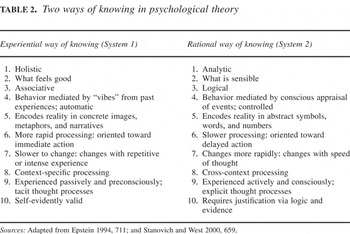
In his Nobel Prize lecture in 2002, Kahneman argues that there are “two generic modes of cognitive function: an intuitive mode in which judgments and decisions are made automatically and rapidly, and a controlled mode, which is deliberate and slower.”
60 These two modes of cognition coexist and complement each other. But intuitive judgments are not mere perceptions although both are equally fast: contrary to the latter, the former “deal with concepts” and “can be evoked by language.”
61 Psychologists usually refer to these two ways of knowing as “System 1” and “System 2.”
62 The theoretical revolution here regards automatic cognition: with the exception of the Freudian tradition, psychology has traditionally spent most of its attention on conscious cognition. More recently, thanks to several experiments, psychologists have found “evidence from everyday life of the existence of an automatic, intuitive mode of information processing that operates by different rules from that of a rational mode.”
63 From that perspective, cognition falls into two ideal-typical categories, as
Table 2 shows.
Two ways of knowing in psychological theory
Though interactive, System 1 and System 2 present different characteristics. A form of cognitive unconscious, System 1 is “a fundamentally adaptive system that automatically, effortlessly, and intuitively organizes experience and directs behavior.”64
Empirical data suggests that this is the natural mode of operation and that it is a lot more efficient than reflexive cognition. A pioneer in this strand of psychological theory, Reber builds on decades of empirical studies to establish the pervasiveness of “implicit learning” in cognitive processes. As he argues: “Implicit learning is the acquisition of knowledge that takes place largely independently of conscious attempts to learn and largely in the absence of explicit knowledge about what was acquired.”
65 Importantly, Reber insists, acting on the basis of such tacit knowledge does not make individuals irrational. Their practices, which are informed by past experiences and exposure to environmental demands, should rather be conceived as “arational,”
66 that is, based on nonrepresentational knowledge and thought processes.
Philosophical and psychological arguments in favor of a practice turn have spilled over to social sciences. For instance, D'Andrade's “cognitive anthropology” intends, among other things, to counter the representational bias in social theory. As he argues, “social scientists sometimes ascribe rules to the actor when it is only the actor's behavior that is being described. In many cases in which behavior is described as following rules, there may be in fact no rules inside the actor.”67
In sociology, Zerubavel emphasizes the social aspects of cognition as well as the tacit dimension of socialization, for instance, in the process of learning a language.
68 In becoming part of collectives, human beings learn how to think socially, a skill that rests on inarticulate knowledge first and foremost. It is a similar premise that gave birth to Garfinkel's ethnomethodology or to Giddens's structuration theory.
69 More recently, a number of social theorists have advocated taking a “practice turn” in social theory.70
Schatzki, Knorr Cetina, and von Savigny 2001.
Among the theoretical innovations advanced is an attempt to overcome the representational bias in sociological theorizing. The key argument put forward is that social action stems from practical logics that are fundamentally nonrepresentional. Practical logics cannot readily be verbalized or explicated by the agents themselves because “practice does not account for its own production and reproduction.”
71 In sociology, this theoretical strand has been best developed by Bourdieu, whose works comport the rare advantage of being systematically applied to various empirical investigations. In general, the rich concepts developed in Bourdieu's dozens of books and hundreds of articles serve no other purpose than their application—an approach in line with the notion of a practice turn. In IR, a handful of scholars have already demonstrated how Bourdieu's sociology could enrich one's understanding of security,
72 power,
73 integration,
74 or political economy.
75 Leander 2001; and Dezalay and Garth 2002.
This article adds to this burgeoning literature by focusing on Bourdieu's attempt to reach at the inarticulate in social life—the huge body of background knowledge that every social being carries and uses constantly, if unconsciously, in daily practices. Many practices appear self-evident without having to reflect about them; how can that be? Bourdieu's conceptual triad of habitus, field, and practical sense offers a most useful apparatus to theorize the logic of practicality.
The Logic of Practicality
Practice theory seeks to save practical know-how from the “nocturnal abyss” of social activities in order to put it at the center of social scientific inquiries.76
The objective, ultimately, is to bring the Background to the foreground. By countering the representational bias, practice theory opens a whole new domain of inquiry traditionally excluded from modern theories of social action: the logic of practicality. This section defines what practical knowledge consists of and then establishes the ontological priority of the logic of practicality over the logics of consequences, appropriateness, and arguing. Throughout this theoretical discussion, Bourdieu's theory of practice is used as the linchpin of a practice turn in IR and political science more generally.
An interesting starting point to understand the logic of practicality is Scott's Seeing Like a State, a rare study in political science that takes practical knowledge seriously.77
Scott 1998. Another interesting exception is Wagenaar 2004.
To explain the failure of certain states' grand schemes for social engineering, Scott argues that state projects of societal legibility and simplification usually fail because they ignore what the Greeks used to call
mètis, “a rudimentary kind of knowledge that can be acquired only by practice and that all but defies being communicated in written or oral form apart from actual practice.”
78 This practical knowledge is absolutely necessary for the implementation of any policy because it is on it, and not on bureaucratic models, that constituents' everyday lives thrive. Contrary to the abstract schemes produced by technocrats and social scientists,
mètis presents three main characteristics. First, it is local and situated.
Mètis is knowledge-in-context and derives from concrete applications. Second,
mètis is plastic and decentralized: there is no core doctrine since it is continually changing with the practices it informs. Third,
mètis knowledge is extremely difficult to convey apart from putting it in practice. In Scott's words, “[
m]
ètis knowledge is often so implicit and automatic that its bearer is at a loss to explain it.”
79 It resists being translated into the deductive and abstract models required by states' social engineering initiatives.
Whether called mètis, tacit knowing, Background, experiential way of knowing, or else, this stock of unspoken know-how learned in and through practice and from which conscious deliberation and action become possible can conveniently be called practical knowledge. Table 3 captures, in a heuristic (if oversimplified) way, the main differences between practical and representational knowledge. While representational knowledge is conscious, verbalizable, and intentional, practical knowledge is tacit, inarticulate, and automatic. The former type of knowledge is acquired through formal schemes whereas the latter is learnt experientially, in and through practice, and remains bound up in it. Representational knowledge is rational and abstract; practical knowledge is reasonable and contextual. Thus the inferences drawn from each type are respectively explicit and justified versus implicit and self-evident. Representational knowledge factors in reflexive cognition (in situation X, you should do Y—whether for instrumental or normative reasons), whereas practical knowledge remains unsaid (in situation X, Y follows).80
Hopf 2002, 12. Contrary to Hopf's “logic of habit,” however, practical knowledge does not merely lead to the repetition of past action: the logic of practicality stems from the contingent encounter of dispositions (habitus) and positions (field). More on this below.
In fact, it is precisely because it is thoughtless and inarticulate that the Background is forgotten as knowledge. It is located within practices instead of behind them. Practical knowledge is unconscious because it appears self-evident to its bearer: “This is simply what I do,” as Wittgenstein quipped.
81 Wittgenstein 1958, § 217.
Thus a defining feature of the practices informed by the Background is that their rules are not thought but simply enacted. Inarticulate, concrete, and local, practical knowledge is learned from experience and can hardly be expressed apart from practice. It is “thoughtless”—what popular parlance calls commonsense, experience, intuition, knack, skill, or practical mastery.
Two ideal types of knowledge
Another useful way to grasp the distinction between representational and practical knowledge is what Searle (after Austin and Anscombe) calls the “direction of fit” between the mind and the world.82
As Searle explains, when a man goes to the grocery store and buys items on his shopping list, the direction of fit is from world to the mind: the man alters the world to fit his mind (here materialized in the list). But imagine now that a detective investigates what groceries this man buys and notes them on a list as they are being placed in the cart. Now the direction of fit is reversed, from the mind (the detective's list) to the world. The list is trying to match the world as it is being acted upon. A similar difference arises between practical knowledge, which is oriented toward action (world-to-mind direction of fit), and representational knowledge, which seeks to capture in words or other representations practices enacted in and on the world (mind-to-world direction of fit). Doing and observing, in sum, are two distinct ways of relating to the world.
It is important to note that although all practical knowledge is taken-for-granted or unreflexive, not all taken-for-granted knowledge is practical. In Hopf's logic of habit, for instance, taken-for-granted knowledge was once reflected upon before becoming internalized; whereas practical knowledge is learned tacitly. But just how could a minimally complex practice be learned without ever being explicitly taught? Building on decades of experiments, psychologist Reber asserts the “primacy of the implicit”: “other things being equal, implicit learning is the default mode for the acquisition of complex information about the environment.”83
Babies learning the complex syntactic rules of their mother tongue is the obvious example of such nonrepresentational competence-building. In Ryle's example, even the game of chess need not be explicitly taught for a boy to be able to play by the rules: “By watching the moves made by others and by noticing which of his own moves were conceded and which were rejected, he could pick up the art of playing correctly while still quite unable to propound the regulations in terms of which ‘correct’ and ‘incorrect’ are defined…. We learn
how by practice, schooled indeed by criticism and example, but often quite unaided by any lessons in the theory.”
84 Though often imperceptible, implicit learning is the rule not the exception.
In world politics, for instance, state elites come to master the international rules of sovereignty and nonintervention in part through implicit learning. In effect, most of them never got trained in the formal schemes of international law. Statespersons simply replicate, in and through practice, the done things in the international society (or else they may face social or political sanctions). In fact, most of the complex workings of the diplomatic practice rest on a stock of practical knowledge that is tacitly learnt. Reviewing dozens of classics on diplomacy, Berridge observes that there is “an overwhelmingly strong sentiment that practical knowledge could be acquired only at the elbow of a master, that is to say, by apprenticeship.”85
This inarticulate mode of learning differs significantly from the dominant model of norm internalization advocated by several IR constructivists.
As a “knowledge that does not know itself,”86
practical knowledge does not lend itself easily to scientific inquiry. In this endeavor, Bourdieu's theory of practice appears especially helpful because his conceptual triad of habitus, field, and practical sense has been empirically operationalized time and again—it works in practice. To begin with, habitus is a “system of durable, transposable dispositions, which integrates past experiences and functions at every moment as a matrix of perception, appreciation, and action, making possible the accomplishment of infinitely differentiated tasks.”
87 For instance, one could argue that there exists a “diplomatic habitus” in world politics—“a set of regular traits which dispose its bearers to act in a certain way”
88—which makes international diplomatic interaction possible. Four main dimensions of the concept need to be emphasized. First, habitus is historical. The dispositions that comprise it are the sediment of individual and collective trajectories. It turns history (and its intersubjectivity) into a second nature; as a result the past is actualized into the present.
89 In Bourdieu's theory of practice, people do what they do because “this is how things are” according to the collective and individual experiences embodied in their habitus. These dispositions are acquired through socialization, exposure, imitation, and symbolic power relationships. Though “ever-changing” as history unfolds, the habitus instills path dependency in social action for revisions take place on the basis of prior dispositions.
90 Second, habitus is made up of inarticulate, practical knowledge. It is learned by doing, from direct experience in and on the world: “The core modus operandi that defines practice is transmitted through practice, in practice, without acceding to the discursive level.”91
This is not to say that individuals form no representations; but they do so on the basis of the habitus's unreflexive dispositions. Without reflection or deliberation, habitus tends to generate “ ‘reasonable,’ ‘common-sense’ behaviours”
92 which agents may be at pains explaining. In that sense, it is a form of “learnt ignorance” [
docte ignorance].
93 Borrowing from Merleau-Ponty, Bourdieu contends that the inarticulate nature of habitus is due to the fact that it is it is comprised of “corporeal knowledge” [
connaissance par corps],
94 a practical mastery of the world that profoundly differs from representational knowledge. Whether one rides a bicycle or plays flute, these practices express an unspoken, bodily knowledge that is learned and deployed corporeally: “Our body is not just the executant of the goals we frame or just the locus of the causal factors which shape our representations. Our understanding itself is embodied.”
95 Being a female or a male, to take a general example, is a bodily form of knowledge that informs most of our practices without conscious reflection about it. People behave in gendered manners often without any explicit teaching; their masculine or feminine behavior is not something they can readily express in words. In world politics, meetings among statespersons similarly involve the bodily knowledge of habitus as a “sense of one's place” and of the others' place.
96 As Bourdieu explains: “What is ‘learned by body’ is not something that one has, like knowledge that can be brandished, but something that one is.”
97 In this sense, practice theory deemphasizes what is going on in people's heads—what they think—to instead focus on what it is they do. This is not to say that the mind plays no role in social action: the point rather is that more often than not, mental processes are so inarticulate that the brain becomes just another part of the body, among others.
98 One example of a thoughtless practice that nevertheless goes through the brain is verb conjugation. When one conjugates a verb in one's mother tongue, one usually applies grammatical rules thoughtlessly: practical mastery is based on background knowledge derived from experience. This is starkly different from conjugating verbs in a foreign language, an action that cannot be undertaken without reference to formal and explicit representations such as conjugation tables.
Third, habitus is relational: its dispositions are embodied traces of intersubjective interactions. In tune with the view that agents are the products of social relations,99
Bourdieu calls this process “the internalization of externality.”
100 Though located at the subjective level, habitus constitutes the intersection of structure and agency. Thus, what may seem to be a set of individual dispositions is in fact profoundly social. Social psychologist Vygotsky similarly supports the view that “[a]ny higher mental function [is] external because it was social at some point before becoming an internal, truly mental function.”
101 Quoted in Marti 1996, 67. See also Vygotsky 1978.
More recently, an increasing body of psychological theory postulates “the dynamic mutual constitution of culture and the psyche.”
102 As “socialized subjectivity,”
103 Bourdieu and Wacquant 1992, 126.
the concept of habitus paves the way for a relational ontology of practice.
Fourth and finally, habitus is dispositional. Far from automatically or deterministically leading to a specific practice, habitus simply inclines or disposes actors to do certain things. It generates inclinations, propensities, and tendencies. One could compare habitus to legal custom: both work on the basis of a small number of schemes that generate a limited number of possible responses or “regulated improvisations.”104
Habitus is not habit, for the former is fundamentally generative while the latter is strictly iterative. Habitus is an “art of inventing” that introduces contingency in social action: the same disposition could potentially lead to different practices depending on the social context. That said, habitus also negates complete free will or fully fledged creativity: agents “improvise” within the bounds of historically constituted practical knowledge. Habitus is a grammar that provides a basis for the generation of practices; but it does so only in relation to a social configuration, or field.
The concept of field is the second key notion in Bourdieu's theory of practice. Basically, a field is a social configuration structured along three main dimensions: relations of power, objects of struggle, and taken-for-granted rules.105
First, fields are comprised of unequal positions, where some agents are dominant and others are dominated. It is the control of a variety of historically constructed capitals, from economic through social to symbolic, that defines the structure of power relations in the field and the positions that result.
106 See Williams 2007, for an illuminating application to international security.
To think in terms of fields, then, is to think relationally. The concept also opens the way to positional analysis. Second, fields “are defined by the stakes which are at stake.”
107 Fields are relatively autonomous from one another because they are characterized by certain struggles that have been socially and historically constituted. All contestants agree on what it is they are seeking—political authority, artistic prestige, economic profit, academic reputation, and so on. Thus the field is a kind of social game, with the specificity that it is a game “in itself” and not “for itself”: “one does not embark on the game by a conscious act, one is born into the game, with the game.”
108 Hence the third characteristic of fields, which is that they are structured by taken-for-granted rules. This “doxa” is comprised of “all that is accepted as obvious, in particular the classifying schemes which determine what deserves attention and what does not.”
109 As a form of immediate adherence, a field's doxa is obeyed not only by dominant agents who benefit from it but also by the dominated ones who clearly do not.
110 Hence the importance of symbolic power relationships.
From the interplay between habitus and field results practical sense, “a socially constituted ‘sense of the game.’”111
Bourdieu and Wacquant 1992, 120–21.
As the intersection of embodied dispositions and structured positions, practical sense makes certain practices appear “
sensible, that is, informed by a common sense.”
112 Of course, agents are not all equally endowed with this social skill. In order to have the feel for the game, agents need to have embodied specific dispositions (habitus) in the past and face a social context (field) that triggers them. It is through the actualization of the past in the present that agents know what is to be done in the future, often without conscious reflection or reference to explicit and codified knowledge. In this sense, practical sense is fundamentally dialectic—it is a sort of synthesis between the social stuff within people (habitus) and within social contexts (field). Thanks to practical sense, agents do what they could instead of what they should. Practice is “the done thing … because one cannot do otherwise.”
113 Contrary to normative compliance in the logic of appropriateness, practical sense thoughtlessly aims at the commonsensical given a peculiar set of dispositions and positions.
The notion of practical sense offers a promising way to tease out the mutually constitutive dynamics between agency and structure. Social action derived from the feel for the game follows neither a structural nor an individualistic logic, but a relational dialectic of “the internalization of exteriority and the externalization of interiority.”114
Habitus is embodied at the subjective level but it is comprised of intersubjective dispositions. The field is a bundle of structured relations within which agents are variously positioned. In intersecting, habitus and field trigger practice in a nonrepresentational way, as an intuition that more or less fits a social pattern. Given a social configuration and agents' trajectories, action
X follows somewhat unreflexively from situation
Y. Suspended in between structure and agency, in other words, practical sense is a “prereflexive, infraconscious mastery that agents acquire of their social world by way of durable immersion within it.”
115 This view is akin to what Goffman calls the “sense of one's place”—the seemingly natural feeling people usually have about how to behave in a given social situation. It is the practical sense and not interests, norms, or truth-seeking that allows people to thoughtlessly comport themselves in tune with commonsense.
116 Goffman 1959. Of course, the practical sense is not infallible as dispositions can be out of touch with positions (what Bourdieu calls the “Don Quixote effect” or hysteresis).
In Bourdieu' sociology, thus, social action is neither structural nor agentic, but relational.
One important implication of this line of argument is that the logic of practicality is ontologically prior to the three other logics of social action often referred to in IR theory. To state it simply, it is thanks to their practical sense that agents feel whether a given social context calls for instrumental rationality, norm compliance, or communicative action. The intersection of a particular set of embodied dispositions (constituted by a historical trajectory of subjectivized intersubjectivity) and a specific field of positions (comprised of power relations, objects of struggle, and taken-for-granted rules) is the engine of social action—be it rational, rule-based, communicative, or unreflexive throughout. For instance, while it makes sense for a Westerner to be instrumentally rational when planning investments in the economic field, it is quite nonsensical (and socially reprehensible) to constantly calculate means and ends with family and friends. In certain social contexts but not others, instrumental rationality is the “arational” way to go thanks to the logic of practicality. Practicality is ontologically prior to instrumental rationality since the latter is not a priori inscribed in human beings' minds but historically constituted in habitus and fields.
The same logic applies to rule-governed behavior: in that case, the practical sense reads from context and embodied dispositions the need for socially appropriate or norm-based action. This thoughtless feeling differs from the externalist interpretation of the logic of appropriateness in which agents reflexively match the demands of a situation with their identity in order to decide on the course to be taken. To return to the example above, a Westerner would not instrumentally calculate costs and benefits within family because this is not “appropriate.” But one need not reflect to “know” this because it is an unspoken disposition learnt in and through practice. Even when the logic of appropriateness requires reflexivity, prior to intentional deliberation the agent must feel from practical sense that rule-based reasoning is the way to go given habitus and the field. In other words, contrary to norm compliance, the logic of practicality is not based on a “should” but instead on a “could”: “The practical sense is what allows one to behave appropriately without posing or executing a ‘should.’”117
There is no explicit ought-to because “practice does not imply—or rather excludes—mastery of the logic that is expressed within it.”
118 If agents feel from practical sense that the way to go is to comply with a norm, they may be able to verbalize what that norm is, but they probably cannot explain why they figured they had to follow a norm in the first place. Although it is inarticulate and thoughtless, the logic of practicality is ontologically prior: as the dynamic intersection of structure and agency, it determines which further logic of social action applies given positions and dispositions.
A second important implication is that the relationship among the four logics of social action is one of complementarity instead of mutual exclusion. The ontological priority of the logic of practicality means that it informs any and all conscious and reflexive action, whether it stems from the logic of consequences, appropriateness, or arguing. For instance, Adler notes that “the capacity for rational thought and behaviour is above all a background capacity.”119
The same could be said of normative compliance and communicative action. Contrary to practicality, these three logics of social action share the same representational bias: instrumental rationality is premised on calculated interests; appropriateness derives from normative judgment; and communicative action is informed by explicit notions of truth and deliberation. In practice, however, the four logics are necessarily interwoven because any reflexive action stems from the practical sense. When Western statespeople are involved in a deterrence situation, for instance, their practical sense generally tells them to calculate the costs and benefits of their policy options. In the field of military strategy, comparing means and ends is inscribed in agents' dispositions as well as in the rules of the game. When the same statespeople face close allies on a disagreement about core values, their practical sense makes them abide by shared norms. Within the North Atlantic Treaty Organization (NATO), for instance, cold calculations do not always make sense in view of the embodied shared identity of the community. When, finally, the statespeople seek to reach an agreement on new international customs of intervention, they feel from their practical sense that reasoned dialogue is the way to reach a compromise. Which logic of reflexive social action is to be followed depends on an unreflexive practical mastery of the world.
In order to further illustrate the analytical pregnancy and empirical pervasiveness of the logic of practicality in world politics, the final section applies it to a foremost issue: international peace.
Outline of a Theory of Practice of Security Communities
As with many other social theories, both Deutsch's and Adler and Barnett's frameworks on security communities are biased toward the study of representational knowledge.120
In Deutsch's scheme, a crucial test of “integration” consists of the “subjective” representations that elites share about themselves: “Did influential people in all parts of the wider area believe that a firm sense of community existed throughout its territories?”
121 The focus here is on what people think about one another, that is, how they represent each other. Similarly, Adler and Barnett's revamped framework asserts that collective identity—the blurring of the Self-Other distinction
122—is a “necessary condition for dependable expectations of peaceful change.”
123 Adler and Barnett 1998, 38.
Mutually encompassing representations are theorized as the constitutive foundation of peace. No doubt these representations are important for the social construction of peaceful realities: Deutsch's subjective beliefs factor in rational decision making, while Adler and Barnett's collective identity informs socially appropriate behavior. The logics of consequences, appropriateness, and arguing all play an important role in security communities.
Yet there is more to peace than representations. Peace also is a very practical relation to the world characterized, among other things, by nonviolent dealings. While it is primarily mutual representations that strike the eye of the social scientist, on the ground the practicality of peace entails several nonrepresentational dimensions. Security communities thrive on a practical modus operandi that has a different logic than its objectified opus operatum. Take, for instance, the key role played by trust, correctly theorized as the second constitutive foundation of security communities by Adler and Barnett.124
Trust (defined as “believing despite uncertainty”
125) is the perfect example of an inarticulate feeling derived from practical sense. Based on personal and collective history (habitus) and faced with a particular social context (field), security practitioners “feel” (practical sense) that they could believe despite uncertainty—that is, they trust their security community counterparts. As a background feeling, trust does not derive from instrumental calculations, norm compliance, or reasoned consensus: it is informed by the logic of practicality. The reasons why an agent trusts another are not readily verbalizable; they derive from tacit experience and an embodied history of social relations. Trust is practical sense. Given its central role in interstate peace and, for that matter, in almost any aspect of world politics and social relations, the logic of practicality needs to be integrated into the security-communities framework and IR theory in general.
How does peace exist in and through practice? The first conceptual challenge is to identify the constitutive practice of security communities. A constitutive practice is a social action endowed with intersubjective meanings that are shared by a given community and that cement its practitioners.126
See the literature on “communities of practice”: Adler 2005; and Wenger 1998.
In this connection, Adler suggests that “peace is the practice of a security community.”
127 But this formulation needs to be refined because peace is better categorized as a social fact (such as money) than as a practice (such as purchasing groceries). In the everyday life of the current interstate system, security communities rather are about the practice of diplomacy, defined as “[t]he conduct of relations between states and other entities with standing in world politics by official agents and by peaceful means.”
128 As a dialogue of states “by means short of war,”
129 Watson 1991, 11. Limited to the Westphalian context, this historical observation does not rule out that peace may be constituted by other practices in political orders other than the current interstate system, nor is it a normative stance in favor of the international status quo.
thus, the diplomatic practice constitutes peace in the current Westphalian system. Critics may find this claim tautological. Yet it is no more tautological than saying that H
2O constitutes water: atoms constitute molecules in the natural realm in a way analogous to how practices constitute social facts in the social world. Without atoms there cannot be molecules; without practice there cannot be any social reality. The semblance of tautology here stems from the very logic of constitutive analysis.
130 One would hardly dispute that the discovery of the atomic structure of water was no tautology but an all-important step forward for humankind. The same arguably goes for the search of the constitutive practices of the social fact of international peace.
Of course, the simple occurrence of the diplomatic practice does not mean that peace is waiting around the corner. Diplomacy may be observed in highly turbulent relationships and insecurity communities, from the contemporary Middle East to the East-West rivalry during the Cold War. No doubt diplomacy is not the preserve of security communities. The key distinction lies in the self-evidence of the practice. Inside a mature security community, diplomacy is the only thinkable way to solve disputes, to the exclusion of all others (including violent ones). As peace settles in, diplomacy becomes a second nature. Thus a theory of practice of security communities argues that peace exists in and through practice when security officials' practical sense makes diplomacy the self-evident way to solving interstate disputes. Diplomacy is the constitutive practice of security community insofar, and only insofar, as it is the only “normal” or “natural” practice, to the exclusion of violent ones. When diplomacy is doxa,131
Doxa is “the relationship of immediate adherence that is established in practice between a habitus and the field to which it is attuned, the pre-verbal taking-for-granted of the world that flows from practical sense.” See Bourdieu 1990, 68.
states do not live under the shadow of deterrence anymore: diplomacy is the commonsensical way to go.
132 See also the Elias-inspired notion of “habitus of restraint” in Bjola and Kornprobst 2007.
Interestingly, a theory of practice of security communities leads to a positive notion of peace, defined as an international relationship in which security practitioners think from, instead of about, diplomacy. Peace is more than simply nonwar; it is self-evident diplomacy. In peaceful interstate relations, the nonviolent settlement of disputes forms the background against which all further interactions take place. Officials continue to think about a variety of policies, either instrumentally or normatively; but they take for granted that all possible options for solving mutual disputes begin with the diplomatic practice. They think from diplomacy and not about its opportunity. The possibility of violence (or threats thereof) recedes from their horizon of possibility, which is narrowed down to a set of diplomatic courses of action. This is peace in and through practice.
By way of illustration, take the case of the transatlantic security community.133
Innumerable pundits have announced its demise over the past five years. Most famously, Kagan argues that “on major strategic and international questions today, Americans are from Mars and Europeans are from Venus: They agree on little and understand one another less and less.”
134 Thanks in part to all this expert talk, the transatlantic rift in security cultures and identities may become a new intersubjective reality. That said, while the Iraqi crisis revealed important differences in international outlook among certain NATO members, it has made equally obvious that even deep disagreements over sensitive issues of defense cannot distract allies from what they have come to routinely do together: diplomacy, that is, the peaceful resolution of mutual disputes. That a security community such as NATO is inhabited by disagreements and identity struggles should hardly come as a surprise: politics and conflict never recede, not even from tightly knit rings of friends. But so long as diplomacy remains the only thinkable or self-evident practice in mutual dealings, one has to conclude that the security community is alive and well. Recent strains over the Atlantic, all solved peacefully if at times painfully, empirically demonstrate just that. In practice, even disagreements over the most sensitive issues of security and defense have not prompted anything like a veiled threat of possible violent retaliation among community members. As early as spring 2006, for instance, a French representative to NATO was confident that “there have been tensions with the Americans over Iraq but since then it's all gone. We both decided to think the relationship positively.”
135 Author's interview with member of the French delegation to NATO, Brussels, 6 April 2006.
Insofar as the nonviolent settlement of disputes remains the self-evident practice among security officials, or better put, insofar as practitioners think from diplomacy instead of about it, then the transatlantic security community is a social reality to be reckoned with.
When this peaceful logic of practicality settles in, it takes on a dimension of habit or routine. The security officials' practical sense leads them to go on diplomatically without reflexive action, that is, without triggering instrumental calculus, deliberate rule-following, or communicative action about the opportunity of settling disputes nonviolently. Although routine is an important part of practicality, however, practical sense cannot be reduced to habit. Routinized diplomacy is more than habitual repetition because practical sense results from the necessarily contingent intersection of a set of dispositions (habitus) and positions (field). For instance, Mérand shows that the diplomatic practices behind the design of the European Security and Defence Policy (ESDP) followed neither a rational nor structural pattern but rather a haphazard, creative, and combinatorial pattern. Dozens of interviews with practitioners indicate that to build tools, they try materials that work and discard others that do not, following their inspiration to change the shape of the object incrementally. Eventually, security officials end up with something completely different from what they had planned (a “bricolage”).136
Similarly, another study of the European diplomatic corps concludes that its autonomy depends not so much on the institutions and explicit rules of the game that formally define and constrain it. Instead, the room for maneuver rests with what diplomats do with these constraints in and through practice.
137 Cross 2007. On the contingency of the diplomatic practice, see also Neumann 2002a, 2005, and 2007.
Even when routinized as in security communities, thus, the diplomatic practice retains a crucial element of contingency. To paraphrase Ryle, practitioners attend from diplomacy to the contingent matters at hand.
The crucial question is obviously how do we get there? What are the sociopolitical processes that turn diplomacy into the self-evident way to solving interstate disputes? The conventional constructivist take on the matter would center on norm internalization. In this scheme, the peaceful settlement of disputes begins as an explicit norm with which security elites at first comply out of instrumental rationality. With iteration, the practice becomes internalized as legitimate or taken-for-granted. In this connection, Checkel envisions three “modes of rationality” whereby deep socialization occurs: instrumental (strategic calculation), bounded (role playing) and communicative (normative suasion).138
Though useful, this internalization framework suffers from two main shortcomings. First, it remains embroiled in the representational bias: taken-for-granted knowledge necessarily began as explicit representations upon which agents once reflected intentionally. A theory of practice of security communities, by contrast, emphasizes tacit learning, a cognitive mechanism that accounts for the transmission of practices without explicit teaching or reflexive compliance. For example, the concept of “communities of practice” allows for the theorization of “learning as social participation.”
139 Collective learning occurs in and through practice, within communities of doers.
Second, the norm internalization framework is sociologically thin: the social context that makes the logic of practicality possible is barely theorized. Especially lacking is a theorization of the power relations that constitute self-evident practices such as diplomacy within security communities. Contrary to widespread liberal views, peace is more than the result of the “arrangement of differences” or a “win-win compromise.” Peace originates from the imposition of meanings through power relations, as barely perceptible as they may be. As Foucault argues: “What makes power hold good, what makes it accepted, is simply the fact that it doesn't only weigh on us as a force that says no, but that it traverses and produces things, it induces pleasure, forms knowledge, produces discourse.”140
Foucault 1980, 119. See also Barnett and Duvall 2005.
Just like any social fact, peace or security communities never simply happen to be there: they necessarily are the result of past struggles among agents to define reality. Symbolic power turns a zero-sum struggle for the imposition of meanings into something that has all the attributes of a win-win relationship: interstate peace.
141 But contrary to Foucault's “machinery that no one owns,”142
Bourdieu advances a practice-centered theory of symbolic power. Space constraints do not allow a full presentation of this complex notion here.
143 Interesting applications in IR are Williams 2007; and Gheciu 2005.
To simplify, symbolic power—the imposition of meanings in and through social relations—feeds on the intersection of three elements: first, the field's structure of positions and distribution of valued capitals; second, the field's rules of the game; and third, the embodied dispositions that recognize given capitals as valuable. As a result, power may stem from a variety of resources depending on agents and contexts—from political authority to material riches through scientific credibility or cultural prestige. In any case, thanks to the contingent nexus of habitus and field, dominant players' practices tend to carve out dispositions in those who are socially exposed. The order of things is established through the iterated practices performed by capital-endowed agents, because their doing something in a certain way makes the implicit but powerful claim that “this is how things are.”
144 Power is exerted at the level of inarticulate knowledge: meanings are thoughtlessly imposed in and through practice. As Polanyi illustrates, the archetype of such performative power relations is apprenticeship.
145 “To learn by example is to submit to authority. You follow your master because you trust his manner of doing things even when you cannot analyse and account in detail for its effectiveness. By watching the master and emulating his efforts in the presence of his example, the apprentice unconsciously picks up the rules of the art, including those which are not explicitly known to the master himself. These hidden rules can be assimilated only by a person who surrenders himself to that extent uncritically to the imitation of another.” Michael Polanyi quoted in Lynch 1997, 339.
In the diplomatic field, for instance, agents from certain states occupy positions of power and authority over others thanks to their possession of types of capitals that are valued, for a variety of historically contingent reasons, at a specific time and within a specific context. In the contemporary field of international security, the transatlantic security community possesses three types of capital that are internationally valued by most players—in part because it has been so promoted by the community itself: first, cultural capital (the community claims to embody the values of liberal democracy); second, institutional-material capital (the NATO organization and its assets); and third, symbolic capital (the community's pretense to be a “disinterested” teacher of universal ideals).146
By systematically practicing diplomacy as if such a move were self-evident, dominant security elites from the transatlantic community make their counterparts see that things have changed—that peaceful change has become the “normal” way of behaving, as part of the (unthought) order of things.
147 See Gheciu 2005, for interesting case studies. Contrary to a theory of practice of security communities, however, Gheciu's framework emphasizes explicit teaching by NATO and remains partly embroiled in a norm internalization scheme.
Wielding power in and through practice endows diplomacy with a doxic aura of self-evidence and naturalness. When a practice is so fully part of everyday routine that it is thoughtlessly but consensually enacted, it forms the background knowledge against which all social interaction takes place. The orchestra can play without a conductor, for doxa produces a commonsensical world of meanings and practices.148
In such a context, diplomacy becomes the shared background against which security elites interact. As a result, peaceful change can be dependably expected. Disagreements may remain but they are dealt with under the light of a nonviolent order of things. Nonviolent settlement of disputes is part of an inarticulate know-how that informs all further practices. In sum, security communities are intersubjectively real insofar as diplomacy is the commonsensical practice for security elites when faced with an interstate disagreement. This peaceful commonsense is established through symbolic power relations; and the practicality or self-evidence of diplomacy makes the social fact of international peace possible.
Conclusion
The logic of practicality is meant to be an epistemic bridge between the practical and the theoretical relations to the world. In fact, the very notion is an oxymoron: practice is logical to the point that being logical ceases to be practical, as Bourdieu liked to say.149
In this article I made the case for a practice turn in IR theory in four steps. First, I contended that most IR theories suffer from a representational bias that entices social scientists to construe the world as a spectacle and to mistake the
opus operatum of practices for their
modus operandi. Second, I argued that selected literatures from philosophy, psychology, and sociology bolster the need for a practice turn in world politics and provide helpful insights to do so. Third, building especially on Bourdieu's theory of practice, I established the ontological priority of the logic of practicality in relation to other logics of social action. Fourth and finally, I outlined a theory of practice of security communities that illustrates the empirical and analytical pregnancy of practicality in world politics. Peace exists in and through practice when security officials' practical sense makes diplomacy the self-evident way to solving interstate disputes.
To conclude this exploration of the logic of practicality in world politics, it is crucial to acknowledge the thorny challenges that it raises at the methodological level. The representational bias that plagues modern social theory probably originates from the fact that norms, ideas, or identities usually lend themselves to empirical scrutiny more easily than background knowledge does. Representations such as norms are part of discourse and debates; they often are explicitly invoked in political life and are objects of open contestation. Background knowledge, by contrast, is unsaid and unthought. It is almost never explicitly mentioned by agents although it is part of each and every one of their practices. Practical knowledge is everywhere but always dissimulated in practices. Consequently, it must be interpreted from contexts and practices as well as through agents' dispositions and subjective meanings. Even so, gaining knowledge about background knowledge is often like asking fish to describe the water in which they swim.150
Rubin and Rubin 1995, 20.
In his critique of practice theory, Turner calls this predicament the “Mauss problem.”151
In order to decipher the meanings of a practice, the practice must be both alien and native to the interpreter's system of meanings. On the one hand, if the meanings of a practice are too deeply embodied by the interpreter, chances are they will remain invisible as a second nature. If, on the other hand, the meanings of a practice are completely alien to the interpreter, then they may not be properly understood within their context. The Mauss problem is a huge methodological challenge for practice theorists as well as interpretivists. One way forward may consist of using a “sobjectivist” methodology that aims to combine “experience-near” and “experience-distant” concepts.
152 Pouliot 2007a. “Experience-near” and “experience-distant” are Kohut's concepts; see Geertz 1987.
Thanks to induction, interpretation, and historicization, the researcher is able to restore the practical logic of practices before putting it in a larger context of meanings, relations, and historicity. Sobjectivism puts in dialogue the insider and the outsider perspectives so as to mutually enlighten both stories and gain in interpretive incisiveness. Prior to theorization and objectification, it is thus necessary to “go to the village” and recover the logic of practicality in social life.
In practice, however, ethnographic methods quickly run into important difficulties in world politics. In effect, it is admittedly easier to practice participant observation to study cockfights in Bali than it is in the field of international security. For one thing, the latter field is so encompassing and populated that it appears impossible to conduct a minimally exhaustive participant observation of relevant practices. For another, international security remains plunged in a level of secrecy that is nowhere else matched in social life. NATO's military committee, for instance, is probably not too keen on welcoming a participant observer in its ranks. Qualitative interviews may take the researcher some distance in the recovery of practical perspectives and subjective meanings. But because such conversations mostly verbalize reflexive knowledge, background dispositions must be read between the lines and distilled from the analysis of practices. Even more problematically, notes Bourdieu, “as soon as he reflects on his practice, adopting a quasi-theoretical posture, the agent loses any chance of expressing the truth of his practice, and especially the truth of the practical relation to the practice.”153
In effect, chefs do not explain their recipes the same way they perform them. All in all, taking a practice turn is no small business for the IR discipline.