Introduction
Studies have established that people with the genetically determined neurodevelopmental disorder Prader–Willi syndrome (PWS) are at an increased risk for developing affective disorders and psychotic illness in late childhood and early adult life (Vogels et al. Reference Vogels, De Hert, Descheemaeker, Govers, Devriendt, Legius, Prinzie and Fryns2004; Soni et al. Reference Soni, Whittington, Holland, Webb, Maina, Boer and Clarke2007, Reference Soni, Whittington, Holland, Webb, Maina, Boer and Clarke2008; Sinnema et al. Reference Sinnema, Boer, Collin, Maaskant, van Roozendaal, Schrander-Stumpel and Curfs2011). Psychosis is particularly common in a subgroup of people with PWS who have a duplication of the maternal copy of chromosome 15 and an absence of the paternal copy (referred to as maternal uniparental disomy, or mUPD), with 60–100% developing mUPD by early adult life. This contrasts with approximately 20% of those with PWS due to the other main genetic cause of PWS, an interstitial deletion of a section of the paternal copy of chromosome 15 (15q11–q13) (delPWS) (Boer et al. Reference Boer, Holland, Whittington, Butler, Webb and Clarke2002; Soni et al. Reference Soni, Whittington, Holland, Webb, Maina, Boer and Clarke2007; Sinnema et al. Reference Sinnema, Boer, Collin, Maaskant, van Roozendaal, Schrander-Stumpel and Curfs2011). Phenomenologically, the psychotic illness does not fit clearly into an affective or a schizophrenic illness and has been more closely likened to a cycloid psychosis. Little is known about the course of the disorder (see Soni et al. Reference Soni, Whittington, Holland, Webb, Maina, Boer and Clarke2007). The aim of this study was therefore to follow up all people from the Soni et al. (Reference Soni, Whittington, Holland, Webb, Maina, Boer and Clarke2007, Reference Soni, Whittington, Holland, Webb, Maina, Boer and Clarke2008) sample who met the criteria for psychosis, in addition to following up the most at-risk group, that is people with mUPD who had not experienced psychosis at the time of the original study. It is assumed that the psychosis experienced by these individuals is the cycloid, PWS-specific psychosis rather than a more general psychosis due to other factors, based on descriptions of the illness given by Soni et al. (Reference Soni, Whittington, Holland, Webb, Maina, Boer and Clarke2007, Reference Soni, Whittington, Holland, Webb, Maina, Boer and Clarke2008).
Method
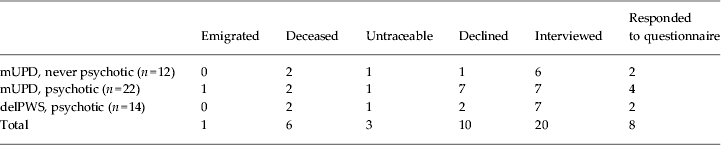
Attempts were made to contact 48 people with PWS identified as having had a psychotic illness and seen as part of the original study by Soni et al. (Reference Soni, Whittington, Holland, Webb, Maina, Boer and Clarke2007) and also those with PWS due to mUPD who had not been psychotic. Twenty people agreed to participate in an interview about their mental health and a further eight completed a postal questionnaire about their mental health since their involvement in the last study, followed up by a telephone conversation with a nominated informant. Table 1 summarizes the response rates.
Summary of status of all participants who were contacted as part of this follow-up study by presence or absence of psychosis and genetic subtype of Prader–Willi syndrome (PWS)

mUPD, PWS caused by maternal uniparental disomy; delPWS, PWS caused by a deletion of a section of the paternal copy of chromosome 15q11-q13.
A structured interview schedule was designed to elicit and record details of participants' mental health since their last study involvement. Information was sought from both an informant and the participants themselves about the overall state of the participants' mental health since their involvement in the previous study, including the number of psychotic episodes, number of hospitalizations for mental health reasons, symptoms during any psychotic episodes, and details of current psychiatric medication. Information was also sought about their functioning in the past 4 weeks, including information about the quality of relationships, activities, presence of psychiatric symptoms, challenging behaviour and self-care. Based on this, a global assessment of functioning (GAF) score (Hall, Reference Hall1995) was assigned by a trained rater (F.V.L.) as a representation of current functioning.
Data analysis
The distribution of IQ and GAF scores was checked and found to be normal. Categorical data were assigned numerical values for analysis. Medication was considered as both a continuous and a categorical variable by listing the number of different medications people were currently taking and constructing categories regarding types of medication prescribed to individuals. GAF scores of people who had experienced further psychotic episodes were compared with those who had not, using an independent-samples t test. Additionally, the GAF scores of people who had experienced psychosis were compared between the groups with delPWS and mUPD using an independent-samples t test, after confirming there were no differences in IQ between those two groups.
Descriptive statistics were used to describe medication profiles. Change in medication over time was assessed by χ 2 analysis. A change was considered to have taken place if a participant had stopped taking a medication, started a new medication, or both.
Results
Cause of death was known for three of the six participants who had died. The age of death ranged from 20 to 58 years and none were known to be as a result of suicide.
Relapse of illness
Mood instability and behavioural problems still featured in carer and self-reports of difficulties, consistent with the well-described PWS behavioural phenotype (Holland et al. Reference Holland, Whittington, Butler, Webb, Boer and Clarke2003). Nevertheless, participants and their carers reported good mental health since involvement in the original study. Two of the 20 (10%) who had previously been psychotic had had a definite recurrence of psychosis, and a further participant reported hearing voices regularly but was functioning well despite this. No one with mUPD who had not previously been psychotic had developed a psychotic illness during this period.
Out of the 20 people we were able to follow-up who had experienced psychosis, 13 had only had one episode at the time of the original study, with an even spread between those with mUPD and delPWS. Those who chose not to take part or who had died/were untraceable had experienced a similar range of number of episodes (in both cases, range 1–5, means 2.15 for the follow-up group and 2.33 for rest).
Medication
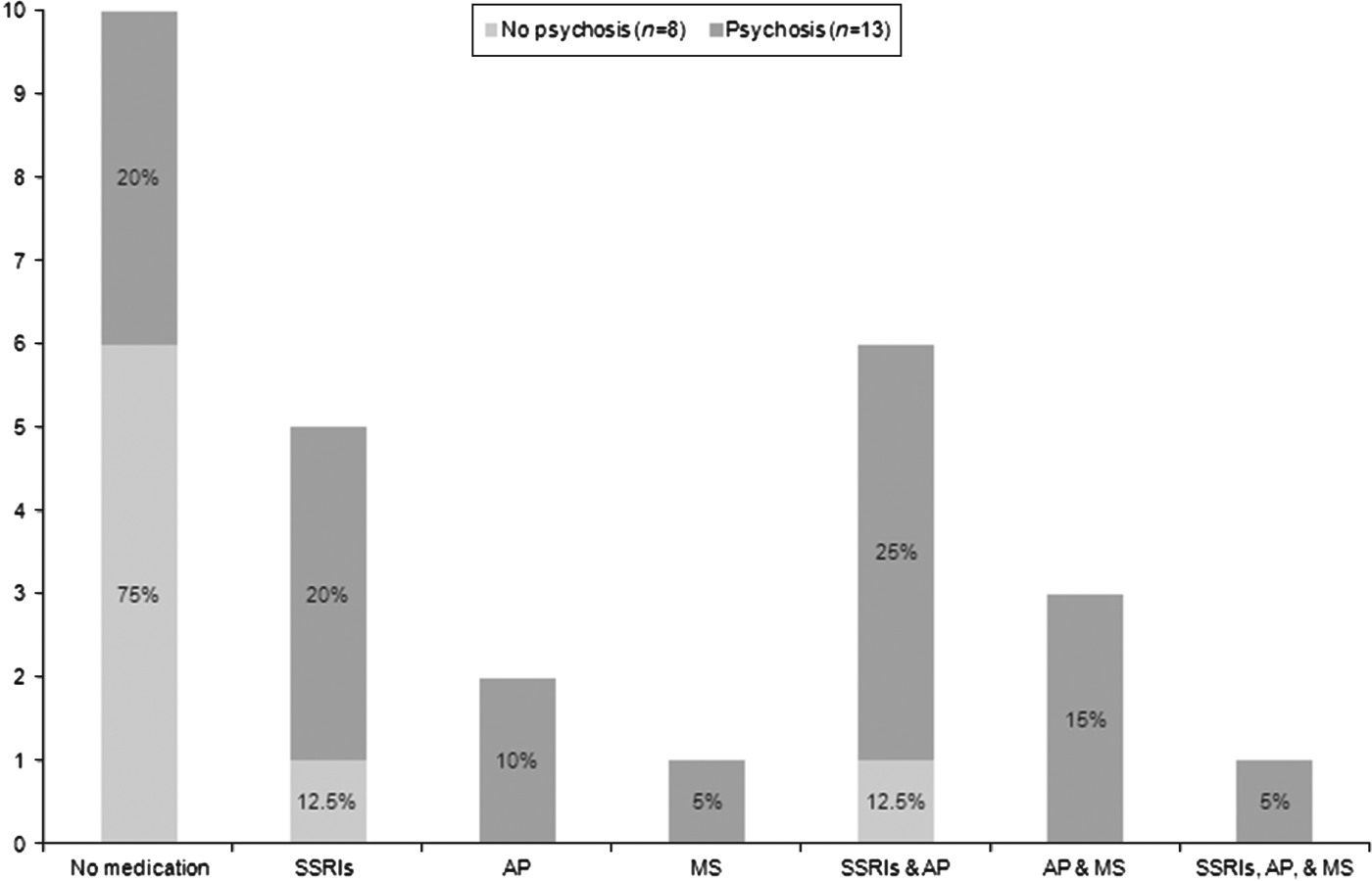
We compared psychiatric medication at the time of the original study, the follow-up 1 year later and our follow-up, an average of 5.5 years later. The majority of participants were prescribed psychotropic medication (18/28; 64.3%). Ten of these were taking more than one type of medication. Only one person who had never had psychosis had a change in psychiatric medication. Two people who had never been psychotic were maintained on selective serotonin reuptake inhibitors (SSRIs) at all stages of their involvement in the study. Figure 1 shows a summary of current medication prescriptions for all participants in this follow-up study.
Types of medication prescribed to participants with Prader–Willi syndrome (PWS) at the time of this follow-up study. SSRI, Selective serotonin reuptake inhibitor; AP, antipsychotics; MS, mood stabilizers. Percentages of the total for each group are shown.

Of the people who had been psychotic, the picture was more mixed. Thirteen people had had significant changes to their medication since the last follow-up whereas seven had had their medication maintained during follow-up. People who had been psychotic had significantly more medication changes than those who had not (χ 2 = 5.34, p = 0.03).
Only two participants who had had psychosis were taken off medication completely by the time of this study; all others were maintained on at least one kind of medication. Additionally, two people who had a history of psychosis were not on medication at the time of the original study or this follow-up.
Outcome
There was no significant relationship between GAF score and IQ (r = –0.214, p = 0.366). People who had never been psychotic had a significantly better outcome than those who had (t = 2.99, df = 26, p = 0.006).
Discussion
More than half of the group who originally had psychotic illness at the time of the Soni et al. (Reference Soni, Whittington, Holland, Webb, Maina, Boer and Clarke2007, Reference Soni, Whittington, Holland, Webb, Maina, Boer and Clarke2008) study were interviewed. It is possible that the subset of people who chose not to take part in the follow-up study or were not traceable may not have been functioning as well and/or had higher rates of relapse. However, only 10% of the population studied here had relapsed, which indicates to us stability in the course of the psychotic illness in people with PWS generally, certainly over the medium term. Further follow-up would be required to make any claims about long-term well-being, but our prediction would be that relapse rates would continue to be low into the future and that psychiatric outcome could generally be considered good for those who had psychosis.
The continued well-being of people with mUPD who had never been psychotic hints at the possibility of a window of risk, similar to that seen in people with psychosis in the general population. The age of risk ranges up to the late 40 s/early 50 s for schizophrenia and into the 70 s for affective psychoses (Slater & Cowie, Reference Slater and Cowie1971). The age of risk is unknown for people with PWS, but data from Soni et al. (Reference Soni, Whittington, Holland, Webb, Maina, Boer and Clarke2008) indicate that it may be broadly similar to that of the general population (the oldest onset reported in that study was age 40 years, with average age at onset in the late teens). Thus, it is worth noting that the people with mUPD studied here remain at risk of developing psychosis. Further follow-up study would be required to begin to determine whether this is the case, although the shorter lifespan and higher mortality rates of individuals with PWS (Whittington & Holland, Reference Whittington and Holland2004) may make follow-up impossible into later middle age. In line with this, the average age of the six people who died in the follow-up period was 36.6 years.
A stress–vulnerability model may be appropriate in considering these findings. Our hypothesis is that of a 'two-hit’ model. First, for most people with PWS, having PWS itself increases the risk for affective disorder in general, one candidate gene being the small nucleolar (sno)RNA HBIII-52, which negatively regulates editing and alternative splicing of the serotonin 2C receptor (5-HT2cR) pre-RNA (Doe et al. Reference Doe, Relkovic, Garfield, Dalley, Theobald, Humby, Wilkinson and Isles2009). In mouse knock-out models, pharmacological challenges support the view that behavioural changes observed may be due to 5-HT2CR dysfunction (Doe et al. Reference Doe, Relkovic, Garfield, Dalley, Theobald, Humby, Wilkinson and Isles2009). The second hit we hypothesize is due to the excess expression of a gene of the opposite imprint to the PWS gene(s) (i.e. the maternal copy is expressed and the paternal copy silenced). We propose that this increases the risk of psychotic illness. Thus, this combination makes people with PWS due to mUPD, or due to a deletion but with extra genetic material, more vulnerable to having a psychotic episode (Webb et al. Reference Webb, Maina, Soni, Whittington, Boer, Clarke and Holland2008). We suggest that the high rates of prescription of antipsychotic, antidepressant and mood-stabilizing medication are potentially moderating this vulnerability, perhaps by addressing the mood instability that people with PWS are prone to. It seems to us that the reduction in the size of the highs and lows in people with PWS is important in preventing psychosis, given the prevalence of mood-related symptoms at onset (Soni et al. Reference Soni, Whittington, Holland, Webb, Maina, Boer and Clarke2007, Reference Soni, Whittington, Holland, Webb, Maina, Boer and Clarke2008). It is not known what the outcome for people would be if they were removed from medication entirely, but it seems a reasonable assumption that medication would be under review regularly and attempts would have been made to reduce medication if it were possible to do this without adversely affecting the participants' mental health.
A potential criticism of the current study is that no formalized outcome measure was used. However, participants and their carers were given their original episode of illness as a reference point and it is clear that, in those who reported no further episodes, nothing of similar psychiatric significance had occurred. The significant psychotic episodes reported in two individuals in the intervening period were different in terms of duration and course, but both contained elements of mood instability, with symptoms of both depression and mania. One seems to be a more recurring mental health problem whereas the other has thus far been an isolated, albeit longer-lasting, event. One of these individuals has seen her medication changed significantly over the follow-up period whereas the other has persisted on the same medication with only the dose altered. It is unclear why these two people became unwell when so many others did not, and this may be due to a combination of biological, psychological and social factors that would be difficult to fully quantify.
Acknowledgements
We thank all the people with PWS who took part in this study, their families and carers, the Prader-Willi Syndrome Association, S. Soni and colleagues for the work undertaken in their original study, and the Wellcome Trust for funding the initial work. This study received financial support from the Health Foundation and the National Institute for Health Research (NIHR) Collaboration for Leadership in Applied Health Research and Care (CLAHRC) for Cambridgeshire and Peterborough.
Declaration of Interest
None.