Introduction
There is an increasing prevalence of both obesity and depression across the UK (Rennie & Jebb, Reference Rennie and Jebb2005; Olfson & Marcus, Reference Olfson and Marcus2009). In Scotland, 28% of adults are obese, and a further 36% are overweight (Keenan et al. Reference Keenan, Grant and Ramsay2011). Around one in six adults in the UK experience common mental disorder (McManus et al. Reference McManus, Meltzer, Brugha, Bebbington and Jenkins2009). More than 50% of these have mixed depression and anxiety disorder, and one in three has generalized anxiety disorder or depression. According to the World Health Organization ‘there is no health without mental health’ (WHO, 2010).
Both overweight and obesity predispose to a number of physical conditions, including cardiovascular disease (Lavie et al. Reference Lavie, Milani and Ventura2009), type 2 diabetes (Mokdad et al. Reference Mokdad, Ford, Bowman, Dietz, Vinicor, Bales and Marks2003), hypertension (Jarvinen et al. Reference Jarvinen, Julkunen and Tarkka2007), musculoskeletal diseases (Lohmander et al. Reference Lohmander, Gerhardsson de Verdier, Rollof, Nilsson and Engström2009) and many cancers (Renehan et al. Reference Renehan, Tyson, Egger, Heller and Zwahlen2008). All-cause mortality is higher among grades II and III obese individuals but reduced among adults who are overweight (Flegal et al. Reference Flegal, Kit, Orpana and Graubard2013). Increased body mass index (BMI) has also been shown to be associated with reduced overall health-related quality of life (HRQoL) (Ul-Haq et al. Reference Ul-Haq, Mackay, Fenwick and Pell2012, Reference Ul-Haq, Mackay, Fenwick and Pell2013a , Reference Ul-Haq, Mackay, Fenwick and Pell b ). However, overall HRQoL covers different domains: physical and mental. The adverse impact of increased BMI on physical HRQoL is now well established, as we have shown in two recent meta-analyses (Ul-Haq et al. Reference Ul-Haq, Mackay, Fenwick and Pell2013a , Reference Ul-Haq, Mackay, Fenwick and Pell b ). In contrast, the relationship between BMI and mental health remains inconclusive. Some studies have reported that increased BMI is associated with poor mental health (Baumeister & Harter, Reference Baumeister and Harter2007; Ohayon, Reference Ohayon2007; Petry et al. Reference Petry, Barry, Pietrzak and Wagner2008), whereas others have reported no association or a protective role (Crisp & McGuiness, Reference Crisp and McGuiness1976; Palinkas et al. Reference Palinkas, Wingard and Barrett-Connor1996; Jorm et al. Reference Jorm, Korten, Christensen, Jacomb, Rodgers and Parslow2003; Goldney et al. Reference Goldney, Dunn, Air, Dal and Taylor2009).
We recently conducted a meta-analysis of the association between BMI and HRQoL, assessed using the 36-item Short Form Health Survey (SF-36), among adults (Ul-Haq et al. Reference Ul-Haq, Mackay, Fenwick and Pell2013a ). The pooled estimate for the mental health component of the SF-36 demonstrated significantly reduced mental HRQoL among class III obese individuals and increased mental HRQoL among overweight adults. However, many of the individual studies included in the meta-analysis had not been adjusted for potential confounders, such as socio-economic status, marital status, smoking and alcohol consumption. Also, many population-based studies could not be included in the meta-analysis because they categorized BMI into two groups only: obese (⩾30 kg/m2) and non-obese (<30 kg/m2), rather than examining the relationship across the whole range from underweight to class III obese. Underweight in particular has been associated with poor mental health, and it has been highlighted that it should be included as a separate category but as yet very few studies have done so (Mond et al. Reference Mond, Rodgers, Hay and Owen2011). In addition to the conflicting findings in relation to the overall association between BMI and mental health, there is also a lack of consensus on whether the relationship varies by age and sex. Studies commonly do not test or report interactions. Some studies have reported no significant interaction with age and sex and, in those that have, the direction of effect has not been consistent (McCrea et al. Reference McCrea, Berger and King2012). For instance, one recent study found that the association between BMI and poor mental health declined with increasing age, particularly among women (Brandheim et al. Reference Brandheim, Rantakeisu and Starrin2013). In contrast, others have reported significant associations among the middle aged and elderly participants (Rosmond & Bjorntorp, Reference Rosmond and Bjorntorp2000; Carroll et al. Reference Carroll, Blanck, Serdula and Brown2010).
In summary, there are inconsistencies in the existing evidence in relation to the overall associations between BMI and mental health, and whether the associations vary by age and sex, and there is a paucity of studies using the full spectrum of BMI. In this study we investigate the relationship between BMI (across its whole range) and mental health (measured using the General Health Questionnaire-12; GHQ-12), and whether it varies by sex and age among a representative sample of Scottish adults, after adjustment for a range of potential confounding factors.
Method
Data source
The Scottish Health Survey (SHS) was undertaken periodically in 1995, 1998 and 2003, and annually from 2008 (http://www.scotland.gov.uk/Topics/Statistics/Browse/Health/scottish-health-survey). Each survey recruited a representative sample of the Scottish general population from different households. Different samples were drawn for each survey using identical methodology. Household response rate was 81% in 1995, 76% in 1998, 68% in 2003, and 61–64% in SHS 2008–2010. For the current study, we combined data from the six surveys conducted up to, and including, 2010. Participants under 16 years of age were excluded from the study. As part of the surveys, face-to-face interviews were conducted in participants' homes to collect information on demographics (including age, sex, marital status and postcode of residence) and health-related behaviours (including smoking status and alcohol consumption), as well as measurements (including height and weight). Participants were asked to complete a GHQ-12. During a second visit, a survey nurse collected self-reported information on diagnosis, by a doctor, of medical conditions (including diabetes, hypertension, coronary heart disease, cardiovascular disease, musculoskeletal diseases and cancer) and obtained urine, saliva and blood samples for biochemical analyses.
Definitions
Age was categorized into four groups: 16–29, 30–44, 45–59, and ⩾60 years. BMI was categorized into underweight (<18.5 kg/m2), normal weight (18.5–24.9 kg/m2), overweight (25–29.9 kg/m2), class I obese (30–34.9 kg/m2), class II obese (35–39.9 kg/m2) and class III obese (>40 kg/m2) (WHO, 1995). Hypertension was defined as greater than >140/90 mmHg or administration of anti-hypertensive therapy. Medical co-morbidity was defined as the presence of one or more of the following conditions: diabetes, hypertension, coronary heart diseases (angina or myocardial infarction), cardiovascular diseases (coronary heart disease or stroke), musculoskeletal disease or cancer. Smoking status was categorized as never-smoker, ex-smoker or current smoker. Alcohol consumption was classified as never-drinker, ex-drinker, drinker within limits (<21 units/week for men; <14 units/week for women) or excessive-drinker. Marital status was categorized as married, cohabitees, single/never married, married but living separately, divorced or widowed. The GHQ-12 is a validated and widely used measure of mental health suitable for use in the general population (Goldberg et al. Reference Goldberg, Gater, Sartorius, Ustun, Piccinelli, Gureje and Rutter1997). The 12 questions ask about relevant experiences over the previous few weeks (including sleep disturbance, feelings of tension, anxiety, stress, depression, lack of confidence and failure to cope). The responses to each question are summated, producing an overall score ranging from 0 to 12. Good mental health was defined as a GHQ-12 score <4 and poor mental health as a score ⩾4 (Goldberg et al. Reference Goldberg, Oldehinkel and Ormel1998). This definition has been validated, and is strongly linked with different mental health disorders such as anxiety and depression (Holi et al. Reference Holi, Marttunen and Aalberg2003; Aalto et al. Reference Aalto, Elovainio, Kivimaki, Uutela and Pirkola2012). Scotland is divided into 6505 datazones using postcode of residence; each contains around 350 households and has a mean population of 800. The Scottish Index of Multiple Deprivation (SIMD) for each datazone is constructed using information on seven domains: income, employment, health, education (including skills and training), housing, crime, and access to services. The SIMD is used to derive quintiles of socio-economic status for the Scottish population, ranging from 1 (most deprived) to 5 (least deprived) (http://www.scotland.gov.uk/Topics/Statistics/SIMD).
Statistical analyses
Differences in the characteristics of participants by BMI category were analysed using the χ 2 test for categorical data and the χ 2 test for trend for ordinal data. We examined the association between BMI category and mental health using univariate and multivariate logistic regression models with adjustment for age, sex, deprivation quintile, presence of medical co-morbidity, marital status, study year, smoking status and alcohol consumption. We tested whether there were statistically significant interactions between BMI and both sex and age, conducting subgroup analyses accordingly. All statistical analyses were performed using Stata version 12.1 (StataCorp LP, USA). Statistical significance was defined as p < 0.05.
Results
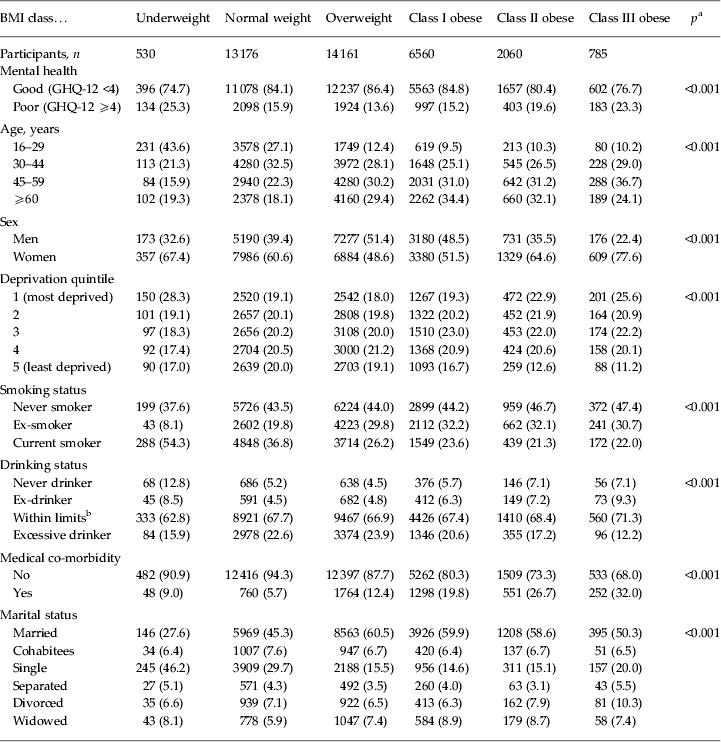
Of the 37 272 participants, 530 (1.4%) were underweight, 13 176 (35.4%) normal-weight, 14 161 (38%) overweight, 6560 (17.6%) class I obese, 2060 (5.5%) class II obese, and 785 (2.1%) class III obese. Overall, the mean age was 47 years (s.d. = 16 years), 16 727(44.9%) were men, 4673 (12.5%) had at least one medical co-morbidity, 11 010(29.5%) were current smokers and 8233 (22.1%) drank excessively. All of these characteristics varied significantly by BMI category (Table 1). There were no statistically significant differences in participant demographic characteristics between individual surveys.
Characteristics of the participants by BMI category

Data are given as number of participants (percentage).
BMI, Body mass index; GHQ, General Health Questionnaire-12.
a χ 2 tests.
b <21 units/week for men, <14 units/week for women.
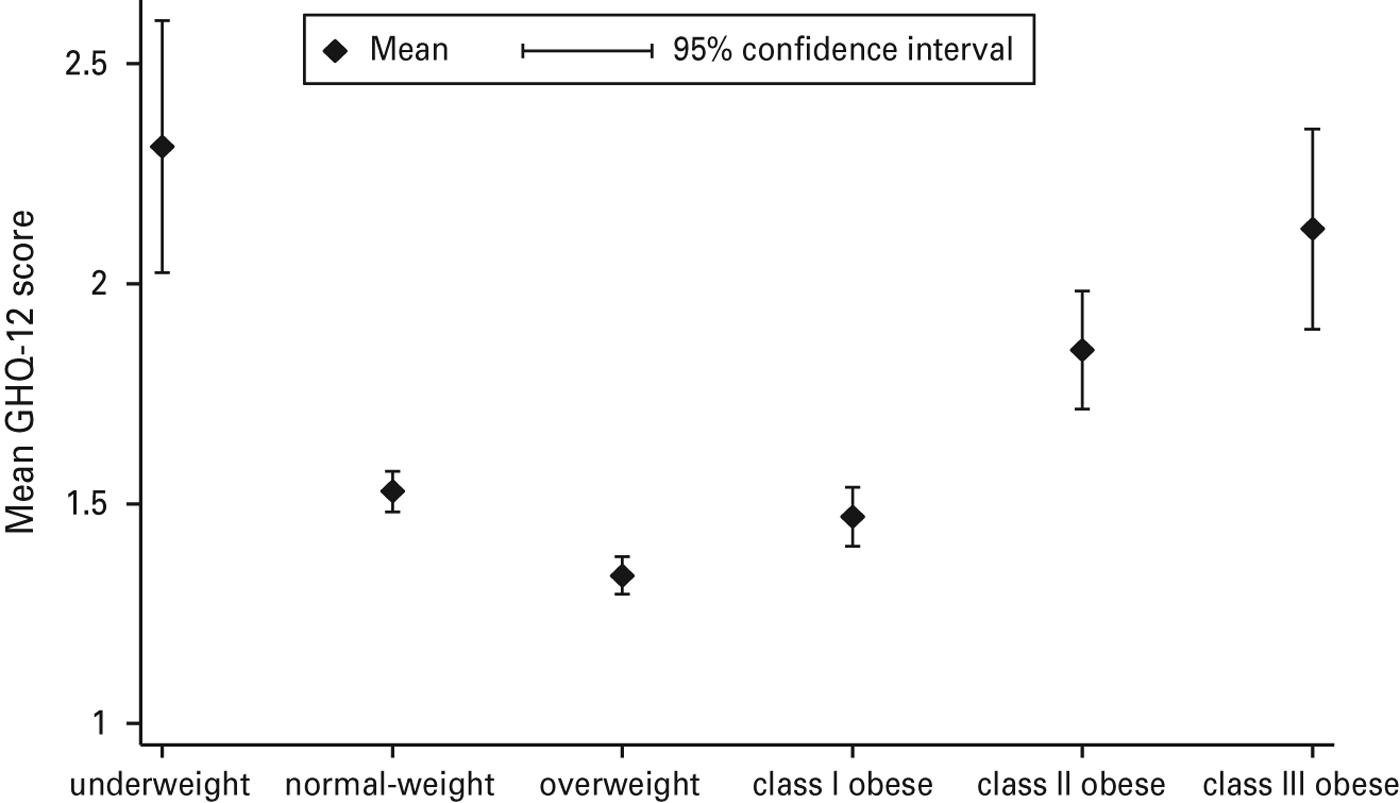
Overall, 5739 (15.4%) participants had poor mental health (GHQ ⩾4) but the prevalence differed significantly by BMI category. It was lowest (13.6%) among overweight participants and highest among the underweight (25.3%) and class III obese (23.3%) groups (Table 1). There was also a U-shaped relationship between BMI category and mean GHQ-12 score (Fig. 1). The percentage with poor mental health varied significantly by sex (12.8% of men versus 17.6% of women, p < 0.001).
General Health Questionnaire-12 (GHQ-12) score by body mass index category. Values are means and 95% confidence intervals.

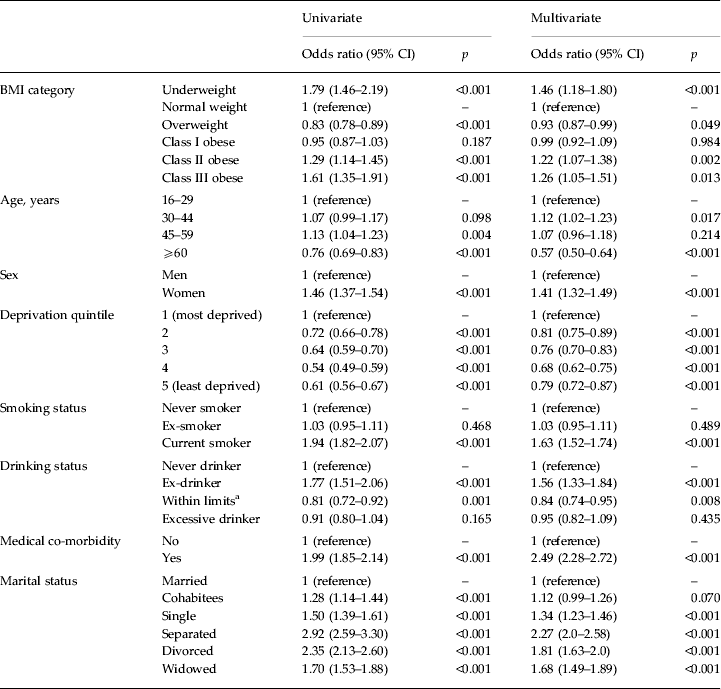
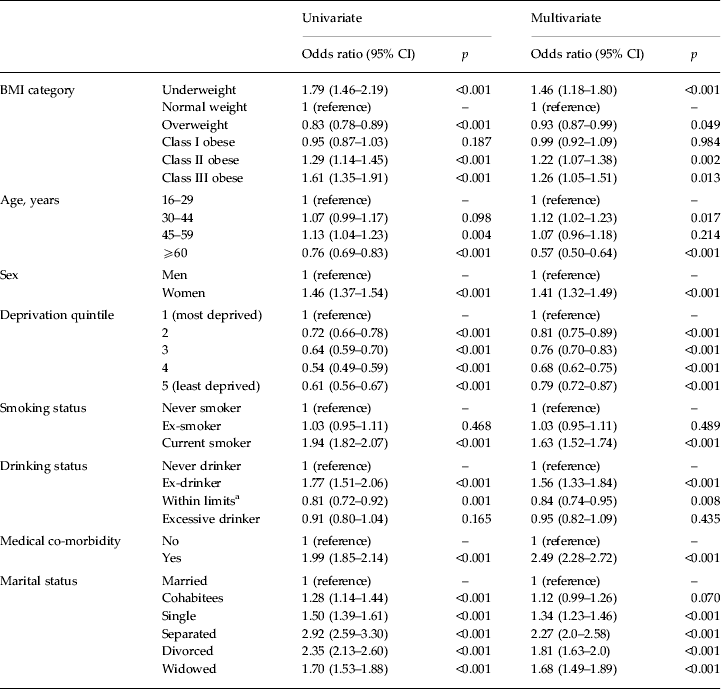
On univariate logistic regression analysis, there was a significant association between BMI category and poor mental health (p < 0.001). After adjusting for the potential confounding effects of age, sex, deprivation quintile, medical co-morbidity, marital status, smoking and drinking status, the overall association remained statistically significant (p < 0.001). Specifically, overweight participants had significantly reduced odds of having poor mental health in comparison with normal-weight participants, whilst individuals who were underweight, class II or class III obese had significantly increased odds of having poor mental health (Table 2).
Multiple logistic regression analysis of the participant characteristics associated with having poor mental health (GHQ ⩾4)
GHQ, General Health Questionnaire-12; CI, confidence interval; BMI; body mass index.
a <21 units/week for men, <14 units/week for women.
There were significant interactions of BMI with sex (p = 0.013) and with age (p < 0.001). When the overall interaction term was disaggregated we observed that it was mainly driven by overweight, possibly due, in part, to larger numbers in this subgroup. The sex differences in underweight and class I obesity were also statistically significant. The sex differences in class II and class III obese were in the same direction as class I obese but failed to reach statistical significance, possibly due to smaller numbers in these subgroups: underweight × female odds ratio (OR) 1.77 [95% confidence interval (CI) 1.10–2.85, p = 0.018]; overweight × female OR 1.24 (95% CI 1.08–1.42, p = 0.002); class I obese × female OR 1.18 (95% CI 1.00–1.40, p = 0.052); class II obese × female OR 1.24 (95% CI 0.96–1.60, p = 0.104); and class III obese × female OR 1.05 (95% CI 0.69–1.61, p = 0.823), compared with the sex difference in the normal-weight group.
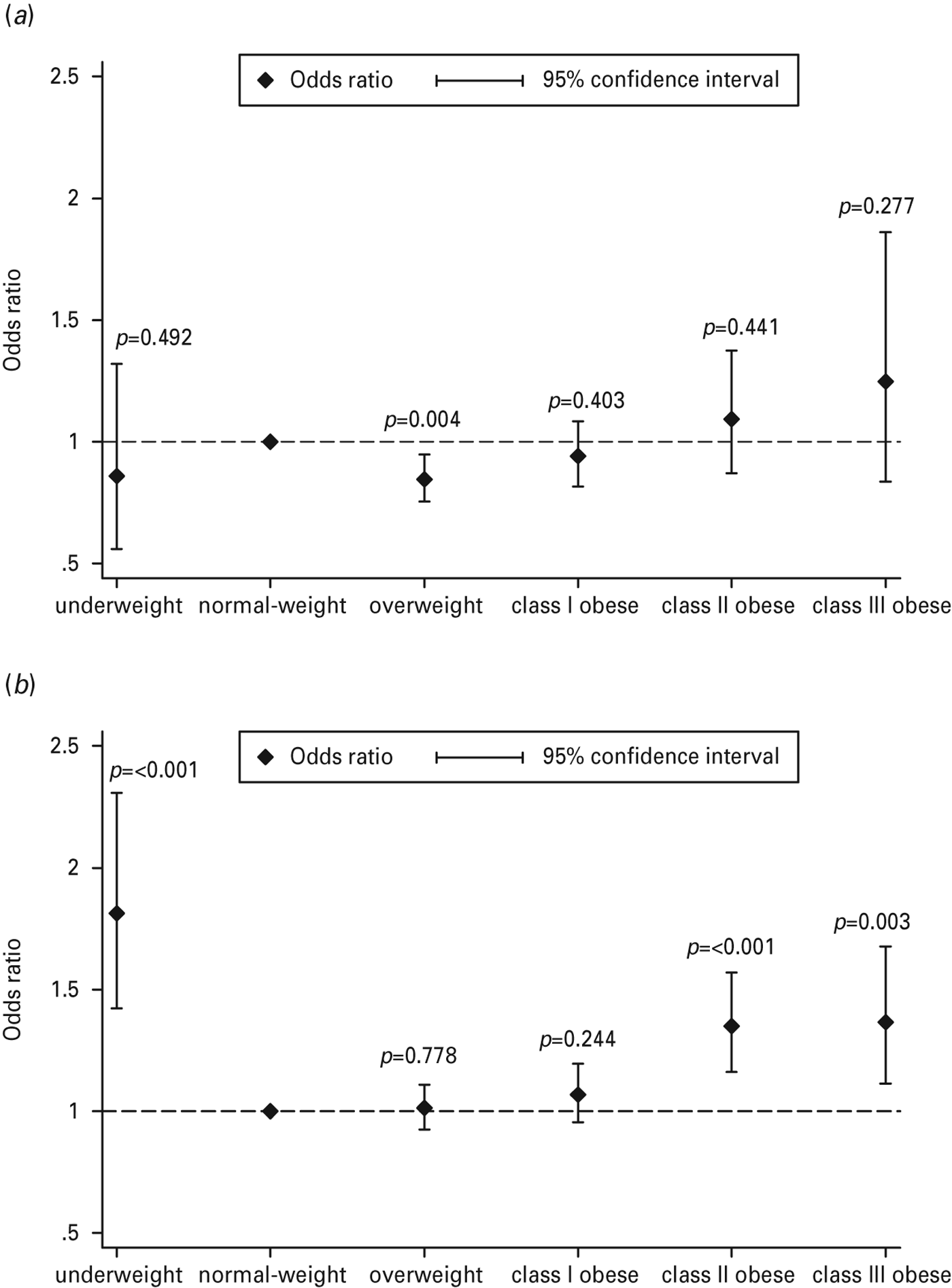
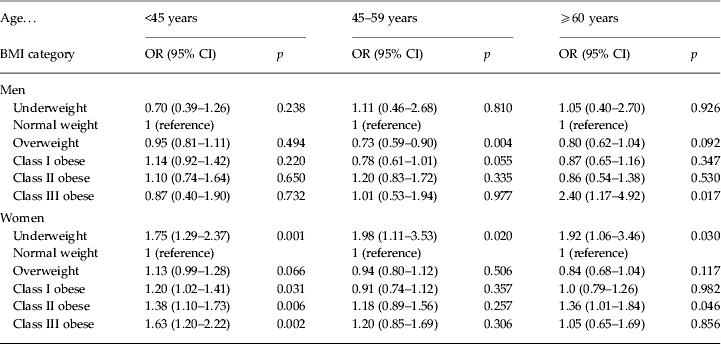
The subgroup analyses by sex demonstrated that overweight men had a significantly lower risk of poor mental health than men of normal weight (adjusted OR 0.85, 95% CI 0.75–0.95, p = 0.004) (Fig. 2). The overall increased risk of poor mental health among class III obese individuals did not reach statistical significance in men (adjusted OR 1.25, 95% CI 0.84–1.86, p = 0.277). On subgroup analysis by age group, the apparent protective effect of overweight only reached statistical significance among men who were middle aged (45–59 years) (Table 3). In other age groups the ORs were also below 1 (0.95 among <45 years; 0.80 among ⩾60 years) but did not achieve statistical significance.
Association between poor mental health measured by the General Health Questionnaire-12 and body mass index category in (a) men and (b) women. Values are odds ratios (adjusted by age, deprivation quintile, medical co-morbidity, marital status, survey year, smoking and drinking status) and 95% confidence intervals.

Multiple logistic regression analysis of the participant characteristics associated with having poor mental health (GHQ ⩾4) by age and sex a

GHQ, General Health Questionnaire-12, BMI, body mass index; OR, odds ratio; CI, confidence interval.
a Adjusted for deprivation, survey year, co-morbidity, marital status, smoking and drinking status.
In contrast, overweight women did not differ significantly from normal-weight women (adjusted OR 1.01, 95% CI 0.93–1.11, p = 0.778), while underweight, class II and class III obese women had a significantly higher risk of poor mental health (class III obese women relative to normal-weight women: adjusted OR 1.37, 95% CI 1.11–1.68, p = 0.003) (Fig. 2). The age-stratified analysis illustrated that underweight women had a higher risk of poor mental health at all ages compared with normal-weight women. In contrast, the higher risk of poor mental health in obese women was confined to young age (<45 years) (Table 3).
Discussion
Overall, compared with normal-weight individuals, overweight participants were significantly less likely to have poor mental health, and those who were underweight or severely obese were significantly more likely to have poor mental health, even after adjustment for potential confounders. However, the relationship between BMI and mental health varied with sex and age. The protective role of overweight was confined to men, and only reached statistical significance among middle-aged men (45–59 years). There was no evidence of a protective effect among women of any age. Furthermore, neither underweight nor obesity was associated with poor mental health in men. In contrast, underweight women at all ages, and obese, young women (<45 years) had higher risk of poor mental health, compared with normal-weight women. There was no significant association between obesity and poor mental health among middle-aged (45–59 years) and older (⩾60 years) women.
There is now a substantial body of evidence suggesting an adverse effect of both overweight and obesity on physical HRQoL with a dose–response relationship (Ul-Haq et al. Reference Ul-Haq, Mackay, Fenwick and Pell2012, Reference Ul-Haq, Mackay, Fenwick and Pell2013a , Reference Ul-Haq, Mackay, Fenwick and Pell b ). In contrast, the published evidence is conflicting in relation to the association between BMI and mental health. A meta-analysis, conducted in 1995, found no association between obesity and depression in adults (Friedman & Brownell, Reference Friedman and Brownell1995). De Wit et al. (Reference De Wit, Luppino, van Straten, Penninx, Zitman and Cuijpers2010) published a meta-analysis of 17 population studies comprising a total of 204 507 participants. The majority of the included studies used self-reported BMI dichotomized into obese (⩾30 kg/m2) and non-obese (<30 kg/m2). None used the GHQ as an indicator of mental health and none was conducted in the UK. The meta-analysis reported a significant overall association between obesity and depression (pooled OR 1.18, 95% CI 1.01–1.37). On subgroup analysis, the association was statistically significant among women (pooled OR 1.31, 95% CI 1.27–1.40) but not men (pooled OR 1.12, 95% CI 0.96–1.30).
Recently, we conducted two meta-analyses of the association between BMI and HRQoL; one in children and adolescents (Ul-Haq et al. Reference Ul-Haq, Mackay, Fenwick and Pell2013b ), and the other in adults (Ul-Haq et al. Reference Ul-Haq, Mackay, Fenwick and Pell2013a ). The meta-analysis of children and adolescents used the Paediatrics Quality of Life Index (PedsQL), and demonstrated that physical HRQoL was significantly reduced in both overweight and obese children but mental HRQoL was only impaired in obese children (Ul-Haq et al. Reference Ul-Haq, Mackay, Fenwick and Pell2013b ). The meta-analysis of adults used the SF-36 index, and demonstrated that there was an inverse dose–response relationship with physical HRQoL across the BMI categories from normal weight to obese. In contrast, mental HRQoL was significantly reduced only in class III obese adults and was increased in overweight adults. The overall results of our current study corroborate these findings, using a different measure of mental health, and suggest that the relationship cannot be explained by confounding since the associations persisted after statistical adjustment.
In the adult meta-analysis, interaction with age was not tested and, contrary to our current findings, sex was not significantly associated with effect size in the meta-regression analysis. However, the meta-analyses did not use individual-level data and the majority of the included studies had not adjusted for potential confounders. Our current study demonstrated a significant interaction with sex, such that obesity has an impact adversely on mental health among women but not men. This finding is consistent with some previous individual studies (Palinkas et al. Reference Palinkas, Wingard and Barrett-Connor1996; Scott et al. Reference Scott, Bruffaerts, Simon, Alonso, Angermeyer, de Girolamo, Demyttenaere, Gasquet, Haro, Karam, Kessler, Levinson, Medina Mora, Oakley Browne, Ormel, Villa, Uda and Von Korff2008). Whilst both men and women compare their bodies with the ‘ideal’, women are more likely to feel dissatisfied with their bodies (Sheldon, Reference Sheldon2010). The female body has more socio-cultural importance than the male body, and women report feeling greater external pressure to conform to media-portrayed ideals (Cattarin & Thompson, Reference Cattarin and Thompson1994; Harrison & Cantor, Reference Harrison and Cantor1997; Connor-Greene, Reference Connor-Greene1998; Sheldon, Reference Sheldon2010).
There is a paucity of studies exploring the effect of age on the association between BMI and mental health. However, our age-specific findings are supported by some recent studies (Minniti et al. Reference Minniti, Bissoli, Di, Olivieri, Mandragona, Mazzali, Fontana, Corzato, Costa, Bosello and Zamboni2011). We found a significant dose–response relationship with poor mental health across class I, II and III obese young women (<45 years of age); adjusted ORs were 1.20, 1.38 and 1.63, respectively (Table 3). However, this association was not apparent among middle and older age groups: class III obese women aged <45, 45–59 and ⩾60 years had ORs of poor mental health of 1.63 (95% CI 1.20–2.22, p = 0.002), 1.20 (95% CI 0.85–1.69, p = 0.306) and 1.05 (95% CI 0.65–1.69, p = 0.856), respectively. Similarly, McCrea et al. (Reference McCrea, Berger and King2012) recently reported that, among young English women (aged 30 years), there was a linear relationship between obesity and common mental disorder; class I and class II obese had adjusted ORs for common mental disorder of 1.38 and 1.40, respectively. They also reported that this association was diminished among middle-aged and older women (class II obese women aged 30 and 60 years had non-significant ORs for common mental disorder of 1.40 and 1.06, respectively). The higher risk of common mental disorder in women began to flatten out from 40 years of age, and there was no association by 60 years of age (McCrea et al. Reference McCrea, Berger and King2012). A recent Swedish study of 68 000 adults from the general population reported a significant linear relationship with poor mental health (used GHQ-12) among class I (BMI 30–35 kg/m2) and class II obese (BMI >35 kg/m2) women (ORs 2.58 and 2.71, respectively). They showed a pattern of decreasing mental distress in women with increasing age in all BMI groups (class II obese women aged 25–34, 35–44, 45–54, 55–64 and 65–74 years had ORs of poor mental health of 3.24, 3.86, 2.32, 1.18 and 1.0, respectively) (Brandheim et al. Reference Brandheim, Rantakeisu and Starrin2013). Another larger study based on the World Mental Health Survey conducted in 13 different countries found a significantly higher risk among young obese women but not men (Scott et al. Reference Scott, Bruffaerts, Simon, Alonso, Angermeyer, de Girolamo, Demyttenaere, Gasquet, Haro, Karam, Kessler, Levinson, Medina Mora, Oakley Browne, Ormel, Villa, Uda and Von Korff2008). Similar findings were reported in an older study that found no association between obesity and mental health among older age groups in both men and women (Heo et al. Reference Heo, Pietrobelli, Fontaine, Sirey and Faith2006). Conversely, other studies have reported no significant interactions with sex (Morris et al. Reference Morris, Koehn, Happell, Dwyer and Moxham2010) and age (Scott et al. Reference Scott, Bruffaerts, Simon, Alonso, Angermeyer, de Girolamo, Demyttenaere, Gasquet, Haro, Karam, Kessler, Levinson, Medina Mora, Oakley Browne, Ormel, Villa, Uda and Von Korff2008) in relation to the association between BMI and mental health. This may have been due, in part, to the fact that they did not study the full spectrum of BMI (Royston et al. Reference Royston, Altman and Sauerbrei2006).
In our study overweight participants had better mental health than normal-weight participants but, on further scrutiny, the association was confined to men. This corroborates previous studies on the association between body weight and subjective well-being (Linna et al. Reference Linna, Kaprio, Raevuori, Sihvola, Keski-Rahkonen and Rissanen2013). Our age-stratified analysis showed that this protective role of being overweight in men was present (OR <1) among all age groups but only achieved statistical significance in middle-aged men: men aged <45, 45–59 and ⩾60 years had ORs of poor mental health of 0.95 (95% CI 0.81–1.11, p = 0.494), 0.73 (95% CI 0.59–0.90, p = 0.004) and 0.80 (95% CI 0.62–1.04, p = 0.092), respectively. There is a paucity of studies with which we could compare our finding that improved mental health among overweight people was specific to middle-aged men. However, the overall finding of improved mental health among overweight people is consistent with our previous research (Ul-Haq et al. Reference Ul-Haq, Mackay, Fenwick and Pell2012, Reference Ul-Haq, Mackay, Fenwick and Pell2013a ). A study conducted in Goteborg, Sweden, exclusively on middle-aged men (aged 51 years), reported that overweight participants had better psychosocial aspects but reduced physical health than those of normal weight (Rosmond & Bjorntorp, Reference Rosmond and Bjorntorp2000). There is evidence that some overweight people may underestimate their BMI and classify themselves as normal weight (Madrigal et al. Reference Madrigal, Sanchez-Villegas, Martinez-Gonzalez, Kearney, Gibney, Irala and Martinez2000; Krul et al. Reference Krul, Daanen and Choi2011). Also, it is possible that as the BMI distribution in the general population has shifted to the right over time, people's belief as to what constitutes ‘normal’ weight has changed. In this obesogenic environment maintaining a healthy weight might be stressful, and thus mental health may be better in overweight men. BMI is a poor measure of adiposity in individuals with a high muscle mass and some men in the overweight category may have a low lean body mass. Whereas women feel pressure to reduce weight, men are more likely to feel pressure to increase their BMI, by increasing their muscle mass (Harrison & Cantor, Reference Harrison and Cantor1997; Sheldon, Reference Sheldon2010). There is also growing evidence that being overweight may not, necessarily, be associated with reduced mortality compared with normal-weight individuals (Flegal et al. Reference Flegal, Kit, Orpana and Graubard2013).
In our study, being underweight was associated with significantly poorer mental health overall, but the subgroup analysis showed that this relationship was mainly driven by women, and was not significant in men. It was one of the most consistent findings in that it applied across all ages in women. The majority of previous studies have focused on the association between increased BMI and mental health, and either excluded underweight individuals or included them in the normal-weight category (Mond et al. Reference Mond, Rodgers, Hay and Owen2011). Our findings support a U-shaped association between BMI and poor mental health, even after controlling for potential confounders, particularly in women (de Wit et al. Reference De Wit, van Straten, van Herten, Penninx and Cuijpers2009). We strongly recommend the use of the full-spectrum of BMI, as merging or excluding the underweight category might not only increase the risk of weakening the association between BMI and mental health but also miss the valuable information associated with being underweight. Mond et al. (Reference Mond, Rodgers, Hay and Owen2011) recently reported that underweight women had significantly reduced mental health compared with normal-weight women. They have further shown that this association was not because of increased body dissatisfaction or eating disorders, and argued that the notion of ‘underweight associated with body dissatisfaction or eating disorders’ is not supported by enough evidence. However, their sample was mainly comprised of young women; we found that this association of underweight with poor mental health persists in all groups – young, middle-aged and elder women.
Strengths and limitations
This study examined the association with mental health across the full spectrum of BMI categories in a large, nationally representative sample of adults in the general population, taking account of obvious confounders such as age, sex, deprivation, smoking status, drinking status, marital status and medical co-morbidity. Many of the published studies have not reported properly adjusted results. Where statistical adjustment has been undertaken, it has usually been restricted to only age and sex. Most previous studies have examined overall associations only. We tested for interactions with sex and age, demonstrating differences in the relationship between BMI and mental health between men and women, and different age groups. The SHS is a large, representative sample of the Scottish population. Height, weight and blood pressure were measured by trained staff using standard operating procedures. BMI is a poor measure of adiposity in individuals with a high muscle mass. The presence of medical co-morbidity was self-reported but based on physician diagnoses. The availability of various potential confounders including demographic data, deprivation, smoking and drinking status, marital status and medical co-morbidity enabled us to perform the adjustment and subgroup analysis. The GHQ-12 is the most widely used measure of mental health in the UK. It is intended and validated for adults aged 16 years and above in both clinical and general populations (Goldberg et al. Reference Goldberg, Gater, Sartorius, Ustun, Piccinelli, Gureje and Rutter1997). Notable limitations of the study include the use of cross-sectional data with BMI and recent experiences of mental health recorded at the same time and, thus, it is impossible to detect causation. There is possibility that poor mental health might lead to increased weight among young women. Over the course of clinical treatment, a psychotropic drug may cause 2–17 kg increase in body weight (Nihalani et al. Reference Nihalani, Schwartz, Siddiqui and Megna2011). Our findings should be confirmed within the context of a cohort study. The GHQ is a short screening tool, not a detailed assessment of mental health. There were fewer people in the underweight and class III obese categories compared with the other BMI groups, so our statistical power to detect differences in these groups is less. Furthermore, we adjusted our analysis for several confounders but there is always a possibility of unobserved heterogeneity. Further research is needed to look for the incidence of BMI-related diseases in overweight participants who have better mental health and vice versa.
Conclusions
Having a BMI well above normal values is associated with significantly poorer mental health in young women (<45 years of age) only. Being underweight is associated with poor mental health among women of all ages, but not men. Conversely, the apparently protective role of overweight was confined to middle-aged men only, and was not significant in young and older-aged men or women. This study further supports the need to consider age and sex variations and to use the full spectrum of BMI (from underweight to class III obese) in future studies of BMI and mental health. Our findings suggest that healthcare providers should be aware that obese and underweight women are predisposed to poorer mental health and may require intervention.
Acknowledgements
Z.U.-H. is sponsored by the Higher Education Commission, Pakistan (Development of Khyber Medical University, Peshawar).
Declaration of Interest
None.