

Introduction
Families of students with intellectual disability and/or autism spectrum disorder (ID/ASD), especially those with more significant support needs, find the periods of school transitions, notably the transition to postschool options, particularly challenging (Blacher, Kraemer, & Howell, Reference Blacher, Kraemer and Howell2010; Shogren & Plotner, Reference Shogren and Plotner2012). Similar to their typically developing peers, these students are faced with two main transitions over the course of their schooling: progressing from primary to secondary school, and from secondary school to postschool life. Each of these transitions place very specific demands on students and their families, and also on students’ teachers.
Previous studies show that despite commitments in the form of signed international treaties and national policies, Australia has yet to legislate formal transition planning for students with disabilities (O'Neill, Strnadová, & Cumming, Reference O'Neill, Strnadová and Cumming2016). This is critical, as international research suggests that there are evidence-based transition predictors and practices that improve postschool outcomes for students with disabilities (Mustian, Mazzotti, & Test, Reference Mustian, Mazzotti and Test2013). These include in-school experiences, where students are taught transition skills and the development of a student-focused transition plan. Unfortunately, without legislation that mandates such plans, many students are not receiving instruction in these crucial skills (Strnadová & Cumming, Reference Strnadová and Cumming2014a).
The transition from primary to secondary school demands changes in students’ physical environment, social circles, and teachers (e.g., moving from a single teacher to number of subject specialist teachers, larger school population, increasing academic difficulty). Due to their difficulties in communication and social interaction, students with ID/ASD often have problems with coping with the more complex social situations found in high schools (Dillon & Underwood, Reference Dillon and Underwood2012). Furthermore, about 40% of students with ASD are bullied by their peers (Reid & Batten, Reference Reid and Batten2006). On the other hand, students with ID/ASD who have more significant support needs are most commonly educated in special schools. This makes the transition from the primary to the secondary level less demanding, as students usually stay in the same school environment, with teachers and students they know, and the only change is in the area of curriculum focus, which shifts towards self-help and life skills in general (Strnadová & Cumming, Reference Strnadová and Cumming2014a).
The transition from school to postschool options can be very problematic for students with ID/ASD and their families. Outcomes for these students are traditionally dismal, as they struggle to find employment, achieve independent living, and participate fully in the community (Shogren & Plotner, Reference Shogren and Plotner2012). One of the most commonly cited difficulties during the transition to postschool options is the move from special schools, which typically offer specialised supports such as therapies, specialists, and social services, to mainstream environments, which often lack even the most basic support services (Gillan & Coughlan, Reference Gillan and Coughlan2010). Parents’ concerns during this transition include concerns about their children's future, especially in terms of available services, living arrangements, or community participation (Gillan & Coughlan Reference Gillan and Coughlan2010; McGill, Tennyson, & Cooper, Reference McGill, Tennyson and Cooper2006), as well as concerns about what will happen to their offspring when they, the parents, die (Strnadová & Evans, Reference Strnadová and Evans2013).
Transition planning is a complex process, and numerous stakeholders need to be involved — the student with ID/ASD, his or her parents, teachers, and other relevant stakeholders (Bhaumik et al., Reference Bhaumik, Watson, Barrett, Raju, Burton and Forte2011). Yet it is students with ID/ASD who are most likely to have limited participation in this process (Griffin, Taylor, Urbano, & Hodapp, Reference Griffin, Taylor, Urbano and Hodapp2014). Similarly, parents of these students are often not as involved as would be desirable. Bhaumik et al. (Reference Bhaumik, Watson, Barrett, Raju, Burton and Forte2011) surveyed 79 carers of teenagers aged 16–19 years with ID in the UK. Only 31% of carers in their sample were aware that their child had a transition plan in place. Furthermore, only 14% of these carers had a copy of their child's transition plan. Twelve parents of young adults with ID in Ireland were interviewed in a study conducted by Gillan and Coughlan (Reference Gillan and Coughlan2010). One of the barriers in the service system they identified was a lack of parent involvement in decision-making and planning.
Collaboration between parents, families, school personnel, community agencies, and other relevant stakeholders is a necessary condition for the successful transition of students with ID/ASD (Davies & Beamish, Reference Davies and Beamish2009). Although parents are essential stakeholders in the transition process, research studies show that parents ‘consistently reported low levels of family participation in the transition process’ (Davies & Beamish, Reference Davies and Beamish2009, p. 249). Davies and Beamish (Reference Davies and Beamish2009) surveyed 218 parents of young adults with ID in Queensland, Australia, to gain deeper insights into the experiences of these parents with the transition process. Results indicated a low involvement of parents in goal setting for postschool options. Parents also expressed their frustration with the lack of postschool options for their children with ID. Beamish, Meadows, and Davies (Reference Beamish, Meadows and Davies2012) surveyed 104 mainstream and special schools in Queensland in order to benchmark the current school practice related to school to postschool transition for students with ID/ASD. The findings indicated that although family involvement in the transition planning process is one of the most strongly supported family–school practices, the more empowering practices, such as families leading decision-making, were less supported. The key aim of the present study was to investigate parents’ and teachers’ experiences with transitions for students with ID/ASD attending special schools. We focused on the supports that both groups felt needed to be in place to allow for the successful transition from the primary to secondary school, and from secondary school to postschool life.
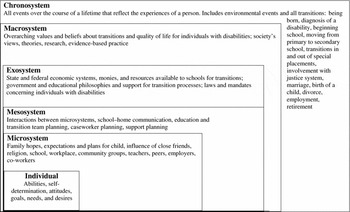
The theoretical framework that guided the study was Bronfenbrenner's ecological model (Reference Bronfenbrenner1994), which focused on the quality and context of a child's environment and therefore provided a useful framework from which to examine the processes involved in transitions for students with ID/ASD attending special schools. It is therefore understood that, according to the model, the student with ID/ASD exists within a complex structure of systems, beginning with the student, then the microsystem, the closest environment for a student, consisting of his or her family, friends, and school. This system also involves the family's hopes, expectations, and plans for the child, as well as family culture and religious beliefs, and the influence of family friends. The microsystem is situated within a nested set of other systems, radiating outward (see Figure 1). Transition processes result in an increase in the student's microsystems, due to the increase in the number of stakeholders and settings that must communicate to one another. It is this communication that constitutes the mesosystem. School–home communication and collaboration is a good example of this, and another main focus of the present study.
Bronfenbrenner's Ecological Model (Reference Bronfenbrenner1994). This figure illustrates the framework that was used to examine the processes involved in transitions for students with ID/ASD attending special schools. Adapted with permission from Figure 1.1 ‘Bronfenbrenner's Ecological Theory of Human Development Applied to Lifespan Transitions’ in I. Strnadová & T. M. Cumming, 2016, Lifespan Transitions and Disability: A Holistic Perspective (p. 5), Abingdon, UK: Routledge.

The exosystem is also pertinent to this study, as it includes entities that the child does not have direct contact with, albeit is still influenced by. These include the resources available to schools for transition support, government and educational philosophies and support for transition processes, and laws regarding students with disabilities. Taking this a step further outward is the macrosystem, which consists of the overarching values and beliefs about transition and the quality of life for individuals with disabilities. These include society's views, theories, research, and existing evidenced-based transition processes in general.
The overarching system of the ecological theory that affects the child's development through transitional periods is the chronosystem. This system encompasses all events over the course of a lifetime that reflects and influences the experiences of the individual. For the purpose of this study, the chronosystem was viewed through the lenses of parents and carers, and included environmental events and transition experiences such as diagnosis of a disability, entering school, moving from primary to secondary school, and transitioning to postschool settings.
Bronfenbrenner's ecological model (Reference Bronfenbrenner1994) therefore provides the impetus to view the schooling transitions of students with ID/ASD from the perspectives and experiences of their parents and teachers, the closest microsystems in the students’ lives. Transition processes were examined and discussed using the model to assist in the explanation of how the systems influence the development of the student.
Method
Research Design
The current study was part of a larger study examining the current state of transitions for students with ID/ASD from government mainstream primary schools to secondary schools, and from secondary schools to postschool life in the State of New South Wales (NSW) in Australia. To date, Strnadová and Cumming (Reference Strnadová and Cumming2014a, Reference Strnadová, Cumming, Higgins and Boone2014b) have provided results of the survey part of their study.
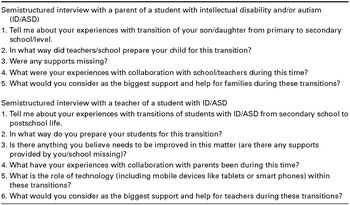
The authors employed a qualitative research design in order to gain an in-depth understanding of transition experiences as perceived by parents and teachers of students with ID/ASD attending special schools. Both groups of participants were interviewed. The authors developed two semistructured interview protocols, one for parents and one for teachers, based on a critical review of literature focused on the transition experiences of students with ID/ASD and their families conducted by the first two authors. The interview protocol was comprised of 17 questions for parents and 16 questions for teachers, with several demographic questions (see Table 1 for sample interview questions; both interview protocols are available upon request from the corresponding author).
Sample Interview Questions

Participants
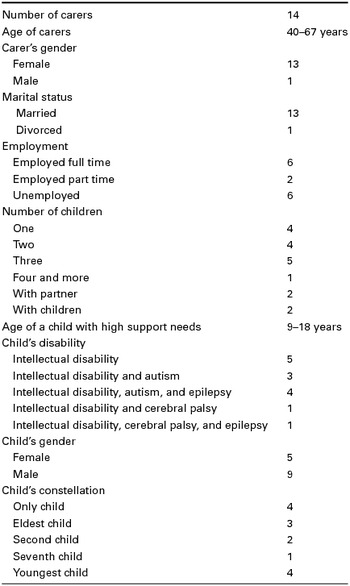
There were 14 parents and primary caregivers, and 13 teachers from four special schools (K–12) in Sydney participating in this study. Among the 14 primary caregivers were 11 mothers, one father, and two grandmothers. The average age of participating carers was 49.57 years, ranging from 40 to 67 years. The average age of their children was 13.71 years, ranging from 9 to 18 years (detailed demographic information is provided in Table 2).
Demographic Data for Parents/Carers

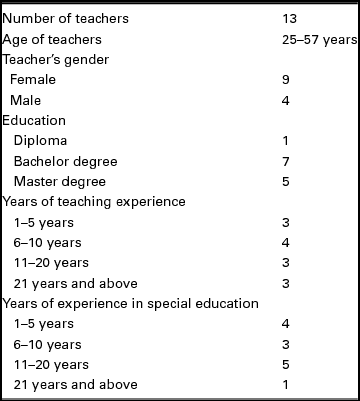
Thirteen teachers participated in the study, nine female and four male teachers. The average age of participating teachers was 39.77 years, ranging from 25 to 57 years (detailed demographic information is provided in Table 3). The participating teachers had an average of 12.85 years of teaching experience, and 10.15 years of teaching in special education settings. The majority of participating teachers held a Bachelor's degree (seven), followed by a Master's degree (five) and a Diploma of Education (one), with 10 teachers being trained (on different levels, ranging from honours to Master's degrees) in special education.
Demographic Data for Teachers

Procedures
The UNSW Human Research Ethics Committee where the authors are employed granted approval for the study (approval #HC13021), as did the NSW Department of Education (SERAP approval 2013076). The authors randomly selected four special schools in Sydney and emailed school principals, inviting them to take part in the study. All four schools agreed to participate. The authors met with school principals and explained the study in detail. The principals approached parents and teachers of their students with a letter explaining the study. Signed content was obtained from parents and teachers who agreed to participate.
The interviews with parents and teachers lasted an average of 29 minutes (ranging from 13 minutes, 21 seconds to 1 hour, 22 seconds). The interviews were conducted by the first two authors in person, via Skype, or via phone, according to the participants’ preferences. The interviews were audio-recorded with the permission of participants and transcribed verbatim. In line with qualitative research, all transcripts were deidentified and allocated an informant code (PSSP — parents of a child in special school; TSSP — teacher working in a special school). The authors also made notes in their research diaries following every conducted interview.
Data Analysis
The first author listened to all audio-recorded interviews to confirm the accuracy of the transcripts, and corrected a few inconsistencies. The interviews with parentsFootnote 1 and teachers, and the authors’ field notes were analysed using content analysis (Elo & Kyngäs, Reference Elo and Kyngäs2008). For the purpose of data analysis, a coding unit was words, sentences, or paragraphs ‘containing aspects related to each other through their content and context’ (Graneheim & Lundman, Reference Graneheim and Lundman2004, p. 106). The first two authors independently coded one parent interview, and the first and third authors independently coded one teacher interview. All three authors compared the results of their coding and resolved any differences. Once an agreement was reached, the first author conducted open coding of all remaining parents’ interviews, and the third author conducted open coding of all remaining teachers’ interviews, reading all interviews line by line and identifying initial codes. There were in-vivo codes (actual words of participants that describe the code itself) noted in this process (Corbin & Strauss, Reference Corbin and Strauss2008). The second author then checked the results of the open coding phase for accuracy of coding, carefully reading the open coding results, as well as reading through all of the transcribed interviews. The authors met several times to verify the results of this coding phase and any disagreement was resolved through discussion.
The first author then refined and clustered the emerging codes and categories into themes, following the ‘emergent nature of qualitative research methods’ (Hodgetts, Nicholas, & Zwaigenbaum, Reference Hodgetts, Nicholas and Zwaigenbaum2013, p. 168). The evidence for an established theme was established by triangulation of ‘memos, codes, frequency of occurrences, and interview quotes’ (Hodgetts et al., Reference Hodgetts, Nicholas and Zwaigenbaum2013, p. 168). The second author reviewed all themes for reliability; these were then re-examined and confirmed by the first and the third authors (Patel & Rose, Reference Patel and Rose2014). The involvement of all three authors in every step of the data analysis enabled triangulation and peer checking (Brantlinger, Jimenez, Klinger, Pugach, & Richardson, Reference Brantlinger, Jimenez, Klinger, Pugach and Richardson2005; Rodger, O'Keefe, Cook, & Jones, Reference Rodger, O'Keefe, Cook and Jones2012).
Results
One of the key themes, identified by the authors across both cohorts of participants, was Transitions of students with ID/ASD, which included transitions from primary to secondary school, and from secondary school to postschool options. Other key themes, such as Students with developmental disabilities and their families, are not a focus of the article, and thus are not discussed in the Results section.
Transitions from Primary to Secondary Level
The main topics brought up by teachers and parents were (a) the ‘seamless’ nature of transition from the primary to secondary level in special schools, (b) the transitions to and from special and mainstream environments, and (c) ways of making transitions easier for students with ID/ASD and their parents.
The change brought by transition from the primary to secondary level in special schools was minimal when a child stayed in a K–12 special school for his or her entire schooling, and was thus perceived as not demanding or even not perceived at all:
The senior school went on one day, and the junior school went on the other, and that's when I realised that I was going on the other day, not for the junior school presentation. (PSSP3)
The participants expressed a variety of attitudes towards the minimal change for special school students during this transition. Most parents and teachers appreciated it, as changes in routine and introduction to new people were among the common triggers of challenging behaviour for the children. As one of the parents expressed:
. . . it's not like there's a big transition from primary to high school, that kind of thing, where I think this kind of facility really does help children with a disability, because there's no, ‘OK, I've got to go to another school and I've got to learn all new people . . .’. Yeah, there's different people in the classes, but it's just the same, sort of — for my son, with autism, the routine-based is what we need. So I think that's been a real blessing for me. (PSSP12)
One participating teacher commented, ‘It's a perfect transition in that they don't know what's going on, because we talk about our school as being the juniors and the seniors’. (TSSP11). The authors view this comment as problematic, as it is disputable that the students’ lack of knowledge about what is going on in their school life is ever recommended for the transition of students with disabilities. On the contrary, the active involvement of these students in transition processes is perceived as crucial for successful transition, as well as for the development of their self-determination skills (Wehman, Reference Wehman2013).
Only one parent perceived the ‘seamless nature’ of transition from primary to secondary level at high school as a negative construct, suggesting that special schools should have a senior campus and a junior campus:
Sometimes there are 8-year-olds in his class, and I don't think that's right, at 12, and they've got a whole different set of problems. . . (. . .) . . . I think when you actually make the distinction between primary and secondary, there should be a proper distinction made with these kids so they do move and don't get primary mixed in with secondary. (PSSP4)
From an inclusive education perspective, the existence of K–12 special schools may be perceived as a prescribed educational trajectory for students with disabilities, limiting any inclusive education options and experiences for students with high support needs. In the present study, only one parent described her efforts to gradually transition her son to a mainstream high school for few days per week, because, ‘. . . we want a better Higher School Certificate for him’. (PSSP8). This was consistent with the teachers’ accounts:
I think it's very common that we have Year 5 for halfway through Year 6, because it seems to be a very common time where there's the realisation that secondary school is approaching and there's a possibility that — well, not a possibility; it becomes apparent to everyone involved in the student's life that it's not going to . . . that a mainstream secondary setting isn't going to be the right environment for the student. (TSSP4)
In cases where a student with ID/ASD transitioned to a special school from a mainstream school setting, the participating parents and teachers highlighted the importance of collaboration between primary and secondary school teachers throughout the process of this transition:
. . . the teachers in the primary school, they'd know the students very well, and they can be objective about their capabilities, or their development areas or whatever, whereas I think parents sometimes . . . you know. (. . .) . . . I think probably collaboration between the two sets of teachers is probably really important. (PSSP2)
The collaboration between the primary and secondary school teachers was not always described as an easy one, with lack of time and poor communication cited as difficulties. Tension around who was more responsible for the success of the transition from primary to secondary school was obvious from the following teacher's comment: ‘It depends on their teachers and how they're preparing them, and teaching them’ (TSSP8).
There were a number of ways in which the participating teachers tried to make the transition from primary to secondary school easier for their students and their parents. These included (a) supporting students transitioning to a special school in getting used to a new environment, (b) organising orientation days for parents, (c) informing parents about their child's transition progress, (d) preparing students for a change in routine, and (e) teaching them skills to manage such a change.
So what I try to do is get kids into that change of routine: meeting lots more people, putting checklists in place (so) they can then self-regulate to the best of their ability, so — I haven't got any on me at the moment, but I use it now, where we have our visual timetable. They know that they have to, you know, catch up on work if they haven't completed it in a high school setting, there's an expectation. How can they manage that in their diaries? How do you actually use a diary? (TSSP7)
Transition from Secondary School to Postschool Life
The main topics brought up by teachers and parents were (a) limited postschool options for students with ID/ASD, (b) lack of information about these options, and (c) ways students with ID/ASD are prepared for the transition to postschool life. The parents were concerned about transitions to postschool options for students with high support needs, particularly about the lack of postschool options for their children in terms of living arrangements, work, and further education. A few parents also expressed concerns that existing postschool options for these students are characteristically more like babysitting than focused on the further development of their skills and potential:
. . . look, I hate to say it, but it's a babysitting service. The emphasis is on keeping these kids happy, maybe taking them on an outing for a few hours each day, and just, you know, letting them basically maybe wander around in the community, do a bit of gardening, something like that, and then, you know . . . that's — there is no real learning . . . . (PSSP14)
One of the parents, whose son had experienced postschool life for 1 year at the time of the interview, perceived the lack of further education options for students with high support needs as a human rights issue. After transitioning from a special school, her son's learning needs ceased to be addressed:
. . . it is very much like everything, all that learning, is now gone. (. . .) . . . Every other normal 18-year-old that leaves school has a choice to either start — you know, maybe start a job, but also they do have the choice to keep learning at university . . . anyone has the choice to keep learning. Why can't these kids have the choice to keep learning? (PSSP14)
This experience was unfortunately not unique. The participating teachers shared their experiences visiting different postschool placements. A number of them felt disheartened about the lack of continuity, and the limited focus on skill development for their students once they transition to postschool life. As one of the participating teachers highlighted:
Well, we're about education. (. . .) We try and teach money skills, and we try and teach the use of PECS, and we try and teach independence, and when they went into these settings it was like their independence was taken away again. The client — I know they're not there to provide education, they're there to provide a service, but all the ones we were doing were saying, ‘Oh, you know, they just get 50 dollars a week in their wallet and we look after all their money for them’. And then none of them used any PECS or any augmentative communication, and it just seemed — in one of the places in particular — they were just sitting in a dark, not a nice room, just watching a TV that didn't even have a clear picture. It was a bit depressing. (TSSP2)
When it came to future living options, some parents were concerned about long waiting lists for group homes: ‘It's all very well saying “applying to group homes which are really good”, but there just aren't the places. There are no places. There are no places’ (PSSP1). The need to be proactive well ahead of the time when diverse services are needed was acknowledged by parents:
I suppose what we've kind of learnt is, when you're trying to get services, you need to get in really early. Get your name down, get on the waiting list, all of that kind of stuff so that by the time you actually get it, it's timely, as opposed to thinking, ‘I need this now!’ and then trying to do some research, because some of these things can take years. (PSSP2)
Half of the participating parents also complained about the lack of information about postschool options. The parents and teachers who were interviewed agreed that the main issue in NSW was the fragmented nature of information, and called for centralised information to be accessible for both schools and parents:
I also believe there needs to be more government services that you can access, whether it's online, so that everyone can access and have a look at what your options are rather than just waiting for someone to tell you where you can and can't go. (PSSP12)
Some participants also described the ways that special schools prepare students for postschool life. They appreciated the focus on integration to the community, independence, and life-skills activities:
. . . the last 4 or 5 years of his school, there was a lot more focus on (. . .) using public transport, being able to handle money and, you know, integrating in the community more. (PSSP14)
The focus on functional academic skills, life skills, communication and social skills, as well as work skills was common among all participating teachers.
Transition planning is an important aspect of a successful transition. It is most commonly conducted at individualised education program (IEP) meetings (Sitlington, Neubert, & Clark, Reference Sitlington, Neubert and Clark2010), which was also the case in this study. The importance of IEPs was stipulated by parents and teachers:
. . . if you've got an individual education plan, that should direct your discussions about where that child's going to be, what's going to be working for that child in the transition. (. . .) . . . in terms of planning, if at all possible, actually formulate an individual plan and then implement it. (PSSP6)
I'm very passionate about the IEP process, and I think that's one of the best things you can do to try and engage parents with what's happening here at school. (TSSP7)
The transition planning should start in Year 9 (Flexer, Baer, Luft, & Simmons, Reference Flexer, Baer, Luft and Simmons2012); however, it often begins during the last 6–12 months of a student's school attendance (Hetherington et al., Reference Hetherington, Durant-Jones, Johnson, Nolan, Smith, Taylor-Brown and Tuttle2010). In the present study, according to the participating teachers, the transition planning started anywhere between Year 10 and 12. The participating teachers were, however, aware of the necessity to begin with transition planning as early as possible:
You couldn't start early enough, really. Like, yeah . . . I think definitely start seriously thinking about it in Year 7, but even as a teacher — and if I had a child with disabilities myself, that should be the thought from day dot of schooling, really . . . (TSSP7)
A few of the participating teachers also highlighted the curriculum implications of transition planning, which necessitate beginning early:
. . . it comes down to curriculum, so we need to be focused on the end result. What do we want our kids, at postschool option age, to be able to do? What does that look like? And backwards map it. So, from day dot, when we receive these kids, we can say, ‘Where are they at? What do we have to build on? Is it travel training? Is it getting them out in the workforce in work experience settings that are authentic to them?’ (TSSP7)
There are a number of evidence-based practices underpinning transition planning, including student-focused transition planning, and student-led IEP meetings (Mazzotti, Test, & Mustian, Reference Mazzotti, Test and Mustian2014). In fact, a student's involvement in the transition planning process is perceived as essential for successful transition (Wagner, Newman, Cameto, Javitz, & Valdes, Reference Wagner, Newman, Cameto, Javitz and Valdes2012). Unfortunately, the teachers who participated in the study referred to excluding students with ID/ASD from the transition and/or IEP meetings, usually stating that the exclusion was due to the student's ID:
. . . although we've had some students contributing to this meeting, it was many years ago that we've last had a student come into that meeting, because we've just got to show dignity for the person themselves, with the intellectual disability, and to talk about them in front of them, particularly in negative terms, we just feel is not appropriate, so the student generally stays in class. (TSSP1)
On a positive note, the majority of teachers agreed that students’ interests needed to be considered when planning their transitions to postschool life. For example, one teacher mentioned, ‘I'm trying to look into some TAFE and other courses for him, because he's interested in art and panelbeating and decorating cars and graffiti and art work and that sort of stuff’ (TSSP5).
The participating teachers also provided suggestions for improving the transition process. These suggestions included (a) learning from experienced teachers, (b) admitting to a lack of knowledge and actively seeking information, (c) having support from a transition professional, (d) having support in liaising with external organisations, and (e) having access to information about postschool options.
Discussion
The themes identified in the process of data analysis provide a complex picture when examined through the lens of Bronfenbrenner's ecological model (Reference Bronfenbrenner1994). The students themselves were not interviewed, and they were not a part of the data collection, therefore the core of the model, the individual, was not investigated from a first-person standpoint. All information relating to this system was obtained by interviewing the students’ parents and teachers.
Surprisingly, none of the parents mentioned their child's part in the transition planning process. Furthermore, some of the participating teachers perceived ID to be a legitimate reason for excluding a student from active involvement or even being present at IEP meetings, where the transition planning most commonly took place. This is antithetical to the recommendations for best practice in the transition literature (Cobb & Alwell, Reference Cobb and Alwell2009; Griffin et al., Reference Griffin, Taylor, Urbano and Hodapp2014), yet commonly experienced by students with ID/ASD (Raghavan, Pawson, & Small, Reference Raghavan, Pawson and Small2013). This demonstrates a clear need for professional development for teachers in the area of evidence-based transition practices. This also is a representation of what is occurring in the macrosystem, where the actions (or inactions) of the parents, schools, and teachers are indicative of society's views about students with disabilities, education, and transition planning and support processes. It is possible that none of those involved felt that it was appropriate or even possible for students with ID/ASD to be involved in their own transition planning.
The importance of the exosystem was represented by the parents’ and teachers’ concerns over the lack of available information on postschool options and services. This is consistent with the findings of Bhaumik et al. (Reference Bhaumik, Watson, Barrett, Raju, Burton and Forte2011), according to which teenagers with ID and their families lack information about ‘adult services, the transition process, and what options may be available to them’ (p. 60). Although not mentioned by parents directly, policies at the Department of Education, state, and federal levels in Australia affect the process and quality of transition planning and support, which in turn affect the development of the child.
The overarching system of the ecological model is the chronosystem, and life transitions figure prominently here, as this system encompasses all events over the course of a lifetime. Parents and teachers discussed many of these, such as their child's transitions from primary to secondary school, and experiences leading up to the transition to postschool settings. Examining the data through this framework demonstrates how crucial effective transition planning and support are. Communication and collaboration between the school and the students’ families, as well as between primary and secondary teachers, are also of the utmost importance.
In addition to framing parents’ and teachers’ perceptions of transition within the ecological model, data analysis also revealed the answers to the research questions. When questioned about the challenges encountered during the transitions from primary to secondary level, and from special school to postschool life, parents were less concerned with the former and tended to focus on the latter. This was due to the fact that since their children went to special schools that encompass the years K–12, the transition from primary to secondary school was mostly imperceptible. This was considered, with the exception of one participating parent, a valuable asset of having their children attend a special school, as this allowed the students to avoid the stress and resulting challenging behaviour brought on by changes in environments and people. The participating teachers also shared this perspective. In situations where a student transitioned from a mainstream school or from another special school, parents and teachers stressed the importance of collaboration and information sharing so that students’ supports could continue seamlessly. This stresses the importance of the macrosystem, as the quality of the interactions among microsystems greatly impacts the probability that the student will transition successfully to the new school.
The parents were very concerned about transitions to postschool options for their children. Their concerns revealed the need for postschool options in living arrangements, employment, and further education. The parents’ responses revealed the necessity for the development of a continuum of living arrangements, from group homes to independent living with minimal to no support. Furthermore, continuity between school and postschool settings, with postschool settings building up and further developing the skills the students learned in schools, is of utmost importance. The participating teachers felt disheartened by some of the postschool placements they visited. In Raghavan et al.’s (Reference Raghavan, Pawson and Small2013) study, the participating parents highlighted the way in which the level of ID influences postschool placements, including quality of services provided.
True employment options rather than situations that are more like babysitting services need to be developed for students with ID/ASD who have high support needs. Vocational schools and universities need to recognise that this population of adults exist and make the appropriate modifications and adaptations to allow students with ID/ASD to access postschool education more fully.
Some parents felt that teachers and schools were providing their children with good support when they focused on student independence and integration to the community and life skills activities. This was, however, only a minority of the parents, which might indicate that this was not a common experience for all of the participating parents. A survey conducted in Queensland, Australia, by Beamish et al. (Reference Beamish, Meadows and Davies2012) found that one of the items with ‘the highest discrepancies between levels of agreement and implementation’ (p. 233) was ‘students are taught how to express personal views in individual transition planning meetings’ (p. 231). This indicates a need to continue in that vein and expand that focus to include self-determination. Encouraging and supporting students to participate in transition planning would help to facilitate this.
Parents and teachers perceived that transition planning and supports could be improved if some missing elements were included. Some felt that the planning and support process should have been implemented earlier. The most major missing piece according to parents was access to information. Parents’ and teachers’ complaints and suggestions on this topic suggest a real need for a centralised information system detailing postschool options and supports, accessible by parents, school personnel, and community partners. Such a database would also be helpful in providing parents with information on changes in support and new systems, such as the recent implementation of Australia's National Disability Insurance Scheme (NDIS), which provides people with disabilities access to the supports they need to lead an independent life. The proposed database would act as a ‘one stop shop’ to make accessing supports and services more seamless.
The limitations of this study include the context, which was regional and limited to government special schools, meaning that the results may not be applicable to other regions outside of NSW, or to Catholic and independent schools within NSW. The interview protocol was not piloted, which may be perceived as a limitation to this study. Furthermore, although the authors took a number of steps to ensure the validity of the data analysis process, the analysis was not checked by a person independent of the study, and this may also be perceived as a limitation. The sample size was small, which limits the generalisability of the findings. The students themselves were not afforded the opportunity to provide their opinions and perceptions about transition processes, so the centre of the ecological model, the individual, was not explored. Future studies should endeavour to involve more participants, including students themselves, and observe/explore actual transition practices as they occur in schools.
Conclusions
The results of this study demonstrate the need for a closer look at transition planning and support for students with ID/ASD in special schools. Parents revealed the processes that they perceived to be important to the successful transition of their children from one setting to another, particularly in relation to the transition from high school to postschool life.
These include an academic focus on independence and life skills. Results also revealed the practices that parents and teachers perceive to be missing, or are addressed at a very minimal level, if at all, particularly universal access to information on postschool opportunities. Although some parents noted very good communication and collaboration with schools, others cited the lack of communication as a deficit in the transition planning and support process. This is an indication of the lack of consistency among schools in this area. Of greatest concern to parents was having to make decisions based on insufficient information about postschool options and support systems.
The results of this study, particularly those that reflect the importance of school–home communication and collaboration among all stakeholders are consistent with the current literature (Strnadová & Evans, Reference Strnadová and Evans2013). The transition from one environment to the next brings challenges for all involved, in all of the systems of Bronfenbrenner's ecological model (Reference Bronfenbrenner1994). This requires different types of interactions at the mesosystem level, and particularly between school and home. An individualised and student-focused approach to transition planning that incorporates the specific wants, needs, and opinions of both the student and the family is recommended in the literature (Cobb & Alwell, Reference Cobb and Alwell2009; Kohler & Field, Reference Kohler and Field2003; Test et al., Reference Test, Fowler, Richter, White, Mazzotti, Walker and Kortering2009) and indicated by the results of this study. This includes empowering parents (and the student with a disability) to take active roles in the decision-making process during different transition stages (Gargiulo & Kilgo, Reference Gargiulo and Kilgo2005). This would be greatly facilitated by providing a central information system for parents. The results of the present study suggest that there is a critical need for mandated evidence-based transition planning processes for students with disabilities, as this would facilitate the inclusion of the crucial components identified by carers and parents and contribute to positive postschool outcomes for this vulnerable population of students.
Acknowledgements
This study was supported by the UNSW School of Education research funding. The authors’ sincere gratitude belongs to the participating carers and teachers of students with intellectual disability and/or autism spectrum disorder, and the principals of schools who supported us in recruiting the families.